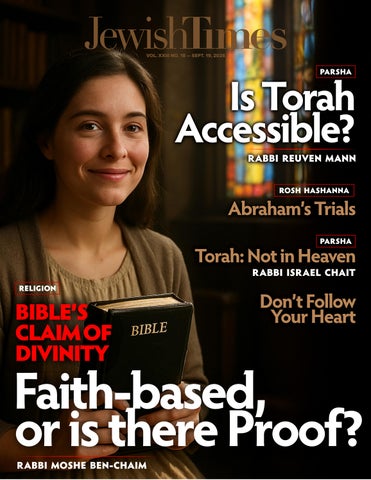
VOL. XXIII NO. 18 — SEPT. 19, 2025
PARSHA
Is Torah Accessible?
RABBI REUVEN MANN ROSH HASHANNA
Abraham’s Trials PARSHA
Torah: Not in Heaven RABBI ISRAEL CHAIT
RELIGION
BIBLE’S CLAIM OF DIVINITY
Don’t Follow Your Heart
Faith-based, or is there Proof? RABBI MOSHE BEN-CHAIM
the FREE
Just click any
2
|
WWW.MESORA.ORG
SEPT. 19, 2025
icon in this issue
MESORA THE JOURNAL ON TORAH THOUGHT | Please send letters and questions to: Comment@Mesora.org |
9 Not in Heaven
3 Bible’s Proof
RABBI ISRAEL CHAIT
RABBI MOSHE BEN-CHAIM
Personality flaws and poor pursuits inhibit Torah wisdom
God ensured Torah can be proven to be His only religion
6 Accessible RABBI REUVEN MANN
11 Your Heart
Renewing our commitment to Torah study, our purpose and true joy
RABBI MOSHE BEN-CHAIM
The parsha warns against following our feelings
12 Trials
RABBI MOSHE BEN-CHAIM
What were Abraham’s perfections through trials?
| NEW YEAR |
May your prayers be made with focus and meaning, and imbue you with a sincere recognition of, and an appreciation for God, and His will to create man to enjoy an existence amazed at constant discovery of His wisdom. BIBLE RABBI MOSHE BEN-CHAIM
Faith vs. Proof Subscribe FREE to the Jewishtimes: mesora.org/jewishtimes
A
ll matters are considered “true” and “real”—religion included—only when proven. And proof exists only with witnesses: either first-hand knowledge we personally witnessed, or second-hand knowledge we learn of that was witnessed by masses. We don’t believe every story, but when masses testify to witnessing an event, we dismiss conspiracy as so many people can’t share a common motive to lie (Rabbi Israel Chait). Now, do we use proof always, or are the matters better left to faith? Should religion be a matter of faith, or should religion follow reason and proof like science? How do we determine this answer? (CONT. ON NEXT PAGE)
–––––––––––––––––––––––––––––––––––––
Articles may be reprinted without consent of the Jewishtimes or the authors, provided the content is not altered and credits are given. WWW.MESORA.ORG SEPT. 19, 2025
| 3
BIBLE SHARE
We all wish to live following God. How do we determine His true will? “Truth” and “reality” refer to any concept that complies with what exits: creations, people, natural laws or events. For example, gravity is a natural “truth,” as we witness all objects fall, and satellites revolve around Earth. Thus, gravity complies with existence, so we say gravity is truth and reality. The moon is a “real” truthful object, as it is witnessed. In contrast, astrological powers are not real, as astrological claims are not validated by reality. And World Wars I and II are “truths” as masses witnessed them both. While claims of UFOs, Bigfoot and the Loch Ness Monster are false as they lack witnesses. And math is “real” as we see its formulas comply with nature. As Maimonides taught, we accept as true that which our senses detect, and which our minds demand must be so, such as 2+2=4. If we leave home and see our front window intact, but return later to a smashed window, we need not witness anything to know some object clearly penetrated the window causing the now broken glass. Reason dictates real events. In all cases, we determine truth based on reason, witnesses or proof. But what about religion? Is determining which religion as God’s true religion, to be subjected to the same rigorous test of proofs and reason? Or is faith more proper when following religion? Which one does God demand of us? We certainly would not accept a job “on faith” that that one will pay us 12 months later for all our labors. We would not ingest a doctor’s prescribed medicine without first knowing the doctor is in fact a doctor with a track record of healing his patients. And we would not drive our car over a mile-high drawbridge while it is open, with faith that it will close by the time we reach the edge. We don’t gamble with matters that risk our livelihood, health and our very lives. But for some reason, people are willing to gamble simple faith or belief when to comes to religion; they don’t seek proof that their religion—of the many that exist—is truly God’s religion. As all religions conflict, they cannot all be correct. Either God’s will is that man follow one leader and his ideas, or the other leader and his opposing ideas. But God cannot ask that man follow contradictory views, just as God does not wish man to both accept and deny his senses. Either God despises worshipping man, that He alone be served…or He accepts man praying to man. Both cannot be God’s will. We arrive at the realization that even in religion, reason and proof reveal that conflicting religions cannot both be God’s will for
mankind. God must have one religion He wants man to follow…the religion He gave man. Which one is it? This idea of a single true religion complies with reality, as God created only one human species. All men and women descend from the first Adam and Eve. And even without knowing this Biblical fact, the world recognizes all humans are identical in bodily design of primary features, like a heart, lungs and brain, and are identical in mental design like our preferred emotions of happiness and love and our shared dislike of pain and sorrow. There’s no doubt about our identical human design, regardless of hair or skin color, facial features or accents: “We all bleed red” (Rivkah Nachmias).
that…a slight problem. Over time, masses attract masses, and attract greater followings…although never proven to be God’s word. But no follower can defend how their religion is more validated than the next. No one stops and thinks, “What makes my religion true? Maybe it’s false. Maybe God never originated my religion. Maybe the other religion is God’s true religion and mine is man-made.” A religion cannot be validated as God-given, merely by numbers of followers. If that were the case, the world is in one great contradiction, as there are masses following Christianity, masses following Islam and many following others. Therefore, something other than followers must determine if a religion is from God, or if it is false and man-made, as most must be. Reason must be employed to answer this crucial question.
A single human species exists regardless of race, and is best treated identical- Proof of a Religion What must be the criteria for determining ly for illnesses: all cancer which religion is God’s religion? As we realize patients (Asians, Africans, reason and proof are inescapable tools to Europeans, Semites, Eskidetermine reality, the reality of God’s religion mos) are identically best too must be subjected to validation by reason treated with radiotherapy, and proof. chemotherapy, and immuGod is merciful, He did not leave man without notherapy…and bacteria an answer. For when He gave His religion to infections are best treated mankind, He incorporated certain elements with antibiotics. As there is into that event so there is no confusion of His true, one religion for His one human species. no variation in treating He created a proof. illnesses, it is wrong to differ in the treatment of religion except Bible/Judaism claims philosophical and religious No masses witnessed miracles. All other religions beliefs. One religion should make claims, but a claim without mass best treat the human mind witnesses of miracles does not prove and emotions, offering man anything. There exists no verbal transmission the greatest happiness, just of mass witnesses of any miracles regarding as one medical cure best Jesus, Mohammed or others. In fact, not only treats the identical human Judaism, but Christianity and Islam accept God’s revelation to 2 million Jews at Mt. Sinai body. But somehow, the world has accepted religions as God-given without any validation. One reason for this lack of demand for proof, is that religion does not present one with any immediate risk. People think, “Nothing happens to me based on my religious choice. So nothing forces me to prove my religion as true.” Also, people are influenced by others, and by reputations, and one follows a religion based on the need for acceptance by others. People also assume their inherited religion is the true religion, as if the group you belong to is inherently correct. Well, everyone says
3337 years ago when God gave His Bible to Moses and the Children of Israel, Abraham’s grandson. Bible lists dates, family names, heads of tribes and the total offspring of each of the 12 sons of Israel. Bible lists the journeys and encampments of the Jews from Egypt to Sinai, and from Sinai throughout the 40 years in the desert. 50 days after leaving Egypt, God gave His Bible to the Jews, and this was amidst great miracles: a voice emanating from fire, earthquakes, a ram’s horn blast and the mountain shaking (Exod. 19, Deut. 4). And all this was immediately subsequent to God instructing Moses to “assemble the people” (Deut. 4:10), a people previously named by (CONT. ON NEXT PAGE)
4
|
WWW.MESORA.ORG SEPT. 19, 2025
BIBLE SHARE
tribe and numbers totaling men 20 and above at 600,000…2 million Jews in total (Exod. 12:37, Num. 1:46, Num. 26:51 ). This remains the only event in history where masses witnessed miracles, specifically the miracle of God communicating a religion, where God gave Moses miraculous sapphire tablets with 10 Commands “inscribed” inside them, an impossible feat for man. Never again did God give man a religion. Search history, you will learn this is fact. God orchestrated His revelation in such a manner so there could be no denial of this event, no denial of His only religion, and no denial of whom would now be His emissaries to man. This precise orchestration was God’s intent for man to believe in Him and His only religion, based on proof, not faith, as faith requires no evidence and therefore, proves nothing. The Jews are no superior to any other human. It is only that Abraham was the only monotheist in his time, in a world steeped in idolatry that God chose him to teach mankind. God wished to remedy the world of man’s great error of deifying man, deifying stars, animals and stone gods, and God did so by gifting man with His Bible. God made a pact with Abraham and his seed from Israel and his 12 tribes that this Jewish nation study and teach His Bible to the world. Yet over time, the sibling rivalry of other people denied God’s words and His chosen nation, and violated His command (Deut. 13:1) not to add to the Bible by creating a New Testament and a Koran. The New Testament’s claim to reject the Jew is that God exchanged his chosen people, and the Koran takes credit for giving Moses to the Jews. Both are lies. Through these 2 distortions these new religions attempted to validate themselves as God’s true word and reject God’s Bible. But they lacked the only validation of Divine communication possessed only by the Jews: mass witnesses of miracles.
no help” (Jer. 16:19). Jews are not humanly special or different, we all descend from Adam. But we do have a special mission to teach the world. When reason is applied to religion, the world will realize that all religions except Bible are without proof of divine origin. All matters are considered true and real—religion included—only when proven. And proof exists only when something is witnessed. No other religion offers proof of their claims. And as God desires man uses reason and proof, man should accept only God’s Bible as His only religion. from an underlying recognition of the truth.. ■
We now see that God ensured that His only religion would pass the same test of truth as any reality. All other religions fail to offer proof, explaining why there is great anti-Semitism: the world recognizes the truth of Bible and their own lack of proof, which explains their demand for blind faith. It also explains their hate of God’s truth through hating the Jew. The Jew’s mission is to share God’s only words with all mankind. The prophet Jeremiah teaches eventually all man kind will follow their minds and confess “we have inherited falsehood from our fathers, futility that offers
WWW.MESORA.ORG SEPT. 19, 2025
| 5
PARSHA
Accesslble? Is Torah Wisdom
SHARE
Rabbi Reuven Mann
The Mission of Bnei Yisrael in Eretz Yisrael
In this week’s Parsha, Nitzavim, Moshe continues to instruct the people about their well-being and future in Eretz Yisrael (the Land of Israel). His approach is unique. He does not focus exclusively, as most leaders would, on the practical aspects of running a country; although he does explicate important details pertaining to the judicial system and the monarchy. His main focus of interest is on
the ability of the people to adhere to the commandments and also incorporate into their behaviors the wisdom of Torah. Beyond the numerous material benefits that will flow from observing the Torah and Mitzvot (commandments) is the issue of whether Bnei Yisrael (the Children of Israel) will endure in the land Hashem promised to their forefathers. We must remember that Bnei Yisrael are a very special kind of nation. We did not become a (CONT. ON NEXT PAGE)
6
|
WWW.MESORA.ORG SEPT. 19, 2025
PARSHA SHARE
national entity through any type of “natural” development. We may properly regard ourselves as a society which was created by Hashem. Had He not redeemed us from Egypt, brought us to Mt. Sinai to receive the Torah, and become our G-d, we would not be around today; for we would have simply died out without anyone having heard of us. We owe our very existence as a nation to the Creator of the Universe, Whose Will it is that we should live in Eretz Yisrael and fulfill the mission He has assigned to us. The only way we can achieve this is by observing the Revelation He has bequeathed us. We cannot redefine Jewishness in accordance with the contemporary value system that dominates Western society. It is only by acknowledging the Divine origin of Torah and dedicating ourselves to its fulfillment that we can become a truly Jewish People. Yet, simple performance of the commandments, while absolutely essential, is by itself not sufficient.
The Profound Wisdom of Torah
Aside from the religious obligations that are conveyed in the Torah is the matter of the Chochmat HaTorah (Torah Wisdom). The Torah contains the most profound wisdom about all aspects of human existence, and the study of it leads to great human enlightenment. In fact, Moshe implores Bnei Yisrael: And guard and perform them (the Mitzvot) for it is your wisdom and discernment in the eyes of the nations; who will hear all of these statutes, and they will say, ‘Surely a wise and discerning nation is this great People’ (Devarim 4:6) It therefore seems that when we expound about the meaning of certain Mitzvot or about the beliefs and values of Judaism, we must do so in a manner that evokes enormous respect for the great wisdom which they reflect.
Torah is Within Reach
In this week’s Parsha, Moshe addresses this issue. He says, For this Mitzvah that I command you this day; is not too wondrous (Nifleit) for you nor is it far away. It is not in heaven; that you might say ‘Who shall go up to heaven and take it for us and communicate it to us that we might do it. And it is not on the other side of the sea; that we might say, ‘Who will go for us to the other side of the sea and take it for us and communicate it to us that we might do it’. For the matter is very close to you; in your mouth and heart to do it. (Devarim 30:11-14)
This is an extremely challenging statement. What did Moshe seek to convey by telling us that the Torah is “not in heaven” or “on the other side of the sea”? Does any sane person imagine that it is? What is the meaning of these challenging words? In my opinion, Moshe is addressing himself to those who deny that there is any rationality that is comprehensible to man in the Torah. Such people are not saying that the Torah is not sensible but are rather asserting that it consists of deep mysteries that are beyond the ken of ordinary humans. The two analogies Moshe provides depict the Torah as being “in heaven” or “across the sea.” The first idea is that ordinary humans, even highly intelligent ones, cannot figure out the philosophy of the Torah and only someone on the level of prophecy could discover its deeper wisdom and hopefully share it with us. In the description of the Torah as being “across the sea” the idea is that we have the potential to unlock the secrets of Torah, but it would require such arduous and backbreaking efforts that it would be practically unfeasible. HaGaon HaRav Nachum Rabinowitz ZT”L describes the matter this way: There are people who are not prepared to acknowledge that the Torah has already been brought down from heaven, and human beings can learn it, understand it, internalize it, and fulfill it. These people believe that the Torah must be something ‘heavenly’, exclusively supernatural ‘wondrous’ as Rashi says, ‘concealed from you.’ … But the true Torah is not like that at all. In the final words that Moshe spoke to the Jewish People, he repeats and emphasizes that the Torah was given to be studied and understood. One can penetrate to the truth – ‘For the matter is very close to you’…Hashem has given us the Torah not so that we should be wondering, confused and astonished, but only that the light of Torah should enlighten our eyes and hearts to make us wise and enable us to distinguish between truth and falsehood. (Ner LeNetivati: Drashot for the Weekly Parashot (Hebrew) by Rav Nachum Eliezer Rabinowitz, p. 428) According to this understanding, Moshe is seeking to disabuse us of this false orientation towards Torah. He is describing for us the true character of Judaism. It is not an unknowable and mysterious religion which is contrary to reason and must therefore appeal to blind faith. Nor should the Torah leave us in a state of bafflement about the meaning of the commandments. To the contrary, Judaism contains the profound philosophy of life which (CONT. ON NEXT PAGE)
WWW.MESORA.ORG SEPT. 19, 2025
| 7
PARSHA SHARE
can illuminate all of man’s paths and enable him to achieve the true purpose for which Hashem created him.
The Path to Enlightenment and Purpose
The basic theme of the High Holiday season is the Coronation of Hashem as the Melech HaOlam (King of the Universe). This also entails the obligation to recognize that He created man and implanted within him a divine soul, which it is his duty to perfect. How are we to achieve that? By embracing the Torah He revealed to us which contains the road map towards the proper service of Hashem. Thus, Hashem gave us the Book of absolute wisdom and the intellectual tools we need to study and understand it. Therefore, a major aspect of our Teshuva (repentance) at this time must be a determination to apply ourselves to the learning of Torah with a new sense of seriousness and commitment. Above all, we must be motivated by the desire to internalize its wisdom and apply it to all areas of human life. So that those who observe us will declare us to be a “wise and discerning People” and they too will be drawn to the appropriate service of Hashem. May Hashem assist us in this noble endeavor. Shabbat Shalom. ■ Questions? Comments? Please reach out to Rabbi Mann on WhatsApp at 050-709-2372 or by email at rebmann21@aol.com Alternatively, contact Mitch Rosner on WhatsApp at 054-426-3419 or by email at mitchrosner@gmail.com Dear Friends, My books on the weekly Torah reading can be found on Amazon.com: Genesis - https://amzn.to/3UyTMsx Exodus - https://amzn.to/45pk46L Leviticus - https://amzn.to/4m8EEP3 Numbers - https://amzn.to/4o8AhVd Deuteronomy - https://amzn.to/3NBewg7 I hope that my essays will enhance your reading and Torah study, and I’d be grateful for your feedback in a brief Amazon review. For those in Eretz Yisrael, my books are available at David Linden’s Bookstore, Emek Refaim 21, Jerusalem, and at Pomeranz Bookstore, Be’eri 5, Jerusalem. Additionally, I have a series of YouTube videos called “Rabbi Reuven Mann Torah Thoughts.” You can find them here: https://bit.ly/49N8hyX. —Rabbi Reuven Mann
8
|
WWW.MESORA.ORG
SEPT. 19, 2025
4IBSF PO GBDFCPPL
W Moses: the quintessential man of action. But in Deuteronomy E he appears as a great thinker, teacher, elucidator of the Torah entrusted to him. Rabbi Mann expounds upon Moses’ final N addresses in words so sublime, God included them in the Bible. “A masterpiece cloaked in a modest, easy to read book.” “Life lessons that can be applied to one's personal situation."
ETERNALLY YOURS Rabbi Reuven Mann – Deuteronomy
Devarim contains Moses’ final communications to the nation he had led out of Egypt and guided through the forty-year ordeal in the Wilderness. The Jews were on the brink of their entry into the land which they would conquer and settle without him, their great leader. Moses’ final talks to the Jews reveals his true greatness. He is not concerned about his own place in history; his only objective is to facilitate, to the best of his ability, the success of the nation in the land. He thus exhorts them to study, understand and fully implement the Torah which constitutes the surest guarantee of their longevity and well-being in the Land that God gave them so they would become a “Kingdom of Priests and a Holy Nation.” This book focuses on those lessons. Rabbi Mann explores these timeless lessons in this, the final installment of his Eternally Yours series. In over 50 essays, he addresses intriguing philosophical, psychological, theological and intellectual questions about the Torah in a style that is uniquely accessible to all. Rabbi Mann shows that the Torah truly is “God’s Greatest Gift to Mankind.” Available on Amazon
Buy Now Observant Artist's Circle Publishing $12.95/$6.95
MORE PRAISE for “Eternally Yours” “Rabbi Mann displays the magical balance of casual-style reading with deep, relevant ideas.” “Will be appreciated by both scholar and student alike.” “His insights into the book of Genesis grip and intrigue.” “Unpretentious & concise: a sensitive and thought-provoking book of wisdom.” “With little effort, you can reap the benefits of Biblical insight into human nature.” "Easy-to-understand Divrei Torah, yet profound and very insightful."
PARSHA SHARE
IN NOTINHEAVEN NOT ALL WHO ENGAGE MUCH TIME IN BUSINESS BECOME WISE (Avos 2:5) RABBI ISRAEL CHAIT
M
aimonides comments:
Torah is not found in haughty people or in those who travel to distant lands. And the rabbis tie this to a verse in a metaphoric sense: “It is not in heaven, that one should say, ‘Who might ascend to the heavens for us and take it for us and we will hear it.’ Neither is it beyond the sea, that you should say, ‘Who among us can cross to the other side of the sea and get it for us and impart it to us, that we may observe it?’ No, the thing is very close to you, in your mouth and in your heart, to observe it.” (Deut. 30:12-14) So the rabbis said, “Torah isn’t found in haughty people (heavens), nor in those who travel the sea for business.” Maimonides teaches that there is an element of haughtiness in business that is an obstacle to becoming wise. What is the common denominator? When referring to one becoming wise, we refer not to one who amassed facts, but to one whose nature is that he loves wisdom. Who is attached to wisdom? There are two possible attitudes of the psyche. Man’s energies are great and seek satisfaction. One personality finds satisfaction in the self. He is convinced he is a great person. This is referred to as “the heavens”—arrogance. The other personality is in search of something: “Once I acquire that object, I will be happy.” This is the “across the sea” personality. Either one has found his satisfaction in the self, or his happiness is to be found in the next conquest. In both personalities, there is no Torah. In the haughty personality, there is no Torah, as his energies are satisfied. In the other personality there is no Torah, as
his energies await the next conquest. Who then is an individual who possesses Torah? What type of nature does he have? It is the personality that does not have the satisfaction of the arrogant individual, nor does he find satisfaction in that next conquest “over there.” The one who possesses Torah seeks satisfaction in the here and now. The thing is very close to you, in your mouth and in your heart, to observe it. When a person recognizes this truth, he is then open to Torah. This is the state of mind necessary for becoming wise. This is Maimonides’ view and the first explanation in Rashi. Once one learns Torah and enjoys the experience of Torah study, his energies are consumed in the here and now. The person of Torah lives in the present. The philosophers said, “Life is strange: the future is not here, the past is gone, so one’s whole life is lived in the split second of the present.” The person of Torah lives in the present: he is not the person of the future or of the past. It is important to be mindful when learning Pirkei Avos, and personalities are depicted, not to think of that person as one with a fixed personality. We each partake of all personality types. Pirkei Avos isolates these personality types to best focus us on positive and negative values and traits. A normal person has parts of him that are “across the river” and “in the heavens,” and perfection requires us to unravel these parts of our nature in order to improve ourselves. One must not label himself or others, otherwise he forfeits the process of perfection. ■ WWW.MESORA.ORG SEPT. 19, 2025
| 9
CODES FOUND IN THE BIBLE CLUES IN THE TEXT REVEAL MYSTERIES
All books depict history, facts, theories, fiction or poetry. No book is coded with hidden messages beyond the words or patterns revealing marvels. But the Bible (Torah) was written by God, and is “coded.” The order of verses, use of certain phrases, apparent contradictions and other Biblical patterns are purposeful clues to God’s wisdom. This book unveils those patterns and shares the hidden messages.
10
|
WWW.MESORA.ORG
SEPT. 19, 2025
SHARE
PARSHA SHARE
DON’T
Follow Your Heart RABBI MOSHE BEN-CHAIM
T
his advice seems so wholesome, so natural, and so right. But God warns against heeding it. Feelings do not dictate what is best for us, no matter how strong the feeling.
For you know that we dwelt in the land of Egypt and that we passed through the midst of nations that was traversed. And you have seen the detestable things and the fetishes of wood and stone, silver and gold, that they keep. Perhaps there is among you some man or woman, or some clan or tribe, whose heart is even now turning away from our God to go and worship the gods of those nations—perchance there is among you a “root sprouting poison weed and wormwood” [metaphor for idolatrous thoughts]. And it will come to be, when hearing the words of these curses, one then blesses himself in his heart saying, “I shall have peace, for I follow my heart’s will.” Therefore I will add the moist to the dry [converting inadvertent sins to intentional, increased punishment]. God will never forgive that party. Rather, God’s
anger and jealousy will burn against that man, till every sanction recorded in this book comes down upon him, and God blots out his name from under heaven. God will single him out from all the tribes of Israel for misfortune, in accordance with all the curses of the covenant recorded in this book of Torah. (Deut. 29:15-20) What is the flaw of “blessing oneself in his heart,” and is he punished for idolatrous thoughts alone, without worship? We also wonder how God can convert previous inadvertent sins into intentional sins; how can the past intent be changed? God says this using a metaphor, “adding the moist (accidental sins) to the dry (intentional sins).” What gain is served by this use of metaphor? And what precisely is the difference between inadvertent sins and intentional sins? Next, why doesn't God ever forgive this person? Furthermore, God's anger “burning” against this person is quite severe; what mandates this harsh response? And again we have another metaphor, “root sprouting poison weed and wormwood” referring to one’s corruption of mind and emotion. How is metaphor preferable than a literal statement? A person who “blesses himself in his heart” means that he is convinced that his subjective view is reality: his idol is real and God is not real. He does not entertain error, God's authority, or other opinions. He cannot change; he cannot be forgiven. God responds, “I will add the moist to the dry” which Rashi explains as God converting his inadvertent sins to intentional sins. But this is not literally possible since a sin committed inadvertently is sealed in history as an inadvertent sin. History cannot be changed. If someone righteous turns away from righteousness and does wrong, practicing the very abominations that the wicked person practiced, shall they live? None of the righteous deeds that they did shall be remembered; because of the treachery they have practiced and the sins they have committed—because of these, they shall die (Ezekiel 18:24). Here is the idea: No righteous deeds are remembered because God's method of judgment is a “summation” of a human being. If a person is presently an idolater, it is irrelevant that he was previously a monotheist. This is the meaning of “converting inadvertent sins to intentional.” It is “as if” the sins are converted (CONT. ON NEXT PAGE)
WWW.MESORA.ORG SEPT. 19, 2025
| 1111
because this person partakes of none of the good of his previous years and regrets his former good acts (Chazal)…as if those good actions never existed. It may be that regarding other sins (not idoalry) that God will weigh the good of the person against his evil: if he has more good (measured not by quantity, but by the gravity of those actions) God then seals him for life. This is because regarding sins other than idolatry, he still functions within the context of accepting God. But here we are discussing idolatry, and the rabbis say “whomever commits idolatry is like he rejects the entire Torah.” As he rejects God, any good he did is completely inconsequential because it was not done as following God. Such a person is not forgiven and suffers severe calamity—“God blots out his name from under heaven”—as God intends to dispel any validity of idolatry. To show that God alone reigns as the sole source of the universe, God delivers severe calamity to the idolater evoking this response from the world: “Because they forsook the covenant that God of their ancestors made with them upon freeing them from the land of Egypt; they turned to the service of other gods and worshiped them” (Deut. 29:24,25). A severe response is vital to discount explanations of “natural” disaster. God intends the world abandons all belief in idolatry and He uses this person as example. The idolater’s false gods did not come to save him, and God’s Torah curses which threatened this response came true. Idolatry is exposed as false, and God is validated as truth. Is this person judged for idolatrous thought alone? It can very well be, as idolatry is a sin of the mind…one sins as soon as he rejects God and accepts belief in idols. The 10 Commandments’ first five laws are in the order of laws of thought, speech and action. Accepting God and rejecting idolatry are first two laws pertaining to the mind. Regarding the use of metaphor, God has decided that idolatry must be viewed as a poisonous growth: it is evil and contagious. Metaphor always intends to call upon a person’s familiar frame of reference to eliminate what might be vague and deliver a precise message with no ambiguity. The lesson from this Torah portion is to show the calamity and tragic irrevocable loss to a person convinced in his subjective false views. God intends Torah to move man away from his fallacies and to teach him what is objectively true, not only for the benefit of God's providence when we follow him, but for the joy God designed us to experience when continuing our Torah studies and seeing His brilliance. It is a person’s insecurity and ignorance that forces his belief in emotionally satisfying but untrue idolatry to protect him, and comfort his fears. We must apply this lesson and teach our children humility and an unwavering commitment and trust in God's wisdom. Our message to them: “This is His world and functions by His rules.” Before a humble child grows into an arrogant adult, train him in this reality, that God determines how the world operates and that we should abandon any thoughts that conflict with Him. How very sad it is for a person who argues with God.. ■
SHARE
Rosh Hashannah & Abraham’s Trials Rabbi Moshe Ben-Chaim
A
major theme of the upcoming High Holidays is Abraham's perfection in sacrificing his son Isaac. During our prayers, we blow the shofar (the ram's horn) associated with the sacrifice of Isaac, and that ram with which that Abraham replaced Isaac on the altar. Through our value of Abraham’s sacrifice of Isaac, and Isaac’s own sacrifice, God views us as if we sacrificed ourselves (Rosh Hashannah 16a). It is therefore appropriate and behooves us to focus on Abraham's trials in general and understand their primary lessons. Maimonides lists the 10 Trials (Avos 5:3): The ten tests with which Abraham, our father, was tested are all [in] the words of Scripture: 1. Abraham’s emigration by God’s statement, may He be blessed, "Go forth from your land, etc." (Genesis 12:1). 2. The famine that was found in the Land of Canaan when he came there and it was [the land of] his destiny - "and I will make you into a great nation" (Genesis 12:2). And this was a great test, and it is its saying, "And there was a famine in the land" (Genesis 12:10). 3. The injustice of the Egyptians towards him in the taking of Sarah to Pharaoh. 4. Fighting against the four kings. 5. Taking of Hagar as a wife after he despaired of giving birth through Sarah. (CONT. ON NEXT PAGE)
12
|
WWW.MESORA.ORG
SEPT. 19, 2025
love for his son. Here, Abraham demonstrated how man can be more devoted to God than to his own flesh and blood. It displayed that man is capable in the greatest degree of being more attached to the ideas than to the emotions, as in sacrificing one's own child. Perhaps the trial of Canaan’s famine was whether Abraham would opt for divine intervention and endure the famine, or follow natural order and seek food from Egypt even at the risk of life (descending to Egypt meant associating with primitive and base people). This is precisely the dispute between Ramban and Rav Moshe Feinstein. Ramban felt Abraham sinned by leaving Canaan, and Rav Moshe said that Ramban is wrong: Abraham was not to rely on divine intervention in a land stricken by famine. He was correct to leave Canaan and go to Egypt, following natural law.
6. Circumcision that he was commanded about in the days of his old age. 7. The injustice of the king of Gerar towards him in his also taking Sarah. 8. The expulsion of Hagar after his being built (having a child) from her. 9. Distancing of his son, Yishmael, and that is His, may He be blessed, saying, "Let not it be bad in your eyes about the youth, etc." (Genesis 21:12). And Scripture already testified how this thing was difficult in his eyes, in its stating, "And the thing was very bad in the eyes of Abraham" (Genesis 21:11). Yet he observed the commandment of God, may He be blessed, and expelled him. 10. Sacrificing Yitzchak. (There are other views on what are the 10 Trials) God placed Abraham in difficult situations where he remained loyal to Him. A trial is a situation that man could
not produce on his own, nor would consider independently, and therefore requires God's intervention to help one reach a higher level, otherwise unattainable without God’s intervention. For example, Rabbi Chait explained that Abraham’s trial of being faced with a famine upon arriving at Canaan addressed a misconception Abraham harbored. Abraham thought, “When on a mission from God, all will go well.” But Abraham discovered he was wrong: any assumption about how God operates is not knowable by man. When confronted with that famine—as he was following God's mission to Canaan—Abraham immediately recognized this idolatrous type of imagined security and he then conquered that emotion. That was his trial regarding the famine: to conquer false assumptions about how God works (Rabbi Israel Chait). The sacrifice of Isaac also concerned Abraham’s ideas, but also addressed his attachment to God compared to his
SHARE
God's initial directive was that Abraham leave Charan and go to Canaan. It would be wrong to remain in Canaan unconditionally, even in a famine. So Abraham followed God’s first directive of traveling to Canaan. But that does not mean Abraham must die there due to famine. God placed Abraham in a situation where he faced making a personal decision of leaving from where God told him to go. God made Abraham think into what to do, to exercise his free will within God’s directives. Abraham now realized, “God may direct me one moment, but then I must decide what to do next.” Fulfilling God’s mission does not mean one’s free choice is now suspended. Abraham traveled to Canaan as commanded, but he did not know if he was to remain. A new circumstance of famine arose which was outside the scope of God’s first directive. Therefore Abraham used his intelligence to make his next move. That’s an important lesson. When Abraham and Sarah arrived in Egypt, what was Abraham’s trial of Pharaoh taking Sarah? As in all trials, we must identify what element of Abraham’s personality was improved, or what misconceptions did he ultimately reject as false due to the trial? What was the trial when Sarah died after learning that Isaac was almost sacrificed? I don’t know these answers and welcome your thoughts at comment@mesora.org But fortunately we have shared some ideas this far. Shanna Tova to all. ■ WWW.MESORA.ORG SEPT. 19, 2025
| 13
SHARE
NYDesign.com Designers of the Jewishtimes & Mesora.org Building loyalty and sales through design strategies 516.569.8888 WEBSITE
14
|
Branding
Dataviz/Charts
Websites
Social Media
UI/App Design
Infographics
Landing Pages
Advtg/Promo
Wires/Prototypes
Iconography
Editorial Design
Animation
App Store Design
Illustration
Presentations
Packaging
WWW.MESORA.ORG SEPT. 19, 2025
WWW.MESORA.ORG SEPT. 19, 2025
| 13
SHARE
WWW.MESORA.ORG SEPT. 19, 2025
| 15
SHARE SHARE
Subscribe FREE at Mesora.org/Jewishtimes
Thought-provoking articles on Torah, Israel, science, politics and readers’ letters.
28 Years / 684 Issues
16
|
WWW.MESORA.ORG
SEPT. 19, 2025
SHARE
WWW.MESORA.ORG SEPT. 19, 2025
| 17
ALL HOME IMPROVEMENTS SERVING ROCKLAND & ORANGE
(347)489-2048 www.BBGHandymanServices.com
&P
RV ICE S
BBG H A
MAN Y ND
SE
E OW
RW AS
HIN
G
HOME REPAIR DONE RIGHT! FALL SPECIAL!
BEFORE
AFTER
Vinyl Siding Cleaning
Includes Algea, Mildew & Mold Treatment BEFORE
AFTER
$275.00 (Hi-Ranch Homes)
•Reasonable Rates •Over 20 Years Experience •Free Estimates 18
|
WWW.MESORA.ORG
SEPT. 19, 2025
WWW.MESORA.ORG SEPT. 19, 2025
| 19