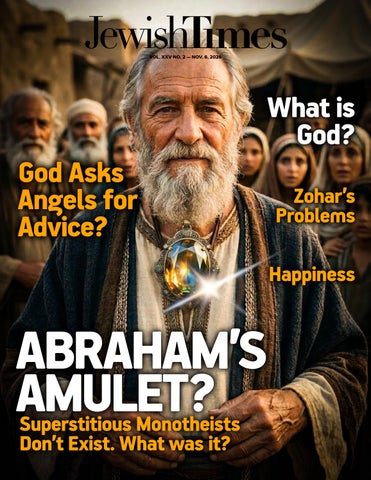
VOL. XXV NO. 2 — NOV. 6, 2026
What is God? God Asks Angels for Advice?
Zohar’s Problems Happiness
ABRAHAM’S AMULET? Superstitious Monotheists Don’t Exist. What was it?
the FREE
Just click any
2
|
WWW.MESORA.ORG
NOV. 6, 2026
icon in this issue
MESORA THE JOURNAL ON TORAH THOUGHT | Please send letters and questions to: Comment@Mesora.org |
3 Letters
RABBI MOSHE BEN-CHAIM
We address amulets, what God is, Zohar’s problems and happiness.
5 God Asks Angels for Advice?
9 Ugly
RABBI MOSHE BEN-CHAIM
A rabbi’s recent mistreatment of a talmudic portion evoked this reader’s question and our response. The lesson is that talmud is not to be treated lightly.
RABBI MOSHE BEN-CHAIM
Deciphering the rabbis’ scripted stories reveals truths. But literal reads is not the rabbis’ intent.
| MIDRASH & PROVERB |
God, King Solomon and the rabbis all spoke in riddles at times. In this issue we take up a number of allegories, which if taken literally, make no sense. But once properly interpreted, provide very pleasing ideas and lessons. LETTERS RABBI MOSHE BEN-CHAIM
Subscribe FREE to the Jewishtimes: mesora.org/jewishtimes –––––––––––––––––––––––––––––––––––––
Articles may be reprinted without consent of the Jewishtimes or the authors, provided the content is not altered and credits are given.
Amulets: Abraham’s Healing Stone Rabbi Shimon ben Yochai said, “A precious stone hung around the neck of Abraham our forefather; any sick person who looked at it would immediately be healed. When Abraham our forefather died, the Holy One, Blessed be He, hung this stone from the sphere of the sun” (Baba basra 16b). Abraham's identity is the individual who was on one side of the world: world population was idolatrous, while Abraham was a monotheist. Certainly he would be the one person who (CONT. ON NEXT PAGE)
WWW.MESORA.ORG NOV. 6, 2026
| 3
LETTERS SHARE
would not endorse idolatry or superstition by wearing a healing stone. Another blatant clue that this is an allegory is that “God hung the stone on the sun” for succeeding populations to be healed after Abraham's death. What is suggested by the location of the stone, Abraham's neck? The neck is from where speech originates. This means that the “healing” that this Talmudic portion refers to is Abraham's speech, that healed people's wrong opinions. He spoke against idolatry. After he died the lesson of monotheism was learnt from nature, as Abraham taught, such as the sun having a creator. ■
Amulets II: Superstition Defies God
LIOR: While everything you wrote makes sense, you seem to
ignore the extensive discussion of effective amulets in the gemara. Whether they’re kadosh, can they be carried on Shabbat, healing people, and even their effectiveness against ayin hara (which is another topic that you obviously wrote about not being a real spiritual force). Rambam also codifies it in his laws of muktzeh. But if it’s been proven effective, you can move it on Shabbat. Shulchan Aruch says the same. How are we to understand all of this? Amulets clearly existed in the Jewish world and [Jews] believed it worked and had some way of proving its effectiveness.
What is God? Man’s Capacity to Know God vs. Knowing God’s Will
AVRAHAM: We say that Hashem is qualitatively different than any thing we can imagine, “Who is like You? Who is similar to You?” recited 3 times daily in Shmoneh Essay. There is no similarity between God and His creations, including man. However, that’s not true. I know that 1=1, and so does God. Question: What is reality? Two possible explanations: 1. What we call reality is actually real: 1=1. Logical deductions teach us reality (assuming the premises are true). The problem: this means that God’s knowledge is not qualitatively different from ours: we both share mathematical knowledge. 2. We think we have knowledge but really it’s not true. It’s like we’re playing monopoly. We have to follow the rules of the game but it’s all made up. RABBI: We must distinguish between what God “is,”
and what God “knows.” God told Moses “You can’t know Me while alive,” plus what you quoted, “Who is like You? Who is similar to You?” These quotes all refer to what God is…we cannot know what God is. However, what God knows is in fact shared with man. God gave man senses to distinguish truth from fantasy. RABBI: Permitted amulets are of two categories. One is a script or He communicated in language we share with Him. The sentences and the other is organic substances that have medicinal prophets warn that we must follow His word. This all value. Some amulets work psychologically—if a certain sentence means that God wishes man to assess God’s will as or verse calms the person's mind, that is a real effect, so they're true and accurately understood. Thus, God says we can allowed to be worn. And the other amulet is medicinal, such as a know what He knows, just not “all” He knows. What we root from a certain herb. But without some effect—psychologically call reality is accurate. God created it and wishes man to or physically—then that amulet, like a horseshoe, falls into the accept what he sees and comprehends as real and true. category of superstition and is prohibited. God doesn’t fool man. God is emess, truth. His goal for man is to attain as much of His truth and wisdom as he LIOR: Thanks for the response. Seems like at the end of the article can. We don’t live in a simulation or a Monopoly game, as that would mean God fools us. you end in the same question that I have which is that it had to be written by a specific person for it to be effective. So you can go as far as to say that psychologically, if a specific person or rabbi wrote AVRAHAM: You’re separating God and His knowledge. it you would feel better. But I think on the surface level it seems to But aren’t they one thing? So, if I can’t know God, I can’t be that just by wearing it , there is some sort of spiritual protective know His knowledge. benefit. RABBI: The distinction is not within God, but within RABBI: “Spiritual protective benefit” is idolatrous. That's why I human knowledge. Maimonides says, God and His believe the amulets have to be effective three times. This validates knowledge are one. Additionally the phenomenon of either its psychological value or its medicinal value. But something separation is a physical phenomenon which cannot exist not validated is a superstitious belief. in God. The distinction is between human knowledge Another fundamental problem amulets present is that if there were of God Himself, vs. human knowledge of God's will. powers that can produce good fortune for a person, that he can God told Moses that “man cannot know Me while have success and health even if he is a wicked person, this opposes alive.” But simultaneously God gave us an entire Torah, the fundamental of reward and punishment, that our benefits and which means His knowledge is something that can be misfortunes are due to our relationship to God alone and not to understood man. So while it's true we cannot know what imagined powers. ■ God is, we can know His will for man. ■ (CONT. ON NEXT PAGE)
4
|
WWW.MESORA.ORG NOV. 6, 2026
LETTERS SHARE
Human Nature: Happiness Zohar: Reincarnation Problems Demands Exertion People are afraid to challenge what’s accepted, a book that so many “Couldn’t God have bestowed upon His creatures complete bliss and permanent happiness without giving them commandments and prohibitions? Surely it would seem that His kindness would, in that case, have contributed even more to their well-being because they would be relieved of all exertion for the attainment of their bliss.” (Saadia Gaon, The Book of Beliefs and Opinions, pages 138-139).
Saadia Gaon answered “No.” He held that exertion is required to enjoy the best existence, referring to engaging in God’s wisdom. How so? In terms of knowledge and wisdom, passivity or no exertion refer to an inactive mind. Saadia Gaon says there’s no equality between one using his mind and one who doesn’t. God cannot create man in a way to enjoy existing, to enjoy ideas without mental activity. The very nature of thought is an exploration, analyzing, deducing, inducing, exploring…active mind states, not a static or passive state. If one is not exerting his mind, he is not involved in thought, and cannot be happy. God can’t make a mind both active and passive simultaneously. That’s like making a ball in motion and stationery at the same moment. So no, God can’t make man needless of exertion and also happy. The greatest pleasure and excitement in life is realizing new truths, which, by nature, is an active mental state. ■
quote. That’s deification of man. Zohar is man-made so it can have defects. A rabbi recently quoted Zohar, saying that Moses was a reincarnation of Noah:
“Noah failed to have concern for people and needed to remedy a personality flaw. Therefore he returned as Moses, who defended people when he asked God not to kill the Jews for the Golden Calf sin. Noah deals with an ark, and Moses was placed into an ark (basket).” Using such circumstantial parallels teaches no ideas. Instead of making pointless correlations, Torah study must engage in principles. Why not simply give Noah extra years to correct his flaws, why not tell him his flaws? Reincarnation is an unnecessary step, and it is also unsubstantiated. Furthermore, Moses never recalled being Noah, that he might correct previous life’s flaws. And God says we're punished and rewarded for what we do in “this” life…not a former imaginary life. Reincarnation denies God's words. The belief in reincarnation reduces God’s threats of death to a joke. For if you come back to life, what punishment was death? ■
WWW.MESORA.ORG NOV. 6, 2026
| 5
SHARE
And God said, “Let us make humankind in our image, after our likeness. They shall rule the fish of the sea, the birds of the sky, the cattle, the whole earth, and all the creeping things that creep on earth.” (Gen. 1:26) (CONT. ON NEXT PAGE)
6
|
WWW.MESORA.ORG NOV. 6, 2026
SHARE
Rashi comments: The humility of the Holy One, blessed be He, the Rabbis learned from here, because man is in the likeness of the angels and they might envy him, therefore He took counsel with the angels. And when He judges the kings He likewise consults His heavenly council. “There are in the heavens beings after My likeness; if there will not be on Earth also beings after My likeness, there will be envy among the beings that I have created” (Sanhedrin 38b). This theme repeats regarding the Tower of Babel: Let us go down and confound their speech there, so that they shall not understand one another’s speech (Gen. 11:7). Rashi comments: “Let us go down” — He took counsel with His Judicial Court because of His exceeding humility (Sanhedrin 38b) Rabbi Yochanan said, “What is the meaning of that which is written, “And the one (Egyptian army) came not near the other (fleeing freed Jews) all the night” (Exod. 14:20)? The ministering angels wanted to sing, but the Holy One, Blessed be He, said, “The work of My hands (the Egyptians) are drowning at sea, and you wish to say songs? (Megilla 10b) Regarding both man’s creation and administering justice over man, God “takes counsel from angels.” This is obviously metaphoric. So let’s slowly unravel the true meaning. Why does God seek advice from angels? God knows all, angels can’t teach Him anything! What is meant by God being very humble? Further, how is God’s humility regarding man alone; either creating him or governing him? As we don’t see God taking counsel from angels regarding any matter other than man, how is God’s humility limited to man alone. And what is this “jealousy” in creation? Finally, what is God’s rebuke of the angels singing at the Red Sea, since the Jews sang too, and the Jews were not reprimanded. Let’s review Talmud’s greater insights: Rav Yehuda says that Rav says, “At the time that the Holy One, Blessed be He, sought to create a person, He created one group of ministering angels. He said to them, “If you agree, let us fashion man in our image.” The angels said before Him, “Master of the Universe, what are the doings of this man You suggest to create?” God said to them, “His actions are such and such, according to human nature.” The angels said before Him, “Master of the Universe, ‘What is man that You are mindful of him? And the son of man that You think of him?’ (Psalms 8:5).” God outstretched His small finger among them and burned them with fire. And the same occurred with a second group of angels. The third group of angels that He asked said before Him, “Master of the Universe, the first two groups who spoke their mind before You, what did they accomplish? Rather, the entire world is Yours; whatever You wish to do in Your world, do.” God then created Adam. When history arrived at the time of the generation of the Flood and the Tower of Babel, whose actions were corrupt, the angels said before God, “Master of the Universe, didn’t the first set of (CONT. ON NEXT PAGE)
WWW.MESORA.ORG NOV. 6, 2026
| 7
SHARE
Without an intelligent being on Earth, angels speak appropriately before Earth's purpose would appear as existing You, that human beings are not worthy of having been created?” God for itself, and not to provide God’s wisdom to observers. The heavens would be said to them concerning humanity, “Even to your old age I am the same; “envied” as having greater importance, as and even to grey hairs will I suffer you; only there, beings exist that perceive God’s I have made and I will bear; and I will wisdom. But now that God did create man, all portions of creation convey God's will carry, and I will deliver you” (Isaiah 46:4), i.e., having created people, I will that intelligent beings should observe His wisdom and enjoy it. even suffer their flaws.” So we have a few cases where the angels lacked knowledge. But we must be clear: these are midrashim (allegories), scripted stories to teach lessons, but not actual historical events: God never asked angels for advice, He never rebuked them. So these midrashim require interpretation, as do all midrashim. Let’s first define our terms.
What is Humility?
Humility is the expressed trait of intelligent beings when subjugated to others, even when not warranted, like a president inviting a commoner into his company. The greater party catering to the lesser is called humility. God seeking advice from angels means God is catering to them, but in what manner?
Jealousy in Creation
If man does not exist, the imbalance (jealousy) as that the earthly portion of creation will not contain intelligent beings capable of recognizing God. This would give the wrong impression of the sole purpose of creation, which Rashi says is Israel’s engagement in Torah (Avos. 2:8). Man must exist. Creation does not exist for itself: an Earth with no man is purposeless. Furthermore angels do not have psyches. Therefore they are bereft of any emotions, including jealousy. God consulting the angels about creating man and talmud’s lesson that God destroyed the angels who disagreed with man’s creation, indicates that angels lacked God’s knowledge. Rav Chaim Ozer Chait said, as God is unrelated to physicality, God created angels as a means to relate to a physical Earth. In this sense, angels serve man. But angels may have another purpose for themselves too, as we see they praise God. If there will not be on Earth also beings after My likeness, there will be envy among the beings that I have created.
8
|
WWW.MESORA.ORG
NOV. 6, 2026
Tolerating Man
Clearly, angels do not possess the capacity of toleration. They also don’t share the Creator’s mercy over His creatures. That's why they initially said, “What is man that you should be mindful of him?” Meaning, “Man will corrupt himself, so why create him?” What’s God’s response of Isaiah 46:4? God initially says that "I am He," meaning “I am the only one that can have mercy as I am the sole creator.” That's why He follows up that statement and explains in the verse, "I have made man," meaning as a creator I have a different relationship to My creations that the angels do not have. That is also expressed by “tolerating” man. The angels don’t have God’s capacity of mercy ("angels of mercy" in Rashi, Gen. 19:1 means they carry out God's mercy, not their own mercy). They see man violating God’s will, and say man should not be created. In the metaphysical world, nothing conflicts with God’s will. Angels included. God originally destroyed the angels who disagreed with Him about creating man (an allegory). This teaches that angels are not all-knowing, they are lacking in this sense and “deserve destruction.” God alone is all-knowing. God knows man should exist despite his sins. That is the tolerance. At the Red Sea too, the angels lacked mercy: “My creations are drowning in the sea and you want to sing?” The midrashim are consistent in presenting allegories that angels operate outside of God’s mercy. Why were the Jews mandated to sing Az Yashir? This is due to the benefit God bestowed upon them in saving them from the Egyptian’s attack. That goodness obligated them in thanks to God (Rabbi Israel Chait). It would appear man knows God’s mercy, whereas angels do not, as in their world, mercy plays no role for all beings there operate without sin. Purely intelligent angels can’t sin and therefore don’t need mercy. That perfect world’s inhabitants—angels—do not deem a sinful creature as deserving existence, so they replied to God, “What is a man that you
should be mindful of him?” So God did not really destroy them because there was no conversation. But it means that as angels do not possess God's knowledge, they are oblivious to God's greater considerations to create man.
God’s Humility: Only Regarding Man We noticed that God consulted the angels only regarding creating man or in governing man. But in creating and managing all else, angels were not consulted. God consulting angels for their opinion is absurd; He knows all. We said it means God’s creation of man was not understood by angels. That’s the message of the angels disagreeing with man’s creation, and also God’s burning of the angels. In the creation and governing of man, the allegories teach that God’s tolerance of a sinful creature is outside the pale of a purely metaphysical angel, who live without mercy. Like we said, at the Red Sea God rebuked the angels, “My creations are drowning in the sea and you want to sing?” There was no dialogue between God and the angels. It means the same idea that mercy is something God possesses and angels do not. Why does God consult angels only in connection with mankind, and not any other creation? Since this midrash is to teach that angels are unrelated to God’s mercy on a sinful creature named man, this does not apply to all other creations which are unrelated to free will and sin. God consulting with angels never took place. This scripted dialogue is to focus on the angel’s response that they don’t understand man. God demanded man’s existence. So it’s irrelevant that angels don’t agree with man’s existence. Man’s existence is mandatory. What is God’s humility in consulting His angels? God knows what they will disapprove of man. What’s the point of the question? As we said, there was no dialogue, this is allegory. But it means that God seeks His creations to operate optimally. So “asking the angel’s advice” allegorically means that God seeks to offer opportunity to His creations. You see that a gemara must be highly respected, and carefully analyzed to derive the rabbis' wisdom. But offering simplified and lame interpretations is wrong, as it treats gemara poorly, and forfeits the chance to inspire others of God's brilliant Torah. ■
UGLY
SHARE
be two unrelated areas. Spiritual perfection has to do with internal values and not with the people who you meet that might be handsome or ugly. This rabbi you listened to on the interview did not read the entire gemara text, so his explanation cannot be correct. He did you and other listeners an injustice. Here is the full story, which, according to Rashi and Tosfos, might be midrash, allegory:
RABBI MOSHE BEN-CHAIM
READER: I just listened to an interview of a rabbi, who quoted a story in gemara. I am curious how you would explain this gemara: Rabbi Elazar was traveling after studying Torah. He was feeling very pleased with himself because of how much Torah he had learned. Along the way, he encountered a man who greeted him respectfully. Instead of returning the greeting, Rabbi Elazar said something very hurtful: “How ugly you are! Are all the people of your city as ugly as you?” The man responded with a powerful statement: “I don't know. But go and tell the Craftsman who made me how ugly the vessel is whom He created. In other words, the ugly man was saying: “If you have a problem with how I look, take it up with Hashem. He is the One who created me.” This rabbi in the interview suggested that the sage may have been so spiritually elevated that he was shocked when he encountered ugliness. It was the first time he had seen an ugly person.
RABBI: So what’s the rabbi’s lesson, that people get shocked by appearances? That’s not worthy of a gemara to record. I also don't see the connection between being spiritually perfected, and one's experience with beauty or ugliness, they seem to
The Sages further taught in praise of the reed: “A person should always be soft like a reed, and he should not be stiff like a cedar.” An incident occurred in which Rabbi Elazar, son of Rabbi Shimon, came from Migdal Gedor, from his rabbi’s house, and he was riding on a donkey and strolling on the bank of the river. And he was very happy, and his head was swollen with pride because he had studied much Torah. He encountered an exceedingly ugly person, who said to him, “Greetings to you, my rabbi,” but Rabbi Elazar did not return his greeting. Instead, Rabbi Elazar said to him, “Worthless person, how ugly is this man. Are all the people of your city as ugly as you?” The man said to him, “I do not know, but you should go and say to the Craftsman Who made me, “How ugly is the vessel (person) you made.” When Rabbi Elazar realized that he had sinned, he descended from his donkey and prostrated himself before him, and he said to the man, “I have sinned against you; forgive me.” The man said to him, “I will not forgive you until you go to the Craftsman Who made me and say, “How ugly is the vessel you made.” Rabbi Elazar followed behind the man, trying to appease him, until they reached Rabbi Elazar’s city. The people of his city came out to greet him, saying to Rabbi Elazar, “Greetings to you, my rabbi, my rabbi, my master, my master.” The man said to them, “Who are you calling my rabbi, my rabbi?” They said to him, “To this man Rabbi Elazar who is walking behind you.” He said to them, “If this man is a rabbi, may there not be many like him among the Jewish people.” They asked him, “For what reason do you say this?” He said to them, “He did such and such to me.” They said to him, “Even so, forgive him, as he is a great Torah scholar.” He said to them, “For your sakes I forgive him, provided that he accepts upon himself not to become accustomed to behave like this.” Immediately, Rabbi Elazar, son of Rabbi Shimon, entered the study hall and taught, “A person should always be soft like a reed and he should not be stiff like a cedar. And therefore, due to its gentle qualities, the reed merited that a quill is taken from it to write with it a Torah scroll, tefillin, and mezuzas (Taanis 20a-20b). (CONT. ON PAGE 11) WWW.MESORA.ORG NOV. 6, 2026
| 9
Is Judaism mystical, or is it rational, based on reason and proofs?
10
|
WWW.MESORA.ORG
NOV. 6, 2026
SHARE
The gemara commences by Rabbi Elazar’s priding himself in his Torah while enjoying the riverbank beauty to enhance his pleasure in himself, and links this to his callous aggression towards an ugly man who pleasantly greeted him. What’s the significance of this contrast? The general lesson of the gemara is that even an intelligent person can be overcome by a poor character flaw. In specific, Rabbi Elazar was callous and aggressive towards a man who was nice to him and gave him respect. And this was on the heels of Rabbi Elazar priding himself on his great knowledge, then enjoying nature. What’s the dynamic of enjoying nature (riverbank stroll) while priding oneself? Apparently an internal feeling projects itself onto the external world. Why? When rejoicing in oneself, like all fantasies, one desires no interruption. Therefore Rabbi Elazar, after elated by much learning, converted a normal riverbank stroll into a “majestic scene.” He viewed it this way to sustain his state of great happiness and self pride. We now readily understand why Rabbi Elazar was so harsh to the ugly man, for he was undeniably gross, and that ugliness abruptly interrupted his euphoric state of mind. That euphoria, first enhanced by nature’s beauty then lost by nature’s ugliness, resulted in Rabbi Elazar’s aggression. This would be identical to a person receiving an award in front of a large group of people, and somebody walking up to the honored person and pouring water on his head. The high of being honored would come smashing down in embarrassment. Here too Rabbi Elazar’s high enhanced by nature’s beauty was abruptly stripped away by nature’s ugliness. The ugly man conditioned his forgiveness on Rabbi Elazar’s confession of accusing God of a poor creation. Meaning, Rabbi Elazar was wrong to focus on himself, when learning is truly to focus on God and His wisdom. That’s what the ugly man meant, that Rabbi Elazar should redirect his focus away from himself, and focus on God. With that correct perspective, Rabbi Elazar could not accuse God that He desires that certain people are ugly. A focus on God would prevent a person from such aggression, as God’s will overrides our own. Why did the ugly man finally forgive Rabbi Elazar? He did so as he took his own advice. For as God is to be the focus, he wanted the townspeople to feel good about Rabbi Elazar who taught about God, therefore he forgave Rabbi Elazar so the townspeople could feel good about his future teachings. ■
WWW.MESORA.ORG NOV. 6, 2026
| 1111
12
|
WWW.MESORA.ORG
NOV. 6, 2026
CODES FOUND IN THE BIBLE
SHARE
CLUES IN THE TEXT REVEAL MYSTERIES
All books depict history, facts, theories, fiction or poetry. No book is coded with hidden messages beyond the words or patterns revealing marvels. But the Bible (Torah) was written by God, and is “coded.” The order of verses, use of certain phrases, apparent contradictions and other Biblical patterns are purposeful clues to God’s wisdom. This book unveils those patterns and shares the hidden messages.
WWW.MESORA.ORG NOV. 6, 2026
| 13
SHARE
NYDesign.com Designers of the Jewishtimes & Mesora.org Building loyalty and sales through design strategies 516.569.8888 WEBSITE
14
|
Branding
Dataviz/Charts
Websites
Social Media
UI/App Design
Infographics
Landing Pages
Advtg/Promo
Wires/Prototypes
Iconography
Editorial Design
Animation
App Store Design
Illustration
Presentations
Packaging
WWW.MESORA.ORG NOV. 6, 2026
WWW.MESORA.ORG NOV. 6, 2026
| 13
SHARE
WWW.MESORA.ORG NOV. 6, 2026
| 15
SHARE SHARE
Subscribe FREE at Mesora.org/Jewishtimes
Thought-provoking articles on Torah, Israel, science, politics and readers’ letters.
30 Years / 706 Issues
16
|
WWW.MESORA.ORG
NOV. 6, 2026