




Just click any icon in



Just click any icon in


| Please send
RABBI ISRAEL CHAIT
Maimonides’ formulation unveils Lashon Hara as most corrupt
RABBI MOSHE BEN-CHAIM
God’s message is clear: He desires only the good for mankind
RABBI ISRAEL CHAIT
A midrash teaches brilliant insights about religion and our instincts
RABBI MOSHE BEN-CHAIM
Maimonides’ select words reveal psychological insights of idolatry
RABBI REUVEN MANN
The Jewish view on marriage and divorce

It's vital, when you study Torah’s laws, don't just understand “how” to perform them. More vital is to understand their purpose for your perfection. You must realize that God created every law so there is amazing wisdom in each one. If you arrive at the underlying purpose of each law, then your love of Torah and your love of God will grow, and that is truly the purpose of our life.

RABBI MOSHE BEN-CHAIM
Maimonides teaches [1] that murder, idolatry and adultery meet with punishment on Earth, and loss of the afterlife. He adds that Lashon Hara is worse than these 3 sins. This lesson is derived as follows. The word “great” is associated with murder, idolatry and adultery, while “many greatnesses” is associated with Lashon Hara. Rabbi Chait taught as follows: (CONT. ON NEXT PAGE)
Each of the three cardinal sins are called “great” (gadol). Regarding idolatry, Moshe said of the Jews’ Golden Calf, “The people sinned a great sin” (Exod. 32:31). Regarding adultery, Joseph refused to sleep with Potiphar’s wife saying, “How can I commit this great evil?” (Gen. 39:9) And regarding murder, Cain said of God’s punishment of banishment for killing his brother Abel, “My sin is greater than I can bear” (Gen. 4:13). But regarding Lashon Hara, the verse says, “Mouths that speak many great things” (Psalms 12:4), using the plural and not the singular, as the three sins above. This indicates that Lashon Hara includes all the “many greatnesses” of the three cardinal sins. How precisely does Lashon Hara correspond to these sins? Lashon Hara distorts reality, similar to idolatry’s distortion of what God is. We also understand that Lashon Hara contains an element of murder (character assassination). But how is it similar to adultery? Man sins in two ways. One is an unbridled and open instinctual expression. Examples of this first category are adultery and murder. But man also sins in a second manner, through sublimation in speech. One would assume the raw expression is worse. In one sense this is true. But in another sense, the sublimated expression is worse in that one can’t extricate oneself: the attachment is stronger—it is constant and it prevents one from change.
Why is Lashon Hara the one sin to which God responds with a miraculous plague of tzaraas a icting the gossiper? Lashon Hara is heresy, as Psalms 12 teaches: “With our speech we will become great, our lips are our own, who can rule over us?!” Rejecting a ruler (God) over oneself, one denies God. Pharaoh’s astrologers too claimed superior status. They received boils they could not remove [2]. Gossipers receive a skin disease. Both cases teach the sinner that their rejection of God is false, through God overpowering their bodies and correcting their misconceptions. Denial of God demands God to show conclusively, He is the lone power that exists. God does so by delivering tzaraas to the gossiper and
the astrologers. He is the sole power in the universe. Nothing else exists. Atonement for Lashon Hara requires the sinner to take two birds, cedar and hyssop. He kills one bird and then takes the living bird with the cedar and hyssop tied with red string, and dips them all in the dead bird's blood and then releases the living bird over an open field. This is not barbarism. On the contrary, it is to teach the sinner of the irretrievable evil that he spread. Just as the bloody bird once released, will never be caught again, the sinner’s “bloody speech” (character assassination) is irretrievable. Stolen money can be returned. But one cannot retract the spoken word. This visual helps impact the sinner with a more tangible sense of the irrevocable damage he inflicted with his words.
Now, after this bird rite, what still lacks in the gossiper that more is still needed, as we see the priest placed blood and oil on his right ear, right thumb and right and big toe? Furthermore, what is the gossiper’s commonality with the priest’s inauguration, for they too had blood placed on their right ears, right thumbs and right big toes? The only di erence is, unlike the gossiper, the priests were not anointed with oil in these 3 locations; blood alone was placed there. Both the gossiper and the priests require a focus on God. The priest is obvious, as he serviced God in temple, a service which cannot be mindless. Sacrifice too requires proper knowledge of God and intellectual acceptance of how to perform the sacrifice and when and where to eat it. The gossiper also requires a focus on God, a return to God from his heresy. It’s insu cient to only see your error through the bloodied bird, you must also return to God: “If a person transgresses any of the mitzvot of the Torah, whether a positive command or a negative command—whether willingly or inadvertently—when he repents, and returns from his sin, he must confess before God”[3]. So they both receive animal’s blood in place o their own blood. There must be no disconnect between what they hear in Torah (ear), and how they act (thumb, toe).
Evil speech is worse than you think. And one also forfeits his afterlife by committing this grave sin. ■
[1] Hilchos Dayos 7:3
[2] Exod. 9:11
[3] Hilchos Teshuva 1:1

READER: I’m a Noahide, and I’ve been trying to understand the Torah more seriously. I have a question about Book of Numbers 31, and I hope this doesn’t come across as o ensive. I genuinely believe in the Hebrew Bible. But I’ve been struggling with this section. I’ve looked into di erent explanations from various Jewish sources and other perspectives, but I still can’t seem to find an answer that fully makes sense to me on a rational level. It’s one of those passages that just doesn’t sit right with my gut, and I don’t want to ignore that feeling or pretend I understand when I don’t. As someone who genuinely believes in God and wants to stay sincere in that belief, I’m just trying to be honest about where I’m struggling. I’d really appreciate any guidance or perspective that could help me understand this better.
The Midian Wars section of the Tanakh are the most di cult to reconcile with my belief in an all loving God. How could God:
1) Demand the slaughter of the ethnic group that Moses himself had married into?
2) Demand that not just all of the men, but all of the non-virgin women and young boys also be killed?
3) Group women into "virgin" and "non-virgin" categories, as though whether or not they'd had sex yet determined whether they are worthy of survival?
4) Enslave the young surviving women?
I've read both Jewish and Christian apologists who will say things like, "These girls were just adopted into domestic servitude." That isn't reassuring. I cannot convince myself that a girl who has just been kidnapped and made witness to the genocide of her whole community will be safe or feel safe among the Israeli men that just up and murdered her mother, father, and brothers before determining that she's a virgin so she gets to live another day. Everything that we're supposed to do, teach peace and love, seems to be undermined by a God who orders this.
RABBI: From God’s creation of mankind, supplying all his physical needs, giving him a soul unlike other creatures, saving the Jews from Pharaoh and countless other enemies, creating miracles to save us, giving us His Torah and protecting His prophets, we gain a clear picture: God desires the good for man. But by “good,” we must understand that morality is defined by God’s wisdom, not man’s. There is much beyond man’s grasp, and he requires regular study to advance and mature his definitions of good, evil, justice, charity, and kindness, until we fulfill the edict, “As God is, so shall you act” (Shabbos 133b). God’s acts embody perfection, if we don’t act as He acts, we are flawed.
The bottom line is that if we have questions, that is due to our deficiencies, not God’s: “For the matter is not empty from you” (Deut. 32:47).
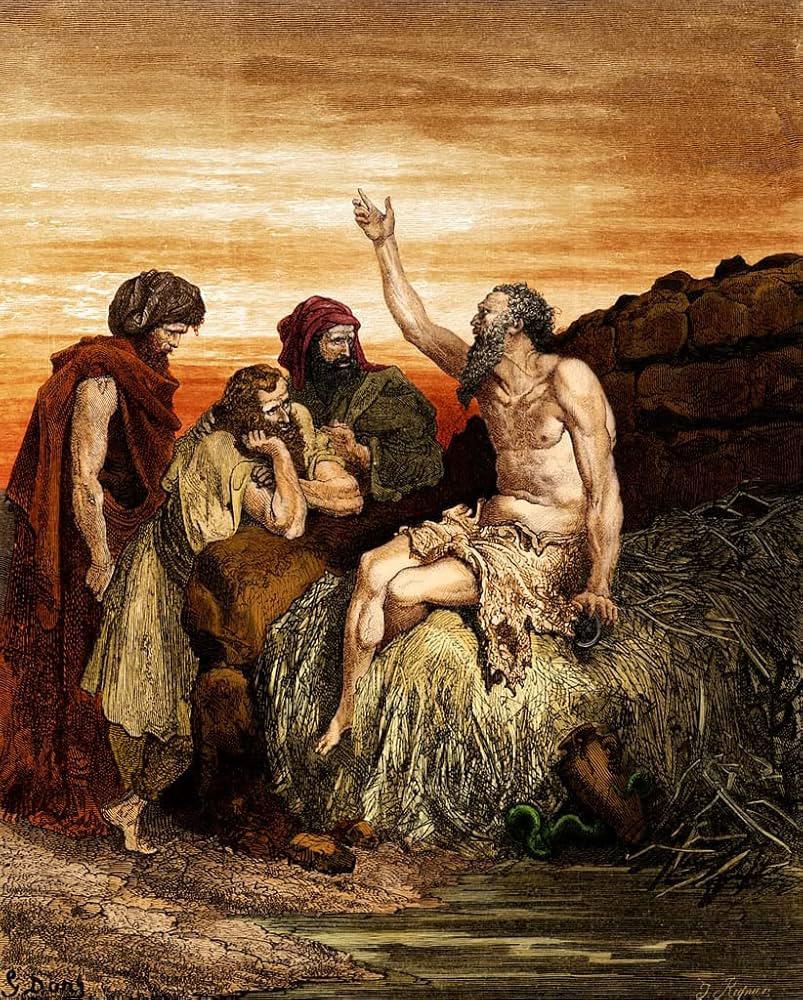
On this verse, Rebbi Mana said, “If it is empty (in your eyes), it is from you because you do not exert yourself [to learn] about it.” Failure to study Torah diligently results in one’s low estimation of Torah and his questioning of God. But Torah is God’s wisdom, every word contains brilliance. And the Shima’s prayer, “A great love You have loved us…” said daily expresses God’s great concern that man have only what is best. The world is His creation and operates according to His terms. As Elihu told Job, “As we cannot fathom God’s physical creations, certainly we cannot contend with His justice” (without study). You must also know that “peace and love” do not trump justice.
There are many examples teaching various aspects of God’s morality and justice. He annihilated the generation of the Flood, including infants. God explained why:
God saw how great was human wickedness on earth—how every thought of his heart was nothing but evil all the time. And God regretted having made humankind on Earth and it grieved His heart. God said, “I will blot out from the Earth humankind whom I created—humans together with animals, creeping things, and birds of the sky; for I regret that I made them.” (Gen. 6:5-7)
God commanded the annihilation of the 7 Nations occupying Canaan/Israel. No inhabitant was to be spared, including children, so their influence when adults is halted now:
However, in the towns of these peoples which God your God is giving you as a heritage (Israel), you shall not let a soul remain alive (Deut. 20:16).
God explains,
It is rather because of the wickedness of those nations that God is dispossessing them before you (Deut. 9:4).
God does not wish evil influences to harm the chances of others, so He kills those who choose evil to spare the innocents from learning their evil ways. God also kills innocent men. He killed Abraham 5 years early so he wouldn’t see his grandson Esav start a sinful life. He killed Chanoch hundreds of years earlier to save him from succumbing to sin, thereby allowing him to die righteous and not evil: “Chanoch walked with God; then he was no more, for God took him” (Gen. 5:24, see Rashi). Life, at times, is not beneficial. Children raised in the societies of the Flood and the 7 Nations had no hope of veering from their parents’ evil ways. Allowing them to live granted them no benefit, and in fact posed a threat to others. Therefore, they were killed. The Midianites sought to drive the Jews to Peor’s idolatry, and therefore were killed. God endorsed Moses as the greatest prophet (Deut. 34:10). Moses emphatically declared, “Now, therefore, slay every male among the noncombatants, and slay also every woman who has known a man carnally” (Ibid.). In that very Torah account itself, Moses justified killing the Midianites:

They are the very ones who, at the direction of Bilam, induced the Israelites to trespass against God in the matter of Peor, so that God’s community was struck by the plague (Num. 312:15,16).
Of all the judges, tribal heads and every wise Jew, not one opposed Moses’ command to kill the Midianites. They all understood the justice. God deemed the virgins innocent and no threat, so they alone were spared. Their virginity was determined by prophecy (Rashi, Num. 31:17). The virgins now greatly benefitted under the Jews’ Torah influence. Killing the evil Midianites Moses himself had married into was justified, including the non-virgin women and all men. They had no redeeming qualities. But Moses wife was righteous, and predated the Midianite’s sin.
Children cannot earn merit or commit sin, as they are too young to understand good and evil. Thus, justice cannot apply to them. Rashi says God will kill an infant if that is a proper method of punishing a parent. “Fathers are not killed on account of their sons' (sin) and sons are not killed on account of their fathers' (sins), each man in his own sin will die” (Deut. 24:16). The operative word here is “man”, that is, only once attaining the status of an adult—“man”—can one attain righteousness and justly earn God’s defense against death. Maimonides explains in Hilchos Teshuva 6:1:
The Holy One, blessed be He, knows how to exact punishment: There are certain sins for which justice determines that retribution be exacted in this world: on the sinner's person, on his possessions, or on his small children. [Retribution is exacted upon a person's] small children who do not possess intellectual maturity and have not reached the age where they are obligated to perform mitzvot [because these children] are considered as his property. [This concept is alluded to] by the verse [Deut. 24:16]: "A man will die because of his own sins."
Children have no merit. If God kills them in such cases, we must not view that child as a lost soul, as God is perfectly righteous and knows how to treat an innocent soul. King David said, “With the pure, You act purely, and with the perverse, You are devious” (Psalms 18:27). We can be sure that child’s soul has lost nothing. For God does not punish without cause: “For God does not torment willfully nor cause men grief” (Lamentations 3:33). Rashi says, “Rather the sin causes the grief (punishment).” Thus, sinless children whom God kills su er no loss. We must not view that child as a lost soul. God manages departed souls justly.
Our culture a ects our values. Just look at the demented values of today’s society, they cannot even define a gender, and they sympathize with Hamas who burned infants alive. Without provocation they butchered civilians and claim that rape is justified resistance. They march against Jews defending their families, but against true genocide they do not take any stand. From where must we learn true morality? Only from God who alone created all life and dictates what is justice. We must not let what is comfortable to our moral thinking to determine truth. Rather, we must study all God’s acts and derive true principles from Him alone. Rebbi Mana said, “If it is empty, it is from you because you do not exert yourself about it.”
This discussion must greatly broaden your considerations about God’s justice. In any case, as God created everything including justice, we are only students of His wisdom, and any complaint is foolish, but questions are wise. With earnest study, we might be fortunate to uncover God’s Torah clues and slowly unravel answers to our questions that will fully please our minds and hearts, just as Job discovered. ■
Rabbi Moshe Ben-Chaim
Rabbi Israel Chait discussed a midrash concerning man’s attempt to control the instincts:
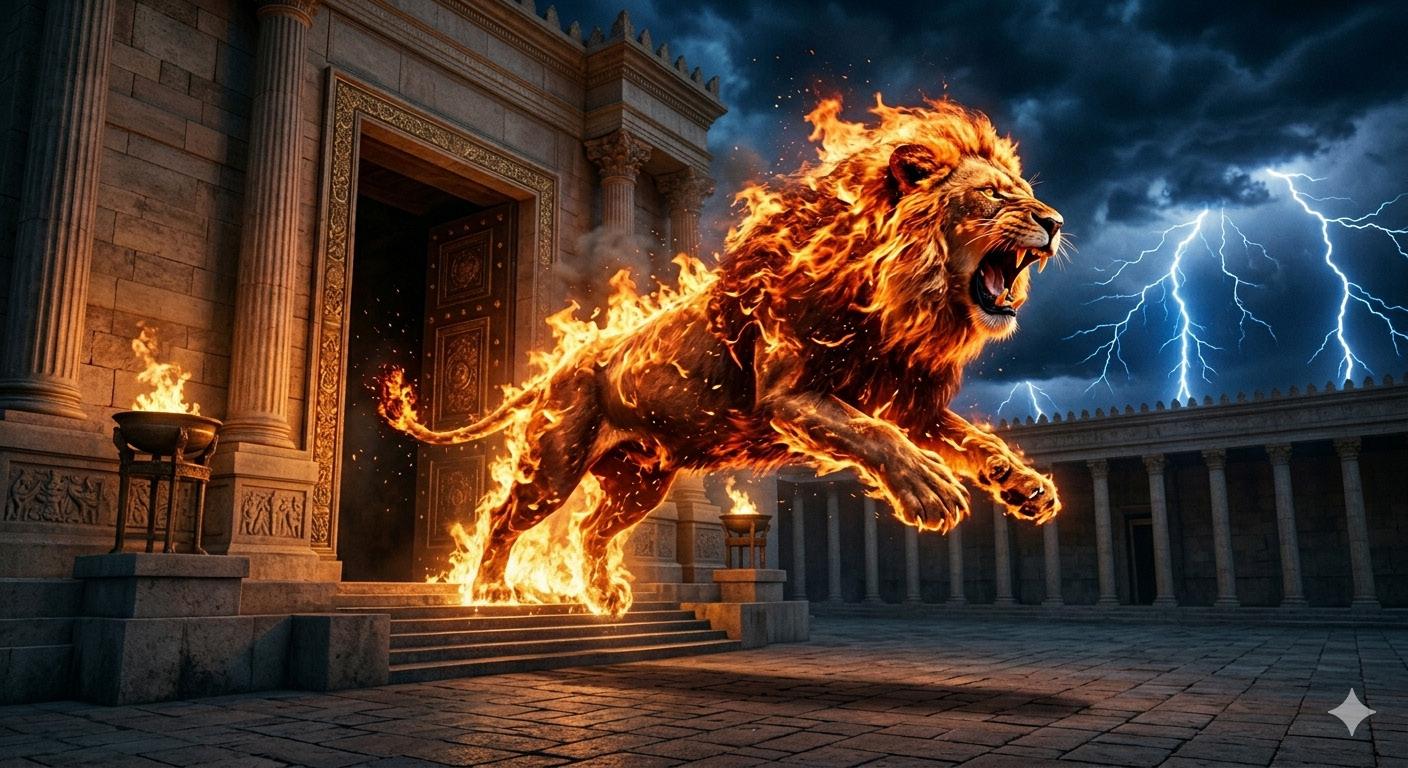
The form of a fiery lion cub came forth from the chamber of the Holy of Holies. Zechariah, the prophet, said to the Jewish people, “This is the evil inclination for idol worship.” When they caught hold of it one of its hairs fell out, and it let out a shriek of pain that was heard for four hundred parasangs (Sanhedrin 64a).
Rabbi Chait asked, “What's the most interesting thing about the midrash? It's that the instincts emerged from the Kodesh Kodashim.” That room is the holiest religious cite. He said this teaches that the strongest instincts are religious matters. That's the Kodesh Kodashim. That's why they're coming out like a fiery lion cub; they are a strong, dangerous thing…what fire and a lion represent. Why is it that religious matters are where the emotions are strongest? And you see it's true because of the Crusades, they had no gumption about killing people. Crusaders murdered, specifically targeting Muslims, Jews, and "heretical" Christians, due to a mix of extreme religious fanaticism, desires for plunder, and strategic brutality. Driven by the belief that they were conducting holy war to avenge Jesus or secure the Holy Land, they
viewed non-Christians as enemies of God, often perpetrating massacres as, or to fulfill, a perceived religious obligation.
Rabbi Chait said And Hitler yimach shemo felt that he was on a divine mission from God. And look how far he and his army can go, how many people that they can slaughter with no resentment. What's the reason for this lack of guilt and ability to massacre innocents? Typically the instincts chase desires but there could be regret: you feel bad, you feel like an animal, like Achashveirosh wanted Vashti to dance naked in front of the other prime ministers of all the other countries. But she refused because there's a conflict in a person when they want to go after their desires: their dignity opposes open instinctual gratification. To do something brazenly instinctually open and show that she loves sex and dancing naked, that would impinge on her dignity. So on the one hand she had the desire to do it. Vashti worked all the women naked so she was very lewd. But on the other hand she's got ego so that conflicts with the instincts. However when you're relating to religious matters and you feel that you're doing religious work like the Christian Crusades, there's no regret so your instincts can be fully expressed without remorse. That's where the instincts are their strongest. These instincts are strongest because there's no opposing force since one feels that his instincts are doing God’s work. ■

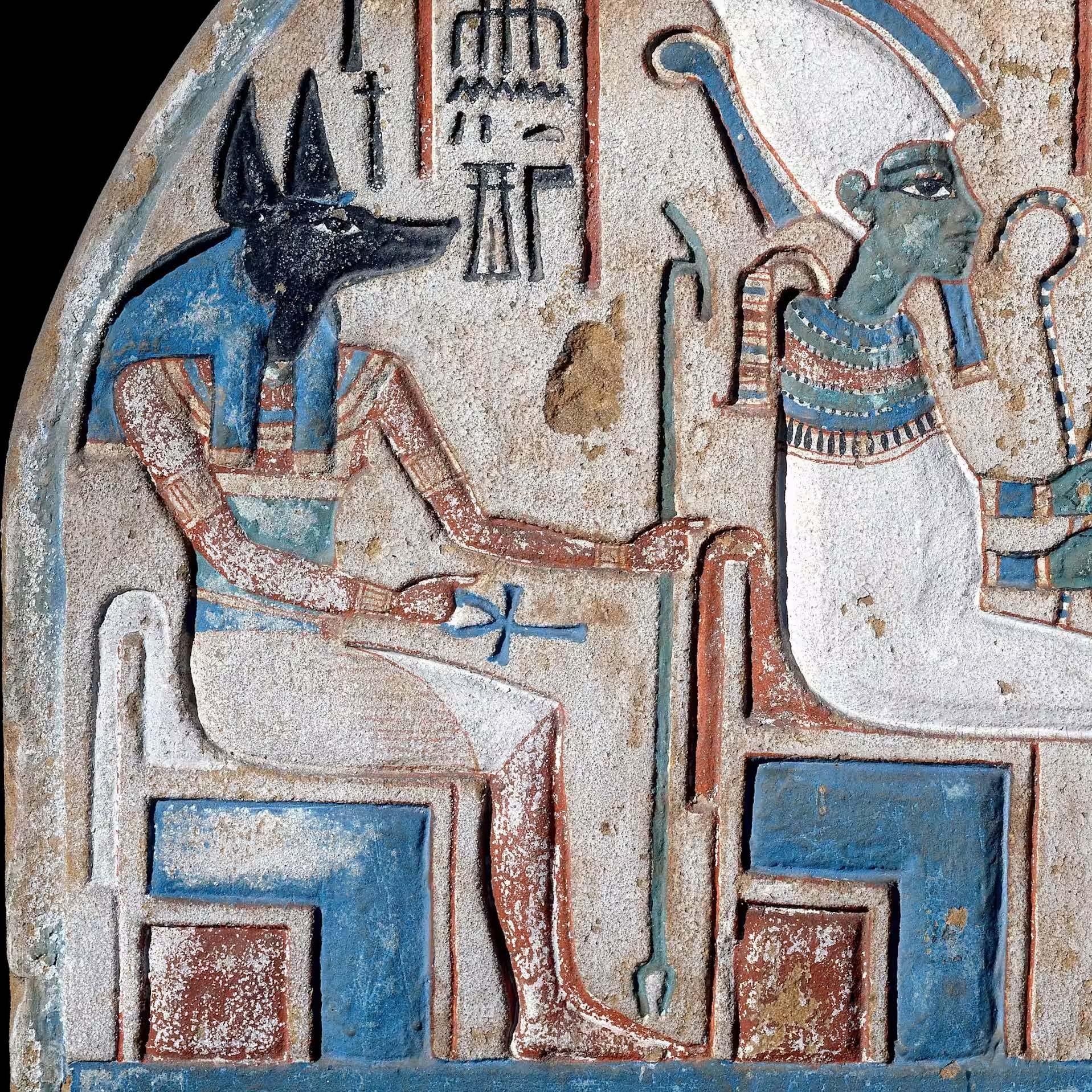
Maimonides states that certain cultures would either eat blood or sit around a pot of blood, as they felt they would be favored by “spirits”:
They imagined that in this manner the spirits would come to partake of the blood which was their food, whilst the idolaters were eating of the flesh; that love, brotherhood and friendship with the spirits were established because they dined with the latter, at one place and at the same time, that the spirits would appear to them in dreams, inform them of coming events, and be favorable to them. (Guide, book III, chap XLVI, pg. 362 Dover ed.)
After Maimonides explains the origin of the Torah prohibition against eating blood, he connects this prohibition to the prohibition to serve Molech, a fire god. (I will record a few sources in a moment which depict Molech's practice.) Maimonides continues:
...the law emphasized the prohibition (against blood eating) in the exact same terms as it emphasizes idolatry. 'I will set My face against that soul that eats blood.'(Lev. 17:10). The same language is employed in reference to him 'who gives of his seed to Molech'; 'then I will set My face against that man' (Lev, 20:5). There is, besides idolatry and eating blood, no other sin in reference to which these words are used. For the eating of blood leads to a kind of idolatry, to the worship of spirits.
Maimonides correlates eating blood to Molech. His parallel is drawn from the Torah's identical language in both o enses, "I will set My face against that soul that eats blood", and , "then I will set My face against
that man" regarding Molech. These two verses strengthen the equation of these two o enses. Maimonides also mentions the notion of "spirits", in application to both blood eating and Molech; a further equation.
How did one worship Molech? According to Maimonides, a parent would cause his child to pass through flames without burning the child. As he states, people felt this to be a "light thing", and by doing so, they imagined they were protecting their children. A "light thing" as he puts it means no risk. Followed by, "to protect their children" clearly indicates that Maimonides held Molech worship not to cause harm to the child. Ramban (Lev. 18:21) was of the opinion that parents would actually burn their children to the point of death. He bases this on many verses. He also equates Molech to the sacrificing of children to Baal, which he concludes are one and the same practice. He points out that the admonishment used by God in reference to such vicious abominations is, "(matters) that I have spoken not of, nor entered My mind." What is so significant about Molech and Baal that this sentiment is used by God? What is the common denominator in these theories of Molech worship? What would both Maimonides and Ramban agree is the element which distinguishes Molech from all other practices?
Why is Molech referred to more harshly than idolatry, "you defiled My sanctuary and profaned My name" (Lev. 20:3). And why is this prohibition followed immediately by prohibitions to divine spirits and enchanters? On this point, the Talmud (Sanhedrin, 64a) teaches that Molech is in fact, not classical idolatry. It derives its proof from a previous Mishna on 53a, where it lists Torah violators who are stoned. There, it lists separately "idolaters” and “one who gives his seed to
(CONT. ON PAGE 11)


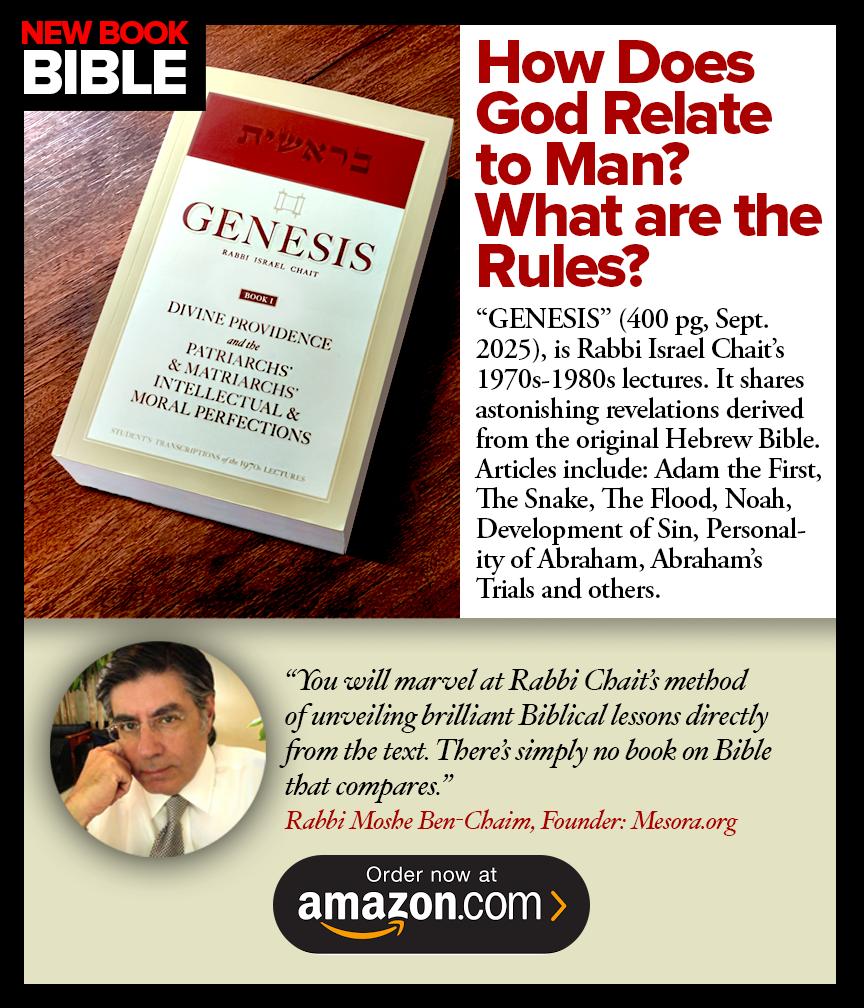
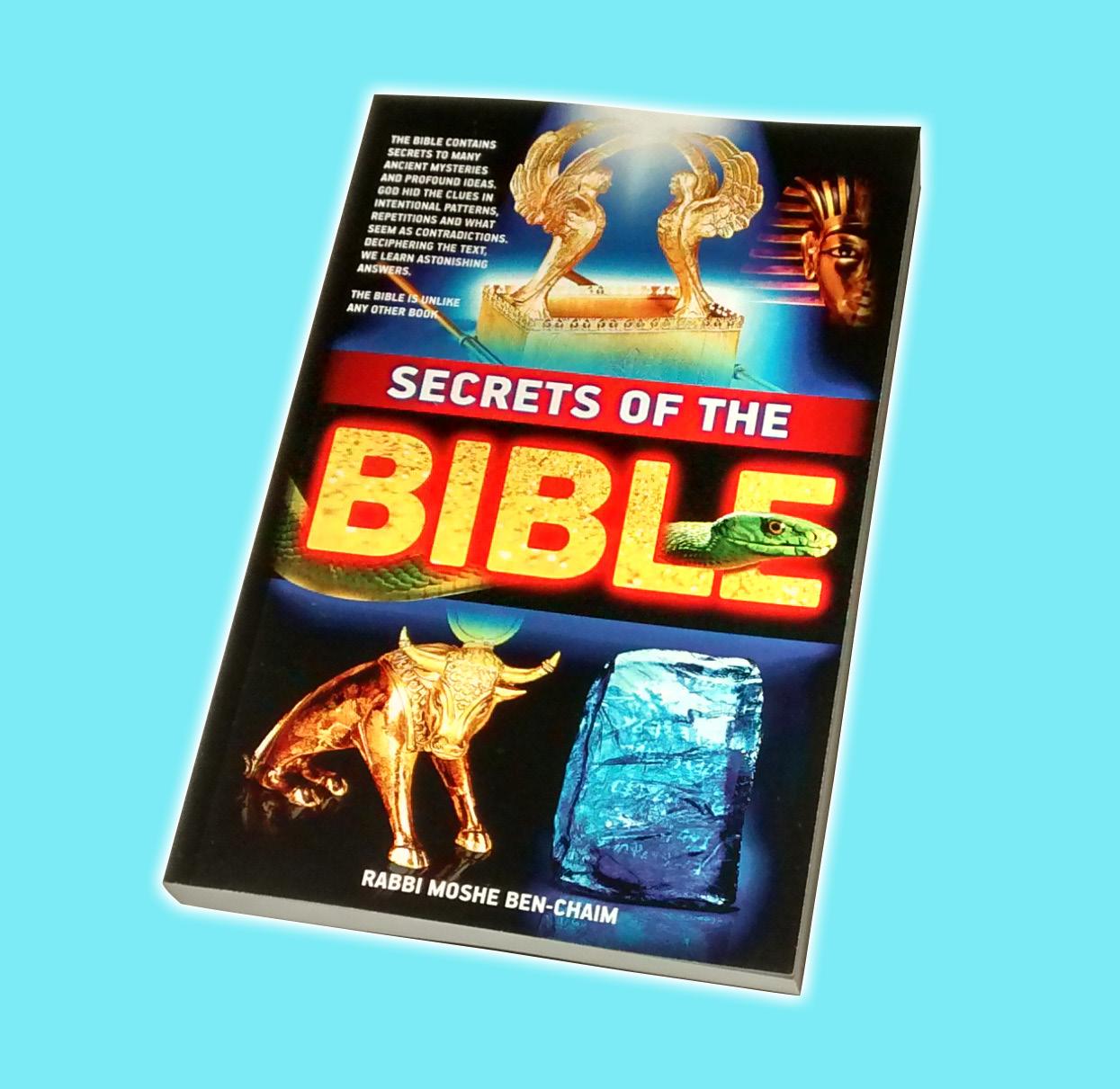
All books depict history, facts, theories, fiction or poetry. No book is coded with hidden messages beyond the words or patterns revealing marvels. But the Bible (Torah) was written by God, and is “coded.” The order of verses, use of certain phrases, apparent contradictions and other Biblical patterns are pur poseful clues to God’s wisdom.
This book unveils those patterns and shares the hidden messages.


Molech." The Talmud proves that had Molech been a classical form of idolatry, there would be no need to list it separately; it would be subsumed under the broader category of idolatry, as is done with regards to all other forms of idolatry. But as the Mishna lists Molech separate from idolatry, the Rabbis conclude Molech is not idolatry. So what is it? Furthermore, the Talmud asks, "Why is Molech called "Molech?” The answer according to one view is that Molech means, "that which rules; one violates the Torah through allowing anything to rule over him, even a pebble, even a chip of wood." This is significant, as idolatry usually has some fixed form, some unique structure for the idol. Here, the Talmud states that the worshiped form is irrelevant. And even though one might say, "are they not worshiping fire?" It might well be that they do burn their children in fire, but perhaps they do so, not to the fire per se, but to an imagined deity. An intangible thing. Let's keep this last point in mind. The fact is that Ramban pointed out that both Molech and Baal incorporate child burning as their practice, so I would say that the fire was a means of worship, but fire is not the deity.
What about the other practice which Maimonides equates to Molech, that of blood eating? How did one violate it? This seems very straight forward, based on Maimonides' description. People either ate blood, or dined around a pot of blood. Both practices were based on "dining with spirits.” This fits in well with the verses which immediately precede the prohibition of blood eating. First, the Torah discusses the prohibition to slaughter animals in the field: :
And to the opening of the Tent of Meeting he did not bring to sacrifice o erings to God, before the tabernacle of God...he will be cut o from the midst of his people. In order that the Children of Israel bring their sacrifices that they sacrifice in the fields, and they bring them to God. (Lev. 17:4-5)
Notice how in both verses the Jews are warned to bring their sacrifices to "God.” This indicates that their crime is one where they are sacrificing to 'another' imagined entity. And two verses later, "And you shall not continue anymore your sacrifices to seirim (demons) that you err after…” This proves that the sacrifices in the fields
were intended for a recipient other than God (the underlying tie between blood eating and Molech).
Now we find after these verses addressing sacrifice, the prohibition of eating blood. What does blood eating have to do with sacrifices to the "seirim,” these demons? It would appear that the goal is one and the same, as both—sacrifices in fields (not to God's Tabernacle) and blood eating—were meant to approach spirits, as Maimonides stated earlier. According to the Ibn Ezra (Lev. 17:7) these spirits were seen only by fools, "mishugaim.” They are not real, but imagined things. Maimonides says so well, "They sacrificed to spirits, not to God. According to the explanation of our Sages, 'lo eloha' (no to God) imply the following idea: They have not only not left o worshiping things in existence; they even worship imaginary things." (ibid, pg. 363)
To summarize, Molech and blood eating share in God's "setting of His face against that person." Molech is not considered classical idolatry, it is its own category. Maimonides mentions "spirit" and “imagined” numerous times when equating Molech with blood eating. Blood eating immediately follows the prohibitions of sacrificing to demons.
Eating blood and Molech worship are uniquely di erent from other crimes. They alone deserve the response of "I will set My face against that man..." What is the crime they both share? I would formulate it as follows: "The imagination of forces other than God." Here is where these two crimes set themselves apart from idolatry. In classical idolatry, the worshiper does not deny God, but rather, he claims a certain sub-deity or practice is a method for relating to God. In regards to the Jews who bowed to the calf, the commentators say that no one thought the calf took them out of Egypt. Also, Rabbi Israel Chait pointed out that Pharaoh accepted one God, but the Egyptians’ method of worship was through sub-deities. So too the Prophet states, "Who would not fear you, King of the nations" (Jeremiah, 10:7). Idolatry does not include the denial of the One, true God. Rather, they deviate in their approach to Him. However, blood eating and Molech worship have a di erent deviation; both imagine a new being called “spirits.” These violators believe there may be God, but they believe in other forces too.
Furthermore, idolatry at least has some object (an idol) that exists in reality, but Molech and spirits (blood eating) is worship of pure imagination. We said that the Talmud teaches Molech to be any object one accepts to rule over himself. Meaning, it is not a physical object or statue, but a force, or spirit, and there’s no defined form.
Blood eating too was described by Maimonides as a wish that imagined spirits would be favorable to those worshipers who dined near the pot of blood. Here too, forces are imagined to exist in addition to God.
Now we understand God's response, "I will set My face against that man..." The only proper response to one who imagines other forces, is that God take the most severe action. How does God do so? The worshiper feels that by eating blood, or worshiping Molech, that his fortune will improve. This is his very motivation. But when God actually destroys his fortune, the worshiper must say to himself, "The Torah's words of destruction have come true, and my imagined forces are false, they have not saved me." The wording is that God will "set His face against that man.” Meaning, there is only God, and no other. Nothing else can respond to his practices of blood eating or Molech worship, because there are no such things as spirits. The only Being Who can respond is God. The very misfortune teaches the violator that in fact, his actions are only witnessed by God, the only Witness to his actions. Nothing else is "out there,” so nothing else responds.
Denying God’s exclusive reign over the universe violates Judaism’s core fundamental. Therefore, one who violates God's unity to gain a favorable fortune from his imagined gods, deserves the most negative “focus" from God to outright reject his imagination. God responds by saying, "I will turn aside from all My involvements, and I will concentrate on him" (Rashi, Lev., 17:10). A deviation of such proportion requires God's proportional "attention.”
The phrase of God, "(matters) that I have spoken not of, nor entered My mind" is used in connection with Molech. Perhaps with this phrase, God wishes to indicate that Molech worshipers assumed forces outside of what is “real.” Meaning, as this practice "did not enter God's mind,” God means to teach that Molech
is a practice unlike idolatry. It is a practice where one forges a false reality that God did not conceive of. Idolatry assumes the real God. Molech does not.
Thus, Molech and blood eating are not idolatry. God plays no part in the goal of the violator. In idolatry, at least one is trying to approach the true God, but his methods are corrupt. But Molech and blood eating do not have God as their aim. They worship imagined "spirits,” as Maimonides states repeatedly. The verses support this idea fully: "And to the opening of the Tent of Meeting he did not bring to bring sacrifices to God, before the tabernacle of God...he will be cut o from the midst of his people. In order that the Children of Israel bring their sacrifices that they sacrifice in the fields, and they bring them to God." The Jews are warned to bring their sacrifices to God, because it is here that they attempt to communicate with something other than God. This approach also explains why Molech is followed immediately by prohibitions of divining spirits and enchanters.
One question remains: If blood eating and Molech are so similar, what in Molech alone is deserving of the statement, "you defiled My sanctuary and profaned My name" (Lev. 20:3)? ■
Rabbi Reuven Mann zt”l
Edited by Ben Silberstein
This week’s Parsha, Emor, deals with two central topics: the special Mitzvot pertaining to the Kohanim (priests) who served in the Temple and the festivals of the Jewish year. The Kohen (priest) has a unique status because he is invested with a higher degree of sanctity than an “ordinary” Jew. In Judaism, a greater degree of sanctity brings with it additional
For example, a Kohen is not permitted to marry any woman he chooses. He is forbidden to marry a divorcée, though he may marry a widow. The Kohen Gadol (chief priest), who enters the Kodesh HaKodashim (Holy of Holies) on Yom Kippur, bears an even higher measure of sanctity. Therefore, the Torah
“And he shall take a wife in her virginity. A widow, or a divorcée, or one who is profaned, or a harlot, these he shall not take; but a virgin of his own people shall he take as a wife” (VaYikra 21:13-14).
These Mitzvot do not sit easily with the modern mindset. First and foremost, the very idea of restrictions on the natural inclination toward love is di cult. Who are we to withhold from a person the “desires of the heart,” especially in a matter as fundamental as love? Moreover, the singling out of the divorcée and widow, and particularly the stricter prohibition placed upon the Kohen Gadol, appears to be a
There was a time when society frowned upon divorce and regarded those who experienced it as somehow flawed. Indeed, until not long ago, the prevailing view was that a divorced person was not fit to be elected to the Presidency
Of course, this is no longer the case in our day, in the era of the new morality, in which “everything” is permitted and traditional values are regarded as obsolete.
This should prompt us to strive to understand the Torah’s attitude toward divorce. This attitude is markedly di erent from that of other religions which, at least doctrinally, forbid it entirely.
Judaism is a bit ambivalent on the subject. It views the marital bond as extremely serious. A marriage of tranquility and stability is vital to the well-being of husband and wife and is essential for creating the proper framework in which to raise children.
Therefore, a person must approach marriage with utmost seriousness. He or she must choose a spouse with careful judgment, with the attitude that the relationship is meant to be permanent, and must completely reject the thought that “if things do not work out, one can always get divorced.” At the same time, the Torah is eminently realistic and (CONT. ON NEXT PAGE)
compassionate. It takes into account that despite all our e orts, we are bound to make mistakes, especially in a matter as complicated as lifelong relationships. Aaron the Kohen Gadol was known as a pursuer of peace and would go from house to house to restore harmony between quarreling husbands and wives.
Our Sages teach in the closing lines of Tractate Gittin (90b) that anyone who divorces his first wife causes even the Altar to shed tears, as it is stated:
“And this further do you do, you cover with tears the altar of Hashem with weeping and displays of grief; so much so that He will no longer regard your Mincha o ering, nor receive with goodwill from your hand. And you say, ‘For what?’; because Hashem has borne witness between you and the wife of your youth, against whom you have dealt treacherously, even though she is your companion, and the wife of your covenant” (Malachi 2:13-14).
These words emphasize the profound gravity of dissolving a marital bond.
Yet sometimes, even though it did not appear so at the outset, two people are simply not meant for each other, and the main theme of their shared life is strife. A mistake has been made, and it is corrosive for people to remain trapped in a prison of misery. Therefore, the Torah permits, and at times recognizes the necessity, to dissolve an unsuccessful union, allowing both partners to rebuild their lives in peace.
In granting this dispensation, the Torah did not intend to imply that it is without misgivings. In my opinion, restricting the Kohen from marrying a divorcée makes the point that divorce is a deviation from the ideal. The Kohen is required to live according to a higher level of sanctity. His choice of a partner should reflect the ideal of an unbroken original bond.
I must clarify that I do not regard divorced people as having any flaw whatsoever. The dissolution of their marriage does not reflect on their character or indicate any moral defect. However, the Torah regards it as imperative to remind us that we should regard divorce as an unfortunate but sometimes necessary step and strive to arrange marriages that are permanent.
This teaching is extremely relevant to contemporary Jewish life. Society at large has undergone a radical change in its attitude toward marriage and divorce, and the percentage of dissolved unions has skyrocketed. Traditionally, the divorce rate among Jews, especially those who are Torah-observant, was very low. However, the force of assimilation
has taken its toll, and the divorce rate among all Jews has risen alarmingly, even as Torah-observant communities have largely resisted the broader societal trend.
This matter deserves our careful attention. We are called upon to be “a Holy Nation,” and the ability to sustain stable, joyful, and lasting relationships is a significant manifestation of our character. Therefore, Jewish education must invest greater e ort and resources in guiding our youth in this vital area: providing guidance before marriage on choosing a partner with wisdom and foresight, developing essential skills of communication and conflict resolution, fostering realistic expectations, cultivating a commitment to working through di culties together, and internalizing the profound importance of Shalom Bayit (domestic harmony). Equipped with these tools, couples can build lasting, joyful unions rather than relying on divorce as a safety valve.
One should not think that because the Kohen bears additional sanctity he is superior to the “ordinary” person. He has a sacred duty to perform, and as a representative of the Jewish people he must adhere to a certain elevated standard.
We should remember the words of the Rambam in Hilchot Talmud Torah 3:1:
“Three crowns were conferred upon Israel: the crown of Torah, the crown of Kehuna (priesthood), and the crown of royalty. Aaron merited the crown of Kehuna, as it is stated, ‘And it shall be for him and for his o spring after him a covenant of eternal priesthood’ (Bamidbar 25:13). David merited the crown of royalty, as it is stated, ‘His o spring shall endure forever; and his throne shall be like the sun before Me’ (Tehillim 89:37). The crown of Torah is set aside, waiting and ready for all, as it is stated, ‘Moshe commanded us the Torah; an inheritance of the congregation of Yaakov’ (Devarim 33:4). Whoever desires may come and take it. Lest you say that those other crowns are greater than the crown of Torah, it says, ‘By me kings reign; and rulers decree justice. By me princes rule…’ (Mishlei 8:15-16). From this you learn that the crown of Torah is greater than the crown of Kehuna and the crown of royalty.”
We do not evaluate a person according to his position, however exalted it may be. The righteous person who engages in Torah study and performs good deeds represents our highest ideal. May we all merit to be immersed in Torah study in this exalted manner.
Shabbat Shalom.
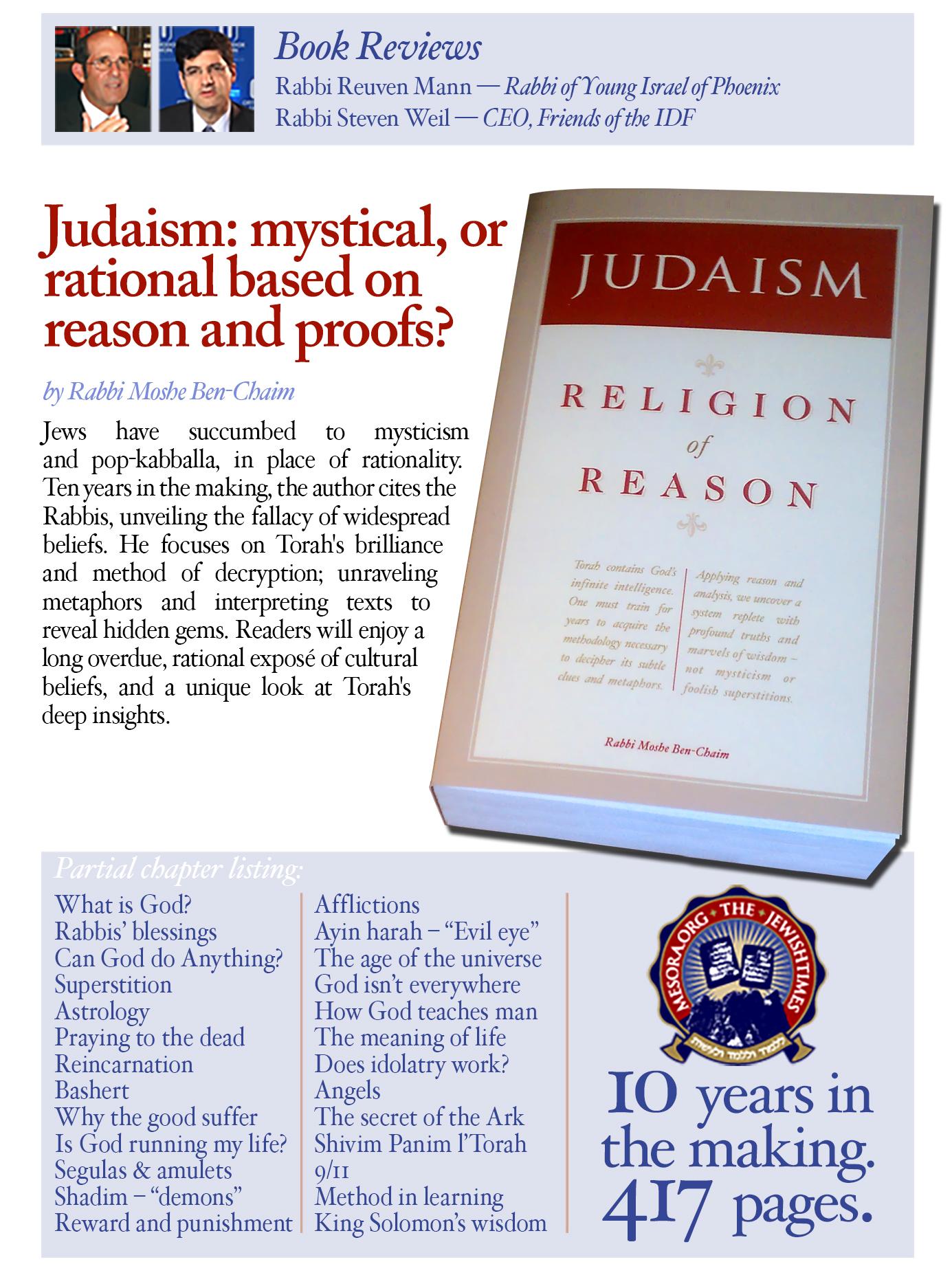
Is Judaism mystical, or is it rational, based on reason and proofs?