





Just click any icon in this


Just click any icon in this


The rabbis’ words are perfectly chosen and insightful 5
RABBI MOSHE BEN-CHAIM
A strange allegory about man and angels unveils how our emotions destroy us
RABBI MOSHE BEN-CHAIM
Even wise psychological plans can fail
RABBI MOSHE BEN-CHAIM
Torah‘s cryptic methods of teaching psychology
RABBI MOSHE BEN-CHAIM
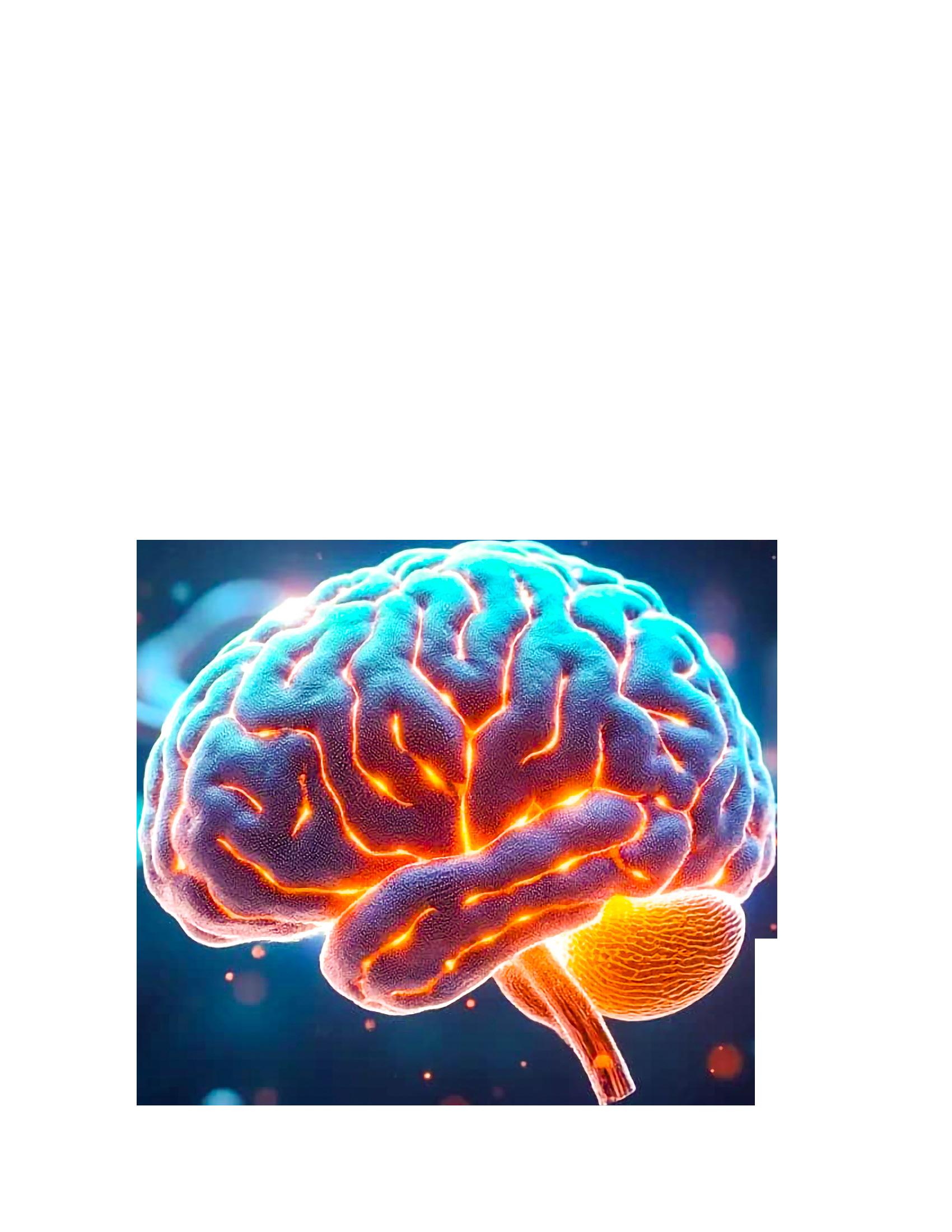
The mind’s components and dynamics
RABBI ISRAEL CHAIT
Two crucial rules for understanding God’s intended lessons

“Blessed are you God, our God, king of the world, Who recalls the treaty, and is trustworthy in His treaties, and fulfills His word.”
God promised Noah He would never flood Earth again. He gave the rainbow as His sign of this treaty. The rainbow is a testament to all future generations. Upon seeing rainbow, we recite this blessing to God. The rabbis deemed certain ideas necessary. What are these ideas?

RABBI MOSHE BEN-CHAIM
ALEX: I was reading Rabbi Chait’s book on Koheles. My question is, if someone chooses to focus on chessed as opposed to chochmah, is that a fantasy pursuit?
RABBI: There can be no chessed without chochma.
ALEX: Can you explain why that is? An am haaretz can't do chessed?
RABBI: This is because all truths emanate from God's wisdom. Man does not innately know anything. He must study all areas using Torah as his starting point. But without studying God's definitions of chessed and all matters, man may be far from the truth. An example of misguided chessed are the French doctors who treated the ailing Arafat. In God’s justice, a murder is not saved. God instructed King Samuel to kill King Agag. God commanded Moses to wire out the 7 nations. God Himself flooded the Earth in Noah’s generation. ■


“Who recalls the Treaty” This is a praise of God’s knowledge: God is all-knowing, regardless of the passing of 5000 years since His oath.
“He is trustworthy in His treaty” Recalling His word is one good trait, but we must also be aware that God is truthful: His word is unwavering.
“He sustains His word” We cannot o er half-praises to God; we must be as complete as possible. Brachos 54a says, when arriving at a place where God saved us with a miracle, we praise God for that miracle, but must also include praises of other instances of God’s salvation. Our praises must be all inclusive. Here too, we cannot praise God for keeping only His treaties, but we praise Him for all cases where He upheld His word.
Rabbi Chait explained a beautiful reason why the rainbow was the sign. As I recall, Rabbi Chait explained that the rainbow is the fragmentation of white light into its seven component colors. When God brought the flood, He fragmented all the laws of nature: there was constant rain, well springs, and there was no seasons or day and night (Gen. 8:22). This parallels the fragmentation of the rainbow. That's why the rainbow is fitting as a sign that God will never again fragment the laws of nature and bring a flood. ■
How envy, lust & honor destroy us


Rabbi Elazar Hakafar said, “Jealousy, lusts and (seeking) honor remove a person from the world (they destroy him).”
(Ethics 4:21)
“These traits–even one–undoubtedly forfeit trust in the Torah, and (thereby) the status of intelligence and character won’t be attained.” (Maimonides)
With these faults, a person is either ego-driven (jealousy/honor) or he is driven by desires. Thus, he does not engage his mind. He is unaware of external wisdom and his internal flaws. He seeks to embolden his stance of egocentricity or feeds his lusts. He has no objectivity. But conquering these are essential if one is to advance in Torah, which is a pursuit if the mind, and external to the self. Also, Maimonides teaches that one must attain good character if he
is to learn Torah (Laws of Torah study 4:1). For a person of poor character will reject laws that oppose his lusts. He will find recognition of God fails to feed his ego. To partake of the life God intended, our focus must be engaging intelligence and reason to study the world and Torah, and to control our desires which enable the former. Only then will we attain true happiness, which is only found in wisdom.
Rashi cites a startling alternative explanation:
Jealousy refers to the angels who saw Adam the First enjoying roasted meat and wine and saw Adam's honor, and were jealous.
That’s some midrash! And it must be midrash (allegory), as Adam was prohibited from eating meat. This midrash presents many questions.
One: Ethics of the Fathers (Pirkei Avos) is written for man, not for angels. So why is this explanation concerned with the jealousy of the angels?
Two: Angels are not human, thus they have no psyches and no capacity for emotion, including jealousy.
Three: Another di culty in Rashi is that he further says that the honor that removes man from this world refers to “the creation of angels which caused Adam to be exiled from the Garden of Eden.” To what honor does Rashi refer, and how does this dynamic operate?
Four: Rashi conflicts with the Torah's account, which attributes Adam’s exile to eating from the Tree of Knowledge, causing his mortality, thereby being exiled to prevent his eating from the tree of life. How then can Rashi suggest the creation of angels caused Adam’s fall?
Apparently this alternative explanation which Rashi cites is a play on the word “Adam”: “Adam the first is driven from the world” through envy, lust and honor. While Maimonides above refers to all human beings, this explanation in Rashi is referring to Adam alone. (But as Adam the First was the prototype human, this lesson applies to all generations.)
The strong questions are that the mishna says that jealousy destroys “man” not angels— it’s not discussing the angels’ jealousy. Further, man was driven from Eden due to eating the fruit, not due to the angels’ honor. What is this “roasted meat and wine”? How can angels be envious, they aren’t human?
Let’s review what transpired in Eden, for it is here that we will find the answers:

And the snake was the shrewdest of all the wild beasts that the God had made. It said to the woman, “Did God really say, ‘You shall not eat of all trees of the garden?’” The woman replied to the snake, “We may eat of the fruit of the other trees of the garden. It is only about fruit of the tree in the middle of the garden that God said, ‘You shall not eat of it or touch it, lest you die.’” And the snake said to the woman, “You are not going to die, but God knows that as soon as you eat of it your eyes will be opened and you will be like divine beings who know good and bad.”
When the woman saw that the tree was good for eating, and lustful to the eyes, and that the tree was desirable as a source of wisdom, she took of its fruit and ate. She also gave some to her husband, and he ate. Then the eyes of both of them were opened and they perceived that they were naked; and they sewed together fig leaves and made themselves loincloths (Gen. 3:1-7).
The rabbis argue whether the snake was literal or not. But either way, it mirrors Eve's instinctual drives as she followed its advice. As Maimonides says, “The snake did not
approach or address Adam, but all his attempts were directed against Eve” (Guide, book II chap. xxx). This means that the snake was some thing that could relate only to Eve, and no one other: it represented Eve’s instincts. Therefore when the “snake is speaking,” it really means that Eve’s emotions are attempting to mislead her.
“And the snake was the shrewdest”
What was so shrewd in the snake’s words? It belittled the threat. Interpreting the snake’s words as Eve's desires, Eve sought to minimize the prohibition. But why? What was so special about this one fruit?
You see, it wasn’t this fruit per se; it was the “restriction.” “Did God really say, ‘You shall not eat of all trees of the garden?’” instincts found restriction unpleasant. Eve felt: “It’s only one fruit we can’t eat, all others are permissible.” This diminished the significance of the prohibition. The shrewdness of the “snake” refers to the shrewdness of the

instincts over all other psychological faculties. One’s desires can distort reality, “The fruit isn’t really bad.” But even after the “snake spoke,” Eve noticeably had to take another step: she had to fantasize the “value” of the fruit in her plans:
When the woman saw that the tree was good for eating, and lustful to the eyes, and that the tree was desirable as a source of wisdom, she took of its fruit and ate.
So although Eve’s own emotions (snake) excited her passions, she needed one more step before she could sin: fantasy. Maimonides says:
The snake had a rider, the rider was as big as a camel, and it was the rider that enticed Eve: this rider was Samael (Ibid.).
This means that the snake (instincts) alone do not move a person to action, but it requires a “rider,” one’s imagination that blinds them from truth. “Samael” means to blind. That fantasy state creates a value system. And only then does one act, as one must feel justified in all their actions
self-image of greatness. In sinners, instincts are driven by fantasies. But in the righteous, the instincts follow proper values and a longing for Torah study.
Let’s now review Rashi’s alternative explanation and show how it perfectly parallels Genesis:
Jealousy: “You will be as divine beings” … The woman saw that the tree was good for eating” God created man with tremendous knowledge (Ibn Ezra). Man knew of God's creation of angels. Adam and Eve knew that they could enjoy food, while angels could not. Of course they did not have meat because it was prohibited to them, but this alternative explanation is depicting a state of “unrestricted” pleasures, as if he was having the most delicious “roasted meats and wines.” Now, Adam, while enjoying his state that he had physical enjoyment while the angels did not, one thing stood in his way of complete satisfaction: that prohibited fruit. Adam and Eve compared themselves to the angels, they saw they had food and angels did not. Reflecting upon their abundant pleasures, focused a spotlight on the one prohibited food. This
metaphor, but it's the rabbi's method of showing us the psychological dynamics in Adam's and Eve's minds. Adam and Eve felt more fortunate than angels in one respect (as if the angels envied them). But what stood in the way of man’s full satisfaction was restriction, the prohibited fruit. Adam and Eve were both envious of that fruit. This is why angels are brought into this alternative explanation, as they evoked Adam and Eve's envy and intolerance of restriction.
So Pirkei Avos is saying it may not be your own envy, but even if you feel you are envied by others (angels), this too destroys you. For it awakens what Adam and Eve did not have.
Lusts: The forbidden fruit was “lustful to the eyes.”
Honor: “God knows that as soon as you eat of it your eyes will be opened and you will be like divine beings who know good and bad.”
Adam and Eve sought greatness. When Rashi says, “The creation of angels caused Adam to be exiled from the Garden of Eden” He means the existence of angels awoke man’s desire to be like them. That’s
Jews insisted on a reconnaissance mission, to which Moses agreed, but God did not (Deut. 1:23, Rashi). Thus, the mission expressed distrust in God. From their very request, Moses understood the nation had great insecurities, explaining why Moses prayed that Joshua be saved from the evil counsel of those spies. Moses did not reject the reconnaissance mission, because had he refused, the nation would grow suspicious.
The twelve spies spied-out Canaan for forty days. Except for Joshua and Caleb who defended God and a successful conquest, the ten evil spies returned with an evil report, and incited a riot, frightening the people with the reports of “giants who eat the inhabitants of the land.” Caleb hushed the people before Moses and said, “Let us by all means go up, and we shall gain possession of it, for we shall surely overcome it” (Num. 13:30).
Rashi comments:
“Caleb hushed the people before Moses” — This means he silenced them that they should hear what he was going to say about Moses. He cried aloud saying: “Is this the only thing the son of Amram (Moses) has done to us?!" One who heard him thus speaking believed that he was about to disparage Moses, and because they felt negative towards Moses through the spies’ statements, all of them kept silent to hear Caleb’s disparagement. However, Caleb said: “Did not Moses also divide the Red Sea
Jews sinned by believing the spies’ negative report of the land. They were sentenced to 40 years in the desert, except for Joshua and Caleb, about whom God said the following:
But My servant Caleb, because he was imbued with “another” spirit and remained loyal to Me—him will I bring into the land that he entered, and his offspring shall hold it as a possession (Num. 14:24).
Rashi comments:
The word “another” suggests that Caleb was filled with a twofold spirit — one with which he spoke to the spies (with his mouth), and another spirit which he concealed in his heart. To the spies he (lied) saying, “I am with you in your counsel”, while in his heart he had the intention to tell the truth, and it was only on this account that he possessed the power to silence the people (Ibid.).
Rashi explains God’s meaning: due to Caleb’s dual personality Caleb was able to silence the people to hear him. As the evil spies and the frightened nation thought Caleb too was against Moses and God, when Caleb called to the people, all turned quiet as the nation thought he would disparage Moses even further. The nation was insecure like the spies, and sought even more attacks on Moses to justify their fears. One who speaks Lashon Hara acts the same.
Who is a gossiper? One who collects information and [then] goes from person to person, saying: "This is what so and so said;" "This is what I heard about -
tions on his own, as he might be doubted and be ostracized. He craves social approval, he is a
others to side with him, making it harder for the
nation did the same. The spies rallied the nation behind their insecurities, and the nation sought
And it was only on this account that he possessed
Rashi teaches that as Caleb fooled the spies during the 40 day mission, all those around him thought Caleb would disparage Moses, so they all let him speak. Caleb then defended Moses and God. This was Caleb’s plan from the outset. Although already knowing the spies were biased against the land prior to the mission, Caleb joined the mission for the only way to defend the land as good, was only if he was an eyewitness. Otherwise he could not credibly oppose the spies when they returned with an evil report.
We see that Moses only prayed for Joshua that he should be saved from the evil counsel of the spies, but Moses did not pray for Caleb. This must be because Moses saw that Caleb was independent enough and did not need a prayer to guard him. Certainly Caleb too detected the same evil intent that Moses saw in the ten spies. Therefore, Caleb had a plan to lie to the spies while he was with them for those 40 days, knowing full well that the spies would come back and accuse Moses and lie about the goodness of Canaan. By fooling the spies, Caleb would have to have the ability to speak, and counter their lies. The ability to counter them only existed because they thought that he too was agreeing with their evil counsel. Thus, they gave him time to speak up. But had the spies seen that Caleb was not with them in their evil counsel, either they would have killed him (Joshua 14:7, Radak), or they would never have let him talk upon their return to the people with their report.
Caleb’s plan was wise, but it failed due to the evil hearts of the spies and the nation. ■

Mention “religion” or “God” to some people, and they cringe or change the subject. But discuss science, and you evoke no emotional response. Why?
Rabbi Moshe Ben-Chaim
Unfortunately, Bible (Torah) is not viewed as valid and true, as is science. This is because Bible asks us to conform our beliefs, actions and values; Bible imposes walls that impede the attainment of our desires. Bible feels authoritarian, restrictive and unpleasant, ripping us away from our freedom to chase any pleasure or desire; we cant tolerate losing the “free” part our freewill. On the other hand, science relates to the physical world and not to how we must think, feel or act. Science is impersonal, evoking no resistance from us, and it’s quite tangible and “real.” Scientific fact does not compete with our wishes. It is Bible’s opposition to our feelings and its assumed irrelevance to our happiness that generates a resistance to explore Bible and value it. We feel religion is optional, while science is fact. However, our feelings do not accurately assess what’s real and what provides happiness. Bible’s restrictions are no grounds for viewing it any less valid and beneficial than science. God created both Bible and physical creation; both equally represent what is real and beneficial. Whether a subject matter relates to the physical world like geology and biology, or if the subject governs our practices like justice and philosophy, all subjects are equally God’s creations. All subjects are created for man’s benefit, as the greatest minds have always taught. We need to get passed our emotional reluctance to Bible’s laws, and view it on par with science. To be happy, we follow natural law and don’t defy it; leaping from a cli or injecting poison leads to death. Just as defying natural law has consequences, ignoring God’s lessons for attaining happiness too ends in dissatisfaction and unhappiness. King Solomon’s book Ecclesiastes (Koheles) addresses this. He studied human happiness and sadness, and found that human emotions lead to poor decisions that o er no happiness. While following God’s Bible directs man not only to the most harmonious life, but Bible’s wisdom is startling and satisfying.
Just as God’s physical creation benefits man, His Bible which teaches psychology, philosophy, ethics and human perfection also targets
human benefit. But benefit is only one purpose. Physical creation and Bible also bear God’s brilliance, which enamors man. God designed physical creation and Bible in a manner where our exploration uncovers infinite wisdom. Such study o ers man the greatest enjoyment. Great thinkers like Maimonides, Rashi and countless sages spent their lives studying Bible and Talmud. They found complete fulfillment in exploring the depth of Torah wisdom. Bearing this in mind will fuel our impetus to uncover brilliance within God’s Bible, driving us to be dissatisfied with mediocre and infantile Biblical explanations. Just as we would not accept a theory of “accidental arrangement” to explain the perfectly complimentary systems within the body (circulatory, respiratory, digestive, etc.) we must equally not accept childish, mystical or simple Biblical explanations. Bible and science are not simple, but are precisely and brilliantly designed. I will now give you an example of Bible’s astonishing wisdom. It is amazing.
Burning the Red Heifer is a “chok” (Biblical statute), which is misunderstood as a law bereft of reason. On the surface, burning a cow of a certain color seems quite odd, and even primitive. Rashi appears to comply with this sentiment that a chok is without reason:
Because Satan and the nations of the world taunt Israel saying, “What is this command and what is the reason for it?” Therefore it is written ‘chukas’: “A decree from before Me (says God) and you have no permission to be suspect about it [to find a flaw]." (Rashi on Num. 19:2)
A simple reading of Rashi would imply not to think into this law. But we must understand God’s plan behind His 2 realities: the natural world and Bible.
His universe reveals brilliance: in material substance itself, in its designs, and mostly in natural law. This indicates God’s desire to share His wisdom with beings that can perceive it. All God’s acts and creations contain the greatest wisdom. And one of the most astounding creations is the human intellect. Therefore, to suggest that chukim (statutes) are bereft of any wisdom, denies this fundamental that God permeates all with His wisdom, as He desires man to derive great joy by appreciating His wisdom. Both, nature and Bible were designed with the intent that man recognize the Creator’s abundant brilliance in both.
Rabbi Israel Chait once distinguished between mitzvah and a chok: Mitzvah is a law which a person would arrive at with his own thinking, such as murder and stealing. But chok is a law that man would not arrive at on his own, such as wearing black boxes (tefillin), resting on Sabbath as a way of recognizing God, or laws of kosher. However, this does not mean that these laws do not share the same brilliance as every other law. Chok is distinguished from mitzvah only in the fact that man would not have innovated such a structure, but not that they are bereft of great wisdom. What then is the reason behind the Red Heifer? Rabbi Israel Chait taught that a human being cannot state with any certainty what the primary goal is of any mitzvah or chok [only God knows for certain], but we can identify its benefits.
What Rashi means by not being “suspicious” about this law, is that one should not view it negatively or emotionally, or make one’s understanding the determinant of following it. But certainly one should intelligently investigate every law and seek its profound ideas, just as one seeks wisdom in nature. We learn that King Solomon knew the reasons for all laws—including chukim—except for some element of the Red Heifer. That means that he
understood the ideas contained all other chukim. Thus, chok—a statute—has reasons like all other laws.
It is also notable that the beginning of Rashi where he says that Satan (i.e., man’s instincts) and the nations of the world (who are lacking understanding) are the only ones that find fault with the Red Heifer. The deduction is that the intellect and the Jewish nation do not find fault with it. This supports the idea that even a chok reveals God’s brilliance. Let’s now understand the Red Heifer.
I understand that a person who speaks evil and degrades others (Lashon Hara) has committed a crime. Thus, remedial action is required. But what about fulfilling a mitzvah of burying the dead: why is there a response of sprinkling the ashes of a Red Heifer on one who was in contact with the deceased? Meaning, why should a mitzvah of burial require a remedial act? Remedy for what? Additionally, why were the Jews in Egypt who fulfilled the command of the Paschal Lamb required to paint their doorposts and lintels with the lamb’s blood? In these two cases, the Jews fulfilled God’s command. A remedial act suggest the presence of some flaw in mitzvah. But that is incoherent. Again, Torah has no remedy for one who prays, or makes a blessing, or performs any other mitzvah: the mitzvah is constructive, and what is positive, cannot require a remedy! Remedy only follows a negative or a destructive matter. Yet, one who buries the dead or sacrificed the Paschal Lamb—God’s commands—requires some additional act. It’s di cult to grasp a remedial need for a mitzvah. As always, God’s generous clues are found in all mitzvahs.
When burning the Red Heifer into ashes, the Torah commands us to
throw into its flames a cedar branch, a hyssop plant, and a red string. Very unusual. Ibn Ezra writes:
This [the cedar, hyssop and red string] is just like the leper, and there I hinted to a principle (Ibn Ezra, Num. 19:6).
Ibn Ezra is referring to his commentary on Leviticus 14:4:
Behold, the leper, the leprous house, and the defilement by contact with the dead are related…and behold, they too are similar to the form of the Egyptian Exodus.
Just as the cedar branch, hyssop plant, and the red string are remedial for one who was in contact with a dead person (Red Heifer), Leviticus 14:4 commands that the leper—the speaker of evil—in a remedial practice which also include these same three items. Nowhere else in Torah are these found. Quite intriguing! What’s the connection between death and evil speech?
Regarding the leper, two birds are taken; one is killed, and the live bird together with the cedar branch, a hyssop plant, and a red string are dipped in the dead bird’s blood and the live bird is let loose over a field. Regarding the Exodus, Ibn Ezra refers to the practice of dipping the hyssop in the lamb’s blood and painting the doorposts and lintel. Here too the hyssop is used, but we note the omission of the cedar branch and red string.
Ibn Ezra points us to three seemingly unrelated institutions that share identical elements, a cedar branch, a hyssop plant, and a red string. These three are burnt with the Red Heifer, they are bloodied in connection with the leper, but the hyssop alone is used in connection with the Passover Exodus during the plague of the firstborns, as the Torah says:
And you shall take a bunch of hyssop, and dip it in the blood that is in the basin, and strike the lintel
and the two doorposts with the blood that is in the basin; and none of you shall go out of the door of his house until the morning. For the Lord will pass through to smite the Egyptians; and when He sees the blood upon the lintel, and on the two side-posts, the Lord will pass over the door, and will not suffer the destroyer to come in unto your houses to smite you (Exod. 12:22,23).
The Rabbis note that the hyssop is the smallest plant, and the cedar is the largest. What is that clue?
My friend and Torah educator Jessie Fischbein said, “Death creates distortions.” I thought about her words and immediately realized she was keying in to the common denominator. All three cases deal with death. The Red Heifer removes ritual impurity from one who was in contact with the dead; the leper’s speech was a crime of character assassination (the Rabbis teach evil speech equates to murder), and the lamb’s blood saved our firstborns from the Plague of Firstborn Deaths. In all three cases, a person was somehow related to death. The fact that all three cases require some remedy, indicate that without that rite, man is left in unacceptable conditions. What are those conditions? Interesting is that once Adam sinned in the Garden of Eden, God feared he would eat of the Tree of Life and live forever. Therefore God placed cherubs (childlike figures) and a flaming spinning sword to guard the path to the Tree of Life (Gen. 4:24). Meaning, as soon as man sinned and he received the punishment or death, he immediately desired immortality. But God did not allow man to attain immortality through the Tree of Life. Instead, God struck a balance in man’s imagination: he would perceive his youth (cherubs) while also confronting the unapproachable spinning sword which represented his death. God deemed it proper that in place of the extreme which Adam desired—immortality through the
Tree of Life—an equilibrium be achieved.
He hath made everything beautiful in its time; also He hath set the world in their heart, so that man cannot find out the work that God hath done from the beginning even to the end (Koheles 3:11).
Ibn Ezra comments, “Everything beautiful in its time” refers to death in old age, while “He hath set the world in their heart” refers to the feeling of immortality. While death is a reality, and man cannot lie to himself that he is immortal, he also cannot face his death daily; it is too morbid. Man requires a sense of permanence if he is to live happily. A balance is again detected in this verse. How does this apply to our three cases?
Why does a person who performs a mitzvah of burying the dead require the ashes of the Red Heifer be sprinkled on him? He did nothing wrong, and in fact, he had no choice but to follow God’s command of burial. Furthermore, what is this strange practice? It is not only errors or sins that require religious remedial practices, but even positive actions can negatively a ect us. Jessie is correct: when one is in contact with the dead, we notice a denial. The tension at funerals evoked by facing one’s own death generates powerful denial. People find funerals di cult, and will laugh hard at the smallest drop of humor: a release of powerful negative emotions. Like Adam, funeral attendees “rush for the door” seeking immortality. But that extreme (the immortality fantasy) is as equally unhealthy as harping on our day of death, however true it is. Contact with the dead creates a denial that must be corrected. We are not allowed to deny our mortality. The “ashes” of the Red Heifer signify that a body—human or animal—is but dust or ashes. The body is not the definition of a human being. (CONT.

When confronting the dead, we must immediately correct our denial of our own mortality by embracing the ashes sprinkled on us, to remind us through proxy, that just as the heifer is ashes, we too ultimately pass on. When faced with death, and we rush to deny it, we must strike a balance. The one who speaks evil “kills” another through character assassination. He did not treasure life, similar to one who murders. In his fantasy alone, through evil speech, he thinks he has “set things aright.” God does not approve of a person venting his aggression. This extreme requires a fix. The evil talker is smitten with leprosy, which Aaron said is like death (Num. 12:12). He must also shave his head, eyebrows and all hair. Why? One’s identity is very much tied to how he wears his hair, and his personality is expressed with his eyebrows. One would have di culty distinguishing two people who were both hairless. It is safe to say that God created di erent hair colors and di erent hairstyles so people are distinguished. Now, when the leper is shaven and has no more hair just like infants at birth, his identity is lost to a great degree. His disregard of another person through his evil speech, is cured by his experiencing a loss of his own identity. This is compounded by the law that he must move outside of society. In Egypt, the Jews sinned through idolatry. Through the Plague of the Firstborns of those Egyptians and Jews who worshiped the lamb, their sins generated their deaths, and mitzvah (paschal lamb sacrifice) sustained life. The blood on the doorpost, through which the Destroyer might enter,focused the dwellers on the truth that worshiping the deity of Egypt caused death, and our mitzvah of the destruction of the deity secured our salvation. The doorpost of the home, through which the Destroyer might enter was the optimal location for all to ponder the absolute truth that the lamb: idolatry is absolutely false.
Death is too morbid to face daily. But immortality too is false. The Rabbis teach the hyssop and the cedar represent two extreme poles of a spectrum: the small and the large in plant life. Sforno teaches the harm of living at the extremes of any attitudinal spectrum is expressed through these two species and the red string that represents sin[1]. (The objects could have been a large and small rock, but something had to be used.) If one is too courageous or too cowardly, he cannot act properly at the appropriate time. A miser and spendthrift, or a sad or an elated person…any extreme is improper. King Solomon teaches that there is a time for every attitude (Koheles 3), meaning there are times not to follow that attitude. Thus, remaining at the pole of any emotional spectrum is harmful. The Red Heifer teaches that denial of death or embracing death—either extreme—is sinful. The evil talker’s carelessness for another person is countered by his reduction of identity. But just as the Red Heifer’s ashes are remedial, and not to be focused on as a permanent ends, the evil talker too must regrow his hair. A remedial rite is temporary by nature, just enough medicine to cure the disease and redirect the person back to an equilibrium[2]. We now appreciate how these seemingly out-of-place plants point to a fundamental lesson and remedy.

But why is the hyssop alone used in connection with the Paschal Lamb? This is because there is no extreme in this case from which we must bounce back. Here, the death of the Egyptian deity is an absolute truth: idolatry is absolutely false. Thus, there is no lesson of two harmful extremes, as is so regarding the Red Heifer and the leper. And our fear of death has been calmed by the lesson that sin brings death, whereas mitzvah secures life. The purpose of painting the doorposts with blood has been explained.
(CONT. ON NEXT PAGE)
Ibn Ezra teaches us that death a ects man uniquely, it requires a unique address, and there are a few related Torah cases that share a bond, indicated by the use of the same three species. Proximity to death frightens man, causing him to flee to the opposite pole of immortality, but this extreme is false. Death is also used regarding the leper where he initially had disregard for life; he must be bent back to the other extreme where “he” loses his identity. But why did God choose the phenomenon of death per se to teach the harm of extremes? I feel this is due to the nature of the immortality fantasy…
Rabbi Israel Chait taught that King Solomon’s work, Koheles, is based on this fantasy. Meaning, all of man’s drives depend on the immortality fantasy. Man would not fantasize about any pleasure, plan, or sense any ambition, if he truly felt death was imminent. Under every emotion lies the feeling of immortality. Rabbi Chait wrote as follows:
“One generation passes, and another generation comes; but the Earth abides for ever (Koheles 1:4).”
The Rabbis teach, “A person does not die with half of his desires in hand. For he who has a hundred, desires to make of it two hundred.”[3] This means that the fantasy exceeds reality. King Solomon addresses one of the two fantasies that drive people. One fantasy is regarding objects or possessions. The second fantasy deals with man’s feeling of permanence. Man’s fantasies make sense, but only if he’s going to live forever. An idea has two parts: 1) the idea itself, and 2) the emotional e ect of the idea. Every person knows the idea that he or she will die. But the emotional e ect of death is usually denied. This enables man to believe his fantasy is achievable. It is impossible to live
without the fantasy of immortality. It expresses itself one way or another.
The meaning behind this verse is that the average person looks at life as the only reality. He cannot perceive himself as a single speck in a chain of billions of people and events, where he plays but a minuscule role, and passes on. Any feeling man has of greatness comes from the feeling of immortality. Immortality never reaches into lusts; only ego. Here, King Solomon places the correct perspective before us. We look at the world as starting with our birth, and as dying with our death. As soon as one sees that his life is nearing its end, he cannot enjoy things anymore. The enjoyment of things is tied to the belief of an endless lifetime in which to enjoy them. Man’s attention is directed primarily toward his well-being. If a life-threatening situation faces man, this is the most devastating experience; everything else doesn’t make that much di erence to him. Once a person faces death, all fantasies of pleasures don’t carry much weight. Rashi says on this verse, “Who are those that exist forever? They are the humble ones that bow down to the ground.” Rashi means there is in fact an eternity: this is for righteous people—tzadikim—expressed as those who humble themselves, “bowing to the ground.” The soul of the tzaddik will endure forever.
As man is most excited about his mortality, and is driven primarily by the immortality fantasy, it is most appropriate that God teaches man not to follow his extreme tendencies in this area.
Death is disturbing, but we cannot deny it. The Red Heifer’s ashes remind us that our physical life is not permanent: we all return to dust and ashes[4]. We need this reminder when we come in contact with the dead: a traumatic moment in which we deny our own mortality. We also cannot
disregard the life of another through evil speech. If we do, we have gone to another harmful extreme of degrading others to raise ourselves, so shaving our hair reduces our identity, temporarily, to help us bounce back to a correct equilibrium. God signaled the sinful nature of extremes using plants of extreme size di erences, and including the “red” thread that signifies their sinful extremes. Torah refers to sin as red[5].
We are again awed by the perfection and structure of the Torah, where religious practice is designed to perfect man’s flaws. Whether we sin by evil speech, or are negatively a ected by a mitzvah of burial or the Paschal Lamb, God includes remedial acts that guide us on a life of truth. Thank you again Jessie for directing me to this fundamental. Bible and Science are equally real and valid, o ering equal brilliance and fulfillment. ■
Footnotes
[1] On Yom Kippur, the red string represented the Jews’ unforgiven state. And when it turned white, it indicated God’s forgiveness. Torah verses too refer to sin as red: “Come now, and let us reason together, saith the Lord; though your sins be as scarlet, they shall be as white as snow; though they be red like crimson, they shall be as wool (Isaiah 1:18).”
[2] Maimonides’ Laws of Character Traits addresses this topic.
[3] Koheles Rabbah 1:13
[4] Gen. 18:27
[5] Isaiah 1:18, Rashi on Num 19:22
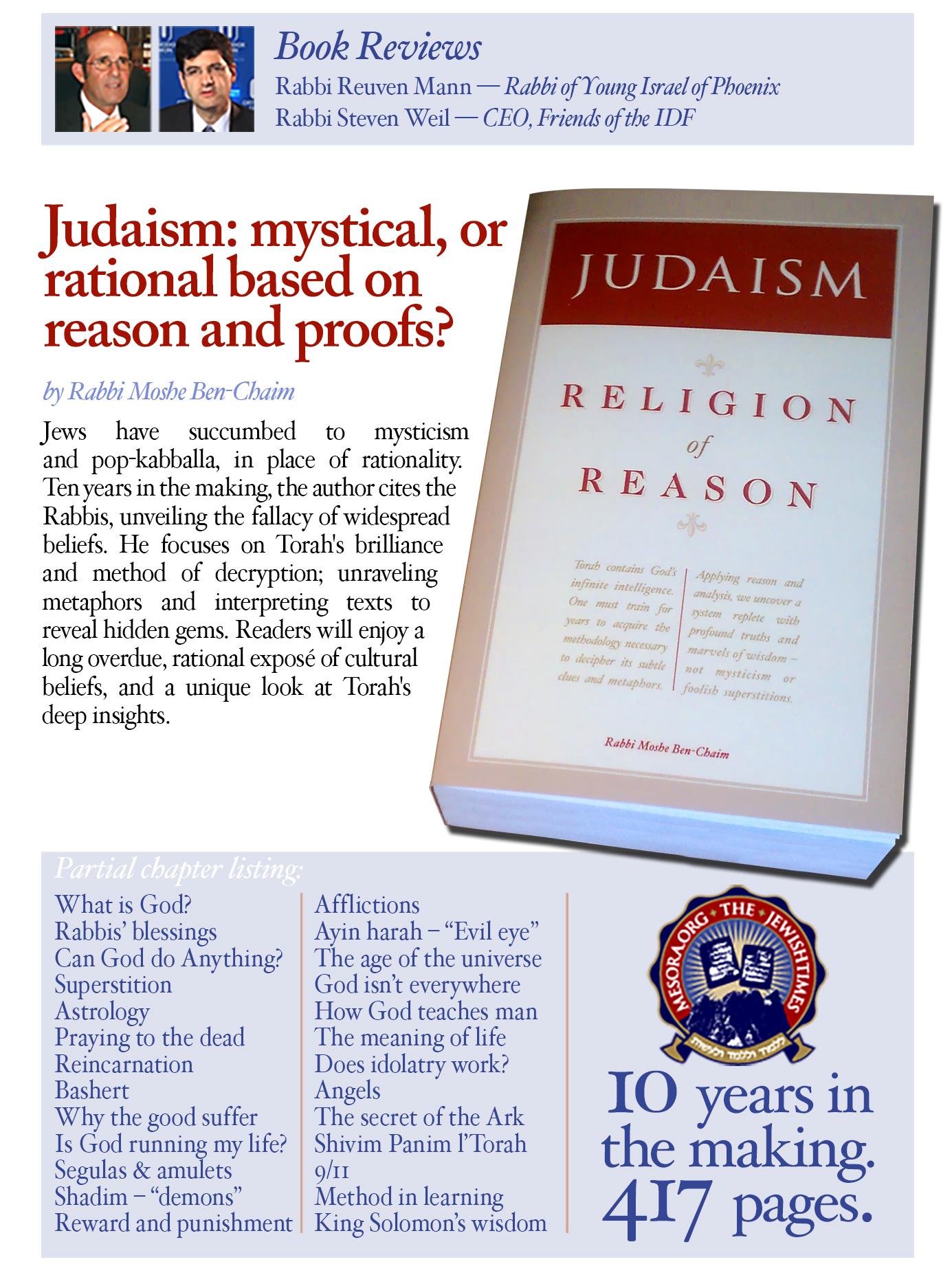
Is Judaism mystical, or is it rational, based on reason and proofs?



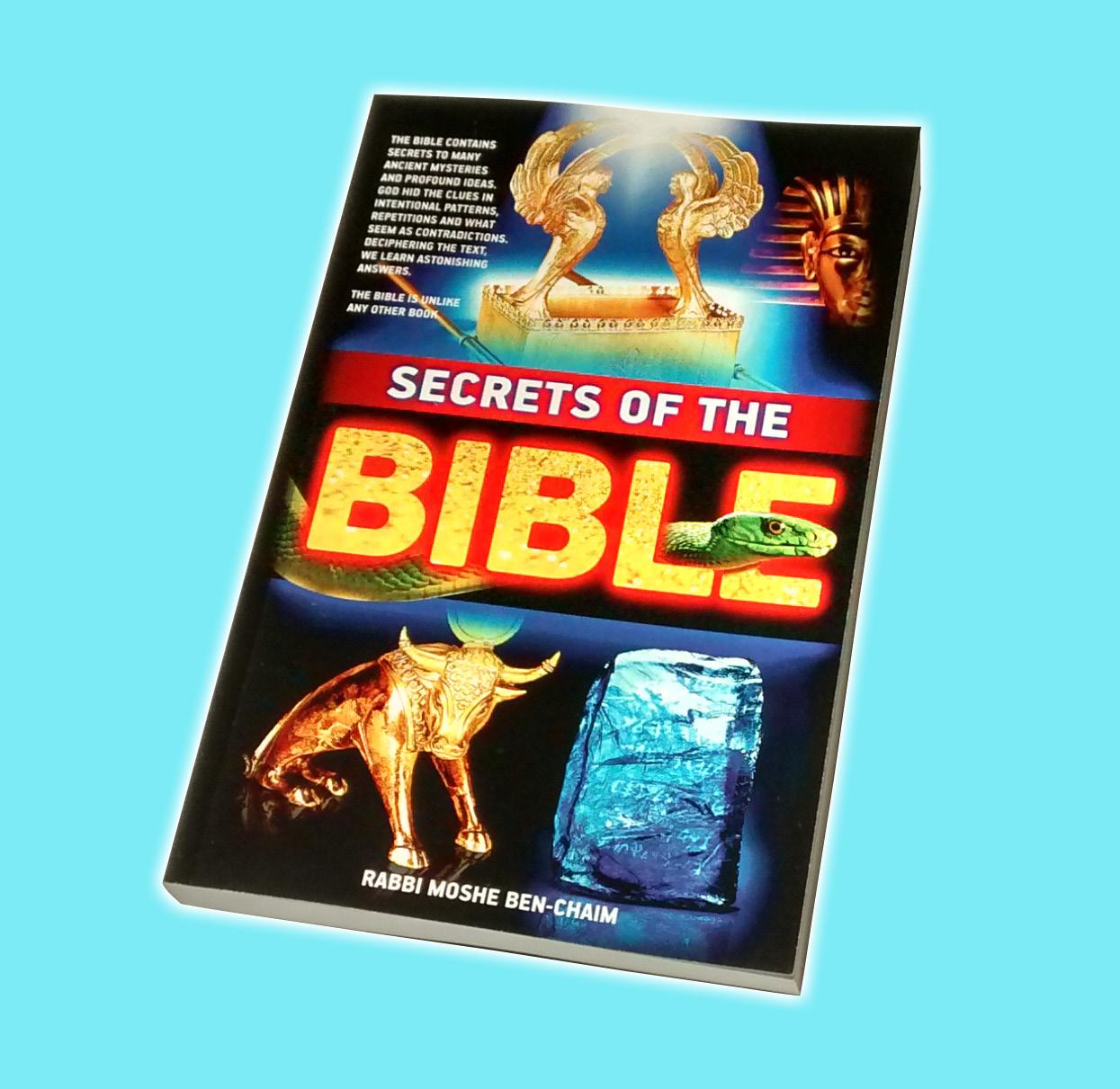
All books depict history, facts, theories, fiction or poetry. No book is coded with hidden messages beyond the words or patterns revealing marvels. But the Bible (Torah) was written by God, and is “coded.” The order of verses, use of certain phrases, apparent contradictions and other Biblical patterns are pur poseful clues to God’s wisdom.
This book unveils those patterns and shares the hidden messages.


RABBI MOSHE BEN-CHAIM
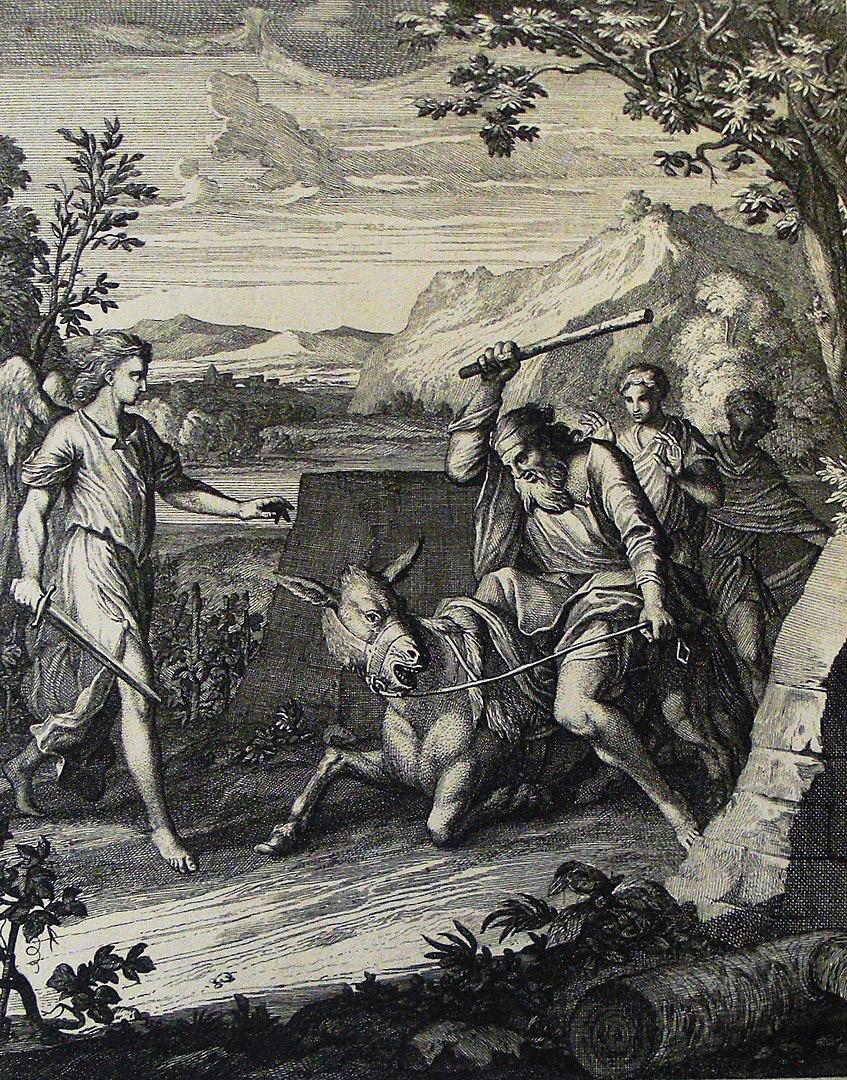
The story of Bilam and his donkey contains unbelievable events and is described in great detail. As the account in Numbers 22:21 goes, Balak was the king of Moav at that time and was faced with the fear of millions of Jews damaging his land by gaining safe passage. To avert this problem, Balak called upon Bilam, a Prophet, and requested that Bilam curse the Jews so that Balak would have ease in attacking them and in driving them out. When Balak sent the first group of messengers to Bilam, Bilam’s reply was that he must consult with God. God’s answer was that Bilam should not curse the Jews for they are blessed. Bilam informed the messengers that he was restrained from going by God’s word. Balak persisted and sent more messengers; now higher in rank. Bilam responded by saying, “Even if my house was filled with silver and gold I couldn’t go.” Nonetheless Bilam requested an answer from God. This time God gave him permission, however, he still must refrain from cursing the Jews. What happens next is quite remarkable. Bilam arose early and God was angry that he went. (This was after God gave him permission) God placed an angel in the path to deter him as he was riding on his donkey. Torah states that the donkey saw the angel standing in the path with an outstretched sword in his hand, and that the donkey turned aside and went into the field. Bilam hit the donkey to return it to the path. The angel stood a second time in the vineyard. There was a fence on both sides of the donkey and Bilam. The donkey saw the angel and pressed up against the wall in avoidance, crushing Bilam’s leg. Bilam continued to smite the donkey. The angel passed to a place that was narrow with no room to pass left or right. The donkey saw the angel and crouched down under Bilam and Bilam’s anger burned, smiting the donkey – this time, with a stick. God opened the mouth of the donkey and it said to Bilam, “What have I done that you have smitten me these three times?” Bilam responded, “Because you have mocked me. If there were a sword in my hand I would kill you.”
The donkey said, “Am I not the donkey that you have ridden upon from long before until today? Is it my nature to act this way?” Bilam replied, “No.” God then opened Bilam’s eyes and he
saw the angel of God standing in the path with a sword outstretched in his hand. Bilam then prostrated himself before the angel. The angel said to Bilam, “For what have you smitten your donkey these three times? Behold I have come out to turn you away because your way is contrary to me. Your donkey has seen me and turned aside these three times. Would it be that you would turn aside. Because now I would kill you and cause her (the donkey) to live.” Bilam says, “I have sinned. I didn’t know that you stood in the path to turn me aside. And now if this is bad in your eyes, I will return.” The angel informs Bilam that he may continue, but only that which he tells him may he say. Rashi states that the significance of “three” times represents two things: the three forefathers, and the three Jewish festivals. Ibn Ezra states that once the donkey spoke it died, and that with each successive hitting, Bilam used a stronger object.
Following are questions on this section, including the meaning behind both Rashi’s and Ibn Ezra’s statements:
1) Why didn’t Bilam see the angel of God at first?
2) What’s the significance of the sword?
3) Why, according to Ibn Ezra, did Bilam hit the donkey with a stronger object each time?
4) Why did the donkey die after it spoke?
5) What was the argument of the donkey?
6) Why wasn’t Bilam astounded at the ability of an animal to talk?
7) What does the fence allude to, and why did the path become more and more impossible to traverse with each appearance of the angel?
8) Of what significance is it that Bilam’s leg was crushed?
Maimonides states (Guide for the Perplexed, book II, chap. XLII) that every case in Scripture where we find an angel appearing or talking, the entire account is describing a vision, and not an actual physical event. The event didn’t take place in physical reality, but in a person’s mind. This being the case, this entire story must be interpreted in this light, according to Maimonides. This is a parable for a conflict with which Bilam was struggling.
If we refer to the events leading up to Bilam riding on the donkey, we see that Bilam comes o appearing as a true follower of God. But with a closer look, his true nature is seen. He was asked to curse the Jews. God told him he could not. The fact that Bilam (during the account of the second messengers) requests from God again to know whether he can curse the Jews shows that he wanted to curse them. That’s why he said, “God has restrained me from cursing.” Meaning that he really desired to curse, but God prevented him.
This desire to curse the Jews awoke in Bilam a strong conflict. On the one hand, he desired the destruction of the Jewish people. On the other hand, he knew that God blessed the Jews. Bilam was well aware that God’s establishment of His Providence over the Jews was due to our forefather’s perfection. Abraham’s self-realization of the absurdity of idolatry, his conclusion of the reality of monotheism and the oneness of God secured this treaty of God’s Providence. With this knowledge, Bilam was greatly troubled as to which path to follow, namely 1) his desire for the destruction of the Jews, or 2) the word of God. This entire account is a parable of his conflict.
Interpreting the elements of this story as representing psychological phenomena, the story’s real meaning can be explained.
Bilam, in great conflict, decides to travel to Balak with the goal of cursing of the Jews. In order to do so, he must suppress his knowledge of God’s command to refrain from cursing them. Riding on his donkey represents the suppression of what his conscience (the donkey) “sees.” “Riding” conveys dominion over another object. Bilam himself (in this vision) represents his evil instincts and thus, isn’t aware of reality (the angel of God). One’s instincts aren’t designed with the ability to judge what is morally good or evil. Instincts are not perceivers: they simply emote. This explains why Bilam couldn’t “see” the angel. Bilam, in this story, represents his instincts—a faculty of man unable to perceive. Instincts have only one function: they guide a person towards instinctual satisfaction.
The donkey represents Bilam’s conscience: the part of man that detects good and evil. The angel represents reality, or his intellect: the ability to perceive what is real and true. Bilam’s inability to curse the Jews was so threatening, it was represented by an angel of God wielding a sword, a very terrifying sight. The conscience, represented by the donkey, is designed to perceive and make value judgments. This is its main function.
Now that we understand the main components of the parable, (Bilam, his donkey, and the angel represent respectively the instinctual drive, the
conscience, and reality), we must interpret this account accordingly.
Bilam riding on his donkey is interpreted as his evil instincts are riding (suppressing) his conscience. His conscience alone is aware of the reality – “the donkey sees the angel,” but Bilam doesn’t. Whenever the conscience goes “o of the path,” it means Bilam’s conscience becomes more conscious, making Bilam sense his error. Therefore, Bilam suppresses his conscience – “hitting the donkey.” His conscience slows him down – “crushes his leg” – as he tries to go on his “path.” Bilam’s weapon for suppressing his conscience becomes stronger – “he hits the donkey with a stick.” Then the conscience finally prevails – “the donkey talks.”
The argument of the donkey is that “it’s not me who’s at fault” – meaning that Bilam gains insight (from his “talking conscience”) into his actions and realizes that there’s something behind his suppression of his conscience. At this point, Bilam becomes aware of his denial only through God’s kindness. That’s why God had to open his eyes. The donkey dying after it spoke means that once his conscience made him aware of this information, the conscience ceases to function –termed here as death. It did its job. It “dies.” Rashi’s statement that the three things shown to Bilam’s donkey alludes to the three forefathers and the three festivals fits in beautifully: the donkey – Bilam’s conscience – was contemplating the primary reason for God’s direct Providence over the Jews, namely the perfection of our forefathers – which entitled the Jewish nation to God’s Providence. Bilam’s conflict was directly caused by these three individuals (Abraham, Isaac and Jacob). Had it not been for them, he might have been able to curse the Jews. That’s why the donkey turned aside (Bilam's conscience experienced greater conflict) when it thought about the forefathers. Abraham, Isaac and Jacob brought about the relationship with God, and now, Bilam desired to curse them! But all curses are from God. We also see why Bilam acted calmly towards a talking animal, as Maimonides states, this was all a vision.
In summary, the entire account of Bilam and his donkey – according to Maimonides – was a vision or conflict, happening only in his mind. In order for the Torah to inform us of this, the Torah writes it as a metaphor so that many ideas and psychological principles can be capsulated into one account. A parable also conceals ideas from those who would shrug at them, if they were written openly. The fact that Bilam did travel to Balak in physical reality is not discounted by this explanation. ■

Rabbi Chait always says, “Let the words speak to you.” He meant that God’s precise formulations of the verses, if strictly followed, will convey God’s intended lessons, the words alone and nothing else will “speak to you.”
He also says, “What must you say?” He meant, do not say anything more than what the words must mean: the true interpretation must perfectly match the verse without forcing it. Torah is not redundant. Each verse must contain a unique message, so if you can plug your message into another verse, then you are wrong. ■