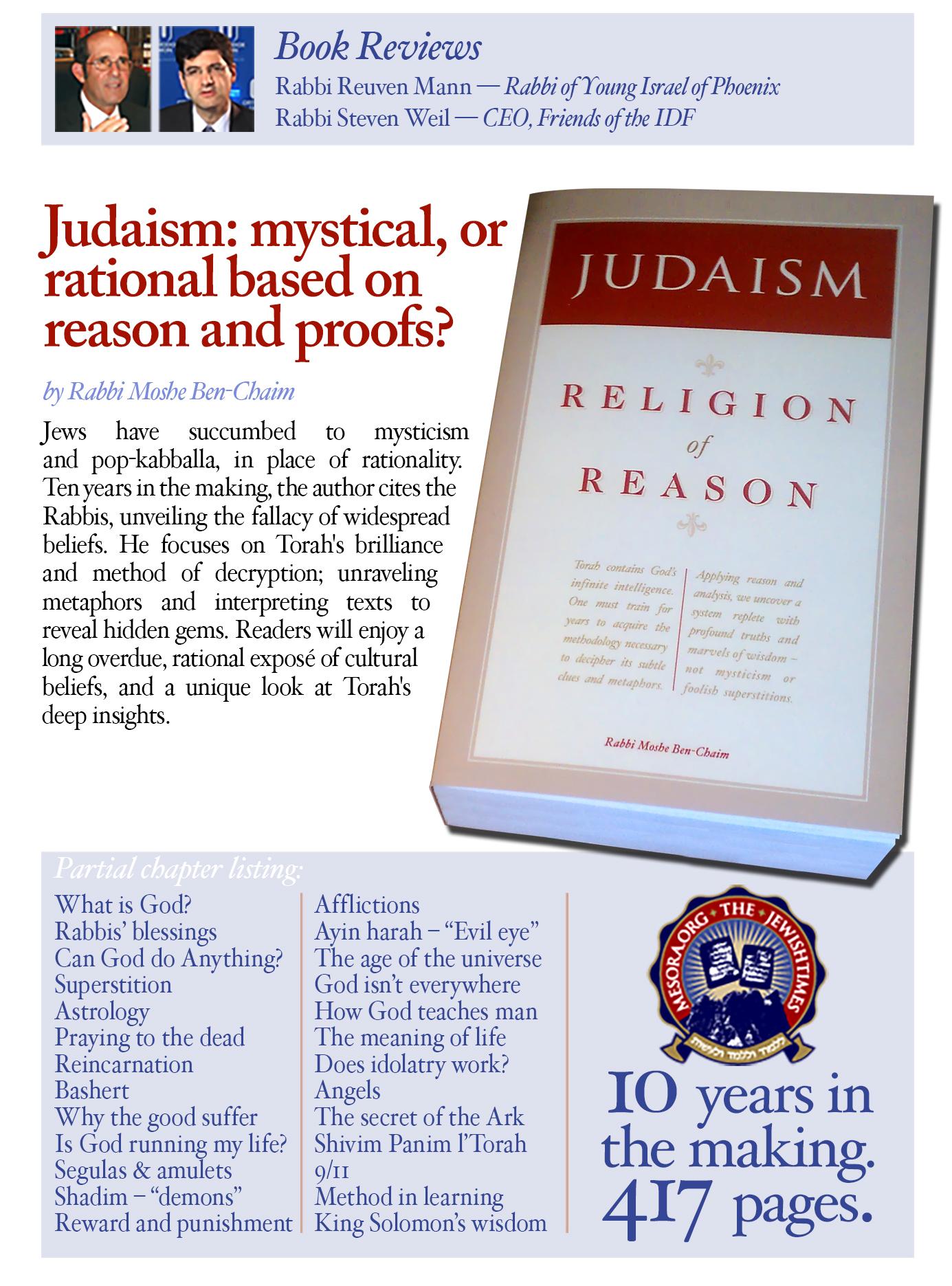
The Spies The Spies The Spies

Gematria God is First & Last Gematria God is First & Last Gematria God is First & Last

Just click any icon in






Gematria God is First & Last Gematria God is First & Last Gematria God is First & Last
Just click any icon in


| Please send letters and questions to: Comment@Mesora.org |
RABBI MOSHE BEN-CHAIM God’s words are perfectly chosen and insightful
RABBI ISRAEL CHAIT
• A comprehensive lecture on Lashon Hara based on Maimonides
• The Spies
7 Gematria Ibn Ezra’s rule applied
8 The Spies
RABBI BERNIE FOX
Harmony of Torah’s 2 accounts

REALITY
RABBI MOSHE BEN-CHAIM
|
“I am first and I am last and besides Me there is not other god” (Isaiah 44:6)
God being first means that everything else owes its existence to God. This strips the claim of power to all else, as everything is dependent on God for it's very existence. God being last means that all else has a limited duration, all else deteriorates and dies. Again this refutes claims of other gods, for how can any god be forced to cease existing? ■

Maimonides writes:
That area which man is advised to speak about, this is man’s purpose. If man can speak in this all his days, this is the purpose.
This means that the goal of abstention from negative speech is the engagement in the commanded type of speech (i.e., mitzvos, wisdom, perfection, and the like).
A person should act as he speaks, as it says, “Pleasant are words spoken from the mouth of one who performs them.” Also, “And the exposition [of Torah] is not what is essential, but the action” (Avos 1:7).
People are most influenced through their attachment to another person. When a person witnesses someone preaching but not practicing, that is harmful. It conveys that the ideas espoused do not have to be carried out in action.
“Tzaddikim sing of God; the pleasant praise is that of the upright [people who act]” (Psalms 33:1). This is why people degrade a person who learns but doesn’t care for the upkeep of a beis medrash (study hall.) By not living in a proper way, one creates a profanation of God. Most people never rise above this level of judging others by their actions as opposed to their speech. “And the exposition [of Torah] is not what is essential, but the action” refers to the e ect one has on others. People are a ected by personalities, not by one’s learning.
Why does our mishna say that silence is best, as opposed to saying that proper speech is best? The answer is that silence is the state of frustration that one undergoes when in the process of redirecting his energies. Silence is what perfects a person. This is followed by “The exposition [of Torah] is not what is essential, but the action”—teaching that although one’s own perfection is through silence, influencing others toward the good requires action.
Maimonides writes, “Always teach
students with brevity” (Hilchos Dayos 2:4). What is the harm in speaking at length? In fact, one of the ways to acquire Torah is through arichus sifasayim, elongated speech.
Maimonides does not refer to the number of words spoken. If the student requires a lengthier elucidation, the rebbe must accommodate him.
And so with words of Torah and words of wisdom, his words should be minimal. But if his words are many and the matter is small, this is foolishness. And on this it is stated, “A dream comes in great matters, and the voice of the fool in many words” (Koheles 5:2).
Man’s purpose is to partake in abstract ideas (truths). What prevents man from doing so is his emotions (which are expressed in speech). Therefore, man must avoid speaking too much even when discussing Torah. The part of the mind that avoids precise definitions (svara) is the same part of the mind that engages nonsensical matters. “Speaking minimally” refers to giving a precise definition, which is brief by nature. If one gives lengthy definitions, he is being descriptive and he is engaging the emotions/imagination.
When one’s explanation goes on and on, he is not keying in on the abstract essence of a definition that only the mind’s eye can see. He is engaged in imagination.
A person uses description instead of abstract concepts because he doesn’t believe in the abstract but in the physical representation of the abstract. And since he believes in the latter, he must deal with all representations. But a person who gives definitions deals only with the one abstract idea. Definition is briefer than description because it is the principle that defines the many cases and descriptions. (Namely, one can define “animal” as an animated instinctual creature without wisdom, or one can list many examples of animals. The former is briefer.)
Urging the teacher to use brevity—derech kitzara—the rabbis mean to teach in precise, yet abstract formulations. The final formulation must be brief, but one should discuss a matter [with elongated speech when necessary], which is one of the ways to acquire Torah. But if the final formulation is not brief, it indicates that the nonsensical part of the mind is involved.
“For a dream comes in many matters” (Ibid.). Behind all the matters there is one idea, but the representations are many.
Why? Because dreams are the language of emotions and the emotions are attached to every physical representation and image. “And the voice of the fool [comes] in many words” (Ibid.). The fool is not that di erent from the dreamer. He is tied to the emotions and to the world of descriptions. Maimonides uses this verse to teach that there is only one perfection: the world of the totally abstract, the shortest and most precise formulation. One must remove himself from all nonsensical areas and engage only in thought. And thought too must be refined from all nonsense so that one ultimately finds himself in the world of the abstract. This is when man reaches the highest level.
Lashon Hakodesh (the Hebrew language) contains no references to sexuality. The existence of Lashon Hakodesh teaches a lesson that speech should be dedicated only to wisdom and to the control of the emotions. Man’s perfection is through speech, as stated. Maimonides now elucidates lashon hara: Man is in an unbelievable blindness. It is a very grave sin in which man stumbles regularly. And no one can avoid daily, avak lashon hara [lit. the dust of evil speech: a lesser form of evil speech]. It is preferable to avoid lashon hara itself.
Lashon hara is the act of repeating people’s faults and reducing their stature in any manner. This applies to debasing a person for what he actually did. Lying would be motzi shem ra—character assassination. Both the speaker and the listener are sinners. Lashon hara kills three people: the speaker, the listener, and the one spoken about. The listener is hurt more than the speaker.
What is the avak lashon hara? This is one who intimates to others the defects of people without clearly spelling out his words. King Solomon said [that this refers to] one who hints or alludes [to something] and the speaker gives the appearance that he doesn’t know what people understood from [the information] he [gave], and that he didn’t intend to speak derogatorily. He claims he was joking. “Like a madman scattering deadly firebrands [and] arrows, [so too] is one who cheats his fellow and says, ‘I was only joking.’” (Proverbs 26:18,19). This is avak lashon hara.
The di culty is that avak lashon hara seems worse than lashon hara itself.
Maimonides discusses avak lashon hara as a subconscious state of mind, where [aggressive] speech escapes oneself undetected. If the mind were conscious, man could control himself.
Rav Amram said in Rav’s name, “There are three matters from which man cannot escape: thoughts of sin, iyun tefilah, [confidence in the fulfillment of one’s prayer], and lashon hara” (Baba Basra 164b).
We understand thoughts of sin and lashon hara, but what is iyun tefilah? Rashbam says that this refers to one who, after completing his prayer, assumes God will respond, since he prayed with proper intent. Rashbam means this is talking on the subconscious level, where a person is confident he will be answered. This is egocentric.
We thereby categorize these three sins as follows: Thoughts of sin are the lusts; iyun tefilah is ego; and avak lashon hara is subconscious aggression. Man cannot escape a daily expression of these drives, as they [regularly] seek satisfaction, even in a mild form.
Further elaborating on the verse “Do not turn toward the idols [elilim]” (Lev. 19:4), this is a prohibition against following nonsense in life. The question strikes a person since nonsense and idolatry are disparate matters.
Most people don’t understand Maimonides words, “The focus of Torah is the obliteration of idolatry.” This is the essence of Torah. People think idolatry is a primitive relic of the bygone past. However, if idolatry is the essence of Torah, it must strike at the core of human existence in terms of human perfection. To reiterate, with “nonsense” we refer to movies and the like, matters that one conjures up in his mind. As this is the essence of Torah, we must arrive at a precise formulation of this prohibition.
The world of reality for most people is what we refer to as “psychological reality.” This is the childhood reality that one projects onto the world scene. Children live with intense emotions. An example of this projection is those whose lives are guided to satisfy the opinions of a few people. Such people find the estimation of others to be the center of their lives. Not only are the opinions of others important, but they have a universal impact on their minds, where all else revolves around them. This emotion is a carryover from (CONT. ON
childhood, where family was one’s entire world. In adult life, the family (whose opinions were vital) is then extended to others. We see this childhood emotion expressed in adults. For example, pettiness is expressed when a person feels envy toward the success of another. A person would be hard-pressed to explain why this success a ects him. But it hits him in a certain way because he retains the emotions of the infantile world. The purpose of Judaism is to remove a person from this type of mentality and bring him into the absolute reality. This is where God is the center of reality: “The great essence [ikkar gadol] upon which all depends” (Hil. Yesodei Hatorah 1:4). This comes from an appreciation of God’s wisdom in Torah and in the universe. If one is involved in pursuing God’s wisdom, all else pales and is immaterial, even the overestimation of our own lives. “A generation passes and a generation arrives” (Koheles 1:4). We are just one generation; our existence is very temporary. One hundred years from now our individual importance will not be as great as we imagine it is now. One of my students said, “If one worries about something, he should think about how important it will be five years from now.” Thinking in these terms prevents the emotions from latching onto temporal values.
A study of reality exposes our lives as insignificant. Why is it that we don’t live with this perspective and we overestimate personal matters? We are still involved in the infantile world. People who read Koheles find it depressing: “Generations pass on,” “Man returns to the dust,” etc. “Why should we think about our deaths?,” people ask (even though death is imminent and certain). We shouldn’t necessarily focus on death, but that we don’t consider these matters and deny their truths shows that we aren’t engaged in reality. King Solomon, Moshe Rabbeinu, and Avraham Avinu never lost sight of reality. If one is in line with reality and with his position in the universe, he would find his existence is radically di erent, and he would operate based on di erent reasons. This isn’t easy and one cannot make a quick transition. But this is the purpose of the entire Torah. Insofar as a person has made that transition from his small-minded view of himself and those who surround him, and he has elevated his values from the opinions of others to objective reality, he has fulfilled the purpose of the Torah.
This was Avraham’s greatness. He was completely unconcerned with what anyone thought. The rabbis say, “The whole world was on one side and Avraham was on the other side” (Beraishis Rabbah 42:8). Avraham was not courageous, rather he was indi erent to people’s opinions. He lived in reality and saw the truth. Matters such as wearing garments of finer quality were of no concern. Such preoccupations are out of touch with reality. Its significance was quite clear to one like Avraham. Insofar as great people are great, so is their measure of partaking in reality.
The Torah’s purpose is to remove a person from psychological reality and bring him into the framework of the absolute: objective reality. “Do not turn to the idols” prohibits involvement in movies and novels. This takes time and one cannot remove himself immediately; it is a long process. God gives man seventy to eighty years. Nonetheless, although we aren’t perfect, we must study the meaning/definition of perfection.
Idolatry is a person’s projection of the infantile mind onto reality. Idolaters’ every aspect of life is dictated by their infantile beliefs. It was a tremendous distortion to the point of sacrificing their children’s lives to their gods. These beliefs stem from a powerful source in man’s nature. Primitive idolatry is not far out of reach in Western society. It too has expressions of the infantile.
This is what is meant by “Do not turn to the idols:” Do not turn toward those aspects of the human mind that are subtle expressions of a much greater phenomenon of idolatry. “Do not turn…” is speaking to the modern individual. (Raw idolatry speaks to primitive man.)
Idolatry removes man from his central faculty: the Tzelem Elohim (the intellect), the ability for a person to appreciate God’s wisdom. This explains the absence of progress in idolatrous cultures. Their intellects are functionless after generations of following primitive idolatrous beliefs. Novels, movies, and anything that is nothing more than a person’s fantasies embody “turning toward idolatry.”
The Gemara says that if one sees he’s about to commit a sin, he should recite the Shema. By doing so, he focuses on the Creator of universe, which in contrast, makes him view his petty desires as ridiculous. If this doesn’t help, the Gemara says one should remember the day of his death. On that day, a person will realize
that many things are unimportant. Why then should one take a two-step approach—instead, remember the day of death and forget about reciting the Shema? The answer is that remembering one’s death isn’t the best approach. It is depressing, but it is a last-ditch e ort. More preferable, however, is reciting the Shema. Whereas the reminder of death o ers man nothing positive, reciting the Shema o ers something in place of his sin: It can make man very happy as he perceives an alternate and more joyful reality than a life of sin. This is why reciting the Shema is the preferred step. Shema also does not bring with it any sadness. Divrei mussar (moral rebuke) also have this saddening e ect. A person should not feel sad at losing his desires. This is because the temporal enjoyments of desires are no comparison to the joy one attains when perceiving true ideas and living in line with them.
If a person follows the laws of muktzeh based on a feeling that there is some evil spirit residing in the object, no doubt, this is idolatrous. The purpose of the Torah is to prevent such notions, and this is accomplished through the halachic system. Sometimes muktzeh cannot be moved, sometimes it can. And sometimes one is obligated to move it. All the halachos are worked out in a completely logical manner with complete wisdom. Therefore, there is no way to attach any taboo to halacha. There is not one mitzvah that is not expounded upon in Torah She-ba’al Peh (the Oral Law) and that is not structured with tremendous wisdom. It is impossible to say that performance of a mitzvah per se is the Torah’s objective. This is like a taboo idea. In the first chapter of Mesilas Yesharim, it says that everyone agrees: The purpose of the mitzvos is a means toward perfection [the act per se is not the objective]. For in Olam Haba (the afterlife) there are no mitzvos. (Thus, this higher state of man’s existence is not one of performing mitzvos, which means that there is something greater than mitzvos.) What exists in Olam Haba are the righteous ones engaged in wisdom. Wisdom continues after death. The Gemara says that in Olam Haba, God teaches man the answers to all the di culties he encountered in his studies while on earth. All agree that mitzvos are a means for perfection. But if one fulfills the mitzvos for some primitive notion or taboo, obviously they don’t have much value, but he is better o than not performing the
(CONT. ON NEXT PAGE)
mitzvah, as there is a chance he might come to the truth. But per se, such an act has very little value. The Gemara says one should engage in Torah and mitzvos, even if not for the correct reason, because once one performs them for the wrong reason, he will come to perform them for the correct reason. (But one who performs mitzvos based on a taboo is worse than one who performs them for the wrong reason—lo lishma.) The deduction is that if one would not come to perform the mitzvos for the proper reason, it is not clear if the incorrect performance has value.
In Hilchos Teshuvah, Maimonides says that one should not train others to follow the Torah based on fear of punishment unless the person has low mentality and cannot rise above that level. But this is a low level.
Maimonides says that one should follow the Torah and mitzvos for their great benefit. One should appreciate being part of the nation God selected to receive his Torah. This is the meaning of the blessing “…that He chose us from all other nations and gave us His Torah” (“Asher bachar banu mekol ha’amim…”). Without Torah, one’s life would be empty. The world at large is of the opinion that happiness is something “out there.”
However, the Torah says the following:
For this instruction that I command you this day is not too baffling for you, nor is it beyond reach. It is not in the heavens, that you should say, “Who among us can go up to the heavens and get it for us and we shall hear it, that we may observe it?” Neither is it beyond the sea, that you should say, “Who among us can cross to the other side of the sea and get it for us and we will hear it, that we may observe it?” For the thing is very close to you, in your mouth and in your heart, to observe it. (Deut. 30:11-14)
The Torah gives a metaphor for man’s fantasy that “somewhere” we’ll find that situation and we will be happy. Man incorrectly blames his lack of happiness on external situations. The problem is within man himself as this series of verses ends, “For the thing is very close to you, in your mouth and your heart.” If man changes himself internally, he will achieve happiness. But if he does not, he can go to the ends of the universe and he will not be happy.
Maimonides continues elucidating lashon hara. He says the Gemara records that at a large gathering, one of the chochamim
praised the writing quality of a certain scribe. Another chocham protested, saying, “Don’t speak lashon hara.”
Maimonides explains that praising a person publicly will cause him to su er abuse. Since there are people present who like him and people who hate him, when the scribe’s enemies hear his praises, they will be forced to talk about his shortcomings. This story seems more like good advice than an example of lashon hara. But going back to our definition of lashon hara, we said that it is “the aggressive instinct finding verbal expression.” Maimonides says this case is a protective distancing (harchaka) from lashon hara. This means that one should go so far as to abstain from any speech that can generate aggression toward others, even if that aggression comes from another, like the scribe’s enemies. Therefore, if one truly wishes to avoid expressing his aggressive instinct, he must investigate not only his speech, but even the results of his speech. Only in this manner can one fully remove himself from all responsibility of aggression directed toward another person. There is an underlying psychological principle in this lesson. A person’s aggression is deeply rooted and often disguised. The most common disguise is when one says “I didn’t realize….” But this excuse exposes an aggressive undercurrent, which is the cause of the mind slipping-up and not realizing the potential harm. By not taking proper precaution, one caters to his aggressive instinct in some way.
The reason people don’t have much success in stopping lashon hara is their lack of understanding. If people saw the benefits in abstaining from lashon hara they would probably be more involved in this type of perfection. Therefore, a person must understand the true good in life so he can grasp the damage of lashon hara. Any person who is not involved in perfecting his speech, is not involved in perfection.
From the spies we learn that if they, whose lashon hara was only against trees and stones [the Land of Israel], received punishment, how much more so he who speaks of the degradation of his friend?
The spies prevented the Jewish nation from entering Israel. How can this crime be compared to one who speaks against his friend? We must understand the mechanism of speaking against a land. Why did
Maimonides distinguish between lies and truth—(lies are character assassination (motzi shem ra); lashon hara is truths)? What is the di erence? In either case, one is being aggressive in his speech. Why does Maimonides make a point that lashon hara is only when you are not lying? Why do we not categorize lashon hara as all forms of aggressive speech, whether truth or lies? Why must lashon hara be its own category?
In lashon hara, a unique process is operating. It is not so much one’s words, for even the smallest degradation qualifies as lashon hara. In lashon hara, the listeners have a certain image of the target of the evil speech. And when one makes even the most benign negative comment about someone, it paints that person in a whole di erent negative light.
The spies didn’t say the Land was so terrible. On the contrary, they praised the Land and gave Moshe the report he requested. But there was only one word they used: “however.” Later on they went further and said, “It is a Land that consumes its inhabitants.”
With the word “however,” the spies wished to introduce suspicion and instill fear in people. The spies were saying, “We don’t know what it is about the Land, but for some reason, a lot of people die there.”
The strength of the spies’ report to sway the Jews into rebelling against entering Israel was a mystical type of argument, a fear of the unknown: “Wonderful fruit, good land, but we don’t know why people are dying there.” The spies caused the nation to sense fear by changing the image of the Land. This is why the verse says, “Thus they spread slander among the Israelites about the Land they had scouted, saying, ‘The country that we traversed and scouted is one that devours its settlers’” (Num. 13:32). Why does this verse use the language of “slander” about the Land? It is because the Torah teaches that this employs the same mechanism as lashon hara. The spies mentioned facts with the purpose of tainting Israel’s image of the Land. This is lashon hara, where through hearing truths, the listener views the target of the lashon hara in a negative light. That is the speaker’s purpose and the way it is received. Motzi shem ra (character assassination) uses a di erent mechanism: It is transparent aggression, where one lies about another. The Torah splits lashon hara from motzi shem ra because in terms of human perfection, they are two di erent phenomena. Lashon hara is more
concealed and therefore must be rooted out di erently from motzi shem ra. As an evil, lashon hara depends more on di erent psychological mechanisms than motzi shem ra does.
Now that we have identified the mechanism of lashon hara with regards to the spies, what is the kal v’chomer (a fortiori argument) that if one is punished for slandering land, he must certainly be punished for slandering people? The evil of lashon hara is a lack of knowledge; it distorts reality. Herein lays the harm of lashon hara. One loses out when another person speaks lashon hara and distorts another Tzelem Elohim, an intelligent creature.
In his Guide, Maimonides says there are di erent types of mistakes. If one mistakenly thinks his friend ate cereal for breakfast but he in fact ate eggs, it is false, but it is inconsequential. If he erred about scientific knowledge, that is worse, since the area of knowledge is greater. If one made an error regarding a person, it is not as damaging as making an error regarding angels, since angels are of a higher existence. And making a mistake about angels is not as severe as making a mistake regarding God. Philosophical knowledge gains importance when we study greater matters. This answers our question. Making a mistake regarding a piece of land is not as important as making a mistake regarding a Tzelem Elohim. (Degrading a person who is God’s handiwork, the one earthly creature capable of perceiving God and His wisdom, and through lashon hara, reducing that person into a “thief” or a “liar” or some other definition, destroys the appreciation of God’s true designation of man.)
Quoting the Tosefta and Talmud Arachin 15, Maimonides writes:
For three sins, man is punished in this world and loses his afterlife: for idolatry, sexual prohibitions, and murder; and lashon hara is equivalent to them all.
Each of the three cardinal sins are called “great” (gadol). Regarding idolatry, Moshe said of the Jews’ Golden Calf, “The people sinned a great sin” (Exod. 32:31). Regarding sexual prohibitions, Joseph refused to sleep with Potiphar’s wife saying, “How can I commit this great evil?” (Gen. 39:9) And regarding murder, Cain said of God’s punishment of banishment for killing his brother Abel, “My sin is greater than I can
bear” (Gen. 4:13). But regarding lashon hara, the verse says, “Mouths that speak many great things” (Psalms 12:4), using the plural and not the singular, as the three sins above. This indicates that lashon hara includes all the “greatness” of the three cardinal sins. How precisely does lashon hara correspond to these sins?
Lashon hara distorts reality, similar to idolatry. We also understand that lashon hara contains an element of murder (character assassination). But how is it similar to adultery?
Man sins in two ways. One is an unbridled and open instinctual expression. Examples of this first category are adultery and murder. But man also sins in a second manner, through sublimation in speech. One would assume the raw expression is worse. In one sense this is true. But in another sense, the sublimated expression is worse in that one can’t extricate oneself: The attachment is stronger—it is constant and it prevents one from change. One has a place in Olam Haba in as much as he loves the good. But an instinctual person has no place there. And if one is constantly speaking lashon hara (a ba’al lashon hara) he has no place in Olam Haba. Judaism underlines perfection: “Who is the man who desires life, one who loves life and seeks good? The one who guards his tongue from evil and his lips from speaking lies” (Psalms 34:13,14).
Maimonides continues:
They spoke about this cursed sin very, very much; at the essence of what he says is that whomever speaks lashon hara denies God, as it says, “They say, ‘We will grow mighty with our tongues; our lips are with us, who can rule us’” (Psalms 12:5).
Maimonides says this is the essence of lashon hara. What is this essential element? How does one deny God via lashon hara? One speaks lashon hara to devaluate another vis-à-vis society. And this is not done for any ulterior motive, like degrading your competition on a business contract to secure it for yourself. The Gemara (Arachin 15b) says they asked the snake “We understand why you bite, but why did you also inject venom?” The snake replied, “And what benefit is there to a person who speaks lashon hara?” The Gemara means that lashon hara has no [ulterior] objective: The act is self-fulfilling. One speaks lashon hara to decrease another person and raise his own self-estimation. He is happy when he feels
society values him, and he’s upset when it does not.
Denying God (kofer b’ikkar) means one rejects the ultimate reality. The Torah says that Reuven heard about his brothers’ plot to harm Joseph and he saved him from their hands (Gen. 37:21). The rabbis say that had Reuven known that the Torah would write this about him, he would have carried Joseph on his shoulders to their father. (Public opinion motivates people.) The medrash continues, “That is good in Reuven’s time, but who writes now? God does.” This means that one should be concerned only about what God thinks. This is the concern of a person who reaches the highest level. But one who is concerned with society rejects God. Talmud Arachin 15b asks what one should do to avoid lashon hara:
If he is a Torah scholar, he should engage in Torah. If he is an ignoramus, he should lower himself.
If the Torah scholar learns Torah, lashon hara will pale by comparison; it will lose its grip. And the ignoramus should lower himself since the appeal of lashon hara is his status in society. He does so by realizing his temporal existence. ■



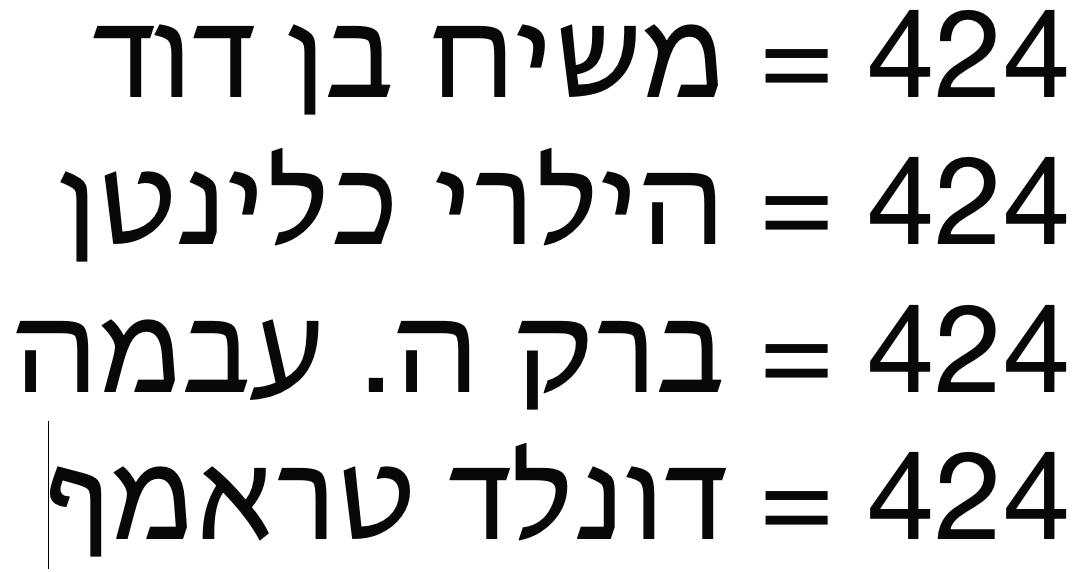
Posts are startling people: “Messiah ben David” = “Donald Trump” in Hebrew: both = 424. To support Ibn Ezra (Gen. 14:14), “A capable person can render a name to equal any number,” see below:


Send out for yourself spies and they should scout the land of Canaan that I give to Bnai Yisrael. You should send one man from each tribe. Each of them should
This pasuk indicates that Hashem initiated the decision to send spies into the land of Canaan. Moshe, in Sefer Devarim, delivers his final address to the people. He recounts this incident. In Moshe's account, he attributes the initial request to send spies to Bnai Yisrael. Rashi discusses this contradiction. He explains that the two accounts are not inconsistent. They are recounting the incident from di erent starting points. In Devarim, Moshe begins the account from the initial request of Bnai Yisrael. Here, in BeMidbar, the Chumash begins with Hashem's response. Hashem tells Moshe that the request of Bnai Yisrael may be fulfilled. They may send the spies[1].
Rashi's explanation removes the contradiction. But a question remains. Why does the Chumash begin the account from separate points? Why does Moshe begin his account with the request of Bnai Yisrael? Why does the Chumash, here, disregard this aspect of the incident?
The decision to send the scouts and the events that followed shaped the future of the people. The Chumash, here, is concerned with this aspect of the event. From this perspective, the essential element of the account is the report the spies delivered and the reaction of the people. It is not relevant that the initial request to send the scouts came from Bnai Yisrael. Therefore, this element of the incident is omitted.
Moshe's final address to the people had a di erent objective. He was evaluating the actions of the nation during their experience in the wilderness. He demonstrated to the people their errors. He hoped that by helping the nation see its mistakes these behaviors would not be repeated.
The request to send scouts was not completely appropriate. Bnai Yisrael should have entered the land confident in the Almighty's assurance that the conquest would take place. This conquest was to be miraculous. Scouts were not needed to plan the campaign. Moshe, therefore, begins his account with the request of the people. He is chastising the people for this behavior.
And Kalev silenced the nation’s protest against Moshe. And he said, “We will surely ascend and possess it. For we certainly have the ability. (Sefer BeMidbar 13:30)
The spies reported that the land is fertile. However, it is occupied by mighty nations. Its cities are fortified. Bnai Yisrael will not be capable of taking possession of the land.
Two spies did not participate in this pessimistic report. Yehoshua and Kalev did not agree with the other spies. Kalev protested that the spies were coming to an unwarranted decision. In fact, they could conquer the land. The Almighty would assist them. No obstacle was too great. It is interesting that during this debate Yehoshua remained silent. He did not take Kalev’s side. Instead, he allowed Kalev to oppose and contradict the other spies alone. Only later did Yehoshua speak. Why did Yehoshua not immediately express his support for Kalev’s position?
Rabbaynu Yitzchak Karo suggests that Yehoshua was following a carefully designed plan. He knew that the other scouts would contradict Kalev. Kalev would be alone in his dissent. Yehoshua felt that by adding his support to Kalev at this time little would be gained.
The ten other spies would oppose him and Kalev.
However, Yehoshua hoped that his silence would serve a purpose. He was careful not to express an opinion. He anticipated that the conflicting parties would turn to him to arbitrate their dispute. This would provide Yehoshua the opportunity to influence the outcome.
Once the parties referred the dispute to Yehoshua, his opinion would become significant. By supporting Kalev, he would undermine the opposition. In this way, he could overcome the pessimism of the majority[2].
Unfortunately, Yehoshua’s plan did not work. The dispute was not referred to him. He did not have the opportunity to execute his plan.
Say to them, "As I live, so says Hashem, shall it not be as you have spoken in my ears? So I will do to you." (Sefer BeMidbar 14:28)
The spies returned. They reported that the land could not be captured. They also criticized the quality of the land of Israel. The people accepted the report. They were despondent. They would die in the wilderness and never capture the fertile land promised by the Almighty. They began to consider returning to Egypt.
The Almighty punished Bnai Yisrael for this rebellion. This generation would not enter the land of Israel. Only the children, whom they had predicted would die in the wilderness, would conquer the land.
Rabbaynu Ovadia Sforno explains that this episode altered the future of Bnai Yisrael. The Almighty had planned for Moshe to lead the people into the land. The land of Israel would be easily captured. The conquest would be permanent. There would be no subsequent exile. The consequence of the sin of the spies and their generation was not limited to their death in the wilderness. Destiny was altered. Moshe would not lead the nation into the land. He would be replaced by Yehoshua. The conquest would be far less miraculous. The most important consequence was that the possession of the land would not be permanent. Instead, it would be followed by exile. Only in the Messianic era would Bnai Yisrael establish permanent possession of the land[3].
Our Sages explain that this rebellion occurred on the ninth day of the month of Av. This has been a day of tragedy for Bnai Yisrael. Among the catastrophes occurring on this date is the destruction of both Temples[4]. The tradition that the rebellion occurred on the ninth of Av has a special meaning, according to Sforno. The destruction of the Temples was an outcome of this rebellion. It is, therefore, fitting to identify the date of the rebellion with the ninth of Av.
(CONT. ON NEXT PAGE)
And they arose in the morning. And they ascended to the top of the mountain. And they said, “We will ascend to the place of which Hashem spoke for we have sinned.” (Sefer BeMidbar 14:40)
Bnai Yisrael refused to proceed to the land. Hashem told the nation of its punishment. The people realized that they had sinned and wanted to correct their error. They prepared to face their fears. They would travel into Canaan and do battle with the nations.
Moshe advised the Bnai Yisrael not to continue to Canaan. Hashem would not be with them. If they attempted to conquer the land of Israel, they would be defeated. The people did not listen. They continued the journey towards Canaan. They are attacked by Amalake and driven back.
Why was the repentance of Bnai Yisrael not accepted? The people recognized their wrongdoing and sincerely repented. They demonstrated their new attitude by proceeding into the land.
To answer this question, we must analyze the process of atonement. Sacrifices are brought to atone for sin. The sacrifice is accompanied by a confession. Maimonides discusses this confession in his Mishne Torah. He explains that the confession contains three elements. First, the person must acknowledge the transgression. Second, the person must indicate that repentance has taken place. Last, one must verbally recognize that the sacrifice is required for atonement[5].
Why is this last step necessary? It seems that atonement is not secured until the sinner accepts the consequences of the transgression. In this case, the consequence is the sacrifice.
Maimonides discusses this concept in his description of the death penalty. He explains that one receiving this penalty must confess. Maimonides defines the minimum standard for this confession. The person to be executed must ask the Almighty to accept his or her death as atonement for the transgression[6]. Atonement requires acceptance of the consequences of the sin. We can now respond to our original question. The nation truly wished to
conquer the land. The people were willing to confront their anxieties. However, this was not su cient to secure atonement. Hashem had decreed that this generation would perish in the wilderness. The nation did not acknowledge and accept the justice of the Almighty’s judgment. ■
[1] Rabbaynu Shlomo ben Yitzchak (Rashi), Commentary on Sefer BeMidbar 13:2.
[2] Rabbaynu Yitzchak Karo, Toldot Yitzchak, Commentary on Sefer BeMidbar 13.
[3] Rabbaynu Ovadia Sforno, Commentary on Sefer BeMidbar 14:28
[4] Mesechet Sanhedrin 104b
[5] Rabbaynu Moshe ben Maimon (Rambam / Maimonides) Mishne Torah, Hilchot Ma’aseh Karbanot 3:15.
[6] Rabbaynu Moshe ben Maimon (Rambam / Maimonides) Mishne Torah, Hilchot Sanhedrin 13:1.



All books depict history, facts, theories, fiction or poetry. No book is coded with hidden messages beyond the words or patterns revealing marvels. But the Bible (Torah) was written by God, and is “coded.” The order of verses, use of certain phrases, apparent contradictions and other Biblical patterns are pur poseful clues to God’s wisdom.
This book unveils those patterns and shares the hidden messages.



Is Judaism mystical, or is it rational, based on reason and proofs?