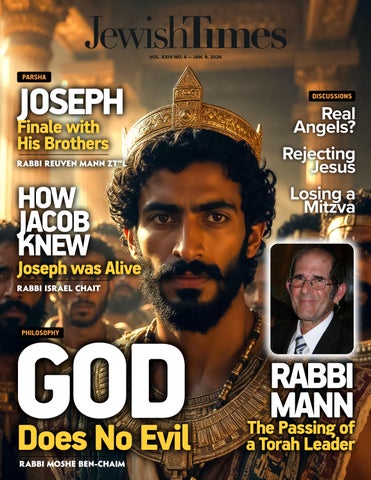
VOL. XXIV NO. 4 — JAN. 9, 2026
PARSHA
JOSEPH Finale with His Brothers
RABBI REUVEN MANN ZT”L
HOW JACOB KNEW
DISCUSSIONS
Real Angels? Rejecting Jesus Losing a Mitzva
Joseph was Alive RABBI ISRAEL CHAIT
GOD PHILOSOPHY
PHILOSOPHY
Does No Evil RABBI MOSHE BEN-CHAIM
RABBI MANN The Passing of
a Torah Leader
the FREE
Just click any
2
|
WWW.MESORA.ORG
JAN. 9, 2026
icon in this issue
MESORA THE JOURNAL ON TORAH THOUGHT | Please send letters and questions to: Comment@Mesora.org |
9 Scene of the Crime Multiple fundamentals are
3 Discussions
RABBI MOSHE BEN-CHAIM
RABBI REUVEN MANN
discussed
6 Passing of a Torah Leader JESSIE FISCHBEIN URI PILCHOWSKI
A close student and rabbi share thoughts on our beloved Rebbe.
One of Rabbi Mann’s last parsha essays on his beloved topic of Joseph and his brothers
11 God Does No Evil
RABBI MOSHE BEN-CHAIM
An analysis of King Solomon’s words
| THANK YOU |
Rabbi Mann toiled 50 years with great clarity, patience, diligence and honesty, instilling love of Torah and God in each of his hundreds of students. I benefited from our close relationship for almost all those years. His wisdom, care, guidance and personality will be cherished, missed and never replaced. His keen teachings will guide us all with endless inspiration. RABBI MOSHE BEN-CHAIM
DISCUSSIONS RABBI MOSHE BEN-CHAIM
Mortality in Koheles HOWARD: What was Rabbi Chait’s explanation of why Koheles concludes with the body’s disintegration?
Subscribe FREE to the Jewishtimes: mesora.org/jewishtimes –––––––––––––––––––––––––––––––––––––
RABBI: Rabbi Chait explained that any philosophy that does not include one’s mortality is a false philosophy. But we must ask why he said this. If one feels he will not die (while all others do), this reveals an overall egoistic fantasy life and denial of realty which certainly corrupts the person in all areas. He may then refuse medication, take unnecessary risks, and fail to concede to the advice of others…all due to his self-overestimation. Those are a physical drawbacks. (CONT. ON NEXT PAGE)
Articles may be reprinted without consent of the Jewishtimes or the authors, provided the content is not altered and credits are given. WWW.MESORA.ORG JAN. 9, 2026
| 3
DISCUSSIONS SHARE
But philosophically too he is corrupt because as he denies death, he denies God’s ultimate reward and punishments. Thereby he will not tame his lusts, greed, anger and other poor qualities that ruin his soul. He won’t fear sin. He thereby denies Torah fundamentals, he denies God’s word, and sacrifices his soul. He traded pleasure for real happiness of the soul here and after, gained only through studying God’s wisdom, which ensures the afterlife. Denying God’s word and His fundamental principles, he denies what God is. He denies God. He wasted his life. To ensure mankind benefits from this life and the next, King Solomon reminds one that life is temporal and not our ultimate destination. This redirects us to explore God’s plan of the afterlife so we might learn what our true existence is, and what God deems best for us. Of course we must first focus on the here and now as this is where we select the choices which most benefit ourselves here, and later. Only in conclusion does King Solomon treat of mortality. ■
Pleasure vs. Happiness “Torah teaches a yesode, a fundamental: the life of lusts
leads to depression. The German philosopher Arthur Schopenhauer said, “Every pleasure is followed by another pleasure, or depression.” He meant this point: physical pleasures do not satisfy man but momentarily, which drive man to seek yet another pleasure, or realize the failure of such pursuits, leading to depression. Man’s pleasure is derived only from pursuing God’s wisdom.” -Rabbi Israel Chait
Alex: I question what Rabbi Chait said above. Isn't there pleasure in having children, intimacy with one's wife? Isn't there pleasure in non-talmud Torah activities like doing chessed? Rambam writes there is no greater joy than helping the orphan etc. Also Rambam writes in his letters that he gets simcha/nachas seeing his son become a scholar. Also, Rambam held the middle ground—“golden mean”—when it comes to simcha. Isn't this to be achieved by doing activities non-metaphysical that contribute to simcha? Didn't the aspiring prophets listen to music to be in a prophetic state because this requires simcha? Didn't Jacob lose prophecy because of the anguish of the loss a son? Doesn't that show the material world contributes to simcha? Rabbi: Yes, there are other pleasures man needs psychologically so he is content, like sex, food, entertainment, etc. But these are not "ends," but merely a "means" preparing man for the primary and ultimate state man must engage to attain happiness, and that is wisdom. Man cannot learn if he is starving, but this does not mean eating is man's goal. Wisdom is what provides ongoing complete fulfillment of man's soul. Do not confuse physical pleasure with happiness, the former are short-lived and not God's aim for man who possesses a soul. Furthermore, all physical pleasures when overindulged end in extreme pain. They cannot be God's plan. Rabbi Chait discounts physical pleasures as an ends. But happiness in pursuing God's wisdom does not expire, like physical pleasures, and offers only enjoyment and no pain. Rabbi Chait said that one may endure a painful operation to improve his health. This results in his happiness. Thus, pain does not detract from happiness. And we see pleasure and happiness are two separate matters. ■
4
|
WWW.MESORA.ORG JAN. 9, 2026
Archaeology Confirms Joseph IRA JACOBSON
Archaeology has uncovered stunning evidence that aligns with the Bible’s account of Joseph in Egypt. Egyptian records from the early 18th Dynasty reveal the sudden rise of a powerful official who oversaw Egypt’s grain supply, treasury, and national infrastructure during a time of unprecedented crisis. This period—around 1530 BCE—also marks the introduction of Egypt’s first known centralized tax system, set at 20%. That detail alone is remarkable—because Genesis 47:26 records Joseph establishing a nationwide 20% tax during years of abundance in preparation for a coming famine. Even more striking, an ancient monument known as the Tempest Stele of Pharaoh Ahmose I describes a catastrophic natural disaster: violent storms, flooding from the Nile, ruined crops, and national chaos—conditions severe enough to trigger widespread famine. This stele dates to the exact window Scripture places the transition from prosperity to famine under Joseph’s leadership (Genesis 41). The Bible also records that Joseph was given an official Egyptian name—Zaphenath-Paneah—a detail that perfectly matches Egyptian custom, where high-ranking officials received throne names tied to their role. Similar titles appear in Egyptian inscriptions for overseers of grain and royal resources. Put together, archaeology confirms: • The timing • The famine • The taxation system • The administrative structure • And the rise of a non-royal official to second-in-command ■
Joseph is Alive RABBI ISRAEL CHAIT Written by a student
And they [Jacob’s sons] told Jacob, “Joseph is still alive and he is ruler over the whole land of Egypt.” His heart fainted, for he did not believe them. But when they recounted all that Joseph had said to them, and when he saw the wagons that Joseph had sent to carry him, the spirit of their father Jacob revived. (Gen. 45:26,27) (CONT. ON NEXT PAGE)
DISCUSSIONS SHARE
QUESTION: What about seeing the wagons convinced Jacob that Joseph was alive? RABBI CHAIT: The word “lasais; to carry” refers not to mere
transport, but to tending to somebody by hand. A broken man—whom Joseph should have been—cannot concern himself with others. But Joseph’s honor of Jacob by sending overabundant wagons to bring his father to Egypt shows concern for others. “Joseph is still alive and he is ruler over the whole land of Egypt”. The spirit of their father Jacob revived.
Jacob’s initial disbelief was because he felt his biological son might be alive, but he would be a broken man, not his original “Joseph.” Upon descending to Egypt to buy food and find Joseph, the brothers first searched for Joseph in houses of ill repute: “They had entered the ten gates of the city and were asking about him; they had entered the houses of ill repute” (Rashi, Gen. 42:9). Jacob too felt even Joseph would succumb to Egyptian influences. But upon seeing the wagons, Jacob’s spirit was uplifted by Joseph honor. Joseph maintained his philosophical and psychological integrity. “Honoring parents is equated to honoring God” (Jerusalem Talmud, Peah 1:1), and a broken man could not perform such an act, certainly not a mitzvah of honoring one’s parent. The original Joseph is still alive; he did not succumb. Joseph desired to honor God which is equated to honoring his father. Jacob seeing Joseph fulfill the mitzvah of honoring his father, saw that Joseph was not destroyed. ■
Jacob Sent Real Angels? RABBI: Pashas Vayishlach opens with Jacob sending messengers to Esav, as he desired to learn if his twin brother still harbored animosity for “stealing” the birthright, although Esav had legitimately sold it to him. Jacob wished to be prepared for Esav, if Esav was intent on attacking him. Rashi says Jacob sent “literal angels,” not human messengers. But that can’t be. So “sending literal angels” could refer to Jacob’s keen psychological acumen: bribing his brother with the gifts of the massive flocks could attain 100% success, as if God’s angels were doing this who always succeed. As angels always succeed as they override all other considerations, Rashi says Jacob’s brilliance would have the same guaranteed results as angels. To teach of Jacob’s expert psychological knowledge and his guaranteed success, Rashi cites a midrash equating his expert plan via human messengers, to literal angels. HOWARD: Maybe. But why does it bother you if Rashi maintains that they were actual metaphysical beings? RABBI: Tanach is the authoritative text, not midrash. And in Tanach you don't see man controlling God’s angels, that’s limited to midrash. And midrash cannot introduce a new idea that is not found in the verses. Furthermore, angels are unnecessary to satisfy reconnaissance mission to learn of Esav’s intention, as human beings can accomplish this. ■
Punished for Rejecting Jesus? READER: Good afternoon. I need assistance phrasing a rebuttal to those insisting that [Jewish problems are] Hashem’s punishment of the Jews for rejecting Jesus. I usually counter this way, sarcastically: “Sure, the Almighty is punishing the Jewish people for obeying Deuteronomy 13:2 and 18:20 that forbids following false prophets like Jesus.” I regularly read Rabbi Skobac (Jews for Judaism) and Rabbi Singer's (Outreach Judaism) literature, however I cannot seem to phrase what I'm trying to say correctly. Thank you for your time and assistance. –Dave
RABBI: Your approach is correct: Validating God's view must be based not on human guesswork, but only on what He said, referring to not following false prophets, accepting other gods, imagined forces, and deifying figurines of anything in the heavens or the Earth, including humans. This fully rejects deification of man, i.e., Jesus. This is also why we reject Jews flocking to the Rebbe's grave and putting notes in it. That's the identical crime of praying to Jesus. Share with others that we do not defend our own brothers and sisters communicating with the dead, as this is a very helpful tool for them to see how unbiased, rational and consistent Jewish thinking is. God hid Moses grave precisely to prevent human deification (Deut. 34:6). On this note of following only what God says, this person violated following God, as he imagines to know God’s thoughts, for God never stated that He's punishing Jews for rejecting Jesus. Torah says just the opposite as I cited above. A person is not capable of knowing God's thoughts in order to make such a statement: “Your “thoughts are not My thoughts, and your ways are not Mine, says God” (Isaiah 55:8). God clearly rejects assumptions about how He operates. ■
Losing a Mitzva READER: A question got me thinking. I once heard (source?) that if one regrets mitzva they fulfilled, they lose its merit. Why is that case? Why is it worse to regret a mitzva, when a person can gain merit for a mitzva done with an ulterior motive? RABBI: When one regrets the mitzvah it reflects a failure to see any value, and even is viewed as a disparaging sentiment about the mitzva. Whereas one performing a mitzva for an ulterior motive is okay because this does not disparage the mitzvah and may even eventually cause the person to see the true purpose. So the former has a negative value to the mitzva, whereas the latter is not negative and may lead to a positive. ■
WWW.MESORA.ORG JAN. 9, 2026
| 5
RABBI REUVEN MANN zt”l SHARE
Loss of a Torah Leader
Rabbi Reuven Mann zt”l JESSIE FISCHBEIN
I
came to Masoret, Institute of Advanced Judaic Studies for Women, when I was 19 years old. I went to college in the morning, then got a ride to a ramshackle shul in Inwood (I am grateful to the many women over the years who drove me and my baby to and fro when I had no car), and we banged our heads against the gemara from 2-3:30pm. From 3:30-5pm was shiur. For about 7-10 years Rabbi Mann taught us gemara on a very abstract level. He went through the sugya, he went through the Rishonim. We learned to break down a machlokes. "Which side makes more sense to you?" We'd divvy up the room and debate. There were rousing arguments and there were silences where we all pondered. Once one side was clear, it became almost impossible to understand the other side. Until we went through the whole thing again, to understand the other side. Then we began to understand “aylu vaylu divrei elohim chaim; both sides are the words of the living God.” A machlokes is two logical sides and both are based on reasoning. We searched to find where they agreed and where they disagreed. And what about a three-way machlokes? R' Mann famously had a methodology for that, too. It's still a two-way debate, with 2 of the 3 positions having a sub-debate. We analyzed many machloksim that way. Then we went through the Rishonim and analyzed their analyses of the machloksim. It was rigorous. It was invigorating. I'd never seen learning like that.
what were the essential questions and what were the smaller questions. All this trained us to use the questions to break open the area. Even the meforshim did not escape the merciless questions. Many was a time Rabbi Mann shrugged and left the question open.
Chumash was even more eye opening to me. I am indebted to R' Mann for sugyas in Brachos (davening, kiddush), Moed Katan (aveilus), Succah (teshvu k'ein taduru which affects my attitude toward living in the succah to this day), Pesachim (so many aspects of the seder). He always kept it practical even while he opened up new worlds of ideas. But Chumash, I never heard anyone learn Chumash like this. Taking the story and asking the most basic questions. Questions anyone would ask but didn't dare. Questions everyone should ask. I learned with him for over 30 years and every year he found new questions. I always had a sense of infinity of Torah because he could do the same area year after year but he was always excited to find new questions. "We never asked this question, did we?" And he always wanted us to sit and enjoy the question before we rushed to answer. "Just enjoy the question." "It's a great question, right?" He also was extremely methodical about asking the questions, teaching us how to organize the questions,
Rabbi Mann loved Rivka Immenu. He loved how proactive she was, how clever. He loved Esther, how she charged the people to fast for 3 days and used the time to make a huge strategic plan designed to pit Haman and Achashverosh against each other.
One of my favorite parts of Masoret was the silences. We used to sit and think. After we got the facts and after we asked the questions and after we were guided as to which questions were the essential questions, it was time to think. We all sat quietly to think. What would happen next? What would we think of? We offered possibilities. R' Mann always wanted to hear everyone's opinion before he offered his own thoughts. He was not there just to tell us what he thought; he was there to teach us how to learn. "It's always good if you can be your own chevrusa," he would say. I used to make cartoons with "Rabbi Mann"isms in the old days. I remember drawing a cartoon with a stick figure learning in the mirror with a sefer, being their own chevrusa. I frequently think about what he taught us about the kruvim (cherubim). Their "na'ar" youthful faces, because learning Torah is approached with youthful energy, as if you are seeing the area for the first time and learning it as if it is new. And there are 2 kruvim because learning Torah is social. Torah is for sharing. On the last day of shiur, at 81 years old, Rabbi Mann had his full youthful vitality and was excited to share Torah.
And Rabbi Mann blew me away when analyzing midrashim. Never had I learned midrashim in any way that made sense until Rabbi Mann opened my eyes. He could take a midrash that was incomprehensible, that seemed to be a fairy tale, and crack it open until it was a shining light of wisdom and insight. It was breathtaking. Again, he used the same methodology. Ask the basic questions. Stick to what we know to be true. Keep hashkafic points clear (we needed guidance with that, but over the years he taught us many sources that helped). Think, think, think. And his answers were delightful. Pure delight to have something incomprehensible end up not just making sense, but being a pathway to (CONT. ON NEXT PAGE)
6
|
WWW.MESORA.ORG JAN. 9, 2026
RABBI REUVEN MANN zt”l SHARE
And the Rambam. I had never learned Rambam before. He broke it down and analyzed it and asked questions. A whole new world of learning opened up. Hashkafically and halachically. Was there a year we didn't look at Hilchos Teshuva before Rosh Hashana and Yom Kippur? (Yes, when he started learning the Rav with us.) And his shiur on Para Aduma (the red heifer), which I've merited to give over many times. Who would dare study Para Aduma? I remember sitting breathless with my notebook open, as he went through the sources about how hard it is to understand and how he painstakingly went through the Sforno, step by step. Who else could explain it in a way that I Rabbi Mann and I sharing a l'chaim can now give over to high schoolers, to people when we heard the good news that Jacob's son was born. November 16th, with no background, and people nod, "Yes, 2025. –Rabbi Pinny Rosenthal that makes so much sense." People walk away happy, enlightened. I spent a lot of time in the kitchen to the side, in Masoret in the early days. My husband character development or a whole way of life. reminded me that when our first child was His Torah not only brought intellectual joy, it born, Rabbi Mann moved the entire Masoret to was incredibly useful in my life. His shiur on lo my in-laws for two weeks so I could attend with sachmod, the Ibn Ezra on Do not covet, for my newborn. Later, whenever the baby cried, I example: understanding my "portion" and what would quickly get up and listen from the next that really means and how internalizing that room so I wouldn't disturb him. R' Mann was can prevent jealousy. incredibly sensitive to noises (he hated even having the air conditioner on during shiur in the And the witty observations he made ad hoc. summer) but he tolerated his discomfort when "When someone cuts you off in the car and the babies made noises because he valued you get annoyed, think about it--you never cut women's learning and wanted me to learn as anyone off in your life? And let's say maybe you long as I could keep coming. Many women didn't, maybe you're makpid (scrupulous) about came to Masoret during their maternity leaves. that particular. Did you never do anything annoying in your whole life? Impossible." The summer programs were their own exciting entities. Rabbi Mann set up a month of And that time he came in all excited, that he weeklong full day learning, shiurim by different wrote to someone who had killed someone teachers, some years including evening while drunk driving. He wrote to them to classes. We got a variety of classes those explain to them the concept of teshuva, to not summers. They brought me back to my year in despair. This person was not Israel. If anything, I found the Torah more Jewish. He had read exciting than my year in Israel because I something they wrote in the appreciated Torah so much more once Rabbi paper and felt compelled to Mann taught me how to ask questions, analyze share with them that there text and midrashim, and was there to provide was hope, that the Jewish satisfying answers. And if he couldn't find an idea of teshuva could change answer, that didn't bother him either. He didn't their life. He was fired up by push to find answers that didn't work. He let that notion. Later, this Jewish the questions stand. That was an important idea of teshuva guided me as lesson, too. a parent when I made mistakes, and in my attitude Until R' Mann moved to Arizona, Masoret was towards my children when I 3:30-5pm. Some years he only had 3 students. understood not to get angry If he was willing to teach only 3 people, I was but to pass on the idea that happy to be one of them. It was only because you can try again. (CONT. ON NEXT PAGE)
WWW.MESORA.ORG JAN. 9, 2026
| 7
RABBI REUVEN MANN zt”l SHARE
R' Mann persisted in teaching women even if there was a tiny group that I benefited to learn the Torah I learned. He also pushed me to teach. If he knew I was giving a shiur or if I was stuck on a question and had to give shiur on it, he would go out of his way to go through the area in shiur. For many years, shiur was sometimes questions that occurred to him, and just as often questions we brought to him. There is something very special about getting Torah tailored to your questions. He also encouraged us to discuss middos (character development) questions with the group. Torah was not just intellectual, it was something we were trying to live, and we had all sorts of interpersonal issues that benefited from a Torah perspective. That doesn't mean we always agreed with him. He loved a good fight and he was often intentionally provocative, making extreme remarks that forced us to push back. When he moved to Arizona, his shiur shifted to over the phone. I invested in one of those fancy triangle conference phones. I almost had the codes to the group call memorized. It was easier at that point to have my children running around in the background because of the mute button. I knew for a fact that Arizona does not do daylight savings time because they don't turn the clock. R' Mann adjusted his schedule to us so we kept the same time for shiur. The only time shiur changed was during Chanuka candles if shiur ended up being in the middle of shkia, sunset. A few years ago, R' Mann moved to Israel and wanted to change to Zoom. I resisted, but it was an improvement on many levels. I am so blessed to have gotten to see my Rebbe's face shining with happiness every day as he taught us new Torah. His Torah blossomed even more in Israel. He was finding new audiences, reading new books, starting to give shiur in Hebrew (with meticulous preparation), having his weekly articles translated. I never especially enjoyed Rabbi Mann's long politics discussions, but I even find myself missing those now. I was hoping for more insider Israeli politics once he was there, and he did indeed discuss Israel more frequently. I miss seeing Rabbi Mann with the window open to the Har Habayis view, receiving daily whatsapp photos of pages of seforim he planned to cover (interspersed with videos and pictures of his newest grandson). I excruciatingly miss the multiple times a week opportunity I had to ask anything on my mind about Torah, about life, about hashkafa, about a strange midrash, about the reasoning behind a mitzva. Rabbi Mann spent endless time with me discussing my pregnancy losses and how that fit into the laws of nature and hashgacha pratis (divine intervention). We were close and there was great love between us, but neither of us make small talk and if there wasn't Torah (or a personal problem I wanted advice about), there was no conversation. I am endlessly grateful that I got to sit in shiur with my Rebbe numerous times a week for decades, and bring up anything on my mind. He welcomed debate, he welcomed our thoughts and opinions, and he was an endless font of Torah creativity. He taught methodology, he was a master speaker, he was meticulously organized and could also be spontaneous, he was a writer, a voracious learner, he loved psychology, he loved helping people. That reminds me of
8
|
WWW.MESORA.ORG
JAN. 9, 2026
what he called "cheap chessed." Rabbi Mann was a proponent of cheap chessed, chessed that was easy for you to do. He loved helping people on airplanes, since it was one and done. I can go on and on, as you can see. I am bereft. I miss the learning terribly. It was a reliable and joyous part of my week, something I looked forward to and was excited about, and Rabbi Mann welcomed everyone into his shiur. ■
Rabbi Reuven Mann זצ״ל
Rabbi Uri Pilchowski
The Jewish people have lost one of their master teachers this week. Parents, siblings, grandparents, other family members and friends leave a gap in the world when they pass away, but a master teacher leaves a gaping hole that can never be filled. To their students there is no one left to turn to and there never will be again. Rabbi Reuven Mann was the co-founder of Yeshiva Bnei Torah in Far Rockaway, New York. In over fifty years of his Rabbinic teaching, he taught hundreds of students. Through his writings and well-spread weekly Divrei Torah sheets, thousands studied Torah from him. Most impressive are the many Rabbis and educators who were his students, and who got their inspiration and professional training from him. Rabbi Mann was one of the rare Rabbis sufficiently talented to play the role of both a Rabbi of a community and a Rebbi in a yeshiva. In addition to those roles, he also founded a higher institution of learning for women, Masoret, where he taught for 33 years. People should be awed when meeting a person talented enough to be able to play just one of these roles, to do three successfully is truly remarkable. It wasn’t just his great knowledge or yiras shamayim that lent Rabbi Mann his success. To conquer and excel in so many different areas required his unique middos. His character allowed him to make all who talked to him feel comfortable with him. A few months ago Aliza came home after speaking to a group visiting Mitzpe Yericho. She excitedly told me she met Rebbetzin Mann, and how special of a person she so clearly is. After everything I had heard about Rabbi Mann it made so much sense that his Rebbetzin would be equally impressive, after all, how could Rabbi Mann do all that he did, without a partner that inspired him! Rabbi Mann’s entire professional career was dedicated to the perpetuation of Judaism as both pulpit Rabbi and Jewish educator. He has taught Torah to every age level from elementary school students to advanced graduates. As if all his teaching wasn’t enough to establish him as a master teacher, he was also the author of the book, “Eternally Yours: God’s Greatest Gift To Mankind.” I never got to meet Rabbi Mann. I am one of the thousands who learned from his writings and heard about him from his many talmidim. I am a direct beneficiary of his teachings. One of Rabbi Mann’s students is my Rebbi, Rabbi Saul Zucker. In his eulogy for Rabbi Mann, Rabbi Zucker said that Rabbi Mann wasn’t only creative in his own learning, but encouraged his students to be creative in their own way. I can’t think of a greater sign of an excellent Rebbi than one who can encourage his students to excel themselves. There is a gaping hole in the world today. Rabbi Mann’s family, friends, and most of all his students feel that loss and hole. ■
PARSHA SHARE
Revisiting the Scene of the Crime Rabbi Reuven Mann ZT”L
aYechi, concludes the V first Book of the Torah. More specifically, it brings
to a close the epic saga of Yosef and his brothers. Although there had developed great animosity between them, the magnanimous spirit of Yosef, the Righteous, acting with the assistance of Divine Providence, enabled a reconciliation to take place.
It appears from the words of Yosef that he was totally sincere in the assurance that he was at peace with what had happened and had no desire for his brothers to suffer. His main point was that he viewed everything that had transpired as the Will of G-d, in which his rise to power in Egypt was an essential factor in saving the budding Jewish nation. He also displayed great kindness in facilitating the family’s relocation to Mitzrayim (Egypt) and providing for all their needs there. Seventeen years had passed, and Yosef had been nothing but kind and caring in his dealings with them. Was his behavior truly sincere, or was it merely a ruse designed to demonstrate to Yaakov that he harbored no ill will against his brothers? Now that Yaakov was dead, would Yosef continue to get along with his siblings or would his desire for revenge burst to the fore?
for me in this place.’ But the brothers did not say this, but rather, ‘Perhaps Yosef will nurse hatred’”(Bereishit 50:15). (Midrash Tanchuma VaYechi 17:5, Bereishit Rabbah 100:8)
Returning to the Pit: Trauma, Memory, and Healing
This was just another of the serious misunderstandings which had plagued the relations between Yosef and his brothers. But what, in point of fact, was Yosef’s real intention in returning to the dreaded hole into which he had been left to die? Many years had passed since Yosef had been rescued from the hands of his brothers. Against all odds, he had risen to the highest position in Egypt and had acted with great wisdom and integrity in saving Egypt and other nations from the consequences of the devastating famine which had afflicted the world. It is safe to say that Yosef had blessed and praised Hashem numerous times for the great miracle of his salvation. So why was it A Misunderstood Act and a necessary to return to the place of that great Renewed Fear happening? Upon returning to Egypt from the burial of Many people who have been harshly Yaakov: mistreated, physically or emotionally, cannot The brothers perceived that their father control themselves from reliving the terrible trauma in their minds, yet we must ask, does was dead, and they said, “Perhaps Yosef will nurse hatred against us; and this serve any beneficial purpose? Hashem has placed in man the ability to heal then he will surely repay us all the evil from his physical wounds as well as his that we did to him.” And so they emotional violations. There is much truth to instructed that Yosef be told, “Your the popular adage that “Time heals all father gave orders before his death saying, ‘Thus shall you say to Yosef, ‘O wounds.” But that is only if a person removes please, kindly forgive the spiteful deed his attention from the suffering he went through. The more he replays the calamity, of your brothers and their sin, for they the more he experiences the pain it caused, have done you evil, and now, please and this prevents the healing process from forgive the spiteful deed of the taking effect. Therefore, in my opinion, it is servants of your father’s G-d.’’ And not good for a victim to replay the horror he Yosef wept when they spoke to him experienced and to keep active the pain he (Bereishit 50:15-17). has gone through. He must instead remove the traumatic event The renewed fear of Yosef’s brothers at this from active consciousness. I don’t mean that time appears irrational and manifestly unwarranted, so the question arises, what did he should completely repress it. He knows that it happened, but he refrains from thinking they “see” that triggered this reaction? about it, as that arouses feelings of insecurity Various answers to this query are provided and depression. He must seek to act as by the Sages. though it never happened and direct his Rav Yitzchak said, “When they returned from energy to the matters that concern him in the Yaakov’s funeral, Yosef went and peered into present. The more he functions in a constructive manner, the more he restores the pit into which the brothers had cast him. his natural sense of confidence and Rav Tanchuma said, “His intention was only self-worth. for the sake of heaven [in order to bless and It seems that Yosef never nurtured feelings of express gratitude to Hashem] for when a anger or depression after he was brought to person comes to the place where he experienced a miracle he must say, ‘Blessed Egypt. Almost immediately he experienced is the Omnipresent who performed a miracle unusual success in the house of his master (CONT. ON NEXT PAGE)
WWW.MESORA.ORG JAN. 9, 2026
Rabbi Moshe Ben-Chaim
| 9
PARSHA SHARE
Potiphar who finally gave him total control over his holdings. Yosef recognized that in order to retain his sanity he could not afford to mourn over what had happened but had, instead, to pour all of his energy into the tasks that confronted him. It was also vital to retain his faith in Hashem. [Note: See Rashi, Bereishit 39:3, who says “The Name of Hashem was routinely on his lips”.] The picture of Yosef that is conveyed is that of an active, confident individual who arouses the admiration of those around him and even the (unwanted) attraction of his master’s wife. Yosef clearly was not wallowing in the wounds of the past. He had left that behind and directed all his energy toward his current situation. Indeed, the name which Yosef gave to his firstborn son, Menashe expressed the idea that, “G-d has made me forget all of my hardship and all my father’s household” (Bereishit 41:51). The Akeidah, Rabbi Yitzchak ben Moshe Arama, explains that Yosef expressed gratitude that Hashem had enabled him to forget the hardships his brothers had inflicted on him in his father’s home. [And Rav Saadia Gaon said: “Hashem has made me forget all my suffering and all that had transpired because of it in my father’s house”.]
Mastery of Thought and the Discipline of the Tzaddik
In response to my contention that one should refrain from reliving traumatic occurrences, you might ask, but isn’t doing so an automatic, non-voluntary response? Is it not inevitable that a victim will have no ability to refrain from replaying the horrible experiences that he suffered? I do not believe that one cannot control his thoughts. There is such a thing as mental discipline and Judaism maintains that if one makes the effort he can gain mastery over his mental activity. Thus, the Rambam explains that prior to reciting the Shemoneh Esrei (Amidah, prayer of eighteen blessings), one must focus his thoughts: What is to be understood by Kavanah (concentration)? He should free his mind from all extraneous thoughts and should envision himself as standing before the Divine Presence”. (Laws of Prayer 4:16). Even more compelling are the Rambam’s words pertaining to the Jewish soldier: He should not think about his wife or children, but to the contrary, erase their memory from his heart and remove all thoughts from his mind except those pertaining to the war.” (Laws of Kings and Their Wars 7:14)
This Rambam is certainly counter-intuitive. When a person is preparing to enter a dangerous battle, it is only natural that he will think about those he loves. However, we must be able to control our thoughts and not allow them to wander to subjects that will cause us to become weak and cowardly in battle. Thus, the Torah expects man to be able to be the master of his mental life. The true Tzaddik (righteous person) does not simply follow the path towards which his emotions lead him. So while there is a strong impulse to relive the humiliating event, he does not give in to it. He realizes that it is not beneficial to place himself in the position of pain and weakness and thereby keep the wounds open and prevent them from healing. He resists the urge to see himself as a victim and a “loser.” Furthermore, he does not allow himself to be defined by what others may have said to him or done to him. He proceeds with his life on the basis of his relationship with Hashem. He does not seek the approval of man but only of G-d.
From Yosef to Our Time: Strength, Faith, and Forward Vision
In 2019 Bruno Dey who had worked for the Nazis as a guard for the dreaded Concentration Camp Stutthof was put on trial in Hamburg, Germany. In his excellent book, Final Verdict, Tobias Buck, recounts that a number of still living survivors were brought in to testify. Among them was eighty-nine-year-old Rosa Bloch, who traveled to the trial from Holon, Israel. In the course of her interrogation, she was asked how she had managed to deal with her memories. She answered: “Of course I suffered from this, it impacted me,” she replied. But Bloch had also proven herself surprisingly resilient, both in the camp itself and in the years that followed. She had to take care of her mother, who found living and surviving at Stutthof even harder than her daughter (and who died very shortly after liberation). “I am a very strong person, I am always optimistic. That is my character,” Bloch said. “After the war I met a man, we married, we started a family, I had children. I always thought you must look ahead, not backward. Life runs forwards not backward. You have to understand that.” Her priority, she said, was to take care of her children, not to dwell on her memories. That changed only later. “Later I could recount what I had lived through, but first I had to be strong. That was a lesson for all of us. We had to be strong.” (Final Verdict by Tobias Buck p. 99) (CONT. ON NEXT PAGE)
10
|
WWW.MESORA.ORG
JAN. 9, 2026
PARSHA
PHILOSOPHY SHARE
There are distinct similarities between the approach of Rosa Bloch and the Biblical Yosef. With this philosophy to guide him, Yosef recuperated from the psychological blows that were visited upon him by his brothers. He relied on his faith in Hashem and on the utilization of the formidable natural talents with which he had been endowed. As a result, he was completely cured of any residual effects of the disaster he had gone through. When he returned to Canaan for his father’s burial, he was reminded of what had taken place so many years before. He wanted to review it, not from the standpoint of a victim but from that of one who had overcome it, so he could gain a greater appreciation for the miracle of his survival. A survival in which he had continued to grow and ultimately attained the highest level of achievement of which he was capable. A level he might never have attained had he not been forced to contend with adversity. Therefore, he returned to the pit in order to fully apprehend what Hashem had done for him. He recognized that what had happened was not a cruel twist of fate but part of a Divine Plan to save Klal Yisrael (the Nation of Israel) in which he had played a central role. At that moment, he had a profound sense of gratitude and wanted to express his wholehearted appreciation to the Creator, Who in his greatest moment of need did not abandon him. Unfortunately, at this point, the brothers still did not fully recognize the greatness and moral perfection of their younger sibling. It was only after they threw themselves at his mercy and he reassured them that he bore them no ill will that they were comforted. Yosef the righteous, is one of the great role models of our history, which is infinitely rich in genuine Tzadikim (the righteous) of every kind. How fortunate are we to be able to partake of this unmatched spiritual heritage. Let us renew our resolve to emulate the example of the great heroes who have come before us. [Note: This is especially relevant at this time of renewed Anti-Semitic violence across the globe.] Let us not be troubled by the extreme hatred of base and corrupt people. They cannot recognize the greatness of the exalted spiritual legacy of Klal Yisrael. Nor do they realize how much they could gain from us if they could somehow get past their insatiable desire to hate. We do not need them to like or approve of us. All we require is to be true to the Torah and find favor in the Eyes of Hashem. May He assist us in this endeavor. Shabbat Shalom. ■
God Does No Evil Rabbi Moshe Ben-Chaim
“I set my mind to study and to probe with wisdom all that happens under the sun: it is an evil matter which God gave the sons of man to be afflicted with. I observed all the happenings beneath the sun, and I found that all is futile and a heartache” (Koheles 1:13,14). God’s plans cannot be evil, as Micha says, “From God’s mouth does not emanate evil or good. [But] about what shall a living man complain? Each one of his own sins!” (Lam. 3:38,39). Rashi comments: Every man should bemoan his sins, because they are what bring the evil upon him. They did not emanate from the Almighty. Rabbi Yochanon said, “From the day that the Holy One, Blessed is He said, ‘See, I have placed before you today the life and the good, etc.,’ (Deut. 30:15) neither evil nor good has come from His command.” Rather the evil comes by itself to the one who commits evil, and the good to the one who does good. Therefore, about what should one complain? Why should a man be angry [about misfortunes] if not about his sins? (CONT. ON PAGE 13)
WWW.MESORA.ORG JAN. 9, 2026
| 1111
12
|
WWW.MESORA.ORG
JAN. 9, 2026
PHILOSOPHY SHARE
"answer" the question of whether man should follow good or evil.
“All is futile and a heartache”
Rashi teaches that God created man with free will. He also created the world to favor one who performs good, and afflict one who is evil. Thus, man causes his own evil and good fortune, as Micha states. Just as physics (nature) determines that you bleed when you carelessly cut yourself, and that you maintain health when you eat properly…God’s metaphysics (providence) blesses one following Torah and curses the sinner. God designed both nature and providence to benefit one choosing rational choices, and to harm one who violates those laws. King Solomon means the “evil matter which God gave the sons of man” is a matter that is regarding choosing between evil and good, not that God callously afflicts man, planning inescapable earthly torture. It's not an accusation of what God created because the king repeatedly says that he searched out all that has been “performed,” meaning man's choices—not God’s natural and providential laws. And the last word in verse 13 “la’annos” does not mean to afflict, but it means for man to
This refers to man's poor choices, not God’s mischief. King Solomon’s work Koheles says “better to be a live dog than a dead lion” (9:4), and “Both the wise and the fool equally perish. So I reflected: The fate of the fool is also destined for me; to what advantage, then, have I been wise?” And I came to the conclusion that that too was futile” (Ibid. 2:14,15). Both thoughts sound like King Solomon’s accusations of a poor state of human affairs. But in fact, these two verses are common man’s opinions which the king quotes in his examinations: man thinks life outweighs the afterlife, so a live dog is superior. Man errs thinking death is the end, so man wrongly feels being wise is of no use since you die. King Solomon speaks cryptically where one could misunderstand the king himself holds these opinions, accusing God of giving man an evil matter to afflict him, as he stays at the end of verse 13. Why then does the king employ such a misleading style? This cryptic style engages the reader more as it might appeal to his own values: “Yea, King Solomon agrees with me, what more has he to say?” So the reader will read further. But if you initially oppose public opinion, people will close the book before giving it any opportunity. So the king draws in the reader, and finally exposes the truth…a clever tactic to reach those with wrong ideas.
“You can't fix what is crooked and what is lacking you can't count” (Koheles 1:15)
This explains why all that man does is a vexation of his spirit and is futile. For whatever man chases which is crooked, inherently cannot provide
happiness. “Crooked cannot be fixed” means that something inherently dissatisfying like the pursuit of money ending in frustration will always be that way, it can’t be corrected. And the second part of the verse “that which is lacking which is (a quantitative critique) cannot be counted” means that people assume “Next time it'll be better, I’ll gain satisfaction if I just try it once more.” These are two reasons why man's pursuits are a vexation: 1) matters are “crooked,” i.e., the very “quality” of the pursuit cannot give any satisfaction; 2) man's wrong assumption that repetition will finally attain happiness—“the more I do something or the next time I do it, it'll be better”—this is also foolish as experience rejects this as false. 1:13 discusses the existence of man's condition, all is heartache as he must choose regarding good and evil. God didn’t perform evil, but it means man’s choices concern evil. 1:14 discusses man's activities—“happenings beneath the sun are futile,” as man chooses poorly. And 1:15 explains that man’s poorly chosen activities cannot provide happiness. So it is not God who causes evil, but it is man’s poor choices. Where does man find happiness? Happiness is found at all times in the pursuit for which man alone was designed: God’s wisdom. But foolish man is disenchanted with such a solitary activity, which offers no fame, riches or lustful satisfaction. People are bent on applause, luxury and instincts. But God did not build man for such a life. If man will study the wisest men like King Solomon, who experimented with all assumed pleasures, man will arrive at the king’s conclusion as wise and true: over all else, we enjoy unraveling God’s insights and lessons regarding nature, providence, philosophy, psychology, morality, justice, commandments and relationships. (CONT. ON NEXT PAGE)
WWW.MESORA.ORG JAN. 9, 2026
| 13
PHILOSOPHY SHARE
We are amazed at the universe, its vastness and startling natural laws responsible for billions of stars and planets, and the natural laws that brought them into existence and sustains them. We marvel at the spectrum of animal life, and the design of biology. We will certainly marvel at all God’s wisdom He determined we study in His Torah. ■ 14
|
WWW.MESORA.ORG JAN. 9, 2026
CODES FOUND IN THE BIBLE
SHARE
CLUES IN THE TEXT REVEAL MYSTERIES
All books depict history, facts, theories, fiction or poetry. No book is coded with hidden messages beyond the words or patterns revealing marvels. But the Bible (Torah) was written by God, and is “coded.” The order of verses, use of certain phrases, apparent contradictions and other Biblical patterns are purposeful clues to God’s wisdom. This book unveils those patterns and shares the hidden messages.
WWW.MESORA.ORG JAN. 9, 2026
| 15
SHARE SHARE
Is Judaism mystical, or is it rational, based on reason and proofs?
16
|
WWW.MESORA.ORG
JAN. 9, 2026
SHARE
WWW.MESORA.ORG JAN. 9, 2026
| 17
4IBSF PO GBDFCPPL
W Moses: the quintessential man of action. But in Deuteronomy E he appears as a great thinker, teacher, elucidator of the Torah entrusted to him. Rabbi Mann expounds upon Moses’ final N addresses in words so sublime, God included them in the Bible. “A masterpiece cloaked in a modest, easy to read book.” “Life lessons that can be applied to one's personal situation."
ETERNALLY YOURS Rabbi Reuven Mann – Deuteronomy
Devarim contains Moses’ final communications to the nation he had led out of Egypt and guided through the forty-year ordeal in the Wilderness. The Jews were on the brink of their entry into the land which they would conquer and settle without him, their great leader. Moses’ final talks to the Jews reveals his true greatness. He is not concerned about his own place in history; his only objective is to facilitate, to the best of his ability, the success of the nation in the land. He thus exhorts them to study, understand and fully implement the Torah which constitutes the surest guarantee of their longevity and well-being in the Land that God gave them so they would become a “Kingdom of Priests and a Holy Nation.” This book focuses on those lessons. Rabbi Mann explores these timeless lessons in this, the final installment of his Eternally Yours series. In over 50 essays, he addresses intriguing philosophical, psychological, theological and intellectual questions about the Torah in a style that is uniquely accessible to all. Rabbi Mann shows that the Torah truly is “God’s Greatest Gift to Mankind.” Available on Amazon
Buy Now Observant Artist's Circle Publishing $12.95/$6.95 18 | WWW.MESORA.ORG JAN. 9, 2026
MORE PRAISE for “Eternally Yours” “Rabbi Mann displays the magical balance of casual-style reading with deep, relevant ideas.” “Will be appreciated by both scholar and student alike.” “His insights into the book of Genesis grip and intrigue.” “Unpretentious & concise: a sensitive and thought-provoking book of wisdom.” “With little effort, you can reap the benefits of Biblical insight into human nature.” "Easy-to-understand Divrei Torah, yet profound and very insightful."
NYDesign.com Designers of the Jewishtimes & Mesora.org Building loyalty and sales through design strategies 516.569.8888 WEBSITE
Branding
Dataviz/Charts
Websites
Social Media
UI/App Design
Infographics
Landing Pages
Advtg/Promo
Wires/Prototypes
Iconography
Editorial Design
Animation
App Store Design
Illustration
Presentations
Packaging
9 | | 113
WWW.MESORA.ORG JAN. JAN.9,9,2026 2026 WWW.MESORA.ORG
SHARE
Subscribe FREE at Mesora.org/Jewishtimes
Thought-provoking articles on Torah, Israel, science, politics and readers’ letters.
28 Years / 688 Issues
20
|
WWW.MESORA.ORG
JAN. 9, 2026