INSIDE
This Report
Page 1
Frequently asked questions
Page 2
Providing quality water for over a century
Why you should read this report
Source water contaminants
Contaminant information
Page 3
Contaminants detected
Facts about coliform bacteria
Nitrate, lead and copper
Page 4
Radon, arsenic, per- and polyfluoroalkyl substances (pfas)
Page 5
Taking precautions for special health concerns
Mesa’s water sources
Page 6
Water treatment process
Water quality data
Page 7
Definitions and abbreviations
Page 8-11
2025 Water Quality Data
Page 12
Water education and protecting our environment
Water FAQ’s
1. Is Mesa’s water safe to drink? Yes, Mesa’s water meets over 100 state and federal water quality standards and is safe to drink and use in daily activities.
2. What is the water hardness in my area? If you live in the City Zone, your water has an average hardness of about 12 gpg. If you live in either the Eastern or Southern Zones, your water has an average hardness of 16 gpg. See the map on page 5 to see what zone you live in. We recommend that you set your water softener at 16 gpg and then adjust the setting to suit your needs and personal preference. See the water hardness table on page 11 for more information.
3. Does Mesa fluoridate the water? Yes, Mesa began fluoridation of drinking water in 1999 by voter approval. For more information on fluoride, see the table on page 10.
4. Where does my water come from? Mesa has three primary water sources: Central Arizona Project from the Colorado River, Salt River Project from the Salt and Verde Rivers, and groundwater. The water you receive depends on where you live in Mesa. See page 5 for more information.
5. Why does my water have a milky or cloudy appearance? Mesa’s water distribution system is pressurized, causing air to get trapped in the lines. This dissolved air in the water escapes at the tap resulting in a milky or cloudy appearance. Don’t worry, it’s just tiny air bubbles and is completely harmless. Fill a clear glass or pitcher and let it sit for a few seconds, it should clear from the bottom as the air rises.
6. Why does my water sometimes smell? It’s probably not your water. Most odors you suspect are coming from your water may be easily fixed with in-home maintenance. If you smell a sulfur or rotten egg odor it could mean that your water heater just needs to be flushed. Or, if you smell a foul odor coming from your sink or tub when you run the water it could mean that the p-trap under the drain needs to be cleaned. The best way to know if it is something in your home is to run the water at the outside hose bibb where the water comes into your home and see if you experience the same odor issue.
7. Is tap water cheaper than bottled water? Yes, much cheaper! The best value in drinking water is right at your tap. You get five gallons of Mesa water for about a penny!
8. I don’t like tap water. What can I do to make my water taste better? You can chill water in the refrigerator or add a few slices of fruit for a refreshing flavor.
9. Why is my tap water hotter than usual? Groundwater in some areas, especially in east Mesa, is naturally warm. Combined with increasing spring and summer temperatures this can make for much warmer water coming out of your tap.
10. Is Mesa Prepared for the shortage on the Colorado River? Mesa has prepared for water shortage for decades by investing in our infrastructure, water supplies, underground water storage and demand management programs. See page 12 of this report to learn more about water shortage and how we can all do our part to use water more efficiently.
As always, if you ever have a question or concern about your water quality please contact us at 480-644-6461 or water.quality@mesaaz.gov. We are happy to help!
Providing quality water for over a century
For over 100 years, the City of Mesa has been committed to providing water that meets more than 100 state and federal drinking water standards. We are happy to report that in 2025, your tap water met all drinking water health standards. The City of Mesa vigilantly safeguards its water supplies and we are proud to provide this summary report detailing our monitoring efforts.
Why you should read this report
This report contains important information about the water you drink and use every day. You will find details about where your water comes from, the testing that was performed, and what was found in the water we deliver to you. To ensure tap water is safe to drink, the Environmental Protection Agency (EPA) establishes regulations that limit the amount of contaminants in water provided by public water systems. This report is a snapshot of the most recent water quality monitoring conducted by the City of Mesa and how your water measures up to those limits.
Questions about drinking water are important, and answers to many common questions can be found in this report. Additional questions or comments can be directed to the City, state or federal contacts listed on the back cover.
Este reporte contiene información importante acerca del agua potable, y está disponible en español. Llama al 480-644-6461 para obtener este reporte o hablar con alguien en español.
Source water contaminants
The sources of drinking water (both tap water and bottled water) include rivers, lakes, streams, ponds, reservoirs, springs and wells. As water travels over the surface of the land or through the ground, it dissolves naturally occurring minerals and sometimes radioactive material, or substances resulting from the presence of animals or human activity. The sources of Mesa’s drinking water are further discussed on page 5.
Contaminant information
Mesa’s highly trained water quality inspectors, analysts, chemists and treatment specialists are responsible for ensuring that your water meets all drinking water health standards. Water is tested daily, weekly, and monthly at Mesa’s state certified laboratory and by outside laboratories. These tests are overseen by various federal, state and local regulatory agencies.
Both tap and bottled water may realistically be expected to contain at least small amounts of some contaminants. The presence of contaminants does not necessarily indicate that water poses a health risk. The EPA prescribes enforceable regulations that limit the amount of certain contaminants allowed in water provided by public water systems. Bottled water is regulated by the U.S. Food and Drug Administration (FDA) as a food product and is required to meet standards equivalent to those the EPA sets for tap water. More information about contaminants and potential health effects can be obtained by calling EPA’s Safe Drinking Water Hotline 1-800-426-4791 or visiting epa.gov/your-drinking-water/ safe-drinking-water-hotline
Source water contaminants detected may include:
Microbial contaminants, such as viruses and bacteria may come from sewage treatment plants, septic systems, agricultural livestock operations, recreational activities and wildlife.
Inorganic contaminants, such as salts and metals, can be naturally occurring or result from urban stormwater runoff, industrial or domestic wastewater discharges, oil and gas production, mining or farming.
Pesticides and herbicides, may come from a variety of sources such as agriculture, urban stormwater runoff and residential uses.
Organic chemical contaminants, including synthetic and volatile organic chemicals are by-products of industrial processes and petroleum production, and can also come from gas stations, urban stormwater runoff and septic systems.
Radioactive contaminants, can be naturally occurring or be the result of oil and gas production and mining activities.
Facts about coliform bacteria
Coliform bacteria are common microbes used as indicators of drinking water quality. Coliform bacteria are generally not harmful and are naturally present in the environment. They serve as an indicator of the sanitary quality of your drinking water. Samples are collected weekly throughout Mesa’s water system to confirm these bacteria are not present in your water. Results from our 2025 coliform monitoring are found in the table on page 8.
Additional information about nitrate, lead, radon and arsenic
Nitrate - Nitrate in drinking water at levels above 10 ppm is a health risk for infants of less than six months of age. High nitrate levels in drinking water can cause blue baby syndrome. Nitrate levels may rise quickly for short periods of time because of rainfall or agricultural activity. If you are caring for an infant, you should ask for advice from your healthcare provider. Nitrates are monitored annually in both groundwater and finished surface water sources. Monitoring results can be found in the table on page 10.
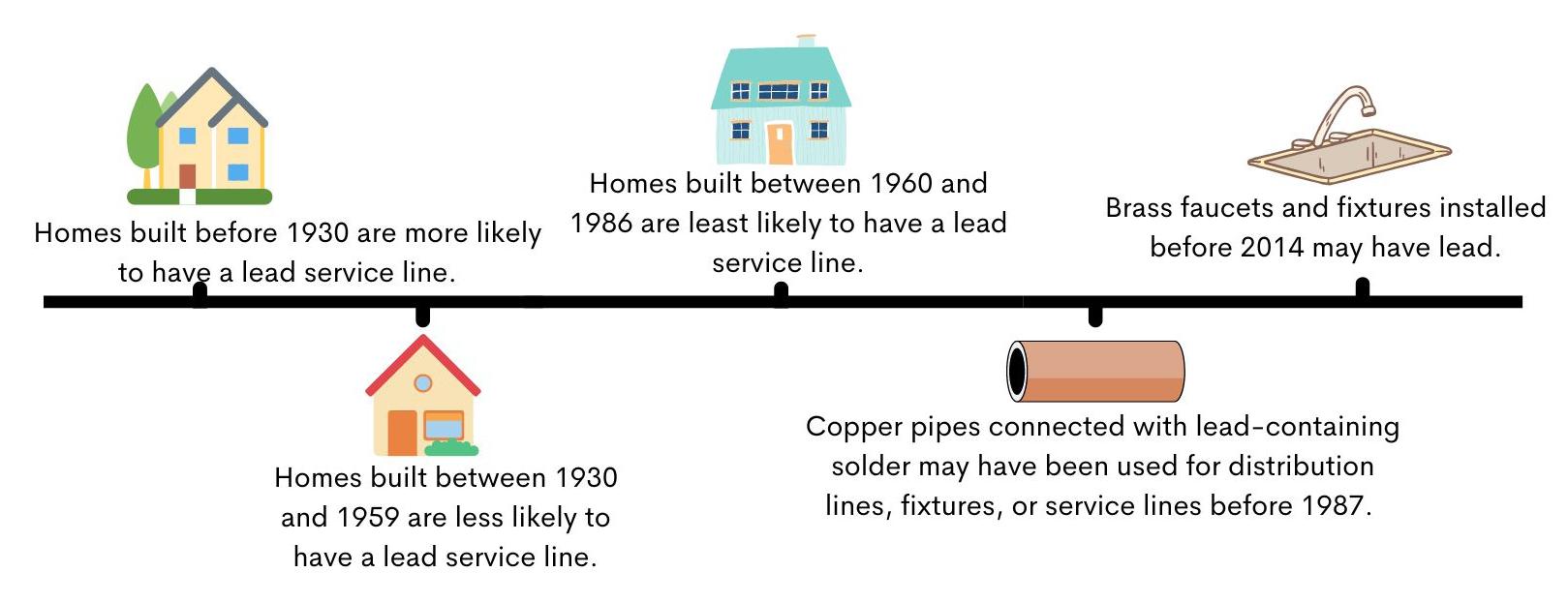
Lead and Copper - Lead can cause serious health problems, especially for pregnant women and young children. Lead in drinking water is primarily from materials and components associated with service lines and home plumbing.
The City of Mesa is responsible for providing high quality drinking water and removing lead pipes but cannot control the variety of materials used in plumbing components in your home. You share the responsibility for protecting yourself and your family from the lead in your home plumbing. You can take responsibility by identifying and removing lead materials within your home plumbing and taking steps to reduce your family’s risk.
Before drinking tap water, flush your pipes for several minutes by running your tap, taking a shower, doing laundry or a load of dishes. You can also use a filter certified by an American National Standards Institute accredited certifier to reduce lead in drinking water.
To address lead in drinking water, public water systems were required to develop and maintain an inventory of service line materials by Oct 16, 2024. Developing an inventory and identifying the location of lead service lines (LSL) is the first step for beginning LSL replacement and protecting public health. The lead service inventory may be viewed online at mesaaz.gov/ utilities/water-wastewater/water-quality/lead-and-copper. Please contact us if you would like more information about the inventory or any lead sampling that has been done, 480-644-5980
If you are concerned about lead in your water and wish to have your water tested, contact the City of Mesa Water Quality group at 480-644-6461. Information on lead in drinking water, testing methods, and steps you can take to minimize exposure is available at epa.gov/safewater/lead
Radon - Radon is a radioactive gas found throughout the U.S. that you cannot see, taste or smell. It can build up to high levels inside a home by moving up through the ground and into a house through cracks and holes in the foundation. Radon can also be released from tap water into the indoor air when showering, washing dishes, and performing other household activities that use water. Radon entering the home via tap water, in most cases, is only a small contributing source to indoor air levels, compared to radon entering the home through the ground and soil. Radon is a known human carcinogen and breathing air containing radon can lead to lung cancer. Drinking water containing radon may also cause an increased risk of stomach cancer. If you are concerned about radon in your home, testing the air is inexpensive and easy. Radon removal should be considered if the level in the air is four picocuries per liter of air or higher (≥4 pCi/L). There are simple ways to fix a radon problem that are not costly. For additional information, call your state radon program or EPA’s Radon Hotline at 1-800-557-2366
Arsenic - Some of Mesa’s drinking water sources contain low levels of arsenic, a naturally occurring metal. Beginning in January 2006, allowable arsenic levels were reduced from 50 ppb to 10 ppb. The EPA determined this standard by balancing the current understanding of arsenic’s possible health effects against the costs of removing it from drinking water. The EPA continues to research the health effects of low-level exposure to arsenic. Some people who drink water containing arsenic in excess of the MCL over many years could experience skin damage or problems with their circulatory system and may have an increased risk of getting cancer. Monitoring results can be found in the table on page 10.
Per- and polyfluoroalkyl substances (PFAS) - What are per- and polyfluoroalkyl substances and where do they come from? Per- and polyfluoroalkyl substances (PFAS) are a group of thousands of man-made chemicals. PFAS have been used in a variety of industrial and consumer products around the globe, including in the U.S., for decades. Due to their widespread use and environmental persistence, most people in the United States have been exposed to certain PFAS.
PFAS have been used to make coatings and products that are used as oil and water repellents for carpets, clothing, paper packaging for food, and cookware. They are also contained in some foams (aqueous film-forming foam or AFFF) used for fighting petroleum fires.
Mesa and all other public water systems have completed the fifth round of the Unregulated Contaminant Monitoring Rule (UCMR 5). UCMR 5 required public water systems to collect and analyze samples for 30 chemical contaminants (29 PFAS compounds and lithium) between January 2023 and December 2025. The purpose of UCMR 5 is to provide scientifically reliable data on the occurrence of these contaminants in drinking water nationwide. All results were submitted to the EPA for review and will be used to help determine potential future Maximum Contaminant Levels (MCLs). The results are publicly available at: epa.gov/dwucmr/fifth-unregulated-contaminant-monitoring-rule-data-finder.
Source water assessment
The Arizona Department of Environmental Quality (ADEQ) completed a source water assessment for the City of Mesa to determine how vulnerable Mesa’s drinking water sources are to natural or man-made contamination. A designation of “high risk” was assigned to Mesa’s water sources, meaning that there may be additional source water protection measures that can be used. This does not mean that Mesa’s source water is contaminated or that contamination is unavoidable. Mesa City Code has several ordinances that prohibit dumping and other activities that could contaminate source water. The complete assessment can be reviewed at ADEQ, 1110 W. Washington Street, Phoenix, Arizona 85007, between 8 a.m. and 5 p.m. You can request an electronic copy via e-mail at recordscenter@azdeq.gov. For more information visit ADEQ’s Source Water Assessment and Protection Unit Web site at azdeq.gov/source-water-protection
Taking precautions for special health concerns
Some people may be more vulnerable to contaminants in drinking water than the general population. Immunocompromised people such as persons undergoing chemotherapy, people who have undergone organ transplants, people with HIV/AIDS or other immune system disorders, some elderly, and infants can be particularly at risk from infections. These people should seek advice about drinking water from their healthcare providers. EPA and Centers for Disease Control guidelines on appropriate means to lessen the risk of infection by Cryptosporidium and other microbial contaminants are available from the Safe Drinking Water Hotline at 1-800-426-4791 or at epa.gov/ ground-water-and-drinking-water/safe-drinking-water-information
Mesa’s water sources
Mesa relies on two sources for its drinking water: surface water and groundwater wells. Water from these two sources can vary in hardness and other characteristics. The city is divided into three zones: the City Zone, the Eastern Zone, and the Southern Zone. The zone you live in determines where your surface water originates. All zones may receive groundwater or a blend of surface and groundwater at varying times throughout the year.
City Zone - Salt and Verde River water delivered through the Salt River Project supplies water for the City Zone. This water is treated at the Val Vista Water Treatment Plant using conventional filtration, fluoridation, and disinfection using chlorine dioxide and chlorine before entering Mesa’s water distribution system. Approximately 40 percent of all the water served to Mesa’s customers in 2025 came from this source.
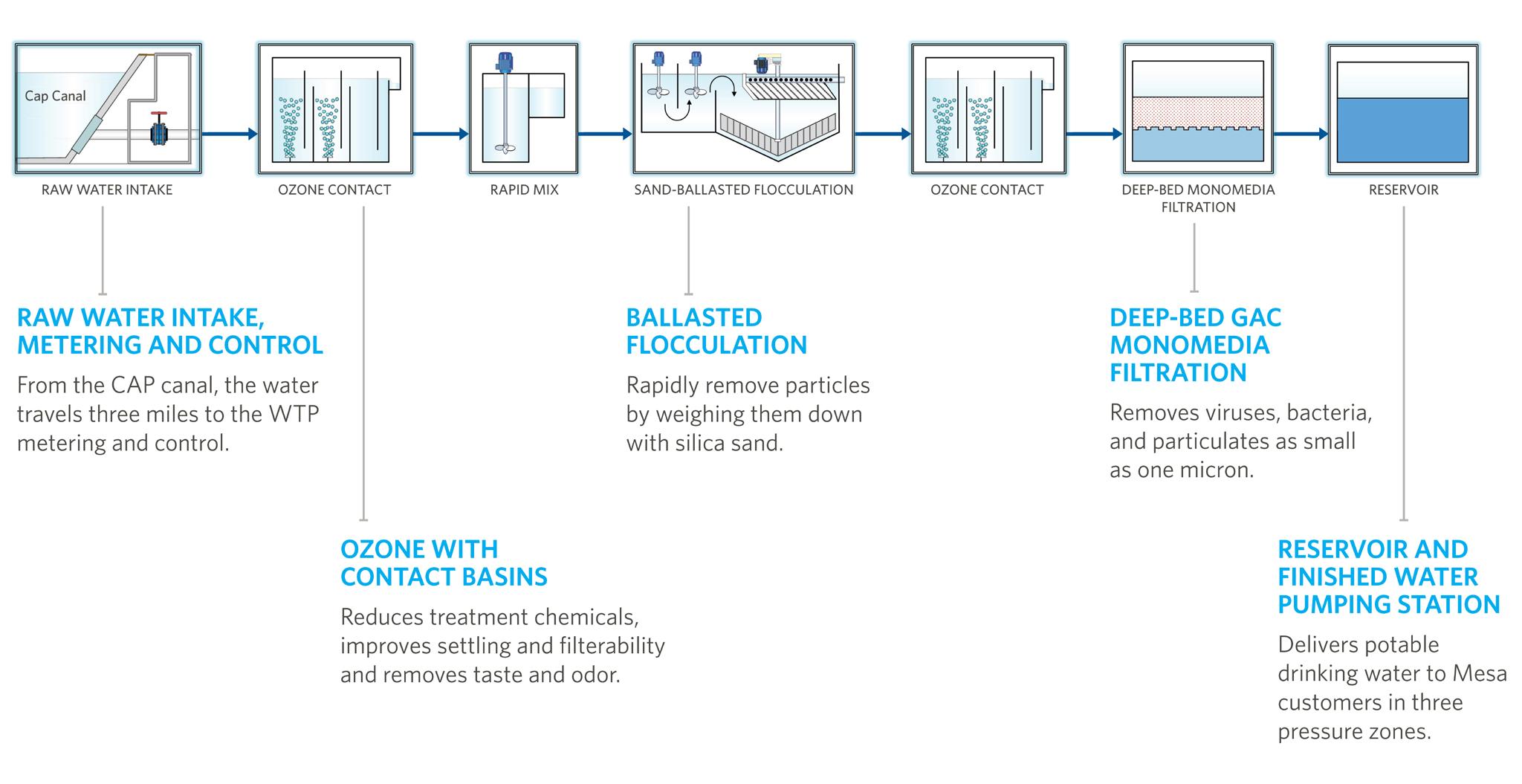
Eastern and Southern Zones - Colorado River water delivered through the Central Arizona Project supplies water for the Eastern and Southern Zones. This water is treated at the Brown Road Water Treatment Plant and Signal Butte Water Treatment Plant. The Brown Road Water Treatment Plant uses conventional filtration, fluoridation, chlorine dioxide, and chlorine disinfection before entering Mesa’s water distribution system. The Signal Butte Water Treatment Plant uses ballasted flocculation, ozone, and chlorine disinfection as part of its treatment process. Approximately 52 percent of all the water served to Mesa’s customers in 2025 came from this source.
City Wells - Eighteen deep aquifer wells supply drinking water throughout the City Zone. After chlorination, water from these wells is typically blended with surface water from the Val Vista Water Treatment Plant. However, during certain times throughout the year, some customers may receive only groundwater from one or more of these wells. Approximately four percent of the water served to Mesa’s customers came from this source in 2025.
Eastern and Southern Wells - Sixteen deep aquifer wells supply drinking water throughout a wide area in Mesa’s Eastern and Southern Zones. After chlorination, water from these wells is blended with surface water. Approximately four percent of the water served to Mesa’s customers came from this source in 2025.
Water treatment process
Mesa’s three water treatment facilities process millions of gallons of raw water daily to meet the standards required by the Safe Drinking Water Act.
The City’s water treatment plants must meet rigorous standards established by the EPA and ADEQ. The Brown Road Water Treatment Plant can process 72 million gallons of water per day, and the Signal Butte Water Treatment Plant can process 24 million gallons per day. The raw water that feeds into the plants comes from the Central Arizona Project (Colorado River). The Val Vista Water Treatment Plant, jointly owned with the City of Phoenix, can process 90 million gallons per day for Mesa. The raw water that feeds into the plant comes from the Salt River Project (Salt and Verde Rivers). All treatment plants are operated by ADEQ certified water operators.
The diagram below shows how raw water is processed at the Signal Butte Water Treatment Plant.
Water quality data
The tables on pages 8-11 list drinking water contaminants detected in calendar year 2025 and data from the most recent testing done in accordance with the Safe Drinking Water Act. The state allows water systems to monitor for some contaminants less than once per year because the concentrations of these contaminants do not change frequently. Some of the data, though representative, are more than one year old. The presence of contaminants does not indicate that the water poses a health threat, only that they were detected during routine compliance monitoring. Not listed are many other regulated contaminants that were tested for, but not detected.
Water treatment process Signal Butte Water Treatment Plant
Definitions and abbreviations
AL (Action Level) - The concentration of a contaminant that, if exceeded, triggers treatment or other requirements that a community water system shall follow.
gpg (Grains Per Gallon) - Unit of water hardness used for setting water softeners. One gpg equals 17.1 ppm or mg/L of hardness.
L/mg-m (Liters Per Milligram–Meter) - Unit of measure used to report SUVA values.
LRAA (Locational Running Annual Average) - The running annual average of sample data collected at one location.
MCL (Maximum Contaminant Level) - The highest level of a contaminant allowed in drinking water. MCLs are set as close to the MCLGs as feasible using the best available treatment technology.
MCLG (Maximum Contaminant Level Goal) - The level of a contaminant in drinking water below which there is no known or expected risk to health. MCLGs are set by the U.S. Environmental Protection Agency (EPA).
MRDL (Maximum Residual Disinfectant Level) - The highest level of a disinfectant allowed in drinking water. The addition of a disinfectant is necessary for control of microbial contaminants.
ND (Non Detect) - The contaminant was not detected or detection was below the method detection limit.
NE (None Established) - Regulatory limit has not been established by the EPA.
NTU (Nephelometric Turbidity Units) - the unit used to measure the presence of suspended particles in water.
pCi/L (PicoCuries Per Liter) - Unit of measurement for some radionuclides in water.
ppb (Part Per Billion) - One ppb corresponds to one drop in 13,563 gallons. One ppb is equivalent to one microgram per liter (μg/L).
ppm (Part Per Million) - One ppm corresponds to one drop in 13.6 gallons. One ppm is equivalent to one milligram per liter (mg/L).
ppm = one drop in 13.6 gallons
ppb = one drop in 13,563 gallons
ppt = one drop in 13,563,368 gallons
MRDLG (Maximum Residual Disinfectant Level Goal)The level of a drinking water disinfectant below which there is no known or expected risk to health. MRDLGs do not reflect the benefits of the use of disinfectants to control microbial contaminants.
N/A (Not Applicable) - Where present, the contaminant has not been assigned an MCL or MCLG.
ppt (Part Per Trillion) - One part per trillion corresponds to one drop in 13,563,368 gallons. One ppt is equivalent to one nanogram per liter (ng/L).
RAA (Running Annual Average)Moving average based upon the previous twelve months (or four quarters) of monitoring data.
SUVA (Specific Ultraviolet Absorbance) - Specific ultraviolet absorption at 254 nanometers (nm), an indicator of the humic content of water. It is a calculated parameter obtained by dividing a sample’s ultraviolet absorption at a wavelength of 254 nm by its concentration of dissolved organic carbon.
TT (Treatment Technique) - A required process to reduce the level of a contaminant in drinking water.
2025 Regulated Contaminants
Microbiological (RTCR)
Treatment Technique (TT)
Treatment Technique (TT)
Surface Water Treatment Rule
1 Turbidity is a measure of the cloudiness of water, and it is an indication of the effectiveness of our filtration system. We monitor it because it is a good indicator of the quality of water. High turbidity can interfere with the effectiveness of disinfectants.
Surface Water Treatment Rule
Treatment Technique (TT)
Less than 2.0 L/mg-m calculated quarterly for treated
2 Total organic carbon (TOC) has no health effects. However, total organic carbon provides a medium for the formation of disinfection byproducts. These byproducts include trihalomethanes (THM) and haloacetic acids (HAA). Drinking water containing these byproducts in excess of the MCL may lead to adverse health effects, liver, or kidney problems, or nervous system effects, and may lead to an increased risk of getting cancer. The City of Mesa meets alternative compliance criteria for TOC removal using Specific Ultraviolet Absorbance (SUVA). Compliance is based on a running annual average calculation for four (4) quarters.
3 Total organic carbon (TOC): Water entering the distribution system from the Val Vista Water Treatment Plant meets compliance based on TOC removal. The value reported is the lowest ratio between the percent of TOC actually removed to the percentage of TOC required to be removed.
2025 Regulated Contaminants
Disinfectants
MCL Violation Y or N
Range of All Samples (Low - High)
Disinfection By-Products
MCL Violation Y or N
Compliance is based on the locational running annual average calculation for four (4) quarters.
Range of All Samples (Low - High)
Lead & Copper
Range
Lead and Copper samples are collected every three (3) years from homes meeting regulatory criteria. The value reported as the 90th percentile means that 90% of the samples collected had lead concentrations that were equal to or less than 5.01 ppb in 2024.
2025 Regulated Contaminants
Radionuclides
Inorganic Chemicals
Erosion of natural deposits; runoff from orchards; runoff from glass and electronics production wastes
of drilling wastes; discharge from metal refineries; erosion of natural deposits
from steel and pulp mills; Erosion of natural deposits.
Erosion of natural deposits; water additive which promotes strong teeth; discharge from fertilizer and aluminum factories
from fertilizer use; leaching from septic tanks, sewage; erosion of natural deposits
from
and
of
Synthetic Organic Chemicals
from
on
Discharge from rubber and chemical factories
Volatile Organic Chemicals
2025 Regulated Contaminants
Volatile Organic Chemicals
2025 Regulated Contaminants
2025 Regulated Contaminants
Inorganic Chemicals
Surface Water Monitoring - CRYPTOSPORIDIUM
The City of Mesa performed surface water monitoring for Cryptosporidium in 2020. Eight (8) samples were collected. There was no indication of the presence of Cryptosporidium in our source water during the 2020 calendar year.
Other Parameters of Interest
Synthetic Organic Chemicals
Erosion ofnatural deposits;runofffrom orchards;runofffromglassand electronicsproduction wastes
Discharge ofdrilling wastes;discharge frommetal refineries;erosion ofnatural deposits
Erosion ofnatural deposits;water additive which promotesstrong teeth; discharge fromfertilizerand aluminum factories
WHY IS THE RANGE OF HARDNESS SO WIDE?
Runofffromfertilizeruse;leaching from septictanks,sewage;erosion ofnatural deposits
Discharge frompetroleiumand metal refineries;Erosion ofnatural deposits; discharge frommines
Drinking water in the City of Mesa comes from surface water and groundwater sources. Depending on utility operations, the water that you consume may have a higher percentage of groundwater. Our groundwater sources also vary in the concentration of mineral deposits and hardness.
Runoff/leaching fromsoil fumigantused on soybeans,cotton,pineapples,and orchards.
Discharge fromrubberand chemical factories
LET’S ALL DO OUR PART Water Shortage
Water education and protecting our environment
Water Shortage Due to historic drought, hotter and drier conditions, and more water being used than nature can supply, the Colorado River is in a state of shortage. While Colorado River water makes up about half of Mesa’s water supply portfolio, the City of Mesa can still meet demand to provide reliable water services to the community. The City continues to strategically plan for a future with less Colorado River water. Read more about Mesa’s water stewardship, how we have cut municipal water use, and what you can do to use water more efficiently at mesaaz.gov/water. Do your part and save money by learning more at mesaaz.gov/water today.
Know Your H2O Mesa has a variety of materials, tips, conservation rebate programs, water-efficient landscaping ideas and more to help you get to Know Your H2O, visit mesaaz.gov/water
Use water efficiently and responsibly Conserving water means using our water supplies efficiently and responsibly, and it is especially important during times of water shortage. Mesa works to inspire our community to save this precious resource through incentive programs, educational materials, easy water-saving tips, workshops, free landscape publications, and more. Visit mesaaz.gov/conservation
Keep our waterways clean A storm can wash fertilizers, herbicides, pesticides and other chemicals from yards into the streets and eventually our waterways. To learn more, visit azstorm.org
Only flush the three P’s – Pee, Poo, (toilet) Paper Do not flush unused medications or personal health care products down the sink or toilet because it introduces contaminants into the water supply and clogs sewer systems. To learn how to safely dispose of these items, visit mesaaz.gov/residents/water/safe-waste-disposal
Household hazardous materials program The City of Mesa now has a permanent facility located at 2412 N. Center Street to recycle appliances, electronics, tires, paint, garden chemicals and more, visit mesaaz.gov/hhm
How to drain or backwash your pool Need to drain your pool, but not sure where to start? To learn how, visit mesaaz.gov/ Environment-Sustainability/Environmental/DrainBackwash-Pool
How you can get involved If you want to provide input on water-related issues, the Mesa City Council meets at 5:45 p.m. the first and third Monday of each month in Council Chambers, located at 57 E. 1st Street, unless otherwise noted. For a complete meeting schedule, visit mesaaz.gov/Government/City-Council-Meetings
Mesa Water Resources does not hold regularly scheduled public meetings. A public notice will be issued for any necessary meetings.
FOR MORE INFORMATION:
Online Consumer Confidence Report: mesaaz.gov/ccr
City of Mesa Water Quality Services: 480-644-6461
E-mail address: water.quality@mesaaz.gov
City of Mesa home page: mesaaz.gov
Maricopa County Environmental Services Department 602-506-6666
Arizona Department of Environmental Quality (ADEQ) 602-771-2300
Environmental Protection Agency (EPA) 800-426-4791
If you would like a copy of this report emailed or mailed to you, please contact City of Mesa Water Quality Services at 480-644-6461 or water.quality@mesaaz.gov
EN ESPAÑOL
Si gustas recibir esta información en español, por favor de llamar al 480-644-6461
Proporciona tu nombre y domicilio para enviarte este folleto en español o visita mesaaz.gov/ccrespanol
Facebook: CityofMesa | X: @MesaAzgov | Instagram: cityofmesa | YouTube: cityofmesa11