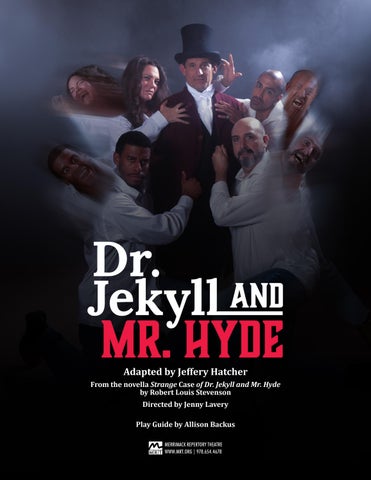
Adapted by Jeffery Hatcher From the novella Strange Case of Dr. Jekyll and Mr. Hyde by Robert Louis Stevenson Directed by Jenny Lavery Play Guide by Allison Backus
JENNY LAVERY NANCY L. DONAHUE INTERIM EXECUTIVE ARTISTIC DIRECTOR
MERRIMACK REPERTORY THEATRE
DR. JEKYLL AND MR. HYDE PRESENTS
ADAPTED BY
JEFFREY HATCHER
FROM THE NOVELLA STRANGE CASE OF DR. JEKYLL AND MR. HYDE BY
ROBERT LOUIS STEVENSON SCENIC DESIGNER
MICHAEL HOOVER PROPS ARTISAN
EMILY ALLINSON
^
COSTUME DESIGNER
YAO CHEN STAGE MANAGER
LIGHTING DESIGNER
BRIAN J. LILIENTHAL
^
JENNA WORDEN
DIALECT COACH
SARA VALENTINE
*
^
SOUND DESIGNER
DAVID REMEDIOS^ FIGHT DIRECTOR
ANSLEY RIZZO
DIRECTOR
JENNY LAVERY+
OCTOBER 14, 2026 – NOVEMBER 1, 2026
*Appearing through an Agreement between this theatre, Merrimack Repertory Theatre, and Actors’ Equity Association, the Union of Professional Actors and Stage Managers in the United States +Member of the Society of Stage Directors and Choreographers ^Member of United Scenic Artists. The scenic, costume, lighting and sound designers in LORT Theatres are represented by United Scenic Artists, Local USA-829 of the IATSE. DR. JEKYLL AND MR. HYDE (HATCHER) is presented by arrangement with Concord Theatricals on behalf of Dramatists Play Service. www.concordtheatricals.com
DR. JEKYLL AND MR. HYDE | PLAY GUIDE | 2026
MERRIMACK REPERTORY THEATRE | 978.654.4678 | WWW.MRT.ORG
Learning Standards for Grades 7–12 Overview Five Facts about Robert Louis Stevenson Did You Know? Stevenson and The Strange Case of Dr. Jekyll and Mr. Hyde Stevenson’s Inspirations Jekyll and Hyde in Pop Culture: Fun Facts! English Language Arts—Reading Literature, Reading Informational Text RL. 9, RI.10 Theatre Arts—Responding TR.07, TR.08
Suggested Listening: 101 Stage Adaptations, “Dr. Jekyll and Mr. Hyde by Jeffrey Hatcher” An Interview with Set Designer Michael Hoover
About Gothic Horror Activity: Two Sentence Horror Stories English Language Arts—Reading Literature, Writing, Language, Speaking and Listening RL.1, W.3, W.4, W.5, W10, L.1, L.3, SL.1
Activity: Gothic Horror Soundscape Scenes Activity: Duality and Physicality Theatre Arts—Creating, Performing T.Cr.01, T.Cr.03, T.P.04, T.P.06
Hyde’s Haunts: Whitechapel in the Late 19th Century Jekyll and Hyde, Duality, and Anxieties of the Time English Language Arts—Reading Informational Text, Reading Literature, Speaking and Listening, Reading in History and Social Science, Language RI.5, RI.6, RI.7, RI.10, RL.2, RL.6, SL.1, SL.2, RCA-H.9, L.4
An Interview with Costume Designer Yao Chen After the Show: Discussion Questions English Language Arts—Speaking and Listening, Reading Literature RL.2, RL.3, RL.9, SL.1 Theatre Arts—Responding TR.07, TR.08
3
DR. JEKYLL AND MR. HYDE | PLAY GUIDE | 2026
MERRIMACK REPERTORY THEATRE | 978.654.4678 | WWW.MRT.ORG
Overview In 1883 London,
the respected Dr. Henry Jekyll strives to isolate man’s bestial and vicious impulses; the impulses that bring shame, fear, and lost reputations to supposedly morally upright citizens. Jekyll develops and regularly ingests a tincture that...
frees his own dark, repressed desires in the night-stalking persona of Mr. Edward Hyde, a man with a penchant for violence and no regard for society’s moral standards. After nearly a year of transforming into Hyde, Jekyll begins to wake with no memory of Hyde’s actions, and when his friends and colleagues cross paths with his malevolent double, he becomes increasingly desperate to...
conceal his secret, no matter the cost. Image: Promotional image for MRT’s Dr. Jekyll and Mr. Hyde. https://mrt.org/show/dr-jekyll-and-mr-hyde/
FIVE FACTS ABOUT ROBERT LOUIS STEVENSON
Image: Robert Louis Stevenson, 1893. https://tinyurl.com/4sv3ra47
Robert Louis Stevenson (1850-1894) was a Scottish novelist, poet, and travel writer best known for Treasure Island (1883), A Children’s Garden of Verses (1885), The Strange Case of Dr. Jekyll and Mr. Hyde (1886), and Kidnapped (1886). Stevenson’s work was immensely popular during his lifetime, and today, his prose and poetry are considered beloved staples of the English literary canon. He is among the most frequently translated and adapted English writers.
1. Stevenson was chronically ill for much of his life… Throughout childhood and adulthood, Stevenson struggled with a chronic respiratory condition that caused breathing difficulty, coughing, fever, and hemorrhages. Stevenson’s recurrent health struggles were worsened by Scotland’s cold, damp climate, and his extensive travels—which produced numerous travel books and essays—stemmed from his need for warmer, drier climates.
2. He was part of a large social circle of 19th-century writers, artists, and critics… Henry James, J.M. Barrie, Sir Arthur Conan Doyle, Thomas Hardy, George Meredith, Sidney Colvin, William Ernest Henley, Auguste Rodin, John Singer Sargent, and Will H. Low were some of Stevenson’s many friends and acquaintances. 4
DR. JEKYLL AND MR. HYDE | PLAY GUIDE | 2026
MERRIMACK REPERTORY THEATRE | 978.654.4678 | WWW.MRT.ORG
FIVE FACTS ABOUT ROBERT LOUIS STEVENSON (CONTINUED)
3. He was married to American writer Fanny Van de Grift Stevenson… Stevenson met Fanny Van de Grift Osborne when he was twenty-five and traveling in France with a friend. She was ten years his senior and married with children, but Stevenson was undeterred in his affections. After divorcing her long-unfaithful husband, Fanny married Stevenson in California in 1880. She was an accomplished writer of fiction and non-fiction, and numerous literary historians believe that her strong support of Stevenson’s talents (and her readily offered constructive feedback) aided Stevenson’s literary success. Stevenson’s love for Fanny is expressed in much of his literary work, including the poem, “My Wife.”
4. He studied engineering and then law before pursuing a career as a writer... Stevenson attended the University of Edinburgh, where his parents expected him to get the education needed to become a lighthouse engineer like his father. Stevenson’s father was disappointed when his son announced that he planned to be a writer instead, but said he would accept the decision as long as Stevenson studied law as a financial safety net. Stevenson earned his law degree in 1875, but never practiced.
5. Stevenson spent the last four years of his life in Samoa and became politically involved in the First Samoan Civil War… The Stevensons settled in Samoa in 1890. While there, Stevenson immersed himself in Samoan culture and came to sympathize with the native islanders’ struggle against colonialism. Stevenson supported the indigenous chieftain Mata’afa, and protested against the contending colonial powers of Great Britain, Germany, and the United States, which earned him accusations of sedition from the British government. Stevenson, known as “Tusitala” or “Teller of Tales” by the indigenous islanders, recounted the period’s political turmoil and the mistreatment and colonial exploitation Samoans endured in his 1892 non-fiction book, A Footnote to History: Eight Years of Trouble in Samoa.
DID YOU KNOW? The Strange Case of Dr. Jekyll and Mr. Hyde was published in 1886, just two years before the infamous serial killer, “Jack the Ripper,” murdered five women in East London… Stevenson’s popular novella had such a profound impact on the public that many people made connections between Mr. Hyde and the unknown, elusive killer. Someone interviewed by the Daily Telegraph believed that the perpetrator was someone whose “diseased brain” had become “inflamed” by viewing a stage adaptation of Dr. Jekyll and Mr. Hyde. “If there is anything in this,” said the speculator, “let the detectives consider how Mr. Hyde would have acted—for there may be a system in the demonic actions of a madman in following the pattern set before him.” 1 When police consistently failed to discover and apprehend the murderer, The Pall Mall Gazette, The Globe, and other newspapers “returned again and again to Dr. Jekyll and Mr. Hyde, suggesting that it was the double nature of the killer that made it possible for him to escape detection.” 2
1
“G.S” quoted in “Letters from the Public,” The Daily Telegraph, October 3, 1888, transcribed and archived by Casebook: Jack the Ripper, https://www.casebook.org/press_reports/daily_telegraph/dt881003/. Judith Flanders, The Invention of Murder: How the Victorians Reveled in Death and Detection and Created Modern Crime, (Thomas Dunne Books, 2014), 435.
2
5
DR. JEKYLL AND MR. HYDE | PLAY GUIDE | 2026
MERRIMACK REPERTORY THEATRE | 978.654.4678 | WWW.MRT.ORG
DID YOU KNOW? (CONTINUED)
Image: Richard Mansfield as Jekyll and Hyde. https://tinyurl.com/z3tkrcuv
An actor playing the roles of Jekyll and Hyde on stage was accused of the murders…
However, Jekyll and Hyde was also likely inspired by two real people…
In 1888, English actor
thief, William Brodie; and Eugène Marie Chantrelle,
Richard Mansfield starred
a French tutor and acquaintance of Stevenson who
in one of the first stage
murdered his wife, Elizabeth, in 1878. Want to learn
adaptations of Stevenson’s
more? Check out “Stevenson’s Inspirations” on the
story. Mansfield’s superb
next page.
acting skills earned
Many scholars believe that Dr. Jekyll and his alter ego were inspired by two people whose lives were wellknown to Stevenson: The 18th-century cabinet-maker, respected Edinburgh council member, and secret
their theory that the actor was the killer: “I do not think
The Gothic horror genre started with an elaborate hoax…
there is a man living so well able to disguise himself in a
Horace Walpole’s The Castle of Otranto is widely
moment as he does in front of the public,” claimed the
considered the first piece of Gothic fiction. When it
theatre-goer, who also pointed out that “the murders
was first published in 1764, the book claimed its story
take place on Saturday nights [and] Mr. M. never has
came from an 11th-century Italian text discovered in the
a performance on Saturday…” The allegations against
library of an English estate in the 16th century and later
Mansfield were dismissed, but his acting career suffered
translated. After the novel’s success, Walpole admitted
for the rest of his life.
authorship in the book’s second edition, subtitled
him suspicion when a concerned audience member wrote to the police with
3
The idea for Jekyll and Hyde came to Stevenson in a dream…
“A Gothic Story.”
Robert Louis Stevenson’s wife, Fanny, recalled the impetus for her husband’s novella: “In the small hours of one morning, I was awakened by cries of horror from Louis. Thinking he had a nightmare, I awakened him. He said angrily: ‘Why did you wake me? I was dreaming a fine bogey tale.’ I had awakened him at the first transformation scene.”4
3 4
“Anonymous Letter to City of London Police about Rack the Ripper,” October 5, 1888, London Metropolitan Archives, British Library, https://umsi580.lsait.lsa.umich.edu/s/jack-the-ripper-archive/item/1014. Fanny Stevenson, quoted in Graham Balfour, The Life of Robert Louis Stevenson, Vol. II, (Methuen and Co., 1901), 13. 6
DR. JEKYLL AND MR. HYDE | PLAY GUIDE | 2026
Stevenson and The Strange Case of Dr. Jekyll and Mr. Hyde
MERRIMACK REPERTORY THEATRE | 978.654.4678 | WWW.MRT.ORG
In 1885, Robert Louis Stevenson was bedridden and battling a severe flare-up of his chronic respiratory illness.
In a fevered state, he dreamt of a man “being pressed into a cabinet,” who then “swallowed a drug and changed into another being.”5 Over the next three days, Stevenson wrote the first draft of what would become The Strange Case of Dr. Jekyll and Mr. Hyde. According to his family, Stevenson burned the first draft when his wife, Fanny, suggested it would be stronger if he leaned more heavily into the story’s allegorical potential. Stevenson was put out by his wife’s critique, but he nevertheless took it to heart. He spent the next three
INTERESTED IN READING OR REREADING STEVENSON’S COMPELLING CLASSIC? Read the full novella HERE, or listen to it HERE.
days obsessively recrafting the story and the next six weeks editing and refining it. The Strange Case of Dr. Jekyll and Mr. Hyde was published to commercial and critical acclaim in 1886.
STEVENSON’S INSPIRATIONS One year after publishing The Strange Case of Dr. Jekyll and Mr. Hyde, Stevenson reflected in an essay that before writing his hit novella, he had “long been trying to write a story” that served as a vehicle for exploring the “strong sense of man’s double being which must at times come in upon and overwhelm the mind of every thinking creature.”6 Where did this fascination with man’s “double nature” stem from? Literary historians believe that Stevenson was inspired by the lives of two real people.
Eugène Marie Chantrelle Eugène Chantrelle was born in Nantes in 1834. Shortly after the French Revolution of 1848, Chantrelle traveled to the United States and then to England, where he worked as a French tutor and textbook writer. By 1866, Chantrelle had settled in Edinburgh, where he enjoyed a reputation as an accomplished linguist and educator. Chantrelle groomed and abused a fifteen-year-old student, Elizabeth Dyer, and the two married in 1868 when she became pregnant. Throughout her and Chantrelle’s ten-year marriage, Elizabeth endured death threats and verbal and physical abuse from her husband. Publicly, Chantrelle’s reputation began to suffer due to his flagrant adultery Image: Eugène and Elizabeth Chantrelle. https://tinyurl. com/45j4pb5e
and frequent bouts of severe drunkenness.
“Evolved in Dreams,” Glen Innes Examiner and General Advertiser, November 15, 1887, 3, quoted in Graham Tulloch. “Where did Jekyll and Hyde Come From?,” Australian Academy of the Humanities, October, 2022, https://humanities.org.au/power-of-the-humanities/where-did-jekyll-and-hyde-come-from/#_edn2. 6 Robert Louis Stevenson, The Works of Robert Louis Stevenson, Volume XVI, (Swanson Edition, 1912; Project Gutenberg), “A Chapter on Dreams,” https://www.gutenberg.org/files/30990/30990-h/30990-h. htm#page177. 5
7
DR. JEKYLL AND MR. HYDE | PLAY GUIDE | 2026
MERRIMACK REPERTORY THEATRE | 978.654.4678 | WWW.MRT.ORG
STEVENS’S INSPIRATIONS: EUGÈNE MARIE CHANTRELLE AND WILLIAM BRODIE (CONTINUED)
In the fall of 1877, Chantrelle bought a life insurance policy against his wife’s accidental death, and less than four months later, he murdered Elizabeth by poisoning her with opium. Chantrelle unsuccessfully staged his wife’s death to look like accidental coal gas poisoning, and three days after Elizabeth’s demise, Chantrelle was arrested. At his trial in May of 1878, Chantrelle was unanimously found guilty and sentenced to death by hanging.
William Brodie Born in 1741, William Brodie was a respected Scottish cabinet-maker and town councilman. Brodie’s work included repairing, creating, and installing locks, giving him intimate knowledge of the security measures in place at the homes he visited. Brodie made a habit of copying his clients’ keys so he could later break into their homes and safes and rob them of their valuables. Brodie used what he stole to fund a secret, disreputable
Robert Louis Stevenson knew Chantrelle, attended his
lifestyle that included heavy drinking, multiple
trial, and had no doubt that he was guilty. Following
mistresses, five children, and a gambling addiction.
the sentencing, Stevenson reflected on what he had
Brodie’s twenty-year crime spree came to an end
witnessed in his acquaintance’s dubious nature:
when his ambition got the best of him: In 1788, Brodie
“I should say, looking back from the unfair superior ground of subsequent knowledge, that Chantrelle bore upon his brow the most open marks of criminality… Chantrelle [had] ill nature, a painfully acute temper, a quivering black sensibility of the nerves were written on every line of his face and confessed in every movement of his body. When I knew him, he seemed never happy except when he was drunk; and even then there was something uncomfortable in his mirth, something feverish and wild.”7 Stevenson also reflected on witnessing Chantrelle’s impressive intellect and single-minded opportunism. During their last interaction, Stevenson declined to “approach a publisher” on Chantrelle’s behalf without a “written sample” of his proposed Molière translation. With his hopes of advancement via Stevenson quashed, Chantrelle did not approach the writer again, and when Stevenson next saw Chantrelle, it was at the trial. Although not corroborated in the trial’s official record,
and his accomplices were caught stealing from an excise office. Brodie fled to London, and then boarded a ship disguised as an elderly man in poor health. After months on the run, Brodie was apprehended in Amsterdam and brought back to Edinburgh for trial, where he was found guilty and sentenced to death by hanging. Stevenson was well acquainted with the legendary story of Brodie’s life and crimes, and his childhood home even featured an inherited wardrobe made by the duplicitous man himself. As an adult, Stevenson co-wrote the play Deacon Brodie, or the Double Life, and because of the clear similarities, many believe Brodie’s life also inspired The Strange Case of Dr. Jekyll and Mr. Hyde.
Stevenson reported in his notes that the prosecutor told him that Elizabeth had not been Chantrelle’s first victim: “He had left France because of murder; he had left England because of murder…more than four or
Image: An illustration of William Brodie, 1788. https://tinyurl.com/4v32ynmn
five had fallen a victim to his little supper parties and his favourite dish of toasted cheese and opium.”8
7 8
“Robert Louis Stevenson, “Memories and Portraits: Memoirs of Himself: Selections from His Notebook,” in The Works of Robert Louis Stevenson Tusitala Edition, Volume XXIX, (William Heinemann, Ltd., 1924), 162-163. Stevenson, “Memories and Portraits: Memoirs of Himself: Selections from His Notebook,” 163.
8
DR. JEKYLL AND MR. HYDE | PLAY GUIDE | 2026
MERRIMACK REPERTORY THEATRE | 978.654.4678 | WWW.MRT.ORG
JEKYLL AND HYDE IN POP CULTURE: FUN FACTS! The Strange Case of Dr. Jekyll and Mr. Hyde has been adapted hundreds of times…
There’s a trilogy of Jekyll and Hydethemed Looney Tunes cartoons…
In addition to boasting over 120 film adaptations, Stevenson’s novella has been adapted into plays, musicals, ballets, radio shows, and graphic novels.
You can find numerous references and allusions to the doctor and his maniacal double in music… The Who’s “Dr. Jekyll and Mr. Hyde,” Bruce Springsteen’s “Two Faces,” Men at Work’s “Dr. Heckyll
Legendary director, animator, and composer Isadore “Fritz” Freleng, known for his artistic contributions to Warner Brothers’ Looney Tunes, created three cartoons based on Stevenson’s novella: “Dr. Jerkyl’s Hide” in 1954, “Hyde and Hare” in 1955, and “Hyde and Go Tweet” in 1960.
& Mr. Jive,” Renaissance’s “Jekyll and Hyde,” and Five
The movie-magic transformation from Jekyll into Hyde was a Hollywood secret…
Finger Death Punch’s “Jekyll and Hyde” are just a number of songs that used The Strange Case of Dr. Jekyll and Mr. Hyde as inspiration.
Two comic book characters were inspired by Jekyll and Hyde… The Strange Case of Dr. Jekyll and Mr. Hyde served as a key source of inspiration for Stan Lee and Jack Kirby’s “The Incredible Hulk,” and for Bob Kane’s “Two-Face.” Image: Incredible Hulk #1 (1962). https://www.marvel. com/comics/issue/8906/ incredible_hulk_1962_1
Rouben Mamoulian’s iconic 1931 film adaptation features a famous transformation scene in which Dr. Jekyll morphs into the monstrous Hyde. For decades, the details behind the continuous shot and its special effects were kept secret. Almost forty years after the film was made, Mamoulian revealed that the transformation scene was achieved with colored layers of makeup (done by Wally Westmore) shot through colored camera filters: “As you know, a red filter will absorb red and reveal all the other colours, and a green filter will do the reverse. Working on that principle, we help graduating colour filters one by one before the camera, thus allowing successive portions of March’s coloured makeup to appear on film.”9 WATCH THE CINEMATIC TRANSFORMATION HERE. Images: A still from “Hyde and Hare” (1955). https://tinyurl.com/4rz8ar9x; Fredric March in Mamoulian’s film adaptation (1931). https://tinyurl.com/37twjhc9
9
Rouben Mamoulian in The Celluloid Muse: Hollywood Directors Speak, edited by Charles Higham and Joel Greenberg, (Angus & Robertson, 1969), 134-135.
9
DR. JEKYLL AND MR. HYDE | PLAY GUIDE | 2026
Suggested Listening: 101 STAGE ADAPTATIONS, “DR. JEKYLL AND MR. HYDE BY JEFFREY HATCHER”
MERRIMACK REPERTORY THEATRE | 978.654.4678 | WWW.MRT.ORG
COMPREHENSION QUESTIONS: 1.
According to Hatcher, what are the three main ways his adaptation differs from Stevenson’s original novella? Why did Hatcher create the character of
2.
Elizabeth? In his mind, how does Elizabeth differ from the other female characters that are often added to Jekyll and Hyde adaptations?
3.
What does Hatcher consider the biggest challenge when adapting something that has been adapted many times before?
4.
What are the “three masters” that every adaptation should serve? In a nod to the novella’s original epistolary format,
5.
Hatcher’s adaptation includes multiple letterwriting scenes. Why did Hatcher feel that these scenes were important to include?
6.
When asked why he thinks Jekyll and Hyde has remained so popular over a century later, Hatcher gives two reasons. What are they?
DISCUSSION QUESTIONS:
Image: Jeffrey Hatcher for 101 Stage Adaptations. https://storage.buzzsprout.com/7s71wpyrp0j9myawrt7wb0i3979t
Hatcher says that when adapting something
1.
that’s been adapted before, it’s important to bring in something new. Do you agree? How faithful should adaptations be to the original source?
On her podcast, 101 Stage Adaptations, actor,
Hatcher says the idea of human duality can
director, and writer Melissa Schmitz interviews
be both comforting and dangerous because
playwrights and theatre-makers about their processes for crafting and staging theatre adaptations. In 2022, Schmitz interviewed Jeffrey Hatcher about his adaptation of Stevenson’s novella. In this episode, Hatcher reflects on the
it can “let us off the hook” and help us avoid
2.
accountability by separating ourselves from our harmful actions. Do you agree with Hatcher? Why or why not? Does the concept of human duality pose other ideological dangers? Is it
original story and his unique take on it.
ever beneficial?
LISTEN TO THE PODCAST EPISODE HERE.
**CONTENT WARNING:
The following comprehension and discussion
At the 20:32 mark in the video, Hatcher makes
questions reflect the section of the podcast that
a general reference to physical abuse. Hatcher
runs from 5:55–20:52.
mentions this to articulate how the concept of human duality can be dangerous because it can be used to avoid taking accountability for harmful actions. 10
DR. JEKYLL AND MR. HYDE | PLAY GUIDE | 2026
MERRIMACK REPERTORY THEATRE | 978.654.4678 | WWW.MRT.ORG
AN INTERVIEW WITH
Set Designer Michael Hoover
Typically, what’s the first thing you do when beginning work on a new production? What’s your process like? There are many initial avenues to travel—read the
What was your first impression when reading Jeffrey Hatcher’s adaptation of this classic story? What associations did you have regarding Jekyll and Hyde prior to reading this play?
script, meet with the director, meet with the production
My first impression was a mild sense of dread. As the
manager to learn about the performance space and the budget, and begin percolating. The ongoing process varies. Sometimes an initial design concept immediately resonates with the production team; sometimes it evolves due to any number of factors, often resulting in Plan B or Plan C.
MRT’s stage is a relatively small one. What’s important to keep in mind when designing for smaller spaces? Yes, the MRT stage is small and oddly shaped, with challenging sightlines and minimal wing space. Much like squeezing ten pounds of sausage into an eightpound casing, we ultimately are shoehorning a sizable set into a small space.
The challenge is that while the space is small, we are nonetheless staging an epic story with nearly thirty scenes and various locations—sometimes with multiple locales being represented simultaneously. In general, smaller spaces are obviously best suited for smaller productions. BUT every theater should dream big! AND I love the challenge, regardless of the size of
story unfolded, it was the pace of action, coupled with the scope of locations, and the challenge of how to convey to the audience scenically where the characters are at any given moment with minimal effort—given the need to flow from scene to scene without stopping the clock for even a second.
And the DOOR. The RED DOOR. What to do about the everpresent (but constantly moving) RED DOOR that Jeffrey Hatcher’s stage directions demand. It’s a prominent plot device threaded throughout the story but potentially problematic in a confined playing space. Regarding previous associations with Jekyll and Hyde, I had read the novel in my youth (back when dinosaurs roamed the earth) and I was a huge fan of the musical version when I was in high school (and, yes, there were still dinosaurs in the backyard) and, finally, I had actually designed a production of an early version of Hatcher’s Dr. Jekyll and Mr. Hyde when I was in college (yup…still a few dinosaurs out there). Recollections have faded, however, so I embarked upon this production with an open mind (short-term memory can work to your advantage sometimes…I guess!)
the stage!
Michael Hoover’s set design for Dr. Jekyll’s laboratory in Act 1, Scene 17.
11
DR. JEKYLL AND MR. HYDE | PLAY GUIDE | 2026
MERRIMACK REPERTORY THEATRE | 978.654.4678 | WWW.MRT.ORG
AN INTERVIEW WITH
AN INTERVIEW WITH SET DESIGNER MICHAEL HOOVER (CONTINUED)
What has informed your set design for Jekyll and Hyde? Where did you find inspiration? We needed to settle upon a “container” in which to present the action.
In the script, Hatcher suggests that an ever-present surgical lecture hall works well. I was also looking to convey a sense of Victorian England, with a nod to Gothic horror, without being literal. Interestingly, when researching Victorian surgical theatres, I stumbled upon images for Victorian outer space conservatories which served as a jumping-off point—even if only tangentially appropriate to the story. But, ultimately, as is the case everywhere, always, the budget dictated the set design. And, while we have echoes in the shape of the space, it also took on a colosseum/ arena feel as well, which seems somehow f itting to the plot.
To your mind, what makes an excellent set design? Creativity. Continuity. An economy of ideas. Something unexpected.
Do you have any advice for aspiring set designers? Yes. Run. Run as fast as you can!!! (I’m kidding!)
How would you describe the set design for Jekyll and Hyde in just three words? Ten. Pound. Sausage. (Still kidding, kind of!)
Costume Designer Yao Chen
Typically, what’s the first thing you do when beginning work on a new production? What’s your process like? I read the script with a fresh mind as an audience member and try to remember my first impression. Then I read the script several times and really try to understand the world of the play and the characters before I start thinking about specific costumes. I look at the relationships between the characters, their journeys, and how the costumes can help tell the story. From there, I begin my research—historical, cultural, visual, and sometimes contemporary—depending on the production. I also spend a lot of time talking with the director about the overall vision and language of the production, because I want the costume design to be part of the larger visual world rather than existing on its own.
What led you to choose a career in costume design? I have loved textiles, fabric, and dolls since I was little. One of my favorite things to do was draw characters I saw on TV and collect fabric scraps f rom a tailor’s workshop in my neighborhood. I was always fascinated by how fabric could become part of a character and tell a story. That interest led me to study fashion design
TEN. POUND. SAUSAGE.
(STILL KIDDING, KIND OF!) — SET DESIGNER MICHAEL HOOVER
at Dong Hua University in Shanghai, where I developed my drawing and rendering skills and gained experience working in a fashion studio and backstage at fashion shows. I later became very interested in fashion history and pursued a master’s degree in the subject. 12
DR. JEKYLL AND MR. HYDE | PLAY GUIDE | 2026
CONFLICT, MYSTERIOUS, DECONSTRUCT.
MERRIMACK REPERTORY THEATRE | 978.654.4678 | WWW.MRT.ORG
A rendering of Yao Chen’s costume design for Elizabeth.
— COSTUME DESIGNER YAO CHEN
AN INTERVIEW WITH COSTUME DESIGNER YAO CHEN (CONTINUED)
After that, I worked in marketing for a real estate company. I enjoyed meeting and talking with all kinds of people, but I eventually realized I wanted to find a way to bring my interests in art, history, textiles, and storytelling together. That realization led me to the United States to study costume design. For me, costume design became the place where all of these interests came together. Theatre is also a lens through which I see the world. It allows me to look at people, cultures, history, and society through the way we dress and the stories we tell.
Has the work of the other designers working on Jekyll and Hyde informed your costume designs? Michael’s set design is filled with Victorian details and has an almost Crystal Palace-like elegance. There is something very refined and decorative about the architecture, but at the same time, the world of Jekyll and Hyde is dark, tense, and violent. I found that contrast very exciting. For the costumes, I wanted to respond to the elegance of the set without simply reproducing its Victorian details. I thought about introducing more abstract lines, patterns, and shapes into the costumes. These elements can echo the structure and ornamentation of Michael’s scenery while also creating a sense of tension within the characters.
The costumes can appear delicate and beautiful at first, but the lines and patterns can become more distorted or fragmented, reflecting the psychological conflict at the center of the story. The sound design also played an important role in shaping my approach. The acoustic world is very tense and unsettling, and it immediately brought me into this strange, violent world.
What else has informed your costume designs for this play? I think the key to the costume design for this play is finding a consistent visual language while still allowing each character to have a distinct identity.
What did you feel was most important to consider when designing the costumes for Jekyll and Hyde? Why? The most important thing for me was mobility. Jekyll and Hyde is an extremely physical show, and the actors need to move quickly and freely throughout the production. The costumes have to support that physicality rather than restrict it. Another major consideration was the very quick transformation between Jekyll and Hyde, as well as the rapid transitions between different characters and scenes. Those changes need to happen almost seamlessly. I was constantly thinking about how a costume could transform, be removed, or be layered in a matter of seconds without interrupting the momentum of the performance. Ultimately, I wanted the costumes to be a strong support for the fluency and rhythm of the play.
What advice do you have for aspiring costume designers? Always bring the best of yourself to the collaborators.
How would you describe the costumes for Jekyll and Hyde in just three words? Conflict, mysterious, deconstruct. 13
DR. JEKYLL AND MR. HYDE | PLAY GUIDE | 2026
MERRIMACK REPERTORY THEATRE | 978.654.4678 | WWW.MRT.ORG
AFTER THE SHOW:
Discussion Questions In stage adaptations of Jekyll and Hyde, often,
In The Strange Case of Dr. Jekyll and Mr. Hyde, Hyde
the lead actor plays both Dr. Jekyll and Mr. Hyde.
1.
is described as “pale and dwarfish” with a “displeasing
However, in Jeffrey Hatcher’s play, several different
smile” and a “husky, whispering, and somewhat broken
actors play Hyde. Why might Hatcher have made
voice.” Stevenson writes that Hyde “gave the impressions
this decision? How does this creative decision
of deformity without any nameable malformation,” and
affect the story?
2.
Each actor playing Hyde at a given time carries a
inspires “disgust, loathing, and disgust” in those who
7.
particular cane. What might this cane represent?
adaptations, including Hatcher’s, tend to negate Hyde’s visible “otherness” entirely. Why might this be? How do
Hyde was, in fact, Dr. Jekyll comes at the end
these different depictions of Hyde’s appearance influence
of the story. However, in most adaptations, this
the story? What do these different depictions suggest
information is shared with the audience early on.
about the nature of evil?
Why might this be? How does this change impact our understanding of the story and its characters?
American-Russian writer Vladimir Nabokov argued that to read Stevenson’s story as a tale of “good” and “evil” was
Adaptations of Jekyll and Hyde frequently
reductive and inaccurate, because Dr. Jekyll is not wholly
feature a female love interest of some kind,
4.
despite the fact that there are no such characters in Stevenson’s original novella. In Hatcher’s
good; he is a complex character with both flaws and virtues.
8.
adaptation, how does the character of Elizabeth
affect the story? How does this creative choice challenge and/or reward audience expectations?
“vital” to any production of this adaptation, and that it helps to “define the space.” What role did do you think “The Red Door” represents?
good and evil even further: Jekyll becomes more morally more conscientious. How do Hatcher’s characterizations
In his script, Hatcher notes that “The Red Door” is
“The Red Door” play in MRT’s production? What
In his adaptation, Jeffrey Hatcher blurs the line between corrupt as the play progresses, while Hyde becomes slightly
affect the story and its characters?
5.
took Stevenson’s description to the extreme, depicting Hyde as grotesque rather than uncanny; however, modern
In the original novella, the great reveal that
3.
encounter him.10 Many early adaptations of the novella
The story of Jekyll and Hyde has remained popular for over
9.
140 years. Why do you think this story continues to resonate with readers and audiences? What do Stevenson’s novella and Hatcher’s adaptation offer 21st-century readers and
At the play’s end, Hyde says that he had “the
audiences?
strangest dream” that he was a man called “Henry
6.
Jekyll”— a man who was “so unhappy” and “so
Based on what you know about the Gothic horror genre,
lonely,” despite the fact that everyone loved him
what makes The Strange Case of Dr. Jekyll and Mr. Hyde
and thought him “the finest person they’d ever known.” Hyde concludes the play by saying,
10.
Gothic? How is the Gothic genre embraced, explored, or challenged in MRT’s production of Jeffrey Hatcher’s
“Thank God I woke in time to know I wasn’t him.”
adaptation, Dr. Jekyll and Mr. Hyde? Consider plot,
What effect does this line have on the rest of the
character, performance, staging, and design.
play? Is Hyde being truthful? What do you think led to Jekyll’s loneliness? Is Hyde ever lonely?
10
Robert Louis Stevenson, The Strange Case of Dr. Jekyll and Mr. Hyde (1886; Project Gutenberg), “Story of the Door,” https://www.gutenberg.org/files/43/43-h/43-h.htm.
14
DR. JEKYLL AND MR. HYDE | PLAY GUIDE | 2026
MERRIMACK REPERTORY THEATRE | 978.654.4678 | WWW.MRT.ORG
About Gothic Horror Crumbling castles and dilapidated mansions; supernatural events and spectral sightings; mysterious deaths and disappearances; foggy cobblestone streets, howling winds, and oppressive landscapes; animals that know something you don’t; fear, grief, and isolation; and a past that
SUGGESTED READING: THE CLASSICS The Castle of Otranto by Horace Walpole (1764) The Mysteries of Udolpho by Ann Radcliffe (1794) Frankenstein by Mary Shelley (1818) The Woman in White by Wilkie Collins (1860) Carmilla by Joseph Sheridan Le Fanu (1872) The Picture of Dorian Gray by Oscar Wilde (1890) Dracula by Bram Stoker (1897)
haunts the present.
The Turn of the Screw by Henry James (1898)
All of these elements and tropes are common in Gothic horror, a genre with prime bone-chilling potential.
SUGGESTED READING: 20TH AND 21ST CENTURY FAVORITES The Haunting of Hill House by Shirley Jackson (1957) Rosemary’s Baby by Ira Levin (1967) Salem’s Lot by Stephen King (1975)
As a branch of Romanticism, Gothic horror prioritizes human subjectivity, emotion, and imagination. Through atmospheric writing and psychological character study, Gothic horror frequently explores moral, religious, and sociological dilemmas that frequently result in tragic endings. There is perhaps no genre better suited to evoking a slow, creeping sense of dread and unease.
LOOKING FOR A SHORT AND SWEET INTRODUCTION TO THE GENRE? Read Edgar Allen Poe’s classic short story, “A Tell-Tale Heart,” HERE.
Interview with a Vampire by Anne Rice (1976) The Historian by Elizabeth Kostova (2005) Our Share of Night by Mariana Enriquez (2019) The Hounding by Xenobe Purvis (2025)
SUGGESTED VIEWING: The Night of the Hunter dir. Charles Laughton (1955) The Innocents dir. Jack Clayton (1961) Suspira dir. Daria Argento (1977) The Others dir. Alejandro Amenábar (2001) The Orphanage dir. J.A. Bayona (2007) The Witch dir. Robert Eggers (2015) Crimson Peak dir. Guillermo del Toro (2015)
Image: An illustration for The Mysteries of Udolpho. https://tinyurl. com/5y6e4zr5
Image: Robert Mitchum in Night of the Hunter, 1955. https://tinyurl.com/3bcu2zaw
15
DR. JEKYLL AND MR. HYDE | PLAY GUIDE | 2026
MERRIMACK REPERTORY THEATRE | 978.654.4678 | WWW.MRT.ORG
ACTIVITY: GOTHIC HORROR SOUNDSCAPE SCENES Much of Gothic horror’s ability to unnerve and f righten comes f rom its reliance on eerie, atmospheric settings. In literature, authors often create this atmospheric dread through descriptive language and characters’ internal thoughts and feelings. On stage, this atmosphere is often created through lighting, scenic, sound, and costume design. In this exercise, students perform short Gothic scenes using mundane-but-unsettling soundscapes to inform their understanding of their scene’s setting, characters, context, and conflict. A number of soundscapes available on YouTube work well for this exercise, including: ■
Rain against windowpanes, thunder
■
Howling winds
■
A clock ticking
■
A dog barking in the distance
■
Crows calling
■
Banging, clunking pipes
■
A forest at night
■
A creaking rocking chair
■
A dark swamp
■
Someone digging with a shovel
■
Creaking, wooden floorboards
■
A dripping faucet
■
A human heartbeat
FOR BEGINNERS: Assign each pair of students a short,
For a shortened version of this exercise, skip the first half
open (or ambiguous) scene. Have students familiarize
of the lesson plan and assign students their soundscape
themselves with their scene by reading through it once
and scene at the same time.
on their own, and then once aloud before discussing the following questions: 1.
What is this scene about? What are the characters
You can find free, accessible open scenes appropriate for students HERE and HERE.
discussing?
FOR ADVANCED STUDENTS: Assign each pair a soundscape,
2.
What is the conflict?
and have them listen with their eyes closed for at least
3.
Who are these characters? How old do you think they are? What are they like?
4.
Where and when do you think this scene could take place?
two minutes. Have students continue listening for another minute while they actively take notes on what they hear, what they’re picturing, and what they’re feeling. After discussing their thoughts, f indings, and associations with their partner, students can
Next, assign each pair of students a Gothic-inspired
write a short, original two- (or three-) person Gothic
soundscape. Have each student pair listen to this
horror scene informed by their assigned soundscape.
soundscape for one minute with their eyes closed. Then
Each script should include a character list (with brief
have them listen for another minute actively taking notes
descriptions), and student scenes should have a clear
on what they hear, what they’re picturing, and what
conflict and minimal stage directions.
feelings are evoked. After sharing their thoughts with their scene partners, students should reread their scene, this time with the soundscape playing in the background. Using the original guiding questions as a jumping-off point, students should reanalyze their scenes and discuss how the characters, context, conflict, pace, performance, and setting should be altered and “Goth-ified” to fit within their assigned soundscape. Have students rehearse their scenes before performing them for the class. 16
DR. JEKYLL AND MR. HYDE | PLAY GUIDE | 2026
MERRIMACK REPERTORY THEATRE | 978.654.4678 | WWW.MRT.ORG
ACTIVITY: TWO-SENTENCE HORROR STORIES Two-sentence horror stories are a popular genre of microfiction, where writers aim to create eerie, spinetingling narratives in—you guessed it—only two sentences. Writer and critic Thomas Bailey Aldrich is often credited with writing the first two-sentence horror story in his 1903 book of miscellaneous writings titled Ponkapog Papers.11 The story, which is actually three sentences, is as follows:
“Imagine all human beings swept off the face of the earth, excepting one man. Imagine this man in some vast city, New York or London. Imagine him on the third or fourth day of his solitude sitting in a house and hearing a ring at the door-bell!”
Today, two-sentence horror stories are an online microfiction phenomenon. Lovers of the genre read, write, and share these stories across various social media platforms. Two-sentence horror stories are a fun, creative way for students to practice conciseness and precision in their writing. Provide students with some examples of two-sentence horror stories (examples can be found HERE and HERE) and discuss the form and style of this microfiction genre as a class. Then, have students try their hand at writing their own two-sentence horror stories.
DISCUSS: 1.
What makes a good two-sentence horror story? Is there a pattern in how these stories are regularly formulated?
2.
What writing skills are crucial to writing a great two-sentence horror story? Why are these writing skills important when writing pieces that are longer than two sentences?
WRITE: 1.
Consider the plot of Jekyll and Hyde. How might you recount this story as a two-sentence horror story? Write two possible examples.
2.
Using your knowledge of the Gothic horror genre, write three original two-sentence Gothic horror stories.
EXTENSION ACTIVITIES: 1.
Have students swap and edit each other’s two-sentence horror stories to practice giving feedback and revising their work.
2.
Encourage students to read their best two-sentence horror stories to the class. As a class, have a vote for the best one!
Images: Two-sentence horror stories. https://www.pinterest.com/theoccultmuseum/two-sentence-horror-stories/
11
Thomas Bailey Aldrich, “Leaves from a Notebook” in Ponkapog Papers, (Houghton, Mifflin & Co.,1903), 8.
17
DR. JEKYLL AND MR. HYDE | PLAY GUIDE | 2026
Hyde’s Haunts:
WHITECHAPEL IN THE LATE 19TH CENTURY
MERRIMACK REPERTORY THEATRE | 978.654.4678 | WWW.MRT.ORG
London: A Pilgrimage In 1869, English journalist William Blanchard Jerrold and French artist Gustave Doré toured London for several months each year, for four years, intent on documenting everyday city life. They documented their findings in London: A Pilgrimage, which included Jerrold’s commentary and over 200 pen-and-ink drawings by Doré. When the duo explored Whitechapel, police accompanied them for safety. Their harrowing and bleak account of
In Jeffrey Hatcher’s adaptation of Jekyll and Hyde, Hyde is said to skulk about the area of Whitechapel. Located in London’s East End and now famed as the location of Jack the Ripper’s murder spree, Whitechapel once had a reputation for theft, gang violence, gambling, drunkenness, and sex work. In the latter half of the 19th century, it was home to a population of over 75,000, which included poor laborers, immigrants, and unhoused people. It was the most impoverished and overcrowded quarter in the city; living and working conditions were extremely poor, disease was rampant, and crime rates were high enough that even police feared trekking Whitechapel’s dark, foggy, narrow, and labyrinthine streets. As a man with a penchant for violence and vice, Edward Hyde’s inclination for Whitechapel is an apt one. Explore the sources below to get a sense of what Whitechapel was like in the late Victorian era, and how it was viewed by outsiders.
Whitechapel and the East End chronicles some of the poverty, danger, and suffering that afflicted Whitechapel’s residents and visitors:
They crowd upon us, with imploring or threatening eyes…Men and women, boys and girls, all quarreling or rollicking together: the artificial flower-maker with the known thief—the yet virtuous girl with the flaunting hussy of Whitechapel Road. From low house to low house we go, picking up some fresh scrap of the history of Poverty and Crime— they must go hand in hand hereabouts—at every turn. At dark corners, lurking men keep close to the wall; and the police smile when we wonder what would become of a lonely wanderer who should find himself in these regions unprotected. ‘He would lose his shirt’—was the candid answer…12 Read Jerrold and Doré’s full chapter about Whitechapel HERE.
Punch’s Political Cartoons Punch, or The London Charivari, was a British satirical magazine that was immensely popular and influential throughout the middle and late 19th century. In 1888, amid Jack the Ripper’s murder spree, the magazine published a number of cartoons about the killings, crime in Whitechapel, and Police effectiveness. Explore some of these cartoons and magazine covers HERE.
DISCUSS: What do these sources suggest about life and crime in Whitechapel? What do these sources suggest about the people living in Whitechapel? Do you think London: A Pilgrimage and Punch Images: A street in Whitechapel sometime in the late 19th century. https://tinyurl.com/94ant757; Sir John Tenniel’s cartoon, “Blind-Man’s Buff,” from Punch Magazine, 1888. https://tinyurl.com/mryk388a
12
appealed to different Victorian audiences?
Gustave Doré and Blanchard Jerrold, London: A Pilgrimage, (Grant & Co., London, 1872; Dover Publishing, 1970), 146-147. Citations refer to the Dover edition.
18
DR. JEKYLL AND MR. HYDE | PLAY GUIDE | 2026
MERRIMACK REPERTORY THEATRE | 978.654.4678 | WWW.MRT.ORG
Jekyll and Hyde, Duality, and Anxieties of the Time Evolution vs. Devolution Charles Darwin’s theory of evolution, which held that
Stevenson’s novella exhibits the Darwinian
all forms of life evolved through natural selection, sent
anxieties of the time in part through its descriptions
shock waves through Victorian society, challenging
of Edward Hyde’s appearance and mannerisms as
religious ideologies and human-centric worldviews.
“ape-like,” “savage,” “troglodytic,” and “hardly human.”
Many Victorians feared that if evolution was possible,
Most importantly,
then devolution was, too:
Hyde is ruled entirely by his own brutal desires and capable of overtaking the body and mind of his host.
If humans could evolve into rational beings capable of creating culture and civilization, what was stopping them from regressing to the primitive forms and minds of their common ancestors? In the last half of the 19th century, these fears peaked in cities like London, where the visible effects of
Hyde’s character embodies the Victorian concern that survival of the “unfit” was possible, and that it posed a serious threat to the survival of the “f ittest” and humanity’s age of civilization, reason, and supposed righteousness.
overpopulation and mass industrialization seemed to challenge notions of human progress, and for many upper and middle-class Victorians, overcrowding, pollution, disease, and severe poverty were signs of societal degeneration. Because the lower and working classes were often believed to be biologically inferior, the growth and suffering of these classes led others to believe that humanity was heading toward evolutionary reversion.
13
Harold Perkin, The Origin of Modern English Society 1780-1880, (Routledge & Kegan Paul Ltd, 1969), 289.
19
DR. JEKYLL AND MR. HYDE | PLAY GUIDE | 2026
MERRIMACK REPERTORY THEATRE | 978.654.4678 | WWW.MRT.ORG
JEKYLL AND HYDE, DUALITY, AND ANXIETIES OF THE TIME (CONTINUED)
Public Life vs. Private Life Victorian British society was dominated by a restrictive moral code, one that prioritized genteel manners, consistent emotional restraint, a strong work ethic, public respectability, charity, and abstention f rom promiscuity, indulgence, greed, and vice. Historians have long noted the hypocrisy of British Victorian morality, which existed alongside industrial capitalism, deep-seated class, racial, and gender inequality, and the brutality of the empire’s imperialism and colonization.
Desperate to rid himself of the shame that comes with indulging in what society condemns, Jekyll creates a potion that allows the immoral, hedonistic, and vicious parts of himself to thrive in his alter ego, Edward Hyde. Jekyll maintains his darker desires and impulses, but unlike Hyde, he remains encumbered by the pressures
Furthermore, while the era’s stringent (and impossible)
of social and moral expectations. Crucially, Jekyll does
standards encouraged and rewarded public displays of
not worry about Hyde’s violent actions; rather, he
decency and moral uprightness, they also instilled an
worries that he will be discovered, and his reputation
unavoidable fear of falling short.
will be irredeemably ruined. As such, Stevenson’s
In a period when respectability and public reputation mattered most, people hid any failure to adhere to society’s moral code, creating a sharp division between public and private life.
novella can be seen as a critique of an unattainable moral code that ultimately values respectable appearance above true moral practice.
EXTENSION ACTIVITY: Look up and define the following words: duplicity, dichotomy, pretense, hypocrisy, hedonism, genteel, atavism, and physiognomy. Use each word in a sentence.
Vice was not abolished, but secreted away so that the public-facing self could maintain its appearance of integrity and decorum. As social historian Harold Perkin notes:
There was of course a considerable gap in all the classes between the moral code and moral practice. Indeed, as the standards rise the distance by which sinners fall short of them becomes greater, and there is not much doubt that there was more prostitution, drunkenness, and furtive pornography amongst rich and poor, as well as a greater consciousness of sinfulness and sin, in Victorian England than before the moral revolution.13 With this context in mind, it is perhaps unsurprising that literary critics have f requently analyzed The Strange Case of Dr. Jekyll and Mr. Hyde as a reflection of Victorian morality and hypocrisy.
20
DR. JEKYLL AND MR. HYDE | PLAY GUIDE | 2026
MERRIMACK REPERTORY THEATRE | 978.654.4678 | WWW.MRT.ORG
ACTIVITY: DUALITY AND PHYSICALITY In this exercise, students practice their physical acting skills by embodying Dr. Jekyll and then Mr. Hyde.
WARM UP: To begin, have everyone move around the space walking as they normally do. Encourage students to focus on how their bodies move: How fast or slow do they typically walk? Where do they hold tension? What is their posture like? Next, call out a series of body parts, and have students move around the space as if they are being pulled by that part of their bodies: wrists, left pinky finger, forehead, nose, right ear, left heel, chin, right elbow, collarbones, ankles, left shoulder, etc. Give students at least thirty seconds to adjust and explore each new physicality.
DISCUSS: 1.
How and why did leading with different parts of your body affect your movement, pace, and feelings?
2.
How did other body parts adjust, rebel, or compensate when moving in different ways?
RESEARCH OPTIONAL: Have students peruse Nathan B. Medbery’s guide, Social Etiquette from 1889. Etiquette guides like this one were popular during the Victorian era, particularly among middle-class individuals. Medbery’s guide offers insight into the era’s social norms and highlights the Victorian pressure to present a refined, controlled, wellmannered, and morally upright public persona.
ENTER JEKYLL: Have students close their eyes for one minute and reflect on how they might move and walk as a respected, well-liked physician in late-Victorian London. Where would their body hold tension? How quickly and steadily would they move? What would their posture be like? What would their face and hands express? Have students move around the space for at least two minutes and experiment with embodying Dr. Jekyll.
ENTER MR. HYDE: Have students close their eyes again, and this time imagine how they might move if they were the villainous Mr. Hyde, roaming the dark streets of London unburdened by Victorian society’s rigid social norms and moral codes. Have students move around the space for two minutes and experiment with embodying Mr. Hyde.
EXTENSION ACTIVITY: In Hatcher’s adaptation, Jekyll and Hyde change over the course of the play. Repeat the exercise; this time, have students embody Dr. Jekyll and Mr. Hyde as they are at the end of the play.
21
WHAT IF THE MONSTER ISN’T HIDING UNDER THE BED… BUT INSIDE YOU?
MERRIMACK REPERTORY THEATRE WWW.MRT.ORG | 978.654.4678