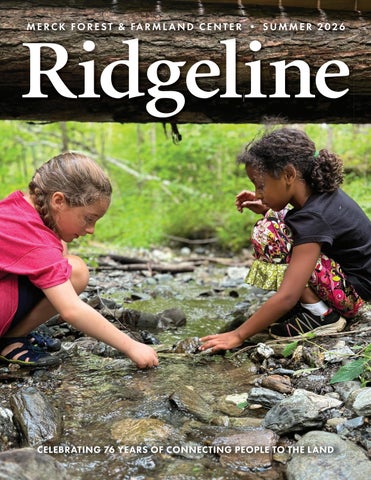
M E R C K F O R E S T & FA R M L A N D C E N T E R • S U M M E R 2 0 2 6
CELEBRATING 76 YEARS OF CONNECTING PEOPLE TO THE LAND
MFFC BOARD OF TRUSTEES Jill Perry Balzano Renee Flesch Barrett, Vice President Dinah Buechner-Vischer Keely Levins Culligan, Secretary Geoffrey Flynn Greg Hopper, Treasurer Kate Kavanaugh Erik Sandvick John Stasny, President Paul Wheeler
ADVISORS
Donald Campbell Jean Ceglowski Austin Chinn George Hatch Jon Matthewson Dee Myrvang Sam Schneski Katelyn Stevens Sue Van Hook
STAFF
Renata Aylward, Communications Manager Darla Belevich, Visitor Center Staff Stephanie Breed, Visitor Center Staff AJ Brundige, Field Educator Cara Davenport, Senior Education Manager Dylan Durkee, Fleet & Facilities Manager Osha French, Field Educator Marv Gates, Visitor Center Staff Tina Hartell, Field Educator Justin Jansson, Field Educator Eric Jenks, Field Educator Marybeth Leu, Business Manager Keenan McMorrow, Land Management Assistant Tom O’Handley, Senior Director of Development Amy Pim, Development Coordinator Carson Robinson, Land Management Assistant Elena Santos, Education Manager John Schneble, Director of Program Hadley Stock, Farm Manager Mike Stock, Land Resource Manager Rob Terry, Executive Director Ryan Warner, Timber Shop Assistant
Content & Images: MFFC Staff • Magazine layout: Renée Noel-Cutler
2
Letters from Leadership By John Stasny, President
By Rob Terry, Executive Director
On a recent walk through Merck Forest, I tried to picture what the scene looked like a few hundred years ago. Within that span of time, the old forests were clear-cut for farmland, and the trees that have grown up on Merck Forest’s landscape since then are remarkably young compared to the ancient woods that had covered the land for millennia. What would it be like to return to those ancient woods? How would it smell, sound, feel, and look?
As we put this issue together, I kept noticing, in story after story, a throughline of people coming back. A Student Conservation Association volunteer returns fifty years later to visit structures she built, still standing. Two old friends reunite on a “woods walk and talk” after decades apart. A camper who cried nervous tears on day one is back again, this time joyful in the mud garden. Our industrious and beautiful blueberry bees return to Blueberry Hill.
I have no reference point in my memory for those old forests, so on that walk in the woods, I asked Rob Terry, Merck Forest’s Executive Director, what he knew of the subject from his study of our forest’s history. The crux of his answer was *diversity*. Those of us who have never set foot in a thousand-year-old forest cannot fully grasp the staggering variety of species in diverse stages of growth, decomposition, and regeneration, or the diversity of life that thrived in those cycles for ages. We cannot turn back the clock hundreds of years to stand in those old forests, but our programs at Merck Forest today offer you the opportunity to return to the same land with curiosity about the power our forests still possess. We can better understand their potential to support a diverse, thriving ecosystem that builds resilience in a rapidly changing climate, and better grasp our opportunities for impact on their future that will be seen by generations to come.
3
In different ways, these stories remind us that time spent at Merck Forest often stays with people. A day on the mountain, a moment of discovery, a season of work, or a quiet encounter with the living world can become part of how someone understands this place, and maybe even how they understand themselves. We do not always know which moments will matter most. We only know that they can take root.
The Moments Before the Moment By Rob Terry, Executive Director A few years back, I participated in a panel of conservation leaders speaking to a room full of recent college graduates at the Department of the Interior’s headquarters in Washington, DC. Having recently been cast out of the relative comfort of their undergraduate experiences, audience members were interested in gaining insight into what might come next. Our first responsibility as panelists was to “share our story.” As I recall, I was fourth in a line of six panelists. The first two shared well-constructed reflections on their careers to date, making their presence on the panel seem all but inevitable. They had both started small, centered passion and service, taken on increasingly larger challenges, and subsequently been handed appropriately larger responsibilities. Their stories made sense, and I was preparing to share my own version when panelist number three sat up, looked out across the audience, and told them frankly, “Chances are, all of these panelists are going to string together something for you that sounds almost too good to be true. Well, guess what, it is. You’ve got to understand that our careers only make sense when we look back on them; I had no idea where I was headed when I took my first position with Fish & Wildlife…” To be honest, I don’t remember what he said next, because I was scrambling to figure out how I was going to follow that without making a complete fool of myself. I fumbled through, acknowledging that he was spot on and confessing that if I had gone second rather than fourth, I would likely have done exactly what he said we all would. Instead, I talked about the seemingly little moments that propelled me from opportunity to opportunity: building a network, doing favors, asking for favors, jumping on big, hairy problems, showing up, being available, and seeking help when I needed it. It was messy, but honest. Frankly, the same could be said of working in conservation. A career in conservation, stewardship, youth development, and whatever other terms best describe this work, is layered. As panelists, we spoke about one of those layers. The other layer centers values, akin to what Aldo Leopold referred to as the land ethic. While less explicit, that second layer shone through in each of the panelists’ stories, even those that were curated. When you work at land management agencies or conservation-focused nonprofits, you often find yourself under-resourced and overwhelmed. Most of the folks I’ve known who have sustained a career in this space carry something in their heart that keeps them moving forward when things get difficult. It’s not unusual for people in the field to be able to tell a clean story about what called them to this work, and what keeps calling them back. I have mine. 4
My initiation to thriving, healthy ecosystems came from the cockpit of a whitewater kayak. It was a purely recreational pursuit. At the time, I was so focused on the technical challenges of running remote class V whitewater that I rarely stopped to consider whether I was in temperate, tropical, or boreal forest. That changed for me on the Reventazón River, which flows from Costa Rica’s Central Valley to the Caribbean Sea. I slid into the river ready for miles of continuous class IV-V big water rapids full of explosive waves, powerful channels, and terminally recirculating holes— features created when surging water backfills upstream spaces. I’d spent decades developing my skills; I was with a team of paddlers I trusted completely; I had all the requisite safety gear tethered to my boat, and still I was unprepared for what I found. Midway through the run, we rounded a bend in the river and came face to face with two enormous canary yellow excavators digging the first trenches for what would later become the Reventazón Hydropower Project. Just over a decade later, the valley was flooded, drowning eight kilometers of river, submerging 1,730 acres of forest, and disrupting key migratory pathways that traverse the Barbilla-Destierro Biological Corridor. Coming around that bend in the river and confronting a direct threat that would consume the ecosystem I was immersed in called me to action. That story is true, and its influence on me is enduring. If there is a singular point at which the trail forked, and I chose the path towards stewardship, that is it. That was my green fire moment. Those excavators gave me what the look in the dying she-wolf’s eye gave to Aldo Leopold, as described in his essay Thinking Like a Mountain. My perspective on the world, and subsequently my trajectory in it, was altered on that afternoon in the Central American jungle. If I had been first or second on the panel, that would likely be the beginning, middle, and end of a tightly confined, carefully curated story; fortunately, I was fourth. Because I was fourth, I now look deeper. When I look more deeply into what inspired my path, I recall countless experiences from my youth that, while they may seem individually inconsequential, collectively primed me for my awakening along the banks of the Reventazon. I remember turning over rocks in Seneca Creek searching for salamanders, pulling a dipnet out of a nature center’s pond to find alien-looking macroinvertebrates writhing in the mud, planting countless pine tree saplings in a seemingly endless Virginia field, and rebuilding puncheons on a particularly muddy section of the Appalachian Trail. Through these experiences, and many more like them, I built a relationship with the natural world that sustains me to this day. I often wonder if, without these experiences, I would still remember those excavators as vividly as I do. As an educator, it is often tempting to try to facilitate transformative learning experiences by bringing students face-to-face with the excavator in an attempt to inspire. But these experiences cannot be forced. They are not an input. They are an outcome, the result of years of incremental, formative experiences that shape what we notice, what we value, and how we respond when something asks us to act. One of the greatest joys of my near-decade at Merck Forest & Farmland Center has been seeing children, families, and adults have these little experiences that collectively build relationship, responsibility, and care: eating a pole bean straight from the garden, watching a lamb take its first breath, catching a frog at the edge of the pond, scanning the horizon from the summit of Mount Antone and beginning to understand that a forest is not just a collection of trees, but a living landscape stretching beyond what we can see. Cooking dinner over an open fire, falling asleep to the sounds of the night forest, or realizing that mud, weather, insects, animals, and darkness are not obstacles to an experience, but part of the experience itself. At Merck Forest, we may not always know which moment will matter. That is the nature of this work. A child may not leave the garden, the barn, the pond, the trail, or the campsite transformed in any obvious way. But something has been added. A little confidence. A little curiosity. A little affection for a place. A little sense that the living world is not somewhere else, but right here, asking something of us. Over time, those small encounters accumulate. They shape what people notice, what they value, and what they are willing to protect. And sometimes, years later, when they come around their own bend in the river and find the excavator waiting, those experiences are what allow them to recognize what is at stake and choose to act. 5
Women in the Woods: A Conversation Honoring Women’s Leadership in Stewardship
Please consider a gift at one of the following levels of support, each with unique benefits:
Saturday, July 11 | 4:30–6:00 pm Frank Hatch Sap House
BIGTOOTH ASPEN $10–74
In the summer of 1971, the first all-female crew from the Student Conservation Association came to work at Merck Forest. Fifty-five years later, we’re marking that moment by looking at women’s leadership in stewardship and what still lies ahead.
• Ridgeline quarterly magazine • 75th Anniversary Decal PAPER BIRCH $75–$249 All Aspen benefits, plus:
Join us in the Sap House for an informal conversation featuring four women doing extraordinary work at the intersection of forests, science, and community.
• 10% Discount at Friends of the Forest Shop • 10% Off Merck-made farm and forest products • 20% Discount on camping RED OAK $250–$499
Panelists: Emily Bush, Director, Vermont Women’s Fund (moderator), Bear LeVangie, Founder, Women’s Tree Canopy Workshop, Marguerite Holloway, Author, Take to the Trees, Judith Schwartz, Author and science storyteller
All Birch benefits, plus: • “Woods Walk & Talk” with the Executive Director SUGAR MAPLE $500–$999 All Oak benefits, plus: • Priority program registration MT. ANTONE CIRCLE $1,000 AND ABOVE
The conversation will be wide-ranging, covering what women have built in conservation in the past, what we are doing now, and what kinds of leadership the land needs next. Signed copies of Take to the Trees will be available for purchase at the event.
All Maple benefits, plus: • Private guided wagon tour (up to 20 guests) • Complimentary weekend (2 nights) cabin stay
This program is part of a series honoring the legacy of the 1971 SCA crew and the women who have shaped Merck Forest since. Supported by the Vermont Women’s Fund and in collaboration with Northshire Books. Free and open to the public. Register online merckforest.org
6
Invasives and Innovation By Mike Stock, Land Manager Hello again from the forest! Today’s topic is Invasives and Innovation. Invasive species outcompete native trees and plants, disrupting the normal cycle of regeneration. They grow faster, making shade under them earlier and dominating areas. My focus is on striped maple (Acer Pensylvanicum). Like me, striped maple is native to Pennsylvania. It grows fast and creates an umbrella effect, completely shading out the ground. This technique eliminates competition and secures the location for striped maple to spread. Its only natural enemy is ice storms. At Merck Forest, we use this invasive plant to build things. It’s the skeleton for a new 20’x20’ shade pavilion for our campers. We used 6”-8” diameter, older striped maples, for in-ground posts and 4”-5” diameter straight trees for the frame and structural pieces. I harvested the trees from a spot in the sugar bush where zero sunlight made it to the ground. Now, after removing 18 trees, there is full sun on the forest floor. This will bring an explosion of life to this new space, hopefully, yellow birch and sugar maple. I also use the crotch pieces to make toilet paper holders in outhouses, backpack and snowshoe hangers, door handles, and shelves. We’ve made woven fences with small-diameter branches in the garden. You could also build woven traps for fish and minnows. Not to mention an endless supply of walking sticks and carving stock. Even the Merck Forest farm truck has a custom Pensylvanicum grill. Every week, we come up with another use for this otherwise life-snuffing invasive. Hopefully, this inspires you to take a look around your own property, to remove invasives, and beautify your space! Turn invasives into an advantage! Many thanks, Mike!
7
New Timber Frame Barn Raised By Renata Aylward, Communications Manager We’ve had significant and meaningful activity on the hillside this summer. As we’ve shared with you in past editions of Ridgeline, our land management team has been working on a new timber frame barn. The barn will include an office for our farmer, improved shelter, drainage, and ventilation for our animals, easier access to pastures, and expanded space for educational programming. This building is an homage to the forest, which provided the birch, oak, black cherry, sugar maple, ash, larch, eastern white pine, black locust, and spruce used in its construction. Eleven species of wood were chosen for what they could bring to the building, like red oak for sturdy posts and beams, and larch, where moisture is a factor. Trees were also chosen with good forest management practices in mind, such as ash salvaged that the emerald ash borer would have claimed. It’s an example of community collaboration, as many hands - staff, volunteers, board members - worked with our team to shape it and now raise it. It’s an example of our timber frame team’s skill and the joy and commitment of the people who helped. This new barn opens up something else we’ve been working toward: more community programs and more school groups experiencing the farm area in a welcoming, more accessible space in all seasons and all weather. The barn-raising and finishing work will continue after this magazine goes to print. A full recount and updated photos will come in the Fall Edition of Ridgeline. We hope you will come up and see this new addition to the hillside.
“This building is an homage to the forest.”
Dorset resident Adam Heaton who helped at the timber frame shop during timber layout, and Tiffany Marquez from the Vermont Works for Women Trailblazers program, who attended our timber framing 101 class both showed up to lend a hand. Dylan Durkee (above) checks architectural plans for the barn.
8
9
Who’s Here This Summer Every summer, a new cohort of educators, students, and guides arrives at Merck Forest. This summer’s group is diverse in age, background, and expertise. From a high school junior researching carbon capture in New Jersey to a veteran maple sugaring operator with 2,500 taps under her belt. They’ll teach. They’ll learn. We can’t wait to see who they become.
CAMP STAFF & FIELD EDUCATORS AJ BRUNDIGE
JUSTIN JANSSON
Certified hunting and fishing guide, tracker, MFFC Field Educator, and camp counselor in his second summer here. AJ leads full moon hikes, golden hour walks, and tracking workshops. He holds a Level 1 tracking certification. His energy is contagious!
Justin is a graduate of The Long Trail School and started helping out at MFFC as a freshman, serving as an intern throughout his four years at LTS. He has expert skills in bridling and walking Fern and Arch around the property for exercise. Justin completed his EMT training and volunteers with the Manchester Fire Department. Justin works on our Homeschool Homesteaders program.
OLIVIA COOLIDGE Recent graduate of The Long Trail School, heading to Paul Smith’s College this fall to study wildlife and fisheries. This spring, Olivia designed and built an orienteering course at MFFC that campers will use this summer. She is also a rock climbing instructor at Green Mountain Rock Climbing in Rutland. Olivia will serve as a Big Oaks counselor.
TINA HARTELL
J LAWSON J is a master of playful learning who has been leading students and teaching for more than 20 years in Northeast Florida, where he lives during the school year. Since 2021, J has owned and operated a selfdirected Agile-inspired homeschool learning center alongside his wife, Jo, and their two children, with a focus on play-based and immersive learning. He is excited to spend his summer in the great outdoors at Merck Forest and learn alongside the experienced staff. OSHA BENSEN LANGSTAFF FRENCH Early childhood environmental educator and recent Prescott College graduate. Osha has designed nature-learning programs, including a community garden at the Manchester Public Library. Osha will lead our Kits & Cubs programs with Ms. Elena. 10
Science educator with a master’s degree from Tufts and over two decades of teaching at places like The Mountain School and Burr and Burton. Tina has run a 2,500-tap commercial maple sugaring operation and taught everything from forest ecology to chemistry. As a Field Educator, Tina will be working with field trips and our partner programs. JO LAWSON Jo Lawson has spent the last five years as the founder and director of her own agile-learninginspired homeschool co-op in North Florida, and brings the magic of play and purpose to every corner of her life. Spending her early years as a Navy brat, she landed in Jacksonville, Florida, where she still lives during the school year with her husband and two children. Balancing mom-life with marketing, program design, and community building, Jo is all about empowering kids to explore, create, and thrive. With a heart as big as her imagination, she’s here to make learning an exciting, self-directed adventure for every child.
SUMMER 2026 INTERNS
CAPSTONE: A capstone project is a comprehensive, culminating academic assignment completed at the end of a program, in which students synthesize their experience and apply their skills to solve a problem or answer a question.
Our interns will learn by doing and present their capstone projects at the end of their time with us. This year’s group ranges from New Jersey to Northern California. We asked them a few questions to get to know them, and here’s some of what they said.
DAISHA QUACKENBUSH
JESS SHAPIRO
Environmental Science, SUNY Plattsburgh. From Shushan, New York, and a MFFC visitor since childhood.
Forestry & Integrated Natural Resources, UVM Class of 2028. From Northern California. Why MFFC? “I discovered an organization that similarly valued sheep, forests, place-based education, and a goal to connect the public with the land.” Kindred spirit: Emu. Superpower: Bagging groceries. Capstone: Goat grazing as a landscape management strategy.
LILLIAN DAY
Why MFFC? “It’s a place I’ve visited many times as a kid. I’m looking forward to gaining hands-on experience in the field.” Kindred spirit: Cat. Superpower: Organization Capstone: Invasive management strategies.
LOUIS PAESE
Junior at Bergen County Academies in New Jersey, Academy for Science and Technology. Currently researching radish plants for carbon capture.
Forestry, UVM Class of 2026. From Missouri.
Why MFFC? “Merck’s focus on forest stewardship aligns with my interests. I research carbon capture, which connects directly to the carbon sink this forest is part of.” Kindred spirit: Fox. Because they are resourceful, inquisitive, and very fluffy. Capstone: Increasing biodiversity and native plantings in MFFC’s orchards. 11
Why MFFC? “It’s a place I’ve visited many times as a kid. I’m looking forward to gaining hands-on experience in the field.” Kindred spirit: Lizard. Favorite things include forestry and creative writing. Louis enjoys birding and finding all sorts of critters in the woods, especially millipedes. Capstone: Monitoring insects as bioindicators of forest and pasture health.
Fifty-Five Years of Friendship By Renata Aylward, Communications Manager It’s pouring rain. Jane Kollmeyer, U.S. Forest Service supervisor (retired), is hiking up Merck Forest’s Old Town Road with her husband when she sees the outhouse. She thinks it might be the one she built in 1973 when she worked as Duncan Campbell’s assistant. Her husband declines the offer to take a closer look, but Jane hasn’t come all the way from Montana not to visit one of her many contributions to the MFFC landscape up close and personal. “None of the four of us (who built the outhouse) had ever done anything like that before, but it worked. “ In the Summer of 1971, she was a high school junior from Michigan, and applied for a 3-week SCA crew scheduled to travel to Merck Forest & Farmland Center in Rupert, Vermont. That summer, the next, and the next would transform her life, and ultimately lead Jane to a career in the US Forest Service. Over the span of her 30-year career in the US Forest Service, Jane worked in multiple forests across California, Oregon, Idaho, Montana, and Merck Forest was where it all started. Michigan is a state that’s “pretty flat,” she tells me over the phone from Montana when I call her, and the mountains of Vermont were impressive to the then-17-year-old. “ We used to sleep out under the stars. We’d hike out to some place in the woods and then wake up to the sunrise and hike back to the Lodge for breakfast. There was one sunrise on Mount Antone that I’ll never forget. We all just sat up in our sleeping bags and were speechless until we had to hike down to breakfast and work that day. How do a group of 15 high school girls end up on a hillside in Vermont in 1971, you might ask?
“The first summer I worked at Merck Forest, I felt like I was living in the wilderness. A friend and I would hike out every evening to a different place to sleep under the stars, get up early, and hike back in time for breakfast at Clark’s Clearing and a day’s work at the Stone Lot Shelter. I still remember the sunrise one early morning on Antone Mountain. I learned to push myself and felt so alive; living and working in the outdoors. I loved it. What a special place to work in high school and then to find your life’s calling.”
It’s mostly due to one Elizabeth Titus Cushman Putnam. Friend of MFFC and Founder of the Student Conservation Association. In 1953, Liz Putnam was a Vassar College junior reading several articles by Bernard De Voto proposing to shut down the national parks because they were being “loved to death.” In 1954 and ‘55, Liz wrote her senior thesis “A Proposal for a Student Conservation Program,” modeled on the Civilian Conservation Corps, proposing enlisting student volunteers to care for national parks and public lands, and upon her graduation from Vassar, shopped her idea around to the National Park administrations. After piloting programs over many summers in Olympia National Park, Acadia National Park, and elsewhere, the Student Conservation Association was officially incorporated in the state of NY on June 13, 1964.
Fast forward a few years to Liz meeting up with her friend of many years, Judy Buechner, George Merck’s daughter, and they hatch a plan to bring an SCA crew back to Merck Forest, the first time SCA would work with an NGO. That partnership, born of the friendship between two women who valued nature and the outdoors and who believed in young people and the power of collaboration, sent Jane Kollmeyer to Vermont. Jane’s initial and auspicious first summer was followed by another in 1972, and this time she returned as an assistant, and returning again in 1973 to work for the then executive director Duncan Campbell — haying, (“Gosh that was hard work!”) gardening, sugaring, and doing some maintenance of MFFC’s iconic buildings with draft horses. 12
These summers led the budding horticulturist to switch her major to Forestry at the University of Michigan, where she graduated in 1976. “I knew I wanted to be outside more. It was a perfect career.” In Jane’s 30 years with the U.S.Forest Service, she supported SCA crews and programs on the forests she managed. The outhouse, even in the pouring rain, looks like it’s holding up. It looks out over the sap house and one of Southern Vermont’s prettiest views. (It always makes this writer laugh.) Over 50 years and counting, SCA crews still come to Merck Forest, leaving their impact and imprint on the landscape. Liz Putnam still visits MFFC, too. At 93 years old, she retains her energy, curiosity, and compassion, addressing groups of teens and, most impressively, holding their attention. “She’s a rock star,” says Jane. If you have ever hiked at MFFC, you are likely on trails that an SCA crew cleared. Liz Putnam’s organization is the largest provider of hands-on conservation programs for young adults in the country. Over 100K people have worked in service to our natural world since 1957. This partnership between MFFC and the SCA - born of the friendship between two women and a shared love of nature and belief in the power of collaboration is still ongoing. Merck Forest will host another SCA crew this August. I asked Jane about her long career, her love for the outdoors, and what a life lived in connection with nature gives a person. “It’s like an anchor. If you’re having a bad day, you know you can go outside. I live at the edge of one of the biggest city parks in the United States, with 900 acres of wildlands. From my house, I can walk into the forest and hike on an incredible network of trails. I’ve been lucky that access to nature is just outside my back door. It becomes a strength and an anchor; it is one of the most important things in my life.” Jane did not have a bluebird-sunny day when she visited Merck Forest last summer, but she did find herself anchored in nature as she was in 1971 on Mount Antone. “My time with the SCA at Merck Forest made me realize I wanted to live in the mountains. It’s just a pretty magical place.” Being open is fundamental to growth. We’re all in this together, and teamwork is key. Being part of a team teaches resilience and opens up your eyes to what is around you. Teamwork allows you to grow and learn how to find your voice, skills, and niche.
Founder of SCA, Elizabeth Cushman Titus Putnam
I learned from my parents that if someone or something needs help, you should pitch in. Many people pitched in to get SCA off the ground, and I still am amazed at what SCA accomplishes. Working and accomplishing a result together is magical. - Liz Titus Putnam
WHAT SCA BUILT AT MERCK FOREST SCA crews have contributed to MFFC in many ways over the years. They have cleared trails, built cabins, shelters, and outhouses; painted signs; cut, split, and stacked firewood; released wild apple trees; created pollinator gardens; written trail and nature guides; trained draft horses; and created the 3-D relief map you can find in the Visitor Center. 13
Sawtooth Forest Supervisor, Jane Kollmeyer, in Idaho. Teddy Roosevelt (who created the Forest Service) and Gifford Pinchot (first Chief of the Forest Service) appear in the photo behind her. Roosevelt and Pinchot were responsible for setting aside the public Forest Reserves and setting up the agency of the Forest Service to manage those lands. The Sawtooth National Forest enabling designation, with map is under the photo of the two conservation leaders. I served in the SCA at MFFC. , and my dad knew Liz Titus. We helped to clear away some trees to help run the first plastic lines for syrup. And we helped to make the foundation for a small windmill at the farm, ‘round about summer of 1977. | Nancy Doyle I remember (Clark’s Clearing) when it was a lean-to in the early 70's. We stayed there overnight and, despite the fact that there was a wood stove in it, our sleeping bags (rated to maybe 50 degrees) and our wet blue jeans made for a really rough night when temperatures dropped below freezing. | Sarah Page I was in a high school SCA work group in the summer of 1982, and we stayed at Clark's Clearing for 10 weeks. The cabin was still a leanto in 1982. We cleared a lot of trails, split a lot of wood for the sugarbush operation, and threw a lot of hay bales... Liz Titus came to chat with us and brought us cold watermelon. We also built an outhouse at Clarks Clearing. | Marion Boulden
Little Sprouts follow Miss Laurel to their next adventure.
14
Little Sprouts Camps Keep Growing by Elena Santos, Education Manager When I was given the idea for Kits & Cubs in 2022 I never imagined that its evolution as a program would reveal the demand for more preschool programs offered by Merck Forest. From where I am now I can look back to reflect on the steady programmatic growth, and look forward into the future at even more programming possibilities. Little Sprouts pre-K day camps were grown from the enthusiastic interest in more preschool age programming at Merck Forest. Little Sprouts debuted in the summer of 2025 with a one-week camp. Just a year later, we are quadrupling that by offering 4 sessions of Little Sprouts – that’s space for 40 campers! The first 2026 session of Little Sprouts Camp was in April, during the local school spring break. Each day, campers ages 3 to 5 were dropped off by their parents or grandparents (and some younger siblings who aren’t old enough for camp yet). Each camper arrived fully prepared for a morning of play in the forest: rain suits, hats, mittens, warm layers, rain boots, and a snack. Forest-themed stuffed animals (we called them our “forest friends”) comforted campers as they acclimated to doing a program without their parents. The mud kitchen grew into a mud garden– renamed by the campers who built it– by the end of the week, as campers worked together to move and assemble fallen branches and decaying logs. I am so excited to meet each new and returning set of campers for the June, July, and August sessions of Little Sprouts. I wonder how each group will interact with the forest and what parts of nature will captivate their curiosity, inspire teamwork and friendship, or bring them joy each camp day.
15
Program & Event Highlights in 2026 A SEASON OF DISCOVERY AWAITS Programs and events are subject to change. Some require advance registration. For the most current information, full descriptions, and to register, visit merckforest.org or call 802.394.7836
SUMMER SUMMER CAMPS June 23 - August 8 NEW! Little Sprouts Camp Little Oaks Camp (ages 6-8) Big Oaks Camp (ages 9-11) Crew Camp (ages 12-14)
WEEKLY & MONTHLY PROGRAMS Kits and Cubs Wednesdays & Fridays | 10-11:30am (ongoing)
NEW! Women’s Tree Climbing Workshop® July 11 | 9am–4pm
Full Moon Hikes July 28, August 28 | 5:30-7pm
Women’s Leadership in Stewardship with Emily Bush, Vermont Women’s Fund July 11, 4:30 pm - 6 pm
NEW! Golden Hour Farm Hikes July 14, August 12 | Times vary
2nd Saturdays with Merck Forest at Manchester Community Library July 11, August 8 | 11am-12:30pm
NEW! Garden Club July 11, August 15 | 10am-12pm
Woods Walk & Talk Jul 31, Aug 14 | Register online 16
FALL
HARVEST FEST Saturday, September 19 11am-3pm Celebrate all the ways trees and forests are part of our lives. See our timber processing equipment, enjoy timber games, press fresh apples, and taste cider, all while engaging in handson, forest-focused activities for the whole family.
HALLOWEEN ON THE FARM Saturday, October 24 | 4-6pm Halloween on the farm is full of haunted fun, wagon rides, dance parties, and spooky surprises for all ages. Costumes are highly encouraged! Whether you’re a grown-up goblin or a pint-sized phantom, join us for family-friendly, nature-inspired, and perfectly spooky activities.
Hike-a-thon is a family-friendly fall fundraiser supporting the work we do to connect kids of all ages with nature. Register online.
Donor appreciation dinner and celebration. Donate $75 or more in 2026 to join this special event.
WORKSHOPS & FIELD TRIPS
Kits and Cubs | Wednesdays & Fridays | 10-11:30am (ongoing)
Fall Field Trip Season September & October Morning session: 9:30-11:30am Afternoon session: 12:30-2:30pm
NEW! Golden Hour Farm Hikes September 10, October 13, November 9, December 8 | Times vary
Saturday, October 3 8am-4pm
Saturday, October 17 4-7pm
WEEKLY & MONTHLY PROGRAMS
Full Moon Hikes | Monthly Times vary
HIKE-A-THON
TWILIGHT ON THE MOUNTAIN
NEW! Garden Club September 12, October 10, November 14, December 12 | 10am-12pm 2nd Saturdays with Merck Forest at Manchester Community Library September 12, October 10, November 14, December 12 | 11am-12:30pm
17
Fall Foliage Wagon Ride Rabbit Processing September 13th: 1:00-3:00pm Track and Sign Certification Wednesday, 8:30-4:30pm: October 21 Tree to Cutting Board Ornament Making Workshop Thursdays, 4-5pm: December 3, 10, 17 Wreath Making Workshop Saturdays, 10am-12pm & 1-3pm: December 5, 12, 19
Many Hands Make a Garden Grow By Hadley Stock, Farm Manager A garden is the work of many hands, the ones that came before, the ones bent to it now, and the ones yet to come. Many hands make light work, the old saying goes, though I am not sure “light” is the right word. But shared work does feel less like labor and more like community. In late winter, children in our homestead homeschool group pushed seeds into the soil in seedling cups, placing them under the grow lights. Volunteers came, too, starting seed after seed, until the shelves in the maintenance building popped with promising little leafy plants. Sometimes one needs a reminder that the Green Mountain State gets green again after long weeks of stick season. This spring, students and teachers visiting on field trips pulled up old mulch and tired irrigation lines, laid down cardboard, and hauled wood chips into paths. They helped relocate a patch of mullein that was growing happily in a fallow garden bed, as mullein likes to do. The mullein now adorns the western fence line. When the tall spikes bloom, that fence will stop people in their tracks and shelter native insects that overwinter, and provide a place to tuck into its shade when it’s hot. These students will not see the bee that finds refuge there, but the bee will find the shade that the students provided. At Meet the Lambs, guests placed sunflower seeds gathered from last year’s crop in rows of freshly turned soil and compost. Last summer’s flowers feed this summer’s garden by way of a guest choosing the right seed and a good spot in the row. As these flowers emerge from the soil, more hands are there to sprinkle them with water, and more are ready to pull up competing weeds so the flowers can thrive. These hands belong to our summer interns, here to learn, explore, and experience Merck Forest and all it has to give. They settle into the hard jobs a garden requires, like lugging bucket after bucket of compost or hay mulch, pulling the tiny lamb’s quarter from the soil to give our crops a better chance at survival, and battling with what feels like miles of hose to keep everything watered. This garden will feed our staff and our community. Some beds raise food for gatherings, like Twilight on the Mountain and Harvest Fest. Others hold flowers grown to be dried for future workshops. The big educational bed offers a sun tea garden to make cold-brew tea with children on a hot day, dye plants for tie-dyed camp shirts, plants for eco-printing, and a raised bed growing delicious snacks for the summer camp kids. There is a stand of basket willow for the weaving workshops, and beds for the rabbits and goats, where guests can pick a handful and feed an animal from their own palm. I tell everyone who works here, at any level, in any season, the same thing. You are helping to feed our friends at Merck Forest. It is a little bit of magic. Many hands have prepared, planted, weeded, tended, and harvested this garden. It’s a labor of love, a learning tool, a magical space, and a connection to all who created it.
18
19
20
The Dandelion By AJ Brundige, Field Educator Just a weed most people say, mow them down before they go to seed, you’ll often hear, but dandelions are useful, tasty, and play a significant part in many ecosystems. They provide an early source of nectar and pollen for bees, butterflies, and other pollinators when few other flowers are available. Their deep roots help loosen soils compacted by harsh winter months, improve soil health, and bring nutrients closer to the surface, benefiting all surrounding plants. In addition, the leaves can be pulled and fermented to make a powerful compost tea for plants. These resilient plants contribute to biodiversity and support healthy pollinator populations, which are essential for food production and environmental balance. And that’s not all, for us humans, dandelions offer several advantages. The leaves, flowers, and roots are edible and contain vitamins A, C, and K, as well as minerals such as potassium and calcium. Dandelion roots are often used in herbal teas, while the leaves and flowers can be added to salads. What’s not to like? 21
Sue Van Hook, former MFFC Board President, is a mycologist, naturalist, and former botany and mycology professor at Skidmore College. Recently, on one of her wild mushroom forays at Merck Forest, she took these extraordinary photos. We recommend you take a cue from Sue and keep an eye on all the beauty that’s underfoot!
Collybia sp.
Amanita flavoconia
First Russula of the season
Marasmius rotula
Chanterelle waxy cap, Hygrocybe cantherellus
22
23
A Closer Look at the Sugarbush By Keenan McMorrow, Land Management Assistant To the unassuming eye, a walk through the sugarbush at Merck Forest wouldn’t raise any red flags; the forest is beautiful and appears healthy. Full of birds chirping, deer scat, a variety of different tree and plant species, and plenty of shade in the summer months. But understanding the true health of the forest requires getting dirty, or wet and cold if some snow works its way into your boots. Yikes! Working at MFFC as one of the land management assistants, I’ve been busy studying for my M.S in Natural Resources Conservation with a Forest Resources Management concentration at Paul Smith’s College. As part of the program, students are required to design and complete a capstone project on a chosen subject matter. I chose to conduct a forest health assessment of the maple sugarbush here at Merck Forest. Located a short walk up Old Town Rd, before turning left at the log landing, up past the barn cabins, and finally following the sugaring lines up the hill. So what is a forest health assessment, and why does it matter? A forest health assessment is very similar to a forest inventory, but serves a different purpose. Instead of collecting data to determine the forest’s general composition, I wanted to gather data to help draw conclusions about its overall health. Another goal of the project was to establish permanent monitoring plots to compare current and future conditions within the sugarbush. Data collected includes species, diameter at breast height (DBH), crown classification, observations of woodpecker drilling behavior, sugar maple borer infestation, and phloem measurements. The phloem is the most recent year’s growth, a direct measure of a tree’s vigor. The phloem is also the living tissue of the tree, responsible for transporting nutrients created via photosynthesis throughout the tree. In addition to personal interest in maple sugaring and Phloem is the living vascular tissue in forestry, this project relates directly to climate change. Suitable habitat for sugar maple (Acer saccharum) trees is plants responsible for transporting projected to decline under several warming scenarios due sugars and other organic nutrients to climate change. Maple syrup producers understand made during photosynthesis to the rest that a decline in sugar maple habitat due to climate of the plant. It moves nutrients from change directly affects them, and it is their responsibility to understand the implications. Most notably being a “sources” (mature, photosynthesizing decreased ability to produce maple syrup, with less leaves) to “sinks” (areas that need intense winters and a less consistent freeze-thaw cycle energy to grow or store food, like required for sap to flow. The freeze-thaw cycle refers to roots, tubers, and developing fruit). temperatures falling below freezing at night, creating a negative pressure environment within the tree that draws sap up from the roots, and temperatures rising above freezing during the day, creating a positive pressure environment that forces sap down the trunk and out through the taps or spouts. To achieve optimal sap flow, this freeze-thaw cycle must occur repeatedly over several days. This shift in forest structure also affects the many organisms that rely on the symbiotic relationships developed over millennia. Think yellow-bellied sapsuckers (Sphyrapicus varius), which drill holes in sugar maple trees so that insects get stuck in the sap. The holes created by the woodpeckers are also utilized by ruby-throated hummingbirds (Archilochus colubris), which drink the sap during early spring. Early results from this project suggest the Merck Forest sugarbush is not adapting well, with low levels of sugar maple regeneration and frequent observations of sugar maple borer. In total, across all 24 sampling units, only 15 individual sugar maple seedlings or saplings were recorded. Without sufficient regeneration, the sugarbush is unlikely to continue being productive in the future. Mature sugar maple trees will be left without sufficient numbers of younger trees to replace them. The understory of the 24
sugarbush is being dominated by American Beech (Fagus grandifolia) and striped maple (Acer saccharum) saplings. These two species were observed in abundance during data collection, effectively shading out competition from sugar maples attempting to break through. Sugar maple borer damage was observed on trees in 50% of sampling units, suggesting they have a widespread presence in the sugarbush. Notably, sugar maple borers prefer to infest trees that are less vigorous or in decline. Another assumption for this lack of established sugar maple seedlings and saplings could be intense pressure from deer browse, and a dense canopy of dominant and codominant trees. The results of this project will help inform future management decisions in the sugarbush and serve as educational material for those who are interested. In spite of this, Vermont led the United States in maple syrup production in 2025, with 5.7 million gallons (The Maple News, June 16, 2025). According to The Maple News, Vermont was also first with 8.3 million taps. How cool is that? Maple sugaring should be safe for the foreseeable future, but proactive management is the best answer. Shifting lines, trying out new methods, and remembering to take care of the forest are all great places to start. If anyone has questions about my research, please reach out or stop by the farm!
25
Stories Left Behind: From heartfelt notes to whimsical drawings, cabin notebooks and the Visitor Center note box are filled with the memories and gratitude of those who want to share the joy of their visit.
26
Gathering Spaces By Cara Davenport, Senior Education Manager There was a magical moment recently when several Merck Forest staff members, including our new cohort of summer camp counselors, were walking down the Farm Trail toward the Visitor Center. The day before, we had installed a brand new stump circle just before the trail curves uphill alongside the stone wall marking the boundary between Merck Forest and neighboring Windgap Farm. As we approached, someone pointed and exclaimed, “Look! People are using the stumps!” A family had stopped to rest, sitting together on the freshly cut White Ash log rounds. We stopped and watched with delighted amazement, almost as though we had spotted some elusive wildlife we’d been hoping would appear. It was a small moment, but one that felt deeply satisfying- we had created a place meant to invite people to pause, and here it was already doing exactly that. If you’ve explored Merck Forest, you’ve probably noticed these circular spaces: a ring of upright log rounds surrounded by mulch. We call them stump circles. They provide gathering places for campers, school groups, guided hikes, Kits & Cubs, and other educational programs. When programs aren’t using them, they become spaces for families, friends, and visitors to sit together, share a conversation, enjoy a snack, or take in the sights and sounds of the landscape and its communities. This season, with the help of MFFC’s Land Manager, Mike Stock, and our camp staff, a few new stump circles have been installed throughout the property. As we continue to care for the landscape, we’re also thinking about how we care for the experiences people have here. Where might someone naturally want to stop? Where does the view invite lingering? Where might a simple circle of logs create an opportunity to connect, both with one another and with this place? Sometimes stewardship looks like maintaining trails or caring for forests. Sometimes it looks like creating a place to sit. And sometimes we are privileged enough to get to witness someone accept that invitation. 27
Chives from the Harwood Barn raised garden in bloom.
28
Chris Hubbard Retires from Merck Forest Chris Hubbard came to Merck Forest & Farmland Center in 2015 as Education Director, bringing a background in the sciences and elementary education, as well as 9 years as a classroom teacher. From MFFC’s meager beginnings (when the education department’s resource materials fit in one box), she created, built, and led the Education department in important ways during her tenure. Chris developed the Next Generation Science Standards (NGSS) school partnership program, in collaboration with Jean Ward, for 5th and 6th-grade students from Dorset and Sunderland schools. The program taught ecological concepts such as forest regeneration, biodiversity, and invasive species, and served hundreds of students from seven schools over the years. During COVID, Chris brought her creativity to the fore, creating an online series called Nearby Nature that covered phenology, moss and lichens, pond life, and more. This series gave students inspiration to explore the natural world in their own backyards, and you can still find it on MFFC’s YouTube channel. Chris authored many pieces for this magazine, including book reviews, articles, recaps, and a recurring seasonal series on things to do at Merck Forest. If you have ever wandered the Farm Trail and appreciated the Tree ID guide, your thanks go to Chris. She helmed the outdoor kiosk project and initiated and drove the collaboration with Mettawee Community School, developing the after-school JISP alternative programming for their students during the winter months. Among her most recent contributions is the Mettawee School boardwalk: a three-year project she shepherded from concept through permits, partnerships, and construction, now carrying students across wetlands they couldn’t otherwise reach. This 1200-foot boardwalk is already providing MCS schoolchildren (and the community) with new outdoor opportunities. For this project, Chris earned the largest grant the education department has received to date. Chris’s work here has impacted, and continues to impact, visitors and schoolchildren by connecting them to nature and this landscape. We wish her every good trail ahead.
29
Partners for Life By Cara Davenport, Senior Education Manager Can you think of something or someone in your life that you are highly attuned to? Some examples could be: The sounds that your car makes when you drive it. The flavor and strength of your morning cup of coffee. The exact whereabouts of your phone. The micro expressions on the face of someone you know very well. You might say you’re “calibrated” to that particular thing. If something is different about it, a shift, a tiny change; you pick up on it. There’s a bee in Vermont whose whole existence is calibrated in timing, almost to the week, around a single flower. The flower of a Blueberry plant. And this bee– the blueberry cellophane bee – has been calibrating that timing for so long that the two of them have developed corresponding biological clocks. Every May, this small, fuzzy bee digs her way out of the sandy ground near the edge of a blueberry thicket. She’s been underground all year and has about three to five weeks (her entire lifetime!) to get everything done. She finds blueberry flowers by smell. The plant releases a chemical signal that essentially says, “I’m ready.” And that’s the message she’s been waiting for. When she finds the flower, however, she can’t just take the pollen. Blueberry pollen is sticky, heavy, and packed inside a tube. To get it out, she grabs the flower and vibrates her flight muscles (not her wings) at a frequency matching the resonant frequency of that flower’s anther. It’s a biological lock-and-key. She’s shaking the pollen loose. This is called buzz pollination, or sonication. She’s so good at it that commercial blueberry growers depend on native bees like her — honeybees can visit blueberry flowers all day without ever triggering that release. This bee unlocks something they can’t. So what does a bee with a short lifespan have to teach us about living well in a changing world? Well, first of all, she doesn’t get a trial run. She emerges, reads the signals her environment is sending, and responds with a precision that took thousands of generations to develop. There’s no backup plan if the blueberries bloom two weeks early because of a warm March. That’s a real threat to specialist pollinators like her – climate shifts that uncouple the timing they’ve refined over millennia. In spite of this threat, there’s hope, because their relationship is what makes them strong. The blueberry evolved to need the blueberry bee, and the bee evolved to need the blueberry plant. They are partners across time, and the way they depend on each other throughout their life cycles is as much a strength as it is a vulnerability. We’re like that, too. Depending on other living things can make us vulnerable, but it’s also where our resilience comes from. What does it mean to be a good partner? What would it mean for us to be that kind of partner with the land, individuals, and communities we share it with? How could being a more attuned partner with something or someone help you become more resilient? As I write this in late May, the blueberry bushes are just beginning to bloom. The cellophane bee will emerge soon from the sandy soil, answering the call of the blueberry flowers, ready to shake the pollen loose. When we pick those sweet navy berries in July and August, it will be thanks to these two partners who have refined their calibration to each other over generations. As a tribute to the blueberry bee, we’ve made her our camp mascot alongside our usual porcupine. We hope that, by highlighting this special bee that makes blueberries possible, campers picking and enjoying MFFC’s blueberries this summer will feel connected to this partnership between bee and plant. To bring us even closer to this partnership, we’re launching a new interpretive hiking loop that highlights the pollinators of Merck Forest, taking visitors through the woods, fields, and farm to glimpse special pollinator relationships right here across the seasons. Look for this when you visit this summer! 30
Home sweet home for new in life the sap house.
Woods Walk and Talk Series Continues By Tom O’Handley, Senior Development Director We walked, we talked, and the birds sang! Audubon Vermont Director of Conservation Jillian Liner joined us for our 2nd “Woods Walk & Talk” of the season on a bright sunny morning at the end of May. The Walk and Talk series is sponsored by Vermont Women’s Fund. Among the attendees were the Fund’s Director, Emily Bush, and surprise guest Sue Van Hook, mycologist and former MFFC Board President. Sue hadn’t seen Jillian since their days at Skidmore, when Sue was teaching, and Jillian was beginning her environmental studies. Now, all these years later, they were able to share a walk, with Jillian providing great commentary on the birds we were seeing and hearing, and Sue helped attendees learn about all things mycological. Woods Walk & Talks continue this summer on Fridays from 9 to 10:30 am, July 14 to August 17. RSVP at amy@merckforest.org. 31
PRESORTED STD US POSTAGE PAID MANCHESTER, VT 05254 PERMIT No. 3
3270 Route 315 PO Box 86 Rupert, VT 05768
Your support sustains education, stewardship, and access to Merck Forest. Please donate to our Annual Fund at merckforest.org.
32