arm. You E F at. e W
October 2023 | Volume 116, Number 10
Merced County Farm News MCFB hosts 9th Annual FARM2U Day
By: Denelle Flake, Farm News Editor
O
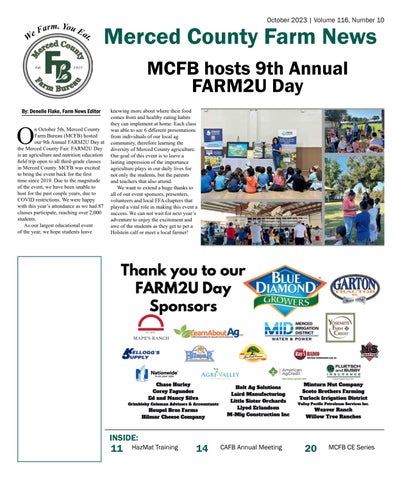
n October 5th, Merced County Farm Bureau (MCFB) hosted our 9th Annual FARM2U Day at the Merced County Fair. FARM2U Day is an agriculture and nutrition education field trip open to all third-grade classes in Merced County. MCFB was excited to bring the event back for the first time since 2019. Due to the magnitude of the event, we have been unable to host for the past couple years, due to COVID restrictions. We were happy with this year’s attendance as we had 87 classes participate, reaching over 2,000 students. As our largest educational event of the year, we hope students leave
knowing more about where their food comes from and healthy eating habits they can implement at home. Each class was able to see 6 different presentations from individuals of our local ag community, therefore learning the diversity of Merced County agriculture. Our goal of this event is to leave a lasting impression of the importance agriculture plays in our daily lives for not only the students, but the parents and teachers that also attend. We want to extend a huge thanks to all of our event sponsors, presenters, volunteers and local FFA chapters that played a vital role in making this event a success. We can not wait for next year’s adventure to enjoy the excitement and awe of the students as they get to pet a Holstein calf or meet a local farmer!
INSIDE:
11
HazMat Training
14
CAFB Annual Meeting
20
MCFB CE Series
Page 2
Merced County Farm News • October 20, 2023
I
from the
Director's Desk Breanne Vandenberg
t finally seems that this challenging year is beginning to sunset. It has seemed like the never-ending year, delivered by a water year that is once in a lifetime. Almonds have been hit with navel orange worm and cotton with lygus and white fly, not taking into consideration other crop challenges. On top of it is the stressors of down equipment, always at the most inconvenient time and immediately halting harvest. For now, we deal with the challenges that this year has brought – a year of record-breaking scenarios with much of it making the poor highlight reel. Years from now we will talk about the impacts brought by this year much as we have done with previous flood years. All too soon conversation will revolve around drought impacts. We are fresh off FARM2U Day which to my knowledge is the largest
agriculture focused educational day for school aged kids in the county. If you have been around Farm Bureau for a bit, you may have participated in this event one time or another. It’s always a kick when a FFA student remembers attending the event as a third grader. A double edge sword that you’ve been a part of an impressionable memory, but a reminder that you’ve been around that long. Never fails. Thank you to the volunteers, teachers and students for attending. Huge congrats goes to Denelle as she has put a ton of time planning the program. We look forward to next year! We have some upcoming events that you should also check out. MCFB is once again hosting CE classes for applicators. Four sessions will be held starting Thursday, October 26. Alexxis has done a great job in planning these courses and last years
attendees appreciated the experience. Check out the flyer on page 20 and registration can be taken online at www. mercedfarmbureau.org/ce. If you have a senior in your household that has plans to move into an ag career, remind them to check out our scholarships. Requirements are established, but doable as they include a 2.5 GPA, continuing an education in ag, a two-page essay and one letter of recommendation from a teacher. We also administer scholarships for the Art Nutcher Family and Merced County Young Farmers and Ranchers. Our 2023 scholarship committee awarded $27,000 dollars to local students. Don’t pass this up! Check out more information and full application at www.mercedfarmbureau. org/scholarships. Hope to see you soon!
Merced County Farm News • October 20, 2023
from the
onions, parsley, basil, sweet potatoes, carrots, peppers, radicchio, chickens, eggs, etc etc. Of course there are still more fall crops to come, such as walnuts, pistachios and cotton! I absolutely love observing the production of and naturally also partaking in the bounty of the harvests we produce here! Despite the ongoing heat, which I seem to feel a bit more every year as I age, it’s my favorite time of the year and never fails to take me back into memories of my childhood years and my farm boy upbringing here in Merced County. When I was a boy, my favorite thing to do was to ride along with my dad and be his “right-hand man” as he always called it. My travels and “work” with dad started when I was just a little guy of 4 or 5 years old, and there was never anything else I’d have rather been doing. In the early years, my seat was the middle seat of his blue and white 1977 GMC High Sierra pickup truck. I got the middle seat for two reasons…first, because it was easier for him to share his drinks, snacks, sandwiches and candy bars with me if I was right next to him, and secondly because the shotgun seat belonged to his little poodle Pepper, who outranked me in human years as well as dog years, and who always rode around with her right paw on the armrest like a person would. Eventually Pepper got too old and frail to go with him every day, and I promoted into the shotgun seat. I spent almost every work day with dad during the summertime and every day I could during weekends and holidays once school started. In those days he worked an area that ranged from I-5 on the westside all the way to Le Grand toward the east, and from as far north as Snelling and Hopeton south to El Nido and Dos Palos. That didn’t include parts
President's Corner Joe Sansoni
W
hile many crops have already been undergoing harvest since early summer, and others are being produced year-round, it is now officially “harvest time” in the Valley…that transitional phase between summer and fall that is the busiest yet most memory-inducing for me. During my travels all over the past few weeks I have seen trucks hauling almost every imaginable product grown in the Valley, and then some. I’ve watched tractors and field crews working day and night. Irrigators and ditch tenders working ‘round the clock and keeping diligent watch over the canals, checks and pumps. Dairy cows cooling themselves under the fans and misters in the barns, and beef cattle grazing and gathering to cool off among shade trees and winding creeks of cool water. Tree shakers and sweepers working to bring in the almond crop…choppers and swathers cutting corn and hay. Tomato and garlic harvesters working day and night. Watermelons, cantaloupes,
Page 3 and equipment runs which ranged to Modesto, Stockton, and Linden to the north and Fresno, Visalia and Tulare to the south. In addition, when he was short a driver he spent time driving one of his trucks moving tractors and machinery or hauling almonds, almond hulls, walnuts, wheat, barley and rice…with me as an eager co-pilot who loved riding up high in that big old International cabover. As I grew he taught me the beginnings and fundamentals of many of the skills I employ to this day, such as welding, engine repairs and tune ups, running tractors and harvest machines, helping run the almond hullers, and how to hook and unhook trailers from a big rig. Though driving or working on machines were always my favorite activities, he also taught me how to “herd” water, run irrigation pumps and repair broken sprinklers and pipes. Another great experience for me during those years was dad’s involvement on the Merced County Fair board, which meant a whole week of every night at the fair until closing time (of course after working all day)! We ranged quite a lot of territory together and those years forged my love of agriculture, tractors, trucks and equipment. The transition from summer into fall was always bittersweet for me as a kid who loved to work and be involved in the farming and harvesting. I had to
return to school during the weekdays, which meant the end of getting up super early to go to work with dad every day. But, as many of us do, I also loved fall, and the special things that fall brings with it…cooler weather, jumping around on the fluffy white stuff in my uncle’s cotton trailers on weekends, bonfire parties for my sister’s October birthday, and eventually Halloween, pumpkin pie and Thanksgiving. I don’t get to jump around in any cotton trailers anymore, but aside from that, these are still some of my favorite things this time of year. Things weren’t always easy, and like anyone we had our share of trials, tribulations and tough times then just as we do now. As I reflect back on the mostly warm and positive memories that made me into who I am today, I think of my own two boys and their upbringing with and alongside myself as a father, teacher and mentor. Surely it has been different times and different experiences for them, but many similarities in there as well. I sincerely hope that they too have been able to come away from their youthful years with not only positive and cherished memories, but also great respect, admiration and appreciation for the tremendous efforts and sacrifice that go into the work of feeding not only a family but a nation and world. Editors's note: Article was previosly run in September's online edition.
From small farms to large commercial operations, the INSURICA Agriculture Experts have grown up in agricultural communities. We’ve designed insurance programs to provide broad and flexible coverage for both your personal and business needs.
Tom Murphy | 209.353.2700 | tmurphy@INSURICA.com | INSURICA.com
Merced County Farm Bureau’s Mission Statement Merced County Farm Bureau is an independent, nongovernmental, grassroots organization that advocates for the men and women who provide food, fiber, and nursery products for our community, state, and nation. Merced County Farm Bureau exists for the purpose of improving the ability of individuals engaged in production
agriculture to utilize California resources to produce food and fiber in the most profitable, efficient and responsible manner possible, guaranteeing our nation a domestic food supply. Merced County Farm Bureau supports policies and legislation that promote and protect our Country’s number one industry agriculture for future generations and the security of our nation.
Page 4
Merced County Farm News • October 20, 2023
IRRIGATION EVALUATIONS
STANISLAUS MERCED MADERA COUNTIES
APRIL THROUGH NOVEMBER
Have an Irrigation Specialist evaluate your existing irrigation system for FREE!
THEY WILL: CONDUCT AN IN-FIELD SYSTEM AND SITE EVALUATION IDENTIFY ANY SYSTEM INEFFICIENCIES DEVELOP FULL CONSERVATION PLAN TO SCHEDULE AN EVALUATION PLEASE CONTACT:
KEVIN REYES
programs@maderachowchillarcd.org
559-755-5148
Merced County Farm News Published monhtly by Merced County Farm Bureau Phone (209) 723-3001 Fax (209) 722-3814 646 S. Hwy 59, Merced CA 95341 Email: dflake@mercedfarmbureau.org
(USPS 339-500)
Entered as Second Class matter, Jan. 20, 1948 at the US Post Office in Merced, CA. Subscription is included in membership. Singles issues are 50 cents. Merced County Farm News is printed by Wesco Graphics, 410 E. Grant Line Road, Suite B, Tracy, CA 95376 POSTMASTER: Send address changes to Merced County Farm Bureau, P.O. Box 1232, Merced, CA 95341; telephone (209) 723-3001; FAX (209) 722-3814. Merced County Farm Bureau does not assume responsibility for statements by advertisers or for products advertised in Merced County Farm News, nor does Farm Bureau assume responsibility for statements or expressions of opinion other than in editorials or in articles showing authorship by an officer, director or employee of the Merced County Farm Bureau or its affiliates.
Merced County Farm Bureau Staff
Mariposa County Farm Bureau Staff Danette Toso Executive Director
Breanne Vandenberg Executive Director Lorraine Passadori Program Director Board of Directors Denelle Flake Farm News Editor/Project Specialist Pres: Kelly Williams................ 376-2408 1st VP: Elnora George............ 376-2419 Alexxis Rudich Project Assistant/ESJ Grower Relations 2nd VP: Carla Kelly.................742-6862 Directors Abel Lopez...............................376-2208 Board of Directors Pres: Joe Sansoni...................761-9284 James Palmer......................... 374-3470 1st VP: David Barroso............652-6437 Walter Palmer Jr...................... 374-3470 2nd VP: Tim Lohman............. 988-3545 Trevor Lee Smith.....................769-9969 Sec/Treas: Dante Migliazzo...769-9525 Danette Toso...........................376-2304 Past Pres: Eric Harcksen....... 620-1953 Tony Toso.................................376-2304 Jordan Cory.....................765-401-4078 District 1 Matt Jasso...............................270-1981 Joe Maiorino............................564-6791 District 2 Mike Davis............................... 387-4151 Bob Vandenberg.................... 704-5568 District 3 Chad Perry............................... 675-4474 District 4 Jean Okuye..............................756-2421 Galen Miyamoto......................761-5366 District 5 Brent Chipponeri.....................652-3473 John Van Ruler........................648-3877 District 6 John Johnston........................ 489-8462 Bill Arnold................................761-0542 District 7 GIno Pedretti III.......................756-1612 Tom Roduner...........................769-9353 District 8 Julie Giampaoli...................... 201-8434 Joe Scoto.................................761-0489 Directors at Large Bob Giampaoli 769-4973 Louie Bandoni 761-0625 Michael Serrano 485-1935 Jesse Penick 678-8887 Tom Murphy 353-2700 Alan Sano 559-905-1240
Jay Mahil CFBF Director - District 9 David Macedo CFBF Field Representative Pierce Hanning Merced County YF&R Chair
Sarah Baskins YF&R State Committee - District 9
Stay Connected with MCFB Follow us on instagram @merced_farm_bureau Like us on Facebook Merced County Farm Bureau Join our mailing list by emailing info@mercedfarmbureau.org
Merced County Farm News • October 20, 2023
Page 5
Grimbleby Coleman Advisors & Accountants Celebrates Its Golden Anniversary — 50 Years & Accounting! By: Grimbleby Coleman Advisors & Accountants
M
ODESTO, CALIFORNIA, October 9, 2023 — Grimbleby Coleman Advisors & Accountants, a leading accounting and business advisory firm, is excited to announce our Golden Anniversary — 50 years of advising, accounting, and growing Central Valley agriculture and construction businesses. Back in 1973, Roy Grimbleby started a company in the heart of Modesto, providing accounting and bookkeeping services to the area for a decade. His son, Clive Grimbleby, carried on the legacy, expanding GC into the multifaceted realm of public accounting and becoming the Modesto area’s largest accounting firm over the following 4 decades. Now, Ian Grimbleby, Managing Partner, President, and CEO, has grabbed the torch and proudly leads an agile and diverse team of 90
professionals. Though we have undergone transformations, not just to recognize trends of the eras but also our identity, our brand tone remains the same. In May, Grimbleby Coleman announced an exciting rebrand, welcoming a more modern website interface while staying true to our constant — a people-first approach. In addition, we enhanced our name by adding “Advisors” to recognize not only the expansion of our services, but our continual quest to walk more closely alongside our clients as a trusted partner. "Our firm name and logo have evolved to reflect the needs of our clients, but our mission and core values remain unchanged. Our ethos of truly building success for all of our people and connections will never change," says Ian Grimbleby. We invite you to pause and take a tour of 50 years, past and present, and offer cheers to our future — it’s the people behind the numbers®.
Page 6
Merced County Farm News • October 20, 2023
Farm Bureau praises bill signing to boost use of drones in farming By: California Farm Bureau
C
alifornia Farm Bureau President Jamie Johansson today applauded the signing of Assembly 1016, which will expedite training and licensing programs so that more farmers may use drones for pesticide applications.
“I am proud that the California Farm Bureau is leading the effort to ensure that farmers have access to precision technology,” Johansson said. “We thank Gov. Gavin Newsom for supporting us by signing Assembly Bill 1016. With aerial spray technology within reach of all farmers for the first time, this will help them save on crop protection costs by allowing drones to target affected
areas instead of entire fields. Drone use can also replace backpack spray and ground-based delivery systems with remote technologies, which protects our agricultural employees from close contact with pesticide applications. “California’s farmers and ranchers lead the world in innovation—producing amazing yields of fresh produce, dairy, and meats while decreasing water,
fertilizer and pesticides use. AB 1016 is a bill in that spirit. It allows farmers better access to innovative technology to gain even more efficiency and safety.” The California Farm Bureau works to protect family farms and ranches on behalf of nearly 29,000 members statewide and as part of a nationwide network of 5.3 million Farm Bureau members.
Merced County Farm News • October 20, 2023
Page 7
Chapter Officers Attend Sectional Leadership Conference
N
By: Atwater FFA
early 900 BBQ tri-tip and pork loin dinners were cooked, prepared, and picked-up by various community families through the annual Atwater “FFA Take-Out BBQ” dinner. With 4000+ lbs of tri-tip, pork loin, salad, beans, and rolls packaged and sold by Atwater FFA students, the BBQ dinner turned out to be a successful for this FFA fundraiser. “This is a win-win situation. The community gets a great tasting BBQ meal and the agriculture program benefits from the funds that will be focused directly on the students,” said FFA advisor and BBQ coordinator Dan Flatt. This fundraiser is one of four takeout BBQ fundraisers for the Atwater FFA throughout the upcoming school year. The students sell the tickets in advance followed by the ordering of food. The Atwater FFA has worked
closely with Atwater’s Smart & Final, Richwood Meats, and Sysco, as they have supported the program’s fundraiser every year. The morning of the BBQ, students arrive early before school to prepare the salads, meat, beans, and dinner bags. Additional volunteered support from community members Joey Pareira and Brad Kessler was generously implemented with the assistance of BBQing all the meat. Throughout the day, students take a “hands-on” approach towards the preparation, cooking, and organization of all the meals. “The students are invested in this event as they put forth tremendous effort in organizing and implementing the event,” said FFA advisor and “BBQ Extraordinaire” Sam Meredith. The “FFA Take-Out BBQ” is one of two current fundraisers for Atwater FFA. The other current fundraiser taking place is the placemat ad sales. “All the money that is raised goes directly toward the
COME JOIN THE FUN & HELP SUPPORT YOUR ag COMMUNITY
Saturday, November 4, 2023 Stevinson Double T 5:30 PM No Host Social 5:30 PM – 6:30 PM Silent Auction 6:45 PM Dinner & Program $75.00/person or $600.00/table Catered by Double T The Agribusiness Committee proudly honors leaders from various areas of agriculture. Who have promoted agriculture while continuing to give back to our community. Proceeds from this event are used to fund scholarships for local high school students that are furthering their education in agricultural.
2023 Nominations are: Ag Education: Stefanie Kuhr Agribusiness: Central Irrigation Field and Row Crops: Mark & Mitch Coit Livestock and Dairy: Carlos & Dimas Lopes – Lopes Dairy Trees and Vines: John Jones
Tickets are available from any committee members: Dori Silva, Stacy Jasso, Gina Rosas, Robert Sylvester, Cody Jacobsen, Melissa Davis, Chad Crivelli, Matt Jasso, Vikki Davis, Jack Hurley, Hannah Cole and Scott Roduner. Checks payable to Agribusiness Committee of Merced County.
ADDITIONAL TICKET INFORMATION: (209) 675-6348 or (209) 675-6480. Agribusiness Committee of Merced County PO Box 2731 Merced CA 95344
students in providing resources and opportunities for all of them to achieve personal growth, academic success, and career objectives,” said FFA advisor Shelby Fishman. Over $25,000 in funds and agriculture resources is expected to be raised this school year to help support the agriculture program’s operation and activities. The success and growth of the Atwater FFA and agriculture program is due to the continued support of the Atwater High School staff and administration, the Merced Union High School District, the Atwater Ag Boosters, and the hundreds of local community members and parents. “We want to ensure that there is a return on the community’s investment by motivating
and encouraging our students to go after their educational and career interests,” said FFA advisor Taylor Helton. “The excitement and effort we are seeing this year from our students is generating just a “taste” of what is still to come!” For more information on the Atwater High School Agriculture Department and Atwater FFA, please log on the AtwaterFFA.org website.
Atwater community member Jennice Whitby picks up her Atwater High School FFA tri-tip BBQ meal from Atwater High School agriculture students Sophia Lomeli and Viviana Roach.
Page 8
Merced County Farm News • October 20, 2023
Making an Impact on Third Graders Throughout Merced County By: Madyson Wilhelm, Merced FFA Chapter Reporter
O
n Thursday, October 5th, 2023 40 of our Merced FFA members were invited by the Merced Farm Bureau to the Merced County Fairground to spend the day giving back to the youth of our community at their annual Farm2U event. Farm2U allows young students from the Merced City Schools District to explore and learn about Agriculture and the many opportunities that agriculture offers. This is a very hands-on setting allowing students to learn that agriculture is so much more than just farming. Merced FFA was honored to have three booths at this year's event, where our members educated the young students about welding and raising different breeds of rabbits.
One of our booths was run by fourthyear member and Chapter President Charli Audlridge, third-year member and Chapter Treasure Preslee Hunter in which they brough different aged Flemish Giant Rabbits for students to learn about and feel the soft coat of the rabbits. Second-year member Morrison King, and second-year member Kylie Wigt also brought out Californian Rabbits. Preslee Hunter shared “I had a great time at Farm 2 U, my partner Charli and I did a presentation on Flemish Giant rabbits. It was a great experience being able to share my knowledge with the younger generation about 4-H and FFA and all of the opportunities both clubs bring.” Kylie Wigt also shared “ For our first time presenting with the rabbits it was amazing! The kids were so focused and asked tons of questions. We loved the fact that the kids were so involved and
Merced FFA at FARM2U Day
wanted to know more about the rabbits. Overall, we had a very fun and exciting day. Our third booth highlighted welding and welding safety, which was run by fourth-year member and Chapter Historian Estaban Castaneda, third-year member and chapter Vice President Christian SantaMaria, and fourth-year member Forrest Johnson. Christian SantaMaria shares “We were in charge of teaching kids about welding and shop safety. The kids put on helmets, gloves, and jackets. We also showcased the tools we use for welding.” The rest of our members escorted third-grade classes around the fairgrounds as “herders” to each booth and engaged with answering questions and highlighting how agriculture touches every aspect of our daily lives and the many opportunities that FFA
has to offer. Third-year member Kamila Mendoza shared “This was my first year as a FARM2U herder. When I got there I was truly a bit nervous but everyone there and the environment felt warm and welcoming. The students were the sweetest and made it a pleasure to be there and lead them through the day. I myself as a herder learned many things as well. It was a fun experience and I can’t wait to do it again.” On behalf of the Merced FFA, I would like to thank the Merced County Farm Bureau for this wonderful opportunity. We can’t wait for next year and the opportunity to share the many opportunities that agriculture has in our community and beyond. To stay up to date on Merced FFA news and events visit www.mercedffa.org and follow us on Instagram and Facebook @ themercedffa.
Merced County Farm News • October 20, 2023
Page 9
Sweet Potato Joe from page 1 the former Florence Cardoza of Merced in 1942. After the war, and during his life as a sweet potato farmer, he served as President of the California Sweet Potato Council, and US Sweet Potato Council, where he was a Director for over 20 years. He was the first California farmer to attend the National Sweet Potato Convention, among other industry firsts. Joe served as President of the Merced County Farm Bureau, and was on the Board of Directors of the Nisei Farmers League. He formed the California Sweet Potato Growers Co-op in Livingston, along with several other local growers, which is celebrating its 50th anniversary this year. His interests and community involvement were very diversefrom serving as a founding member of the Livingston Medical Group, to past-President of Livingston Rotary, to being
known as the “Voice of Livingston.” From 1946 to 1996, he announced all the Livingston High School football games, lending his strong voice to the community by also announcing everything in Livingston from parades to radio programs. He served on the Livingston Elementary School Board and the Merced County Recreation Commission for many years. Joe’s acting skills even benefited the Livingston Little Theater Group, where he starred in several productions, most notably as Elwood P. Dowd in “Harvey”. His love of baseball began at an early age and became a life-long interest that manifested itself into a devotion to the sport for over eighty years. He organized the first kid’s hardball team in Merced County in the early 50’s. He was particularly fond of American Legion Baseball, serving as a coach, sponsor, announcer
and booster for over fifty years. This led to his being appointed the third Area Commissioner of Baseball. All of these years of being involved in baseball in Livingston culminated in the community baseball field being renamed the “Joe F. Alvernaz Baseball Field,” something he was so proud of. Joe was predeceased by his parents, Joe and Mabel Alvernaz, brothers, Arthur and John Alvernaz, and sister, Mary Geyer. He was also predeceased by his oldest son, Joey Alvernaz, in 1980 and by his wife of 64 years, Florence, in 2007. He is survived by five children, Judy Blevins, James (Colette) Alvernaz, and Benjamin (Debbie) Alvernaz of Livingston; Cecelia (James) Simon of San Diego, and Susan (Randall) Wilson of Mariposa, a sister, Cecelia Luker of Atwater, 17 grandchildren and 13
great grandchildren. His light on earth has dimmed, but heaven is brighter as he has joined Florence, the true love of his life. So long to our Dad, coach, neighbor and everyone’s friend. He will be deeply and painfully missed, yet celebrated, honored and never forgotten. In lieu of flowers, the family requests that donations may be made to Grace Nursing Home in Livingston or to the Joe F. Alvernaz Memorial Fund to benefit youth baseball in Livingston. Sweet Potato Joe was the Farm Bureau President from 1983-1986 and hired long-time staff member Lorraine Passadori when she showed up in her clown costume for the interview. Agriculture lost a strong advocate that will truly be missed. We will continue to keep his family in our thoughts and prayers.
Pazin & Myers, Inc. 129 West 15th Street Merced, Ca 95340
Serving Merced and Mariposa Counties for over 35 years!
(209)725-2050
Meeting all of your residential, farming, commercial, and retail needs... GASOLINE - DIESEL - QUALITY LUBRICANTS Merced county FarM news
saturday, noveMber 16, 2013, page 12
Page 10
Merced County Farm News • October 20, 2023
Merced County Farm News • October 20, 2023
Page 11
ATTENTION
Farmers and Farm Employees who need to renew their DL-267 Endorsement or acquire their initial endorsement. The Agricultural Hazardous Materials Transportation Program is being offered by the Farm Bureau and Nationwide Insurance. This class is for persons 21 years or older and have a current California Class C drivers license. Due to new requirements, once a person completes the course, they must: • Submit completed training record along with a completed CHP application • Await paperwork return from CHP • Pay any applicable DMV fees • With returned CHP paperwork apply for DL-267 certificate from the DMV
November 1st, 2023 10:30 AM – 12:00 PM Spanish 1:00 PM – 2:30 PM English Merced County Farm Bureau Conference Room 646 South Highway 59 Merced, CA 95341 $25.00 for Farm Bureau Members $45.00 for Non Members
TO REGISTER: Please call the MCFB Office at (209) 723-3001 or email info@mercedfarmbureau.org NOTE: Instructor will be via webinar, but attendance at the above site is required for testing purposes. Please pay by cash, check or credit card in advance.
Page 12
Merced County Farm News • October 20, 2023
Senators Introduce Bill to Protect and Invest in Farmland Used for Renewable Energy Developments By: Sara VanderPoel, Ag Center News
L
ast month, U.S. Senators Tammy Baldwin (D-WI) and Chuck Grassley (R-IA) introduced the Protecting Future Farmland Act, new legislation to support farmers’ land stewardship efforts as many choose to deploy solar energy on their land. The legislation will ensure that federal investment in rural energy projects prioritizes both land stewardship and responsible deployment of renewable energy to protect America’s farmlands for future cultivation. As the demand for renewable energy grows to cut energy costs, reduce reliance on foreign oil, and combat climate change, agricultural landowners are increasingly interested in using their land for solar energy production. About 83% of new solar projects are installed on farmland and ranchland, with almost 50% placed on the most productive,
versatile, and resilient land. But despite the growing number of solar farms in rural America, there is no current coordinated federal strategy for land management below solar arrays. As such, many farmers, land owners, and those in rural communities are concerned about the quality of agricultural land after a solar lease ends, as well as the impact of energy installations on soil and water. “While many farmers are choosing to expand clean, renewable energy – supporting energy independence and increasing revenues of their operation – we need to support our farmers’ land stewardship efforts and help them protect the farmland that is critical to the future of our rural economies and national food security,” said Senator Baldwin. “I am proud to partner with my Republican colleague to lead legislation that will give our farmers who want to expand solar operations the tools they need to continue responsibly managing
our soil, water and nation’s heartland.” In light of more American landowners engaging in renewable energy production, while recognizing the need to preserve farmlands that are critical to our rural economies and our nation’s food security, the Protecting Future Farmland Act would: • Prioritize federal assistance to those renewable energy projects (through existing Rural Energy for America Program) that have in place soil, water, and vegetation management and conservation plans. • Collect data on conversion of farmland to solar energy and directs the U.S. Department of Agriculture (USDA) to deliver a report to Congress on the benefits and impacts of solar energy development on agricultural land. • Authorize the National Resources Conservation Service to develop best practices for protection
•
•
of soil health and productivity during the siting, construction, operation, and decommissioning of solar energy systems on agricultural land. Authorize the National Resources Conservation Service to provide technical assistance to farmers growing crops or managing grazing below or in tandem with solar energy systems. Define agrivoltaic systems and authorize USDA to conduct a study on agrivoltaic systems including compatibility and riskbenefit analyses. Agrivoltaics, the co-location of agricultural production (crop production, livestock grazing, and pollinator habitat) with solar energy infrastructure, has the potential to reduce land-use conflicts and provide additional benefits to farmers, rural communities, and the solar industry.
Merced County Farm News • October 20, 2023
Page 13
California Expands Paid Sick Leave Law Effective January 1, 2024 days. Many employers have opted to provide 24 hours, or 3 days, of PSL to employees up-front at the beginning of the PSL Period to avoid having to track employees’ accruals each pay period. In those instances, PSL does not carry over because the full amount is re-issued at the start of the new PSL Period. Under both the accrual method and the up-front method, employers can cap an employee’s usage of PSL at 24 hours, or 3 days, in each PSL Period. Under the new law, in addition to the requirement that an employee accrue 24 hours by the 120th day, an employee must accrue no less than 40 hours, or 5 days, of PSL by the 200th calendar day of the PSL Period. If an employer chooses to satisfy their PSL obligation by providing PSL to employees up front, they must provide them with at least 40 hours, or 5 days, of PSL. The new cap on the total amount of PSL an employee can accrue will be 80 hours, or 10 days, and an employer can only cap an employee’s use of PSL at 40 hours, or 5 days, in each PSL Period. What This Means for Employers: The Labor Code imposes strict requirements on employers regarding inhibiting an employees’ use of
By: Barsamian & Moody, FELS
O
n October 4, 2023, Governor Newsome signed into law Senate Bill 616 (the “Bill”) which nearly doubles the amount of paid sick leave (“PSL”) employers are required to provide employees. The law will take effect on January 1, 2024 and is yet another progressive policy passed by politicians for the sole purpose of gaining votes, while completely disregarding the severe strain it will have on employers of all sizes. Currently, California Labor Code section 246 requires employers to provide employees who work 30 or more days within a year with PSL that accrues at a rate not less than one hour per 30 hours worked. Employers can use a different accrual method, so long as the employee has no less than 24 hours, or three days, of accrued PSL by the 120th calendar day of employment of each calendar year or in a 12-month period (the “PSL Period”). Under current law, employers are allowed to cap the amount of PSL carried over to the next PSL Period to 48 hours or 6
November 7, 2023
at the Stanislaus County Fairgrounds in Turlock, California 7 a.m. - 2 p.m.
Serving California Grape, Nut & Tree Fruit Growers (Tree Nut Sessions) 7:00 am Registration
7:15 - 8:30 am
Nut Grower/PCA Breakfast
7:15 - 7:30 am
Welcome and Introduction
7:30 - 8:30 am
“Pesticide Regulatory Changes to Prepare For” (1 hr Laws/Regs CEUs)
Matthew Malcolm, Editor Pacific Nut Producer Melanie Pellegrino & Amit Sandhu, Ag Inspectors, Stanislaus County Department of Ag
-------- 30 Minute Break & Exhibits -------9:00 - 9:30 am
“State of the Walnut Industry”
9:30 - 10:00 am
“State of the Almond Industry”
PSL. Employers are prohibited from retaliating against employees for using PSL, prohibited from imposing certain conditions on employees’ use of PSL and are prohibited from interfering with an employee’s request to use PSL. By requiring employees to provide documentation, such as a doctor’s note, or detailed information regarding the leave as a prerequisite to using PSL, employers leave themselves susceptible to lawsuits claiming they infringed on the employee’s protected right. Employers generally should refrain from questioning an employee’s reason for using PSL beyond what is necessary to protect other employees from illness or injury, such as COVID-19. The glaring issue with this impending legislation is the increased financial burden on employers. Under the new PSL requirements, employees can and are incentivized to take more workdays off, especially right before their PSL hours are renewed in the following PSL period. Meanwhile, employers are left paying the same amount, if not more, in case additional workers are needed. Further, employers cannot pry into the need for PSL, even if they believe the
• Grape, Nut & Tree Fruit Seminars • Continuing Education Credits • Free Breakfast & Tri-Tip Lunch agexpo.biz (Grape/Tree Fruit Sessions) 7:00 am Registration
7:15 - 8:30 am 7:15 - 7:30 am
Richard Matoian, President, American Pistachio Growers
11:00 - 11:30 am
-------- 30 Minute Break & Exhibits --------
12:00 - 1:30 pm Grower/PCA Tri-Tip Lunch (1 hour PCA CEUs)
12:30 - 1:00 pm “Phytophthora Diseases in Almond & Pistachio” (30 Min PCA CEUs) Florent Trouillas, UCCE Plant Pathology Specialist
1:00 - 1:30 pm
“Whole Orchard Recycling & Effect on Second Generation Tree Nutrition, Growth, Yield & Replant Disease” (30 Min PCA CEUs) Brent Holtz, UCCE Pomology Farm Advisor, San Joaquin County
“Comparing Irrigation Requirements Between Tree Crops & Pomegranates” Cameron Zuber, UCCE Orchard Crops Farm Advisor, Merced County
-------- 30 Minute Break & Exhibits -------9:00 - 9:30 am
9:30 - 10:00 am
“Managing Powdery Mildew, Summer Bunch Rot, & Grapevine Trunk Disease” (30 Min PCA CEUs) Akif Eskalen, UC Cooperative Extension Specialist & UC Davis Plant Pathologist
“Vine Mealybug Control & it’s Role in Disease Management” (30 Min PCA CEUs) Karl Lund, UCCE Viticulture Advisor, Madera, Merced & Mariposa Counties
-------- 30 Minute Break & Exhibits -------10:30 - 11:00 am “Vine & Rootstock Pairing for Drought & Pest Resilience” (30 Min PCA CEUs)
11:30 - 12:00 pm “Continuing the Fight Against Navel Orangeworm” (30 Min PCA CEUs) Jhalendra Rijal, UCCE IPM Advisor, Northern San Joaquin Valley
“Mapping Grapevine Water Potential from Drone-Based Hyperspectral Luca Brillante, Department of Viticulture & Enology, Fresno State
8:00 - 8:30 am
“State of the Pecan Industry” Karlene Hanf, President, California Pecan Growers Association Blake Houston, HNH Nut Co., American Pecan Council Board
Grape Grower Breakfast
Welcome and Introduction
Dan Malcolm, Publisher, American Vineyard
7:30-8:00am Imagery”
-------- 30 Minute Break & Exhibits -------10:30 - 11:00 am “State of the Pistachio Industry”
Scan Here to Register to Attend
(4.5 hours PCA CEUs & 4.5 hours CCA CEUs Pending)
Robert Verloop, CEO/Executive Director, California Walnut Board & Commission Richard Waycott, President, Almond Board of California Clarice Turner, (Incoming) President & CEO, Almond Board of California
employee is simply taking it because it is there. You can expect that supervisors will become increasingly frustrated due to any resulting operational delays. However, anyone authorized to issue any type of discipline must be trained that they cannot require proof of or details about the reason for the PSL and most certainly cannot punish or treat employees differently for using PSL. Remind your supervisors that employees can use PSL for almost any reason related to their health or the health of a family member or for reasons related to being a victim of domestic violence or stalking. Employers should review and revise their company policies and handbooks to reflect the new minimum accrual and usage rates before January 1, 2024. The goal of this article is to provide employers with current labor and employment law information. The contents should neither be interpreted as, nor construed as legal advice or opinion. The reader should consult with Barsamian & Moody at (559) 248-2360 for individual responses to questions or concerns regarding any given situation.
Justin Tanner, San Joaquin County UCCE Viticulture Farm Advisor
11:00 - 11:30 am. “On-Farm Wildlife Management: Beavers, Bears & Pigs” (30 Min PCA CEUs) Brian Popper, USDA-APHIS Wildlife Services, Central District Supervisor
11:30 - 12:00 pm “Ag Legislative Update” Michael Miiller, Director of Gov’t Relations, California Association of Winegrape Growers
-------- 30 Minute Break & Exhibits --------
12:00 - 1:30 pm State of the Grape Industry Tri-Tip Lunch 12:30 - 1:30 pm
“State of the Wine Grape Industry” Mike Needham & Marc Cuneo, Turrentine Brokerage
Page 14
Merced County Farm News • October 20, 2023
Merced County Farm News • October 20, 2023
Page 15
California fast food workers will earn at least $20 per hour. How's that minimum wage compare? By: Sara Chernikoff, USA Today
U
nions representing health care workers, fast food workers and other industries are increasingly flexing their power, as employees take to the picket lines this summer. Across industries, workers are seeking improved benefits, better working conditions and most commonly, increased wages. In California, nearly 1 million fast food and health care workers are set to get a major raise after a deal was announced earlier this week between labor unions and industries. Under the new bill, most of California's 500,000 fast-food workers will be paid at least $20 per hour next year. And a separate bill will increase health care workers' salaries to at least $25 per hour over the next 10 years. How does minimum wage for health care and fast-food employees compare in other states? Minimum wage varies across the US Fifteen states have laws in place that make minimum wages equivalent to the federal minimum wage of $7.25 an hour, according to the Department of Labor. Another five states have no minimum wage laws. Strike a deal:California fast food workers to get $20 per hour if minimum wage bill passes Health care walkout:Kaiser strike authorized by unions in 4 states; 3 more may follow Which states have the lowest minimum wage? The following states require businesses to pay employees a wage that’s equivalent or higher to the federal minimum wage of $7.25: • Georgia • Iowa • Idaho • Indiana • Kansas • Kentucky • North Carolina • North Dakota • New Hampshire • Oklahoma • Pennsylvania
• Texas • Utah • Wisconsin Which states have the highest minimum wage? Washington, D.C., has the highest minimum wage of any state or territory in the U.S. at $16.50 an hour. Washington state has the highest minimum wage of any state in the country at $15.74 per hour, followed by California at $15.50. The following states and Washington, D.C., have minimum wages higher than the federal level: • Washington, D.C., $16.50 • Washington, $15.74 • California, $15.50 • Massachusetts, $15.00 • New York, $14.20 • New Jersey, $14.13 • Connecticut, $14.00 • Arizona, $13.85 • Maryland, $13.80 • Maine, $13.80 • Colorado, $13.65 • Oregon, $13.50 • Vermont, $13.18 • Rhode Island, $13.00 • Illinois, $13.00 • Missouri, $12.00 • New Mexico, $12.00 • Virginia, $12.00 • Delaware, $11.75 • Arkansas, $11.00 • Florida, $11.00 • Hawaii, $11.00 • Alaska, $10.85 • South Dakota, $10.80 • Minnesota, $10.59 • Nebraska, $10.50 • Nevada, $10.50 • Michigan, $10.10 • Ohio, $10.10 • Montana, $9.95 • West Virginia, $8.75 Which states have no minimum wage laws? There is no minimum wage law in Alabama, Louisiana, Mississippi, South Carolina, or Tennessee, so minimum wages default to federal law at $7.25. In Georgia and Wyoming, the state minimum wage is lower than the federal minimum
wage at $5.15 an hour. But, many employers are subject to the Fair Labor Standards Act and must pay the Federal minimum wage. Do minimum wage laws vary within a state? Nevada has two tiers of minimum wage: Employers that provide health benefits must pay workers at least $9.50 an hour, while employers that do not provide health benefits must pay at least
$10.50 an hour. How many workers make federal minimum wage or less? According to the Department of Labor, 78.7 million workers 16 and older were paid at hourly rates, making up 55.6% of all wage and salary workers. Of those hourly workers, about 1 million were paid wages at or below the federal minimum wage, making up 1.3% of all hourly paid workers.
Page 16
Merced County Farm News • October 20, 2023
Farm Bureau at work By: California Farm Bureau
O
ctober 13, 2023 Agricultural Employment Policy “CARD CHECK” REGULATIONS PROPOSED At its Oct. 4 public meeting, the California Agricultural Labor Relations Board considered draft regulations to implement the “card check” and appeal bond provisions contained in Assembly Bill 113, which Gov. Gavin Newsom signed into law on May 15. At that meeting, the ALRB voted unanimously to open formal rulemaking intended to lead to the adoption of the proposed regulations. At a prior ALRB workshop and in written remarks submitted to the ALRB afterwards, Farm Bureau had asserted the proposed regulations should express the right of agricultural employees to revoke their signatures authorizing a labor union to represent them for the purpose of collective bargaining. Neither the law nor the proposed regulations addressed this employee right, which is recognized by the National Labor Relations Board. The ALRB is required to follow applicable precedents under the National Labor Relations Act. Sadly, the proposed regulations were revised to expressly prohibit an employee from revoking an authorization. At the public meeting, Farm Bureau criticized that provision and urged it not be included in the regulations. In the upcoming rulemaking process, Farm Bureau will again object to that provision as stripping employees of an important right. The “card check” provisions of AB 113 enable a labor union to be certified as the collective bargaining representative of an employer’s agricultural employees by merely submitting to the ALRB a Majority Support Petition backed by signed authorizations of a majority of those employees gathered over the prior 12 months. Previously, such a showing of support could be used only to trigger a secret ballot election to be held among an employer’s ag employees, whose outcome would determine whether a petitioning union would be certified as their collective bargaining agent. Ag Tech AB 1016 , authored by Assemblymember Reginald JonesSawyer (D-Los Angeles) and sponsored
by California Farm Bureau, was signed by the Governor. As previously discussed, AB 1016 authorizes the Department of Pesticide Regulations to update the unmanned aerial vehicle (drone) licensing pathways in order to increase farmers’ access to precision agriculture technology. CESA and Wildlife California Farm Bureau sponsored bill AB 606, by Assemblymember Devon Mathis (R – Porterville), was signed by the Governor on October 8th. This bill extends the current sunset of the current accidental take statute from January 1, 2024, to January 1, 2029. The California Endangered Species Act (CESA) prohibits the taking of an endangered or candidate species. Under CESA, the Department of Fish and Wildlife may authorize the take of listed species pursuant to an incidental take permit if the take is incidental to an otherwise lawful activity. Current law provides until January 1, 2024, that the accidental take of a candidate, threatened, or endangered species resulting from an act that occurs on a farm or a ranch in the course of otherwise lawful routine and ongoing agricultural activities is not prohibited by the act, and would require a person, when an accidental take is known to occur under these circumstances, to report the take to the department within 10 days. Senate Natural Resources and Water Committee staff expressed concerns with the lack of reporting since the reporting provision took effect in 2020. The Committee proposed language that will require the Department of Fish and Wildlife to conduct outreach to stakeholders about this reporting requirement to ensure compliance. Farm Bureau thanks both the governor and Assemblymember Mathis for their support on this important issue. Pesticides AB 652 (Assemblymember Alex Lee, D-San Jose) was signed this week creating an Environmental Justice Committee for the Department of Pesticide Regulation. Farm Bureau opposed this legislation along with a broad coalition of agricultural interests. AB 363 (Assemblymember Rebecca Bauer-Kahan, D-Orinda) was also signed this week which would prescribe in law when Department of
Pesticide Regulation would complete neonicotinoid reevaluations. Taxation AB 1500 , authored by Assemblymember Jaqui Irwin (D-Thousand Oaks) was signed by the Governor. In 2020, the Legislature enacted AB 2013 (Irwin), which ensured consistency between the standards that apply to owners who rebuild onsite using the new construction exclusion, who currently must meet the “substantial equivalence” requirement, and the more specific and flexible requirements that apply to owners who transfer their base year values to a newly purchased or constructed offsite property under Proposition 50. Under AB 2013, assessors would not revalue a structure that is larger in size if its value is within 120% of the value of the damaged or destroyed structure. Additionally, the assessor will only assess to fair market value that portion of value that exceeds 120% of its pre-disaster value. This treatment applies only when taxpayers’ complete reconstruction within five years of the disaster, which can be difficult if there are permits and other delays. Assembly Bill 1500 extends the five-year deadline by three years if the qualified property was substantially damaged or destroyed on or after November 1, 2018, but on or before November 30, 2018. The measure limits its provisions to property that was substantially damaged or destroyed by the 2018 Camp Fire or Woolsey Fire disaster, as proclaimed by the Governor. The bill applies its provisions to the determination of base year values for the 2018–19 fiscal year and fiscal years thereafter. SB 701 , authored by Senator Melissa Hurtado (D-Sanger) was signed by the Governor. The bill was sponsored by the California Agricultural Commissioners & Sealers Association. The bill provides authority for any county board of supervisors to impose a registration requirement and annual fee schedule up to $500 on fruit and vegetable wholesalers. Water GOV. NEWSOM ACTION ON PRIORITY WATER BILLS In the past week, the Governor: • Signed SB 659 , the California Water Supply Solutions Act of 2023 (Senator Angelique Ashby, D- Sacramento), to add recharge
and storage targets to the California Water Plan. • Signed SB 389 (Senator Ben Allen, D-Santa Monica) to clarify the State Water Board’s authority to investigate water rights. Farm Bureau moved to a “neutral” position on this bill. • Signed AB 779 (Assemblymember Lori Wilson, D-Fairfield) to increase requirements on courts and groundwater sustainability agencies during an adjudication. Farm Bureau opposed this bill. • Vetoed AB 676 (Assemblymember Steve Bennett, D-Ventura) to add “domestic use” as the highest use of water to the Water Code. Farm Bureau moved to a neutral position on this bill but did not favor it. STORAGE PROJECT UPDATES DURING WATER COMMISSION MEETING The California Water Commission’s meeting on Wednesday, Oct. 18 in Sacramento will include a report on the Water Storage Investment Program, including an update on the Pacheco Reservoir Expansion Project, and an O&M update on the State Water Project. The meeting will also be streamed via Zoom; members of the public can comment in person or remotely. WEBINAR ON IMPACTS OF ILLEGAL GROWS ON WATER SUPPLIES The Association of California Water Agencies is hosting a webinar on Tuesday, Oct. 17 with a panel of experts discussing the environmental consequences of illicit cannabis farming. Panelists will include San Bernardino County Supervisor Dawn Rowe, Erin Ryan of Congressman Doug LaMalfa’s office, and California Department of Fish and Wildlife senior scientist Scott Bauer. There is a $25 fee to attend for non- ACWA members. Wildfire AB 297, authored by Assemblymember Vince Fong (R-Bakersfield) was signed by the Governor. Farm Bureau supported AB 297. As discussed, AB 297 recognizes prescribed grazing as a fire prevention activity eligible for the Department of Forestry and Fire Protection's (CAL FIRE) local assistance grant program for fire prevention and home hardening education activities and deletes a sunset date on a provision that allows CAL Fire to make advanced grant payments.
Merced County Farm News • October 20, 2023
Page 17
California’s epic rain year boosted groundwater levels, but not enough to recoup losses By: Ian James, Los Angeles Times
C
alifornia’s extraordinarily wet year brought the state vast quantities of water that have soaked into the ground and given a substantial boost to the state’s groundwater supplies, but not nearly enough to reverse long-term losses from over-pumping in many areas, according to a new state report. Officials with the Department of Water Resources examined water-level measurements in thousands of wells statewide and found that from spring 2022 to spring 2023, water levels rose significantly in 34% of wells, and declined in 9%. Others saw little change. The rise in aquifer levels in many areas represents an improvement from the rapid and widespread declines that occurred during the last three years of extreme drought. Still, state officials cautioned that California’s groundwater remains depleted by decades of overuse. “This year, groundwater levels began to recover from the prior drought years, but only partially,” officials wrote in the semiannual report. “Above average precipitation across the state alone can’t undo the damage from years of drought. Groundwater levels, while recovering, are still lower than the period after the 2012-2016 drought.” The report’s authors said it will still require “several more wet years, in addition to more focused efforts to increase recharge and reduce pumping, to recover from the most recent drought and the cumulative depletion of groundwater aquifers that occurred over the years.” The report includes data through August, and water managers said it will take more time to see the full effects of water that percolates through soil and sediment to aquifers. “Water moves very slowly within groundwater basins, and that infiltration of surface water into the groundwater system, it does take time,” said Steven Springhorn, a supervising engineering geologist who worked on the department’s report. The data show more recovery has occurred in shallow layers of aquifers. In areas where much of the pumping draws on deeper aquifers, which are often tapped by agricultural wells, there
has been less of a rise, Springhorn said. The groundwater measurements also show how conditions vary widely from one part of the state to another. Some of the largest declines in recent years have been driven by heavy agricultural pumping in the San Joaquin Valley, which has left many residents with dry wells. The state report said that some of the largest recent extractions of groundwater have occurred in the Tulare Lake hydrologic region, in Kings and Kern counties, and that water levels declined more than5 feet in nearly a third of the area’s monitoring wells this year, a larger proportion than in any other hydrologic region. Since 2018, more than 70% of the wells in the region have declined significantly. In contrast, more than 50% of monitoring wells increased during the same five-year period in the heavily urban South Coast region. In farming areas of the Central Valley, water levels have been helped in some areas by a combination of natural recharge and state-supported recharge efforts. With more water available from canals, growers and agricultural districts have also been able to reduce groundwater pumping, which has helped to lessen the pressures in some areas. Over decades, heavy pumping has drained aquifers to a point that clay layers collapse, causing portions of the valley floor to sink, and permanently reducing aquifer storage capacity. In some areas, the ground has sunk more than 30 feet. The phenomenon of land subsidence has caused damage to canals, roads and other infrastructure. State officials said the abundance of water during the recently ended water year — which runs from Oct. 1 to Sept. 30 — has slowed the rate of subsidence for now. And in one part of the western San Joaquin Valley where water levels rose significantly, the ground surface also rose slightly. In this farming area, located along the 5 Freeway in the Westlands Water District, rising water levels have caused this small “rebound,” Springhorn said. According to state data, he said, the ground level rose nearly an inch within a year after sinking about 3 inches over the last decade — an uplift that scientists describe as a recoverable
“elastic” deformation of the land surface. The long-term trend in the San Joaquin Valley, however, has been continuing subsidence across large stretches of farming areas. State water regulators have told six local agencies in the San Joaquin Valley that their groundwater plans are inadequate, a step that clears the way for potential state intervention to force stronger measures to curb overpumping. The State Water Resources Control Board announced this week that the agency’s staff has recommended placing the Tulare Lake basin on probationary status, because the area’s local plan doesn’t include adequate measures to stop declines in water levels, degradation of water quality and rapid land subsidence. Tulare Lake was drained generations ago and transformed into cotton and tomato fields, but this year, the lake reappeared on thousands of acres of farmland. State officials pointed out that parts of Tulare Lake have sunk up to 6 feet since 2015, which has sent floodwaters into areas that emerged unscathed in previous floods. To deal with the subsidence and reduce risks, local flood control districts have had to raise the levees that protect the city of Corcoran. “We recognize that we should start where problems are most urgent and solutions appear to be further away,” said Natalie Stork, supervising engineering geologist for the State Water Board. “We are very concerned about potential impacts … that could occur due to continued lowering of water levels, subsidence, water quality degradation.” The State Water Board’s staff analyzed local agencies’ groundwater plan and found it would allow declines in water levels that could leave 700 household wells dry. Stork said the reappearance of Tulare Lake doesn’t fix groundwater issues in the area. “The lake bed contains clays that prevent water from moving into aquifers below the ground, and the water quality is not ideal for uses like drinking water,” Stork said.
The board scheduled an April 16 hearing to consider whether to place the basin and its five local groundwater management agencies on probationary status. If the board decides to put the area on probation, most well owners would be required to start reporting their water usage and start paying pumping fees, among other requirements. The action is the state’s latest step in implementing the 2014 Sustainable Groundwater Management Act, which requires local agencies to develop plans and curb over-pumping by 2040 in many areas. Farms in the Central Valley have long depended on groundwater to produce crops such as almonds and grapes. Despite this year’s historic snowpack and record rainfall in parts of the state, California has received much less precipitation since 2000 than the 20th century average. State water officials describe this as the “accumulated precipitation deficit,” reflecting repeated droughts alongside the effects of climate change. “As California transitions to a warmer and drier climate, this scenario of persistent groundwater depletion becomes increasingly likely, further emphasizing the importance of sustainable groundwater management,” state officials wrote in the report. In wet years, groundwater typically accounts for 30% to 40% of the state’s water use, but in dry years, that often grows to about 60% of water usage. The increased pumping during droughts has led to especially large drawdowns. According to state data, about 1,500 dry household wells were reported during the severe drought last year. This year, more than 400 dry wells have been reported, many of them in farming areas of the Central Valley. The wet weather also affected the drilling of new wells. According to the report, fewer new wells were drilled in 2023 than in any year since 2014. The latest data underline the importance of continued efforts to manage groundwater, Springhorn said. “Sometimes it’s out of sight, out of mind,” Springhorn said, “but it’s so critical for the state’s overall water resiliency.”
Page 18
Merced County Farm News • October 20, 2023
When
from the
Mariposa CFB Danette Toso
“
There is no power for change greater than a community discovering what it cares about.” – Margaret J. Wheatley
I don’t know about you, but my hectic life seems to be one big “When.” I find myself saying, “When this meeting is done, when this upcoming event is over, when I finish this project, then I can breathe.” But, as we all know, “When” is never done, finished, or over, there is always something new on the horizon to deal with, discuss, debate and handle. Life can become one unending cycle of “When” and it can become overwhelming more often than not. Many times, it’s hard to add one more appointment, meeting, study or research session to our busy days, but sometimes an issue comes up that is vitally important to our businesses and our lifestyle and can’t be put on hold. The Mariposa County Planning Department is working on an Agricultural & Working Lands Conservation Plan. This is not an “If,” but “When” must read for local farmers and ranchers. After several community meetings, listening to concerns, ideas, and questions from
local farmers and ranchers, the county is asking for additional public comment and feedback. Currently, the planning department is working on a third draft, so now is the time to get involved and let your voice be heard. The intention is to incorporate this Conservation Plan into the General Plan so, we’ve got to get this right. The plan can be viewed at mariposacounty.org Sustainable Agricultural Lands Conservation Program. The Mariposa County Agricultural Advisory Committee recently received a presentation from the planning department on this proposed plan. The committee members had questions, concerns, and provided feedback. The general consensus was that this second draft of the plan did little to support agriculture in Mariposa County and was tailored to farmers in the lower lying lands. The committee commented that the plan should be focusing on what we really do in Mariposa. Williamson Act subvention funds should be worked toward being reinstated. We should be pushing to get any conservation easement lands included in the land base inventory for the 30x30 plan.
We should be working toward more fire resiliency so that we can get insurance costs lowered and fire risk mitigated and we should also be working toward using private companies for carbon credits for those interested in using such a program. The committee is confused as to why the arts council is still part of this plan. Ag education can be fostered through 4-H and FFA for youths and anyone that wants to do agri-tourism can provide such through their operations, with liability and bio-security concerns duly noted. The program is viewed as having a huge understanding gap as it appears the writers do not understand ag, or at least ag in Mariposa County. Solutions like the mobile slaughter unit and agritourism are nice, but they offer little in the way of significant impact on commercial viability. I strongly suggest that you review the proposed plan, take notes, ask questions, and leave comments. “When” is never ending, and now is the time for action. As always, I encourage farmers, ranchers, and conservators to invite friends, neighbors and family members to join the collective voice of the Farm Bureau. Together, we can make our organization stronger than ever, one member at a time.
Mariposa County Business Member Directory Businesses Supporting the Farm Bureau
To be included in the directory, join Mariposa County Farm Bureau as a business member by calling 742-5875. AGRICULTURAL SUPPLIES
HARDWARE STORES
REAL ESTATE
Gallaway Feed and Supply..................374-3331 Mariposa Feed & Supply...................966-3326 Bootjack Equipment Rental & Feed.. 966-3545
Coast Hardware.................................. 966-2527 Foster Ace Hardware .........................966-2692
Cathey's Valley Real Estate................ 742-2121
ASSOCIATIONS 35-A District Agriculture Assn........... 966-2432 Mariposa Chamber of Commerce..... 966-2456 Mariposa County Farm Advisor......... 966-2417 Mariposa County Farm Bureau......... 742-5875
CONSTRUCTION Bucks Construction............................ 878-3702 Tobey Guenthart Construction.......... 374-3334
FINANCIAL SERVICES Inter-County Title Company................966-3653 Yosemite Bank....................................966-5444
MEDICAL Mariposa Physical Therapy................ 742-7242
MISCELLANEOUS Allison Sierra Inc................................966-4082 Happy Burger Diner ........................... 966-2719 Mariposa Friends of the Fairgrounds Foundation..................... 742-4680 Hugh A. Yamshon Ranch Mariposa Gun Works......................... 742-5444 Miners Roadhouse 14.......................966-2444 Pony Expresso....................................966-5053
SERVICES Chases Foothill Petroleun.................. 966-3314 Edward Lien & Toso Ag Appraisers...634-9484 Palmer Tractor ....................................374-3470 Ranch Fence, Inc................................ 966-5914 Valley Pacific Petroleum..................... 948-9412 Yosemite Glass & Window Inc...........966-3292
WINERIES Mount Bullion Vineyard...................... 377-8450 Rauch Ranch Vineyard & Winery.......742-7162
Support Farm Bureau Member Businesses
Merced County Farm News • October 20, 2023
Page 19
Merced County Business Member Directory Businesses Supporting the Farm Bureau
To be included in the directory, join Merced County Farm Bureau as a business member by calling 723-3001. REPAIRS & SERVICES AC King................................................722-3552 Arrowhead Field Repair......................658-5250 Atwater Radiator & Muffler, Inc.........358-2638 Car Plus...............................................722-3552 SS Blue ..............................................722-2583
CONSTRUCTION CONTRACTORS
Allison Sierra, Inc...............................966-4082 Dias Construction, Inc........................634-9601 Mid Cal Pipeline & Utilities, INC........ 383-7473 M-Mig Construction, Inc..................... 724-9488
FARM EQUIPMENT
Garton Tractor, Inc..............................726-4600 Holt Ag Solutions................................723-2021 J M Equipment Co Inc ....................... 386-1797 Kirby Manufacturing.......................... 723-0778 Laird Mfg LLC...................................... 722-4145 N&S Tractor........................................383-5888
REAL ESTATE
Flanagan Realty.................. 723-4337 (Merced) Flanagan Realty.. (559) 665-1313 (Chowchilla) Powerhouse Realty Jed Kruppa Team .617-6727 Property Team.................................... 769-4698 Dick Templeton Property Team......... 761-4441 Valley Real Estate Sales, Inc.............854-1000
GROUPS & ORGANIZATIONS
Blue Diamond Growers............ (559) 474-2996 California Farmland Trust........ (916) 544-2712 California Sweet Potato Council........ 385-7403 California Women for Agriculture...... 723-5878 Central CA Irrigation District.............. 826-1421 Cortez Growers Association............... 632-3118 Dos Palos Co-op Gin........................... 387-4151 Farmers Rice Cooperative....... (916) 923-5100 Gustine Drainage District .................854-6782 Hilltop Ranch Inc.................................874-1875 Livingston Farmers Assoc.................. 394-7941 Merced Boosters................................ 761-0815 Merced Irrigation District................... 722-5761 Merced College Ag Division...............384-6250 Turlock Irrigation District....................883-8205 UCCE Merced...................................... 385-7403 Water & Land Solutions..................... 677-4700
FARM SERVICES
A-Bar Ag Enterprises .........................826-2636 Agri-Valley Consulting ........................ 769-2357 Caddy Shack Rodent Servc.....(559) 363-3315 Cal Ag Safety....................................... 351-0321 Cal Corn Growers Inc...............(559) 665-5775 Chipponeri Electric............................. 634-4616 Dutch Door Dairy................................ 648-2166 Farm Management Inc...................... 667-1011 Guerrero Farm Labor.........................492-0408
Horizon Farms, Inc.............................383-5225 J & F Fertilizer.....................................854-6325 La Follette Enterprises, Inc................632-1385 Mass Energy Works..................(530) 710-8545 Machado Feed Company...................658-5943 Maciel & Co........................................ 777-0911 Mid Valley Ag Service......................... 394-7981 Modern Dairy...................................... 722-7452 Modesto Dairy Supply........................669-6200 Silva & Sons Custom Spreading.......667-2566 Stone Family Spreading..................... 756-1491 The Pollination Connection...... (877) 970-BEES (2337)
FOOD PROCESSING
A V Thomas Produce.......................... 394-7514 Dallas Distributing Co........................394-2803 Del Rio Nut Company.........................394-7945 The Morning Star Company...............826-8000 Minturn Huller Co-op............... (559) 665-1185 Parreira Almond Processing Co.........826-1262 Sensient Natural Ingredients. (800) 558-9892 Yosemite Farms.................................. 383-3411
HARVESTING & HAULING
Baldes Hay Co.......................... (559) 718-9714 Bertuccio Hay......................................761-6247 Castillo Brothers Hay.......................... 392-3817 Diamond J Farms...............................564-0870 Minturn Huller Co-op............... (559) 665-1185 Northern Merced Hulling...................667-2308 Wallace & Son.................................... 382-0131
IRRIGATION, WELLS, & SEPTIC
Allison Sierra, Inc...............................966-4082 Agri-Valley Irrigation ..........................384-8494 Dickey's Pump Service ...................... 394-3112 Irrigation Design & Construction, LLC.387-4500 Pacific Southwest Irrigation...............460-0450 Precision Aqua....................................756-2025 Quality Well Drillers............................ 357-0675 Rain for Rent/Westside Pump.(559) 693-4315 Robal Inc.............................................826-4540 San Luis Pump Company...................383-0464 Shannon Pump Company..................723-3904 SWAN Systems.........................(661) 335-2649
INSECT & WEED CONTROL
Environmental Spraying Service ......667-1038 Malm Ag Pest Management .............392-6905 Star Creek Land ................................ 704-1790
FARM SUPPLIES
Ag Flag ............................................... 357-3424 Cal Farm Service................................358-1554 Kellogs Supply ................................... 722-1501 Livingston True Value.........................394-7949 Hardware & Farm Supplies...............394-7949
Marfab................................................826-6700 Modesto Dairy Supply........................669-6200 Pacific Bay Equipment.............(800) 640-1227 Stanislaus Farm Supply..................... 723-0704
ORCHARD REMOVAL
Custom Farm Services....................... 358-1759
FUEL SERVICES
Amarants Propane Service ............... 358-2257 Hunt & Sons, Inc......................(916) 383-4868 Pazin & Myers Inc...............................725-2050 Western States Petroleum Assoc. ............ (661) 321-0884 Valley Pacific Petroleum..................... 948-9412 Van De Pol Petroleum .......................667-0236
INSURANCE
Barlocker Insurance ..........................383-0220 Fluetsch & Busby Insurance ............. 722-1541 Rico, Pfitzer, Pires and Associates ...854-2000 Walter Mortensen Insurance ............ 353-2700 Western Valley Insurance .................826-5667 Winton Ireland Insurance .................394-7925
FINANCIAL SERVICES
Alice B. Contreras CPA ......................722-6778 American Ag Credit ........384-1050/826-0320 Central Valley Community Bank........725-2820 Grimbleby Coleman CPAs.................. 527-4220 Trans County Title Company .............383-4660 Yosemite Farm Credit ........................ 383-1116
MISCELLANEOUS
Berliner Cohen LLP............................ 385-0700 The Hat Source................................... 357-3424 Merced County Fair............................722-1506 P. B. Iyer, M.D......................................854-1120 Razzari Auto Center............................383-3673 Unwired Broadband.................(559) 336-4157
BUSSINESS SUPPORT FARMERS DCB Farming LLC J&J O'Banion Ranch, LLC Live Oak Farms Migliazzo Farms Nicholas Calf Ranch
Page 20
Merced County Farm News • October 20, 2023