Farmworker Wages Despite UFW Challenge
By: Fisher Phillips LLP
Afederal court in California just delivered a major win to H-2A agricultural employers across the country. After the Department of Labor (DOL) issued an interim final rule in October that significantly changed how the Adverse Effect Wage Rate (AEWR) is calculated for H-2A job orders, the United Farm Workers filed suit to challenge the rule and asked the court to temporarily block it while the litigation plays out. The court officially denied that request on May 13, allowing the rule to stay in place for now. Here’s everything H-2A agricultural employers need to know about this development.
Quick Background
The DOL issued an interim final rule in October that dramatically reshaped the
H-2A program’s minimum wage policy. Under this framework, the DOL calculates the AEWR for H-2A job orders using a new skill-based and occupation specific wage structure. Learn more here: DOL Issues Game-Changer Rule for H-2A Farmworker Wages: 8 Key Takeaways for Agricultural Employers.
This new interim rule –which in some states and occupations lowers wage costs for H-2A agricultural employers and helps prevent severe labor shortages across the farm industry – was challenged by the United Farm Workers (UFW) in a California federal lawsuit back in November. The UFW waited until December 22to ask the court to temporarily set the rule aside while the lawsuit plays out. Since the US Department of Agriculture had already eliminated the
survey used to calculate the AEWR under the old DOL methodology, the UFW also wanted the court to implement an entirely new methodology that the union had created in the meantime.
The federal government opposed the UFW’s request for a preliminary injunction, and Fisher Phillips attorneys filed a friend-of-the-court brief on behalf of the National Council of Agricultural Employers and the California Farm Bureau Federation in support of that opposition.
Court Denies UFW’s Request to Put the Interim Final Rule on Ice
The court issued an order on May 13 denying the UFW’s request for a preliminary injunction, ruling that the union and other


individual plaintiffs failed to show that they are likely to suffer irreparable harm without it. In reaching this decision, the court noted that:
Six of the individual plaintiffs did not indicate that there has been any reduction in their wage rates since the interim final rule took effect, and that one who did failed to show that they have “had any difficulties in paying for costs of living, or suffered any other irreparable harm, due to the wage reductions or IFR.”
The three-month delay between the interim final rule taking effect and the
See 'H-2A' Page 8


By now every registered voter should have received their mail-in ballot. I’ve had at least two people state they’ve had issues receiving theirs – either they had yet to receive or it was delivered to an incorrect address. If either of these scenarios happens to you, remember that you can vote on a conditional ballot. If received, the missing ballot will be compared to the conditional by Elections. Ballots can be submitted through the mail, but polling centers are open for business. Locations in Atwater, Los Banos and Merced will be open for 11 days starting Saturday, May 23 through Tuesday, June 2. Additional locations open throughout the county including for our smaller cities and unincorporated areas. Locations will be open for 4 days starting Saturday, May 30 through Tuesday, June 2. All locations are open from 8am-4pm and from 7am-8pm on election day.
One important area to consider in this election –races for Merced County Supervisor District 3 and District 5 will be decided in
the Primary. Superintendent of Schools will likely move on to November as there are 4 candidates in the race. All other races – State Assembly, State Senate, US House of Representatives, Governor – will all continue to November. If you are concerned on who will be your Supervisor, I encourage you to cast a ballot during the June Primary.
We were fortunate to host a successful Candidate Forum on May 13. This event brought candidates vying for seats from the federal level down to local jurisdictions. It can be challenging for the average voter to find an opportunity to interact with those requesting their vote. We hope this evening allowed for people to better understand the platform of each candidate. Conversely, it can be a daunting process for a candidate to get around to the entire community they want to represent. Each candidate was provided with time for their platform and answer three questions relevant to their desired position.
Providing an opportunity for both candidates and constituents to come together has been something we have wanted to provide for years. The event had more attendance than I had expected with standing room only throughout the evening. We have been thrilled with the feedback and look forward to having this as a routine event each election year. I want to personally thank those that kept the schedule on track - our moderator, Doug Fluetsch, and timekeeper, Dante Migliazzo. I would encourage you to watch the recorded video on our Facebook page.
We’ve wrapped some big events over the past three months but we’re not stopping. Merced County Fair exhibitors are

encouraged to find us in front of the 4-H Milk Bar on Tuesday morning serving up donuts. I will also be on the fairgrounds helping with Merced County 4-H’s Friends Helping Friends that Friday. This program allows children and adults with disabilities an opportunity to visit the fair in a lower sensory setting. As your fields start to push more growth, MCFB picks up on agricultural tours to ensure those around us understand the importance of your efforts.
Remember to get your vote in by June 2. Regardless of how you feel about the current political situation, nothing will become better if you sit out. At the very least, let your voice be heard and counted.
We’ve

Hello to all of our friends and supporters of Farm Bureau. As I write this newsletter in early spring we are well into planting, fertilizing, irrigating, and other activities to support our crops for the new crop year. As the days get longer, that typically means longer days out on the farms. I wish you all good growing weather. As the new board of directors assembled for our monthly meeting in April, we had a full agenda in front of us. One of the topics that we will be working on for some time is the Merced County Ag Mitigation Policy. As Merced County and several of the cities look to update or renew their general plans soon, ag mitigation is a part of that process. The agricultural element of the plan provides the policy context for Merced County to achieve its vision for the protection, preservation, and expansion of productive agriculture. The Merced County Farm Bureau staff and board of directors will want input and consideration into the future direction of this policy element, and we will be working with county and city staff to provide this input. This will be a lengthy process, and we would expect to have many discussions on this topic to navigate the best way forward for agriculture. There are two events that the Farm Bureau participated in over the last few weeks
that I wanted to thank our staff and directors for. The first was a fundraiser for MC Gomes and Priority One Showpigs. MC Gomes lost most of their show pigs in a devastating fire a few months ago. Some community members quickly assembled a meeting to see how they could help with this devastating loss. Our Executive Director, Breanne Vandenberg, was one of those community members offering our assistance, along with some of our members. They were able to put together a dinner fundraiser with the proceeds going to MC Gomes. It’s amazing to watch how the ag community comes together in a time of need, and this dinner is another example of that goodwill. Well done to all of those who participated and supported this event. The second event was our annual fundraiser staffing up a beer booth at the Los Banos Spring Fair. Our staff led by Alexxis Rudich did an amazing job with this event. They worked some long days over that weekend, assisted by many of the directors. My wife Kim and I worked in the booth on Saturday afternoon, and sales of beer were steady during our time out there. I am told that the early numbers on profits looked better than last year, and we will know the final numbers at our May board meeting. A big Thank You to our staff and directors who
participated in this event. Staff at the state and local levels of FB are watching closely the legislative action that is happening at all levels of government. At the federal level, they are still working to get the Farm Bill passed. At the time of writing this article, the House of Representatives approved the Farm Bill on a bipartisan vote and sent it to the Senate for their approval. There is still some work to do on it, but we have not had a full reauthorization of the Farm Bill since 2018. I am sure there will be some revisions and serious debate but maybe they can come together to
get it passed. There are many bills that could affect agriculture being considered at the state level. There may be a time when you are asked to sign on to a letter to encourage legislators to vote in a way that would be supportive to agriculture. I keep hearing from people in Sacramento that when politicians hear directly from us that it means a great deal to them. So if asked, please try to sign on to the letters of support, or continue your dialogue with the politicians on your own. It’s a good way to stay connected and
See 'President's Corner ' Page 4

President's Corner
continued from page 3
let them know how their constituents feel about the issues.
While talking about politics and watching the race for the governor’s seat, it has occurred to me that we have a real opportunity for the first time since Arnold Schwarzenegger to elect a governor who could be both supportive of and appreciative for the farmers and ranchers in this state. I feel like the winds of change are blowing slightly back to a more common sense
approach to running this state. Things could change dramatically between now and election day, but my ask to all of you is please vote. I think every vote will matter in this election. You can hear more from candidates, by watching the video of our Candidate Forum on our Facebook page. It’s a great way to hear from these candidates and learn what their position will be on the important issues. You can get more information by calling our office.
I wish all of you a healthy and safe growing season.

Thanks for Thanks for being a being a Member!
Grizzly bears could return to California after a 100-year absence
By: KVPR | By Marek Warszawski
More than a century after they were hunted and trapped to extinction in California, grizzly bears could once again roam the state’s wildlands under a divisive bill currently making its way through the legislature.
Senate Bill 1305, introduced by Democratic State Senator Laura Richardson of San Pedro and authored by two Native American tribes, would require the California Department of Fish and Wildlife to formulate a feasibility study and roadmap geared toward the potential reintroduction of grizzly bears by 2030.
Before the Gold Rush, an estimated 10,000 grizzlies inhabited diverse habitats throughout the state ranging from the Sierra Nevada foothills to the Central Valley to coastal areas. Ever wonder how the San Luis Obispo County city of Los Osos got its name?
Although grizzly populations can still be found in several Western states including Alaska, Montana
and Wyoming, in California these fierce and fascinating omnivores exist only as a symbol: moving across a patch of grass on the state flag.
The last widely accepted grizzly bear sighting in California occurred in 1924 near Moro Rock in Sequoia National Park.
Proponents of the bill cite a moral imperative for their reintroduction to the Golden State. They also tout ecological benefits – grizzlies promote forest vitality by dispersing seeds and aerating soil while foraging for roots – and the potential economic boost for communities near recovery areas.
The push follows a feasibility study conducted by researchers at the University of California, Santa Barbara, and the University of Washington published by the nonprofit California Grizzly Alliance. The 200page report published last year concluded there are no biological, ecological, social or legal obstacles that prevent the return of a sustainable grizzly bear population.
“Whether or not we bring grizzly bears back to California is a choice, as
there is no biological reason we couldn’t do it,” said Peter Alagona, a UC Santa Barbara environmental historian. “A decade of research informing this study demonstrates that grizzlies likely can thrive in California if we make the decision to bring them back.”
Besides their historic relevance, grizzly bears are also culturally significant to Native American communities, including the Tejon and Yurok Tribes that co-sponsored the pending legislation.
“It’s important for people to realize that the grizzly bear isn’t just a symbol on a flag — it was a real animal that shaped California’s ecosystems and holds deep meaning for Tribal Nations across the state,” Tejon Tribe Chairman Octavio Escobedo III said in a news release published by the nonprofit Center for Biological Diversity.
Ranchers voice their opposition
The effort is opposed by elected leaders representing rural areas where grizzlies would most likely be brought back as well as ranchers already coping with the loss of livestock related to mountain lions and the recent return of gray wolves.


“While we're still struggling with how to effectively manage depredations by wolves and mountain lions, we don’t think now is the time to reintroduce
a new apex predator to California,” said Kirk Wilbur, vice president of government affairs for the California Cattlemen’s Association. “If we were to introduce grizzlies, it would only be something that we could envision happening after we get a handle on our existing apex predator populations. And even then it probably wouldn’t be prudent.”
“The state of California is not even able to manage the new wolf population – how are they going to add grizzly bears to the mix and manage that as well?” asked Jack Lavers, a sixth-generation cattle rancher from Glennville in Kern County.
The state’s Department of Fish and Wildlife, which would be entrusted with formulating a reintroduction plan, is not taking a position on SB 1305, spokesman Peter Tira said. When asked about the topic in past years, officials expressed reservations over the agency’s budgetary and staffing ability to manage another wild animal population while also educating the public about bear awareness with respect to grizzlies – which are larger than black bears and exhibit more aggressive behavior.
Compounding that challenge is California’s thriving estimated population of 60,000 to 80,000 black bears, whose numbers have more than tripled since the 1980s.
Black bears are finding their way into previously unseen areas — this month news outlets reported a cub
Atwater FFA Shines at State Finals with Vegetable Crops Championship and Multiple Top-Five Team Finishes
By: Haliee Billings, Atwater FFA Reporter
Atwater High School FFA had an outstanding showing at the California FFA State Career Development Events held at Cal Poly, San Luis Obispo, on May 2, highlighted by the Atwater FFA Vegetable Crops Judging Team capturing the California FFA State Championship. Team members Ailene Magana, Mailene Magana, Elina Burroughs, and Maria Avalos earned the state title after competing against top agriculture students from throughout California. Ailene Magana was named 1st overall individual in the state, while Mailene Magana placed 3rd overall. In the Vegetable Crops contest, students apply their knowledge of vegetable production, crop quality, identification, and industry practices while evaluating different crops and demonstrating an understanding of how vegetables are grown, harvested, graded, marketed, and managed. As state champions, the team earned the opportunity to travel to Washington, D.C., this summer for an FFA leadership experience.
Atwater FFA also had three additional teams finish in the top five in the state. The Farm Business Management team placed 3rd overall, led by Iker Chargoy, who placed 4th overall individually, and Gannon Gossman, who placed 5th
overall individually. Team members Iker Chargoy, Gannon Gossman, Armaan Pabla, and Marissa Vargas applied math, decisionmaking, and problem-solving skills to real-world farm and agribusiness situations. The Poultry Judging team, made up of Johnna Quezada, Eric Villalobos, Amorie Gutierrez, and Kendrick Morales, also earned a top-five state finish. Quezada was named 1st overall individual in the state, while the team demonstrated its knowledge of poultry production, egg quality, meat quality, processing, and industry standards. The Milk Quality and Products team of Fatima Soto, Marisol Duran, Lola Alvarez, and Brianna Robles also finished among the top teams in California after competing in a contest focused on identifying dairy products, evaluating milk samples, recognizing milk defects, judging product quality, completing problem-solving activities, and answering questions about dairy production and processing.
Nearly 200 high schools from throughout California, representing more than 2,000 high school agriculture students, gather each year for the California FFA State Career Development Events to showcase their knowledge and skills in a wide variety of agriculture industry-related contests. These contests allow students to apply classroom instruction to realworld agricultural situations while developing leadership, communication, decision-
making, and career-ready skills.
“It is the most competitive contest of the year,” said Atwater FFA advisor and Vegetable Crops Judging coach Jose Vargas. “Students from across California bring their best knowledge, preparation, and skills to compete at an extremely high level. I am very proud of the growth these students have shown throughout the season, not only in their contest knowledge, but also in their confidence, teamwork, and ability to perform under pressure.
Their accomplishments are a reflection of their hard work, dedication, and commitment to representing Atwater FFA with pride.”
Additional Atwater High School FFA teams also competed at the State Finals with the goal of gaining valuable experience and building toward continued success in future competitions. Ian Rodriguez, Joselyn Sainz, Daniella Menjivar, and Asul Rodriguez competed in the Nursery/Landscape
See 'Atwater FFA' Page 7
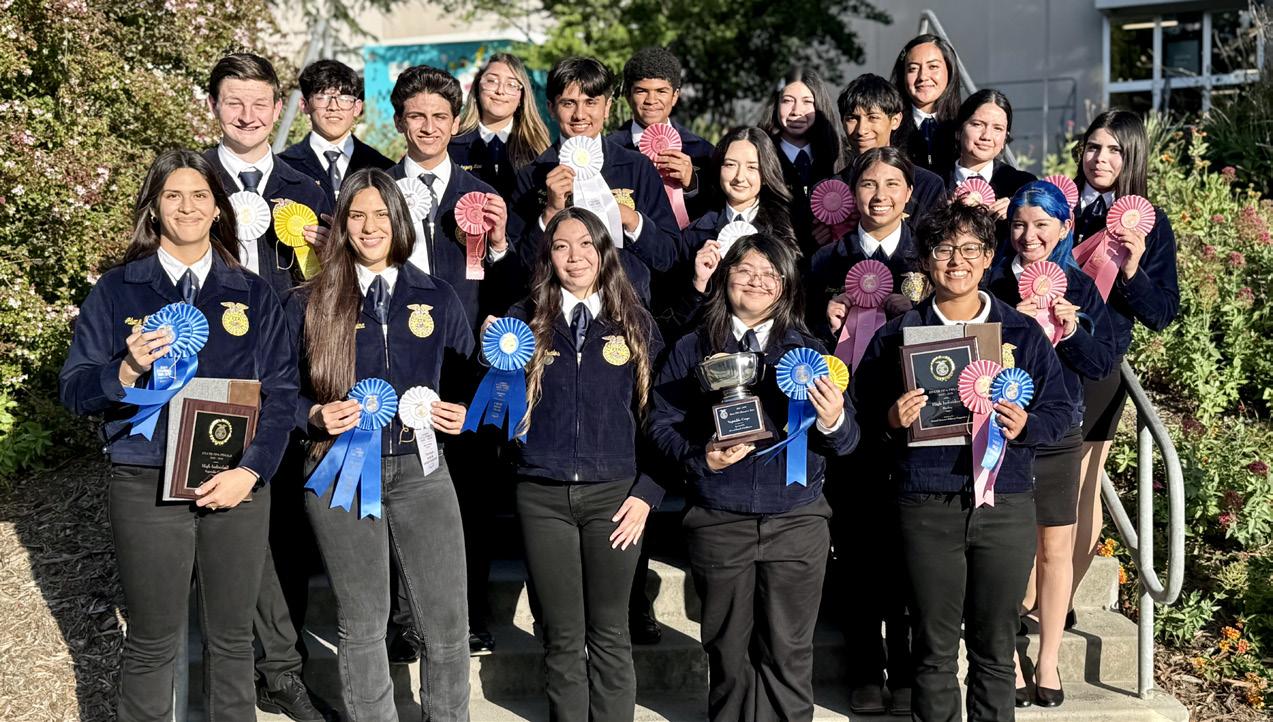

Atwater High School FFA was well represented at the 2026 California FFA State Finals, with seven judging teams competing and three teams earning top-five finishes in the state. Highlighting the outstanding showing, the Atwater FFA Vegetable Crops Judging Team captured the California FFA State Championship.
Atwater High School FFA’s Vegetable Crops Judging Team of Maria Avalos, Elina Burroughs, Ailene Magana, Mailene Magana, and coach Jose Vargas won the 2026 California FFA State Championship at Cal Poly, San Luis Obispo on May 2.
Atwater FFA
continued from page 6 contest, where students applied their knowledge of plant identification, landscape design, plant care, nursery production, and industry practices. Frances Madelo, Jolette Rubio, Diana Solorio, and Kassady Goodman competed in the Floriculture contest, which
develops student knowledge in plant identification, plant maintenance, floral design, sales, and employment readiness while connecting students to greenhouse production, garden centers, and the broader floriculture industry. Araceli Perez, Wynter Lee, Briseyda Venancio, and Lesley Rico-Paz competed in the Veterinary Science contest,
where students demonstrated knowledge of animal anatomy, diseases, parasites, medical tools, animal handling, and veterinary procedures.
“Overall, Atwater High School was well represented at the State Finals with seven teams competing,” said Atwater FFA advisor and agriculture instructor Dave Gosman. “That level
of participation reflects the strong interest and dedication of our students, the commitment of our agriculture teachers, and the continued support of our school, families, and community. When all of those pieces come together, it creates opportunities that make a positive and lasting difference in the lives of young people.”
ACWA Names Nemeth As Executive Director
By: ACWA, News Release
California Department of Water Resources
Director Karla Nemeth has been selected to lead the Association of California Water Agencies (ACWA) as its next executive director, President Ernie Avila announced today. Her selection follows a nationwide recruitment process and overwhelming support of the association’s Board of Directors. Effective Sept. 1, Nemeth will oversee staff of the nation’s largest statewide coalition of public water agencies. Based in Sacramento, ACWA represents approximately 470 members responsible for 90 percent of the water delivered to cities, farms and businesses across California. Nemeth will lead a staff of more than 40, including a Washington D.C.-based office, supporting state and federal advocacy, educational outreach and events. ACWA’s membership includes urban, rural and agricultural water suppliers of all sizes throughout California. She will lead ACWA as its first female executive director in the association’s 116-year history.
“Karla Nemeth brings deep expertise and a proven track record navigating California’s most complex water challenges,” said ACWA President Ernie Avila. “Her leadership will strengthen ACWA’s role as a leading voice and advocate for water agencies across the state.”
Nemeth has served as Department of Water Resources (DWR) director since her appointment by Gov. Jerry Brown in 2018 and was reappointed by Gov. Gavin Newsom the following year. DWR manages and protects California’s water resources and supports the reliability of the state’s electrical grid.
During her tenure, Nemeth led DWR’s efforts to adapt to more extreme weather driven
by climate change, including investments in atmospheric and runoff forecasting, and aging and green infrastructure; better management of groundwater supplies; and programs to strengthen local water resilience.
In 2024, Newsom tasked her with implementation of key water projects to achieve his “Water Supply Strategy – Adapting to a Hotter, Drier Future,” including modernizing California’s water conveyance infrastructure, executing agreements in support of the Healthy Rivers and
Landscapes Program, and stabilizing Colorado River supplies.
Prior to joining DWR, Nemeth worked at the California Natural Resources Agency as Gov. Brown’s deputy secretary and senior advisor for water policy. She also served as Bay Delta Conservation Plan project manager from 2009 to 2014. Nemeth holds a bachelor’s degree in political science and Latin American studies from the University of California, San Diego, and a master’s degree in public administration from the University of Washington.





H-2A continued from page 1
plaintiffs filing a request for the preliminary injunction weighed against finding irreparable harm.
What’s Next?
The lawsuit will continue playing out until a court rules on the merits of the UFW’s claims, and the October 2025
interim final rule remains in effect until further notice. Stay tuned for updates on this lawsuit and look out for the DOL to replace the interim final rule with a “final” final rule any day now.
It remains to be seen whether the ultimate final rule will reflect any of the comments submitted by worker advocates or
industry groups late last year. In the meantime, H-2A employers must be extremely careful about how they construct their job orders for H-2A positions to ensure compliance with the new AEWR methodology. Under the new AEWR rule, new wage and housing data from federal agencies will result in the DOL publishing new
H-2A wages effective July 1, 2026. If those “adjusted” wages are lower than those included in H-2A job orders already in effect, there will be no change in the wages paid, but if they are higher, then employers will need to be ready to increase their H-2A wages as of the July 1effective date.
Calif. lawmakers, officials discuss state’s $16.9B deficit
By: Madeline Shannon, The Center Square
Officials from the Legislative Analyst’s Office told lawmakers on Tuesday that despite California Gov. Gavin Newsom’s latest budget proposal, lawmakers need to consider the “gray cloud in the silver lining” as they work on the final version of the budget this summer.
“I once heard that the job of a budget analyst is to find the gray cloud in every silver lining, so unfortunately, along with the silver linings of revenues, we see quite a bit of gray clouds on the horizon,” said Rachel Ehlers, deputy legislative analyst for the Legislative Analyst’s Office.
What they’re saying: The gray clouds come in the form of the LAO’s projected deficit of $16.9 billion. That’s the operating deficit adjusted for the LAO revenue estimate.
“Despite these booming revenues, the state’s underlying fiscal condition, in our assessment, is not sound. We continue to have a structural deficit, both for the coming budget year, ’26-27, as well as forecast for ’27-28, even under the
governor’s proposals,” Ehlers told the Assembly Budget Subcommittee on Climate Crisis, Resources, Energy and Transportation.
In other words, planned expenditures exceed projected revenues, Ehlers said. “Really, the only way the budget proposal before you is balanced is by relying on reserves,” Ehlers added during the hearing. “Under the governor’s proposal, both withdrawals from reserves, as well as suspended requirements to put money into reserves, totals $20 billion.”
State of play: Newsom’s last budget proposal as governor, released on Thursday, aimed to leave the state with a balanced budget in the 2026-27 fiscal year, as well as into 2028, according to previous reporting by The Center Square. The revised budget projects revenues much higher than what Newsom’s original budget predicted in January, which the Legislative Analyst’s Office agreed are much higher than expected.
“Revenues are booming, and they continue to boom,” Ehlers told the committee. “The statistics around this truly blow the mind.”
According to Ehlers, the state’s revenues are $30 billion higher than what the Legislative Analyst’s Office predicted last June, a 30% growth from 2023. Those revenues, paired with the administration’s proposals in the May budget, helped state officials make substantive progress in addressing California’s structural deficit, Ehlers added.
The Legislative Analyst’s Office previously predicted a $20 billion to $30 billion structural gap in prior years, Ehlers said. “That’s now about in half based on the new, updated revenue forecast,” Ehlers said.
Go deeper: Officials with the state’s Department of Finance said the governor’s May budget proposal leaves $4.5 billion in the state’s rainy day fund during the 2026-27 budget year, which dwindles to $2.1 billion during the 2027-28 fiscal year.
“It takes important steps to address what both the administration and the [Legislative Analyst’s Office] have pointed out is a large out-year operating deficit,” Stephen Benson, assistant program budget manager for the California Department
of Finance, said during the budget hearing. “With the May revision, that is cut by more than half. Huge strides in terms of reducing the outgoing operating budget.”
The governor’s May budget proposed changes to the state’s climate bonds authorized under Proposition 4, a $10 million bond measure that California voters passed in November 2024. Approximately $3.5 billion was authorized for the first year of the climate bonds, according to a 2025 report from the Legislative Analyst’s Office.
Department of Finance officials said during the hearing that an additional $2.1 billion in climate bond funds will be used during the 2026-27 fiscal year, and an additional $148.2 billion in 2026-27 to pay for acquiring 161 acres of the now-closed former racing track Golden Gate Fields. State officials plan to use the property to create a shoreline park and “recreational hub” in the San Francisco Bay Area. Some of that money will also be used to pay for creating wildlife refuge and wetlands, Benson told the budget subcommittee.
That's a Wrap: Successful CultivatED Season
Over the past few weeks, CultivatED, the educational outreach program of the Merced County Farm Bureau, has experienced tremendous growth and momentum. During the past month alone, our team visited more than 30 classrooms throughout Merced County, engaging with students in the communities of Los Banos, Ballico, Stevinson, Atwater, Merced, and Le Grand. Each classroom presentation reinforces the impact of the program and reveals new opportunities for growth and expansion. As staff, we continue to be energized by the enthusiasm of students and educators alike.
Since launching CultivatED in November 2025, we have presented at 12 schools, visited 64 classrooms, and reached more than 1,200 students from preschool through seventh grade across the county. Reflecting on the past several months fills me with gratitude as I see the curriculum I developed coming to life in classrooms. Through these lessons, students are learning that they are the future and that food is the fuel that powers their lives and communities.
My primary goal when working with students is
to help build a connection between their everyday lives and agriculture. I want them to understand that every person on this planet depends on agriculture in some way. More importantly, I hope they develop a greater appreciation for the food they eat and the natural resources that make food production possible.
When I was not in classrooms during May, I spent time in the office and at community events focused on growing and strengthening our Farm Bureau membership. This month, I had the opportunity to attend both the Hilltop Growers Appreciation Lunch and the Yosemite Farm Credit Growers Appreciation Lunch. At the Hilltop event, I hosted a booth featuring promotional materials and information about Farm Bureau, providing growers with an opportunity to learn more about our organization and the resources we offer. I would also like to recognize the Hilltop staff for hosting an outstanding event, the venue was beautifully organized, and the meal was exceptional.
Another meaningful project this month was assisting with our Candidate Forum. Participating in the planning process gave
me valuable insight into the political landscape and reinforced the importance of civic engagement and voting. As I prepared for the event, I spent time researching the candidates, learning about their priorities, backgrounds, and perspectives. During the forum, I assisted with the live-stream broadcast on Facebook, helping ensure the event was accessible to a broader audience. Overall, the forum was a success, and our staff has already begun
discussing ways to expand and enhance the event in the future.
As the summer months approach, I am looking forward to taking a brief pause from classroom presentations as CultivatED wraps up another successful school year. This time will allow us to reflect on what we've learned, refine and strengthen our curriculum, and prepare for an even greater impact in the 2026–2027 school year.

Grizzliy Bears
continued from page 5
was spotted near Herndon and West avenues in northwest Fresno — and there have been increasing break-ins to homes, automobiles and garbage bins in mountain and foothill areas.
A Downieville woman mauled in 2023 was reported as the first documented human fatality in California involving black bears.
Three areas considered for reintroduction
The 2025 study looked at three areas with potentially suitable habitat for grizzly bears despite their longtime absence: the state’s northwest forests, the southern Sierra Nevada mountains and the Los Padres National Forest. It also examined the likely ecological, social and economic impacts of bringing them back in limited numbers.
Alagona, one of the study’s authors, said that
human-bear conflicts get “disproportionately covered” by the news media but have statistically been in steep decline over recent decades thanks to heightened public awareness.
“It's important to understand that the reason there are some coexistence challenges with bears is because they're so much like us,” Alagona said. “There are only three large terrestrial land-based animals on earth that are also omnivores, and that's humans, bears and pigs.”
Citing genetic testing of more than 50 California grizzly bears held in museums, researchers concluded the state’s former grizzlies were roughly 85% herbivores feeding on plant material and fruit. Grizzly bears are considered more carnivorous than black bears.
Other studies, meanwhile, have found that the historical grizzlies were genetically indistinguishable from those currently living in
the Rockies, Yellowstone National Park and into Canada.
“That’s a really interesting finding,” Alagona said. “It tells us that although California’s grizzly population is extinct, there are still bears that are essentially identical that could be used as kind of the seeds of a new population here.”
Over-correcting past wrongs?
While proponents believe humans bear an obligation to restore the former keystone species, opponents reject this argument for a more pragmatic view.
“I think it is possible to acknowledge the potential wrongs of the past without, in a sense, over-correcting in the present,” Wilbur said. “I think we have to be clear-eyed about what the landscape looks like today and the negative impacts that grizzlies or various other wildlife species may have on the landscape that we have
developed in the centuries since their extirpation. I think that in 2026 we have to manage for what the landscape looks like in 2026.”
SB 1305 has cleared two committee hearings since its introduction in February including a 5-2 vote by the Senate Appropriations Committee on May 14.
Lavers openly questioned what business a state senator representing central and south Los Angeles has to introduce a bill with such potential negative effects on rural communities.
“Those bears are not going to be released in south-central LA, and so it doesn’t impact her or her constituents,” Lavers said of Richardson. “She’s writing a bill for an issue that she has nothing to do with. It won’t impact her except for the fact that she wants to be able to say she can go out there and see a grizzly bear someday.”
Reclamation increases Central Valley Project 2026 water supply allocations for south-of-Delta contractors
By: Bureau of Recreation, News Release
The Bureau of Reclamation is increasing Central Valley Project 2026 water supply allocations for south-of-Delta contractors following continued modest improvements in reservoir storage and spring runoff conditions across California’s water system.
This allocation update reflects improved operational flexibility and hydrologic conditions resulting from
April storm activity, strong carryover storage, and coordinated reservoir management efforts that allowed water managers to capture additional runoff while continuing to meet environmental and flood control requirements.
Based on current hydrology and updated forecasts, Reclamation is announcing the following changes to CVP water supply allocations:
South-of-Delta Contractors
Irrigation water service and repayment contractors
south-of-Delta are increased from 20% to 25% of their contract total.
Municipal and Industrial water service and repayment contractors are increased from 70% to 75% of their historic use, or public health and safety needs, whichever is greater.
Eastside Division contractors are increased from 0 to 49,000 acre-feet.
All other allocation amounts announced March 24 remain unchanged.
“Careful coordination and improved spring runoff
conditions have strengthened overall system storage and allowed us to make additional water supplies available to south-of-Delta contractors,” said Acting Regional Director Adam Nickels. “While the Sierra snowpack has for the most part dissipated earlier than usual due to a warm spring, current reservoir storage and operational conditions support this incremental increase while maintaining prudent management of the CVP system.”
CV Project 26
continued from page 10
California’s major reservoirs remain at or above average storage levels for this time of year following coordinated efforts to maximize capture of spring runoff. Recent precipitation in April provided additional inflows into the system and reduced demands on stored water supplies. San Luis
Reservoir and other key project facilities continue to benefit from these improved conditions.
At the same time, Reclamation emphasized that hydrologic uncertainty remains due to the rapid decline in Sierra Nevada snowpack. Statewide snowpack conditions have been well below average this year following an early seasonal peak and accelerated
spring melt. Reclamation will continue to closely monitor conditions and adjust operations as necessary to maintain balanced management of water supply, environmental requirements, and reservoir storage heading into the summer months.
Operational improvements supported by Executive Order 14181 continue to enhance Reclamation’s ability to optimize project operations
and efficiently move available water supplies through the system while meeting applicable regulatory requirements.
Reclamation continues to reserve a portion of storage in San Luis Reservoir as part of its drought reserve strategy. These reserves are not included in and supplementary to the current year allocation determinations updated today.
China renews expired export licenses for US beef plants, Chinese customs website shows
By: Tom Polansek and Daphne Zhang, Reuters
China renewed export licenses that had expired for more than 400 U.S. beef plants, the Chinese customs website showed on Friday, after President Donald Trump and Chinese counterpart Xi Jinping concluded their summit in Beijing.
A casualty of the recent trade war between Beijing and Washington, U.S. beef exports to China peaked at $1.7 billion in 2022.
More than 400 U.S. plants lost export eligibility over the past year as Beijing's permissions, granted between March 2020 and April 2021, lapsed without the customary renewals, accounting for roughly 65% of the onceregistered facilities.
"China's renewal of U.S. beef establishments is excellent news for the U.S. beef industry and for the customers in China who are anxious to resume purchases," said Dan Halstrom, CEO of the U.S. Meat Export Federation, an
industry group.
The federation confirmed China granted five-year registration extensions to 425 overdue U.S. beef plants and new five-year registrations for 77 additional U.S. facilities.
The White House told ranchers in recent weeks that export licenses would be discussed at the summit.
Reuters reported on Thursday that the longawaited licenses had been approved as U.S. and Chinese leaders met, before Chinese customs appeared to halt the learances hours later.
LITTLE U.S. BEEF TO EXPORT
On Friday, China's Foreign Minister Wang Yi said both sides had agreed to address concerns regarding market access for agricultural products.
Though welcomed by American producers, China's approvals were not expected to result in a surge of exports from the U.S., where supplies are tight and prices are soaring.
U.S. beef prices set records this year due to
strong domestic demand and as the nation's cattle herd dwindled to a 75-year low. Earlier this week, Trump was considering executive actions to facilitate increased beef imports to cool domestic prices.
"We don't really have the supply to be exporting right now," said Austin Schroeder, analyst for commodity
advisory firm Brugler Marketing & Management.
Cargill CEO Brian Sikes was among U.S. CEOs accompanying Trump on his visit to China. Facilities owned by Cargill, a major U.S. producer of ground beef, and other meat companies were included in the approvals.

By: Chelsea Dinterman, Successful Farming
Although quality grades are the biggest opportunity for lost profit, yield grades are a key factor in premiums and discounts for cattle sold on the grid. As beef prices continue to skyrocket, yield grade accuracy is more important than ever.
This, paired with changes in packing plant technology, production practices, and overall animal composition, has some questioning if it’s time to evolve.
“There’s a growing relevance of yield alongside quality,” said John Stika, president of Certified Angus Beef. “Because of the improvements we’ve made
Why the Beef Industry Is Rethinking Yield Grades After 60 Years There's Growing Local Support for Extending Life of Diablo Canyon Nuclear Plant
By: Keith Mizuguchi, KQED
The plant passed its final hurdle to run until 2030, but there are talks about extending that expiration date.
Nuclear advocates are pushing to keep Diablo Canyon – California’s only running nuclear power plant – open even longer than planned. The plant passed its final hurdle to run until 2030 last month, but legislators are talking about extending that expiration date even further. And while lawmakers debate how long Diablo Canyon should stay open, local support for the nuclear plant
in quality, there’s more opportunity represented by yield grade. Per the 2022 National Beef Quality Audit, 31% of overall lost opportunity lies within yield.”
The Original Equation
First created in the early 1960s, the yield grade formula considers external fat thickness over the ribeye; the rib-eye area; the estimated percentage of kidney, pelvic, and heart fat (KPH); and the animal’s hot carcass weight.
The full formula is: Yield Grade = 2.5 + (2.5 x adjusted fat thickness, in.) + (.20 x KPH%) – (.32 x rib-eye area, sq. in.) + (.0038 x hot carcass weight, lbs.).
But the equation has some
flaws. For one, it leaves value on the table.
“Yield grade is designed to predict boneless, closely trimmed retail cuts from the round, loin, rib, and chuck,” Stika said. “It doesn’t account for lean and fat trim. It doesn’t account for some of the thin meats that are rather valuable today, like the skirt and flank.”
Today’s cattle herd looks drastically different compared with the early ’60s. Animals are heavier, leaner, and more muscular. The increased use of implants and steam-flaked corn has changed production.
“The entirety of how we feed cattle, the technology we use, and the length of time we feed an animal has changed notably,” said Ty
Lawrence, an animal science professor at West Texas A&M University.
Improved beef quality has been a top priority for the industry. Increasing intramuscular fat also increases fat in other areas of the carcass, though the current yield grade formula doesn’t account for this.
“For every 100° of marbling, we add 5.8% empty body fat to the animal,” Lawrence said. “That’s more and more tallow to deal with, both inedible at the harvest floor and edible tallow through fabrication.”
These changes have allowed farmers to maximize premiums for quality grade but are not considered in the current yield grade formula.
is growing.
Life for California’s last nuclear power plant could be extended
The most striking view off one of San Luis Obispo County’s winding coastal roads is not the lashing ocean waves of the Pacific Ocean or cows plodding out from the shade of a California live oak tree.
It is two enormous concrete domes that come into focus along a final climb that began 7 miles back at Avila Beach. The land sinks away, and what looks like a small town emerges, showcased in a palette of grays, whites and terracotta.
This is Diablo Canyon, California’s last operating nuclear power plant.
Just years ago, the plant was slated to close, and employees worked to decommission it, until a 2022 about-face by Gov. Gavin Newsom led the state to extend its operations to 2030. Now lawmakers in Sacramento are talking about allowing it to operate even longer, potentially to 2045. But there’s debate locally on whether keeping the facility open is a good idea.
On the Cal Poly Campus in San Luis Obispo, a student advocacy club is hosting a meeting. It’s called
“Nuclear is Clean Energy”, or “NICE”. Club president Zach Mousharrafie said their work on-campus has been pretty easy, since none of their fellow students seem to be anti-nuclear. “We haven’t experienced a nuclear disaster in our generation. Fukushima was in the 2010s? I was six years old,” he said.
Diablo Canyon is about a 20-minute drive from this classroom. Advocates, like Mousharrafie from the student club, want to keep it open until 2045. “We need to build huge amounts of clean power cause the climate crisis is a now issue,” he said.
See 'Diablo Canyon' Page 13
Diablo Canyon
continued from page 12
Mothers for Peace is one of the activist groups that has fought against Diablo in the 70s and 80s. But Linda Seeley, who joined the movement shortly after moving to the Central Coast in 1982 said things are definitely different these
days. “Nuclear is normalized now,” she said.
Ann Bisconti is a researcher who studies public opinion around nuclear energy. She said support has increased nationally since the 80s. “ There is lot more activism among those who are for nuclear energy.,” she said. “What we always find is that people living within
the 10 mile radius are very supportive of the local plant. They know people who work there. They go to church, they go to synagogue, they play baseball. ”
Nuclear generates nearly 9% of the state’s energy supply, part of an energy mix that includes gas, hydroelectric, solar, wind, geothermal and even small
amounts of coal. While California’s demand for electricity has been flat for years, it’s now growing with the adoption of electric vehicles, people swapping gas appliances for electric ones, and data centers. The debate to keep Diablo Canyon open is spurred, in part, by this uptick in demand.
NRCS Chief Bettencourt resigns; Buckley becomes chief today
By: Lydia Johnson, AgriPulse
Natural Resources Conservation Service
Chief Aubrey Bettencourt has resigned from the agency, according to a letter sent to staff and obtained by Agri-Pulse. Colton Buckley, NRCS associate chief, will assume the role of chief today.
In the letter, Bettencourt said she “could not be more confident in this decision, prouder of what we have accomplished, or more excited of what is to come for our Service.”
Bettencourt’s departure comes as the Agriculture Department remains under criticism for understaffed NRCS field offices across the U.S. after mass resignations and layoffs across the federal government last year. NRCS maintains field offices in many counties and administers a variety of voluntary, incentive based farmer-facing programs including the Environmental Quality Incentives Program, Conservation Stewardship Program, and Agricultural Conservation Easement Program, among others.
Most recently NRCS is leading a regenerative agriculture pilot program, which is a key tenant of the Make America Healthy Again movement's reach into production agriculture.
New NRCS chief hopes better internet service, updated technology will boost morale
Colton Buckley, the agency’s new leader, joined NRCS in March 2025 as chief of staff and was promoted to associate chief in November. Earlier, he was CEO of the National Association of Resource Conservation & Development Councils and was a senior strategy manager at Turning Point USA, a conservative political organization founded by Charlie Kirk.
The American Farmland Trust called Buckley, who grew up on his family's cattle ranch, an "ardent advocate for a farmer-first agenda," and praised his experience "elevating the issue of agricultural land loss as a priority within the Department and supporting funding to help farmers and ranchers who want to permanently protect their land."
Bettencourt will step “into a new role of service,” according to the letter. Sources suggest that position will be at the Department of the Interior.
During the first Trump administration, Bettencourt served as deputy assistant secretary in the office of the secretary for the Water and Science Division at the
Department of the Interior. She oversaw a range of operational, policy issues and programs for the Bureau of Reclamation, the U.S. Geological Survey, and the Central Utah Project Completion Act, which included managing water supplies in the Bureau of Reclamation’s 17 Western states.

Awaken the Blue, Embrace the Gold
By: Victoria Petty, Merced FFA Reporter
The end-of-the-year FFA banquet was a special night dedicated to recognizing the hard work, dedication, and accomplishments of our members throughout the year. Chapter officers spent a great deal of time preparing for the banquet to make sure the evening ran smoothly and that students who truly deserved recognition felt appreciated for all they had accomplished.
To start the evening Emily Mua, a student at St. Paul’s School and secretary of the Lancers 4-H group, shared the history of the FFA Creed. Her presentation gave attendees a deeper understanding of the importance and meaning behind one of FFA’s most well-known traditions.


This was followed with a meaningful presentation of the FFA Creed by some of our freshmen members, helping start the night on an inspiring note.
Throughout the evening, many students were recognized for their achievements and involvement in our chapter. Outstanding member awards were presented to students who showed leadership, dedication, and commitment to FFA. This year’s recipients included Star Greenhand, Malik Robinson; Star Sophomore, Brooke Xiong; Star Junior, Victoria Petty; and the prestigious DeKalb Award recipient, Christopher Anguiano.
In addition to student awards, graduating seniors were recognized for their dedication to the chapter and were presented with their graduation cords and

senior stoles. This moment celebrated the hard work and memories seniors created during their time in FFA.
We were also honored to have the Mayor Of Merced,Matt Serratto attend our banquet and give a welcoming speech. His support and encouragement made the evening even more special, and we were grateful for his presence. Another highlight of the night was recognizing Mr. Del Toro, a business education teacher who was awarded the
Honorary FFA Degree for his support and dedication to agricultural education and our chapter.
To close out the evening, the 2026–2027 chapter officer team was officially announced, marking an exciting start for the future of our chapter. Overall, the banquet was a successful night filled with celebration, recognition, and appreciation for all the hard work our members have put in throughout the year.





The newly elected 2026-2027 Officer Team. (From left to right - Bryson Rob sion, Serenity Villa, ANdrew Carroll, Alexandra Carlson, Advisor Mrs. Kuhr, Victoria Petty, Brooke Xiong and Oscar Espionza)
$6 gas and refinery fears collide with California’s climate ambitions
By: Alejandro Lazo, Cal Matters
In the last six months, two refineries have closed and gas prices have topped an average of $6 a gallon as the Iran-Israel war sent oil markets into turmoil. The oil and gas sector spent $10.3 million lobbying Sacramento in the first three months of the year, according to lobbying filings, with the Western States Petroleum Association and Chevron accounting for the bulk of it.
The result is a new proposal before the California Air Resources Board that would provide as much as $4 billion in new free emission permits to companies with half slated for the fossil fuel industry in exchange for commitments to invest in clean energy.
Environmentalists warn the proposal is a giveaway to Big Oil that would weaken California’s “cap-and-invest” program just as the state is relying on it to cut emissions and fund climate, housing and other programs. Anthony Martinez, a spokesman for Gov. Gavin Newsom, said the changes are necessary to keep the state’s carbon market “durable” and “affordable” amid mounting refinery closures.
The fight over California’s carbon market has exposed the political tensions at the heart of Newsom’s energy transition agenda. California is trying to preserve its climate ambitions while keeping gasoline affordable for drivers already facing the highest prices in the country. Critics say the air board’s proposal accomplishes
neither goal.
“We are really concerned that this would significantly kneecap the program,” said Chloe Ames, a policy adviser with NextGen Policy.
Weakening the backstop
Through California’s 13-year-old carbon market, major polluting companies must buy permits for every ton of greenhouse gases they emit, with the state capping total emissions year by year. Each permit is worth real money and companies can sell the ones they don’t use. The program is considered California’s climate backstop — the only state policy that sets a firm limit on greenhouse gas emissions.
At the heart of the dispute with environmentalists is a proposed subsidy program carved out of that carbon market. The air board, if it approves the proposal on May 28, would create a new pool of free pollution permits for refineries, cement plants and other big companies that pledge to invest in clean energy and efficiency projects.
The pool would be capped at 118.3 million permits — the same number the air board has said must come off the market for California to hit its 2030 climate target. Environmentalists say the proposal risks wiping out those reductions.
Berkeley energy economist Meredith Fowlie, who chairs an independent committee that oversees the carbon market, wrote in a recent analysis that the design would give qualifying refineries more free permits than they need to cover their emissions.
“One could use the word generous,” Fowlie said.
Rajinder Sahota, the air board official overseeing the program, said the proposal would ensure emissions reductions. The new permits, she said, would only go to companies undertaking clean energy and efficiency projects and would be limited, temporary and rescinded if companies misuse them. The plan is meant to help keep refineries operating in California at a time of uncertainty, she added.
“We want to make sure that there’s reliable, affordable fuel for California consumers while the demand persists,” Sahota said.
But environmentalists say the air board has built in almost no accountability for how companies invest in those projects. Katelyn Roedner Sutter, state director for the Environmental Defense Fund, said the proposal “is based on proposed investment, not any guaranteed reduction.”
“That’s a red flag,” she said.
A climate money crunch
Quarterly auction revenue for state programs could drop from roughly $4 billion a year to about $2 billion under the proposal, according to the Legislative Analyst’s Office.
Sen. John Laird, the state Senate budget chair and a coauthor of California’s original 2006 climate law, warned at a May 6 hearing that the proposal “flies against many things we negotiated just last fall” with the governor and could put the carbon market deal “back on the table.”
Not all lawmakers are critical. Assemblymembers
Jacqui Irwin and Cottie Petrie-Norris, who respectively chair climate and energy committees, said the proposal “reflects the Legislature’s focus on affordability,” and urged the board to proceed “without delay.”
They pointed to an increase in the Climate Credit, the twice-yearly rebate that the carbon market funds on Californians’ utility bills; a UC Santa Barbara analysis, however, found the new subsidy could shrink the credit by as much as $1.7 billion under the proposal.
A separate, bipartisan group including Assemblymember David Alvarez, a Democrat, and Senator Suzette Valladares, a Republican, argues the purpose of the carbon market is to cut emissions, not raise money for programs.
Newsom struck an eleventh-hour deal with lawmakers last year that extended the state’s carbon market through 2045 and set the order of which state programs get auction money first.
Under that plan, California’s high-speed rail project receives $1 billion a year before many other programs. Lawmakers also carved out a $1 billion annual pool for priorities they control themselves, but Newsom in January proposed committing that money to wildfire spending and other programs.
Last in line are programs lawmakers have spent years building into California’s climate agenda: affordable See 'Refinery Fears' Page 16
Refinery Fears
continued from page 15
housing and transit-oriented development meant to reduce driving and climate pollution, rail and bus service, wildfire resilience, clean drinking water in poor communities and neighborhood pollution monitoring.
Newsom unveiled a revised state budget on May 14 that did not reflect the potential drop in carbon market revenue. Laird, in an interview, said the administration told him the revenue drop wouldn’t show up in the coming fiscal year.
Laird said he planned to “ground truth” that assessment in the weeks ahead. The hit “would still be a big hit the year after this budget year,” he added.
Big Oil’s biggest target
California’s carbon market became a central focus of the oil industry’s lobbying efforts after the air board released a January proposal sharply reducing free pollution permits for industry.
Seven of the 10 highestspending oil and gas lobbying groups in California pushed state officials on the proposal, state filings show.
The petroleum association and Chevron mounted some of the industry’s most aggressive lobbying, pressing lawmakers, the governor’s office, the air board and the California Energy Commission on the plan.
The April plan raised free permits for most industries through 2030 above the January version, but deferred decisions on permits after 2030 to a future rulemaking.
Jim Stanley, a spokesman
for the petroleum association, said the group has been pressing lawmakers, regulators and the governor’s office about “the potential consequences of a poorly structured cap-and-invest program.”
Chevron spokesman Ross Allen declined to comment beyond letters Chevron filed with the air board. Chevron initially warned the proposal threatened refinery survival in California. After last month’s revisions, the company is continuing to push for additional protections.
Zach Leary, a lobbyist for the petroleum association, said California needs to go further than even its latest proposal. He wants California to lock in a higher level of free permits permanently.
“The state is acknowledging that
affordability and ambition are not getting along very well right now,” Leary said.
Eddie Ahn, executive director of Brightline Defense, oversees community air sensors in San Francisco’s Tenderloin, Mission and South of Market neighborhoods funded through the state’s community air protection program. That program is among those that could lose state money if carbon market auctions decline under the proposal.
“If the funding is cut off, then convening groups of people on a monthly basis — that goes away,” Ahn said. “It means frontline communities get disconnected from environmental policy.”
Success in the Ring: Golden Valley FFA
By: Golden Valley FFA Students
The members of the Golden Valley FFA had an outstanding turn out at the Chowchilla Fair!
These 5 exhibitors dedicated countless hours of hard work, responsibility and commitment to their projects and we are incredibly proud of their accomplishments!
Congratulations to Anika Borges for earning the Grand Champion Market Goat and 2nd Placefor her Commercial Heifer Class. Trent Sceurich exhibited the Champion Yorkshire. Adela Cruzplaced 2nd in her Market Goat class. Makinna Woods received 1st place in both her Market Hogand Breeding Hog class, and Julyssa Perez also earned 1st place in her Market Hog class.
Golden Valley FFA is proud to recognize these members for their dedication and success in representing their chapter at the Chowchilla Fair. Members of their chapter are now gearing up and getting ready to exhibit their projects at the Merced County Fair.
At the Los Banos Spring Fair, Anika Borges had an outstanding and highly successful show season representing FFA. She exhibited her breeding doe project and earned the honor of 3rd Overall Doe, demonstrating the hard work, dedication, and daily care she has invested throughout the year.
In the showmanship ring, Anika continued to excel by winning FFA Advanced Showmanship, showcasing her strong knowledge of animal
handling, professionalism, and presentation skills.
She then went on to earn the prestigious title of FFA Master Showman, one of the highest accomplishments at the fair and a reflection of her commitment, preparation, and leadership within agricultural education.
In addition to her success
in the show ring, Anika was also recognized academically and within the agricultural community as the recipient of a Heritage Foundation Scholarship. Her accomplishments this year highlight her dedication to both her SAE project and the values of FFA.

Anika Borges gathered with her supporters after winning Supreme Grand Champion Market Goat and FFA Champion Market Goat at the ChowchillaMadera County Fair.




When Cattle Wear Jewelry
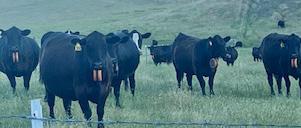
Ialways chuckle when I hear a non-cattle savvy person ask why the cows are wearing earrings. Of course, they’re referring to the ear tags that identify the animal’s number in the herd, and sometimes the rancher’s brand is also printed on the tag. With modern technology progressing rapidly, some ranchers have decided to purchase “Necklaces” for their cattle as well.
This isn’t a fashion statement, it’s a relatively new fencing system, or Virtual Fencing for Modern Livestock Management. Cotton Creek Ranch in Mariposa has recently begun using the Gallagher e-Shepherd system for fencing. This system represents a shift in how ranchers manage cattle grazing, using GPS-enabled technology instead of traditional physical fencing. It is part of a growing category often referred to as “virtual fencing,” where boundaries are created digitally rather than with posts, wire, or electric tape. At the center of the system is a lightweight, solar-powered collar worn
by each animal. The collars we\re currently using are orange and black and are easily identified form a distance. These collars communicate with a cloudbased platform that allows ranchers to draw virtual paddocks or grazing zones on a map using a smartphone or computer. When cattle approach a virtual boundary, the collar delivers a series of cues. First, an audible tone warns the animal it is nearing a boundary. If the animal continues, a mild, controlled stimulus, (Shock) is delivered. Most animals quickly learn to respond to the sound alone, avoiding the boundary altogether. Over time, the system conditions livestock to respect invisible boundaries without physical infrastructure.
The Gallagher e-Shepherd system is designed to solve several long-standing challenges in livestock management. Ranchers can adjust paddock sizes instantly from a phone or computer, allowing for rotational grazing that improves pasture health and soil recovery. Traditional fencing is expensive to install and
maintain, especially across rugged or remote terrain. Virtual fencing reduces the need for miles of wire and posts. Areas that are difficult to fence—such as hillsides, waterways, or irregular parcels—can be managed more effectively. Because no physical barriers are required, wildlife corridors can remain open, supporting ecological balance.
The e-Shepherd system is part of a broader movement toward precision livestock farming, where data and automation help improve efficiency, sustainability, and land stewardship. As adoption grows, systems like this may reshape how ranchers think about pasture boundaries altogether— replacing fixed fences with
active, flexible grazing zones. It’s exciting to be part of this innovative new fencing system. Tony has been training the cattle at our home ranch, preparing them to begin grazing on our BLM permit in Hunters Valley very soon. It’s remarkable to see how this technology allows him to pinpoint each cow’s location right from an app on his phone.
Beyond the convenience, this system also creates new opportunities for land stewardship. By strategically guiding cattle into areas with heavier vegetation, we can use targeted grazing to help reduce fuel loads and support wildfire mitigation efforts. To be continued, I’ll keep you posted!