IAPH Conference Review | Lighting up with LED | Containership Fleet Update

Range of wheel bases toplift lift hook intermodal tool carrier driver training connected to MyKalmar INSIGHT nancial predictability


Range of wheel bases toplift lift hook intermodal tool carrier driver training connected to MyKalmar INSIGHT nancial predictability
MIKE MUNDY
It is suggested there is scope to refine the methodology underpinning the World Bank’s Container Performance Index (CPPI) as well as promote a greater understanding of its intended role. Equally, refinement is seen as essential in conjunction with IMO’s adopted approach to gaining broad-based acceptance of a Net Zero Framework
The World Bank’s Container Port Performance Index 2020 to 2024: trends and lessons learnt is now in its fifth edition. This edition represents an evolution of the product with added coverage provided on key trends identified over the five years of its publication in addition to its core function which the World Bank describes as “providing a comparative global assessment of container port performance.” The key measure of this is total vessel time in port, which is assessed by combining two complementary approaches (referred to as “administrative” and “statistical”) to produce what is seen as “a robust and normalised score” by the World Bank and its co-authors of the report, S&P Global Market Intelligence.
In turn, the net result of this, as viewed in practical terms, is a ranking of just over 400 ports.
The foreword of the new report states that, “it builds on the strong foundation laid by its predecessors.”
BUT for some this is not the case with various points made that question the veracity of the methodology and which suggest there is significant scope to refine it.
Our article on p24, CPPI: Room for Improvement summarises the situation. It further highlights the reality that while the purpose of the Index in the eyes of the authors is to “serve as a diagnostic and planning tool to help port authorities, governments and private stakeholders develop a constructive dialogue on investment, reform and innovation in port infrastructure and operations” the more common usage is to benchmark ports against each other – a role the World Bank actually states the CPPI is not intended to fulfil. Given this, it would seem that there is a case for the stronger marketing of the Index’s intended role to promote this understanding.
Even so, this does not negate the case for refining the methodology employed.
A more refined approach is also suggested in our article IMO MEPC landmine on p29 of this issue. There were points of contention in relation to economic and technical issues in conjunction with the proposed Net Zero Framework but the argument is put that its failure to gain acceptance was as much about a switch away from a proven approach to gain consensus as anything else.
The approach adopted to achieve agreement prior to the next vote at IMO is seen as vital and worthy of deep consideration.
The international magazine for senior port & terminal executives
EDITORIAL & CONTENT
Editorial Director: Mike Mundy mmundy@portstrategy.com
Features Editor: A J Keyes keyesj186@gmail.com
Consultant Editor: Felicity Landon felicity@felicitylandon.com
Regular Correspondents: Felicity Landon; Stevie Knight; Ben Hackett; Peter de Langen; Charles Haine; AJ Keyes; Oleksandr Gavrylyuk Johan-Paul Verschuure; Phoebe Davison
Production David Blake, Paul Dunnington production@mercatormedia.com
SALES & MARKETING t +44 1329 825335 f +44 1329 550192
Media Sales Manager: Daniel Spicer dspicer@mercatormedia.com
Marketing marketing@mercatormedia.com
Chief Executive: Andrew Webster awebster@mercatormedia.com
PS magazine is published quarterly by Mercator Media Limited, Spinnaker House, Waterside Gardens, Fareham, Hants PO16 8SD UK t +44 1329 825335 f +44 1329 550192 info@mercatormedia.com www.mercatormedia.com
Subscriptions: Register and Subscribe at www.portstrategy.com
Annual subscriptions from: £275.00 Single user: Full online access to Port Strategy and Greenport with digital magazine issues.
For multi-user access: Subscriptions@mercatormedia.com


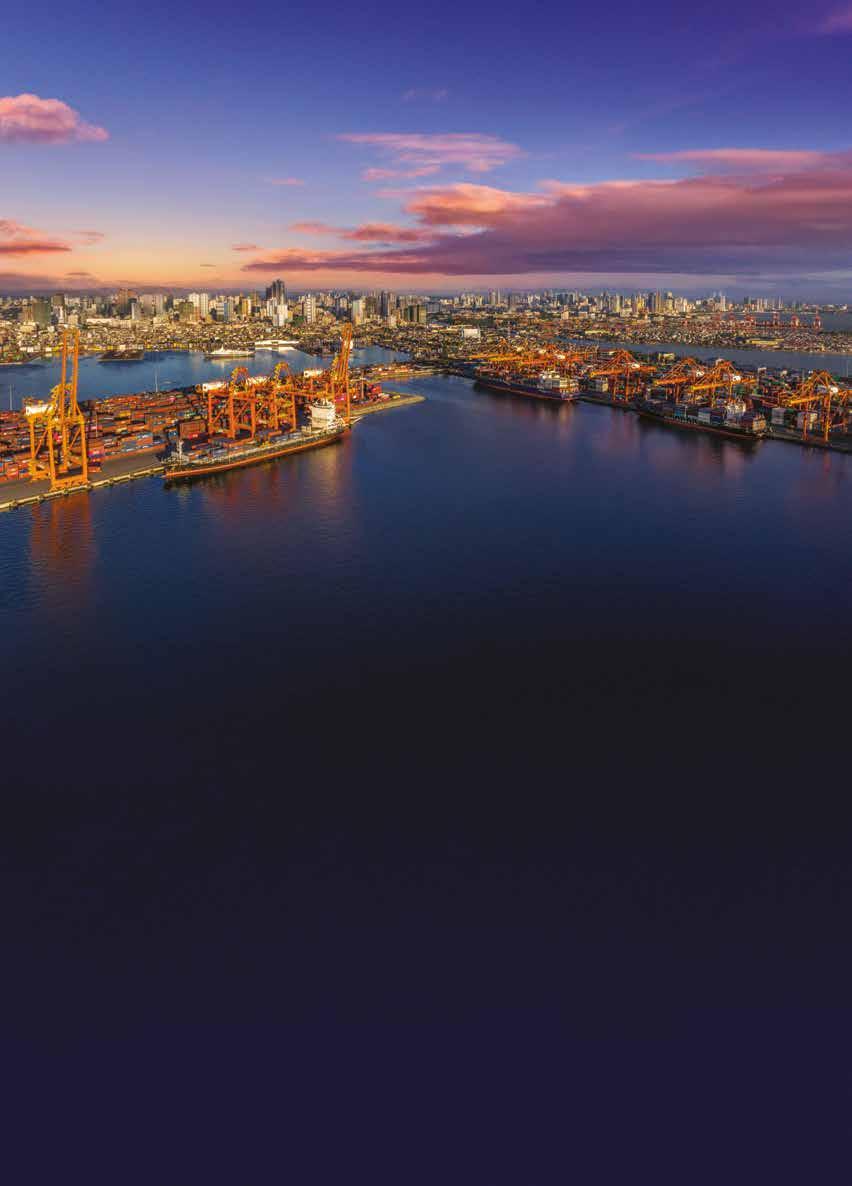



Building from a one-country operation at the Port of Manila in the Philippines, ICTSI has pressed forward across 37 years. On six continents, currently in 19 countries, we continue developing ports that deliver transformative benefits.
All across our operations, we work closely with our business and government partners, with our clients and host communities: to keep building momentum where it matters, in and through ports that keep driving sustainable growth.

5

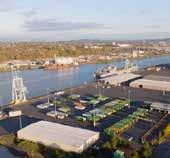
The Port of Los Angeles is seeking proposals from interested parties to participate in the pre-development of Pier 500, a new stand-alone marine container terminal along the Pier 400 Channel.
The selected entity would enter into a public-private pre-development agreement with the port authority to scope the project’s financial feasibility, procure entitlements and handle other requirements needed before implementation and build-out of the project.
“For the first time in a generation, the Port of Los Angeles plans to build a new container terminal to meet global supply chain demand for decades into the future,” said Gene Seroka, Executive Director, Port of Los Angeles, adding, “The development of the cleanest terminal possible would enhance our efficiency and sustainability while creating new jobs in our communities.”
As proposed, Pier 500 will be a 200-acre site with two new berths and approximately 3,000 linear feet of new available wharf. The identified location is just south of Pier 400.
The port authority is also reportedly keen for the Vincent Thomas Bridge to be raised by 8m to 64.3m, which would allow ships of up to 23,000 TEU to access terminals along the East and West Basins. Proposals from interested parties must be with the Port of Los Angeles by January 29th 2026.
The government of Greece has confirmed investment of US$680 million to modernise the country’s port infrastructure. Stefanos Gkikas, Greek Deputy Maritime Affairs Minister, said the upgrade programme will focus on up to 30 of Greece’s island ports, using US$210 million already secured from the National Strategic Reference Framework (NSRF) 2021-2027 Transport programme and US$93 million from the EU’s Recovery and Resilience Facility.
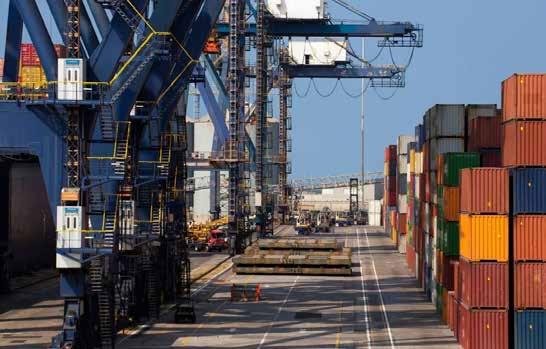
Largescale deals were confirmed during India Maritime Week 2025.
Syama Prasad Mookerjee Port, Kolkata (SMPK) has signed a number of memorandums of understanding (MoU) to improve infrastructure expansion and support port-led growth. The MOUs, which total Rs 480bn according to SMPK, include:
● Project agreement with Dredging Corporation of India for long-term dredging operations to improve harbour maintenance and capacity.
● Investment by Haldia Petrochemicals Limited to develop tank farms and petroleum, oil and lubricants (POL) handling infrastructure at Haldia Dock.
The Australian Port of Darwin has released its new long-term master plan, outlining its vision and priorities for the next 30 years. “With regional and global trade dynamics evolving at an unprecedented pace, the Master Plan provides the clarity and structure needed to remain a resilient, responsive gateway,” says Darwin Port CEO Peter Dummett. Increasing container capacity to 300,000 TEU p.a. and bulk export space to 13.5 million tonnes p.a. are included.
● Partnerships with Adani Ports and Special Economic Zone Limited, JSW Infrastructure Limited and Century Ports & Harbours Limited to build new container terminal projects under public-private partnership models.
● An agreement with UltraTech Cement Limited, signed to establish a cement bulkterminal at the Kolkata Dock, as well as real-estate tie-ups for river-front development with firms like Srijan Real Estate & Infrastructure Private Limited and Eden Realtors Limited. At the same time, the Chennai Port Authority (CPA) and V. O. Chidambaranar Port Authority (VOC Port) in Tamil Nadu outlined their own MOUs exceeding Rs 1.2 trillion in value.
The Western Access to Waaslandhaven (WOW) project, a key step for the Extra Container Capacity Antwerp (ECA) project in Antwerp has gained preliminary approval. The plan will help raise annual handling port capacity from 15 million TEU to 22 million TEU. ECA will cost €2.9bn (US$3.4bn) and includes building a second tidal lock, filling in the Noordelijk Insteekdok, developing the Drie Dokken and Bieshoek logistics zones.
■ Chennai Port’s Outer Harbour reclamation project is part of investment totalling Rs 12 trillion announced at India Maritime Week 2025
A major infrastructure development confirmed by CPA is the 90ha Outer Harbour reclamation project between the fishing harbour and Bharathi Dock area that will generate significant additional space for port use
Additionally, VOC Port has announced projects of Rs 800bn, which includes a Rs 20bn venture with J M Baxi Ports & Logistics to establish shipbuilding and repair facilities, with the aim of helping increase ship traffic by 25%.
During India Maritime Week 2025, investment of more than Rs 12 trillion has been confirmed.
CMA CGM Group has acquired Freightliner in the UK. The deal includes the rail and road operations, (500 trucks and 900 trailers), inland terminals and the Freightliner brand. The transaction value has not been disclosed but it is understood that Freightliner’s freight train division Heavy Haul, along with Rotterdam Rail Feeding, and Freightliner Poland/Germany, are not part of the deal, which is expected to close in early 2026, subject to all regulatory approvals.












































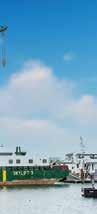




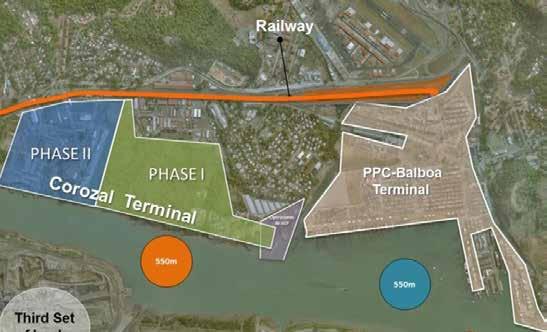
The Panam Canal Authority (ACP) is focusing on securing long-term water resources and diversifying revenue streams in its new 2025-2035 strategic plan. The waterway authority is expecting to undertake over US$8bn in investments across multiple projects, including the Río Indio Reservoir, an Interoceanic Energy Corridor, and the Corozal Container Terminal.
ACP is targeting these initiatives to transform Panama into a fully integrated logistics and energy hub as part of enhancing the Canal’s global competitiveness and expanding its role beyond traditional vessel transits.
One aspect of the plan is not
new, with the Corozal project being revived. In 2016, ACP published a tender to develop a 5.3 million TEU container facility near Panama City at the Pacific Ocean end of the Canal and although four interested parties prequalified, no official bid was ultimately received by ACP.
At the end of October 2025, seven different organisations have prequalified for the construction of this new facility, namely a Dragados-Sacyr consortium, China Railway Construction Corp, Van Oord, Jan de Nul, CHEC, Hyundai Engineering and Construction and Acciona-Deme Consortium, Dragados-Sacyr consortium,
■ ACP is reviving the Corozal port project within its 2025-2035 strategic plan
China Railway Construction Corp, Van Oord, Jan de Nul, CHEC, Hyundai Engineering and Construction and Acciona-Deme Consortium. Both APM Terminals and CMA CGM Group have reportedly expressed an interest in the project.
The initial infrastructure comprises two new 1730m terminals and a 4-km breakwater. ACP has confirmed that formal bids are expected in January 2026, with the contract to be awarded in March 2026. The first 836m berth could potentially come online in 2036.
QTerminals Kramer Rotterdam (QTKR) and Ocean Network Express (Europe) (ONE) have reduced emissions by as much as 500 tonnes of CO2 in just six months by implementing a biofuel scheme using HVO100, a sustainable biofuel made from renewable raw materials for port shunting operations.
This joint initiative marks a significant step forward in QTKR and ONE’s partnership to decarbonise port logistics. It highlights how readily available alternatives can deliver immediate results while longer-term solutions, including
electrification, are developed. By targeting emissions in port operations, a critical link in the container supply chain, both companies are demonstrating how practical change at a local level can accelerate progress towards global decarbonisation.
The partners are now preparing for the next phase of their collaboration, which will see the introduction of a dedicated fleet of electric trucks (e-trucks) for port operations. These e-trucks will serve alongside the HVO100 trucks, handling container movements across
terminals, further cutting emissions to establish a long-term platform for zero-carbon logistics.
QTKR and ONE view the combination of immediate, scalable measures, achieved by switching to biofuels, along with longer-term investments in electrification, as central to the maritime sector’s transition. The partnership also reflects a growing recognition that decarbonisation requires close cooperation between carriers, logistics providers and port operators if industry-wide goals are to be achieved.
Plans for a major container port at Świnoujście, Poland, are being revived, with the aim of creating the country’s second deepwater container hub after Gdańsk. The planned two million TEU capacity facility is part of a 186ha development known as Cape Pomerania. It will offer a 17m water depth, 2900m of berthing and the capability of receiving 400m LOA vessels. Construction of the US$2.35bn project is targeted to begin in 2027 and complete in 2029.
The Port Authority of Valencia (APV) has awarded a concession for the construction and operation of a new solid bulk terminal (excluding clinker and cement) at the Port of Sagunto. APV hopes the award will attract investment, boost regional bulk cargo throughput, and support sectors including agribusiness, metallurgy, and construction. The winning consortium consists of Ership, Intersagunto, and CGCA.
ICTSI’s Adriatic Gate Container Terminal (AGCT) in Rijeka is expecting to have two new Super Post Panamax quay cranes operational before the end of 2025. Built by ZPMC, the state-of-the-art cranes are specifically tailored to meet AGCT’s requirements and will enable the terminal to handle the largest container ships in service. These new units will complement recently delivered hybrid RTG yard cranes, part of the terminals drive to reduce equipment emissions.

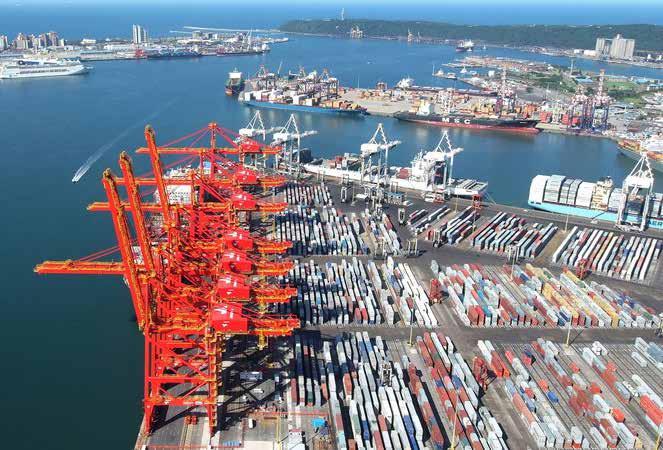
A court in South Africa has upheld the award of an operating concession to ICTSI for Durban Container Terminal (DCT) Pier 2.
This ruling from the Durban High Court dismisses a legal challenge from APM Terminals that the state-owned ports group, Transnet, acted unlawfully in selecting ICTSI for a 25-year joint venture. It now allows the Philippines-based operator to take control of the busiest container facility in the country. This terminal is critical to both the Port of Durban and South African trade, currently handling over 70% of the port’s total container business and more
Hamburger Hafen und Logistik AG (HHLA) significantly increases its revenue and earnings in the first nine months of 2025. Group revenue rose by 12.5% to €1,331.4 million (up from €1,182.9 million), with the EBIT margin improving to 8.8%, from 7.9% in the 2024 comparable period. Container throughput at HHLA’s container terminals rose by 6.7% to 4.8 million TEU, up on the 2024 period total of almost 4.5 million TEU.
than 45% of total container volumes moving through the country’s ports as a whole.
APM Terminals had contested the tender process, claiming that ICTSI’s bid “relied on market capitalisation rather than balance sheet equity to satisfy solvency requirements,” thereby providing ICTSI with what the AP MollerMaersk subsidary described as an “unfair advantage in the bidding process.”
However, in rejecting the appeal from APM Terminals the Durban High Court confirmed that it “found no irregularities” in the tendering process. The operator is now currently understood to be “reviewing the
Forth Ports Group has placed a repeat order for three Kalmar Hybrid straddle carriers. The new units will be deployed at the Port of Grangemouth in Scotland, with delivery scheduled for Q2 2026. Forth Ports Group ordered six identical machines in Q1 2025 for use at the London Container Terminal at the Port of Tilbury. The latest hybrid units will reduce fuel consumption and CO2 emissions, while being less noisy, compared to diesel-powered machines.
Nimba Mining Co. (NMC), the state-owned company in Conakry to which the government has reallocated the mining site of Emirati company Guinea Alumina Corp. (GAC), is searching for a new subcontractor for bauxite extraction.
The process is now needed because DTP Mining, a subsidiary of Bouygues Travaux Publics, confirmed in August 2025 that it no longer wanted to continue working with the Guinean state-owned company.
NMC has confirmed that it is currently reviewing several potential new partners to take over from DTP, with a decision expected by the end of 2025. The companies being considered are believed to consist of mainly local operators.
judgement” while ICTSI described the court decision as a validation of a fair and transparent tender process.
This ruling now allows ICTSI to move forward with its planned investment of R11 billion (US$638 million) at the facility.
The court action from APM Terminals commenced in April 2024 and has effectively slowed down a much needed programme to deploy private investment and operating expertise at DC2.
Mediterranean Shipping Company (MSC) has launched a new intermodal rail service directly linking Serbia with the Port of Trieste. The weekly service carries over 70 TEU from the Batajnica terminal near Belgrade through to MSC’s own terminal in Trieste and focuses on carrying automotive parts, ores, machinery, packaging materials and consumer goods, enabling MSC to now combine rail and ocean transportation.
In early November 2025, NMC stated that it had commenced loading barges and vessels with the 1.5 million tonnes of bauxite ores stockpiled since GAC left the Tinguilinta mining concession.
The resumption of bauxite exports from Tinguilinta comes at a time when GAC is preparing an arbitration case against the Guinean government in connection with the termination of its concession.
GAC initially acquired the 690km² concession in the Boké Region in 2001, though bauxite extraction only began in 2019.
The Australian Port of Gladstone has released a request for registrations of interest to develop a new container terminal. An official statement said the port corporation is seeking interest “from suitably experienced private sector investors and operators to develop and operate a new container terminal and integrated logistics hub. The port has eight main wharf centres handling 30 different products, led by coal, LNG, alumina, and aluminium.
Unlock full access to Port Strategy incorporating GreenPort today with our digital subscription. Port Strategy is the multi-media platform for senior executives from port authorities, terminal operators, service and equipment suppliers. A Port Strategy subscription now includes content from GreenPort, focusing on environmental best practices and corporate responsibility centred around marine ports and terminals. Stay up-to-date with new products, innovations and developments which impact their business.
Informing a combined audience of over
61,000
Port professionals around the world
Register now for free and enjoy one month of complimentary unlimited access to our news archive, podcasts, webinars, and articles on innovations and current trends in the Port industry.

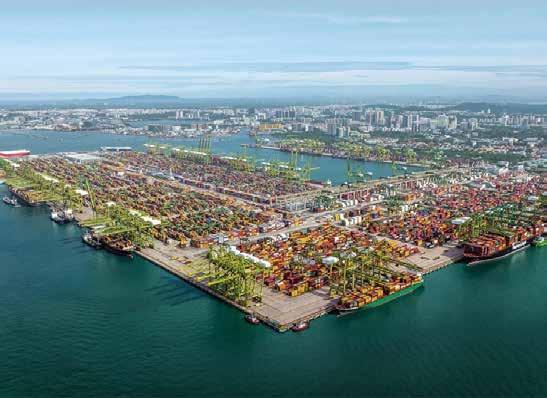
Global logistics and supply chain service provider PSA BDP, part of PSA Group, is teaming up with A*Star’s Institute of High Performance Computing (IHPC) to develop a new AI model, dubbed ‘AI-based Event Mining and Impact Evaluation of Maritime Shipping Disruptions.’
As part of a three-year collaboration, this new initiative is combining the logistics knowledge from PSA BDP with the expertise in AI, modelling and simulation of A*STAR IHPC.
Utilising AIS data and other public sources of information, the system will detect shipping
A new tool in the fight against mis declared and undeclared dangerous goods in containers has been launched by the World Shipping Council as part of its Cargo Safety Program. The new AI-powered screening application aims to identify the dangers that are a leading cause of fires and increase protection for crew, vessels, and the environment. Ocean carriers representing more than 70% of global vessel TEU capacity have already joined the programme.
interruptions early, forecast any impacts on terminal capacity and operations, and support more resilient decision making. Each of these components can then be used as part of mitigation strategies.
By enabling earlier detection and faster response during unforeseen events, the AI model will be able to better support logistics providers, shipping lines, and port operators maintain supply chain continuity and operational resilience
The AI development process is also going to experiment with large language models (LLMs) in
The European ATHENA security project has kicked off in the Port of Valencia, Spain. The initiative, in which Fundación Valenciaport is a participant, offers software and hardware suppliers a flexible and scalable cybersecurity solution that will enable them to test, validate and ensure compliance with the new EU security requirements, ensuring that products are ready for certification in accordance with the European Cybersecurity Act.
Greece-based forward-thinking AI-powered maritime software company, HarborLab, has moved to further accelerate development and expansion of its capabilities towards delivering more robust, AIenabled solutions to customers.
The company already offers e-disbursements accounts analysis software that automatically calculates and evaluates port expenses against real-time port tariffs, thereby optimising the Port Cost Management process and transforming port expense management through transparency and innovation.
■ PSA BDP is aiming to strengthen Singapore’s position as a resilient maritime hub and empower more adaptive and secure global supply chains through use of AI
order to assess unstructured information like news or regulatory updates.
The model will be tested and validated in Singapore before a planned broader rollout to global markets.
The project is being funded under a Singapore Maritime Institute (SMI) grant, part of Phase 2 of the Maritime AI Research Programme, with support from the Maritime Port Authority (MPA).
Hamburg-based technology company, omogo, has confirmed a new commercial development partnership with Cargo-Terminal Lehmann (CTL). CTL will use omoqo cloudbased software to digitise core operational workflows. As a modular platform offering Terminal Operating Modules (TOM), terminal processes are simplified without the rigidity of legacy systems. TOM offers rapid TOS set-up without a large up-front investment.
“Our mission is to bring transparency and efficiency to maritime operations, and strong leadership in sales is critical to achieving that,” said Antonis Malaxianakis, CEO, HarborLab, when explaining why George Făcăeru has joined the HarborLab team as its new Vice President of Sales.”
“George’s expertise is both timely and transformative. We’re confident his leadership will energize our team, deepen our market connections, and help us reach new heights. We are excited to welcome George to the team as we continue scaling globally and delivering value.
The Panama Canal Authority (ACP) has unveiled the second generation of its Long-Term Slot Allocation (LoTSA) programme. LoTSA 2.0 reduces the booking horizon from 12 to six months, split into two reservation cycles per year, which allows vessel operators to be better able to react to volatile market conditions, seasonal trends, and fleet redeployment needs. ACP is offering a segmented package structure split to cover all cargo types.
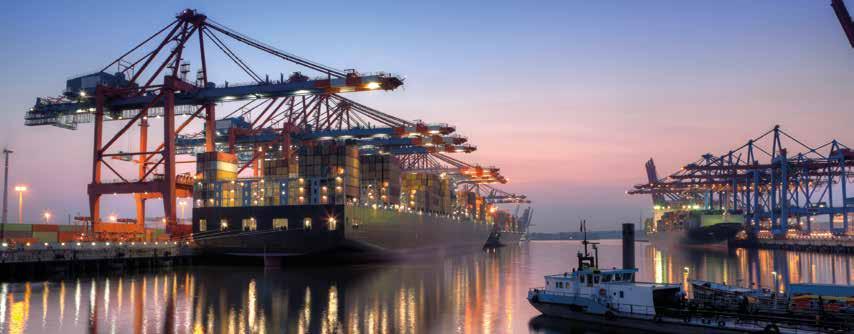
The ultimate combination for uncompromised safety in crane operation.
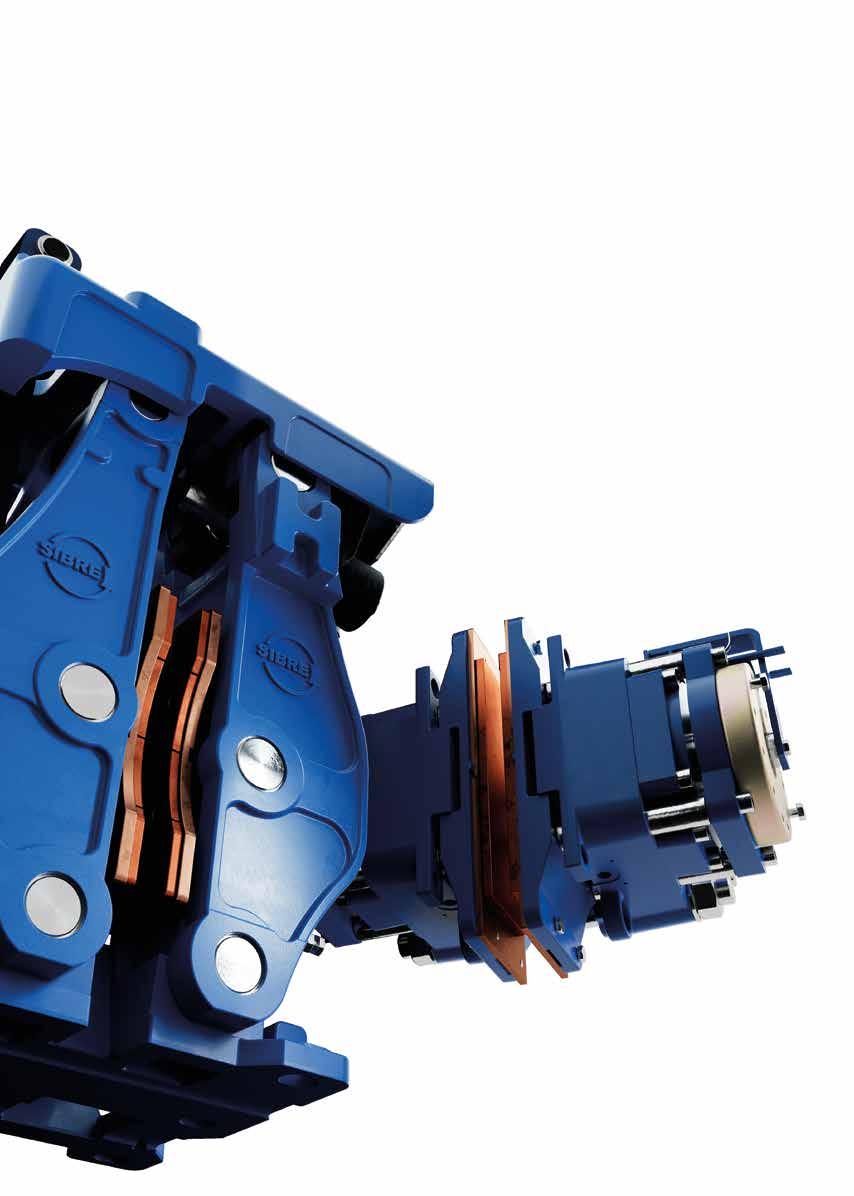
Couplings and Components
SIBRE Siegerland Bremsen GmbH Auf der Stücke 1 - 5
Haiger - (Germany)

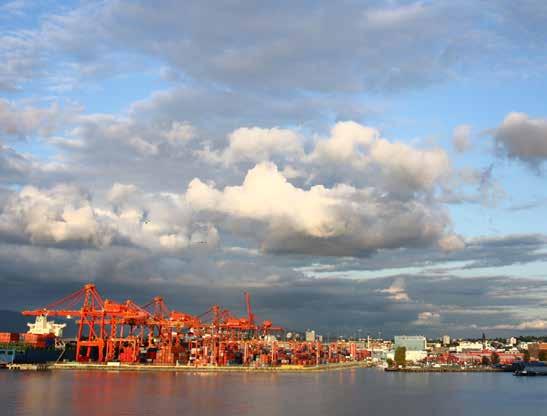
US-based Kaleris has launched Terminal Insights, a new data platform targeting the reduction of bottlenecks in marine terminals, while also improving operational performance through live data visibility. This new platform is part of the company’s Advanced Optimisation suite of services and can be integrated with a terminal’s existing terminal systems to deliver real-time operating data and performance metrics. It addresses challenges in yard management, equipment utilisation and truck turnaround times by offering:
● OpsView and Analytics: OpsView and Analytics brings together operational data into a single, real-time view of the
terminal. It equips operators with dashboards, KPIs and analytics to track performance, uncover bottlenecks and make faster, data-driven decisions that improve efficiency and throughput.
● Execution Visibility Platform (EVP) Connectivity: Built-in APIs offer seamless integration with existing TOS, crane systems and external platforms, eliminating heavy IT involvement or long development cycles.
● Expert Collaboration: Kaleris Optimisation Services experts work side-by-side with terminal teams to interpret data, troubleshoot issues and implement sustainable process changes.
The company, which acquired
■ Kaleris says that terminals relying on legacy systems and manual reporting can gain improved operational performance through its new Terminal Insights platform
Navis in 2021, states that this latest announcement is a further move towards a more pro-active, technology-enabled terminal management approach that can assist in the “mounting pressure on port and terminal performance.”
Kirk Knauff, Chief Executive Officer of Kaleris, explains further: “Terminal operators are under immense pressure to deliver speed and efficiency in an increasingly complex supply chain. Terminal Insights is a game-changer in this type of environment.”
DP World has announced the release of a new digital customs platform, CARGOES Customs, with Electronic Citizen Solutions (eCitizen) in Nairobi, Kenya.
The implementation of this new service, via Kenya’s government services portal, will give cargo importers, exporters, and authorised customs agents
access to what the global terminal operator says is “one of the most advanced systems globally for managing customs declarations.”
The introduction of the new CARGOES platform represents an alternative to the Kenya Revenue Authority (KRA) legacy system by targeting more efficient customs
clearance, revenue collections and compliance monitoring.
In addition, DP World confirmed that the new CARGOES application will be integrating with the existing trade ecosystem in Kenya which already utilises eCitizen for all services and electronic payments relating to Kenya Ports Authority activities.
The Port Authority of New York and New Jersey (PANYNJ) has signed a deal with Boingo Wireless to deploy next generation 5G and Wi-Fi networks across all of its terminal and maritime facilities. PANYNJ said the agreement further endorses its ongoing aims of modernising its digital infrastructure and enhancing operations across its marine infrastructure. The agreement continues a partnership that began in 1999 and runs to 2038, with an option to extend to 2043.
Leading supplier and developer of rugged computers for demanding environments, JLT Mobile Computers, has confirmed the successful validation of its VERSO™ Series vehiclemount terminals (VMTs) for the latest release of the Navis N4 Terminal Operating System (TOS). JLT says the deal means zero-risk deployment, maximum uptime & durability and future-proof investment for users. This multi-year Navis Ready subscription agreement began in 2019 and has now been extended for another five years.
The Port of Newport in the UK has confirmed a new deal with Ensemble for use of the Athena AI-driven platform that supports more efficient workforce planning and scheduling. Athena has been designed to focus on the complexities of port operations whereby multiple skill sets and safety-critical elements need to be included in the process. To achieve this, the application uses machine learning to offer optimal workforce schedules in mere seconds. Newport is part of UK port operator, Associated British Ports (ABP).
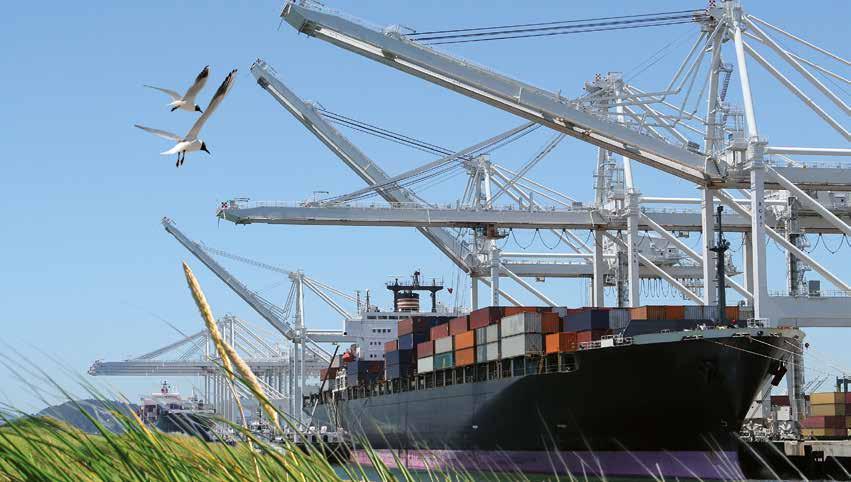
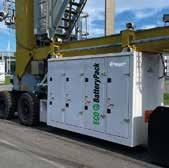
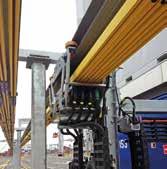
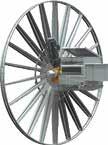
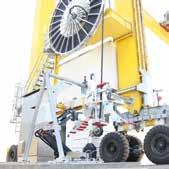
Converting a conventional RTG into an electrical one (E-RTG) means to shut down the diesel generator and to power the RTG with electrical power only – the emission saving, sustainable basis for automation. This is possible with electric power solutions, including E-RTG auto-steering and positioning systems, developed by Conductix-Wampfler: Drive-In Solution, Hybrid and e-Hybrid Solution, Full-Battery Solution and Motor Driven Cable Reel Solution. We move your business!
www.conductix.com
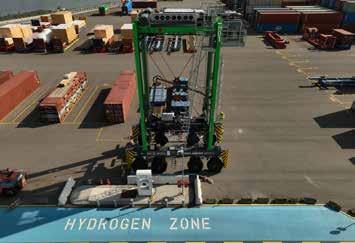
Hamburger Hafen und Logistik AG (HHLA) has confirmed that it is testing the first hydrogenpowered straddle carrier at the Port of Hamburg.
The machine is in operation at the testing facility of Container Terminal Tollerort (CTT), as part of the Clean Port & Logistics (CPL) innovation cluster at the port.
The new straddle carrier, manufactured by Konecranes, is powered by a hydrogen fuel cell and is emission-free.
Initial feedback released by HHLA references how the “drive system responds quickly and performs handling operations with the same performance as the hybrid version.”
A key feature of the new unit is its modular power system, which can be flexibly adapted to different types of drive systems (hybrid, battery or hydrogen) through simple modifications.
The straddle carrier is refuelled at the hydrogen filling station at CTT using a process similar to standard procedures, thereby creating synergies in operations.
Dr. Volker Windeck, Head of Hydrogen Projects, HHLA, elaborates: “With this pilot project, we are demonstrating that hydrogen drive systems represent a genuine alternative in the area of heavy-load operations. The technology matches the performance level of conventional drive systems and generates zero emissions. By systematically recording and sharing our
The UK Port of Felixstowe has ordered 34 Autonomous Trucks (ATs) from Shanghai Westwell Technology Co. Ltd (Westwell), to double its fleet. A new automated battery swap station allows ATs to automatically exchange depleted power units for fully charged ones in about five minutes. Each AT has 128-line LiDAR, 360-degree camera vision, monocular and stereo cameras with radar. Felixstowe deployed 34 of the same units earlier in 2025.
experiences in the Clean Port & Logistics cluster, we are creating the basis for climate-friendly transport solutions that benefit not just us but the entire industry.”
As part of the “Balanced Logistics” sustainability strategy, HHLA is aiming to become climate-neutral throughout the Group by 2040. To achieve this, HHLA has been relying on the electrification of its systems and equipment across Europe for many years. Hydrogen could make a significant contribution to the further decarbonisation of logistics.
HHLA works together with over 40 partner companies in the Clean Port & Logistics cluster to develop solutions to bring hydrogen-powered heavy goods vehicles and terminal equipment to market quickly and to put in place the measures necessary for their use. The testing facility is based at CTT.
The Alabama Port Authority has ordered two RTGs from Konecranes for its new Montgomery Intermodal Container Transfer Facility (ICTF). The Montgomery ICTF is being developed in partnership with CSX. The US$100 million construction commenced in February 2025 and expects to be operational in early 2027, providing Port of Mobile users with seamless rail and truck connectivity into central Alabama.
Container management solution, Optibook, has been launched by Patrick Terminals at the Port of Brisbane, Australia.
Developed by OneStop in consultation with landside operators, OptiBook integrates with the Vehicle Booking System (VBS) to provide enhanced visibility of container status, improve booking efficiency, and deliver greater transparency across the landside supply chain.
OptiBook changes the process from vessel-based availability to container-based availability. Instead of releasing slots against a vessel timeframe, import slots will only be available once a container has been fully discharged and marked as “ready.”
At the same time, HHLA has signed an MoU with Kawasaki Heavy Industries Ltd to explore the development of a reliable and cost-effective supply chain for green liquid hydrogen via the Port of Hamburg to the European hinterland.
This collaboration is designed to enable the import of liquid hydrogen from hydrogenproducing countries to Germany, reinforcing Hamburg’s role as a hub for sustainable energy. The participants are planning to assess the logistical requirements for transshipment and onward transport by road and rail. The initiative also seeks to attract additional companies and institutions to form a consortium that spans the entire hydrogen value chain.
Cavotec has signed an order from Mohan Mutha Group to supply shore power systems in the Maldives. This is the first shore power installation in the Maldives and is a key step in the country’s efforts to reduce carbon emissions at ports. The systems will enable vessels to connect to electrical power while berthed, eliminating berth emissions. The order includes five Power Run and Power Feed systems, with deliveries scheduled for Q1 2026.
OneStop has highlighted several benefits of the new system, including: better slot access and higher truck utilisation; enhanced visibility for planning and scheduling, a more intuitive booking interface and integration opportunities, and real-time updates and on-the-go efficiency via the OneStop Deliver App.
OptiBook has previously been rolled out at other terminals in Australia, including Patrick’s Melbourne facility (December 2023), DP World’s West Swanson Terminal in Melbourne (December 2024) and in July 2025 at DP World’s Fisherman Island Terminal in Brisbane.
APM Terminals (APMT) Lázaro Cárdenas has confirmed receipt of a new fully electric SuperPost-Panamax ship-to-shore (STS) crane at its terminal at the Port of Lázaro Cárdenas, Mexico. The crane has a maximum lifting capacity of 100 tonnes and will ensure better energy efficiency. The investment is part of an expansion project that will see annual capacity of 2.2 million TEU p.a. offered by 2026, also supported by automated railmounted gantry units (ARMG).
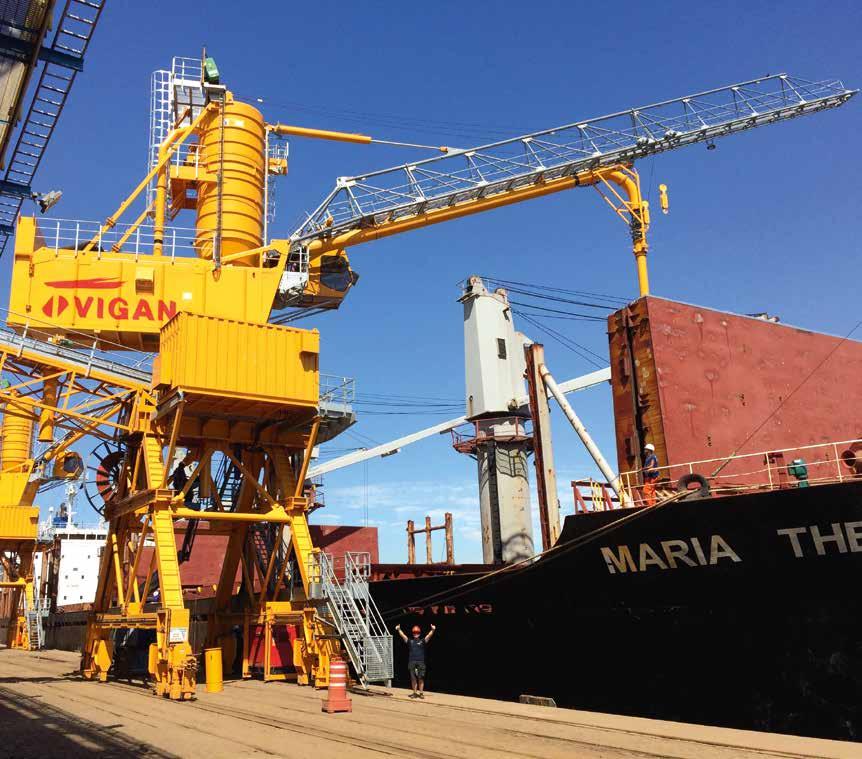
Pneumatic and mechanical ship (un)loaders
Up to 2500 tph for loaders and up to 1200 tph for unloaders.
Low noise & dust emission machine within reach
Turnkey solutions for cereals, soy flour, fertilizer, pellets and more...

As sustainability takes centre stage and the transition from fossil fuels is both an environmental and economic imperative, the demand for electric drive systems is accelerating, according to Liebherr.
Between 2019 and 2025, Liebherr recorded a significant increase of 400% in its electric drive mobile harbour cranes. This substantial rise in demand underlines the clear movement within the industry towards integrating more sustainable technologies in port operations.
‘Our clients have benefitted from the integration of electric drives into our product range for over two decades’, says Franz Findel, Product Manager at Liebherr-Rostock GmbH.
‘Beyond the considerable reduction in CO₂ emissions and noise levels, e-drives require minimal consumables and feature fewer moving parts –significantly reducing maintenance demands and associated costs. These advantages contribute directly to improved overall efficiency and
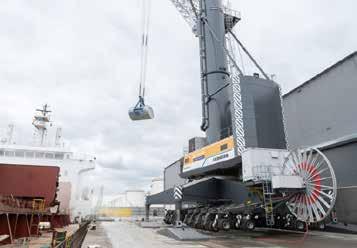
operational reliability, without sacrificing speed or lifting capacity.’
The company further explains that during heavy lift operations, cranes often experience idle periods when no load is being moved. In these moments, opting for an e-powered drive offers a significantly more sustainable solution. While a diesel engine continues to emit approximately 24 kg of CO₂ per hour even when idling, the e-drive consumes no extra energy during these pauses.
■ e-drives require minimal consumables and feature fewer moving parts – significantly reducing maintenance demands and associated costs
When powered by renewable energy sources, the environmental benefits are even greater –handling operations at the quayside with an electric Liebherr mobile harbour crane can reduce CO₂ emissions by up to 100 kg per hour compared with a diesel driven mobile harbour crane.
There are hopes that President Trump’s recent meeting with Xi Jinping of China could see a pause in tariffs on imports of ship-to-shore cranes and chassis manufactured in China and arriving at US ports.
Reports in the international media confirm that Jamieson Greer, US Trade Representative was soliciting feedback on the possibility of a one-year truce. As proposed, China would
also agree to halt any retaliatory measures.
Collectively, the move, if agreed by the US and China, represents a 12-month pledge not to invoke tariffs or other penalties stemming from a US probe into China’s actions in the maritime, logistics, and shipbuilding sectors.
The US federal government was planning to collect 100% tariffs on imported ship-to-shore
cranes, intermodal chassis and parts, a move that targets Chinese-made port equipment, from November 9, 2025. The plan also proposed potential additional tariffs as high as 150% on some Chinese-origin cargo handling equipment used across the US port industry as well.
In response, China announced steep fees on US-owned ships calling at Chinese ports on the same day.
Fogmaker International AB has released a new targeted fire suppression for vehicles with several critical compartments.
Traditionally, a fire suppression system can handle only one deployment zone with one piston accumulator. This section valve will be able to handle up to four different deployment zones with
the same piston accumulator. The valve is said to hold the potential to revolutionise fire suppression for commercial electrical vehicles.
A vehicle or machine with a diesel engine has most of the fire hazards in one single compartment, but due to basic design criteria for battery
electric vehicles, for instance an electric bus can have fire risks in several places. The new valve addresses this challenge by covering up to four individual deployment zones, directing the fire suppressant to where it is needed and buying crucial time when it’s needed the most.
The Damietta Alliance Container Terminal (DACT) has confirmed receipt of the final 10 of 40 RTG cranes. The new terminal is a 30-year JV between Hapag Lloyd Damietta GmbH and Contship Damietta Srl and is planning to offer 3.3 million TEU of annual capacity. Operations are expected to commence before the end of 2025. Financing includes contributions from IFC (US$120m), EBRD (US$125m) and AIIB (US$100m) amongst others.
Trelleborg Marine and Infrastructure has confirmed the final phase of a major navigation modernisation project across 25 ports in Mexico is underway, with implementation of its SafePilot Portable Pilot Unit (PPU) and navigation software. The project is delivering immediate and long-term advantages across multiple operational areas. Enhanced safety protocols will allow pilots to perform more accurate navigation and operational consistency through uniform systems across all ports, while reducing maintenance complexity and training requirements.
Konecranes has confirmed a new order for 30 batterypowered RTG cranes for a Indian greenfield container terminal. Booked in Q3 2025, delivery of the units is scheduled for Q1 2027. Each crane will feature Konecranes’ E-Hybrid technology, which reduces peak power demand to 60 kilowatts (kW) per RTG, compared with up to 400 kW for traditional electric models. Charging of the batteries occurs on site dynamically through the busbar supply as required during operation.



BARRY PARKER
The on again, off again, backwards, and forwards action on the tariff front, along with similar course shifts (at least temporarily) on fees tied to vessel ownership, continues. Against the backdrop of Election Day and new actions concerning sanctioned entities (with potential for the more impactful “secondary sanctions” looming), what are port officials supposed to do?
In earlier columns, I’d suggested that ports would need to be flexible with their policies related to international shipping. While I can pat myself on the back for being prescient for thinking about on/off switches, the problems/ opportunities facing port executives, and international trade players generally, are more complex, and certainly more impactful, than I had envisioned.
Indeed, the situation that has played out during 2025 has suggested that the tenets of international trade, bringing countries and businesses together over many years,

Ports remain fully entrenched in the world of politics
decades really, lowering costs, and bringing about efficiencies, may be shifting. In certain parts of the maritime world, notably with petroleum and product carrying tankers, there are effectively two parallel universes at play. While shipping generally has now seen a one year reprieve regarding port fees for vessels and the associated challenges, we don’t know what might happen a year out in November 2026. In
The recent announcement of the ‘Cape Pomerania’ development, a project involving a container terminal as well as additional port activities is interesting because its setting reflects the changing geopolitical landscape and how that leads to changing port development approaches.
The project, coined ‘the most ambitious project in the 75-year history of the SzczecinŚwinoujście Port Authority’ consists of 186ha of new land, a quay wall almost 3 km long with a breakwater, an access channel, and a harbor basin with a depth of 17m. The centerpiece is a deep-water container terminal with a 1.3 km long quay and a handling capacity of 2 million
outlining the dynamics here, a number of expert analysts and commentators on international trade have described bifurcations, and all the inefficiencies that come with them, that will likely linger for a while.
One example of how ports may try to play in the new arena is built around the notion of
“green corridors”- where two ports (or more likely regional agglomerations) will develop trade routes for transporting specific cargo flows across an ocean, with a cleaner fuel (compared to conventional diesel) available to support the particular back and forth. Admittedly, the recent pause at the International Maritime Organization (IMO) concerning the timetable for reducing greenhouse gas emissions has taken the emphasis away from fuels. However, the general concept, where certain ships (again, the concept could be expanded to the fleet level) are deployed semi-exclusively in particular trades.
So, when the ports post their tariff books, maybe not everyone will be treated the same; certain preferred cargo shippers and owners might be treated better than others. That’s the emerging face of bifurcations, fractures and fragmentations, the new face of global trade, at least for a while.
TEU per year. It is considered one of the largest investment projects on the Baltic Sea.
This project replaces a previous project, agreed only two years ago (July 2023) in which a consortium consisting of DEME and Q Terminals pre-agreed to finance, build and operate a container terminal based on a for a 30-year lease. The consortium was selected by means of a competitive tender procedure. At the announcement of the new project, financing issues were stated to be one of the bottlenecks that had prevented full closure of the deal.
The newly announced project is considerably larger than the
previous one – not in terms of the TEU capacity of the terminal, which is 2 million TEU in the current and previous project, but in terms of additional infrastructure. The investment is partly justified as it enhances Poland’s military mobility, as the terminal is designed for dual civil and military use.
In addition to the investments of the state-owned port authority (around US$350 million), the central government is committing US$1.9bn for the land and seaway improvements, including deepening port access channels and road and rail infrastructure.
This case shows how the
government changed its port development approach, from market driven to governmentled, gave military mobility considerations a central place in port development, provides large scale public funding for port development and reduced geopolitical dependencies by no longer involving a foreign state-owned port company (i.e., Q terminals). And all of this quite rapidly. While I think all of the above is justifiable based on the changed geopolitical landscape, the ultimate test of whether the investments make Poland better off is the commercial success of the port in terms of attracting container volumes.
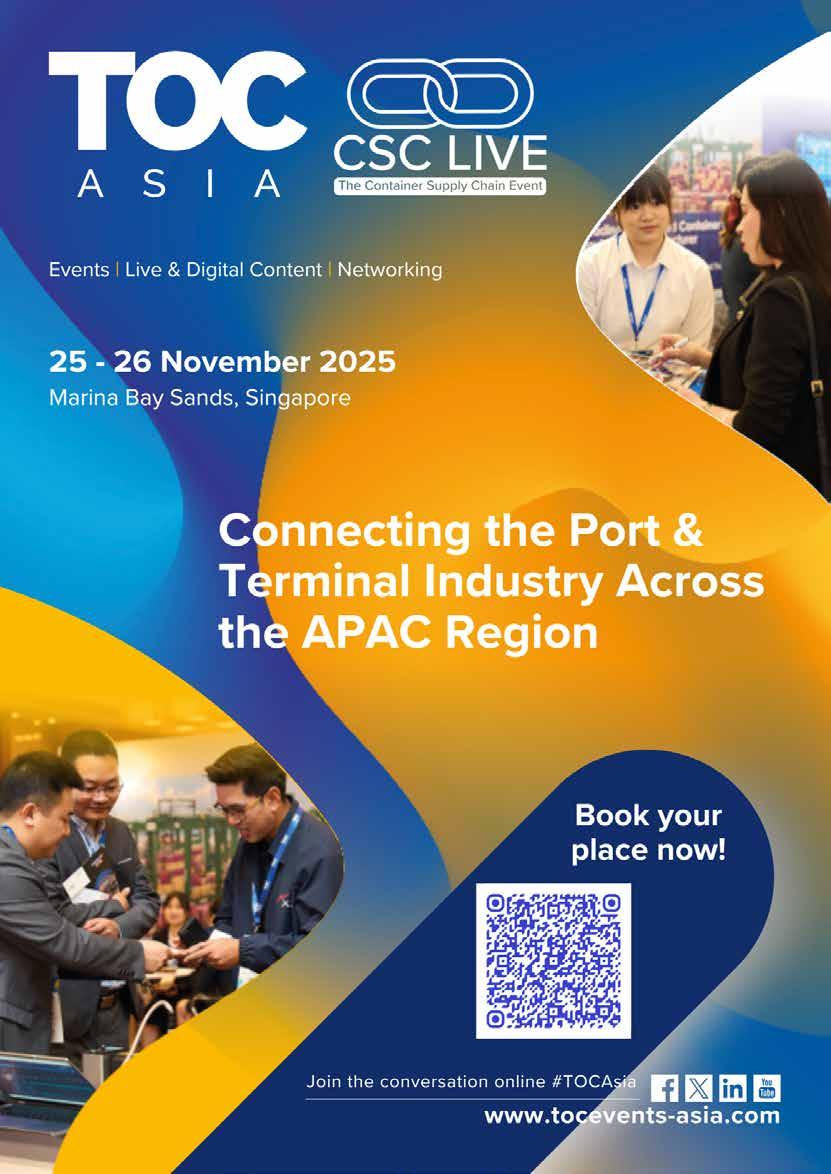

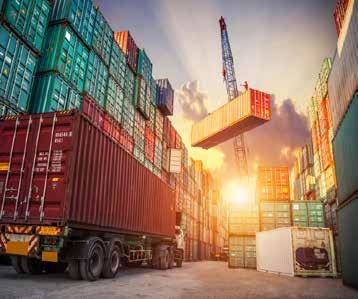
The impacts of geo-political disruptions, created by wars in Europe, the Middle East and Africa combined with the strategy to upend international trading relations by the use of tariffs as a tool to upend trade and logistical supply chains, will create an unmeasurable instability to global trade and international relations.
Maritime trade has been disrupted by the Houthis in Yemen and by the misuse of tariffs by the U.S. This has disrupted sources of production and supply chains harming economies worldwide and likely causing a global recession as the tariff tax begins to push up inflation, creating an economic impact quite the opposite of the intended purpose.
The uncertainty caused by ambiguous economic, political and trade policies is being felt in investment decisions. Companies that formerly based their forward-looking strategies into the long-term are now struggling to even come up with short-term planning. This can be seen in the maritime sector as well as in industrial investments based on geographical locations. Countries

The impact of tariffs and inward looking policies by the U.S. are a major cause of disruption to international trade and political relationships
like Canada, Brazil, India and the European Union (EU) are struggling to find reliable new trading partners to replace the U.S. This is already unleashing further tariff policies independent of the U.S. based trades. The EU recently announced a swinging
The Houthis have announced that they have paused maritime attacks on Israel and lifted their so-called blockade on Israeli ports. This effectively signals the end to Red Sea attacks on shipping which up until the point of the announcement had killed at least nine seafarers and sank four ships.
The Suez Canal Authority has promoted the story of an end to the conflict citing as evidence the recent passage of the 17,859TEU capacity CMA CGM Benjamin Franklin through the Canal sailing from Europe to Asia
2024. This cannot be said for the projection in 2025, as both bulk and containerised transactions are weakening to the point of either flat-lining or having negative growth. Not all is negative however as regional trade growth is expanding, primarily in Asia but also in Africa.
tariff on global steel imports as a means to protect their domestic industries in response to U.S. tariffs on steel imports. Global trade benefitted from relatively stable trade growth in
and which then passed unimpeded through the Bab el-Mandeb Strait at the southern end of the Red Sea.
Indeed, it is fair to say that CMA CGM has been something of a pioneer in this respect with other vessels following in the footsteps of the Banjamin Franklin and making use of the Canal. Indeed, CMA CGM’s boldness in this respect goes as far back as June, during the conflict time, when the 15,536TEU capacity CMA CGM Osiris achieved the status of being the largest vessel to pass through the Canal for over a year.
Generally, however, while transits have definitely picked up there is no mad rush to use the Suez Canal.
Caution is the watchword!
Certainly, this seems to be the path to follow according to shipping consultants and online shipping analysts.
“Details are sketchy and you cannot base the safety of crews, ships and cargo on the word of Houthi militia,” says Peter Sand, Chief Analyst at Xeneta. “Carriers need far more assurance than that and, perhaps more importantly, so do insurers.”
As long as tariffs are the primary force impacting political relationships and trade lane routings, the uncertainty of what the short and medium-term future hold will act as a suppressor of consumption and a source of delay for investment decisions. We can therefore expect to see the maritime sector planning process stumble as investment in new ships becomes a greater risk as trade volumes decline, all of which could well cause a delay in new port development and expansion. The loss of the U.S. as a reliable trading partner is forcing a complete refocus on formally stable relationships.
Perhaps even more tellingly there are economics to take into account. Xeneta underlines that a mass return to using the Canal could trigger a seismic drop in freight rates with more than two million TEU of capacity absorbed by the longer alternative route round the Cape of Good Hope.
Bottom line there is also the warning from the Houthis that if the conflict in Gaza resumes then there is the possibility of a resumption of hostilities.
Caution definitely seems the best policy!
The Container Port Performance Index is now in its fifth edition and has achieved a certain prominence as a document to be scrutinised on release. But is it being used for the right purpose and is it robust enough to justify its title? Mike Mundy reports
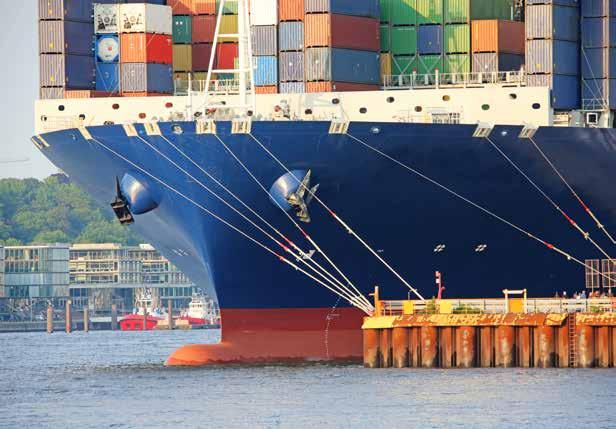
The World Bank 2025: The Container Port Performance Index 2020 to 2024: Trends and lessons learnt, has recently been released following joint preparation by the World Bank and S&P Global Market Intelligence.
It is the fifth edition of this work which while called an Index is effectively a ranking of 400+ ports worldwide related to “time expended in a vessel stay in port.” This latest edition also reviews trends over the five-year time period since the Index was first released.
The core function of the Container Port Performance Index (CPPI), however, is to provide a comparative global assessment of container port performance by focusing on vessel time in port using this as the key metric of performance. Specifically, it focuses on vessel time in port and the number of containers moved with the underlying methodology combining what the authors call administrative and statistical approaches.
The administrative approach provides a direct measure of port performance using vessel time in port, adjusted for operational variables – for example, port time is defined with this being adjusted by ship size categorised into five predefined groups by TEU capacity and call size: categorised into ten predefined groups by number of container moves per port call (load + discharge + restow). The statistical approach applies “multivariate factor analysis (identifies patterns between multiple variables) to derive latent performance dimensions from a set of correlated indicators.” Generally, the methodological explanations do remain
unacceptably vague. Feedback suggests clear examples of calculations should be shared to allow third parties to examine the theoretical approaches in detail.
The commentary accompanying the latest index states in terms of its purpose and rationale: “The CPPI is intended to serve as a diagnostic and planning tool. The aim is not to benchmark ports against one another but rather to help port authorities, governments, and private stakeholders identify where and how improvements are taking place, and under what conditions. It provides a starting point for constructive dialogue on investment, reform, and innovation in port infrastructure and operations.”
In reality, however, what happens is that the ranking of one port against others is arguably the main way in which the Index is interpreted. The competitive element rises to the fore with the Index when released prompting a flurry of News Releases highlighting good performances/improved rankings from one year to the next etc. Such releases confirm that the more analytical aspects of a position in the index are often overlooked in favour of highlighting the position achieved relative to other parties.
This becomes even more apparent when the results are basically weaponised – for example, one party suggesting that two ports positioned in the lower rankings with the same operator in place should lead to “eliminating this operator”
■ Would the construction of the Index benefit from a Working Group comprising representatives from key industry sectors that can aim to refine methodology and generally iron out problem areas?
1. Single Productivity Measure
2. Clarity of Definition between a Port Versus a Terminal
3. Comparability Across Port Types
4. The Weighting System as Employed Favours Ports Handling Larger Vessels, Disadvantaging Those with Smaller Vessel Profiles
5. The Exclusion of Certain Time Components
6. Publishing Rankings with Miniscule Differences Between Ports
7. Expertise View
8. Ports Serving One or Two Major Customers or Services Gain an Advantage
9. Port Service House
10. Differences in the Impact of Exogenous Factors (e.g. COVID-19) Across Regions
● Focuses on vessel time in port as the core metric of performance. Port performance is more than just port hours. It also includes reliability, flexibility, connectivity, sustainability and more.
● A comprehensive measure of port productivity should factor in vessel turnaround time at berth, crane rate, number of shipping connections and asset utilisation in addition to port hours.
● Port hours can also be impacted by external factors outside of a port’s control, such as ship arrival patterns and bunching – all having the possibility to influence port hours even if the port itself is performing well.
● In comparison, the World Bank’s Logistics Performance Index considers six dimensions for evaluation, covering efficiency, quality of trade, ease of arranging shipments, service competence, track and trace capability and timeliness.
● Comparing a single terminal in a port with a multi-terminal set-up is inherently misleading and inevitably distorts results.
● Transshipment terminals face the additional challenge of managing the different arrival schedules of main-line vessels and feeder vessels to connect the cargoes optimally. Transshipment hubs face inherent operational asymmetries when compared against gateway ports, as they may at times need to provide time-recovery service and stowage corrections. Greater clarity could come from ranking ports within peer categories.
● Ports handling both main haul vessels (e.g. TransPacific and Asia-Europe services) and regional feeders are at a disadvantage compared to ports that handle predominantly main haul mega vessels. The case is put that normalising vessel size profiles allows for fairer comparisons between ports.
● Consistent rules should be applied when including or excluding time components to avoid bias.
● For example, bunkering may occur either before or after port operations. However, the report excludes bunkering time if it takes place after port operations but includes it if it occurs before operations.
● The case is put that port rankings would be more meaningful if they are grouped into performance clusters. Minor numerical differences such as 10 versus 11 average waiting hours do not always represent a statistically different variation in port performance.
● In the Logistics Performance Index, used to rank global logistics performance, the World Bank incorporates expert views in addition to objective hard data, to score logistic performance. In complex systems like logistics and port services, hard data alone may not paint the full picture. The input of experts will supplement and provide a more balanced measure of performance and thereby enhance the quality of performance ranking.
● Such ports are better able to coordinate vessel schedules and thus lower the incidence of vessel bunching (which invariably results in waiting time).
● It would be more meaningful if the ports are classified in the various categories and ranked accordingly within these categories.
● Ports that do not operate on a 24/7 basis and/or are restricted in terms of night time navigation are disadvantaged. This also has the potential to impact waiting times at anchor.
● Exogenous factors which impact port productivity may not be uniform across regions. The CPPI 2020-2024 reported that COVID-19 seem to have a greater impact on North America ports than others. Hence in different time periods, local or global disruptors may have varying degrees of impact on ports and without knowledge of such disruptions, readers may have a distorted view of the ranking.
when it comes to assessing the candidates to take up an operating role in another port.
The flaw in this argument, however, and also generally for the purposes of comparison is that the methodology behind assessing containerport performance needs to be entirely fit for purpose. And particularly from the terminal operating sector – made up of the entities that are in the front line of container handling – there is a growing body of criticism in this respect.
One clear problem is that port performance is used as a proxy for container terminal performance. This is unfortunate as terminal operators very often cannot control overall port performance. More should be done to distinguish between the two.
If the Rankings in the Index were to serve merely as indicators for the intended purpose of providing “…a starting point for constructive dialogue on investment, reform, and innovation in port infrastructure and operations,” then no doubt there would
■ Table 1: Concerns raised in conjunction with the methodology employed for the compilation of the container port performance index
Sales start autumn 2025

The future of crane spreaders
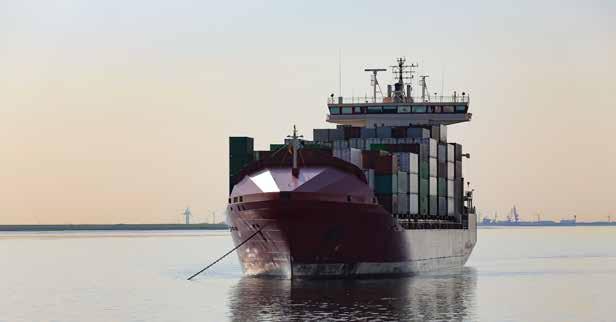
be fewer calls for clarification. But as more editions of the Index have come out, and it has gained recognition as a method of comparative performance measurement, it has increasingly been utilised in a competitive context – by port administrations with terminal operators, between port administrations and to a certain extent by shipping lines with ports.
This trend line has, in turn, put the methodology behind the Index under the microscope and significant issues have been identified that contend the criteria employed are not sufficiently robust to justify such an Index and the ranking contained therein.
Port Strategy has received several points of contention in relation to the Index from a range of parties, the majority of which wish to remain anonymous, and for the sake of uniformity PS has decided not to specifically attribute various comments and remarks but to present the feedback on methodology recorded under various headings, as featured in Table 1. The feedback is based on both the latest 2024 version of the Index and the previous edition: The Container Port Performance Index 2023.
Factors such as those in Table 1 are identified as disruptive when in pursuit of an accurate measure of container terminal performance. A central part of the problem here seems to be that on the part of many parties how the Index is used is not how the World Bank intends it to be used – as a diagnostic and planning tool in what can be termed as a big picture context. It is though perhaps just human nature that it will be utilised quite
Port Strategy has received several points of contention in relation to the Index from a range of parties
extensively in a competitive ranking context. The thought occurs, is this why in the latest edition the format of the ranking is not quite so distinct as it has been in previous editions – to try and achieve a shift away from this type of usage?
The fact remains, however, that in numerous detailed contexts the Index is not perfect and so long as it is used in a comparative context then it will lead to issues. The factors listed above as problematic are by no means exhaustive –there are others in addition to these. Overall, there is significant scope a/ for the message to be made clearer as to what the authors intend the index to be used for and b/ to take a fresh look at the methodology employed in its construction in pursuit of a more robust result.
This would additionally serve to strengthen the new coverage in the 2024 report which examines changes in port performance over time and aims to provide stakeholders with insights into whether a given port’s CPPI has increased, declined, or remained stable. The authors state: “This marks a significant evolution from annual snapshots to a longitudinal perspective, enabling a deeper understanding of the structural patterns in container port efficiency.”
But only, of course, if the projections come off a solid base.
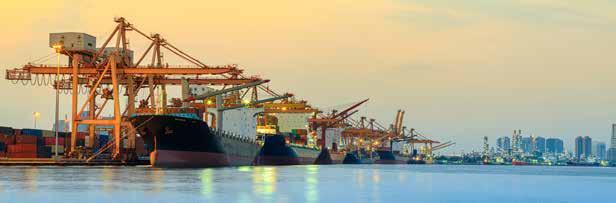
■ It is suggested that using the same methodology to measure gateway ports and transshipment ports is a flawed approach
Coastlink is a neutral pan-European network dedicated to the promotion of short sea shipping and intermodal transport networks.
Learn from and network with international attendees representing shipping lines, ports, logistics companies, terminal operators, cargo handlers, and freight organisations.

For more information on attending, sponsoring or speaking contact the events team: visit: coastlink.co.uk contact: +44 1329 825335 or email: info@coastlink.co.uk
DAY ONE – Tuesday 6th May 2026
08:15 Coffee & Registration
09:00 Chairman’s Welcome
Nick Lambert, Co-Founder and Director, NLA International Ltd
09:10 Port Welcome Address
Andrew Dawes, Regional Director – Humber Region, ABP
09:25 Gold Sponsor Address Port of Bilbao
Address the multifaceted challenges confronting the short sea shipping sector in an increasingly volatile global trade environment. How are operators developing resilience against tariff-related cargo disruptions, climate change impacts, and broader market instability? What are the risk mitigation strategies, adaptive business models, and policy recommendations for managing uncertainty while maintaining service reliability.
09:40 Nils Minor, Director Freight Sales, West & Southern Europe, P&O Ferrymasters
09:55 Stephen Carr, Group Commercial Director, Peel Ports Group
10:10 Speaker to be confirmed
10:25 Speaker to be confirmed
10:40 Q&A
10:55 Coffee & Networking
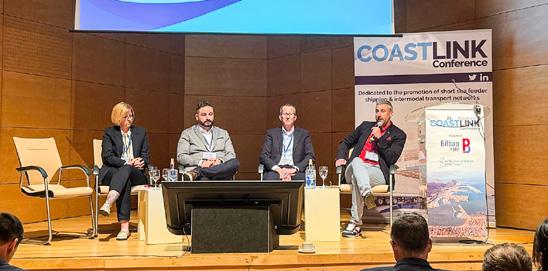

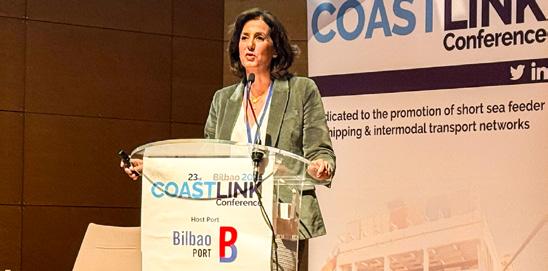
11:25 GROWTH & TRANSFORMATION IN RORO SHIPPING, INFRASTRUCTURE, AND SERVICE MODELS
What are the major RoRo terminal investment projects, innovative service delivery models, and infrastructure developments designed to meet evolving shipper demands and operational requirements?
Panellists include:
Andre Mast, Commercial Director, A2B-online Container B.V. Graham Cross, Business Development Manager, Clarksons
12:30 Lunch & Networking
Explore innovative approaches to streamlining distribution networks that meet demanding sustainability requirements while maintaining the reliability of feeder short-sea services. A look at the evolving role of shipping routes as “motorways of the sea,” the impact of changing funding structures on route viability, and strategies for building resilient, environmentally responsible distribution networks. How are operators managing schedule integrity amid increasing European port congestion?
13:50 Tracy Jin, Business Development Manager, Port of Esbjerg
14:05 Richard Newton, Client Director, Integrated Sales, Automotive Maersk Logistics and Services UK&I
14:20 Justin Atkin, UK & Ireland Representative, Port of Antwerp-Bruges
14:35 Speaker to be confirmed
14:50 Q&A
15:15 Day 1 wrap-up by Chairman (Pre-port tour)
15:25 Coffee & Networking
16:00 Port Tour Details to be confirmed
19:00 Evening Drinks Reception & Conference Dinner
The Deep Aquarium, Tower St, Hull HU1 4DP
Drinks reception sponsor:
The official networking dinner for Coastlink 2026 will take place at The Deep, Hull’s award-winning aquarium and one of the UK’s most spectacular visitor attractions. With Associated British Ports (ABP) the Humber as host port for Coastlink 2026, The Deep provides a fitting venue that on showcases Hull’s maritime identity and commitment to innovation, sustainability, and community.
DAY TWO – Wednesday 7th May 2026
08:45 Arrival coffee
09:15 Chairman’s Opening
Nick Lambert, Co-Founder and Director, NLA International Ltd
Examine the latest policy developments shaping maritime security, with a particular focus on the new European Port Strategy and its implications for economic growth, energy security, and operational resilience. How are ports and short sea shipping lines adapting to evolving regulatory frameworks while implementing innovative contraband prevention technologies?
09:30 Johan-Paul Verschuure, Maritime Entrepreneur – Director/Partner, Rebel Ports and Logistics
09:50 Speaker to be confirmed
Investigate the practical implementation of emerging technologies in port and shipping operations. How are artificial intelligence, digital twins, and advanced analytics creating measurable operational improvements? A look at vessel arrival and departure optimisation systems, predictive maintenance applications, data-driven decision making, and the quantifiable benefits of digital transformation initiatives in short sea shipping environments.
10:15 Finding the Data Capture Sweet Spot
The presentation highlights finding the “Data Capture Sweet Spot” — balancing the effort of real-time data collection with the operational efficiencies and business improvements it delivers. Chris Hicks, Managing Director, TBA Doncaster
10:30
The Role of ITS in Digital Green Corridors
Tim Morris, Principle Engineer, ARUP
10:45 Theresa Huang, Public Sector Account Manager, Amazon Web Services
11:00 Speaker to be confirmed
11:20 Q&A
11:40 Coffee & Networking
12:10 PORT-CENTRIC LOGISTICS & INLAND WATERWAY DISTRIBUTION
Examine trends in logistics network expansion, vertical integration, and the evolving balance of power in inland distribution systems. How can container barge operations be optimised alongside existing intermodal networks to maximise efficiency and capacity? A look at growth opportunities for inland waterway transport, integration strategies that enhance competitive positioning, and innovative approaches to port-hinterland connectivity.
Moderator: Logistics UK
Panellists include:
George S Macleod, Managing Director, Highland Shipping Company ABP
Matthew Lowes, Commercial Manager, PD Ports Humber Region
13:10 Conference Wrap up – Chairman
13:20 Lunch & Networking
Conference Fee
Premium Package
£695GBP/ €830euro
Cost per delegate
Standard Package
£650GBP/ €785euro
Cost per delegate Fee Includes
• Conference attendance including lunch & refreshments
• Electronic documentation
• Technical Visit 6 May 2026
• Conference Dinner 6 May 2026 (Premium Package)
• Presentation download (Premium Package)
Booking Online coastlink.co.uk/buy or complete and scan the booking form below to info@coastlink.co.uk. On receipt of your registration, you will be sent confirmation of your delegate place
For further information on exhibiting, sponsoring, or attending the conference, contact the Events team on: +44 1329 825335 or info@coastlink.co.uk
Venue
The Humber, United Kingdom Visit coastlink.co.uk
BOOK ONLINE OR COMPLETE THIS FORM AND SCAN TO info@coastlink.co.uk
Please tick all that apply :
(Please copy this form for additional delegates)
Please register me for the Coastlink Conference 2026. I will attend the
Conference dinner (6th May 2026)
Technical Visit (6th May 2026)
Members of supporting associations will receive a discount I am a member of
Family Name
First Name
Title Mr/Mrs/Ms/Dr/Other
Company
Job Title
Company Address
HOW TO PAY *UK registered companies will be charged the standard rate UK VAT
Bank Transfer: Mercator Media Ltd, HSBC Bank plc, GBPaccount, Sort Code: 40-21-03, Account number: 91894919
SWIFT/BIC8: HBUKGB4B BRANCH BIC11: HBUKGB4131C, IBAN: GB61 HBUK 4021 0391 8949 19
Bank Transfer: Mercator Media Ltd, HSBC Bank plc, EURaccount, Sort Code: 40-12-76, Account number: 70235247
SWIFT/BIC8: HBUKGB4B BRANCH BIC11: HBUKGB41CM1 IBAN: GB35HBUK40127670235247
Prepayment is required in full for entry to the conference. Full terms & conditions are available at mercatormedia.com/our-business/terms-and-conditions
Credit/Debit Card: Complete the form with your card details
I have paid by bank transfer
Please fax form. Do not send by email as we cannot guarantee the security of card information.
Please charge my card (delete as appropriate) Mastercard/Visa/Amex
Card Number
Expiry Date
Name on Card
(3


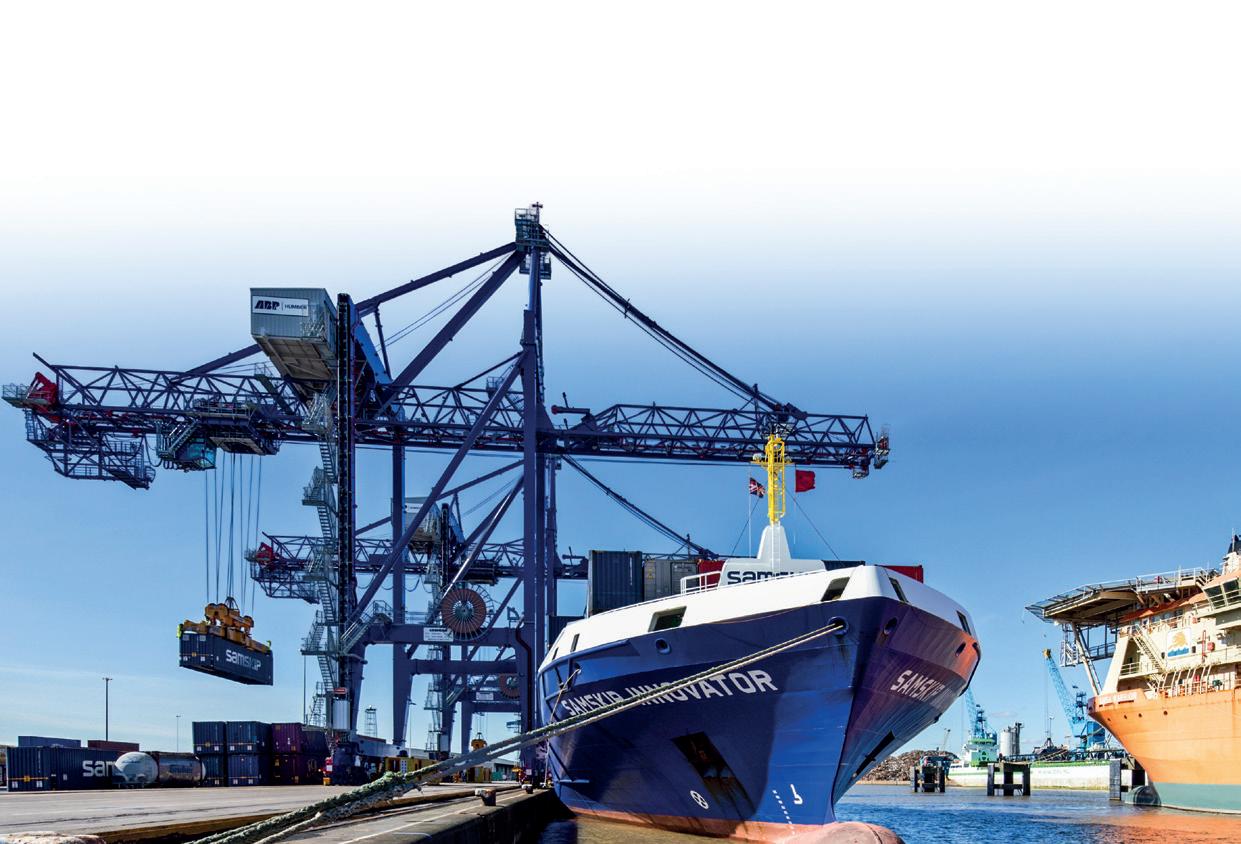
Coastlink is a neutral pan-European network dedicated to the promotion of short sea shipping and intermodal transport networks. Media supporters: The short sea shipping & sustainable logistics network

Learn from and network with international attendees representing shipping lines, ports, logistics companies, terminal operators, cargo handlers, and freight organisations.

For more information on attending, sponsoring or speaking contact the events team: visit: coastlink.co.uk contact: +44 1329 825335 or email: info@coastlink.co.uk
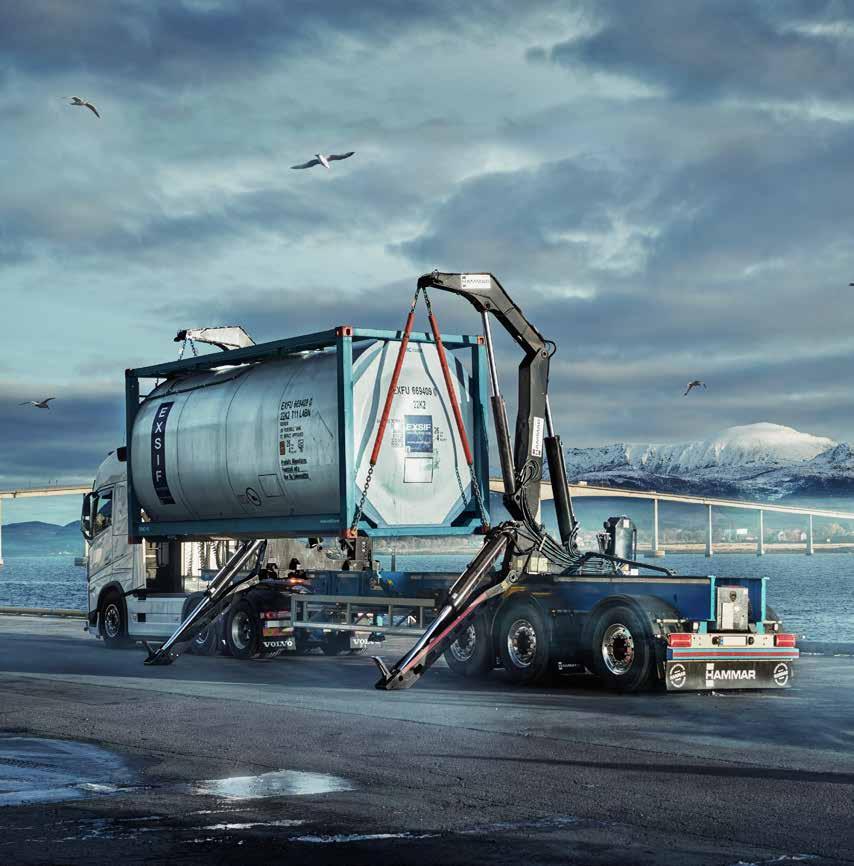
Hammar is the world leading manufacturer of Sideloaders, self-loading vehicles for containers and more. A competetive quality solution for container logistics, special transports and terminal handling.
+ Made in Sweden since 1974, delivered to more than 125 countries world-wide
+ Lift, transport and transfer up to 50 tonnes
+ Increase safety and efficiency with grounded containers
+ One vehicle, one driver, anywhere, anytime
A switch away from a proven approach by IMO’s Marine Environment Protection Committee has brought division to its door. The route ahead to decarbonise shipping needs very careful management
“The recent 2nd extraordinary session of the IMO’s Marine Environment Protection Committee (MEPC) and the ensuing decision to delay adoption of new requirements on greenhouse gas (GHG) fuel intensity, in combination with a pricing and reward mechanism, represents a catastrophic event. If not handled well it could lead to the emasculation of an international organisation that has never really been political and has done critical work for safety, security and the environmental impact of the sector.”
So says an informed party who spoke to Port Strategy on condition of anonymity. He continues:
“The foundations for this catastrophe were not in the events of last week but earlier in the year. In April 2025 the MEPC broke with the proven precedent of keeping talking until everyone could be accommodated. MEPC’s precedence had been established because the regulation of international shipping is essential but complex. Shipping is not homogenous. There are many sectors and sub-sectors bound together through a complex relationship between ship owner, operators, managers and cargo owners.
“Now in the aftermath of the decision, the consequences of breaking precedence are savagely exposed, the vote to defer implementation of the Net Zero Framework is a disaster for shipping. One that can to a large extent be planted at the foot of Donald Trump, a man who knows little about shipping and probably cares less. Spare a thought, if precedence had been followed and the painful and slow diplomacy of IMO had been allowed to continue the recent catastrophe would not have happened.
“Those who wanted to move forward with the framework were clear their approach was right and action was needed now. Time was of the essence, we can’t wait. Examine those statements! Perhaps 2-3% of global emissions are from the shipping sector. If you are looking for somewhere to have a profound effect on emissions of carbon dioxide shipping should not be high on your target list. Some say, this misses the point. In 2040 shipping will be 40% of global emissions. They don’t say that 40% assumes all other emissions are mitigated by 90% to just 10% of their 1990 levels. The chances of that are remote, given that China, one of the world’s largest emitters, saw its emissions rise by between 5 and 6% in 2024. By some assessments China’s emissions grew by the entire emissions of the shipping sector in 2024.
“There is one outstanding difference between shipping and almost all other major sectors. Shipping has traditionally had a functioning international regulatory structure that has shown itself capable, over time, of improving safety, security and environmental standards. Not perfect, frustratingly slow, but functional. That outstanding difference, that shipping created, now seems to be a potential downfall. It provides an easy target for pressure groups, academics and politicians to attack most of an industry that can claim to have contributed more to global poverty reduction, through trade, than most others. High profile, easy to hit, good for global publicity, but virtually irrelevant to the war against emissions.
“What was so urgent? Was it a clear and obvious solution to decarbonising the shipping sector? Was it a solution which could be implemented in a direct and practical way? A solution that had the support of the main financiers of the sector, the ship owners? No way can these questions be answered in a positive manner. No!
“Most serious assessments of the net zero framework suggest it is not fit for purpose. Even supporters and cheerleaders for the vote have been heard to say the proposals, as drafted, would not achieve the objective. Some say that the central weakness is because they don’t go far enough. Others say that the amount of money to be charged is wrong. Some parties are far more critical, that the fuels, ships and ports could not be made ready.
“IMO has always been slow and worked on consensus. This result is not just a Trumpian nightmare it is the decision to go against the previous culture of IMO. A decision to be political - to throw away consensus. Thus, we are now in a situation where the IMO and its regulations have become a political football. IMO does vital work. It has created the way to resolve many complex regulatory issues. It is now at risk when it shouldn’t be.
“Many, and I think most people knew IMO’s net zero framework was unlikely to work as advertised and lead to rapid decarbonisation of the sector. Let us take responsibility, our general lack of honesty, the poor quality of the open debate (why did it take so long for some big ship owners to say it wasn’t going to work?) and an overall lack of clarity in the framework proposals did impact how this vote went. Also perhaps the media need to be more open and honest about what is happening at IMO and the net zero framework? Perhaps more factual reporting, benchmarked to practical operating and investing is required?
“There is considerable scope for sincere reflection on adopting a proven approach.”

Where does hydrogen fit into the port sector’s push to decarbonise? Andy Tam, Global Vice President Energy Management at DP World, spoke to Felicity Landon about the opportunities around hydrogen – and the need for both commercial and technical viability
As ports increasingly go for electrification as the quick route to decarbonisation, they need to bear one thing in mind, says Andy Tam, Global Vice President Energy Management at DP World. “We are not the only industry electrifying – there are many other stakeholders outside the gates. Collectively they are going to demand more and more capacity from the local utilities, which will not be able to keep up with the connection requests – there will be transmission and distribution constraints, not just generation constraints.”
Is hydrogen the solution? DP World first initiated a group hydrogen strategy in 2021: “We identified at that time that the price of hydrogen was too high and too volatile to justify any significant investment in the hydrogen space,” says Tam. However, DP World Canada embarked on a pilot project in 2023-24, retrofitting a diesel RTG at Vancouver port with an integrated solution consisting of a hydrogen-electric generator (HEG), battery energy storage system, hydrogen storage module, regenerative energy capture, and integrated control and safety systems. A one-year field trial, tracking hydrogen consumption, energy generation, regenerative energy capture rates and other parameters, was successfully completed earlier this year.
“We have been investing in the technology there and keeping our head to the ground to see where else hydrogen can be used in ground handling,” he says.
The biggest challenges? Sourcing the hydrogen, and the price. To strengthen the business case for using hydrogen in the port environment, “you need multiple revenue streams”, he explains.
Tam says there are a number of use cases for hydrogen in this context – not least, in locations where electrification isn’t an option at all because of inadequate local power infrastructure. “We can still decarbonise if we are able to access green hydrogen in areas where we can’t electrify.”
Second, energy hubs can be built around ports, to include hydrogen infrastructure. Ports are generally strategically placed to be at intersections, he points out – bringing together, for example, industrial operations that could be offtakers for hydrogen; infrastructure land where electrolysers could be built to produce hydrogen and with space for compression and storage, allowing for distribution including by pipelines; and the possibility to enable hydrogen import/ export infrastructure and bunkering infrastructure.
“It is about resilience – customers want to decarbonise within their value chain, so having green hydrogen services may attract more shipping lines and tenants,” says Tam. “In order to make it financially feasible, you need multiple revenue streams.”
Hydrogen and renewables are uniquely coupled, he notes – “realistically we are not fully decarbonising unless the energy source is making green hydrogen.”
And of course, it will all come down to price. “The cheapest is grey hydrogen, which is in the US$2 per kg range, while blue hydrogen is $3-4 per kg. Green hydrogen is $4-7 per kg and even that varies drastically depending on geography. Those costs don’t bake in fully the infrastructure required to deliver to the end user.”
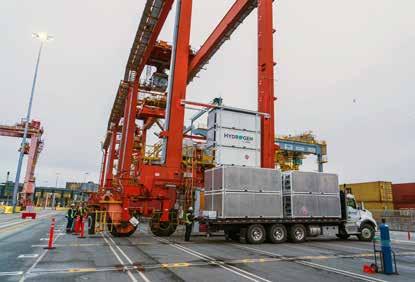
Tam believes that the industry needs a big push from the policy and regulation side to enable the advance of hydrogen and other technologies. “Also, it is really important to get all the stakeholders on board, to ensure that there is a viable commercial, not just technical, case for the industry to move forward with hydrogen applications. We have seen an example in Canada where we have been able to push forward our unique hydrogen RTG offering. We were able to leverage some provincial subsidies and work with local partners. The local innovation and regulation was already in place to enable it to happen. So, we need to find all the ingredients first, and then be the catalyst.”
Batteries as part of a whole energy hub concept are essential tools for resilience, he adds, and the industry needs to exploit power management concepts such as peak shaving and demand response in order to be more intelligent energy users – but “electrification will only get us so far.”
He predicts a move to hydrogen usage will be “similar to the electrification journey we have seen – through partnerships, pulling together stakeholders to drive down the cost of electrical equipment. We strongly believe that partnership is one of the tools that will help to drive forward this transition, especially with hydrogen.”
PROSPECTS BUT CHALLENGES
Tam says he is “fully confident” that hydrogen will be a mid to long-term decarbonisation tool, not only for ports but for all industries. However, the hydrogen must be green, there must be off-takers and regulation is required to enable it all, he says. “And the main overarching point – we need to see the price of hydrogen drop to the $2-3 per kg range in order for that to make a big difference.”

Imagine a bustling port, where cranes set the rhythm of the day. Since the 1970s, Alimak has been a trusted companion, ensuring global trade flows smoothly.
Since our first port elevator in 1971, we’ve supplied over 3,000 elevators, providing reliable access that minimizes downtime and maximizes productivity and safety.
Today, Alimak elevators are in ports and shipyards across more than 90 countries, supporting the seamless flow of goods worldwide. Our elevators are the trusted partners that keep everything running smoothly and safely.
For more stories and information, visit our website.
Dean Davison looks at the latest developments relating to container terminal box collections from specialists in maritime supply chain security, T-Mining
“Walk into a major European seaport and you will see the investment in security everywhere: fences, cameras, smart gates, patrols, all designed to keep cargo safe. Yet when a container is released, the process in most ports still hinges on a single PIN code. This code is the digital key to the container, passed from carrier to forwarder, from forwarder to haulier, and eventually to the driver. By the time the truck reaches the gate, it has typically changed hands eight times,” explains Nico Wauters, CEO, T-Mining.
Wauters makes a highly valid point. Every exchange of the PIN code is a weak point because each time a PIN code is shared it can potentially be intercepted, copied, or deliberately leaked. The result of these weak links is predictable: stolen cargo, frontline staff exposed to criminal pressure and in the end reputational damage for carriers, terminals and ports.
As Wauters explains: “It’s striking, that after all that investment in infrastructure and surveillance, access to the container still comes down to a number in an email or WhatsApp message. It’s the equivalent of putting a vault door on the warehouse and leaving the key under the doormat.”
Secure Container Release (SCR) built by T-Mining, was created to close this weak link. Instead of using a PIN code, the right to collect a container is issued as a secure digital token.
Moreover, this token is unique, cannot be copied, and can only be passed on through the official chain (from carrier to forwarder, to the haulier and in the end the driver). Every transfer is recorded and verified, creating a tamper-proof chain of custody.
….access to the container is currently the equivalent of putting a vault door on the warehouse and leaving the key under the doormat…
This means at the terminal gate, staff simply verify the driver’s identity against a valid digital token, giving frontline teams greater safety and certainty, and removing the risk of PIN-code fraud for carriers and terminal – or as Wauters says, “Locking the weak link in container logistics.”
LOCAL PROGRESS, GLOBAL FRAGMENTATION
Fixing the weak link solves the operational challenge. But for ocean carriers, the bigger test is strategic.
Across Europe, several ports have made secure release a priority in their port community system roadmap, rolling out their own local solutions. It is a welcome sign that the need for more secure processes is recognised, yet each rollout is in essence border bound and tied to one port and one ecosystem.
“For carriers, who move boxes across dozens of ports, this quickly turns into fragmentation. Every system brings its own technical and operational demands, forcing carriers into a patchwork of port-specific integrations. What adds value locally becomes fragmentation at scale, driving up costs and
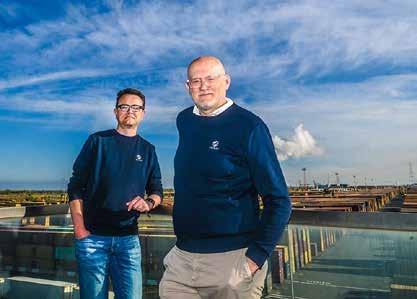
limiting the ability of carriers to streamline and automate their release process,” explains Wauters.
At the same time, the customers of the ocean carriers, the beneficial cargo owners and shippers (and their freight forwarders) are looking beyond just the local arrangements.
Supply chains span multiple countries, and every variation in the release process adds costs and complexity, so BCOs and the like expect their ocean carrier partners to offer a standardised process across ports, to ensure predictability and smooth operations through borders and the wider transport network.
“This is exactly the role of SCR,” explains Wauters, adding: “In regions where no secure release process exists, SCR provides a ready-to-use solution. In ports where community systems have already developed their own initiatives, SCR works with them so carriers can follow one uniform process across countries instead of a different one in every port.”
This approach ensures each port community keeps control of its local ecosystem, while carriers replace a patchwork of port-specific integrations with one consistent approach across their global network. With a single integration, they can gain lower costs, smoother operations and the predictability their customers will welcome.
What began as a pilot in Antwerp in 2020 has grown into a proven solution. Today, SCR is used by three of the world’s five largest carriers – MSC, Hapag-Lloyd and CMA CGM – alongside more than 7,000 freight forwarders and transport companies.
“The platform connects over 30 terminals and ports, is live in Belgium, the Netherlands, the UK and Poland, and serves users in more than 25 countries. At Antwerp’s MPET terminal, containers have been released without PIN codes since early 2023, demonstrating secure operations at one of Europe’s busiest deep-sea gateways. Now, in 2025, the Port of Limburg became the first inland terminal to go completely PIN-codefree – proof that SCR works in practice, at scale, and in even the most complex logistics environments,” concludes Wauters.
Following diverse problems associated with container release new standards are under development with associated new technology being rolled out
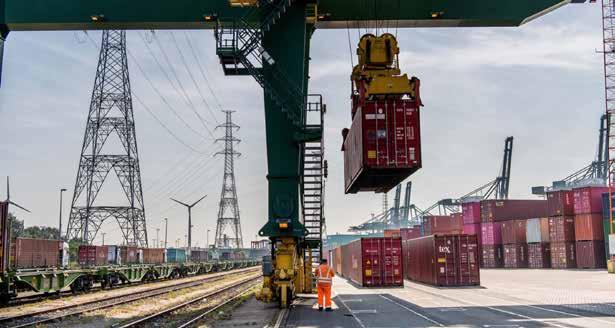
A new digital exemption procedure that is being rolled out for container release at ports in Northern Europe significantly boosts security by reducing the risk of misuse, data leaks and smuggling. While the technology providers are different, the strategy across ports and countries is the same – it replaces the pin-based exemption that was previously used and deemed to be vulnerable to fraud. Instead, only digitally verified individuals can take delivery of containers. From Rotterdam and the Netherlands, to Belgium, and now to Germany in October 2025, the scheme is still in the process of being rolled out. The new process goes beyond ports: it is now part of amended regulations that have involved port authorities, state governments and industry representatives. It is expected to pave the way for uniform standards. It has been welcomed by shipping lines including Hapag-Lloyd, which said: “…The container authentication and release process in German ports will
now be centrally managed by the organisation German Ports, ensuring faster, safer, and more transparent handling.” Holger Hübner, Authorised Signatory and Head of Port Solutions, dbh Logistics IT AG, which is behind the Bremerhaven and Wilhelmshaven roll-out, highlights the benefits: “…Freight forwarders, shipping lines, terminal operators, and other stakeholders have responded very positively. While some initial challenges remain, the industry’s close cooperation and the phased rollout are ensuring a smooth and stable transition. The Secure Release Order demonstrates how digitalisation can build trust, boost efficiency, and increase transparency in international trade. It sets a new standard of security and reliability – not only for our ports but for the entire supply chain. We see this success as a call to action to promote shared digital standards across Europe, creating a connected, secure, and competitive trade environment.”
■ Dakosy/dbh: On 1 October 2025, the new digital exemption procedure for import containers was introduced in the German ports of Bremerhaven, Wilhelmshaven and Hamburg with the Secure Release Order (SRO). This will be followed by a nationwide roll-out at all other terminals. In Hamburg and Bremen, the corresponding laws will come into force this year, while Lower Saxony is expected to join in 2027. As operators of the Port Community Systems (PCS) in Bremerhaven/Wilhelmshaven (dbh) and Hamburg (DAKOSY),
the two IT service providers designed and implemented the project together with partners from the port industry. The aim of the joint project is to introduce a standardised, secure and end-to-end digital process for the exemption of import containers. Companies can connect their systems and integrate the new processes via open interfaces or existing access to the PCS platforms. Alternatively, the intuitive web platform German Ports is available as a browser-based solution to ensure the integration of all affected companies.
■ NxT Port’s Certified Pick up (CPu) has collected over one million containers at Port of AntwerpBruges since it was implemented in January 2024
■ Genetec: Port of Barcelona has implemented Genetec Security Centre this year, having faced new security and operational challenges due to its growth as one of the Mediterranean’s major logistics hubs. The Port Authority launched a modernisation initiative to address this, and selected Canada-headquartered enterprise physical security software developer Genetec’s Genetec Security Center for its open, unified platform that integrates security technologies into a single interface. Following a successful pilot using
■ NxT Port: NxT Port’s Certified Pick up (CPu) has played a key role in secure container release with the Port of Antwerp-Bruges’ container traffic since it was implemented in January 2024. Over one million containers have been collected via CPu. It is a neutral platform that centralises container information. It thus connects the various parties involved in the import process and is mandatory for all supply chain partners involved in the release process of a container. To pick up a container from a terminal in Port of Antwerp-Bruges, a unique PIN code was previously needed. The port highlights that usually, quite some time would pass between the moment the shipping company created the
■ ORBCOMM: Evergreen Line has adopted the USheadquartered company’s smart container technology for its dry container fleet, therefore boosting cargo intelligence and security. ORBCOMM says that the rollout provides advanced event alerts, including door openings, temperature deviations, shock detection, and comprehensive location reporting. These capabilities work together to provide several benefits including increasing container security. “Smart intermodal containers are no longer experimental – they are becoming the new standard,” says Sameer Agrawal, Chief
■ Portbase: Portbase’s Secure Chain has been rolled out in Port of Rotterdam this year to boost the safe release of containers. Relevant parties digitally pass on the right to securely collect a container in the port to each other. Only a haulier, barge operator or rail operator that has been authorised via the Secure Chain is able to collect a container at the terminal. So far, more than 1.1 million containers have already been released via Secure Chain, which is a joint initiative between government and industry. Portbase developed the technical infrastructure, using its existing Port Community System (PCS). To accommodate the Secure Chain, it has added an extra authorisation layer on top of
■ T-Mining: T-Mining’s Secure Container Release (SCR) solution ensures the safety of the container release process for MSC, Hapag Lloyd and CMA-CGM, and is being rolled out further. It replaces the traditional PIN codes with blockchainenabled tokens. In December last year Hapag-Lloyd announced that it had expanded T-Mining’s Secure Container Release to Ports (SCR) in Poland and the United Kingdom. Releases originating from the shipping line are safely transmitted to the First Release Party, who can then securely transfer the release to subsequent parties in the logistics chain. Since 2021, Hapag-Lloyd has used SCR in the
■ Tive Inc.: The Tive Security Seal has been launched to “set a new benchmark” in cargo protection. US-headquartered supply chain visibility technology provider Tive Inc. has partnered with security seals developer TydenBrooks to deliver the intelligent, digital tamper detection device. Designed to strengthen shipment security measures, the Tive Security Seal locks containers while adding a layer of smart digital protection. Fully integrated with Tive’s Solo 5G trackers
virtual servers, the port migrated its CCTV infrastructure –growing from 180 cameras to over 530, with plans to surpass 800 in the coming years. Alongside this expansion, the port integrated advanced technologies including access control, intercom systems, video analytics, forensic tools, fire detection, and real-time occupancy analysis. The Port’s operators can now manage all security systems through a single tool, streamlining workflows and reducing response times to incidents. .
code and the moment the driver entered the code to pick up the container. During this period, the code was visible to various parties. The Port of Antwerp-Bruges highlighted the benefits: “Concrete evidence of the impact is the reduction in claims to customs regarding container pick-up. Thanks to improved chain information, high-risk containers can be identified faster. Cooperation with customs, which also further deploys (mobile) scanning technology, makes smuggling drugs through the port significantly more difficult.” The port platform of Zeebrugge will follow at a later stage. Belgium’s NxT Port built the link in the digital port infrastructure of the Port of Antwerp-Bruges.
Executive Officer, ORBCOMM. “Deployments are moving beyond visibility to cargo protection and container security. This evolution reflects growing industry demand for real-time data, enhanced cargo protection and operational transparency across the global supply chain.” New deployments will take advantage of ORBCOMM’s second-generation smart dry container technology, which adds new sensors for security and cargo integrity. ORBCOMM provides a suite of satellite-based IoT solutions that enables visibility and control over maritime assets.
several existing digital services to make it possible for different links to securely pass on the authorisation to collect a container. Highlighting the effectiveness of the secure chain, Jan Janse, Head of Seaport Police Rotterdam, says: “We’ve experienced hundreds of incidents involving PIN code fraud in the port in the past. But with the introduction of the Secure Chain for container cargo from South America, the issue was eliminated overnight.” In August it was announced that Matrans Rotterdam Terminal is the latest terminal to join the Secure Chain. With deepsea shipping lines nearing completion with the Secure Chain, discussions are currently underway in Rotterdam port about connecting the shortsea sector.
ports of Antwerp and Rotterdam, securing over one million containers. Belgium’s T-Mining is now expanding its footprint to inland terminals. The Port of Limburg in Genk is the first inland terminal in the Benelux to introduce SCR. Benjamin Hermans, CEO, Port of Limburg said: “We are committed to deploying advanced technologies to protect our terminal from criminal activities, particularly drug trafficking. Our partnership with T-Mining and itsme® is a key part of this effort, ensuring that only authorised individuals can access the container release process.” itsme® is an online application that serves as a digital ID.
and cloud platform, the Security Seal helps ensure that cargo stays secure by providing real-time tamper alerts when security is compromised by cable cutting, forced entry, or device damage. It feeds analytics directly to the Tive cloud platform, offering customers a real-time view into the security and location of their global shipments. The companies highlight the major benefit: the Security Seal enables users to act before the situation spirals into a bigger problem.
Rising trade, climate, nature and new fuel issues as well as new defence imperatives are reshaping Australia’s ports. Why integrated strategy and digital innovation will define the next era - if the sector moves fast enough
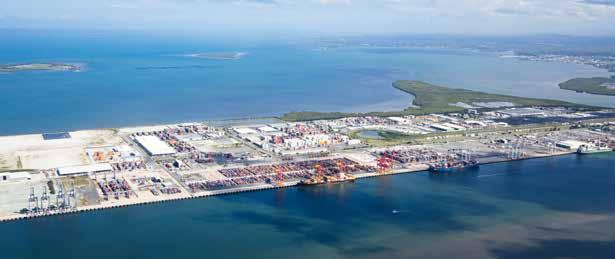
Australia’s port sector, anchoring more than AUD$650 billion in annual trade and vital employment, now stands at a pivotal crossroads. Surging container and bulk exports, escalating investment in defence, rapid technological advances and new mandates for climate and nature stewardship are converging to rewrite the playbook for sustainable port development. The real question isn’t if Australian ports can meet the future’s evolving demands - but how quickly, smartly and collaboratively they can adapt?
Alongside these trends, the sector faces the emerging challenge of alternative fuels for shipping, with ports increasingly called upon to provide future-ready refuelling infrastructure. Meeting these requirements comes with significant investment demands - not only in technology and operational capacity, but also in new partnerships and funding models tailored to green maritime solutions.
Growth and Government Ambition
Trade volumes keep breaking records. In FY25, the Port of Melbourne alone handled AUD$154 billion in trade and 3.39 million TEU - a new national high - while Western Australia’s Pilbara Ports delivered nearly AUD$153 billion in bulk exports, underpinning the country’s economic resilience. The Australian Government’s AUD$8 billion investment in new naval and shipbuilding precincts - part of an unprecedented surge in defence spending - will accelerate demand for future-ready, resilient port infrastructure. Private and resources sector investment is powering new renewable energy and transshipment facilities, while digital transformation is fast becoming table stakes in asset management and trade enablement.
Karim Ghaly observes: “Rising trade volumes, the rapid expansion of renewable energy, the growth of transshipment operations and evolving defence priorities are placing
*Meeting the Challenge of Growth, Alternative Fuels, Security and Sustainability. By Dr David Rissik, APAC Lead Risk and Resilience, BMT and Karim Ghaly, Dredging Advisory Lead, BMT
unprecedented demands on Australia’s maritime infrastructure. The question is no longer whether Australian ports can meet future requirements, but how quickly and sustainably they can adapt? Success will depend on how effectively the sector can plan, design and invest in infrastructure that is adaptive, digitally enabled, environmentally responsible, climate-resilient, and operationally efficient. As a global leader in maritime engineering, environmental science and digital innovation, BMT is uniquely positioned to guide this transformation and build on decades of partnership with Australia’s ports and government agencies.”
COMPLIANCE AND OPPORTUNITY
ESG and Defence as Change Drivers
Recent federal reforms have shifted mandatory climaterelated financial disclosures, including TCFD and IFRS S2, to the heart of boardroom agendas. Universities, government and industry are aligned: scenario planning, climate risk management and nature financial disclosure (TFND) are now non-negotiable. Leading ports – Brisbane, Melbourne, Westport, Newcastle - are setting benchmarks with decarbonisation plans, habitat restoration and digital reporting strategies. These are now first-order priorities for government too, as defence precincts and allied naval operations rely on ports that can demonstrate resilience and transparent governance.
Crucially, ports must plan for the transition to alternative fuels, such as hydrogen and ammonia, by developing the complex infrastructure these future fuels require. This is rapidly becoming a first-order priority for port operators and government, given the scale of investment and interdependency with national sustainability targets.
SMARTER, GREENER, MORE RESILIANT
The Next Port Paradigm
Here, as in the energy and resources sector, integrated infrastructure planning - spanning digital twins, simulation and ecological stewardship - is now central to board-level decisions. Recent government announcements have
confirmed that progressing shipyard, sustainment and marine security capabilities will be critical to Australia’s delivery of the AUKUS pathway, ensuring the nation is equipped to meet strategic requirements through the early 2030s.
Karim Ghaly adds: “Expanding trade volumes and the arrival of larger vessels are increasing demand for deeper channels and upgraded berths. At the same time, national defence priorities are driving major spending in new and upgraded naval infrastructure to support fleet expansion and maritime security.
Growth plans for renewable energy projects including offshore wind and hydrogen hubs are transforming coastal and port land use. Private and resources sector investment is stimulating the growth of transshipment and associated logistics infrastructure. Meanwhile, technological advancements are facilitating digital transformation of ports to optimise asset management, enhance safety and improve cost efficiency. Overlaying all of this are heightened community and regulatory expectations for environmental adaptation, carbon reduction and social responsibility that continue to shape all planning, design and delivery activities.”
Global best practice - and local examples - show that digital transformation isn’t an option; it’s foundational. Digital twins and real-time data integration, as pioneered at leading Australian ports, are proving their worth in improved safety, operational insight, and environmental stewardship. AIenabled simulation, predictive analytics and cloud platforms now guide capital investment, asset renewal and proactive management of risks and bottlenecks.
Ghaly’s perspective: “BMT is integrating its expertise across metocean modelling, ship motion analysis port logistics, and materials handling to simulate the full spectrum of transshipment operations. Using proprietary discrete-event simulation tools, BMT models complex logistics chains to test and refine operational scenarios before implementation. This approach identifies potential bottlenecks, optimises equipment selection and capacity, and accurately predicts throughput while accounting for both planned and unplanned downtime. Together, these insights form a critical foundation for informed transshipment investment decisions, helping customers reduce uncertainty and de-risk capital planning.”
Building on this analytical foundation, real-time digital platforms are re-writing the future for port operations. As Ghaly notes, “Digital transformation is redefining how ports operate, maintain and expand their assets. Real-time data integration, digital twins, predictive analytics and AIenhanced decision support are rapidly moving from ‘goodto-have’ to the core of modern port management. BMT’s ADAPT cloud-based system stores, visualises and analyses vast port-related datasets. By integrating these data streams, ADAPT enables port operators to monitor environmental conditions in real time and optimise asset management through predictive modelling and AI algorithms. BMT’s simulation and digital platforms provide a powerful decisionsupport ecosystem, enhancing predictability, safety, and cost efficiency while helping ports accelerate their digital transformation journey.”
Australia’s ports are uniquely placed to turn compliance into advantage. Nature-related financial disclosures prompt restoration of natural habitats, opening doors to green finance and new partnerships, while climate-related assessments support proactive adaptation, staged infrastructure upgrades and improved trust with stakeholders.
The sector’s most forward-looking operators see these requirements not as burdens, but as catalysts for innovation and new commercial value.
A key example: Port of Brisbane’s advanced asset monitoring delivers both real-time operational data and positive community impact. Similarly, in the bulk sector, Pilbara’s record export figures and throughput depend on technology-enabled logistics, resilience planning and alignment with public sustainability goals.
The ability to stay relevant and resilient hinges on continued investment in digital tools, ESG governance and multistakeholder partnerships. The ports that integrate technological innovation and scenario planning with robust, board-led risk management will stand ready for what’s next. Compliance, when seen as a springboard for strategic adaptation, can fuel operational excellence, growth and ecological stewardship alike.
Further, as investment in alternative fuel infrastructure grows, ports will play a wholly decisive role in shaping the entire supply chain for low-carbon shipping. Addressing these infrastructure demands in partnership with industry and government will be essential for delivering lasting resilience and value.
As Dr David Rissik concludes: “Having worked alongside port boards, operators and stakeholders for many years, I’ve witnessed the transformative impact of integrated governance, evidence-based decision-making and ecological leadership. As the sector navigates new disclosure mandates, rising expectations and unprecedented climate risks, those willing to invest in robust standards and practical, recurring assessment - combining data, people and partnerships - will shape the legacy of Australia’s maritime gateways for generations to come. This journey is not just about ticking compliance boxes, but about redefining what it means to be a trusted bridge between economic progress and thriving coastal communities.”
Australia’s ports can and must set new global standards for climate and nature resilience, forging ahead as partners in growth, security, sustainability and enduring value creation.


About BMT in Ports
Dr David Rissik – David is BMT’s APAC Lead in Risk and Resilience. He has over 30 years’ experience working in marine and coastal systems and in climate change risk assessment and adaptation planning, with a portfolio of work in Australian Ports.
Karim Ghaly – Karim is BMT‘s Dredging Advisory Lead with more than 20 years of experience overseeing the design and delivery of large-scale ports, maritime and dredging projects across Australia and internationally.
BMT delivers customised solutions for modern, sustainable port operations - including planning, engineering design, navigation, berthing, material handling, transshipment, dredging, land reclamation, metocean analysis, hydrodynamic modelling, marine environmental management, climate resilience, geospatial services, and data management platforms.’
Haskoning provides a route map of the dos and don’ts of adopting autonomous horizontal transport in container terminal operations
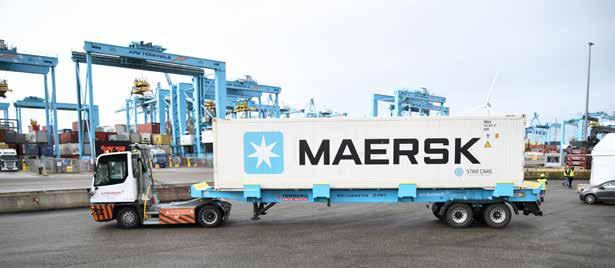
Haskoning, the international engineering consultancy, sets out its perspective on the application of autonomous transport for container terminals. The two authors* discuss the potential benefits, key challenges, industry complexities, and how this emerging technology can be leveraged.
Imagine your terminal’s horizontal transport between quay and yard being handled by autonomous vehicles. These vehicles use on-board intelligence to determine routes and sensors to avoid collisions, all without manual drivers. They can safely operate alongside manned external trucks.
Autonomous vehicles can be categorised as Autonomous Terminal Trucks (ATTs) or Intelligent Guided Vehicles (IGVs). A number of terminals have already adopted one of these options.
Autonomous horizontal transport offers potentially interesting benefits for terminals – Figure 1.
Three key benefits are identified:
1. Improved working conditions and safety. The employee role will transition from working with heavy equipment in varying weather conditions to air-conditioned, ergonomically designed workspaces. This change reduces the chances and impact of accidents as there are no human drivers prone to fatigue and errors present in vehicles.
2. Autonomous vehicles claim to operate in mixed operations with external trucks in the same area, unlike conventional horizontal transport automation using Automated Guided Vehicles (AGVs) in areas fenced off from external trucks. This results in fewer layout changes and increases operational flexibility when converting your brownfield terminal with terminal trucks to autonomous vehicles.
3. Implementing autonomous horizontal transport is expected to reduce the number of operators needed per vehicle, reducing potential labour shortages and optimising labour costs.
However, it also has to be acknowledged that like any other (emerging) technology, several challenges such as financial and performance factors need to be solved to implement autonomous horizontal transport effectively and efficiently.
In this section we identify five major challenges regarding the implementation of autonomous horizontal transport:
1. The financial business case should balance CAPEX (e.g. increased autonomous vs. manual vehicle CAPEX, extra software, and potential civil adjustments), OPEX savings (e.g. labour and fuel) and non-financial improvements (e.g. safety and labour conditions). Given the novelty of the technology, obtaining clear and accurate CAPEX & OPEX data (e.g. vehicle cost, software license fees, vehicle maintenance) to make this financial business case can be challenging.
2. It is currently uncertain if the operational performance of autonomous horizontal transport meets your terminal’s requirements. Autonomous vehicles typically take a conservative approach in interactions with other equipment types and drive at reduced speeds due to safety considerations. This can reduce productivity, especially when operating in congested areas. It is essential to also review if all necessary functionality, such as sequencing at STS cranes, can be provided by autonomous horizontal transport.
3. Application of autonomous vehicles could require layout changes that take up valuable terminal space. Multiple early adopters are applying dedicated lanes for external trucks or autonomous vehicles, sometimes combined with segregation infrastructure and traffic lights at junctions. Terminals like to limit this space usage, but this can only be accommodated safely if autonomous vehicle technology is sufficiently mature.


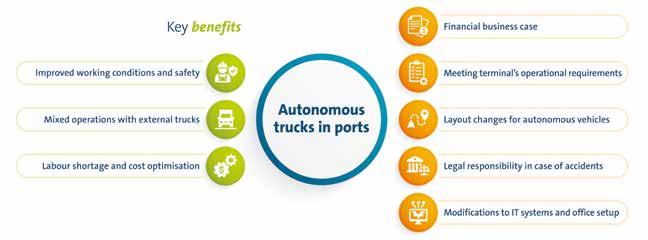
4. Legal responsibility in case of accidents is currently unknown. Is the terminal operator, the autonomous vehicle supplier, or another involved party (e.g. security or system integration supplier) responsible? This legal risk needs to be managed by clearly defining the Operational Design Domain (ODD) and co-developing the autonomous horizontal transport solution with suppliers to fit the terminal’s needs.
5. Implementing autonomous transport in your terminal requires changes to your IT systems and office setup. The control system of autonomous vehicles must interact with other systems, such as the Terminal Operating System or Equipment Control System, to receive transport jobs and line up with yard or quayside equipment. On top of this, remote operator stations are required for exception handling. These challenges can point to the need for an impartial and experienced partner to assist you in implementing autonomous horizontal transport.
To implement this type of autonomous transport effectively and efficiently, selecting the right supplier is crucial. However, comparing potential suppliers can be difficult due to the following complexities – Figure 2:
● Suppliers are currently at different levels of technological maturity, with most having limited portfolios and operational experience.
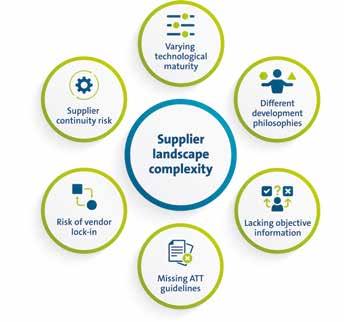
● Different development philosophies or practices are applied.
● Objective, publicly available information about key aspects like performance, exception handling, and maintenance is often lacking.
● Clear guidelines for autonomous horizontal transport are currently unavailable and will likely only be established once technology has further matured.
● Novelty of the technology and the specific requirements of your port or terminal may necessitate custom development. Custom development will likely require significant development, testing and training efforts from both the terminal operator and supplier. This introduces the risk of vendor lock-in, where only one vendor can supply the solution you need and can therefore charge premium prices.
● Business continuity risks of suppliers, with parties like Gaussin going bankrupt or Fernride recently shifting strategic focus away from container terminals.
As the work environment is complex, with different interests involved, e.g. container terminal operator, developers, legislator, clients and employees, this requires a tailored approach. To help navigate this having an impartial party with the relevant experience that can mediate between potential suppliers can prove most beneficial.
It can, for example, prove most beneficial in conjunction with:
1. Building an overview of the choices and changes possible in terminal layouting and interaction with equipment types vis-à-vis the resulting required ODD for autonomous vehicles and how this can be optimised.
2. Conducting interviews with autonomous horizontal transport suppliers.
3. Providing tender support and evaluation of bids for this type of autonomous transport, and 4. Assessing the financial business case.
Such steps build a wider perspective: global instead of only one terminal, more suppliers instead of just one, a long term/strategic view looking at forecast growth and terminal development.
The accompanying article is authored by Daan van de Ven is a Port Consultant for Haskoning where he specialises in Container Terminal and Smart Port studies. He has delivered a number of commercial studies for ports on autonomous horizontal transport. He holds an M.Sc. and B.Sc. from Erasmus University Rotterdam, NL.
Henry Forgan is a Port Consultant for Haskoning where he specialises in Container Terminal and Smart Port studies. He has delivered a number of commercial studies for ports on autonomous horizontal transport. He holds an MEng from the University of Plymouth, UK.
Seventy years on from its formation IAPH held the World Ports Conference 2025 in Kobe, Japan. The conference programme underlined IAPH’s emergence as the key representative body for the global ports industry
Environmental Port Index (EPI)
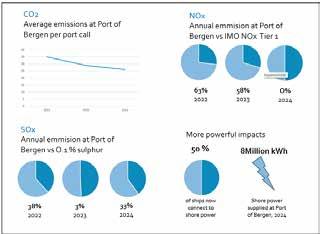
Supported by



The IAPH World Ports Conference, held recently in Kobe, Japan addressed a range of subjects central to the forward development of the international ports sector.
It was also a renowned occasion as it marked 70 years since IAPH’s formation, a special moment in the organisation’s evolution which today, through a growing number of Working Groups, Committees and work with governments and NGOs as well as generally the robust efforts of its core team headed up by Patrick Verhoeven, Managing Director, IAPH, reflects an organisation with genuine influence able to speak with authority on behalf of its core port authority membership.
This influence was marked in Kobe by the size of the delegate body (circa 650 delegates), the senior calibre of the delegates attending and the global spread of the countries from which delegates originated, spanning the developed and emerging world.
An exhibition area operated alongside the Conference programme. There were also ample opportunities for networking at various functions run in conjunction with the Conference, not the least of which was the IAPH Gala Dinner which also incorporated the IAPH Sustainability Awards 2025.
There were a number of keynote ‘setting the scene’ presentations included in the plenary sessions of the Conference programme.
Sessions with a specialist focus spanned both the plenary and breakout sessions with the programme augmented by site visits and technical workshops and the networking elements of the programme.
The opening keynote speech came from Masato Kanda, President, Asian Development Bank (ADB) with a central theme of his presentation being energy transition and the need to mobilise private sector finance to close the funding gap to facilitate progress in this area. He put under the
spotlight the fact that the task of selecting new clean fuels is still in a state of evolution. Specifically, he identified methanol, LNG, shore power and other options as all still having challenges associated with them including the important aspect of funding arrangements.
His keynote speech was preceded by welcome addresses by a number of dignitaries: Jens Meier, President of IAPH; Hiromasa Nakano, Minister, Ministry of Land, Infrastructure, Transport and Tourism, Japan, Kiso Hisamoto, Mayor, City of Kobe and Masami Kubo, President, Japan Harbor Transport Association.
The keynote speech on Day Two came from the client side of the port business, i.e. from Hitoshi Nagasawa, President/ Chairman, Japanese Shipowners’ Association/Nippon Yusen Kabushiki Kaisha (NYK Line). Again, clean fuels came into the discussion, sustainability goals overall and the then thorny subject of tariffs and port performance.
Among the specialised presentations there was considerable discussion of the implications and routes to meaningful climate change and associated with this energy transition, both subjects identified as an area of ongoing challenge.
The then proposed IMO Net Zero Framework came in for much discussion. In a specialist session on the subject Edward Molitor, Head of International Public Affairs, Gothenburg Port Authority and Michael Forland, Port Director, Port of Bergen, debated the likely consequences of the proposed Framework, which encapsulated technical and economic measures, and the big question, will ports benefit? They drew into this discussion their own environmental experience based on their respective organisations – a case in point being Michael Forland presenting the port of Bergen’s interesting
Environmental Index, which highlights the progress the port has made with decarbonisation – Figure 1.
The ensuing discussion on the Net Zero Framework not surprisingly highlighted the general feeling about the proposed measures – both positives and negatives were identified. There was no overwhelming confidence that the pending vote on the measures at IMO would be voted through. And, as we know, this proved to be the case – the initiative was delayed for a year with a vote of 57 in favour, 49 against with 21 abstentions. IMO member states plan to keep working on the framework with a view to another vote taking place in 2026.
Most of the discussion in the above referenced session and others in the conference programme was centred around the specific economic and technical measures proposed. By way of an added perspective, this edition of PS carries an article that discusses the negotiation tactics employed by IMO, how these differed from past practice and seemingly had a bearing on the outcome – see p29.
The Day One morning sessions also included a focus on marine fuels and the associated opportunities with ports. It was acknowledged in this respect that the demand picture will be clearer for larger ports and on the other hand somewhat murkier for medium to small size ports.
The afternoon of Day One saw two sessions that delved into the modern day problem of volatility in supply chains with notably the question of tariffs coming up and the thorny issue, at the time, of the Red Sea ‘blockage’ factor. Lessons were taken from both sessions about how to handle such extraordinary events. Eugene Seroka, Executive Director, Port of Los Angeles, was particularly notable in citing the rollercoaster effect of such events and the challenging nature of managing under these circumstances.
Some argue a slow retreat from international competitive bidding for EPC and PPPs is underway ‘‘
Also prominent in the Day One afternoon sessions was the focus on the newly-launched 3rd edition of the World Bank’s Port Reform Tool Kit, a product that IAPH had significant input into. Jan Hoffman, Global Lead, Maritime Transport, World Bank and Patrick Verhoeven, Managing Director, IAPH, talked through the content of the tool kit, highlighting its modular format and the edition’s new sections which span: environment and sustainability; change management, digitalisation and cyber risks as well as the updated sections on regulation, governance and private sector involvement.
Day two of the World Ports Conference had a strong focus on finance and satellite subjects associated with this. The morning saw David Wignall, Manging Director, David Wignall Associates and Jean-François Belzile, Harbour Master and Director of Marine Operations, Port of Montreal, explore the topic of the current investment climate for ports. This session was followed by Port financing and risk: what ports need and banks want?, a topic introduced by Jamie Simpson, Economic Consultant, Triple Line Consulting and Ms Yesim ElhanKayalar, Adviser, Office of the Chief Economist, Asian Development Bank. Following on from this came the session, Energy Hubs: can investment be de-risked?, introduced by Stuart Neil, Strategy and Communications Director, International Chamber of Shipping and Rico Salgmann, Transport Specialist, The World Bank.
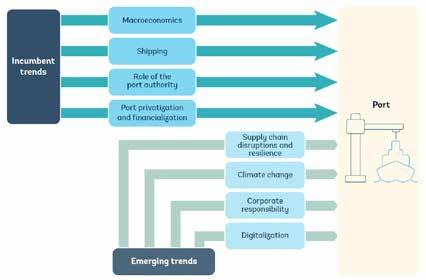
In summary, the main points raised across these and other finance related sessions such as Maximising the Value of Port Land Through Smarter Concessions were as follows:
● Geo-political factors are reshaping trade patterns and port financing strategies. Trade patterns are likely to shift towards the growing importance of intra-Asia trades as well as more trade between the Far east and Africa and Latin America. Alongside this G2G governance arrangements are becoming more prominent in ports, both with port authorities and operations. Some argue a slow retreat from international competitive bidding for EPC and PPPs is underway.
● Emerging market port authorities, serving small national economies, are facing many of the same disruptions as larger ports - climate risk exposure, digitalisation, cybersecurity, ship and cargo handling technology changes - but are struggling to put in place plans to manage these disruptions.
● Pressures to embark on a green transition and net zero pathway are especially problematic in smaller ports; not least as technology choices around fuels and landslide power are still nascent in much of the world.
● The financing challenges facing smaller emerging market ports are materially different from larger more mature markets; there is often a higher exposure to risk and less capacity to manage these risks. Thus, there is a need for new approaches and instruments to de-risk investments and to transfer risks where possible. The needs of these smaller market ports should be better provided for and should be elevated within the IAPH community.
● Port financing investment criteria and risk assessments vary significantly depending on the scale and types of port (containers, bulks, multi-purpose) and brownfield vs greenfield. Further complexity is added when port authorities are often tasked with managing both inside and outside the port gate infrastructure requirements and externalities that impact on operations and returns.
● Access to concessional port financing increasingly depends not only on the strength of fundamental - ROI and cashflow - but also contributions to wider economic benefits such as job creation and other ESG considerations.
● You can start with distinct goals in concession arrangements, such as maximising land values, but invariably it is not one but a combination of benefits that wins the day. There remains significant scope for upgrading tender procedures and bidding arrangements as well as procedures governing concession extensions or retendering.
■
3 – 6 November 2026
IAPH has developed into a global alliance, representing 200 ports and 173 port-related businesses across 94 countries. Member ports together, handle well over one third of the world’s sea-borne trade and over 60% of the world container traffic.
#IAPH2026 will bring together stakeholders from the global maritime supply chain including port authorities, policy makers, ship and cargo owners and service providers, delivering an international platform for networking, innovation and debate.
For information on attending/sponsoring contact the events team:
visit: worldportsconference.com contact: +44 1329 825335 or email: wpc@mercatormedia.com
The US Pacific North West and Canadian Pacific Gateway is a major container gateway for North American imports and exports. Dean Davison looks at trade developments for ports in this region and the road ahead
The Pacific North West (PNW) region, (which includes the US ports of Seattle-Tacoma (North West Seaport Alliance (NWSA), Portland (OR) and the Canadian Pacific Gateway area comprising both Vancouver (BC) and Port of Prince Rupert), is one of the major gateways for Asian imports to North America and loaded exports from Canada and the US back to Asia.
Between 2000 and 2024, the PNW region saw total container volumes increase from almost 4.8 million TEU to just over 8.2 million TEU, reflecting a CAGR of 2.3% per annum. In 2024, this figure reflected a share of total North American container port traffic of 12.6%.
In terms of individual ports in the PNW region, a comparison of the position for the first three quarters in 2024 and 2025 is shown for all three facilities in Figure 1, with the following conclusions drawn:
● Total Sea-Tac volumes are down by 1.7% year-to-date for the first three quarters of 2025, and the NWSA facilities saw a share of total regional container traffic drop from 43% to 41%.
● Vancouver saw total containers handled rise from almost 2.7 million TEU for the 2024 period to 2.9 million TEU for YTD end of September 2025, enabling the port to increase its share of the regional market from 47% to 48%.
● Prince Rupert generated an increase from 593,666TEU to 673,032TEU over the same comparable periods, which also meant that its share of the PNW market was up from 10% to 11%.
“TARIFFS WEIGH ON VOLUMES”
NWSA confirmed that for YTD 2025 container throughout against the comparable nine months of 2024 saw full box imports decline by 5.7%, with loaded exports falling 2.9%. The port authority confirms that “tariffs continue to weigh on container volumes, and negative year-over-year comparisons reflect volumes from Canada due to labour disruptions in September 2024.”
With the actual drop for the 2025 period being just over 40,000 TEU, potential remains for Seattle-Tacoma to target a stronger Q4 and claw back this deficit, though container demand for these two ports is currently more challenging compared to nearby Pacific Gateway facilities in Canada which are performing better in 2025 based on their results.
Continued increases in Q3 2025 for Vancouver followed a strong first half of the year, with the port authority suggesting what is driving container trade through the port’s terminals. “Containerised trade—like the Canadian economy—has shown remarkable strength and resilience so far this year in the face of US tariffs and global uncertainty. More and more, we are seeing Canadian businesses turn to containers to securely trade goods with world markets,” explains Peter Xotta, President and CEO of the Vancouver Fraser Port Authority.
John-Paul Verschuure, Director, Rebel Group, offered further insight: “Container trade through Vancouver has returned to pre-COVID-19 growth levels and has overcome the pandemic-era surge in consumer demand and numerous supply chain disruptions. For full year 2025, it is reasonable to expect Vancouver to see double-digit improvements on 2024, helped by some Asian cargo diverted to the West Coast
• Prince Rupert generated an increase from 593,666TEU to 673,032TEU over the comparable periods, which also meant that its share of the PNW market was up 10% to 11%.
Figure 2: Comparison of Q1-3, 2024 vs Q1-3, 2025, in ‘000 TEU by PNW Port
of North America away from the eastern seaboard due to the ongoing Red Sea crisis.”
Source: Base data from ports “TARIFFS WEIGH ON VOLUMES”
Prince Rupert’s container volumes are increasing in 2025 too, with the recovery due to the port overcoming realignment of ocean carriers’ transpacific trade routes, two labour disruptions, and a brief suspension of rail service due to wildfire that paused terminal operations. As a result, the port will be targeting a return to calendar year volumes that surpassed one million TEU per annum between 2018 and 2022 (which peaked at 1.2 million TEU in 2019).
NWSA confirmed that for YTD 2025 container throughout against the comparable nine of 2024 saw full box imports decline by 5.7%, with loaded exports falling 2.9%. The port authority confirms that “tariRs continue to weigh on container volumes, and negative year year comparisons reflect volumes from Canada due to labour disruptions in September
With the actual drop for the 2025 period being just over 40,000 TEU, potential remains Seattle-Tacoma to target a stronger Q4 and claw back this deficit, though container demand these two ports is currently more challenging compared to nearby Pacific Gateway facilities Canada which are performing better in 2025 based on their results.
For full year 2025, it is reasonable to expect Vancouver to see double-digit improvements on 2024 ‘‘
Continued increases in Q3 2025 for Vancouver followed a strong first half of the year, with port authority suggesting what is driving container trade through the port’s terminals. “Containerised trade like the Canadian economy has shown remarkable strength and resilience so far this year in the face of US tariRs and global uncertainty More and more, seeing Canadian businesses turn to containers to securely trade goods with world markets explains Peter Xotta, President and CEO of the Vancouver Fraser Port Authority.
The PNW region continues to benefit from a strong geographic proximity to Asia and Indo Pacific locations, which endorses the ongoing potential for loaded inbound cargo. With Prince Rupert being 11 days sailing from Shanghai, Vancouver 12 days of ship time and SeattleTacoma being 13 days, all of these ports offer a saving on the 14 days to reach Los Angeles/Long Beach
John-Paul Verschuure, Director, Rebel Group, oRered further insight: “Container trade Vancouver has returned to pre-COVID-19 growth levels and has overcome the pandemic surge in consumer demand and numerous supply chain disruptions. For full year 2025, reasonable to expect Vancouver to see double- digit improvements on 2024, helped by Asian cargo diverted to the West Coast of North America away from the eastern seaboard the ongoing Red Sea crisis.”
Prince Rupert’s container volumes are increasing in 2025 too, with the recovery due to overcoming realignment of ocean carriers’ transpacific trade routes, two labour disruptions,
For Canadian ports, while China is a major trading partner (i.e. accounting for over 60% of Vancouver’s import cargo tonnage), Canada’s wide range of free trade agreements across 16 Pacific Rim countries, including Japan, South Korea, Vietnam, Malaysia, Australia/New Zealand, and, soon to be signed, Indonesia, helps support potential cargo demand for both imports and exports.
Timing of trade diversification for Canada may be relevant. In late October 2025, US President Trump announced he was ending “all trade negotiations” with Canada, citing what he described as “egregious behaviour” linked to recent television advertisements protesting US tariffs. “A desire to look elsewhere to lower the current strong reliance on trade with the US seems a sensible policy,” states Verschuure.
LaseASTO automatically identifies trucks and drivers, detects and tracks people, and splits the work area into danger and safety zones. Entry into the danger zone triggers an emergency crane shutdown; operations in the safety zone can proceed safely.
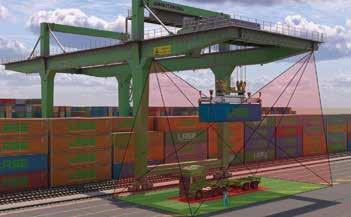










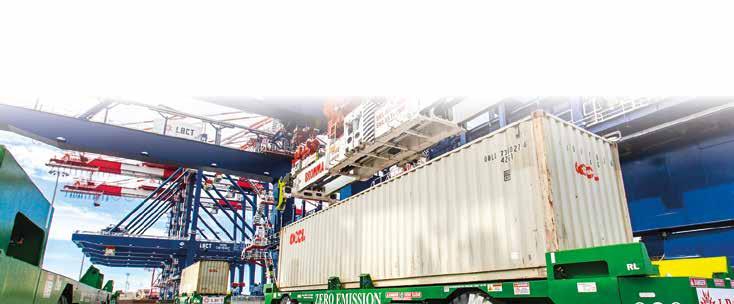


The Port of Portland (OR) is rebuilding its container throughput again and has recently signed a new deal to maintain international container activities at the port. Dean Davison assesses the strategy in play and what the future holds
“We’re optimistic about container service and believe it’s an asset that Oregon businesses need now more than ever,” explained Kimberly Branam, Chief Trade and Economic Development Officer, Port of Portland, adding: “Without container service at T6, Oregon shippers would incur an estimated US$19.2 million in additional net trucking costs annually, and overall it costs Oregon shippers an average of US$585 more per container to move goods out of Seattle.”
Portland has had a traditional role handling containers and has handled almost 350,000TEU per annum in the relatively recent past.
Indeed, the port was a sufficiently attractive proposition that it even secured a terminal operating deal with global terminal operator, ICTSI.
However, subsequent inter-union rivalry issues commencing in Q3 2012, which saw the ILWU encouraging members to operate in a “slow and nonproductive manner” (electricians from rival union IBEW Local 48 were assigned the job of plugging and unplugging refrigerated containers, a job the ILWU asserted should be handled by its members while handling and moving containers in Portland). This action correlates with the strong decline in container activity at the port as ICTSI terminated its contact at the port in 2017 and subsequently won a court battle with the ILWU.
However, Portland has been working to rebuild container activity since 2018 and underwent a process to secure a private operating partner, subsequently resulting in Harbor Industrial securing the contract.
“Harbor Industrial knows the market well and has a lot of experience in the industry, including deep experience at Terminal 6. We’re pleased to see them take on an expanded role as the full operator of our container and breakbulk services. This is great news for the workers and businesses who rely on access to global shipping. A thriving Oregon economy relies on international trade, whether you’re a business owner, a farmer, a rancher, or a consumer anywhere in the state,” confirms Branam
“With this agreement now in place, we are in a stronger position to provide regional shippers with the stability they need to grow their businesses, which in turn will drive economic growth and strengthen the local economy,” highlights Tim McCarthy, Chief Operating Officer of Harbor Industrial Services.
The deal with Harbor transitions the company from being a stevedore in Portland to the terminal’s long-term operator. A seamless transition is predicted by both the port authority and Harbor, with completion slated for the end of December 2025.
Portland has traditionally faced a number of challenges in its role as a competitive container gateway, such as location, infrastructure limitations, financial issues and strong competition from other West Coast ports.
True, the port is located 100 miles upriver from the Pacific Ocean, resulting in extra steaming time and costs for ships, and limitations on the sizes of vessels that can access the
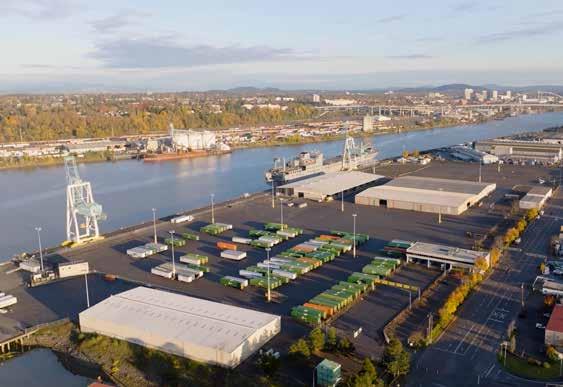
port, but this is true of many other ports, in the US and throughout the world. The counter argument is, of course, that the port is located close to its markets – just ask Baltimore or Antwerp, for example.
Portland has had recent financial struggles, with losses of US$30 million from container operations over the past three years, but this has to be put into context – would the losses likely not be so severe had momentum been maintained and volumes were on an upward curve? The 2022 total of almost 171,500 TEU fell to just under 99,000 TEU for 2024. Hence if the port was able to grow its traffic back to 350,000 TEU levels, then revenues would be higher.
‘‘
Scores of businesses throughout Oregon rely on Terminal 6 to ship their goods…
The other key factor is port competition. Obviously Portland will always face stiff competition from PNW ports (and San Pedro to the south), or the proposed new Coos Bay intermodal port, but further context is needed here. If Portland is predominantly to serve Oregon and its population, then it is not necessarily looking to be a gateway for the US Midwest as its primary market.
“Scores of businesses throughout Oregon rely on Terminal 6 to ship their goods,” Governor Tina Kotek said. “Oregon communities will be better off because we came together and worked toward this shared goal.”
As Branam concludes: “Terminal 6 is an important piece of Oregon’s economic infrastructure, with container service supporting 1500 family wage jobs and countless businesses across the state. Oregon is one of just 11 states with a trade surplus, exporting US$42 billion of goods and services each year. At least 1 in 8 jobs are tied to international trade, and a majority (88 percent) of the state’s exporters are small or medium businesses.”
Ports in the PNW region of Seattle-Tacoma, Coos Bay, Vancouver (WA), Prince Rupert, and Vancouver (BC) each have plans to invest in their facilities. Dean Davison assesses these projects and the forward competitive position
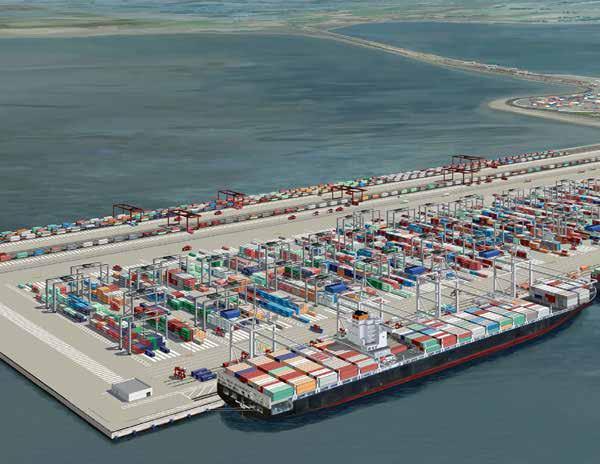
“At the Vancouver Fraser Port Authority (VFRA), our purpose is to enable Canada’s trade by being reliable and innovative, while protecting the environment. The Port of Vancouver is Canada’s gateway to diverse markets, enabling trade of approximately C$350bn every year with 170 countries. C$1 in every C$2.50 of Canada’s trade outside of North America moves through the port,” explains Devan Fitch, Roberts Bank Terminal 2 Program Director at the VFPA, speaking exclusively to Port Strategy.
On the basis of these comments from Fitch, the importance of the long-running Roberts Bank 2 container project to Vancouver (BC) is undeniable. “Roberts Bank Terminal 2 is a transformational, nation-building project set to build new industrial land, unlock C$100 billion of container trade capacity annually, and create tens of thousands of jobs. It is a direct investment into Canada’s economic resilience and future, which will increase Canada’s west coast container capacity to trade with the rest of the world by more than 30%.
“Located at the core of western Canada’s largest economic region and well positioned geographically relative to competitors on all principal transpacific trade routes (up to two days sailing time advantage from Shanghai compared to competitors in the San Pedro Bay port complex). The terminal will benefit from comprehensive, resilient, and cost
competitive rail access through three Class 1 railways (CPKC, CN, and BNSF) and direct access to a robust local network of off-dock container handling, transload, and other trade supporting facilities.”
So, while the project itself has seen a number of delays over recent years, what is the current position and, when will it be built? Fitch is upbeat here. “In July 2025, we started the search to find the best qualified team to progress construction planning and build the landmass and wharf component of the Roberts Bank Terminal 2 Project—a key milestone in advancing the project, before adding a crucial update on timescales. We will work with our construction partner and First Nations to obtain remaining permits in 2026. Construction mobilisation and early works are expected to occur in 2027, with major land reclamation works expected to begin in 2028.”
On this basis, VFPA is now actively pushing ahead with the project, with Fitch also giving more details on the specific timetables: “Our current expectation is that the terminal concession to select the operator that will build, equip, and operate the new terminal will take place in the late-2020s, with the operator selected around 2030. Terminal operations are set to begin in the mid-2030s.”
Terminal operations are set
Devan Fitch, Roberts Bank Terminal 2 Program Director, VFPA
Based on previous growth levels and periods of congestion, this positive traction will be good news for Canadian shippers and BCOs using Vancouver.
“Investments in Terminal 5 are critical to remain competitive in the shipping industry,” announced the Port of Seattle when confirming its intention to redevelop this facility to keep pace with the need to handle larger container vessels.
The need for this enlarged terminal has certainly been felt at the port, as it explains: “With a modernised T-5, the NWSA’s containerised cargo is estimated to reach nearly seven million TEU annually in 2050……...without the T-5 investments, containerised cargo is expected to be 5.3 million TEU in 2050, a difference of 1.6 million TEU. This estimated reduction of total TEU results in reduced economic impact, including more than 6,000 fewer jobs and US$2bn in lower direct business output.”
Construction commenced in 2019 and by Q2 2024 Phase 2 had opened, supported by an investment of more than US$500 million from SSAT/ST – a joint venture between SSA Terminals and Terminal Investment Limited (TiL). “The major part of the Terminal 5 redevelopment is complete (completed last year) but there is still some work ongoing, including increasing reefer capacity and expanding capacity for on terminal truck queuing though a major truck gate reconfiguration,” confirmed a port spokesperson.
In June 2025, the proposed Pacific Coast Intermodal Port (PCIP) at Coos Bay in Oregon gained tangible traction, with funding of US$100 million confirmed. This investment from the State authorities joined US$58 million gained in federal transportation grants for infrastructure from Infrastructure for Rebuilding America, Consolidated Rail Infrastructure and Safety Improvements, and Railroad Crossing Elimination awards.
The terminal is being designed as a ship-to-rail hub, moving containers from ocean vessels onto the Coos Bay Rail Line for a 134-mile run to Union Pacific tracks in Eugene. From there, freight can reach largescale US Midwest markets – in essence, not only would it be the first facility of this type in the US, but it could also be argued that it is seeking to replicate what has been achieved in Prince Rupert, Canada.
PCIP is located on Coos Bay’s North Spit and is planning a strong green agenda. Its use of rail will remove trucks from
the highways, while providing port capacity without a corresponding increase in greenhouse gas emissions. The Port will be fitted with electric power plug-ins that will power ships at berth during the process of unloading, which will eliminate ship engine emissions. All vessels will be unloaded using electrified ship-to-shore gantry cranes, further reducing greenhouse gas emissions.
PCIP has confirmed a US$2.3bn total construction cost, with a five-year project timeline (of which three years is anticipated for construction, following all necessary environmental permits being secured). With berths for two ships, the terminal would offer capacity of 1.2 million TEU initially, (800,000 containers), with capacity subsequently increasing to 2 million TEU annually.
Commenting on the project, Melissa Cribben, Executive Director, PCIP, confirms: “This project reflects the kind of bold, future-focused investment that Oregon needs. For too long, rural communities like those on the South coast have been left behind. This project gives us a path forward — one grounded in good jobs, sustainable freight infrastructure and long-term community stability.”
Prince Rupert is continuing to develop through the further diversification of new terminal and logistics capacity in order to build greater resiliency against market fluctuations.
The Canada Infrastructure Bank provided a C$150 million loan for the first phase of CANXPORT, a large-scale export logistics and transloading facility, to be operated by RayMont Logistics. The planned capacity is 400,000 TEU per annum, primarily for forestry, agricultural, and resin products as part of a rail-to-container transloading operation, with Canadian National Railway also a partner in the project.
Prince Rupert remains a facility serving Asian imports entering Canada and the US. Fairview Cove capacity was increased in 2022 from the previous 1.4 million TEU to 1.8 million TEU and a further rise to 2.1 million TEU is already on the agenda. The Prince Rupert Port Authority has confirmed that a second terminal is part of the overall port masterplan for the port. It will add at least two million TEU of additional annual capacity, with existing terminal operator, DP World Canada, expected to participate in the project. Current estimated completion date is 2030-2031.
With the development of projects such as CANXPORT and significant future capacity potential, Prince Rupert offers longer-term potential to support Canadian supply chains, drive trade and economic growth, especially with IndoPacific markets. A more distant geographic location to the north of BC, is appealing for imports but a lack of localised export volumes remains.
A newly designed Terminal 2, Berth 7 facility is being constructed at the Port of Vancouver (WA). The project will redevelop the port’s existing Vancouver Bulk Terminal mineral operation into a larger export facility, with the ability to handle more than 3 million tons of soda ash annually once fully operational. Soda ash has many uses, including for manufacturing glass and lithium-ion batteries, while natural soda ash is a key ingredient for toothpaste, baking soda,
powder, and detergents. The expanded terminal capacity is expected to support expansion of Solvay’s Green River, Wyoming, soda ash operations.
Alex Strogen, Chief Commercial Officer, Port of Vancouver (WA), confirms that this project involves demolishing old existing infrastructure and replacing it with modern facilities featuring expanded storage space, upgraded rail unit train access and state-of-the-art cargo handling systems. It
will include a new ship loader and a conveyer system. “It will have the most advanced dust mitigation on it,” Strogen underlines.
The project is a joint venture between Nautilus International Holding Corp. and Neltume Ports, the Port of Vancouver (WA) and Solvay, a leader in soda ash. The total investment cost is approximately US$80-US$90 million, with construction to continue through to Q3 2026, with operations commencing before the end of 2026.
Union Pacific and Norfolk Southern are planning a railroad merger to create a coast-to-coast network covering 50,000 miles and 43 US states. Dean Davison assesses developments to date, project timescales, and potential industry impact
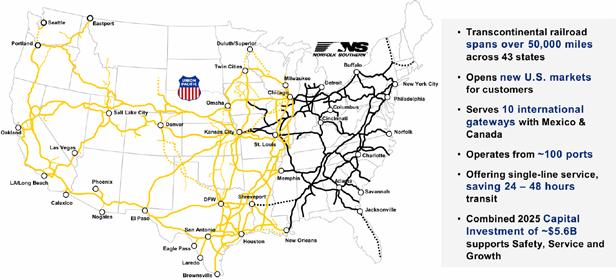
Source: UP and NS
In July 2025, Class 1 US railroads, Union Pacific (UP), and Norfolk Southern (NS) announced a merger that both companies stated will be “the nation’s first transcontinental railroad” and that the combination of the two networks will “transform the US supply chain and unleash the industrial strength of American manufacturing.”
A potentially bold claim, especially considering the reduction in railroad choice available to cargo users and shippers. So, just what are UP and NS proposing and what’s the rationale behind the deal?
Figure 1 represents a snapshot of the two company rail networks and a summary of the proposed benefits, as supplied by UP and NS in their transaction investor presentation.
To put the proposed new entity into context, Table 1 shows the size of a combined UP and NS company and how it will dwarf the two remaining Class 1 US railroads in terms of financial metrics, route miles operated and number of employees.
In terms of what customers, investors and employees think of this proposed merger has provoked a clear and unequivocal response from UP and NS. Jim Vena, CEO, Union Pacific said, “We’ve already had positive feedback from customers – customers who pay the bills,” while Mark George, President and CEO, Norfolk Southern states, “When the details are absorbed by the market, they’ll understand the value we’re creating. Both companies are operating from positions of strength – we’ve got excellent safety and service records and high net promoter scores with our customers.”
However, competing railroad, BNSF, disagrees, arguing that the merger will negatively impact both competition and service levels, with reductions in choice, increased cargo rates and even leading to what it called an “operational meltdown.”
The company is also openly disputing positive customer feedback to the planned transaction: “No customer is asking for a UP-NS merger to happen. It’s driven by Wall Street on
the promise of a big shareholder payout. BNSF does not believe a merger is necessary at this time when we can deliver immediate benefits to our customers while preserving competition.”
Indeed, BNSF is encouraging railroad customers to raise concerns with the Surface Transportation Board (STB) (the regulatory authority responsible for approving the proposed merger). The company has created via its company website a dedicated section titled “Preserve Rail Competition” that offers a direct link to the STB under the auspices of telling “the STB to say no to unchecked market power and the loss of competitive options that you’ll never get back.”
In a hard-hitting response, BNSF also added: “Wall Street and UP would like to force BNSF into a competing merger that creates a coast-to-coast duopoly controlling over 90% of our nation’s rail traffic….. BNSF is not looking to create a national duopoly and doesn’t believe the appropriate competitive response is for BNSF to acquire CSX at this time. We should not be viewed as the fix to correct the competitive imbalance that UP-NS are trying to create.”
BNSF said interline collaboration, rather than undertaking a merger with CSX, is the more appropriate competitive response to the proposed UP-NS option. “We should not be viewed as the fix to correct the competitive imbalance that UP-NS are trying to create,” the railroad stated, adding that a better approach is to increase cooperation between railroads.
“These partnerships provide more, not fewer, options for our customers while preserving competition and flexibility. We can also implement them now, not two years later, after an expensive and arduous regulatory process,” BNSF explained.
Clearly a merger with CSX is not on the cards for BNSF.
For its part, CSX has not openly commented on the UP-NS merger, but it has just changed its CEO, with the new incumbent (Steve Angel) joining from Linde, where he oversaw the successful integration of Linde AG and Praxair,
Union Pacific and Norfolk
Southern talk up the benefits of a merger but the competition is not so sure
Inc., which created the world’s largest industrial gases and engineering company. So, extremely largescale merger processes are part of his forte, although Angel is not from a railroad background.
Other Class 1 railroads are also against the merger too. Both Canadian National (CN) and Canadian Pacific Kansas City (CPKC) have individually launched website pages to encourage shippers and railroad users to oppose the deal.
The argument from CN and CPKC mirrors exactly what BNSF is stating – this merger is not needed nor necessary and it is not regarded as being in the best interests of rail customers and the US economy.
As part of its Q3 results presentation to investors at the end of October, Keith Creel, CEO, CPKC stated that the STB should take up to 17 months to consider this transaction, meaning that a schedule of 500+ days would then be in line with the review the STB completed when Canadian Pacific acquired Kansas City Southern in 2023.
“You’ve got a lot of people that deserve and want and will need to take ample time to review the application, ample time to respond. The only way you get to a place where the STB can make a fulsome, thorough decision is if all the facts have been shared and heard and understood,” Creel said.
On an operational level, Creel was also unequivocal in his belief that this latest merger is not a simple end-to-end combination because of structure of the overlap between the respective UP and NS networks in the US Midwest and in key gateway locations such as Chicago, Memphis, St. Louis, and New Orleans.
“You’ve got overlap in key markets. You’ve got customers that are going to have fewer options. I don’t say you’re enhancing competition if you reduce options,” Creel announced, as he contended that the merged entity will handle 40% of US rail volumes.
At the time of writing, mid-October 2025, UP and NS are targeting early 2027 for transaction closure, assuming that
the paperwork is filed with the STB in the October 29 2025 –January 29, 2026 period. “We’re in a position of strength— great service, great safety, growing volumes. Our respective cultures are aligned. And more broadly, the country is going through reindustrialisation. Freight demand is rising, and the administration and STB appear more open to thoughtful, growth-oriented mergers. The timing just makes sense,” stated George, when originally outlining the proposed deal.
The STB has already referenced changes to the proposed timescales, noting an additional 15 days to give the Justice Department and Transportation Department more time to consider comments filed by other railroads, shippers, labour unions, and communities.
The opposition to the merger is clear from other Class 1 railroads and probably to be expected. Therefore, and probably unsurprisingly, UP and NS are eager to get the transaction moving, by asking federal regulators for a quicker review of the proposed merger. In their filing to the STB, the two railroads stated that, “because of the merger’s end-toend nature, the transaction does not present any complex competitive or operating issues.”
Vena at UP added that the merger is “so pro-competitive that there’s no reason for the STB to spend a year gathering information.” Indeed, these two railroads are seeking condensed comment and rebuttal periods, and also asking the STB to set firm dates for public hearings and the close of the record, the timing of a final decision, and its effective date.
The UP-NS merger represents a potential significant shift in the US railroad industry. The regulatory process will be crucial in determining the merger’s future, with the outcome a long way down the track at present, with many considerations yet to be faced.
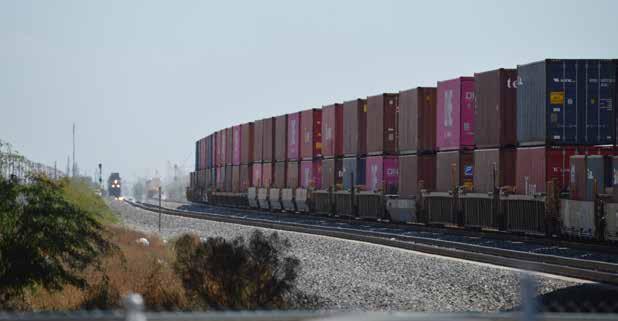
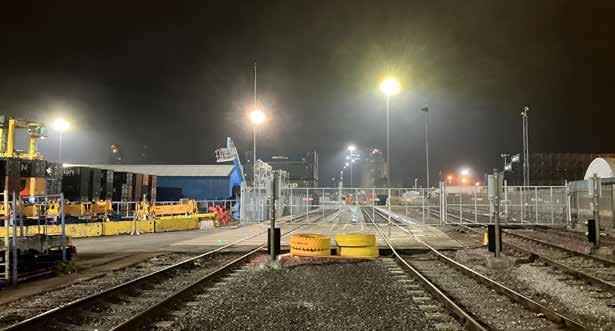
The ports lighting supply sector is moving rapidly towards energy efficient LED solutions, on the back of the drive for sustainability, operational cost reductions and less maintenance. The case-by-case supplier news below highlights the move towards LED with both new launches and retrofit projects favouring this solution. They also highlight the drive to reduce the impact of
port lighting on sensitive marine eco systems, an area being spearheaded by DarkSky International (see below). According to the global light pollution authority, more than 22% of the world’s coastal waters are exposed to artificial light at night. Alongside LED and sustainability, there has been a rise in smart lighting systems that boost safety and real-time monitoring.
■ Abacus Lighting: Abacus Lighting has recently completed what it calls a “landmark” retrofit project at the Port of Tilbury, enhancing the port’s operations with energy-efficient Challenger 1 floodlights. The floodlights, which are mounted on masts equipped with internal climbing ladders for safe maintenance access, provide “excellent illumination”. Abacus Lighting notes: “The upgrade offers significant benefits to the port, including enhanced safety for workers and drivers, reduced energy consumption, and a lower carbon footprint due to the superior efficiency of
■ Continental: German manufacturer Continental has expanded its NightViu� LED Driving Lights to include 10 more models. Engineered for Construction and Off-Highway Use, including ports, the new lights have been designed to help improve operational safety by increasing nighttime visibility. They feature rugged aluminium die-cast housings with cataphoretic coating, and resilient shatterproof polycarbonate lenses. Depending on the model, they are rated IP69K or IP67K for Ingress Protection (IP) from dust and water. NightViuÒ Multi-function Driving Lights and
the Challenger 1 technology.” Elsewhere, UK-headquartered Abacus provided new lighting as part of the Aberdeen Harbour expansion project, to ensure safe and efficient operations, particularly during night shifts and adverse weather conditions. The solution incorporates a new LED lighting system which aims to enhance Aberdeen Harbour’s operational efficiency with reduced energy consumption and maintenance costs. A wireless control solution was installed throughout, that can be dimmed through a computer system in the gatehouse.
Lightbars feature free-form reflectors that direct the light beam to where it is needed. Elsewhere, NightViu® reversing lights feature Fresnel lenses to create a broad field of illumination directly behind the equipment. NightViu® Driving Lights provide up to 5,500 lumens and a beam field length of up to 440 metres. They also include integrated electronics driver and a thermal management system to allow them to operate safely from -40°F to +190°F. They produce from 50-100 lumens per watt, depending on the model.
■ Abacus Lighting has carried out a retrofit project at the Port of Tilbury, enhancing the port’s operations with energyefficient Challenger 1 floodlights
■ Cree Lighting: The US headquartered company has expanded its Dot. family of retrofit LED engines with Dot. wall and Dot.fuel gen2. Dot.wall is the only Dot. available with a dedicated housing, making it a full, stand-alone luminaire. Dot.fuel gen2 now comes pre-assembled and is available with up to 12,000 lm per LED module. “… Dot. reaches new heights of sustainability thanks to its modular design. With Dot., ageing LED installations can be easily updated without the need to replace entire fixtures. This can save up to 68% of raw material and represent an important step towards the circular economy,” says Alberto Gerli, Sales Director, Cree Lighting. Dot. Is suitable for urban
■ CU Phosco: UK headquartered CU Phosco, which designs, manufactures and installs high mast lighting, singles out how one of its specialist areas is port lighting. CU Phosco undertakes contracts at ports worldwide, working with large port operators including DP World, APMT and ICTSI. Recent projects include the ABP-owned Port of Southampton. Most of the large areas in the port are lit using high masts. The main objective of the project was to reduce the cost of illuminating and maintaining these high masts by converting them to more efficient LED products and
■ DarkSky International: Global light pollution authority DarkSky International has launched a new certification programme to bring responsible lighting to industrial-scale ports. The DarkSky Approved Port Marine Terminal Lighting Programme is designed to significantly reduce light pollution, safeguarding sensitive coastal ecosystems and nearby communities. Initiated in 2023, in partnership with the Port of Tampa Bay, the port engineering team selected LED fixtures with advanced optical controls, dimming capabilities, and shielding to reduce glare and minimise light trespass beyond the port property. DarkSky Approved Port Marine Terminal Lighting is the latest addition to the DarkSky Approved programmes suite, a third-party
■ Phoenix Lighting: The US company has introduced next-generation lighting solutions spanning High Mast LED, wet docks and port cranes over the past five years. It first launched its ModCom Series - designed for applications including port cranes - LED floodlight in 2010. In 2023, it introduced its upgraded ModCom 3 Series, which incorporates end user and industry feedback. Highlighting the upgrades, the company says: “The ModCom 3 delivers powerful illumination at 130 LPW, providing more light for less cost. It has survived extensive testing, including temperature, impact, vibration and salt spray. It now also includes heat monitoring technology, which will preserve the life of the fixture in extreme heat, dust, and debris.” The series is available in three different sizes – LO, HI and MAX. A patented no-glare/ perimeter optic delivers light
■ Schréder: Germany headquartered Schréder has played a major role in the provision of smart and sustainable lighting within the Port of Rotterdam’s Maasvlakte 2 development project. This expansion included the creation of an empty depot of approximately 16 hectares for Star Container Services. Schréder was chosen to provide lighting for this new outdoor area. To ensure safety and optimal visibility in all weather conditions, it proposed the energy-efficient and high-performance BRITELINE floodlight, which was coated to meet C5 standards for highly corrosive environments. A total of 78 floodlights were mounted on fourteen 45-metre-high Valmont masts and strategically positioned to provide uniform lighting
and industrial applications. The family’s energy-saving toolkit includes LEDs, dedicated lens optics, auto-dimming, and smart lighting modules, including Zhaga sockets and sensors, which enable communication between the environment, drivers and LED modules. Last year also saw Cree Lighting highlight its role within terminal lighting with its participation in the British Ports Association (BPA) Conference, in the UK. Showcasing how its marine lighting solutions are specifically designed to perform in marine environments, it explains that they are available with a specialised C5 anti-corrosion coating, along with the company’s LiteStrong™ non-corrosive housing material.
installing fixed head lantern carriages to reduce maintenance costs further. CU Phosco was appointed as the main contractor. Telensa CMS nodes were installed in each lantern to provide additional control and reporting information. Singling out the FL800R and P855 lights, CU Phosco says that they “provide exceptional optical control minimising obtrusive light, without compromising the lighting performance”. Following the successful completion of the project, ABP has awarded CU Phosco a second phase of high mast LED replacement works.
validation programme that recognises lighting products and projects that protect the night. A statement says that the new certification “fills a critical gap, guiding ports in transitioning to LED lighting with proper optical control, shielding, and dimming systems. These solutions ensure light is used only where and when it’s needed, while virtually eliminating unnecessary spill into surrounding areas.”
Throughout 2024, DarkSky and Port Tampa Bay engaged lighting designers, marine infrastructure experts, and environmental advocates to ensure the programme meets both operational needs and ecological goals. The resulting guidelines are now available for adoption by other ports and marine facilities worldwide.
only where it is needed and minimises glare to operators. Its next-generation Soar Series High Mast LED is designed for high output illumination across ports and terminals. The fixture delivers up to 130,000 lumen output performance in a sleek design with all components housed in a IP66-rated, marine grade die-cast aluminium enclosure. The fixture mounts to a standard 2-3/8 inch (60 mm) mast arm with adjustable +/- 5 degree tilt capability. The company has also released DLAW 2, its next generation wet location LED task light. The DLAW 2 boosts productivity by optimally lighting more challenging applications including spray down areas, cold storage, and docks exposed to outdoor conditions. Other improvements include a lighter weight, and more compact polycarbonate head for less strain on the arm and better stability.
across the area, taking into account shadows from the containers. Brent Compeer, Area Sales Manager Industry, Sport & Transport, Schréder, comments: “For this project, we conducted a detailed lighting study, taking into account the shadows of the containers on the site. Although this was not explicitly requested in the tender, we felt it was important to incorporate this additional aspect to achieve the best possible result.” All the floodlights are controlled by the Schréder EXEDRA lighting platform, which can adapt the lighting to exact requirements. Schréder said that as the platform is open and interoperable, it offers a futureproof solution for integrating devices or applications.
advertise in the
+44 1329 825335 dspicer@mercatormedia.com www.portstrategy.co.uk
Telestack are a leading global manufacturer of equipment for the bulk material handling industry including Ship Loaders/Unloaders, Hopper Feeders, Truck Unloaders, Bulk Reception Feeders, Stockpiling Conveyors, Link Conveyors and Telescopic Stackers.
+44 (0)2882 251100 sales@telestack.com www.telestack.com

LASE offers innovative andproductive solutions for ports by combining state-of-the-art laser scanner devices and sophisticated software applications. We are specialised in the fully automatedhandling of containers, cranes or trucks.
+49 (0) 281 - 9 59 90 - 0 info@lase.de www.lase.de


ifm electronic gmbh ifm is one of the world’s leading sensor companies in the automation of measurement and control, optimizing technical processes in almost all industries.
+49 201 24 22 0 info@ifm.com www.ifm.com
Main customers are shipping companies with their bulk carriers, which know that they can rely on the performance, speed and reliability of ORTS grabs for many, many years. But also terminal operators, stevedore companies and heavy industry companies (e.g. steel works) value the quality of ORTS grabs.
+49 (0)451 398 850 info@orts-gmbh.de www.orts-gmbh.de/
SAMSON Materials Handling Ltd specialisesin the design and manufacture of mobile bulk materials handling equipment for surface installation across multiple industrial segments. Designed for rapid onsite set-up and continuous high performance SAMSON equipment provides an excellent return on investment.
+44 1353 665001 sales@samson-mh.com www.samson-mh.com/
Portable pneumatic conveyors or grain pumps, Continuous pneumatic Ship Unloaders on gantry, Mechanical Ship Unloaders and loaders, as well as complete turnkey projects for port terminals.
+32 67 89 50 41 info@vigan.com www.vigan.com
Bromma is a global organization with an extensive sales and service network around the world. We have delivered spreaders to more than 500 terminals in over 90 countries on six continents. In all, more than 14,000 crane spreaders and rotators have been put into service.
+46 8 620 09 00 sales@bromma.com https://bromma.com/
Customised damper and buffer solutions for container spreaders and ship-to-shore, rail mounted gantry and process crane’s. When fitted to spreaders, our dampers protect the hydraulics’ and reduce noise.
+46-(0)157-45 43 40 info@dellnerdampers.se
American Manufacturer of industrial lift trucks. Taylor Machine Works designs, engineers, and manufactures morethan 100 models of industrial lift equipment with lift capacities from 4,000-lbs. to 125,000-lbs. YOU CAN DEPEND ON BIG RED! +1 662 773 3421 contact_sales@taylorbigred.com www.taylorbigred.com
ELME Spreader is well known for our reliable container handling solutions. Trust and reliability have made us the largest independent spreader manufacturer in the world.
+46 10 222 18 00 sales@elme.com www.elme.com/
For more than four decades, Steelpaint has protected and prolonged the life of heavy industrial facilities such as ports, offshore platforms, tanks, bridges, and ships. Its 1-C-PUR coatings set new standards in corrosion resistance, surpassing traditional epoxy coatings.
+49 (0) 9321 370 40 mail@steelpaint.de www.steelpaint.de
DSP supports ports, terminals, inland facilities & rail terminals around the world with services and products related to Terminal Operating Systems, Terminal Automation and Optimization.
+41 91 230 27 20 info@dspservices.ch www.dspservices.ch
INFORM develops software to optimize business processes using AI and operations research. Since 1969, it has enabled sustainable value creation across industries through tailored solutions that support resilient, efficient, and successful decision-making worldwide.
Magna Tyres is a global supplier of premium OTR, industrial, port handling and truck tyres. We deliver durable tyre solutions for port handling equipment, ensuring maximum performance and efficiency worldwide.
0031-6-21383568 info@magnatyres.com https://magnatyres.com/
ABB SpA ABB is a global leader in electrification and automation technologies. We are dedicated to innovative solutions that enhance sustainability and efficiency in the port and maritime sectors.
+33
DockGuard is a global provider of marine fender technology and mooring solutions offering a true collaborative approach with customers. We have a reputation as a dependable partner in the international port, harbor and waterways market.
+44 (0) 8452 778800 sales@dockguard.com www.dockguard.com

ShibataFenderTeam is focused on customization and pursues a holistic approach to fender system design to ensure the safety and protection of vessels, port infrastructures and people With more than six decades experience and an unparalleled expertise in rubber production.
+49 (0)40 63 86 10 - 170 contact-germany@sft.group www.shibata-fender.team

The Fogmaker Fire Suppression System is a high-quality and efficient Swedish engineered product. It is not only cost-effective, but it is also tailor-made according to each type of material handling equipment.
Royal HaskoningDHV is an independent consulting engineering company that is helping clients with challenges ranging from climate change and digital transformation to the energy transition.
www.royalhaskoningdhv.com/
As one of Europe’s largest dredging- and marine contractors. We work with nature, performing Beach Nourishment, Land Reclamation, Port Development, Capitaland Maintenance Dredging, Rock Installation, and Offshore Services.
+45 33 91 25 07 mail@rohde-nielson.dk www.rohde-nielson.com
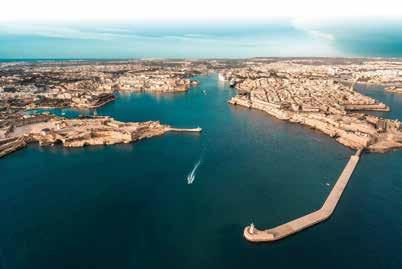
The National Oceanography Centre (NOC) is a leading UK-based marine science research and technology institute, with a dedicated commercial team that serves as the catalyst for a sustainable blue economy.
+44 (0)300 131 2321 https://noc-innovations.com
CONDUCTIX-WAMPFLER
The world specialist in Power and Data Transfer Systems, Mobile Electrification, and Crane Electrification Solutions. We Keep Your Vital Business Moving!
+49 7621 662 0 info.uk@conductix.com www.conductix.com
Hammar is the world leading manufacturer and developer of Sideloaders, also known as Sidelifters or Self-loading trailers. With over 115 countries, Hammar offers a high quality logistics solution tailored for your needs.
+46-33 29 00 00 info@hammarlift.com www.hammarlift.com
+46 470-772200 info@fogmaker.com https://fogmaker.com/

At IDENTEC SOLUTIONS we are engineering ideas to improve efficiency in the Industrial Internet of Things. Our wireless solutions keep people safe, make teams work better, deliver valuable insights and eliminate wastefulness - even in harsh environments.
+43 5577 87387- 0 www.identecsolutions.com
&
in constant use around the clock or when needed, our customers count on energy efficiency, reliability, performance, service and innovative solutions. +49 (0) 25 22 / 76 - 0 mail@hammelmann.com www.hammelmann.com

As Logistics & Change professionals, we use our expertise to help our customers capitalise on their expertise; creating modern 21st Century, customer-centric services that help them secure their short and long term success
+44 (0)203 404 2468 info@psolved.com www.psolved.com/
Taiwan International Ports Corporation, Ltd. (TIPC) is a state-owned enterprise, 2012. TIPC focuses on Taiwan’s port business operations as well as the integration of various domestic and international commercial port resources.
886-7-521-9000 #6616 www.twport.com.tw
Collinson Tensile design & construct wide, clear span Steel framed buildings for Ports for use as Bulk materials storage, Waste, Recycling, Fertilizer storage, Timber storage, Breakbulk. Clear span widths up to 100m, Heights upto 35metres. 01995 676 680 info@collinsontensile.co.uk www.collinsontensile.co.uk
Tideworks Technology provides comprehensive terminal operating system solutions for marine and intermodal terminal operations worldwide. +1 206 382 4470 info@tideworks.com
Container ships are getting bigger, and ports are investing in deeper water, longer quays, and larger cranes. This is a common phrase regularly used across the container industry. But is the equation that simple?

According to well-respected liner shipping information provider, Alphaliner, the current orderbook for newbuild container ships is now in excess of 10 million TEU, the equivalent of over 30% of the current fleet capacity in service on a global basis.
As Figure 1 shows, the majority of the new vessels fall into the category classified as Ultra Large Container Vessels (ULCV), which are 14,000+ TEU in size – though between 2026 to 2029, there is significant growth in ships that are above 18,000 TEU, with around 170 units due into service before the end of the current decade.
Leaving aside the question of whether there is sufficient cargo demand to fill a high amount of new tonnage coming on stream, the ocean carriers are expected to maintain the usual strategy of redeploying (or ‘cascading’) units from primary East-West routes to secondary trade lanes, especially on North-South routes. Aside from laying-up tonnage, a costly and last resort, this is really the only viable option for shipping lines.
Fundamentally, ports will continue to serve the major trunk routes, where there are strategicallyplaced developed ports – the new Gemini arrangement is perhaps a good example of a specific network of ports used on a major route that is geared around the very largest ships in service.
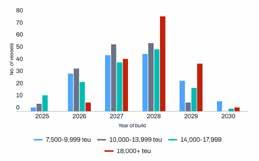
■ Figure
Source: Alphaliner
Container Ships Newbuilds Schedule, 2025-29
Source: Alphaliner
■ The question raises its head again: is containerport development in sync with container fleet growth, especially with high capacity vessels?
This is a strategy that works well for a shipping line and/or alliance that has access to largescale, deep-water ports with sufficient capacity in the best geographic locations.
Yet for many parts of the world, the ability to develop new ports is simply not that easy. The West Coast of North America is a good example. The Port of Vancouver (BC) is now gaining traction on its Roberts Bank 2 project that will offer long-term future capacity and allow larger container ships to call – likewise, the North West Seaport Alliance is finishing the T-5 expansion project to condense older and smaller berths with limited infrastructure to be able to cater for bigger vessels. Elsewhere, the Port of Los Angeles has confirmed its intention to develop Pier 500 but it still needs to raise the Vincent Thomas Bridge by 8m to 64.3m to allow ships of up to 23,000 TEU to access terminals along the East and West Basins.
The economics of ULCV’s make sense, assuming the vessel is full and can maintain its schedule integrity, but while shipping lines can incorporate larger vessels into services on a reasonably straight forward basis, the time and investment needed for ports and terminals to gear-up and be ready is more challenging. Extending quay line and dredging for deeper water, let alone finding space for new facilities, is only possible when or IF, all necessary environmental permitting has been successfully completed – and how long does that take?
Container shipping lines may well continue to order bigger vessels and seek to introduce what’s currently on order before the end of the current decade, but whether enough ports, in the right locations, are ready and able to successfully support them is another question. Unfortunately, 1+1 simply does not equal two.