
Looking into the future is complex, the rules of the game are changing fast not geopolitical factors. The future, as Drewry says, is “hard to read”
Looking into the future is complex, the rules of the game are changing fast not geopolitical factors. The future, as Drewry says, is “hard to read”
MIKE MUNDY
The world is under stress.
Erratic actions emanating from the White House generate big challenges.
Tariffs play havoc with supply chains – delays, congestion, added costs to businesses and consumers and general uncertainty are all negative consequences. Add into this volatile mix some select actions such as new port fees on Chinese built ships calling in the US – US$18 per ton or US$120 per container (whichever is greater) - and the prospect of more similar actions, a 100% additional tariff on Chinese built cranes bound for the US, for example, then it is clear that a new, problematic, trading climate is fast developing.
Plus, factor in the madness underway in the Middle East and the war with Ukraine being pursued, relentlessly it seems, by Russia then the seeds of seismic change become even more distinct. Personally, I just don’t get why the largest country in the world – Russia – wants to grab even more territory?! It is not as if the addition of Ukraine land area will lead to the major enrichment of Russia as a whole. Indeed, achieving the limited gains it has to date has been made at a phenomenally high cost – in life and limb for the Russian people and in all probability increasing economic chaos. For what, the misguided dream of reinventing the USSR? Why? History tells us it proved to be a ‘busted flush, by no means utopia!
Then there is China growing in economic power and with sights set on achieving the status of World Number 1. This too is driving change, notably via BRICS, which has the stated goal of growing in political power and becoming a real and influential counterweight to the West.
As it has expanded, however, this has prompted more internal disagreements on key issues such as the Ukraine war. Additionally, the very fact that BRICS includes Pariah states such as North Korea, Iran and today Russia is also a reality that does not sit well with every member.
The geopolitical card is very much in play in today’s trading world, underpinned by a general rise in authoritarianism.
It will be most interesting to see how things develop, economists seem to suggest it will get worse before it gets better – it is hard not to disagree with them.
Certainly, if you bring it all down to an industry level the same scepticism about the future is there. As Drewry notes (see p33), “Overall, all we can do is express sympathy with port executives and the rest of the supply chain that are trying to map out the game plan…”
That says it all...
The international magazine for senior port & terminal executives
EDITORIAL & CONTENT
Editorial Director: Mike Mundy mmundy@portstrategy.com
Features Editor: A J Keyes keyesj186@gmail.com
Consultant Editor: Felicity Landon felicity@felicitylandon.com
Regular Correspondents: Felicity Landon; Stevie Knight; Ben Hackett; Peter de Langen; Charles Haine; AJ Keyes; Oleksandr Gavrylyuk Johan-Paul Verschuure; Phoebe Davison
Production David Blake, Paul Dunnington production@mercatormedia.com
SALES & MARKETING t +44 1329 825335 f +44 1329 550192
Media Sales Manager: Daniel Spicer dspicer@mercatormedia.com
Marketing marketing@mercatormedia.com
Chief Executive: Andrew Webster awebster@mercatormedia.com
PS magazine is published quarterly by Mercator Media Limited, Spinnaker House, Waterside Gardens, Fareham, Hants PO16 8SD UK t +44 1329 825335 f +44 1329 550192 info@mercatormedia.com www.mercatormedia.com
Subscriptions: Register and Subscribe at www.portstrategy.com
Annual subscriptions from: £275.00
Single user: Full online access to Port Strategy and Greenport with digital magazine issues.
For multi-user access: Subscriptions@mercatormedia.com


CRUISE CAPITAL OF THE WORLD® GLOBAL GATEWAY OF THE AMERICAS


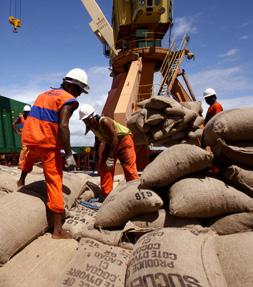
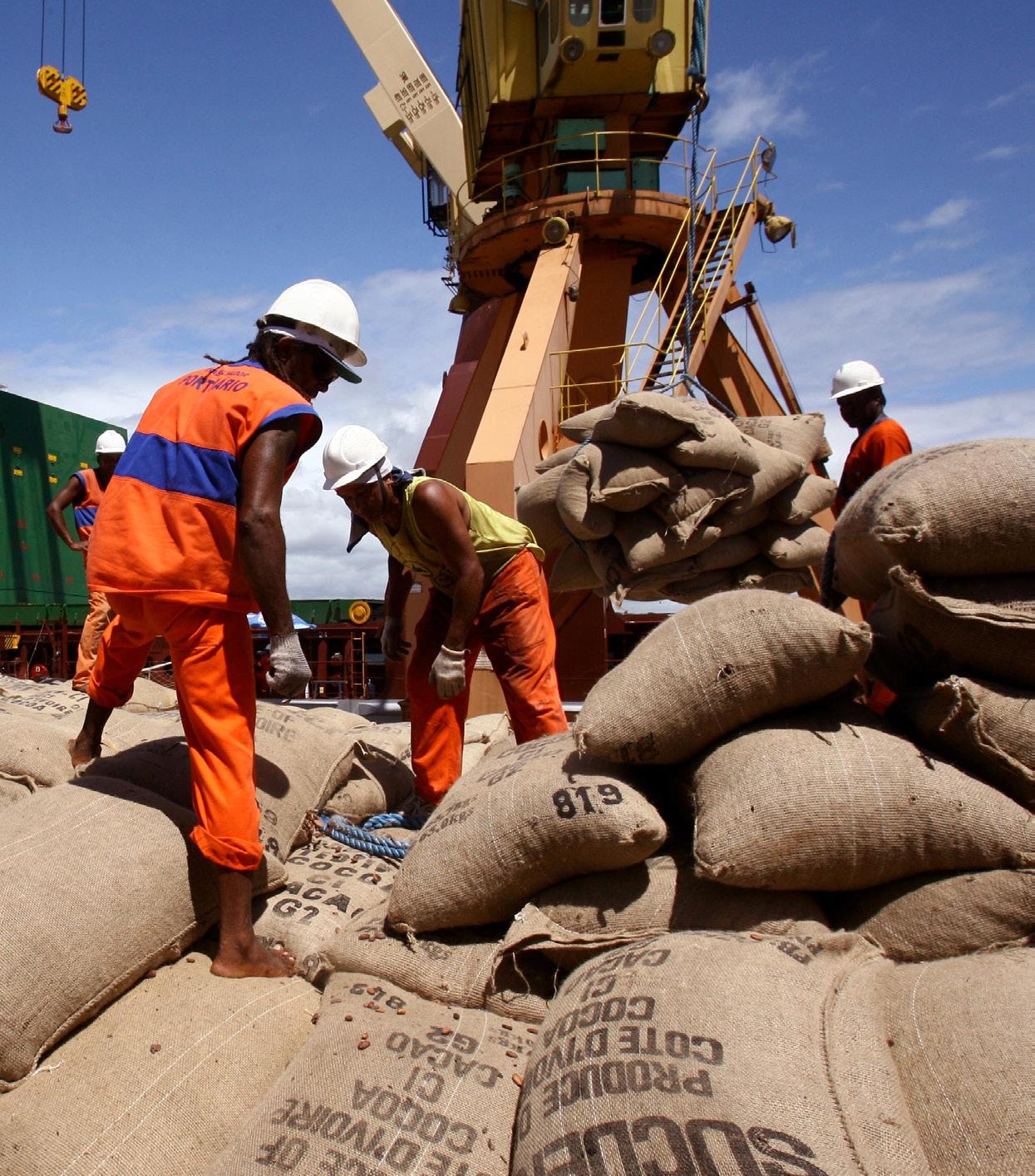
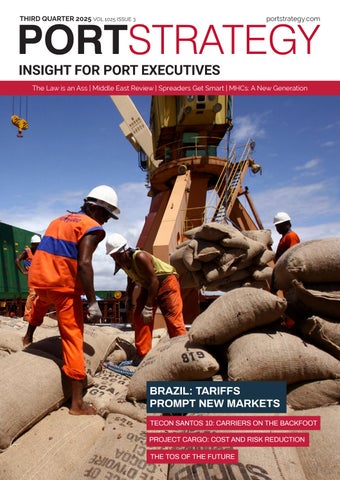
On the cover “What Trump’s actions did was to force Brazilian shippers to reorientate the way they operate” – consolidate and expand existing non-USA relationships and to seek new markets. Coffee is a prime example, while China’s population is generally more oriented towards tea, it has moved up from 14th to 11th on the ranking of biggest coffee importers from Brazil. In container terms, China is Brazil’s top trading partner for both imports and exports with the USA a distant second

5
5
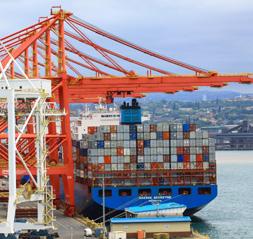
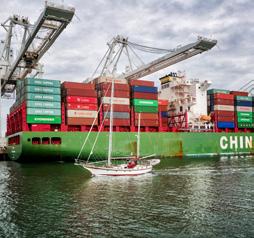
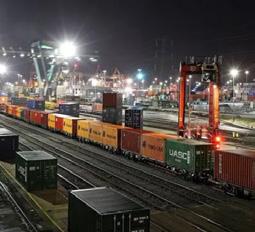

A massive new port and logistics hub is being planned in Haiphong, northern Vietnam. Located approximately 100km east of Hanoi, the project will be developed in three phases, with full completion by 2040.
Vingroup is keen to support its industrial footprint, including its VinFast EV plant operating locally.
Vietnam’s largest conglomerate, Vingroup, led by billionaire Pham Nhat Vuong, has confirmed that it is intending to invest VDN374trn (US$14bn) in the project, of which 15% will come directly from the company’s own internal resources, with the remainder coming from investors.
This latest largescale development follows an announcement from CMA CGM Group which confirmed its own US$600 million investment plans in Haiphong to develop a new, 1.9 million TEU per annum facility in conjunction with Saigon Newport Corporation (SNP).
The deal for the global French shipping and logistics company involves the design, construction, and operation of the Lach Huyen terminals 7 and 8, located in Lach Huyen area in Haiphong. Operations are slated for 2028.
The Ministry of Oceans and Fisheries (MOF) in Korea has selected BNOT (Busan Newport One-stop Terminal) as the preferred bidder for the privately funded, Busan New Port Feeder/General Goods project. BNOT submitted a proposal to invest KRW 800bn (US$575 million) in developing and operating two 2000-TEU feeder berths and one 30,000DWT general cargo berth on 360,000m2 of land on the west side of Busan New Port.
Positive progress has been confirmed for two longstanding port projects in Canada.
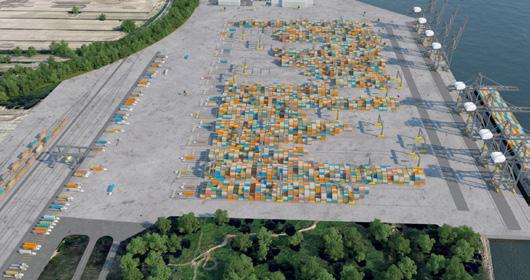
The Vancouver Fraser Port Authority (VFPA) has launched a request for qualifications (RFQ) for the construction planning and delivery of the landmass and wharf component of the Roberts Bank Terminal 2 (RBT2) Project at the Port of Vancouver. The planned terminal will have an annual capacity of 2.4 million TEU, with construction scheduled to begin in 2028 and operations expected to commence by the mid-2030s.
According to the port authority, RBT2 will be a state-of-the-art marine container terminal and will support Canada’s trade diversification strategy by enabling more than C$100bn in new trade capacity, while contributing an estimated C$3bn annually to national GDP.
The contract includes the development of a 100ha marine landmass, a 35ha widened causeway, a 1300m wharf and berth pocket, and an expanded tug basin. “We’re excited to issue the request for qualifications today and move this vital project forward,” said Victor Pang, Chief Financial Officer at the port authority, adding: “To meet Canada’s needs in today’s rapidly evolving trade landscape, we’ve accelerated our efforts to deliver RBT2, a project that will enhance Canada’s economic security and trade resilience. The terminal will serve as a catalyst for economic transformation, from supporting Prairie grain exports and B.C.’s
Phase I of the new rail yard on the south side of Colonels Island at the Port of Brunswick is operational. This facility doubles rail capacity from five to 10 trains per week. The US$22 million investment increases the port’s annual rail capacity from 150,000 autos to more than 340,000 units. By 2028, Phase II, representing a US$54m investment, will bring annual rail capacity to 590,000 autos. Over 90% of vehicles using rail in Brunswick are exports.
forestry sector to ensuring communities have access to reliable and affordable goods.”
Following federal and provincial approval in 2023, the port authority submitted a Fisheries Act Authorisation application in 2024, compliant with the Species at Risk Act. A decision on this final major permit is expected no later than October 2026, under a joint commitment with regulators and government.
At the same time, the Montreal Port Authority (MPA) has submitted its notice of intent to begin preliminary construction work for the new Contrecœur container terminal expansion as early as September 29, 2025, pending receipt of the final required approvals.
Julie Gascon, President and CEO of the MPA, notes: “This step allows us to meet the conditions required to move forward with a project that positions Quebec and Canada more strongly to diversify international trade. Once all the necessary approvals are in place, we’ll be ready to begin work on this major strategic project that is
AD Ports Group (ADPG) is deepening berths and channels at Karachi Gateway Terminal (KGTL). The project will be led by the Group’s Noatum Ports subsidiary, in conjunction with Van Oord, and will subsequently allow ships up to 350m LOA and drafts of 15.5m to call (up from 305m LOA and 13m draft). ADPG said container handling capacity from 750,000 TEU to one million TEU per annum. The dredging is set for completion in Q1 2026.
essential to the future of our supply chains.”
MPA further confirms that the initial work will primarily focus on preparing the project site for “more significant construction activities” which could take place in 2026 (subject to receiving the appropriate regulatory approvals).
The Contrecœur site is planning to offer an annual container capacity of 1.15 million TEU, with two berths, a rail yard and connected services in an industrial zone. Operations are currently expected to commence by 2030. It is being built to complement the existing city-based terminals, not to replace them.
As PS goes to press, news also breaks that DP World and La Caisse have entered into a Joint Development Agreement for the design of the land-based works of the future container terminal. The official signing of the agreement took place on August 28, 2025.
The Port of Cromarty Firth (PoCF) has gained formal granting of marine and dredge licences from Scottish Ministers. The £111 million, Phase 5 expansion project will deliver a new 400m quay extension, land reclamation and dredging. This new phase is part of the port’s ongoing, long-term strategy to establish the Cromarty Firth as a national renewables hub, with capacity to support the deployment of floating wind projects in the North Sea.

A wide range of new initiatives have been confirmed by India’s government, ports and terminals to increase competitiveness and quality of infrastructure offered. These include:
● Indian Ports Bill 2025:
Rajya Sabha (Council of States, the upper house of the Parliament of India) passed this new bill to replace outdated provisions of the Indian Ports Act, 1908, with a main aim being to simplify port procedures and digitalise operations to enhance ease of doing business. The new Bill also establishes the Maritime State Development Council (MSDC) as a statutory consultative body that is to prepare a national perspective plan to ensure integrated port development.
● Coastal Shipping Bill, 2025 The Rajya Sabha also passed this Bill to replace Part XIV of the Merchant Shipping Act, 1958, to simplify and modernise the legal framework governing coastal shipping. A key inclusion is the formulation of a national coastal and inland shipping strategic plan to guide future infrastructure development and policy direction.
● Kolkata Port Inaugurates
First PPP Terminal
The new 30-year concession, dubbed the Century Ports Limited Terminal, constructed at a cost of ₹190 crore is equipped with a mobile harbour crane, a barge unloader, modern yard equipment and an advanced terminal operating system.
The facility has an initial handling capacity of 165,000 TEU and 330,000 tonnes of other cargo. Kolkata Port is planning an extensive short-term rollout of PPP infrastructure across its Kolkata and Haldia docks.
● New Inland Waterways Link - Kottayam Port and Vizhinjam Port Kottayam Port and Container Terminal (KPCT) is exploring a new inland waterways link with the Vizhinjam International Seaport in Kerala, with backing from the government of Kerala, with aims to improve cargo transshipment efficiencies from Kottayam to Vizhinjam. The project will reduce reliance on road transport and ease congestion at Kochi. Targeted moves are 30,000 TEU, annually.
● Visakhapatnam Port Six Projects
The union minister of ports, shipping and waterways confirmed six projects worth more than ₹116 crore, including construction of a B-ramp within the port area and a finger jetty and wharf in the fishing harbour, two additional breasting dolphins at the offshore tanker terminal (OSTT) and an additional ramp linking the Ambedkar centenary flyover to the L-17 corridor. Other developments include the commissioning of the new oil refinery berth-2, installation of advanced fire-fighting facilities at the OSTT berth, building a covered storage shed at the R-10 area and various road and boundary improvements.
● Chennai Revives Outer Harbour Project
Chennai Port Authority is conducting a technological feasibility assessment to consider reclamation of 200 acres behind the container berth. The estimated cost of the project is Rs 80 billion. A previous bidding process launched in 2014 failed to attract enough interest and the plan was subsequently abandoned.
With the inauguration of its Phase 2 expansion, PSA Mumbai is poised to become India’s largest container terminal, doubling its annual handling capacity to 4.8 million TEU per annum.
Designed to accommodate multiple mega container vessels alongside 2000m of continuous quay length, PSA Mumbai represents investment of SG$1.7bn (US$1.3bn billion) by PSA International under a public-private partnership model - the largest foreign direct investment from Singapore in India to date, according to PSA.
Kim Pong, PSA International Group CEO, Ong underlines the
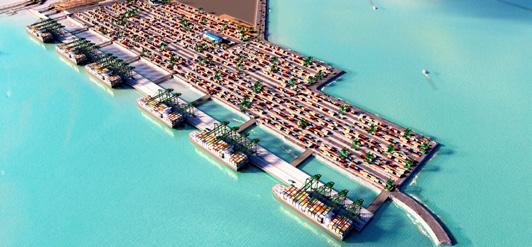
■ With 4.8 million TEU capacity, PSA Mumbai will become India’s largest volume container facility according to PSA International
importance of the project, “PSA Mumbai’s Phase 2 expansion brings together capacity, connectivity and sustainability in a terminal for India – a catalyst for advancing India’s trade ambitions.
PSA Mumbai’s enhanced capacity of 4.8 million TEU will reinforce
the resilience of supply chains within and beyond India, and bolster PSA’s global network of port ecosystems.”
Constructed on 200ha of land, the new terminal enhances yard capacity with multimodal infrastructure.
South Africa’s stateowned Transnet National Ports Authority (TNPA) has issued an RFP for the liquid bulk terminal at the Port of Ngqura. A 25-year concession is being offered to a terminal operator to fund, design, develop, construct operate and maintain the facility. The new terminal will include liquid bulk storage tanks, truck tanker loading equipment and pipelines and will see the relocation of a tank farm from the Port of Elizabeth to Ngqura.
The Port of NEOM and the Logistics Partnership Council has confirmed the successful trial of a new intermodal trade corridor connecting Egypt, Saudi Arabia and Iraq. The pilot shipment used the intermodal routing from Cairo (Egypt) via the Port of Safaga, across the Red Sea to the Port of NEOM (Saudi Arabia) before moving inland to logistics warehouses in Ebril, Iraq, a distance of over 900km. The Port of NEOM aligns with the Vision 2030 initiative in Saudi Arabia to diversify the economy beyond oil.
The Port of Callao (Peru) has inaugurated Stage 3A of the North Terminal modernisation plan with a US$95 million investment that improves grain unloading. The project has been led by APM Terminals Callao and the Peruvian government, and involves the construction of 12 state of-the-art vertical silos, increased grain storage capacity from 25,000 to 85,000 tonnes. Two high capacity Continuous Ship Unloaders (CSUs) were also installed, increasing unloading speeds from 900 to 1300 tonnes per hour.
Sales start autumn 2025
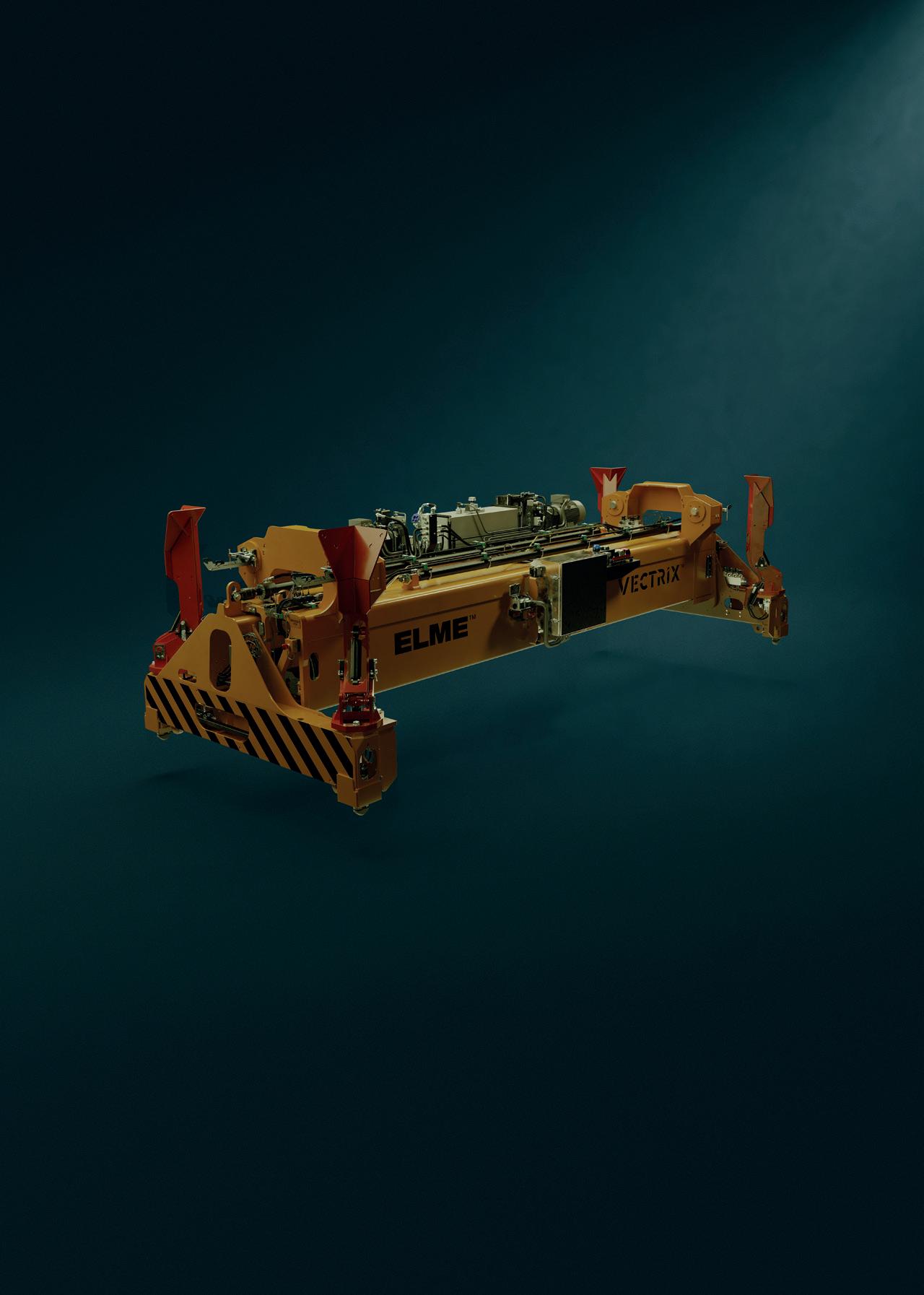
The future of crane spreaders
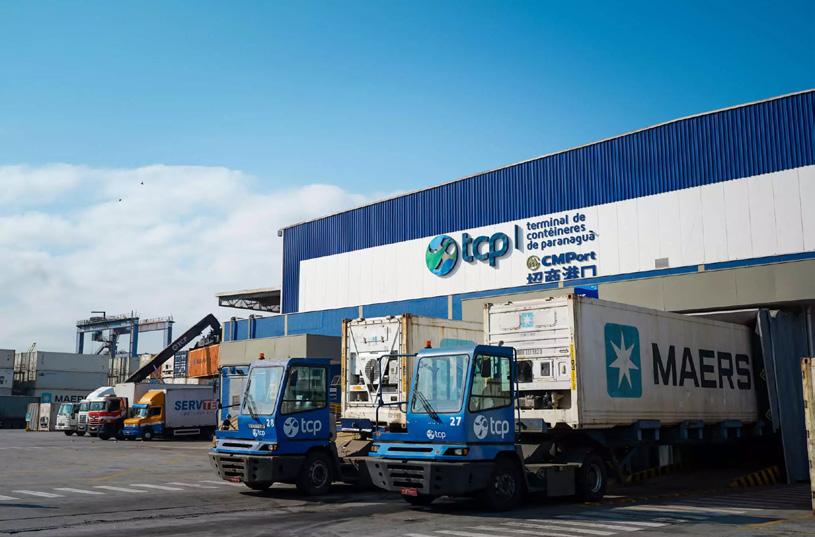
Booming beef exports through the Terminal de Conteineres de Paranagua (TCP) helped push the Chinese owned box facility to register record throughput during the first half of this year.
For decades Paranagua (namely TCP) and Itajai - where Portonave and JBS Terminais (formerly APM Terminals) share the spoils – have vied for title of “Chicken Export Capital of the World”, but now Paranagua is having a tilt at taking the title of leading beef exporter for Brazil: currently held by Santos.
Some 449,000 metric tons of beef (69,290TEU) was shipped
The General Company for Ports of Iraq has confirmed that it is currently preparing to select an international operator for Al Faw Grand Port. In November 2024, 11 companies were shortlisted. Among the operators reportedly showing an interest in the process were Adani Ports, China Merchants, CMA CGM Group, Cosco, Evergreen, ICTSI and MSC/ TiL. Al Faw Grand Port aims to develop capacities of 25 million TEU and 55 million bulk tons.
out of TCP from January to end of June, a rise of 48% over the 303,000 mt (64,641TEU) for the corresponding period of 2024. This grew the box terminal’s market share from 23% up to 31%.
Overall movement was also a record for the period, rising 3% from 780, 460TEU last year to 803,041TEU, for the same six-month period. And this was trumped again, with the end of July figure totalling 943,892TEU, up 4% on same period of 2024.
“The increase in ship calls is a direct result of TCP’s expanded maritime service offerings, which now include 26 weekly calls —
Spanish billionaire Amancio Ortega, founder of the Zara fashion empire, has acquired a 49% stake in UK operator, PD Ports, through his investment arm Pontegadea Inversiones. Brookfield Asset Management is retaining 51%. PD Ports comprises 11 sites across the UK, including Teesport, with a valuation of just under £2bn (US$2.7bn). Traditionally, Pontegadea has focussed on real estate, renewable energies and telecoms infrastructure.
TTI Algeciras has officially submitted its expansion plans to the Port Authority of Algeciras Bay (APBA) for development of Phase B of Isla Verde Exterior.
The plans cover an additional 160,000m2 and involves proposed investment of €150 million, which will allow the terminal to add 0.5 million TEU of annual container capacity, to reach a 2.1 million TEU/yr handling capacity.
Alongside this investment, the concession period will be extended until 2065.
“The project not only adds much-needed physical capacity but also positions us to take on new service opportunities and larger vessels, while maintaining the flexibility and efficiency that have defined our terminal from the beginning,” explains Alonso Luque, CEO, TTI Algeciras.
the highest number among Brazilian terminals,” explains Carolina Merkle Brown, Head of Carrier Relations and Market Intelligence for TCP.
TCP claims to be the “largest hub for maritime lines along the Brazilian coast, with 24 maritime services”. Of these some nine connect to the Far East, and especially China. The volume has increased since China Port Holdings took over control of TCP in September 2017.
The Port of Coos Bay (OR) has secured a major funding boost of US$100 million from the State of Oregon. Located on the US West Coast, the project aims to develop the first fully shipto-rail container terminal. As container freight arrives at the port, it will be loaded directly onto the Coos Bay Rail Line, which then connects to Union Pacific’s mainline in Eugene, thereby enabling direct access to the largescale discretionary US Midwest markets.
Located on the European shore of the Strait of Gibraltar, TTI Algeciras is a strategic terminal for its main shareholders, the South Korean shipping line HMM (50% plus 1 share) and since February 2021 the CMA CGM Group (50% minus 1 share) a global player in sea, land, air and logistics solutions, who is also historically its major customer.
The second container facility at the port is operated by APM Terminals, at the Juan Carlos I quay.
Beijing is opposing plans by the Australian federal government to take back the leased Port of Darwin. In its statement, the Chinese authorities said the move is “ethically questionable,” citing that the decision by the Australian authorities is due to the influence of the US Trump Administration and a desire to advance militarisation in northern Australia. A previous political spat saw Australian export coal banned from Chinese ports.
Leading global cyber threat intelligence specialist, EclectricIQ, has partnered with NATO Cooperative Cyber Defence Centre of Excellence (CCDCOE) to deliver actionable intelligence for protecting maritime infrastructure against state-sponsored cyber threats.
CCDOE highlights that with 80% of global trade flowing through digital systems, it makes ports prime targets for cyber-attacks: “Cyber threats are a growing concern for all infrastructure critical for world trade and with ransomware attacks disrupting operations and exposing vulnerabilities across sectors, the maritime industry is no exception.”
EclectricIQ has delivered expert analysis and supporting information to the important NATO-affiliated report titled, “Addressing State-Linked Cyber Threats to Critical Maritime Port Infrastructure.”
The report reveals that state-sponsored advanced persistent threat (APT) groups including Russia-linked APT44 and Iran-linked Yellow Lideric have conducted targeted cyber campaigns against European and Middle Eastern ports. These operations have exploited vulnerabilities in legacy operational technology, foreignmanufactured equipment, and poorly segmented digital systems, threatening both civilian and military maritime operations.
Xeneta has acquired supply chain data company, eeSea. Patrik Berglund, CEO, Xenata, explains that adding eeSea’s global schedule, transit time and reliability data to its existing range of freight rate data will enable BCO procurement teams to manage freight contracts and suppliers based on service levels, and not just cost factors, while enhancing transparency and efficiencies to how ocean freight is bought and sold.
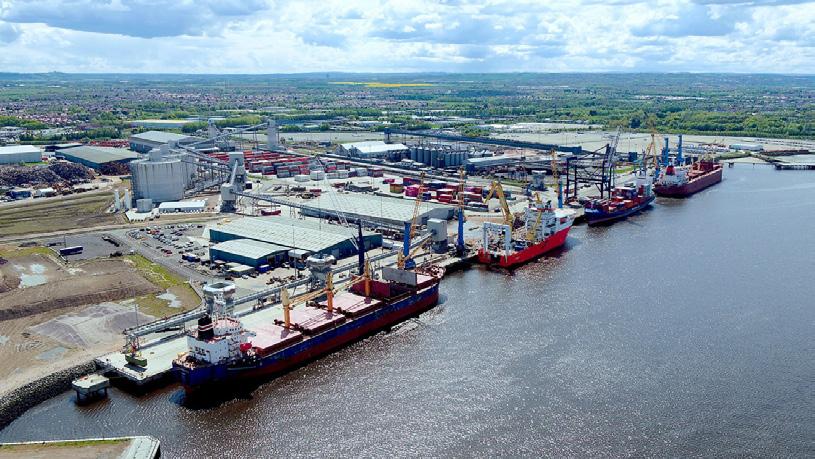
The Port of Tyne in the UK is testing new automated container movements using a 5G network that will support real-time data sharing, secure communications, and system integration.
Led by the North East Automotive Alliance (NEAA), with the backing of the UK government, this new initiative, dubbed the Port-Connected and Automated Logistics (P-CAL) project, is aiming to successfully demonstrate the use of a fully autonomous terminal tractor operating within a live quayside environment.
The new system will move containers between the quayside after discharge from ship and to the container compound, while incorporating continuous data exchange with terminal systems and remote operators that can coordinate with crane
PSA Singapore (PSA) and Cargo Community Network (CCN) have launched OptEModal, a next-generation, one-stop digital platform that enables faster, smarter and more coordinated sea-air intermodal transshipment by integrating real-time data streams across PSA terminals. OptEModal is an intermodal shipment management platform that allows the logistics community to track multimodal shipments to reduce cost and complexity for shippers.
movements and other port infrastructure.
NEAA notes: “It is expected to reduce costs, create skilled jobs and lay the groundwork for wider adoption of autonomous logistics across UK ports and distribution centres. With its focus on innovation, collaboration and environmental responsibility, P-CAL is not just a trial; it’s a bold step towards the future of freight.”
Cybersecurity specialist, ANGOKA, is developing a secure mesh network and the digital infrastructure that will allow communication between the autonomous vehicle, port systems, and operators maintaining high-frequency data transfer under real-world port conditions.
The P-CAL project is being funded through the CAM
Fundación Valenciaport has concluded its participation in the European project DT4GS (Digital Twin for Green Shipping) that is targeting faster decarbonisation of maritime transport through the use of digital twins. Fundación Valenciaport led the Living Labs concept to validate the Just-inTime (JIT) arrivals concept to improve coordination between ships and ports to reduce fuel consumption, emissions and waiting times.
■ Supported by UK government funding, the Port of Tyne is to test new automated terminal tractor-based container movements using 5G, a mesh network and digital infrastructure
Pathfinder – Enhancements programme, which is part of the UK Government’s wider £150 million Connected and Automated Mobility (CAM) strategy. This initiative is the responsibility of the Centre for Connected and Autonomous Vehicles (CCAV), in partnership with Innovate UK and Zenzic.
The nine-month project builds on earlier 5G CAL and V-CAL initiatives and brings together a consortium including the Port of Tyne, Oxa, ANGOKA, Vantec Europe, BP, Nissan, Newcastle University, Womble Bond Dickinson, and Connected Places Catapult.
Kaleris has launched its new Advanced Optimisation solutions, with the aim of optimising scheduling and dispatch across manned and automated RTGs and terminal trucks. Designed to complement the company’s N4 terminal operating system, the new solutions are expected to deliver faster job assignments and shorter cycle times to produce higher productivity and better fleet management, while ensuring safer working environments.







Reduced handling costs, shorter turnaround times, reliability and flexibility: Nemag grabs give dry bulk terminals throughout the world that competitive edge they need in today’s demanding market.
Driven to achieve the best performance, we closely listen to our clients’ needs. For almost a hundred years, Nemag’s innovative grabs make it possible to realize the highest productivity at the lowest costs.
Explore our comprehensive range of high-quality grabs and discover the power of great bulk handling.
From coal and iron ore to wheat, scrap metals, minerals and clinker: Nemag has the optimal solution for every dry bulk flow!
Contact us find out how we can take your bulk handling to the next level.



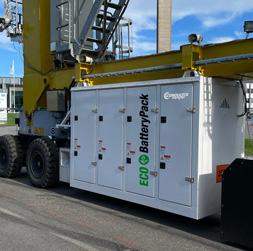
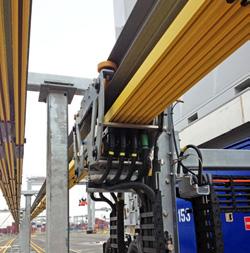
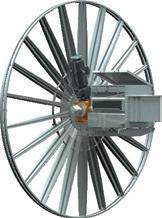
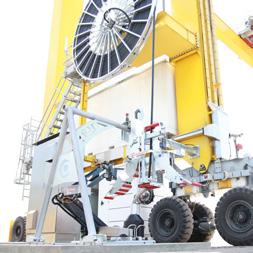


Converting a conventional RTG into an electrical one (E-RTG) means to shut down the diesel generator and to power the RTG with electrical power only – the emission saving, sustainable basis for automation. This is possible with electric power solutions, including E-RTG auto-steering and positioning systems, developed by Conductix-Wampfler: Drive-In Solution, Hybrid and e-Hybrid Solution, Full-Battery Solution and Motor Driven Cable Reel Solution. We move your business!
www.conductix.com
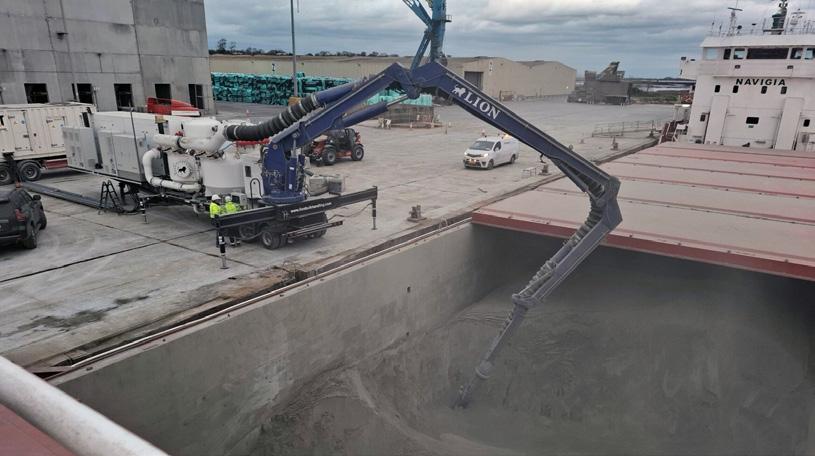
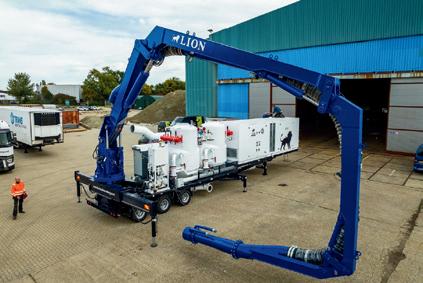
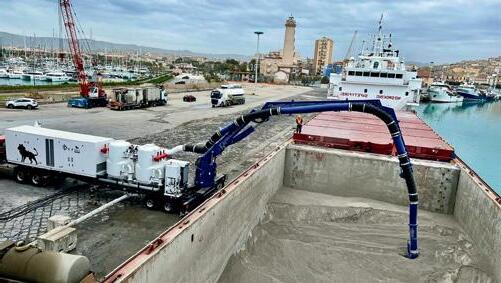
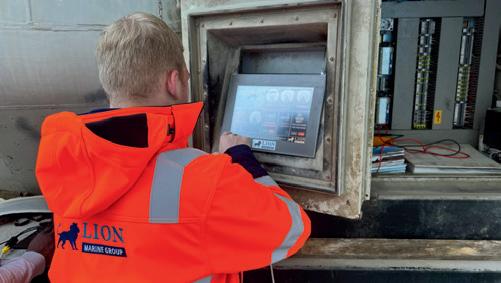
Lion Bulk Handling has launched a new innovative approach in ship unloader technology with the integration of Digital Twins. The use of Digital Twins in Lion Bulk Handling’s ship unloader systems offers benefits for bulk material handling activities, including:
● Operational Efficiency
In bulk material handling, reliability and efficiency are critical. By leveraging real-time data, Digital Twins simulate various operating conditions to optimise ship unloader performance. This fine-tuning ensures faster and more effective material transfer, reducing handling time and improving overall efficiency. This means operators can use the Digital Twin to identify bottlenecks or inefficiencies
in the unloading process, plus adjust configurations to optimise operations, ensuring that every moment is as productive as possible.
● Predictive Maintenance
Unplanned downtime is one of the costliest challenges in bulk handling operations.
Digital Twins mitigate this risk by enabling predictive maintenance. Sensors embedded in the ship unloaders continuously feed data into the virtual model, allowing it to monitor the condition of critical components in real time. By assessing patterns and trends, the Digital Twin can identify early warning signs of wear or failure.
● Training and Safety
Digital Twins provide a safe, virtual environment for operator training. Instead of learning on
India’s Union Minister of Ports, Shipping and Waterways is launching three new digital initiatives to boost maritime efficiency and productivity:
● Launch Sagar Setu platform: It integrates multiple service providers to ensure seamless export import related services by reducing processing times for vessel and cargo documentation, thereby promoting faster and paperless logistics.
● Develop and establish Digital Centre of Excellence (DCoE):
The Ministry of Ports, Shipping and Waterways (MoPSW) and Centre for Development of Advanced Computing (C-DAC) signed a memorandum of understanding to establish a DCoE for the maritime sector to provide advanced information technology solutions, foster innovation, and guide the modernisation of port operations and shipping logistics through emerging technologies like artificial intelligence, internet of
things and blockchain. It will also prioritise green and sustainable operations, aligning with Maritime India Vision 2030 and Amrit Kaal Vision 2047.
● Release of a Standardised Scale of Rates (SOR) template for all major ports: To enhance transparency and ease of doing business by addressing inconsistencies and interpretation issues by providing a uniform structure for port tariffs. live equipment, where mistakes can lead to costly damage or safety risks, operators can practice using the Digital Twin. This training tool replicates realworld conditions, allowing users to gain hands-on experience and confidence before working on physical systems. Digital Twins enhance safety by identifying potential hazards in the unloading process. By simulating various scenarios, the technology can highlight risks and recommend mitigations, fostering a safer working environment for all.
Dutch logistics company
Samskip has joined the Digital Container Shipping Association (DCSA) partnership. “We believe the future of logistics relies not just on smart systems, but on a shared digital language,” says Ragnar Thor Ragnarsson, Chief Information Officer, Samskip. DCSA is a nonprofit organisation founded by 10 of the world’s largest ocean carriers to help shape the future of digital logistics. Samskip is a multimodal operator across shortsea, rail, road, and inland waterways.
Kalmar has launched Inspector, a digital application that streamlines routine inspections of materialhandling equipment. Timely, regular inspections of handling equipment are critical to ensuring safety, optimal performance and compliance with company health and safety practices and local regulations. Inspector allows accurate document inspections, stores data digitally and identifies and records maintenance needs. It is an optional module of the MyKalmar INSIGHT subscription.
Leading vendor for simulation-based training solutions in the ports, construction, and utilities industries, CM Labs Simulations, has an ultrarealistic remotely operated rubber-tired gantry (ROS RTG) training solution, expanding its Remote Operating line of products. ROS RTG comprises a remote operating desk from Spohn + Burkhardt and the Intellia ROS RTG Training Pack by CM Labs, to ensure training remotely without disrupting port operations.
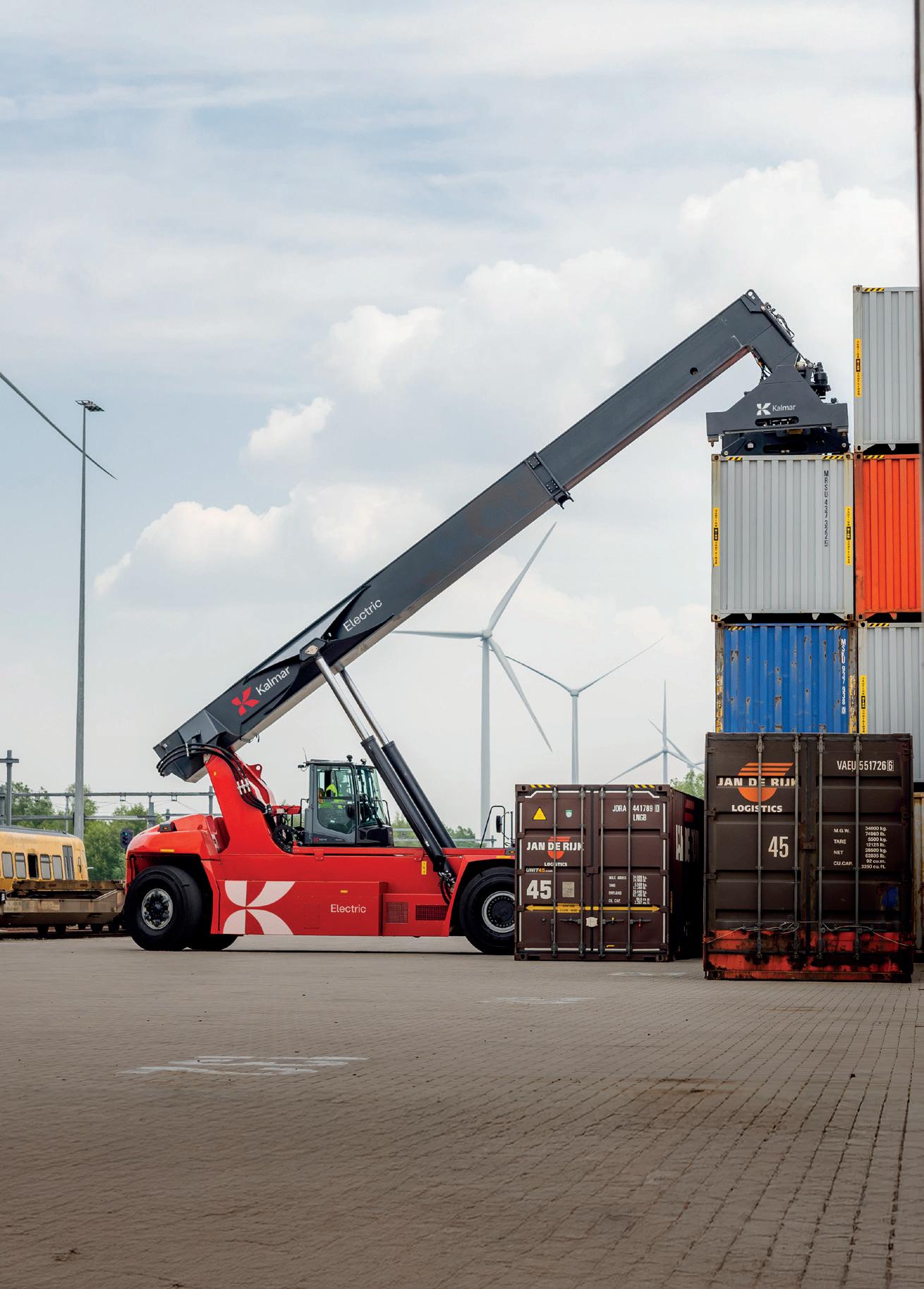
Decarbonise your operations.
Kalmar’s electrically powered reachstacker produces zero emissions at source, while maintaining the highest levels of productivity and safety. With a range of modular battery options and charging solutions available, we can design a solution that will deliver for your business.
Kalmar, making every move count.
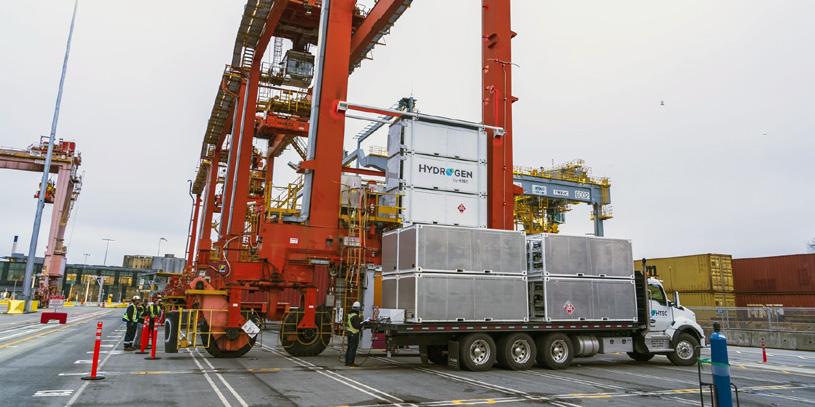
A range of different port projects have been announced relating to the use of hydrogen based technologies to reduce equipment emissions.
The French Port of RochefortTonnay-Charentes has deployed Canadian dynaCERT’s hydrogenbased technology, HydraGEN, to reduce greenhouse gas (GHG) emissions from port tools, machinery, and equipment. The port reports that this is the first time that HydraGEN technology, an aftermarket unit which produces hydrogen and oxygen on demand through an electrolysis system, is being used on a crane.
The €58,000 unit was deployed on the first crane on July 1, 2025, although it has been part of ongoing tests since December 2024. Similar units are expected to be installed on four other cranes before the end of 2025 because the port has concluded that the use of HydraGEN contributes to a reduction in GHG emissions.
At multiple ports in Japan, Mitsui E&S has confirmed
commencement of field trials of hydrogen-powered RTGs, as part of ports collectively targeting widespread decarbonisation of terminal operations. The trials involve retrofitting existing diesel RTGs with hydrogen fuel cell systems or hydrogen internal combustion engines (ICE).
Further developments are ongoing in North America. At the Yusen Terminals Inc. (YTI) facility at the Port of Los Angeles, a Mitsui PACECO H2-ZE hydrogen fuel cell RTG is now in operation. This RTG has a 100kVA class fuel cell with a rated output of 60kW (DC 650V) and stores 64kg of hydrogen, which can support 16 hours of operational activity.
At the Canadian West Coast Port of Vancouver, DP World has confirmed the successful completion of the testing of a hydrogen fuel cell-powered RTG, as part of the BCH2 Ports Project at the operator’s Centerm facility. This initiative currently funds a “large-scale project to use hydrogen and fuel cells
■ Use of hydrogen power is gathering pace on a global basis, with more machinery being powered in this way across ports in Japan, the US, Canada (shown in image) and elsewhere
in the shipping and transportation sectors.”
DP World states that its 19 RTGs at Centerm account for 50% of diesel consumption and generate more than 4,200 tonnes of CO2 emissions annually.
“The system operated continuously for 16 hours, lifting and lowering a 40-tonne load 105 times, emitting only steam compared to the 400kg of CO2 produced by a comparable diesel unit, explains Scott Mason, President and CEO of TYCROP Manufacturing Ltd, one of DP World’s partners on the project. H2 Portable, HTEC and Loop Energy are also all involved in the initiative.
The operator has confirmed plans to convert its 25 diesel RTG cranes in Vancouver and Prince Rupert to hydrogen-electric power to support future zeroemissions objectives.
Port of Manaus operator, Super Terminais Comercio e Industria Ltda (Super Terminais), has placed a repeat order for three Konecranes Gottwald ESP.10 pedestal-mounted cranes. The deal was booked in Q2 2025, with handover scheduled for Q3 2026. With a maximum reach of 64m and a strong lifting capacity curve, the pedestal-mounted cranes can handle containers and general cargo on vessels as large as super-postPanamax class. The cranes can be connected to onshore electricity supply.
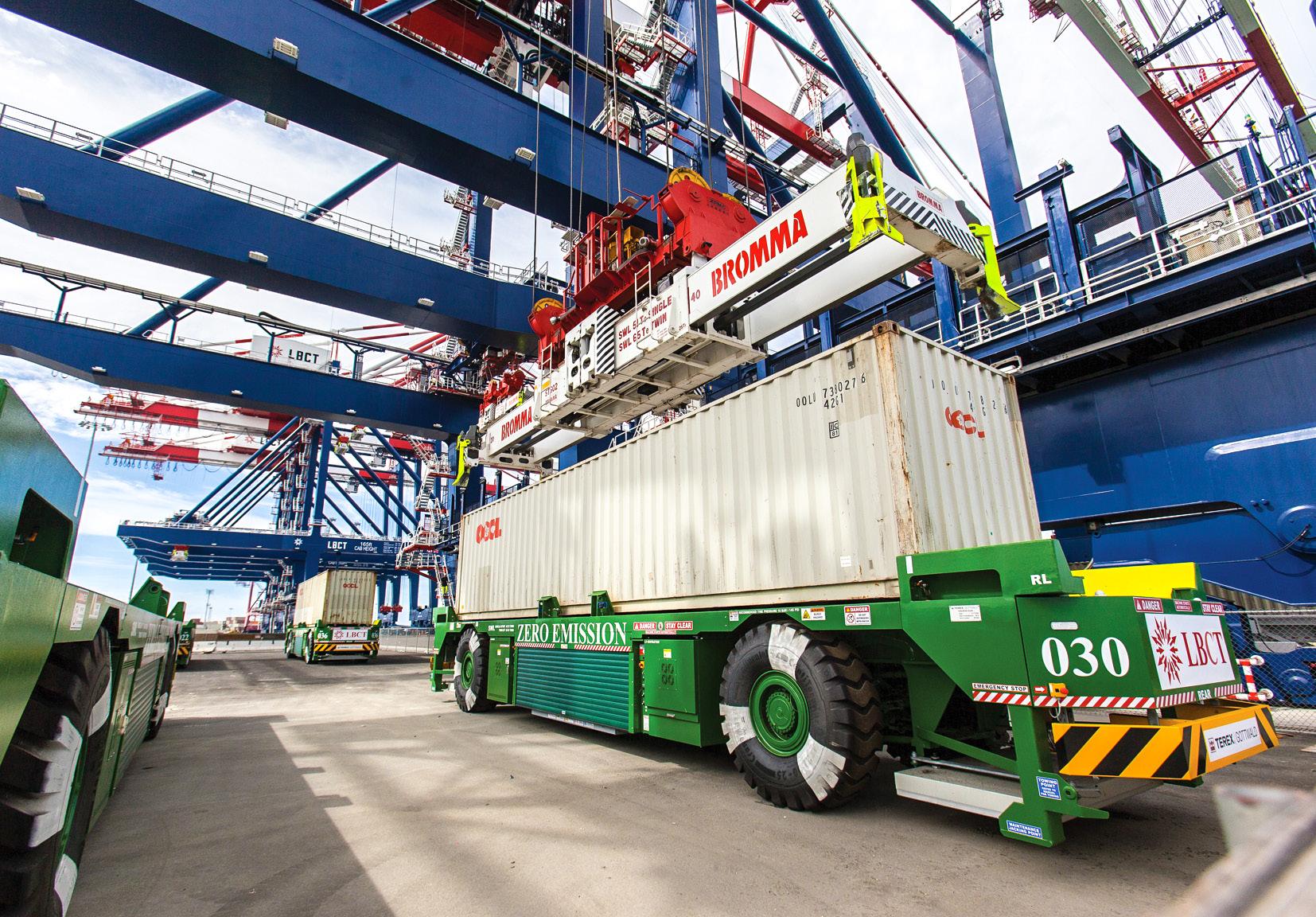
APM Terminals and SANY Marine have signed a Master Framework Agreement for the future supply of battery-electric terminal tractors to APM Terminals. Under the new deal, 500 diesel-powered terminal tractors across the APM Terminals’ global network will be replaced with batteryelectric models by 2030. The agreement moves from a traditional capital expenditure (CAPEX) model to a fullcycle partnership, providing end-to-end support for the operation, maintenance and optimisation of the equipment throughout its lifespan, states APMT.
AGVs are critical components of automation in a port, moving containers autonomously from quayside to storage yards with manual involvement.
Hyundai Rotem has confirmed a new contract for Dongwon Global Terminal Busan at Pusan New Port, Pier 7. This deal will see the supply of 57 automated guided vehicles (AGVs) and associated control systems, chargers, and ancillary equipment.
Hyundai Rotem is already a key provider of this type of equipment, previously delivering 43 AGVs to Dongwon Global Terminal in the same port and a further 44 AGVs for Yeosu Gwangyang Port Authority (YGPA) in 2024.
The Cimolai Technology Group, comprising multiple companies, is currently assembling two 800-ton lift capacity railmounted Goliath cranes at its dedicated facility in Chiogga, Italy. Each crane is 110m high and has a rail span of 118m, with the design allowing both independent and tandem activities, with a joint lift capability of 1600 tons, to ensure maximum operational flexibility.










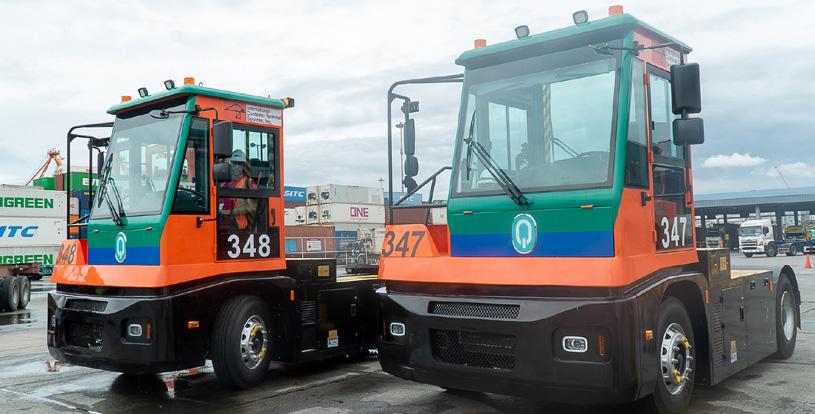
The flagship terminal of International Container Terminal Services, Inc. (ICTSI), Manila International Container Terminal (MICT), has confirmed deployment of two fully electric terminal tractors. The move represents the first time this type of equipment has been used at a Philippine port.
MICT says it is piloting the use of electric vehicles to help improve energy efficiency and reduce emissions in its port operations. Furthermore, the effort supports ICTSI’s
environmental strategy and commitment to achieve net-zero greenhouse gas emissions by 2050. The company is gradually introducing cleaner energy and equipment across its global terminals.
The two Qomolo E-truck S2 units were manufactured by Shanghai Westwell Technology Co., Ltd. Powered by lithium iron phosphate batteries, the tractors have a rated motor power of 263kW and a peak output of 410kW. Each unit operates with zero emissions.
■ Two fully electric terminal tractors at MICT represent the first deployment of this kind in the Philippine ports sector – the units will reduce emissions while supporting sustainable operations
MICT will assess the performance of the E-truck S2 units before considering wider deployment.
Qomolo was created in 2016 and has a mission to “create more possibilities on behalf of human beings,” using AI to empower smart transportation to release manpower from dangerous activities.
Kalmar has introduced a new second-generation lithium-ion (Li-ion) battery solution for its range of electrically powered counter balanced equipment covering reachstackers, empty container handlers and forklifts.
The new battery system is said to deliver enhanced energy capacity, improved thermal stability, and a longer, more predictable performance curve across a wide range of operating
environments. The solution is now available globally with the European standard, while versions for the US and Chinese standards will follow in 2026.
With the Gen 2 solution, Kalmar electric equipment will substantially improve the battery capacity, e.g. Kalmar electric reachstackers will, in a heavy-duty application, be able to operate up to 10 hours providing greater flexibility and uptime in
demanding terminal environments.
At the same time, Kalmar has introduced Automation as a Service, a subscription-based model designed to ensure successful and efficient deployment of automation in marine container terminals and intermodal sites. The service focuses on accelerating time-tovalue and building long-term performance-focused partnerships with automation customers.
Notable in Kalmar’s busy order book are projects on the north and south coasts of France.
A deal has been signed with Hanseatic Global Terminals (HGT) to supply 14 Kalmar hybrid straddle carriers for the company’s Atlantique multimodal terminal (operated by Compagnie Nouvelle de Manutentions Portuaires Le Havre (CNMP LH)), with delivery due in Q2 2026.
Also, Kalmar is supplying 11 Kalmar hybrid straddle carriers for the Seayard Terminal FOS2 XL container terminal in Fos-sur-Mer, France. The order additionally includes MyKalmar INSIGHT coverage and full delivery is expected in Q2 2026.
Irish-based manufacturer Combilift, a specialist in multi-directional and customised handling solutions, has been awarded the prestigious Red Dot Award for Product Design 2025 for its Combi-CB70E, highcapacity, electric-powered multidirectional forklift, developed to meet the needs of heavy-duty, long-load handling in more sustainable ways. The Combi-CB70E is a 7-tonne capacity electric counterbalance forklift, specifically designed for handling long and bulky loads in confined or challenging spaces.
Leading global suppliers of fire suppression systems for machines and vehicles, Fogmaker, is strengthening its presence in Southeast Asia. Fredrik Rönnqvist is the new regional manager and will lead the company’s focus on meeting the evolving needs of customers for Fogmaker’s advanced, environmentally friendly, and comprehensive fire suppression solutions.
FERNRIDE is launching driverless operations at HHLA TK Estonia. The operations have been granted a certification of safety concept and system design by TÜV SÜD, and regulatory approval from the Estonian Transport Administration (ETA), under the EU Machinery Directive (2006/42/EC). FERNRIDE and HHLA TK Estonia have been cooperating since January 2023 to prepare for these live autonomous operations, with the vehicle, sensors, computers, and software meeting all EU requirements.
Hutchison Ports ECT Rotterdam (ECT) has ordered a Konecranes Automated Horizontal Transport System as part of modernising and electrifying its operations. The deal will see Konecranes supply an advanced Automated Horizontal Transport (AHT) System, supporting the ECT Euromax terminal’s transition to fully electric operations.
The new order was booked during H1 2025 and consists of 42 Li-Ion Konecranes AGVs and Automated Charging Stations with fast-charging capabilities.
The AGV batteries, during both operations and the charging process, are monitored by a Battery Management System, which collects and stores operational and charging data to secure efficient battery operation and long-term reliability.
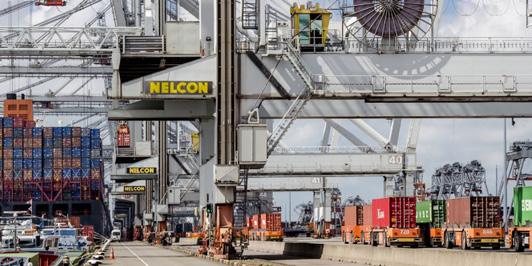
ECT confirms that the AGVs are designed for fully automated container handling and are capable of operating seamlessly sequencing with Ship-to-Shore Stacking Cranes (ASC). Equipment
Konecranes has launched a new E-Hybrid Rubber-Tired Gantry (RTG) and electric empty container handler for the global market as part of reaching its goal of having fully electric variants of its entire port equipment portfolio available by 2026.
Konecranes says that its new E-Hybrid RTG represents an expansion of hybrid power beyond traditional diesel-battery RTG operation to electric-battery operation. This is a vital option for terminals currently unable to drop diesel power given the need for back-up if blackouts occur. This is because even short, one- or two-second blackouts cause emergency stops, brake issues and maintenance problems, while longer outages halt operations completely.
“Blackouts are a clear operational risk for a number of our terminal customers, so the Konecranes E-Hybrid RTG, with a combination of onboard batteries and busbar or cable reel electricity supply, solves that problem. But the E-Hybrid RTG is a gamechanger for all customers on the road to fully electric container handling and lower emissions,” says Thomas Gylling, Director of Marketing & Customer Experience, Port Solutions, Konecranes.
■ ELME Spreader is upgrading and expanding its production methods and facilities to support its new Vectrix crane spreader series. With this enhanced production capability, the company is focussing on meeting market demands and adapting to customer needs by investing in technology and process development to create a more flexible production chain. “We are proud to introduce this improvement, which not only enhances our production efficiency but also strengthens our ability to deliver products to our customers on time and with the highest quality,” underlines Gösta Karlsson, Founder and President, ELME Spreader AB.
dship Carriers has confirmed a new order for eight Liebherr LS 250 heavy-lift cranes for its D 500-class vessels. Each crane has a maximum lifting capacity of 250 tonnes, with a 36m outreach and can support vessel lifting requirements in the Great Lakes-Atlantic trade corridor. Manufacturing of the cranes will be at Liebherr’s Rostock facility before onward delivery in 2026 to China for subsequent installation on four confirmed newbuild vessels.
The Port of Tilbury, part of the Forth Ports Group, is partnering with Continental to enhance operational performance, safety, and sustainability. The port has over 500 tyres in continued use across its fleet of equipment. Three YardReader stations have been installed to support datadriven decision-making, to help reduce downtime by 20%. The port also notes the durability and fuel efficiency of StraddleMaster tyres, reducing fuel consumption by up to 30%.
Cavotec, a global leader in electrification and automation solutions for ports, has launched PowerAlign, a new modular, mobile shore power solution designed specifically for container terminals. The system’s enclosed cable reel, mounted at the quay edge, ensures extended cable life and minimal maintenance –a major advantage in space-constrained and high-traffic terminals – and helps keep the quay clear.
The empty container handler joins other electric trucks in the 10-18t & 18-25t ranges.
The first pure electric tugboat has called at DaChan Bay Terminals in the Port of Shenzhen. Operated by Shenzhen DaChan Bay Towing Co., Ltd., in which DaChan Bay Terminals has an equity stake, “Shen Gang Dian Tuo 1” officially commenced operations in mid-July after tests. Equipped with a high-capacity battery system of 6,880 kWh, it is currently the most powerful pure electric tugboat in South China.
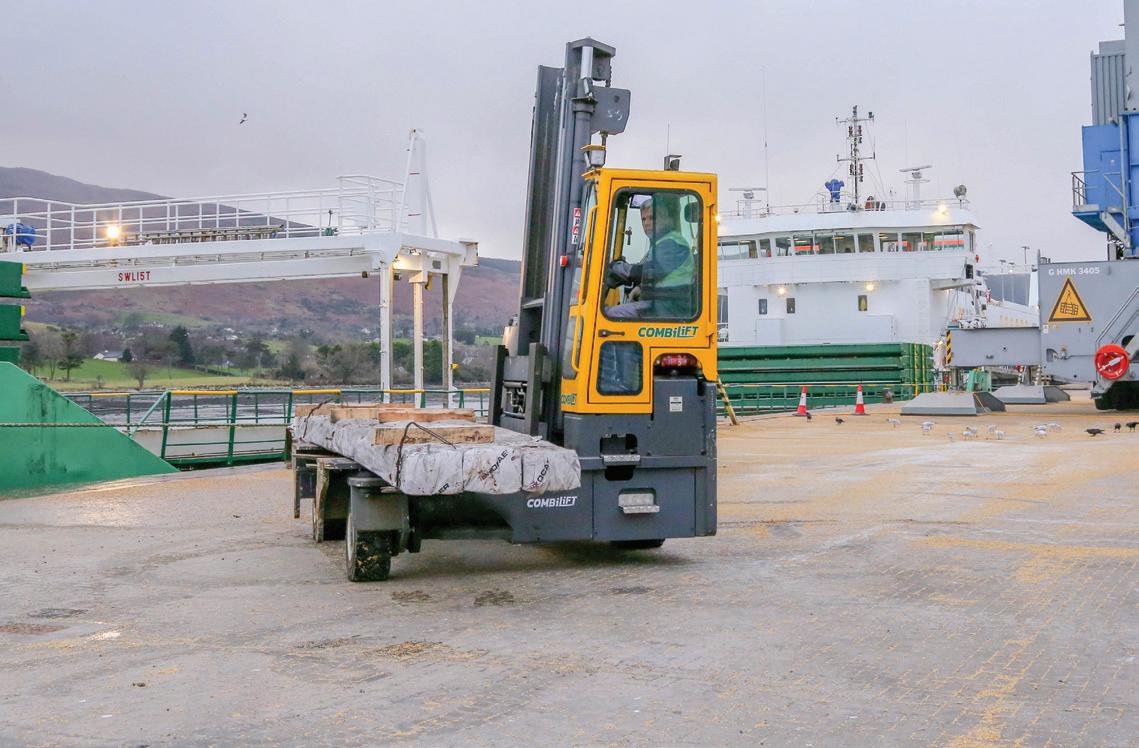
For 25 years, Combilift has been revolutionising the way companies handle and store goods. Our pioneering product range of multidirectional, articulated and pedestrian forklifts, straddle carriers and container loaders allows you to manoeuvre long loads safely, reduce aisle widths and increase the amount of space available for storage.
CONTACT US TODAY
To find out how Combilift can help you unlock every inch of your storage space.

full access to GreenPort incorporating Port Strategy today with our online and digital subscription. GreenPort is the multi-media platform for environmental officers and policy makers within ports, as well as port professionals concerned with environmental best practice and corporate responsibility. Stay up-to-date with new products, innovations and developments which impact their

BARRY PARKER
While North American ports saw funding gains from the Feds in Fiscal Year 2024 related to Harbor Maintenance Tax collections, these were pulled back in FY2025, with proposed FY2026 allocations keeping the same cutbacks.
The ports, quite sensibly and correctly (this is an opinion piece, after all) have argued that they are necessary, vital, and even critical to infrastructure and commerce on a general level. Indeed, port projects support economic development with hefty multipliers of benefits compared to investment outlays.
Taking a high level view, maybe from 42,000 feet, thinking of that old Byrds song, there are broader currents beginning to flow through US maritime policies, with potentially outsized gains for US flagging of shipping tonnage and the associated development of vessel construction and repair facilities. We’ve seen this in the dictates from the office of the US Trade Representative (USTR) and within inchoate policies being formed to “Restore

Political considerations continue to be profound influencers on North American ports
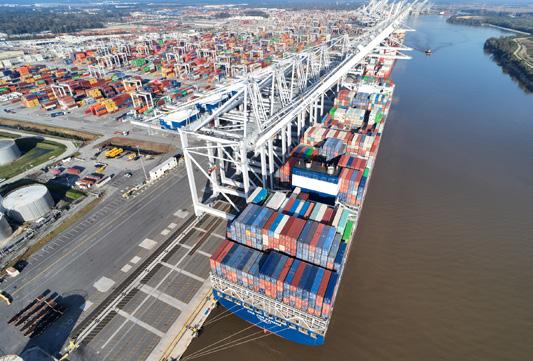
America’s Maritime Dominance,” a document issued in April 2025, during the first 100 days of the current Administration.
So, I’m wondering where seaports might fit into this emerging matrix? For the ports, supporting vessels of a specific registry, even one very close to home, could be a very tricky, though not entirely impossible, channel to navigate. But the April 2025 document is replete
Recently, the Russian government added the seaports of Berdiansk and Mariupol in occupied Ukrainian territory to the list of ports of the Russian Federation open to foreign vessels, a move strongly condemned by Ukraine and a breach of international sanctions. This development highlights how relevant ports and shipping are in international sanctions, but also that securing compliance with sanctions is far from straightforward. In shipping, hundreds of old oil vessels are used to avoid sanctions on Russian oil trade, even though it is quite well known where they are sailing and what they
with language alluding to infrastructure which benefits overall US “security” (however you define that).
Later this year, a group of Executive branch agencies will be releasing a report with plans on how the US might: “…invest in and expand the Maritime
Industrial Base including, but not limited to, investment and expansion of commercial and defense shipbuilding capabilities, component supply chains, ship repair and marine transportation capabilities, port infrastructure, and the adjacent workforce.” Ports, in their (typical) role as landlords, have a great deal of sway when it comes to landside real estate, and should be watching closely as decision makers in the White House develop their plans. Over the decades, the role of builders of commercial vessels has declined, but the infrastructure still exists. The early 2020s have seen port and regional planners’ abilities to re-purpose old and dormant facilities, with offshore wind (a separate topic, to be sure, especially when Washington, DC policies are part of the discussion) coming to mind. There may be some useful and readily applicable lessons here as the US maritime infrastructure evolves in the coming months and years.
Probably emboldened by the inability of (international) institutions to enforce sanctions, Russia is moving towards re-opening ports in occupied Ukrainian territory
are shipping. This shadow fleet has enabled Russia to generate large revenues, which have helped sustain its war in Ukraine. It has been shown that multiple western shipowners and ship agencies benefitted from this shadow fleet.
Probably emboldened by the inability of (international) institutions to enforce sanctions, Russia has now taken a step aimed at re-opening the seaports of Berdiansk and Mariupol in occupied Ukrainian territory. An IMO resolution agreed to consider
these ports as closed and calls on member states to ensure no ships call at these ports. Russia’s new move calls for developing an effective ‘compliance regime’ to prevent that these ports will effectively become ‘shadow ports’ which manage to handle ships notwithstanding the sanctions and the IMO resolution. With all the international turmoil currently ongoing, the public and policy attention required for developing an effective compliance regime are not guaranteed.
The first step towards effective compliance seems to be effective monitoring of any loading and unloading activity in both ports. The most intuitive additional step in a compliance regime would be for Türkiye to close the Bosporus for ships originating from Berdiansk and Mariupol. That would be in line with Türkiye’s official position that it is bound by UN sanctions, but nothing beyond that. In any case, this development further puts the spotlight on Türkiye, and its evolving relations with the US, EU, and Russia.


Sponsors:



Meet and network with over 200 attendees representing port authorities, terminal operators and shipping lines. For more information on attending, sponsoring or speaking, contact the events team: visit: greenport.com/congress tel: +44 1329 825 335 email: congress@greenport.com


DAY ONE - Wednesday 15th October 2025
08:30 Coffee & Registration
09:30 Welcome by Chairmen
Christopher Wooldridge, Science Coordinator EcoPorts EcoSLC
Mark van der Veen, Director of the Graduate School of Business, University of Amsterdam
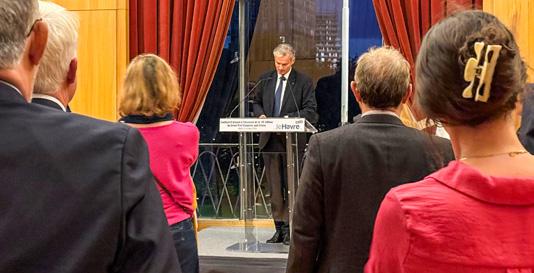
09:40 Welcome Address
Hon Dr Chris Bonett, Minister for Transport, Infrastructure and Public Works
Kurt Farrugia, CEO, Transport Malta
09:55 ESPO Environmental Report
Tim Verhoeven, Senior Policy Advisor – Sustainable Development, ESPO
10:20 ECOSLC Environmental Report
Marti Puig Duran, Chemical Engineer & University Lecturer, Polytechnic University of Catalonia
10:45 Question & Answer Session
11:00 Coffee & Networking
Moderator: Mark van der Veen, Director of the Graduate School of Business, University of Amsterdam
11.30 The sH2unter@ports project
The sH2unter@ports project, consisting of six project partners ranging from port operators and rail transport companies to research institutes, investigated the conversion of shunting operations in the ports of Hamburg and Bremerhaven to climate-neutral drives.
Insa Pohlenga, Ministry of Economic Affairs, Ports and Transformation, Unit 32 – Environmental and Climate Matters, Free Hanseatic City of Bremen
11:45 Port of Hamburg as a Centre for Green Hydrogen Manfred Lebmeier, Senior Environmental Advisor, Hamburg Port Authority

12:00 How targeted lubrication strategies can support sustainability in the port industry
Klüber Lubrication helped VLI cut energy use by over 5%, reduce CO₂ emissions, and extend equipment life through a gear oil upgrade, enhancing efficiency and sustainability in port operations
Christian Kiefer, Business Development Manager, Klüber Lubrication
12:15 The BlueBARGE Project
The BlueBARGE Project addresses the design, development, and demonstration of an optimum power-barge solution to support offshore power supply to moored and anchored vessels, limiting local polluting emissions and global GHG footprint in a life cycle perspective, following a modular, scalable, adaptable, and flexible design approach.
Ignacio Benítez, PhD, Senior Project Manager - Innovation & Port Cluster Development, Fundacion Valenciaport
12:30 Question & Answer Session
12:45 Lunch & Networking
3.1 Renewables, Reclamation & Responsible Economic Growth
Moderator: Christopher Wooldridge, Science Coordinator EcoPorts EcoSLC
14:10 Nature-Based Solutions
A promising future for ports amidst an increasingly complex political, environmental, and economic landscape.
Niels van Kouwen, Maritime and Resilience Consultant/ Specialist, Haskoning
14:25 ISO Guidance on In-Water Cleaning
The upcoming ISO 6319 standard will guide ports in approving in-water hull cleaning, preventing invasive species spread and reducing emissions through improved hull smoothness and reduced fuel use.
Irene O. Tvedten PhD, Senior Advisor, Bellona Foundation
14:40 Dredging for Sustainable Infrastructure: The Port Focus
Arnold de Bruijn, Director, IADC
15:10
15:30 Coffee & Networking
3.2 Workshop 1
Moderator: Marti Puig Duran, Chemical Engineer & University Lecturer, Polytechnic University of Catalonia
The workshop will explore: What is the role of circular economy in port sustainability? How can ports measure circularity through meaningful indicators? What are the benefits of integrating circular strategies into port operations and reporting? And how can ports foster innovation and collaboration through circular practices?
Note: workshops must be booked in advance due to limited numbers. Please contact the team at info@ greenportcongress.com to confirm.
4. Ports of the Future.
Innovation, energy transition and new roles for the port beyond 2050. How will ports contribute to decarbonization
Moderator: Dr. Mark van der Veen, Director of the Graduate School of Business, University of Amsterdam
16:00 Edvard Molitor, Head of International Public Affairs and Sustainability, Port of Gothenburg & Chair, IAPH Climate and Energy Committee
Tim Verhoeven, Senior Policy Advisor Sustainable Development, EcoPorts Coördinator, ESPO
Jan Egbertsen, Manager - Innovation, Port of Amsterdam
Koen Hamels, Port Environment Advisor, Port of Antwerp-Bruges
4.2 Workshop 2
Moderators: Marti Puig Duran, Chemical Engineer & University Lecturer, Polytechnic University of Catalonia
Chris Wooldridge, Science Coordinator EcoPorts EcoSLC
Calming the Waters – Delivering Sustainable Cruise Operations*
This workshop will explore both the positive impacts and contentious challenges of cruise operations—shifting the focus from purely economic concerns to the environmental, social, and cultural dimensions of sustainability. Key questions to be debated:
• What challenges and strategic recommendations could shape sustainability in the cruise industry?
• How can we bridge the gap between policy and practice to better support local communities and economies?
*Note: We are limited to 35 participants per workshop.
17:20 Day 1 Round Up with Chairs
17:30 Conference Close
19:00 Conference Dinner
Join us for 3 courses in Taste History. On arrival guests will be welcomed with a glass of prosecco followed by flowing wine and water served throughout the experience. The menu will be thematic and historical with chefs providing a bespoke menu as researched by their curatorial team.
The Malta Maritime Museum, Xatt l-Assedju l-Kbir, Birgu BRG 1721, Malta

DAY TWO - Thursday 16th October 2025
08:30 Coffee & Registration
09:00 Opening by Chairman/Moderator
Christopher Wooldridge, Science Coordinator EcoPorts EcoSLC
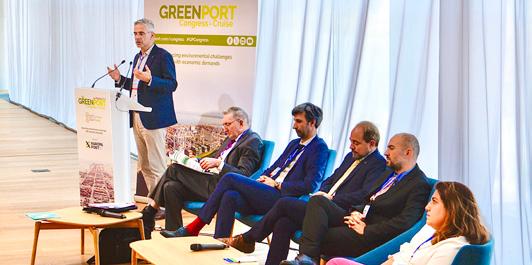
09:10 Keynote 1: Strategy for Resilience and Decarbonisation
Challenges for EU ports from the perspective of Port Authorities and Terminals are particularly relevant, this session will look at macro and micro challenges faced by members, and outline their expectations at a time when the European Commission is developing the EU Ports Strategy.
Panel Moderator: Christopher Wooldridge, Science Coordinator EcoPorts EcoSLC
Panellists include:
Isabelle Ryckbost, Secretary General, ESPO
Lamia Kerdjoudj. Secretary General, FEPORT
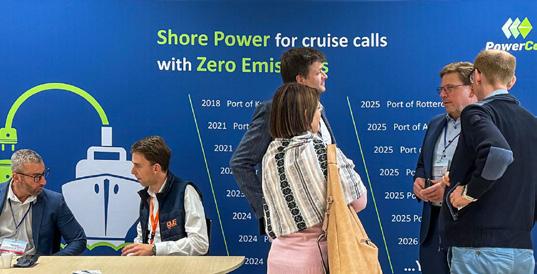
09:40 1.2 Plug in for the Planet: Shore Power Contracts and the Path to Implementation speakers to be announced
10:25 Coffee & Networking
10:50 Panel Moderator: Nicolette van der Jagt, Panellists include:
Lamia Kerdjoudj, Secretary General, FEPORT
Jon Kuiper, Senior Policy Advisor – Dutch Supply Chain Digitalisation, Dutch Ministry of Infrastructure
12:10 Roundup with chairs
12:20 Lunch & Networking
Handover to Day 1 of Decarbonising The Future
Including the following sessions:
• 2030 and Beyond: Steering European Ports Towards Emissions Compliance and Growth
• Regulating for the Future: A Framework for Greener Seas and Smarter Ports
• Delivering Energy Infrastructure for a Carbon-Neutral Maritime Sector
• The Port Gridlock: Can National Energy Systems Support Electrified Harbours?
Featuring speakers from Port of Oslo, Port of Helsinki, Port of Koper, Valletta Cruise Port and more. Visit https://www.dtfconference.com/programme-and-speakers for more information.
16:00 Boat tour of Valletta Grand Harbour
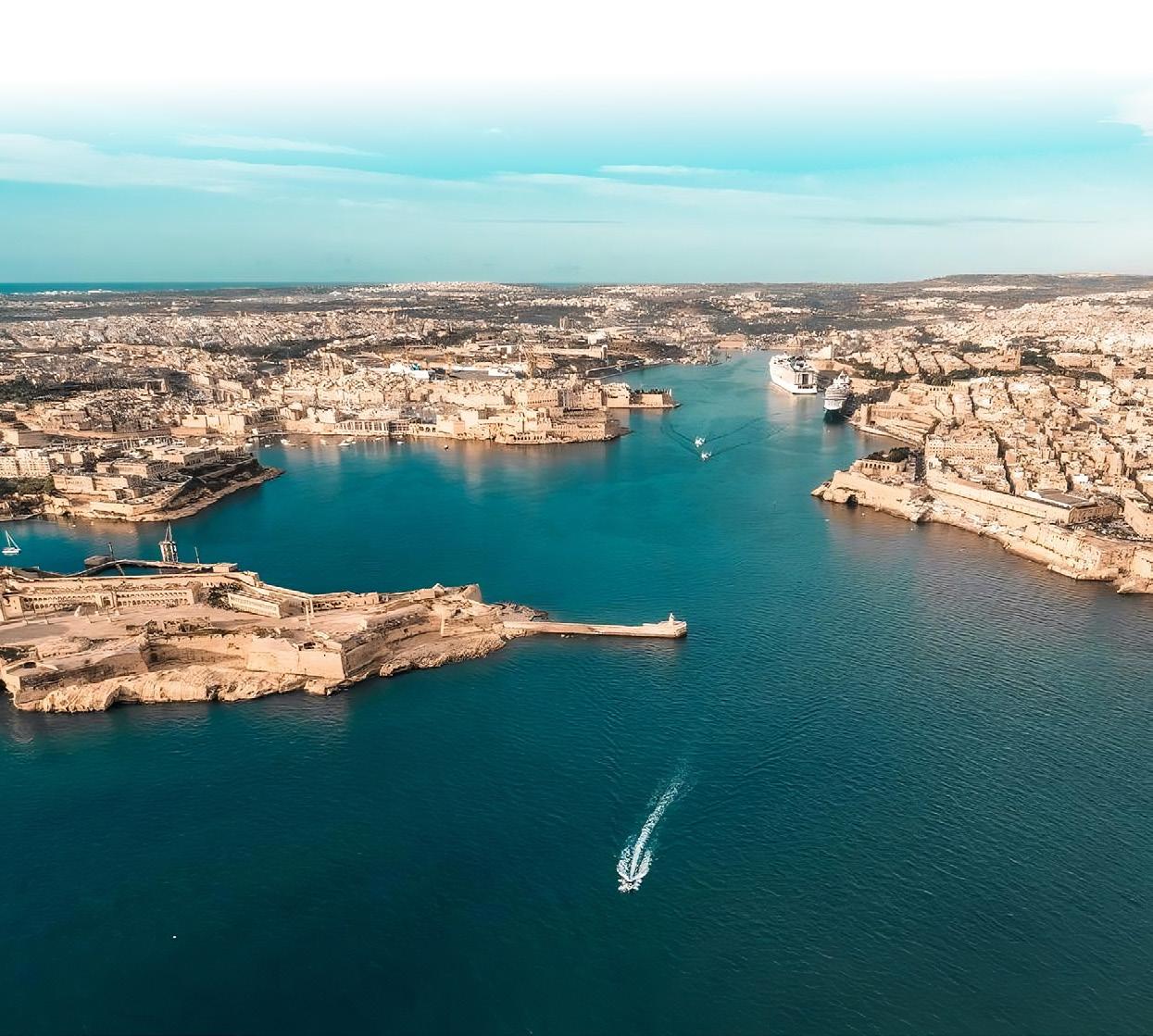
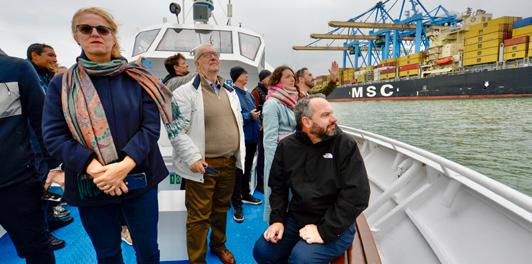
A boat port tour of Valletta’s Grand Harbour and a chance to see Phase 1 of Malta’s OPS port electrification projects in action. With over 73 vessel connections in one operational year, this port tour will also give delegates an insight into Phase 2 and what’s in store for future cargo and RoPax vessel connections.
19:00 Networking Drinks - Hosted by Transport Malta
The Networking Reception is a networking icebreaker, which provides the perfect opportunity to consider the topics and working groups during the previous two days. Gardjola Gardens, Senglea, Malta
AY THREE - Friday 17th October 2025 -
16:00 A coach tour to Port of Marsaxlokk run by Malta Freeport Corporation which will showcase the plans for the Phase 1 construction and Phase 2 tender.
GreenPort Congress
Delegate rate in EUR is €2,390.00 and includes:
n Three day conference attendance at GreenPort Congress (15-16th Oct) & DTF: Shore to Ship Conference (16-17th)
n Full documentation in electronic format - Conference Handbook and Presentations Download.
n Lunch and refreshments throughout
n Place at the Gala Dinner (15th October 2025)
n Place at the Networking Reception (16th October 2025)
n Place at the Port Tour (17th October 2025)
Click here to buy
**Alternatively, you can call us on +44 1329 825335
**Currency will default to GBP - Enter your country name to change the currency.
Booking Online: www.portstrategy.com/greenport-cruise-and-congress or complete form and return to sales@greenport.com On receipt of your registration, you will be sent confirmation of your delegate place.
BOOK ONLINE OR COMPLETE THIS FORM AND RETURN TO SALES@GREENPORT.COM
Please copy this form for additional delegates)
Please tick all that apply:
Please register me for GreenPort Congress (15-17th Oct) & DTF: Shore to Ship Conference (16-17th) - 3 days
Gala Dinner (15th Oct 2025) – No additional cost Networking Reception (16th Oct 2025) – No additional cost
Port Tour (16th Oct 2025) - Valletta Grand Harbour, no additional cost
Port Tour (17th Oct 2025) - Port of Marsaxlokk, no additional cost
Members of supporting associations will receive a discount I am a member of
Family Name
Country
First Name Telephone
Title Mr/Mrs/Ms/Dr/Other
Company
Job Title
Company Address
Signature
Company VAT No.
HOW TO PAY *UK registered companies will be charged the standard rate Maltese VAT
Bank Transfer: Mercator Media Ltd, HSBC Bank plc, GBP account, Sort Code: 40-21-03, Account number: 91894919
SWIFT/BIC8: HBUKGB4B BRANCH BIC11: HBUKGB4131C, IBAN: GB61 HBUK 4021 0391 8949 19
NB: Prepayment is required in full for entry to the conference. Cancellations are not permitted, however substitutions are allowed.
Credit/Debit Card: Complete the form with your card details I have paid by bank transfer
Please charge my card (delete as appropriate) Mastercard/Visa/Amex
Card Number
Name on Card
Credit Card Billing Address
Security Code
Expiry Date
Signature SPACE AT THE CONFERENCE IS LIMITED – RESERVE YOUR PLACE TODAY! Book online at www.portstrategy.com/greenport-congress or complete form and return to sales@greenport.com

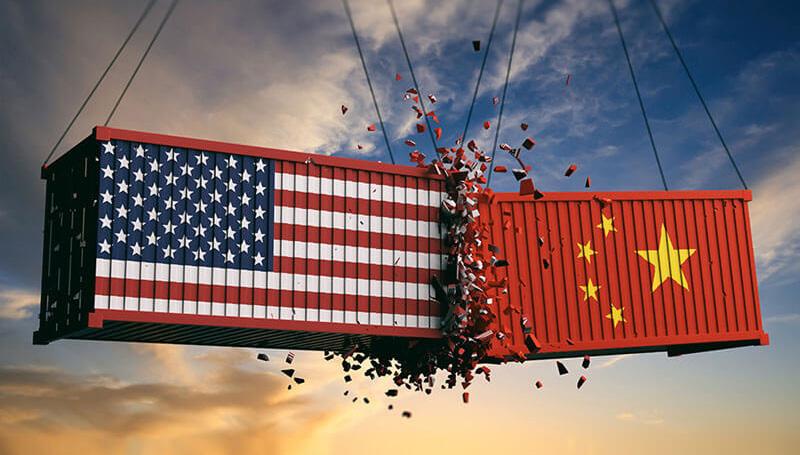
A new set of economic and political rules, driven by the Trump Administration, are creating a future that has no rational strategy. This is creating uncertainties. Traditional rules in place since the demise of the USSR are evaporating almost daily. This is impacting global trades in volume and routing terms, playing havoc with political relationships as tariffs are used as a political leverage that has nothing to do with trade.
The global nations are left in a quandary trying to work out their relationship with the US. Too many countries have become subservient to Trump in their attempt to gain favour in both the economic and political environment, all trooping to the White House on bended knees. There is fear in the air, make no mistake. The US is losing its democratic mantle and rapidly becoming an authoritarian state much like Russia, Türkiye, Belarus, Hungary, and North Korea but to name a few. The Russians were

The world is in a maelstrom of uncertainty as the US rapidly becomes an authoritarian state
recently welcomed with open arms in Alaska, and their Foreign Secretary made his message clear with his sweatshirt emblazoned with “USSR.”
The expected decline of the US and EU economies has been slower than expected despite the fact that the US GDP in the first half of this year is half that of the comparable period in 2024. Europe, meanwhile, is spluttering
In its recent webinar looking at the future prospects of the port and terminal container market –see p33 – Drewry also considered the impact of the TIL-BlackRock bid to acquire Hutchison’s non-Chinese assets – a deal encompassing 43 terminals, with 199 berths in 23 countries.
This deal, which would bring the MSC/TIL portfolio to “a staggering 196m TEU” capacity, would mean that for the first time, three hybrid operators are represented in the top five global terminal operators (GTO), notes Eirik Hooper, Senior Analyst, Ports & Terminals, Drewry. “These three hybrid operators are also among the top four liner carriers by fleet capacity – which begs the question whether truly
■ Tariffs are being used for political leverage, which has nothing to do with trade
along with minimal growth, notwithstanding the British Prime Minister claiming that his country has the highest growth in the G7, this despite the fact that GDP grew by a mere 0.3% in the second quarter of 2025 (April to June), a slowdown from the
0.7% growth in the first quarter. The negative signs of a looming economic crisis are not getting much attention. For example, the 30-year government bond yields are reaching historic highs as a result of nations borrowing more money, which in a volatile world becomes more expensive. This results in national debt repayments sucking up money that could be put to better use in bolstering their economies. We should not expect interest rates to fall globally as the pressures on the cost of living are increasing.
Between the pressures of convoluted trade policies, unstable economic policies, and a surge in geopolitical chaos it is not surprising that the levels of uncertainty are unprecedented. At the moment there is a shortage of positiveness on the darkening horizon.
independent GTOs are still able to compete with global hybrid operators when it comes to portfolio capacity expansion and if they are able to compete on an even playing field for new capacity,” he said.
Whether terminal operators should be concerned about MSC’s growth and dominance depends on the market and on the shape of the final deal once the relevant competition authorities have gone through it with a fine toothcomb, said Hooper.
While all terminal operators have naturally allied with their own customer base, and provide logistics efficiency and networks which attract customers whether or not they are hybrid operators or
are financially aligned with the shipping line, if the Hutchison deal goes ahead, Hooper warns:
“This should give all other operators pause for thought as to how they should adapt their commercial and competitive strategies to defend against what could be a significant risk to their underlying business.”
Since the time of the webinar COSCO has also emerged as a potential partner to the tune of around 20%, a development that is seen as satisfying the requirements of the Chinese Government. At the same time, however, it remains to be seen as to the reaction of the Trump administration to such an arrangement. The Panama
Government, at the time of writing, with the support of the Trump administration was making moves to expel Hutchison from its two Panamanian terminals at either end of the Canal. Trump is on record as disapproving of Chinese involvement in the workings of the Panama Canal and so it remains to be seen about COSCO’s involvement if the two Panama terminals are involved.
CMA CGM is another entity that has expressed interest in getting in on the deal.
Then there are the diverse anti-trust hurdles to get past. The story continues to unfold –expect a few more twists and turns!




Technically it may not be misuse of the legal system but morally matters are not so clear cut. Mike Mundy dissects the real basis of APMT’s legal challenges over Tecon 10, Santos and DC2 Durban
Classic theory is that taking legal action is an initiative of last resort. Today, however, this does not stand as an entirely true statement – legal action is now in the toolbox of certain companies as an instrument used to challenge and frustrate processes, to seek to achieve a dominant market position and/or to maintain one. In short, legal action is now increasingly deployed as a tactical weapon and not just as a path to sensible conflict resolution.
The party bringing the action will undoubtedly argue that right is on its side – and certainly it has a right to initiate legal action but whether right is on its side in the fullest sense is questionable.
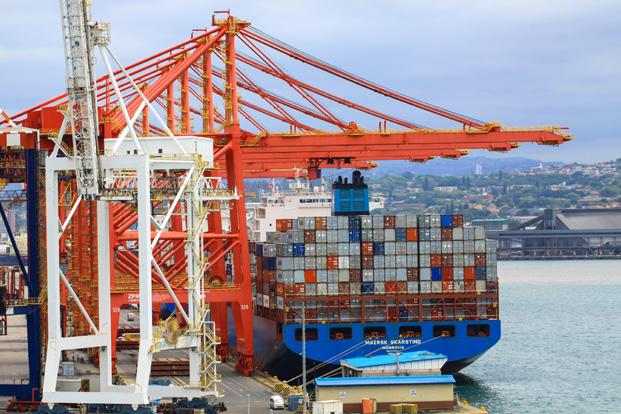
APM Terminals (APMT) recently launched a legal action against Brazilian regulator Antaq over the rules governing the public auction of the new four berth Tecon 10 container terminal in the port of Santos, Brazil’s major containerport. Antaq has structured a two-phase process under which existing terminal operators such as APMT and TIL, the terminal operating arm of MSC, are excluded from the first round of bidding and allowed to bid in the second stage, but only if there is not sufficient interest in round one and subject to them divesting existing terminal assets prior to signing a contract for Tecon 10.
The rationale underpinning the Antaq process is to ensure strong competition in the marketplace, encourage new market entrants and to avoid the negative scenario of market domination. This thinking certainly appears validated when it is appreciated that the existing APMT/TIL joint venture terminal in Santos, Brasil Terminal Portuário (BTP), offers a capacity of 1mTEU/yr with a concession extension approved in 2023, to 2047, entailing an investment package that will see a 40% boost in terminal capacity.
Existing annual capacity in the port of Santos as a whole is around 6mTEU/yr, Tecon 10 will add 3mTEU/yr, so, out of a projected overall capacity of 9+mTEU/yr BTP plus Tecon 10 would account for approaching half of available capacity. Factoring in other criteria such as berth length requirements for vessels and available draught this would rise significantly beyond the 50% mark.
It is hardly surprising, therefore, that, at the end of July, the Federal Court of Sao Paulo rejected, APMT’s request to suspend the bidding process for Tecon 10. The auction will proceed as planned. Had this not been the case then it is apparent that APMT would have secured a very strong, if not wholly dominant, market position in Santos and added to an already strong position in Brazilian container trade.
In addition to a 50% stake in BTP, APMT holds shareholdings of 75% and 30% respectively in terminals in Pecem and Itapoa, and is currently building an entirely new terminal in Suape. There is also a long-term strategic agreement, signed, in March this year, between sister company liner operator Maersk and Santos terminal operator DP World to make available more handling capacity. Plus, Maersk has a very strong position in Brazilian container trade overall including ownership of local liner operator Aliança Navegaçao, secured as part of its acquisition of Hamburg Sud in 2017. At the time of acquiring Alianca it was reported to hold a 59% share of Brazilian coastal container trade as opposed to the 21% held by Mercosul, the
local operator Maersk owned but was required to dispose of as a condition of the Hamburg Sud acquisition.
This steady encroachment of influence over the supply chain has not gone unnoticed, notably with the Brazilian Association of Port Terminals accusing both Maersk and MSC of occupying and abusing their dominant position in the container business.
Durban is another location where APMT has deployed a legal challenge – this time to change the result of a tender process for Durban Container Terminal Pier 2 (DC2).
Following a comprehensive tender process, International Container Terminal Services Inc. (ICTSI), the Philippinesbased terminal operating group, was declared the winner. Its bid of US$618m (circa R12 billion) was more than R2billion above the second placed bid from APMT.
The latter, however, has contested the result in the courts stating that ICTSI did not comply with a specific formula used to calculate financial solvency – the net effect of which has been to put a brake on much needed investment in the terminal for over two years. This despite the fact that ICTSI was submitted to a further evaluation by an independent financial consultancy, over and above standard tender processes, whose report concluded that ICTSI was a financially strong, well-diversified company, with the proven capabilities to operate and improve the terminal.
While technically the legal challenge is about financial strength, drawing back the curtain on what lies behind it then it is clear that the real issue is about APMT and Maersk seeking to expand its influence over key South African linked supply chains. Already Maersk has ‘ownership’ of the majority of berthing slots at DC2. An uplift in terminal efficiency will open up more slots to competing lines – so even just maintaining the status quo puts Maersk in a winning position while South Africa as a whole is the loser.
It will be interesting to see if common sense will prevail in the pending legal ruling on the case.
■
High tariffs imposed by the USA represent a troubling scenario for Brazilian exporters but they also provide impetus to consolidate and expand other trading relationships, such as with China, and to seek out new markets. Rob Ward reviews the news and trend lines
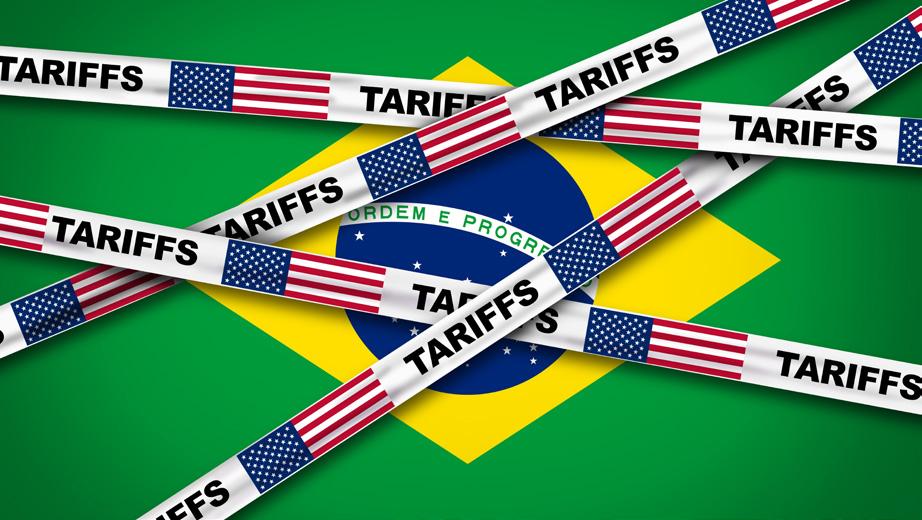
When it comes to the infiltration of Chinese companies into the fabric of Brazil and other Latin American countries, it is not just a case of the Chinese are coming, but that they have well and truly arrived and made themselves at home. Meanwhile, US interests, historically quite influential in Brazil, appear to be on their way out. Chinese firms are now deeply embedded into Brazil and the punishing Trump Tariff Wars, first mooted back in April but mostly coming into force in August, have given them added impetus.
This is especially true in the case of Electric Vehicle (EV) manufacturing and sales, as well as in the port and shipping sector. Certainly considering future projects, it is clear, for example, that various Chinese companies are keen to get a slice of the action when the Reais5.6BN (US$1.015BN) Tecon Santos 10 project, goes to auction later this year. (see page 31). China is expected to be among the contenders bidding for this high capacity new terminal.
“It’s not completely new that China is interested in expanding into Brazil, especially our infrastructure, but it has gone rapidly into overdrive this year,” underlines Armando Freigedo Rodrigues, a Director of Aquapar the maritime sector consultancy based in Rio de Janeiro. “It really does seem that Trump’s Tariff Wars will create some commercial opportunities for Brazil in China, especially in the agriculture sectors,” he adds.
The Chinese interest also gained momentum from Brazil hosting, in Rio, this year’s summit of BRICS (the grouping of emerging powers, led by Brazil, Russia, India, China and South Africa). Equally, it has been spurred by President Lula’s extravagant state visit to Beijing in May, where President Xi showed very clearly how seriously he regarded Brazil as a reliable world trade partner.
Trump slapped tariffs of 50% on the majority of Brazilian imports, including coffee, beef and several fruits but he exempted orange juice, commercial aircraft (Embraer), aircraft parts and energy products. Trump was seemingly advised by a Brazilian senator Eduardo Bolsonaro, son of Jair, the former President of Brazil (2019 to 2023), who fled to Mar a Lago, to get the US President to try and help his father avoid a trial for inciting an insurrection!
Uncle Sam has been playing a game of dare with China all year, as part of the US President’s bid to “stop the bad deals for the US leading to unfair trade deficits, and China, and now Brazil, have called his bluff. The irony with this, is that the US has not had a deficit with Brazil for 18 years and, in fact, ran a huge surplus of US$7.4BN last year; on about US$92BN in overall trade. Some commentators are calling Trump’s half-baked economics move “Tariffmagedon,” but for countries with tariff add-ons of more than 10% it is no joke and has caused “absolute chaos” for port operations and supply chains.
According to Datamar data, more than 490,000TEU of containerised goods exported to the US since 2022 (including coffee and wood products) fall under US HS Codes listed for tariff enforcement, while just over 93,000TEU (mostly chemical wood pulp) are exempt, although these figures don’t include beef. The country is set to lose US$1BN of beef sales to the US this year alone. Mexico, Japan, China and some European countries, are expected to take up some of this load, according to ABIEC, Brazil’s Beef Export Association, citing shipments up 13.4% to 1.47M tons and revenue up 27.1% to US$7.23Bn for the first seven months of this year, but that was before the tariffs kicked in!
Much healthier trade between Brazil and Argentina this year, has helped liner operator Log-In Logistica post record profits and terminal operator TCP (now owned by China Port Holdings), to report record throughput (803,041TEU for the first six months of this year). It is understood that a reviving Argentine economy could sweep up some off-loaded Brazilian exports such as coffee and Fruit.
A good example of the “chaos” was evident at the port of Vitoria, Brazil, where, at the end of July, one ship cancelled its call due to the high tariffs imposed and as a result did not load 1,500 containers. The cargo, valued at Reais360 million, was mostly made up of ornamental stone, plus coffee, ginger, musical instruments and beef, according to Vports, the port operator.
Vports notes, “more tariff fallout is expected”.
In terms of coffee Brazil is the biggest producer in the world and the US the largest importer but a 50% tariff on that commodity means vast quantities of coffee will no longer be headed for the US and Americans will have to source from other exporters, possibly Costa Rica and other central American countries. CECAFE, the Brazilian Coffee Exporters Association, states, “there is a lot of anxiety in the sector,” and it’s having a terrible impact on the logistics out of the three main coffee exporting ports of Santos, Vitoria and Rio de Janeiro.
Last year the US imported 8.1 million tons of coffee from Brazil, but this year shipments to the US have almost halved, from 721,718 bags (of 60 kg coffee) in January to just 440,034 bags in June. Importers from Belgium and China seem to have picked up some of the slack. Nevertheless, the danger for coffee producers, says CECAFE, is that the domestic market will be flooded, with consequent massive price drops.
Various Arab countries have imported 31.5% more Brazilian coffee but all these changes, says CECAFE, will require many alterations to port rotations and supply chains.
China has moved up from 14th to 11th biggest coffee importer from Brazil. However, China is mostly a country of tea drinkers so is not expected to pick up much more of the slack over the coming years.
And it’s the same on the fruit front.
“Although the US only accounts for 2.4% of all Brazilian fruit exports for some companies, like Agricola Famosa, it can account for 12 to 13% of total sales,” said Valeska Cire, Brazil’s rep’ on the International Fresh Produce Association. As one exporter further notes: “it takes at least two years to find new
What Trump’s actions did was to force Brazilian shippers to re-orientate the way they operate ‘‘
fruit markets and that won’t help the mangoes waiting to be picked today.”
Mangoes usually get shipped from North and Northeast ports such as Salvador, Fortaleza, Pecem and Natal.
“What Trump’s actions did was to force Brazilian shippers to re-orientate the way they operate,” highlights Leandro Carrelli Barreto, a Director of Solve Shipping consultancy. “I am now giving lectures all over Brazil on international scenarios, the tariff wars between the US and China, infrastructure and bottlenecks.
“From Manaus to Recife to Sao Paulo and down to Porto Alegre I have delivered almost 20 lectures over the past couple of months, mostly for importers and exporters.”
With the imposition of tariffs – given that this remains the case – it is plain that Brazilian exporters are seeking new markets to compensate for reduced demand from the USA. Up to mid-year this year, however, container trade statistics with the USA did not reflect the impact of new tariffs. According to Datamar, shipments in this period rose by 3.9% but for the second half of the year it notes that “companies have already begun evaluating alternative markets for products that will be subject to surcharges…”
In China trade, Datamar notes that containerised exports from Brazil actually fell by 0.4% between January and June 2025 with this said to be the result of global trade tensions, regulatory uncertainty and volatility in maritime freight costs.
The central trend in Brazil China trade is, however, a growth story.
As Datamar points out: “China remains Brazil’s top trading partner for both imports and exports. Nearly 50% of Brazil’s imports originate from China. In 2024, 1.595.302TEU were imported, compared to 1,220,337TEU in 2023. For comparison, imports from the United States, Brazil’s second-largest trading partner, totalled 325.493TEU.
Overall, in 2024, imports from China to Brazil grew by 30.7%, while exports slightly increased by 2.7%.
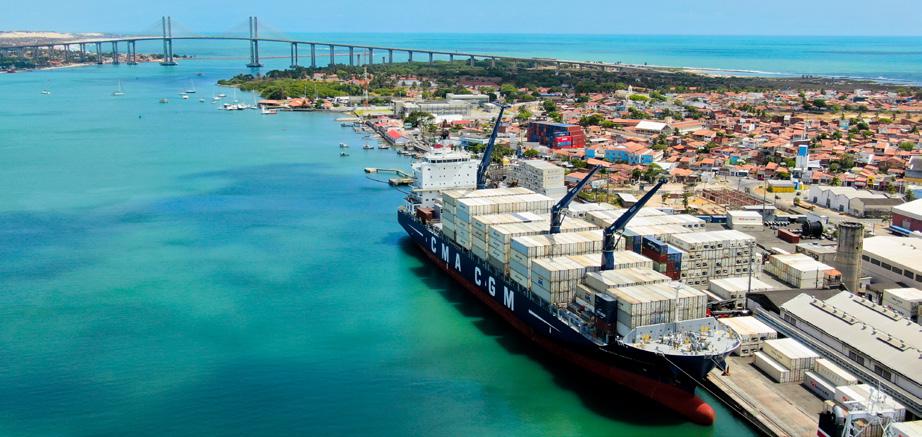
■ Coffee and fruit exports are potentially among the hardest hit by new USA tariffs
With more twists and turns than a mile-long corkscrew, the tender for the prestigious Tecon Santos 10 container terminal has witnessed a couple more key developments since PS last visited the process
Firstly, Maersk and MSC, the two joint owners of Brazil’s largest container terminal Brasil Terminal Portuaria (BTP), were, surprisingly to many, excluded from Round One of the bidding process for the Reais5.6Bn (US$1.015BN) project by the Brazilian authorities, including ANTAQ, (the National Waterborne Transport Agency).
But then, far less surprisingly, the two Mega Giants of the shipping world decided to appeal against the decision and rounded up a bevy of lobbyists to back up their arguments. Maersk filed a lawsuit calling for “procedural corrections to ensure a fair process” to the tender for the controversial project. This appeal was turned down by Judge Paulo Cezar Neves, stating that the maritime authorities had designed the tender process in a legal way. However, the judge also made it clear that the two multinationals could bid in the second round if no other company had met all the requirements in the first round.
Brasilia’s argument is that it preferably wants a new operator in Santos to stir up more competition. There are also fears in Brazil that the Verticalisation policies of the major carriers (whereby they have a stake in many levels of the transport matrix, not just ocean transport), are creating “quasi monopolies” and “future freight price increases”. The TCU (federal audit court) is still reviewing the tender but is not expected to overrule Antaq (which laid down the rules in the first place). The tender document is now expected to be released in September or October of this year and the Ministry of Ports and Airports hopes the auction will take place before the end of the year.
For the record, the exclusion of existing terminal operators from bidding on a new concession is an option that has been fielded before in the international container terminal market. Some may also see the irony in Maersk raising a legal challenge to being excluded when in the Port of Aarhus, Sweden it recently raised a legal challenge with the port authority against allowing MSC in as a new terminal operator. In this case it is clear that it wanted to maintain its exclusivity!
The urgent need for more container capacity in Santos, South America’s largest port for containers, is self-evident.
Leandro Caselli Barreto, a Director for the Solve consultancy based in Sao Paulo, confirms that there is a “desperate need” for more container capacity throughout Brazil, but “especially in Santos”.
“Through Santos we have seen phenomenal increases,” states Barreto. “During 2024 Santos throughput was up by 15% [up to 5.48m TEU], and the same increases have been experienced during the first five months of this year. In tonnage terms it was up 18.5%.
“And throughput for all Brazil was up 20% in 2024, up from 11.3m TEU to 13.9m TEU, so even with a new terminal the size of Santos Brasil [now operated by CMA CGM], of 2.6m TEU a new major terminal will barely cover the annual increase from last year. It’s been more than 10 years since a new terminal opened in Brazil, and we desperately need more now.”
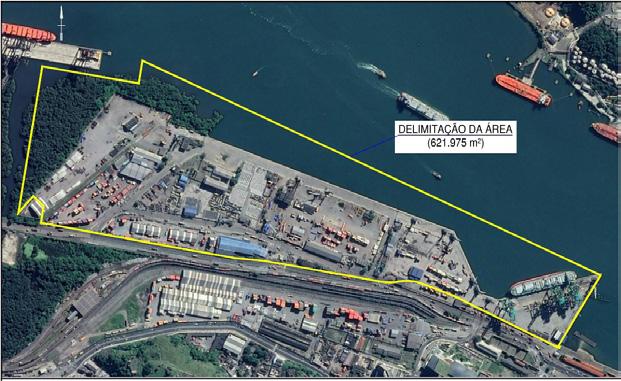
Tecon Santos 10 will occupy an area of 621,900 sq m, have 1.3km of quay and an initial capacity of 500,000TEU in its first year of operations, scheduled for January 2027, and an eventual capacity of 3.5M TEU per annum by the year 2034.
With the (very likely) sidelining of three big shipping line players (Maersk, MSC as well as CMA CGM, who, as a result of buying Santos Brasil, has also been excluded via the new rules), it seems that JBS, the international meat packer now trading on the New York Stock Exchange (NYSE), is the favourite to win the bid.
Although it will face fierce competition from several sources – including International Container Terminal Services Inc (ICTSI of the Philippines, PSA of Singapore, Hutchison Ports, China Merchants (already operating out of TCP, Paranagua), Cosco (hoping to build on their success in Chancay, Peru) and HMM of South Korea. It now seems to be generally acknowledged that the Brazilian owned JBS, the world’s largest producer of beef (with meat products exported to 180 countries and 2024 revenues of US$77BN), is the front runner, largely due to two of the shareholders, Joesley and Wesley Batista, “having the best contacts and greatest influence in Brasilia where the final decisions will be made. “They know how to pull the strings to get things done,” as one well-placed source acknowledged.
Powerful voices from the Maersk and MSC camps –especially Patricio Junior, Regional Investment Director for TIL, the stevedoring arm of MSC – are arguing that the “experienced, international players” are essential for the tender process. JBS Terminais only started handling boxes in October of 2024, taking over, ironically, Maersk’s APM Terminals operation in Itajai. New services were added and Reais250m of investments in equipment and infrastructure, and now around 140,000TEU per annum – mostly chicken and pork, plus wood exports – are being handled.
Another slice of irony is that the first service to call Itajai, under JBS Terminais rule, was MSC’s East Coast South America to US East Coast service (SAEC).
Book now - 20th Anniversary event! Congress speakers include:



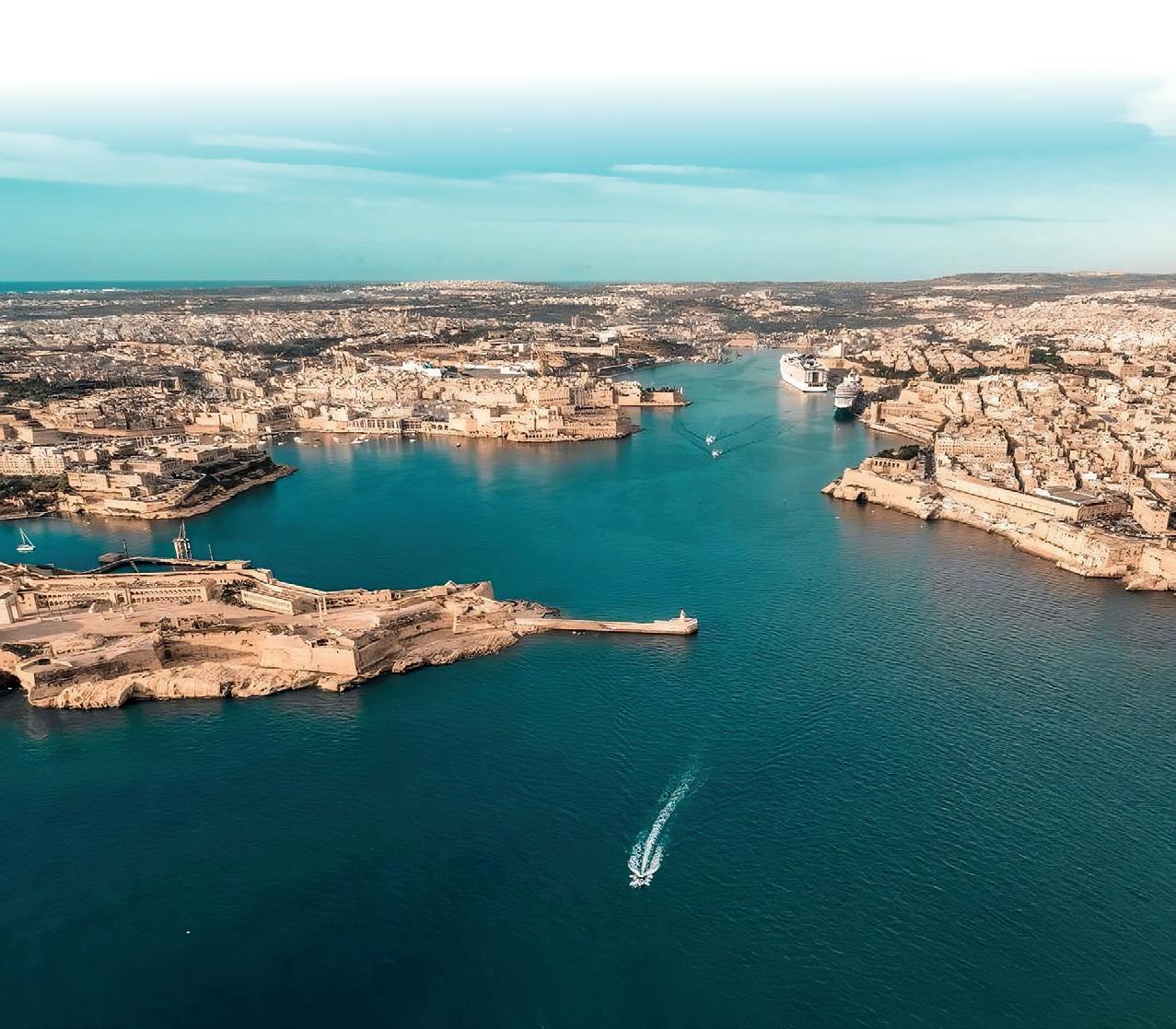
Sponsors:


Developing a Sustainable Port Community Harbouring the Future: Infrastructure for a Stronger Port Ecosystem Renewables, Reclamation & Responsible Economic Growth Ports of the Future: Innovation, energy transition and new roles for the port beyond 2050. How will ports contribute to decarbonization Managing Cyber Risk in Automating Processes Electrification of Ports
Supported by:

Meet and network with over 200 attendees representing port authorities, terminal operators and shipping lines. For more information on attending, sponsoring or speaking, contact the events team: visit: greenport.com/congress tel: +44 1329 825 335 email: congress@greenport.com



Drewry anticipates the ‘lurch towards protectionism’ will squeeze trade’s contribution to global GDP but it acknowledges the future is difficult to read in the Trump era. Felicity Landon reports
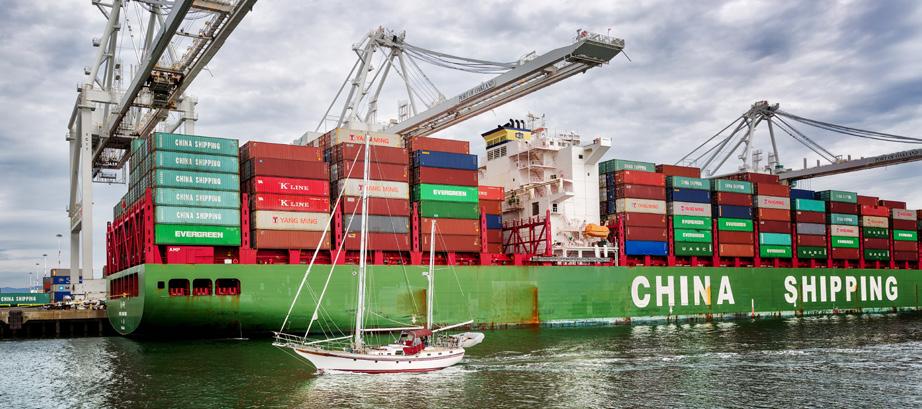
No prizes for guessing the main theme tackled in Drewry’s most recent webinar on its research into the Container Ports and Terminals Market – US tariffs and trade policies dominated the discussions with the allied difficulties of making accurate forecasts.
Considering the outlook for the second half of 2025, Eleanor Hadland, Senior Analyst, ports & terminals, Drewry said: “The key uncertainty here is tariffs and the US and therefore the global economy. The tariff announcements led most economists to revise their forecasts. This lurch towards protectionism is expected to greatly reduce international trade’s contribution to GDP, which will squeeze the GDP to container trade multiplier in very quick order.”
It’s certainly a challenge to find a fixed moment at which to assess the market, given President Trump’s habit of constantly moving the goalposts. In June, the WTO was forecasting that world trade would contract by 0.2% this year; Drewry expected container handling to decrease by 1% in 2025, the same level of contraction of 2020, during Covid. This would, said Hadland, be only the third year with an annual decline since Drewry started recording this data in 1979 – but “the news keeps on changing, so we expect to keep revising these forecasts,” she said. “Overall, all we can do is express sympathy with port executives and the rest of the supply chain that are trying to map out the game plan in a Trump 2.0 administration. There really are few, if any, upsides for container shipping in this trade war. And it must be noticed that tariffs can just as easily be with withdrawn and that could reverse much of the predicted damage.”
Beyond the threat to volumes, US port and terminal operators are set to be particularly hard hit by the US tariffs and trade policy, warned Hadland. “Yes, demand is a major impact and combining that with the proposed fees on Chinese owned and built ship fleets, the impact on the ports sector as a whole is going to be a very high risk to the US market and economy.”
However, she said, narrowing the focus back down to container operators, the American Association of Port
Authorities has already issued a “very stark warning” in relation to port equipment and the “build America, buy America” push.
“If you look at the proposed tariff on a ship-to-shore cranes and multiply that by the four or five you might be buying to expand your terminal or replace existing equipment, then the impact of tariffs on container operator costs must not be underestimated. It is important to note that in the current environment, there are a small number of crane manufacturers which are located outside China – but I wouldn’t have said that US policy is consistent or established enough yet for them to be putting in place investment plans to expand their production capacity. So for spare parts and replacement equipment in particular, US ports are going to see costs rise very steeply in the very near future; whatever the outcome, tariffs are going up on this type of equipment and the sector is one where those costs get passed back through to end users and eventually on to US consumers.”
Container terminal capacity is projected to increase at an average rate of 2.1% annually between 2024 and 2029
The Drewry team also considered global port capacity and utilisation over the next five years. Hadland said that container terminal capacity is projected to increase at an average rate of 2.1% annually between 2024 and 2029, to reach 1.48bn TEU by 2029 – representing an additional 145m TEU of capacity coming on stream over five years.
Global utilisation is expected to drop below 65% in 2026, then recover to just below 68% by 2029.
While utilisation is expected to stay high in the Greater China market, there is major new capacity coming online –not least with Shanghai International Ports Group’s announcement that it is moving ahead with the next phase of development at Yanghshan Port, where it is planning to construct another 6km (6,000 metres) of deepwater berths over the next six years.
Robert Blades, Global Commercial Sales Manager, Peters & May, drills down into mitigating rising risks and avoiding hidden costs when transporting specialist project cargo on multi-purpose vessels (MPVs)
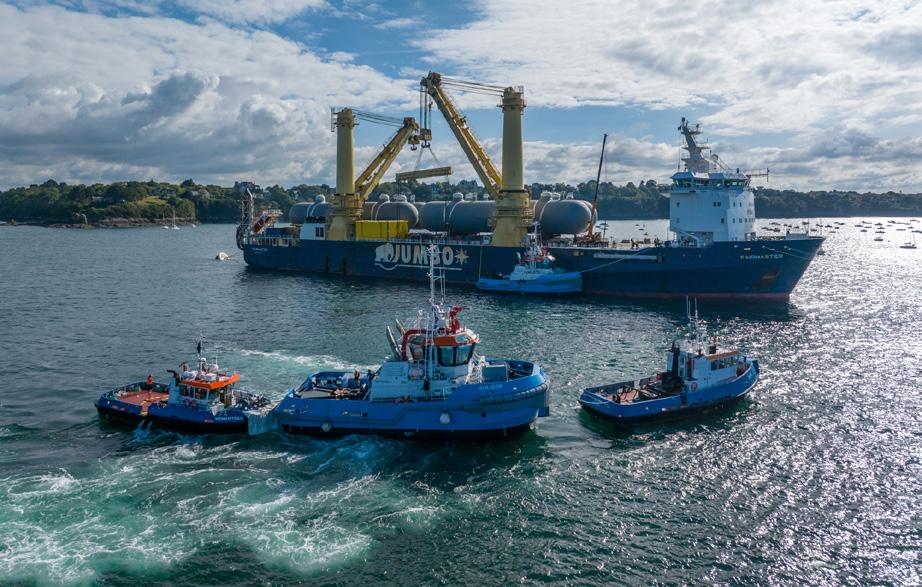
Transporting oversized, heavy and out-of-gauge cargo on multi-purpose and heavy-lift, specialised vessels presents unique challenges.
From pontoons, to wind farm components, to commercial vessels like tugboats or patrol boats, the movement of complex project cargo brings different risks and roadblocks for asset owners to consider at every stage of the process.
This type of awkward cargo calls for bespoke breakbulk solutions, requiring specialised cradles and lifting equipment, an experienced technical team, and expert loadmasters to provide drawings and load plans.
The need for tailored logistics also increases when dealing with the handling challenges of large projects, with foresight and precision coordination essential due to the more intricate decisions around vessel selection, route optimisation, port pairings and scheduling.
Although it is sometimes feasible for a specialist transportation partner like Peters & May to offer out-of-gauge options on container lines, it is more often the case that multipurpose vessels (MPVs) are the only solution due to their capabilities to handle considerably more complex cargo and heavier boats – weighing up to 875,000kg in our experience.
These specialist vessels, which operate in the spot charter market, bring their own complexities, demanding more flexibility from the customer due to less stringent scheduling compared to container services.
In addition, MPVs often requiring more challenging port pairings, due to the nature of equipment that requires heavylift vessels – which is often for the energy market or similar sectors, located in areas with minimal port infrastructure.
As cargo and asset owners demand reliable options for moving specialist project cargo safely by sea, some ports and terminals are needing to adapt and upgrade to support MPV operations, ensuring they adhere to key criteria in terms of capabilities, facilities and infrastructure to process such cargo.
Today, more than ever before, when using MPVs to efficiently move, load and offload high-value assets and project cargo in diverse ports globally, a smooth and seamless operation can only be achieved with the right approach, systems and mindset to mitigate risk, avoid delays and hidden costs, and manage expectations.
The movement of heavy out-of-gauge cargo on MPVs has become even more challenging in today’s uncertain and turbulent geopolitical and economic environment.
Planning for MPVs has become more complex, with longer lead times, as the prolonging of the Ukraine/Russia conflict and escalation in the Middle East, and the continuing threat of Houthi attacks on ships transiting the Red Sea, impact supply and demand dynamics, adversely affecting available tonnage and market stability.
Vessels are being forced to avoid the Suez Canal and transit around the Cape of Good Hope, rather than utilise the more efficient Asia to Mediterranean or Northern Europe route through the Red Sea. A 25-day transit now takes 45 to 50 days on the longer route, with substantial additional fuel and charter costs.
With an increased demand for MPVs compared to 2019/2020, the already tight availability has been
exacerbated as the added pressures of territorial tensions and increased transit times result in less available spot tonnage in the market than previous years – but not necessarily in every region.
Asia is the in-demand region right now, where some big wind energy and oil & gas projects are consuming a lot of the available tonnage in the market. As owners look to send their larger vessels back to Asia urgently to meet their contractual demands, finding space is challenging and rates are high, with a minimum typical lead time of one to two months to secure space.
Europe and USA are in more of a decline and we are seeing plenty of opportunities from these regions, especially back to Asia.
Appetite for risk is at a low point and insurance providers are ensuring project shipments are fully up to the latest safety requirements. In Peters & May’s shipments, we are seeing a growing number of requirements for surveyor sign offs, particularly Marine Warranty Surveyors, who will review all technical documentation and report back to the insurers and give a ‘right to sail’ document, confirming they are happy with all aspects of the operation.
Seamless coordination with local port authorities is an important aspect in managing a swift and safe discharge –and reducing risks. We will use a local port agent, or, in some of our busier ports, we have direct communication or even a registered stevedore.
Port capabilities come into play when handling complex cargo as some cargoes do demand a specialist facility. The appropriate on-site storage and equipment, such as shore cranes, must be in place, along with experienced stevedores.
If they are to be considered for more specialist projects, ports and terminal operators need to ensure they keep up with a variety of cargo handling knowledge – and work to demonstrate to clients that they can handle all cargoes with the same level of expertise.
We are seeing some ports opting to upgrade to cater for larger vessels to handle project cargo and MPV operations –whether that is by improving their local infrastructure, building new berths to increase capacity, or dredging existing berths to allow larger and deeper vessels into the port.
In terms of specialist ports that focus on one cargo type, typically you will only have one covering a large area. Although ROI could be low without regular volumes, it is highly likely that the specialism is due to its geographical location and lack of competition in the region, combined with specialist knowledge and correct shore facilities.
While volumes may be lower at a specialist facility than a more general port, new avenues are opened up for increased fees and other chargeable services which means that these more niche capabilities, in the right circumstances, can prove to be a worthwhile investment, for example when incorporated into a multi-purpose terminal.
For asset and cargo owners and operators, it is difficult to manage schedules, budgets and new obstacles with confidence in these turbulent times.
However, it is possible to mitigate these risks with the support of a partner with a deep understanding of specialised transport requirements and an insight into geopolitical trends. By applying lessons from previous experience it is possible to identify potential problems and react quickly to ensure a safe and timely delivery of the owner’s items, even when faced with an unpredictable scenario.
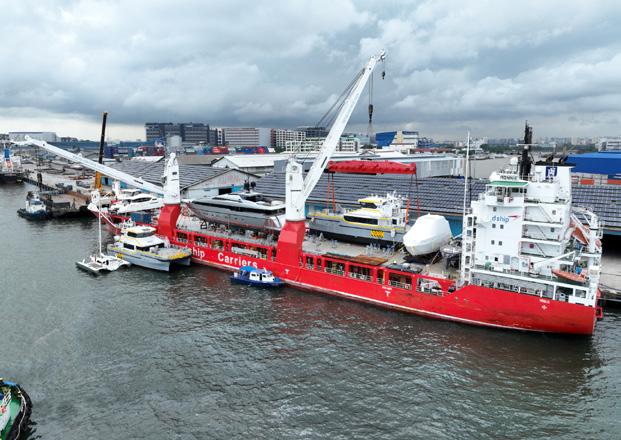
Our recent shipment of a high-speed catamaran from Southampton, UK, to South Korea demonstrated the need for rapid rerouting due to rising geopolitical risks. The vessel’s planned passage through the Red Sea was ruled out by the shipowner following deteriorating conditions, including renewed Houthi rebel attacks on commercial ships. The team quickly adapted the voyage plan, securing the necessary permits, port arrangements, and vessel support to accommodate the new route back through the Suez Canal and around the COGH, while considering weather variations, fuel resupply, crew scheduling and increased transit risks over the longer distance.
The challenges for other projects may centre around a bespoke architectural design of a vessel, for example specialised lifting lugs integrated directly into the structure – which was the case when shipping two new 22m tugboats from Vietnam to the Port of Saint-Malo, France.
For some marine cargo, it is essential to ensure a suitable specialised cradle is in place to avoid additional insurance costs, while, for some cargo owners, stringent budget and dates are the focus, requiring a seamless end-to-end service with no delays.
We regularly see how expertise and experience when planning operations results in the avoidance of hidden costs. For example, one potentially expensive mistake which we see regularly is a discrepancy between the supplied Gross Registered Tonnage and Displacement Weight of the cargo. Our technical team can quickly spot any errors and inconsistencies, which, if unnoticed, could result in the wrong type of vessel being selected with cranes unable to lift the cargo.
Another instance where more efficient transportation can be achieved is by combining cargoes on an MPV already scheduled to sail, meaning that costs, including fuel, port costs, chartering, cradling and lifting equipment, and manpower costs, can be shared and saved.
The importance of forward planning and the support of specialist, experienced problem-solving experts with a deep understanding of specialised transport requirements and an insight into geopolitical trends is more critical than ever before when transporting project cargo.
To navigate new rules and risk, partnering with a specialist for out-of-gauge cargo planning and risk-managed transport solutions is an added value which cannot be underestimated.
The Red Sea crisis continues to impact cargo flow dynamics for all shipping activities, with longer vessel sailing times and higher costs. AJ Keyes assesses the current position and challenges facing the container industry
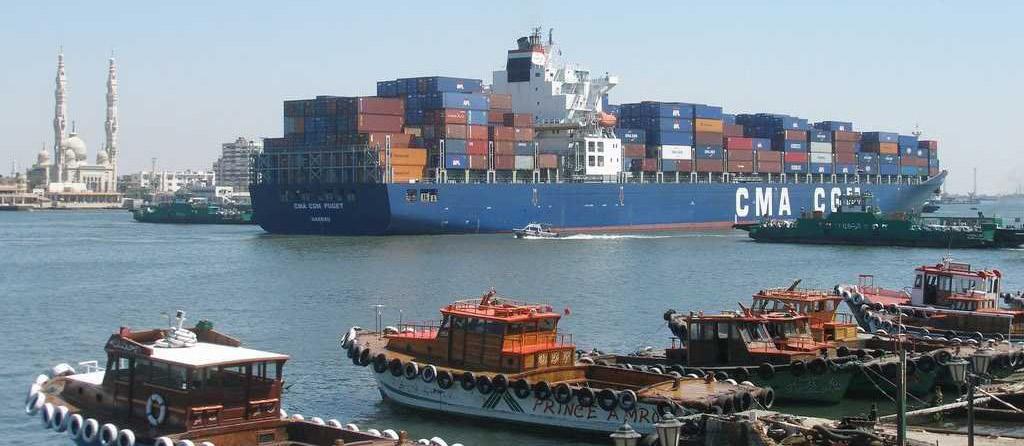
The Suez Canal is both a maritime choke point and a vital waterway for global trade. The waterway may only be 193km in length, but by connecting the Red Sea and the Mediterranean, the Suez Canal sees between 12% and 15% of worldwide trade and about 30% of global container traffic, according to the Suez Canal Authority (SCA).
To put this into perspective, SCA states that more than US$1 trillion in goods transit the waterway annually and on a “normal” operating day, an average of 50 to 60 ships transit this routing carrying anywhere between an estimated US$3bn to US$9bn in cargo value.
Given this strategic role facilitating the fastest sea route between Asia and Europe, any disruption to the Suez Canal has a significant impact on global commerce – and this is currently the exact position. Hence any disruption is an international concern and the need to protect trade flows and supply chains, reduce shipping and insurance costs, and support the flow of trade remains.
There is no doubt that the Suez Canal remains an economic powerhouse for Egypt overall and toll revenues set a record of US$9.4bn for fiscal year 2022-2023. However, with the Red Sea crisis truly biting for fiscal year 2023-2024, SCA reported a drop of -60.1% in revenues, as Table 1 summarises. Clearly, a massive negative impact for SCA and the Egyptian economy overall.
Clearly, the disruptions arising from the conflicts and issues creating the Red Sea crisis are having far-reaching economic effects, including on trade flows and supply chains. So, what is actually happening?
Attacks on shipping effectively throttled the Suez Canal from late 2023 and throughout 2024. With no confirmed attacks on shipping off the Yemeni coast since December 2024 until July 2025, there was even speculation that the threat posed by Houthi militants had been greatly diminished and shipping lines may look at returning to using the Suez Canal again.
Clearly any growing sentiments throughout the shipping industry that Red Sea transits could begin to increase were negatively impacted with the return of the attacks on cargo vessels.
According to UAE based WeFreight, a rapidly expanding freight forwarding and logistics company focused on emerging markets, the additional sailing time from vessels rerouting from this transit waterway is clearly shown in Figure 1. The detour around the Cape of Good Hope adds a number of extra sailing days to Asia-Europe voyages, thereby placing tremendous pressure on just-in-time supply chains. This means that shippers and cargo owners that rely on faster supply-chain turnaround, such as electronics manufacturers and retail supplies, are having to cope with extended transit times and uncertain delivery schedules.
A further outcome of these longer routes is increased transportation costs. Leading vendor-neutral global freight booking platform, Freightos® (Nasdaq: CRGO), which has over 10,000 importers and exporters connecting with thousands of freight forwarders across the shipping and airline industries, states that global shipping capacity has, at times, shrunk by an average of 20% during the Red Sea crisis and this capacity crunch has pushed up freight rates on major trade lanes.
Cargo insurance rates for shipments passing through the Red Sea region also continue to increase. Policies that traditionally cost around 0.5% of cargo value rose to around 2% as the situation deteriorated and this has once again occurred in 2025.
As a result, these increased costs mean that a larger container ship – as typically would be using the waterway –faces millions of dollars in extra insurance costs for a single Suez Canal passage. Such extra costs make the viability of using the Red Sea and Suez Canal financially challenging, if not unviable, for shipping companies to now consider this sailing route. Instead, sailing around Africa, despite the longer journey, remains the preferred route.
The aftermath of the July 2025 Houthi attacks resulted in a new insurance spike, with premiums subsequently rising to around 0.7% of the value of a ship in mid-July. This escalated from around 0.3% before the attacks took place, with some underwriters pausing cover for some voyages, according to
■ Despite the resumption of attacks on shipping in the Red Sea again, some vessels are taking advantage of a discount scheme to transit the Suez Canal. But the Cape diversion will continue as the dominant rerouting option
No end in sight yet to the Red Sea Crisis and ultimately it will be the consumer who pays
reports from Reuters. To put the numbers into perspective, additional premiums of 0.3%-0.6% for Red Sea transits represent an extra (estimated) outlay of US$150,000US$300,000 for a vessel worth US$50m
Nervousness moving forward, especially after the July 2025 return of attacks on shipping, is that insurance providers will once again become reluctant to cover Red Sea transits, with shippers facing the challenge of obtaining any insurance or needing government-backed guarantees. Until the situation changes and insurers do not designate the Red Sea as a high-risk war zone, insurance for cargo owners and ship operators will remain challenging.
There are other concerns too. The International Monetary Fund (IMF) has recently stated that “continued disruption will put upward pressure on inflation in affected economies” due to a combination of higher costs for imports and delays to the logistics supply chain.
Additionally, the mass diversion of ships around Africa has a major environmental cost - longer voyages mean higher fuel burn and emissions. Freightos estimates that rerouting ships sailing 50-60% farther instead of using the Suez Canal route, produces 40% more carbon dioxide per voyage.
Source: Suez Canal Authority base data
Moller-Maersk raised its 2025 profit forecast, citing strongerthan-expected volumes. It now expects global container growth of two-to-four percent, up from the previous estimate of one-to-four percent.
Semiramis Payu, CEO of US-listed Diana Shipping agrees. “This situation remains volatile and the Red Sea rerouting is likely to continue,” he confirms.
SCA is fighting back though and confirms that as of midJuly a total of 10 container ships had taken advantage of its 15% rebate incentive for any container ship exceeding 130,000 tons transiting the waterway. This offer was introduced in May and was set to run for three months but is now in place for the remainder of 2025. SCA confirms that, at the time of writing, CMA CGM has transited with six vessels and Mediterranean Shipping Co (MSC) with four vessels.
According to UAE based WeFreight, a rapidly expanding freight forwarding and logistics company focused on emerging markets, the additional sailing time from vessels rerouting from this transit waterway is clearly shown in Figure 1. The detour around the Cape of Good Hope adds a number of extra sailing days to Asia-Europe voyages, thereby placing tremendous pressure on just-in-time supply chains. This means that shippers and cargo owners that rely on faster supply- chain turnaround, such as electronics manufacturers and retail supplies, are having to cope with extended transit times and uncertain delivery schedules.
In its July 2025 earnings announcement, AP Moller-Maersk said the longer route has “added a lot of cost” for the company and other operators and this impacts profitability.
Yet despite the resumption of the Red Sea crisis, AP
The Red Sea crisis highlights the vulnerability of global trade routes to geopolitical conflict and the broad implications of such events on the global economy. The outcome is simple. The Red Sea crisis continues to result in increased operating costs for ocean carriers, which are subsequently being passed on to shippers – and, as a result, ultimately it will be consumers who pay more.
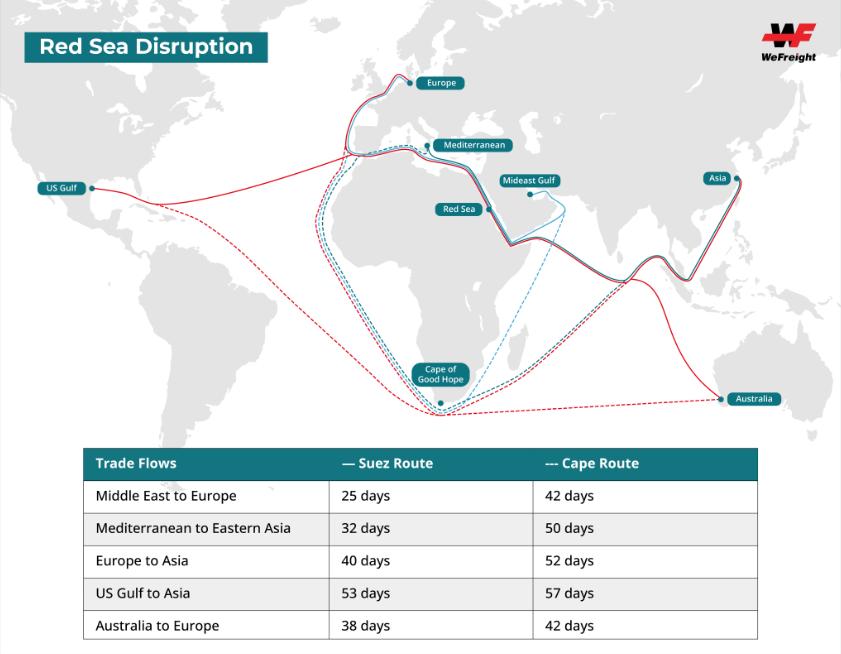
Source: WeFreight
shipping crisis is having a major impact on the region
In terms of total volumes of the leading hub ports, the 2016 throughput of just under 26.5 TEU has seen overall growth, but it has been inconsistent. Volumes fell to just under 24.7 TEU in 2018 before returning to stronger increases to 31.4 million TEU by the end of 2023 impact of the Red Sea crisis resulted in 28.6 million TEU recorded for 2024.
Jebel Ali clearly retains the largest share of the container traPic being handled, with 54.2% 2024, albeit that the Red Sea crisis has clearly impacted the position. In 2023, Jebel Ali’s was 46.2%, which reflected a declining trend from 60.9% in 2018. The emergence of Khalifa was also a factor, with the home facility of Abu Dhabi Ports’ seeing an increase from just 2016 ramping up to 19.6% for 2024 – although this Arabian Gulf port also benefitted from Red Sea problems with a jump of 5% from 14.6% in 2023.
With a strategic location at the crossroads of global trade routes, ports across the Middle East play a critical role in facilitating trade movement between key markets in the east and the west. AJ Keyes tracks recent activities and assesses the impact of future expansion
Figure 1: Development of Total Port Volumes at Leading Hub Ports in Middle East Region Million TEU, 2016-2024
Transshipment is a key component of the container port industry in the Middle East and there are number of largescale hub facilities supporting global shipping lines. However, the Red Sea shipping crisis is having a major impact on the region.
In terms of total volumes of the leading hub ports, the 2016 throughput of just under 26.5 million TEU has seen overall growth, but it has been inconsistent. Volumes fell to just under 24.7 million TEU in 2018 before returning to stronger increases to 31.4 million TEU by the end of 2023 – the impact of the Red Sea crisis resulted in 28.6 million TEU recorded for 2024.
Jebel Ali clearly retains the largest share of the container traffic being handled, with 54.2% in 2024, albeit that the Red Sea crisis has clearly impacted the position. In 2023, Jebel Ali’s share was 46.2%, which reflected a declining trend from 60.9% in 2018. The emergence of Khalifa Port was also a factor, with the home facility of Abu Dhabi Ports’ seeing an increase from just 5.5% in 2016 ramping up to 19.6% for 2024 – although this Arabian Gulf port also benefitted from the Red Sea problems with a jump of 5% from 14.6% in 2023.
MASSIVE DROP
According to the Saudi Port Authority (Mawani), volumes at King Abdullah Port were hit by a massive drop of 82.7% in 2024. In 2023, the port handled almost three million TEU but within 12 months this figure had fallen to 500,000 TEU. To put the situation into further perspective, in 2023, KAP handled 389 vessels above 15,000 TEU, but for 2024 just one vessel of this size specification called at the port.
Prior to the Red Sea crisis commencing, KAP was emerging as a fast growing, largescale container facility with volumes being generated by Mediterranean Shipping Co (MSC), supplying traffic for its operating arm, Terminal Investment Ltd. The facility was inaugurated in 2019 and by 2022 it had surpassed 2.9 million TEU due to a strategy of utilising the new port as a regional transshipment hub, along with other shipping lines using its strategic Red Sea location.
Source: Ports, terminal operators, Data&
Source: Ports, terminal operators, Data&
Fellow West Coast of KSA port, Jeddah, has also been impacted by the Red Sea crisis, with a drop of 33.4% in container traffic in 2024 on the 3.7 million TEU handled.
According to the Saudi Port Authority (Mawani), volumes at King Abdullah Port were hit massive drop of 82.7% in 2024. In 2023, the port handled almost three million TEU but
However, unlike KAP which has a heavy reliance on transshipment activity, Jeddah’s container throughput is split between transshipment and gateway cargoes, with importexport activity for the capital, Riyadh and the culturally important city of Mecca.
Transshipment volumes and incidence at the leading regional hub ports for 2024 can be seen in Figure 2.
Continued expansion of container terminal facilities is planned in the Middle East, irrespective of the Red Sea shipping crisis. Table 1 provides a summary of the known / confirmed plans that the listed ports are undertaking.
The following also provides insight:
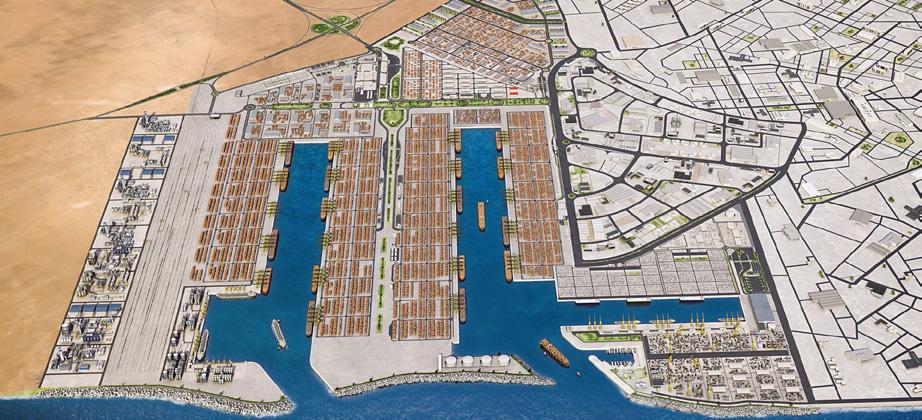
■ The Red Sea crisis may be continuing, but container facilities in the region, such as King Abdullah port (shown) and nearby Jeddah are both still expanding to satisfy long-term demand
● Khalifa Port – 15 million TEU by 2030:
The new US$845 million CMA Terminals facility in Khalifa Port, is managed as a joint venture between the CMA CGM Group’s subsidiary CMA Terminals (70 percent) and Abu Dhabi Ports (30 percent) and adds a further 1.8 million TEU of container space to the port.
The addition of this operation increases Khalifa Port’s annual container capacity by 23% to almost 10 million TEU per annum and represents a key step in reaching the goal of Abu Dhabi Ports in offering an annual handling capacity of 15 million TEU by 2030. The terminal features shorepower infrastructure for vessels and is rail-connected.
● Jebel Ali – T4 Underway and Green Aims:
Jebel Ali’s current handling capacity is 19.4 million TEU across four terminals and over 100 berths. With a 2024 total throughput of 15.5 million TEU, there is some space to facilitate near-term growth without major congestion bottlenecks. Nevertheless, plans are underway to fully build out the fourth terminal, to boost capacity beyond 22 million TEU per annum, ensuring the ability to meet future demand for the current decade.
Greater use of autonomous vehicles is being introduced to transport containers within the port, supported by advanced digital platforms coordinating logistics operations, while implementation of carbon-reducing initiatives, clean energy sources and use of biofuels and electric vehicles are all underway.
● Salalah – Gemini Focus
In Q1 2025, APM Terminals-operated Port of Salalah confirmed expansion investment of US$300 million to ensure readiness for the new network under the Gemini cooperation.
This port investment includes upgrades to all six existing berths, 10 new STS cranes with the capability to handle ultra large vessels 26 containers wide increasing the number of cranes at the Port from 21 to 27 and an expansion of the yard to increase capacity from 4.5 million TEU per annum to 6.5 million. The new equipment list also includes 12 hybrid rubber tyred gantry (RTG) cranes, two reach stackers, six empty container handlers and 30 terminal trucks and trailers.
The Port of Salalah is a central component of the Gemini network, serving as one of the primary hubs supporting the shipping activity. In an August 2025 release, Vincent Clerc, CEO, Maersk confirmed that the “Gemini Cooperation was successfully phased in fully in June with reliability scores above the 90% target in its first few months of operation.”
● Jeddah – US$800 Million Investment
At the end of Q1 2025, DP World and Saudi Ports Authority (Mawani) unveiled a new state-of-the-art South Container Terminal at Jeddah Islamic Port, as part of DP World’s SAR 3 billion ($800 million) expansion and development programme. The three-year project more than doubled annual capacity at the facility from 1.8 million TEU to 4 million TEU and according to the operator “paves the way for a future capacity of 5 million TEU, with additional ship-to-shore equipment to be deployed as demand grows.”
Automated and electrified yard cranes have been introduced, along with an expanded fleet of quay cranes that will grow from 14 to 17 by the end of 2025, reaching 22 as the terminal scales up to 5 million TEU. In addition, the terminal connects advanced automation and digitalisation to improve operational efficiency. Smart systems will reportedly slash gate transaction times from two minutes
UAE Khalifa Port CMA Terminals +1.8 million TEU
Start of 205
Total port expansion Form current 10 million TEU to 15 million TEU By 2030
Jebel Ali Terminal 4 +3 million to port total of 22 million TEU
Oman Salalah Six existing berths From 4.5 million TEU to 6.5 mil-lion TEU
Plans underway
Completed in early 2025
KSA King Abdullah Total port 25 million TEU Demand driven in phases
Jeddah South Container Terminal (DPW) From 4 million to 5 million TEU “Paves the way to reach 5 million TEU”
Source: Ports, terminal operators, Data &
to just 10 seconds supported by IoT-enabled cargo tracking and AI-powered cargo tallying for precise record keeping. Integrated with the terminal, Jeddah Logistics Park will streamline cargo transfers and enhance efficiency, with completion scheduled for Q2 2026.
■ Table 1: Summary of Confirmed/ Known Expansion Plans at Key Middle East Hub Ports
months this figure had fallen to 500,000 TEU. To put the situation into further perspective, 2023, KAP handled 389 vessels above 15,000 TEU, but for 2024 just one vessel of this size specification called at the port.
Prior to the Red Sea crisis commencing, KAP was emerging as a fast growing, largescale container facility with volumes being generated by Mediterranean Shipping Co (MSC), traPic for its operating arm, Terminal Investment Ltd. The facility was inaugurated in 2019 2022 it had surpassed 2.9 million TEU due to a strategy of utilising the new port as a regional transshipment hub, along with other shipping lines using its strategic Red Sea location.
Fellow West Coast of KSA port, Jeddah, has also been impacted by the Red Sea crisis, drop of 33.4% in container traPic in 2024 on the 3.7 million TEU handled.
● King Abdullah – Targeting 25 million TEU Capacity: King Abdullah Port is the first privately owned, developed and operated port in the Middle East. Strategically located on the coast of the Red Sea in King Abdullah Economic City, King Abdullah Port occupies an area of 17.4 km2 and is in proximity to the cities of Jeddah, Holy Makkah, Madinah and Yanbu. Once completed, the port will be equipped to handle 25 million TEU, 25 million tons of bulk cargo, as well as 1.5 million CEU annually according to the port’s master development plan. Featuring deep 18m berths, industry processing facilities, multi-level expanding operations, fully integrated Port Community and Smart Gate e-systems and multipurpose bonded and re-export zones, the port is a key component in the Kingdom’s Vision 2030 initiative.
However, unlike KAP which has a heavy reliance on transshipment activity, Jeddah’s container throughput is split between transshipment and gateway cargoes, with import- export activity the capital, Riyadh and the culturally important city of Mecca.
BUILDING OUT OF CHALLENGES
Transshipment volumes and incidence at the leading regional hub ports for 2024 can be Figure 2.
and Incidence at
2: Estimated Transshipment Volumes and Incidence at Leading Hub Ports in East Region in 2024, in %
It’s clear that the Red Sea crisis has impacted volumes for some of the transshipment hubs in the Middle East, while for others less so. However, one thing is clear, that investment in infrastructure is continuing and will carry-on, regardless of the turmoil and instability.
Source: Data&
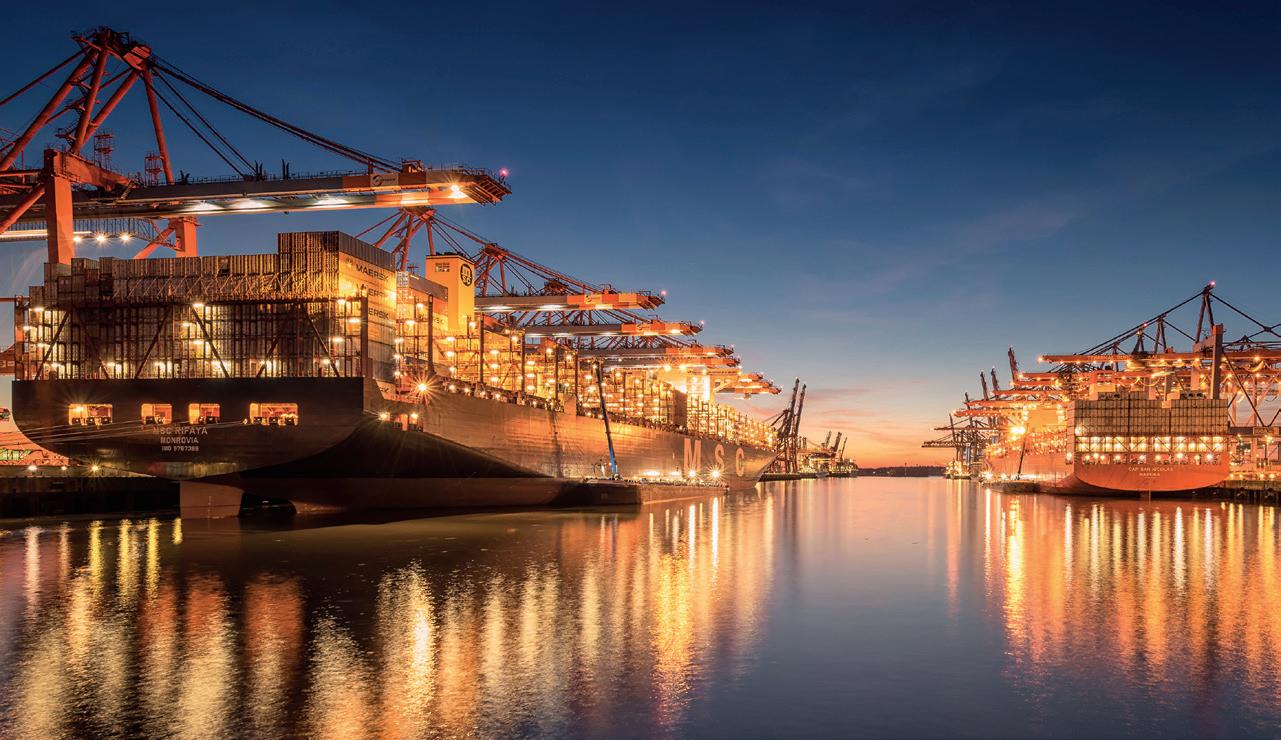
Propulsion & Future Fuels is the longest-running technical conference in the shipping & marine engineering sector providing senior executives with a meeting place to learn, discuss, and share knowledge of the latest developments in efficient propulsion technology and low flashpoint, low carbon fuels.
KEYNOTE PANEL: C-Suite panel, regulatory update

Moderator: Lars Robert Pedersen, Deputy Secretary General, BIMCO Wolfram Guntermann, Director Regulatory Affairs, Hapag-Lloyd AG

The ammonia debate: Sustainable shipping or safety concern?
Hydrogen and fuel cells: Unlocking decarbonisation potential. Exploring technical feasibility.
Ship designs for new fuels: How do we most efficiently propel our ships?


LNG: Bio-LNG and ENG: Next generation LNG: Bio-LNG and ENG. Given stringent regulations and targets, what new options are available?
Methanol: Navigating methanol: Findings and fixes.
Biofuels: Credible path or short-term fix?

THE MOTORSHIP AWARDS
Moderator: David Stevenson, Mercator, The Motorship Editor
Harnessing the power of wind: Scaling up to meet demand.
Onboard carbon capture: Feasibility of storing emissions onboard?
Retrofit: Forward thinking solutions to enable vesels to transition into new fuels.


Que Tran,* VP Technology – Ports and Terminals, Europe, DP World, sets out why Northern Europe’s ports need (digital) systems (not just space) to relieve congestion
Urban planners know the concept of induced demand: Building wider roads to ease traffic often leads to more congestion, not less. More lanes attract more drivers, worsening the problem. In port logistics, a similar dynamic is at play – more space does not necessarily equal less congestion.
Northern Europe’s container terminals are facing delays, with wait times rising by up to 77% at key ports. Causes range from low water levels to strikes, re-routings, and an early peak season. But despite expanded capacity, congestion persists. Like roads, physical growth must be matched by digital agility. Digital systems are not just a substitute for space, it’s what makes that space work at its best.
Without rapid coordination or extensive scenario planning, added capacity fills up fast. Ports are now feeling the consequences of this. Of course, the sequence of events that led to the current operating environment aren’t necessarily predictable in isolation. But if you take the long-term view that global and regional disruption is here to stay, then port operators must have access to advanced technology that makes their spaces work not just harder but also smarter.
A terminal is like a city grid. Widening roads and improving signs won’t help if the traffic lights aren’t synced. Similarly, yard, gate and vessel operations must be well-coordinated in real time. Performance hinges on unified visibility and control.
Since the 1980s, terminals have relied on specialised Terminal Operating Systems (TOS) to manage container movements. Early systems tracked inventory and schedules but in silos, with extensive manual checks often still needed to keep things running.
Today’s cargo flows are less predictable, with tighter yard space and increasing ship sizes and shifting schedules. Expectations for faster turnarounds and clearer emissions tracking add pressure. While many Northern European ports have the physical infrastructure to meet demand, it’s often the absence of real-time coordination, not a lack of space, that limits performance. And as ports expand, the role of smart systems becomes even more critical to ensure every square metre delivers value.
Recognising this challenge, DP World launched CARGOES TOS+ in 2021 at our Jebel Ali Free Zone in Dubai. Unlike conventional terminal operating systems, which manage functions in discrete modules, TOS+ offers a real-time, unified view of container and cargo handling. It integrates planning, execution, and exception management into one platform, allowing terminals to act on live data instead of delayed updates or siloed perspectives. With this digital layer, terminals can respond to change with greater speed and accuracy.
As a cloud-based platform, TOS+ connects with Terminal IoT systems and real-time location services, automating job sequencing across yards and equipment. AI and machine learning capabilities help identify bottlenecks early and support proactive decisions that prevent congestion. Processes like equipment allocation and gate handling can now occur synchronously, improving flow and avoiding delay escalation.
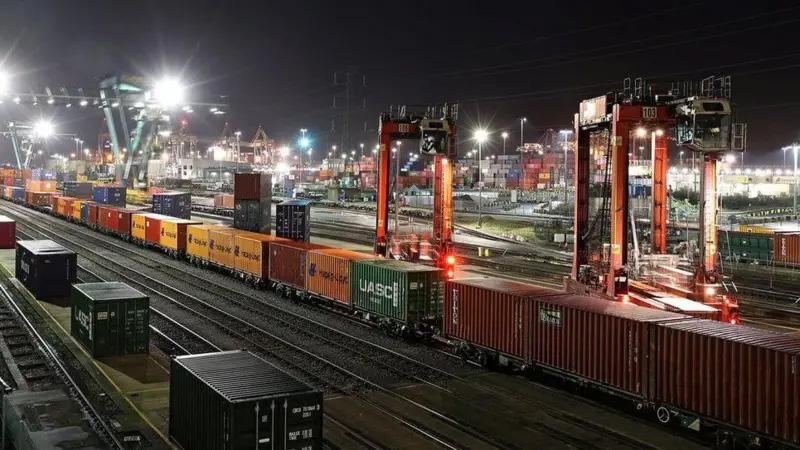
This is akin to reprogramming a city’s traffic system to adjust dynamically to live conditions, flagging disruptions before they occur. In complex terminal operations, every unplanned minute has costly knock-on effects – and TOS+ helps minimise them.
In April 2022, we deployed TOS+ at our Southampton terminal. This replaced the existing system, transforming operations with added new features including real-time simulation modelling, allowing pre-implementation finetuning of terminal plans.
Results include improved yard planning, more accurate container discharge/loading, and better coordination between ship and shore. Truck turnaround times dropped significantly, while rail integration has helped remove over 300,000 truck journeys annually, cutting both congestion and emissions. Today, DP World Southampton averages 35-minute landside turnarounds, with 99.5% of containers meeting their train schedules.
Although not every site can or should invest in large-scale expansion, all terminals can seek to improve how their existing system and operations work together. With pressure building across European supply chains, the ability to coordinate and manage seamlessly through digital, may matter more than any single new physical investment. Sometimes, the clearest path to progress is not creating more lanes but getting the traffic lights right.
*Que Tran, VP Technology, DP World Europe
Que Tran has extensive senior technology and transformation leadership experience, with a focus on cyber, digitalisation and innovation initiatives to help protect, optimise and transform organisations and the industry. Que is currently leading the Technology function across Europe at DP World and has been named among the top 30 leading business and technology executives in the CIO 100 by CIO UK. He was named and has been conferred title ‘Fellow of the British Computer Society’ and recognised for outstanding achievements and contributions to technology. Que also holds Chartered Engineer status with the Engineering Council and is a Chartered Fellow with the Chartered Management Institute.
simulation modelling, allowing the pre-implementation fine tuning of terminal plans
Is your terminal ready for the future or just reacting to the present? Thomas (TJ) Rucker, President, Tideworks Technology, identifies the realities involved in developing effective TOS solutions for the future
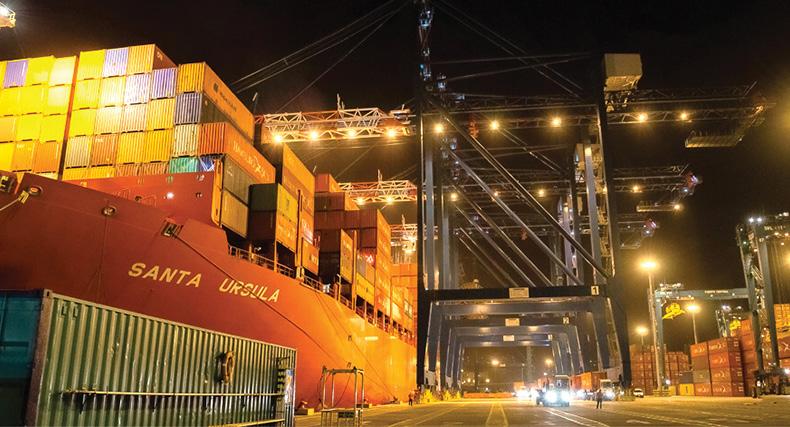
Over the past twenty years, Terminal Operating Systems (TOS) have advanced with improved planning tools, realtime visibility, AI-powered insights, and IoT connectivity. These developments have transformed how terminals organise and manage operations. In contrast, the core machinery that moves containers, such as cranes, yard tractors, and other handling equipment, has changed more slowly. While there have been gains in capacity, speed, and automation, the basic mechanics of lifting, moving, and stacking containers remain much the same, and many terminals are still dependent on manual processes, leaving a gap between digital progress and physical capability.
AI, ML, automation and digital transformation aren’t just buzzwords anymore; they are part of the current tech stack that terminal operators are exploring to drive operational impact. Operators need to understand whether their terminal is equipped to adapt, because change isn’t coming; it’s already underway.
In my experience leading a technology company, moving forward doesn’t mean chasing every new trend. I’ve learned that implementing technology is like a strategic balancing act, connecting lessons we’ve learned from yesterday’s crisis with today’s demands and tomorrow’s goals. Making smart investments starts with a strong foundation and a clear plan to evolve.
When terminals have access to the right data at the right time, they can build a strong foundation for meaningful change, going beyond just checking the “AI” box. With the correct information and tools in place, they can make faster decisions, reduce bottlenecks and improve terminal performance across the board, directly impacting the bottom line.
After two decades of incremental progress, the industry doesn’t just need more technology; it needs transformation, and that future is taking shape by the decisions being made now.
Bridging the gap between interest and execution is no longer optional. Terminals must confront it head-on to reach the next level of performance and future demands. Even though terminals are eager to explore digital transformation, interest alone won’t drive action. The space between curiosity and execution remains wide.
Tideworks Technology conducted a global survey of marine terminal operators to better understand what terminals want to build towards and what’s holding them back.
While 89% of respondents today use a TOS, only 31% tap into real-time analytics, meaning most are operating without visibility of what’s happening in the moment. In fact, 56% of respondents still rely on manual communication methods like email and spreadsheets, and only 33% use APIs. More than 45% of terminals reported challenges integrating with external partners, and nearly half say they lack real-time visibility into their own operations.
Foundational issues haven’t disappeared. Disconnected systems, data silos and rigid platforms are still creating friction and making it harder for terminals to adapt as conditions change and are unable to predict what’s coming next. To reach the point of an agile and adaptable future, terminals require practical, real-time and automated data connectivity across operations. If your team can’t see what’s happening in the moment, how can they act fast enough or make the right call when it counts?
FLEXIBILITY IS THE FUTURE
What terminals need most is flexibility – the ability to build at their own pace, not being forced to overhaul everything just to make progress. A flexible system design lets terminals configure systems, add new features, or plug in third-party tools without disrupting their core infrastructure. Think of it
like adding apps to a smartphone. You don’t need a new phone every time your needs change; you just add new apps when it makes sense.
The same principle will help define the next wave of terminal technology. A flexible platform puts terminals in control, so they can build, integrate and evolve on their terms, with the data structure to support that growth.
With change as a constant, a flexible system isn’t just “nice to have,” it’s how terminals ensure that the system they choose today will still deliver value years well into the future.
Flexibility only works if the technology is built to meet terminals where they are. Too many operators are locked into outdated platforms that can’t keep up with change, or worse, systems that make day-to-day operations harder. If you’ve found yourself stuck with a system that can’t grow with you, you’re not alone.
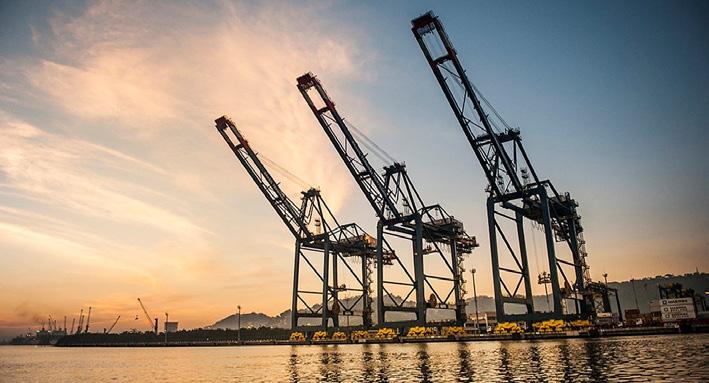
Despite rapid innovation across the industry, not every terminal has the resources to scale all at once. Many critical terminals are operating with lean teams and limited or distracted IT support, yet still need the capability to adopt emerging technologies as they become available. Tools like AI-driven yard optimisation, automated gate systems, or predictive analytics shouldn’t require massive infrastructure investments or months of training. The best technology is built for impact and intuitive from day one.
For example, automated gate systems can significantly reduce truck turn times, allowing drivers to process entry and exit in minutes rather than waiting in long queues. AI-guided yard planning helps dispatchers dynamically assign container moves and optimise crane or hostler deployment, cutting down on unproductive moves and congestion. Predictive maintenance tools can identify potential equipment failures before they occur, helping prevent costly downtime. And visibility integrations can support safety by automatically flagging unauthorised access or risky activity in real time.
When powered by real-time, connected data, these tools give terminals the flexibility to act before issues escalate, helping maintain both uptime and adaptability.
Even as innovation accelerates, that doesn’t mean technology should become harder to use. Operators need systems that are advanced yet accessible. User-friendly interfaces, AI-assisted workflows and simplified dashboards help small teams operate with confidence, adapt quickly and maintain continuity, without needing steep learning curves.
The right solutions empower teams to work smarter today while preparing for what’s next.
Of course, we aren’t flipping a switch and unlocking the future overnight. Even the smartest tools still need accurate, real-time data, or AI can’t deliver impact.
Using AI without clean data is like showering using muddy water. You might go through the steps, but you do not come out any cleaner or wiser. Clean data is the bedrock of every automated decision, yet in the terminal world, the causes of bad data are endless. A simple example: containers processed manually at discharge may have their move times batch-updated to the end of a shift, leaving every box with the same timestamp.
It is also worth noting that applications, including your TOS, are not designed to structure data for future needs. They are built to serve the application’s functions, often by many different people over the years, each focused on immediate requirements. Governance in software development is rarely
perfect, and there is no TOS or any other system with a primary database instantly ready for AI use. In some largescale efforts, getting data into shape has taken as long as two years.
Why is this more important than ever? Real-time, automated decisions rely on the data to accurately represent the current state of the terminal, which is already challenging enough. It’s even more difficult when attempting to use months of historical data, which is often expected for AIbased solutions such as predictions. So, is it worth showering? Definitely, when proper effort is made to clean the water. When terminals have a strong data foundation, AI becomes truly useful. Agents can simulate and optimise yard plans based on inbound/outbound flows, equipment availability and vessel schedules. Terminals can provide real-time updates to shipping lines, trucking companies and BCOs through automated data feeds. And delays or bottlenecks can be identified before they occur to prevent operational disruptions.
When terminals have access to the right data at the right time, they can build a strong foundation for meaningful change ‘‘
That’s where data governance matters. As terminals adopt more digital tools, governance ensures accuracy, consistency and accountability across workflows. Without it, data becomes fragmented, duplicated or outdated, turning insight into noise.
As terminals evolve, the need for a strategic, forward-thinking partner becomes just as important as the tech itself. The truth is, you can’t future-proof your operation alone.
What you need is a partner who understands your operations from the inside out. The right technology partner doesn’t start with technology, but with an understanding of your operations, business goals, and constraints, while keeping your customers in mind. Once they understand those fundamentals, they build the right solutions on top of that foundation.
The most valuable partners take a proactive and practical approach. They work alongside your team to ask the right questions, shape the answers, embed technology that solves real problems, delivers measurable impact, and evolves as your business does.
What will it cost you if your foundation is not ready when change comes?
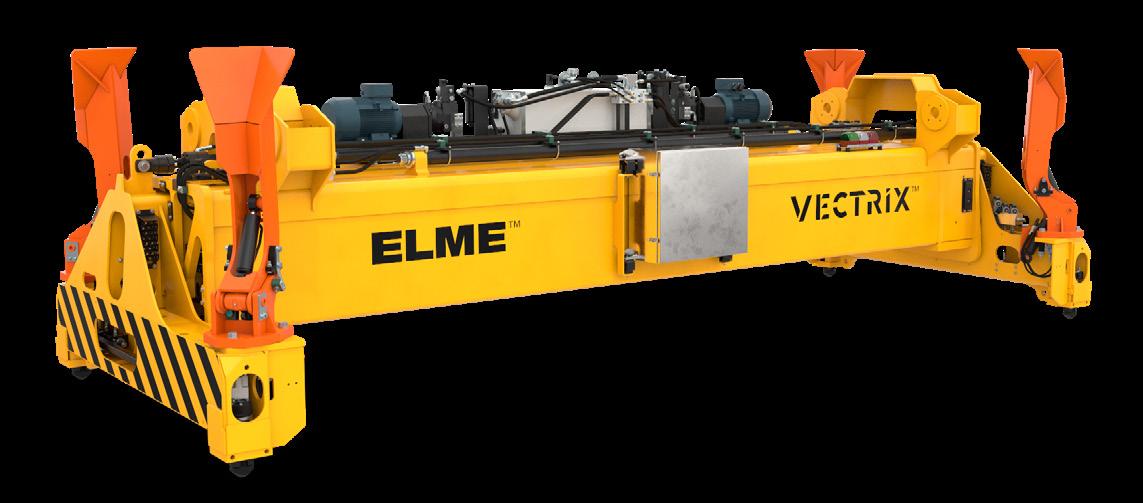
Growing global trade volumes are boosting the demand for high capacity spreader systems and the evergrowing exploitation of digitalisation and cutting-edge technology is helping the supplier sector step up to the challenge. In addition, the drive to net zero has created a focus on electric, energy efficient spreaders.
The impact of growing trade on the port spreader market is highlighted by the Container Spreader Market Size and Forecast (2026-2033) report, published this year by Verified Market Reports. It values the container spreader market size at USD1.2 billion in 2024 and forecasts it to grow at a CAGR of 5.2 per cent from 2026 to 2033, jumping to USD1.8 billion by 2033.
The rapid growth of smart spreaders is helping cope with increasing port volumes. As the report says: “Technological integration remains a pivotal trend, with AI and IoT enabling predictive maintenance,
real-time monitoring, and autonomous operations transforming traditional port handling paradigms.
The shift towards smart ports, particularly in Asia-Pacific, is fostering the adoption of digital twin models and automation solutions that enhance operational transparency and efficiency.”
This theme is reflected in the following company by company reviews, which include news of Bromma’s recently developed fossil free steel electric yard spreader, its new Spreader Monitoring System and Stinis Lifting Equipment’s new Stinis Connect system, which also offers remote spreaders monitoring.
The trend towards electric spreaders is further highlighted by ELME Spreader, whose new series of crane spreaders, Vectrix, includes electric models. Electric spreaders have the add-on benefit of being energy efficient, meeting cost and emission targets.
■ Bromma: This well-known spreader manufacturer is about to deliver the world’s first crane spreader manufactured using fossil-free steel. The spreader is part of a two-unit delivery of YSX45E all-electric yard spreaders, with the HYBRIT fossil-free steel version using steel supplied by Swedish steel manufacturer SSAB. The use of fossil-free steel, Bromma underlines, represents a major breakthrough in the decarbonisation of port equipment and a shared strong commitment with the client, DP World, “to reduce environmental impact through innovative and forward-looking solutions.” Specifically, Bromma refers to a technical white
paper which confirms that by using fossil-free steel (based on SSAB’s HYBRIT technology), the manufacturing emissions of the YSX45E spreader are reduced by more than 90%, leading to a 66% reduction in total lifecycle emissions. The units are scheduled to be shipped to DP World’s terminal in Sokhna, Egypt during September, 2025. All-electric spreaders figure prominently in Bromma’s extensive product range which has also recently seen the addition of its predictive maintenance solution, the Spreader Monitoring System (SMS). This delivers key benefits such as early indication of potential problems facilitating a ‘prevention rather than cure’ approach.
■ Elme’s new series of Vectrix crane spreaders are designed to boost operational reliability and energy efficiency
■ ELME Spreader: The company debuted its new series of crane spreaders Vectrix at TOC Europe 2025 in Rotterdam. The Swedish company says the series features a modular design that allows for cost-effective customisation to meet specific operational needs. Key enhancements include a boost in operational reliability and energy efficiency. Gösta Karlsson, President and Founder, ELME Spreader, notes: “…We have listened to our customers and developed a product that we hope will not only meet but exceed their expectations in terms of reliability, safety, and efficiency.” The new portfolio includes the 8210 Vectrix model, a telescopic top lift spreader for handling laden ISO containers up to 45 tonnes. Two parallel telescopic beams enable maximum overlap. Beam sections are dimensioned to absorb not only the vertical, but also the horizontal force. The 8210E is the electrical version of
■ Intella:LUS-headquartered Intella has launched new Ship-to-Shore spreader actuators that can be used across several brands, with the aim to boost life span and durability. It says: ““The new models, engineered by Intella, address the most common complaint of terminal operators: hydraulic leaks. Traditional local rebuilds often fail to solve this issue due to the difficulty of sourcing proprietary seals. Intella’s upgraded actuators eliminate these challenges, providing a reliable solution that minimises downtime, prevent messy
■ Konecranes: The Finland-headquartered company has introduced the Spreader Kit 500 to address unexpected service interruptions. The kit is a preventative maintenance solution designed to reduce the risk of twistlock failures and unplanned equipment stoppages. It enables operators to schedule twistlock maintenance every 5000 working hours. Konecranes says: “This regular maintenance interval not only improves operational reliability but also enhances safety by reducing the likelihood of container handling incidents caused by twistlock fatigue.” The kit includes four twistlock replacement kits and essential wear pads for scheduled replacement. Konecranes says that by aligning maintenance with this 5000-hour schedule, operators can avoid:
■ RAM Spreaders: The Singapore-headquartered company has launched a universal pipe-handling spreader following an offshore project with Australia’s Spliethoff Shipping to handle pipes between Indonesia and Australia. The RAM Octo pipe-handling spreader is designed to allow the handling of a range of pipes from 1 to 3 pipes with diameters from 16 to 60 inches (40 cm to 152 cm) and diameters between 11.8 to 12.7 meters. RAM Octo will first be deployed at a port in Batam, Indonesia, loading the offshore pipes from the quayside into the shipping vessel’s hatch. Another RAM Octo on the vessel crane then transfers the pipes into a transshipment vessel near the coast in Northwest Australia
■ Stinis Lifting Equipment: The company has launched Stinis Connect to boost the efficiency and reliability of its container spreaders by remotely monitoring and managing them. Its smart spreader addition, which was showcased at TOC Europe 2025, has key features that include the provision of centralised information about the status of each spreader, and the monitoring of metrics including container moves, twistlock operations and operating hours. Stinis Connect has sensors on the spreaders that transmit data about their operation and condition. This data is then securely sent to a cloud-based platform which provides the information through a user interface to terminal operators. Benefits include enabling predictive maintenance, boosting fleet management, identifying trends and optimising resource
this model. The 8610H Vectrix is a hybrid electrical and hydraulic telescopic piggyback top lift spreader. The hybrid spreader combines the efficiency of electric spreaders with the reliability of Elme’s hydraulic piggyback legs system. Designed for operations where twistlock handling is primary, but occasional trailer handling is required, this solution optimises energy consumption while ensuring full versatility. During twistlock handling, the spreader runs fully electrically, making it significantly quieter. As part of the development of its new Vectrix crane spreader series, ELME announced in June this year that it has upgraded its production methods. This includes streamlining production processes and expanding its production area with newly established facilities. The investments will allow for the future expansion of new and current product ranges, says ELME.
hydraulic leaks, and reduce overall costs for container terminals.” One of the companies now providing Intella’s new Actuators is Barlow Technology. It explains: “Ports and harbours face unique challenges, from harsh environmental conditions to the need for precision in heavy-duty tasks. That’s why the Intella Actuators are a game-changer. Engineered with cutting-edge technology, they provide robust, precise, and smooth actuation that ensures the optimal performance of flippers in critical marine applications.”
unforeseen service breaks due to twistlock wear; emergency machine stoppages for single wear pad issues and delays caused by unavailable spare parts. Konecranes’ Noell Spreaders are an accompaniment to the company’s Noell Sprinter and Straddle Carriers, allowing port operators to have fully integrated solutions for key components. The company says that the “clear-cut steelwork” with a minimum of welds enables strong reliability. Konecranes uses CAN bus (Controller Area Network) technology in its equipment to facilitate communication between various electronic control units. It says: “Because the telescopic arms are equipped with our patented hydraulic clamping rather than a mechanical locking device, damage is limited in the event of collisions.”
before being transferred again into the pipe laying vessel. Due to the nature of the load and harsh environment, RAM Spreaders says that an essential feature of the RAM Octo is its rotational control system that controls the rotation of the pipes being handled, making for fast and safe operations. The ability to quickly control rotation (up to 360 degrees in less than one minute) allows accurate placement of pipes, saving time and allowing the operator to control the load at a safe distance without the need for ropes or slings.
Mechanical sensors on the soft touch end grippers send a signal to the operator’s remote control when the pipes are securely clamped longitudinally.
allocation. Stinis Connect is securely connected through Microsoft Azure. Elsewhere, at the end of 2024, Stinis announced that Paterson Simons will become its sales and aftermarket representative for West and Central Africa. The agreement between Paterson Simons and Stinis represents a “strategic move to enhance the availability and support of Stinis products in this region”, says Stinis. As part of this partnership, Paterson Simons recently commissioned Stinis Overheight Spreaders in the Congo. Other developments include the Netherlands’ company launching a new version of its Long-Twin spreader for mobile harbour (MHC) cranes. This spreader allows for the separation and handling of two 20ft containers with a gap of up to 1.6m, improving flexibility and productivity in MHC operations.
A new generation of mobile cranes is fast emerging with distinct smarter, stronger and greener characteristics
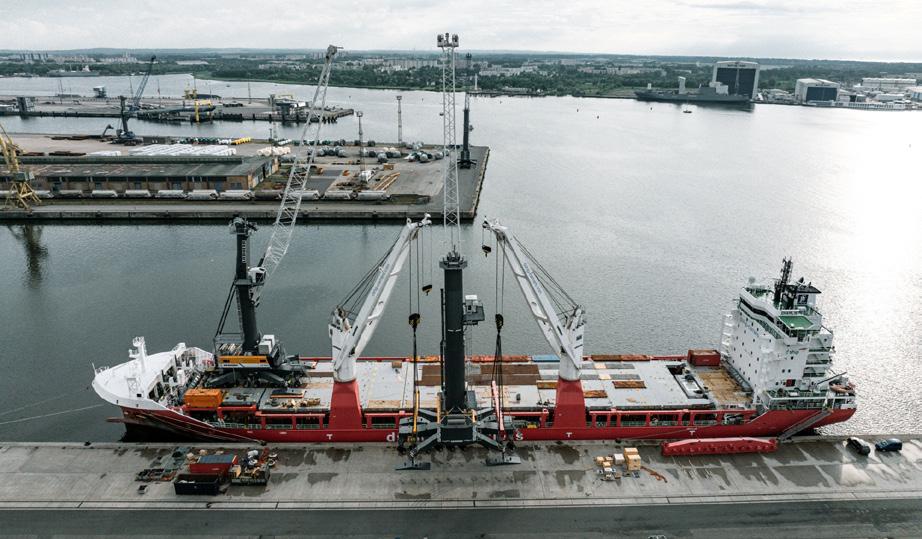
Electric power, analytics and customisation are major drivers for the port mobile harbour crane (MHC) market.
According to DataM Intelligence’s Mobile Harbour Cranes Market Size, Share, Growth Trends and Forecast 20242031 report, this market is expected to grow at a CAGR of 25.1% during the forecast period. There is a greater demand for cranes that have higher lifting capacity to cope with the larger vessels entering service. The report highlights market themes: “Manufacturers are launching next-generation cranes equipped with advanced energy recovery systems and digital monitoring
platforms for real-time performance analytics. Strategic collaborations between crane manufacturers and port operators are being formed to develop customised solutions tailored to specific terminal requirements.” The business cases below highlight these themes. Indeed, Liebherr, at the fiftieth anniversary of Its MHC division underlined its vision for the future includes more data-driven logistics. The large shift towards electric and hybrid power, driven by tightening emissions regulations, is also highlighted by the report, and seen in the latest MHC solutions reported by manufacturers.
■ GENMA: GENMA’s third generation MHC has boosted efficiency by 20% compared to its predecessors. The China-headquartered company reports that this is to a significant extent due to a smarter loading and unloading system which can choose the optimal path of operation and carry out the planned action in an optimal way. With improved anti-sway technology, container operations are smoother and more stable. This, according to GENMA, means that more time is saved, efficiency is improved and operator fatigue is reduced. In dry bulk operations mode, Intelligent Grabbing Technology means that the grab can adapt to a variety of materials, but at the same time each grab action is optimised. On the environmental front, GENMA provides a shore power option for customers which facilitates switching between diesel engines and shore
power. Furthermore, the hydraulic accumulator can store energy and make use of it. Other features include a product life analysis system, which highlights the equipment condition and optimises maintenance, and a Multi Machine Cooperative Operating System, allowing the operator to command two cranes simultaneously.
Recent uptake: GENMA has announced that it has delivered three MHCs to an unnamed Latin American client. It includes one 210 tonne capacity GENMA MHC and two 150 tonne capacity GENMA MHC, both of which are customised according to the operational requirement. The 210 tonne unit has an intelligent hybrid power system, which utilises energy recovery technology in conjunction with diesel engines via accumulators to reduce energy consumption and carbon emissions.
■ Green Energy Resources has invested in two electric LHM 550 cranes, a first-time collaboration with
■ Konecranes: Konecranes has won a clutch of recent MHC contracts, highlighting the move to electrified operations. Port of Manaus operator Super Terminais has placed a repeat order for three Konecranes Gottwald ESP.10 pedestal-mounted cranes to expand its Amazon River operations. Due to be delivered in Q3 2026. Super Terminais is repeating its 2021 purchase of the first three Konecranes Gottwald ESP.10 mobile harbour cranes ever produced. With a maximum reach of 64m and a strong lifting capacity curve, the pedestal-mounted cranes can handle containers and general cargo from vessels as large as super-post-Panamax class. The cranes can be connected to an onshore electricity supply to minimise emissions. Elsewhere, Dutch Combined Cargo Terminals (CCT) has ordered a Konecranes Gottwald ESP.7 MHC with external power supply for its terminal in Moerdijk. The crane is CCT’s response to growing freight volumes and meeting its own CO2 reduction targets. Delivery is scheduled for the third
■ Liebherr: Liebherr has introduced Its LiSIM move mobile simulator, which is designed for rapid deployment and enables “realistic” training for Liebherr MHCs, specifically the LHM 550 and LHM 800. The system includes original Liebherr controls, a lifelike VR environment, and a user-friendly instructor interface. The simulator supports a wide range of training scenarios, from basic manoeuvres to complex operational challenges. Operators can practise 16 container handling exercises, five bulk handling tasks, and six breakbulk operations, each based on real-life port conditions. Adjustable settings such as ship draught and lighting conditions allow for tailored instruction, while built-in performance tracking ensures measurable progress. The Germany-headquartered company says that the LiSIM move saves approx. 99% of CO2 emissions compared to those generated in actual crane training.
Recent uptake: Green Energy Resources has invested in two electric LHM 550 cranes – a first-time collaboration
■ Mantsinen: The UK’s Shoreham Port has announced its latest major investment with the purchase of a new Mantsinen 140M Hybrilift crane. The Mantsinen 140M has a maximum reach of 30 metres and a handling capacity of up to 900 tonnes per hour. Thanks to its Hybrilift energy recovery system, the crane offers greater fuel efficiency, enhanced reliability, and smarter energy use. Capturing and storing energy when the main boom is lowered, the system then reuses it when lifting - providing the equivalent of up to 210kW of additional power. Combined with closed loop swing hydraulics, on-demand hydraulic flow, and
■ SENNEBOGEN: SENNEBOGEN offers what it claims is the largest material handler in the world and has also recently increased its port portfolio with a new model, as well as launching a new crane cabin. At the 2020 BAUMA trade show, the Germany headquartered company introduced its 885 G Hybrid MHC, with a 320 tonne operating weight and 38m reach. The crane can be optimised to meet individual needs. There is a choice of diesel or electric drive, the undercarriage can be designed as a tracked, mobile or rail-mounted version, and the flexibly adjustable skylift cab elevations can also be designed to suit the site and application. Elsewhere, in 2023, the company launched its new, completely redesigned Portcab large-capacity cabin. Its large glass areas to the front and sides, as well as floor panes made of safety glass, provide an unobstructed view across the entire work area and into the ship. The operator is
quarter of 2025. With a working radius of 51m, it is designed to increase handling performance. The external power supply for connection to the port network is intended to reduce fuel consumption and local emissions. The order is part of Finland headquartered Konecranes’ Ecolifting initiative. With this initiative, the company aims to continuously reduce the carbon footprint. Ecolifting also underpins Konecranes’ latest Generation 6 MHCs, a portfolio of six models. These are equipped with smart functions for automation and connectivity. They have a lifting capacity of up to 200 tonnes (400 tonnes in tandem lift with two cranes). Designed to use external power sources as well as to operate independently of the grid with consumption-optimised diesel-generator sets and modern hybrid drives, the crane range can also operate in conjunction with renewable energies such as wind and solar power as well as from the on-shore grid.
between the Indian cargo company and Liebherr. The two cranes, with four-rope configuration, 124 tonne SWL, electric drive and overpressure units are being delivered fully assembled for immediate deployment at Green Energy Resources’ berth EQ1A in Visakhapatnam, India. Also notable, the Port of Dover has added a new Liebherr LHM 550 crane, which has a 54m outreach and 104 tonne lifting capacity. The unit is built as a high-rise version with a 4.8m tower extension, providing a more elevated crane operator perspective to support efficient cargo handling. It offers a capacity of up to 32 cycles per hour in container handling operations. The new LHM 550 runs on Hydrotreated Vegetable Oil (HVO). Liebherr has additionally delivered a new LHM 550 crane to BLG Logistics at its Bremerhaven car terminal. The crane is equipped with a 4.8m tower extension to accommodate ship heights and has a reach of 54m. With 10 drive axles, it can be used flexibly on site and operated with shore power.
temperature-compensated performance, the crane operates efficiently in all weather conditions; using less fuel, reducing emissions, and keeping noise levels to a minimum. In line with other plant across the port, the crane will run on ISCC certified HVO (Hydrotreated Vegetable Oil), enabling an 80–90% reduction in CO2e emissions compared to traditional fossil fuels. The Finnish company says that its Mantsinen 140 is characterised by its energy efficiency and agility. “The 140 brings together the benefits of the smaller and nimble 120, as well as the big and fast 160, when cost per operated tonne makes the difference,” it states.
also supported by cameras when monitoring the safety zones. The company additionally offers what it says is the largest material handler in the world, the SENNEBOGEN 895 E, with an operating weight of 420 tonnes and a reach of 40 metres. In November 2023, this model was delivered to the Gateway Terminal in Connecticut, USA. With cycle times of less than one minute, the 895 E enables faster loading processes. Its special skip pans, which are lighter than the original ones, have proven to be low-maintenance, resulting in cost savings. SENNEBOGEN’s Green Energy recovery system is claimed to be able to save up to 50% in operating costs via one or more additional hydraulic cylinders on the boom and a nitrogen accumulator in the rear. This enables the machine to store the energy generated when the boom is lowered and release it again when it is subsequently raised.
advertise in the
+44 1329 825335 dspicer@mercatormedia.com www.portstrategy.co.uk
Telestack are a leading global manufacturer of equipment for the bulk material handling industry including Ship Loaders/Unloaders, Hopper Feeders, Truck Unloaders, Bulk Reception Feeders, Stockpiling Conveyors, Link Conveyors and Telescopic Stackers.
+44 (0)2882 251100 sales@telestack.com www.telestack.com

LASE offers innovative andproductive solutions for ports by combining state-of-the-art laser scanner devices and sophisticated software applications. We are specialised in the fully automatedhandling of containers, cranes or trucks.
+49 (0) 281 - 9 59 90 - 0 info@lase.de www.lase.de

ifm electronic gmbh ifm is one of the world’s leading sensor companies in the automation of measurement and control, optimizing technical processes in almost all industries.
+49 201 24 22 0 info@ifm.com www.ifm.com
Main customers are shipping companies with their bulk carriers, which know that they can rely on the performance, speed and reliability of ORTS grabs for many, many years. But also terminal operators, stevedore companies and heavy industry companies (e.g. steel works) value the quality of ORTS grabs.
+49 (0)451 398 850 info@orts-gmbh.de www.orts-gmbh.de/
SAMSON Materials Handling Ltd specialisesin the design and manufacture of mobile bulk materials handling equipment for surface installation across multiple industrial segments. Designed for rapid onsite set-up and continuous high performance SAMSON equipment provides an excellent return on investment.
+44 1353 665001 sales@samson-mh.com www.samson-mh.com/
Portable pneumatic conveyors or grain pumps, Continuous pneumatic Ship Unloaders on gantry, Mechanical Ship Unloaders and loaders, as well as complete turnkey projects for port terminals.
+32 67 89 50 41 info@vigan.com www.vigan.com
Bromma is a global organization with an extensive sales and service network around the world. We have delivered spreaders to more than 500 terminals in over 90 countries on six continents. In all, more than 14,000 crane spreaders and rotators have been put into service.
+46 8 620 09 00 sales@bromma.com https://bromma.com/
Customised damper and buffer solutions for container spreaders and ship-to-shore, rail mounted gantry and process crane’s. When fitted to spreaders, our dampers protect the hydraulics’ and reduce noise.
+46-(0)157-45 43 40
American Manufacturer of industrial lift trucks. Taylor Machine Works designs, engineers, and manufactures morethan 100 models of industrial lift equipment with lift capacities from 4,000-lbs. to 125,000-lbs. YOU CAN DEPEND ON BIG RED! +1 662 773 3421 contact_sales@taylorbigred.com www.taylorbigred.com
DSP supports ports, terminals, inland facilities & rail terminals around the world with services and products related to Terminal Operating Systems, Terminal Automation and Optimization.
+41 91 230 27 20 info@dspservices.ch www.dspservices.ch
INFORM develops software to optimize business processes using AI and operations research. Since 1969, it has enabled sustainable value creation across industries through tailored solutions that support resilient, efficient, and successful decision-making worldwide.
+49 2408 9456 6136 info@inform-software.com www.inform-software.com
ELME Spreader is well known for our reliable container handling solutions. Trust and reliability have made us the largest independent spreader manufacturer in the world.
+46 10 222 18 00 sales@elme.com www.elme.com/
For more than four decades, Steelpaint has protected and prolonged the life of heavy industrial facilities such as ports, offshore platforms, tanks, bridges, and ships. Its 1-C-PUR coatings set new standards in corrosion resistance, surpassing traditional epoxy coatings.
+49 (0) 9321 370 40 mail@steelpaint.de www.steelpaint.de
&
Magna Tyres is a global supplier of premium OTR, industrial, port handling and truck tyres. We deliver durable tyre solutions for port handling equipment, ensuring maximum performance and efficiency worldwide.
0031-6-21383568 info@magnatyres.com https://magnatyres.com/
ABB SpA ABB is a global leader in electrification and automation technologies. We are dedicated to innovative solutions that enhance sustainability and efficiency in the port and maritime sectors.
+33 1 34 40 25 81 contact.center@fr.abb.com https://global.abb/group/en
DockGuard is a global provider of marine fender technology and mooring solutions offering a true collaborative approach with customers. We have a reputation as a dependable partner in the international port, harbor and waterways market.
+44 (0) 8452 778800 sales@dockguard.com www.dockguard.com

ShibataFenderTeam is focused on customization and pursues a holistic approach to fender system design to ensure the safety and protection of vessels, port infrastructures and people With more than six decades experience and an unparalleled expertise in rubber production.
+49 (0)40 63 86 10 - 170 contact-germany@sft.group www.shibata-fender.team

The Fogmaker Fire Suppression System is a high-quality and efficient Swedish engineered product. It is not only cost-effective, but it is also tailor-made according to each type of material handling equipment.
Royal HaskoningDHV is an independent consulting engineering company that is helping clients with challenges ranging from climate change and digital transformation to the energy transition.
www.royalhaskoningdhv.com/
As one of Europe’s largest dredging- and marine contractors. We work with nature, performing Beach Nourishment, Land Reclamation, Port Development, Capitaland Maintenance Dredging, Rock Installation, and Offshore Services.
+45 33 91 25 07 mail@rohde-nielson.dk www.rohde-nielson.com
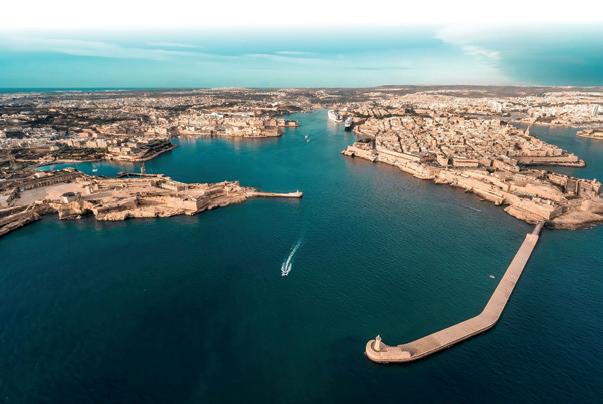
in constant use around the clock or when needed, our customers count on energy efficiency, reliability, performance, service and innovative solutions.
+46 470-772200 info@fogmaker.com https://fogmaker.com/

At IDENTEC SOLUTIONS we are engineering ideas to improve efficiency in the Industrial Internet of Things. Our wireless solutions keep people safe, make teams work better, deliver valuable insights and eliminate wastefulness - even in harsh environments.
+43 5577 87387- 0 www.identecsolutions.com
& CHANGE SERVICES

The National Oceanography Centre (NOC) is a leading UK-based marine science research and technology institute, with a dedicated commercial team that serves as the catalyst for a sustainable blue economy.
+44 (0)300 131 2321 https://noc-innovations.com
CONDUCTIX-WAMPFLER
The world specialist in Power and Data Transfer Systems, Mobile Electrification, and Crane Electrification Solutions. We Keep Your Vital Business Moving!
+49 7621 662 0 info.uk@conductix.com www.conductix.com
Hammar is the world leading manufacturer and developer of Sideloaders, also known as Sidelifters or Self-loading trailers. With over 115 countries, Hammar offers a high quality logistics solution tailored for your needs.
+46-33 29 00 00 info@hammarlift.com www.hammarlift.com
Taiwan International Ports Corporation, Ltd. (TIPC) is a state-owned enterprise, 2012. TIPC focuses on Taiwan’s port business operations as well as the integration of various domestic and international commercial port resources.
886-7-521-9000 #6616 www.twport.com.tw
Tideworks Technology provides comprehensive terminal operating system solutions for marine and intermodal terminal operations worldwide. +1 206 382 4470 info@tideworks.com www.tideworks.com
+49 (0) 25 22 / 76 - 0 mail@hammelmann.com www.hammelmann.com 7-9 October 2025 Kobe, Japan
As Logistics & Change professionals, we use our expertise to help our customers capitalise on their expertise; creating modern 21st Century, customer-centric services that help them secure their short and long term success
+44 (0)203 404 2468 info@psolved.com www.psolved.com/
Collinson Tensile design & construct wide, clear span Steel framed buildings for Ports for use as Bulk materials storage, Waste, Recycling, Fertilizer storage, Timber storage, Breakbulk. Clear span widths up to 100m, Heights upto 35metres. 01995 676 680 info@collinsontensile.co.uk www.collinsontensile.co.uk
New regulations aim to play a major part in reducing the potential for battery fires while under transport. Central to the mandatory changes is key battery types having to be presented for transport with a State of Charge of 30% or under
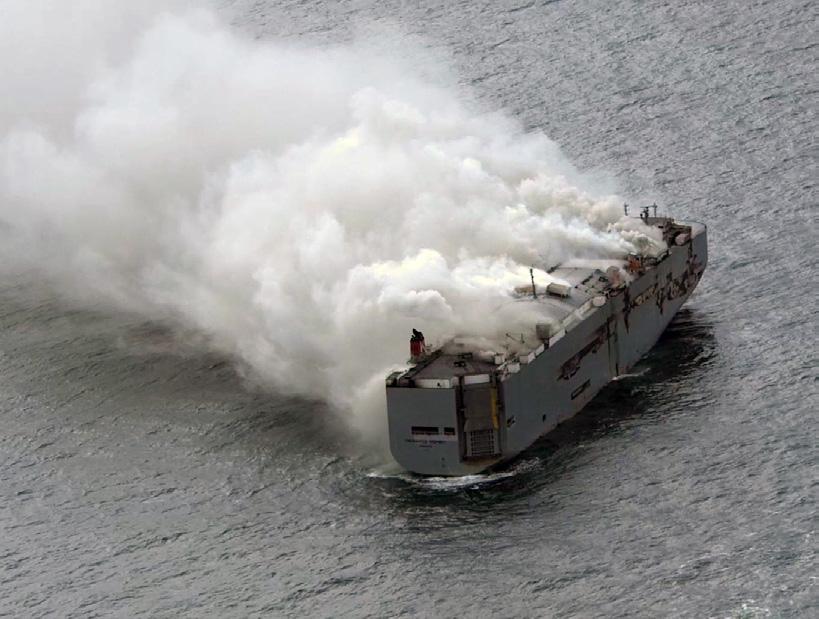
Use of battery related products continues to grow on a global basis, powering everything from doorbells to automobiles, but the shipment of these items, especially in vehicles, continues to raise concerns.
Fortunately, there are new regulations about to come into force to help alleviate these fears.
Progress has been made during 2025, even if these positive steps lost column inches to the more sensationalist reporting of fires on ships, but a major step forward is now expected come January 2026.
Lithium ion and Sodium ion batteries are already separated in terms of their UN numbers (identifiers assigned to hazardous materials for international transport. They are four-digit codes that categorise substances based on their hazards, ensuring safe handling and communication across borders, ranging from UN0004 to UN3550).
Further safety-led requirements were brought into play at the start of January 2025. For example, all sodium ion batteries being shipped without equipment must be transported at a State of Charge (SoC), i.e. packaging requirements for determining the rated capacity of sodium and lithium batteries, of 30% or less and all lithium-ion batteries greater than 2.7 watt hours (wh) that are packed with equipment should be offered at an SoC not exceeding 30% of their rated capacity.
However, a crucial change is now coming into force on January 1, 2026 – mandatory enforcement of these safety-led requirements. But what does this mean?
Well, driven by risks of thermal runaway (an explosive, self-sustaining chain reaction within a system, like a battery, which causes an uncontrollable increase in temperature), adaptations in both production and logistics are needed, as the SoC limits now extend to batteries inside consumer devices and batterypowered vehicles. Shipments above the 30% SoC threshold require specific approvals from relevant authorities and the transport carrier.
Consequently, for manufacturers and retailers there will be a need to adapt production and shipping processes to ensure that all batteries are offered at or below the new SoC limit. By comparison, for shipping and logistics service providers there is a need to be familiar with the International Maritime Dangerous Goods (IMDG) Code in order to ensure full compliance with packaging, labelling and documentation requirements associated with maritime shipping and transportation activities for these items.
Positive steps are being taken, but the two key requirements remain, regardless. First, all employees must be sufficiently trained to identify and handle all dangerous goods like lithium-ion batteries and if in any doubt then consult specialists in hazardous materials and regulatory authorities and second, stay informed about revisions to international regulations, notably the IMDG Code for maritime transportation.

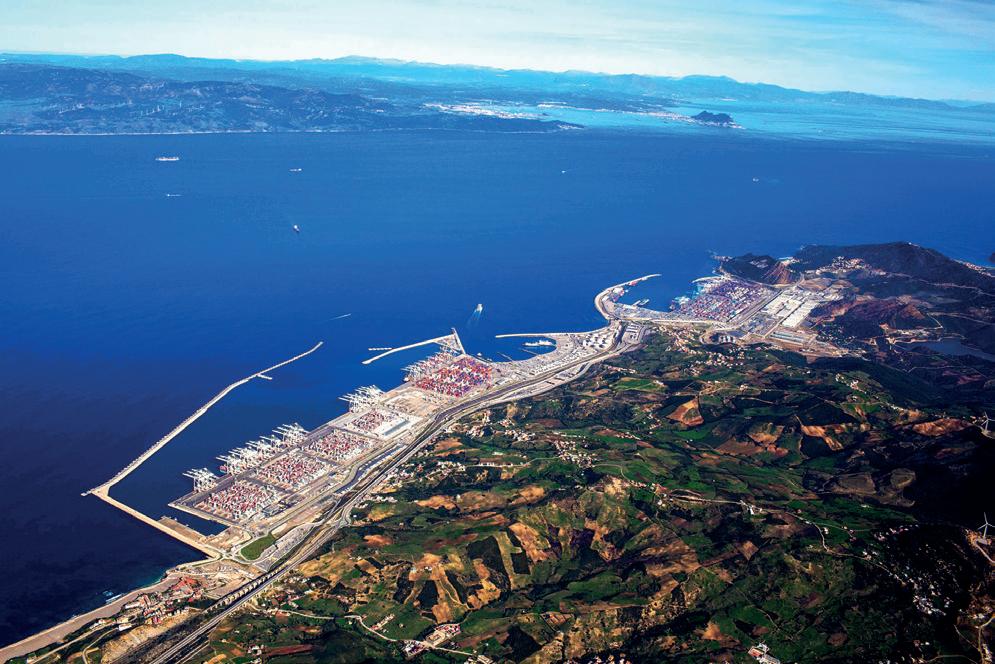
Located on the Strait of Gibraltar, Tanger Med Port Complex is a strategic hub connected to over 180 ports worldwide. A leader in Africa and the Mediterranean, it is a key link in global supply chains connecting Asia, Europe, the Americas, and Africa. The port complex also serves as a maritime bridge for import and export flows between Europe and Africa, spanning 14 kilometres. More than just a port, Tanger Med is an integrated logistics platform offering direct access to rail, road, and sea networks.
Ranked the 3rd most efficient port in the world by the World Bank and S&P, the complex is actively engaged in digitalization and decarbonization to enable more efficient and sustainable logistics.