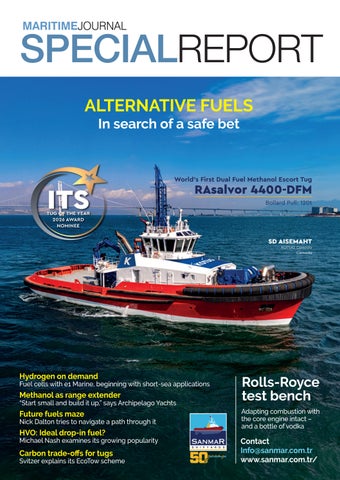
Fuel cells with e1 Marine, beginning with short-sea applications
Methanol as range extender
“Start small and build it up,” says Archipelago Yachts
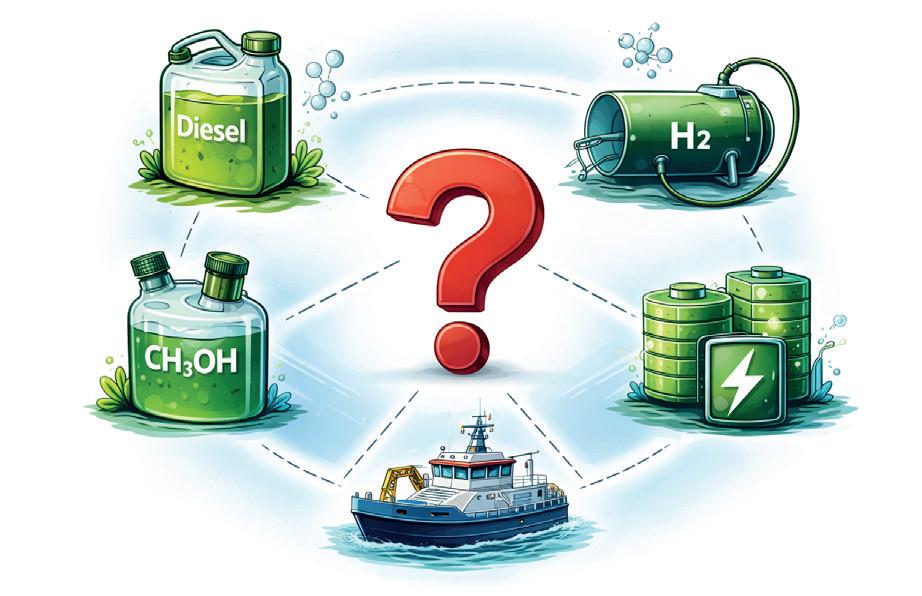
Future fuels maze
Nick Dalton tries to navigate a path through it
HVO: Ideal drop-in fuel?
Michael Nash examines its growing popularity
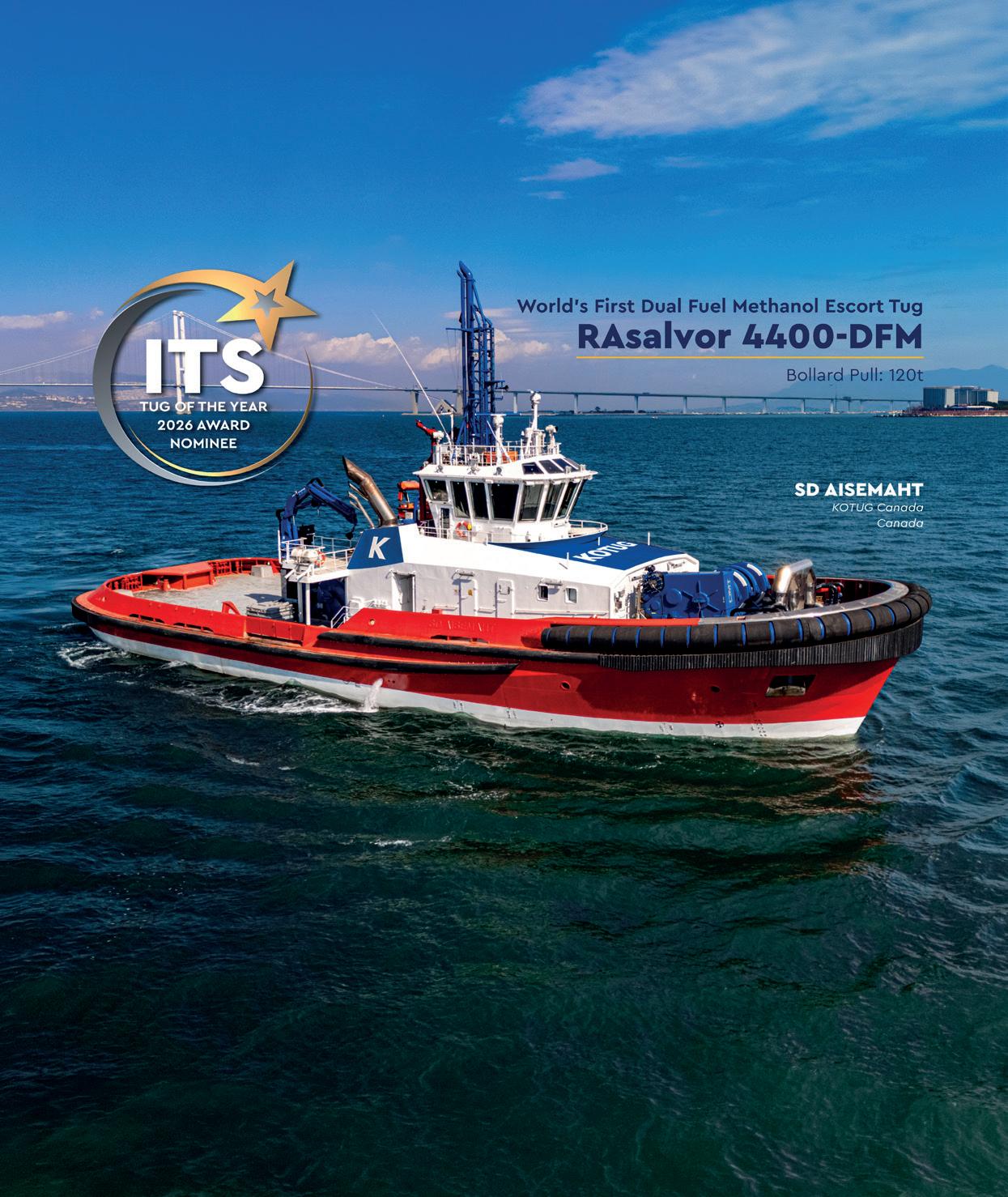
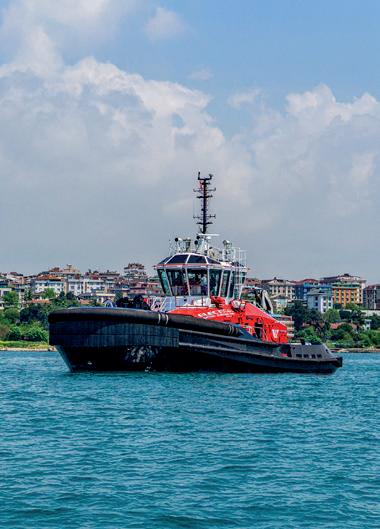
Carbon trade-offs for tugs
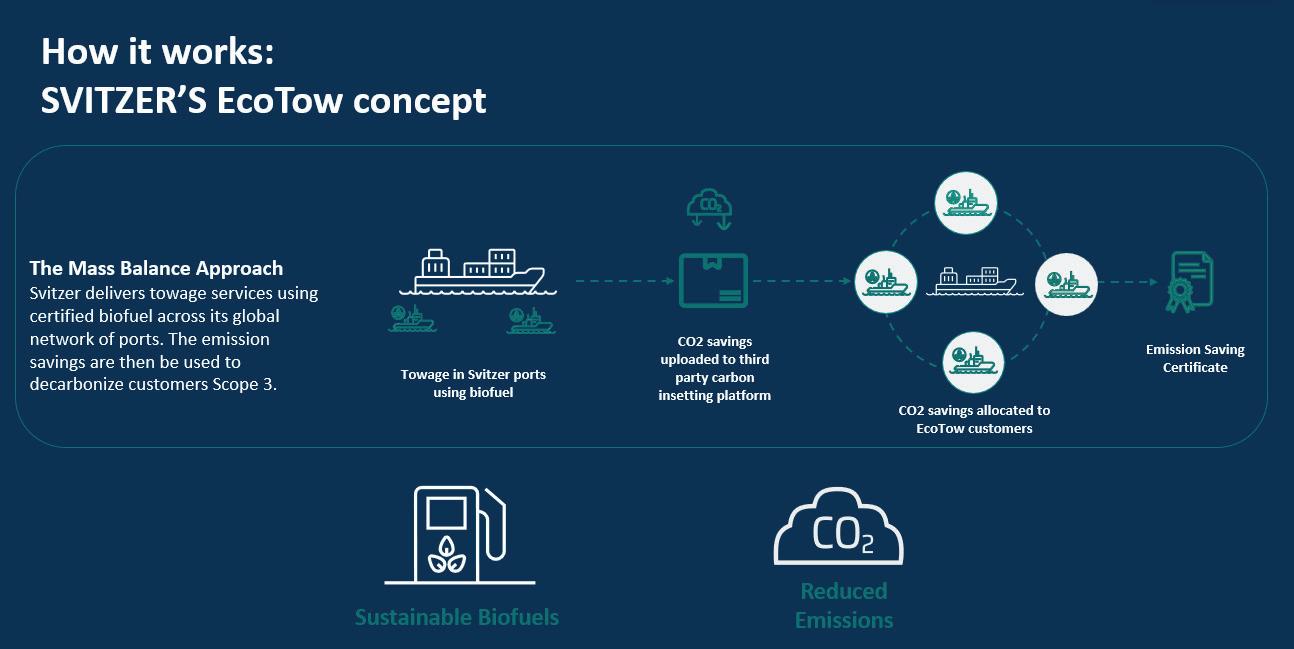
Svitzer explains its EcoTow scheme
Contact
Vessel exemption is just a lengthy detour.
We develop Emission Control solutions specific to your vessel requirements.
The Eminox certified Selective Catalytic Reduction (SCR) technology achieves NOx reduction targets mandated in ECAs and ultra low emission zones.
Our marine engineers will guide you through the Scheme B Approval Process for full on-vessel and class approval.
• Marine exhaust aftertreatment systems for NOx reduction
• Select a product from our standard range
• Easily configurable for challenging spaces
• Scheme B Approval Process for single vessel approval
• Engine ratings from 130kW to 2MW+
Navigating the fuel labyrinth
We are on the cusp of one of the greatest transformations in history in terms of fuel options for commercial vessels.
Never before has there been such a myriad of options either being developed, invented or engineered in the name of ‘net zero’ – ie zero carbon emissions.
This itself is extremely questionable.
How ‘carbon free’ are batteries, for example, when you look at them from cradle to grave?
How ‘carbon free’ is hydrogen, when you consider the added weight on vessels, energy to produce it and greater infrastructure that full-scale availability would require?
How ‘carbon free’ is Svitzer’s EcoTow emissions trading solution, explained in these pages, which simply moves the fuel burn around on paper to give a ‘net zero’ result locally?
As regulation tightens, ship operators have few options: they have to consider ditching diesel, which to this day has no performance or availability competitor, for one or even some of the emerging contenders in the space.
From hydrogen fuel cells to methanol engines, from HVO drop-in fuels to sophisticated carbon-accounting frameworks, we try to offer an insight into where alternative marine propulsion stands today and where it is heading.
Hydrogen commands much of the debate in decarbonisation circles, and we spoke to Dave Lee, executive director at e1 Marine, who makes the case that hydrogen's first credible marine applications are not in deep-sea shipping but in the short-sea and coastal sectors.
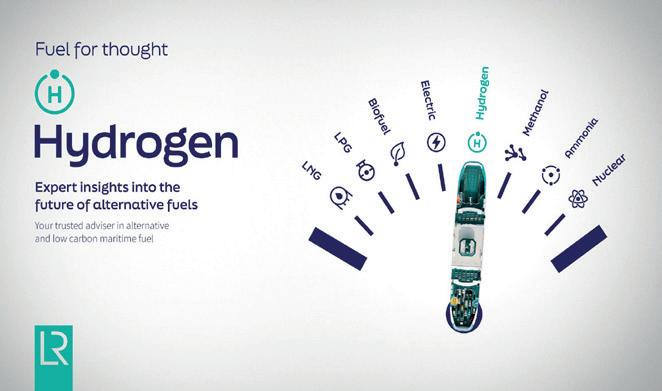
Lloyd's Register's authoritative Fuel for Thought report also examines the gas in depth, showing that the fuel is already moving into real-world applications.
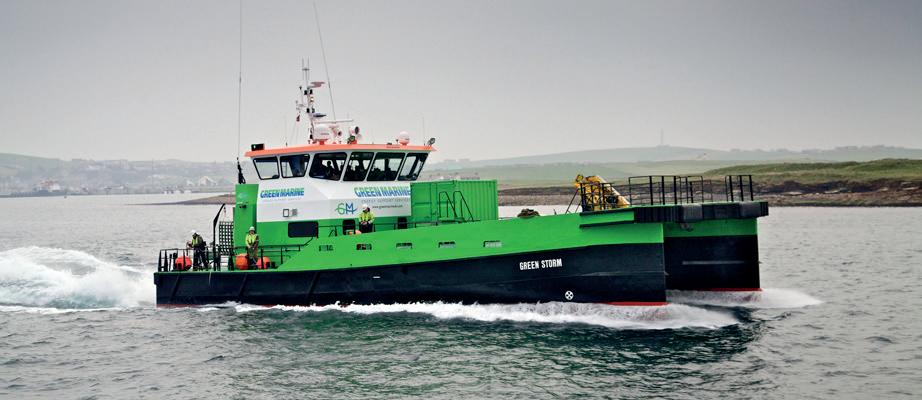
Retrofits are explored through Green Marine UK's Project Verdant, which is converting an existing crew transfer vessel, Green Storm, into a hydrogen fuel cell hybrid.
Methanol seems to be another favourite, and we look at it in two contrasting contexts: Rolls-Royce's application engineering team – Tobias Kohl and Peter Gommeringer – explain the results of their meOHmare full engine test programme on the mtu Series 4000 platform, and at the other end of the scale, Archipelago Yachts owner Stephen Weatherly explains how he arrived at methanol through a systematic elimination of every other alternative fuel.
We also look at HVO (hydrotreated vegetable oil), both as the fuel itself and as a pawn in Svitzer’s chess game of fuel trading, or as it would call it, ‘mass-balance approach’.
And finally a few facts and figures, brought to you by Nick Dalton, who summarises the key elements of the different options coming out.
It won’t be plain sailing, but I hope you enjoy the report!
For more information visit: seawork.com contact: +44 1329 825 335 or email: info@seawork.com
OPINION: A FLEXIBLE COURSE TO NET-ZERO SHIPPING
By Kenneth Coughlan, Chief Technology Officer, North Star
We are now halfway through what is a defining decade for the shipping industry as it faces up to its decarbonisation aims. Operators are under mounting pressures as regulatory frameworks tighten, while investors and clients demand credible transition strategies. Technology is advancing at speed, creating unprecedented opportunities for the shipping industry to positively overhaul the way it operates.
This change, however, will not be uniform and there is no single, one-size-fits-all answer to decarbonisation. Instead, the sector must embrace a broad portfolio of solutions, deploying the right tools for the right missions while ensuring resilience and reliability remain front of mind.
The innovation challenge
For an industry that is a cornerstone of global trade and energy production, two key pillars of modern life, the stakes could not be higher. With a 139-year track record, supported by a 1,500-strong workforce and 47 vessels in operation or build, North Star knows more than most about the scale of the challenge. Thousands of offshore transfers each year rely on robust, proven platforms and any change to this must balance ambition with pragmatism.
Innovation focus areas are broad and hardware advances in marine technology, ancillary services such as drone deployment infield, software, AI and cutting-edge navigation systems, are being balanced with the wave of future alternative fuels under evaluation. Hydrogen, ammonia, methanol, ethanol and electrification are all on the table, each carrying distinct benefits and hurdles.
When it comes to future fuels there is no silver bullet If there is one clear message for shipowners, it is that there is no single winning fuel. Hydrogen may hold promise for shorter-range operations when coupled with offshore charging or floating wind generation, but questions of storage, infrastructure and crew training remain.
Technology
is advancing at speed, creating unprecedented
opportunities for the shipping industry to positively overhaul the way it operates
Ammonia offers high energy density and scalability but brings challenges around toxicity and safe handling. Methanol and ethanol are gaining traction for their easier drop-in potential, while battery-electric propulsion is proving viable for niche, nearshore routes.
The reality is that different operational profiles will require different solutions. A vessel serving offshore wind installations close to port may be well suited to electrification and hybridisation. A platform supply vessel operating further afield may find methanol more practical in the near term. Long-range, heavy-duty support ships could ultimately transition to hydrogen-derived carriers such as ammonia.
From lab to wake
What is encouraging is that these conversations are no longer confined to the drawing board. Demonstrator projects are under way, with offshore charging infrastructure trials and hydrogen collaborations such as those with NAVHYS as well as digital systems that enhance efficiency in real time. The industry is moving from theory to practice, with learnings feeding back into design loops at pace.
But the challenges are real and they are weighing heavy. Regulations remain in flux, fuel supply chains are embryonic, and cost and return-on-investment questions weigh heavily. Training seafarers to operate novel propulsion and storage systems safely is non-negotiable. Collaboration between owners, yards, classification societies, technology developers and regulators will therefore be decisive.
A collective responsibility
North Star’s own net-zero pathway acknowledges this complexity. By 2040, we aim to transform our fleet through staged investment, piloting and scaling solutions as they mature. Crucially, North Star is taking a collaborative stance, partnering across energy, maritime and technology sectors to de-risk innovation and accelerate adoption.
For the offshore industry more broadly the ‘clean leap’ is inevitable, but it must be carefully navigated. Operators cannot afford to wait for a perfect solution to emerge, nor should they gamble on a single pathway. Instead, the sector’s strength will lie in optionality and flexibility.
The industry’s credibility will rest on its ability to demonstrate progress, but decarbonisation cannot be at the expense of vessels in the water or compromised safety. This will require openness to a wide spectrum of technologies and sustained investment, underpinned by a willingness to share learnings along the way.
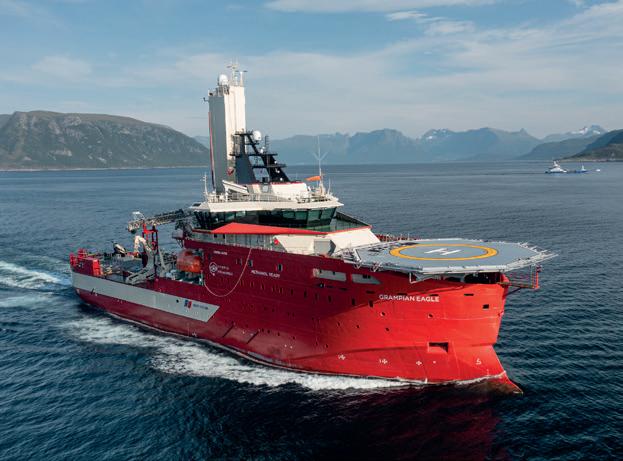
■ North Star's GrampianEagle has been designed so that it can run on methanol fuel, as well as integrating battery technology
HYDROGEN FINDS ITS FOOTING IN SHORT-SEA SHIPPING
Hydrogen is widely positioned as a future fuel for deep-sea shipping. But as Dave Lee, Executive Director at e1 Marine, explains, its first credible applications are emerging in a very different part of the fleet – and for practical reasons rather than aspirational ones.
Green hydrogen appears in almost every maritime decarbonisation roadmap, yet large-scale adoption for ocean-going vessels remains distant. Production costs in Europe currently sit around €4-8/kg, several times higher than the energy-equivalent cost of conventional marine fuels, and this is before factoring in storage, transport and infrastructure challenges.
Beneath that debate, a quieter shift is under way. Hydrogen fuel-cell systems are already being deployed on ferries, workboats, short-sea vessels and harbour craft, proving how engineering solutions can circumvent hydrogen’s most vexing barriers without waiting for global infrastructure to catch up.
Battery-electric ferries have proven effective on short, fixed routes, and hybrid propulsion is spreading across workboats and offshore vessels, while methanol and ammonia are also being explored. Hydrogen fuel cells –particularly when paired with on-demand generation – are finding a role where onboard storage limits, charging constraints or a need for greater operational flexibility make other options harder to deploy.
The key change is not scale but design philosophy. Instead of storing large volumes of hydrogen onboard, emerging systems generate hydrogen on demand and feed it directly to fuel cells, removing the storage penalty associated with compressed or liquefied hydrogen while avoiding dependence on bunkering networks still in their infancy.
Fuel cells also offer characteristics well suited to short-sea operations: relatively high electrical efficiency compared with conventional marine engines, rapid response under variable loads, and quiet operation in ports and coastal environments. PEM fuel cells typically operate in the 40-60% efficiency range, compared to 25-45% for diesel engines.
Why short-sea shipping moves first Independent research by the European Maritime Safety Agency suggests hydrogen-fuelled vessels may be better suited to short-sea than deep-sea operations, as shorter routes and frequent port calls mitigate storage and bunkering constraints.
A North Sea Hydrogen Valley study identified 13 hydrogenand methanol-powered vessels in operation as of 2025 on short-sea and inland routes, with further vessels on order in the 0.6-6.4 MW range for delivery before 2030.
The operational logic is straightforward. Short-sea vessels operate on predictable routes, require comparatively modest fuel volumes, and many are transitioning toward hybrid propulsion combining batteries with electric drive – a configuration into which hydrogen fuel cells integrate naturally.
Regulation reinforces the urgency. FuelEU Maritime came into force in January 2025, requiring progressive reductions in GHG intensity towards 80% by 2050, while the EU ETS expanded to cover 100% of regulated shipping emissions in 2026. Shore power remains patchy across European ports,
with grid constraints and permitting timelines delaying deployment – making modular, grid-independent hydrogen fuel-cell systems an increasingly practical alternative.
From stored hydrogen to on-demand generation
Hydrogen’s physical challenges are well understood. Its low volumetric energy density means that even in compressed or liquefied form it requires significantly more storage space than conventional fuels, while its wide flammability range demands careful system design and ventilation. For vessels where space is finite, simply scaling up hydrogen tanks is impractical.
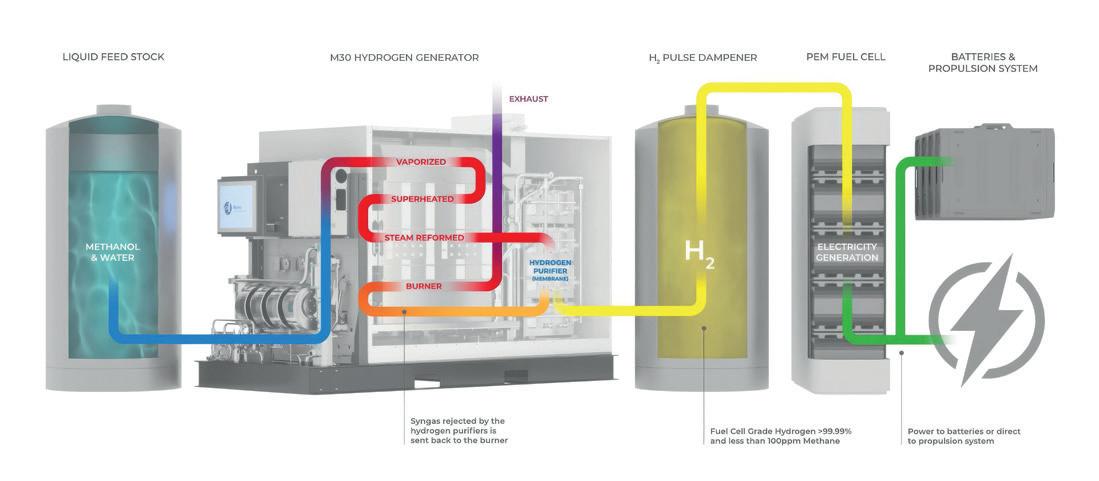
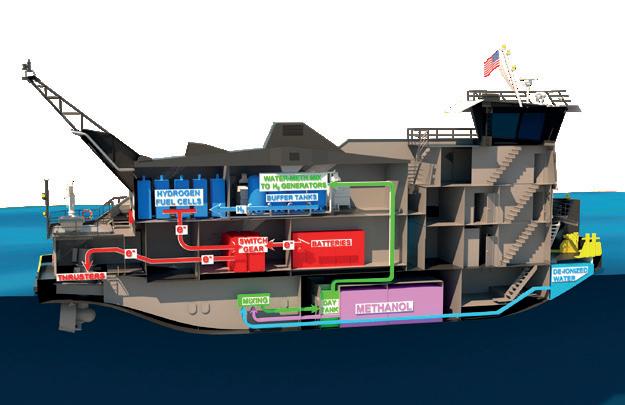
On-demand generation offers a different approach. Using methanol as a hydrogen carrier – a liquid fuel available in more than a hundred ports worldwide – integrated onboard reforming systems convert a methanol-and-water blend into high-purity hydrogen in real time. This is then supplied to PEM fuel cells, which produce only water and heat as by-products.
For vessel designers and operators, the practical advantages are clear. Methanol fits within familiar liquid-fuel logistics, storage integrates more easily into vessel designs, and the volumetric penalties of compressed or cryogenic hydrogen are avoided. Classification societies have begun publishing dedicated rules for ships using hydrogen, and IMO and national regulators are developing risk-based approval frameworks.
Evidence from the water
These are not theoretical propositions. Norway’s MF Hydra entered regular service as one of the first liquid-hydrogenpowered ferries, using fuel cells combined with batteries on a fixed coastal route. In the US, the MVSeaChangebegan public
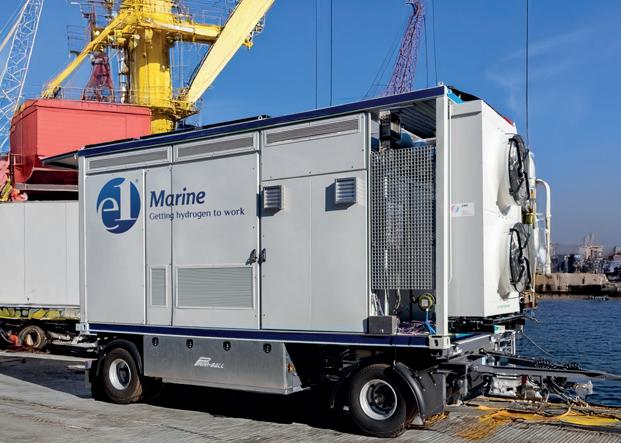
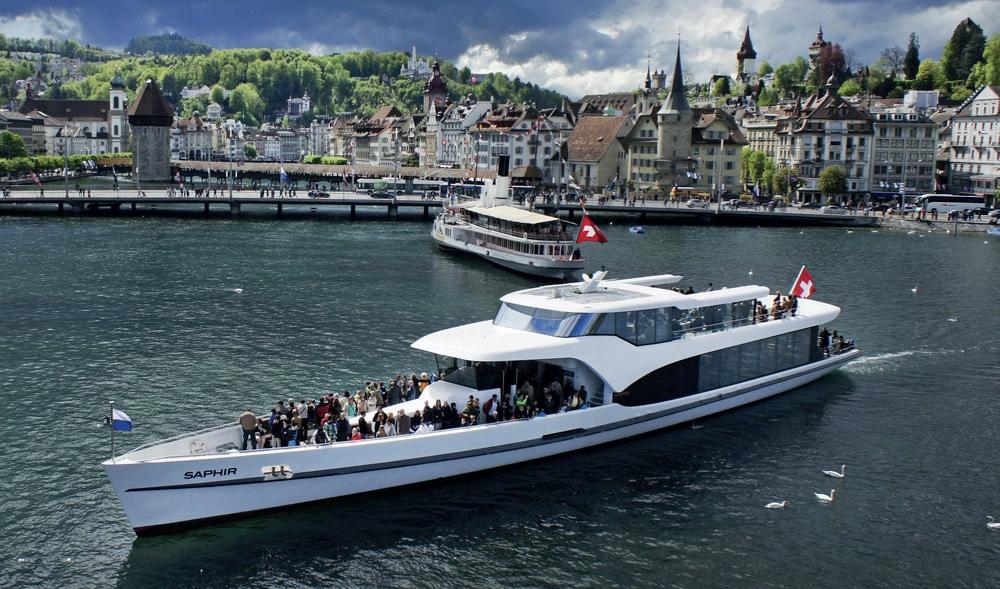
■ e1 Marine's e-Nomad at port
service in July 2024 as the first commercial hydrogen fuel-cellpowered ferry in San Francisco Bay and has since been refinanced through a sale-and-leaseback arrangement with Maritime Partners, signalling growing commercial confidence.
Norwegian studies examining high-speed ferry conversions have found that compressed hydrogen can be one of the most cost-effective zero-emission options under certain conditions, with projections suggesting hydrogen fuel-cell passenger ferries could approach cost parity with diesel between 2025 and 2030.
Samskip has selected Norwegian Hydrogen to supply liquid green hydrogen for two new 730-TEU hydrogenpowered short-sea containerships scheduled for delivery in 2026, extending momentum beyond the ferry sector.
The maritime industry’s wider debate about hydrogen –storage versus combustion, green versus blue, ammonia derivatives versus pure H2 – will continue, and rightly so. But it should not obscure what is already deployable
The hydrogen-ready electric ferry CapdeBarbaria , operated by Baleària between Ibiza and Formentera, is the first ferry in Europe to use e-methanol to produce renewable hydrogen onboard, powering a fuel cell to generate auxiliary electricity and reduce reliance on conventional generators. Its significance lies in demonstrating hydrogen fuel-cell power deployed without dedicated hydrogen bunkering infrastructure.
e1 Marine has received an order from PowerCell Group for eight M30 reformers to support the first commercial sale of the M2Power 250 methanol-to-power system, forming part of a 2MW installation contracted by a major European shipyard. Each 250kW module combines e1 Marine’s methanol-to-hydrogen generator with PowerCell fuel-cell stacks, replacing conventional diesel gensets without requiring high-pressure hydrogen storage.
Independent operational modelling of e1 Marine’s technology, based on approximately 50,000 hours of
aggregated workboat data, indicates lifecycle GHG reductions of up to 85% when renewable methanol is used, alongside elimination of NOx, SOx and particulate emissions at the point of use.
Starting where the conditions are right
The maritime industry’s wider debate about hydrogen –storage versus combustion, green versus blue, ammonia derivatives versus pure H2 – will continue and rightly so. But it should not obscure what is already deployable.
The most promising early applications share three characteristics: constrained or absent shore power, operations in or near emission-controlled waters, and continuous power needs that map well to modular fuel-cell systems. Ports across the North Sea region are positioning themselves as clean energy hubs, combining offshore wind, hydrogen production and maritime fuel supply.
Hydrogen will not replace marine diesel across the global fleet in the near term. But coastal fleets have historically served as testbeds for new propulsion technologies before wider adoption. In specific short-sea and coastal segments, hydrogen is beginning to move from pilot projects towards early deployment, offering operators a realistic pathway to cut emissions and reduce compliance risk without waiting for perfect global infrastructure to arrive.
■ Reformer Process Diagram
■ Render of e1 Marine's hydrogen fuel cells in a vessel
ElectRA 2500SX
HYDROGEN IN THE DOCK: LLOYD’S REGISTER’S JUDGEMENT
Hydrogen promises zero-emission operations for tugs and crew vessels, but real-world feasibility hinges on safety, infrastructure and operational realities. In its FuelforThought report, Lloyd’s Register puts hydrogen in the dock.
The classification authority presents hydrogen not as a speculative technology but as a fuel already moving into real-world maritime applications, though there are limits: it is particularly viable in short-sea and coastal segments where operational constraints are more manageable, but certainly not in other areas.
The report finds that the decarbonisation drive is accelerating faster than past propulsion transitions, but this time not primarily by economics or performance, rather by environmental fears and regulation.
For workboats, such as tugs and CTVs, hydrogen’s feasibility depends less on technical possibility and more on operational suitability: these vessels often operate close to shore, with predictable duty cycles and regular returns to base to allow fuelling, which obviates the need for large storage capacity on board.
Hydrogen’s core technical promise
Hydrogen’s attraction as a marine fuel is straightforward: when used in fuel cells, operational greenhouse gas emissions can fall to near zero.
The report explains that hydrogen combustion produces water as the primary by-product, though high temperatures may lead to nitrogen oxide formation, which must be controlled.
Lloyd’s Register emphasizes that hydrogen has ‘the highest energy density of any fuel by mass’, but also the lowest by volume compared with candidate marine fuels such as methanol.
This contrast explains why hydrogen presents both opportunity and limitation: while it is a good energy carrier in theory, when it comes to onboard storage needs, it’s a challenge.
Liquid hydrogen storage requires cryogenic temperatures at around minus 253°C, while compressed gas storage demands large tanks and high pressures. And while these factors are problematic for long-range ships, they are potentially workable for harbour and coastal vessels, the paper says.
Propulsion pathways: fuel cells and engines
Lloyd’s Register confirms the two main hydrogen propulsion options:
● Hydrogen fuel cells, which produce electricity to power propulsion and offer quieter operation and zero carbon emissions at the point of use, making them attractive for port operations and vessels serving offshore wind.
● Hydrogen internal combustion engines, which work in the traditional way, swapping diesel for H2. These may remain more relevant for tug operations that need sudden peak power.
In practice, many early concepts blend these systems with batteries, creating hybrid vessels that balance efficiency with operational flexibility.
Safety and operational reality
Hydrogen’s feasibility cannot be discussed without acknowledging safety concerns.
■ Shiptec hydrogen passenger ferry given AiP by Lloyd's Register
Lloyd’s Register repeatedly stresses that hydrogen is an extremely flammable gas with a wide flammability range and very low ignition energy.
The report highlights several specific considerations:
● nearly invisible flame in daylight
● rapid dispersion in ventilated spaces but accumulation risk in confined areas
● hydrogen ‘embrittlement’, when hydrogen atoms permeate solid metals, causing a reduction in ductility and making them prone to cracking
● cryogenic hazards for liquid hydrogen systems.
These challenges do not prevent adoption but require safeguards in vessel design, bunkering arrangements and operational procedures – all of course adding to cost.
The safe adoption of hydrogen also depends on training in fuel handling, gas detection, emergency response and bunkering procedures.
The report references ongoing IMO work to develop interim training guidelines for seafarers operating alternativefuel ships, highlighting that human factors may be as important as technology in the transition.
Lloyd’s Register has developed risk-based certification frameworks specifically to support novel hydrogen vessel designs.
For workboats, the smaller scale of systems and port proximity can make monitoring and risk management more achievable compared with larger ships.
Regulations and commercial drivers
Lloyd’s Register emphasises that regulation is one of the strongest forces driving interest in hydrogen.
EU and IMO frameworks increasingly reward fuels with low lifecycle emissions, and hydrogen – particularly ‘green’ hydrogen – aligns well with these future requirements.
Hydrogen may not replace diesel overnight, but within harbour and coastal operations it is already moving from theory to implementation
The report also says shipping companies are assessing hydrogen partly because future carbon pricing and fuel intensity rules may make zero-carbon fuels economically attractive, despite higher upfront costs.
For workboats operating under port authority or offshore wind contracts, compliance advantages may outweigh fuel price disadvantages before they do in other sectors.
The report is clear that bunkering infrastructure is also a major barrier: international standards for liquid hydrogen bunkering are still emerging, and only limited pilot operations currently exist.
However, workboat sectors may again have an advantage. A single port-based hydrogen facility can support an entire local fleet, avoiding the need for a global supply network.
Hydrogen bunkering locations are already being explored in parts of Europe, North America and Asia, which aligns naturally with tug and crew-transfer operations tied to fixed geographic hubs.
Realistic assessment
Another factor shaping hydrogen’s feasibility for workboats is the changing role of ports themselves.
Increasingly, ports are not just locations where vessels
refuel; they are becoming integrated energy hubs, linking renewable electricity, industrial hydrogen production and maritime demand. This ecosystem model matters because hydrogen economics improve dramatically when production, storage and consumption are geographically clustered.
For workboat fleets operating from a single base, the possibility of shared infrastructure – servicing tugs, pilot boats and CTVs together – reduces risk and spreads capital costs across multiple users.
This evolution also aligns with broader trends in offshore wind development.
CTVs operate within fixed corridors and predictable schedules, making them ideal candidates for early hydrogen adoption. In some regions, developers are already exploring direct links between offshore renewable generation and hydrogen production, creating local energy loops that bypass long supply chains.
At the same time, hydrogen adoption may reshape operational culture. Operators accustomed to measuring fuel in tonnes and endurance in days are beginning to think in terms of energy management, charging windows and hybrid optimisation, the report says.
In this sense, hydrogen is not just another fuel choice – it signals a shift towards more integrated, data-driven vessel operations, where efficiency depends as much on how energy is used as on what fuel is stored onboard.
Prediction
Hydrogen may not replace diesel overnight, but within harbour and coastal operations it is already moving from theory to implementation.
Lloyd’s Register believes that there is no longer any question of shipping decarbonising, just how quickly it can adapt to the fuels and technologies that could make it possible.
Hydrogen’s future in workboats will not be decided by a single technological breakthrough, but by thousands of operational decisions made across ports, shipyards and fleet operators over the coming decade.
It will also need them to come together in a way that has never been seen before, in a way that can accommodate a myriad of different points of view.
The real test will not be whether hydrogen works in principle, but whether it can be integrated into everyday maritime practice without compromising reliability or commercial performance.
If that balance is achieved, the smallest vessels in the fleet may once again lead shipping’s biggest transition.
ElectRA 2500SX
METHANOL WILL FIND ITS HOME AS A RANGE EXTENDER
Archipelago Yachts owner Stephen Weatherley talks to Maritime Journal about his work to find a potential range extender for commercial vessels using methanol.
Stephen Weatherly arrived at methanol by a process of elimination. When he began looking seriously at alternative fuels for the leisure and light commercial marine market, he worked through what he sees as the five main contenders: batteries, ammonia, hydrogen, LNG and methanol.
Ammonia was ruled out immediately: "It's just too poisonous," he says. "You're certainly never going to get it on a leisure vessel. I can't see it ever being carried on a highspeed craft."
Hydrogen has theoretical appeal but practical difficulties: unless stored at 300 bar or cryogenically, its energy density is poor, and confining a molecule that small is technically demanding. Its explosive properties when mixed with air present further obstacles, particularly for leisure users.
LNG he regards as largely irrelevant to any serious decarbonisation discussion, since it is a fossil fuel.
That left methanol. It can be stored as a liquid, has a relatively benign toxicity profile compared to ammonia or hydrogen, and dissolves in seawater without harming aquatic life in the event of a spill. Its energy density is roughly half that of diesel, meaning vessels need to carry approximately double the volume for equivalent range, but that is a manageable burden compared with the alternatives.
Critically, it has a credible pathway to becoming genuinely clean: most methanol today is ‘grey’, which means it is derived from natural gas, or ‘brown’, produced from coal, predominantly in China. But biomethanol, made from degrading organic waste matter, and e-methanol,
synthesised from seawater and renewable electricity, offer lower-carbon routes.
"Methanol is interesting because it can come from clean sources," Weatherly says.
Its one significant safety concern is the invisible flame it produces when burning, which means heat detectors rather than visual observation are required to identify a fire.
Weatherly acknowledges this but does not regard it as a fundamental barrier.
It can also be used in two distinct ways for propulsion: either burned directly in a combustion engine, which engine manufacturers including the major diesel producers are actively developing for dual-fuel applications; or fed through a reformer that cracks it into hydrogen and carbon dioxide, with the hydrogen then passed through a fuel cell to generate electricity. That is the pathway Weatherly and Archipelago are currently exploring under an Innovate UK grant as part of the CMDC6 programme: developing a methanol reformer fuel cell combination as a range extender for electric vessels.
"Given that methanol is 20 to 25 times more energy dense than batteries," he says, "you don't need to store a huge amount of methanol to really have a significant impact on the range of your vessel."
The case for and against batteries
Although he is currently building an all-electric vessel for a customer who has specifically requested it, Weatherly is skeptical about electric vessels.
■ A-63 powered by biomethanol
"Batteries are great for one use case, which is doing short distances between places so you can charge up and refuel," he says.
The fundamental problem is energy density. Batteries remain 40 to 50 times less energy dense than diesel. To achieve equivalent range on battery power alone, a vessel would have to carry 40 to 50 times the weight of a diesel installation.
Port-side charging infrastructure for large vessels is also limited, and the time required to recharge high-capacity battery banks is an operational constraint that does not apply to liquid fuels.
Weatherly also has environmental reservations about the mining of lithium and cobalt and the challenges around endof-life disposal.
"All of these big technical leaps require early adopters who are technically willing to take the risk and also have relatively deep pockets," he says. "This stuff is expensive."
The reformer fuel cell route has its own complications, however. The purity requirements for the methanol feedstock are stringent. Standard commercial methanol is not sufficient; the reformer demands something close to laboratory grade, and the deionised water used in the process must also be chemically pure. The reformers and fuel cells themselves are heavy and expensive, with catalysts requiring replacement after several thousand hours of operation.
Greenwashing, dual fuel and the regulation problem
Weatherly is sceptical of what he calls the dual-fuel approach being pursued by much of the commercial sector, where vessels are fitted with both a diesel tank and an alternative fuel tank but operate predominantly on diesel.
His concern is that without binding regulation requiring operators to demonstrate actual use of alternative fuels, there is no commercial incentive to bunker anything other than diesel. He would like to see a framework that requires CTV operators, for example, to prove a minimum percentage of methanol use over a given period or face financial penalties.
"Unless that exists, you're just going to go into a port, bunker up with diesel and you're off," he says.
The major marine engine manufacturers are developing dual-fuel engines, but Weatherly notes that most are not expected to reach market until around 2030, having been in development for years and with further testing ahead. That timeline, combined with the absence of methanol bunkering infrastructure, means the commercial case for alternative fuels remains weak without external pressure. "I think we have to be honest with ourselves about it," he says. "I don't think it will become a thing unless it's forced upon operators of these vessels, because it's too hard, it's too expensive."
He is careful about the form that pressure should take, however. Legislation introduced before the technology and infrastructure are mature can be self-defeating, locking in requirements that cannot practically be met. He sees incentivisation through carbon credits or tax relief linked to demonstrable alternative fuel use as a viable intermediate step. "It doesn't necessarily need to be legislative at first. It could be incentivisation. Carrot and stick."
The case for simplicity: weight, speed and vessel design
Running alongside Weatherly's work on alternative fuels is a conviction that the industry is overlooking the most straightforward decarbonisation measures available to it. The argument is simple: slower vessels burn less fuel.
"Just go slower," he says of CTV operators. "Go out at 20 knots rather than 25, you'll probably cut a hell of a lot more carbon than you will using a dual-fuel solution."
CTVs, he says, have also become much heavier than their predecessors, driven by a combination of regulation, crew comfort requirements and operatorspecified equipment. The additional mass translates directly into higher fuel consumption for equivalent distances.
Computational fluid dynamics has made hull design experimentation far more accessible, removing the need for physical tank testing and models, but Weatherly believes operators' requirements still constrain what designers can achieve.
When operators specify 25-knot transit speeds and particular turbine push-on loads, the resulting design brief leaves limited room for optimisation. The outcome is a semiplaning hull carrying more weight than it needs to, burning more fuel than it should.
Given that methanol is 20 to 25 times more energy dense than batteries, you don't need to store a huge amount of methanol to really have a significant impact on the range of your vessel ‘‘
Archipelago wants to push back against this trend.
"It's a pretty fundamental belief of mine that boats are too complicated, too heavy, and people are not appreciating enough the simplicity of a twin-engine installation that's a very accessible, lightweight fit-out. It's a boat. It's not a home."
He advocates simpler, lighter outfitting, accessible engine installations and a design aesthetic that acknowledges the marine environment rather than works against it. Less equipment means less weight, less fuel consumption and less to go wrong.
Weatherly draws a parallel with the development of other transport technologies, where safety standards tightened as experience accumulated rather than being imposed before the technology was understood.
The leisure sector, with its lighter regulatory framework, is where he sees the most scope for experimenting. Foiling technology followed the same path, starting with leisure craft before moving into commercial ferry applications.
"Start small and build it up," he says.
Modern
■ Archipelago Yachts' shipyard on the Isle of Wight
ElectRA 2500SX
REALISM IN TRANSITION RACE: BACK ALL HORSES
With green investment drying up and hydrogen still years from commercial viability, Green Navy is taking a pragmatic new approach: building vessels that work today but are ready for the fuels of tomorrow.
At two recent international events that once flourished in the ‘green’ sphere, Green Navy CEO Charles Cardi was amazed to see how the mood had changed.
Where Hyvolution in Paris and EuroMaritime in Marseille had once been bursting with enthusiasm for minimising CO2 emissions and investing in new technologies, the last two events were ‘undeniably negative’, Cardi says, with a distinct lack of government presence, no investors and worse than that – no customers.
“It was a very little fair compared to what it was the year before,” he says. “There was no business being done during the fair. It was mainly manufacturers there, sharing that it was also a very tough time. Some exhibitors told me they were considering attending for the last time.”
Green Navy is a French maritime technology company that had been formed to develop hydrogen-powered vessels to decarbonise coastal shipping.
Based in La Forêt-Fouesnant in Brittany, in the Finistère region on the Atlantic coast, the company is a subsidiary of the aviation and logistics group Vallair, and works with a number of maritime partners, including Seco Marine.
So in view of this reluctance what is the company, whose electro-hydrogen flagship project Prometeo has been running since 2019, going to do?
“Commercially, in this new environment, it would be suicide to continue the sole focus on electrohydrogen propulsion, and in fact the company has already been sensing that there was a change in
attitude from operators, and local regions, towards new technologies,” Green Navy says.
“The global enthusiasm is being severely impacted by the focus on fossil fuels in the US and the lack of funding for infrastructure investment across Europe as governments struggle.”
Regulations are not yet pushing ship owners towards alternative fuels, and without the carrot of financial incentives or the stick of compliance requirements, the commercial logic simply isn’t there.
“It’s just not financially viable yet,” Cardi says. “The answer is to have parallel strategies that can converge when the time is right.”
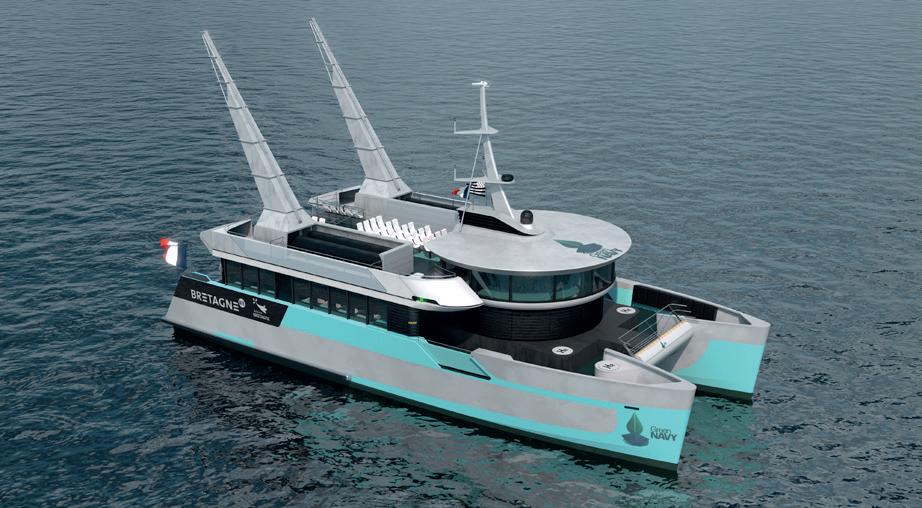
The plan is to develop a fully electric passenger catamaran – Prometeo – with diesel generator that can be retrofitted with hydrogen fuel cell technology or hybrid options when it makes sense to do so.
At the same time, it’s not giving up on the hydrogen option: it will continue to improve its fuel cells and work with certification authorities to get accreditation for when the time is right.
Three vessels, one hull Green Navy’s response is a modular architecture built on a single hull concept that Prometeo from the start. The vessel can now be configured in three distinct versions, all with an identical weight footprint.
The first is a fully electric version, running purely on batteries — adequate for
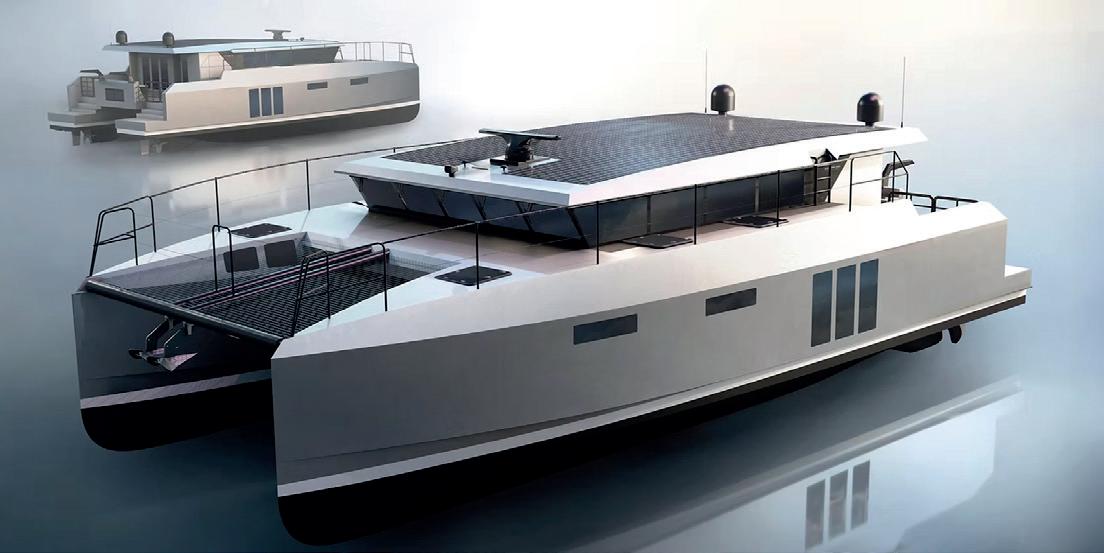
■ Render of Green Navy's vessel
■ Charles Cardi, Green Navy CEO
The global enthusiasm is being severely impacted by the focus on fossil fuels in the US and the lack of funding for infrastructure investment across Europe as governments struggle
shorter routes, where autonomy requirements are modest. The second is a diesel-hybrid: still electric in propulsion, but with a diesel or HVO generator to recharge the batteries, extending range.
The third is the original electro-hydrogen vision, with a hydrogen fuel cell acting as the range extender in place of the generator.
The crucial feature is that all three variants are hydrogenready. The vessel’s architecture means the generator can be removed and a fuel cell installed “as soon as you have the hydrogen ready at a competitive price”.
“You take off the generator and then you install the fuel cell on board. It’s as simple as that,” says Cardi.
Moving from full electric to a range-extended version means halving the battery capacity and using that saved weight for either the generator and fuel, or the fuel cell and hydrogen storage.
Selling the vision to ship owners
The commercial pitch that is now resonating with operators is a straightforward one: buy a vessel today that protects your investment for a 30-year operating life. Ship owners who must commit to new tonnage now, but cannot yet afford or justify hydrogen propulsion, can take delivery of a hybrid or electric vessel knowing they are not stranded when green fuels eventually reach price parity.
“Those ships, they will be running and be operated for 30 years,” Cardi says. “To know that your investment is already ahead of its time, that’s very appealing to them.”
He says that since pivoting the commercial offer, Green Navy has started to attract fresh interest from ferry operators, particularly in coastal regions of Brittany and western France, who were previously cool about the project.
A parallel study under way with a shipowner partner is modelling the capital expenditure and operating costs of all three versions against a conventional diesel-powered equivalent.
The results, which Cardi expects to share in the coming weeks, are intended to give operators hard data, covering energy costs from diesel and HVO through to electricity and two hydrogen production pathways, to inform fleet decisions.
Cracking the safety question
Even among operators who accept hydrogen’s long-term potential, safety anxiety remains a significant barrier.
Cardi says Green Navy’s key innovation is the elimination of ATEX zones: areas where hydrogen leakage could create an explosive atmosphere.
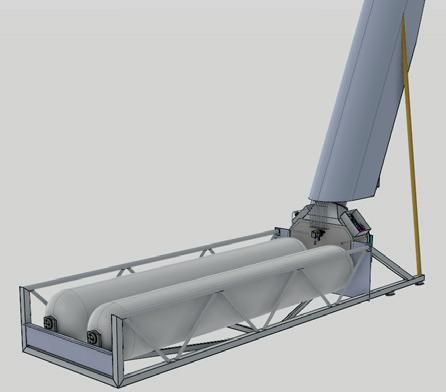
The solution relies on layered containment and ventilation. Double- and triple-sealed piping routes any leaked molecules to large exhaust and ventilation systems mounted on the upper deck. The hydrogen storage bottles, made from a plastic liner wrapped in carbon fibre, sit inside a sealed casing connected directly to the exhaust system, with automatic detection, autocutting, and continuous monitoring throughout.
“Prometeo, when it will be approved, will be able to have passengers close to the H2 bottle because those bottles are safe and there is no leak possible happening,” Cardi says. The approval he refers to is an Approval in Principle from Bureau Veritas for the complete electro-hydrogen system, which he expects to be granted within weeks. It will be among the first such certifications for a passenger vessel of this type.
Eyes on the horizon
Green Navy is also tracking alternative fuel pathways.
Solid oxide fuel cells — high-temperature systems capable of running on hydrogen, methanol and methane alike — are being studied with partners as a way to broaden the vessel’s future options further.
Ammonia, by contrast, is not on the near-term roadmap for vessels of this size, though Cardi acknowledges it could have a role as a hydrogen carrier for larger deep-sea shipping.
The broader picture, he believes, is one without a single winning fuel. The maritime transition is more analogous to the current energy mix than to the coal-to-oil shift of the last century — a mosaic of solutions deployed where they make most sense.
“We have to offer those versions that actually are a step ahead, that you will be able to convert this ship into the H2 version because we’re going to have the approval in principle next month,” he says.
“It’s going to require more time than what we all believed at the beginning.”
■ Leak proof - Green Navy's hydrogen storage solution
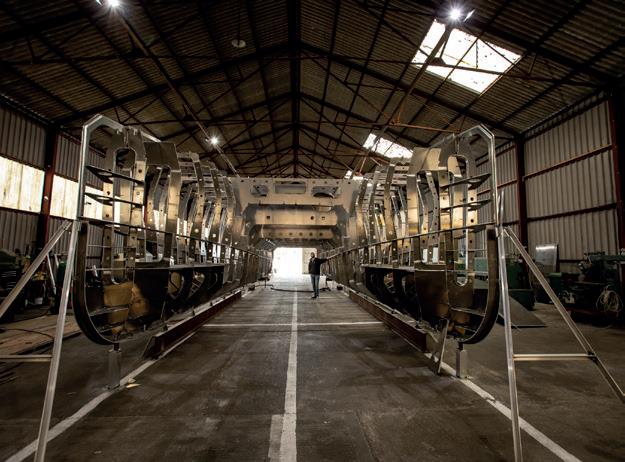
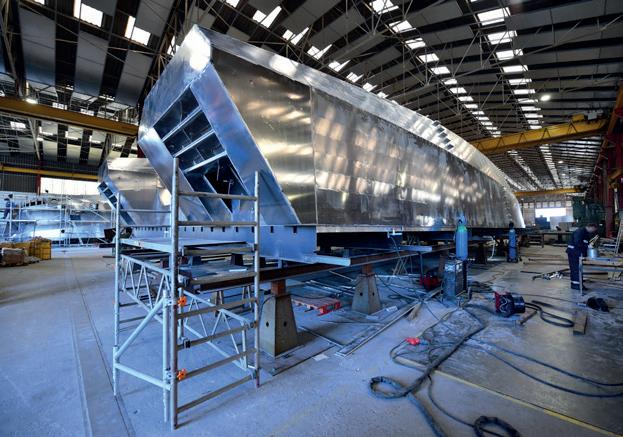
■ Promoteo hull in the shipyard
PROJECT VERDANT: THE HYDROGEN CTV OPTION
Green Marine UK is looking ahead to a new generation of fully zero-emission vessels, including hydrogen-powered CTVs and SOVs. Serena Shores spoke to Managing Director Jason Schofield what the project has achieved so far – and what comes next.
Green Marine’s brainchild, ‘Project Verdant’, looks at how retrofitting an existing crew transfer vessel (CTV) with hydrogen fuel cell technology can offer a real-world testbed for integrating zero-emission propulsion into today’s offshore fleets – without waiting for newbuilds.
Green Storm, bought by Green Marine in 2019, is the primary testbed for retrofit hydrogen technology and the vessel is scheduled to undergo an innovative integration of hydrogen fuel cells and battery storage.
This conversion will not only demonstrate that a dieselpowered CTV can have its lifespan extended, it also serves as the functional blueprint that proves the concept behind Project Verdant, pioneering the transition for offshore fleets to be repowered with clean energy.
Based in Orkney, north of Scotland, Green Marine is working on the project with the European Marine Energy Centre (EMEC).
“Project Verdant’s conceptual design incorporates hydrogen fuel cells connected to electric motors, working in conjunction with existing diesel-fuelled engines, which can be shut down to enable zero emission operation at slow speed while servicing offshore wind farms,” says Jason Schofield.
“The aim of the project is to significantly reduce operational emissions and advance sustainable maritime practices in a challenging sector, by enhancing vessel redundancy and flexibility without impacting the vessel’s operational profile.”
An opportunity for transition CTVs operate in low power mode roughly 70% of the time, when standing by or loitering in offshore wind farms and harbours. When in low-power mode, the power drawn is about 5-10% of the power needed for high-speed transit, so the addition of hydrogen fuel cells will result in reducing CO2 and NOx by up to 30% and 40% respectively.
In 2024 the Innovate UK-funded project received RINA AiP (Approval in Principle), which unlocks future project phases for Green Marine UK.
“In terms of opening the door to subsequent project phases seeking to execute design, engineering and sea trials, obtaining AiP was a key objective for Project Verdant,” says Schofield.
It also provides confidence in the CTV’s ability to operate safely in UK waters in accordance with the MCA (Maritime & Coastguard Agency) regulations MGN 664 and RINA Rules Pt C, Ch 1, App 14, Appendix 14: Hydrogen Fuelled Ships.
“Project Verdant focused on engineering a credible solution and to come up with that we worked along with RINA throughout all processes,” Schofield says. “Everything we developed and engineered was evaluated by RINA, then we got approval for the engineering works carried out, so to get that recognition was really important.”
Making the benefits of retrofitting a reality
Phase 1 of Project Verdant was the feasibility study. The technologies required to convert the CTV to operate as a hydrogen fuel cell hybrid are pre-existing and commercially available and the fuel cell technology selected by Green Marine is known as Proton Membrane Exchange (PEM), which has already been proven safe in different means of transport.
PEM fuel cells use an acidic polymer membrane electrolyte and a platinum-based electrode. These lower-temperature fuel cells are more expensive, but they deliver a longer lifespan, reducing maintenance costs and improving the number of hours they can work until they need to be replaced, making them a more environmentally friendly solution.
“The same goes for the battery system,” says Schofield. “It will help the vessel meet required peaks in power when operating on zero-emissions mode, while at the same time
■ The 26m Damen Twin Axe CTV Green Storm in loitering mode at an operational wind farm in the UK
making the vessel completely noiseless if needed, if the CTV is operating in that mode. Several companies have also proven its safety through different safety features such as thermal runaway insulation. Both solutions are modular, making the installation on board the CTV’s constrained deck space very promising.”
Phase two involved integrating the hydrogen fuel cell into the power frame and gear box and testing and operating the converted CTV.
Specialist consultancy Waves Group was a very important partner in this project, providing all the naval consultancy architecture services required. Schofield also stresses the importance of the collaborations with EMEC in looking at where they could get the fuel from for the production of hydrogen.
“EMS (Engineered Marine Systems) provided technical expertise in the integration of alternative fuels, conducting a comprehensive feasibility assessment and developing a robust preliminary design framework for the retrofit,” he says. “EMS was excellent in calculating where all systems fit within the vessel, incorporating retrofit fuel lines and electrical systems into the retrofit.”
Another strategic partner was global leader in hydrogen systems Energys, one of the technology leaders for marine fuel cell generators.
“Energys helped design and provide engineering and modelling. As technology leaders for making electrolysers, they were a fundamental part of the overall design,” Schofield says.
With the
diesel
engine as back-up on the retrofit,
Green Marine is wanting to operate four days at a time on hydrogen for six hours a day, in loitering mode and in transit mode to reduce fuel emissions
“In all there will be five phases acknowledging that technology changes the whole time. With the diesel engine as back-up on the retrofit, Green Marine is wanting to operate four days at a time on hydrogen for six hours a day, in loitering mode and in transit mode to reduce fuel emissions.”
Based on Green Marine's hindcast vessel-operating profiles, the direct saving of a converted CTV using an H2 fuel cell for low-power mode is anticipated to be 300 te (tonnes of CO2 equivalent) (12hr operations) up to 450te/yr (24hr operations) of GHG emissions.
The drive towards 100% zero emissions
The next stage is preparing specifications for the new-build zero-emission CTV, then commissioning a newbuild. When it comes to SOVs there are no plans to retrofit, but to focus on new-build 100% zero-emission vessels incorporating the new technology. There will be no retrofit CTVs running alongside the newbuild.
“By converting an existing vessel with a conventional engine to include a hydrogen fuel cell (for use in low-powermode), Green Marine will get valuable insight into the challenges of building and operating a CTV powered 100% by hydrogen,” Schofield says.
They can also start the progressive training of the crew, while developing maintenance routines for this new power source. The ultimate mission is to capture sufficient learning
from the operation of a retrofitted vessel to enable Green Marine UK to expand its fleet with new-build zero-emission CTVs and SOVs.
“We are engineering into new-build CTVs to eventually be 100% hydrogen powered.”
All retrofit and new-build vessels will increase efficiency, reducing their carbon footprint. Schofield feels that industry confidence that the technology is reliable is countered by the need to not exceed the budgets available to increase the number of vessels.
“The end goal of all CTVs operating in UK and EU offshore wind farm fleets being zero-emission vessels would eliminate 472,850 te per year at current rates,” he says. “Increasing competitiveness by achieving true zero and spearheading innovation comes with challenges, but the success of this five-phase approach will de-risk the project by steadily increasing Green Marine’s know-how.”
A greener future
Green Marine will naturally move on once it has proven a concept viable and reliable to build up market confidence.
“The project will run in a certain sequence, but it is vital to prove the concept in an operational environment,” says Schofield. “Everything moves to the right; the timescale of the project runs over three years going from the feasibility study to the commission of a new CTV and a further three years to design.”
This will be prefixed by designing the SOV with the same system, subject to technology improving.
Project Verdant’s advantages over other awarded projects in the UK and Europe stem from its location and maritime industry segment.
“The demand for CTVs to support offshore wind after the recent ScotWind lease is on the rise and due to the big push on green hydrogen technology in the north of Scotland, the supply of zero-emission fuel should not represent a concern,” he says.
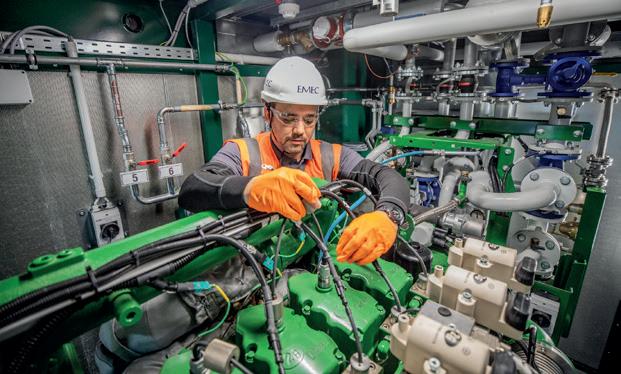
■ CHP test and run, Colin Keldie - EMEC
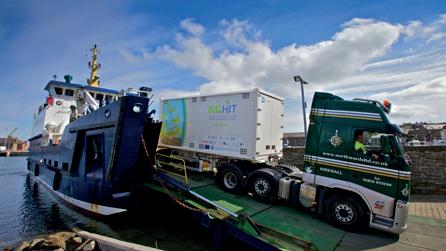
■ EMEC hydrogen mobile storage trailer coming off Shapinsay ferry
ROLLS-ROYCE BETS ON A GREENER ENGINE
Maritime Journal talks to Tobias Kohl, Vice President Application Engineering, and Peter Gommeringer, Application Engineering Marine – Methanol Engine, both at Rolls-Royce.
ElectRA 2500SX
With a successful full-engine test behind them, RollsRoyce's application engineering team explains to MJ editor Debbie Mason why methanol is the most realistic alternative to diesel for tugs, ferries and offshore vessels – and what still needs to be solved before the technology hits the water.
Performance: Same power, different fuel
At the heart of Rolls-Royce's methanol programme is a deceptively straightforward claim: that a methanol engine can deliver the same power output as its diesel equivalent.
For Rolls-Rorce, that claim rests on a firm distinction between two different kinds of density.
"Power density is the power per weight/volume of the system in this case the combustion engine," says Gommeringer. "The kilowatts coming out of the block – that's something we can influence and this is about the same for a methanol engine as for a heavy-duty diesel engine. The energy density refers to the fuel and methanol is less energy dense than diesel."
What Rolls-Royce has done is keep the core engine –specifically the well-proven mtu Series 4000 platform – largely intact, while adapting the combustion process. Diesel ignites under compression; methanol does not, it needs a spark.
"If we talk about single-fuel methanol, we need a spark ignition – a spark plug," says Kohl. "It's not like a diesel combustion process, but we have experience with that. We have an LNG engine in the field with spark ignition already."
The company has been running single-cylinder tests on methanol combustion for several years, accumulating data on the fuel's combustion behaviour.
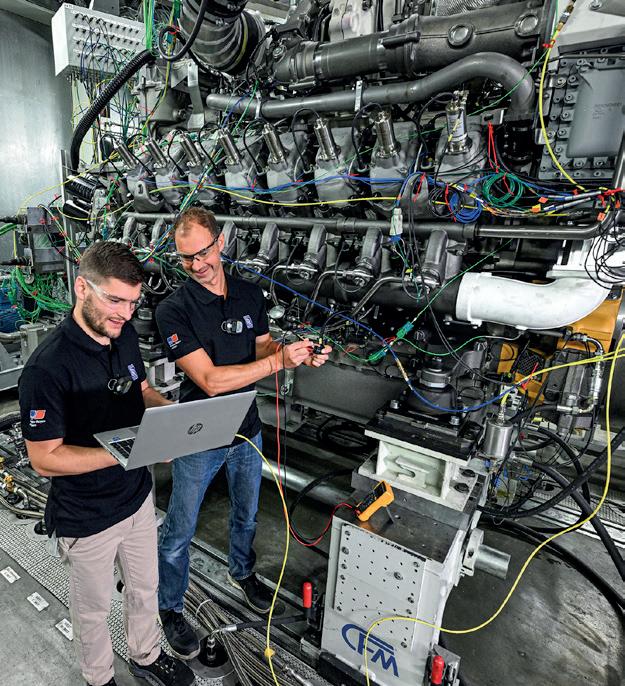
Last year, it completed a full Series 4000 engine test as part of a publicly funded project called meOHmare, examining not just combustion, but emissions, vibration, transient response and cold-start behaviour across a full four-month test programme.
"You can't test everything on a single cylinder engine," says Gommeringer. "You can test the combustion itself, but you can't test real emissions. You can't test the vibrations of an engine."
The results were, by Kohl's account, ‘super successful’. At commercial ratings – the derated output levels suited to heavy duty workboat operation – the methanol engine matched the diesel's power output from the same block dimensions.
For tugs, ferries, offshore supply vessels and platform support vessels that form Rolls-Royce's commercial marine market, the numbers, Gommeringer and Kohl believe, stack up.
With the single-fuel concept, there is also the potential to dispense with exhaust after-treatment. Only low levels of nitrogen oxide emissions are produced, and no particulates.
One open challenge is lubrication. Diesel is self-lubricating; methanol is not. This has implications for injectors and other components in direct contact with the fuel. All of the suppliers face the same issues and Rolls-Royce is collaborating with most of them.
"If you would like to use it today, the maintenance costs will be higher," Kohl admits. The company is now working through the disassembled full test engine, examining each component for wear and identifying where material changes will be needed.
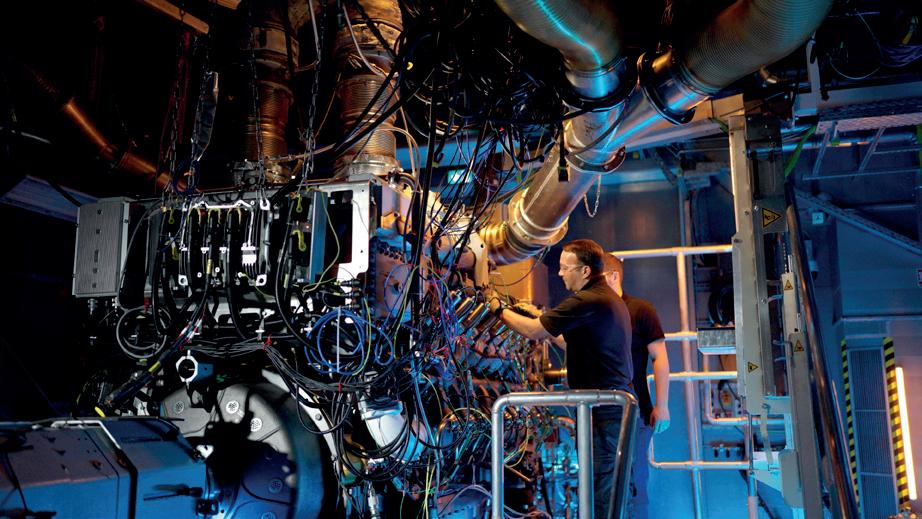
■ First mtu methanol engine on the test bench
"Changing materials will help in the most cases," says Gommeringer.
Expensive fuel, manageable engine
The economics of methanol are not straightforward. As a fuel, methanol produced from renewable electricity via hydrogen is more expensive to manufacture than conventional fuels like diesel. Producing e-methanol from renewable sources is ‘definitely not the cheapest green fuel in the end’, says Gommeringer.
“This is totally clear,” he says. “But on the other hand it’s important that you can really bunker the fuel and manage to have the same operation that you have to today – it doesn’t have to be the same, but it needs to be feasible somehow.”
The process stacks costs at each stage: electricity, electrolysis, CO2 capture, synthesis; but set against those are the costs of the alternatives.
Compressed hydrogen, which attracted a lot of regulatory and financial attention several years ago, requires about 20 times the onboard volume of diesel to store the same energy (at 350bar)– an impossible task for a workboat where space is already at a premium.
Liquefied hydrogen is more compact but introduces cryogenic complexity that drives up tank and bunkering costs. Batteries can work well for short-range, predictable routes, but for vessels with variable operational profiles, the maths rarely adds up beyond a hybrid supplementary role.
E-diesel – synthetic diesel from renewable sources – is simpler to handle and compatible with existing infrastructure, but is more expensive than e-methanol. Biofuels are available now and cheaper in many cases, but their supply is fundamentally constrained.
"The global production capacity of biofuels today is roughly the same as the marine energy demand," says Gommeringer. "But marine energy demand is about 3% of global energy demand. So what about aviation? What about on-road?"
On the engine hardware itself, Kohl's expectation is that a methanol engine (with significant production capacity) will not be significantly more expensive than a comparable diesel, with the same engine core, just a different fuel equipment, air supply and engine control.
Applications: Where methanol makes sense Rolls-Royce's methanol engine targets a specific segment of the marine market: vessels in the 700kW to roughly 4MW power range, operating in applications where operational patterns are less predictable than a simple harbour ferry.
Tugs, ferries on longer or more variable routes, offshore supply vessels and platform support vessels are the primary targets, along with the megayacht sector.
The choice of methanol, Kohl says, followed a systematic process of elimination. The company ran studies examining the available onboard volume on different vessel types, their operational profiles and the infrastructure likely to be available at their ports of call.
"We identified methanol as a very good compromise," he says. "Methanol, if it's coming from green sources, is CO2 neutral. We can achieve a similar behaviour close to diesel in terms of dynamics and the characteristics of the combustion process."
The key advantage for workboat applications is that methanol shares many practical properties with diesel. It is liquid at ambient temperature, can be bunkered using relatively conventional infrastructure, and does not require the cryogenic handling that liquefied natural gas or liquefied hydrogen demand. Its lower energy density does mean that
a methanol-fuelled vessel needs roughly twice the bunker capacity of its diesel equivalent, but Kohl argues this is manageable.
Cold-weather performance was examined closely during the meOHmare test programme. Methanol's high enthalpy of evaporation – the energy required to vaporise it – means that starting a cold engine demands a preheating system.
Testing showed that at 45-50 degrees Celsius preheat, the engine started reliably every time, but without preheating, it did not start at all. The good news is that preheating systems are already standard on many commercial marine diesel installations in cold-weather regions, so the requirement does not represent a significant additional cost in most cases.
What Rolls-Royce has done is keep the core engine –specifically the well-proven mtu Series 4000 platform – largely intact, while adapting the combustion process ‘‘
Retrofit versus newbuild
One of the more commercially significant questions is whether methanol can be retrofitted to existing vessels, or whether the transition will be confined to newbuilds. Vessel operators have substantial capital tied up in their existing fleets, and a technology that requires a new ship to deliver its environmental benefits faces a much longer adoption curve.
On the engine itself, retrofit is not the obstacle: the Series 4000 block dimensions are unchanged, the power output at commercial ratings is comparable, and the gearbox, shaftline and generator can be retained.
"From the engine side, it's not that big an issue," says Kohl. The challenge lies on the ship side of the installation.
Methanol requires double-walled tanks with cofferdams, double-walled pipework, a nitrogen generation system for inserting and fuel-pumping equipment adapted to handle a non-lubricating fluid. In a vessel not originally designed for these features, finding the space and carrying out the structural modifications means a substantial investment.
"If the boat is not from the beginning prepared for methanol in regards to cofferdams, tanks and pipework, in my personal view, it is not unrealistic, but it means a very high investment," Kohl says.
■ Methanol engine testbench
Reach the decision-makers in the commercial marine business
Connecting brands with verified buyers and influencers
7,500
Maritime
Audience: operations managers,
campaign
Request
If the boat is not from the beginning prepared for methanol in regards to cofferdams, tanks and pipework, in my personal view, it is not unrealistic, but it means a very high investment
The industry response, particularly in the superyacht sector, has been to design new vessels as "methanol-ready" – laid out and piped for eventual methanol use, but delivered running on diesel. Dutch yacht builders are already offering this configuration.
Not everything needs to be installed upfront: the doublewalled pipes, nitrogen generator and fuel pumps can be added later, provided the space is reserved. The tank itself, which must be double the diesel volume, is the hardest element to accommodate after the fact.
Safety and vodka
Safety is one of the first concerns raised when alternative fuels are discussed, and methanol is not without hazards. It has a lower flash point than diesel and burns with an invisible flame, and it is toxic – absorbed through the skin as well as inhaled – and once ingested is converted in the body to formaldehyde, a much more dangerous compound.
"Methanol sits in between diesel and ammonia, but significantly closer to diesel and far away from ammonia," says Kohl. The practical mitigation is a double-walled installation: tanks and pipework sealed against the possibility of fuel contact.
"It’s important to make sure that you have a safe system with double-walled pipes, cofferdams, leakage detection but also personal safety equipment and a well-trained crew to reduce the risk," says Gommeringer. "Today, there is not a lot protection against skin contact with diesel and gasoline, for example at a filling station, even if gasoline and diesel are very toxic as well It seems like a double standard is being applied because diesel and gasoline are well known while methanol is not (in most industries).
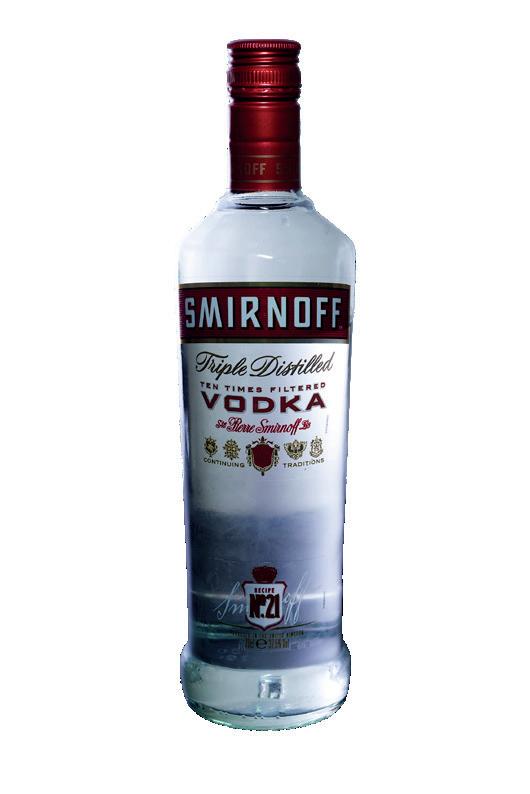
The treatment for methanol ingestion – rapid consumption of ethanol (or alcohol), which the body preferentially metabolises, blocking the conversion of methanol to formaldehyde – is established and effective, though needs prompt action. And this is why next to Rolls-Royce’s test bench is a handy bottle of vodka, just in case.
Diesel to dual-fuel transition Rolls-Royce is not betting everything on methanol displacing diesel by the end of the decade. Regulatory uncertainty clouds the market outlook, and the hoped-for acceleration from IMO legislation – a net-zero framework that would have created large, predictable demand for low-carbon fuels – has not materialised in the timeline the industry anticipated.
"We did hope to have more clarity and a strong signal towards decarbonisation from IMO to have a better predictability on the methanol engine market demand," he says.
The practical response has been to continue
investing in diesel alongside methanol, ensuring that every new engine development is specified for both fuels.
"All investments we are doing, all developments we are doing at the moment have diesel and methanol in the
Dual-fuel engines – capable of running on either diesel or methanol – are also on the table, but this creates engineering challenges of its own.
"You have diesel on board, you have urea on board, you have methanol on board, and you have all these exhaust gas after-treatment solutions," he says. "The result is an installation that is bulky, costly and demanding to maintain. From my personal perspective, I don't think it's a good solution. We showed with the meohmare project that beyond the issues of methanol supply, a single fuel methanol engine can be simpler without the need for different fuel tanks and complex after-treatment systems, as a SCR is not
Rolls-Royce regularly evaluates market demand and the availability of green methanol. Based on this, the company makes decisions regarding product development and its
Between now and then, the engineering gaps – injector lubrication, cold-start optimisation, materials durability – will continue to close. The underlying technology, both Kohl and Gommeringer insist, is already proven in principle. What remains is turning a testbed demonstrator into a product fit for a century's worth of marine service – with the bar set, whether they like it or not, by the diesel engine it is trying so hard to
■ Methanol engine test bench at Rolls-Royce
SUPPLIERS OPTIMISE ONBOARD MANAGEMENT FOR HVO
Handling the unique properties of HVO requires specialised software and equipment onboard, and ongoing improvements may lead to increased adoption of the alternative fuel.
By Michael Nash
Popularity of the renewable “drop-in” fuel HVO (Hydrated Vegetable Oil) has consistently grown among fleet operators for several years. Starting with small-scale pilot projects, many fleets have extended their reliance on the fuel, with a handful of trend setters even fully transitioning from MGOs (Marine Gas Oils).
Aside from lowering emissions and not having the restraints of electrification, one of the benefits of adopting HVO in the workboat sector is that it behaves very similarly to MGOs and therefore requires minimal modification to existing vessels.
However, there are a number of specialist onboard systems and pieces of technology that must be considered.
Separators and storage
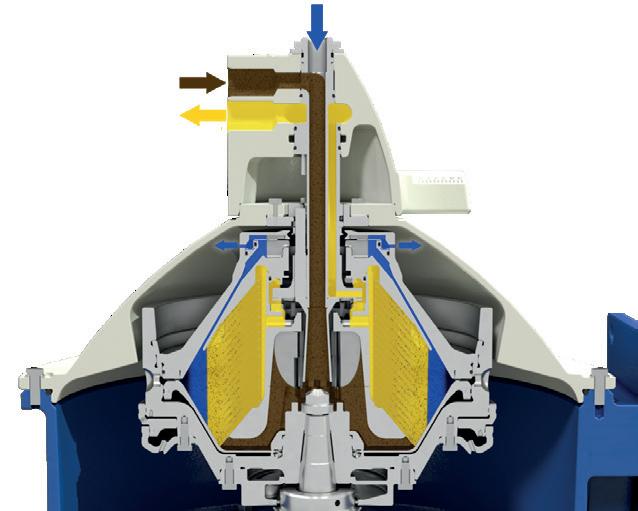
“Our equipment is used for fuel treatment in all steps onboard,” Remco de Witte, Global Application Manager for Fuel and Lube Systems, Alfa Laval, tells Maritime Journal “From the moment the fuel is pumped into the treatment system the fuel will be fully prepared to be used by the engine. This means cleaning the fuel with our separators and heating, pressurising and providing a final filtration step with our fuel supply systems.”
As well as availability issues due to feedstock shortages and high production-related costs, de Witte says a key challenge for workboats using HVOs is that they must be equipped with up-to-date fuel management technology.
Within this, a primary challenge is ensuring the separation system is operating effectively. This is particularly pertinent considering the low density of HVO when compared to traditional MGOs. “HVO has a defined density of 770-790 kg/ m3, whereas the lightest density of MGO is 820 kg/m3,” says de Witte. “This challenge is overcome by either a mechanical upgrade of our purifying machines or a software upgrade of our automatic ALCAP machines.”
HVO is described as one of the best ‘drop-in’ fuels for a reason, precisely because the changes needed for existing installations are minimal ‘‘
Remco de Witte, Alfa Laval
Alfa Laval’s ALCAP technology is a centrifugal separation system that automatically adjusts to varying fuel densities and viscosities, eliminating the need for manual gravity disc changes. Without this software upgrade, the ALCAP system could fail, or the oil may not be properly cleaned, which could in turn lead to engine damage.
However, material upgrades are not required as HVO is similar to MGO in both performance and storage parameters.
Furthermore, unlike FAME, HVO is relatively stable and does not degrade over time any faster than traditional MGOs.
“HVO is described as one of the best ‘drop-in’ fuels for a reason, precisely because the changes needed for existing installations are minimal,” says de Witte.
Onboard fuel treatment systems have evolved over recent years. Recalling the low sulphur challenges of 2020, de Witte says that Alfa Laval made significant improvements across its product portfolio, ensuring its fuel treatment systems could handle the unique properties of both FAME and HVO. He expects further improvements to be made as a result of decarbonisation regulations and taxes.
Sensors and software
Another vital onboard tool for fuel management is the vesselmonitoring platform. This typically provides key information to the fleet operators on performance, fuel consumption and emissions – data that is extremely important when tracking the benefits of HVO.
“HVO makes baseline measurements more important, because if you are paying a premium for a lower-emission fuel, you need to be confident you are capturing the consumption and emissions data correctly to demonstrate compliance and calculate your return,” says Veronica Söderbergh, Marketing Manager at Cetasol – a company that specialises in vessel and fleet performance software.
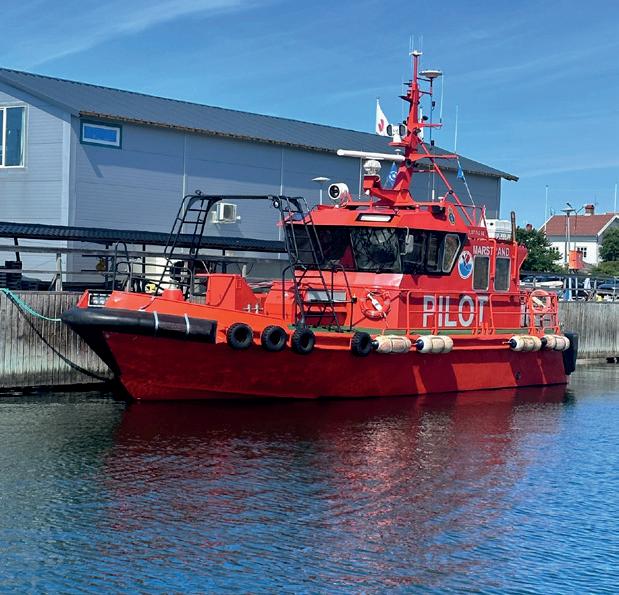
■ Cetasol's iHelm software is used by the Swedish Maritime Adminstration on 29 pilot boats
When crew can see the direct relationship between their decisions and the fuel burn, idle time, speed profiles, power management, that feedback loop tends to drive meaningful change ‘‘
Veronica Söderbergh, Cetasol
“We adapt our approach to ensure that the density and energy content characteristics specific to HVO are correctly parameterised in the consumption model. Getting that right is essential for accurate reporting under MRV and CII frameworks.”
Although the software is the same, Söderbergh says that Cetasol must tweak its systems to ensure fleets can effectively use the monitoring technology when operating HVO workboats. This is because a system calibrated for MGO would give misleading numbers if it does not account for the energy content differences of HVO blends.
With lower density, different cold flow behaviour and variations in energy content depending on feedstock and blend ratio, the intrinsic characteristics of HVO have implications for how consumption is calculated when relying on volume-based measurement.
“We can then contextualise that consumption data, tying it to speed, engine load, voyage segment and environmental conditions, so operators can see performance trends that are meaningful regardless of which fuel they're burning. That level of insight becomes more valuable, not less, when you're using a fuel that may behave differently under different operating conditions,” says Söderbergh.
Adding AI
Monitoring technology has evolved with the advent of new sensors, cloud connectivity and advances in data modelling. In the past, one of the barriers to HVO adoption, particularly for smaller operators, was uncertainty around whether they would be able to accurately report and document the emissions benefits they have paid for with a more costly fuel. If the measurement infrastructure isn't in place to demonstrate compliance gains with confidence, the business case for the fuel premium weakens.
“Better fuel management systems reduce that uncertainty,” says Söderbergh. “When an operator can show, with clean, auditable data, that their HVO consumption is accurately tracked, that the CII improvement is real, and that the reporting will withstand scrutiny, it makes the decision to switch considerably easier to justify commercially. In that sense, the data layer and the fuel choice are mutually reinforcing.”
Söderbergh sees further improvement with the impact of AI and machine learning, which can add value by identifying patterns in the data and subtle correlations between trim, speed, loading condition and influence of external factors that would otherwise be missed.
AI also shows “genuine near-term potential” when considering predictive analytics. Söderbergh describes a monitoring system that gleans information on everything from the weather and tidal conditions to cargo weight and engine state. With this, fleet operators could make decisions ahead of each voyage, ensuring optimal operating profiles based on the recommendations of the platform.
“This is within reach for the workboat sector, and could make a substantial difference for operators managing tight fuel budgets on demanding operational cycles,” says Söderbergh.
Both
and
envisage technological improvements on the horizon, and with increasingly stringent emissions regulations, HVO could represent a viable alternative for workboats that are operationally intensive.
“The harder problem is translating that into changed decisions on the bridge and in the engine room,” says Söderbergh. “A large proportion of fuel savings are unlocked not through hardware upgrades, but through operators having reliable feedback on their own performance over time. When crew can see the direct relationship between their decisions and the fuel burn, idle time, speed profiles, power management, that feedback loop tends to drive meaningful change.
“The technology has to earn trust before it changes behaviour, and that takes time and good data presentation.”
Looking ahead, the continued improvement of onboard fuel management systems may encourage fleet operators to shift towards using HVO.
de Witte
Söderbergh
■ A separator cleaning HVO with a correct gravity disc
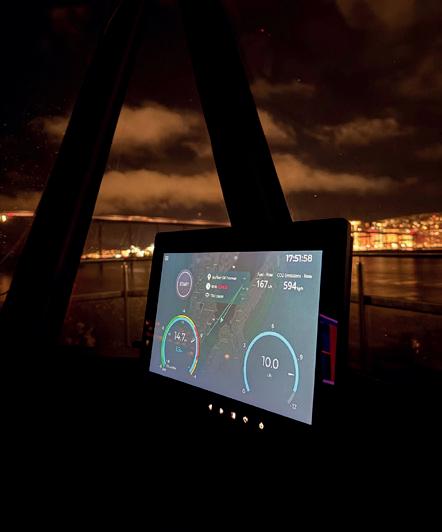
■ Cetasol platform in use in Tromso Harbour
ElectRA
SVITZER: A PARTNERSHIP APPROACH TO FUEL TRANSITION
As pressure mounts on maritime operators to cut emissions, global harbour towage giant Svitzer is promoting a concept that treats emissions reductions less as a fixed technological upgrade and more as a flexible accounting mechanism.
Known as EcoTow, the solution combines biofuel use, carbon accounting and a mass-balance system that effectively allows emissions savings to be traded across operations.
And while biofuel certainly plays a role, EcoTow is not about a single alternative fuel: instead, it is a method of allocating emissions reductions, says Sven Muchardt, Senior Global Account Manager for RoRo & Carbon Solutions at Svitzer. The mechanics of EcoTow lie in how carbon savings are tracked and distributed.
“Well, currently it’s based on biofuels. So we’re using HVO to a very large extent and we’re using the mass balance principle,” Muchardt says. “So basically regardless of where the fuel is burned, we keep track of the emission savings that we achieve and then we’re able to decarbonise our customers regardless of where they operate.”
This approach allows Svitzer to apply carbon reductions generated in one port to operations elsewhere.
“For example, if they call at ports where we are not currently using biofuels, we’re still able to decarbonise their towage because we use the mass-balance principle,” he says. “We keep track of all the emission savings that we achieve in the ports where we are operating on HVO and then we’re able to distribute those emission savings to customers even if they have a call in another part of the world where we’re not operating on biofuels.”
Emissions trading for towage
The logic resembles emissions trading schemes seen in other sectors, such as the EU Emissions Trading Scheme (EU ETS), and scalability is central to EcoTow’s appeal.
“Depending on the amount of customers that we have on the EcoTow programme, if we get another customer then we’re able to scale that up in a port where the biofuel is available and hopefully at the best possible price as well,” he says. “That’s regardless of where they call within our global network.”
In practice, the system evolved from a simpler model. Initially, emissions reductions were linked directly to specific vessels operating on biofuel. Now the company has moved towards mass balance to increase flexibility.
“We’ve since then progressed to the mass-balance approach, which is much more widely accepted in the industry now,” he says. “It basically allows for a wider opportunity of decarbonisation because you’re not limited to places where biofuel is available.”
Sven says the initiative emerged from the company’s broader climate strategy rather than from regulatory pressure.
“EcoTow is basically developed as part of Svitzer’s broader decarbonisation strategy to allow us to reduce emissions within our harbour towage,” he ays. “And the decarbonisation strategy in general is based on three pillars. It’s fuel, behaviour and equipment, and basically we need to work on all three of those in order for us to achieve our net zero ambitions for 2040.”
The concept first appeared as a trial in the UK in 2021
before evolving into a global service.
“EcoTow started in 2021. It was pretty much a trial locally in the UK and since then it’s progressed to a global service offering to our customers on a global level,” he says. “It started small and it’s expanded since then.”
Carbon accounting behind the scenes
While the concept may sound complex, Muchardt insists the calculations follow established frameworks.
“I would say it’s pretty straightforward. It follows carbon accounting principles,” he says. “It’s very structured, how it’s accounted for and what documentation is needed. We use a third-party platform for the calculation. It’s not something that we do on Excel sheets ourselves.”
The model also allows Svitzer to deploy biofuel strategically. Rather than spreading supply thinly, the company concentrates HVO use where it is most practical or cost effective.
“Typically we procure biofuel where available and where the pricing is the most attractive,” he says. “And it’s always smoother if you put the fuel into an operation where the crews already have the experience.”
He adds that operational considerations remain manageable because HVO is a drop-in fuel. “It’s not an issue to put it in new locations, it’s very much a drop-in fuel,” he says.
Voluntary decarbonisation
EcoTow currently operates on a voluntary basis, driven largely by customers seeking to reduce Scope 3 emissions.
The voluntary nature reflects the regulatory landscape in which there are, at the moment, no actual legal requirements for Scope 3 emissions for tugs.
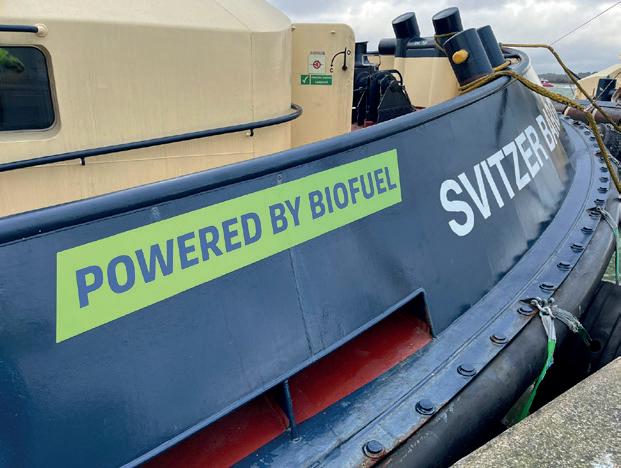
■ Svitzer Bargate
However, reporting frameworks are beginning to shape demand.
“The emission reporting, depending on where you are in the world, there is a requirement for reporting - for example under EU CSRD,” he says. “The reduction itself is still very much voluntary.”
Participation therefore tends to come from companies with strong sustainability commitments. “EcoTow does come at a cost,” Muchardt says. “It tends to be those companies that have a very high environmental agenda that have shown interest in the product.”
The
fuel component
Although EcoTow is not tied to a single fuel, HVO is the one under the spotlight for Svitzer at the moment. Muchardt says performance differences are minimal and the transition from MGO to HVO is easy.
“From a tank-to-wake perspective, it’s nearly complete decarbonisation,” he says, although admits that when transport is considered, emissions will rise.
But other fuels are certainly not ruled out, and one of EcoTow’s strengths, Muchardt says, is its adaptability to future technologies.
“If the emission savings are there, then yes - other fuels could be theoretically included in some sort of decarbonisation platform,” he says.
This flexibility aligns with Svitzer’s broader decarbonisation roadmap, which combines multiple technologies.
“EcoTow is one part of our decarbonisation strategy,” Muchardt says. “Electrification is another area where we are looking.”
He highlights hybrid and electric tug developments as complementary measures, and says Svitzer is investing in battery-powered vessels alongside biofuel use.
But the accounting framework behind EcoTow could, in principle, integrate reductions from these technologies as well.
“The focus at the moment is here and now, HVO and biofuels, and also electrification,” he says. “We’re going to need more of a mix.”
A scalable model for the industry?
The broader implication is that EcoTow offers a pathway to decarbonisation
without waiting for universal fuel availability. By separating where emissions reductions occur from where they are applied, the model aims to overcome logistical constraints.
“It’s very scalable,” Muchardt says.
For an industry with highly fragmented infrastructure and varied port capabilities, this could be attractive. Rather than requiring every location to adopt new fuels simultaneously, operators can aggregate reductions across their network.
Ultimately, EcoTow reflects a shift towards treating carbon savings as a transferrable resource.
With voluntary uptake growing and regulatory scrutiny increasing, the concept may offer towage operators a pragmatic route to lowering emissions while the sector experiments with the next generation of propulsion technologies.
Future Svitzer
Svitzer is determined to grow, and with its target of becoming a DKK10 billion (€1.3 billion) company by 2030, it’s working hard.
Part of the future, as Muchardt says, is likely to be electric, and he references two of the company’s stand-out examples.
“For example the Svitzer Ingrid is a hybrid vessel with a 1,808kWh battery, equal to 23 modern electric cars,” he says, as well as being fitted with a conventional diesel engine. This, he says, reduces CO₂ emissions by 600–900 tonnes per year compared to existing tugs.
A full charge takes about 3.5 hours; but in practice, around one hour of charging is sufficient for operations and 90% of tasks can be completed on battery power, he
is the most powerful TRAnsverse tug the company has ever built, with a 6,000kWh battery, two 350kW methanol engines and a 2,000kW diesel engine.
She will start operations in Gothenburg before the summer.
“From a decarbonisation perspective, we have our 2040 net zero target,” says Muchardt. “And we have a pretty ambitious growth strategy, we are aiming for a 10% growth year on year, to secure new business, renew contracts and by 2030 become a 10 billion Danish krone business.”
■ Sven Muchardt
■ Svitzer's EcoTow concept
ElectRA 2500SX
THE FUTURE OF MARINE FUELS: HORSES FOR COURSES?
Choosing your vessel’s fuel shouldn’t feel like a gamble. Nick Dalton picks his way through an increasingly complicated field
It is fair to say that few inventions since the wheel have changed the world as much as the diesel engine. Without it, we would not have the global trade we rely upon nor the lifestyle we have come to expect, and it has shaped and perhaps even defined the marine industry as we currently know it.
If Rudolph Diesel were to return to Earth, 100-plus years after his mysterious death, he would be thrilled to see that millions of copies of the engine he invented are to be found working away in every corner of the world. From cars and trucks to boats and ships, via every scale of power generation imaginable, the engine type and the fuel it uses still honour him by their name: diesel.
He’d no doubt be impressed at some of the improvements that have been made over time, and pleasantly surprised at how little the main mechanical elements of his design have changed. And he would find the fuel familiar from a century ago. Wherever you are on earth, you’re not far from a diesel engine, nor probably from an engineer who can fix it and a source of fuel, and this ubiquity is a practical and safety feature we take for granted.
The fraction of crude oil we call diesel suits its purpose well as a safe and economic source of densely stored energy, below explosive gasoline in the refinery tower but above the thicker lube oils. It’s a natural lubricant that doesn’t form an explosive atmosphere, great for safety, and yet it doesn’t need a spark to ignite it, making for simpler engine designs.
Of course, nothing is perfect and when you burn diesel you
generate emissions including carbon dioxide, nitrogen oxides, sulphur oxides and soot. Engine designers, pushed by legislation, have improved efficiency and reduced emissions over time but some exhaust products are chemically inevitable, especially CO2.
Now, with the world focused on finding the path to a Net Zero carbon future, the search is on for sources of energy that can replace diesel and lower or eliminate greenhouse gas (GHG) emissions. In a rapidly evolving and uncertain regulatory environment manufacturers, with their eyes firmly set on a large market up for grabs, are vying to promote a growing range of new fuels and engine technologies.
The potential benefits of any new fuel type must obviously be weighed against any opportunity costs in terms of complexity, reliability, cost, supply chain and impacts on trading.
For the vessel owner considering power options for some future project, the obvious old choices have been replaced by a decision-making process infinitely more complex and unpredictable than once it was. And of course, the datum point remains: diesel.
So what are the main “new fuel” options and how do they compete – with each other and with diesel – in environmental, financial and practical terms?
Liquefied Natural Gas/Compressed Natural Gas Natural Gas (NG) is probably the best known of the “alternative fuels” – normally in liquified form (LNG) - with significant early
uptake in the marine industry (dual-fuel MEGI engines in LNG carriers, for example) and peremptory engine preparation in other vessel types.
Primarily consisting of methane, NG is collected from natural fossil fuel reservoirs, contains a lot of energy by weight and produces lower emissions than diesel, especially CO2 and NOx, and zero soot. “Methane slip” can offset GHG savings.
NG is well understood globally as a fuel source and has a good distribution network, piped into homes or in canisters for cooking and heating. Existing engines can be converted to LNG at added cost and complexity, but still require some diesel as a pilot fuel.
Only small quantities can be stored and shipped as a compressed gas, but low temperatures allow bulk transport as a liquid, with regasification at the other end. NG is explosive so any leaks are dangerous, but it is lighter than air and disperses rapidly into the atmosphere.
Liquefied Petroleum Gas
LPG is an energy-dense fossil fuel liquid, requiring lower pressures to contain and transport compared to NG. It burns hot and very clean with no carbon soot. It is seen as a possible “bridging fuel” to lower carbon alternatives but, being hydrocarbon based, it does still produce significant CO2 as a product of its combustion. It provides more energy for a given volume (but less for a given weight) than diesel.
LPG takes energy to produce from petroleum and the gas it forms is explosive and heavier than air, so leaks in confined spaces are serious. The supply network for LPG is well established, and whilst it can’t be used in diesels, modified petrol engines can burn it, often in a switchable dual-fuel format.
Ammonia
Being nitrogen based, ammonia produces no CO2 when it burns but it does make nitrous oxide and some NOx, and unburnt NH3 is also likely. It requires some diesel to be injected to act as a pilot fuel and thus relies on significant engine modifications.
Ammonia is an experimental fuel just reaching real-world trials now. It takes twice as much energy to make as it contains, complicating the analysis of any benefits. It also has only 1/3 the energy density of diesel, so requires three times greater supply and storage volumes, and flow rates.
It can be stored as a liquid (ammonium hydroxide) at atmospheric pressure, but it is very toxic and corrosive. Even small amounts produce an explosive, highly caustic atmosphere that will burn eyes and lungs, causing blindness and permanent lung damage.
Methanol
Methanol can be produced either via industrial processes requiring significant energy inputs – hence with their own carbon costs – or via fermentation of cereal crops, impacting food supply. Methanol is a liquid that can be stored at atmospheric pressure and ambient temperature; it has flammable vapours and burns with an invisible flame.
Methanol, whilst only one carbon molecule longer than the ethanol in an alcoholic drink, turns into highly toxic formaldehyde and then formic acid if ingested or spilled on the skin, causing neurological damage including blindness and death, even from a small dose.
Depending on the method of production, methanol takes about 1.5 times as much energy to make as it contains, and like ammonia is only about 1/3 the energy density of diesel, requiring three times greater storage volumes and flow rates.
CO2 is still emitted in the exhaust gas, and any carbon benefit is down to how inputs are calculated.
Bio-fuels (Biodiesel etc)
“Biofuels” are produced from non-fossil fuel sources of fats and oils, processed to mimic existing types of fuel such as diesel, albeit about 10% less energy-dense. They are either used alone or blended with their conventional counterparts.
Typically quite intensive to produce in terms of agricultural land, fuel, fertiliser and water inputs, biofuels still produce CO2 and other emissions when burnt. Since CO2 is also sequestered during their production, any net environmental benefit is difficult to calculate.
With the current cost-of-living crisis and global fertiliser shortages, the logic to using farmland to produce fuel feedstock, always debatable, requires greater scrutiny than ever.
Methanol, whilst only one carbon molecule longer than the ethanol in an alcoholic drink, turns into highly toxic formaldehyde and then formic acid if ingested or spilled on the skin, causing neurological damage including blindness and death, even from a small dose
Hydrogen
The most abundant element in nature takes considerable energy to capture and store, about 1.5 times what it releases when burnt in an engine. It is highly explosive, but burns cleanly, producing only water.
Hydrogen is the smallest atom and thus - as H2 - also the smallest molecule, so small in fact that it will escape through metals, making them brittle. Tanks are therefore made of expensive and bulky wound carbon fibre, which in order to contain meaningful amounts of energy must typically hold the hydrogen at 700 atmospheres of pressure. This carries obvious safety concerns, although in its favour H2 rises rapidly in air and disperses quickly.
Even at such high pressures, a litre of diesel still contains more than seven times as much energy by volume as H2. Hydrogen engines have been around for many years, but the cost and complexity of the supply chain has meant that to date hydrogen has remained an experimental novelty rather than a practical fuel.
■ Making bidiesel from cooking oil
“Green” hydrogen (only 1% of global production) is made via the electricity-hungry process of electrolysis, meaning that the costs vs benefits vary widely according to power source. This does mean that it’s potentially a good use of “spare” renewable electricity, once an economic solution is found for capturing and storing it, and fuel cells could be a quiet, safe future way of converting it back to electricity.
Battery power/EV (Electric Vessel)
Batteries as a source of motive power (if not a fuel perse) are increasingly familiar to us all as a result of the push towards EVs on the road. As with road vehicles, weighing the real world pros and cons of battery power for marine use is complicated, but the calculation starts with about double the CAPEX of a conventional vessel.
The obvious main advantage of EV technology is zero emissions at the point of use, although of course no source of electricity is truly free of emissions. The obvious main environmental drawback of EV technology, regardless of power source, is the complexity, cost and resource intensity of getting enough power to where it is needed to recharge a vessel, and at a sufficient flow rate, and storing it onboard ready for use. Power availability is also a consideration, especially in a world of grid constraints and rapidly expanding, power-hungry AI.
Range will limit the applications for which pure EV power is a realistic option to port-bound vessels or those on fixed short routes with good power supplies at both ends. Battery power will not yet, if ever, suit vessels that trade widely, or change berth often, or spend long periods at sea, although hybrid installations can broaden this envelope.
In an application where fuel volume and weight has a bearing on range, efficiency, speed, draught and freight capacity, battery size and mass is a major consideration. Batteries lose efficiency over time, as we all know, and unlike liquid fuels, they don’t get lighter as the stored energy reduces. Power-heavy vessels such as tugs will likely need grid upgrades to enable them to operate effectively, and charging time will naturally impact availability. Changes of berth, jobs in other ports and refit runs will be complicated.
And finally, one cannot discuss this topic without acknowledging the resource demands and impacts of renewable energy and EV technology, different though they are from those of conventional power. Lithium, lead, copper, cobalt and cadmium production have enormous environmental and human costs, including child slavery and toxic waste, and much of the hardware required for generating and storing renewable energy is, ironically, not recyclable.
By the honest reckoning of even its most ardent supporter, Net Zero by 2050 will take more copper than has been mined, globally, ever. That means – assuming we can find enough of it – opening nearly 200 new large-scale copper mines, or eight a year. Even if that turns out to be possible the environmental impact, however measured, will be enormous.
Of course, any new fuel or propulsion technology in any market will have pluses and minuses in operational, economic and environmental terms, and have challenges to overcome as it beds in over time; progress is rarely linear, after all. But it’s not binary either, and the transition to any new fuel will naturally be a trade-off.
New fuels will need new distribution chains, with their own demands in terms of infrastructure, personnel, investment, safety, training, parts, maintenance, insurance and licences, and these costs will be passed on. Bunkering hydrogen or ammonia is a very different prospect from topping up a diesel tank.
Multiple fuel types will also mean parallel supply lines, and
with engines tied to one fuel type (or maybe two), we may soon see vessels that can only operate in certain ports, from certain berths, or on particular routes, and for which refit and emergency voyages are greatly complicated or even impossible. This loss of flexibility will render business models more fragile, at a time when resilience has never been so important.
It’s natural to want ongoing environmental improvement from our industry, of course, and there has been much of that in the recent past. But it’s also right that new technologies must stand on their own two feet in the real world and not merely satisfy new rules from the IMO (international Maritime Organisation) which, seeking environmental benefits at one level, often have unforeseen costs at another.
When it comes to fuel choice, there is no panacea. Complexity is an environmental risk. Reliability is an environmental benefit.
A dollar can only be spent once. And CO2 is not the only game in town.
■ NICK DALTON has run Quantum Marine Marketing Ltd for the past 20 years, offering bespoke sales, communications and business development consultancy focused on the commercial marine industry. A marine biologist by training, Nick is as passionate about the marine industry as he is the marine environment…..and the search for a balance between the two. When not talking about the sea he is usually to be found either on it or in it.
■ A hydogen electrolyser is an impressive, large piece of kit
3 – 6 November 2026
London, United Kingdom
IAPH has developed into a global alliance, representing 200 ports and 173 port-related businesses across 94 countries. Member ports together, handle well over one third of the world’s sea-borne trade and over 60% of the world container traffic.
#IAPH2026 will bring together stakeholders from the global maritime supply chain including port authorities, policy makers, ship and cargo owners and service providers, delivering an international platform for networking, innovation and debate.