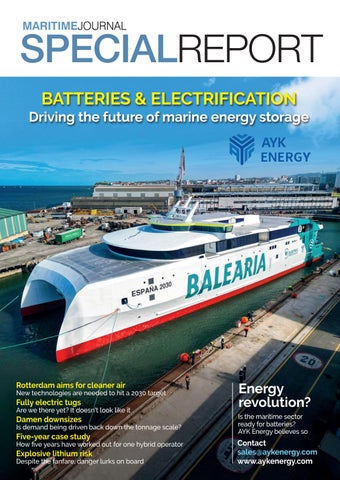
SPECIALREPORT BATTERIES & ELECTRIFICATION Driving the future of marine energy storage
Rotterdam aims for cleaner air
New technologies are needed to hit a 2030 target
Fully electric tugs
Are we there yet? It doesn't look like it
Damen downsizes
Is demand being driven back down the tonnage scale?
Five-year case study
How five years have worked out for one hybrid operator
Explosive lithium risk
Despite the fanfare, danger lurks on board
Energy revolution? Is the maritime sector ready for batteries? AYK Energy believes so
Contact sales@aykenergy.com www.aykenergy.com
THE EUROPEAN COMMERCIAL MARINE & WORKBOAT EXHIBITION
REGISTER YOUR INTEREST FOR 2027
Partnering with
WHERE EUROPE’S COMMERCIAL MARINE INDUSTRY DOES BUSINESS
Featuring: in partnership with
170,000+
26,800
7,900+
60+
82%
Unique online users per year across Seawork and Maritime Journal
Email recipients across our commercial marine databases
Visitors to Seawork and in person conferences
Countries represented
Influence purchasing decisions
32
520+
137
11,000
2,032
Networking events
Exhibitors
New businesses
Linkedin followers
Conference attendees
For more information visit: seawork.com contact +44 1329 825 335 or info@seawork.com
#Seawork
Batteries, boats and the power problem How do we electrify shipping if the ports and harbours that support it cannot provide the electricity that vessels need? And how can shipowners be expected to invest in battery-powered vessels when the upfront cost is a third higher than a conventional vessel, and the cost of charging them makes the economics difficult to justify? Maritime electrification has generated plenty of enthusiasm. Advances in battery technology, growing pressure to reduce emissions and punishing environmental targets have all helped put electric propulsion firmly on the agenda. But widespread adoption is proving much more complicated. Battery-powered workboats, ferries and passenger vessels are already showing how the technology can work, but the much-anticipated transition is not happening at the pace many expected. Even the tug sector, which has been at the forefront of the conversation about battery-electric propulsion, and is a particularly suitable sector for electric manoeuvring, is seeing a relatively slow uptake of fully electric vessels despite considerable fanfare and a growing number of high-profile projects. So what is holding things back? Is it the cost of batteries, uncertainty over their operational performance, or simply the difficulty of accessing affordable electricity where vessels actually need it? The infrastructure challenge is becoming increasingly apparent. Ports are investing in shore power, charging facilities and renewable energy, but connecting vessels to the grid is rarely as straightforward as installing a charging point. Available capacity, grid constraints, connection costs and competing demands for electricity can all stand in the way. Smaller ports in particular may lack both the financial resources and the physical infrastructure to support widespread electrification. And even where the infrastructure exists, does the cost of shore-side electricity make commercial sense? For some operators, charging from the grid can be considerably more expensive than generating electricity onboard using conventional fuels. This report examines the progress being made, the obstacles that remain and the practical realities of moving towards a more electrified maritime industry. From Rotterdam's ambitious shore-power programme and the challenges facing smaller ports, to battery technology, hybrid vessel operations and electric safety equipment, our contributors explore what is working, what is not, and what needs to change. Because if maritime electrification is to move beyond isolated success stories and become an everyday reality, the industry must answer a fundamental question: where is all the power going to come from – and who is going to pay for it? Debbie Mason Editor, Maritime Journal dmason@maritimejournal.com
For the latest news and analysis go to www.maritimejournal.com
NOVEMBER 2026 | SPR 3
SPECIAL REPORT
CHANGE OF CURRENT: DAMEN DOWNSIZES THE eSOV For the past half decade, the construction pipeline for Service Operations Vessels (SOVs) has been dominated by 90-metre platforms. Could this be about to change? Serena Shores talks to Mark Couwenberg, Product Portfolio manager for SOVs at Damen, about market dynamics and the push for up to 98% full-electric operations – something that could drive demand back down the tonnage scale.
■ SOV at work “Measuring 70.1 metres in length with a 17-metre beam and a 4.5-metre service draught, our Damen SOV 7017E is the compact sister to the established SOV 9020,” says Couwenberg. “Engineered specifically to balance capital expenditure with advanced green technology, the 4,300GT vessel introduces a highly sophisticated diesel-battery hybrid plant, a double-ended propulsion layout and an integrated offshore charging philosophy. The mismatch between potential excess capacity and the philosophy to favour scale has been the catalyst behind the design.” By standardising a 70m platform with a 60 single-cabin layout, Damen aims to eliminate the costly engineering hours and operational risks associated with building bespoke asset prototypes. The platform provides the exact capabilities the industry requires for short-to-mid-term maintenance campaigns without unnecessary structural bloat, and complements the company’s diverse portfolio of targeted maritime electrification projects as part of a clear strategy to become the world's most sustainable shipbuilder, using an approach that transitions from small workboats to massive offshore vessels. Propulsion revolution: Double-ended azimuth layout Damen decided on a radical departure from traditional propulsion geometry in the SOV 7017E. The design moves
SPR 4 | NOVEMBER 2026
away from a conventional bow configuration with tunnel thrusters, to use four 900kW azimuth thrusters positioned in a double-ended arrangement that drastically changes how the vessel interacts with localised wind farm environments. Damen’s layout removes the traditional bulbous bow entirely, creating volume to house highly agile azimuth units that can orient thrust 360 degrees. There is a highly logical hydrodynamic and operational philosophy behind this configuration.
Damen has laid out a clear strategy to become the world's most sustainable shipbuilder, using an approach that transitions from small workboats to massive offshore vessels "The four-thruster arrangement is something which is highly viable, operating fully electric in DPX Green DP mode and using less energy than the vessel’s hotel load,” says Couwenberg. “It’s the rationale behind the concept: achieving stable station keeping and low speed on wind farms, which the 7017E easily has the ability to facilitate. Mainly we’re
For the latest news and analysis go to www.maritimejournal.com
SPECIAL REPORT looking at the operation, plus 80 per cent low speed between wind farm and ports, which is perfectly justified. The manoeuvring makes the operation more efficient and uses less power, taking into account wind speeds and if conditions are even. It means the vessel can approach a turbine while at stern so there is an efficiency gain from the system. “Positioning involves minute, highly efficient manoeuvres and adjustments in the direction you need, because these thrusters, especially in the bow, are most effective compared to tunnel thrusters. This naturally influenced a big change in the hull design,” says Couwenberg. This intense focus on low-speed hydrodynamic optimisation yields major efficiency dividends, even if it compromises topend transit speeds slightly. To move smoothly at sea, the impact of the waves needs to be as minimal as possible, but there is always a compromise: the right balance. “Basically at low speeds of 10–11 knots we are saving, which is what clients ask for,” says Couwenberg. “At 12.5 knots in this scenario, conventional is sometimes faster." LFP versus NMC batteries For the 7017E, Damen communicates an LFP battery capacity of 10 or 15MWh, enabling approximately 75% or 98% fullelectric operations, with two 1200ekW HVO/diesel generator sets as back-up. This battery system functions as a dynamic spinning reserve and power back-up, ensuring the internal combustion engines run at peak thermal efficiency. When selecting battery chemistries, Damen opted for lithium iron phosphate (LFP) over lithium nickel manganese cobalt (NMC). "When it comes to LFP, a large part of the world is using this technology,” says Couwenberg. “Its application makes perfect sense for a lot of reasons, one being cost. NMC in general has better energy density, discharges faster, but is less safe. For what we are trying to achieve, a little bit slower speed for charging is okay. “LFP was also selected specifically because of its comparatively high level of safety: it is less prone to ignition and a fire is easier to contain. What complicates things is that lots of development is taking place incredibly fast, particularly with aluminium edits to alter and improve the battery’s performance.” The vessel is also prepared for future conversion to methanol as a fuel, with preparations including all steel construction of tanks, cofferdams, fuel treatment rooms and pipe trunks. The selected diesel generators can be converted for methanol and the prepared tank capacity is sufficient for two weeks’ normal operation on full methanol.
‘‘
When it comes to LFP, a large part of the world is using this technology. Its application makes perfect sense for a lot of reasons, one being cost. NMC in general has better energy density, discharges faster, but is less safe power,” says Couwenberg. “The battery is therefore sufficient on one single charge. However, we are also looking at if it would be beneficial to charge twice a day. There are limitations in that we cannot acquire anything more than 6-8 megawatts as the cable becomes so big. We have been considering using multiple cables that could be manageable. If we were charging using the gangway, this might still be possible.” A ship-to-quayside charging option puts a line in the connection unit and the cable coil would unravel. Directed from the wheelhouse, charging at a single turbine is predicted to take a few hours; in port this should be no more than 10 minutes. However, implementing that infrastructure requires navigating commercial, regulatory and electrical challenges across the wider wind farm development landscape. "The status of 7017E is that it’s a concept design that has the potential to trigger the market, thus steps have to be taken and calculations made to make it work,” Couwenberg says. “To make sure we have the wind farm charging infrastructure, it is very much a matter of addressing the obligations and questions about who owns the electricity and who is going to pay. “Chargers and everything around them have progressed pretty far and there are a lot of different possibilities. One proposal would be to add the charger to the turbine, which would be relatively expensive, but on a new-build wind farm it would be much more feasible.” With the space for the charger considered, as it would operate from the offshore substation, current research can at this stage say a lot more about the charger itself, not the implications for a significant new build wind farm phase. Chargers are at various stages of development, from engineering and testing to reading the market about top ups. ■ Damen 7017E SOV
Direct offshore charging: Stillstrom and MJR Power The ultimate goal of the 7017E is achieving complete operational autonomy on battery power while in the field. Damen envisions an infrastructure where the vessel can transition through its daily task list solely on electrical storage, due to the slow-speed nature of wind farm work. The company is collaborating closely with Stillstrom to evaluate the deployment of a simple crane and messenger line system from the foredeck. There has also been cooperation with MJR Power & Automation regarding charging via the gangway, with a 4MW/11kV connector at the stern. "As a typical SOV, we believe we can give endurance for one day of work – not just sailing – as the demands are for the vessel to be pretty slow, which doesn’t consume a lot of
For the latest news and analysis go to www.maritimejournal.com
NOVEMBER 2026 | SPR 5
SPECIAL REPORT
■ Lithium batteries
for marine generally come in two types – LFP and NMC. (Battery properties vary)
“In terms of testing, the fastest appears to be Denmark. It’s interesting stuff,” Couwenberg says. “From a technology perspective it’s a measure of proper engineering." Crucially, the hybrid architecture does not discard conventional power backstops. The onboard diesel generators remain an essential component for regulatory compliance and safety insurance. The necessity for installing diesel generators is not counter-intuitive to the drive towards zero emissions, but vital for security to ensure that vessels can still do all their operations, including long trips such as leaving a shipyard for their destination and factoring in charging potential, adverse wind conditions or battery malfunction.
■ Mark
Couwenberg, Product Portfolio manager for SOVs at Damen
Damen’s layout removes the traditional bulbous bow entirely, creating volume to house highly agile azimuth units that can orient thrust 360 degrees. There is a highly logical hydrodynamic and operational philosophy behind this configuration Final thoughts on the future "In today’s market and operationally, we hardly see smaller vessels of 70m; for the past four to six years demand for 90m has been very strong, with all vessels under construction or being delivered in that range,” says Couwenberg. “However, what I believe is going on, is that the sector is recently beginning to expect demand for smaller vessels. “We can learn from charterers too that owners are looking to SOVs with more flexibility in mind but building prototypes in this industry involves engineering, thousands of manhours, plus risk. “With its battery capacity prepared, there will certainly be an evolution over the next few years for not only 7017E but also our extensive range of vessel types, shifting clean propulsion from experimental pilots into scalable commercial realities. “This all forms part of our infrastructure ecosystem; it’s a case of preparing these vessels for an exciting future."
SPR 6 | NOVEMBER 2026
For the latest news and analysis go to www.maritimejournal.com
9 – 11 November 2027 Rio de Janeiro | Brazil
Host sponsor
SAVE THE DATE IAPH has developed into a global alliance, representing 216 ports and 190 port-related businesses across 100 countries. Member ports together, handle well over one third of the world’s sea-borne trade and over 60% of the world container traffic. #IAPH2027 will bring together stakeholders from the global maritime supply chain including port authorities, policy makers, ship and cargo owners and service providers, delivering an international platform for networking, innovation and debate.
For information on attending/sponsoring contact the events team: visit: worldportsconference.com contact: +44 1329 825335 or email: wpc@mercatormedia.com
#IAPH2027
SPECIAL REPORT
HOW ROTTERDAM IS AIMING FOR CLEAN AIR BY 2030
Credit: Peter Barker
Interest in battery-powered vessels has accelerated in recent years, driven in part by advances in battery technology resulting from the rapid adoption of electric vehicles, writes Peter Barker.
But what are the consequences when conventionally powered vessels, large and small, berth in built-up areas? Peter Barker investigates how Rotterdam, Europe’s largest port, is providing plug-in shore supply electricity to reduce emissions when harbour generators would otherwise be powered up. From sail to steam to internal combustion, shipping propulsion has evolved, and diesel-electric propulsion has been part of that story since 1903. In this arrangement, diesel engines drive generators that supply electricity to electric motors. It is still regarded as the best option in terms of performance, cost and fuel availability, and remains popular with cruise ships because of their huge hotel load demands, as the same generators can supply both propulsion and hotel loads. One example of its flexibility is diesel-powered generators supplying Azipod propulsion units. This ‘power station’ approach means the engines can be located without a fixed shaft line restricting the layout of internal spaces. The adoption of batteries to supply all or part of a vessel’s energy demand (with or without on-board charging) has been influenced by battery technology and the operating profile and power requirements of the candidate vessel. This is why the smaller vessels are dominating the transition to electric propulsion. On the berth To a greater or lesser degree, the advantages of dieselelectric or battery power include reducing emissions and
SPR 8 | NOVEMBER 2026
■ Two of Heerema's
crane ships can now connect to shore power at Rozenburg
improving air quality. When the vessel is moored alongside, particularly when powered solely by internal combustion engines, small vessels often use a harbour generator. Rotterdam is an example of where ports were originally centred around the city itself: in Rotterdam’s case, the city centre is some 25km inland from the sea at Hoek van Holland. Over time Rotterdam’s harbours and terminals have expanded gradually west, from Waalhaven, just 3km from the city centre, to the Maasvlakte 2 development, new land reclaimed from the sea in 2013, requiring the country’s maps to be redrawn. Settlements have grown to become sizeable communities, such as Schiedam, Pernis, Vlaardingen, Maasluis, Rozenburg and Hoek van Holland, with a combined population of more than 224,000 people. The region has subsequently become increasingly exposed to emissions from these otherwise very welcome visitors, who bring employment and prosperity to the region. This is also the case in the heart of the city at Cruise Port Rotterdam, and while it makes sense for cruise ships to be close to city centres its location includes Kop van Zuid, with an expanding population. Highrise offices and apartment blocks are sometimes just 100 metres from visiting vessels and this can put them directly in the path of emissions. But now, the cruise terminal, along with nearby residents and workers, are benefiting from the shore-based power supply that has become available for around 75% of cruise ships visiting Rotterdam. Inland shipping accounts for around 36% of Rotterdam’s cargo volume, Barges can be many years old and while the
For the latest news and analysis go to www.maritimejournal.com
SPECIAL REPORT
Assessing the task Providing shore power facilities at Rotterdam’s seagoing and inland vessel berths is not a matter of simply running an extension lead from a nearby electrical socket. Questions around finance and who pays are complex and require investment and commitment from the port, local municipalities and of course the end user. Reduced noise levels, vibration and recurring maintenance costs all have to be considered by vessel operators when they turn off their on-board generators. While the electricity is no longer generated on the vessels themselves it has to be sourced from somewhere, and there is no benefit in just moving the source of pollution out of sight. The energy efficiency and level of emissions from conventional power stations has to be considered – and such plants may not be in areas as highly populated as the centre of the Netherlands’ second largest city. ‘Sustainable’ energy sources are an important feature and there is a growing number of offshore wind farms in Dutch waters. The spark of an idea In 2018, while approaching its berth, the captain of one of Heerema’s large crane ships asked why his ship, when moored, could not be powered by the wind turbines on the Rozenburg peninsular close to the berth in Caland Canal. The idea was born – and the following year Rotterdam Shore Power (RSP), a joint venture between PRA and Dutch energy company Eneco, was born. RSP’s approach was to bring together government, grid operator, insurers, energy suppliers, contractors, terminals and shipping companies to make the idea a reality. In 2020, together with the municipality of Rotterdam, PRA reported on its ‘ambitious shore-based power strategy’ for vessels and the goal of a significant share of sea-going vessels being able to ‘plug in’ once moored. By 2030, the programme would have been accelerated and scaled to adopt shore-based power. “Our vision combines ambition and pragmatism,” said Allard Castelein, PRA CEO, at the time. “We will be setting up eight to 10 shore-based power projects for a variety of seagoing vessel types. We will be doing this in partnership with companies in the port area and with the shipping companies
that use our port. We will continually monitor the results of these projects to learn whether we can speed up the process or need to take a bit more time.” Since then, a succession of terminal operators and ship owners have recognised the corporate value of this clean image of their operations – both in highly populated areas and more industrialised zones. An early adopter of shore power for sea-going vessels in Rotterdam and actually pre-dating the current activity was in 2012, when Stena Line switched to shore power while its roro passenger and freight ferries were berthed at its Hoek van Holland terminal. Early in 2022 Heerema’s captain got his wish, and the giant crane ships Sleipnir and Thialf were able to switch to a 20MW capacity shore power supply generated by the wind turbines at Rozenburg – or from other renewable sources when required. A standard repair/maintenance period for the vessels will see a nitrogen reduction equivalent to the annual emissions from 5,000 diesel cars. 2023 saw Boskalis introduce shore power at Waalhaven. Large offshore support vessels frequent its berths and green shore power (from Dutch wind and solar sources) was installed in conjunction with RSP, Boskalis having realised the grid connection in-house. By the following year DFDS had introduced shore power at its freight ferry terminal at Vlaardingen. RSP reported the adjustments to ships and the port were a challenge with 2,000 metres of cable needed for the ships alone.
For the latest news and analysis go to www.maritimejournal.com
■ Cruise Port
Rotterdam's shore power cable lies in a 230m long trench
■ Heerema's crane ships connect to shore power at their berths in Caland Canal
Credit: Peter Barker
subject of re-engining and use of alternative fuels is a separate subject, they can spend periods moored at lay-by berths, often crewed and requiring electric power, albeit less than sea-going vessels. Port of Rotterdam Authority (PRA) says sea-going vessels alone moored on its quays consume as much electric power as 250,000 to 300,000 households a year, in the process releasing 600,000 tonnes of CO2 and 8,000 tonnes of nitrogen. There is therefore huge scope for reducing emissions from bmoored vessels – but they still require electric power.
Credit: Peter Barker
The adoption of batteries to supply all or part of a vessel’s energy demand (with or without on-board charging) has been influenced by battery technology and the operating profile and power requirements of the candidate vessel
NOVEMBER 2026 | SPR 9
Incorporating
Reach the decision-makers in the commercial marine business
Connecting brands with verified buyers and influencers
WEB TRAFFIC
EMAIL AUDIENCE
SOCIAL MEDIA
AVERAGE MONTHLY PAGE VIEWS
AVERAGE OPEN RATE: 27% AVERAGE CLICK RATE: 3.3%
SOCIALS ACROSS ALL PLATFORMS
44,074
24,045
73,554
7,970 ATTENDEES
Maritime Journal is the leading information source for the European commercial marine sector. It is also the official partner to Seawork, Europe’s leading commercial marine and workboat exhibition. Audience: operations managers, harbour masters, marine superintendents, vessel owners/operators.
Sponsored Content
Podcasts
Let’s build your marketing campaign Request your media kit today and discuss your campaign with our team: T (+44) 1329 825 335 E: sales@maritimejournal.com
Webinars
Magazines & Special Reports
Social Media
SPECIAL REPORT
Flexibility The DFDS and Stena Line roro operations involve ships mooring in virtually the same position, determined by connecting their loading ramps with the shoreside linkspan. This potentially allows for more of a fixed shore installation, typically a crane type arm to compensate for tidal heights and small movement when connecting the cable to the vessel’s electric socket. Cruise ships present different challenges, such as the different locations of each vessel’s sockets. They can moor either port or starboard side, also having to line up with the passenger walkway. The 700m long quay can also berth two vessels at once. A consortium including Danish company PowerCon worked for nearly two years to solve these issues, including making the quay at Wilhelminakade accessible to the public when cruise ships are not present. A 230m ducted trench was dug for the cables, connected
to a trolley that transits along the trench to the ship’s connection point. A remotely controlled support vehicle, housed within the cruise terminal building, is driven to the location and becomes in effect a junction box connecting the cables in the trench to the sockets on board the ship via a crane-type loading arm. When the vessel sails, the cables are re-stowed in the trench, covers put back in place and the connection vehicle put back in its garage leaving the quay unobstructed and safe for the public to use. Grid limits One major hurdle facing ports considering shore power is whether the existing grid can take the extra load. Portable battery containers could be one solution – see our feature on AYKEnergy – for the problem of insufficient energy capacity, but for Cruise Port Rotterdam and PRA, the municipality of Rotterdam and other stakeholders, a more permanent solution has been chosen. Constant growth over time in the area meant the existing power supply on the quay had to be extended. Dutch regional grid operator Stedin, part of the consortium, laid a 1.5km long cable from Maashaven to Wilhelminakade and in March 2025 the cruise ship AIDAnova became the first ship to ‘plug-in’ and make the air cleaner for the residents around Kop van Zuid.
For the latest news and analysis go to www.maritimejournal.com
■ The wheel-based support vehicle ready for parking in its dedicated garage
■ 125amp up to
400amp capacity shore supply is provided for inland barges
Credit: Peter Barker
Scaling up So far, shore power has involved relatively small terminals with limited numbers of ships berthed at any one time. With around 11km of quay dedicated to deep-sea container vessel operations at Maasvlaktes 1 and 2 alone, this area of the port’s operation clearly has huge potential for shore power but it needs cash and infrastructure upgrades. Around a third of the port’s cargo by tonnage is containerised. In 2024, Rotterdam World Gateway (RWG) revealed plans to design, finance and build a shore-based power system at its container terminal at Maasvlakte 2, the first berths reported to be operational in 2026. RWG aims for a fully CO2 neutral operation with its cranes and most ground vehicles operating on ‘green’ electricity. APMT also plans to adopt green shore power for operations at its Maasvlakte 2 deep-sea container terminal, with visiting ships expected to use around 13,000 MWh a year, the service available from 2028 well in advance of European regulations requiring shore power for container ships by 2030. Hutchison Ports is embarking on shore-power supply for its ECT Euromax and Delta container terminals in conjunction with RSP and Heijmans. A 66kV intake station is under construction, linked to a convertor station making power suitable for moored ships. Closer to the city itself, Rotterdam Shortsea Terminals handles more than 50 container feeder vessels a week and is another location for RSP’s shore-power. Other developments include moveable shoreside battery containers, trialled at Steinweg Beatrix Terminal and at Parkkade, a popular lay-by berth for smaller vessels close to Erasmus Bridge. PRA’s particular focus on providing shore power for inland vessels includes a target whereby barges at all public berths are able to moor emissions-free by 2030.
Credit: Peter Barker
An early adopter of shore power for sea-going vessels in Rotterdam and actually pre-dating the current activity was in 2012, when Stena Line switched to shore power while its roro passenger and freight ferries were berthed at its Hoek van Holland terminal
NOVEMBER 2026 | SPR 11
SPECIAL REPORT
LITHIUM BATTERIES: HIDDEN DANGERS OF THE TECHNOLOGY By Mike Schwarz, CEO, International Institute of Marine Surveying
■ Remains of the
Dufour rocked by a lithium battery explosion
Over the past five years, I have developed a keen interest in lithium-ion battery technology, not from a technical aspect, as the chemistry is just far too complex for me to comprehend, but from a safety angle. My interest was rudely awakened following a number of devastating incidents in recent years on ships and boats, caused as a direct result of lithium-ion battery fires that have sent far too many vessels to the bottom of the ocean, costing insurers millions. Let me be clear. In most instances fires are not as a direct result of the propulsion system itself malfunctioning, rather the electric vehicles, toys and devices onboard misbehaving. The aim of this article is not to extol the virtues, or otherwise, of this amazing technology. It is incredible, but I want to warn people that things can and do go wrong with devastating consequences, and to provide some best practice guidance. We are surrounded daily by lithium-ion batteries of all
SPR 12 | NOVEMBER 2026
types. Our lives are dominated by them increasingly through the vehicles we drive, the vessels we sail, wearable tech, our laptops, mobiles phones and so on. Case study Confusion around lithium-ion battery incidents and fires abounds. Let me share with you the recent case of a Dufour sailing yacht in Palma, Mallorca, which was designed to have electric propulsion. Unconfirmed information about the incident is that the yacht was sailing hard and leaning over. There was a loud bang from the aft part of the vessel. The lazarette hatch was opened to reveal water and flames. The assumption was that a seacock had broken during the ‘bang’, allowing water into main power cabling, which caused a short circuit. The heavy battery pack, which was assumed to be LFP (lithium iron phosphate), was closer to the keel, some metres away. The resulting conflagration was intense as the photos
For the latest news and analysis go to www.maritimejournal.com
SPECIAL REPORT show, but the event was not a battery chemistry issue specifically. However, once the water came into contact with the batteries, there was only one outcome. The local marine newspaper headlined the incident ‘Thermal runaway in the bay’, which strictly speaking was incorrect and adds to the confusion surrounding this power option. The newspaper controversially finished the article by saying, “However, the fundamental question, beyond the performance that electric motors can offer, is whether it is really worth giving up the reliability and safety of a diesel propulsion system and assuming the risk of carrying lithium batteries on board to save the atmosphere a negligible amount of carbon dioxide. It is worth keeping one fact in mind: recreational craft account for 0.1% of global greenhouse gas emissions.”
In most instances fires are not as a direct result of the propulsion system itself malfunctioning, rather the electric vehicles, toys and devices onboard misbehaving What we see is something that at first sight appeared to be obvious – a direct lithium-ion battery explosion of some magnitude. But as the ongoing investigation unravelled the facts, this turned out not to be the case. The reason for sharing this case study is to highlight that having some knowledge about this technology only gets us so far. There are clearly things that are beyond our control as this case study highlights. However, many of the lithium-ion battery accidents we observe at sea and on land are caused by human error and are thus preventable. Safety tips ● Make sure that li-ion batteries are certified to UL, CE or IEC standards. ● Avoid the temptation to use cheaper products, such as chargers. Stick to the manufacturer’s specifications. ● There is no place for non-marinised batteries on board. Call it out.
Any li-ion battery propulsion installation must be installed by a competent person. ● Does the installation meet the ISO 23625:2025 Small craft Lithium-ion batteries standard, published in 2025? ● Don't leave devices on charge overnight unattended. ● When charging in the daytime, it is good practice to be able to have line of sight to your device. ● Never accept a charger offered by someone else. You cannot vouch for its authenticity. ● Never cover chargers and make sure they are charged in well-ventilated areas. ● Lithium-ion batteries do not like extremes of temperature. Avoid charging in direct sunlight, hot environments, or extreme cold. ● Never charge a lithium-ion battery device in a place where you would need an escape route - the speed, rapid spreading of any fire and heat intensity could block your way out. ● If you see white vapour that may look like smoke coming from a lithium-ion battery then get out, stay out and call the fire service immediately. Further reading. “Lithium-ion battery fires: What we know so far” is a free 48 page guide and can be downloaded at https://bit.ly/483vqhi. ●
■ Total destruction of the battery pack
SPOTLIGHT: A trio of li-ion battery blazes From the destruction of yachts in crowded marinas to an explosion aboard a canal boat, the risks of lithium batteries are certainly real. However, there is no evidence to show that they are becoming more frequent. On 9 January 2025, the 27m motor yacht Naisca IV caught fire while moored near Marseille, France. The blaze spread to two neighbouring yachts, destroying the Naisca IV and causing major damage to the other vessels. Initial indications suggested a lithium-ion battery may have been the source, and whether it was or not, the incident demonstrated how a fire on one vessel can quickly threaten others in a confined marina. Seven months later, on 5 August, a canal boat caught fire at Gayton Marina in Northamptonshire, England. The fire engulfed the boat's cabin before an explosion occurred shortly before firefighters
were ready to tackle the flames. No serious injuries were reported. The vessel was fitted with lithium iron phosphate (LiFePO₄) batteries, a type commonly used in larger battery installations. Northamptonshire Fire and Rescue Service said it believed the batteries had started the fire, and the service warned that damaged, overheated or overcharged lithium-ion batteries could release flammable vapour that may ignite or explode. More recently, in early September 2026, an electrically powered hire boat caught fire on Lake Wörthsee in Bavaria, Germany. Four women reportedly jumped into the water and nobody was injured, but the boat was destroyed. The incident was reported by marine insurer NAMMERT in an article about battery fire risks. The UK Maritime and Coastguard Agency
For the latest news and analysis go to www.maritimejournal.com
(MCA) published MGN 681 (M) Amendment 1 in December 2025, updating it in January 2026. The guidance addresses fire prevention, detection, suppression, charging and storage arrangements for small electrically powered craft carried aboard yachts, including electric tenders, jet skis and hydrofoil boards. The MCA highlights the particular challenges of lithium-ion battery fires, which can generate intense heat, produce hazardous gases and reignite after appearing to have been extinguished. It recommends that risks are considered during vessel design and that appropriate storage, charging and firefighting arrangements are incorporated into safety procedures. The three incidents demonstrate the potential severity of battery-related fires aboard boats, but do not establish whether the frequency of such fires is increasing.
NOVEMBER 2026 | SPR 13
SPECIAL REPORT
LEHMANN LOOKS TO THE ELECTRIC VESSELS MARKET As the electric vessels market gathers pace, ferries are at the forefront of the transition and in answer to the demand, Lehmann Marine has pledged to expand its maritime operations in the Benelux region, Norway and Denmark and supercharge its presence. Alexander Lehmann talks to John Shepherd about the company’s foothold in the sector.
■ Ship render The German tech leader in maritime lithium iron phosphate (LFP) battery systems won a contract last December with HADAG Ferries for the next fully electric ferries in the Port of Hamburg. Now managing director, Alexander Lehmann has told Maritime Journal the firm is uniquely placed to become a worldwide energy powerhouse in the sector as a majorityowned business of Greece-based international battery manufacturer the Sunlight Group. Lehmann said the Hamburg contract represented a significant increase in operational scale for the firm, providing industrial validation of its technology’s performance in highcapacity maritime environments. This scale impacts the broader value chain, as increased production volumes allow for manufacturing efficiencies and improved cost-competitiveness across the product line, Lehmann said. The technical specifications required for the installation have also led to developments in safety and software that are now being integrated into standard offerings. Lehmann Marine’s technical growth is complemented by the partnership with Sunlight, which integrates its 30 years of battery manufacturing experience with LFP systems developed by Lehmann – founded in 2016 as the battery department within Germany’s Becker Marine Systems. “Additionally, our LFP systems meet international
SPR 14 | NOVEMBER 2026
standards for non-flammability, backed by certifications from global safety and risk management specialists DNV, Bureau Veritas, RINA and Lloyd’s Register,” Lehmann said. “With production and service facilities located near major global shipping hubs, the joint infrastructure is designed to address the increasing demand for emission-reduction solutions. “All of this aligns to help drive the maritime industry’s transition toward hybrid and electric propulsion through localised manufacturing and established technical standards.” Battery systems At the heart of Lehmann Marine’s existing product portfolio are two battery systems � CUBE and AQUBE. The original water-cooled system, COBRA, has been phased out and is being replaced by AQUBE. However, COBRA holds a significant place in the firm’s history after becoming, in 2021, the first maritime LFP battery system to receive DNV-type approval – a milestone that Lehmann said established the company as a pioneer in safe maritime energy storage. CUBE, introduced in 2023, is an air-cooled LFP system with patented cooling technology and a highly modular, flexible architecture. Its compact module design offers a clear weight and volume advantage for shipbuilding. “With over 100 ship sets sold, it remains our best seller,
For the latest news and analysis go to www.maritimejournal.com
SPECIAL REPORT
serving applications from ferries and yachts to offshore workboats at up to 1C charge and discharge rates,” Lehmann said. AQUBE is the company’s next-generation water-cooled LFP system, purpose-built for high-power applications up to 3.5C such as peak shaving and fast turnaround operations. It combines the thermal performance of water cooling with the modularity and flexibility established by CUBE. First deliveries are scheduled for the first quarter of 2027. “Our offices in Scandinavia and Benelux open up important new opportunities to expand our presence in the maritime sector,” said Lehmann. “These regions are home to some of the most innovative shipbuilders, operators and technology leaders in Europe, creating direct access to key decision makers and emerging projects. “With a local footprint, we can engage more closely with customers, understand market needs faster, and position our solutions earlier in the development process. This strengthened regional presence not only increases visibility but also builds the foundation for sustained growth in the maritime market.” And as global supply chain concerns continue to make waves across industry sectors, including maritime, Lehmann Marine stands as a prime example of how strategic mergers and acquisitions can insulate a firm from macroeconomic shocks. Decarbonisation as hedge against instability Lehmann said the company has successfully transitioned from a standalone specialist into a vital limb of a global energy powerhouse since becoming a subsidiary of Sunlight. “In today’s fractured trade environment, this provides a level of de-risking that few competitors can match,” he said. The cornerstone of this resilience is Sunlight’s deeprooted industrial infrastructure in Greece, where a major production and R&D hub in Xanthi manufactures many of its own critical components. This robust made-in-Europe capability serves as a natural
Credit: Lehmann Marine
The technical specifications required for the installation have also led to developments in safety and software that are now being integrated into standard offerings
hedge against global logistics obstacles, such as the recent maritime choke point disruptions that have paralysed traditional Asia-to-Europe shipping lanes. Lehmann said the maritime sector is currently witnessing a strategic pivot, where ‘green resilience’ has graduated from a sustainability metric to a high-value operational asset.
■ CUBE battery system
This robust made-in-Europe capability serves as a natural hedge against global logistics obstacles, such as the recent maritime choke point disruptions that have paralysed traditional Asia-to-Europe shipping lanes Shipowners and operators are increasingly prioritising fleet decarbonisation not just for compliance, but as a hedge against the inherent instability of traditional bunker fuel supply chains. “As these fuel networks remain under constant geopolitical pressure, the transition to battery power, backed by the localised, high-capacity manufacturing of the SunlightLehmann alliance, is moving from a niche alternative to a primary trade strategy for regional and coastal shipping. “The industry is increasingly favouring projects that utilise vertically integrated suppliers to ensure long-term vessel uptime.”
Lehmann makes China debut with CUBE battery system Lehmann Marine has commissioned its modular CUBE battery system aboard AESEN 116H, marking its first installation in China and a step towards expanding its presence in Asia-Pacific. The 42-metre hybrid fast crew boat was built by China’s Cheoy Lee Shipyards for Singapore-based operator AESEN, with hybrid propulsion integrated by marine systems specialist Stin Global. The system is expected to deliver fuel savings of 30–40% compared with conventional crew boats operating under similar conditions.
The air-cooled CUBE battery system supports peak shaving and zero-emission harbour manoeuvres. Its modular design allows individual components to be serviced or replaced on board, reducing maintenance complexity and avoiding potentially costly drydock delays. “Reliable energy storage is essential for hybrid propulsion. Lehmann Marine’s CUBE battery system has provided the safety, reliability and performance required for AESEN 116H, supported by strong technical assistance during the project,” said
For the latest news and analysis go to www.maritimejournal.com
Laks Ekanayake, director at Stin Global. Lehmann says the installation demonstrates the appeal of European marine engineering in Asia’s competitive shipbuilding market, where reliability, safety and class approvals are key considerations. As a member of Sunlight Group, Lehmann combines specialist marine engineering with the backing of an international industrial and manufacturing network. The company sees the project as a platform for further commercial growth across the Asia-Pacific region.
NOVEMBER 2026 | SPR 15
SPECIAL REPORT
AYK ENERGY: AWAITING THE MARINE BATTERIES REVOLUTION Marine battery specialist AYK Energy is building its business around the electrification of tugs, ferries and workboats. It is also trying to address one of the key obstacles to electrification: the lack of shore power. Founder and CEO Chris Kruger speaks to Maritime Journal editor Debbie Mason
■ AYK Energy will
supply battery systems for Spanish ferry operator Baleària
Batteries were supposed to be the key to maritime electrification, but despite the enthusiasm, adoption has been slower than anticipated. The main issue, says founder and CEO Chris Kruger, is shore power – or lack of it. While major ports are beginning to invest in shore-side electricity, there is no coordinated approach to ensuring vessels can access the power they need and the smaller ports can’t afford it. “This is where China has the advantage. They decide we're going to do this and simply get it done,” says Kruger. “They supply the power and this is a national project. National money goes into this.” Europe, he says, has been less decisive. The EU has set a 2030 deadline for cold-ironing capability, but Kruger believes this ambition lacks sufficient financial support and clear responsibility. “There are maybe a few initiatives, but there’s not a concerted effort to make this happen,” he says. “So nobody takes responsibility. If the port is big enough, they say okay we will do it – but it’s not the port’s responsibility.”
Cost of batteries, cost of power Battery-powered vessels typically cost around a third more than diesel alternatives, but Kruger believes the additional investment can be recovered through lower operating costs, provided electricity is competitively priced. He says UK electricity prices have come as a shock and can completely undermine the business case. “I've found out that in England, electricity is extremely expensive. I was blown away when I found out how much.” He is not wrong – according to GlobalPetrolPrices, the UK is the most expensive in the world at $0.47/kWh, with Germany in second at $0.27. India is the cheapest at $0.19, followed by China – $0.19 – and the US at $0.15. “If it's 20, 30, 40 cents a kilowatt hour, then it doesn't make sense,” he says. The economics depend heavily on the local energy market and vessel operating profile. Kruger also believes energy storage will be essential as renewable generation expands. Shore-side infrastructure is another major expense, with no clear agreement over who should pay, and Kruger says vessel owners are reluctant to fund facilities that other operators could also use.
For the latest news and analysis go to www.maritimejournal.com
NOVEMBER 2026 | SPR 17
SPECIAL REPORT
Battery-powered vessels typically cost around a third more than diesel alternatives, but Kruger believes the additional investment can be recovered through lower operating costs, provided electricity is competitively priced AYK's proposed containerised battery solution offers a potentially more flexible investment, but it is not cheap, yet, at $1 million each (they are in the testing phase). However it does have other advantages: buying one as an asset means it can be moved between vessels and applications rather than tied to a single project. Setting the safety standard “We take safety to a completely different level,” says Kruger. “We are setting the standard.” AYK Energy manufactures exclusively lithium iron phosphate (LFP) batteries, with safety built into both its battery modules and containerised energy storage systems. The container incorporates A60 fire protection, designed to withstand an external fire reaching 1,000°C for an hour while keeping the interior below 100°C.
AYK has adopted a deckhouse-style construction, using substantially thicker steel. Its half-height container weighs six tonnes in steel alone, twice the weight of a conventional full-height container. Both the container and individual battery modules are designed to IP67, protecting against dust and water ingress. The modules also incorporate fire suppression, including water mist, while gas extraction prevents gases from a failing module entering the container space. "Then in the battery module, we have a built-in fire suppression or water that we can spray into the module if there's a failure. It's not really necessary, and this takes it really to the next level," Kruger says. A key element is preventing thermal runaway from spreading between modules. Kruger describes testing a 117kWh module measuring 2.2m by 0.7m under the UL 9540A test method. “We had to do a test which says you need to put the battery module into some runaway in between other modules that's alive with live cells and show that it does not propagate,” he says. AYK deliberately triggered thermal runaway in six cells simultaneously. “We only got two more cells beyond those to go into thermal runaway. It self-extinguished without us doing anything with this design.” AYK is going further even than the classification societies demand, "They didn't insist on IP67 for the container," says Kruger. ■ AYK Energy's shoreside containerised battery
SPR 18 | NOVEMBER 2026
For the latest news and analysis go to www.maritimejournal.com
SPECIAL REPORT "They said we couldn't do it, but we did. We submerged the full container underwater and it was sealed. They didn't ask for a water sprinler in the module - but we did it." The system also incorporates battery management protections against overvoltage, overtemperature and overcurrent. Batteries on board and on shore AYK's containerised battery concept is designed as a transportable energy asset, rather than an installation permanently tied to one vessel. It could supply charging power to a tug, feeder vessel, workboat or ferry, and be moved elsewhere when operational requirements change. The concept could help address the shore-power shortage, although the electricity still needs to come from somewhere. Several units have been built for testing, but at approximately US$1 million each, they represent a substantial investment. AYK's batteries are already powering around 50 vessels, including tugs, ropax ferries, workboats, harbour-cleaning vessels, superyachts and ro-ro ships. Some retain a small emergency diesel generator, but the aim is increasingly fullelectric operation.
‘‘
What is the load profile? What do they want the battery to do for them? The most important thing is to know what job this battery needs to do and how much energy it will need Tougher penalties Kruger believes stronger financial penalties are needed to accelerate electrification, both for vessels continuing to pollute in port and ports failing to provide charging infrastructure. “If you run a diesel generator in harbour, they have to say, you are polluting, you are creating health issues for the population in this area,” he says. He believes the same principle should apply to ports that fail to provide shore power. “The EU could enforce this kind of law and say by 2030, if you don't have the capability of receiving shore power, you will get penalised by X amount per kilowatt hour of pollution,” he says. “They have to make it extremely expensive when you come to shore.” Meanwhile, AYK has doubled its manufacturing space to 10,000m² and increased annual production capacity from 300MWh to 600MWh, with air-cooled and liquid-cooled production lines. It has also developed a more energy-dense liquid-cooled battery range for a major ferry project and established a presence in Liverpool, with service and research facilities planned and potential manufacturing to follow. Kruger says the business achieved positive EBITDA in 2024 and 2025 and is targeting a third consecutive positive year. How to achieve longevity For operators considering a new installation or retrofit, Kruger says understanding the battery's intended application is paramount. “What is the load profile? What do they want the battery to do for them? The most important thing is to know what job this battery needs to do and how much energy it will need,” he says.
Charging speed, available space and shore-power capacity must also be considered. AYK generally designs its batteries for a 10-year life, but Kruger says some have lasted considerably longer. He cites the Princess Benedikte, owned by Danish ferry firm Scandlines, which underwent a battery retrofit in 2012 and achieved a return on investment in approximately one year. Its battery remained in service for more than 14 years, largely thanks to careful operation and adherence to the manufacturer's recommendations. Another installation, designed for five years, lasted only three because it was repeatedly operated above its voltage limits. Choosing experienced suppliers and installers is equally important. “There are a lot of scammers out there and many people have had their fingers burnt,” he says.
For the latest news and analysis go to www.maritimejournal.com
■ AYK Energy's
battery system for vessels
NOVEMBER 2026 | SPR 19
SPECIAL REPORT
SMALL PORT, HUGE CHALLENGES Ports and harbours are being tested across the board. Maritime Journal editor Debbie Mason visits the Port of Shoreham on the UK south coast to see how it's tackling the challenges.
■ Battery-powered
workboat Electra at Shoreham Port
With no mandates on the ports themselves, they still have to attract the businesses who are being slapped with restrictions or penalties, and they’ll only be able to do that by offering the new fuels or power supply that are classed as ‘green’. Arguably it is easier for larger ports to electrify their operations. They are more likely to have substantial grid connections and existing power infrastructure, making it easier to supply energy-hungry equipment; their larger sites can accommodate substations, charging hubs and battery storage, while smaller ports may struggle to find space; bigger ports may have greater financial resources to meet the high upfront costs of electric vehicles and infrastructure, and can spread investment across larger fleets; and they may also have dedicated engineering and sustainability teams to plan upgrades and secure funding. For the smaller ports it’s much more of a challenge. The Port of Shoreham – while being the third largest fishing port in terms of catch value in England, it is nonetheless tiny by comparison with the likes of Rotterdam or Gothenburg – has imposed a net-zero target on itself of 2035, and while this has not been mandated from government, it is determined to reach that goal. Director Of Engineering & Environment at Shoreham Port Brian Rousell showed Maritime Journal the hurdles the port will have to jump to get there. Early brick walls For Shoreham Port, electrification is not simply a matter of swapping diesel engines for batteries.
SPR 20 | NOVEMBER 2026
The port is already investing in electric vehicles, solar panels and shore power, but its ambitions are running up against a fundamental constraint: getting enough electricity to where it is needed. “We can easily fit the charging points,” says Brian Rousell. “But whether we can get supply to them is a massive challenge.” The port has around 16 substations, but the one serving its busiest area is already at capacity. Rousell says the port has been told by UK Power Networks and other network operators that it must wait until 2039 for major increases in supply, five years after its own deadline. “We could do it if we could get the power, basically,” says Rousell. “But where from?” Electric trucks Shoreham has bought its first electric truck, and when another arrives the pair will sit alongside 18 diesel trucks at the port. The electric model has a range of around 300 kilometres, Rousell says, although performance depends on weather and what it is towing. Its battery weight also reduces carrying capacity compared with a diesel vehicle. The truck is being charged using a combination of solar power and the grid. Around 250 kilowatts of solar panels are installed on the building above, with a battery helping to supply the charging points. “Wherever possible, first and foremost, we’re using solar to charge our truck,” says Rousell. “But we need the grid as well.”
■ Brian Rousell
For the latest news and analysis go to www.maritimejournal.com
SPECIAL REPORT The port has also ordered a new Mantsinen material handler capable of running entirely on diesel, hydrotreated vegetable oil or electricity, but it has nowhere to plug in The electric truck is being leased at the same price as a diesel vehicle through a special manufacturer-backed arrangement, but Rousell says electric trucks are more than twice the cost of diesel. Forklifts present an even bigger infrastructure problem. The port has 38, all currently diesel, and its first two electric forklifts are due soon. But the question, again, is where to charge them. “We use most of what we’ve got available at the moment,” says Rousell. “So when we want to plug anything in or put in a new supply, it very quickly becomes difficult.” The port needs to plan for overnight charging, when solar generation is unavailable. “We’ve got to be able to charge 38 of these overnight when there’s no solar,” he says. “We’ve got to be able to charge 20 HGVs overnight when there’s no solar.” Shoreham’s long, narrow layout adds another complication: bigger supplies would mean extensive cabling across the site. The port has also ordered a new Mantsinen material handler capable of running entirely on diesel, hydrotreated vegetable oil or electricity, and the port is now planning for its arrival and looking at how it can be supplied with electricity as the port switches from HVO, which has already replaced all of the diesel consumed at the port with the exception of the HGV fleet. Quayside charging The port is also working to electrify activity alongside its quays. A grant from the Marine Management Organisation and Defra helped fund shore power for scallop trawlers, with five fixed double connections installed between berths. Solar panels feed batteries that can supply vessels while they are alongside. But the infrastructure has not necessarily changed behaviour. “They haven’t been plugging in usually because there’s still a kind of price challenge between diesel and electric,” Rousell says. “There’s a whole kind of culture thing to overcome as well, I think, a mindset.” The scheme cost close to £1 million, including more than £250,000 for the substation. When vessels do not connect, they continue running their engines, creating noise as well as emissions.
“It would massively help” to have more batteries and solar capacity, Rousell says, and it would “massively reduce the cost”. But installing it is expensive, particularly when older sheds need new roofs before solar panels can be fitted. Progress, then, is likely to come in stages. “We’re doing it as and when we can, really,” Rousell says. The port is pursuing smaller-scale innovations as well. All of its nine small port vans are electric, and partners funded through the Freight Innovation Fund are developing a microgenerator intended to charge forklifts. “We’ve got 38 of those,” he says. “We’ve got our first two electric forklifts coming very soon but the trouble again is where to charge them. We can easily fit the charging points: but whether we can get supply to them is a massive challenge.” Shoreham is trying to electrify its operations while facing limits on the power it can draw, the cost of equipment and the practicalities of a working port. The ambition is there, but for now, the power is not.
■ Solar panels on
the roof of the Port Kitchen
■ Far left: Volvo
eHGV parked up by the port's dual-power Mantsinen crane Left: A fishing vessel moored beside one of the ‘Berth Zero’ installations
For the latest news and analysis go to www.maritimejournal.com
NOVEMBER 2026 | SPR 21
SPECIAL REPORT
FIVE YEARS OF RUNNING A HYBRID PASSENGER CATAMARAN After five years transporting 750,000 passengers on a hybrid catamaran, Mundo Marino technical director David de Haro talks to Maritime Journal about the pros and cons of the technology.
■ Mundo Marino
hybrid passenger catamaran
When the Mundo Marino Eco passenger catamaran entered service in 2020, its hybrid propulsion system was unusual for a commercial excursion vessel in the Mediterranean. Five years and around 750,000 passengers later, its operators have a much clearer picture of what the technology delivers – and where the complications lie. Mundo Marino is a Spanish nautical-tourism company operating along the Mediterranean coast, with departure bases including Valencia, Gandía, Dénia, Jávea, Calpe, Altea, Almería and Málaga. It operates sightseeing and sailing excursions, catamaran trips, private and corporate events, and other passenger-boat experiences.
SPR 22 | NOVEMBER 2026
Technical director and naval engineer David de Haro decided to launch the project to see how far fuel and emissions could be reduced while maintaining the reliability and flexibility the boat needed for this line of work. The sailing passenger catamaran was built by Astilleros Dalmau, with a Torqeedo Deep Blue hybrid system supplied and integrated by Viatec, a Mundo Marino group company. The system comprises two 25kW electric motors, 40kWh lithium-ion batteries, power electronics, rapid shore charging, onboard electricity generation by diesel generator, solar panels and hydrogeneration. The vessel itself cost around €1.5m, with the hybrid system
For the latest news and analysis go to www.maritimejournal.com
SPECIAL REPORT adding another €300,000 – about 20% of the vessel’s cost. The project received no public subsidy. Mundo Marino technical director and naval engineer David de Haro says the vessel was never intended to be a prototype. “Mundo Marino ECO was designed as a working passenger vessel, not as a prototype,” he says. “We wanted to see how far we could reduce fuel use and emissions while keeping the reliability and flexibility we need in daily tourist operations.” The vessel was designed around three principal sources of propulsion: sail, electric power and diesel. Sail is used whenever conditions permit; the electric motors are intended principally for manoeuvring and low-speed operation; and diesel provides range and operational redundancy. “We wanted to use each system where it works best,” says de Haro. “The advantage is flexibility. The skipper can choose the most efficient combination for the conditions instead of running the diesel engines by default.” Built for intensive commercial operation This is not a lightly used demonstration vessel. The operational records show around 150,000 passengers a year, an average of five departures per day and approximately six nautical miles per departure. Over five years, the vessel has accumulated about 750,000 passengers and 54,750 nautical miles. That operating profile has proved important to how the hybrid system is used. The electric propulsion is concentrated on harbour arrivals and departures; berthing and unberthing; short repositioning; approaches to bathing areas; anchoring and anchor recovery; maintaining position during events; following regattas; and operations close to environmentally sensitive areas. The motors can also provide occasional assistance while sailing.
‘‘
The other issue is the difficulty of electrifying the professional fleet. This applies to both new-builds and particularly to repowering older commercial vessels Electric propulsion is most useful at low power, says de Haro. “Harbour manoeuvring, arrivals and departures, short repositioning and low-speed operation are very good applications. Noise and vibration are much lower and we do not need to start a diesel engine every time we need a small amount of propulsion. “It also changes the way the skipper thinks about the trip. You start asking how little power you actually need for each part of the operation.” Leaving and entering harbour is, he says, the clearest example of where the electric system makes a practical difference. “Conventional engines are not at their best at very low loads, while electric propulsion is very comfortable there,” he says. The electric motors can also provide a small amount of power in light or variable wind, maintaining steerage or the vessel’s schedule without immediately starting the diesel engines. “None of these uses is spectacular on its own, but they happen repeatedly during normal operations, and that is where hybrid propulsion becomes genuinely useful,” he says.
Sail remains central Despite the focus on electrification, the five-year experience has reinforced the importance of the catamaran’s sailing capability. “Sailing is probably still the most important renewableenergy system on the vessel,” says de Haro. “When conditions are good, the sails do most of the work. Electric propulsion is a very good complement because it can provide a small amount of power during wind shadows, manoeuvres or when we need to maintain a timetable. “Commercial sailing is rarely 100% sail or 100% engine. There are always transitions, and electric propulsion handles those transitions very well.” The vessel can also use its propellers for hydrogeneration while sailing. Under favourable test conditions – around 20 knots of wind, a sailing speed of 5-6 knots and no passengers – the system produced approximately 1kW per motor, or 2kW in total. With passengers aboard and around 10 knots of wind, the regenerated power was less than half that level. “The amount recovered depends on vessel speed and sailing conditions, and regeneration also creates drag,” he says. “In good sailing conditions it contributes to the energy available onboard, but we do not see it as a replacement for shore charging. The main energy saving still comes from good sailing and avoiding unnecessary engine use.” Shore power: the economic problem One of the clearest findings from five years of operation concerns the cost of electricity ashore. In Málaga, the average cost of electricity supplied in port has been around €0.47/kWh. The report puts the cost of generating electricity onboard at approximately €0.25/kWh when marine fuel costs around €1/litre and generator efficiency, consumables and engine maintenance are included. Shore electricity is therefore about 88% more expensive on the figures recorded by the project. For an operator investing heavily in electrification, that creates an uncomfortable situation: the cleaner charging option is also the more expensive one. “Shore power is critical to the economics,” says de Haro. “If you have to run a diesel engine to generate electricity onboard, then charge a battery and later use that electricity through an electric motor, much of the economic and environmental advantage disappears.” The preferred arrangement is straightforward: charge directly from the port grid at a commercially viable price. But that requires more than a charging socket. De Haro says ports need sufficient available power, practical berth connections and charging arrangements that fit around the vessel’s operating schedule. “Better shore infrastructure would make a very big difference to electrification in the Mediterranean,” he says. “Our view is not that the favourable treatment of professional marine fuel should be removed. Rather, if electrification is to be encouraged, shore electricity needs an incentive and pricing framework that makes using clean energy economically attractive to the operator. “The other issue is the difficulty of electrifying the existing professional fleet. This applies both to new-build decisions and, particularly, to repowering older commercial vessels. The investment itself is only part of the challenge: engineering approvals, certification, modification work and the period during which a vessel may be unavailable for commercial service can all become significant barriers. “For us, the main lesson remains that hybridisation is not only about fuel and CO₂ savings. It also affects reliability, vessel availability, passenger comfort and the commercial value of offering a quieter and cleaner maritime experience.”
For the latest news and analysis go to www.maritimejournal.com
NOVEMBER 2026 | SPR 23
SPECIAL REPORT Less mechanical maintenance; more electronics The five-year experience has also exposed a significant shift in maintenance requirements. “Our vessels accumulate many operating hours every year, and conventional diesel engines require regular maintenance linked directly to those hours. In our experience, the electric propulsion system has proved extremely reliable and requires very little routine maintenance. This reduces downtime, and electrical servicing can normally be coordinated with scheduled diesel-engine maintenance without materially affecting commercial operation. “The maintenance does not disappear. It moves elsewhere,” de Haro says. The areas requiring attention include inverters, batterymanagement systems, sensors, cooling, connectors, communications and software diagnostics. “A mechanical fault can often be understood quite quickly by an experienced marine engineer. An electronic or communications problem may require specialist software or support from the manufacturer.” That dependence on specialist support has operational consequences. “For us, access to diagnostics, spare parts and good technical support is now an important part of choosing a system.” The marine environment adds another layer of difficulty. Salt, humidity, condensation, vibration and temperature changes can affect connectors, cable entries and cooling systems even where the underlying electrical component is sound. “We have learned to pay much more attention to installation details, sealing, ventilation and preventive inspection,” he says. De Haro says a component can be electrically sound but still cause problems if it has not been properly marinised or installed for prolonged exposure at sea. Specialist skills and support The maintenance implications extend to personnel. “You need both traditional marine engineering and electrical knowledge,” he says. Crew members do not need to become high-voltage technicians, he says, but must understand propulsion modes, alarms, isolation procedures and basic energy management. Maintenance personnel need knowledge of batteries and power electronics alongside conventional marine machinery. Remote diagnostics and after-sales support are particularly important. “A tourist vessel cannot sit idle for several days waiting for a specialist to travel from another country.” The report identifies high-voltage training, access to diagnostic software and telemetry, electronic spare-parts availability and close coordination between owner, integrator and manufacturer as key lessons from the project. Battery performance After five years, the 40kWh lithium-ion battery bank remains in good condition, with capacity loss described as compatible with normal system depreciation. The relatively moderate battery duty cycle is significant: the vessel uses electrical power mainly for manoeuvring and low-speed work, avoids systematic deep discharges and has thermal propulsion and sail available for the rest of the operation. De Haro’s advice is not to treat the battery as something that must be fully charged and discharged on every trip. “Good monitoring, temperature control and avoiding unnecessary deep cycling are important, and the battery should be sized around the vessel’s actual operating profile; we prefer to use electrical energy where it gives us the greatest benefit rather than trying to maximise electric range on every voyage.”
SPR 24 | NOVEMBER 2026
The system can also supply other onboard electrical loads, including bow thrusters, AC inverters, 24V chargers and converters, lighting, electronics, hotel services, pumps and domestic consumption. On a per-mile operational basis, ECO recorded approximately 53% lower fuel consumption and CO₂ emissions, de Haro says. Passenger figures also show a significant difference: ECO recorded 121,904 passengers in 2025 compared with 22,215 for Estrella Fugaz, approximately 0.60 kgCO₂e per passenger for ECO versus 3.68 kg for Estrella Fugaz. The operational figure we use for ECO is around 44 gCO₂e per passenger-mile. “As an additional diesel benchmark, Mundo Marino 2 travelled 6,123 nautical miles, consumed 15,979 litres and generated 43.82 tCO₂e, equivalent to 2.61 L/nm and 7.16 kgCO₂e/nm,” he says. “This is particularly interesting because MM2 is a substantially lighter vessel — approximately 30 tonnes displacement compared with around 60 tonnes for ECO — yet ECO still records slightly lower fuel consumption per mile.” What comes next The Mundo Marino Eco’s five years of operation have led to a second vessel, the Mundo Marino Sostenible, which is complete and awaiting certification, with entry into service expected during 2026. Its propulsion architecture is described as equivalent to that of the Eco. For de Haro, however, the principal lesson is not that one particular propulsion system should become standard: indeed, one of the main lessons learned is specifically that. The route, distance, speed, weather, time in port, passenger capacity and access to shore power all need to be considered before the propulsion and battery system is specified. The next vessels are being developed with better integration, easier maintenance, robust marine electronics and good diagnostic access, he says. For the wider sector, his priorities are better shore charging, financing for the higher initial investment and stronger local service networks for high-voltage marine systems. The project’s decarbonisation story is therefore inseparable from its operational lessons: sail remains important, electric power has proved particularly useful at low power and the battery has survived five years of commercial use. But the experience also shows that electrification brings its own infrastructure, maintenance and support requirements. “Our aim is not to have one ‘green boat’ in the fleet,” he says. “It is to improve the fleet progressively, using sail, electric propulsion, efficient hulls and better energy management wherever they make practical sense.”
For the latest news and analysis go to www.maritimejournal.com
SPECIAL REPORT
ELECTRIC LIFEBOATS LEAD THE CHARGE TO OFFSHORE SAFETY A quiet revolution is underway as offshore platform developers bring a new generation of all-electric free-fall lifeboats into service, according Erik Mostert, senior Technical Sales manager Oil & Gas, with VIKING Life-Saving Equipment, writing for Maritime Journal. Lifeboat operators are increasingly accepting all-electric power as a viable alternative to conventional diesel-based propulsion, with advances in battery technology pointing toward enhanced performance and greater power density. VIKING Life-Saving Equipment has already delivered its E-GES (Electrical Gravity Escape System) free-fall lifeboats to several well-known companies in the offshore sector. Smooth operations Electric propulsion offers several operational benefits for lifeboat operators, including lower levels of vibration, a quieter cabin with better air quality, increased acceleration, and higher top speeds. These advantages enable electric lifeboats to transport evacuees more comfortably and quickly than diesel-powered boats. Battery power also means the asset owner does not need to transport, store or handle diesel fuel on the platform, eliminating the associated risk of fuel contamination. For operators working in areas affected by hydrogen sulphide gas clouds, electric propulsion offers a further benefit: because the battery provides the entire power supply, there is no need to draw air from outside when the lifeboat is in operation. This means the boat can operate autonomously for up to two hours in such environments, compared with 10 minutes for a diesel-powered boat.
A lifeboat with electric propulsion can be fully verified remotely, removing both the on-site check requirement and any risk to maintenance crew site evacuation Beyond these immediate operational advantages, electric propulsion offers potential benefits in reliability, accident prevention, maintenance, and through-life costs. The design of VIKING’s GES free-fall lifeboats reflects the industry’s wider emphasis on safety. Their structure follows the principles underpinning DNV-ST-E406, a lifeboat performance standard that goes beyond the requirements of the International Convention for the Safety of Life at Sea (SOLAS). The compact, lightweight davit installations used with these lifeboats also play an important role in safe and efficient operations. Built to the NORSOK 002 standard, they incorporate dynamic considerations drawn from crane safety rules, alongside maritime regulations and provisions intended to simplify operation for users. Remote risks Today, the ‘not normally manned platform’ is an increasingly common feature of the offshore industry, as operators
prioritise reducing the number of personnel working in-field. Advances in connectivity, digitalisation and remote management have enabled asset managers to automate processes and control others from remote control rooms. However, having been formulated with diesel engines in mind, SOLAS maintenance procedures require lifeboat engines to be run for up to five minutes every 14 days to ensure and validate they are fit for purpose. The diesel lifeboat check is also the first compliance task assigned to a maintenance crew boarding a platform, with any failure having consequences for the crew’s own ability to evacuate the facility. A lifeboat with electric propulsion can be fully verified remotely, removing both the on-site check requirement and any risk to maintenance crew site evacuation. The electric solution also mitigates risks associated with the way a free-fall lifeboat’s diesel engine, tilted at an angle of up to 35 degrees and cold-started every two weeks, will lose performance over time.
■ Freefall lifeboat, VIKING Norsafe
Connected to safety Since electric systems are compatible with remote maintenance, operating systems can be checked from land to confirm that the lifeboat’s propulsion system is available when required, including on platforms that are not normally crewed. As well as eliminating the risks associated with physically accessing the lifeboat, remote diagnostics, maintenance and control methods can extend the interval between service engineers’ visits from once every 14 days to once a year. Maintaining a diesel-powered lifeboat is estimated to require more than 300 hours of work annually. With tests of the deluge, steering and hook-release systems carried out remotely, and launches simulated rather than carried out physically, analysis indicates that equivalent procedures for an electric lifeboat can be completed in 90% less time. VIKING lifeboats also feature self-diagnostic programmable logic controller systems, with each boat connected to an individual email address that alerts maintenance teams to issues in monitored parameters including temperature, charge, gases, and fumes.
For the latest news and analysis go to www.maritimejournal.com
NOVEMBER 2026 | SPR 25
SPECIAL REPORT
BATTERY TUGS: WHY HAS THE ELECTRIC PROMISE STALLED? Damen's electric tug Sparky was hailed in 2022, and she's still working for the Ports of Auckland. But in Europe, just 11 battery tugs are operating - eight of them in Turkey. Why? The Netherlands-based Maritime Battery Forum (MBF) recently announced that the world's battery-powered commercial ships have passed the 2,000 mark, whether delivered or on order. "For years, pure electric applications were primarily limited to small ferries operating on short routes,” said Syb ten Cate Hoedemaker, managing director of the MBF. “Thanks to advancements in battery pricing and technology, we are passing a crucial tipping point. It now makes clear economic sense to build larger, fully electric ships, and installations scaling up to 100MWh per vessel are expected to become a reality soon. This milestone proves the technology is ready to scale.” But in a closer look at the figures announced by the MBF, one jumps out and not because it’s big: the global number of battery-powered tugs – and bearing in mind this includes those on order – is just 83: just over 4% of the global total of electric vessels. There are more than 17,000 operational tugs around the world and while not suitable for sea-going tugs, batteries are an attractive proposal for harbour tugs, which account for about 52% of the world total, according to the Tugboat Service Market Size, Share, Growth, and Industry Analysis, By Type (Harbor Tugboats, Offshore Tugboats, Terminal Tugboats), By Application (Shipping, Marine Services, Port Operations), Regional Insights and Forecast From 2026 To 2035 report by ‘Market Reports World’. Harbour tugs don’t have to go very far, sit alongside for long periods and have a fairly repetitive work schedule. So why has the uptake been so meagre? And how can the number of operational electric harbour tugs in Europe, excluding Turkey, number just THREE? Single figures There is no single authoritative register of global electric harbour tugs, so with the caveat that these figures may not be correct, Maritime Journal with the help of AI has come up with a rough idea of where they are deployed. According to the results of extensive searches, in Europe, just 11 electric tugs are actually operating at the continent’s ports. Most of these are in Turkey, with four – Gisaş Power, Gisaş Power II, Gisaş Power III and Gisaş Power IV – all operated by Gisaş/Tuzla Tugboat Services in Tuzla and another four – Botaş Ay, Bayrak, Hilal and Yildiz – allocated to two LNG terminals at Marmara Ereğlisi LNG Terminal and Saros FSRU Terminal. That leaves just three in the rest of Europe: at the Sound between Denmark and Sweden for the Port of Helsingborg is Svitzer Ingrid; at the Port of Oslo, Buksér og Berging operates BB Electra, built by Sanmar and Europe’s first electric tug; and at Antwerp-Bruges, where Volta 1 was delivered by Damen in November 2024. There are others under build, and the keels have been laid on four Svitzer TRAnsverse 2600e tugs in India, but it is not known where they will be deployed.
SPR 26 | NOVEMBER 2026
■ Svitzer Balder, Svitzer Balder Most surprisingly is the case of Svitzer Balder, an electricmethanol tug that was scheduled to be delivered around now to the Port of Gothenburg and announced in September 2024 in glowing terms. “Continuing developments in alternative power technologies convinced Svitzer that the combination of battery power and methanol engines can ensure both safe, efficient and reliable
the world's first battery-methanol tug, no longer has methanol gensets and has still not been deployed
So why has the uptake been so meagre? And how can the number of operational electric harbour tugs in Europe, excluding Turkey, number just THREE? operations in a location with the right availability of these two power sources,” said a press release in September 2024 announcing the order of the vessel and placing methanol at the heart of the tug’s green credentials. “Applications for battery solutions are constantly expanding, and we see it becoming an important power option in the sustainability transition,” said Svitzer CEO Kasper Nilaus, in the same press release. “This battery tug will bring a new dynamic to our operations.” Not only has Svitzer Balder not yet been deployed – she has also had her methanol engines converted to diesel. “Svitzer Balder was initially an innovation project aimed at creating a battery-powered TRAnsverse escort tug, equipped with both methanol and diesel range-extender engines,” Thomas Grondorf, head of Communications – Europe, Svitzer told Maritime Journal.
For the latest news and analysis go to www.maritimejournal.com
SPECIAL REPORT
‘‘
As expected with innovation, our understanding improved over time. After comprehensive testing and review, we have decided to remove the methanol engines and replace them with additional diesel range-extender engines Svitzer spokesman “As expected with innovation, our understanding improved over time. After comprehensive testing and review, we have decided to remove the methanol engines and replace them with additional diesel range-extender engines. “The methanol gensets had technical difficulties and performance uncertainties. At Svitzer, we need reliable and durable technical solutions to serve our customers. Balder is still methanol-ready, meaning we can reinstall the methanol gensets once the technical solution’s performance is proven. “Svitzer Balder remains the largest battery-driven escort tug, featuring a 6,000kWh battery, but is now powered by three range-extender diesel engines generating 2,700kWh. We anticipate her departing Turkey in October/November and arriving in Gothenburg some weeks later. That is all we can share at this point.” Volta 1: Hailed as the future – but where are the others? When Europe’s first fully battery-electric RSD tug, Volta 1, was officially launched at the Port of Antwerp-Bruges in May 2025, it was accompanied by some fanfare about the future of sustainable harbour towage. Built by Damen, Volta 1 was described as ‘a groundbreaking addition to our fleet and a beacon for the entire maritime sector’ by then the port COO Rob Smeets, who is now the CEO. Vincent Maes, Sales manager Benelux at Damen, said the project was ‘a landmark in the adoption of all-electric tugs as mainstream harbour towage solutions’. Volta 1 has 70 tonnes of bollard pull, can operate for up to 12 hours and be fully recharged in about two hours. With no exhaust emissions during battery-electric operation, she appeared to offer a compelling demonstration of how demanding harbour towage operations could be decarbonised. But more than a year later, there has been no announcement of an order for a second battery-electric tug by the port. So what has happened to the electric tug revolution? “We do not currently have a procedure under way to purchase new vessels,” Tom Cuypers, spokesperson for the Port of Antwerp-Bruges, told Maritime Journal. “At the next tender, we will build further on the experience gained and the offers available on the market at that time. This is to make the best choice for the specific operations in Antwerp.” At the time of the order, announced in October 2023, another five Damen RSD tugs were ordered – all conventionally powered – but Antwerp has also looked at hydrogen propulsion with Hydrotug and methanol with Methatug.
States,” he says. “The crew would fight to get that tug in the morning because it’s so much more responsive. Electric power is immediate – that responsiveness is unique to electric power, there’s less vibration, and electric motors deliver maximum torque from standstill, making them particularly well suited to vessels that need rapid manoeuvring and pulling power” – benefits that can be transferred to smaller craft as well. But there are two main problems – the lack of shore power and the upfront costs. Battery tugs are at least a third more upfront, and in countries like the UK it can take a long time to make up the difference because of the cost of electricity needed to charge them. In China, for instance, where power is cheap and rules are enforced, electric tugs appear to be taking off. According to the China New Energy and Clean Energy Ship Development Report 2025, compiled by the Ministry of Transport, there were 12 fully electric tugs operating in China by January this year. That number has now risen by four, with the Haitian Terminal in the Dongdu port area of Xiamen Port welcoming four this year. In Europe, as well as cost and power limits, skills shortage is another issue. “Operators face a shortage of licensed mariners, engineers and captains who can handle advanced tug systems,” the Market Reports World report says. “Emission regulations, port specific rules and safety standards differ across regions, which complicates fleet design and compliance planning. Training programs and simulator investment are rising, yet recruitment and retention remain difficult, especially for 24hour harbour service that demands constant readiness and strong technical skills.” Until the infrastructure, economics and operational confidence catch up with the technology, battery-powered tugs may be hailed as the future of harbour towage, but that future still looks some way off.
■ Gisas Power Zeetug
■ Europe’s first fully electric tug, Volta 1
Power bottleneck Chris Kruger, founder and president of marine battery firm AYK Energy, says battery tugs will be the future, they’re just stalled by the global lack of shore power. When it comes to performance there is no contest, he says. “One of the first vessels I converted was a hybrid tug in the
For the latest news and analysis go to www.maritimejournal.com
NOVEMBER 2026 | SPR 27