How preventing injury led to Hefring's all-seeing predictive technology
Cutting the cord
Phantom Two combats the underwater communications challenge Into the DEEP
Fincantieri rolls out a vast swarm of subsea autonomous drones
Pioneering world first
Hydrogen-powered USV completes first continuous 24-hour offshore operation
Surveillance is increasingly relying on holistic autonomy. As threats grow and operations become more complex, an all-round approach is one answer.
Enhance situational awareness beyond radar and AIS with leading maritime machine vision.
Embracing autonomy in commercial marine
While the word ‘autonomy’ is bandied about rather a lot, strictly speaking it’s not quite here in the commercial marine world.
On land in California, Waymo’s electric autonomous taxis have really taken off, with the company’s statistics reporting that more than 14 million trips were made last year. These are almost completely autonomous: they take bookings, drive to required destinations, park legally and lock themselves when not in use, or return to a depot.
The only function a human has is to physically plug them in to charge up.
In commercial marine the pace is slower, as is often the way with newer technologies, and most truly autonomous vessels are found in defence or research contexts.
But it’s coming, and with the cost, safety and efficiency benefits, why wouldn’t it?
One of the hurdles is the lack of coherent classification and regulations so far – these are being developed but there is a way to go, with different classification authorities using different parameters to class them, and the IMO telling Maritime Journal that many of its codes and guidance were 'presently under development’.
This report features a selection of the companies that are diving into the space, such as Fincantieri, with its swarm of subsea drones; Subsea Europe Services, which has a holistic approach to connect assets from deep underwater to the clouds above; and Hefring Marine, which is improving its predictive models by daily gathering more and more data on real-time events to inform situations at sea.
Our sponsor, SEA.AI, also explains its machine vision approach, calling it a ‘critical layer’ in maritime autonomy that will reduce crew workload and forms the foundation for increasingly automated operations in the near future.
We talked to Dynautics, who have cut the umbilical and have a ‘nose-up’ approach to battling tricky subsea communications; and ACUA Ocean, whose Pioneer sets an offshore benchmark with hydrogen propulsion.
Across uncrewed maritime operations, CUSP, MarineAI and RAD Propulsion address perception, decision-making and propulsion. CUSP enables practical 3D seabed imaging from USVs for safer offshore wind development. MarineAI reduces cognitive load on ship bridges by prioritising what matters in confined waters; and RAD Propulsion supplies electric drives and open control architectures that deliver quieter, longer-endurance hybrid vessels across defence markets globally.
Autonomous deep water mapping firm Saildrone has completed its mission to map the exclusive economic zone of the Cayman Islands, using a Saildrone Surveyor uncrewed surface vehicle. Over about 300 mission days, it surveyed 90,000m2 of seabed, in depths ranging from 20-7,000 metres, executing more than 900 sound-velocity profile casts to ensure accurate bathymetric data. Crucial hotspots of biodiversity supporting fisheries, tourism and recreation were included in the survey.
Huisman unveils inspection tool
Huisman has launched ‘Rope Vision’, an automated visual inspection tool designed to improve the reliability and safety of wire operations, showing the range of applications that autonomy can fulfil. By measuring and analysing key parameters including lay length, diameter, broken wires and protrusions, the tool, which is specifically aimed at heavy-lift cranes, can predict remaining wire rope life expectancy and support timely maintenance planning.
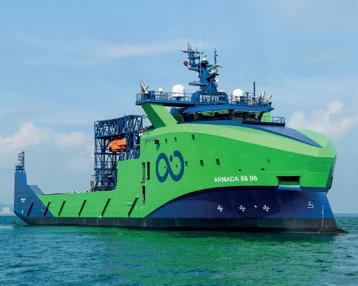
Ocean Infinity has completed construction of its 14-vessel Armada fleet with the delivery of the final ship, ending a programme that began in 2020. Over five years, the company has built and deployed a fleet of lean-crewed offshore vessels designed to operate with extensive robotic systems. The latest delivery completes the 86-metre class of Armada vessels, following the introduction of the 78-metre class in 2023. Twelve vessels are currently in operation, with two expected to enter service shortly.
The Armada vessels are smaller than many conventional offshore ships and are integrated with Ocean Infinity’s onshore control centre, allowing live
Hefring and SEA-AI join forces
Collision avoidance is at the heart of a new partnership between navigation software companies Hefring Marine and SEA.AI, who have brought together their marine technologies ‘to deliver comprehensive safety and operational solutions’ for the industry, they say. Hefring’s AI-driven IMAS platform will be integrated with SEA. AI’s advanced marine vision technology, which also uses AI to detect identify objects at sea in real time.
Aluminium USV under build
ZeroUSV is building Oceanus17, a new large, long-range uncrewed surface vessel being built entirely in the UK. Developed using a rapid spiral design process, Oceanus17 shortens traditional defence acquisition timelines from years to months, ZeroUSV says. The aluminiumhulled vessel is designed for extended offshore operations, advanced autonomous navigation and high payloads, supporting UK ambitions in maritime autonomy, sovereign capability and high-tech shipbuilding.
Euroatlas unleashes Greyshark AUVs
German defence technology company Euroatlas has launched two AUVs – Bravo and Foxtrot – to conduct extended subsea operations without human intervention. They are intended for persistent surveillance, reconnaissance and monitoring in complex maritime environments.
Greyshark AUVs operate with Level 5 autonomy, allowing them to function independently and reconfigure mission profiles during deployment. Using an integrated suite of 17 sensors, the vehicles continuously collect data and can adapt tasks based on environmental inputs without surfacing or receiving direct operator commands.
■ Greyshark automated underwater vehicle
The Bravo AUV is battery powered and has completed sea testing, while Foxtrot uses a liquid hydrogen fuel cell to support long-endurance missions of up to 16 weeks. Both AUVs are designed to operate in open water, coastal regions and GNSS-denied environments, including polar areas.
Greyshark vehicles can operate individually or in coordinated swarms, enabling distributed tasking and collaborative data collection.
Euroatlas plans to manufacture the systems in Europe following completion of testing milestones.
Ocean Infinity finishes five-year mission
monitoring and remote operation of subsea robotic systems.
The fleet is designed to reduce offshore personnel requirements and fuel consumption while supporting more automated offshore workflows.
Each vessel is equipped with a configurable set of underwater robotic tools to support tasks such as geophysical surveys and geotechnical investigations.
The fleet is operating on projects in the United States, Europe and the Asia-Pacific region, supporting a range of offshore data collection and subsea operations.
■ Ocean Infinity completes Armada
MACHINE VISION: A CRITICAL LAYER IN AUTONOMY
Autonomy in the maritime sector is often talked about as an end-state: vessels operating with minimal or no crew, navigating complex waterways without human intervention. By
SEA.AI CEO Marcus Warrelmann
In reality, the industry is progressing through practical, incremental steps, and many of the most valuable advances today are not about replacing crews, but about supporting them.
For commercial operators, the most immediate opportunity is systems that reduce workload, improve situational awareness and help crews make better decisions under pressure. Within that landscape, AI-powered machine vision is emerging as one of the most important enabling technologies, because autonomy begins with perception.
Most professional vessels already rely on radar, AIS, ECDIS and experienced watchkeeping. These remain essential tools, but they have well-understood limitations. AIS depends on other vessels transmitting correctly and consistently. Radar performance can be affected by sea clutter, target size and operating conditions. And even on highly disciplined bridges, fatigue and high workload remain real operational risks, especially during night operations, in congested waterways, or in poor visibility.
Machine vision adds an independent layer of real-time perception: a visual understanding of what is physically present around the vessel. Using optical sensors and trained algorithms, machine vision systems can detect and classify targets that may be difficult to interpret via radar or invisible to AIS, such as small craft, marine mammals, unlit vessels, floating debris or partially submerged debris. If the algorithm determines that the detected object is a hazard, the crew is alerted to action.
For commercial maritime operations, the value is tangible. Pilot boats, patrol craft, workboats and offshore service vessels frequently operate in dynamic environments, and ferries and passenger craft often face transits through crowded channels with mixed traffic. In these scenarios, earlier detection and clearer identification can reduce collision risk and help crews maintain consistent performance across long shifts and varied conditions.
Whether a vessel is crewed, remotely monitored or increasingly automated, decision-making depends on accurate awareness of the environment. That awareness must include not only cooperative targets broadcasting AIS, but also the ‘unknowns’ that create real-world incidents. Machine vision helps close that gap by detecting what is actually there, rather than what is electronically visible.
This same perception layer is also what makes higher levels of autonomy possible.
AI-powered machine vision is a core technology for many uncrewed surface vessels, particularly those used for surveillance, intelligence and defence. These projects highlight an important point for the industry: the technology that supports decision making on a crewed vessel can also become a core input for increasingly automated operations. However, adoption is not simply a matter of adding another sensor. Integration into bridge workflows is critical. For machine vision to be useful, it must support crews rather than distract them, with alerts that are timely, relevant, and trusted.
False alarms and alert fatigue are legitimate concerns, particularly in busy waterways, and the industry will judge systems not only on technical capability but on operational usability. There are also wider barriers that affect autonomy as a whole.
Regulation and classification frameworks are evolving, but unevenly, across regions and vessel types. Operators continue to ask how autonomy-related systems will be evaluated in incident investigations, what “good performance” looks like and how responsibilities are defined when a system contributes to situational awareness or decision support.
Whether a vessel is crewed, remotely monitored or increasingly automated, decision-making depends on accurate awareness of the environment
This is where machine vision can play a valuable role beyond real-time detection.
By recording and logging detections, near-misses and developing situations, vision-based systems can support training, safety management, and post-incident review.
That evidence is increasingly important, not only for internal learning and continuous improvement, but also for demonstrating due diligence to insurers, regulators and other stakeholders.
For operators who have not yet explored autonomy-related technologies, machine vision is one of the most practical entry points. It delivers immediate safety and workload benefits on conventionally crewed vessels today, while building a foundation for the more automated operations of tomorrow.
Autonomy will not arrive through one dramatic leap, but through layered capability, and machine vision is a core layer in that stack.
ACUA OCEAN: PIONEERS IN HYDROGEN USV TECHNOLOGY
After more than three years on the drawing board, the hydrogen powered USV Pioneer last August completed the world’s first continuous, remotely operated, 24-hour offshore operation on zero emissions, writes Serena Shores.
Mike Tinmouth, co-founder and chief operating officer of ACUA Ocean, spoke to Serena Shores about setting a new benchmark in remote USV technology.
ACUA Ocean
Founded by brothers Neil and Mike Tinmouth in 2020, ACUA Ocean has set out a mission to enable the sustainable and scalable collection of ocean data through technology solutions and services, with a vision to become the leading platform for full ocean data collection for the benefit of our oceans and our planet.
After more than three years on the drawing board, the company’s hydrogen-powered USV Pioneer was launched for Harbour Acceptance Testing at Turnchapel Wharf in December 2024 before successfully completing its 24-hour voyage.
“Two sea trials took place after we first received certification under the UK Maritime and Coastguard Agency’s Workboat Code Edition 3 Annex 2, a world-first approval for a remotely operated, hydrogen-powered vessel,” says Mike Tinmouth. “This meant we were able to go out into open sea. The first mission was from Plymouth to the Eddystone Lighthouse and a couple of days hours later we conducted a 24-hour uninterrupted operation at sea, marking the first time an autonomous vessel, powered by hydrogen, had achieved such a mission.”
Tinmouth says the operation went smoothly and Pioneer performed well with no interruptions. She was remotely operated from Turnchapel Wharf, using Acua Ocean’s own Remote Operations Centre, which is the base of all missions, and travelled beyond the breakwater to a distance of 12 nautical miles.
“We put Pioneer through different manoeuvres, different speeds and different wave heights and critical information was fed to the ROC,” Tinmouth says. “The vessel was
monitored during both day and night operations, a first opportunity for the USV operators crewing the ROC to test night-time operations procedures.”
At command they had the ability to see the ROC data, where remote-based engineers dialled in to support the mission, monitoring how the camera and communications systems performed and also weather reports.
Hydrogen power – remote control
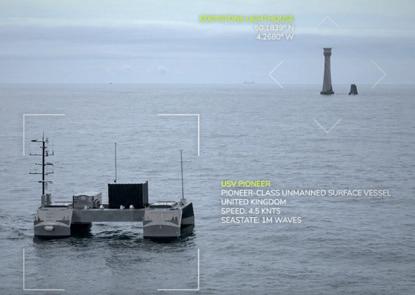
For this first trial Pioneer performed in a range of sea conditions including 1-2m wave heights at 4.5 to 5 knots with a 4-tonne payload performance ballast, but Tinmouth says Pioneer has, in the past, achieved speeds of 6 knots.
“The hydrogen-electric hybrid has essentially been built to be two boats in one, providing us with systems redundancy and increased reliability,” he says. Hydrogen is held in three tanks in the fuel cell module on deck at 175 bar and charges the battery system, which comprises two 43-kilowatt lithiumion batteries.
“The electric system manages peak power and redundancy so if power is lost from one side of the vessel, we have sufficient power to hold stationary or return to port.”
Autonomous systems, stability and hydrogen performance were monitored around the clock, generating valuable data now being shared with research partners including the University of Southampton and MarRI-UK.
“Facilitating this was USV Pioneer’s operational control, which is managed through a dual-system approach,” says Tinmouth. “For close-quarters manoeuvres like berthing and in-harbour pilotage, a handheld PCN controller is used, whereas for beyond-line-of-sight control, including mission management and real-time data transfer, the vessel is operated via satellite communication from our dedicated ROC equipped with the necessary proprietary software to control missions.”
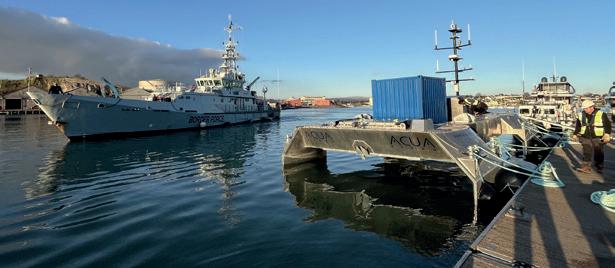
■ Pioneer and Valiant
For longer-term operations, the ROC can be integrated into traditional maritime operations centres providing proximity to decision makers or other platform and payload operators to deliver the best insights from operational situations.
Unique design – unique capabilities
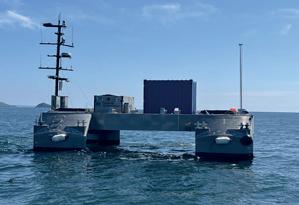
Acua Ocean believes the 14m USV Pioneer has a reliable and persistent offshore capability designed to operate effectively in inclement sea conditions and integral to that is a unique, SWATH hull form which ensures exceptional stability.
The integrated central moonpool simplifies the installation and safe deployment of payloads, from sensors to robotics, and provides the space, weight and power to deploy modular sensor and system cargo of up to 6 tonnes from a 20ft ISO container.
“With a focus on versatility, scalability and cost-efficiency, the H-USV was designed by John Kecsmar of Ad Hoc Marine Designs Ltd, who is a world-leading expert on SWATH designs - a very unique and stable design which suits the end customers,” says Tinmouth. This was made possible through funding from the UK government Department of Transport’s Clean Maritime Demonstration Competition after numerical and wave tank testing at the University of Southampton.
“John Kecsmar had previously designed dozens of commercial SWATHs, but never an autonomous design. From the outset we knew Pioneer would be a robot with no bridge or cabins; essentially not a traditional concept.”
Pioneer was built by Aluminium Marine Consultants on the Isle of Wight, a shipyard for aluminium workboats. Its robust design comprises aluminium sheets for a modular build that were welded together for final assembly and integrations in four sections in Plymouth.
“Acua Ocean bench tested the internal systems before arrival and the ethos of the design was about reliability and reconfigurability, so that sections could be taken out and replaced,” he says. “The plan all along was to work in a novel way with hull form and robotics, following lessons learned from Acua Ocean’s first autonomous build: the concept vessel Protector, which rapidly iterated Pioneer.”
First of class Pioneer is, however, capable of being adapted to the needs of the end customer, bearing in mind current limitations.
“As power lasts eight to 10 hours on a battery-electric only vessel, running on hydrogen-electric, Pioneer has an endurance of four to 10 days and if operating a diesel system, 40-50 days. Considering hydrogen is currently 12 times more expensive than diesel, the commercial reality is that both the commercial requirements as well as the necessary short side infrastructure aren’t in place to fully realise hydrogen’s potential from an application perspective,” says Tinmouth.
“We therefore decided that a diesel-electric propulsion system can replace hydrogen if requested by a customer.”
That being said, Pioneer continues to deliver zero-emission fuel demonstrations and has so far spent 47 autonomous days at sea, powered by hydrogen and electric propulsion, which is believed to be a world first, certainly for an autonomous vessel.
A future-focused concept
Pioneer’s recent achievements are a benchmark as they have shown the way forward on both Workboat Code 3 regulatory approvals and offshore operational capability.
Tinmouth also feels that the current situation, where small autonomous vessels are used in ports and harbours but not offshore, will remain the same for the time being, as no other vessel has achieved regulatory approvals, nor have competitors developed hull forms that provide the required stability and payload capabilities for offshore operations.
“For the future, Acua Ocean wishes to trial Pioneer’s very stable modular payloads in higher sea states of 4m plus wave heights. We are excited to be collaborating with technical partners to provide pre-engineered integration solutions for several payloads and deployment,” he says. These will include towed arrays, underwater sensor bodies, ROVs and a gondola-deployed MBES (Multi-Beam Echo Sounder) for reliable high-resolution seabed mapping.
“Pioneer was showcased to a global audience at DSEI and London International Shipping Week in September and we have recently announced building our second and third vessels in the Pioneer class,” he says. “We will use strategic partners to deploy systems and sensor payloads and have exciting demonstrations planned for ‘25/26.”
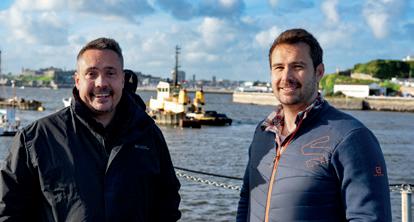
■ Acua Ocean founders Mike Tinmouth (L) with brother Neil
■ Pioneer passing Eddystone Lighthouse Graphic
■ USV Pioneer in sea trials
SYSTEMS THINKING IS CRITICAL FOR COMPLEX NAVAL AUTONOMY
Will Alexander, Global Business Development Lead – Maritime Autonomous Systems with BMT, tells Maritime Journal why design and thinking systems matter more than ever with autonomy in an increasingly complex and critical naval domain.
In the face of mounting challenges from rising costs, undercrewing and increasing sophistication of adversaries, the naval domain, like others, is embarking on a strategic transformation. At the heart is a shift from high-value exquisite platforms to a more flexible, disaggregated set of capabilities employing a Systems of Systems Approach (SOSA).
In the UK, the Royal Navy’s approach to transformation is encapsulated in its Hybrid Navy Strategy, which embraces modularity, autonomy, digital and Ai at scale while maintaining flexibility to adapt to meet evolving threats and deliver a spectrum of missions.
The Strategy makes a lot of sense if navies are to maintain operational advantage in today’s uncertain and rapidly evolving strategic context. But implementation is always the hard bit.
The latest technology needs to be developed, proved, integrated and deployed at pace – but pace and cost cannot come at the expense of considered design. In the harsh naval environment, solutions that look attractive on paper but are not engineered for the realities of combat or North Atlantic Sea states will fail to deliver credible deterrence. Time invested upfront avoids the false economy of rework and retrofits later.
The ambition is clear and industry is preparing and investing in this future – many options for uncrewed and autonomous systems exist. The challenge for industry and defence is how to harness this technology in partnership before the end of this decade. There is an urgent need to scale uncrewed platforms, integrate systems and enhance survivability to meet the demands of war-fighting capability.
Credible deterrence at sea depends on coherent, interoperable and interchangeable capabilities, not isolated platforms. A SOSA demands systems thinking from the
outset – architecture, integration and assurance designed within, not bolted on later.
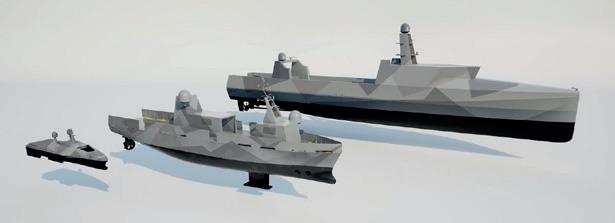
Our early concept work on large uncrewed surface vessels identified six critical challenges for scaling autonomy at fleet level: command and control; sensor data management; engineering systems; vessel/mission resilience; maintenance; and logistics and modularity.
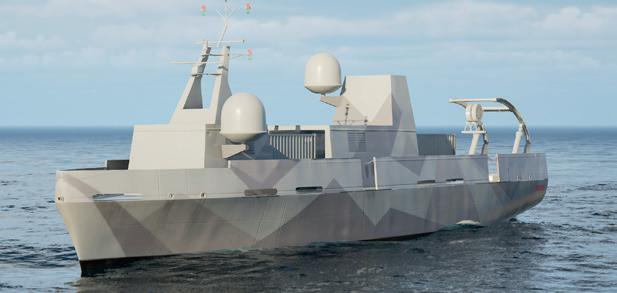
Building on this work, we matured the design into the Modular Uncrewed Ship, or MODUS concept, revealed at DSEI London 2025. A concise set of six principles provides the design compass for MODUS: Autonomy, Modularity, Availability, Affordability, Buildability, Adaptability.
Together, these principles ensure that flexibility and modularity are designed in from the outset, creating a platform that can iterate and adapt at pace. MODUS is intended to accommodate spiral development, enabling new payloads, autonomy software and mission systems to be integrated over time without compromising availability or driving prohibitive through-life cost.
MODUS is a family of uncrewed vessels conceived to be part of a mixed-fleet concept. It is designed to leverage the benefits of autonomy: military data gathering/survey, seabed warfare (including protection of critical undersea infrastructure), and Anti-Submarine Warfare (ASW). These are persistent, payload-led missions where long on-task durations and seamless integration are decisive.
Designing for the waters you sail Designing explicitly for the environment you intend to operate in is essential to delivering credible deterrence.
In the Northeast Atlantic in winter, for example, survivability is only the starting point; the real question is whether a vessel
■ BMT's uncrewed 40m MODUS
can continue to deliver operational effect and has the resilience to sustain that effect. Vessel length and arrangement should align with seakeeping requirements dictated by the environment: our analysis shows that a larger hull, such as the 75 metre LUSV, performs better in the North Atlantic, while medium USVs are adequate for the North Sea – clear guidance to avoid a one-size-fits-all approach.
Autonomy and lean crewing do not make the ocean any less harsh. If anything, they raise the bar on design because vessels must operate safely and effectively without constant human intervention.
Hull-form considerations include lighter materials, balanced design for weight/displacement and theatrespecific stability. The aim is credible, repeatable performance in the seas navies will actually face.
The concept emphasises payload-first architecture. Modular mission systems enable vessels to switch between roles (ASW, seabed warfare, military data gathering) and adopt new technologies at pace. The PODS (Persistent Operationally Deployed Systems) concept underpins this approach, enabling long-term use and ease of replacement. The payoff is agility: rapid technology updates, the ability to swap payloads without deep refits and a pathway to commercial missions when required.
This mission-modular architecture supports rapid technology updates, enables pier-side swap-outs rather than deep refits, and lets navies switch between defence and commercial payloads. Because payloads and software can move faster than hull life, decoupling upgrades from the platform creates a steadier cadence of capability increments across the fleet.
Survivability for autonomous ships differs from traditional warship recovery strategies. For roles closer to home waters such as monitoring, intelligence and protection, threats are more likely cyber or disruptive than direct kinetic attack. Emphasis shifts to susceptibility reduction and resilience: hardening the architecture, ensuring predictable behaviours under interference or partial failure, and building in redundancy where it protects the mission. For larger uncrewed vessels pressing into contested areas, the baseline hardens further with robust system architecture to avoid mission-critical failures.
The common thread remains mission continuity and graceful degradation.
The family approach: variants with commonality, not a single hull
Here BMT’s proposition is distinctive. Rather than a singular multi-role vessel, the approach embraces different solutions for different tasks – categories such as 15m, 40m MUSV and 75m LUSV – to maintain affordability, enable build across a
broader range of UK shipyards and avoid disrupting complex warship programmes.
Each vessel works collaboratively in a mixed fleet while remaining adaptable and scalable for defence and commercial applications. By treating the family as a connected whole rather than a collection of standalone platforms, the approach builds coherent capability that is both interoperable and interchangeable. This is central to credible deterrence: the ability to combine and recombine assets rapidly across missions, partners and theatres.
Open, modular interfaces and portable payloads support exportability while allowing partners to integrate indigenous systems. The approach complements complex warship programmes by adding scalable, interoperable mass rather than competing for the same industrial bandwidth.
The call-to-action is collaborative: technology providers, autonomy specialists, payload integrators and shipbuilders should be engaged to fill capability gaps and accelerate delivery, turning a pre-concept vision into a sustained pipeline of trials, prototypes and fielded variants.
By treating the family as a connected whole rather than a collection of standalone platforms, the approach builds coherent capability that is both interoperable and interchangeable
The direction of travel
Taken together, the evidence points to a durable thesis: a family of medium and large uncrewed vessels value-engineered for cost efficiency, designed from the bottom up for uncrewed operation and integrated as part of a mixed fleet.
MODUS provides a set of principles and variants aimed at minimising vessel cost while adding naval-credible mass with high availability to fleets at pace. In complex programmes, the same logic applies as on operations: just as time spent in reconnaissance is never time wasted, history shows that time invested upfront in rigorous design and systems engineering saves time and cost in the long run and is far more likely to deliver an enduring solution.
By combining our design and innovation heritage with deep domain knowledge and engineering excellence, BMT applies that rigour to inform decisions quickly and effectively – turning the Royal Navy’s Hybrid Navy vision into credible, resilient capability for the most demanding seas.
■ BMT's Family fleet emphasises that one size does not fit all
SILENT DISRUPTOR: DRIVING THE UNCREWED REVOLUTION
Hampshire, UK-based RAD Propulsion is becoming one of the most quietly influential players in the booming uncrewed and electric-propulsion sector. In an interview with Maritime Journal, co-founder and CEO Dan Hook explains how his company is capitalising on the growing demand for uncrewed, long-endurance vessels demanding a lower noise and thermal signature.
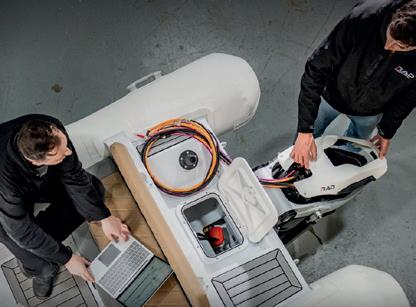
Having now supplied drives, batteries and interface units to multiple USV builders – and with more in the pipeline –the company is positioning itself as the enabler of a new generation of smart, electric and remote vessels. It has also delivered full control solutions to several undisclosed clients, contributed consultancy support to multiple USV programmes and developed its own autonomy interface, RADLink, which integrates with standards such as MAVLink.
Hook, a veteran of 25 years in the unmanned marine space, says RAD exists to fill a fundamental skills gap.
“Boat builders historically have been very good at hulls and structures, stability, design and fit out, but not so much the electronics, software, navigation and new electric drives,” he says. “So we built a range of products, like control systems, electric drives and batteries, that boat builders and USV builders can use.”
Autonomy vs remote operation
Public perception often blurs the lines between autonomy and remote operation, but Hook believes the distinction is critical – and widely misunderstood.
“There are very, very few vessels that are truly autonomous,” he says. “To be truly autonomous you don’t have a communications link. You’re out there on your own making decisions based on the environment. There’s only a handful of things doing that, mainly in defence.”
The greater shift for now, though, is remote operation, which is mushrooming at unprecedented speed.
For almost every other vessel, he says, there’s some form of human supervision. The frequency of that supervision varies, but nearly all have a remote operator of some kind.
“I think for routine survey work – cables, pipelines, infrastructure checks – those are going to get more and more autonomous. It’s taken people a while to trust their Roomba (a brand of autonomous vacuum cleaner), but they get there.”
Hook recalls how small the sector was a decade ago.
“Ten years ago I had a pretty good database of everything happening. There might have been 1,000 USVs in the world. Now you wouldn’t be far off finding 1,000 companies doing stuff.”
The number of platforms, he says, has exploded into “maybe 10,000” when including small lake and harbour systems and the proliferation of defence craft.
“It’s massive.”
As operational models shift, vessel design shifts with them. Without crew on board, whole categories of equipment simply aren’t needed.
“If you’re designing it to be uncrewed all the time, there’s no point fitting a loo, internal lights, washing machines, air conditioning, guardrails – the list goes on,” he says. “You save weight, you save power, you save cost… it’s a really positive spiral.”
Not everything can go that way: some vessels will remain dual-role, and Hook acknowledges the limitations.
“Their safety comes top, so if they’re crewed even occasionally, the guardrails are back. When you look at a work boat, so much of it is there because the people are there.”
For uncrewed systems, the barriers ahead are no longer mainly technical.
“The tech is there now,” Hook says. “It’s awareness, training, trust – the human factors. Regulation, insurance, skills. That’s where the big challenges are.”
Defence booms as wind pauses
If any single sector defines the explosion in uncrewed maritime systems, it is defence (see Fincantieri interview on p16 and BMT on p8)
“Defence has been a really big growth area in the last three years. Massive,” he says again.
The conflict-driven adoption of low-cost surface drones has changed the global landscape: “People have suddenly acknowledged they can do things, they can be quite effective for not a lot of money.”
There are three main uses today, he says: kinetic or weaponised drones; coastal and port patrol craft; and fastgrowing interest in logistics.
“I think more and more are soon going to be used in logistics – ship-to-shore transfer, things like that,” he says. “You’ve got companies popping up everywhere building drones, including lots of military ones for the projects in Ukraine and the Far East.”
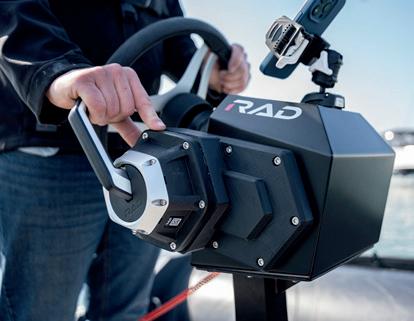
■ Remote controlRAD Propulsion
But other markets are less buoyant.
“Wind farms were really busy a few years back,” he says. “I can't really comment on the latest numbers, but I've got a feeling wind farms have slowed for a few people. I know some of the projects in the US got cancelled and I'm not a wind farm expert, but I know it's been a bit tough.”
But new niches are emerging. RAD sees rising demand for long-endurance, low-signature vessels – craft that must operate quietly and invisibly for extended periods.
“Demands for low noise and thermal signature are really well suited to our product line,” Hook says. “Electric systems lend themselves to that.”
In the broader commercial world, Hook expects remote operation, not full autonomy, to define near-term adoption, especially in ports.
“I’m pretty sure within 10 years you’ll see most ports with something uncrewed going on,” he says. “It could be CCTV, cleanup, survey… whether it’s more advanced will vary country to country.
“More has happened in the last three or four years than in the 20 before. You can imagine the next three years being bigger than all of it combined.”
Electric future
Electric propulsion, Hook argues, is not just the future – it is the logical engineering solution for uncrewed vessels.
“There’s a really long list of positives of using electric in robotic systems,” he says. “It’s more reliable, more easily controlled, quieter. It suits long-endurance running.”
Whether paired with diesel generators, HVO, solar, fuel cells or all-battery systems, electric architectures unlock performance advantages that conventional drivetrains cannot match. “More and more robotic systems are going electric or hybrid electric,” he says.
This belief shapes RAD’s propulsion portfolio. The company began with a 40kW drive, recently launched a 120kW unit, and is now developing a smaller 6-8kW model.
RADLink, the company’s control and autonomy interface, is central to the company’s philosophy of openness and ease-of-integration.
“We publish our interface standards,” Hook says. “We don’t have proprietary codes that people can’t work with.”
RADLink is designed so that autonomy providers can plug in their own systems with minimal friction.
“I’ve seen it with my own eyes – within a couple of hours, robotics companies that didn’t know our system at all were fully plugged in, interfaced and running. It’s not quite ‘plug a USB in’, but it’s not far off that.”
RAD has supplemented its hardware and interface systems with full control packages for select clients –autopilot, communications, cameras and supervisory control – while building a network of partner companies with their own proprietary autonomy stacks. Data handling and communication remain key issues for the sector.
“The amount of data generated, although high, is still not that high compared to a bunch of teenagers on TikTok,” he says. “Edge processing is quite a trend – do what you can on board and send only the important bit. If you’re collecting HD video on 10 cameras, most of it is empty sea. You only send images that matter.”
Remote control infrastructure is also maturing, but while technically it could be done from a coffee shop, that’s not going to happen, he says.
“People are worried someone would be on a laptop in Starbucks driving a robot and knock their latte over. Technologically you could do it but in workboat environments, the safety case doesn’t stack up.”
RAD in the field
RAD’s growing project list demonstrates the breadth of its systems, such as a project with Zero USV in Plymouth.
“They’re doing really, really well,” Hook says. “They're principally focused on defence and coastal monitoring, and they did do some survey work. It's mainly anti-submarine warfare and coastal patrol.”
In the Netherlands, RAD supplied drives to Damen for a new vessel developed with mobility partner Z-Buzz.
And the company is also involved in three defence projects that cannot yet be named.
“Some are using the drives; some are using a lot more of our control system,” Hook says. “We’re a bit more involved in the actual autopilot and control.”
One of the company’s most distinctive installations lies far from Europe’s defence labs: a 35-metre solar-powered floating hotel on the Chobe River in Africa, equipped with four RAD 40 drives.
More has happened in the last three or four years than in the 20 before. You can imagine the next three years being bigger than all of it combined ‘‘
“It runs on solar alone,” Hook says. “The whole roof is covered in solar. They get enough energy during the day to fully charge the batteries, and they use the batteries at night to run air conditioning and the kitchen. It’s really cool.”
The 75-tonne vessel showcases what Hook sees as a fastapproaching future: electric systems powering large workboats, pontoons and barges.
RAD’s technology is not limited to uncrewed platforms.
“Probably two thirds, maybe three quarters of our drives are going on crewed conventional boats,” Hook says. “Onequarter or one third are starting to go onto uncrewed.”
As for the near future, Hook highlights the company’s excitement about scaling up.
“We are really excited about our new 120kW drive,” he says. “It gets us into much bigger boats.” RAD will be showing its latest developments at Seawork in Southampton next year, vessel to be confirmed.
■ RAD Propulsion RAD40 power console
FROM SKY TO SEA: A HOLISTIC SECURITY SOLUTION
Traditional maritime security has always relied on crewed patrols and fixed surveillance. As threats grow and operations become more complex, operators and governments are adopting remote and autonomous technologies to improve awareness across the maritime domain.
By Jannik Sauer, Chief Technology Officer, Subsea Europe Services/FLANQ
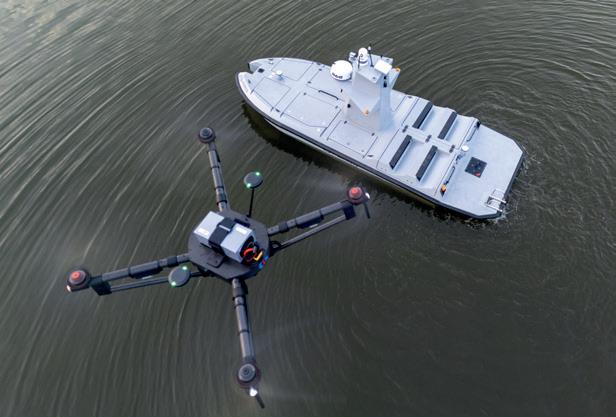
Uncrewed Surface Vessels (USVs) are leading this shift. Cheaper to purchase and cheaper to operate than conventional patrol boats, they excel as platforms for underwater sensors and as launch stations for Uncrewed Aerial Vehicles (UAVs), linking subsea, surface and aerial surveillance in one, unified ecosystem.
A new security landscape
The sabotage of the Nord Stream gas pipelines in 2022 demonstrated that commercial assets were now potential targets for bad actors.
The perpetrators were never publicly identified, but the incident demonstrated that large-scale attacks on maritime energy infrastructure are not only possible but highly disruptive. The attack caused extensive environmental damage, disrupted energy supply and revealed that critical underwater assets are difficult to protect using conventional means.
In the United Kingdom and across Europe, maritime security strategies have evolved to address this reality.
The UK’s unveiling of Atlantic Bastion, a comprehensive strategy combining autonomous vessels, AI-enabled detection
networks and traditional naval and air platforms, has signalled a growing recognition at the highest levels that unmanned and sensor-driven systems are no longer niche assets but foundational to future maritime defence and security.
The operators of maritime facilities have similarly acknowledged the challenges protecting their own facilities.
The foundation for integrated operations
USVs, have become one of the most promising tools of a new, more dynamic, security model.
USVs, working solo or as a collaborative fleet, can patrol and monitor extensive areas for long periods with no need to send personnel to sea. But it’s not all about the vessel. In fact, it’s the integration of sensors, positioning and other critical systems that truly defines operational performance at sea. When fully integrated with advanced sensor payloads and unified to underwater and aerial systems, the USV becomes the foundation to provide continuous awareness of activity below, on, and above the water. This layered approach offers the kind of persistent surveillance that static sensors and periodic patrols cannot achieve.
■ Drone in tandem with USV
The value of uncrewed systems has already been demonstrated in practice.
Exercises such as NATO’s REPMUS and Dynamic Messenger series have shown that USVs are capable of performing complex surveillance and mine-countermeasure missions alongside traditional naval assets.
They can detect, classify and track potential threats while sharing edge-processed data in real time with command centres ashore. The combination of autonomous navigation, intelligent decision-making and networked communication is turning these compact, easy-to-deploy platforms into true force multipliers for maritime security operations.
From commercial autonomy to defence innovation
Subsea Europe Services (SES), headquartered in Rostock, northern Germany, began working with commercial, off-theshelf uncrewed vessels in 2022.
Initially focused on survey and offshore energy support missions, the company quickly recognised that the same technology could enhance maritime security.
In 2023, the firm participated in the annual Baltops exercise, integrating its Autonomous Surveyor vessel into mine countermeasure operations alongside NATO partners. The results were clear: the autonomous workflow achieved during the exercise was significantly more efficient and resource-saving than traditional methods.
This experience demonstrated that advanced autonomy and intelligent sensor integration could have far-reaching applications beyond commercial survey work.
The insight gained from these operations led to the creation of FLANQ, a business unit of SES, dedicated to using these proven marine technologies into mission-ready security solutions. FLANQ was established to address the growing need in Europe for affordable marine autonomous systems capable of protecting ports, harbours and offshore assets without relying on crewed vessels. Its approach focuses on reconfigurable, modular platforms designed to adapt rapidly to new tasks or threats through an approach to payload integration it calls ‘plug-and-sail’..’
Building a reconfigurable platform
Maritime security requirements can vary widely from one day to the next.
A port authority might need to track small craft entering a restricted zone, while a wind -farm operator may want to monitor for underwater intrusions near turbine foundations.
FLANQ’s modular vessel architecture was designed with this operational diversity in mind. Each platform can be quickly reconfigured to accommodate different sensor payloads and mission profiles. The company’s "Q-Spine" hardware backbone forms a standardised interface that allows equipment to be swapped easily, enabling a single vessel to perform surveillance one day and subsea inspection the next.
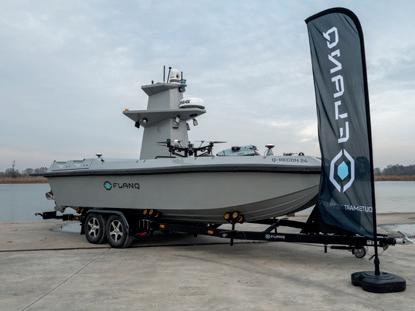
This flexibility extends to scale and deployment. The Q-Class USV family can range from compact, man-portable models to larger vessels more than 10 metres in length, allowing operators to match platform size to mission demands. Each is designed for rapid mobilisation and ease of transport, including containerised logistics for fast global deployment.
While the hull gets you to the mission, the integration completes the mission. As such, FLANQ’s USVs come equipped with a broad range of sensors, from radar and electro-optical cameras to acoustic systems such as the R3Vox Voxometer, which provides detailed, real-time hydrospatial imagery of underwater environments.
By combining these capabilities, the same platform can
detect surface threats, monitor the environment below, and even support scientific or maintenance missions when security demands are low.
Integrating the air domain
The 2025 edition of NATO’s REPMUS exercise, held in Portugal, provided a public demonstration of the next step in uncrewed maritime security.
During the event, FLANQ’s team, working with its strategic partner, CiS, integrated an ORKA drone system on the deck of a 4-metre USV.
Together they achieved fully autonomous take-off and landing of the UAV from the moving USV, marking a major milestone in multi-domain operations.
By combining USVs with aerial drones and underwater vehicles, operators can achieve an unprecedented level of awareness and resilience across their assets
The demonstration showed how a single surface platform can extend its surveillance reach into the air, offering operators a complete picture of activity from the seabed to the sky. The exercise also reinforced the growing importance of standardised communication between uncrewed systems operated by different nations, a goal actively pursued by NATO and its partners.
A holistic approach to maritime protection
The logic behind this integrated approach is straightforward. Uncrewed systems can provide persistent coverage at a fraction of the cost of crewed patrols. They can be deployed around the clock and operate in conditions that would otherwise require significant manpower or risk to personnel. When linked with underwater vehicles such as AUVs or static systems such as diver detection sonar and complemented by UAVs overhead, USVs create a continuous security envelope around critical assets. They can observe, classify and transmit data in real time to control centres on shore,
■ FLANQ USV
where analysts can assess potential threats and coordinate appropriate responses.
For operators of ports, harbours, waterside-power plants, offshore wind farms and other critical national infrastructure, this model offers an efficient way to strengthen protection without expanding headcount or budgets.
It also allows for flexible use of assets. The same uncrewed surface vessel that performs night-time security patrols can be redeployed for survey or inspection work during daylight hours, providing additional value from existing equipment.
In large offshore projects where operational costs are closely monitored, this kind of dual-use capability can deliver substantial savings over the lifetime of the asset, n. Not forgetting the significant reduction in risk to personnel and the environmental impact.
Looking ahead
As the global energy transition accelerates, the number of offshore installations is expected to grow dramatically, while ports and harbours continue to be the backbone of local, regional and global trade.
For both government and industry, the focus is shifting from reactive to proactive security. Uncrewed platforms represent the most practical way to achieve this goal, whether offshore or near shore. They offer continuous situational awareness, rapid detection and scalable response, while reducing risk to human personnel.
Recent projects have already demonstrated how quickly these systems can move from concept to reality.
By combining these capabilities, the same platform can detect surface threats, monitor the environment below, and even support scientific or maintenance missions when security demands are low
In late 2025, FLANQ delivered a Q-Recon 24 USV to a European navy just 100 days after contract signature, underlining how modern design, additive manufacturing (3D-printing) and modular engineering can accelerate deployment.
It is a glimpse of what European defence and civil protection procurement could become when innovation and urgency align.
Uncrewed, multi-domain security is a reality and the multilayer approach is already optimising operations. By combining USVs with aerial drones and underwater vehicles, operators can achieve an unprecedented level of awareness and resilience across their assets.
The approach is a practical process to safeguarding the infrastructure that keeps our economies, our energy and our communications running every day.
OFFSHORE WIND ON THE CUSP OF SBP BREAKTHROUGH
By David Hull, Founder & CEO, HydroSurv and Richard Dowdeswell, CCO, GeoAcoustics
As offshore wind deployment scale, developers need increasingly detailed characterisation of the seafloor to de-risk engineering activities such as cable route planning, landfall design and foundation installation.
Much of this work remains reliant on conventional 2D subbottom profiling (SBP), which provides only a narrow vertical slice through the seafloor. This can limit confidence in feature interpretation, particularly where geological complexity exists or where feature continuity must be understood laterally.
Emerging 3D SBP technologies address this limitation but are typically dependent on towed arrays or subsea-deployed systems. This introduces constraints, particularly in shallow water, congested nearshore zones and sensitive landfall areas where towing is impractical or restricted.
The CUSP project, supported by the Offshore Wind Growth Partnership (OWGP), directly addresses this gap by enabling a USV-first, non-invasive 3D sub-bottom profiling capability.
The aim is to eliminate the need for towfish deployment and enable cost-effective, dependable surface-based operations. It is specifically designed to operate safely and efficiently in shallow, constrained environments that are increasingly critical to offshore wind development.
The CUSP consortium consists of:
● HydroSurv, which contributed uncrewed systems engineering and operational delivery experience
● GeoAcoustics, which brought established SBP technology and geophysical instrument expertise;
● Tellus Geoconsulting, which provided practical survey delivery and data interpretation experience.
Platform engineering
The primary engineering challenge is packaging a relatively large sonar and hydrophone array within the relatively compact 4.5m hull of a HydroSurv REAV-45 USV without compromising vessel operability or data quality.
Crucially, the deployment system must maintain precise and repeatable geometry between transmitters and receivers to support 3D data reconstruction, while remaining compatible with routine launch and recovery procedures and allowing safe access for inspection and maintenance. Positioning tolerances for the array are critical, as small deviations can materially affect data integrity.
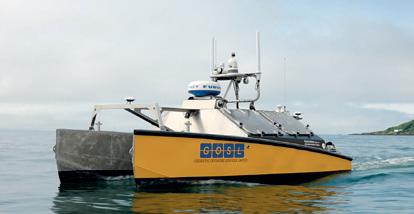
For the CUSP project specifically, the REAV-45 incorporates a revised twin steerable pod drive system supplied by Rim Drive Technology. This replaces the previous outboard configuration, simplifying the propulsion installation and improving low-speed manoeuvrability. The vessel’s batteryhybrid power system provides endurance of up to 100 hours, supporting extended survey operations without intervention.
The catamaran hullform offers high transverse stability and buoyancy, which is vital for maintaining consistent sensor geometry and minimising motion-induced noise during SBP acquisition. This builds on the REAV platform’s use across multibeam, side-scan sonar, parametric SBP, oceanographic profiling and towed magnetometry operations.
In parallel, the data acquisition, navigation, and processing toolchain must be adapted to support synchronised multichannel acquisition from a surface platform.
This includes ensuring accurate time-stamping, vessel motion compensation and integration with HydroSurv’s vessel control and survey systems. Addressing these challenges holistically is central to delivering a reliable operational capability rather than a one-off demonstration.
Sensor integration
The most important capabilities for a USV-based 3D SBP include stable and repeatable sensor geometry, high positional accuracy, tight integration between navigation and acquisition systems and the ability to operate efficiently in shallow and constrained environments without compromising data quality.
To achieve this, the consortium is iterating on the GeoAcoustics GeoPulse 2’s digital SBP architecture while optimising the transducer and hydrophone geometry for integration with the REAV-45.
Using a field-proven SBP core allows the project to focus on novel aspects such as array configuration, deployment mechanics and USV-based acquisition workflows.
Building on decades of SBP development, GeoPulse 2 is a flexible digital platform with high-resolution, shallow and mid-depth capabilities. It supports up to 16 transducers and programmable source signatures including Chirp, CW and Ricker wavelets, and is optimised for precision and adaptability.
In typical seabed conditions, GeoPulse 2 achieves up to 80 metres penetration in fine sediments and 20 metres in sand, with resolution as fine as 6 centimetres.
Project delivery
The CUSP project engineering and integration work is well under way and final selection of the demonstration site is ongoing in coordination with the project’s stakeholder group. Initial trials are expected to take place in the South West of the UK, supported from HydroSurv’s headquarters in Exeter.
While offshore wind remains the primary driver, the capabilities developed through CUSP have broader relevance across offshore energy and maritime security sectors.
■ HydroSurv REAV47
INTO THE DEEP: FINCANTIERI'S DRONES DIVE IN
When Fincantieri, one of the world’s largest and oldest shipbuilding groups, announced three years ago that it was entering the subsea robotics sector, many in the maritime world assumed it would be a gradual move – perhaps the development of an underwater vehicle here, a defence research project there
What has emerged is something far more expansive: a full underwater ecosystem of drones, sensors, motherships and AI-driven command-and-control systems that Fincantieri believes will redefine the way nations and industries protect, monitor, maintain, and develop critical underwater infrastructures, such as telecommunication cables, pipelines, offshore energy assets, ports and other strategic installations.
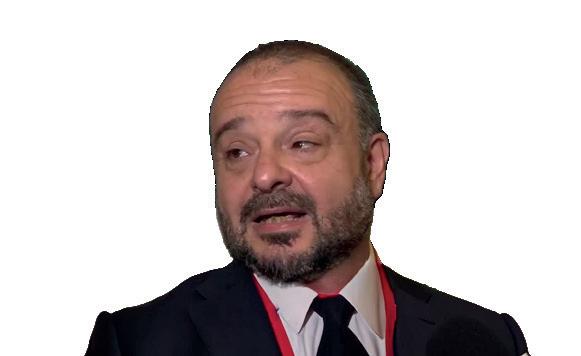
This new business area, referred to internally as the Underwater Hub is led by executive vice president Underwater Gabriele Maria Cafaro, who is overseeing its growth and implementation.
Speaking to Maritime Journal, Cafaro described the project not as a product launch but as the foundation of an entirely new strategic pillar for the company.
“This journey started something like three years ago,” he says. “And it started a process, a strategic path in order to be ready to capture some early-stage interest regarding the underwater dimension.”
This ‘dimension’ is the vast, shifting, increasingly contested space beneath the world’s oceans: where everything from global data flows to energy transmission to military security is affected.
And for Fincantieri, a company whose legacy spans cruise ships, naval vessels and submarines, it represents both an urgent challenge and a once-in-a-generation opportunity.
Unseen underwater utilities
Modern civilisation depends on underwater infrastructure far more than most people realise, Cafaro believes.
“A very big portion of human being wellness is somehow passing through underwater infrastructures,” he says.
Indeed – this is an understatement when we consider that about 98% of global data traffic, from financial transactions to video calls, travels through subsea fibre-optic cables.
Power interconnectors, oil and gas pipelines also snake across or under seabeds worldwide. And as offshore wind continues to scale up, thousands of kilometres of new cables are being laid every year.
All of these assets are vulnerable. The 2022 explosions that crippled the Nord Stream pipeline system thrust subsea infrastructure security into geopolitical view, and even simple accidents, from dragging anchors to fishing gear, are capable of inflicting millions of euros of damage. According to Cafaro, the failure of a major telecommunications cable can cost hundreds of million per day. And unlike pipelines and power grids on land, the underwater network is extremely difficult to patrol, let alone protect.
Historically, operators have relied on large, crewed vessels for inspections and mapping, making the process slow, costly and reactive. Fincantieri’s bet is that a new generation of autonomous drones, paired with persistent underwater sensors and a coordinating ‘brain’, can fundamentally change that model.
The DEEP system: a network built for the seabed At the centre of Fincantieri’s subsea push is DEEP. Unlike traditional subsea inspection tools – standalone, remotely operated vehicles (ROVs), AUVs or single-mission drones –
DEEP has been conceived as a full ecosystem, combining early-warning electro-acoustic seabed sensors; an Underwater Management System command-and-control platform; swarms of autonomous underwater drones; purpose-built surface drones acting as communication hubs; launch-and-recovery gear, docking stations and long-endurance motherships.
“What is really new is the system that we call DEEP,” says Cafaro. “The DEEP system is something that we have orchestrated as a whole, as an entire system, that has been developed to protect, maintain and develop the infrastructure.”
Early-warning sensors: Underwater ‘alarm system’ The process begins on the seabed, where Fincantieri places arrays of electro-acoustic sensors capable of detecting anomalies such as movement, intrusion, or unexpected noise patterns near critical infrastructure.
“First of all, we have an early warning system,” Cafaro says. “Down in the seabed, you position some electro-acoustic sonars to understand if there is an intrusion or if something is happening in a specific area. When something happens, these sensors communicate and report the information to a central underwater management system (UMS) that has been developed internally by our company, IDS (Ingegneria dei Sistemi).”
When triggered, these sensors beam alerts to the UMS, a software platform built by a Fincantieri-owned engineering specialist. IDS, bought by Fincantieri in 2021, has a long pedigree in naval and defence systems, including sensor integration for submarine and mine-countermeasure operations.
What is really new is the system that we call DEEP. The DEEP system is something that we have orchestrated as a whole, as an entire system, that has been developed to protect, maintain and develop the infrastructure ‘‘
The company’s experience provides the interface and analytics backbone that makes DEEP possible.
Once the UMS assesses the anomaly, it automatically deploys the appropriate response – either a drone swarm or, if needed, a manned vessel.
“This software launches a reaction,” Cafaro says. “Our swarm of drones is in action, our drones are deployed and they go and recognise the threat with the payload they are carrying.”
The drones carry side-scan sonar and forward-looking sonar, along with proprietary AI-based automatic target recognition, allowing them to classify objects on the seabed, which could be anything from a lost anchor to a suspicious, intentionally placed device.
While DEEP is designed to be autonomous first, it is not, strictly speaking, fully autonomous.
A human pilot, trained at Fincantieri’s facilities in La Spezia (defence) and on Italy’s Adriatic coast (energy sector), oversees operations.
“This system was born to be unmanned,” Cafaro says. “But it requires on shore a sort of pilot for the entire system. We are training pilots on the west and east coasts of Italy, one for defence, the other for offshore energy.
“The drones operate by themselves, and that’s why the UMS is crucial because you need to have a brain that coordinates everything and guarantees the pilot constant and rapid information.”
For defence operations the drones could even be weaponised, Cafaro says.
“First of all, identifying the threat is itself very important because you have also a deterrence,” he says. “So, if someone is going to enter that space and he knows that you have this system, this is a deterrent, which is very, very important.
“Second, the action that you can take is another, an additional mission profile that you can add to the system, weaponizing the drones, which is something that we can easily do. We have a very small torpedo as a countermeasure. It's 50cm long and it's more than enough to counterattack a drone.”
The drones: A growing fleet for multiple depths
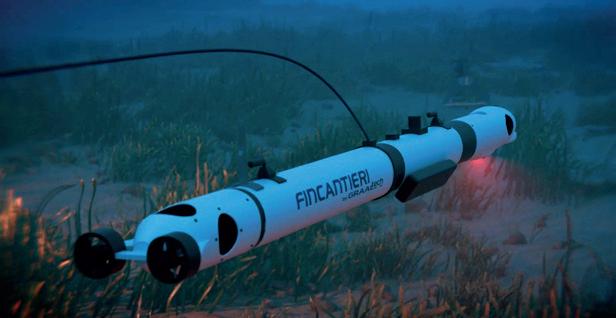
The company builds USVs (Uncrewed Surface Vessels), while for subsea it uses drones from Graal Tech, a Genoa-based SME with more than two decades in underwater robotics.
The drones range in size but essentially break into three classes:
● A 4-metre-long AUV rated to 300 metres
● A similar-sized model rated to 500 metres
● A large-deepwater drone, under development, rated to 3,000 metres and equipped with real-time 3D imaging
One of the biggest obstacles in underwater robotics is communication, which is extremely limited below the surface.
Radio waves attenuate almost immediately; acoustic signals are slow and unreliable. Fincantieri approaches the challenge in layers:
● Short-range cooperative communication between drones
● Collaboration with W-Sense, a deep-tech Italian company specialised in underwater wireless communication
● Mission profiles requiring drones to surface periodically to transmit data
● Use of a surface drone or vessel as an intermediate hub In the future, drones may even recharge and upload data directly from undersea cable repeaters, which Fincantieri believes can be repurposed as docking stations.
From security to surveying: Dual-use technology
Although much of the early interest in DEEP comes from national defence organisations, the company insists its
■ Fincantieri executive vice president Underwater, Gabriele Maria Cafaro
The same tools that can detect tampering with a pipeline can inspect a wind turbine’s cable conduit or survey the seabed for a new cable route. The company is moving aggressively into offshore renewables support, seabed mapping and pipeline inspection markets.
This dual-use approach reflects a broader shift in the maritime sector, where unmanned systems are becoming indispensable across civil, commercial and defence missions.
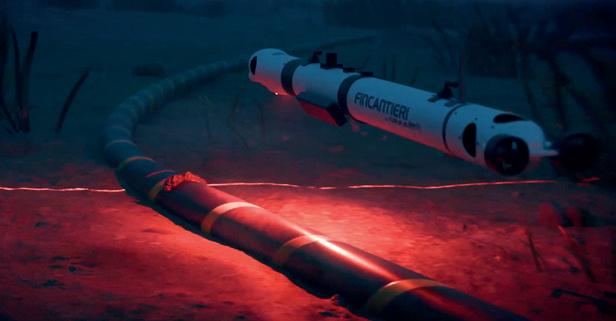
Today, laying a new subsea cable requires a crewed geophysical survey vessel to chart the seabed, identify obstacles, and determine a safe route. Fincantieri believes that soon a small, unmanned surface platform, accompanied by a swarm of drones, will take over this role faster, more cheaply and with higher resolution.
“Tomorrow you can use unmanned surface vessels or a smaller surface vessel as a mothership, then coordinate a swarm of underwater drones to map and get images from the seabed and perform real time data processing,” Cafaro says. “The key words are protection, maintenance and repair, and development
Fincantieri’s expanding industrial base
The move into the underwater domain has also reshaped Fincantieri’s corporate footprint. In recent years it has acquired, consolidated and repositioned several companies to build its subsea competencies:
● Leonardo’s Underwater Armaments & Systems (WASS): Bringing electro-acoustic and defence expertise
● Remazel Engineering: Specialising in deep-sea launchand-recovery systems, seabed and top-side equipment and offshore engineering
● IDS: Providing the UMS command-and-control system and surface drone production
Remazel is especially critical. It designs and manufactures heavy subsea structures including docking stations, deepsea mining components, and sophisticated launch-andrecovery systems for drones and autonomous vessels. These are essential for scaling DEEP into a global, industrial product.
Commercial momentum
Fincantieri points to concrete operational references. The Italian Navy was the first partner to implement the UMS, along with several surface drones and, more recently, a mothership. An unnamed major Italian EPCI in energy and
TLC segments is co-developing and preparing to acquire a complete system.
“At the end of the co-development, which will last several months, the underwater management system, the underwater drones and the surface drone will be fully operating,” Cafaro says.
Given the growing importance of subsea monitoring for offshore energy, telecommunications and national security, demand is likely to accelerate.
The future: an autonomous underwater network
For Fincantieri, the long-term vision is a permanent, semiautonomous underwater surveillance network, a subsea equivalent of an air-defence radar shield.
At the end of the co-development, which will last several months, the underwater management system, the underwater drones and the surface drone will be fully operating ‘‘
As geopolitical tensions rise and seabed infrastructure proliferates, the company expects countries to deploy such systems around critical assets. The implications reach beyond security. If drones can recharge from cable repeaters, operate for months, and cooperatively map or inspect the seabed, industries like offshore wind and subsea telecoms could see enormous reductions in downtime and cost.
For a 240-year-old shipbuilder, the transition from cruise ships and frigates to AI-driven subsea swarms may seem radical. But to Cafaro, it is a natural evolution rooted in the company’s maritime DNA.
“Fincantieri wants to be the orchestrator of these technologies,” he says. “To provide integrated solutions to protect, maintain and develop underwater infrastructure.”
And as global reliance on seabed infrastructure only grows, the shipbuilder’s bold foray into the deep may prove not just ambitious, but essential.
■ Subsea cable checking by DEEP
WHEN AI ADDS NOISE, SAFETY RUNS AGROUND
AI is arriving on ship bridges faster than bridge routines are changing.
By Oliver Thompson, Director of Engineering, MarineAI.
Nowhere is the gap highlighted more than in ports and harbours, where pilotage, tug assistance, crossing traffic and restricted waters mean decisions need to be made with increasing speed. In that environment the bridge team does not need more information – it needs help deciding what matters now.
Too much AI is failing that basic test in maritime. Many systems are sold as ‘decision support’ yet behave like information amplifiers.
They add alerts, risk scores and predicted tracks on top of radar, AIS, ECDIS and VHF, while the bridge team is already coordinating with pilots and tugs in a high-tempo setting.
This often leads to more noise and a higher cognitive load in the very waters where attention is most scarce.
Confined waters are not a demo environment
Picture the approach. The pilot is on board, visibility is down, a tug is coming up on the shoulder, the ferry is keeping to schedule, and small craft are skating along the channel edge.
Radar is cluttered, AIS is patchy, and VHF is constant. In that moment, any tool that asks for extra analysis is not providing support.
If an AI system throws up five medium-risk flags without ranking, context or a clear recommendation, it has not improved safety. It has simply created another task at the worst possible time.
This is not an anti-AI argument. Machine learning can genuinely help in ports by taking on the high-frequency monitoring that humans struggle to sustain over a watch. Machines can track many targets at once, fuse sensor inputs, detect subtle changes in motion and maintain vigilance without fatigue.
But people remain better at judgement, coordination and communication, particularly when intent is unclear or behaviour turns unpredictable. The aim should be a clean division of labour that sees AI monitor and filter, while humans decide and coordinate.
A standard the industry can actually use
The problem is that many AI deployments expose complexity to the operator instead of absorbing it. They present problems and expect bridge teams to translate statistics into action while they are already managing speed, helm, communications and a tight traffic picture. In confined waters, the question is rarely about what might happen; usually it is ‘what matters now, and what should I do next?’
A minimum standard for maritime AI in ports should be how well it reduces cognitive burden at the point of decision. If we want AI to earn trust in pilotage waters, three expectations should be non-negotiable.
First, disciplined prioritisation. The system should compress dozens of signals into a small number of ranked concerns that match how navigators work in port. Second, confidence you can read. When the system is
uncertain, it should say so in operational terms and adjust its guidance accordingly. Bridge teams can work with uncertainty, but they cannot work with false precision.
Third, robustness when conditions degrade. Ports are messy data environments. AIS can be incomplete, targets can drop in and out, sensors can be compromised by clutter and weather, and behaviour can be inconsistent. An AI that only performs in clean conditions will be ignored. A system that stays useful, and is explicit about what it cannot see, will be used.
A minimum standard for maritime AI in ports should be how well it reduces cognitive burden at the point of decision
These are not design preferences, they are important safety requirements. Confined waters leave little margin for tools that distract, over-alarm, or add mental work just to interpret what they are claiming.
Maritime technology becomes indispensable when it helps people see clearly and act decisively. Radar, ECDIS and AIS earned their place by improving a single shared traffic picture, not by duplicating it across multiple competing alerts, overlays and interpretations. Maritime AI should meet the same standard, especially in ports and harbours, where cognitive load is at its highest. If AI is to improve safety in confined waters, it must bring clarity at the moment decisions are made.
The winning system will not be the one that detects the most. It will be the one that helps the bridge team decide and act with confidence when it matters.
■ MarineAI’s white paper, Cognitive Load: the navigator’s lifeline in the age of AI at sea, explores how maritime AI can reduce workload rather than add to it in confined waters.
CUTTING THE UMBILICAL: TRUE SUBSEA AUTONOMY
For all the talk of autonomy in cars, drones, and aircraft, the most demanding frontier remains largely invisible. We talked to Dynautics CEO Dr Henry Robinson about the march towards autonomy under the waves.
Beneath the waves, radio signals die, GPS disappears and pressure mounts. It is here, far from roads, runways or rails, that true autonomy is particularly desirable; and it is here that Dynautics is quietly building its reputation.
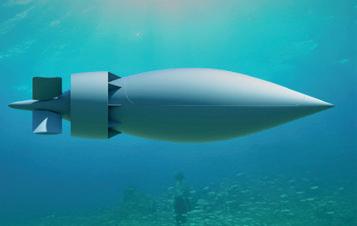
At the centre of Dynautics’ latest ambitions is Phantom Two, an autonomous underwater vehicle (AUV) designed not only to prove the company’s control systems, but to embody its philosophy of autonomy: robust, pragmatic and built for the real constraints of the ocean.
From surface to deep Dynautics’ early work focused on autopilots for small vessels – an area often overlooked in discussions of autonomy.
“There are more very small vessels worldwide than there are large vessels, particularly when it comes to unmanned,” says Robinson. “The risks are much lower if you're dealing with a five-metre vessel. We provided autopilots, self-tuning autopilots that would control vessels, learn the characteristics of the vessel and then control it.”
The move underwater was a natural – but far from simple – extension. Ships, after all, are broadly similar in shape –they are ‘pointy at one end and they’ve got propellers and rudders at the other’ – whereas underwater vehicles can be all shapes and sizes.
“When you go to underwater vehicles, there are all sorts,” he says. “Observation-class ROVs, work-class ROVs which look like a great big brick, torpedoes and everything in between And you're also dealing, of course, with six dimensions, so buoyancy and pitch and roll start to become important.”
Robinson says the challenge became irresistible more than two decades ago, when a two-page spread of all the ROVs in the world caught his eye. But of them all, just six were AUVs.
“It didn’t take a genius to realise this is the way things are going. People are going to want to cut the umbilical.” And thus began the move towards an architecture that
would lend itself to lots of different configurations.
“We came up with an architecture which is particularly versatile,” he says. “I can honestly say we haven't yet found a vehicle that we can't control with this. We've applied it to torpedo types and to work-class ROVs 2,000 metres deep in the Gulf of Mexico and everything in between. And it's been fun.”
Autonomy where it matters
Above the surface, autonomy is as much about regulation as technology.
“The MCA will not allow people to put an unmanned boat and get it to drive through a busy harbour,” Robinson says. “They’re scared stiff. The maritime industry generally is conservative.
“Underwater communication and navigation are the two biggest challenges. Salt water is a barrier to radio waves, and that’s why small, unmanned underwater vehicles have to be autonomous, much more than on the surface.
“Even the smallest AUV, once you cut the umbilical, it really is on its own. You have to give it parameters and it has to stay within them, or stop.
“I think of it as a little bit like navigating down a corridor. You can take even a drunk and send him down the corridor and say, ‘If you hit the wall, just lie down.’”
The underwater version of that corridor is multidimensional: depth limits, pitch angles, roll thresholds, battery charge.
“If something dodgy happens, this is what you do. if there’s something really unexpected, come to the surface.”
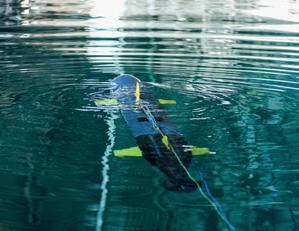
Phantom Two: Nose-up buoyancy
Phantom Two is not just a platform for software – it is a physical manifestation of Dynautics’ thinking about failure, recovery and trust.
One of its most distinctive features is its nose-up attitude at the surface.
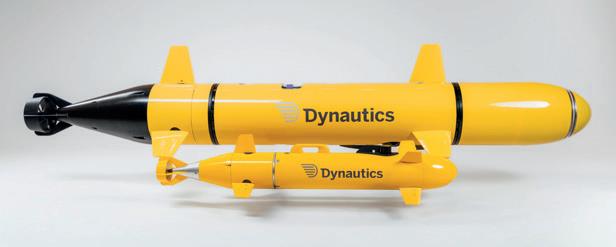
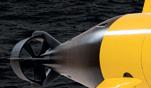
■ Phantom Two
If anything happens, you just stop everything and it’ll float. It literally just floats to the surface. Once it gets there, it can gently push itself so as to maximise the emergence of that little nose ‘‘
“We did Phantom One a few years ago, and we decided that worked so well, we would use it on Phantom Two with an added dimension. Phantom Two has got instrumentation in the nose – so that it tends to poke up a little bit more, improving the chances of antennas clearing the waves.
“If anything happens, you just stop everything and it’ll float. It literally just floats to the surface. Once it gets there, it can gently push itself so as to maximise the emergence of that little nose.”
From there, redundancy takes over: multiple radio frequencies, and even a flashing optical beacon.
“After an exhausting day, we’ve even got an optical beacon, a flashing light, and that can be seen from some distance away,” he says.
There’s quite an emotional side to this, as well.
“The first time you put this thing in the water, it disappears, and you’re left with an empty sea and the hope that you’re going to get it back,” Robinson says. “It can be quite worrying the first time.”
Have they lost any? “No,” he says.
Work load
Much of Phantom Two’s mission is survey work – scanning the seabed for oil and gas exploration, offshore wind, security and science. The data volumes are enormous.
A side-scan sonar mission produces a huge amount of data, and there is no way it could all be communicated back to base, Robinson says.
This is where onboard processing becomes transformative. GPUs (Graphics Processing Units) can flag anomalies without understanding them.
“It doesn’t need to work out what it is. Just say, ‘Look, there’s something interesting there,’” he says.
The vision is a single mission: scan, identify, revisit, and photograph – without human intervention between stages.
“So you really can send it off, scan the seabed, come back, and here are the pictures of the things,” Robinson says. “The grunt work has already been done by the GPU.”
This matters most where time is critical. “They’ve got a backlog of a year’s worth of data,” Robinson says of one operator. “By the time you analyse it all, it’s stale data.”
‘Unmanned’ reality
Autonomy, Robinson says, is not about eliminating people; it is about letting people focus on decisions that matter.
And sometimes, curiously, autonomation can need more people – he mentions a defence exercise that involved hundreds of unmanned vehicles, something like 15 people to each one, he says, ‘which I thought was rather paradoxical’.
Unmanned does not mean unstaffed – but it does mean safer.
“There are so many ways in which you can get hurt underwater, the pressure is huge, and staying down there for hours and carrying all the life support etcetera for man divers is expensive, so it is much cheaper than doing the same thing with manned vehicles, and of course much safer.”
Phantom Two is typically launched from a crewed vessel, but that is not a technical limitation. “There are plenty of unmanned vessels launching unmanned submarines. That technology is all doable, really,” Robinson says.
The hard part is the sea itself.
“What looks very benign on a lovely summer’s day can turn into something very violent,” he says. “Launch and recovery is the difficulty–but as soon as you go below the waves, things calm down.”
How Phantom Two has changed things Dynautics usually supplies systems, but with Phantom Two it is a complete vehicle, designed and built in-house.
“Phantom Two is particularly important because it’s been demonstrated and it’s working, and there are several being built,” Robinson says. It can also be scaled up and is deliberately versatile.
Phantom Two is not the end goal – it is a demonstration of what autonomy can look like when it is designed for the ocean, not borrowed from the road, he says.
“We are taking further steps towards autonomy, so you can send the USV out routinely, it leaves the dock unmanned, goes miles out, does the job and comes back – that opens the door to all of that.”
■ Phantom Two being launched
■ Phantom Two prototype tank testing
HOW SAFETY AT SEA LED TO PAINTING THE FULL PICTURE
Iceland-based Hefring did not start with autonomy in mind: to begin with it was all about safety.
The company’s earliest work focused on understanding how vessel motion affects people on board, particularly those positioned away from the helm, to pinpoint where the most dangerous seat on board was – and therefore who was most likely to get injured should the worst happen.
“We started with accelerometers and a very simple computer that could capture that accelerometer data and visualise it in real time for the operator,” says co-founder and now CEO Karl Birgir Björnsson.
The problem was straightforward but largely unaddressed because vessel operators typically experience a different motion profile to passengers or crew seated elsewhere and therefore don’t realise the difference.
In high-speed vessels, particularly RIBs used for tourism and transport, this difference could translate directly into injury risk.
Early deployments focused on monitoring motion at specific locations on board. The intention was to give operators immediate feedback so they could adjust speed or heading before conditions became unsafe. However, realtime feedback alone proved insufficient.
“If we’re just showing to the operator something that happened even a millisecond ago, it’s already happened,” Karl says. “They’re still hurt.”
That limitation pushed Hefring towards prediction rather than observation. By analysing how vessels move as they interact with waves, the team began developing models that could anticipate the next impact before it occurred. This work coincided with research in Iceland on high-speed vessels, including whale-watching boats, where the data revealed large variations in impact forces across different parts of the same vessel.
“The impact force in the bow could be ten times greater than it was for the operator,” says Karl.
This research led to the formation of Hefring as a company in late 2018, with operational work beginning in 2019. While the initial project had been tied to vessel design validation, the findings highlighted a broader opportunity: using motion data to inform safer vessel operation. That principle remains the foundation of the company’s systems today.
IMAS data collection
Hefring’s current IMAS systems are deployed across approximately 400 vessels, ranging from small workboats to fishing trawlers and offshore support vessels. Data is collected automatically and continuously.
“Everything from how vessels move through the water to what kind of sea conditions they’re tackling, to what kind of fuel it uses – everything down to multiple times a second,” Karl says.
The data are anonymised and used primarily for model training, and the scale and consistency of the data are what allow Hefring to build systems that can be deployed quickly on new vessels. It also differs from the computer vision approach, which could eventually be used in tandem, Karl says.
“There are companies that do that very well, but we don’t need that for our applications,” he says.
Instead, the company concentrates on vessel dynamics – like how a boat responds to waves and speed – and how those factors affect safety and efficiency. The sensors used are largely focused on motion, supplemented by data already generated by onboard systems.
“A boat already has a lot of sensors,” Karl says. “Everything from the engine to the depth sounder – we capture everything that’s on the vessel.”
Real-time information is key, when decision-making at sea can depend on current conditions, not just historical averages.
“For any future of autonomy, it needs real-time intelligence,” he says. “It needs actual information on what’s happening right now, because that’s what an operator would do.”
Human-driven autonomy
Despite frequent use of the term ‘autonomy’ in the maritime sector, it isn’t truly the case – yet.
“Nothing is really autonomous,” he says. “That’s why the word ‘unmanned’ is used quite a lot more – or ‘optionally unmanned’.”
Hefring’s systems are designed to work within this scope. Most vessels still need people on board, and most maritime operations involve tasks that cannot be automated.
“We’re not really talking about automating the process of catching fish or rescuing somebody,” Karl says. Instead, the focus is on reducing the cognitive load on operators.
By managing throttle, routing or speed recommendations, systems can allow crew to focus on other responsibilities.
“You could take one of the crew members and make them more effective on board doing those other jobs as opposed to operating the boat,” Karl says, although this would only work if the system behaved in a way that reflects experienced human judgement.
“You need that instinctive feeling that
■ Console, Helm, Sensor and Control Unit
■ Karl Birgir Björnsson, CEO of Hefring Marine
Most vessels still need people on board, and most maritime operations involve tasks that cannot be automated
an operator would have built into a system,” he says. Without it, trust breaks down.
The models Hefring develops are trained on real operational data, capturing how skilled operators respond to different sea states. This allows the system to support, rather than override, human decision-making.
In this sense, Hefring’s work sits between manual operation and full autonomy. The systems are intended to augment human capability while laying groundwork for more automated operations in the future.
Cost and fuel savings
Fuel efficiency is one of the most measurable outcomes of Hefring’s systems.
“If you train a model to make the right decisions, you avoid human error over time,” he says.
The benefits are not limited to speed optimisation. Fleetlevel visibility provides insight into how vessels are actually being used, including understanding idle time – idling consumes a lot of fuel – routing inefficiencies and operational patterns.
By identifying unnecessary idling and adjusting scheduling towards a more just-in-time approach, operators can significantly reduce consumption.
“Just structuring how the fleet is being used could yield you 30–40% fuel savings,” he says.
Vessels are expensive assets, and limited insight increases risk.
“Not having that level of detail is taking on unnecessary risk,” he says. Real-time data, for example, allows operators to identify vessels operating in deteriorating conditions and respond earlier if assistance is needed – resulting in the offset of the cost of deploying the systems.
Regulations and classification
While technical capability has advanced rapidly, regulatory frameworks have evolved more slowly and it’s still a bit of a mess where autonomous vessels are concerned, with no clear route set out yet.
“I think the technical capability is more advanced than the regulation that’s limiting it,” Karl says, with existing maritime rules written with crewed vessels in mind and not addressing new operating models.
A central challenge is responsibility. “There are a lot of ‘what ifs’ that haven’t been fully addressed,” he says, including questions about liability when unmanned vessels cross borders or operate without direct human control.
“Classification societies aren’t going to go out of the frame that has been set up by regulators,” he says. As a result, companies developing new technologies must fit within existing frameworks or wait for standards to evolve.
At the same time, Karl acknowledges that regulation can enable adoption. Mandated standards can reduce risk aversion by providing insurers with defined requirements, in turn affecting how quickly new systems are adopted.
Hefring’s data systems also support emissions reporting, an area of growing regulatory focus. “CO₂ emissions, NOx –we calculate that. It’s all reported in real time,” Karl says.
Operators can generate reports covering specific periods with minimal manual input.
Where vessels are fitted with emissions sensors, data is captured directly. In other cases, emissions are calculated from fuel consumption.
As emissions reporting becomes more widespread, automated data collection reduces administrative burden.
“The old-school way is calling operators, getting invoices, putting it into Excel,” Karl says. “With a system like ours, it’s one button – download the report and send it off.”
By identifying unnecessary idling and adjusting scheduling towards a more just-in-time approach, operators can significantly reduce consumption
Next steps
Hefring’s development strategy is still aligned with its original focus on vessel motion and prediction.
“Our focus is to keep developing, but on the same premise that we started off with,” Karl says. Navigation, fuel modelling and autonomy all build on the same underlying understanding of how vessels interact with the sea – which means real-time decision-making, again, is central.
Looking ahead, Karl expects autonomous vessels to appear gradually in specific use cases.
“I think we’ll see it in our lifetimes,” he says, while adding that adoption may follow developments in other industries, which often move before maritime.
For now, Hefring continues to focus on improving safety, efficiency, and data quality for existing vessel operations, while preparing for a more automated future.
Console and App
■ Sensor and Control Unit
Phantom 2 is a versatile UUV ready for commercial, scientific and security applications, supporting a sustainable future for subsea exploration. Its modular design uses Dynautics’ proven autopilot technology and can be scaled to accommodate different payload requirements and mission objectives, reducing risk and time to market.