PRESENTATION CONTENT
MC INTRODUCTION - FINAL DRAFT
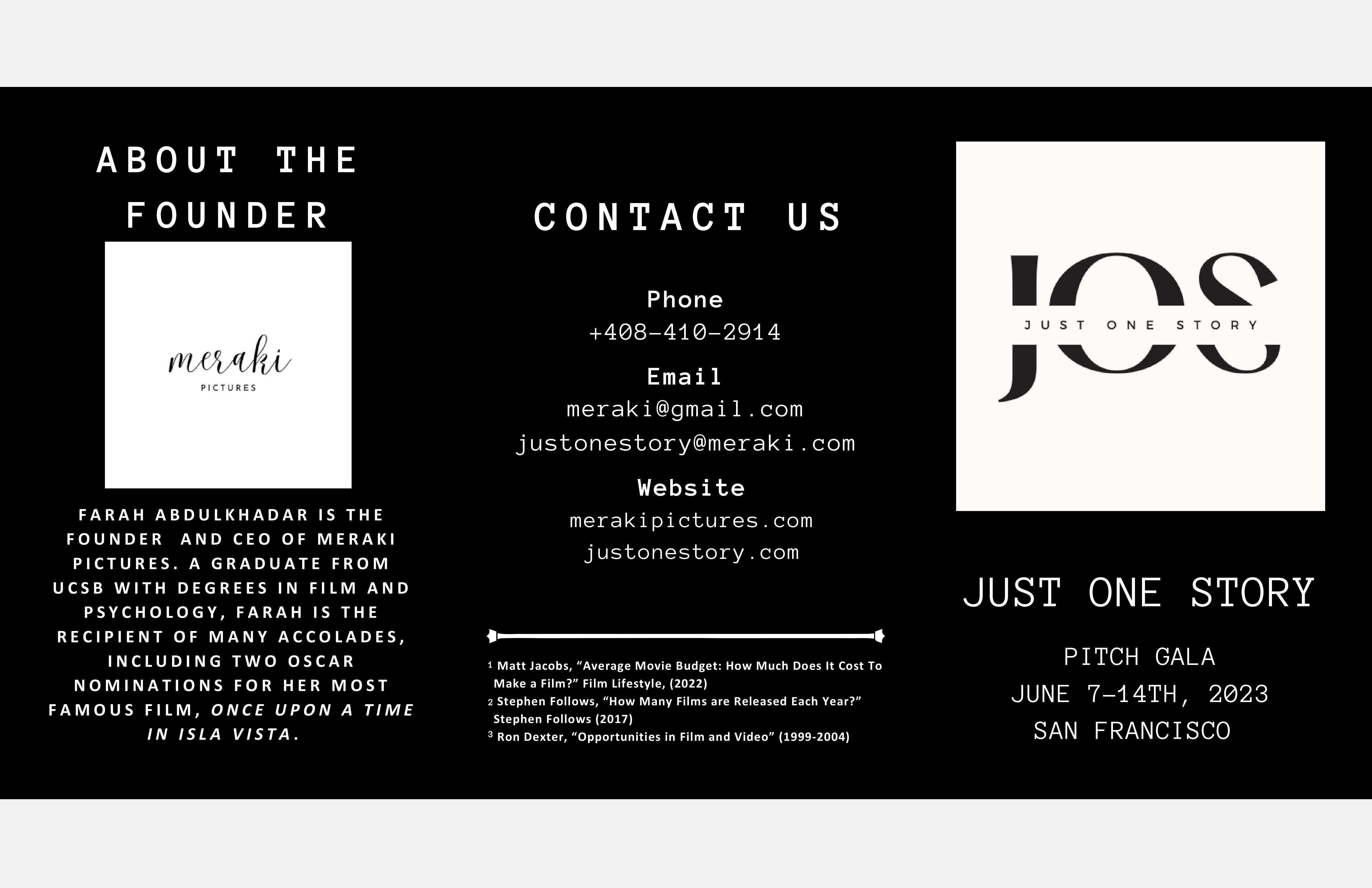
Welcome to the Just One Story 2023 Pitch Gala! I hope you are all excited for the all the wonderful stories you’ll hear today. We have with us 500 talented young filmmakers, 250 industry professionals, and an audience of over 1,500 film lovers that will help select a handful of the next big blockbuster screenplays. Before we begin today, I’d like you all to meet someone very special. She’s a filmmaker and film lover- just like all of you! Her production company has made over 25 films and she herself is the proud recipient of many accolades for her stellar contributions to this industry as a screenwriter, director, and actress. She is best known for her work in the film, Once Upon a Time in Isla Vista. I think you all know who I’m talking about now. Please join me in giving a warm welcome to the founder of the Just One Story Program - Farah Abdulkhadar!
MC INTRODUCTION - ROUGH DRAFT
Welcome, everyone! I hope you are all excited for the stories you’ll hear today. We have with us over 500 young filmmakers, 250 industry professionals, and an audience of over 1,500 film lovers that will help select the next big blockbuster screenplay. Before we begin today, I’d like you all to meet someone. Her production company has helped dozens of new filmmakers just like some of you become successful storytellers. Please join me in welcoming the founder of the Just One Story Program- Farah Abdulkhadar!
PRESENTATION SCRIPT - FINAL DRAFT
EXPOSITION
Meet Sarah. Sarah is a recent film school graduate. She spent the last four years working hard in school, making short films, and getting ready for her grand industry debut. Sarah’s dream had always been to make her stories into movies for the world to see. However, it wasn’t as easy as she thought. After countless rejections, struggles, and lack of support, Sarah gave up on her dream and started to look for other job opportunities to pay off her film school debt.
CONFLICT
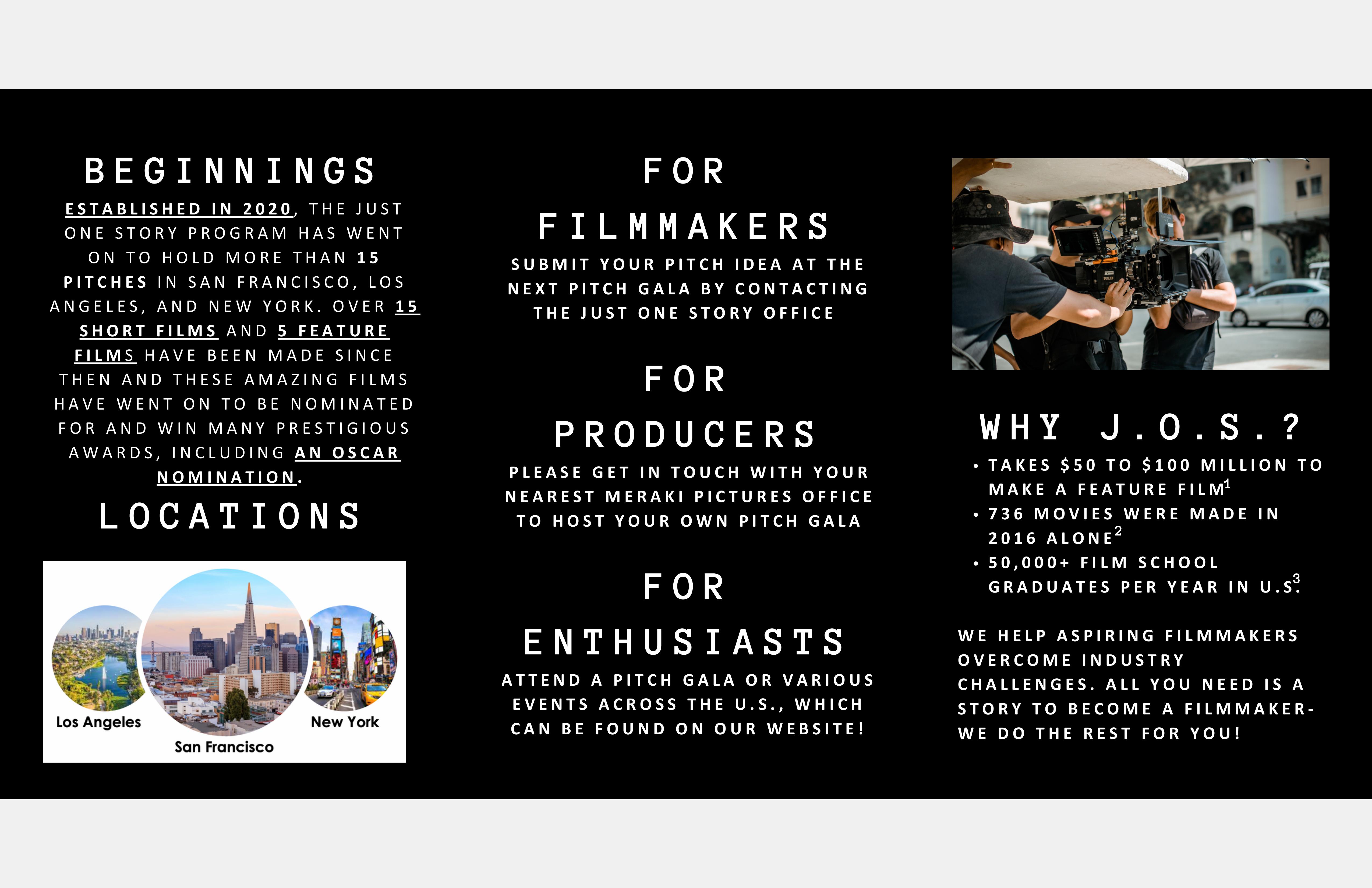
Film students just like Sarah all over the world face many challenges trying to get their foot in the industry. The most challenging obstacle of them all- financial resources. On average, it takes anywhere from $50 to $100 million to make a full length industry level feature film1 736 movies were made in 20162 alone, but so many more did not make the cut because of limited finances and lack of industry connections. To top it off, over 50,000 film school graduates3 and other aspiring filmmakers are struggling for opportunities in such a competitive industry.
Remember I told you about Sarah? Well…this is actually my story. And I’m sure it is many of yours too. Except, I lied to you about the ending. I wasn’t about to give up on a lifelong dream, no matter how much I had to struggle. I’m here today as someone who was able to get past the obstacles and bureaucracies of the industry and I’m here to help new filmmakers’ journeys become a little easier. This is exactly why I started the Just One Story Program.
RESOLUTION
The Just One Story Program is an industry pipeline program created under Meraki Picture for aspiring filmmakers. It doesn’t matter where you come from or how you got here- all that matters is that you have a story to tell to the world and are ready to put all your love and effort into creating meaningful movies. Now in its third year, Just One Story has opened the door to students and aspiring filmmakers. With over 5,000 employees in 3 different cities across California, we’ve hosted pitch galas just like this one in Los Angeles and New York and helped dozens of new talented filmmakers the opportunities they deserve. We’ve made $2,000,000 in profit from the 5 features and 15 shorts we’ve produced, which has gone right back into holding events like this one.
Today, you’ll be hearing stories from 500 individuals who are all walking the same path that you once did to be where you are today. With as small an investment as $50,000, this is your chance to invest in someone else’s dream and make the industry once again about good stories. Just One Story is all about the art, the artist, and the audience. Together, let’s pave the way for our new storytellers. Thank you.
1 Matt Jacobs, “Average Movie Budget: How Much Does It Cost To Make a Film?” Film Lifestyle, (2022)
2 Stephen Follows, “How Many Films are Released Each Year?” Stephen Follows (2017)
3 Ron Dexter, “Opportunities in Film and Video” (1999-2004)
PRESENTATION SCRIPT - ROUGH DRAFT
EXPOSITION
This is Joe. Joe is a film student who’s always dreamed of becoming a director and dedicated his life to making this dream come true. Now Joe spent 6 months on writing his screenplay, perfecting every little detail. But when the day came where he pitched his story to a producerlet’s just say that Joe did not get a happy ending. This was the first of many times Joe would have to walk away from rejection.
CONFLICT
I bet this story sounds familiar to most, if not, all of you. Because Joe is you when you were starting out. It wasn’t easy- the lack of resources, competition, and pure bureaucracy of the industry kept most people outside the door. And when you did eventually get around to making a short or indie film, you worked tirelessly with little to no financial or legal support. When there are 50,000 film graduates a year and it takes $50 million dollars to make a professional feature film, it’s just not possible to give everyone an opportunity.
RESOLUTION
Now in its third year, Just One Story has opened the door to students and aspiring filmmakers. With over 5,000 employees in 3 different cities across California, we’ve hosted pitch galas just like this one in Los Angeles and New York and helped dozens of new talented filmmakers the opportunities they deserve. We’ve made $2,000,000 in profit from the 5 features and 15 shorts we’ve produced, which has gone back into holding events like this one.
Today, you’ll be hearing stories from 500 individuals who are all walking the same path that you once did to be where you are today. This is your chance to invest in someone else’s dream and make the industry once again about good stories. Just One Story is all about the art, the artist, and the audience. Let’s pave the way for our new storytellers. Thank you.
PRESENTATION PLANNING FORM
PRESENTATION PURPOSE
➢ This presentation is the opening speech to the 2023 Pitch Gala by the Just One Story program
➢ To demonstrate how the Just One Story program helps student filmmakers produce their films by giving financial, legal, and creative support
➢ To persuade the directors to attend the next Just One Story Pitch Gala taking place in June 2023 to consider story pitches
○ Asking for directors to provide mentorship to aspiring filmmakers and connect with industry professionals to produce a select number of pitches
PRESENTATION GOAL
➢ To persuade the directors to attend the next Just One Story Pitch Gala
➢ Remember that the Just One Story program is for the aspiring filmmakers that you all once were
➢ Help the new generation of filmmakers overcome the struggles of making good films by using the knowledge and resources we have now as experienced professionals
AUDIENCE ANALYSIS
➢ Audience: Just One Story Pitch Gala Attendees
○ Experienced professional directors/screenwriters/other industry professionals
○ Amateur filmmakers (film school students or recent graduates)
○ Film enthusiasts to be audiences for the pitches
WIIFY POINTS
➢ Filmmaking is more than just a business - this is your chance to pay forward the support you got to the newcomers
➢ Professionals get to become mentors to newcomers and newcomers get the support they need to get their foot in the door
➢ Audiences get to keep up with the latest film culture updates
PRESENTATION STRUCTURE
➢ Exposition: story of Sarah (me and other filmmakers’ journeys)
➢ Problem: obstacles that new student filmmakers face that keep them from realizing their dreams
➢ Solution: Just One Story program helps make this journey easier
PRESENTATION CONTENT (FORM MAY VARY)
➢ Opening Sentence: Meet Sarah, a recent film school graduate hoping to become the next hitmaker in the industry.
➢ Exposition: Sarah’s story of getting rejected and quitting the industry…
➢ Problem: New filmmakers do not get access to large funds and studios to produce their films. Many don’t have industry experience or connections to make their way to the top.
➢ STAR Moment: Sarah is not real. This is my story - and I lied I didn’t give up!
➢ Solution: The Just One Story program streamlines the pitching process by bringing producers, directors, and other professionals from the industry together with new aspiring filmmakers.
➢ Request: Invest in a filmmaker’s dream!
STAR MOMENT EXPLANATION
I chose my STAR moment to be the revelation that “Sarah” is a name I used as a placeholder for telling my own story (“Farah”). Not only that, I mention that this is very similar to others’ stories in the audience. This is a moment where I can connect with other filmmakers in the audience who have surely faced similar challenges and are familiar with the obstacles that I mentioned. I also tell the audience that “I lied” to them by saying the fictional character “Sarah” gave up. This is intended to impact the audience by showing them that no matter what challenges come my way, I would never give up on something important to me. In contrast to the story of giving up, the part after the STAR moment shows how I not only persevered to make my own dreams come true, but I used that passion to create a venture that would help others following the same path get to realize their dreams with a little less stress. I hope that this will spark memories of the audience’s own struggles and persuade them to invest in the new filmmakers’ projects to pay it forward.
SCRIPT STORYLINE EXPLANATION
My presentation script follows the basic storyline structure (exposition, conflict, resolution). I chose this structure as it works better in a scenario where I am speaking to give my audience a concise talk about what my venture is, why I started it, and how it improves an existing entity In the exposition portion, I narrate how the struggles I faced as a recent film graduate and aspiring filmmaker (under a fictitious name and withholding that this is my story). In the conflict portion, I talk about the various obstacles faced by student filmmakers and how the most pressing issue is the lack of financial resources. I place my STAR moment as the transition between the conflict and resolution portion to reveal to my audience that this is indeed my story and that many in the audience may also be able to relate. I explain in the resolution portion how I overcame the struggles and now am here to support new filmmakers. I end off by asking the industry professionals in the audience to remember their journeys and help realize the dreams of new filmmakers. To summarize, this structure precisely explains why I started Just One Story, what problems of the film industry the program is targeted to address, and how it solves these issues.
PRESENTATION VISUALS
SLIDE DECK - FINAL DRAFT



FARAH ABDULKHADAR









SLIDE DECK - ROUGH DRAFT





FARAH ABDULKHADAR
Joe’s Dream
Joe’s Dream
Joe’s Dream
Joe’s Not So Happy Ending



BROCHURE - FINAL DRAFT
SELF ANALYSIS
PRESENTATION SELF ANALYSIS
CONTENT AND LANGUAGE
Strengths
➢ Script was mostly planned out and used basic storyline structure to advantage of content at hand
➢ “Joe” story was good for exposition
Weaknesses
➢ Contained too little info in conflict section (spent a bit too much time on exposition)
➢ More impactful problems needed to highlight why this venture is important
STRUCTURE AND FLOW
Strengths
➢ Followed story structure well (exposition, conflict, resolution)
➢ Flow between exposition and conflict was good
Weaknesses
➢ Did not spend as much time on conflict - rushed through this part a little too much and needed more content here
➢ Resolution section was not as thorough and clear as it could be
VISUAL SUPPORT
Strengths
➢ Slides were easy to see and read - simple yet informative
➢ Images for the ideal portion were good
➢ Use of banners made sections easier to understand
Weaknesses
➢ More stats and big numbers to make impactful points
➢ Practice slide cues to match what is being said in the script
➢ Use full screen images rather than leaving space on slides
DELIVERY STYLE
➢ Confidence and articulation were pretty good throughout
➢ Loud and clear enough for all audience to hear (for most part)
Weaknesses
➢ Speaking too fast throughout full presentation - inconsistent pacing
➢ Occasionally volume dropped at end of sentences
➢ Looks back at slides too much and doesn’t engage with audience
➢ More eye scanning (left, center, right)