MUNICH AIRPORT: THE INAUGURAL IMPLEMENTATION / page 9
WHAT THIS MEANS FOR AIRPORTS AND OPERATORS / page 12
HOW TO ENGAGE WITH US / page 15
APPENDIX: NORTH AMERICAN AIRPORTS IN THE STUDY / page 19
FOREWARD
Airport F&B has long operated in the background of the travel experience. It serves millions of people every day in some of the most demanding environments in the world, and yet it has rarely been evaluated through a lens designed to reflect those realities. Most assessment frameworks used across the industry today were built for the high street. They measure what happens in restaurants and cafes where guests arrive rested, unhurried, and in full control of their choices. The airport is none of those things.
The Travel F&B Fit (TFF) Framework® was created to address that gap. It does not ask simply whether food tastes good or service is fast. It asks a more fundamental question: is this offering genuinely fit for travel? Does it serve the emotional, functional, and wellbeing needs of a person who may be anxious, time-pressed, navigating an unfamiliar terminal, or simply in need of something fresh and restorative before a long flight?
The framework emerges from a strategic partnership between the Culinary Institute of America and tRetail Labs, combining the CIA’s decades of culinary and foodservice leadership with tRetail Labs’ expertise in AI-powered visitor intelligence and behavioural analytics. The TFF Framework® is a core component of the nrtureAI® platform, which enables airports and operators to continuously monitor, benchmark, and act on traveller experience intelligence at scale. Together, we believe that airport F&B can and must evolve. Not as a nice-to-have, but as a defining element of the passenger experience.
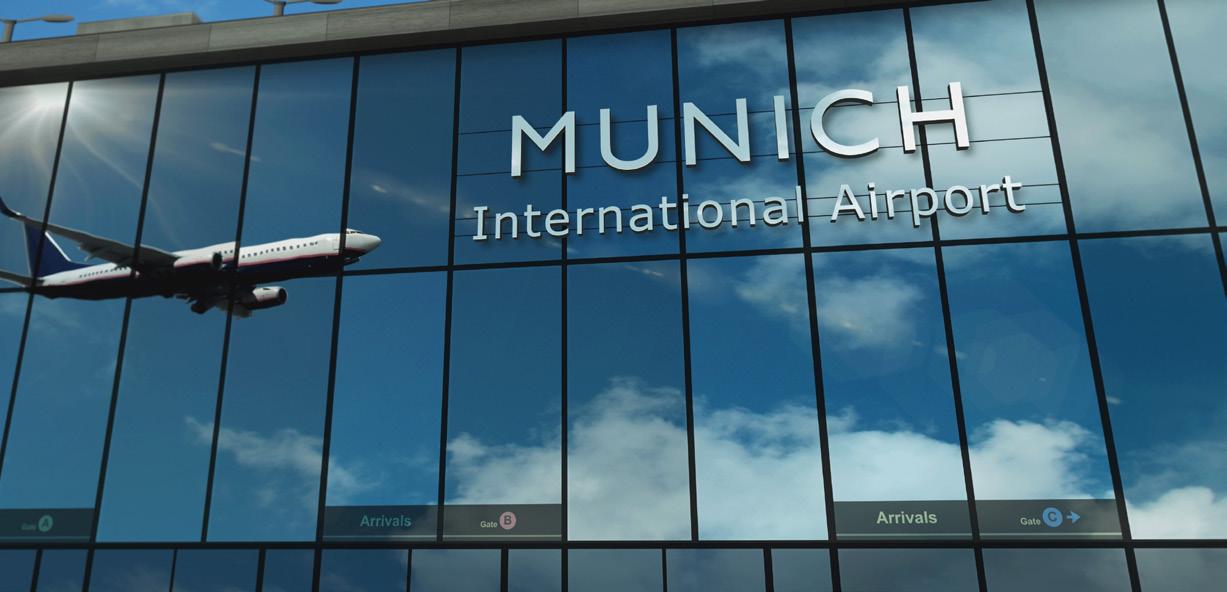
Munich Airport, through its hospitality subsidiary Allresto, has become the first airport in the world to adopt the TFF Framework®, and we are proud to share the initial findings from that inaugural implementation in this paper. What the data reveals is both encouraging and clarifying. There is genuine strength to build on. There are structural gaps that will require collective will to close. And there is a clear case that the airports and operators who act with intention now will be the ones who lead the next decade of travel dining.
We invite you to explore these findings and, more importantly, to consider where your airport stands. The journey toward a genuinely travel-fit food experience starts with understanding where you are today.
Sushanta Das CEO
Behavioural Scientist
Robert E. Jones VP of Strategic Partnerships, Industry Leadership, and Impact
Developed by the Culinary Institute of America and tRetail Labs, the Airport F&B Manifesto 2035 sets out a vision for what airport food and beverage must become over the next decade: healthier, more sustainable, more traveller-centred, and more commercially resilient.
Airport F&B represents one of the largest recurring consumer environments in the world, yet it remains significantly under-evaluated through a lens designed for the specific demands of travel. With approximately 10.3 billion passengers moving through airports globally each year and an estimated 2.8 billion meals served within airport environments, the scale of the opportunity is considerable. The gap between traveller expectations and what is currently on offer is equally considerable.
The Travel F&B Fit (TFF) Framework® is the first diagnostic tool built specifically to evaluate airport food and beverage environments through a travel lens. Rather than applying hospitality metrics designed for the high street, the TFF Framework® assesses how well offerings align with the realities that define the airport experience: time pressure, emotional stress, constrained choice, and the human need for comfort and nourishment in transit. The TFF Framework® forms a core part of the nrtureAI® platform, enabling airports and operators to move from periodic evaluation to continuous, real-time intelligence across the full passenger experience.
New research from tRetail Labs and the Culinary Institute of America drawing on over 334,000 traveller reviews across 28 airports reinforces both the opportunity and the urgency. Munich Airport outperforms all 27 North American airports benchmarked in the study, offering an early indicator of what genuinely travel-fit food and beverage can achieve when airport hospitality is designed with the traveller’s journey at its centre.
At the same time, the gap between Munich and the North American benchmark has narrowed significantly across the three-year study period, driven primarily by service quality improvements across North American airports. The competitive landscape of airport F&B is moving faster than many in the industry may realise. Standing still is not a neutral position.
Across the full study, the most structurally significant gaps cluster around value perception, freshness, food preparation quality, and the post-meal experience. These are not peripheral concerns. They sit at the heart of what it means to offer food that is genuinely fit for travel, and addressing them represents both a hospitality imperative and a commercial opportunity.
The TFF Framework® provides a practical three-part pathway. It diagnoses current performance across 15 core attributes and six fit layers. It identifies where and why offerings fall short of traveller expectations, and what that misalignment costs in terms of satisfaction, spend, and commercial performance. And it creates a structured foundation for action that airports and operators can use to drive measurable improvement over time.
The cost of inaction is growing. Airports and Lounge / F&B operators that fail to adapt risk falling behind evolving traveller expectations, missing opportunities to strengthen commercial performance, and ceding ground to competitors who are already moving. Those that act now can position food and beverage as a core driver of satisfaction, revenue, and long-term resilience.
Airport F&B environments are unlike any other foodservice context. Travellers arrive under conditions that high street hospitality frameworks were never designed to account for: variable stress levels, time pressure, limited mobility between options, and the physical and emotional demands of the journey itself. The food decisions made in an airport are shaped by all of these factors simultaneously, and yet the tools used to evaluate airport food performance rarely reflect any of them.
The Travel F&B Fit (TFF) Framework was designed to close that gap. It is a perception-based diagnostic lens that evaluates how well food and beverage offerings are genuinely fit for the realities of travel. It does not measure whether an offering is good in an absolute sense. It measures whether it is right for this environment and this traveller, at this moment in their journey.
The TFF Framework® is a core component of the nrtureAI® platform developed by tRetail Labs. nrtureAI® combines behavioural science, emotional intelligence, and real-time visitor analytics to give airports and operators a continuous, dynamic view of traveller experience across all commercial touchpoints, not just food and beverage. The TFF Framework® brings that same intelligence to the specific challenge of understanding how well the airport food environment is truly serving the people who pass through it.
WHAT THE FRAMEWORK EVALUATES
The TFF Framework® captures traveller experience across 15 core attributes, spanning the complete range of an airport dining encounter from first impression through to how a traveller feels after eating. These attributes cover brand appeal, visual appeal, staff service experience, farewell experience, value for money, menu variety, speed of service, food and beverage quality, food preparation quality, freshness, healthy options, portion size and satisfaction, allergen information, post meal experience, and packaging
These 15 attributes are interpreted through six fit layers, each reflecting a distinct dimension of travel-fit performance.
6 FITS FOR AIRPORT SUCCESS
CONTEXT FIT
Measures how well the offering aligns with the realities of travel, including time pressure, environment, and airport type.
FUNCTIONAL FIT
Measures how effectively the offering delivers on core traveller needs such as speed, clarity, and ease of access.
EMOTIONAL FIT
Measures how the experience makes travellers feel, including comfort, reassurance, and overall satisfaction.
HEALTH FIT
Measures how well the offering supports healthier choices and perceived wellbeing.
ENVIRONMENTAL FIT
Measures how the offering reflects sustainability expectations, including packaging and responsible practices.
POST MEAL IMPACT
Measures how travellers feel after consuming the food and beverage, including satisfaction, physical comfort, and absence of regret.
Together, these layers produce a composite Travel F&B Fit (TFF) score that positions an airport’s food offering across a performance spectrum from Weak Fit through Moderate Fit to Strong Fit. The score is not a verdict. It is a directional diagnostic, highlighting where offerings are aligned with traveller expectations and where the most meaningful gaps exist.
HOW THE FRAMEWORK WORKS
The strength of the TFF Framework® lies in its ability to operate at scale. It translates large volumes of unstructured traveller feedback into a consistent and comparable structure, allowing meaningful benchmarking across airports of different sizes, geographies, and operating models. Each attribute is scored using AI-attributed sentiment analysis applied to real traveller reviews, producing a granular view of performance across the complete range of experiences that make up an airport food encounter.
Rather than providing absolute judgement, the framework offers directional insight. It highlights misalignments between what is being offered and what travellers genuinely need, and it creates a structured foundation for industry dialogue and operational decision making. The goal is not to rank airports, but to equip them with the intelligence needed to improve with precision.
Within the nrtureAI® platform, the TFF Framework® can be applied continuously, allowing airports and operators to track shifts in traveller sentiment over time, monitor the impact of operational changes, and benchmark performance against peer airports as new data becomes available. Critically, the platform also enables performance to be understood across distinct traveller segments, revealing how different groups experience the same food environment in meaningfully different ways and allowing operators to prioritise improvements with far greater precision.
Munich Airport, through its hospitality subsidiary Allresto, became the first airport in the world to adopt the Travel F&B Fit Framework. As a founding member of the Airport F&B Pathfinders Committee (APC), Munich Airport joined this initiative with a clear commitment: to look beyond traditional commercial metrics and build a deeper, evidence-based understanding of the relationship between traveller wellbeing, hospitality design, and food relevance in the airport environment.
That commitment reflects Munich’s long-standing reputation for progressive airport gastronomy. Allresto has consistently invested in raising the quality and authenticity of its food and beverage offer. The opening of the new Terminal 1 pier represents the latest chapter in that journey, introducing five new restaurants that blend regional Bavarian specialities with global culinary trends while catering to diverse traveller needs including halal, vegetarian, and vegan options.
Munich Airport is now actively using the TFF Framework®, powered by the nrtureAI® platform, to inform and sharpen its ongoing food and beverage strategy. This means moving beyond point-in-time evaluation to a continuous intelligence model, where traveller sentiment, attribute performance, and competitive position are monitored dynamically and integrated into strategic and operational decision making across Allresto’s portfolio.
STUDY SCOPE
The inaugural TFF study benchmarked Munich Airport against 27 North American airports across a three-year period from 2023 to 2025. The analysis drew on over 334,000 traveller reviews and more than 930,000 individual attribute mentions, spanning airports classified as International Hubs, Large, and Medium based on infrastructure scale. Munich, classified as a Large airport, was treated as a standalone European benchmark throughout the analysis. A full list of the North American airports included in the study is provided in the Appendix.
KEY FINDINGS
Munich Airport outperforms all 27 North American airports across the full three-year study period. Its performance is particularly strong across a cluster of attributes where traveller feedback is most concentrated: the quality and freshness of food, the post-meal experience, and overall food and beverage quality. These are the attributes where travellers are most likely to feel that their needs are either genuinely met or consistently overlooked.
At the same time, the data carries a candid and strategically important message. North American airports have been improving, and improving at pace. The gap between Munich and the North American benchmark has narrowed meaningfully across the study period, driven largely by service quality improvements across the North American market.
The convergence between Munich and North American airports is the most strategically significant finding to emerge from the inaugural TFF study. It signals that the competitive landscape of airport food and beverage is shifting. The airports and operators that invest now in understanding their position and addressing structural gaps will be the ones who lead the next era of travel dining.
THE GAPS THAT MATTER MOST
Across the full study, value for money stands out as the most structurally entrenched challenge across all airports. The vast majority of traveller sentiment on this attribute is negative, and this has not improved meaningfully over the three-year study period. This is not simply a pricing issue. It reflects a broader alignment gap between what travellers expect and what they receive.
Freshness, food preparation quality, and the post-meal experience form a cluster of product quality gaps where Munich maintains its clearest advantages over the North American market. These attributes are most directly connected to how travellers feel about their own wellbeing in transit. Addressing them is not merely an operational improvement. It is a direct investment in the health and comfort of every traveller who passes through.
Relative strengths exist across the market too. Healthy options, visual appeal, and overall food and beverage quality are the attributes where traveller sentiment is most consistently positive. These strengths provide a foundation to build from, but they also illustrate the gap between what travellers want and what they ultimately experience across the range of an airport meal.
WHAT
THIS MEANS FOR AIRPORTS AND OPERATORS
The TFF Framework® is not designed to produce a ranking. It is designed to produce a roadmap. The findings from the Munich benchmark study illuminate a set of structural realities that apply across the airport food and beverage sector, regardless of geography, terminal size, or operator mix.
FOR AIRPORT OPERATORS
The data makes clear that traveller expectations for airport food have moved ahead of what most environments currently deliver. Travellers know what fresh food feels like. They know when a meal has left them energised versus depleted. They know when value has been delivered and when it has not. What the TFF Framework® provides is a structured way to translate that knowing into measurable, actionable intelligence.
For airport operators, the framework offers a means of understanding not just how a food and beverage environment is performing today, but how it is trending over time and how it compares against meaningful peer benchmarks. Integrated into the nrtureAI® platform, this intelligence becomes continuous, enabling operators to monitor the impact of changes in real time and respond with greater precision. In an industry where food and beverage is increasingly recognised as a defining element of airport experience and a significant driver of non-aeronautical revenue, that capability is foundational.
FOR LOUNGE / F&B CONCESSIONAIRES
The TFF Framework® surfaces something that traditional food and beverage evaluation often misses: the gap between product quality and travel fit. An offering that performs well on the high street may still fall short in an airport environment if it does not account for the speed requirements of a departing traveller, the freshness expectations of someone who has been in transit for hours, or the post-meal comfort that determines whether a passenger feels ready to board.
For concessionaires and vendors, the framework creates an opportunity to demonstrate value in a language that airports and investors increasingly want to hear: not just footfall conversion or average spend, but genuine alignment with traveller wellbeing and satisfaction. Operators who can show measurable improvement across TFF dimensions will be better positioned in an increasingly competitive tendering environment.
The cost of standing still is not neutrality. It is the gradual erosion of position in a market that is moving. The airports and Lounge / F&B operators who act with intention now, who invest in understanding where they stand and what their travellers truly need, will shape the next decade of travel dining. Those who wait will find the gap harder to close.
INDUSTRY VOICES
The following perspectives from two of the initiative’s founding contributors reflect the broader industry conviction that is driving the TFF Framework® forward.
Our initial implementation journey at Munich Airport has already highlighted the importance of looking beyond traditional commercial metrics and better understanding the relationship between traveller wellbeing, hospitality expectations, food relevance, and airport experience design. We believe this creates an important foundation for the next era of airport dining and are happy to play a role in helping shape future industry discussions.
—
Andreas Reichert, Managing Director, Allresto Flughafen München Hotel und Gaststätten, Munich Airport
The future of airport food and beverage will belong to operators and airports that understand how culinary strategy, traveller emotion, commercial performance, and hospitality design work together as one ecosystem. The TFF Framework® creates an important opportunity for the industry to openly challenge legacy thinking and collectively shape what comes next.
— Mark Angela, Advisor, tRetail Labs
CASE STUDY: COLLECTIVE IMPACT IN ACTION
The MCURC demonstrates the power of collective action paired with shared goals and measurement through the Collective Impact initiative. Since 2019, participating colleges and universities have tracked over 400 million pounds of protein purchases, achieving an 18.5% reduction in protein-related greenhouse gas emissions, nearly halfway to their 2030 target. The initiative’s Cost Insights Pilot also found that these shifts lowered food costs by an average of 11%, generating an estimated $22 million in annual savings over baseline across 30+ participating institutions. By aligning around common targets and shared data, the MCURC has shown that coordinated efforts can drive meaningful environmental and financial outcomes at scale while leveraging the power of institutional procurement to drive food systems change.
HOW TO ENGAGE WITH US
Preparing for 2035 starts now. The Travel F&B Fit Framework is available for implementation at airports and with food and beverage operators worldwide. The inaugural Munich Airport study demonstrates the power of the diagnostic lens and the kind of strategic intelligence it generates. We are ready to bring that same rigour to your environment.
AIRPORT F&B PATHFINDERS COMMITTEE
The Airport F&B Pathfinders Committee (APC) is an industry platform established by the Culinary Institute of America and tRetail Labs to bring together forward-looking airports, hospitality operators, and research leaders to guide the next generation of travel dining to 2035. Munich Airport, through Allresto, is a founding member.
The APC creates a space for collective learning, shared benchmarking, and collaborative development of the standards and practices that will define the future of airport food and beverage. Membership is open to airports and operators who are ready to move beyond the status quo and contribute to shaping what comes next. Additional founding members and industry collaborations will be revealed in the months ahead as the initiative builds global momentum.
THE APC MEMBER SUITE OF OFFERINGS
Membership of the Airport F&B Pathfinders Committee provides preferred access to a progressive suite of services developed jointly by the Culinary Institute of America and tRetail Labs.
Diagnostic and Intelligence (The Discovery Phase): This comprehensive entry phase seamlessly bundles the TFF Diagnostic Lens, the Menus of Change® Evaluation, and a tailored Report of Opportunities into an actionable roadmap. The TFF Lens benchmarks performance across 15 attributes to uncover hidden commercial friction, while the Menus of Change® Evaluation introduces a one-of-a-kind holistic evaluation of sustainable outlet architecture, optimized assortment strategy, menu composition, sourcing and production practices, packaging, and more to help assess standout operators and unlock triple bottom line benefits. The custom Report of Opportunities compiles the travel fit and commercial recommendations, along with a rating award, to offer detailed information for continuous improvement to increase revenue.
Concept and Menu Development: Move past simple evaluation into proven, actionable strategies for profitable, travel fit-ready operations. The CIA Concept Incubator leverages world-class culinary science, nutrition, and trends to design and test new concepts tailored specifically to the travel environment. Through data-driven plant-forward innovation and pre/post-impact metrics via nrtureAI®, operators can immediately optimize their menu mix to align with evolving passenger expectations.
Training and Capability: Bridge the gap between strategy and commercialization with evidence-based workshops designed for frontline teams, site managers, and C-suite leaders. Customized CIA culinary training and action workshops can build team culinary capability, help scale sustainable operations, build staff food literacy, reduce food waste, and more to directly strengthen operational food cost percentages and lead to consumer satisfaction. Concurrently, tRetail Labs training converts traveler emotion into actionable revenue-driving behaviors.
Research and Knowledge: Address client-specific strategic challenges through proven, CIA applied operational research focusing on plant-forward menu engineering, traveler decision flows, and layout optimization, among other topics.
Thought Leadership: APC Members are fully integrated into the APC Knowledge Network, gaining exclusive access to continuous peer learning, collaborative benchmarking, global convenings, and forward-looking trend analytics through 2035.
Strategic Advisory: Establish a distinct competitive advantage before a tender cycle even begins. Pre-Bid F&B Strategy helps airports synthesize TFF diagnostics, Menus of Change metrics, the CIA’s Center for Food & Beverage Leadership industry resources, and nrtureAI® traveler intelligence into an evidence-based concession brief, setting standard evaluation frameworks and milestones that attract premier master operators.
THE APC AIRPORT MEMBER JOURNEY: A SCENARIO
A TFF Diagnostic Lens uncovers what travellers have been experiencing but not saying out loud. Freshness is falling short. The post-meal experience is leaving people flat. And beneath the surface, there is strong, unmet demand for plant-forward options that the current concession mix simply is not delivering. The Menus of Change Evaluation offers clear benchmarking on sourcing, menu design, production, food environment, and packaging opportunities, and the Report of Opportunities combines the two into a custom guide for recommendations that can lead to commercial success.
The airport engages the CIA Concept Incubator and Action Workshop Series. Drawing on Menus of Change principles and a deep understanding of the travel context, CIA food business, sustainability, and culinary experts develop and test new concepts designed specifically for the demands of the airport environment: fresh, flavourful, and operationally viable at scale.
Before rollout, a nrtureAI® baseline is established across the relevant TFF attributes. After implementation, the platform captures the shift: traveller sentiment improves, satisfaction scores rise, and spend per head moves in the right direction. The airport now has a clear, evidence-based account of return on investment to bring to concessionaires, commercial teams, and leadership.
Throughout the journey, the airport stays connected to the APC Knowledge Network, tracking emerging concept developments from the CIA Concept Incubator and benchmarking its progress against peers. As the next tender cycle approaches, the Pre-Bid F&B Strategy service translates everything learned into a compelling, intelligence-led brief for the market.
From gap to concept. From concept to proof. From proof to competitive advantage.
WHAT’S NEXT?
The future of food in travel is best shaped together. The Culinary Institute of America and tRetail Labs formed a strategic partnership to accelerate the transformation of food and beverage across the travel sector. There are three ways to get involved.
• Join the Airport F&B Pathfinders Committee to become part of the industry-wide movement to define the next era of travel F&B, with access to shared benchmarking data, peer learning, and emerging research.
• Commission a TFF Diagnostic, powered by the nrtureAI® platform, to understand exactly where your airport’s F&B environment stands today, where the gaps are sharpest, and where the greatest opportunities for improvement lie.
• Explore the Menus of Change® principles for the airport environment. Co-founded by the Culinary Institute of America and Harvard T.H. Chan School of Public Health, Menus of Change® provides a science-backed framework for integrating health, sustainability, and culinary excellence into foodservice design. The CIA is actively working to translate these principles into practical, airport-specific strategies that can be adopted by operators of all scales.
To learn more about the Travel F&B Fit Framework, to commission a diagnostic for your airport, or to explore membership of the Airport F&B Pathfinders Committee, contact us at: www.ciaindustryleadership.com/airport-fb
ABOUT TRETAIL LABS
tRetail Labs is the AI Capability Uplift partner for the Visitor Economy, helping airports, destinations, hospitality groups, food and beverage operators, and travel ecosystems better understand visitor behaviour and act with greater precision. Through its nrtureAI® intelligence platform, tRetail Labs combines behavioural science, emotional intelligence, and real-time visitor analytics to transform experience and commercial decision making into actionable intelligence. Alongside its AI-powered platform, tRetail Labs delivers bespoke research, strategy, and consulting services that help destinations and operators decode emotional drivers, uncover experience gaps across the visitor journey, and strengthen visitor experiences, commercial performance, and long-term capability.
ABOUT THE CULINARY INSTITUTE OF AMERICA’S CENTER FOR FOOD AND BEVERAGE LEADERSHIP
The Culinary Institute of America celebrates the role that food and the sharing of food plays in our lives: as nourishment, a source of enjoyment and community, and often a triumph of art and craft. At the same time, we recognise that food and food systems have a consequential impact on personal and planetary health. The Center for Food and Beverage Leadership at the Culinary Institute of America is an accelerator for conscious culinary and foodservice leadership. We advance the broader industry through curated industry convenings, educational programs, operational research, and resource development to prepare decision makers in leading a resilient food future.
APPENDIX: NORTH AMERICAN AIRPORTS IN THE STUDY
The following 27 North American airports were included in the inaugural Travel F&B Fit Framework benchmark study, grouped by infrastructure classification alongside Munich Airport as the European comparator.
IATA Airport Name Category
ATL Hartsfield-Jackson Atlanta International Airport
DEN Denver International Airport
DFW Dallas/Fort Worth International Airport
JFK John F. Kennedy International Airport
LAS
LAX
MSP
ORD
Reid International Airport
Angeles International Airport
Paul International Airport
International Airport
SEA Seattle-Tacoma International Airport
YUL Montreal-Pierre Elliott Trudeau International Airport
International Airport
Munich Airport (MUC) is classified as a Large airport and was treated as a standalone European benchmark throughout the analysis.