
FOREWORD / page 3
EXECUTIVE SUMMARY / page 5
DEFINING THE OPPORTUNITY / page 8
A MENUS OF CHANGE® BUSINESS CASE FOR THE NEXT DECADE OF AIRPORT FOOD AND BEVERAGE / page 11
HOW TO ENGAGE WITH US / page 20
REFERENCES / page 21


FOREWORD / page 3
EXECUTIVE SUMMARY / page 5
DEFINING THE OPPORTUNITY / page 8
A MENUS OF CHANGE® BUSINESS CASE FOR THE NEXT DECADE OF AIRPORT FOOD AND BEVERAGE / page 11
HOW TO ENGAGE WITH US / page 20
REFERENCES / page 21
With over 2.8 billion meals served globally in airports, and with the number of travelers doubling every 1520 years, airport food and beverage has historically been treated as a secondary element of the travel experience, shaped primarily by short-term revenue priorities and operational convenience rather than by the traveler experience or wellbeing. Despite its scale, visibility, and influence on consumer eating behavior in a highly constrained environment, it remains a largely untapped opportunity to enhance the traveler experience while driving healthier and more sustainable food system outcomes.
The Airport Food and Beverage 2035 Business Opportunity Report builds on the vision set forth in the 2035 Airport Food and Beverage Manifesto, offering a practical and action-oriented roadmap for travel industry transformation over the next decade.
This report integrates tRetail Labs’ nrtureAI® visitor experience intelligence platform, combining advanced traveller intelligence, behavioral analytics, and emotion-to-spend insights with proven industry case studies and research-backed initiatives from the Culinary Institute of America’s Center for Food and Beverage Leadership. Emerging research from this collaboration reveals shifting traveler expectations for better food options in airports while underscoring the persistent gap between this demand and current offerings.
Our findings demonstrate how adopting the Menus of Change® framework can unlock a new era of airport food and beverage experiences at scale. Together, these insights define a compelling business opportunity to align delicious, healthy, and sustainable food with strong and resilient business performance to proactively shape the future of airport dining and generate collective impact across the travel sector.
We invite you to explore, reshape, and join us as we lead the next era of travel foodservice and hospitality with us, starting with the airport F&B business opportunity. Learn more and engage: https://www.ciaindustryleadership.com/airport-fb
tRetail Labs is the AI Capability Uplift partner for the Visitor Economy, helping airports, destinations, hospitality groups, F&B operators, and travel ecosystems better understand visitor behaviour and act with greater precision. Through its nrtureAI® intelligence platform, tRetail Labs combines behavioural science, emotional intelligence, and real time visitor analytics to transform reputation, experience, and commercial decision making into actionable intelligence.
Alongside its AI powered platform, tRetail Labs delivers bespoke research, strategy, and consulting services that help destinations and operators decode emotional drivers, uncover experience gaps across the visitor journey, and strengthen visitor experiences, commercial performance, and long term capability uplift in an increasingly competitive global visitor economy.
The Culinary Institute of America celebrates the role that food—and the sharing of food—plays in our lives: as nourishment, a source of enjoyment and community and, often, a triumph of art and craft. At the same time, we recognize food and food systems have a consequential impact on personal and planetary health. The Center for Food & Beverage Leadership at the Culinary Institute is an accelerator for conscious culinary and foodservice leadership. We advance the broader industry through curated industry convenings, educational programs, operational research, and resource development to prepare decision makers in leading a resilient food future. As an increasingly global non-profit organization, The Culinary Institute of America offers a transformative learning experience, preparing future food leaders, innovators, and experts for personal and professional success.


Sushanta Das CEO | AI Behavioural Scientist


Robert E. Jones VP of Strategic Partnerships, Industry Leadership, and Impact

Airport food and beverage represents one of the largest recurring consumer environments in the world, yet it remains significantly under-optimized. About 10.3 billion passengers move through airports globally each year (ACI, 2025), creating consistent demand for food under conditions defined by time pressure, stress, and limited choice. While airports host an increasingly wide range of dining formats, the overall system remains fragmented with inconsistent quality and customer experience.
Over the past five decades, airport food and beverage has evolved from basic offerings to more diverse, premium, and chef-driven formats while travelers have become a highly segmented and expectationdriven customer base. Yet airport F&B offerings have not undergone significant innovation since the 2010s, establishing a gap between 15 years of ‘status quo’ amidst significant changes to consumer preferences. Airports of the future must design for the next generation of travelers that are increasingly demanding food that is not only convenient, but also high-quality, healthy, and aligned with personal values.
Research shows that food plays a critical role in both traveler satisfaction and airport financial performance. It influences overall experience, destination perception, and repeat behavior. However, satisfaction with airport food is generally low and inconsistent, especially for those seeking healthier offerings.
A survey from Physicians Committee for Responsible Medicine and Morning Consult (2024) found that 71% of frequent travelers are interested in healthier food options, yet more than half report difficulty finding them, highlighting a clear gap between what travelers want and what options are perceived as available.
Sustainability efforts in airport food systems are growing, but they are largely focused on downstream waste management such as composting, packaging, and recycling. While these efforts are important, they do not address the core issue of what, and how much, food is being offered. At the same time, emerging concepts and early innovations point to growing demand for healthier, plant-forward menu items and portion options, but these remain limited in scale.
New research from tRetail Labs and the Culinary Institute of America (CIA) reinforces this opportunity. Findings from a survey of 950 recent U.S. and Canadian airport travelers reveals strong latent demand for healthier food options, particularly when options are visible, accessible, and easy to identify. At the same time, travelers perceive the current availability of healthy and sustainable options within airport environments as limited (Merkle & Angela, 2026).
This research further suggests that airport food decisions are shaped less by price than by quality, convenience, and ease of access. Travelers prioritize food that is fresh, appealing, and easy to obtain within the constraints of the airport journey. Together, the findings point to a significant opportunity to improve the visibility, accessibility, and overall relevance of healthier and more sustainable food options within the passenger experience. Better aligning airport offerings with traveler expectations has the potential to simultaneously increase customer satisfaction, shift purchasing behavior, and unlock new revenue growth.
The Menus of Change® framework, jointly developed by the Culinary Institute of America and Harvard T.H. Chan School of Public Health, is a comprehensive, science-backed guide for the foodservice industry to build a future where ‘delicious, healthy, and commercially viable’ are integrated as one (Menus of Change®, n.d.). Across multiple foodservice sectors, the Menus of Change® approach demonstrates that integrating health, sustainability, and culinary quality into menu design can improve business performance while delivering positive outcomes for people and the environment. Airports are uniquely positioned to apply these strategies at scale, given their high volume, visibility, and influence over consumer behavior.
Five strategic opportunity areas emerge based on Menus of Change®-aligned case studies across the Culinary Institute of America’s Center for Food & Beverage Leadership Initiatives:
• Using choice architecture to make healthier options easier to select
• Showcasing regional and seasonal food to elevate quality and sense of place
• Leveraging transparency and storytelling to build trust and increase appeal
• Scaling sustainable operations across vendors and systems
• Driving collective impact through shared standards and purchasing power
Together with tRetail Labs’ Travel F&B Fit (TFF) Diagnostic Lens and nrtureAI® platform, these strategies provide a roadmap to modernize airport food systems, align with evolving traveler expectations, and create measurable business value. They demonstrate that offering healthier and more sustainable food is not a trade-off, it is a proven business strategy.
The cost of inaction is rising. Airports that do not adapt risk falling behind changing consumer expectations and missing opportunities to improve performance and differentiation. Those that act now can position food and beverage as a core part of the travel experience driving satisfaction, revenue, and long-term resilience.


The global airport food and beverage sector combines one of the largest recurring consumer environments with one of the most under-optimized food ecosystems. Each year, about 10.3 billion passengers move through about 4,000 commercial airports globally (ACI, 2025, 2026), generating considerable food and beverage demand under conditions of time pressure, stress, and constrained choice. Airports host an estimated 120,000 food and beverage outlets with formats that span full-service dining, quick-service, and retail (ACI, 2025, 2026). Airport lounges have also emerged as increasingly important consumption environments, with food and beverage offerings becoming a defining feature of the premium travel experience and a key differentiator between lounges. Despite their scale and strategic importance, airport food environments remain structurally uneven and highly heterogeneous hospitality systems with wide variability in food quality, nutrition, pricing, and customer experience across regions and operators (Merkle & Das, 2025).
Airport food and beverage environments have increasingly evolved beyond purely functional offerings towards more differentiated and experience-oriented hospitality ecosystems, including branded, premium, and chef-driven concepts (Merkle et al., 2020, 2025). These shifts reflect rising traveler expectations for food quality and dining experience. In the next decade, the airport food and beverage sector must continue to evolve to meet the needs of a new generation of travelers that expect enhanced food experiences and options that reflect their expectations for food quality, health, and sustainability.
Research shows that food is a major part of the airport experience and an important driver of airport revenue, traveler satisfaction, destination perception, and repeat behavior (Del Chiappa et al., 2016; Han et al., 2019; Paulo et al., 2021). Yet satisfaction with airport food options continues to fall short of traveler expectations, especially for those seeking healthier choices (Pinna & Del Chiappa, 2013; Paulo et al., 2021). Although airports have been identified as an opportunity for public health and nutrition promotion, most existing efforts focus on food safety, disease prevention, or employee wellness rather than helping passengers make healthier food choices (World Health Organization, 2018; de Leeuw et al., 2018; Ebunlomo et al., 2015). This gap is increasingly out of step with traveler expectations. A 2024 survey of over 2,200 U.S. travelers found that 71% of frequent flyers would be interested in trying healthier options while traveling, yet more than half of respondents reported difficulty finding them (Physicians Committee for Responsible Medicine, 2024).
Sustainability efforts in airport food and beverage programs are also expanding, but they remain heavily focused on downstream waste management strategies such as composting, food donation, and recycling (Weisstuch & Good, 2025). Many airports have adopted broader sustainability frameworks and certifications (San Diego International Airport, 2025; San Francisco International Airport, n.d.; Port of Seattle, 2024; JFK International Air Terminal, 2022), but few initiatives address the environmental impact of the food itself. Emerging plant-forward concepts, healthier menu innovations, and behavioral design strategies suggest growing demand for better food options and show signs of influencing consumer choices (Avolta, 2026; Lande, 2025; Otterbring et al., 2025; Sodexo, 2021). However, these efforts remain relatively limited and fragmented across the sector. Together, the evidence points to a significant opportunity to shift toward more proactive food strategies that redesign airport food environments around healthier, more sustainable choices.
THE
OF AMERICA REVEALED STRONG LATENT DEMAND FOR HEALTHIER FOOD OPTIONS IN AIRPORTS, DESPITE LOW PERCEIVED AVAILABILITY.
A recent survey of 950 airport users conducted by tRetail Labs in collaboration with the Culinary Institute of America further highlights the opportunity to better align airport food and beverage environments with evolving consumer expectations. The findings reveal strong latent demand for healthier food options, particularly when these are visible, accessible, and easy to identify, while the perceived availability of healthy and sustainable choices in airports remains low. The study further suggests that traveller food decisions are shaped less by price alone than by perceived quality, convenience, and ease of access. Together, these insights point to significant untapped potential for healthier and more sustainable food offerings that better align with consumer expectations for quality, convenience, and the realities of the travel environment (Merkle & Angela, 2026).

A MENUS OF CHANGE® BUSINESS CASE FOR THE NEXT DECADE OF AIRPORT FOOD AND BEVERAGE

The case for transforming airport food and beverage systems is increasingly defined by a convergence of shifting consumer expectations, operational dynamics, and strategic opportunity. Travelers are entering airports with growing expectations for fresher, healthier, more transparent, and more sustainable food options. These expectations are already shaping purchasing behavior across other foodservice environments, and key case studies from adjacent sectors highlight the opportunity to translate the most promising approaches into the airport food and beverage context.
Growing evidence from across the industry indicates that healthier, plant-forward, and sustainably sourced menus can support stronger margins, diversified revenue streams, and improved menu performance while creating positive impact for people and the planet. Most importantly, these strategies show that delicious, flavor-forward menus can drive food system transformation while enhancing customer satisfaction.
Embracing a Menus of Change® approach in the airport food and beverage sector is both an opportunity and an imperative. Further, nrtureAI® unlocks a tangible measurement of post implementation impact. Together, the Menus of Change® framework paired with nrtureAI® offers a comprehensive value-add for airports that builds clear brand differentiation and reputational value in an increasingly competitive travel landscape.
The combined CIA and tRetail Labs approach follows a practical three phase pathway. First, the Travel F&B Fit (TFF) Diagnostic Lens helps airports and operators identify current gaps and opportunities across traveller wellbeing, hospitality expectations, sustainability, and travel relevance. Second, the Menus of Change® framework provides a proven roadmap to implement healthier, more sustainable, and commercially viable food environments. Finally, nrtureAI® delivers a tangible means of measuring post implementation impact, enabling airports to track shifts in passenger sentiment, behaviours, experiences, reputation, and commercial outcomes. Together, the Menus of Change® framework paired with nrtureAI® offers a comprehensive value-add for airports that builds clear brand differentiation and reputational value in an increasingly competitive travel landscape.
Food is one of the most visible and emotionally resonant touchpoints in the passenger journey. Airports that lead on health, sustainability, and deliciousness can strengthen their identity as forward-thinking, traveler-centered institutions. These shifts also have meaningful implications for the workforce, supporting improved engagement, retention, and pride among employees through higherquality offerings, more innovative approaches, and alignment with broader mission-driven goals.
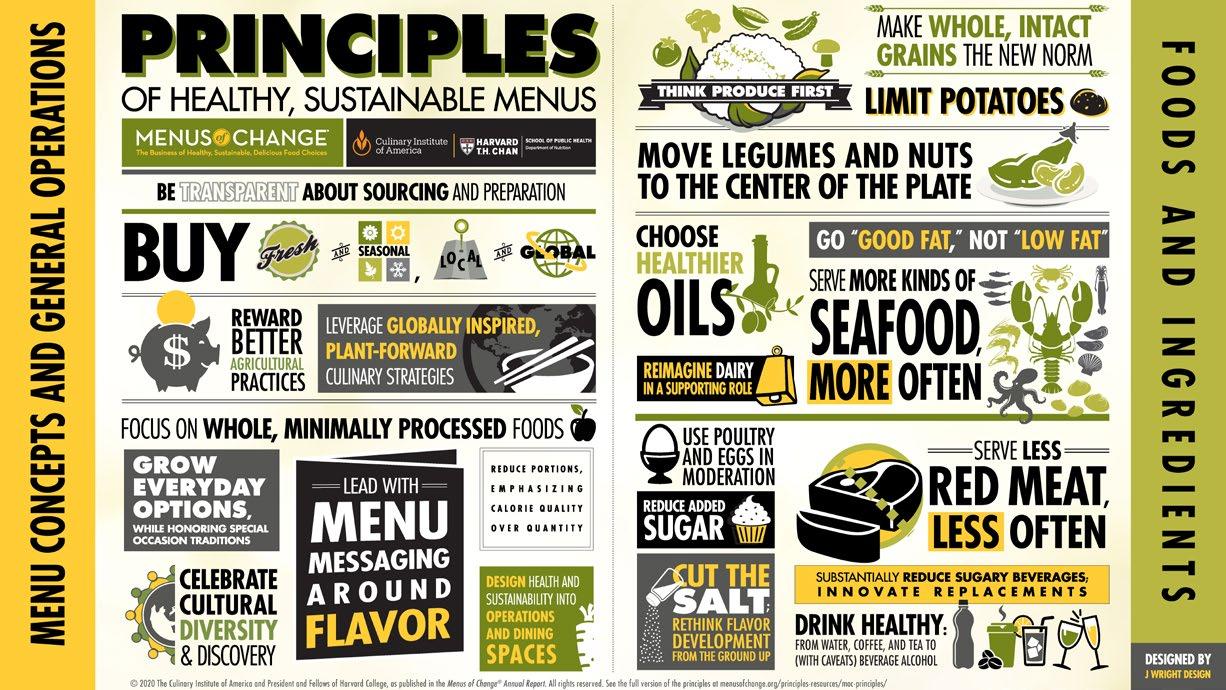
Co-founded in 2012 by the Culinary Institute of America and the Harvard T.H. Chan School of Public Health, Menus of Change® is a leadership initiative designed to advance a long-term, practical vision for integrating nutrition, public health, environmental stewardship, and social responsibility into the foodservice industry and beyond. Grounded in its Principles of Healthy, Sustainable Menus, developed as science-based guidance for the foodservice industry, the Menus of Change® platform brings together chefs, operators, nutrition scientists, sustainability experts, and business leaders to co-create and apply evidence-based strategies that help foodservice organizations elevate food that is healthy, sustainable, and delicious.
For more than a decade, the Menus of Change® initiative has driven progress across the foodservice industry toward a future where health and sustainability are embedded into the way foods are designed, sourced, and experienced. Through its network of leadership collaboratives, the Culinary Institute of America has helped the food industry advance evidence-based strategies that improve menu quality, shift purchasing toward more sustainable ingredients, and influence consumer behavior in alignment with the Menus of Change® principles for healthy, sustainable, and delicious menus. Across sectors ranging from fast casual and QSR restaurants to K-12 schools, higher education, healthcare, and corporate dining, these efforts
THERE IS A SIGNIFICANT
SIGNIFICANT
AIRPORTS TO APPLY PROVEN MENUS OF CHANGE® STRATEGIES TO IMPROVE TRAVELER SATISFACTION, STRENGTHEN SUSTAINABILITY PERFORMANCE, AND UNLOCK NEW BUSINESS VALUE.
have demonstrated that healthy, sustainable menus are not simply a values-driven aspiration, but a viable business strategy. By integrating culinary excellence and deliciousness with behavioral science, procurement innovation, and operational best practices, these initiatives demonstrate that food environments designed to improve public health outcomes, shift consumer behavior, and reduce environmental impacts can also create measurable business value at scale.
The airport food and beverage sector is uniquely positioned to benefit from these same principles. Airports are high-volume, high-visibility food environments that influence millions of food decisions each day, yet evidence shows that they have not fully evolved to meet growing consumer expectations for fresh, healthy, and sustainable food experiences. This presents a significant opportunity for airports to apply proven Menus of Change® strategies to improve traveler satisfaction, strengthen sustainability performance, and unlock new business value. By adapting successful approaches from other foodservice sectors, airports can transform food and beverage programs into drivers of health, sustainability, and commercial growth. The opportunity areas presented below outline industry-proven strategies that can be translated into the airport context, supported by case studies from CIA Menus of Change®-aligned leadership initiatives that demonstrate the real-world impact of aligning menu innovation with operational and business objectives. Together, these opportunity areas provide a roadmap for airport food and beverage systems to meet evolving traveler expectations for healthier options, advance sustainability, and strengthen long-term business relevance and resilience across the next decade.
1. USING CHOICE ARCHITECTURE TO MAKE HEALTHIER OPTIONS EASIER
Behavioral research consistently shows that food choices are strongly influenced by environmental cues such as product placement, defaults, menu framing, and visibility (Mertens et al., 2022). Research conducted by tRetail Labs and the CIA suggests that the challenge in airport environments is not simply the availability of healthier options, but whether those options are prominently featured and offered in ways that make them feel convenient, appealing, and easy to choose (Merkle & Angela, 2026).
Travelers report willingness to purchase healthier foods, yet items are often overlooked due to poor placement, limited visibility, or weak promotion. A review of choice architecture strategies implemented in retail settings found that increasing the visibility and accessibility of healthier food products, particularly when paired with promotional strategies, can significantly improve healthy food sales and purchasing behaviors (Karpyn et al., 2020).
Airports have a significant opportunity to use choice architecture strategies to make healthy and sustainable options the most visible and desirable choices through proven behavioral nudges and choice architecture. This may include enhanced marketing, positioning plant-forward meals at eye level, using more appealing menu language, incorporating healthier defaults, or designing grab-and-go spaces where healthier items are encountered first. Because travelers often make food decisions quickly and under stress, small design and presentation changes can have outsized impacts on purchasing behavior.
When plant-based options were the default option using choice architecture in a 2023 university dining hall study, 81.5% of students chose them (as compared to 30.8% before the intervention), with student satisfaction remaining high even among meat-eaters (Better Food Foundation, 2023).
These approaches have the potential to increase sales of healthy and sustainable menu items without restricting choice or reducing customer satisfaction. Choice architecture addresses the need to increase visibility of higher-margin plant-forward offerings and reduce decision friction for travelers who are under stress and time limitations. Over time, making healthier and lower-impact foods easier to find and select can help shift purchasing patterns toward more nutritious and environmentally sustainable choices.
The MCURC’s landmark DISH study was conducted across five universities, examining different menu descriptions for 71 vegetable dishes and analyzing more than 140,000 diner decisions. The research showed that menu language plays a significant role in shaping food choice. Taste-focused descriptions increased vegetable selection by 29% compared to health-focused descriptors and by 14% compared to basic names without descriptors. A key finding is that language emphasizing flavor and sensory experience is more effective at driving selection than messaging centered on health alone. These insights have been applied across the foodservice industry, elevating taste-focused descriptors as a key tool for promoting healthier foods. (Menus of Change® University Research Collaborative, n.d.)

The Menus of Change® University Research Collaborative (MCURC) is a global network of over 80 colleges and universities using campus dining halls as living laboratories for behavior change. Co-founded and jointly led by the Culinary Institute of America (CIA), Stanford Residential & Dining Enterprises (R&DE), and Stanford Prevention Research Center, the Collaborative brings together academic researchers, campus dining leaders, administrators, students, and mission-aligned sponsors and research collaborators to advance applied research, education, and operational innovation in support of the Menus of Change® Principles.
Across foodservice sectors, seasonal, regional, and sustainable sourcing strategies are increasingly recognized for their ability to enhance food quality, support local economies, and advance environmental goals, with consumers often associating these offerings with freshness, authenticity, and premium value. In airport environments food and beverage vendors have a unique opportunity to redefine the dining experience by showcasing regional ingredients, seasonal menus, and local culinary identity in ways that create a stronger sense of place and emotional connection to destination food cultures.
Sourcing strategies that visibly elevate freshness, quality, and authenticity can create value beyond sustainability messaging alone. This may include featuring local produce, regionally inspired dishes, or partnerships with local chefs and producers, while incorporating organic and sustainably sourced ingredients to further reinforce perceptions of quality and thoughtful curation. In addition to strengthening airport brand differentiation and supporting higher guest satisfaction and spend, these approaches can build stronger relationships with regional suppliers and improve sourcing resilience during periods of supply chain disruption.
When aligned with plant-forward menu strategies, seasonal, regional, and sustainable sourcing can help to increase the availability of fresh, minimally processed foods while reducing the environmental impacts associated with long-distance transportation and emissions-intensive ingredients. These strategies build a foundation for promoting healthier dietary patterns alongside regional economic resilience and environmental stewardship.
44% of consumers state they would be likely to choose a plant-forward dish that featured flavors they know and love (Datassential et al., 2025).
Healthy Kids Collaborative member Manor ISD Food and Nutrition Services in Texas advances regional and seasonal food systems through scratch cooking, local procurement, and student-centered engagement strategies that connect school meals to the community. By preparing more meals in-house, the district increases the use of fresh, minimally processed ingredients, improves nutritional quality, and creates menus that reflect student preferences and cultural diversity while expanding opportunities to feature Texas-grown and Texas-raised products. These efforts are reinforced through partnerships and hands-on engagement. Garden and classroom-to-café initiatives connect students with the origins of their food, building nutrition knowledge and environmental awareness. Together, these strategies demonstrate how school nutrition programs can elevate local food systems while engaging students and supporting sustainability goals.
The Culinary Institute of America’s Healthy Kids Collaborative (HKC) is a strategic initiative designed to accelerate innovation and deepen technical and professional expertise in K-12 school food.
As travelers increasingly seek food experiences that reflect their values, transparency and storytelling play a key role in shaping customer perceptions of quality, trust, and value in airport dining. Transparency means making the origins of food visible and meaningful, helping travelers experience local food culture, see the people and places behind what they are eating, and anchor the dining experience in specific foods, producers, and culinary traditions. This can be reinforced through menu language, signage, digital platforms, and imagery that highlights farms, producers, chefs, and local businesses.
Airports can also use storytelling to elevate the visibility of diverse culinary voices alongside local producers and businesses, making their experiences and contributions more present in the traveler experience. These efforts can be further amplified through chef collaborations, pop-ups, limited-time offerings, and curated experiences that invite travelers to engage directly with the food story, whether through exploration, participation, or feedback.
To authentically integrate transparency and storytelling, airport food and beverage operators must extend beyond the terminal by actively engaging surrounding communities to co-create offerings and provide visible platforms where local producers, chefs, and businesses can share their stories and brands directly with travelers. These strategies can help transform airport dining from a transactional purchase into an engaging, place-based experience that builds trust and perceived value while deepening traveler connection to both the food and the destination.
Compass Group, a member of the Healthy Menus R&D Collaborative, partners with local and independent restaurants through its FoodWorks division to bring authentic, diverse flavors and culinary experiences into corporate dining spaces. In 2024, the company launched a global street food competition designed to elevate women- and minority-owned businesses while highlighting the culinary traditions and creativity behind plant-forward cuisine. Participants were challenged to create dishes composed of at least 51% plant-
Local, minority-owned businesses sales increased 10-39% compared to the previous month through a celebration of global culinary traditions and street food culture.
based ingredients that celebrated quality and originality. By featuring these restaurant partners and their dishes, the initiative created opportunities for customer engagement while increasing visibility for diverse food businesses. After tracking sales over a one-month period, participating restaurant operators reported sales increases ranging from 10% to 39% compared to the previous month, demonstrating the strong consumer interest and economic potential of initiatives that combine culinary innovation, storytelling, and plant-forward dining (National Peanut Board, 2024)
The Culinary Institute of America (CIA) Healthy Menus R&D Collaborative (HMC) is a member-based initiative designed to take inspiration, information, and insights from other CIA health and wellness initiatives and craft highly targeted, sector-specific, practical solutions that contribute towards expanding healthy food and beverage choices within the foodservice industry.
While some airports have made progress on food waste reduction, composting, and sustainable packaging, sustainability efforts can be fragmented across vendors and often focus on downstream waste management rather than broader operational transformation. A more impactful approach integrates food waste prevention directly into menu design and planning, reducing food waste before it occurs for both operators and consumers (U.S. Environmental Protection Agency [EPA], 2025).
In parallel, integrating plantforward menus and sustainable sourcing strategies into airportwide sustainability and wellness initiatives presents a significant opportunity to meet growing traveler demand for healthy and sustainable food options
while enhancing airport brand differentiation and demonstrating industry leadership. Airports can scale these efforts by establishing collective standards and strategies across food and beverage vendors that incorporate plant-forward menu targets, responsible sourcing requirements, and food waste reduction goals.
Collaborative goals and coordinated action can help generate shared learnings, operational efficiencies, and replicable best practices that improve long-term execution and decision-making. These integrated approaches have the opportunity to strengthen vendor performance, improve system resilience, and enhance the airport’s ability to adapt to evolving consumer expectations while expanding access to healthier, lower-impact food offerings at scale.

The MCURC’s Repurpose with a Purpose initiative shows how surplus ingredients can be transformed into new, high-quality dishes and reframes food waste as a usable resource. In 4 weeks, participating institutions developed 16 recipes using onhand surplus ingredients. Scaling this intervention across participating universities generated nearly $20,000 in food cost savings, reducing more than 21,000 gallons of water use, and avoiding over 500,000 tons of greenhouse gas emissions, while also improving staff morale through active engagement in waste reduction efforts.
Airport concessions represent high-volume foodservice operations with significant collective purchasing power, yet without alignment across airports, vendors, and suppliers, this influence remains fragmented and underutilized in shaping healthier and more sustainable food systems. By establishing shared standards for promoting nutritious and environmentally responsible food, airports can collectively influence supplier offerings, expand access to better-for-you products, and create economies of scale that reduce costs while accelerating innovation in procurement, menu development, and operational practices.
A collective impact approach creates opportunities to standardize metrics and impact measurement across airport food and beverage systems, including common metrics for menu healthfulness, sourcing practices, greenhouse gas emissions, and sales performance, enabling airports to benchmark progress, identify high-impact opportunities, and track improvement over time. Aligned purchasing strategies can strengthen negotiating power, improve sourcing efficiency, and reduce costs for both operators and suppliers, while also lowering the risks associated with isolated experimentation and making innovation more scalable and commercially viable.
Most importantly, coordinated action across airport systems can generate greater health and sustainability impacts than isolated efforts by individual operators. Shared goals and aligned demand signals across multiple airports can help shift supplier behavior, expand access to nutritious and lower-impact foods, and drive structural change across supply chains, delivering long-term benefits for public health, environmental resilience, and the broader food system.
The MCURC demonstrates the power of collective action paired with shared goals and measurement through the Collective Impact initiative. Since 2019, participating colleges and universities have tracked over 400 million pounds of protein purchases, achieving an 18.5% reduction in protein-related greenhouse gas emissions, nearly halfway to their 2030 target. The initiative’s Cost Insights Pilot also found that these shifts lowered food costs by an average of 11%, generating an estimated $22 million in annual savings over baseline across 30+ participating institutions. By aligning around common targets and shared data, the MCURC has shown that coordinated efforts can drive meaningful environmental and financial outcomes at scale while leveraging the power of institutional procurement to drive food systems change.

The cost of inaction is growing. Airports that fail to adapt risk, falling behind evolving consumer expectations, missing opportunities to unlock sales and operational efficiencies, remaining reliant on legacy systems that do not reflect current demand for healthier and more sustainable food presents instability in a changing industry landscape. Maintaining the status quo is not a neutral proposition; it represents a missed opportunity to capture value, differentiate the traveler experience, and future-proof operations in a rapidly changing world. The Menus of Change® framework paired with nrtureAI® offers a pathway not only to improve airport food and beverage systems, but to ensure they remain relevant, resilient, and aligned with the future of travel.
The future of food in travel is best shaped together. The Culinary Institute of America (CIA) and tRetail Labs formed a strategic partnership to accelerate sustainable foodservice across the Travel Food & Beverage sector. Learn more about CIA x tRetail Labs’ mission here
To learn more on nrtureAI® and Menus of Change® evaluation frameworks for your airport, F&B or Lounge operations, or to contribute your support or experience to this initiative Contact Us

ACI. (2025). Joint ACI World-ICAO Passenger Traffic Report, Trends, and Outlook | ACI World. https://aci.aero/2025/01/28/joint-aci-world-icao-passenger-traffic-report-trends-and-outlook/
ACI. (2026). Global Gateways: How Airports Drive Economic Development and Sustainability | ACI World Insights. https://blog.aci.aero/environment-and-sustainability/global-gateways-how-airportsdrive-economic-development-and-sustainability/
Avolta. (2026). Avolta expands award-winning Eat Well. Travel Further. program to major US airports
Better Food Foundation. (2023). Serving up plants by default https://www.betterfoodfoundation.org/ reports-publications/serving-up-plants-by-default/
Datassential, The Culinary Institute of America, Food for Climate League, & Menus of Change® University Research Collaborative. (2025). 2025 plant-forward opportunity report. https://datassential.com/ resource/plant-forward-opportunity-report-2025/
de Leeuw, E., Crimeen, A., Freestone, R., Jalaludin, B., Sainsbury, P., Hirono, K., & Reid, A. (2018). Healthy airports vision. UNSW Sydney.
Del Chiappa, G., Martin, J. C., & Roman, C. (2016). Service quality of airports’ food and beverage retailers: A fuzzy approach. Journal of Air Transport Management, 53, 105–113. https://doi.org/10.1016/j. jairtraman.2016.02.002
Ebunlomo, E. O., Hare-Everline, N., & Weber, A. (2015). Development of a comprehensive 12-week health promotion program for Houston Airport System. Texas Public Health Journal, 67(1), 11.
U.S. Environmental Protection Agency. (2025). Wasted food scale https://www.epa.gov/sustainablemanagement-food/wasted-food-scale
Han, H., Lee, K.-S., Chua, B.-L., Lee, S., & Kim, W. (2019). Role of airline food quality, price reasonableness, image, satisfaction, and attachment in building re-flying intention. International Journal of Hospitality Management, 80, 91–100. https://doi.org/10.1016/j.ijhm.2019.01.013
Karpyn, A., McCallops, K., Wolgast, H., & Glanz, K. (2020). Improving consumption and purchases of healthier foods in retail environments: A systematic review. International Journal of Environmental Research and Public Health, 17(20), 7524. https://doi.org/10.3390/ijerph17207524
Lande, S. (2025). The best, most nutritious airport meal comes from a vending machine. Food & Wine
Menus of Change®. (n.d.). Principles of healthy, sustainable menus https://www.menusofchange.org/ principles-of-healthy-sustainable-menus
Menus of Change® University Research Collaborative. (n.d.). Delicious Impressions Support Healthy Eating (DISH) Study Executive Summary https://drive.google.com/file/d/1j4gkNYnYvlbhgXQJv5VKhTzp9nK1wsA/view
Merkle, T., & Angela, M. (2026, June 3). The Future of Travel. Menus of Change® Leadership Summit, Hyde Park, USA.
Merkle, T., & Das, S. (2025). Passenger Delight in Liminal Spaces: Uncovering the Dynamics of Airport Airside F&B. ICHRIE Research Reports, 10(6), 5.
Merkle, T., Das, S., & Weddig, A. (2025, April 8). The next evolution of CX delightors in an airport. Passenger Terminal Expo & Conference, Madrid, Spain, 8-10 April 2025. https://digitalcollection.zhaw.ch/ handle/11475/32951
Merkle, T., Tajeddini, K., Vlachos, I., & Keane, J. (2020). Entrepreneurship Within Airside Food and Beverage Outlet Patronage: The Creation of Ecosystems Using Outlet Context and Passengers’ Emotions. In V. Ratten (Ed.), Entrepreneurship as Empowerment: Knowledge Spillovers and Entrepreneurial Ecosystems (pp. 127–150). Emerald Publishing Limited. https://doi.org/10.1108/978-1-83982-550-720201010
Mertens, S., Herberz, M., Hahnel, U. J. J., & Brosch, T. (2022). The effectiveness of nudging: A meta-analysis of choice architecture interventions across behavioral domains. Proceedings of the National Academy of Sciences, 119(1), e2107346118. https://doi.org/10.1073/pnas.2107346118
National Peanut Board. (2024). Case study: Global street food competition—Elevating plant-forward menus with the National Peanut Board. https://nationalpeanutboard.org/news/case-study-global-streetfood-competition-elevating-plant-forward-menus-with-the-national-peanut-board/
Otterbring, T., Malodia, S., Taheri, B., & Dhir, A. (2025). Activating green airport actions: Promoting ecofriendly choices for sustainable travel through commitment and consistency. Journal of Travel Research https://doi.org/10.1177/004728752513469
Paulo, T. C., Freitas, L. M., Silva, N., Nascimento, M. V., & Borille, G. M. R. (2021). Passenger profile and its effects on satisfaction level in food and beverage establishments: Case study of major Brazilian airports. Case Studies on Transport Policy, 9(3), 1219–1224. https://doi.org/10.1016/j.cstp.2021.06.009
Physicians Committee for Responsible Medicine & Morning Consult. (2024). Airport travel and food purchasing study https://pcrm.widen.net/s/pxbhvnzrqh/pcrm-mc-airport-food-study-12.6.24
Pinna, M., & Del Chiappa, G. (2013). Consuming food and beverage at the airport: Analogies and differences among business and leisure tourists. Marketing Trends Conference Proceedings
Port of Seattle. (2024). SEA moves to all reusable or compostable food service materials
San Diego International Airport. (2025). Green concessions program promotes sustainability in daily operations
San Francisco International Airport. (n.d.). Food service requirements
Sodexo. (2021). Fighting food waste in airport lounges
Weisstuch, L., & Good, H. (2025). How airports are reducing waste and embracing sustainability. The Washington Post.
Zahari, H., Mohamad, M. H., & Aqilah, W. A. (2021). A study on in-flight catering impacts on food waste. Solid State Technology, 64, 46