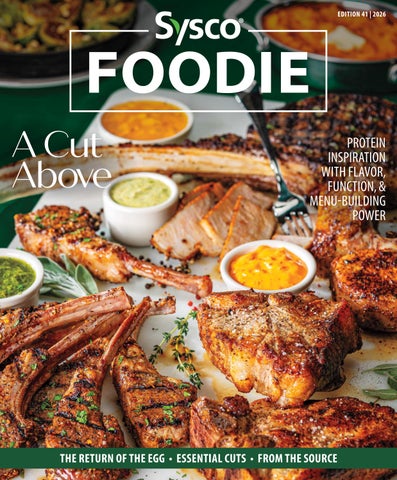
EDITION 41 | 2026
A Cut Above
PROTEIN INSPIRATION WITH FLAVOR, FUNCTION, & MENU-BUILDING POWER
THE RETURN OF THE EGG • ESSENTIAL CUTS • FROM THE SOURCE
DEAR VALUED CUSTOMERS,
More Support for the Way You Operate Sysco Perks brings together benefits across three essential areas: Delivery Preferred delivery options and responsive order support Products A broad, fresh assortment with dedicated product guidance Services Exclusive offers, foodservice expertise, menu support, and marketing solutions Contact your Sales Consultant to learn more about Sysco Perks and the benefits available to you.
Running a restaurant has never been easy. Rising costs, labor pressures, and changing guest expectations are making an already demanding business even more complex. At Sysco, we see those challenges, and we know our job is to help you meet them head-on with a partnership that works as hard as you do. Sysco Perks puts that commitment into practice. Our free loyalty program brings together dependable delivery, the right products, and valuable services, plus exclusive benefits designed around the needs of your business. Qualifying members can benefit from greater flexibility and support, including preferred delivery windows, next-day service with no order minimums, and real-time order response and recovery when plans change. The right products remain at the core of what we provide. Sysco offers a broad, fresh assortment, including locally sourced items, backed by dedicated guidance to help you find what works for your menu, your kitchen, and your customers. Just as important are the people behind those products. Your Sales Consultant is backed by chefs, specialists, and industry experts who understand foodservice and can help you solve problems as they arise. Whether you’re developing your menu, improving your operation,
“ YOUR PARTNERSHIP IS OUR PRIORITY. THROUGH SYSCO PERKS, WE’RE DELIVERING GREATER SERVICE, VALUE, AND SUPPORT FOR YOUR BUSINESS EVERY DAY.” ~ Kevin Hourican
or finding new ways to grow, Sysco Perks connects you with expertise, exclusive offers, and practical resources to help you get there. Together, these benefits help you manage day-to-day demands while preparing for what comes next. Throughout this edition of Sysco Foodie, you’ll find more ideas designed for the realities of today’s kitchen, from versatile proteins and smarter production techniques to fresh menu and beverage inspiration. I hope these pages give you practical ways to support consistency, creativity, and profitability. Restaurants have always been defined by resilience, ingenuity, and hospitality. We are proud to stand beside you with local expertise, meaningful benefits, and a shared commitment to moving your business forward.
STORIES AND
Features
CUSTOMER SPOTLIGHT 10 UNCLE JACK’S See how Uncle Jack’s brings its “best of everything” philosophy to every part of the guest experience
TRENDS 12 THE RETURN OF THE EGG
Explore what’s driving the egg’s comeback and find approachable ways to put the trend on your menu
TASTE 16 A CUT ABOVE
Menu inspiration from our Culinary Specialists built around versatile proteins, smarter production, nostalgic flavors, and entrées with presence
FROM THE SOURCE 40 NORWEGIAN SEAFOOD: PROTEIN CRAFTED WITH PRECISION
Go behind the scenes in Norway to see how precision and whole-ingredient utilization deliver the consistent quality of Portico Seafood
TIPS & TECHNIQUE 46 BUILD A BETTER BEVERAGE MENU Make every drink earn its place with practical ideas that reflect how guests want to drink today
TALENT & TRAVEL 52 A TASTE OF BRITISH COLUMBIA
Tour British Columbia’s multicultural dining scene with Sysco Culinary Specialist Chef Andrea Cruise, where global influences meet exceptional local ingredients
RECIPES 57 FEATURED DISHES
Find the full recipes behind this issue’s inspiration
Thank you for your partnership and for the trust you place in Sysco. We are proud to serve you.
Kevin
Kevin Hourican Chair of the Board and Chief Executive Officer
© 2026 All Rights Reserved. Sysco Corporation. 8824100 Reproduction in whole or part is prohibited without permission of Sysco Corporation. Printed in the United States. Please review federal, state and local regulations to ensure your compliance with the law. For safety and sanitation, stay up to date and check the latest information on CDC.gov. Consult your legal advisors regarding any risks associated with starting a new venture or implementing any recommendations. Every effort and care was made in the production of this magazine to ensure that the information included here is true and accurate. Any editorial errors or omissions may be corrected in a future printing.
3
n i e t o r P n o i t c n Fu M E E TS
In the last edition of Sysco Foodie, we looked at how deliberately pairing protein with fiber can create meals that work harder, delivering the satisfaction, sustained energy, and nutrient density today’s guests are seeking. Since then, the conversation has only gained momentum. Protein has moved into the center of everyday food decisions. It’s shaping grocery carts, influencing what people scan for on menus, and
4
increasingly, helping guests decide where and what to eat. Recent research puts a number behind what many chefs are already sensing at the pass: 62% of diners now actively look for high-protein options when ordering out, and more than a third say they’ll pay extra for them. A majority of guests are walking through the door with protein already on their minds.
Several forces are fueling that demand. As more people manage their weight with the help of GLP-1 medications, protein plays an important role in supporting muscle health. At the same time, wellness content has become a fixture across social feeds, bringing protein into daily conversations for guests of all ages and lifestyles. Even the biggest names in food are moving with it. Chains including McDonald’s, Chipotle,
and Subway are placing greater emphasis on protein across parts of their menus; another signal that guest expectations are evolving. Those expectations are also changing the way people eat. Portions are getting smaller, meals are getting lighter, and snacks and shareables are filling more occasions throughout the day. As the plate shrinks, each bite carries more weight. Guests want food that feels intentional, satisfying, and worth the spend, and protein has become one of the clearest signals of that value.
For chefs, the opportunity may already be sitting in the walk-in. Most menus already contain the building blocks guests want: animal and plant-based proteins, fiber-rich grains and legumes, fresh vegetables, fermented ingredients, and healthy fats. The next step is connecting those familiar dishes to the reasons guests choose them, and making those reasons easy to see. Most people order according to how they want to feel: “something filling,” “something lighter,” or “a meal with protein that won’t slow me down.” Menu language that reflects those priorities helps guests recognize the value already built into the plate. The food is doing the work. Make sure the menu tells the story.
62
%
THE CASE FOR BETTER WORDS In a field study, menu items rewritten with descriptive, sensory language saw sales rise 27% compared to plain labels, and diners rated the exact same food as higher quality and better value. The food stayed the same. Only the words changed. That’s the leverage point.
PROTEIN IS PULLING ITS WEIGHT Today’s diners are putting protein front and center. Sixty-one percent of consumers report increasing their protein intake, and animal proteins remain the preferred choice because they’re associated with taste, satisfaction, and value.
Compare two versions of the same bowl. One lists salmon, farro, spinach, and lemon vinaigrette. The other calls out a hearty bowl featuring protein-rich salmon and whole-grain farro. Same dish, same cost, and same prep, but now the guest can see why it fits what they’re already looking for.
For operators, that’s good news. Many menus already feature protein-rich dishes. The opportunity is simply making that benefit more visible. Clear, thoughtful menu language helps guests recognize the value already built into those dishes.
61
%
OF DINERS NOW ACTIVELY LOOK FOR
HIGH-PROTEIN OPTIONS WHEN ORDERING OUT, AND MORE THAN A THIRD SAY THEY’LL PAY EXTRA FOR THEM
MENU ITEMS REWRITTEN WITH DESCRIPTIVE, SENSORY LANGUAGE SAW
SALES RISE 27% COMPARED TO PLAIN LABELS
Source: Cornell Food and Brand Lab
OF CONSUMERS REPORT
INCREASING THEIR PROTEIN INTAKE, AND ANIMAL PROTEINS REMAIN THE PREFERRED CHOICE Source: Cargill’s 2025 Protein Profile
Source: Revenue Management Solutions, 2026 Protein & Fiber Playbook
5
ICON KEYS Mediterranean Salmon Grain Bowl
Existing Dish
Protein + whole grains create a balanced, satisfying meal.
Why It Works
Salmon, whole grains, and fresh vegetables come together in a balanced, satisfying bowl.
Menu Language That Connects
Overnight Oats
Berry & Greek Yogurt Parfait
Kimchi Rice Bowl
Whole grains and healthy fats provide slow, steady energy.
Protein and probiotics make breakfast more satisfying.
Fermented ingredients and fiber support digestive wellness.
Creamy overnight oats made with whole grains, fruit, and wholesome ingredients.
A balanced breakfast with protein-rich Greek yogurt and fresh berries.
Made with fermented ingredients and fiber-rich vegetables for digestive wellness.
Tofu & Vegetable Bowl
Harvest Lentil Bowl
Plant proteins and vegetables create a hearty, nourishing meal.
Plant protein and fiber help guests stay satisfied longer.
Plant-powered fuel built around wholesome ingredients.
A satisfying bowl packed with plant protein and fiber.
Chocolate Protein Smoothie The look and flavor of a decadent dessert, with a protein boost that makes it more substantial. Rich chocolate flavor with an added boost of protein. 6
BUILD THE DISH. THEN SELL THE STORY. Many menus already feature dishes with functional ingredients. The opportunity is describing them in ways that help guests recognize their value.
KEEP CLAIMS CREDIBLE A word of caution: stick to describing what an ingredient is and does generally (fiber-rich, probiotic, protein-packed) rather than what it will do for the guest (aids digestion, boosts immunity). The first is menu copy; the second edges into a health claim, and that distinction helps keep menu language both credible and compliant. Function-first menuing doesn’t start with a new recipe. It starts with a fresh look at the one you already have. For each dish, ask: would a guest immediately see why this fits what they’re looking for? If the answer is no, a clearer description may be all it takes to help the right guest choose it.
WHERE TO START > Bowls naturally combine protein, whole grains, legumes, vegetables, and healthy fats, making them ideal for highlighting lasting satisfaction and sustained energy. > Breakfast menus already feature ingredients guests associate with staying power, including protein, yogurt, whole grains, fruits, and seeds. >B everages provide an easy way to introduce familiar functional ingredients like green tea, kefir, tart cherry, citrus, or ginger.
SCAN TO SHOP
Visit Sysco Shop to purchase products.
> Seasonal specials are a low-risk place to test function-first language before expanding it across the rest of the menu. 7
THE
ESSENTIAL CUTS Ribeye RICH & ROBUST
• Ribeye Steak (Delmonico) • Ribeye Heart (Filet of Ribeye) • Bone-In Ribeye (Cowboy Steak) • Tomahawk
Striploin
BALANCED
• Strip Steak (New York Strip) • Manhattan Strip Filet • Bone-In Striploin (Kansas City) • Roasts for Catering
Everything can be produced at your local Buckhead | Newport!
Shortloin
FINE TEXTURE
• Porterhouse • T-Bone Steak • Tenderloin Steak (Filet Mignon) • Center Cut Bone-In Tenderloin • Center Cut Tenderloin Roast
Sirloin
VERSATILE
• Top Sirloin Heart • Filet of Sirloin (Baseball) • Sirloin Flap Meat • 2/3 Sirloin (Strip Style) • Coulotte/Picanha • Center Cut Sirloin • Ball Tip • Tri Tip
• •
½ oz variance on all cut steaks Individually cryo-vac 21 days from date of pack for boneless, 14 days for bone-in
FEATURED CUSTOMER
Uncle Jack’s: THE BEST OF
10
EVERYTHING
Anyone can eat at home. That reality guides nearly every decision Matt and Ashley Turner make at Uncle Jack’s. When guests dine out, the owners believe the experience must deliver more: excellent food, attentive service, and a welcoming room where people want to return. In Independence, Kansas, that promise begins with a place worth preserving. Uncle Jack’s opened in 2000 and changed hands several times before the Turners purchased it roughly three and a half years ago. They had been looking for a business in the town they love and found a local institution that needed renewed energy and care. Its historic building offered a distinctive canvas, with a soaring two-story dining room capped by a tin ceiling. Music, an easygoing atmosphere, and a familiar service team made the space feel inviting, but restoring Uncle Jack’s required more than ambiance. The Turners set out to raise the standard across the food, drinks, and service, with one goal: to give every guest the best of everything.
BUILD CONSISTENCY INTO THE RECIPE
TAKE CARE OF THE PEOPLE EXECUTING IT
Matt and Ashley tested burger blends and patty methods, sampled pickle after pickle, and scrutinized everything from produce and proteins to breading and fry oil. The fried chicken captures that discipline: boneless breasts move through a multistep buttermilk process before being coated in a breading Ashely developed, then fried to order.
Recipes provide the framework, but the Turners are quick to credit the people who execute them. Familiar servers and a consistent kitchen team have become a competitive advantage. The owners connect retention to care: value employees, compensate them well, and recognize that the restaurant cannot work without them.
That attention extends across a completely revamped menu. The Turners wrote 140 recipes and compiled them into what the team calls the “Kitchen Bible.” It gives cooks a precise standard and helps the kitchen reproduce the intended result shift after shift. For operators, the lesson is simple: creativity gets an item onto the menu; documentation and training keep it there.
“ WE NEED TO PROVIDE A BETTER EVERYTHING FOR THEM TO WANT TO EAT HERE.” ~ Matt Turner
That listening culture extends to guests. Matt tries to greet nearly every table, showing that the owner truly cares while gathering direct feedback. Regulars have become friends with the team and one another, and their reactions help shape what Uncle Jack’s refines or introduces next. Rather than chasing trends alone, the Turners study industry ideas and ask guests what the restaurant could do differently or better.
CHOOSE PARTNERS WHO IMPROVE THE PROCESS
stretched shrimp sourced with Cope’s help has become a strong performer, while proteins, produce, and other staples support the restaurant’s standards.
CUSTOMER SPOTLIGHT
“We truly feel like we’re Zack’s only customer because he pays so much attention to us,” Matt says. “It feels more like Sysco is a partner than a vendor.” For chefs and operators, that distinction can translate into faster product discovery, better-informed menu testing, and more reliable execution. Looking ahead, the Turners are considering an expansion of their existing location, growing Uncle Jack’s while keeping it firmly rooted in Independence. Their advice to aspiring operators is pragmatic: have more cash than you think you need, and love the work. That commitment is evident in every part of Uncle Jack’s: from the recipe book and prep hours to the people and partnerships behind every plate.
Sysco Sales Consultant Zack Cope is part of that development loop. The Turners run ideas by him, and he brings products and connects them with additional expertise. They have worked with a produce specialist and traveled to the Sysco test kitchen in Kansas City for tastings. A tempura-style
11
The Chef FRESH TAKE FROM
Sometimes the simplest moments leave the biggest impression. During a recent From the Source trip to Norway, I had the opportunity to see firsthand where our Portico Norwegian Salmon begins its journey. Experiencing that level of care gave me an even deeper appreciation for what ends up on the plate. The fish was pristine, beautifully prepared, and every bite reflected the craftsmanship behind it from start to finish. It was a reminder that, as chefs, one of our most important jobs is knowing when to step back. It’s a philosophy that’s finding its way into more and more kitchens today. There’s a renewed appreciation for fresh, protein-forward dishes built on quality ingredients and honest cooking. Vegetables are cooked just enough to preserve their color, texture, and natural flavor. Proteins are prepared with confidence rather than excess. When the ingredients are exceptional, restraint becomes one of the most valuable techniques we have. That same approach can go a long way across the menu. A versatile protein can be the centerpiece of an entrée, but it can also work beautifully in salads, bowls, sandwiches, and shareable dishes. When you find different ways to use an ingredient you trust, you can create more variety while improving consistency, working more efficiently, and reducing waste in the kitchen. There’s a timeless quality to cooking this way. The dishes feel familiar because they’re rooted in techniques that have stood the test of time, while delivering exactly what today’s diners are looking for: fresh, wholesome food that’s satisfying without being overcomplicated. You’ll see that philosophy woven throughout this issue. The recipes celebrate protein in versatile ways through clean flavors, thoughtful preparation, and the confidence to let exceptional ingredients lead the way. One lesson from Norway has stayed with me: some of the best cooking starts with trusting the ingredients in front of you. I hope that reminder stays with you, too. Cheers,
Chef Neil
Chef Neil Doherty
CORPORATE EXECUTIVE CHEF, SYSCO CORPORATION
12
TRENDS
Return E gg
THE
OF THE
Protein continues to dominate menu innovation, but adding another premium protein isn’t the only way to meet guest demand. Some of the best menu ideas don’t come from adding another ingredient—they come from looking at a familiar one differently. Long associated with breakfast, eggs have far more potential than many operators give them credit for. Used strategically, they can elevate familiar dishes, stretch higher-cost proteins, and create new menu opportunities across lunch, dinner, snacks, and small plates—all without expanding inventory. Eggs are versatile, profitable, and packed with potential. Here’s how operators are using them to build value, simplify prep, and keep menus fresh across every daypart. 13
> WHY EGGS DESERVE A FRESH LOOK The best uses for eggs often don’t put them at the center of the plate. A fried egg transforms a burger into a signature item. A jammy egg adds richness and texture to grain bowls and ramen. A grated cured yolk delivers concentrated umami as a finishing ingredient, creating the richness guests often associate with aged cheese. The result isn’t just another egg dish. It’s a more satisfying plate with greater perceived value, built from an ingredient already working in the kitchen.
14
> ONE PREP, MULTIPLE MENU OPPORTUNITIES Few ingredients reward batch prep like eggs. Marinate a batch of jammy eggs on Monday, and they can top ramen bowls Tuesday, grain bowls Wednesday, fill the grab-and-go case Thursday, and finish catering trays Friday. One preparation can support multiple menu applications while creating consistency across dishes.
That flexibility also aligns with one of the fastest-growing occasions in foodservice: snacking. According to Datassential, snacks were the fastest-growing restaurant daypart last year, with 58% of guests citing a quick bite as their reason for visiting. Hard-cooked eggs offer a protein-forward grab-and-go option with minimal additional labor, while deviled eggs, Scotch eggs, and other shareable small plates give operators new ways to build snack and bar menus from an ingredient already in rotation.
they love them, making cured yolks a low-risk way to introduce something unexpected.
> FAMILIAR TECHNIQUES, FRESH INSPIRATION Some of the most exciting egg applications today build on techniques chefs already know. Cured yolks are one example gaining momentum. After being salt-cured, dried, and grated, they deliver concentrated umami and visual appeal while offering an economical alternative to some finishing cheeses. Datassential reports cured yolks now appear on 0.5% of menus, up 71% over the past four years. Nearly half of consumers have yet to try them, but 61% of those who have say
Deviled eggs are evolving, too. Instead of serving a single classic version, operators are offering rotating flights topped with ingredients like chili crisp, smoked salmon, bacon jam, pickled vegetables, or everything seasoning. It’s an inexpensive shareable that’s easy to refresh seasonally while encouraging guests to explore multiple flavors in a single order.
Global preparations offer equally approachable inspiration. Japanese shoyu eggs, Turkish eggs with whipped yogurt and chili butter, and Korean mayak eggs all rely on familiar techniques—boiling, poaching, marinating—but introduce new flavors and presentations that feel fresh to guests without adding significant operational complexity. They’re ideal for seasonal features, LTOs, or refreshing familiar menu items with a different flavor perspective.
SCAN TO SHOP
Visit Sysco Shop to purchase products.
5 EGG IDEAS WORTH TESTING
TRENDS
1. Upgrade What’s Already Selling: Top burgers, sandwiches, grain bowls, or loaded fries with a fried or jammy egg to add richness and create a premium menu upgrade with minimal prep. 2. Turn One Prep Into Multiple Dishes: Look for opportunities to extend a single preparation across the menu. Marinated eggs can move from ramen to grain bowls to grab-and-go, while cured yolks can finish pasta, vegetables, salads, and proteins. 3. Rethink the Small Plate: Deviled egg flights, Scotch eggs, and rotating seasonal toppings transform an economical ingredient into a shareable that feels distinctive without requiring complicated execution. 4. Borrow Global Flavor: Use familiar techniques with different flavor profiles. Soy-marinated eggs, chili butter, miso, sesame, or gochujang can introduce something new without reinventing your kitchen. 5. Make Eggs the Main Event: Move eggs beyond an add-on by building protein-forward entrées around them, pairing them with hearty vegetables, grains, or premium proteins.
15
A Cut Above
The holiday season is one of the busiest and most rewarding times of the year for restaurants. Guests gather to celebrate with family, friends, and coworkers, bringing higher expectations for memorable meals and elevated dining experiences. They’re looking for dishes that feel festive, comforting, and worthy of the occasion, while operators are balancing increased traffic, tighter labor, rising food costs, and the challenge of delivering consistent quality at every service. The most successful holiday menus don’t choose between creativity and efficiency; they find ways to achieve both. In this section, you’ll discover practical ideas for creating standout holiday offerings that work as hard behind the scenes as they do in front of guests. Explore strategies for elevating nostalgic comfort classics, maximizing the value of premium proteins, designing shareable entrées that encourage larger checks, and building versatile handhelds that can spark new menu ideas. You’ll also find production-focused approaches that simplify execution through smart prep techniques, flexible ingredient utilization, and thoughtful menu planning. Whether you’re developing seasonal specials, refreshing signature favorites, or looking for new ways to improve kitchen efficiency, these pages offer inspiration and actionable ideas to help you serve dishes that impress guests, support your team, strengthen profitability, and keep diners coming back long after the holiday season has ended.
16
STACKED TO SELL The sandwich station has become a proving ground for menu innovation. It’s where premium proteins, plant-forward ideas, and new flavor combinations prove themselves before expanding across the menu. Because sandwiches feel familiar, guests are often more willing to try something new in a handheld than they are in a premium entrée. Handhelds give operators a lower-risk way to test new ingredients, gauge guest demand, and decide what’s worth expanding across the menu. Every successful sandwich is market research you can serve.
TASTE BUILT TO BE CRAVED Plant-forward sandwiches succeed when they stop competing with beef and start competing with every other great sandwich on the menu. Guests don’t choose a great black bean burger because it’s replacing beef. They choose it because it’s craveable in its own right. A well-built black bean burger delivers texture, color, and bold flavor that feel intentional, making the sandwich something guests want to order, not just the vegetarian option.
The sandwich format gives chefs room to layer creamy sauces, crisp vegetables, bright pickles, and bold spreads until the entire build becomes the reason to order it. When a plant-forward sandwich earns repeat orders, it becomes easier to build around elsewhere on the menu. That same black bean mix can become tacos, grain bowls, stuffed peppers, or salad toppers throughout the week. One well-planned prep supports multiple menu applications, turning a single plant-forward recipe into a flexible ingredient that works across the menu.
Kicked Up Black Bean Burger ~ p. 57
SCAN TO SHOP
Visit Sysco Shop to purchase products.
Dinnerware on these pages is supplied by Don. Contact your Sales Consultant for information. 17
PREMIUM MEETS FAMILIAR Premium proteins tend to perform best in formats guests already trust. That might be a salmon BLT or Portico Classic cold smoked hot honey salmon layered onto a breakfast sandwich or brunch handheld. Because it’s cold-smoked, thinly sliced, and ready to serve, operators can add premium appeal with very little additional labor. Sometimes the easiest way to introduce something new is to wrap it in something familiar.
BEYOND THE SANDWICH In many kitchens, the sandwich station is often where ingredients reveal what else they’re capable of. A drizzle of hot honey adds balance to wings, flatbreads, fried chicken, roasted vegetables, and grain bowls. Bacon, herb aiolis, pickled vegetables, and fresh greens all move easily into wraps, salads, breakfast, and seasonal specials. The best sandwich ideas rarely stay sandwiches for long. Once a flavor combination proves itself with guests, it often has a place elsewhere on the menu. That’s how one successful handheld can inspire bowls, entrées, breakfast specials, and future LTOs without starting menu development from scratch.
QUESTIONS WORTH ASKING BEFORE IT GOES ON THE MENU What makes this build memorable? One flavor a guest can describe to a friend beats five ingredients competing for attention. If you can’t explain why a guest would order this instead of the one down the street, neither can they. Can these ingredients do more than one job? A component that only exists for one sandwich ties up inventory. One that appears in three dishes becomes an asset. Is there enough contrast? Richness needs brightness. Crunch needs softness. Heat benefits from something cool. The sandwiches guests remember balance flavor, texture, and temperature in every bite. Can the line execute it consistently? Premium ingredients only create value if every sandwich can be built quickly and consistently, regardless of who’s working the station. Does it offer something guests can’t get everywhere else? Whether it’s chef-driven, plant-forward, or built around a protein guests can’t easily get elsewhere, the strongest sandwiches give a guest something they can’t just order at the place next door.
SCAN TO SHOP
Visit Sysco Shop to purchase products.
18
TASTE
SBLT Sandwich ~ p. 57
HOW SEAFOOD STACKS UP
23%
of restaurants already serve a
fish sandwich or wrap. Source: Technomic, MenuMonitor
42%
of guests say they’d order a
fish sandwich for lunch or dinner.
Source: Technomic, Seafood & Vegetarian Report
Salmon is the primary protein
16%
in
of seafood bowls.
Source: Datassential
Dinnerware on these pages is supplied by Don. Contact your Sales Consultant for information. 19
MAKE EVERY GRIND COUNT Ground beef continues to earn its place as one of the most versatile proteins in the kitchen. Today, that versatility matters more than ever. The ability to use the same product across multiple menu applications helps operators simplify inventory, reduce waste, and maximize profitability. From nostalgic classics to premium burgers, ground beef supports multiple menu occasions while giving operators flexibility across a range of price points. Matching the right grind and fat ratio to each application helps every dish perform at its best while making every pound work harder across the menu.
START WITH THE RIGHT BLEND
BUILD MORE VALUE
Before seasoning or toppings come into play, grind size and fat content determine how ground beef performs. Choosing the right blend improves texture, moisture retention, and consistency from one plate to the next.
The details around the beef often shape the guest experience just as much as the protein itself.
> Cottage Pie: A finer 85/15 grind holds its structure beneath mashed potatoes while keeping the filling rich without becoming greasy.
> Finish with herb oil or compound butter.
> Meatloaf: An 80/20 blend delivers the balance of moisture and tenderness needed for a long bake.
> Balance richness with something acidic.
> Premium Burgers: A 70/30 or Wagyu blend creates the sear, juiciness, and mouthfeel guests expect from a signature burger.
> Add house-made pickles or crispy onions for contrast.
These three applications show how one ground beef program can work across the menu, helping operators maximize versatility while simplifying purchasing and inventory. Fat ratio is only part of the equation. Grind size influences texture just as much. Finer grinds create a tighter bite that works well in composed dishes, while coarser grinds produce a looser, more steak-like texture that shines in burgers.
Idaho Fire to Farm Burger ~ p. 57
20
To elevate familiar ground beef dishes:
> Feature a signature sauce unique to your operation. > Use descriptive menu language that highlights premium blends or sourcing. Small upgrades help familiar dishes stand apart while reinforcing the value guests see on the plate.
SPEND PREMIUM WHERE GUESTS NOTICE Not every menu item requires the same investment. Dishes layered with gravy, aromatics, vegetables, and longer cook times allow a quality standard grind to perform beautifully. As guests become more value-conscious, where you invest matters. Premium blends deliver the greatest return when the beef is the centerpiece of the dish, allowing operators to justify a higher price point through both the eating experience and the story behind it. Highlighting a regional ranch, breed, proprietary blend, or house grind on the menu gives guests another reason to choose the dish while supporting a higher price point.
TASTE
FLAVOR NOTES FROM CHEF MICHAEL LARGE
I wanted to build a burger around the idea that great food doesn’t have to take itself too seriously. I layered in flavors and textures I love: smoky, spicy, crispy, rich, and bright. It’s a little Idaho, a little chef creativity, and a lot of burger.
Meatloaf ~ p. 58
SCAN TO SHOP
Visit Sysco Shop to purchase products.
Cottage Pie ~ p. 58
Dinnerware on these pages is supplied by Don. Contact your Sales Consultant for information. 21
WHEN IT COMES TO TABLETOP AND BUFFET PREPARATIONS FOR THE HOLIDAYS, DON HAS YOU COVERED ALL YEAR LONG. The biggest biggest holidays holidaysare arethe thebusiest busiesttimes timesininthe theindustry industry— – from Thanksgiving, Christmas and and New Year’s andDON DON isis the equipment equipment and and supplies partner Years Eve Evethrough through Easter Easter— – and partner you can cantrust trust to to what need when youneed needit.it.Our Ourreputation reputationasasthe theleading leadingfoodservice foodservicedistributor distributor getget youyou what youyou need when you allows us products across all categories, usto tosupply supplyyour yourbusiness businesswith withover over12,000 12,000in-stock in-stock products across all categories, including the most stunning tabletop collections and and the the latest latestinnovations innovationsin inmodern modernbuffet buffet service. service. No Nomatter matterwhat whatholiday holidayyou’re you’repreparing preparingfor, for,DON DONisisthe thesolution solutiontotomake makeit itshine! shine! For more information scan
For more information or to inquire about the codefeatured to see don.com the plateware in these recipes, scan the code to visit don.com or callCare or call our Customer Customer Care at 800.777.4366.
at 800.777.4366.
TASTE
PREMIUM MADE PRACTICAL Sheet-Pan Chicken Dinner (Plated Skillet-Style) ~ p. 58
Dinnerware on this page is supplied by Don. Contact your Sales Consultant for information.
The difference between a premium dish and a difficult one often comes down to timing. The best kitchens don’t eliminate complexity; they decide when to tackle it. Techniques like sous vide, braising, whole roasting, and sheet pan cooking move the hardest work out of the dinner rush and into prep, when there’s time to get it right. That’s how a dish stays premium on the plate without demanding premium line time to execute. When prep carries more of the workload, the line can focus on what guests actually notice: a proper finish, thoughtful presentation, and sending every plate out looking like the last. Premium execution starts long before the ticket prints.
BUILD THE WORK BEFORE THE RUSH Sheet pan cooking is one of the clearest examples of that philosophy in action. The strongest sheet pan entrées aren’t just designed around flavor; they’re built around execution. Proteins and vegetables finish on the same timeline, allowing plates to come together with minimal last-minute coordination. That same production system also makes menu changes easier. Swap seasonal vegetables, introduce a new sauce, or finish with a different garnish, and guests experience an entirely new entrée while the kitchen continues executing the same reliable process. The best production systems don’t ask the line to create complexity during service. They build it into prep, where consistency is easier to build and easier to maintain.
SCAN TO SHOP
Visit Sysco Shop to purchase products.
23
Most kitchens buy a whole tenderloin with one dish in mind. The strongest operators buy it with several. A whole tenderloin can support signature steaks, rotating chef specials, appetizers, and bar menus from a single roast. Thinking beyond tonight’s feature before the tenderloin ever
hits the oven makes it easier to serve premium beef throughout the week without bringing another premium protein into inventory.
BUYING ONE CUT, GAINING MULTIPLE OPTIONS The value of a whole tenderloin isn’t just in the quality of the beef; it’s in what happens after it’s broken down. Center cuts become signature entrées, secondary portions support rotating features, and trim creates opportunities for steak bites, tartare, or shareables. One thoughtful purchase creates multiple menu applications, giving chefs more flexibility without adding complexity.
BUILD THE SYSTEM, THEN CHANGE THE PLATE Whole roasting creates a repeatable foundation. Every slice comes from the same roast, so doneness, texture, and presentation stay consistent from the first ticket to the last. Once that system is in place, changing the guest experience becomes much easier. A different sauce, seasonal vegetables, or a fresh finishing garnish can make the plate feel entirely new while the kitchen continues executing the same reliable process.
24
Dinnerware on these pages is supplied by Don. Contact your Sales Consultant for information.
TASTE
MAKE EVERY ROAST GO FURTHER Before the roast ever hits the oven, decide where each section is headed.
> One roast supports multiple services without another premium protein entering inventory. SCAN TO SHOP
Visit Sysco Shop to purchase products.
Whole Roasted Beef Tenderloin ~ p. 58
> Portions shift between featured entrées and specials as demand moves through the week.
> Secondary portions become rotating chef specials.
> Trim supports appetizers, steak bites, tartare, or bar menus.
> Center-cut steaks anchor the signature entrée.
The best whole-muscle programs don’t ask, “What’s tonight’s feature?” They ask, “How many jobs can this roast do before it’s gone?” That’s the real value of a whole tenderloin. It isn’t just the steak in front of the guest tonight; it’s every menu opportunity the rest of the roast quietly creates throughout the week. 25
Smoked Lentils & Roasted Butternut Squash ~ p. 59
Braised Pork Shank Osso Buco ~ p. 59
FLAVOR NOTES FROM CHEF MARKQUEL POUNDER
SCAN TO SHOP
Visit Sysco Shop to purchase products.
26
This is my play on pork and beans, a staple in my house growing up, although ours came out of a can! Slow cooking is my kitchen love language, and this dish brings those two ideas together.
TASTE LEAVE TOMORROW’S OPTIONS OPEN The best production plans don’t predict the week perfectly. They make it easier to adapt when the week doesn’t go according to plan. Before a batch of braised pork shanks or sous vide pork belly ever hits the oven or water bath, decide where those portions could go, not necessarily where they will go. Some may become tonight’s featured entrée, while others are held for lunch specials, banquets, or a weekend small plate. That flexibility starts long before service. When one production run is planned with multiple applications in mind, changing course becomes much easier as the week unfolds.
BUILD PRODUCTION, NOT JUST PLATES Sous vide and braising are valuable because they shift the hardest work out of service and into production. Pork belly can be cooked, chilled, portioned, and finished to order days later with the same texture and consistency. Braised pork shanks often improve after resting overnight, giving chefs a premium centerpiece that’s already done the hardest part of its work before service begins. When production carries more of the workload, the line can focus on pacing, timing, and presentation.
Roasted Sous Vide Pork Belly with Roasted Root Vegetables ~ p. 60
GIVE YOURSELF A PIVOT POINT The busiest weeks rarely unfold exactly as planned. Reservations change. Banquets grow. One feature unexpectedly outsells another. That’s where production cooking earns its value. Holding proteins that are cooked, portioned, and ready to finish makes it easier to redirect them where they’re needed most, whether that’s tonight’s feature, tomorrow’s lunch special, or an unexpected catering order. The best prep doesn’t eliminate decisions. It delays them until you have better information. Instead of committing every portion before the week begins, production cooking lets chefs make smarter decisions as demand reveals itself.
SCAN TO SHOP
Visit Sysco Shop to purchase products.
Dinnerware on these pages is supplied by Don. Contact your Sales Consultant for information. 27
DELIVERING ACROSS
NORTH AMERICA FreshPoint brings field-fresh produce right to your kitchen. Get the best fruits & vegetables of every season delivered directly to your restaurant. Call your Sales Consultant today to learn more!
TASTE
MADE FROM MEMORY
Shredded Chicken Lemon Orzo Soup ~ p. 60
SCAN TO SHOP
Visit Sysco Shop to purchase products.
Some dishes never leave the menu because they never leave people’s memories. Chicken pot pie, homemade soup, meatloaf and roast chicken are the meals guests grew up with, and they’re still what they reach for when they want something familiar done exceptionally well. They order them because they trust them, and because every great version reminds them why those classics became favorites in the first place.
Nostalgia is shaping menus in a big way. The National Restaurant Association’s 2026 What’s Hot forecast named comfort and nostalgia the year’s biggest menu theme, with chefs reworking childhood classics rather than replacing them. That demand goes beyond the food itself. Guests are looking for meals that feel personal, generous, and worth slowing
down for. For operators, that’s an opportunity. Comfort dishes already come with built-in familiarity, so thoughtful upgrades have an even greater impact. House-made stock, fresh herbs, seasonal vegetables, premium fats, and scratch-made finishes stand out because guests already know what a great chicken pot pie or bowl of soup should taste like.
Dinnerware on this page is supplied by Don. Contact your Sales Consultant for information.
Today’s comfort food isn’t about making classics fancier for the sake of it. It’s about making them feel handcrafted, seasonal, and unmistakably worth ordering. The real opportunity is knowing where to elevate them: a buttery beef tallow crust, fresh herbs, roasted vegetables, or a finishing drizzle of herb oil, all while preserving everything guests already love.
29
COMFORT THAT EARNS ITS PRICE Guests are willing to spend more on nostalgic dishes because they’re buying more than a recipe. They’re buying the best version of a dish they’ve loved for years.
That’s why so many 2026 menu forecasts pair comfort with value: guests want to feel like they’re splurging without feeling like they’re overspending. That’s where thoughtful upgrades have the biggest impact. A truffled chicken pot pie feels worthwhile not because truffle is a more expensive ingredient, but because every element supports the experience. The same goes for a slow-simmered chicken soup built with rich stock, hand-pulled chicken, and fresh herbs. Small upgrades create a noticeable difference without changing what made the dish comforting in the first place.
Truffled Chicken Pot Pie with Beef Tallow Crust ~ p. 60
SCAN TO SHOP
Visit Sysco Shop to purchase products.
30
Dinnerware on these pages is supplied by Don. Contact your Sales Consultant for information.
TASTE FAMILIAR MEANS FLEXIBLE
IT’S THE LITTLE THINGS
Nostalgic classics also work harder than they get credit for. A batch of shredded chicken can anchor soups, sandwiches, grain bowls, pot pies, and seasonal specials throughout the week. House-made stock becomes the foundation for soups, sauces, braises, and gravies. When one production run supports multiple menu applications, familiar dishes become both a guest favorite and one of the most efficient items on your prep list.
Guests may remember ordering chicken pot pie, but what sticks with them is the buttery crust, the aroma of fresh herbs, or the warm bread that arrived alongside it. Those small details are what turn a familiar meal into a signature dish. > Use a finishing vinegar or squeeze of lemon to brighten rich soups just before they leave the pass. > Brush crusts with herb butter and finish with flaky salt while they’re still warm. > Rotate accompaniments like compound butters, pickles, or seasonal relishes to keep familiar dishes feeling fresh. > Bake pot pies in individual crocks or cast iron for a made-from-scratch presentation. Guests come for the comfort, but it’s the small, thoughtful details that give them a reason to order it again.
FLAVOR NOTES FROM CHEF COREY FULLER
I spent six years working for Wolfgang Puck. He loves truffled chicken pot pie and was incredibly proud of it. We served it all around the world, and it was the No. 1 dish served at the Oscars. Here, the tallow gives the crust a flaky texture, making it tender and crackly.
31
PLATES WITH PRESENCE Some entrées have a way of changing the table the moment they arrive. Conversations pause. Heads turn. Phone cameras come out. Everyone leans in for a closer look before the first bite. That kind of presence comes from thoughtful execution: a shareable meat board or beautifully seared salmon, where every element works together to create a memorable meal.
LET THE PROTEIN LEAD THE PLATE Protein sells the entrée, so build everything else around it. Choose sauces that complement rather than cover. Pair vegetables and starches that add color, texture, and seasonality without pulling attention away from the centerpiece. A grilled tomahawk shines with simple accompaniments that let the quality of the meat speak for itself. When every component has a purpose, the plate feels intentional, and guests notice the difference. Try this: Look at your current best-selling entrée. If more than one garnish, sauce, or side is competing with the protein, simplify it. Sometimes removing one element makes the entire plate stronger.
A BUILD WORTH SHARING Shareable entrées naturally create energy in the dining room. Guests pass plates, compare flavors, and turn one dish into part of the experience. And for operators, that energy translates directly to the bottom line. A successful board starts with a centerpiece that draws attention, then layers in variety. A tomahawk ribeye anchors the presentation while grilled lamb chops and a Cajun-rubbed pork chop each bring something different to the table. Round it out with sides that offer contrasting textures and colors. A well-built board showcases multiple premium proteins in a single order, which supports a higher price point without a proportional jump in food cost, since each protein portion can run smaller than it would on an individual plate. Because the components are largely proteins and sides your kitchen is already prepping, the board adds a high-impact menu item without adding real complexity to the line. Try this: Pull three items already on your prep list and plate them together as a limited-run board special. No new proteins and no new training; just a new presentation. 32
Roasted Veal Porterhouse ~ p. 61
Goat Cheese Grits ~ p. 61 Roasted Pork Chop with McCormick Cajun Rub ~ p. 61
Baked Smashed Sweet Potatoes ~ p. 62
TASTE
Grilled Lamb Chops with Herb Sauce ~ p. 61
Tallow Roasted Brussels Sprouts ~ p. 61
Grilled Tomahawk Ribeye with Cowboy Rub ~ p. 61
Butternut Squash Gratin ~ p. 62
FLAVOR NOTES FROM CHEF JASON HOOKER
SCAN TO SHOP
Dinnerware on these pages is supplied by Don. Contact your Sales Consultant for information.
Visit Sysco Shop to purchase products.
Nothing warms the heart during the holiday season quite like a shareable butcher’s board of grilled and seared proteins with luscious sides. 33
ANCHOR THE PLATE
BALANCE CREATES RECALL
Great entrées start with one idea. Choose a protein guests are excited to order, then surround it with ingredients that sharpen its flavor, add contrasting textures, and create visual appeal. This approach makes seasonal menu updates easier while keeping a signature entrée recognizable to returning guests.
Guests may not remember every ingredient individually, but they’ll remember how every bite came together. Crisp-skinned salmon paired with tender farro, bright citrus pesto, and fresh herbs creates contrast in texture, richness, and acidity. Those layers keep a dish engaging from the first bite to the last, and that’s often what guests remember most.
When a product is backed by exceptional sourcing and craftsmanship, as with Portico Norwegian Atlantic Salmon, the supporting ingredients should elevate those qualities, not compete with them. Let the rest of the plate reinforce what makes the protein exceptional.
Try this: Before finalizing a new entrée, identify the one element you want guests to remember most. Then evaluate every sauce, grain, vegetable, and garnish against it. If a component doesn’t reinforce that memory, it’s competing with it.
FLAVOR NOTES FROM CHEF EMMA SISARSKY
This dish makes me feel good! I love pairing Norwegian salmon with hearty farro. It’s satisfying without feeling heavy. Citrus pesto and yogurt add bright, fresh pops of flavor that bring everything together. Simple, colorful, and wholesome, this dish leaves you feeling nourished and energized.
WHAT SETS PORTICO NORWEGIAN ATLANTIC SALMON APART 34
SCAN TO SHOP
Visit Sysco Shop to purchase products.
Every Portico Norwegian Atlantic Salmon fillet is the result of thousands of careful decisions.
> Fully traceable from farm to harvest.
> Raised in cold, fast-moving fjords.
TASTE Pan Roasted Salmon with Farro and Citrus Pesto ~ p. 62
Dinnerware on these pages is supplied by Don. Contact your Sales Consultant for information.
> Responsibly produced with efficient use of every harvest, maximizing every usable part of the fish.
>C arefully processed for consistent quality.
> Crafted to deliver dependable performance in the kitchen.
The story behind your ingredients can be just as memorable as the dish itself. See page 40 to learn how Portico Norwegian Atlantic Salmon goes from fjord to fork. 35
DESIGNED TO HOLD
Shrimp Pasta Salad ~ p. 62
SCAN TO SHOP
Visit Sysco Shop to purchase products.
36
TASTE
Cold dishes are judged differently than hot entrées. There’s no fire to reset the plate; guests expect the last portion served to taste as fresh as the first. That single requirement is what separates a cold prep that simply holds from one that becomes a menu workhorse.
MAKE THE LAST PORTION COUNT The strongest cold dishes are built for longevity. Choose vegetables that stay crisp under dressing, grains or pasta that absorb flavor without becoming heavy, and herbs or citrus that keep the dish tasting bright throughout service. Every ingredient should contribute to a preparation that performs consistently from the first portion served to the last. That durability creates opportunities throughout the operation. A shrimp pasta salad built to hold for six hours can move seamlessly from a catering order to the grab-and-go case or buffet line, all from the same production run. Consistency allows one prep to support multiple menu applications without adding labor or unnecessary complexity. Try this: Taste one of your cold preparations at the start of service and again several hours later. If texture, seasoning, or acidity has drifted, adjust the recipe until the final portion is just as balanced as the first.
Dinnerware on these pages is supplied by Don. Contact your Sales Consultant for information. 37
BUILT FOR THE BUSY SEASON AND BEYOND Sysco Classic
PEACH CRISP BRIOCHE BREAD PUDDING
SUPC 7414115 • 24/5 OZ
Key differentiator: Fully-prepared, individually portioned with flexible heating options.
The busiest time of year calls for menu solutions that work as hard as you do. From nostalgic favorites and globally inspired flavors to labor-saving innovations and trend-forward ingredients, Cutting Edge Solutions helps you serve memorable dishes with confidence. Whether you’re preparing for holiday crowds, winter cravings, or the menus that carry you into the new year, these exclusive solutions deliver the performance, versatility, and inspiration to keep your kitchen ahead of what’s next.
Butcher’s Block Prime
Sysco Classic
Natural Bone-In Pork Ribeye • SUPC 7390783 • 12/10–14 OZ Natural Bone-In Pork Ribeye Prop 12 • SUPC 7390785 • 12/10–14 OZ
SUPC 7385231 • 6/1.9 LB
NATURAL BONE-IN PORK RIBEYE
Key differentiator: All-natural brined and larded then consistently portioned to a 1-inch thickness.
BACON WRAPPED TURKEY BREAST (“TURKETTA”)
Key differentiator: Premium ready-to-cook, speed-scratch solution.
Sysco Premium
Sysco Classic
SUPC 7340464 • 2/14 CT
SUPC 7440411 • 20/3.17 OZ
Key differentiator: Trending sweet and spicy flavor profile.
Key differentiator: Ramekin-free, scalloped format that is ready to plate.
Jade Mountain
Arrezzio Classic
SUPC 7506027 • 20/12 CT
Four Cheese SUPC 7407795 • 4/2.5 LB | Creamy Truffle SUPC 7407790 • 4/2.5 LB
Key differentiator: On-trend flavor and vibrant color in a familiar format.
Key differentiator: Stuffed with authentic Italian ingredients and rich, savory flavors.
HOT HONEY PEACH CHEESECAKE
UBE GYOZA
GOURMET PREPARED CRÈME BRÛLÉE
ITALIAN STUFFED GNOCCHI
Norwegian Seafood: Some products earn your trust the first time you cook them. Others earn it long before they ever reach the kitchen. Chef Neil Doherty and the Foodie team traveled to Norway to follow Portico Norwegian salmon and cold-water prawns from hatchery to fjord, from boat to processing line, seeing firsthand what goes into producing seafood of this caliber. What they discovered wasn’t one defining moment or breakthrough. It was hundreds of small decisions, made with care every single day. Decisions that quietly add up to exceptional seafood.
40
PROTEIN CRAFTED WITH PRECISION
RAISED WITH PRECISION The salmon’s journey begins in pristine glacial freshwater, where they hatch and spend the earliest part of their lives in carefully controlled hatcheries. Even feeding time is carefully orchestrated. Young salmon receive their first meal only once every fish in the tank is ready to eat, giving the group a more consistent start before they’re gradually moved into larger tanks. As they grow, the salmon are slowly acclimated from freshwater to seawater, following the same rhythm wild Atlantic salmon would take on their own. From there, they spend another 14 to 18 months in Norway’s cold, clean fjords. Strong currents keep the fish moving while carefully
FROM THE SOURCE
“ THIS IS NOT JUST CUT AND GO. THIS IS ACTUALLY SUPER TRIMMED TO A HIGH SPEC.” ~ Chef Neil
managed feeding programs and continuous monitoring support healthy growth. Every fish remains fully traceable throughout its life cycle, giving chefs confidence in where their seafood comes from and how it was raised. Watching it happen firsthand, Chef Neil found himself thinking less about the technology than the people behind it. “The amount of care that’s put into this product is amazing.” One of the most surprising moments came while watching the sea lice removal system in action. Operators tracked individual fish on screens before using underwater lasers to eliminate the parasites without chemical treatments. From the viewing room, it looked almost
like someone playing a video game. Behind that surprisingly familiar scene was technology designed to support healthier fish while reducing the need for chemical treatments.
FINISHED TO A HIGHER STANDARD Inside the processing facility, that same attention to detail continues. Every fillet is photographed, graded, checked twice for pin bones, and trimmed to precise specifications before it is packed. Even thickness, not just weight, is measured to create fillets that cook more evenly from end to end. Watching the line, Chef Neil immediately recognized what separates the Portico product from an ordinary cut. “This
is not just cut and go. This is actually super trimmed to a high spec.” For chefs, that extra work matters. Uniform thickness helps reduce thin tail sections that can overcook, creates more consistent portions, and supports predictable cook times during service. The precision built into processing becomes consistency on the plate, confidence on the line, and another example of how hundreds of careful decisions shape the finished product.
PURPOSE IN EVERY CUT One of Chef Neil’s biggest takeaways from the salmon facility had nothing to do with advanced technology. It was the respect shown for every part of the fish. Almost nothing was discarded. Heads become
ingredients for soups and stocks. Frames, bellies, skins, and trim find uses in other food applications. Packaging materials are recycled, and even the Styrofoam shipping containers are compressed and repurposed into products such as outdoor furniture. It wasn’t presented as a campaign or marketing story. It was simply how the operation worked. That mindset reflects something chefs understand well: when an ingredient has been raised and handled with this much care, every usable part deserves a purpose.
41
SMALL INGREDIENT. SERIOUS PRECISION. The smallest products often demand the greatest precision. Norway’s cold-water prawns are a perfect example. Every step, from peeling to cooking, is carefully calibrated to protect their delicate texture and deliver consistent quality. Throughout the processing facility, the team saw just how carefully that precision is built into every step. After harvest, the shrimp enter a carefully controlled maturing process using salt and phosphate. This step gently loosens the shells from the meat, allowing them to peel cleanly without tearing the delicate 42
flesh underneath. It is a small but essential detail that protects texture while improving yield. The shrimp are then sorted into precise size categories before moving through a multi-zone steam cooker. For some of the smaller shrimp, cooking takes just 66 seconds at 96°C before they are cooled immediately to preserve their texture. With a product this delicate, every second matters. Too little time affects the finished texture; too much can compromise the delicate product. Precise cooking and rapid cooling help each batch deliver the consistency chefs expect from one order to the next.
NOTHING WASTED. NOTHING OVERLOOKED. The same respect for the whole ingredient seen in the salmon operation continues here. Rather than discarding the shells after peeling, the facility transforms them into shrimp powder used in soups, sauces, bouillons, and seasonings. Thousands of pounds of shells are given a new purpose each day instead of becoming waste. The facility also draws its water from a nearby glacial lake. Alongside that natural resource, ongoing investment in automation helps improve capacity and efficiency without losing sight of the product itself.
The equipment may be sophisticated, but the goal is straightforward: consistent size, consistent yield, and consistent quality, batch after batch. Like the salmon operation, every stage reflects the belief that quality isn’t measured only by the finished seafood. It is shaped by how thoughtfully the ingredient is handled from beginning to end.
FROM PROCESS TO PERFORMANCE Most chefs will never have the opportunity to stand beside a Norwegian fjord, tour a salmon hatchery, or watch a shrimp processing line run at full speed. But they will notice the results.
FROM THE SOURCE
They’ll notice salmon that’s consistently trimmed and portioned to cook more evenly. They’ll notice prawns with dependable sizing and delicate texture. They’ll notice predictable preparation, cleaner execution during service, and products that perform the same way from one delivery to the next. That consistency gives chefs something increasingly valuable in a busy kitchen: confidence. Portico Norwegian salmon and cold-water prawns are the product of hundreds of careful decisions, each one contributing to the consistency chefs rely on every day. It’s craftsmanship that begins in Norway and delivers performance where it matters most: in the kitchen.
SCAN TO WATCH Experience Norway with Chef Neil!
SCAN TO SHOP
Visit Sysco Shop to purchase products.
43
Specialty Companies dedicated experts for superior provide dedicated superior customer customerservice. service. We offer customized customizeddelivery delivery options options for for our our products productswith with quality, consistency and food the highest quality, food safety safety priority. priority. Take advantage advantage of ofour ourdeep deepassortment assortment and andexpertise expertiseinin the categories categories that that matter most.
The industry’s most innovative offerings of fresh produce
America’s premier center-of-the-plate specialty distributor
Providing “Everything But the Food” since 1921
Unique assortment of 5,000+ gourmet and specialty foods from over 60 countries
Call your Sales Consultant today to learn more!
Beverage Menu BUILD A BETTER
Every beverage has a job to do. With guests scrutinizing what makes it onto the check, drinks must deliver more than refreshment. Datassential’s 2026 trends data shows that 72% of consumers have become more selective about where they spend on food, with beverages and add-ons facing particular pressure. The interest is still there, but the
72% of consumers have
become more selective about where they spend on food, with beverages and add-ons facing particular pressure. Source: Datassential 46
bar for what feels distinctive, satisfying, and worth the spend is higher. For chefs and operators, that means making every drink work harder, from flavor and format to presentation and pairing. The guiding question is simple: What would make this drink an easy “yes”?
FUNCTIONAL SODAS have reached 66% awareness and 58% interest. Source: Datassential
1) OWN THE SPACE BEYOND SODA
Between the fountain and the cocktail list is plenty of room to create something memorable: sparkling refreshers, fruit-and-herb coolers, agua fresca-inspired drinks, tea-based spritzes, and botanical or functional sodas. These beverages can deliver flavor, visual appeal, and a sense of discovery without requiring a complicated bar program. Datassential reports that functional sodas have reached 66% awareness and 58% interest. Tea is finding new occasions, too: Gen Z is significantly more likely than Gen X and Boomers to choose tea or tea-based beverages at happy hour, yet only 20% of operators currently offer tea-based mocktails. This is a natural place to bring a culinary point of view. Ingredients such as cucumber, ginger, basil, chile, citrus, and tropical fruit can connect the beverage
list to the food menu. Global flavors, including yuzu, guava, tamarind, and passion fruit, can add freshness and distinction. The best ideas, however, still have to work during a busy service. Nearly three-quarters of operators tell Datassential that beverages must be easy for staff to serve. Simplicity isn’t a creative limitation; it’s what makes creativity sustainable. Look for components that can work across multiple drinks and dayparts. A passion fruit or yuzu base, for example, could become a sparkling lunch refresher, a zero-proof dinner spritz, and a cocktail ingredient at the bar. A short list of distinctive, easy-toexecute drinks will often create more impact than an expansive menu, especially when those drinks travel well and offer something guests wouldn’t typically make at home.
2) DESIGN FOR
THE MODERATING DRINKER The zero-proof conversation is changing. Many guests no longer identify strictly as drinkers or nondrinkers. Instead, they adjust what—and how much—they drink based on the occasion.
Datassential reports that low-alcohol cocktails now have 63% consumer awareness and 51% interest. Session drinks, tea-based cocktails, spritzes, and other lighter choices give guests more control over the pace of their experience. That flexibility is also behind “zebra striping,” the practice of alternating alcoholic and alcohol-free drinks. A guest might begin with a cocktail, switch to a zero-proof option, and return to alcohol later. They aren’t necessarily choosing a lane; they’re looking for ways to extend the occasion while staying in control.
TIPS & TECHNIQUE Operators can support that behavior by offering a spectrum of choices: a well-developed zero-proof selection, lower-ABV spritzes or wine-based cocktails, or alcoholic and alcohol-free versions of the same signature drink. These options let guests moderate without feeling like they’re trading down. Price these drinks according to the experience they deliver. An alcohol-free beverage can still require premium ingredients, prep, labor, and thoughtful presentation. When it’s developed with the same intention as the rest of the menu, it can provide meaningful value for the guest and margin for the operation. Ultimately, the best reason to order a zero-proof drink is the same as any other: It sounds delicious.
47
TIPS & TECHNIQUE
3) RETHINK THE
FORMAT BEFORE THE PRICE
Value isn’t communicated by price alone. Sometimes the barrier to ordering isn’t the drink itself, but the commitment required. A 5- or 6-ounce pour, half-carafe, or tightly edited tasting flight can make discovery feel more approachable without discounting the product. Used strategically, smaller formats may also support pour-cost and waste-reduction goals. Pairings can create accessible value, too. An appetizer with a complementary beverage or a specialty drink with dessert
gives guests a complete, easy-to-understand experience. It can also encourage an order that might otherwise be skipped. The best clues may already be showing up during service. Watch for unfinished drinks, hesitation at the point of order, or recurring price objections. These behaviors can reveal where a smaller pour, shareable option, or pairing might make the decision easier. Sometimes the right adjustment isn’t changing what’s in the glass. It’s giving guests a better way into it.
4) GIVE PARTNERS A CLEAR BRIEF
A new beverage product only matters if it fits the concept, works during service, and earns its place in inventory. Instead of simply asking what’s trending, give sourcing partners a specific challenge: a zero-proof drink with a fast pickup, for example, or an ingredient that can work across multiple drinks and dayparts. European Imports, a Sysco company, offers imported and specialty ingredients that can help operators add distinction without sourcing every component separately. The best finds won’t inspire just one drink; they’ll create possibilities across the menu while keeping execution manageable.
EXPLORE PREMIUM BEVERAGE INGREDIENTS LIKE 1883 SYRUPS AT EILTD.COM LOW-ALCOHOL COCKTAILS now have 63% consumer awareness and 51% interest. Source: Datassential
SCAN TO SHOP
Visit Sysco Shop to discover specialty products.
48
BUILD FOR HOW GUESTS DRINK TODAY Beverages remain one of the best places on the menu to create both experience and margin. Today’s guests want options that reflect how they spend, explore, and moderate, while operators need them to fit the realities of prep, staffing, storage, and service. A beverage menu doesn’t need to capture every trend to feel current. It needs a focused point of view, a clear sense of value, and drinks that deliver on their promise. Get those elements right, and the response every operator wants to hear comes naturally: “Yeah, I’ll have one of those.”
ELEVATE YOUR HOLIDAY MENU
With European Imports Favorites FOOD TASTES BETTER WITH A STORY
BROWSE ALL OF OUR BRANDS AT EILTD.COM
From authentic imported ingredients to premium specialty products, European Imports private label brands such as Maiale®, Cocina Selecta®, Cucina Viva®, Love of Fare®, Raisin River®, Amber Valley®, Le Village®, and DeMill®, deliver the quality, consistency, and value chefs count on throughout the holiday season. Proud members of the Sysco family of brands, these trusted favorites bring together authentic flavor, premium ingredients, and the support of a partner dedicated to your success. European Imports quality. Sysco strength.
DISCOVER MORE FROM EUROPEAN IMPORTS
Explore the enhanced European Imports website for culinary inspiration, product spotlights, trend insights, recipes, and specialty food solutions designed to help you create memorable dining experiences all season long.
SCAN TO EXPLORE Visit EILTD.com to browse our products.
KNIFETIPS CUTS && TECHNIQUES: SPECS KNIFE CUTS
Fine Brunoise (Brunoisette) 1/16” x 1/16” x 1/16”
Shred
Julienne 1/8” x 1/8” x 1”-21/2”
Brunoise 1/8” x 1/8” x 1/8”
Mince (Hacher)
Matchstick (Allumette) 3/16” x 3/16” x 2”-2 1/2”
Small Dice (Macèdoine) 1/4” x 1/4” x 1/4”
Chiffonade
Bâtonnet 1/4” x 1/4”x 2”-2 1/2”
Medium Dice (Parmantier) 1/2” x 1/2” x 1/2”
Shave
Fine Julienne 1/16” x 1/16” x 1”-2”
Bâton 1/2” x 1/2” x 2”-3”
Large Dice (Carré) 3/4” x 3/4” x 3/4”
Plank Cut (Plateau)
Mirepoix 1/4” in length
Slice (Émincer)
Large Mirepoix (Rough Chop)
FreshPoint brings field-fresh produce right to your kitchen. Get the best fruits & vegetables of every season delivered directly to your restaurant.
Call your Sales Consultant today to learn more!
Quarter
Rondelle 1/8” - 1/2” in thickness
Half moon (Demilune)
Fermière (Rustic Style)
Bias Cut (Sifflet)
Lozenge (Diamond) 1/2” x 1/2” x 1/8”
Paysanne 1/2” x 1/2” x 1/8”
Olivette 1”- 2” in length
Tourné 2” in length with 7 sides
Oblique (Roll-Cut)
Parisienne
Tomato Concassé
Wedges
Tourné with skin 2” in length with 7 sides Supreme (Section)
British Columbia A TASTE OF
CHEF ANDREA CRUISE’S GUIDE TO VANCOUVER AND BEYOND
“ THE FOOD SCENE IS GLOBALLY INSPIRED. WE HAVE THAI, CAMBODIAN, PERSIAN, VIETNAMESE—YOU NAME IT.” ~ Chef Andrea
For Sysco Chef Andrea Cruise, British Columbia’s food culture is defined by connection: to the Pacific Ocean, to local producers, and to the diverse communities that have shaped one of North America’s most exciting culinary destinations. Born in England and raised between the United Kingdom and Canada, Chef Andrea has cooked around the world, but British Columbia continues to inspire her with its abundance of local ingredients and global influences.
WHERE THE PACIFIC MEETS THE PLATE Having worked alongside renowned chefs including Jamie Oliver and Jean-Georges Vongerichten, Chef Andrea believes the best cooking starts with exceptional ingredients. “I like simplicity,” she says. “I like ingredients to shine on their own.” That philosophy fits naturally in British Columbia, where Dungeness crab, oysters, salmon, and seasonal spot prawns are local standouts. Combined with nearby farms, wineries, cheesemakers, and sustainable fisheries, they create a food culture rooted in freshness and seasonality. But British Columbia’s culinary identity extends far beyond its local bounty. “The food scene is globally inspired,” Chef Andrea says. “We have Thai, Cambodian, Persian, Vietnamese—you name it.” For first-time visitors, Vancouver’s diversity is often the biggest surprise. Richmond is renowned for its Chinese food and dim sum, while neighborhoods throughout the city offer cuisines from around the world.
52
Traditional family-run restaurants continue to thrive, while a new generation of chefs reinterprets those cuisines with premium local ingredients and modern techniques. The result is a dining scene that feels both authentic and ever-evolving—a source of inspiration for chefs looking to balance cultural tradition with contemporary execution. Visitors can spend the day exploring Richmond’s dim sum scene, then discover modern Thai, Vietnamese, Persian, or Cambodian cooking throughout Vancouver. For travelers who want to sample several standout concepts in one stop, Time Out Market Vancouver brings dishes from many of the city’s notable chefs and restaurants under one roof. Beyond the food, British Columbia is equally rewarding to explore. Winter visitors can experience the Festival of Lights at Capilano Suspension Bridge Park, browse seasonal holiday markets, or head to nearby Cypress Mountain, Mount Seymour, or Whistler for snow-covered scenery and outdoor adventure.
WHERE TO EAT IN BRITISH COLUMBIA
TALENT & TRAVEL
Phnom Penh: A longtime Vancouver favorite serving Cambodian-Vietnamese cuisine. Chef Andrea recommends the famous chicken wings, butter beef, and pepper squid. PiDGiN: A contemporary Asian-French restaurant in Chinatown that showcases Vancouver’s creative, globally influenced dining scene. Lunch Lady: A modern Vietnamese restaurant that reflects the city’s diverse and evolving culinary landscape. Time Out Market Vancouver: Chef Andrea’s pick for first-time visitors. The city’s newest food hall brings together several of Vancouver’s top chefs, making it easy to sample a variety of standout concepts in one stop.
For Chef Andrea, British Columbia is unforgettable because it never asks visitors to choose between local and global, city and nature, or tradition and innovation. Here, they all belong at the same table.
53
STOCK SMART & SERVE BETTER The holidays bring full houses, packed schedules, and nonstop catering orders. Make sure you’re ready with the right disposables to keep service smooth and stress-free. • Space-Saving Storage: Stackable designs make it easy to stay organized in a busy kitchen. • Versatility You Need: From hot entrées to chilled desserts, we’ve got containers for every type of menu item. • Sustainable Choices: Options that support both your business and the environment. This season, don’t let supplies slow you down. Be prepared, stay efficient, and keep your guests happy with disposables built for the holiday rush. Contact your Sysco Sales Consultant today to learn more.
SCAN TO SHOP
Visit Sysco Shop to purchase disposables.
Elevate Your Menu AT SYSCO’S CULINARY KITCHEN.
Step into a premier culinary experience crafted just for you. Whether you’re refreshing your menu, creating something new, or exploring fresh inspiration, this hands-on session is your chance to collaborate with our expert chefs in a dynamic, innovation-driven kitchen.
Contact your Sysco Sales Consultant to sc schedule a Culinary Co Consultation today.
MOMENTS THEY’LL REMEMBER Start with brands you trust
RECIPES
Visit SyscoFoodie.com for these recipes and more. Scan for recipes.
KICKED UP
BLACK BEAN BURGER
Yield: 6 servings
2 tbl Arrezzio Classic 75/25 extra virgin olive/canola oil ½ lb Imperial Fresh crimini mushrooms, diced 1½ cups diced Imperial Fresh yellow onion 1 cup Imperial Fresh matchstick shredded carrots 2 tbl diced Imperial Fresh jalapeño pepper 2 tbl minced Imperial Fresh peeled garlic 1 lb 2 oz ready to eat black beans, drained 3½ cups House Recipe Classic old-fashioned hot oat cereal 4 tbl sliced Imperial Fresh iceless green onions 1 tbl chopped Imperial Fresh washed & cleaned cilantro 1 tbl corn starch 1 tbl Imperial/McCormick ground turmeric 1 tbl Imperial/McCormick peri peri seasoning blend Sysco Classic salt and ground black pepper to taste 6 whole grain buns Optional toppings: mashed avocado, sprouts, roasted Roma tomatoes, golden sauce (BBQ sauce & honey mustard) 1. In a large sauté pan, add the oil, mushrooms, yellow onion, carrots, jalapeño, and garlic; cook for 10 minutes.
2. In a bowl, mash half of the drained black beans with a fork or potato masher. 3. When the mushrooms are completely dry, add the mushroom mixture, whole black beans, oats, green onions, cilantro, corn starch and seasonings to the mashed black beans. Begin to fold together and incorporate well. Taste for seasoning and adjust with salt and pepper, if needed. Refrigerate the bean mixture for at least 2 hours. 4. Once the bean mixture is chilled, form it into 4 to 6-ounce patties (about ½ to ¾-inch thick). Cook the patties in a sauté pan with oil, searing for 3 minutes on each side. 5. Serve burgers in buns with optional toppings.
3 oz Portico Classic cold smoked hot honey salmon 1 bag Block & Barrel Classic original kettle potato chips 1. For the bacon, place the slices on a parchment-lined sheet pan and bake in a 350°F oven for 8 to 10 minutes; reserve at room temperature. 2. For the toast, grill or toast the bread; reserve. Slice the tomatoes and prep the lettuce leaves. 3. For the sandwich, spread 1 tablespoon of mayonnaise on each slice of bread. Top the bottom slice with the lettuce, followed by the tomato slices, smoked salmon, bacon and top slice of bread. Serve sandwich with a bag of chips.
Chef Tip: Serve bean burgers with
oven-roasted sweet potato fries.
SBLT SANDWICH
(SMOKED SALMON, COLD SMOKED BACON, LETTUCE & TOMATO) Yield: 1 serving
3 to 4 slices Sysco Premium applewood cold smoked bacon 2 slices Baker’s Source Classic sliced deli Hawaiian bread 2 tbl Sysco Premium mayonnaise Imperial Fresh ultimate burger leaf lettuce 2 slices Imperial Fresh tomato
IDAHO FIRE TO FARM BURGER Yield: 1 serving
¼ cup Arrezzio Imperial imported roasted whole red pepper 1 tbl Imperial Fresh peeled garlic 1 tbl toasted sliced almonds 1½ tsp sherry vinegar ½ tsp smoked paprika Sysco Classic salt and ground black pepper to taste 2 tbl Arrezzio Classic 80/20 olive oil blend 6 oz Fire River Farms Reliance 81/19 blend beef ground bulk 1 tbl Wholesome Farms Classic clarified butter
1 ea Baker’s Source Imperial 4-inch brioche hamburger bun 1 ea Wholesome Farms Classic USDA Grade AA extra-large white eggs 3 oz halloumi style cheese stick 1 cup Imperial Fresh baby arugula 2 tbl Sysco Premium house lemon vinaigrette ¼ cup Sysco Imperial bacon habanero pepper jam 1. For the romesco, blend the peppers, almonds, garlic, sherry vinegar, smoked paprika, salt and pepper in a blender; drizzle in olive oil to desired consistency. Reserve in the cooler. 2. Form 6 oz of ground beef into a patty. Season the patty with salt and pepper; grill to desired temperature. Let the patty rest before building the burger. 3. Add clarified butter to flat-top and toast the brioche bun. Next, fry the egg, cooking to your desired doneness (over-easy recommended). 4. Deep-fry the halloumi; season out of the fryer with salt and let rest. 5. Dress the arugula with the lemon vinaigrette. 6. Spread the bottom half of the bun with the romesco; top with the patty, halloumi, jam, fried egg, dressed arugula and the top half of the bun.
57
MEATLOAF Yield: 15 servings
becomes one emulsified mixture. Keep cold.
12 ea Wholesome Farms Classic USDA Grade AA extra-large white eggs 5 lb Fire River Farms Reliance 81/19 chub ground beef Sysco Classic salt and ground black pepper to taste 2 cups Arrezzio Classic grated Parmesan cheese 2 cups Wholesome Farms Classic whole milk 3 cups Jade Mountain Classic toasted Japanese panko bread crumbs 2 cups Imperial Fresh jumbo yellow onion ¼ cup Imperial Fresh peeled garlic 1 cup House Recipe Imperial ketchup ½ cup House Recipe Premium sweet chili sauce Chopped Imperial Fresh Italian parsley for garnish
3. For the assembly, place the meatloaf mixture on a clean, dry surface lined with plastic film. Make a flat rectangle shape, about 1-inch thick. Cut the ends off of the hard-cooked eggs so that they will line up better. Place the eggs lengthwise, touching end to end, in the middle of the meatloaf rectangle. Begin to roll the meatloaf mixture over the eggs and press gently to create a seal with the eggs; follow with the other side and continue to fold over, pressing gently. You should have a cylinder shape. Transfer to a parchment-lined sheet tray and place in an oven at 325°F for 30 minutes. In a bowl, mix the ketchup and sweet chili sauce. Brush the meatloaf with some of the mixture and continue to cook for an additional 30 to 35 minutes or until the internal temperature reaches 165°F; let meatloaf rest, covered, with aluminum foil for 10 to 15 minutes.
1. For the boiled eggs, add 7 eggs and ¼ cup salt to a saucepot; cover with cold water by 1 inch and bring to a boil. Once boiling, turn off the heat and cover the pot with a lid; let stand for 11 minutes. Strain the eggs and place in an ice bath to stop the cooking. Once the eggs are chilled down, peel and reserve.
4. To plate, place the remainder of the ketchup mixture on the bottom of a platter, and shingle the sliced meatloaf slices on top; garnish with parsley.
2. For the Meatloaf, place the ground beef in a large bowl; season with salt and pepper. Add the cheese and remaining 5 eggs (usually a 1 egg per pound of beef ratio). Place the milk and bread crumbs in a separate bowl; let stand for 10 to 15 minutes, then mix with your hand until well combined. For the onion and garlic, grate the onion in a bowl with a box grater; squeeze out and discard as much of the juice as possible using cheese cloth. Add the onion to the beef. Mince the garlic and add to the beef. Combine the beef mixture and milk mixture with your hands or use a mixer with a paddle attachment to combine until it
58
COTTAGE PIE Yield: 1 serving
4 oz Sysco Classic cooked mashed Yukon Gold potatoes 1 oz Imperial Fresh jumbo yellow onion 1 oz Imperial Fresh matchstick shredded carrots 2 tbl Arrezzio Classic olive oil 1 oz Wholesome Farms Imperial 83% minimum butterfat unsalted butter ¼ cup Wholesome Farms Classic 40% heavy cream 8 oz 81/19 chub ground beef ½ oz Sysco Premium California fancy tomato paste ½ tsp chopped Imperial Fresh thyme
Sysco Classic salt and pepper to taste 1 oz Sysco Classic packaged green peas ½ cup water 3 oz Casa Solana Imperial fancy shredded yellow Cheddar cheese 2 tsp chopped Imperial Fresh Italian parsley 1. For the mashed potatoes, bring a large pot of water to a boil. Add the boil in the bag mashed potatoes and simmer until heated through. Remove from the bag, and adjust with butter and cream; mix. Keep hot and reserve for assembly of the cottage pie. 2. For the beef filling, ¼-inch dice the onion and the carrots; set aside. 3. In a sauté pan, add the oil and onion, and sauté over high heat. Add the ground beef and continue to cook. Add the tomato paste and chopped thyme, and season to taste. Add the peas, water, and carrots; mix well and simmer for 4 to 5 minutes on low. Reserve hot to assemble the cottage pie. 4. In an oven-safe pan, fill ¾ of the way with the beef mixture. Add a layer of shredded Cheddar cheese. Pipe the potatoes with a straight tip on top as shown in the photo. Place in an oven at 400°F for 3 to 4 minutes to brown the top; garnish with chopped parsley.
SHEET-PAN CHICKEN DINNER Yield: 4 servings
1 lb Imperial Fresh fingerling potatoes 1 lb asparagus 2 ea Imperial Fresh lemons, halved 1 cup Imperial Fresh cherry tomatoes 2 tbl Wholesome Farms Classic clarified butter Sysco Classic kosher salt to taste Imperial/McCormick ground black pepper to taste
4 ea Sysco Imperial sous vide chicken breast filets 6 to 8 sprigs Sysco Imperial fresh oregano 1 to 2 sprigs Sysco Imperial fresh rosemary 1. Preheat an oven to 425°F. Combine the fingerling potatoes, asparagus, lemons, and cherry tomatoes in a non-reactive bowl; coat in butter, salt and pepper to taste. Spread vegetables on a lightly greased sheet pan; roast at 425°F until the potatoes are almost cooked through, about 30 minutes. 2. Remove the pan from the oven; place the chicken breast filets on top of the bed of vegetables. Evenly add the oregano and rosemary over the contents of the sheet pan. Roast an additional 10 minutes, until the internal temperature of the chicken breasts reaches 165°F and the potatoes are cooked through. Remove the pan from the oven and allow to rest for 5 minutes before serving.
WHOLE ROASTED BEEF TENDERLOIN
1 ea USDA beef tenderloin 2 cups bourbon 12 oz Sysco Classic coarse flake kosher salt 6 oz Sysco Classic light brown sugar 4 oz Imperial/McCormick coarse ground black pepper 6 ea Imperial Fresh peeled garlic 4 ea Imperial Fresh peeled shallots 3 to 4 Imperial/McCormick whole bay leaves 1 ea Imperial Fresh medium yellow onion ¾ cup Sysco Premium 55% maple syrup 1 ea Reliance Fresh choice lemon, juice 1¾ cups Sysco Premium mayonnaise 1 cup Wholesome Farms Classic sour cream � cup Sysco Classic prepared white horseradish
RECIPES Sysco Classic ground black pepper to taste 1 cup Creole style mustard 15 ea Baker’s Source Imperial French artisan dinner rolls 1. Clean the tenderloin of all connective tissue and fat; reserve. 2. For the brine, in a large pot, add the bourbon, salt, sugar, coarse black pepper, garlic, shallots, bay leaves, onion, syrup, and 1½ gallons of water. Bring to a light simmer and cook for 15 to 20 minutes. Once all the flavors have combined, add 1½ gallons of ice to chill down the brine. Once the brine is cold, truss/tie the tenderloin to keep the barrel shape, and then place it in the brine for 8 to 12 hours; overnight is best. Remove the tenderloin from the brine the next day, and let air dry for 1 to 2 hours in the cooler. 3. For the horseradish sauce, combine the lemon juice, ¾ cup mayonnaise, sour cream, and horseradish; mix all together and season with salt and ground pepper. Cover and chill. 4. For the Creole mustard mayonnaise, mix mustard and remaining 1 cup mayonnaise; season with salt and ground pepper. Cover and chill. 5. For the station, roast the tenderloin until the internal temperature reaches 125°F; let rest. Remove all the butcher’s twine and carve into ¼ to ½-inch-thick slices; serve in the rolls with your choice of sauce.
Chef Tip: For additional festive flavors, serve alongside a seasonal fruity chutney and/or relish.
BRAISED PORK SHANK OSSO BUCO Yield: 4 servings
4 ea White Marble bone-in pork shanks 3 tbl Arrezzio Classic 80/20 olive oil blend Sysco Classic coarse flake kosher salt to taste Sysco Classic ground black pepper to taste
1 tbl Arrezzio Imperial avocado oil 2 cups ½-inch diced onion 1½ cups Sysco Reliance diced carrot 1½ cups ½-inch diced celery 1 tbl Arrezzio Classic anchovy fillets in olive oil 1 tbl drained Arrezzio Classic chopped garlic in water 2 tsp granulated lemon zest 1 tsp Imperial/McCormick crushed red pepper 1 cup Sauvignon Blanc 3½ cups Arrezzio Imperial crushed tomatoes 2 tbl chicken broth concentrate (stock pot in a pouch) 3 to 4 Imperial/McCormick bay leaves 3 to 4 sprigs Imperial Fresh thyme 1 sprig Imperial Fresh rosemary Sliced Imperial Fresh chives and chopped Imperial Fresh flat-leaf parsley for garnish 1. Pat pork shanks dry with paper towels. Coat lightly with olive oil, and season generously on all sides with kosher salt and black pepper. 2. Preheat oven to 300°F. Heat remaining olive oil in a large cast-iron or heavy-bottomed braising pan over high heat until shimmering. Sear the shanks in 2 batches, turning occasionally, until deeply browned on all sides, about 8 minutes per batch. Transfer seared shanks to a large roasting pan. 3. Add the avocado oil to the same pan. Add the onion, carrot, celery, and a generous pinch of salt and pepper; cook over moderately high heat, stirring occasionally, until vegetables are softened and beginning to caramelize, about 10 minutes. Stir in the anchovies, garlic, lemon zest and crushed red pepper; cook until fragrant, about 1 minute. Add the white wine and simmer until reduced by half, about 3 minutes. Add the crushed tomatoes, broth, bay leaves, thyme
and rosemary; bring to a boil. Pour the braising liquid over the shanks in the roasting pan. Cover tightly with aluminum foil and braise in the oven for approximately 3½ hours, until the meat is very tender and pulling away from the bone. 4. Remove shanks from the oven and carefully transfer to a platter; tent loosely with foil to rest. Discard the herb bundle. Skim excess fat from the braising liquid. Working in batches, if necessary, transfer the sauce to a blender and purée until smooth. Return the sauce to the pan, and adjust seasoning with salt and black pepper. 5. To plate, spoon a generous portion of the Smoked Lentils & Roasted Butternut Squash (see recipe) base into the center of a large, wide pasta bowl. Place 1 braised pork shank upright in the center of the lentil base. Ladle puréed braising sauce over and around the shank. Garnish with freshly sliced chives and chopped flat-leaf parsley. Serve immediately.
Chef Tips: Searing: Ensure the pan
is hot enough to achieve a deep, even crust before turning to build the flavor base for the braise. Anchovies: These dissolve completely into the sauce and provide umami depth without a discernible fish flavor. Do not omit. Sauce Yield: Purée only as much sauce as needed for service; hold extra unpuréed for kitchen flexibility.
SMOKED LENTILS & ROASTED BUTTERNUT SQUASH Yield: 4 servings
8 oz Sysco Premium Autumn lentil blend 1 lb Imperial Fresh ½-inch diced butternut squash Arrezzio Classic 80/20 olive oil blend as needed 1 tbl smoked paprika Sysco Classic coarse flake kosher salt to taste Sysco Classic ground black pepper to taste
2 cups Imperial Fresh ½-inch diced yellow onion 1 cup Imperial Fresh ¼-inch diced carrots 1 cup Imperial Fresh ¼-inch diced celery 1 tbl drained Arrezzio Classic chopped garlic in water 2 cups Casa Solana Imperial California fire roasted diced tomatoes 2 cups reduced vegetable stock plus additional, if needed 5 oz Imperial Fresh baby spinach, coarsely chopped 2 cups quartered heirloom cherry tomato mix 1. Rinse lentils well under cold running water; drain and set aside. Toss diced butternut squash with oil, 1 teaspoon smoked paprika, salt, and pepper; spread in a single layer on a sheet tray. Roast squash in a 400°F oven for 20 to 25 minutes, turning once at the 15-minute mark, until golden and fork-tender. 2. In a large stockpot over medium-high heat, add 1 tablespoon oil. Add the onion, carrots, and celery, and sweat for 7 to 8 minutes until softened and the onion is translucent. 3. Add the garlic and remaining 2 teaspoons smoked paprika; stir and cook 1 minute until fragrant. Add the fire roasted tomatoes, vegetable stock, and lentils. Stir to combine. Bring to a light boil, then reduce heat to low; cover and simmer 20 to 25 minutes or until lentils are tender, but not mushy. 4. In the last 2 minutes of cooking, stir in the spinach and cherry tomatoes. Fold in the roasted butternut squash, and adjust seasoning. Adjust consistency with reserved stock, if needed.
59
ROASTED SOUS VIDE PORK BELLY
WITH ROASTED ROOT VEGETABLES Yield: 6 servings
1½ lb Sysco Supreme vegetarian blend sweet potato & roasted root vegetables 1 lb Sysco Reliance complete buttermilk biscuit mix 1 cup Sysco Classic IQF pitted red tart cherries 2 tbl Wholesome Farms Imperial 83% minimum butterfat unsalted butter 1 tsp chopped Imperial Fresh thyme plus additional for garnish ½ cup whiskey 2 lb Sysco Classic fully cooked sous vide pork belly Sysco Classic salt and ground black pepper to taste � cup House Recipe Classic true source certified grade A hot honey 1. For the vegetables, thaw overnight in the cooler. Remove as much moisture as possible. 2. For the drop biscuits, follow the instructions on the biscuit mix bag and once the batter just comes together, set aside; make sure not to overwork the dough. When the dough has had a chance to rest, spoon the dough (which should be a little wet) onto a sheet pan, about 1½ ounces each. Bake at 375°F for 10 to 15 minutes. When they have reached a nice golden brown, let rest at room temperature. 3. For the whiskey cherry compote, in a sauté pan, sauté the cherries in butter and fresh thyme; deglaze with whiskey. Reduce heat to mediumlow and reduce until slightly thickened. Reserve hot for plating. 4. For the pork belly, remove the pork belly from the sous vide bag; pat dry and season with salt and pepper. Slice pork belly into 2 to 3-ounce portions; brush with hot honey. Sear 2 pieces of pork belly in a large sauté pan 1 to 2 minutes on 1 side, turn and transfer to a 400°F oven; roast for 18 minutes. Remove from oven and cover with foil; let rest for 10 minutes.
60
5. For the vegetables, sauté them in a large sauté pan until hot, about 5 to 8 minutes. Reserve hot.
2 minutes, stirring occasionally. Deglaze saucepot with sherry, stirring constantly.
6. To plate, place 3 to 4 ounces of the vegetables in the middle of the plate, top with the sliced pork belly (4 to 6 ounces) and garnish with thyme; serve with the drop biscuits, hot honey, and whiskey cherry compote.
2. Add broth and thyme; heat to a simmer. Reduce heat to mediumlow; simmer 15 minutes, stirring occasionally. Add chicken tenderloin, chickpeas, lemon juice, lemon zest, salt and pepper; cook until heated through, about 10 minutes, stirring occasionally. Hold warm in a steam table for service. Makes about 16 cups.
SHREDDED CHICKEN LEMON ORZO SOUP
3. To serve, fill serving bowl with the orzo and soup; garnish with lemon wedge and tarragon, and serve with a baguette.
Yield: 12 servings
2 tbl Arrezzio Imperial olive oil 5 ea Imperial Fresh celery ribs, diced 4 ea Imperial Fresh carrots, diced 1 Imperial Fresh large white onion, diced 3 Imperial Fresh garlic cloves, minced 2 cups Tuscan kale, stemmed and thinly sliced ¼ cup Sysco Classic sherry cooking wine 2½ quarts Sysco Classic chicken broth 1 tbl chopped Imperial Fresh thyme 3 cups Sysco Imperial shredded chicken tenderloin 2 cups Sysco Classic chickpeas, drained and rinsed 1 cup Sysco Natural lemon juice 2 tbl Imperial Fresh lemon zest 1 tbl Sysco Classic kosher salt ½ tsp Imperial/McCormick ground black pepper 3 cups Pasta LaBella cooked orzo 12 slices Imperial Fresh lemon wedges ¼ cup Imperial Fresh tarragon leaves 6 ea Baker’s Source baguette, halved 1. Heat oil in a saucepot over medium-high heat. Add celery, carrots and onion; cook until tender, about 10 minutes, stirring occasionally. Add garlic and kale; cook until wilted and fragrant, about
TRUFFLED CHICKEN POT PIE
WITH BEEF TALLOW CRUST Yield: 8 servings
Beef Tallow Butter Crust 2¼ cups Sysco Classic bleached all-purpose flour Sysco Classic coarse flake kosher salt to taste 6 oz cold American wagyu beef fat tallow, cubed 4 oz cold Wholesome Farms Imperial 83% minimum butterfat unsalted butter, cubed ½ cup ice water 1 tbl Sysco Classic apple cider vinegar Truffled Chicken Velouté 1 gal Sysco Classic reduced sodium chicken broth 4 lb Sysco Classic cvp halal whole chicken without giblets 1 cup Wholesome Farms Imperial unsalted butter 1 cup Sysco Classic bleached all-purpose flour 1½ cups Wholesome Farms Classic sour cream ¼ cup truffle peeling 1 tbl white truffle sunflower oil Truffle sea salt to taste Pot Pie Filling � cup peeled, diced turnip ½ cup peeled tri-color baby carrots ½ cup peeled & diced butternut squash
� cup Imperial Fresh ¼-inch diced celery � cup Imperial Fresh ¼-inch diced yellow onion � cup Sysco Classic packaged green peas Sysco Classic salt and ground black pepper Egg Wash ½ cup Wholesome Farms Classic liquid scramble eggs ¼ cup Wholesome Farms Classic whole milk For Assembly 1 lb pulled poached chicken meat (from the Truffled Chicken Velouté) 2 tbl sliced black summer truffles 1. For the Beef Tallow Butter Crust: Whisk together flour and salt in a large bowl. Add the beef tallow and unsalted butter; using your fingertips or a pastry cutter, work the fats into the flour until you have a shaggy mix with flat, pea-sized pieces, some larger chunks are fine and desirable for flakiness. Stir together the ice water and apple cider vinegar, then drizzle the liquid over the flour mixture, a tablespoon at a time, tossing with a fork. Stop adding the water mixture when the dough just comes together when pressed. Flatten dough into a disk, wrap in plastic, and refrigerate for at least 1 hour to set up the fats for a flaky crust. 2. For the Truffled Chicken Velouté: To prepare base broth (see pot pie filling recipe, you will be using this chicken for recipe) in a large stockpot, heat 1 gallon of chicken broth and the whole raw chicken to a simmer, skimming foam that forms on top once simmering. Poach the chicken in the broth until tender, legs move freely and can be pulled. Remove chicken from the stockpot with a strainer and pull the chicken meat from the bird; place the remaining carcass back in the stockpot; simmer for 30 minutes. Strain the broth through a fine-mesh sieve into a clean saucepot and heat to a simmer; reduce until 2 quarts of liquid remain. (This will be used to make the velouté.)
RECIPES 3. Melt butter in a large saucepot. Add flour and sauté until fragrant and cohesive, slightly tanned, with no smell of raw flour (it should look like a blond roux). Add the reduced broth, stirring until combined and thickened. Add the remaining ingredients and adjust the viscosity as needed with more stock. Taste for seasoning and adjust as needed. Hold warm for assembling the pot pie. 4. For the Pot Pie Filling: Cut all the vegetables to the same size. Blanch and shock the turnips and carrots, and lightly sauté all other vegetables until al dente, cooking all vegetables separately; cool vegetables. Once cooled, mix all vegetables together; season with salt and pepper. 5. For the Egg Wash: Whisk the liquid eggs and milk together in a small bowl. 6. To assemble the pie, mix the pulled chicken, Pot Pie Filling and warm Truffled Chicken Velouté together in a bowl. Add the truffle slices or peelings and stir until incorporated. Spoon into a pie pan—depending on the depth of the pan, there may be a little extra filling. Brush the Egg Wash over the top edge of the pie pan all the way around; place the Beef Tallow Butter Crust dough over the top and press down gently onto the top edge and just outside the pan, securing it all the way around. Poke several holes with a toothpick or cake tester in the top of the pie; brush the top of the pie with Egg Wash, evenly brushing to coat. Bake the pot pie in preheated 400°F oven until deep golden brown and piping hot, about 35 to 40 minutes. Remove the pot pie from the oven; let rest for 5 to 10 minutes before serving.
GOAT CHEESE GRITS Yield: 8 servings
2 lb Sysco Premium entrée cheese grits 1 tbl chopped Imperial Fresh thyme plus additional for garnish 1 tsp chopped Imperial Fresh oregano plus additional for garnish
10 oz Block & Barrel Imperial chèvre goat cheese log Place the bag of grits in a large saucepot with water and simmer until the grits are at least 180°F, about 30 minutes. Place the grits in an oven-safe casserole dish and stir in the herbs. Cut the goat cheese into ½-inch slices and place on the grits; broil just to add a little color and texture. Serve grits garnished with herbs.
ROASTED VEAL PORTERHOUSE Yield: 1 serving
14 to 16 oz Butcher’s Block Reserve veal short loin Sysco Classic salt and ground black pepper to taste 2 tbl Arrezzio Imperial avocado oil For the short loin, the whole short loin has cuts on the bone side so that simple cuts for steaks can be made. Pat 1 steak dry, and season with salt and pepper. Place in a cast-iron pan and sear with avocado oil, cooking for 4 minutes on each side. Roast the steak in a 400°F oven for 10 to 12 minutes until it reaches an internal temperature of 130°F. Let rest, then carve off of the bone, but do not discard, it makes a nice wow factor in presentation value.
ROASTED PORK CHOP
WITH MCCORMICK CAJUN RUB Yield: 1 serving
12 oz Buckhead Beef/Newport Pride Frenched bone-in center-cut pork chop 1 tbl Arrezzio Imperial avocado oil 1 tbl Imperial/McCormick Cajun seasoning Season the pork chop with the Cajun seasoning and sear in a hot pan with avocado oil for 2 minutes on each side. Finish in a 400°F oven for 8 to 10 minutes or until the internal temperature reaches 145°F. Let rest 3 to 5 minutes, then slice.
GRILLED LAMB CHOPS
GRILLED TOMAHAWK RIBEYE
WITH HERB SAUCE
WITH COWBOY RUB
Yield: 4 servings
Yield: 2 servings
1 ea Imperial Fresh serrano pepper, halved, stemmed and seeded 1 ea juicing lime, zested and juiced 1 cup Imperial Fresh mint plus additional for garnish 1 cup Imperial Fresh Thai basil plus additional for garnish 1 cup Imperial Fresh washed & cleaned cilantro plus additional for garnish � cup Imperial Fresh iceless green onions 2 tbl Imperial Fresh peeled garlic 1 tbl Imperial Fresh ginger root ½ cup Sysco Premium 100% Delcato extra virgin olive oil Sysco Classic salt and ground black pepper to taste 1 Buckhead Beef/Newport Pride Frenched lamb rack � cup hickory & molasses seasoning � cup pomegranate molasses Chopped pistachios for garnish
2 lb Certified Angus Beef/ Buckhead Beef Frenched bone-in tomahawk steak 2 tbl Arrezzio Imperial avocado oil 2 tbl cowboy butter spice blend 3 tbl Wholesome Farms Imperial 83% minimum butterfat unsalted butter
1. For the herb sauce, in a blender or food processor, add the serrano pepper, lime juice and zest, herbs, onions, garlic, and ginger; blend, adding oil and 1 to 2 tablespoons of water until smooth. Season with salt, pepper, and lime juice, if needed. Reserve cold in the cooler. 2. For the lamb rack, cut the rack into individual chops and season with the hickory & molasses seasoning. Let sit for 20 minutes in the cooler. Cook on the char grill or flat-top until desired doneness. 3. To plate, place the lamb chops on a platter and drizzle with the herb sauce and pomegranate molasses; garnish with herbs and chopped pistachios.
Remove steak from the sealed vacuum bag and place on a rack on a sheet tray; place in the cooler overnight to air dry to enable a nice crust. Remove the steak from the cooler and let come to room temperature. Rub very well with oil and spice blend so the spice blend adheres to the steak. Cook the steak on a char grill or flat-top for 4 to 5 minutes on each side, then move to the indirect spot on the grill and cook until the internal temperature reaches 125°F. Let the steak rest with the 3 tablespoons of butter on it for 10 minutes before slicing.
TALLOW ROASTED BRUSSELS SPROUTS Yield: 1 serving
½ cup Buckhead Beef tallow 2 lb Imperial Fresh halved Brussels sprouts � cup Arrezzio Imperial 75/25 shredded Parmesan & Romano cheese Sysco Classic salt and ground black pepper to taste 2 tbl Sysco Classic raw shelled pine nuts, toasted Chopped Imperial Fresh basil for garnish Melt the tallow and toss with the Brussels sprouts and cheese, and season with salt and pepper. Spread on a sheet tray and roast in a 400°F oven for 10 to 12 minutes. Serve in a bowl sprinkled with toasted pine nuts and garnished with basil.
61
BUTTERNUT SQUASH GRATIN Yield: 12 servings
2 ea Imperial Fresh leek bunch � cup Sysco Classic real bacon bits 2 tbl minced Imperial Fresh peeled garlic 2 tbl Wholesome Farms Imperial 83% minimum butterfat unsalted butter 1 tsp chopped Imperial Fresh sage plus whole leaves crisped for garnish 1 tsp chopped Imperial Fresh thyme plus additional for garnish 1½ cups Wholesome Farms Classic extended shelf-life 40% heavy cream 1 cup Block & Barrel Imperial shredded Gruyère cheese Sysco Classic salt and ground black pepper to taste 2 lb Imperial Fresh ½-inch diced butternut squash 1. Wash and clean the leeks; thinly slice the white part only. Cook the leeks, bacon bits, garlic, butter, sage, and thyme in a hot pan until translucent, about 5 to 7 minutes. Add the cream and cheese; simmer until thickened, and season with salt and pepper. Reserve hot. 2. Place the butternut squash in an oiled casserole dish; roast in a 400°F oven for 20 minutes to start the cooking process. Pour the cream and leek mixture over the squash; reduce the oven temperature to 375°F and bake until the squash is fully cooked and the cream has caramelized. Garnish the gratin with thyme and crispy sage leaves.
BAKED SMASHED SWEET POTATOES Yield: 10 servings
2 lb Reliance Fresh jumbo sweet potatoes ½ cup Wholesome Farms Imperial 83% minimum butterfat unsalted butter, melted Sysco Classic salt and ground black pepper
62
Bake the sweet potato in a 375°F oven until tender, about 40 minutes. Scoop out potato flesh into a bowl; mix in the melted butter, and season with salt and pepper. Reserve hot.
1. For the Citrus Pesto Yogurt: Mince the dill and chives. Stir all ingredients together in a bowl; reserve cold.
PAN ROASTED SALMON
3. For the Farro: Heat the farro, soup base and 3 cups water in a medium saucepot to a boil over high heat; reduce heat to a simmer and cook, uncovered, until tender, about 20 minutes. Drain excess liquid, if necessary; cool.
WITH FARRO AND CITRUS PESTO Yield: 1 serving
Citrus Pesto Yogurt 1 cup Sysco Premium tzatziki Greek yogurt dip ½ cup Sysco Premium citrus pesto vinaigrette 1 tbl Imperial Fresh baby dill 1 tbl Imperial Fresh chives Citrus Pesto Verde ¼ cup Imperial Fresh iceless green onions 2 tbl Imperial Fresh chives 1 tbl Imperial Fresh baby dill ¾ cup Sysco Premium citrus pesto vinaigrette ¾ cup Sysco Premium 100% Delcato extra virgin olive oil 2 tbl original IPA whole mustard Farro 1 cup farro 1 tbl Sysco Premium vegetarian soup base Salmon 7 oz Portico Simply skinless Norwegian Atlantic Salmon Sysco Classic salt to taste 1½ fl oz Arrezzio Imperial avocado oil ½ tsp Wholesome Farms Imperial 83% minimum butterfat unsalted butter Vegetable stock or water as needed 2½ oz Imperial Fresh peeled and cooked red beets 1 oz pickled purple onion 1 oz mini red pepper drops Plating 2 oz Citrus Pesto Yogurt 1 oz Citrus Pesto Verde ¾ cup Farro Rainbow microgreens for garnish
2. For the Citrus Pesto Verde: Mince the green onions, chives and dill. Stir all ingredients together in a bowl; reserve cold.
4. For the Salmon: Heat a medium skillet over medium-high heat. Pat the salmon dry and season with salt. Once the skillet is hot, add 1 fluid ounce avocado oil and heat until shimmering, but not smoking, about 30 seconds. Add salmon, flesh side down; cook until the desired temperature is reached. (Optional: baste with butter, thyme and lemon juice.) 5. While the salmon cooks, heat a small sauté pan over medium-low heat. Add remaining ½ fluid ounce avocado oil, farro, butter and a splash of vegetable stock or water to loosen up the grains; cook until heated through. Remove pan from heat; gently fold in beets, pickled onion and red pepper drops. Taste and adjust seasonings, if needed. 6. To plate, add the Citrus Pesto Yogurt to the center of a serving plate; use the back of a spoon to create a “bed.” Spoon the farro mixture over the yogurt bed, leaving the edges exposed. Top with the salmon, seared side up, and spoon the Citrus Pesto Verde over the corner of the salmon; garnish with the microgreens.
SHRIMP PASTA SALAD Yield: 6 servings
2 lb Portico Imperial raw 16/20 count headless brown shellon wild caught shrimp 1¼ lb Portico Imperial cooked coldwater 150/250 count shrimp 1 cup Sysco Premium house lemon vinaigrette plus additional for serving 1 lb orzo pasta
¼ cup Arrezzio Imperial 50/50 avocado/extra virgin olive oil blend 1 cup Arrezzio Imperial roasted red tomato wedges � cup diced Sysco Imperial pitted Kalamata olives ¼ cup diced Imperial Fresh jumbo red onion 1 cup chiffonade Imperial Fresh spinach � cup diced Arrezzio Imperial fire roasted red pepper strips ¼ cup diced hearts of palm Sysco Classic salt and ground black pepper to taste 1 tbl smoked sweet paprika 2 tbl chiffonade Imperial Fresh basil 6 skewers 1. Thaw the two styles of shrimp overnight in the cooler. Pat dry and peel and devein the 16/20 shrimp, leaving the tail on. Marinate the small shrimp in the lemon vinaigrette. 2. For the pasta, cook in boiling water according to the manufacturer’s directions (no need to salt, coldwater shrimp have enough salt); strain and chill down. Reserve cold. 3. For the salad, mix the chilled pasta, small shrimp with marinade, and all the vegetables except the basil. (This is best if made a few hours ahead of time.) 4. Place the 16/20 count shrimp in a bowl, and season with salt, pepper, and paprika. Drizzle with oil and let stand for 30 to 45 minutes. Place 7 shrimp on each skewer, and cook on the flat-top for 2 minutes on each side. 5. To plate, place the shrimp pasta salad on the bottom of a plate and top with a skewer of the shrimp. Drizzle with a little of the house lemon vinaigrette and sprinkle with basil.
For more information or to inquire about the plateware featured in these recipes, scan the code to visit don.com or call Customer Care at 800.777.4366.
DELIVERY DAY WITHOUT THE GUESSWORK Sysco Shop delivers a streamlined experience with ordering and delivery visibility on one platform
SMARTER DELIVERY UPDATES NOW AVAILABLE KEY BENEFITS Real-time delivery visibility • See where your delivery is along the route with improved location tracking and delivery status updates
Next stop notifications • Receive helpful alerts when your delivery is getting close, so you can be ready when your truck arrives
More accurate arrival estimates • Plan ahead with enhanced estimated arrival times that help your team prepare for receiving
Delivery details front & center • Access delivery information quickly from the Sysco Shop homepage with visibility into out-of-stocks and partials
New Delivery-Only user profile allows access to our larger CMU groups who restrict ordering in Shop.
Sysco Shop is available 24/7. Scan to visit shop.sysco.com.
All-in-1 menu and marketing platform that makes it easy to understand your costs, analyze your business, and make strategic decisions. • Self-Service Online Marketing Tool • Recipe Builder • Menu & Marketing Design
Get started today!
syscostudio.com
For more information contact Sysco Restaurant Solutions at solutions@sysco.com or visit solutions.sysco.com.