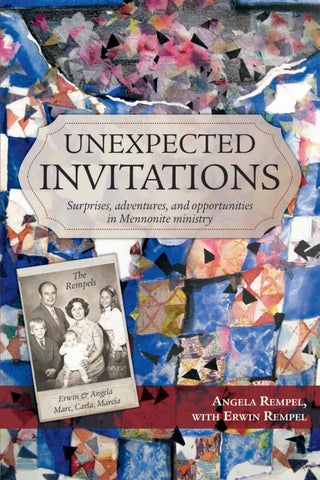
UNEXPECTED
INVITATIONS Surprises, adventures, and opportunities in Mennonite ministry
Angela Rempel, with Erwin Rempel An autobiography
i
Cover: The background, a watercolor painted by Marcia Rempel Weaver in 1994, is based on a quilt that was pieced by her great-grandmother Ida Albrecht (1884 – 1975) of Kingman, Kansas; quilted by her grandmother Magdalene Albrecht (1916-1986) and the women at Bethel Mennonite Church, Fortuna, Missouri. The quilt was first used in the 1950s by Marcia’s mother, Angela (Albrecht) Rempel. After many years of use, some fraying quilt pieces came off, inspiring the painting, which shows the quilt hanging on a cross, as a symbol of Marcia’s parents, Angela and Erwin Rempel, leaving the comfort of the familiar to follow God’s leading to a new place. Photo: The Rempel family in 1981, as shown on a prayer card prepared by the Commission on Overseas Mission of the General Conference Mennonite Church.
Unexpected Invitations: Surprises, adventures, and opportunities in Mennonite ministry Angela Rempel, with Erwin Rempel An autobiography Copyright © 2016 by Angela M. Rempel and Erwin H. Rempel All rights reserved. No part of this publication may be reproduced, distributed, or transmitted in any form or by any means, including photocopying, recording, or other electronic or mechanical methods, without the prior written permission of the copyright holder. Cover design by Campbell Print Center, 4564 South Valley Pike, Harrisonburg, VA 22801 Text design and layout by Jim L. Friesen Library of Congress Control Number: 2016920231 International Standard Book Number: 978-0-9979990-0-6 Printed in the United States of America by Mennonite Press, Inc., Newton, Kansas. www.MennonitePress.com
ii
Dedication To our three children and their spouses: Marcia Rempel Weaver and John Weaver Marc and Hannah Gascho Rempel Carla and Micah Hurst And to our six grandchildren: Rachel and Evan Weaver Madeleine and Katherine Gascho Rempel Shawna and Jeremiah Hurst
iii
iv
Contents Foreword............................................................................................. vii Preface...................................................................................................ix Chapter One: Childhood and Family Backgrounds................................................ 1 Erwin Rempel’s Story.................................................................... 1 Part 1: Family Background............................................................ 1 Part 2: Childhood in California, 1944-1957............................... 10 Part 3: Montana Teenager, 1957-1962....................................... 26 Angela Albrecht’s story................................................................ 39 Part 1: Family Background and Infancy..................................... 39 Part 2: Missouri Childhood, 1946-1956..................................... 45 Part 3: Montana Teenager, 1956-1962....................................... 67 Chapter Two: College, Courtship, Wedding, Seminary, 1962-1968.................. 91 Chapter Three: Pennsylvania Pastorate, 1968-1975.............................................. 121 Chapter Four: Brazil, 1975-1982............................................................................ 147 Part 1: Life and Language School in Campinas....................... 147 Part 2: Life in Gama, 1977-1980.............................................. 163 Part 3: Congregational Life of Gama Mennonite Church...... 195 Part 4: More Stories of Life in Brazil....................................... 212 Part 5: North America Ministry, June 1980-June 1981........... 220 Part 6: Gama Again, June 1981-September 1982..................... 237
v
Chapter Five: Kansas, 1982-1994.......................................................................... 249 Part 1: Starting Over in Kansas................................................. 249 Part 2: Erwin’s Work Experiences............................................ 252 Part 3: Family Life during the Newton Years........................... 270 Part 4: Angela’s Experiences...................................................... 282 Part 5: Church Experiences...................................................... 291 Part 6: Anticipating a New Chapter......................................... 296 Chapter Six: Botswana, 1994-2000...................................................................... 301 Part 1: Life and Ministry in Southern Africa............................ 301 Part 2: Our Family - A Funeral and Two Weddings................ 359 Chapter Seven: Kansas Again, 2000-2010............................................................... 375 Part 1: A New Life in the Same Town...................................... 375 Part 2: Working Again at 722 Main Street............................... 379 Part 3: Our Family Grows, Moves around the World, and Back......................................................................... 395 Part 4: Back to First Mennonite Church in Newton............... 404 Part 5: Afghanistan Adventure.................................................. 407 Part 6: Erwin’s Family Changes................................................ 432 Chapter Eight: Moving On as Retirees, 2010........................................................ 441 Part 1: Helping Family in California........................................ 441 Part 2: Retirement in Virginia................................................... 454 Epilogue............................................................................................. 465 Acknowledgements............................................................................ 467 About the author............................................................................... 469
vi
Foreword This is a story of the journey of two ordinary people inspired by their love for God and their love for each other. It is also a story of their common call to serve the purposes of God. That call inserted them into uncommon experiences and called forth in them extraordinary commitments that allowed them to make a difference in the lives of those they served. Along the way they created a family and engaged in cross-cultural mission. They became key players in a story filled with pathos, passion, and the pursuit of their desire to be agents of healing and hope in the world. Erwin and Angela’s story begins with their rootedness in communities that were shaped by the immigrant experience of their forebears who searched for a better, freer, more secure existence. This story recounts the intentional decisions Erwin and Angela made to leave the familiar circumstances that were their lot – risking comfort and security for the sake of Christ’s kingdom. In pursuit of their call, they travel to all continents, live in several, and everywhere encounter the surprises of God’s love and care in whatever circumstances they were called to face. The story told here is unvarnished and compelling. Through the journeys of the Rempels we observe the fashioning of a legacy that brought blessing into many lives. I am grateful for the gift of their story. The mission agency of Mennonite Church USA and its predecessor agencies give thanks for their service. I personally celebrate the privilege I had of intersecting with their story for a few years during the first decade of the 21st century. – Stanley W. Green, Executive Director, Mennonite Mission Network vii
viii
Preface The big Boeing 707 plane flew steadily through the night, non-stop from New York City to famous and beautiful Rio de Janeiro in Brazil. I was on my way, at last, to what I felt God had been preparing for me. Back in the country church of my childhood in Missouri, through the words of a missionary to India, I first heard God’s quiet voice urging me toward serving in overseas mission. That call intensified through my teenage years. In college I met and then married Erwin Rempel, who shared the same interest. We thought the overseas “mission field” lay straight ahead for us as soon as he completed seminary. However, some unexpected invitations came – tempting detours or part of God’s training for us? Now in the darkened aircraft, at age thirty-one, with a husband and two children, I focused on trying to sleep upright and not kick infant Marc sleeping at my feet. Earlier I had felt as though I, a non-swimmer, was jumping into the deep end of a swimming pool. Now excitement and fear, anticipation and curiosity, blended into a calm confidence of trust in God’s leading. This is a story of God at work, weaving together experiences that brought together a shy little country girl and a tall orphan boy into a life of ministry in Mennonite church circles – both in the United States and internationally. The chapters of our lives include living in nine different states and on three continents and too many travels to relate or even count. Each chapter of life left a permanent imprint on us. Our time in Brazil turned out to be especially momentous. At the far end of life now, we see that our experiences in earlier chapters of life continued ix
like strands into the next chapters to enrich, enable, and strengthen us for new tasks. Several themes run throughout: major unexpected invitations that changed the direction of our lives, changing times and technologies, and navigating through various aspects of Mennonite church life. We didn’t set out with clearly defined goals. We simply sought to follow the Lord’s leading, one step at a time. It is humbling and amazing to realize how full and abundant our lives have been. Erwin and I are overwhelmed with gratitude for God’s undeserved blessings in our lives. For our family, interested friends, and fellow travelers on the journey from the General Conference Mennonite Church to Mennonite Church USA, this account reflects our memories of where we came from and some of what we did. Unless identified differently, upon first reference, the churches and people mentioned were part of the General Conference Mennonite Church or Mennonite Church USA. “One generation will commend your works to another; they will tell of your mighty acts.” Psalm 145:4 Angela Rempel 2016
x
Chapter One
Childhood and Family Backgrounds Erwin Rempel’s Story Part One Family Background Henry Henry Rempel, Erwin’s father, had the distinction of being born in Switzerland into a German-speaking Mennonite family whose home was in Russia. That date was April 10, 1895, depending on which calendar is used. The Rempels were among thousands of Germans, including Mennonites, who settled in colonies in southern Russia beginning in the late 1700s. Their ancestral sojourn prior to that had been in the Netherlands and Prussia. While settled in Prussia, which now is part of Poland, the Mennonites’ diligent farming methods caught the eye of Catherine the Great, empress of neighboring Russia. She recruited Mennonite farmers in Prussia to relocate in Russia’s recently acquired Ukraine to develop its agricultural potential. In addition to enticing them with land, she offered exemption from military service and the privilege of maintaining German-speaking communities and churches. The first Mennonites moved to southern Russia in 1789 and began establishing several sizeable colonies. Henry Aron Rempel, (1861-1900), Erwin’s grandfather, was a minister in the Mennonite church in the town of Karassan on the Crimean Peninsula. Seeking more Bible knowledge, Henry Aron took his wife, Barbara Matthies Rempel, and two young daughters to Switzerland 1
UNEXPECTED INVITATIONS where he studied at the St. Chrischona Theological Seminary in the Canton of Basel. During Henry Aron’s year of study there, his only son, Henry Henry, was born, thus bestowing on him a Swiss birth certificate. We can only conjecture whether or not that document influenced the trajectory of Henry’s life. The family custom was to give the father or mother’s first name as a child’s middle name. Apparently they really liked the name Henry (Heinrich in the German) so the boy was named Henry Henry Rempel. The proud father wrote a letter on May 20, 1895, to his own mother back in southern Russia. He attempted to reassure her about the baby’s well-being. Here are some excerpts from the English translation of that letter written in the old handwritten German gothic script: “The little Heinzi brings us much joy. … That Heinzi is not suffering from malnutrition is guaranteed by his peaceful sleep, his round cheeks and legs and then (pardon please!) if you mother could see his accomplishments in his diapers, then surely all your motherly doubts and concerns would fade away.” Returning to Russia The Rempel family moved back to Karassan in the Crimea when Henry Aron completed his studies in Switzerland. Later another daughter joined their family. Henry Aron suffered from some chronic illness and died in 1900 when his son, Henry Henry, was only five years old. The widow and her children moved from Crimea north to Halbstadt, the administrative center of the large Molotschna Mennonite colony where both she and her late husband had been born. Barbara Rempel and her children likely enjoyed a comfortable and secure life in the Mennonite community. A 1903 photo of a large prosperous Rempel family shows blond-haired eight-year-old Henry sitting among the other children on the ground near the center of the photo. Erwin’s great-grandfather, Aron Johannes Rempel, is the elderly man centered in this photograph. Aron Johannes had been a minister at the Gnadenfeld Mennonite Church in the Molotschna colony, probably about the time that there was a major and bitter split resulting in the formation of the Mennonite Brethren Church. In general, most Mennonites in Russia enjoyed a comfortable life 2
Childhood and Family Backgrounds
Henry H. Rempel, age 8, with blonde hair, sits with other children on the ground in center front of large Rempel family at Gnadenfeld, Ukraine, 1903. Henry’s grandparents, Aron J. and Anna (Goerz) Rempel are seated behind him.
lived separately from the Russian people around them. Some Mennonites became very wealthy on large estates; some did well in business, but many prospered in agriculture. Among the Rempels there were teachers and ministers. In 1915 when Henry was twenty, he was studying at a commercial school in Halbstadt. The Great War begins Life changed when World War I began. During the war, from 191618, Henry, along with other Mennonite conscientious objectors, served in an alternative service role with the Russian military as a non-combatant in their version of the Red Cross, called “sanitar.” Henry didn’t leave any written information about that time. Other young men who served in that capacity have written about caring for wounded and dying Russian soldiers on the trains that shuttled them away from the battlefront to hospitals. 3
UNEXPECTED INVITATIONS
Erwin A. Albrecht and Magdalene Bixel wed on June 28, 1942, Bluffton, Ohio.
After a honeymoon to Niagara Falls, the couple settled into the parsonage a few blocks from First Mennonite Church in Chicago. They joked that the two-story houses were so close together that someone at the end of the block could fill a plate with cookies and pass it through the windows from house to house. During the Albrechts’ time, the south side of Chicago was transitioning to an African American community. The church remained there and transitioned with the community. In 2014 the directory of Mennonite Church USA listed it as a member of the Central District Conference with thirty-five members. The Albrechts’ firstborn My mother suffered a long and painful labor before my birth on June 20, 1944, at the Cook County Hospital in Chicago. They named me Angela Marie, apparently from a character in a book my mother had read. She spent about ten days in the hospital, as was the custom then. That left her too weak, after dismissal, to walk up the front steps of the porch of their home without help. One church member knew I liked bananas, a rationed product, and 44
Childhood and Family Backgrounds gave her portion to her pastor’s family. Mother enjoyed dressing me in pink. The one thing I am certain about regarding my parents’ aspirations for me is that I would become a follower of Jesus. They had no idea where that path would eventually take me. Erwin and Magdalene longed to return to their rural roots. January 1, 1946, they left the soot-filled air of Chicago. They moved to central Missouri to serve a Mennonite church in the country. I was eighteen months old and have no memories of the city where I was born.
Angela Albrecht, 15 months, Chicago, 1945.
Part Two Missouri Childhood from 1946 to 1956 One bright June morning in 1947 I was sent off to Vacation Bible School. Church was like a second home to this pastor’s daughter, and I was too young to wonder why they sent me. Not quite three years old, I wasn’t old enough to go to VBS. I didn’t realize how special that day would be, the first incident in my life that I remember. A couple who drove an old black car brought me back home about noon. I entered the house and saw a baby bassinet! I stood on tiptoe and peeked into it. There was my new baby brother, David Alan Albrecht. The doctor had come to the house for the delivery. Mother’s sister, Hilda Bixel, who had nurses’ training, probably came from Bluffton, Ohio, to help.
45
UNEXPECTED INVITATIONS Country church, country life The setting for my childhood in central Missouri was in the country, between the small town of Fortuna, our address, and Versailles, a larger town. Trees edged modest-sized fields on gentle hills. Dad served as pastor for about ten years at the Bethel Mennonite Church. The square white frame church with two bell-less towers was a landmark. Its tenacre plot included a cemetery and several acres of farmland that lay between the church and the two-story white frame parsonage. Near the house there was a barn, two chicken houses, a pasture, and large garden plots. After living in Chicago, farm-reared Erwin and Magdalene were in their element. Our chickens provided eggs and meat, cows gave milk, and numerous cats controlled the mice. Tall metal milk cans in the basement kept cream to sell. Large flat cardboard crates of peeping tiny chicks arrived to keep the brooder house supplied. We carefully tended fertilized eggs to sell for hatching more chicks. Dad planted various crops in the field that lay between the church and the house. He fed wheat, corn, and oats he grew to our animals and sold any extra for some income.
Bethel Mennonite Church, Fortuna, Mo., circa 1955.
46
Childhood and Family Backgrounds
David Albrecht poses with pets in front of Bethel Church parsonage, the Albrecht family’s home from 1946 to 1956.
We didn’t have indoor plumbing for the first several years we lived in Missouri. We used a hand pump, in the house, which pulled water from a cistern that collected rainwater from the roof. We used a drafty, stinky, two-hole wooden outhouse. An old Sears Roebuck catalog offered up its glossy pages first as something to look at, and then as a stiff option for toilet paper. My parents followed society’s custom of setting aside Sunday as a special day. We wore our nicest clothes, dressy shoes, and best coats to church. Shopping wasn’t an option as most stores weren’t open. Sunday was called a “day of rest,” but it was a busy day of work for a pastor and for the women who invited guests for a big Sunday dinner. Preparing for Sunday began on Saturday night when we studied our Sunday school lessons, shined our shoes, and took our weekly bath. Dad brought a large washtub inside, set it close to a gas heater in the dining room, and filled it with warm water. We children bathed first, followed by our parents after we’d gone to bed. 47
Chapter Three
Pennsylvania Pastorate from 1968 to 1975 When Erwin and I returned to Pennsylvania on June 1, 1968, Pastor Whitermore and his family greeted us again. They introduced Erwin and me to the recently formed congregation of Indian Valley Mennonite Church in Harleysville. It was a small town about eight miles from the “mother church,” Grace Mennonite in Lansdale, where Whitermore was pastor. The vision for a church in Harleysville had begun a few years earlier when Howard J. Habegger was pastor at the Grace church before he and his family went to Colombia as missionaries. Howard had even left a small monetary “deposit” for the birthing of a new congregation. Thus our journey first connected with Howard Habegger. An unfurnished two-bedroom apartment awaited us in the Mark Twain Apartments, set back off Main Street in Harleysville. In addition to paying Erwin an annual salary of $4,800, the church paid our rent of $135 a month, and utilities. It seemed strange that such a young firsttime pastor was paid significantly more than my father who had about thirty-five year’s pastoral experience. The kitchen electric stove and refrigerator were brown, one of the typical earth-toned colors fashionable in the 1960’s. There was no dishwasher or microwave. The second bedroom we made into an office. We bought used furniture for most of the apartment. We wanted the living room to look nice for visitors, so we borrowed money to buy new furniture for that room.
121
UNEXPECTED INVITATIONS Surrounded by charming farm fields, the small village of Harleysville straddled the two-lane Sumneytown Pike where it intersected with equally narrow Highway 113. We could buy groceries and some other basic items there, and do our banking. The larger town of Lansdale provided most other necessities. The sprawling Philadelphia metropolitan area thirty-some miles to the south offered an international airport, large hospitals, universities, major league sporting events, and a world-class symphony orchestra. Indian Valley Mennonite Church Before our June arrival, the new congregation had begun meeting in January at a township building in a room above the volunteer fire department. Dave Whitermore preached, so the new church started with having worship first so that he could also preach at the Lansdale church. Having the worship service before Sunday school was rather new then. Because of Erwin’s summer internship at the Grace church two years earlier, in 1966, we gladly reconnected with some familiar people and places. The members of Grace Mennonite in Lansdale who lived close to Harleysville made up a significant number of the new congregation, probably about thirty-five of the fifty who attended. Several other families from Eden Mennonite in Schwenksville rounded out the group. Grace Mennonite funded the new church, but already by the next January, the congregation was self-supporting. Within a few months of our arrival, the congregation rented a small old church building, known as the Chapel. Following my mother’s example, I plunged into being a pastor’s wife. I was a church pianist, taught Sunday school, helped Erwin make the weekly bulletins, hosted people, visited in homes, and whatever else was needed. Erwin and I also worked with youth. One winter we took some youth to Word of Life Snow Camp in upstate New York. That was the only time Erwin and I rode snowmobiles or tried skiing. Some of those same young people continued to meet in our apartment for Bible study into their college-age years. Soon other people joined our new church, including non-Men122
Pennsylvania Pastorate from 1968 to 1975
Angela and Erwin Rempel stand in front of old chapel where Indian Valley Mennonite Church was meeting in Harleysville, Pa., after his ordination on July 20, 1969.
nonites and new believers. Some of the women worked outside the home. The middle-class occupations of people in the congregation included factory worker, teacher, realtor, banker, and businessman. We were surprised how few people in the area had completed college or had traveled beyond a couple hundred miles of home, usually to the Pocono Mountains or the Jersey Shore. We were all of white European descent. Norman and Verna Bergey, already retirement age, took this young couple under their wings. (We were only twenty-three years old upon arrival!) They and the other church folks became the spiritual family Jesus refers to for those of us He calls to live and serve Him at a distance from our biological families. We had a lot of growing up and learning ahead of us. For a church potluck meal, I prepared a cake – from a box mix. The cake didn’t turn out and I quickly made something else. Then I observed that in Pennsylvania Dutch country one makes things from 123
UNEXPECTED INVITATIONS Introduction to Botswana Since the time Erwin and I visited Botswana in 1984, not only had the tense political climate changed dramatically, but Mennonite Ministries’ office and guesthouse had downsized and relocated in a smaller facility. As we arrived, the Mennonite Ministries (MM) team of about eighteen adults and nearly as many children converged on Gaborone from their assignment locations scattered around Botswana. They gathered for their annual planning meeting, led by outgoing country representatives Kathy and Eric Fast. We were immediately impressed with the qualified, capable, and delightful people who formed the MM team we’d work with. Mennonite Ministries used facilities on Pudomo Road that were owned by the Botswana Christian Council. What originally was a simple house had been enlarged to accommodate the MM office, library, bedrooms for guests, a lounge, dining area, and kitchen. Erwin, Carla, and I stayed at the guesthouse during our first week in Botswana. We slept on bunk beds in the two small rooms of a concrete block building behind the main building. Within a short time after our arrival, we began the process of getting residency documents. Thanks to the Technical Service Agreement that MCC had negotiated years earlier, that was easily accomplished. The three of us embarked on a steep learning curve in all aspects of our work and life. Living in an African village After the planning meeting, our next important task was to learn the Setswana language and culture. Botswana had no structured full-time language school, so MM team members learned the local Setswana language using the Brewster method. Brewster advocated self-guided language learning while living among local people. Learning imitated the way a young child learns – listen and try to speak. New MM workers went to live in a village right after arriving in the country. We did that too. The thought of living in an African village for nearly two months may sound very exotic and difficult. In many aspects, it was just that! 302
Botswana, 1994 to 2000 The Fasts took the three of us to the village of Metsimotlhabe about fifteen miles from Gaborone. Harriet, our village host, waited for us. Her spacious yard, kept free of vegetation, was swept clean. We drove up with the MM van and a small pickup carrying some basic furniture and simple items for our use. Metsimotlhabe wasn’t an untouched traditional African village but rather a village very much in transition, which helped us understand the realities of life in a fast-changing society. Harriet’s husband, along with many other villagers, commuted daily to Gaborone, riding in overloaded VW vans that served as public buses. His job with the water department paid enough for his family to have a nice house with electricity. They anticipated having piped-in water soon and a landline phone. Three of their children went to private schools. Their house was nicely furnished, including a color TV. But they had no vehicle. A short distance behind their nice house, we set up our temporary home in one of the other buildings in their yard – a plaster-covered concrete block, two-room structure without electricity or water. A small propane-powered refrigerator and two-burner camp-style stove functioned adequately in our kitchen corner of one room. Several shelf units and a table with a dishpan for a sink made a small convenient kitchen area. In the other room, we arranged three single beds and a small desk. After experimenting, I figured out a system of doing our laundry by hand, outside, using several plastic tubs. Three teenage girls looked on in amusement as this white woman clumsily scrubbed and wrung out things by hand. I asked one of them to show me how to do the scrubbing on a washboard, and she did so. In hindsight, instead of being a frugal, do-it-yourselfer, I should have thought in terms of “job creation,” and paid the girls to do the washing. The cold air and dust of dry season filtered inside through the loosely fitted windows and the gaps between the top of the walls and the tin roof. We used an outhouse, which was an unpleasant cold experience – especially in the dark at bedtime and early morning when the temperatures dropped to nearly freezing. A flashlight revealed spiders and bugs in the outhouse. It was easy to imagine other invisible creatures. During the daytime, the sun provided welcome warmth. Away from bright city lights, the star-filled night sky looked like the Montana skies 303
UNEXPECTED INVITATIONS I’d seen in my teenage years. Candles and a gas lantern illuminated our small quarters at night. A movable heater with a small propane tank kept us warm. We tuned in to BBC World Service on a shortwave radio to keep up with world events. Long before dawn, roosters’ crowing announced the coming day. Baby goats’ cries sounded eerily like a human child. Other sounds we heard in the village ranged from the sound of donkeys’ death-defying braying to piercing car alarms. The place where we stayed was on the edge of the village, next to a busy paved highway where cars zipped past and noisy trucks and buses roared and rumbled along. A work crew accompanied a big Caterpillar machine digging a trench alongside the highway. They laid fiber-optic cable for a new landline phone system that eventually circled all of Botswana. Every day Erwin, often Carla with him, took plastic containers in a wheelbarrow for a ten-minute walk to get water from a public water tap. Maneuvering the wheelbarrow with heavy full water containers over the uneven dirt paths was strenuous. We marveled at how slender girls of about twelve years of age appeared to manage doing that quite easily. Women carried large water containers on their heads with graceful ease.
Angela and Erwin wash dishes during village live-in, Botswana, 1994.
304
Botswana, 1994 to 2000
Carla and Erwin take a wheelbarrow to fetch water during village live-in, Botswana, 1994.
Our host’s oldest son, about age twenty, was a language tutor for Erwin. My tutor was a young woman who attended the University of Botswana. She, her three-year-old daughter, and the child’s father lived in another building on the same yard. The Brewster language-learning method probably works fine for extroverts. We found it hard to overcome our shyness and actually try to talk to people using the new Setswana words. Villagers were startled that white people would try to say more than the basic greeting, Dumela. Their mumbled responses didn’t resemble what the books said they were supposed to say in return. One of several Bantu languages, Setswana is very different from English, other than using the same ABCs for writing. Our host, Harriet, took us to meet and greet some village people. One day we walked with Harriet out to “the lands,” visiting people at homesteads along the way. This gave us a valuable glimpse of rural life and an opportunity to try out some Setswana. Each homestead consisted of several small buildings, often round thatched huts. Some type 305