The Voices Continue Series
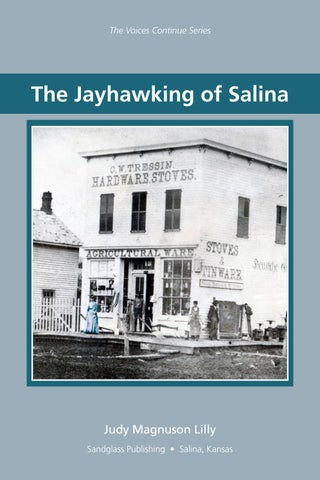
The Jayhawking of Salina
Judy Magnuson Lilly Sandglass Publishing • Salina, Kansas
Preface For years in my job in the Campbell Room of Kansas Research at the Salina Public Library, I kept running across references to the Civil War era raid on Salina by a small band of thieves. The known details were scant. On the morning of September 17, 1862, bushwhackers struck at dawn, surprising everyone. The ruffians corralled all the men and confiscated guns, ammunition, horses and mules. Then they rode away. What becomes murky is the sorting out of the hours and days following the surprise attack by the guerrillas. I found several reminiscences written by people who were there that day, and they agree that when the bushwhackers were gone, the towns people sent a messenger to Fort Riley to enlist help in recapturing their possessions. The first time I heard the raid referenced, soldiers were said to have refused to offer help. But I discovered more than one written source that confirms the presence of soldiers in Salina following the raid. Robert Bishop was the messenger to Fort Riley. He swears the officials at the fort refused to send troops. However, Rev. A.A. Morrison recorded in his diary two days later that fifteen soldiers arrived in town and left with a posse of Salina men to follow the bandits. How could there be such opposing memories? I decided to research the event, gather all the first-person accounts I could find, plus newspaper accounts, and compare them in order to iron out the confusion. The story that follows is the result of my attempt to search for truth. Judy M. Lilly
7
The Jayhawking of Salina They rode out of the north at dawn. The rough-looking bunch— fifteen some said; others remembered as many as thirty-five —thundered down Santa Fe, raising dust, brandishing weapons and running stolen ponies and mules. They would profess to be purloining for the Confederate cause in the War Between the States, but the community of Union supporters pegged them for common horse thieves. It was Wednesday, September 17, 1862. While a few settlers were still rubbing sleep from their eyes when the ruckus began, most folks on the prairie had started the day at first light. Horace L. Jones, hotel owner and manager of the Kansas Stage Company station, checked the feedbags in the corral near the center of town. He expected a mail stage later that morning. Gunsmith Charles Tressin sat by a window in his small hardware store, writing a letter to a friend. Settlers on claims outside of town—the Muir brothers, Benjamin Bean, the Giersches, James Sharp—had left their grass-filled bed ticks to tend livestock before tackling the field work of the morning. In a cabin southeast of the village, Irish-born Jane Coburn prepared the body of her small son, Wallace, for burial. Mrs. Coburn already knew this would be no ordinary day. Everyone else in the valley would find out soon enough.
1
They rode out of the north at dawn, September 17, 1862, taking the fledgling outpost by surprise. The rough-looking bunch—fifteen some said; others remembered as many as thirty-five—galloped down Santa Fe, raising dust, brandishing weapons and herding stolen ponies and mules. They would profess to be purloining for the Confederate cause in the War Between the States, but the community of Union supporters pegged them for common horse thieves. “The boldest piece of robbery that we have heard of lately was the descent upon the town of Salina, last Wednesday morning.” ~ The Smoky Hill and Republican Union (Junction City) Saturday, September 20, 1862
Judy Lilly is a native Kansan and has been researching local history for over forty years, beginning with a genealogy/history column in the Salina Journal called “Smoky Valley Roots.” In 1994, she published Voices from the Valley, containing selections of these articles about early families in the area. Over the years she has published historical fiction and nonfiction, including The Graves Truck Line Story. She is an associate member of Western Writers of America. “The Jayhawking of Salina documents an event that brought the MAG 80 NBAR .0104 BWA -0.0010 the jayhawking of salina violence of war to the very doorsteps of Salina residents. Every person interested in Kansas history should grab a copy.“ Encode: 9780985913014 90000 PU
~ Rod Beemer, author of Notorious Kansas Bank Gunslingers to Gangsters ISBN 978-0-9859130-1-4
90000>
$7.99
9 780985 913014