ISBN 978-0-9904722-1-6
51495>
9 780990 472216
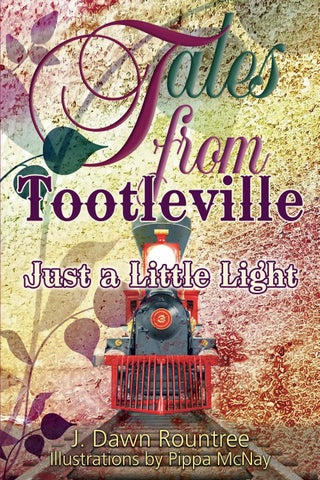
Tootleville
he “whoo whoos” of train whistles can still be heard, followed by rumbles as train cars gently sway from side to side as they lumber down the track through Miltonvale, Kansas. Trains have been a part of the town’s history since its beginning in the late 1800s, when cattle were shipped from Miltonvale by train. The town was named for Milton Tootle, a rich entrepreneur from St. Joseph, Missouri, who made his fortune in the 1800s when “the forty-niners” rushed toward California in search of gold. At the age of 26, Milton Tootle established a business in St. Joseph, selling supplies to pioneers in covered wagons who were headed west. Mr. Tootle did not need to go to California to find gold—the “niners” came right to him.
T
1
Tales from Tootleville Tootle took an interest in our little town and deeded land to the railroad that ended there. Miltonvale was the “terminus,” the end of the tracks, where trains turned around and headed back in the direction from which they had come. Since Milton Tootle helped found the town of Miltonvale in 1881, the people wanted to name the town for him. They discussed several different names including Tootletown, Tootleville, or Miltonvale, but decided on the latter. Maybe Miltonvale sounded a bit more sophisticated than Tootleville. The town is tucked in the midst of gently rolling hills. As early as the mid-1800s, settlers were already making their way to the area. But before the settlers came, it was prairie land inhabited by Native Americans and buffalo. No wonder Dr. Brewster Higley penned the words to a song in 1870 that became the state song of Kansas. “Oh, give me a home where the buffalo roam, where the deer and the antelope play….” That is what the land around Miltonvale was like. One of the early settlers, George Gray, shared his story of coming to the Miltonvale area in 1869. Here it is: “I will try to relate part of my life as a pioneer. I was born in Indiana in 1849. We came to Bala, Kansas, by covered wagon in October, 1869, and it was a great adventure. Father was eager to go on a buffalo hunt—his reason for coming to Kansas. “Two wagons were loaded with provisions and our first stop was at Dexter’s for flour. The mill and a few other buildings comprised Clay Center. We crossed the Republican River at Rocky Ford and camped the second night at a site, now the Miltonvale Park. There was one lone tree and a waterhole. We cut down the tree to cook our supper and killed two coons in the waterhole. This country was just 2
Tales from Tootleville hills and prairies” (written by Fannie Palmer, 1959, for the “Miltonvale Record”). Mr. Gray told a story of a buffalo hunt near Miltonvale when he and his father encountered Native Americans. He continued his story, “We were told a tribe camped up the river and we tried to avoid them; but coming to a hilltop, we met two riders who ordered us to camp near them. “They were friendly Pawnee and after council we smoked the pipe of peace with them. The next day they moved and took us with them lest we stampede a nearby herd of buffalo.” During George’s buffalo hunt with the friendly Pawnee, they killed seven buffalo and had to melt snow to cook the meat and to have water to drink. There were soon many changes in the town of Miltonvale after it was founded on December 1, 1881. Businesses and houses began to spring up. At one point there were three hotels, a livery barn, an opera house, a grocery store, a bank, a creamery, and six churches, just to name a few. The town had its own doctor and dentist. There were also saloons, “joints,” as the ladies called them. But in 1898, the women of Miltonvale took care of that. Armed with axes, the women chopped down the door to one saloon, hacked open the barrels of beer, sending the liquor flowing and owner running! Lively times in our little town! Tragedy struck our town in 1904 when fire destroyed seventeen businesses—some which were never rebuilt by the owners. Grasshoppers, drought, and tornadoes also took their toll on Miltonvale from time to time. In 1909, the Miltonvale Wesleyan College was established in Miltonvale, but it was closed in 1972 when the college was moved to Bartlesville, Oklahoma. The population of the town decreased significantly at that time. 3
Tales from Tootleville In 1947, Joe and Mildred Foster bought a small telephone company. In 1949, their son Jack and his wife Ludie moved to Miltonvale to help with the company which became known as Twin Valley Telephone. It has grown and continues to expand today. In 2002 a large playground area was added to our park. There is a large sign over a little train that names the park simply “Tootleville.” Each August there is a celebration called “Tootlefest” complete with a parade, turtle races, sack races, and tractor pulls for the children. In the evening there is a concert in the park at the band shell (built in 1936) followed by a street dance downtown. Today part of the land around Miltonvale is still prairie land where cattle graze, but crops of wheat and milo dot the fields of the flatter land. There is more than “one lone tree” in Tootleville Park, and many unwelcomed cedar trees spring up throughout the pasturelands. The town has seen numerous changes. Many of the original old buildings are gone—they have been burned down, torn down, or moved. Five of our original six churches are still open—plenty churches for a town of a little over 400 people. Some houses are empty, and many of the people that I became acquainted with in the 70s have gone on to heaven—I miss them. Train whistles still blow their daily “whoo whoos” at the railroad crossings, and the cars still squeak and rumble down the track. The train whistle has a new tone; the whistle is probably electronic rather than steam as it was in the past. Trains still regularly pass through Miltonvale, but the narrow gauge tracks were taken up years ago. Miltonvale is no longer the terminus—the track continues on to other towns. Farming has replaced much of the cattle raising, so 4
Tales from Tootleville more wheat is now loaded into the box cars than cattle as in the 1800s. Life in our small town goes on. I still love “Tootleville� because of its people. Someday I will probably be buried here, in the cemetery that overlooks a large wheat field. But until then, I plan to keep on writing my stories, my Tales from Tootleville.
5
Bumblebees and Hollyhocks
grew up in Tennessee on a farm where my sisters and I were free to safely explore our large back yard, woods, and beyond. We romped barefoot from early spring until fall, making memories that have lasted. One of my memories is of bumblebees and hollyhocks. Let me tell you how it worked. When the hollyhocks were in full bloom in our back yard, my sisters and I would pick off a big blossom, just the flower without a stem. We would hold the blossom in one hand like a cup and face the hollyhock stalk with wide-open blooms, waiting for an unsuspecting bumblebee to arrive inside a flower to sample the sweet nectar.
I
35
Tales from Tootleville When the bumblebee had settled himself inside the flower, we would quickly clamp the already-picked hollyhock over a blossom on the stalk with the bumblebee inside. Then we had to hold on tightly, really hold on to the two flowers with the trapped bee! While we held on to the hollyhocks, the bumblebee inside became frustrated and buzzed and buzzed, louder and louder! We had trapped a bumblebee, and we were in charge of the show! Such fun it was—at first! Then, in time, our arms became tired, the game grew old, but inside that hollyhock was a very angry bumblebee! Yes, the only down side to our game was we eventually had to let go, we had to turn loose! Even though we had done the “bumblebee-hollyhock trick” before, it was always a temptation to do it again. As a general rule, the bumblebee won even though we had learned to run like crazy when we turned loose! But we usually got stung! The pain was excruciating with ensuing swelling, soreness, and itching to follow! Looking back, I believe there are lessons I learned about bumblebees and hollyhocks which can be contrasted and compared to living life. • As children we chose whether or not to play the bumblebee-and-hollyhocks game. With life, sometimes there are no choices in some situations. Sometimes “life just happens,” and we have to deal with the fallout. • Sometimes when playing with bumblebees and hollyhocks, we did not get stung. Many times life brings us joy and we can escape the pain, at least for a while. • As a child, while hanging on to the hollyhocks, my arms became tired. Hanging on to the past, if the past has been unpleasant, can be wearisome and tiring. 36
Tales from Tootleville • Whether hanging on to an angry bumblebee in two flowers or hanging on to the past, turning loose of either can be painful. Turning loose and moving on with life is not always easy. • When holding on to a bumblebee, one must make a decision when to turn loose—moving on is a conscious decision. Even though “letting go” can be difficult and painful, whether it be turning loose of a bad relationship, a job, or making some other change in your life, you may have to turn loose of the “hollyhocks” in order to get “unstuck” and move around “the yard,” to explore life freely again. But dare to kick off your shoes and feel the cool, green grass beneath your feet. Yes, sometime you just have to let go!
“Just living is not enough,” said the butterfly. “One must have sunshine, freedom, and a little flower.” —Hans Christian Andersen
37
The Night of the Wooly Booger
My “wooly-booger” experience happened in the springtime in 2007. My husband Ralph had died the previous year, so life had been a bit tough. Prior to my husband’s death, it was he who I would call if there was a crisis, he who would pray with me. After his death, even though things had not been easy, there had not been a major crisis in my life until the “Night of the Wooly Booger.” Here’s the story. After work one evening, rather than go home to an empty house, I drove to a town about 25 miles away. There I ate a quick meal, then went to Wal-Mart. It was just easier to push a basket around the store than go home alone.
M
221
Tales from Tootleville I had not been there long when my son-in-law Bryan called to let me know that my daughter Misty was in the hospital in Manhattan and was in excruciating pain. He said the doctor was not sure what was going on. I told Bryan I would be on my way, and I hurriedly exited the store, jumped into my car, and was soon headed toward home. Thinking I might need to stay all night at the hospital, I stopped by the house which was one mile off the highway to pick up a change of clothes and some cosmetics. When I drove in the driveway, I didn’t bother to turn off the car engine and did not shut the door on the driver’s side. I quickly gathered a few things, jumped back in the car, and started driving toward Manhattan. Shortly after leaving home, I called my dear friend Joan and told her Misty was in the hospital. I told her that normally Ralph would have been the one to pray for Misty, but, as she knew, he was gone. I tearfully asked Joan to say a prayer for Misty, and she did. It was a jet-black night. As I drove east, my mind was still spinning, but I felt reassured by the prayer of my friend. When I was a few miles further down the road, I sensed that I was not alone in the car—something was silently moving in the passenger seat! Then I felt something very big, very heavy, warm and wooly move over into my lap. The wooly thing just plopped there! I could feel the hair on my head stand straight up! A shiver went up my spine, and goose bumps popped up on my arms! It was too dark to see what my traveling companion was! But I did know for sure that I was terrified, and “the thing” had to go! So I started rolling down my car window while I carefully but firmly applied the brakes. I also put on the blinker to signal my intention of pulling the car to the side of the road. I did not want to wreck, but I could not get 222
Tales from Tootleville the car stopped fast enough! And the “wooly booger” still sat firmly planted in my lap, heavy, furry, and warm. It was sooo heavy, I actually thought it might be a raccoon. I said aloud to “the thing,” “You’ve got to go!” When the car was almost stopped, “the thing” spoke up with a timid “Mee-ow!” You guessed it—it was a cat! When the car came to a halt, I opened my door, and “the wooly booger” bolted out of the car like a streak, quickly disappearing into the pitch-black night! Then I called my friend Joan again. She must have thought I had gone bonkers! The first time I had called her, I had been crying, but this time I was laughing so hard I could hardly tell her the story of “the wooly booger.” By then, it had occurred to me that “the wooly booger” was probably the neighbor’s cat which regularly made visits to my house. In retrospect, the whole incident made sense. The cat probably saw my car door open when I ran into the house. It was then the cat had crawled into the car. In the dark, I did not see the cat in the car with me. Perhaps the cat was as scared as I had been as we traveled down the road together. A few days later, I spotted the neighbor’s cat in our yard again. The cat had walked a few miles to get back home! What lessons did I learn from my “wooly-booger” experience? Here are a few: • I learned the importance of having a wonderful friend in a crisis. (My daughter had gall bladder surgery and was fine— my friend helped at just the right time.) • I learned that some of those “things that go bump in the dark” are not always monsters as we might think. (They might be something as harmless as the neighbor’s cat.) • I learned that “laughter is the best medicine” in a crisis. 223
Tales from Tootleville (Laughter can make you forget your tension—make you laugh until you cry, replacing tears of sadness!) • I learned that I had made it through a frightening experience even though my husband was not there with me. (I was thankful for Joan.) •B ut most of all, I learned that God must have a sense of humor. When I had my encounter with “the wooly booger,” I can imagine God looking down at me and that cat riding down the road together in the dark, just knowing what was about to happen. (I think God must have had a chuckle too!) If you have ever had a scary, traumatic moment, I hope your outcome was as harmless as a friendly kitty with a timid “mee-ow”—that your “wooly-booger” experience has been a reassurance that everything will be okay.
God is light; in him there is no darkness at all. —1 John 1:5
224
You Have to Go Through It A Will Thomas Tale
hen our youngest grandson Will Thomas was almost three years old, his family lived in a cul-de-sac where there were many neighborhood children. Will liked to slip away from his own yard, sometimes without permission, to go play with the other kids. It was common for him to try to slip out through their front gate or climb over the backyard fence. One day Will’s
W
303
Tales from Tootleville mother Misty was in the front yard when Will Thomas decided to go out of the gate to play. Misty said, “Will Thomas, don’t you dare go through that gate!” Without a word, he did not go through the gate, but climbed right over the top of the gate and proceeded on his way. It was amazing how well he already knew the difference in the prepositions through and over, even at the age of two. Since he did not go through the gate, he thought he had outsmarted his mom, but he did not get away with his escape attempt. We usually have plans for our lives, dreams for good things, not bad. Yet things await us that we do not want and do not expect. We would prefer to not go through the tough times at all, but they are a part of life. Unlike Will who just crawled over the gate, there are times when there is no other path than through—we cannot go over or around some situations. Since there is no other path, we sometimes have to brace ourselves and “go through the gate.”
Enlightenment means taking full responsibility for your life. —William Blake
304
ISBN 978-0-9904722-1-6
51495>
9 780990 472216