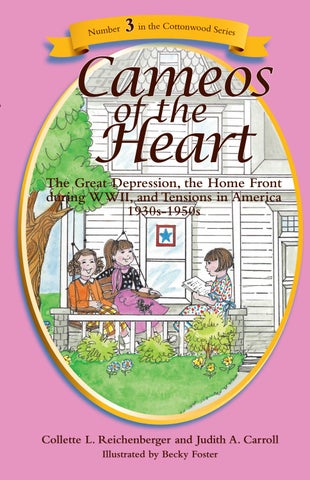
Cameos of the Heart: The Great Depression, the Home Front during WWII, and Tensions in America, 1930s–1950s
Number
3 in the Cottonwood Series
Cameos of the Heart
The Great Depression, the Home Front during WWII, and Tensions in America 1930s-1950s
Collette L. Reichenberger and Judith A. Carroll Illustrated by Becky Foster
Cameos of the Heart
The Great Depression, the Home Front during WWII, and Tensions in America 1930s-1950s By
Collette L. Reichenberger and Judith A. Carroll Illustrated by Becky Foster
j Author’s Voice McPherson, Kansas
Cameos of the Heart:The Great Depression, the Home Front during WWII, and Tensions in America,1930s–1950s By Collette L. Reichenberger and Judith A. Carroll Copyright © 2018 by Collette L. Reichenberger and Judith A. Carroll. All rights reserved. No part of this book may be reproduced or transmitted in any form or by any means, except for brief quotations in reviews, without the written permission of the authors. This book is a work of fiction. The historical events, figures, and places are real. However, the characters and the circumstances of these stories are figments of the authors’ imaginations. Illustration by Becky Foster Editing and book design by Jan Gilbert Hurst Published by Author’s Voice 1315 East Euclid, McPherson, KS 67460 www.AuthorsVoicePublishing.com ISBN: 978-0-9970062-7-8 LCCN: 2018940685 Printed and bound in the United States of America by Mennonite Press, Inc., Newton, Kansas. This is Book Three in the Cottonwood Series. Book One, also by Reichenberger and Carroll, is Cameos of Courage, published 2017 under ISBN 978-0-9970062-3-0, Book Two is Cameos of Strength, published 2017 under ISBN 978-0-9970062-5-4. ii
Praise for Cameos of the Heart “In their quest to make subjects relevant for students, effective teachers search for methods and materials that will pique interest and inspire connections. Cameos of the Heart, the third volume in the Cottonwood Series by Judy Carroll and Collette Reichenberger, certainly provides a relevant resource. Cameos of the Heart is filled with vivid descriptions of everyday life during the 1930s through the 1950s for the children and their families and friends featured in the three stories, highlighting socioeconomic conditions affecting Southeastern Kansas during the Dust Bowl and Great Depression, life at home during WWII, and racial tensions of the era. Utilizing the literary technique of letters, the authors reveal how the appealing young characters were affected personally by historical events/disasters and how they overcame the hardships they faced. As well as gaining a better understanding of the historical era, readers possibly will learn to empathize with other peoples’ trials and perhaps infer that compassion and resolve may very well lead to a variety of possible solutions. Additional features in the book include: helpful glossaries in the beginning of each story; recipes for bread and cookies discussed by characters; and authors’ notes at the end of each of the stories providing further information. Kudos to Carroll and Reichenberger for another fine volume in the Cottonwood Series. As a former teacher and teacher educator, I thoroughly enjoyed and highly recommend Cameos of the Heart.” Kay Clapp, Ph.D., Professor Emerita, Truman State University “In Cameos of the Heart, young readers will discover important history lessons hidden within the relatable stories of young women experiencing the highs and lows of life on the prairie. Readers from Southeast Kansas will find it exciting to recognize their hometowns and local history in the book’s settings, but all readers will be able to see themselves in the stories of Grace, Alexis and Tayler. As these protagonists navigate through the Great Depression, the homefront during World War II and the Cold War and Civil Rights Movement, they always maintain their core values of optimism, compassion and kindness. In the end, this three-part series will not only make history come alive for young readers, it will also prove that those readers, too, can live life with courage, strength and positivity. I only wish I’d had these stories to read as a young girl growing up in Kansas!” Kimber Wallace, Publisher & Editor | Southeast Kansas Living P.O. Box 475, Neodesha, KS 66757 620-249-0073 | southeastkansasliving@gmail.com www.sekliving iii
Dedication Cameos of the Heart is dedicated to all young girls and boys to inspire an interest in history and to our grandparents, parents, and grandchildren. We especially dedicate it to Grace, Alexis, John, Eleanor, Byron, Tayler, Payten, and Colton.
iv
CONTENTS Introduction . . . . . . . . . . . . . . . . . . . . . . . . . . . . ix Story One Grace: The Optimistic Girl. . . . . . . . . . . 1 Story Two Alexis: The Compassionate Girl. . . . . . 45 Story Three Tayler: The Friendly Girl with Heart. . . 79 Resources . . . . . . . . . . . . . . . . . . . . . . . . . . . . . 139 About the Authors and Illustrator. . . . . . . . . . . . . 143
A cameo is a piece of jewelry with a stone or shell on which figures are carved. —A Student’s Dictionary & Gazetteer, 22nd edition. The Dictionary Project, Inc., Sullivan’s Island, South Carolina
vii
INTRODUCTION “…when a society or civilization perishes, One condition may always be found. They forget where they came from. They lost sight of what brought them along.” —From Remembrance Rock by Carl Sandburg
Cameos of the Heart
is the third book in the Cottonwood Series. The book features three girls, age ten, and covers the time period from the 1930s through the 1950s. The unifying positive character traits of the three girls are their empathy and ability to feel positive in difficult circumstances. “Grace: The Optimistic Girl” focuses on three cousins during the Great Depression. Grace lives in a small town located in the Southern Flint Hills of Kansas and moves to Wichita, Kansas, with her mother and father. Ginny, her cousin, lives on a farm in Western Kansas. Another cousin, Mary Alice, lives in Southeastern Kansas. The narrative tells stories shared by the girls through their letters to each other during this time. The Dust Bowl in Western Kansas, farming in Eastern Kansas, and the aircraft industry in Wichita are covered. All chapters except the first one begin with a letter. “Alexis: The Compassionate Girl” is about a young girl who lives in Parsons in Southeastern Kansas during World War II. Her positive character trait is compassion.World War II facts begin each ix
chapter, and the story focuses on the Home Front during this war. Alexis’s family adjusts to the rationing program, her mother’s entering the work force, and her uncle’s going missing in action during the war. “Tayler: The Friendly Girl with Heart” is set in a small town in Southeastern Kansas in the 1950s. Tayler is ten and, along with her family and friends, Linda and Delia, faces the challenges of living in the early years of the Cold War. Her friends and she are confronted with racial discrimination and deep-seated prejudice. Tayler’s heart tells her what actions need to be taken during each challenge. Some events and characters from Cameos of the Heart are based on actual happenings and people. Other events are fictional and creations of the authors. Real historical people, such as President Franklin D. Roosevelt, President Harry S. Truman, General Dwight D. Eisenhower,Woodie Guthrie, Martin and Osa Johnson, and Amelia Earhart appear in the stories.The authors have tried to portray an accurate picture of history.
x
1 Grace: The Optimistic Girl By Judith A. Carroll with Collette L. Reichenberger The Flint Hills and Wichita, Kansas 1930s
2
C ameos of the H eart
Optimist: A person who anticipates the best outcome of actions or events
G race : the O ptimistic girl
3
CONTENTS Chapter One – Bad News Chapter Two – The Boarder Chapter Three – Family and Friends Chapter Four – The Unexpected Chapter Five – Farm Life Chapter Six – Hard Times Chapter Seven – The Wedding Brings Change Chapter Eight – A New Home Chapter Nine – A Christmas Reunion Authors’ Notes
, HELPFUL TERMS Dust Bowl: An area of the Great Plains of the United States with dust storms caused by lack of rain, wind erosion, and poor farming practices WPA: Works Progress Administration was created in 1935 to provide jobs constructing public works projects, like public buildings, parks, and roads. The WPA also employed people in arts’ projects. PWA: Public Works Administration was a federal government relief agency created in 1933. It paid for heavy construction projects building highways, airports, bridges, dams, irrigation, water management, and sewage systems around the United States. It did not employ people.
4
C ameos of the H eart
Shantytown: An area, usually on the edge of a town, where poor people constructed flimsy shelters made of plywood, tin, or cardboard Stock Market Crash of 1929: The stock market crash occurred October 29, 1929. Stocks lost their value, and people who were invested in the market lost money. It signaled the beginning of the Great Depression. Sulfur: A bright-yellow powder found in volcanic deposits and sometimes used to repel chiggers The Great Depression: A time of low business activity and financial crises in the world Thresher: A power-driven machine used for separating grain from plants Windmill: A wind-driven water pump
C H A P T E R one
Bad News
M
ama, I’m home,” I said and hurried to the kitchen sink where Mama peeled potatoes. I stood beside her and, just as I did every day after school, wrapped my arms around her and gave her a big kiss. Usually, she stopped what she was doing and gave me a hug and kiss, but that day she didn’t. She just kept peeling a potato. I watched the spiraled, brown peel drop unbroken into a pan of water. The eyes of the potato had started to sprout, and Mama cut them out with the tip of the paring knife. “Mama,” I said again and hugged her tighter. Still, there was no hug or smile. I looked up at her face and saw tears seeping from the corners of her eyes. “What’s wrong, Mama? What is it? Is Daddy okay? Is he hurt?” “Oh, Grace, something awful happened,” Mama said. She dropped the smooth, white potato into a different pan of water and picked up another one.“Daddy’s not hurt, but he can’t work at the bank much longer. The president of the bank told your daddy this morning he could pay him for only two more weeks,” Mama said. “The bank president said the bank will close.” Mama dropped the peeled potato into the pan of water. Daddy had worked at the bank for five years. He could do every job—from receiving deposits to locking the vault where the money was kept. I thought Mama was mistaken. How could the bank operate without my daddy? I didn’t like to see Mama’s pretty blue eyes puffy and red. Tears continued to slide down her cheeks. Mama had only cried 5
6
C ameos of the H eart
twice before that I remembered. She cried when my grandma died and when my Aunt Ruth moved to Western Kansas. Mama always said she cried so much as a child when her two brothers died that she had used up all her tears. Her brothers had died of diabetes before the discovery of insulin. I wondered how losing a job could be as bad as having two brothers die. “Mama, don’t cry. Daddy will find another job. Maybe he can work at the lumber yard or in the grocery store,” I said and smiled at her. Mama always said my smile made her happy. At last Mama wiped her wet hands on her apron, dropped to her knees, and hugged me tightly. Mama and Daddy were quiet during supper. Fried chicken with mashed potatoes and gravy was one of Daddy’s favorite meals, but even Mama’s good food didn’t bring a smile to his face. Mama dabbed at her eyes with her lace-edged handkerchief. “I didn’t miss any math problems in school today,” I said, hoping to cheer them. Math was my worst subject in school, and I seldom got all the problems correct. Both Mama and Daddy looked at me and halfway smiled, but neither said a word. After I went to bed, I heard my parents talking about a market crash in 1929, but I didn’t understand how a market crash in 1929 in New York caused my father to lose his job now in Kansas. I tried to think of a way to cheer up Mama and Daddy. Maybe Mama would let me bake a cake for Daddy. Chocolate was his favorite. Or, maybe my cat, Mr. Jingles, and I could perform a play for him. Mr. Jingles could wear one of my old baby dresses. Perhaps I could try to find a job for Daddy. “Please, God, help me find a new job for Daddy,” I prayed. The next morning I hurried to the breakfast table. “Mama, I will be late getting home from school today. My teacher said she needed help rearranging the books in the library after school.” “Okay, just be home in time to do your chores,” Mama said. Our house sat on several lots at the edge of town. There was a shed by the back fence where we kept Splat, our Holstein cow. When we first got her, Daddy said she looked like someone had
G race : the O ptimistic girl
7
splattered black paint on a white rug, and that’s why we gave her the name. Milking her every evening after school was my job, unless it was cold or I was sick. Daddy did the milking on those days. We had a chicken coop for Mama’s chickens, too, and I gathered the eggs after school each night. I didn’t like telling Mama a lie. It was wrong, but if my plan worked, she would forgive me. Instead of staying after school, I walked to the lumber yard. “Aren’t you Grace Butler?” the man at the lumber yard asked before I could tell him what I wanted. “Yes, I am,” I answered. “Do you…?” “Your daddy works at the bank, doesn’t he?” the man interrupted. “Yes,” I answered, “that’s why….” “How old are you now, Grace? About ten?” “Yes, sir, I’m ten,” I answered. “Do you….” “I heard the bank was in trouble…that it might have to close,” the man said. “I’m sorry to hear that. What can I get for you? Is your daddy going to finally fix up that old chicken coop? I’ll need cash for what you buy,” the man said. “No sir,” I said.“Daddy doesn’t need boards or nails. I’m here to see if you need any help at the lumber yard. My Daddy needs a job. He’s really good at building things, and he gets along well with folks. Everybody likes him.” “Well now, Gracie, that’s mighty nice of you to try to find a job for your daddy, but I’m afraid I can’t give him one. I wish I could, but I can’t. This depression is about to put me out of business. I barely make enough money to feed my own family. No one is building houses or barns. If I didn’t have this lumber yard, I’d pack up and move to Wichita. I hear there’s a few jobs to be had building airplanes. Don’t know how long those jobs will last, though. I still owe money to the bank myself,” the lumber-yard man said and shook his head. I was disappointed, but not discouraged. The next morning I told Mama my teacher still needed my help, and after school
8
C ameos of the H eart
I asked the owner of the hardware store if he had a job for my Daddy. He didn’t—nor did the men at the drug store, the feed store, or the car garage. Daddy no longer went to the bank every morning. Some days he didn’t get out of bed until after I left for school. At the supper table Mama and Daddy didn’t talk about him not having a job. They didn’t smile much either. I tried to cheer them up and told stories about school. No matter how funny I made my stories, they just said “that’s nice” and kept eating, taking small bites and chewing slowly. It seemed they wanted to taste every drop of flavor in the food. I worried that Mama was too thin. Her dress drooped from her shoulders. Once I heard Mama and Daddy talk about taking in a boarder. Our house had only a kitchen, a front room, one bedroom, and a small room off the kitchen we called the back porch. My bed was in one corner of the back porch. Mama kept her washtubs and our heavy, outdoor winter coats and boots in the back porch, too. I didn’t know where a boarder would sleep in our house.
C H A P T E R T wo
The Boarder Dear Ginny, Hello. I have bad news. Daddy no longer works at the bank. The doors are locked because it failed. Daddy said it couldn’t stay open because there wasn’t enough money to pay back the people who put their money in the bank. Mama said the country is in a depression. There are no jobs, and no one has any money. I heard Mama and Daddy talk about taking in a boarder. Mama said Daddy and she will sleep on the enclosed back porch where I sleep now. The boarder will sleep in their room, and I will sleep on a mat of blankets on the floor in the front room. We might move to Wichita so Daddy can get a job building airplanes. I hope we do move because I might get to take an airplane ride. I hope, too, we have an inside bathroom. My Sunday school teacher said, “Be of good cheer and trust God.” I always try to be of good cheer because I think it makes Mama and Daddy feel better. I’m trying to trust God to find Daddy a new job, too. I just hope God doesn’t take much longer.
9
10
C ameos of the H eart
I caught a cold this week. Mama wants to rub my chest with turpentine and lard and put a hot towel on me. She has already said I can’t wash my hair Saturday night. I don’t want the croup, but I don’t like smelling like turpentine either. Mama said it is bedtime, so I will close for now. She is holding the turpentine bottle. Ugh! I wish we lived closer to each other. Write soon. Yours very truly, Your cousin, Grace
G
,
inny and I put our letters to each other in the same envelopes Aunt Ruth and Mama used for their letters. My other cousin, Mary Alice, lived in Eastern Kansas. I didn’t get to see either of my cousins often, but Mama and Daddy said family was important, and we stayed close to each other through our letters. It was comforting to write to Ginny about Daddy losing his job. Mama and Daddy didn’t talk about it anymore. Without a job, Daddy spent most of his time in his garden. One day he made a hotbed on the south side of Splat’s shed. He enclosed soil mixed with manure in a wooden, box-shaped frame covered with a window pane. The heat from the sun and decaying soil caused Daddy’s tomato seeds to sprout into tiny seedlings. Mr. Jingles couldn’t dig them out of the ground either. Daddy’s lettuce and radishes peeked through the ground in the garden. Some days Daddy helped a farmer cut wood. One night his back hurt so badly he didn’t come to supper, and he had blisters from using the cross-cut hand saw. “You’ll feel better after I rub this red Rawleigh’s Salve on your hands and back,” Mama said.
Cameos of the Heart
The Great Depression, the Home Front during WWII, and Tensions in America, 1930s–1950s “Then I heard the rattling, much like the sound the cicadas made at night, but it wasn’t an insect. It was a snake, a rattlesnake!” “The folks at the drugstore said Hawaii had been attacked by Japanese war planes.” My family quickly gathered around the radio in the living room. “Well, no, they can’t and neither can you if you’re trying to bring them into my store. Colored cannot be served at this counter. You better git, girl, and take your friends with you. Git, before I call your father,” he said with a growling voice. Grace, Alexis, and Tayler demonstrate empathy in their lives along with Christian family values. Readers will learn about historical events and life on the prairie as they relate to the young girls in the book. The readers can apply the positive character traits of the girls and the lessons learned to their own lives.