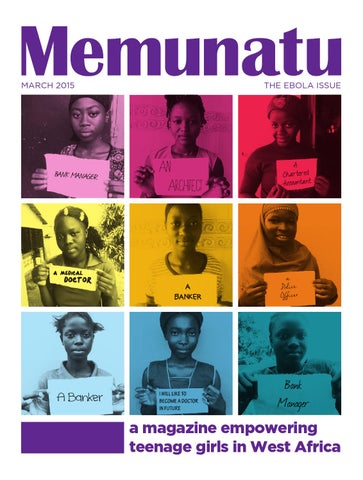
MARCH 2015
THE EBOLA ISSUE
a magazine empowering teenage girls in West Africa
Welcome to Memunatu a magazine for teenage girls
From studying to housework, there can be a lot to do in one day! Memunatu is here to help you with school, life, and everything in between. Let your voice be heard through Memunatu magazine.
memunatumagazine.com MemunatuMagazine
MAGAZINE
Read articles written just for you! In each issue, you will find topics that you care about from trends to technology and entrepreneurship, along with tips for school and advice on how you can succeed. In the Features section, see girls like you in the magazine!
MEMUNATU AMBASSADORS
Take on a leadership position by joining the Memunatu team as a student ambassador. Represent your school and represent your classmates! Tell us what issues matter to you and get some great training as a leader.
In this Issue: Stories, tips, and resources to help you understand the Ebola epidemic and move beyond the crisis: Trends: The Power of Music p3 Feature: Ebola in Town p4 Health: Halt Ebola in its Tracks p6 Spotlight: Science of Ebola p7 Skill Building: Study Tips p8 Page Turners: So Long a Letter p9 Speak Up: Resources p10
MOBILE SMS
Participate in Memunatu over mobile. Share your opinions on articles, give your perspective on issues, and get some important feedback. copyright Š 2015, Memunatu Magazine, Inc. All rights reserved
IT’S SPECIAL TO BE A MEMUNATU GIRL.
TRENDS
Want more? Learn about the “Save Liberia” initiative—a collaborative effort from musicians across Liberia. memunatumagazine.com
EBOLA IS REAL According to Sky FM radio DJ Elliot Adekoya “Milk Man,” a popular song circulating the airwaves is from F.A. and Soul Fresh. [i] Their song, “Ebola Is Real”, provides information on how people can protect themselves and avoid infection. This catchy, upbeat number has easy to remember lyrics. Although lighthearted, the song gives vital facts.
EBOLA IN TOWN
By Shadow and Kuzzy of 2Kings, “Ebola in Town” also shares preventative suggestions. Lyrics such as, “don’t touch your friend,” are sung to a fast-paced beat. Although this dance song discourages human contact, it has inspired a new dance craze where dancers mimic hugging from a distance. This allows dancers to express affection and interact in a safe way.
As Ebola spreads, physicians and aid workers try to take care of the sick and prevent infection. Musicians, however, are also key players in this effort. Throughout the region, popular singers are using their talents to help spread the word about Ebola. While healthcare workers apply their medical training to patients, musicians offer intangible care to society. Here are some songs getting radio play:
EBOLA PRAYER
Sierra Leone’s Emmerson Bockarie takes a different approach. Known for writing songs that critique contemporary politics and social issues, Emmerson produced a musical statement. His song, “Ebola Prayer” is a ballad-style slow jam that touches on religious themes and serves as a source of comfort for listeners. Unlike songs from his contemporaries, Emmerson’s work does not offer specific information, but is meant to address the psychological toll that a crisis may inflict on a nation.
OTHER ARTIST CONTRIBUTIONS While some artists express concerns through their lyrics, other musicians support the effort in different ways. With the release of her newest album “Take Over Me,” focused on themes of love, DJ LuLu of Sierra Leone aims to reach those affected by providing a message of hope. Also from Sierra Leone, singer Vicky Fornah participated in several benefit concerts in the United States to raise funds and awareness.
[i] http://www.npr.org/2014/10/12/355427316/liberian-singers-use-the-power-of-music-to-raise-ebola-awareness
3
*according to Center for Disease Control (CDC) as of January 30, 2015. The actual number of cases, the CDC has mentioned, are likely two to three times the reported.
This is the number of reported Ebola cases across Guinea, Liberia, and Sierra Leone.
What a number like this can sometimes miss however is the human side of crisis. Of these 22,000 cases, 40% ended in death. Those who died are not numbers—but friends, relatives, and members of the community. They made their way to clinics, faced stigma, and more, as fear dominated daily life. Yes, the Ebola epidemic continues to affect economies and politics. People, though, are at the center. So we wanted to hear from you—how did you see the crisis? What did you experience... how did you feel? Several of you volunteered your time to tell us.
4
“When I heard my auntie has died”
“I lost my elder sister who was a nurse in Makeni”
About 75% of you said that spending time with your family was the best experience to come out of the epidemic.
“My uncle”
About the past few months: “The event that stands out in my mind is this Ebola crisis. You know, since it broke out in [Sierra Leone], we have not been living our normal lives...have not been going to school and doing the things we ought to have done so it is really disturbing us.” - Juliana, 16 “Well, Ebola has [set us back]. Schools are not yet reopen and even the market still contains the same things...” - Janet, 17 This virus has killed so many people and is still killing people” - Susan, 14 “It affected me because I should be busy preparing...for my entrance exams” - Gloria, 12
Schools in Liberia are set to reopen in February. Sierra Leone government announced its schools will reopen in March.
The worst part of the crisis: “Hearing so many deaths on the radio” - Comfort, 12 “...is the day I heard that our examination was canceled” - Mariama, 15 “Well I was about to start my BECE exam. I had studied so hard, then suddenly we hear[d] the news that the exam has been suspended” - Susan, 14
“Sitting at home doing nothing...” - Daphne, 17
Did any good things happen? “Even though we have not been privileged to go to school . . . at home in my quiet time, I have time for my books, to study the topics that have not been covered...to understand” - Juliana, 16
“Before we [were] not at home [with] enough time as a family. Now the Ebola crisis has brought us all together” - Gloria, 12
5
HEALTH
When you hear the word “Ebola”, there is often fear and worry that comes with it. What we do know is that Ebola is spread through direct contact with body fluids—like a person’s blood, urine, saliva, and vomit. Practicing good hygiene is one of the main ways that you can reduce your chances of contracting Ebola.
Here are a few things that you can do to protect yourself:
Make sure you wash your hands with soap and water and/or use an alcohol-based hand sanitizer. Times you want to wash your hands: • Before
you eat or handle food you come in contact with others • When you get home from school • Whenever you use the bathroom
• After
Items that may have come in contact with an infected person’s blood or body fluids.
(items include clothes, bedding, needles, for example and any item they may have come in contact with)
Avoid contact with an infected person’s blood or body fluids.
Though it may be hard, do not touch an infected person’s body or any of their fluids even if they have passed away.
We hope that you will share this information with your friends and family. Sometimes people just need to be reminded about the best ways to keep our communities safe. 6
Although the crisis appears to be going down, do not let your guard down. Continue practicing good hygiene.
AUTHOR: Charita R. Boseman, M.S.Curator of Wellness - @healthfabulous Sources: Centers for Disease Control and Prevention, Kidshealth.org
SPOTLIGHT
A graduate student from Massachusetts Institute of Technology (MIT) shares her experience. Most scientific fields are organized around the kinds of questions you can ask. Biologists ask questions about living things; chemists ask about molecules; and physicists ask questions about the underlying mathematical laws of nature. By contrast, computer scientists can ask questions about all three. As a computational biologist, I use computer science to answer questions about living things. I am especially interested studying organisms that cause infectious diseases. When the Ebola outbreak started this March in Guinea, two of my labmates traveled to Kenema to set up Ebola diagnostics. Augustine Goba, the director of the lab in Kenema, carefully tested whether any of the patients who came into the hospital with fever were infected with Ebola virus. Although the first few months did not have Ebola cases, by the end of May, patients ill with Ebola began to come to the hospital. So many people became sick that the medical workers in the hospital often spent twelve or sixteen hours a day trying to help the patients. Many people who worked in the hospital became ill with Ebola and died. Hearing about the heroic hospital workers in Kenema, my labmates and I wanted to help as best we could. We used our computational skills to analyze the data that our collaborators from Kenema sent. This work helps understand the relationship between the current outbreak strain and strains from previous outbreaks. It shows how the genome of the virus is changing over the course of the outbreak. Understanding the virus genome and how it is changing during the outbreak is relevant for developing effective diagnostic tools and treatments for the disease.
Collaboration is happening across the globe “I am deeply privileged to be able to work with brilliant, creative, and kind women from the US like Rachel Sealfon, and Sierra Leone, like Simbirie Jalloh. I am thankful that through Memunatu Magazine women from these different countries can connect and share their extraordinary stories and inspire each other in pursuing their dreams.” Associate Professor, Harvard University Center for Systems Biology
“My experiences growing up in Nigeria and later the United States, helped shape how I approach medicine. I research the social and cultural factors that contribute to health differences between groups of people. As a future physician, I plan to continue this work and combine research with clinical medicine. My desire is to tackle barriers to access and quality healthcare.” Senior Research Coordinator, University of Pennsylvania, Mixed Methods Research Lab (MMRL)
7
SKILL BUILDING
Schools in Sierra Leone and Liberia have been out of session for a while now. Let’s face it- you may not necessarily remember everything from last year (who could?) Not to worry. Here are some tips so how you can start preparing right away:
There is no way around this tip. Dust off your notebooks and start reading from the beginning. Think of it as a refresher. This could seem like a challenge when trying to catch up on the past few months, so alternate the subjects you read to keep it interesting. Also, bite off manageable pieces. Math one day, English the next, etc. Making a to-do list when you start the day will help keep you organized. Which brings me to...
It can be tempting to just read your notes like a novel, but it is important to stay actively engaged. One way to do that is to write things down in the margins, especially if you are struggling with a concept. You can use different colored pens, your own symbols...whatever will help you remember. If you come across something that does not sound familiar, make a note of it so you can ask your teacher.
Studying in a group can be fun and helpful. A group of people working together will remind you that you are not on your own. You do not even need a large group to reap the benefits. Find one friend, sibling, or family member to help you review. Have them quiz you on your notes. No one to meet with? Quiz yourself on concepts. Write down main questions from your notes, then pick questions at random to answer out loud. No peeking! This is a great way to test yourself on whether or not you really know the material. The more honest you are, the better it will work. And remember, everyone is catching up. Do not get discouraged, try these tips and find which combination works best for you. Have some tips of your own? Tell us on twitter @MemunatuMag 8
PAGE TURNERS
ariama Bâ’s So Long a Letter takes readers on a journey through a woman’s past. The story begins when Senegalese schoolteacher, Ramatoulaye, writes a letter to her longtime friend, Aissatou. In the letter, Ramatoulaye tells Aissatou of her husband Modou’s death. She divulges her struggles, including Modou’s decision to take a co-wife, and talks about the life that she later leads as a widow. So Long a Letter resonates today in part because of its rich storytelling. Bâ’s book weaves themes of relationships, change, and love in a way that shows the complex lives of African women like never before.
Throughout the story are relationships. We see spouses and significant others:
Ramatoulaye
Modou Daba
The Co-Wife Ibrahim
(RAMATOULAYE’S DAUGHTER) (HER BOYFRIEND)
Aissatou
“Marriage is no chain. It is a mutual agreement over a life’s program.”
Mawdo (HER HUSBAND)
Each relationship shows a different outlook on marriage. However, there are different types of relationships. We also see family—children and parents as well as in-laws. Importantly, So Long a Letter shows friendship. The friendship between Aissatou and Ramatoulaye spans decades and is foundation for the entire novel.
“It was the privilege of our generation to be the link between two periods in our history, one of domination, the other of independence, We remained young and efficient, for we were the messengers of a new design...” (p.25) Look back through the novel and see if you can identify the contrast between tradition and change.
What is love and how does it transform over time? Is Ramatoulaye’s outlook on love different from what you expected?
A letter is the main frame of the story. We even see how the author uses different letters at key moments. A well-written letter has the power to move someone emotionally and bring that person into your experience (like Ramatoulaye’s letter to Aissatou, for example).
Want to try your hand at letter writing? Go to page 11 and find out how!
9
SPEAK UP
There are many programs, initiatives, and organizations near you working on Ebola. Here are a few that might catch your eye: This national campaign in Liberia, focuses on communities to eliminate Ebola. Partners include USAID and through programs like E-CAP, NGOs are supporting the community effort. The goal: zero new Ebola cases.
Comics are not just for boys! Tabellah Tee is a comic book featuring “Tee” Johnson, a Liberian football star. Each issue of the comic book spotlights a theme from personal accountability to WASH (water, sanitation and hygiene). For more information tabellahtee@gmail.com
Mobile might have the power to make change. Stay up to date through “Ebola-InfoSharing” mobile application from ITU for example that shares the news from official sources and has an interactive map. Plus it is free to download! Other apps come from International SOS and more.
Look for resources in your community that are available. Not all are reputable, so make sure that the one you find is legitimate. Asking a trusted source to verify wouldn’t hurt! 10
Have something to add to our list? Let us know!
THINK ABOUT YOUR STORY
What moment or experience stands out to you? In a quiet area, think of what story you want to tell and why it is important to you. Jot down notes and write what comes to your mind on a sheet of paper.
Here is a common structure you can use:
GET ORGANIZED
• •
Now that you have an idea, it is time to give it some structure. Outline what it is you are sharing. How does it start? What is the plot or storyline? Though you are writing non-fiction, all elements of a good story are there. Just find out what those elements are and you will begin to see your experience take form.
•
Introduction (where you can grab your audience’s attention) Body (tell your experience here) Conclusion (wrap up with a summary and launching point describing why this is important/ how we can take action)
TELL IT!
You have a story—great! Here is the opportunity to tell it: Write a letter to Memunatu Magazine. Start off with “Dear Memunatu” and then share your experience. Remember to include your name, school, and contact information at the bottom. Send your finished letter to campaign@memunatumagazine.com. Your story might be shared in a future issue or in http://www.memunatumagazine.com. Photo Credits: Photos for this issue were taken by Memunatu staff and volunteers with permission granted: Cover, Samuel Kamara (volunteer); Page 2, Sierra Leone volunteers; Page 3, Natu Kamara; Page 4 and Page 5 (top), Mariama Kabia; Page 5 (bottom), Sierra Leone volunteer; Page 8, Mariama Kabia; Page 9, Mariama Kabia; Page 11, Sierra Leone volunteer.
11
Co-founder and President: Mariama Kabia Co-founder and Vice President: Fatmata Kabia Volunteers: Samuel Kamara and Martha Lee
12
Special Thank You: Cornell Advocates for Human Rights (CAHR) Julia Pascuzzo