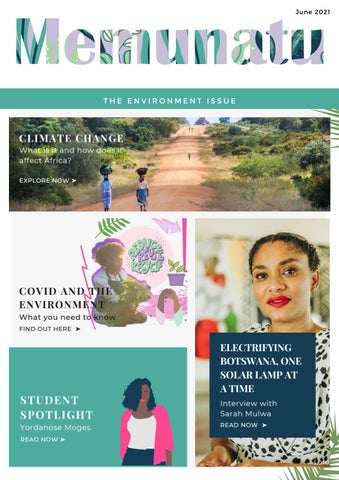
June 2021
THE ENVIRONMENT ISSUE
CLIMATE CHANGE What is it and how does it affect Africa? EXPLORE NOW ➤
COVID AND THE ENVIRONMENT What you need to know FIND OUT HERE ➤
STUDENT SPOTLIGHT Yordanose Moges READ NOW ➤
ELECTRIFYING BOTSWANA, ONE SOLAR LAMP AT A TIME Interview with Sarah Mulwa READ NOW ➤
September 2019
Vol 1 Issue 21
ED-TALKS Learn basics of conservation TUNE IN ➤
Respond to this issue's prompt and you could see your piece in Memunatu Magazine!
SHARE YOUR THOUGHTS TEN BLACK WOMEN AND GIRLS IN SUSTAINABIL ITY WHO YOU NEED TO KN OW ABOUT #Blackgirlmagic inspiration here READ NOW ➤
CONNECT WITH US @MEMUNATUMAG
• MEMUNATUMAGAZINE.COM
Learn more about our work - memunatumagazine.com/become-a-member/
Vol 1 Issue 21
WELCOME What a year it has been (or 15 months to be exact)! With the COVID-19 pandemic, many of us have been adjusting to a new normal. So much is changing around us and that includes the planet. This issue, we are focusing on the environment. From climate justice to conservation, it is now more important than ever to see how sustainability, climate change, and our lives are connected. While some information may be discouraging, I am most inspired by girls making change in their schools, their communities, and the world. They prove that change can happen! Explore our Environment Issue to learn more about what's happening in and out of Africa, plus ways you can get involved.
MARIAMA KABIA CO-FOUNDER, MEMUNATU MAGAZINE
CO-FOUNDERS
EDITORIAL FELLOWS
FATMATA KABIA MARIAMA KABIA
GABRIEL ETIM MEMUNA KONTEH
MEMUNATU MAGAZINE, INC. Memunatu Magazine is a 501(c)(3) non profit media organization that empowers adolescent girls in Africa and the diaspora. At Memunatu Magazine, we believe girls can be the readers, writers, and leaders of their own narratives. Producing print, digital, and inperson content, Memunatu Magazine uses educational media to build community, foster a culture of reading, and improve girls’ outcomes. COPYRIGHT © 2021 MEMUNATU MAGAZINE, INC. ALL RIGHTS RESERVED.
Memunatu Magazine • 2021
3
DEFINITIONS
CLIMATE CHANGE According to the United Nations, of all regions in the world, Africa is going to be the most vulnerable to the climate crisis. Though Africa contributes only 2-3% of global carbon dioxide emissions, climate change nevertheless has the potential to affect many areas of life on the continent.
Carbon dioxide Emissions Climate change Atmosphere Greenhouse gases Solar energy Hydro-electric power Equilibrium
What is climate change: Climate change is a long-term change in the average weather patterns in Earth’s local, regional, and global climates. It is basically understood to happen when excess heat from the sun builds up in the atmosphere, close to the surface of the Earth. This causes changes that are potentially harmful to humans, animals, and plants. Climate change continues in part because of human activities (like burning coal and oil for energy) that emit or release gases known as greenhouse gases into the atmosphere. Greenhouse gases in the atmosphere prevent the excess solar energy from reflecting back into space the way that it should.
This is more than weather. This is about the people. VANESSA NAKATE CLIMATE JUSTICE ACTIVIST (UGANDA)
The environment is important to us all and climate change threatens the balance. The Niger River in West Africa for example is a major body of water that is a source of hydroelectric power, seafood, water, and transportation for many people across 10 countries. Another example is rainwater. Rainwater helps sustain agriculture across the continent.
Memunatu Magazine • 2021
4
Imagine the impact that a change in average weather patterns can have on the River Niger and agriculture on the continent. Changes to the climate can throw off the equilibria and affect the environment, the economy, and more. How climate change is affecting Africa: In about a century, the earth’s surface temperature has increased by 1°C, bringing with it extreme weather events such as droughts, desertification, extreme heat, and flooding. These conditions have negatively affected Africans: The Southern Africa Drought, which has been going on since 2018, has limited agricultural production in the region. Tropical Cyclones Idai and Kenneth created a humanitarian disaster, displacing over 1,000 people in 2019. Swarms of locust in 2020 affected farms in multiple countries. Lake Chad Basin has shrunk by about ninety percent of its former surface area. Natural disasters in Southern and Eastern Africa left 33 million people food insecure in 2019.
In the face of these challenges, everyone has a part to play in order to reverse climate change in Africa. There are things we can do as individuals, as communities, and society as a whole—from planting trees, to reducing the plastics we use, to looking at renewable sources of energy.
CLIMATE FACTS 1. The top of Mount Kilimanjaro is covered with a mass of movable ice called glaciers. Today, more than 80% of the glaciers have disappeared since they were first recorded in 1912. 2. With an average temperature of 33.9 °C, Dallol, Ethiopia has the hottest average temperature on Earth. 3. Did you know that rice farming contributes to global warming? Rice is cultivated in flooded fields, which harbour bacteria that produce substantial amounts of methane, an active greenhouse gas.
Turn to the "Share Your Thoughts" section to share how you would make a difference for the planet.
Memunatu Magazine • 2021
5 3
COVID AND THE ENVIRONMENT
Overview Over the past year, the Covid-19 pandemic has changed many aspects of our lives. Schools have been shut down, lockdowns imposed, and we have changed many of our habits, like commuting and wearing masks, to help slow the spread of the virus. These changes, however, have not only had an impact on us as human beings. Our new behaviors have also had an impact on the physical world around us—for better and for worse.
THE GOOD, THE BAD, AND WHAT'S NEXT Read more here ➤
Memunatu Magazine • 2021
6
The Good* Improved air quality - With millions of people working from home and traveling less, particularly at the height of the pandemic, there were fewer cars and airplanes making trips. Both cars and planes emit greenhouse gases like carbon dioxide, which pollute the air. Lockdown therefore affected those greenhouse gas emissions from cars and planes. In some places the results were dramatic--In Delhi, India, where the air is usually cloudy with harmful gases like nitrogen dioxide, during lockdown residents said they could see the Himalayas from their homes for the first time! Reduced energy use - As offices, schools, and factories closed, the demand for electricity to power these places decreased. Even though domestic energy use, like electricity to power homes, increased by about 40% according to the International Energy Agency, the increase was not big enough to outweigh the positive impact from reduced commercial power use. What does this mean? It could potentially mean falling emissions, but only if it comes with “sustained climate action,” says the United Nations Secretary General. Reduced Water Pollution - There have also been fewer water activities like fishing, boating and surfing, as well as less shipping, which have meant less water pollution. Observers have noted that there has been improved water quality. However, we also know that there are negative consequences to the environment. *Here, we are pointing to some of the positive outcomes for the environment
Memunatu Magazine • 2021
7
The Bad Medical waste - To run diagnostic tests and treat infected people, hospitals and healthcare facilities have used personal protective equipment (PPE), often disposable, to keep themselves and the community safe. According to one study in Iran, these disposable materials contributed to a 102.2% increase in daily waste across 5 hospitals. Even as individuals, our new preventive health habits like using face masks, tissues, and sanitizers have had an impact on waste. Waste management - In some countries, recycling facilities stopped altogether during the pandemic. With many people using recyclable goods, like cardboard boxes for deliveries, no recycling facilities meant that waste had not been properly managed.
What's Next As the world gradually opens up from the pandemic, what do we keep in our new normal and what do we leave behind? It is hard to say. What we’ve seen during lockdown are on one hand, the environment benefits from our new behaviors, and on the other hand, its loses. Nonetheless, the pandemic has taught us how connected we are to the physical world and hopefully that means we are in a better position to make long-lasting, positive impact on the environment.
5
STEPS FOR WASHING YOUR HANDS
Washing your hands properly is a healthy habit to continue beyond the pandemic. Here is a reminder of the key steps.
1. WET your hands with clean, running water, turn off the tap, and apply soap. 2. LATHER your hands by rubbing them together with the soap. Lather the backs of your hands, between your fingers, and under your nails. 3. SCRUB your hands for at least 20 seconds. Need a timer? Hum the “Happy Birthday” song from beginning to end twice. 4. RINSE your hands well under clean, running water. 5. DRY your hands using a clean towel or air dry them. Source: Centers for Disease Control and Prevention (CDC)
Memunatu Magazine • 2021
8
Electrifying Botswana, One Solar Lamp at a Time Interview with Seeng Sarah Boitumelo Mulwa (Botswana)
Sarah is an environment and energy
started to excel in my school work
specialist. Her work involves carrying
and my school grades improved due
out environmental impact
to available grid electricity. It is [at]
assessments in the energy,
this time that I realised my great
transport, water, and transport
potential and began to enjoy school
sectors. She also works on
more and excelled in my academic
monitoring and evaluating
work. As an adult and doing
development projects. Sarah is the
environment and social
founder of Now for Them Trust, a
safeguarding in the rural areas, I
Botswana based non-governmental
began to realise the lack of
organization (NGO) that donates
electricity in rural areas and it led
solar lamps to scholars without
me to evaluate the pass grade of
access to electricity in rural areas. In
rural scholars. I found that they were
2020, they started assembling solar lamps for the first time, with women and youth from a rural community. Memunatu virtually sat down with Sarah to discuss her work and inspiration. MM: What inspired you to start doing this? I grew up in a rural area with no electricity. As the youngest of my siblings, I did not get priority to the lit candle during evening studies. When I moved to the city later, I Memunatu Magazine • 2021
not performing as well as urban located scholars. This is how I decided to play my part in growing the energy sector to rural areas [and] to target scholars as they presented an opportunity to fight out of rural poverty through education. MM: Your team assembled Botswana’s first energy lamp. Could you tell us more about that experience? [A funder] challenged me to build a 9
lamp that would represent our country and be built by our people. We got into an agreement to assemble 4,250 solar lamps for scholars surrounding the company’s diamond mines. We assembled the lamps with women and youth and gave them a new skill and newly found confidence in their ability to build something with their hands. We targeted school dropouts (who left school due to pregnancy, learning disabilities, substance abuse, financial issues, etc.) and those individuals who had not qualified for scholarships due to a low grade in their final high school exams. We also targeted women aged 35 to 65 who were single
If interested in knowing how to play a role in combating climate change, do not let society dictate or restrict you from knowing more.
parents, widowers, single mothers, or those who had survived [gender based violence] GBV, or were living with HIV/AIDS. MM: What has been a particular challenge you have faced and how did you overcome it? COVID-19 delayed our production. With three lockdowns in 2020, we
SARAH MULWA ENVIRONMENT AND ENERGY SPECIALIST (BOTSWANA)
commenced work [later than expected]. Due to the pandemic, components were also delayed to arrive, but we had great support from the funders who understood our predicament and did not pressure us or threaten to cancel the project. The funders really had patience and that was enough for us to keep our faith to see the project through.
Memunatu Magazine • 2021
10
MM: What has been the best part about your work? Oh gosh there are so many! There is nothing as beautiful as teaching someone a new skill that was thought to be a skill reserved for men only. . . and to see them start to build a solar lamp and then switch on the lamp and see their amazement. And the fact that they themselves just buil[t] this electricity which is fitting into a little container. Oh goodness, no feeling can explain this. In addition to this, it’s a joy to know that they now have an income for their households. Nothing beats that feeling.
MM: What advice would you give to young girls interested in pursuing your path? You will find many boys in this space–do not let them intimidate
MM: How can adolescent (girls) get involved in climate change efforts and make a difference? They need to be brave, to fight the many times we are told girls should not be in a certain sector because we are not strong enough. Girl, that is nonsense talk–you can do it as good as a boy if not better! If interested in knowing how to play a role in combating climate change, do not let society dictate or restrict you from knowing more. This is why
you. You are very capable of leading them. Also, you will face challenges including having others doubt your capabilities as a girl. For the 10 that doubt you, if one listens it’s enough ears. And if you don’t succeed, don’t change your idea. Try a different approach. There are often more ways to get through a closed door. [W]hen there is no key–find out those ways.
I have always loved science teachers. They are ready to teach more if asked. I encourage all adolescents to ask their teachers more questions about our environment and how they can save it.
Memunatu Magazine • 2021
11
#CLIMATE MOTIVATION Check out these inspiring quotes from climate activists featured in this issue:
Location: United States African country: Ethiopia
MM: Hi Yordy! Please introduce
When I first heard about the Thirst
yourself:
Project I found it interesting, so I
Hi! I'm Yordanose, but I also go by
looked into it more and saw that it
Yordy and I'm a freshman in high
had done work in Ethiopia. Although
school.
it didn't directly affect my family or me, knowing that the Thirst Project
MM: We heard that you're involved
had helped improve the lives of
in the Thirst Project! What is the
other Ethiopians made me want to
Thirst Project and what inspired you
help them do the same in other
to join? The Thirst Project is a nonprofit that works to stop the global water crisis by building freshwater wells in developing communities. Clean water isn't just something that is needed for drinking though. It is also vital for health and sanitation. Annually, there are more preventable young deaths caused by waterborne diseases than HIV, malaria, and all world violence combined. By working to end the water crisis, the Thirst Project is greatly improving the lives of the people in the communities who
communities. I would have joined even if they hadn't done any work in Ethiopia, but it was the cherry on top for me. A donation of $25 gives one person clean water for life, and if we can raise $12,000, it will fund a freshwater well for a community. The Alexandria Thirst Project sector has already raised over $2,000 since we've started, and we're still raising more money now. MM: Could you tell us why the water crisis is so important? How does it affect women and girls? There are 785 million people on our
receive clean water. Memunatu Magazine • 2021
13
planet who do not have access to
opportunities that would be much
safe, clean drinking water. Because
harder to find without them.
of this, women and children get tasked with collecting water. The
MM: What has surprised you the
average amount they need to walk
most so far while volunteering?
to get water is 3.75 miles. The need
There is this image of volunteer
for the women and children of
work–people think it's hard, but it
developing communities to travel
isn't. Even if you're busy, any time
these long distances hinders their
you can use out of your day, sending
ability to get jobs, contribute financially to their families, or get education. Clean, easily accessible water is a necessity. The Thirst Project works to make sure that it gets given to those who need it. When these communities have water, it not only drops the rate of disease and the mortality rate, but it also makes sure that women and children have more time on their hands. They can use this time for school or a job. Freshwater wells provide economic productivity, food security, and educational
Memunatu Magazine • 2021
emails or advertising the donation page, makes a huge difference in someone's life. When I went to the interest meeting for the Thirst Club, I wasn't sure I'd be able to do it, but I wanted to check it out anyway. The things that were talked about didn't seem like they would be too hard for me to do, so I decided to try them out. It hasn't been difficult, and if there were ever days where I had something conflict with a meeting, I would be able to catch up on everything that happened the next time we met.
14
MM: You are currently in high
able to balance everything. I try to
school–what does a typical week
make sure that I set aside at least 30
look like for you (and how do you
minutes for each class that I have an
balance everything)?
assignment for. That helps me avoid
Mondays are asynchronous this year,
procrastinating or running out of
which has given me a catch-up day
time on anything.
if I'm ever falling behind. My classes haven't been that difficult this year,
MM: What advice would you give to
so I focus on getting my work done
other girls interested in pursuing
on time. Other than the Thirst
your path?
Project Club, I've also been involved
There are so many ways to
in activities after school like the Debate Team, the Ethics Bowl Team, and tutoring elementary schoolers. Being organized has become a top priority. I've been using [a productivity app] to keep track of new assignments and any important dates coming up, which is a lifesaver when you have so many things that you're juggling. Time management is another thing that has played a crucial role in me being
Memunatu Magazine • 2021
volunteer, so it's important to make sure you're doing something you're passionate about. If you care enough about a cause, it will motivate you to make sure you can do something about it. Find the causes you care about and find the form that works for you. That may mean posting about [the cause] on social media to raise awareness or raising money by going door to door. You shouldn't get discouraged if you don't get any donations at first.
15
Hallway Chat–Quick Questions Favorite school subject: A bit of an unpopular opinion, but my favorite subject is math. Favorite color: My favorite colors are lilac and sky blue. Song you have playing on repeat: I've had Olivia Rodrigo's entire album on repeat since it came out. If we saw your locker, we would be surprised to find: My locker is completely bare. I actually haven't had any classes in my school yet because of the pandemic, so that's something I have to look forward to for next year. Go-to mantra: Stand up for what you believe in, even if you stand alone.
Memunatu Magazine • 2021
16
Conservation 101 #EdTalk with
ELIZABETH TOLU OJO
Memunatu Magazine’s digital series, Ed-Talks features mini video lessons from African changemakers who share advice and insights specifically for students. Elizabeth Tolu Ojo is an environmental educator who is passionate about developing the next generation of pro-environmental African leaders. She currently serves as Director of Operations for the African Leadership University (ALU) School of Wildlife Conservation. Learn how to explain conservation in simple terms in her Ed-Talk, Conservation 101.
CHECK OUT OTHER ED-TALKS ON FACEBOOK The Conservation 101 transcript and exercise are on the next page ➤
Memunatu Magazine • 2021
17
READ ALONG HERE! Hello! Welcome to Conservation 101: The Basics. Now imagine with me two corn farmers, each with a plot of land. Now, while the kids are away at school, harvest season comes around. One farmer roasts all of his corn for the village festival. Cool right? The second farmer roasts a third of his corn for the festival. He preserves another third as seed for the next planting season, and he sells a third of his crop for income. Now who would you consider more responsible when the kids come home from school and there are needs at home. That's exactly what conservation is about. It's about using resources, natural resources, in a manner that ensures that current and future generations can benefit from them. It's about using the resources in a way that minimizes waste and cares for the environment. Resources like trees that purify the air for us every single day. Like water that comes from rivers and streams or underground water that costs a lot of money to extract and purify for our use. Or like energy that comes from fast moving water and hydro dams or from burning fossil fuels. In subsequent videos, we will talk about how conservation applies to specific resources, but for this week, I challenge you to be responsible by turning off the lights when you're not using them and turning off the tap when you're not using the water. Speaking of energy, I challenge you to try this week's energy audit exercise for your home.
UPDATE One of nature's most prized resources is potable water. Although 71% of the earth's surface is covered in water only about 3% is freshwater (drinkable/potable) but less than half of that can actually be used as drinkable water for humans the 'rest is locked up in glaciers, ice caps, permafrost or locked deep underground.' Thankfully that tiny fraction is constantly recycled along with the rest of the earth's water however, it is our job to use water responsibly especially when you consider the high cost of purifying water. A gallon of motor oil can seep into the earth and pollute 250,000 gallons of drinking water. Sources: https://www.nationalgeographic.org › earths-fresh-water https://www.usbr.gov/mp/arwec/water-facts-ww-water-sup.html
Memunatu Magazine • 2021
18
ENERGY AUDIT Here is a worksheet so you can do your own energy audit at home or at school.
Memunatu Magazine • 2021
19
Ten Black Women and Girls in Sustainability Who You Need to Know About
We are recognizing amazing African women and girls who are tackling climate change, leading environmental movements, and helping to make the world a better place. See who is changing the game in sustainability!
SIRA BAKHAYOKHO Sira is a regenerative farmer and climate activist from the Senegalese village, Boulel. Three years ago, as a 19-year-old law student, she joined Trees for the Future, an organization that aims to transform the livelihoods of sub-Saharan African farmers. Specifically, they train farmers in regenerative farming techniques and business skills. Sira has since risen the ranks to become one of their most prominent training technicians. She is currently helping 280 female farmers in the Kaffrine region and says in this Agrilinks interview that she believes “regenerative agriculture remains the future of Africa.”
Memunatu Magazine • 2021
20
VANESSA NAKATE
AUTUMN ADEIGBO Autumn is a Nigerian-American fashion designer who makes colorful clothes, inspired by the bold African prints of her heritage. Her designs are made sustainably and she’s committed to both supporting femaleowned production facilities and ensuring the global artisans who she works with are paid fairly. She only produces garments through pre-orders to minimize fabric waste and excessive manufacturing, making her collections environmentally friendly (and exclusive).
Memunatu Magazine • 2021
Vanessa is a 24-year-old climate justice activist from Kampala, Uganda who began her activism in late 2018 after noticing unusually high temperatures in her country. In early 2019, she protested for months outside of the Ugandan parliament building, urging politicians to take notice of the immense threat Africa is facing from climate change. Eventually, she gained support from peers and the attention of world leaders. She has since founded the Rise Up environmental movement as well as the Green Schools program, which has so far supported six schools in transitioning to solar energy (and eco-friendly stoves)! Vanessa has also spoken at notable climate conferences such as the 2020 World Economic Forum and this year’s Berlin Energy Transition Dialogue.
21
AMARIYANNA ‘MARI’ COPENY Mari is a 13-year-old philanthropist, activist, and selfprofessed future president of the United States. She began her activism in 2016 when she wrote a letter to President Barack Obama, pleading with the government to pay attention to the water crisis in her hometown of Flint, Michigan. In 2018, after Michigan backed out of a free bottled water program for Flint residents, Mari helped crowdfund nearly $50,000 to provide clean drinking water to her neighbors. Mari has since expanded her efforts to help other communities across the US that are dealing with toxic water supplies.
VANESSA NAKATE
ANICOLE ZIZI Anicole is a Hatian-American fashion designer who makes genderless clothes out of recycled materials. For her commitment to environmentalism, she says: “Every decision I make serves as a motif of my commitment to sustainability. By sourcing recycled, alternative, and natural materials I am able to develop new products that push towards the elimination of environmental pollution. As a nod to circularity, I aim to protect our communities while simultaneously keeping in mind the way each design affects our environment as a whole.”
Memunatu Magazine • 2021
22
WANJINKU ‘WAWA’ GATHERU
JAKAPITA KANDANGA
Wawa is a Kenyan-American environmental justice activist. She founded the Black Girl Environmentalist platform, which seeks to unite young Black women who are passionate about the environment. Her goal? To make climate activism more inclusive and beneficial to Black, Indegenous, and other racial minority communities. In an interview with The Canary, she shares that her motivation was the many instances in which she was “the only person of colour, not just the only Black person, in most environmental spaces.”
Jakapita is a 23-year-old Namibian communications student and climate justice activist. As a member of Fridays for Future Windhoek, she conducts community outreach, campaigns, and demonstrations to raise awareness of pressing environmental issues that affect the community. Most recently, she has been campaigning to save the Okavango Delta from proposed fracking by Canadian petroleum company, ReconAfrica.
Memunatu Magazine • 2021
23
ELIZABETH WANJIRU WATHUTI Elizabeth is a Kenyan climate activist and founder of the Green Generation Initiative. Having established a successful environmental club in her high school, she set up the Green Generation Initiative in 2016 to bring sustainable thinking to all Kenyan schools. So far, the initiative has planted over 3,000 trees and Elizabeth has grown her environmental advocacy through her work as a campaigns manager at the Wanagri Maathai Foundation and coordinator at Daima Green Space.
YOLA MGOGWANA Yola is a 13-year-old South African environmental activist who mobilizes young people in Khayelitsha to fight for climate justice. In 2019, she began volunteering with the Earthchild Project, which brings environmental education to communities and classrooms. She has since become a prominent spokesperson at schools in her region and has repeatedly called for government action on the very real consequences that climate change has on working-class Africans.
Memunatu Magazine • 2021
24
LEAH NAMUGERWA Leah is a 16-year-old climate justice activist from Uganda. She helped to establish the Ugandan branch of the Fridays for Future movement, which led to her first solo climate strikes in 2019. Leah has led several marches and campaigns and is a driving force behind Uganda’s plastic-ban petition. On her 15th birthday, she planted 200 trees instead of having a party and launched the Birthday Trees project, which gives seedlings out to those who also wish to celebrate their birthday by giving back to the planet. So cool!
Know of any #environmentheroes in your community that should be featured in Memunatu Magazine? Nominate them here!
Memunatu Magazine • 2021
25
SHARE YOUR THOUGHTS
ENVIRONMENT THEME Have your voice heard in Memunatu Magazine! Respond to the following prompt: What is your vision for helping the environment? This could be something that you could do in your local community, or your ideal version of a world where the environment thrives. It's up to you! We ask that you keep your responses to 300 words (2 paragraphs) maximum. If you would like an opportunity for your piece to appear in Memunatu Magazine, share it with us! Instructions and a template are on the next page. Memunatu Magazine • 2021
26
Your vision for helping the environment Share your response with us over email or WhatsApp! YOUR NAME: COUNTRY: AGE:
Memunatu Magazine • 2021
27
literacy.
leadership. empowerment.