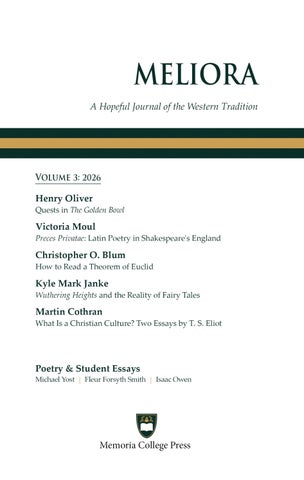
CONTENTS Quests in The Golden Bowl......................................................................... 1 Preces Privatae: Latin Poetry in Shakespeare's England......17 How to Read a Theorem of Euclid..................................................35 On the Death of Simone Weil...............................................................47 Wuthering Heights and the Reality of Fairy Tales................49 What Is a Christian Culture? Two Essays by T. S. Eliot......59 Homer's Epics and Moral Imagination.......................................73 Supernatural Madness and the Danish Prince.....................81
iii
QUESTS IN THE GOLDEN BOWL by Henry Oliver
M
ost people aren't going to read The Golden Bowl. Henry James' last completed novel is long and difficult, exemplifying his late style, in which his sentences can become discombobulatingly convoluted. It is the sort of thing that gets James a bad name as a stultified hippopotamus of a writer, expounding and confounding his readers with sentences that seem as impenetrable and interminable as the rambling conversation of a dull and supercilious old man. Earlier James novels and stories—such as Washington Square, Daisy Miller, and The Portrait of a Lady—are more focused on action and events, and are written in a plainer, more "readable" style. Next to these, The Golden Bowl can feel like it was written by a different person—a more pompous, irascible writer. So why am I writing about The Golden Bowl? Because literature is read in the spirit of ambition, not acceptance. And The Golden Bowl is quite simply one of the best novels written in English. It is, as Gore Vidal says, "ambitiously divine." It is about as close an examination of the psychology and inner lives of four people as it is possible for a novel to make. The action is not so much greater than that of an ordinary novel, but the amount of unfolding of the characters' inner lives is very much greater. One of the characters in Sally Rooney's novel Beautiful World, Where Are You called it a "juicy" book, which is exactly right. The Golden Bowl provides us with an extraordinary amount of information about what everyone thinks and feels, consciously and unconsciously, about the events of the book. 1
Quests in the Golden Bowl
There is a strange and splendid beauty to James' difficult prose. Ezra Pound was right to say that James' late, elaborate style was in fact concise. James' closeness to his characters and the great precision of his style means, as Pound says, that James says more in a page than many other more "direct" writers would get into a chapter. It is frequently marvellous what James can make a sentence do. One must read The Golden Bowl slowly. All of this means that James can turn a simple story of love and betrayal—a story of how rich people who collect nice objects have a distorted view of human relationships, which is a theme he had handled many times before—into an odyssean story, a great quest of the psychological and romantic lives of four ordinary people. The Golden Bowl is full of questing references, from the Golden Isles (the Elysian Fields of Greek mythology) to people who are looking for each other at a moment of high tension being described as going in quest of each other. It might seem flatly obtuse to call the The Golden Bowl a quest. These people walk the park and stroll the grounds and pace the drawing room. But The Golden Bowl has the quality of a High Romance, in which James' coiled prose creates a shimmering effect, as if we are reading a novel that aims not at verisimilitude, but a marvellous tale. Romance is a hard genre to define. The predominant literary mode of the Middle Ages, Romance tales are often long stories about love and adventure which take place in a heightened version of reality. We do not expect Chaucer's work to be strictly realistic: We expect it to have brave knights and fair maidens, magicians and supernatural figures. Elements of folk and fairy tales 2
Quests in the Golden Bowl
are present throughout Shakespeare's plays, despite his plays being full of very "real" characters. The novel emerged after the Protestant Reformation, when beliefs about magic and the supernatural were receding, decried by many as superstitions. Storytelling became more realistic, rooted in the twin influences of the Reformation and the Enlightenment, and more individualistic. The high point of the early English novel was the work of Jane Austen, who created the novel form that we recognize today. In her work you will not find anyone doing or saying anything you would be surprised to hear in real life. There is an almost documentary quality to her realism. But even in novels that are intently realistic, Romance is present. Northrop Frye described the realistic novels of Austen and James and others as almost a parody of Romance. Sense and Sensibility is a quest, in which the Dashwood women journey from one home to another. Lizzy Bennet travels the forests of Derbyshire like a modern Sir Launcelot. In Emma, Mr. Knightley's chivalric name is an open hint at his role. James' stories often have this quality. Daisy Miller is a modern American princess who isn't quite rescued by her knight. Washington Square is a realistic fairy tale in which the heroine becomes a strongwilled resistor of the cruel king. The ending of The Spoils of Poynton is often described as "poetic justice," but when Fleda discovers the alarming news at the end, it feels more like a folk tale. Like Austen, Henry James writes drawing room quests. The Golden Bowl is about two marriages. Adam Verver is Maggie Verver's father. His wife (her mother) has died. They live a very co-dependent life. At the start of the nov3
Quests in the Golden Bowl
el, Maggie is getting married to Prince Amerigo. Amerigo meets, by chance, Maggie's friend Charlotte Stant when he arrives in London ahead of his wedding. The plot depends upon the (secret) fact that Charlotte and Amerigo knew each other intimately some years earlier. They did not get married, but this re-encounter prompts a new intimacy. They go to a shop looking for a wedding present that Amerigo can give to Maggie and decline to purchase a golden bowl because it has a crack. Later on, Maggie persuades her father, Adam, to marry Charlotte. Meanwhile, Maggie remains overly attached to her father, making Amerigo feel isolated. Charlotte feels similarly locked out, and their relationship continues to develop in secret. The only person who has any foreboding of the problems that will follow (exposed via the golden bowl, though I shall not tell you how …) is a friend of the family, Fanny Assingham. It is a novel of London houses and country houses, of Colonels and Princes. Many recognise it as James' masterpiece, a remarkable development of the techniques that evolved into the writing of James Joyce and Virginia Woolf. Early on, after Maggie's marriage, but before his own, Adam is looking for solitude in his country house. To escape his guests, he goes on a "quiet flight, almost on tiptoe, through tortuous corridors." Although the action is merely that of a man looking for an hour of uninterrupted work, the inner life that goes with this act is far more complicated. Adam is dutiful; he is always interruptible, always ready to pause his work for his social obligations. This routine of finding solitude was an "innocent trick of occasionally making believe that he had no conscience, 4
Quests in the Golden Bowl
or at least that blankness, in the field of duty, did reign for an hour." James treats Adam seriously, but ironically, The greatest of wonders, moreover, was exactly in this, that so interrupted a man should ever have got, as the phrase was, should above all have got so early, to where he was. It argued a special genius; he was clearly a case of that. The spark of fire, the point of light, sat somewhere in his inward vagueness as a lamp before a shrine twinkles in the dark perspective of a church.
Like Prospero in The Tempest, Adam has a very high opinion of his abilities, perhaps justifiably, but cannot see that he has become remote and narrow-minded as a result. His achievements are real, as are his abilities—as too is the price he has paid for his solitude. Variety of imagination—what is that but fatal, in the world of affairs, unless so disciplined as not to be distinguished from monotony? Mr. Verver then, for a fresh, full period, a period betraying, extraordinarily, no wasted year, had been inscrutably monotonous behind an iridescent cloud. The cloud was his native envelope—the soft looseness, so to say, of his temper and tone, not directly expressive enough, no doubt, to figure an amplitude of folds, but of a quality unmistakable for sensitive feelers. He was still reduced, in fine, to getting his rare moments with himself by feigning a cynicism.
What looked like a mock-quest for an hour's peace while his house guests were at church is revealed to be part of a larger, imaginative quest to spend time alone with5
Quests in the Golden Bowl
out feigning cynicism. An American guest, Mrs. Rance, hunts Adam down in the billiard room, and he begins to worry (somewhat ridiculously) that she will propose to him, that all that stands between them is the billiard table like a desert Mrs. Rance will not cross, but which she can go around. Mrs. Rance has come from "the great alkali desert of cheap Divorce." At this point, he is a rich widower whose daughter has recently gotten married, and so he is an inevitable target for marriage from people like Mrs. Rance. Mrs. Rance is a symbol. She makes Adam realise that he will be proposed to at some point. Maggie has married Amerigo. And Adam is rich. He is afraid not of her crossing the desert, so much as he is afraid that he will have to cross it. The hour of solitude he was looking for was an escape from himself, an escape from the prospect of having to get married again, to live through difficult changes. Above all, he was afraid of refusing proposals. It was above all as a symbol that Mrs. Rance actually rose before him—a symbol of the supreme effort that he should have sooner or later, as he felt, to make. This effort would be to say No—he lived in terror of having to. He should be proposed to at a given moment—it was only a question of time—and then he should have to do a thing that would be extremely disagreeable.
Now that Maggie is married, Adam's life is changed. It is as if Amerigo "had somehow filled the scene and blocked the future." Adam is really afraid of losing his daughter. Adam makes many assessments of Amerigo. There is a long comparison to a Palladian church, but eventually he settles on seeing Amerigo as rounded like a crys6
Quests in the Golden Bowl
tal, easy enough to live with. Adam is reassured by his judgment of Amerigo because he fancies himself a man of good taste, with "the spirit of the connoisseur." He is described as comparing himself to Cortez, the Spanish colonialist who conquered Mexico. The comparison is not outright, though. He had, like many other persons, in the course of his reading, been struck with Keats's sonnet about stout Cortez in the presence of the Pacific; but few persons, probably, had so devoutly fitted the poet's grand image to a fact of experience.
Keats' sonnet, titled "On First Looking Into Chapman's Homer," is about how, as a reader of Homer's epic poems, Keats has "travell'd in the realms of gold, / And many goodly states and kingdoms seen." It was reading Chapman (an Elizabethan poet-translator of Homer), though, that made Keats feel "like some watcher of the skies / When a new planet swims into his ken." Keats has thus used two questing images: first that of the Homeric characters; second that of the astronomer, who quests not in action but in the mind, through the telescope. The poem ends: Or like stout Cortez when with eagle eyes He star'd at the Pacific—and all his men Look'd at each other with a wild surmise— Silent, upon a peak in Darien.
Adam's Pacific was a combination of collecting art objects and admiring Maggie. James says, "To rifle the Golden Isles had, on the spot, become the business of his 7
Quests in the Golden Bowl
future." The Golden Isles means Elysium, the legendary realm in Greek mythology where men lived in eternal bliss. Rifling them means collecting the beautiful objects to which Adam, as a connoisseur, is dedicated. This allows him to imagine "the affinity of Genius, or at least of Taste, with something in himself," so that "he was equal, somehow, with the great seers, the invokers and encouragers of beauty." James ironises this with his use of "rifle"—a word which, with its association with guns and its meaning here of "ransacking," makes Adam sound more like the colonial Cortez than he knows. Just as Cortez had perverse intentions on his dark quest, so Adam is searching for the wrong thing. The lesson of many traditional quests is that the object the hero quests for turns out not to be the important thing. If you wish to save a Princess to gain the status of marrying her, the quest will teach you the higher importance of true love. If you wish to find the Holy Grail for its power, the quest will teach you the importance of humility. Adam has not learned this lesson on his quest for antiques and art objects. His call to adventure happened after his wife died, when Maggie was ten. At that point the light in his mind broke out, having on his earlier "journey of his honeymoon year … still been closely covered." His wife has been a "frail, fluttered creature" more interested in dresses than art. Thinking of her vulgar taste, Adam regrets having to remember her, now, with his superior taste, in such a way, These were wandering images, out of the earlier dusk, that threw her back, for his pity, into a past more re8
Quests in the Golden Bowl
mote than he liked their common past, their young affection, to appear. It would have had to be admitted, to an insistent criticism, that Maggie's mother, all too strangely, had not so much failed of faith as of the right application of it…. And they had loved each other so that his own intelligence, on the higher line, had temporarily paid for it.
This is all rather heartless, but it conveys the difficulty of Adam's grief: He bought fine objects to find a way through the dark years. He was questing in search of who he could become without his wife. This idea of questing for the past runs through so much great literature, from Shakespeare's plays and sonnets to Proust's great novel In Search of Lost Time. John Donne's haunting line—"O tell me where all past times are"—is an invitation to nostalgia and fantasy, and to the sort of literature Henry James writes too. We are all, somehow, in quest of who we were and who we might now become. All of this runs through the narrative while Adam and Mrs. Rance are still facing each other in the billiard room. James turns Adam's search for a little peace into an examination of the quest for meaning he has been living in the years since his wife died. His acquisitions of objects were a preliminary to being able to marry again. He was happier, doubtless, than he deserved; but that, when one was happy at all, it was easy to be. He had wrought by devious ways, but he had reached the place, and what would ever have been straighter, in any man's life, than his way, now, of occupying it?
His ambition was to create a house full of "civilization," full of "the highest knowledge" that would be open to 9
Quests in the Golden Bowl
the "thirsty millions." But now that Maggie has children, he can take life "higher up the stream," not just as a collector but as a grandfather. He sees in Maggie and her husband a marital happiness he is not sure he ever knew. He is worried about proposals because it will disrupt the calm happiness he has managed to come to. He did in some way find truer value and meaning: In Maggie he has real happiness. … the strange dim doubt, waking up for him at the end of the years, of whether Maggie's mother had, after all, been capable of the maximum. The maximum of tenderness he meant—as the terms existed for him; the maximum of immersion in the fact of being married. Maggie herself was capable; Maggie herself at this season, was, exquisitely, divinely, the maximum…. She was her mother, oh yes—but her mother and something more; it becoming thus a new light for him, and in such a curious way too, that anything more than her mother should prove at this time of day possible.
Alas, he has not seen as clearly as he believes. It is precisely Maggie's attachment to her father that will prevent her from achieving "the maximum of immersion in the fact of being married." The plot of The Golden Bowl relies on Maggie and Adam retaining such a close bond that it leaves their spouses, Charlotte and Amerigo, isolated, lonely, and thus tempted to restore the romance which, James showed us at the start, had never truly died. In searching for a better version of lost time, Adam inadvertently opens the way for Amerigo and Charlotte to go in quest of their own past times. And thus the golden bowl of all their lives will eventually be shattered. The quest object is revealed to be a flawed aspiration in and of itself. 10
Quests in the Golden Bowl
At the end of these ruminations, we see Adam and Mrs. Rance interrupted by the party returning from church, and now, they, too, perform a small domestic quest: … the divided parties, coming back at the same moment, had met outside and then drifted together, from empty room to room, yet not in mere aimless quest of the pair of companions they had left at home. The quest had carried them to the door of the billiard-room, and their appearance, as it opened to admit them, determined for Adam Verver, in the oddest way in the world, a new and sharp perception.
At this moment, there is a "mute communication" between Maggie and Adam. She knows that Mrs. Rance is looking to propose; she can tell from the mood and body language, from the fact that Mrs. Rance has gone in quest of Adam to the billiard room of all places in this enormous country house. Now, suddenly, her speculations about his possible future marriage deliver her the realisation that he will have to become less attached to her, as a consequence of her having married Amerigo. When, in their common past, when till this moment, had she shown a fear, however dumbly, for his individual life? They had had fears together, just as they had had joys, but all of hers, at least, had been for what equally concerned them. Here of a sudden was a question that concerned him alone, and the soundless explosion of it somehow marked a date.
Neither of them had realised until now that some new threshold had been crossed in their lives, some new quest begun. 11
Quests in the Golden Bowl
What Adam is doing, questing for solitude, amounts to an anti-quest. His immersion into collecting, into becoming a connoisseur of art objects, is ironised as his version of seeing the Pacific. But his quest is almost an entombment, a creation of a museum in his home. His questing in search of the billiard room is a form of denying the real call to adventure, the journey in strange places; he is, like Bartleby the Scrivener, an un-quester. The quest object is the golden bowl itself, which is not purchased when Amerigo and Charlotte visit the antique shop early in the novel. And when the bowl is later purchased by Maggie, coincidentally, and becomes the means by which she discovers their infidelity, she breaks the bowl—but rather than this being a spur to her revealing the truth, after a brief confrontation with Amerigo, Maggie decides to remain quiet. She chooses not to know. So she too is an anti-quester. One evening after dinner while Amerigo, Adam, Charlotte, and Fanny Assingham (who has known much more than she let on) are playing cards, Maggie feels that "she might sound out their doom in a single sentence." She gets up and walks around the room, intending to leave it. As she goes, "silent and discreet," each looks at her. Her father and her husband, Mrs. Assingham and Charlotte, had done nothing but meet her eyes; yet the difference in these demonstrations made each a separate passage—which was all the more wonderful since, with the secret behind every face, they had alike tried to look at her through it and in denial of it.
Maggie feels the burden of having to become a scapegoat for the sake of the group—the "complexity of their peril" is too great to be modulated any other way. 12
Quests in the Golden Bowl
Nothing in fact was stranger than the way in which, when she had remained there a little, her companions, watched by her through one of the windows, actually struck her as almost consciously and gratefully safer. They might have been—really charming as they showed in the beautiful room, and Charlotte certainly, as always, magnificently handsome and supremely distinguished—they might have been figures rehearsing some play of which she herself was the author.
Confronted with the possibility of revelation, Maggie chooses silence. She walks around the outside of the house. She reaches the drawing room. … while she rested on the cool smooth stone balustrade … in the course of which, after a little, she passed again the lights of the empty drawing-room and paused again for what she saw and felt there.
To begin with, she could see nothing concrete. Then Charlotte was in the room, launched and erect there, in the middle, and looking about her; that she had evidently just come round to it, from her card-table, by one of the passages—with the expectation, to all appearance, of joining her stepdaughter. She had pulled up at seeing the great room empty—Maggie not having passed out, on leaving the group, in a manner to be observed.
Maggie knows immediately that Charlotte is in "so definite a quest of her." Bob Assingham (Fanny's husband) draws Charlotte's chair back, which becomes an image of Charlotte being released from a cage, 13
Quests in the Golden Bowl
The splendid shining supple creature was out of the cage, was at large; and the question now almost grotesquely rose of whether she mightn't by some art, just where she was and before she could go further, be hemmed in and secured.
The question at play is whether Charlotte will tell Adam (her husband, Maggie's father) that she and Amerigo are suspected of having an affair. Maggie wants to keep the whole business secret. Eventually, Charlotte sees Maggie, sees that she is being watched from afar. Maggie the un-hero, on her un-quest, is now refusing to battle the guardians. Her technique is stasis, silence. Through her own inaction, Maggie tries to turn Charlotte away from her plan of confronting her. But it doesn't work. Charlotte was the creature who had escaped by force from her cage, yet there was in her whole motion assuredly, even as so dimly discerned, a kind of portentous intelligent stillness. She had escaped with an intention, but with an intention the more definite that it could so accord with quiet measures. The two women, at all events, only hovered there, for these first minutes, face to face over their interval and exchanging no sign; the intensity of their mutual look might have pierced the night.
Maggie doesn't know if it has been one minute or five, but she does know Charlotte now has the advantage: Maggie walks slowly over "with her heart in her hands." Maggie's anti-quest is defeated. After tense small talk about the weather, they walk back towards the smoking room, standing outside together for three minutes. Watching her father, next to her stepmother, is the first 14
Quests in the Golden Bowl
time Maggie has known "her old possession of him as a thing divided and contested." Once more, Maggie feels the pressure of being appointed as the scapegoat, the one who will, through her silence, preserve the equilibrium among the four people. Charlotte shows Maggie her father as if she was the ghost of Christmas present, warning Maggie about the sorrows any revelations will bring. Back inside, Maggie has to confront Charlotte, who asks her, I've seen, week after week, that you seemed to be thinking—of something that perplexed or worried you. Is it anything for which I'm in any degree responsible?
This is a brazen moment! Charlotte, who must know too well what her behaviour with Amerigo looks like, is facing Maggie down. Maggie, the anti-quester, backs down from the challenge. The Golden Bowl is the culmination of James' Romance Realism. In their pursuit of each other, the characters must realise, as all questers must realise—whether they are intentional questers or not—that they quest for knowledge: knowledge of love, virtue, the world, and themselves; knowledge of good and evil. "Knowledge, knowledge, was a fascination as well as a fear," James writes in The Golden Bowl. He echoes Genesis. We quest because we had to leave the garden. "They hand in hand with wand'ring steps and slow, / Through Eden took their solitary way," as Milton wrote. James also invokes the eternal spirit of the quester, compelled by fascination and fear confounded together. The Golden Bowl, as so much of James' fiction, is about people who try to cage 15
Quests in the Golden Bowl
and contain each other—the domination not of preventing physical quests, but of trying to restrict journeys of the mind. When Adam takes Charlotte away at the end, they are undertaking a quest of confinement. Fanny Assingham shudders at the thought: "I see them at last, day by day and step by step, at the far end—and I see them never come back." The Miltonic echo is loud. For Maggie and Amerigo, thrown together at the end, "the golden cage has shut on them both"; as Gore Vidal wrote, "she is both jailer and prisoner."
16
PRECES PRIVATAE LATIN POETRY IN SHAKESPEARE'S ENGLAND by Victoria Moul
T
oday, Protestants and Catholics alike tend to assume that Latin as the language of worship—and with it, Latin as a functioning spoken and literary language—disappeared at the Reformation. It is true that the Reformers felt strongly that the Bible and the liturgy should be presented in a language understood by the worshippers. They weren't alone in that conviction: Thomas More, for example, by no stretch of the imagination a Protestant, was also a passionate advocate for the translation of Scripture. But the cultural centrality of Latin did not disappear at the Reformation and in some ways it was even strengthened. In the mid-sixteenth century, no vernacular European language was widely spoken or understood outside its own country, in the way that English or even French or Spanish is today. The international language was Latin, and the campaigns of Reformation and Counter-Reformation—both highly international affairs—were carried out to a large extent in that language. This period saw a flood of Latin pamphlets and treatises and works of accessible theology, like Calvin's Institutes (published first in Latin in 1536), but also of literary texts, such as the hugely popular and widely taught Latin psalm paraphrases of the early Scottish Protestant convert George Buchanan (1506–1582). It was important to the early Reformers to show that Protestantism could give rise to a lively and innovative literary culture of its 17
Preces Privatae
own, and in the sixteenth century that meant, above all, verse written in Latin. The landmark publication of the emergent English Reformed church was the Book of Common Prayer, which is still in use. If you are curious, you can access the liturgy set for today on the Church of England's website.1 The principle of the BCP was that worship ought to be conducted in the language "understanded of the people": but in schools and colleges, where Latin was the ordinary language of instruction and conversation, that included Latin too, and a Latin version of the Book of Common Prayer was quickly produced, the translations made by Walter Haddon, probably the most important and innovative English Latin poet of the mid-sixteenth century. The language of the English Book of Common Prayer is famously beautiful and memorable, and the choice of Haddon shows that those commissioning him were concerned with the literary quality of the Latin version as well. The Book of Common Prayer is often used privately by individuals, but it was designed as a book of liturgy for public services. In this essay I want to look a bit more closely not at the Latin version of the BCP, fascinating as it is, but at another Latin prayer book produced and officially endorsed by the English state in the 1560s, titled Preces Privatae, or Private Prayers, and first published in 1564, the year of Shakespeare's birth. As the title suggests, this is a collection of private devotions, intended for personal or family use. Both the existence of this volume and its con1. https://daily.commonworship.com. Click the option for "Traditional Language" to get the BCP of 1668, which is only a fairly lightly revised version of the text first put together in 1549. 18
Preces Privatae
Preces Privatae (1564 edition)
19
Preces Privatae
tents tell us a great deal about the role of Latin in the England in which Shakespeare was born and educated. Preces Privatae has a careful and slightly defensive preface, stressing that such a volume is not intended for those who do not know Latin well, who might thereby end up reciting prayers they don't understand, for the sound alone (the implication here is, "like Catholics"). It has an equally cautious endnote, explaining that the list of saints' days is included purely for information, and should not (of course!) be taken as any endorsement of praying to them. But for all this careful hedging, the core of the volume is rather traditional, as the handful of scholars who have looked at it have noted: Anything explicitly Marian has been dropped, and there are no prayers for the dead, but the structure of the traditional Catholic liturgy is largely intact and several traditional Latin hymns are included as well. Alongside the liturgy for the daily office, the book contains sections with prayers and readings on specific topics, such as the Nativity, the Trinity, for the monarch, and "on the fragility of life." Its prayers and meditations draw on a wide range of authors, including Augustine, Jerome, and John Chrysostom as well as the Bible. So far, so traditional: These authors have been standard sources of devotional material since late antiquity. If we look a bit more closely, however, we start to see elements of the book which, though traditional enough in their devotional content, are also distinctly of their moment. After an opening section containing useful practical information, such as on the religious and secular calendar, the religious core of the volume begins with a Latin poem titled Ad Iesum Christum precatio ("Prayer to Jesus 20
Preces Privatae
Christ"), which is attributed to "I. Park."—that is, John Parkhurst (c. 1512–1575), Bishop of Norwich. Parkhurst had been one of the Marian exiles, convinced early Protestants who went into exile outside England after the accession of the Catholic Mary I in 1553. After her death, and the succession of the Protestant Queen Elizabeth I in 1558, he had returned from Zurich to England and had only recently, in 1560, been appointed to his bishopric. He had, in other words, impeccable Protestant credentials and was also very much still alive when Preces Privatae appeared: This is a bit like publishing a prayer book today with a preface by the Archbishop of Canterbury or a prominent cardinal. The poem itself is worth looking at. This is how it begins: Dulcis Iesu Caelica nutu Regna gubernans, Et reparator Totius orbis, Quem mala noxa Prima parentum Perdidit olim: Accipe vota Sancta precantis, Oro, benignus.
Sweet Jesus, At a nod controlling The heavenly realms, And repairer Of the whole world, Which the wicked original Sin of our parents Did once destroy: Accept the holy Prayers of a worshipper, Kindly, I beg you.
Any adult in England in 1564 had lived through a tumultuous series of religious changes. In the years immediately before Elizabeth I came to the throne in 1558, the nation had seen four monarchs in fifteen years, and four changes of religion in the last twenty-five. Henry VIII was a Catholic monarch for twenty-four years before he broke fully from Rome in 1533. The brief reign of his son 21
Preces Privatae
Ad Iesum Christum precatio, the first religious poem in the book
22
Preces Privatae
Edward VI (1547–1553) consolidated Protestantism, before Mary I (1553–1558) reversed it and made the country Catholic again. When Elizabeth I came to the throne, she switched England back to Protestantism once more. Elizabeth would go on to rule for forty-five years, and England has remained a Protestant nation ever since. But the men and women of 1564 had no way of knowing that the Elizabethan settlement would prove as enduring as it did. Parkhurst's poem goes on to acknowledge the political and religious uncertainties of the moment: Its final lines beseech Christ to cast out "false religion" and instil true religion; to destroy "wicked Papistry," drive out all sedition and division, and restore the people to unity. If you have at some point studied classical Latin poetry, you might be surprised by the very short lines of Parkhurst's poem. To explain what's going on here we need to know a bit about how Latin verse is different from English. Latin poetry—like poetry written in ancient Greek and some other languages, such as Sanskrit—is structured by what we call "quantity" rather than stress. This means that the main patterns in poetry—the patterns that make a piece of Latin sound like verse rather than prose—are created by the arrangement of long and short syllables, conventionally indicated as "—" for long syllables and "∪" for short syllables. You can appreciate what this means even if you don't read any Latin because English has longer and shorter syllables as well: It takes a lot longer to pronounce a word like depth or whirl than it does to say the or to, for example, and the best poets in English are always sensitive to this element of verbal music. But length is not a structural principle 23
Preces Privatae
in most English poetry, and so even experienced readers of English verse are less used to listening for it. English poetry, like the poetry of several other modern languages, such as German, is structured mainly by stress: by the difference between a stressed and an unstressed syllable. If you speak aloud an English word with more than one syllable, like woman or table or dependency, you'll notice that you naturally lay more emphasis upon one particular syllable (in shorter words, often the first one): so woman, table, and dependency. Indeed, stress is important enough in English that it can be used, like tone in Chinese, to distinguish between different meanings of words with otherwise similar pronunciations and identical spelling, particularly in some verb/adjective pairs like present (adjective) and present (verb), perfect (adjective) and perfect (verb). Of course, a lot of poetry in English today is free verse which does not follow a particular metrical pattern. But when an English poem does follow a particular metre, the metre is constructed mainly by the pattern of stressed syllables. With these differences in mind, we can go back to Parkhurst's poem. Each of the short lines, which are called adoneans, follow the same metrical pattern of three long syllables interrupted by two short ones as follows: – ∪ ∪ – –. This pattern is easy to read, say, and recognise, and it's also quite easy to compose in Latin, but it is not a classical verse form. In classical Latin verse you find this kind of line only as one element in a more complex pattern, most commonly as the brief fourth line in a sapphic stanza. There are no classical examples of Latin poets using just this line, repeated, to write a whole poem, as Parkhurst does here. Although there is one poem by 24
Preces Privatae
the late antique Christian poet and philosopher Boethius written in this way, and there are also a few medieval examples, any experienced reader of Latin verse will be surprised to find a Latin poem in this form. But in fact in Parkhurst's choice of this form he is being not so much eccentric as vogueish, because this particular metre had a short-lived period of being highly fashionable in the second half of the sixteenth century: Walter Haddon wrote some poems like this in the 1560s; a volume of poems prepared by boys at Eton College in 1563 for presentation to the Queen also includes some verse in this metre, and so does a sequence of Latin poems written to greet the arrival of the Queen at Woodstock, again in the 1560s. Indeed, in English manuscript sources, almost all the examples of poems written in this metre are datable to the second half of the sixteenth century. The earliest examples all appear in what we might describe as very "well-connected" contexts, by prominent Latin poets of the day like Haddon and Parkhurst, or in presentation volumes closely associated with the court. By the 1580s, we find examples farther afield and in less glorified circumstances, such as a poem from 1586 written by a fourteen-year-old William Paget as a gift to his great-aunt. This is just what you'd expect for a form that was highly fashionable only briefly: a flurry of examples near the cultural centre, followed by a tail of more provincial imitations. Today, even scholars often assume that Latin literature of the sixteenth and seventeenth century was just a matter of learning to copy the classics in order to produce a kind of refined pastiche of Virgil or Ovid or Cicero. But this could not be farther from the truth. Parkhurst's poem 25
Preces Privatae
is an excellent example of how Latin was a living literary language in the 1560s, and indeed a living literature that was going through a particularly rapid period of formal and stylistic innovation. This is a lot of detail about a single poem, but it helps us to see how, if we know enough about the context, Parkhurst's choice of his opening poem tells us a great deal about the atmosphere and aspirations of the book in which it appears. Preces Privatae contains many elements of continuity with Catholic practice, but it is also alive to its moment culturally and politically. Latin stichic adoneans—poems in this engaging short line—must have sounded extremely "up-to-the-minute" in 1564, the very sound of ambitious English Protestantism. This is not the only section of the book which suggests a literary orientation. The final section of Preces Privatae is taken up with a series of Latin poems. These are mostly not, I think, intended for singing—Latin hymns for singing are elsewhere in the volume—but verse prayers or devotional poems. This section begins with a verse version of the Lord's Prayer, followed by Latin verse paraphrases of the Apostles' Creed and the Ten Commandments. Putting something into verse was assumed to make it easier to memorise, and Latin verse paraphrases of essential religious texts or doctrines are a common feature especially of educational material at this period. The section of Latin verse at the back of the book contains twenty-five poems from ten different authors, offering a fascinating glimpse of Latin verse culture at this moment in history. The most obvious point is that, apart from the very final poem—which is by the late antique Christian Latin poet Prudentius (348–413 A.D.)—all of 26
Preces Privatae
them are by contemporary or near-contemporary Latin poets. In other words, like the Parkhurst poem at the start, this section offers a kind of contemporary interpretation of the largely traditional core content: rather like buying a modern missal with a section at the back containing recent Christian verse. If you could buy such a thing in the U.S. today, however, I think it's likely that most of the selected modern poems would be by fellow Americans, with perhaps one or two Canadian, British, or Irish contributors, and possibly one poem in translation. In Preces Privatae, though, the authors come from all over Europe, and the single best-represented country is not England—as you might expect—but Germany, the cradle of the Reformation. Four contributing authors—Adam Siber (1516–1584), Georg Fabricius (1516–1571), Johann Stigel, (1515–1562), and Johann Cellerius (1496–1542)—were German Protestant poets and scholars, two of whom were still alive at the time the book was first published. The international nature of Latin literary culture meant that even a "domestic" prayer book produced only for the English market could project in this way a strong sense of the unity of Protestant literary culture across Europe. Three poems in this section, including one long epigram sequence on the life of Christ, are again by our friend John Parkhurst, Bishop of Norwich. It seems likely that he played a role in assembling the book and may well have written other anonymous parts of it, such as the preface and concluding note to the reader. By far the largest number of poems, however—nine in total—are by Marcantonio Flaminio (1497–1550), an Italian humanist poet, and this is quite a striking inclusion. Flaminio was certainly interested in church reform—his late work, 27
Preces Privatae
including a popular devotional treatise, was influenced by Calvin as well as Augustine—but he never became a Protestant. Similarly, one poem is by the French Latin poet Nicholas Bourbon (1503–after 1550), who, though suspected of Protestant sympathies, also never officially made the switch. As such, the selection tells us various things about Latin literary culture in England in the 1560s: that it was markedly international (much more than either British or American literary culture today), and that though it was seriously Protestant it was not rigidly so. Whoever compiled the volume could see the value in devotional poems by Catholic as well as Protestant authors, especially humanist Catholic authors who—like Flaminio and Bourbon, and like Erasmus and Thomas More in their time—had shown interest in and sympathy with some elements of the Protestant cause. This fits with the wider "moderate" feel of the project: Preces Privatae is an undoubtedly Protestant book which nevertheless keeps space for many elements of the old liturgy and for contemporary voices whom we might (from a Protestant perspective) call something like "progressive Catholics." Who was this book really aimed at? Clearly it was something of a commercial success, with subsequent editions in 1568, 1573, and 1574. Two of the poems seem like a clue to the anticipated readership: the first is a lively poem of fourteen lines in elegiacs by Fabricius, titled Pro felici in literis successu ("For success in learning"). Here literis can mean "literature," "writing," or—because early modern education was so focused upon reading and writing Latin texts—"learning" in general. The poem ends, quite stirringly: 28
Preces Privatae
Accende aethereo puerilem numine mentem, Mi Deus, ut flagrans ardeat igne tuo. Sedulaque in cursu studiorum pergat honesto Nec lassis retro perfida tendat equis: Ad res ut sese maiores praeparet olim, Si quando meritam patria poscet opem. Templa pii rectoris egent, Respublica docti: Da claros studiis & pietate viros. Kindle my young mind with your heavenly power, My God, to burn with blazing fire. And may it tirelessly pursue a course Of honest study, not turn back in weariness: May it prepare itself for greater tasks, To stand ready if required by my country. Churches need sound leaders, the nation needs learned men to rule: Grant us, then, men remarkable both for piety and learning.
Like Parkhurst's opening poem, such a prayer reflects the reality of a country rebuilding itself after a period of repeated upheaval, but it is clearly written in the persona of a student or schoolboy and surely aimed primarily at readers in this age bracket. This target audience seems confirmed by another inclusion, Bourbon's Pia admonitio ad pueros ("Pious advice to boys"). These two are the only poems with a specific application to a particular stage of life or occupation: The selection is otherwise fairly generic, containing prayers on getting up and going to bed, morning and evening hymns, poems on the blessed life, and meditations on death and on the resurrection. If the book was produced with school or student use in mind, this also explains its frequent reprinting in London. In Europe at this period, the Latin book trade was 29
Preces Privatae
sophisticated and extensive: Most Latin books read in England were printed on the continent and imported. Ben Jonson's large library, for instance, consisted largely of books in Latin, but only 26% of his Latin books had been printed in either England or Scotland—the rest had been imported from elsewhere in Europe. But schoolbooks were the main exception to this tendency, and many Latin books either produced specifically for school use or which were widely used at school went through multiple English printings in the later sixteenth century. Aside from Prudentius, the best poems in the verse section of Preces Privatae are by Flaminio, which is surely another reason for his inclusion: Parkhurst, or whoever put the selection together, wanted to associate English Protestant culture with literary as well as religious excellence. Flaminio's memorable lyrics combine simplicity and tradition with a focus upon the individual experience that feels very of its moment. The poems by Flaminio included in the book are all in iambic dimeters, short lines of only eight syllables. Again, like Parkhurst's opening poem in stichic adoneans, this is not a classical metre, but it is found in late antique hymnody—there are examples in Prudentius, Ambrose, and Sedulius, for example—and it is also (not coincidentally) one of the most common metres in the collections of Latin verse paraphrases of the psalms which were extremely fashionable in the later sixteenth century. George Buchanan's Latin psalm paraphrases, for example, use the metre fourteen times. Buchanan's psalms were so enormously popular that by the mid1560s this metre probably sounded naturally religious to many readers. 30
Preces Privatae
Here in his Hymnus ad Iesum Servatorem ("Hymn to the Servant Jesus") Flaminio writes with an emotional intensity reminiscent of Augustine, but which also seems to anticipate the popular Jesuit devotional verse of the later sixteenth century—a body of poetry which, within another few decades, would have an enormous influence upon English poetry as well. Te sancte Iesu mens mea, Amoris icta vulnere, Suspirat O salus mea, Me solve tandem vinculis Istis, ut evolem tuam Beatus ad praesentiam: Fac interim magis magis Amore totus ardeam: Ut pura mens a corporis Contagione, amplexibus Evadat aptior tuis. Tu spes, voluptas, unicum Cordis mei sis gaudium.
Holy Jesus, my mind, Struck by the wound of love Sighs for you, O my salvation, Release me at last from these Bonds so that I may fly Joyfully into your presence. Meantime let me more and more Burn up entirely from love, So that my mind, now pure May flee from the taint of the body Fitter for your embrace. May you alone be my hope, My desire, my pleasure, the single Joy of my heart: Let me, kind Jesus, I pray Benigne Iesu da precor, Humana cuncta spernere Despise for your sake all Te propter, omnia fac; mihi Human and worldly things, may they Te propter unum sordeant: Be as nothing to me. Seu pulcher oras aetheris Whether the bright sun bathes The shores of heaven with light, Sol lustrat almo lumine: Seu nox benigno languida Or rather leisurely night Fixes our bodies in sleep— Rigat sopore corpora, At home or abroad let my mind Domi forisque mens mea Te quaerat, invocet, canat, Seek you, call you, and sing: And at last may it find in your blest Solumque felix in tuo Dulci acquiescat numine. And sweetest presence its rest.
Though it's not as good as Flaminio, the plain-speaking of this short lyric by Stigel is also touching. It's a prayer for peace written in sapphic stanzas and may be an excerpt from a longer poem. 31
Preces Privatae
The first of the French wars of religion, a struggle between Catholics and Protestants for control of France, had taken place in 1562–3, and the potential for further bloodshed, both in France and in England if Elizabeth died without an heir, was a pressing concern. Any boy or young man in 1564 would have known that they might end up serving as a soldier: Da Deus laetae bona sancta pacis, Quae vacet vitae studiis honestae, Debito semper tibi quae timore Serviat uni. Pace foecundae nutriuntur artes, Et vigent urbes, populique leges, Omnis & virtus pietasque vero Claret honore. Ast ubi Mars est, ibi nil honesti, Sed iacent leges: silet inter arma Quicquid est sanctum, pietas & omnis Languet honestas. God grant the sacred goods of blessed peace, Which give us leisure for the pursuits Of an honest life, and with proper reverence always To serve you alone. The creative arts are nourished by peace, In peace cities flourish, and the laws of a people, And every virtue and duty Shines with true honour. But where there's war, there's nothing honourable, The law is suppressed: amid weapons All that is holy falls silent, piety and all Honour grows feeble.
We know from the references in Shakespeare's work that he received a grammar school education at least for two or three years, beginning probably around 1574, and an 32
Preces Privatae
edition of Preces Privatae is just the kind of thing that he might have looked at as a schoolboy himself. Despite the vast extent of Shakespeare scholarship, almost every discussion of his Latinity consists of quite circular debates about his knowledge and use of "the classics"—the classics, that is, as they were taught by British or American classicists in the twentieth century. Of course, what Shakespeare read from Virgil or Ovid or Homer, and what he did with the classical texts he encountered, is an important critical question. But to focus only on this aspect can feel like "missing the point" about Shakespeare, who is ultimately not a very classical author compared to many of his contemporaries, such as Christopher Marlowe or Ben Jonson. It is also to miss a great deal about how early modern Latinity actually worked. By modern standards, Preces Privatae—a fascinating but in lots of ways very typical product of its moment, first produced in the 1560s for adolescent boys and written entirely in Latin—contains nothing "classical" at all: Most of the Latin it contains is modern, not ancient, and not one of the late antique or early modern authors it quotes from are standardly taught by classics departments today. Instead, it conveys a powerful sense of the continuity of Christian Latin writing from Augustine and Jerome down to the prayers and poems written by men who were alive then, at the time of publication in 1564, in various countries across Europe, and including Catholics as well as Protestants. For Protestant English schoolboys in the later sixteenth century, Shakespeare among them, Latin remained a language of faith and of religious tradition—but it was also a language of modernity, of literary fashion, and of innovation in both literature and religion. 33
HOW TO READ A THEOREM OF EUCLID by Christopher O. Blum
T
he first challenge for the beginning student of Euclid's Elements is to learn how to read the theorems. For while it is evident that each one of them tells a kind of story, or perhaps a chapter of a larger story, it is difficult to figure out just what sort of narrative one is confronted with. It will help to begin with a consideration of the end of geometry. Each of the liberal arts, in addition to serving the pursuit of wisdom by being a foundation for rational inquiry, has its own internal, constitutive end. Rhetoric, for instance, allows us to use words in a way that helps our hearers to recognize the truth by removing obstacles that would hinder truth's intrinsic attractiveness and power. Harmonics, or music, enables us to produce melodious sounds, and astronomy to chart and predict the course of the moon, planets, and stars. What of geometry? As the science of figures that we consider in our imagination in abstraction from matter and motion, geometry may seem to be entirely useless. What is the good of knowing that the angle in the semi-circle is a right angle? Or that it is possible to inscribe a regular fifteen-sided polygon in a circle? The answer is that beyond any practical application of these truths, they reveal to us the properties of and determinate relations among angles, circles, triangles, parallelograms, and the like, which are worthy of our contemplation and delight. One might object, however, that because these figures exist only as imagined in the mind, they are therefore 35
How to Read a Theorem of Euclid
no more worthy than any other image that we might construct, and perhaps a good deal less. Consider, for instance, that the complex image or notion that we have of the character of Professor Tolkien's Faramir or Miss Austen's Mr. Darcy can inspire in us a desire to emulate virtues such as courage, magnanimity, and piety. No truth about parallelograms or triangles, however lovely, seems able to measure up. Yet, beyond the intrinsic beauty of the geometric figures revealed by Euclid, there is an additional merit within the study of geometry which flows from its very simplicity. That merit is its certitude. The worthiness of geometry is a direct result of the inerrancy of its reasoning. To read a theorem of Euclid correctly is to understand the movement of reason by which a new truth is derived from the ones that preceded it. Let us consider the fifth theorem, the infamous pons asinorum (bridge of fools) that terrorized our ancestors in the twelfth and thirteenth centuries: In isosceles triangles the angles at the base are equal, and, if the equal straight lines be produced further, the angles under the base will be equal to one another.
The first step is to ask whether we understand the theorem as it has been enunciated. The theorem treats the isosceles triangle. What is an isosceles triangle? A triangle with exactly two of the sides equal to one another. Then we must ask what is proposed for our consideration about this kind of triangle. Two truths about its angles: first, about the angles that the equal sides subtend; second, about the angles formed when the equal sides 36
How to Read a Theorem of Euclid
A
B
C
F
G
D
E
are produced beyond the triangle's base. Neither of these truths is particularly surprising to us. We are inclined to accept them on the force of pure intuition. Yet there is a vast difference between the intuition that apprehends the fittingness of a certain claim and the process of reasoning that proves that it must be so. One might even say that the chief purpose of a course in Euclid is to convey the reality and significance of that difference. Each theorem is a chain of reasoning from what is given in the enunciation to the truth that we are called upon to prove. In the majority of cases, the reasoning begins with a making, a construction, that itself repos37
How to Read a Theorem of Euclid
es upon earlier and simpler geometric truths. We must be absolutely certain that the construction is valid before we attempt to unfold its implications. In I.5, the theorem begins by laying down the isosceles triangle. This step is simply a making concrete of what we are given: "Let the isosceles triangle ABC be described, with AB = AC." Although Euclid does not supply an explicit proof that such a triangle exists, the proof follows upon the first proposition, in which an equilateral triangle is constructed, using the diameters of the circles in that proof to make larger circles from the base of the equilateral triangle, circles that meet far above the apex of the equilateral triangle to construct an isosceles. The second step is to produce the equal straight lines: "and let the straight lines BD, CE be produced further in a straight line with AB, AC." In most published editions of the Elements, one finds here in the margin of the text the notation "[Post. 2]." This note signals that the step in the construction is validated by or founded upon the second postulate: "To produce a finite straight line continuously in a straight line." That postulate we can accept as a sound beginning because there is nothing in it that contradicts or adds to the definition of line as "breadthless length." When Euclid has completed enough of the construction to make his enunciation intelligible with respect to it, he restates what he proposes to prove, now making use of the letters of his construction: "I say that the angle ABC is equal to the angle ACB, and the angle CBD to the angle BCE." It is important to note that this step adds nothing to the demonstration. It is simply a pointing out of how the general truth relates to the diagram that has 38
How to Read a Theorem of Euclid
been constructed and labeled, and thus a declaration of his particular intention in the theorem. Having signaled his intention, Euclid then carries it out. In some theorems, such as I.10, he will proceed directly to argumentation. In I.5, he must first perform some additional preliminary steps. He therefore constructs the two small triangles under the base of the isosceles triangle, beginning by giving them equal sides: "Let a point F be taken at random on BD; from AE the greater let AG be cut off equal to AF the less [I.3]; and let the straight lines FC, GB be joined [Post. 1]." As with the earlier and very simple step of producing the straight lines below the base of the triangle, here Euclid must justify each new part of his construction. It is, of course, a simple matter to connect F to C and G to B, and we are in no doubt as to the validity of the first postulate—to draw a straight line from any point to any point—for it merely makes explicit a potential that is contained in the third definition, "the extremities of a line are points." The first half of the new construction, however, is more difficult. How do we know that we are able to make two straight lines equal, which is what we are doing when "from AE the greater" we "let AG be cut off equal to AF the less"? The answer is that we proved that it is possible to do so in theorem I.3, and, if we are pressed further, we respond that I.3 reposes upon I.2, which in turn requires I.1. The numbers of the theorems, however, are often difficult to recall. What we need to remember is that if we begin with the definition of a circle, we will be able to construct an equilateral triangle on a given line. Once we are able to construct an equilateral triangle, we are then able to place at a given point, as at 39
How to Read a Theorem of Euclid
an extremity, a line equal to a given line [I.2]. That ability, in turn, allows us to cut from a greater line a line equal to a less [I.3]. Now that we have seen that the construction is valid, it remains to make use of it. The balance of the theorem turns upon I.4, the side-angle-side theorem about the equality of triangles. First we consider the large triangles, AFC and AGB. We know that they share a common angle—the angle at A—but we need to know whether the other angles are equal. Euclid proves that they are: Then, since AF is equal to AG and AB to AC, the two sides FA, AC are equal to the two sides GA, AB respectively; and they contain a common angle, the angle FAG. Therefore the base FC is equal to the base GB, and the triangle AFC is equal to the triangle AGB, and the remaining angles will be equal to the remaining angles respectively, namely those which the equal sides subtend, that is, the angle ACF to the angle ABG, and the angle AFC to the angle AGB. [I.4]
The language should seem highly formulaic, for it is. First, Euclid places before us the relevant truths from the construction ("since AF is equal to AG and AB to AC"). Second, he restates what we know in such a way that we can apply it to the side-angle-side theorem: "The two sides FA, AC are equal to the two sides GA, AB respectively." Third, he identifies the equal angle, which is evident because it is one and the same angle: "And they contain a common angle, the angle FAG." Having set out the necessary conditions for side-angle-side, he is then able to conclude from it, which he does at "therefore the base FC, etc." 40
How to Read a Theorem of Euclid
At this point it will be well for us to pause and to consider what has just been established. The conclusion— the sentence beginning with the word "therefore"—is the result of applying the side-angle-side theorem [I.4] to the particular triangles AFC and AGB. To say that the series of affirmations beginning with "the base FC is equal to the base GB" is a conclusion is to say that it is a new truth that follows from what we already knew. The conclusion is a result of what Aristotle calls a syllogism, that is, of a movement of reason, or a reckoning with words. The reckoning is a kind of summing up: This truth plus that truth gives a new truth. Or, in the case at hand: I. Two triangles that have the two sides equal to two sides respectively, and have the angles contained by the equal sides equal, will also have the base equal to the base, the triangle will be equal to the triangle, and the remaining angles will be equal to the remaining angles respectively, namely those which the equal sides subtend. [I.4] II. AFC and AGB are two triangles that have the two sides equal to two sides respectively and have the angles contained by the equal sides equal. Conclusion: Therefore, the base FC is equal to the base GB, and the triangle AFC is equal to the triangle AGB and the remaining angles are equal to the remaining angles respectively, namely ACF is equal to ABG and AFC is equal to AGB.
When the second premise is joined to the first, the conclusion necessarily follows, which is to say that we have learned by a movement of reason, a process of demon41
How to Read a Theorem of Euclid
stration. Every theorem of Euclid (with the notable exception of I.4 itself) contains at least one such process of demonstrative reasoning. To read a theorem of Euclid with understanding, therefore, is to understand the movements of reason that it contains. Once he has proven that the large triangles are equal, Euclid can turn to the smaller triangles. He proves them to be equal by side-angle-side once again: "Therefore the two sides BF, FC are equal to the two sides CG, GB respectively; and the angle BFC is equal to the angle CGB …" Once we know that the smaller triangles are equal, we are halfway home, for angles FBC and GCB are the angles under the base of the isosceles triangle. All that remains is to prove the angles at the base of the triangle to be equal, which is done by a subtraction of the equal angles CBG and BCF from larger and equal angles ABG and ACF respectively. This operation reposes upon common notion #3: "If equals be subtracted from equals, the remainders are equal." The principal challenge at the end of I.5 is to keep track of what angles we are speaking about. Euclid seems to be aware of this difficulty, which is why he tells us explicitly what he has accomplished: "The remaining angle ABC is equal to the remaining angle ACB; and they are at the base of the triangle ABC." He then adds, finishing his recapitulation, "But the angle FBC was also proved equal to the angle GCB; and they are under the base." When he concludes "Therefore etc.," we should have in mind—and on the tip of our tongue— the theorem's enunciation: "In isosceles triangles the angles at the base are equal to one another, and, if the equal straight lines be produced further, the angles under the base will be equal to one another." 42
How to Read a Theorem of Euclid
As we look back at I.5, we see that the chief difficulty in the theorem comes in understanding that it turns upon I.4, the side-angle-side theorem. Until one has realized this dependency, one has not understood the movement of reason that the theorem contains. That each and every step of the reasoning must be explicit and secure is a quality that some beginning readers of Euclid find hard to appreciate. Some teachers of geometry, wishing to make the reasoning of the theorems as explicit as possible, counsel or require students to complete their work in two columns, a left column noting the steps of the proof and a right column noting the reasons why. Here is how I.5 might be begun in that way: 1. Let triangle ABC with AB = AC
Given
2. Let AB & AC be produced … 3. Let point F be taken at random …
Postulate 2 Definitions 1, 3 and Postulate 1 Theorem I.3 Postulate 1 Theorem I.4
4. From AE the greater … 5. Let FC, GB be joined 6. The two sides FA, AC are equal to the two sides GA, AB respectively … therefore etc.
It may indeed prove helpful to study the theorems by writing them out in this manner. What this kind of two-column proof sometimes leads to, however, is the use of symbols and shorthand instead of the spelling out of the steps in words. The problem with the use of symbols is that they leave much implicit, and so may trick 43
How to Read a Theorem of Euclid
our memory. To memorize the numbers of the theorems, moreover, is actually adding to the amount of material that we must master. The writing out of the words of each step is a better way of forcing oneself to understand the theorem. Two final comments may be in order. First, there is a temptation in theorem I.5 to make use of the side-sideside theorem in order to prove the two smaller triangles equal to one another. That temptation should be avoided. The truth that the side-side-side theorem contains, namely that "if two triangles have the two sides equal to two sides respectively, and have also the base equal to the base, they will also have the angles equal which are contained by the equal straight lines," is not self-evident. We know that it is not self-evident because it admits of demonstration, a demonstration turning proximately upon theorem I.7 and remotely upon I.5. To use sideside-side in an effort to prove I.5 is, therefore, to engage in circular reasoning. If we have crossed the pons asinorum, we are then ready to proceed toward more worthy truths, such as the grand and glorious I.32, in which we will prove that the three interior angles of a triangle are equal to two right angles, and then onward to the Pythagorean Theorem and the Golden Section. Second, it is worth stopping to reflect once more upon the leading quality of the mental activity that is involved in reading a theorem of Euclid's Elements with understanding: the sureness or certitude of the reasoning. It is evident to us that the matters treated in geometry fail to measure up to the greatest questions and problems that we find in life: Where do I come from? What is my life for? Can human beings really enjoy friendship with 44
How to Read a Theorem of Euclid
God? Compared to the true answers to those questions, the truths about angles and sides, parallel lines and figures simply do not measure up. Yet the humble truths studied by the geometer do have something in common with the truths of faith, which is their certitude. When by attentive reading we come to appreciate the sureness of geometrical reasoning, we are better prepared for the highest and noblest science of all, reflection upon what has been revealed to us, in his mercy, by the God who is himself the Truth (see John 14:6).
45
ON THE DEATH OF SIMONE WEIL by Michael Yost
"Who among us shall dwell with the devouring fire?" She lies inert upon the bed's white sheet, And lets the last breath rattle from her throat. Her living flesh becoming hunger's meat, While dancing on the light, she sees a mote, And thinks, perhaps, for one last time of Being, Of Its sustaining, interruptive force. But shadows flash across her corporal seeing. Now months of near-starvation take their course. At harsh Necessity's compulsive chain, Her flesh shrinks back as tide recedes from shore; Binds mind to Time's one sacrament of pain. And she subsists, within the body's core. Her belly's sullen void now fills her frame; She sojourns, hungry, out from nature's waste, And still, she yearns to eat the secret Name Of Him whose corpus she declines to taste. When Moses saw the burning back of God, And Arjuna Its all-devouring form, And both returned to dust, and rot and sod, Did they make conquest of the conqueror worm? Or did the flames whose coals are lit and fueled Beyond both Being and Non-Being's limn, Obliterate, with energies unruled, Their limitation, habit, matter, sin?
47
On the Death of Simone Weil
Did she, who Love bade welcome, sit at last, In humble recognition of her need, And break the sharp abstention of her fast And on belief, permit his Ghost to feed? Or had she, like dead Semele, presumed To join with roiling death and call it life? By Being's self-love utterly consumed, Was she Death's virginal and untouched wife? No man, perhaps, can tell. But let us pray That Hermes guided her with gentle flame To her own country by another way, And underneath Love's sacred, utter name.
48
WUTHERING HEIGHTS AND THE REALITY OF FAIRY TALES by Kyle Mark Janke
B
ronte works a kind of magic in Wuthering Heights, transforming real life into a fairy tale. So should any great work, for such is the charm of art and the treasure we find in truly great literature. I do not mean that great writers whitewash hard facts. Indeed, one would have difficulty finding a crueler novel than Bronte's Wuthering Heights, at least in her particular era. Her writing gropes into every dark corner of the human heart. Her villain, Heathcliff, proves one of the truest villains in English literature, standing proudly next to Shakespeare's Edmund and Milton's Satan, even sharing the worst characteristics of the monster, Grendel. Her story introduces the reader to "a perfect misanthropist's Heaven," characterizing the title location in the following manner: Pure, bracing ventilation they must have up there at all times, indeed: one may guess the power of the north wind blowing over the edge, by the excessive slant of a few stunted firs at the end of the house; and by a range of gaunt thorns all stretching their limbs one way, as if craving alms of the sun. Happily, the architect had foresight to build it strong.
Bronte never winks at reality, knowing that magic, to maintain its charm, must engage with true things. So her novel initiates a Darwinian nightmare, in which only the strong and the cruel survive. Here she cultivates her garden. Her thorny plot leads to flowers, planted by the 49
Wuthering Heights and the Reality of Fairy Tales
characters Cathy and Hareton in the final pages of her text. In this way, the telling of her story is an act of civilization. She tames a wilderness, an act which, because it comes from humanity alone, may rightly be called supernatural. Wuthering Heights is honest about reality in order to faithfully portray how real life really does resolve like a fairy tale. If Wuthering Heights had a moral, it would go something like this: It is far worse to flatter than to oppress. Let us then put aside all doubts concerning the novel's relevance and efficacy, as well as any fear that it might be a shade too "dark." It is a work of great importance—of greater importance, perhaps, than its sister work, Jane Eyre, published in the same year by the elder Bronte, Charlotte. In Emily's novel, the reader finds no offstage conflagrations and uncharacteristic acts of daring (rather too fortunately ineffective) to rescue romance from the ruins of truth. The house at Wuthering Heights remains unremittingly true to form and representative of the hardness of our world. This cannot be said of Jane Eyre's Thornfield Hall and, while this fact detracts very little from the superb art of Charlotte's work, it shines a light on the razor's edge of Emily's. Wuthering Heights shuns flattery above all else, especially the literary kind. Its author cannot wink at reality, because she wants to see it redeemed. For this reason, the younger sister's novel makes for rather oppressive reading, but that is just the point. Hope is often diluted by romantic sentiment, and hope—enduring hope, the hope of kidnapped princes in tales, of princesses locked in towers, hope beyond hope and beyond expectation—is Emily Bronte's aim. Her novel ends with romance, of course, but its world, as ours, remains op50
Wuthering Heights and the Reality of Fairy Tales
pressive. True hope must endure oppression, not skirt it with flattery, even as true poetry must redeem reality, not falsify it. This is the great cause by which we identify great work. The best literature is not written to satisfy but to correct our desires. It does not fulfill our expectations; it elevates them. How thoroughly popular art errs on this point! Follow your heart. Make your own fate. You can be whatever you want to be. Be yourself because you are special. You are beautiful just the way you are and, after all, everyone has a right to be happy. Flattery! Popular culture asks for flattery to cure this world's oppression, rather than for oppression to cure our false desire. Such empty slogans, like so many empty mangers, comprise the illegitimate offspring of the human heart when wed to its own desires. Here Bronte focuses her authorial attention, filling her text with a host of false heavens. One character notes the "paradise on the hearth," another makes heaven of a luxurious room, and each marriage in the tale anticipates a better life at the expense of the beloved. The story relates a history of false heavens, tracing out the failure of each, and the reader does well to pinpoint each false hope and to ask if it will weather the tempest of Wuthering Heights, for the setting of the novel constitutes a storm, a "bracing ventilation." Here, our hope must sprout and grow. To do so, its roots must grow deep. Flattery, rootless words, false portrayals of heaven are all too soon blown away. Thus, the novel concerns itself primarily with a literary investigation, with the truth or falseness of words, with those tales (more than empty slogans) that stretch their roots through dirt and dung to the bedrock of true things. 51
Wuthering Heights and the Reality of Fairy Tales
Fairy tales seek truth, not flattery. Early in the novel, the servant, Nelly, gives the following advice to a young Heathcliff, advice that his vengeful response to suffering will quickly occlude: And now that we've done washing, and combing, and sulking—tell me whether you don't think yourself rather handsome? I'll tell you, I do. You're fit for a prince in disguise. Who knows but your father was Emperor of China, and your mother an Indian queen, each of them able to buy up, with one week's income, Wuthering Heights and Thrushcross Grange together? And you were kidnapped by wicked sailors and brought to England. Were I in your place, I would frame high notions of my birth; and the thoughts of what I was should give me courage and dignity to support the oppressions of a little farmer!"
Is this advice flattery or truth? Later, she speaks another word to a wayward youth, this time to Cathy, whose hope rests in romance and who asks her nurse if the sea lies beyond the hills outside her window. "No, Miss Cathy … it is hills again, just like these." Nelly's wisdom seems in contradiction, however; both instances have in common a stalwart emphasis on enduring oppression, with never a hint at the false promise of escaping it. In this way, Bronte's story persistently probes the rootedness of words, seeking the best and truest thing to say. Her book finds its meaning and greatness in foundations deep enough and true enough to weather real storms. Bronte pursues this rootedness in Wuthering Heights by means of a particularly calculated frame narrative. The subject of the frame is Mr. Lockwood, tenant of Thrush52
Wuthering Heights and the Reality of Fairy Tales
cross Grange, who, after suffering the ill effects of a snowstorm on the Heights, is laid up in bed and hears the story of Wuthering Heights from Nelly Dean. Nelly narrates while Lockwood listens. Thus, Bronte presents the reader with a fellow reader. We hear the tale as Lockwood hears it and are made aware of his manner of reading. For instance, midway through the novel, Lockwood recaps: Dree, and dreary! I reflected as the good woman descended to receive the doctor; and not exactly of a kind which I should have chosen to amuse me. But never mind! I'll extract wholesome medicines from Mrs. Dean's bitter herbs; and firstly, let me beware of the fascination that lurks in Catherine Heathcliff's brilliant eyes. I should be in a curious taking if I surrendered my heart to that young person, and the daughter turned out a second edition of the mother!
What little wisdom Lockwood takes from this tale! He makes use only of what flatters his interest: "brilliant eyes." For him, those eyes reveal no soul. The story, with its portrait of human pride, is not what Lockwood wants for entertainment. Rather, he would place himself at the center of its plot, and that is the root of evil in Wuthering Heights. In the initial chapters of her tale, Bronte introduces a similar and seemingly harmless habit in her central character. Catherine uses the books in her library as diaries, writing an account of her childhood suffering in the margins and on any blank page. Later, her daughter, also Catherine (with whose eyes Lockwood is so smitten), uses her books to carry love letters in secret to her cousin at the Heights. Books, for both, are a means to flatter the significance of their own sentiments. Do we not do 53
Wuthering Heights and the Reality of Fairy Tales
the same when we make entertainment our chief criteria, when we speak of happy endings and settings that remind us of home? One a faultless victim, the other a daring lover, both Catherines write their stories over the stories that books contain. Lockwood does the same with the novel itself, reading his own fantasy in every line. We also do likewise when we condemn the novel's dreariness in denial of its truth—when we expect the novel, chiefly, to entertain. The fault lies in wanting art to bend to our desire, to flatter our conception of ourselves and of the world. We want the wind on the Heights to stop blowing. Such instances of writing our own story over others, of demanding that a tale should bend to our desire, reveal the inherent pride of flattery. How often we expect a book to satisfy our wants, taking its measure by our own lights, rather than allowing it to measure us. All great books do measure us, and Wuthering Heights quite keenly makes its measure felt. At the heart of every heinous act in her "dreary" book, Bronte shows us pride. It is the source of all the novel's cruelty. For, if reality must cater to our flattery, if we cannot stand to suffer, then cruel we must be and others must suffer for us. Only one story may be told. If it is to be our own, all others must be silent. This is the incontrovertible fact of Wuthering Heights, that Heathcliff is nothing more than an oppressed faction demanding recognition, as are readers who demand to be amused. Yet the story Bronte tells is not a dreary but a hopeful one. The darkness most readers recall from an initial reading of the text stems only from the pride of every character who would claim to be the focus of the tale, yet not every character succumbs. Readers must remember 54
Wuthering Heights and the Reality of Fairy Tales
that Nelly tells the tale. It is, in this sense, her story, but she does not tell it as her own. She tells Catherine's story, and Heathcliff's, and Catherine Heathcliff's, and Hareton's. She tells the story of every inhabitant at Wuthering Heights and Thrushcross Grange. She knows these stories because she has read them. She reads them because she cares for them. The suffering and sentiments of others mean more to her than her own. Her interest is humane. Careful readers see that, while Nelly's facts are grim, her tone is bright. She embodies indefatigable hope. In profound error, many modern critics read her situation as oppressive and endemic to the historical circumstance in which the novel is set. To them, Nelly represents a marginalized lower class. Bronte, however, highlights such marginalization as her best virtue. Free from concern for herself, Nelly loves, and because she loves, she prevails. By the end of the novel, after every selfish figure self-destructs, it is Nelly who controls both households. The meek inherit the manor—two manors, to be exact—and, with Cathy and Hareton soon to be wed, Nelly claims, "There won't be a happier woman than myself in England." Bronte wisely intuits that, while this world entails oppression, it also rewards humility. The very fact that debases flattery, with the same motion, ennobles charity. Reality is happily just and gets the better of oppression. It is by this sense of justice that Bronte exonerates Hareton as the hero of the novel and, therefore, the true focus of its plot. Hareton parallels Heathcliff, in order that the novelist might highlight a stark and solitary difference—Hareton has a resilient heart, one that has been exercised in suffering. The son of Hindley Earnshaw, 55
Wuthering Heights and the Reality of Fairy Tales
Heathcliff's rival, Hareton receives the brunt of the latter's abuse, which his father was too lost in drink to feel. Though Hareton stands to inherit Wuthering Heights, Heathcliff usurps and withholds his due, putting him to use as a servant and a farmhand. Here, the plot adopts the proportions of a fairy tale. Hareton is a prince in disguise—a "rough diamond," in Bronte's words. This quality becomes most evident when, mocked by Catherine for his ignorance, Hareton learns to read the name above the door of Wuthering Heights. The name is his own, the appellation of his ancestor and founder of the estate. He reads the letters, but not the date, ignorant of the moment's import and of his true deserving. Recall Nelly's fairy tale advice to Heathcliff: "Were I in your place, I would frame high notions of my birth." For Hareton, to follow this advice would be most realistically true. Yet her advice to Cathy proves likewise sagacious: "hills again, just like these." Surrounded by the real hills that have taught him humility, Hareton's fairy tale romance thrives. In this condition, Bronte finds her hero. Goodness roots in rugged soil. A true hero proves the veracity of fairy tales in the very fabric of reality, for reality is truly fair, in both senses of the word. Lockwood mistakes the meaning of the story when, at the end of it all, he summarizes his impression: "How dreary life gets over in that house," I reflected, while riding down the road. "What a realization of something more romantic than a fairy tale it would have been for Mrs. Linton Heathcliff, had she and I struck up an attachment, as her good nurse desired, 56
Wuthering Heights and the Reality of Fairy Tales
and migrated together into the stirring atmosphere of the town!"
Lockwood has just witnessed the glimmer of hope long anticipated in this "dreary" book—the union of Catherine Heathcliff and Hareton Earnshaw—and he has missed it entirely. He rides out of the fairy tale, into the "stirring"— that is, amusing—"atmosphere of the town." Hareton, like Nelly, stays to care for those at the Heights. His reason for doing so marks the most important aspect of Bronte's book. Why does he eschew vengeance? Why does he also shun escape? Why, instead of destroying the text, does he struggle to learn to read it? He does so because Catherine is lovely and he would be worthy of her. Bronte brilliantly entwines the twin offspring of true love: humble patience and noble ambition. Because of Catherine's beauty, Hareton makes nothing of his pain and, again, because of her beauty, he learns to read. His reading is both self-effacement and self-care. Catherine's story, to Hareton, is not a means by which he might advance his own. It is instead a means by which he might take part in something greater. Bronte says it best: "one loving and desiring to esteem, and the other loving and desiring to be esteemed." Lockwood, in contrast, sees Catherine's beauty as an addendum to his sentiment. Seeing only the beauty of his own dream, he misses the better one. Hareton, humbled in his oppressive and unflattering situation, strives to be worthy of Catherine's story and, by striving, succeeds, just as in a fairy tale. The form of the modern novel originated on the cusp of a great age of realism, when civilization cried for authenticity in art. At the time, this was seen as a great ad57
Wuthering Heights and the Reality of Fairy Tales
vancement, driving toward truth. Bronte's novel is faithful to this form. Her realistic portrait has no angels in human guise. Yet, in her portrait, with a poet's sight, she finds that better image of goodness by which the best fairy tales thrive. She drives toward that deeper truth. She believes in justice without winking at fact and, in doing so, restores the reader's faith in old stories. Nelly's "nursery lore," applied to true things, never falters. It is something like magic when romance is possible, plausible, and sure. Our delight renews; we are young again. So, Bronte's novel achieves something like a perfect calm after a storm, identical to that achieved by the most notable fairy tales. Each contains its desert exile followed by its ever after. Bronte's artistic fidelity to this structure, her conviction that her novel should be as true as it is miraculous, restores our faith in the great, old tales and this, at last, is a necessary thing, for only by the vision of true hope in the midst of the real world's darkness might our own wonder at beauty overwhelm our present pain.
58
WHAT IS A CHRISTIAN CULTURE? TWO ESSAYS BY T. S. ELIOT by Martin Cothran
T. S.
Eliot is known to most people today primarily for his poetry, in particular, "The Waste Land," "Four Quartets," and "Ash Wednesday." His plays too still have a purchase on our literary consciousness: Murder in the Cathedral and The Cocktail Party. His essays, however, seem to languish in their shadow, despite the fact that most of his later career was distinguished for his literary and cultural criticism. The productions of his early career, in particular— when he was considered, by himself and others, as a modernist—were characterized by all the things modernism was famous for: intentional difficulty, ambiguity, experimentation, and the promiscuous use of symbolism, as well as a general disruption of conventional literary forms. Anyone reading "The Waste Land" unprepared will understand the full scope of the mischievousness of modernism's style (if "style" is really the right word). Eliot's later prose work, however, is anything but obscure. Some readers today might find it slightly stilted, as they would, we should admit, most intellectual prose of the time. Still, his essays commenting on important cultural and literary issues are clear, well-reasoned, and insightful. Eliot's extended essays Christianity and Culture and Notes Towards the Definition of Culture are the perfect examples of the lucidity of his prose and the 59
What is a Christian Culture?
clarity of his thought. They are also an indication of how far he had come from his early modernist days toward a Christian conception of culture. Christianity and Culture Christianity and Culture, Eliot says, is a "preface to the problem of Church and State." He states first that the terms under which the current discussion on political matters is conducted are unsatisfactory. The point of departure for his analysis of culture consists of a few uncomfortable observations about our culture as it is: By destroying traditional social habits of the people, by dissolving their natural collective consciousness into individual constituents, by licensing the opinions of the most foolish, by substituting instruction for education, by encouraging cleverness rather than wisdom, the upstart rather than the qualified, by fostering a notion of getting on to which the alternative is a hopeless apathy, Liberalism can prepare the way for that which is its own negation: the artificial, mechanised or brutalised control which is a desperate remedy for its chaos.
Liberalism, by itself, despite the rhetoric of many of its advocates, does in no way ensure its own survival. In fact, it leads to its own demise: "Out of Liberalism itself come philosophies which deny it." Although he mentions "Liberalism" in this indictment (liberalism in its most generic form), he does not ignore conservatism, commenting on the extremes that can be taken in the two polarities of liberty and order: 60
What is a Christian Culture?
In the sense in which Liberalism is contrasted with Conservatism, both can be equally repellant: if the former can mean chaos, the latter can mean petrifaction. We are always faced both with the question "what must be destroyed?" and with the question "what must be preserved?" and neither Liberalism nor Conservatism, which are not philosophies and may be merely habits, is enough to guide us.
The ideas behind liberalism and democracy, thinks Eliot, result in a cultural vacuum and lead inevitably to a kind of pagan totalitarianism—unless it first escapes to the daylight of a Christian society. If, then, Liberalism disappears from the philosophy of life of a people, what positive is left? We are left only with the term "democracy," a term which, for the present generation, still has a Liberal connotation of "freedom." But totalitarianism can retain the terms "freedom" and "democracy" and give them its own meaning.
And besides, he insists, the live option we really face is not between liberalism and conservatism. "I believe," he said, "that the choice before us is between the formation of a new Christian culture, and the acceptance of a pagan one." In his accompanying work Notes Towards the Definition of Culture (examined in more detail in the next section), Eliot discusses his opinion that culture and religion are two different sides of the same coin. On the one hand, culture comes into being and maintains itself on the basis of religion. On the other hand, what is part of our culture is also a part of our lived religion. Culture and religion are 61
What is a Christian Culture?
not the same thing, yet they cannot be completely separated one from another. And the culture of the people is the incarnation of their religion. Eliot spends a good deal of time enumerating the organization of a Christian society. One important feature of such a society—and one that helps distinguish it from a theocracy—is not that it should include Christians exclusively, or that it should be one in which a non-Christian would be at a disadvantage, but simply that it operates on Christian presuppositions. A Christian will desire a Christian society. But he is not the only one who will. A non-Christian will desire it as well—if he is made fully conscious of the ramifications of a secular society, ramifications which would be undesirable even to the secularist. "If you will not have God (and He is a jealous God) you should pay your respects to Hitler or Stalin," says Eliot. One of the goals of such a society would be the maintenance of the conditions in which the virtuous life could be pursued unhindered. A necessary element contributing to this end is an educational system that provides all citizens with a common set of values and criteria. The Christian society will require Christian education, an education that does not necessarily "make men and women pious Christians." This, he argues, would produce obscurantism (and is probably not even possible anyway). It would, rather, create a system of basic Christian assumptions that are shared: A Christian education would primarily train people to be able to think in Christian categories, though it could not compel belief and would not impose the ne62
What is a Christian Culture?
cessity for insincere profession of belief. What the rulers believed, would be less important than the beliefs to which they would be obliged to conform.
These commonly shared assumptions will act to unify the educational disciplines and create a common cultural ground upon which important matters of law and society can be intelligently discussed at all. If such values and criteria are not diffused among the citizenry, cultural power devolves to those holding political power, who may not themselves be adherents of a virtuous philosophy of life. Christianity, in a cultural context, is not religious in the conventional sense. It must incarnate itself in a social way. However bigoted the announcement may sound, the Christian can be satisfied with nothing less than a Christian organisation of society—which is not the same thing as a society consisting exclusively of devout Christians. It would be a society in which the natural end of man—virtue and well-being in community—is acknowledged for all, and the supernatural end—beatitude—for those who have the eyes to see it.
Eliot's culture differs from our own in a significant way. His culture was a Christian culture in dissolution, and therefore the need was for a reenergizing of forces that were still present. And the personal acceptance of Christian assumptions is not sufficient: The rulers … will, qua rulers, accept Christianity not simply as their own faith to guide their actions, but as the system under which they are to govern. 63
What is a Christian Culture?
It is worth noting in this context that our own is a very different age, one in which the need is not for a reenergizing of what is still there, but for a resurrection of something that has become culturally moribund. Different tactical options have been proposed for the direction of this project, mostly along one or more of the lines of several possibilities proposed by Richard Niebuhr in his 1951 book Christ and Culture: "Christ Against Culture," in which Christians maintain separation between themselves and an evil and unredeemable culture (e.g., Tertullian, Tolstoy, and the "Benedict Option"); "Christ of Culture," in which Christians accept the fundamental moral assumptions of the culture (e.g., Gnosticism, liberal Protestantism); "Christ Above Culture," in which Christianity is thought of as transcending culture through the ultimate harmonization of reason and faith under Divine authority (e.g., Thomas Aquinas, Catholicism); "Christ and Culture in Paradox," in which the Church and culture coexist separately, but in an unresolvable cultural tension (e.g., Luther, Kierkegaard); and "Christ the Transformer of Culture," a program which calls on Christians to remain in the world and to convert the culture from paganism or secularism to Christianity (Reformed Protestantism)—the option championed by Niebuhr himself. In 1984, Niebuhr's thesis came under the scrutiny of Richard John Neuhaus in his book The Naked Public Square and in the periodical he later founded and edit64
What is a Christian Culture?
ed until his death in 2009: First Things. In a 2007 essay in First Things, he proposed the addition of a sixth category of Christian cultural engagement: "Christ without culture." This, he said, was now the primary relation between religion and culture, at least in America: What then do I mean by suggesting this sixth type, Christ without culture? I mean that the Church— and here Church is broadly defined as the Christian movement through time—can at times adopt a way of being in the world that is deliberately indifferent to the culture of which it is part. In the "Christ without culture" model, that indifference results in the Church unconsciously adopting and thereby reinforcing, in the name of the gospel, patterns of culture that are incompatible with her gospel.
We might say that the relation between Christianity and culture as it exists today is best described, not quite as opposition, or separation, or acceptance, or coexistence, but as something more like Niebuhr's simple indifference. In Eliot's time, these distinctions would have been harder to make, partly because the process of secularization was not nearly so advanced as it has become, and partly owing to the fact that Britain maintained (and still does) an established state church. If we had to apply them, we might have to conclude that the culture of Eliot's time was somewhere between Christ Above Culture and Christ and Culture in Paradox. Unlike Eliot's native America (he was an American expatriate living and working in Britain), where the issue of the separation of church and state generates a much greater amount of interest and discussion, Eliot himself 65
What is a Christian Culture?
discusses it very little, an indication of how unimportant (particularly in a British context) the issue is to him. All he says about the actual relation of church and state is that they should remain distinct and have some coherent relationship to each other. The Church, he says, must be organized so that its roots go deep in the national and regional life so that its autonomy remains secure. The Church must command the primary loyalty of the citizenry and must recognize the dependence of politics on ethics and ethics on religion, but the Church itself, he remarks, is only one element in a Christian society. Notes Towards the Definition of Culture In Notes Towards the Definition of Culture, often published under the same cover as Christianity and Culture, Eliot turns his attention to culture specifically, and attempts to establish what the essential conditions for the growth and survival of culture are. We cannot, he says, after determining what these conditions are, attempt to bring them about for the sake of culture, since culture is not something which can be consciously aimed at. It is the product of various harmonious activities, each pursued for its own sake. All we can hope to do is recognize that these conditions are natural to mankind and combat the intellectual and emotional prejudices that stand in their way. The word "culture," he insists, can be used in one of three ways: in terms of the individual, the group, or the society as a whole. The culture of the individual, he says, is dependent upon that of the group, and that of the group upon society as a whole. There are also several kinds of attainment we have in mind when we use the word "ur66
What is a Christian Culture?
banity," "civility," "learning," "philosophical attainment," and "artistic achievement." Yet no achievement in any one of these things can establish a man as a cultured person. No individual, in fact, is a wholly cultured person. Culture, in its correct sense, can only be found in the pattern of a society. Culture is a "way of life." The conditions he considers essential for a culture worth having are, first, a society structured by social class. If a class system breaks down (or, for that matter, is absent from the beginning), there will result instead the formation of groups of elites. Eliot distinguishes between a class system and a system of elites. A class system, he says, is a system in which certain specified groups "are more honoured than others." A class has a function as that part of the society that maintains "a particular level of culture" that is "to the benefit, not merely of the class which maintains it, but of the society as a whole." A class system, which is multi-layered, is largely distinguished by its reliance on coherence and continuity on family structures. An essential element in a class is the family, which is the primary conduit, he maintains, for the transmission of culture. An elite, on the other hand, part of the motivation for which is the intolerance for the class system, is distinguished by its reliance on individual talent and competency. The only social distinction in the system of elites is that "between elites and the rest of the community." The distinctions among classes are made on the basis of "nominal education" or "birth or consanguinity," whereas the distinction between elites and non-elites (the one, major distinction) is based on wealth, expertise, and societal interconnectedness. Eliot does not mention 67
What is a Christian Culture?
it, but we would be well within the spirit of his critique to add celebrity status to his list of elite distinctives. Another condition that distinguishes a class system and elite status would be the stable, organic interconnection characteristic of the class system, something lacking among elites: "The doctrine of elites … posits an atomic view of society." The replacement of a class system with one headed by elites has a disintegrative influence on the larger society. The second condition for culture is the matter of divergent loyalties: those toward the nation as well as those toward region and family. Family, class, and local loyalties all support each other, he says, and the decay of any one will detrimentally affect the others. Loyalties to regional cultures promote those regional cultures which in turn enrich the national and global cultures. The third factor is Eliot's consideration of the sort of dialectical tension between culture and religion when viewing culture from a sociological standpoint. From this standpoint culture and religion are two sides of the same coin. He argues, on the one hand, that diversity of religion is good for the coherence of a culture, and, on the other, that unity is also necessary. Religion and culture must be unconsciously united, but subconsciously separated, and "the meaning of the terms 'religion' and 'culture' is of course altered between these two levels." We may here define the religious point of view, as that from which we ask the question, whether the tents of a religion are true or false. It follows that we shall be taking the religious point of view, if we are atheists whose thinking is based on the assumption that all religions are untrue. From the sociological point of view, the truth or falsity is irrelevant: we are con68
What is a Christian Culture?
cerned only with the comparative effects of different religious structures upon culture.
The high view of a class system expressed in Notes is not likely to go down well with Americans, who fashion themselves egalitarians. The class system clashes with the whole tenor of democratic and liberal belief as they are conceived by many people, and certainly many Americans. Eliot goes further and expresses doubt that democracy—a political view that, according to its own definition, does not play cultural favorites—can bear the cultural weight that has been placed on it, or that it can mount a coherent defense of itself against totalitarianism. But the argument against Eliot's position on a class system will need to take account of his important distinction between class and elite status. Eliot points out that a class system is based on family. By the term "elite," he surely has in mind a system in which cultural power is apportioned on the basis of economic or political status. He doesn't press his case, but he could certainly argue persuasively that there is no obvious advantage in having a system in which power is apportioned according to economic and political influence rather than one in which the family is the determinant. What is the advantage of being controlled by economic and political interests over familial ones? The answer is at least not self-evident. In the last two chapters of Notes, Eliot briefly explores the role of politics and education, respectively, in the framework of culture. Political thinking (politics being the art of the possible, in Otto von Bismarck's famous expression) has taken on too much power for itself in modern society. Political consciousness has its place in the 69
What is a Christian Culture?
whole cultural scheme, but modern political theory has taken upon itself the role of "queen of the [social] sciences" to such an extent that it invites us to judge every other discipline by its political utility—even culture itself, which, rather than being a thing that can be manipulated by the state, is the unconscious background on which all theory, including political theory, operates. In regard to education, Eliot comments that the dogma of equal opportunity is the most influential dogma of any expressed by thinkers concerned with the philosophy of education. However, he says, this idea is one which arises only out of the ruins of a healthy culture. It is only a relevant idea when the class system, informed by the institution of the family, has disintegrated. Likewise the idea that education is the primary conduit of culture: This too is an idea which is merely a symptom of an unhealthy culture. Neither of these books is a handbook, and, in fact, the kind of books they are constitute a diagnosis, not a prescription. If one can diagnose today's culture, then it would seem that one of the chief symptoms of whatever disease it has is that it searches for the prescription before it has properly diagnosed its ailment. According to Christianity and Culture, "What we are seeking is not a programme for a party, but a way of life for a people." Eliot's Notes seems to imply that his analysis (and any analysis worth pursuing on culture) is an exercise in contemplation rather than a call to action. He cautions that we cannot, by direct action, aim at the "culture" in order to effectively improve or fix it. It can only be positively affected by improving the specific things that constitute it: religion, education, art, and social structure. And he 70
What is a Christian Culture?
invites the question of how realistic such a revitalization would be. To revivify our culture, we must revivify religion, redirect our misdirected schools, reorient the purpose of art, and create a class system from whole cloth. This is, of course, a tall order, and Eliot gives us no practical direction on how this could be done. But it is no less a service that he identifies what it is that actually must be done. Healthy cultures have arisen before, so we must conclude that they can arise again. Outlining the difficulty of a cultural task makes the accomplishment of that task just a little bit less impossible. Eliot's cultural essays are not the kind of thing we seem to want, but they are certainly the kind of thing we need.
71
HOMER'S EPICS AND MORAL IMAGINATION by Fleur Forsyth Smith
T
o engage with the Greek epics is to be immersed in a world where gods and mortals collide. It is a world of violence, gore, bloodshed, and anguish, a world that classical educators feel impelled to introduce our students to. But why? Beyond being a chronicle of past culture and a gateway to our own history, beyond the beauty of the language—both of which are reasons enough—what virtues are we to garner from these epics? What knowledge do we gain? With what wisdom do they furnish the moral imagination? This can be challenging to answer. We need to start by remembering that the Iliad and the Odyssey were not treated as scriptural and that the portrayal of the gods in these epics does not define the religion of the Greeks. These petty and meddling gods are as Edith Hamilton put it, "Homer's Olympians, and the jovial company of the Iliad." She goes on to explain in her book The Greek Way how very different the way of Greek religion was from our notions of religion today. We look to an absolute authority to which each man must submit, but the Greeks sought truth, each man for himself such as a poet or an artist would. This is not to say that they had no religious authority, but rather that there was no single prevailing church or set of beliefs. There was, however, a prevailing ideal so compelling that many Greeks desired to attain it even if they should but catch a glimpse. It held different meanings depending on one's vocation. It could look one way to a warrior 73
Homer's Epics and Moral Imagination
and another to a poet. The Greek word for it was arete. The closest translation we have in our modern English language is "excellence," but even that falls short and doesn't quite convey the meaning of this ideal. It was the absolute highest form of human perfection and the pinnacle of accomplishment and virtue. Man had to struggle and strain to achieve it. To reach it demanded a complete investment. We are reminded by Tracy Lee Simmons in Climbing Parnassus that, History and literature rebuke our self-sufficiency; that's one reason why we ought to study them. It's not so much that people of olden times were the finest exemplars of higher humanity, for they too fell short of their ideals, as must all who aspire to higher things— that's what ideals are for.
Understanding this ideal gives us insight into what Homer was trying to accomplish. Homer was not providing a spiritual text for the Greeks but rather creating a representation of the Greek way, the Greek corporate psyche, the indomitable human spirit willing to give it all, undaunted in the face of opposition. In the Iliad and the Odyssey, he pierces the veil of the human heart and human condition. These aren't morality tales, nor characters to be emulated; these are lessons to be learned from the realm of ideas. Hamilton explains it thus: The lesson-book we cannot graduate from is human experience. Great literature, past or present, is the expression of great knowledge of the human heart, great art is the expression of a solution of the conflict between the demands of the world without and that within. 74
Homer's Epics and Moral Imagination
And why turn to the Greeks? While there are far older cultures, they were a young culture that rose up from the Bronze Age collapse and as such are responsible for developing a new world out of the rubble and chaos of an old one, using a venerable tradition of introspection and ethical inquiry. This is of primary importance to us who have witnessed much of our old world and traditions erased in such a short span of time. We must not lose this heritage, our heritage. In What's Wrong With the World, Chesterton writes of "the responsibility of affirming the truth of our human tradition and handing it on with a voice of authority, an unshaken voice. That is the one eternal education; to be sure enough that something is true that you dare to tell it to a child." Dr. Vigen Guroian, in an article for Ancient Faith Ministries, contends that this brand of truth telling is a challenge, and it is a rallying cry for Christian parents and educators, for the kind of ship we cast off our children into the sea of life makes a difference as to whether they sink into the abyss or reach the shores of paradise.
When mired in the depths of brutal warfare, involving both gods and men, it would seem the message was one of glory at all cost. But what do we learn of valor, perseverance, and the price of loyalty? What do we glean of human nature? We feel the weight of manhood and the cost of bravery. We experience the folly of pride and the sting of loss. We learn the value of humility and the glory of sacrifice. Professor and author Louis Markos asserts that part of the genius of Homer is how he explores with extraordinarily keen insight the way these valiant war75
Homer's Epics and Moral Imagination
riors of ancient Greece are tainted by the lust of the eye, the lust of the flesh, and the pride of life. Homer clearly demonstrates how these vices can prove internally corrupting and prohibit us from developing into who we are ultimately capable of being. His works likewise examine, with such poetic grandeur, the value of virtue and the resulting outcome of virtue applied, in a way that is almost prophetic. Homer seems to perfectly capture a pre-Christian interpretation of the abstruseness of the gods and humanity's propensity to distrust their benevolence. What then is the value of reading stories replete with graphic detail? Life is often violent and we must not be people faint of heart or consumed by fear. It is profitable to witness the consequences of human choice secondhand. Our children need to face and interact with the sobering and painful realities of life from a safe distance. The epics give them this vantage point. What Dr. Guroian claims about fairy tales is also true of the Greek epics. He argues for the importance of good stories in the lives of children. Children don't have depth or breadth of life experience. Good stories prepare them for the world outside of their homes. They help fill the gaps in their experience. They "bestow images to the memory … that become metaphors for the moral imagination." These memories become like seeds planted deep within the human imagination where they grow and mature into superior images that can be used later on in life. Whether or not these stories are intentionally remembered when similar situations in life are encountered, those embedded images will become an aid. The developed moral imagination will enable the use of discernment and will counsel the mind to choose right over wrong and good over evil, and in doing so mirror the divine. 76
Homer's Epics and Moral Imagination
Let's look to the Iliad for an example. We repeatedly read of the Trojan warrior prince Hector's prowess and courage on the field of battle. He has a reputation for being a fierce and menacing fighter. However, this valiant hero is multifaceted; he is not merely brawn, devoid of emotion. Book VI shows Hector, in all his humanity, as husband and father, when he says goodbye to his beloved wife. Their mutual love is tangible. The scene, coming after several epic battles, engenders such tender feelings from the reader. Hector: "My wife, my infant, claim a moment's stay; This day—perhaps the last that sees me here— Demands a parting word, a tender tear …" He said, and passed with sad presaging heart To seek his spouse, his soul's far dearer part … Silent the warrior smiled, and pleased resigned To tender passions all his mighty mind. Andromache: "For sure such courage length of life denies, And thou must fall, thy virtue's sacrifice. Greece in her single heroes strove in vain; Now hosts oppose thee, and thou must be slain! Oh, grant me, gods, e'er Hector meets his doom, All I can ask of heaven—an early tomb! So shall my days in one sad tenor run, And end with sorrows, as they first begun." Hector: "My early youth was bred to martial pains; My soul impels me to the embattled plains; Let me be foremost to defend the throne, And guard my father's glories and my own. 77
Homer's Epics and Moral Imagination
Yet come it will, the day decreed by fates— How my heart trembles while my tongue relates!"1
After his speech, he takes his infant child in his strong warrior arms and kisses him and prays for him. Is this not such an agonizing scene, a father holding his child for what may be the last time, while his wife stands by weeping? Is this not what we see today when our boys leave for war, and is it not every bit as heart-wrenching? This is a man under extreme duress having to choose between his duty to his country and his men or staying with the family he loves. What is more human than having to choose between two goods? There are few places we will find such depictions of humanity paired with such stunning language. In this scene, Homer elucidates the value system of the Greeks who, though without formal law, either legal or moral, were guided by honor. This is just one small illustration of how the epics instruct the moral imagination. Beyond that, these are the very stories, though mythic in nature, that paved the way for the gospel, by priming human hearts to receive Christ, the Logos, when He came to earth in all His fullness. These masterpieces of antiquity foreshadow the story of the God-man who died for the world and was resurrected and in doing so, not only fulfilled but baptized them. Or as C. S. Lewis wrote: The heart of Christianity is a myth which is also a fact. The old myth of the Dying God, without ceasing to be myth, comes down from the heaven of legend and imagination to the earth of history.… Christians also need to be reminded … that what became Fact was a Myth, that it carries with it into the world of Fact all 1. Trans. Alexander Pope. 78
Homer's Epics and Moral Imagination
the properties of a myth.… We must not be ashamed of the mystical radiance resting in our theology. We must not be nervous about "parallels" and "Pagan Christs": they ought to be there.
It is altogether fitting that we should revel in this mythic wonder. The epics, while brimming with tales of human wrath and tragic heroes and bloody battles, are a microcosm of the plights and paradoxes common to all humanity, but from our current vantage point we are able to use them as a lens through which we can evaluate our own modern culture. I echo Louis Markos, who perhaps sums it up best in From Achilles to Christ, when he says, "Great literature (and this includes both Homer and the Bible) reveals both man's greatness and his limitations, his inner divinity and his unregenerate nature, his God-given capacity for virtue and his fallen propensity toward lust and pride." The transcendent nature of these stories is with us still. Understanding the Greeks, the original Westerners, through the epics, is part of the path to maintaining lasting impact. Your children will be challenged; they will be changed. Why then wouldn't we want to explore this great literature for ourselves? Why wouldn't we want to give it to our children?
79
SUPERNATURAL MADNESS AND THE DANISH PRINCE by Isaac Owen
T
he scholarship on Hamlet is vast, with many essays and books exploring the intricacies and paradoxes of the Bard's most famous play. Foremost among those paradoxes is the nature of the eponymous character's madness. Renaissance and Victorian critics argue whether the Danish prince's madness is true or contrived. Some claim Hamlet's madness is merely a tool the prince uses to enact his revenge. Modern commentators have used psychoanalysis to portray Hamlet's madness as a response to trauma. T. S. Eliot, in his own interpretation of the play, claims that Hamlet's condition "is less than madness and more than feigned."1 In my own reading of the play, happily accomplished during a class at Memoria College, I was struck that Hamlet's interaction with the Ghost of his father holds the key to understanding the nature of his madness. Hamlet exhibits (or is possessed by) some form of supernatural madness derived from his encounter with his father's ghost. His later actions, fair and foul, result from being possessed by a supernatural presence that causes him to behave erratically. Madness in the Greek and Christian Traditions The idea of spiritual madness goes back to some of the earliest forms of religion and philosophy. Plato mentions it in his dialogue the Phaedrus (theia mania in Greek). Socrates says to the title character,
1. T. S. Eliot, "Hamlet and His Problems," in Selected Essays (New York: Harcourt, Brace, Jovanovich, 1950), 183. 81
Supernatural Madness and the Danish Prince
For if it were a simple fact that insanity is an evil, the saying would be true; but in reality the greatest of blessings come to us through madness, when it is sent as a gift of the gods. For the prophetess at Delphi and the priestesses at Dodona when they have been mad have conferred many splendid benefits upon Greece.2
According to Plato, madness confers insight and benefit upon those who receive it. Plato also explains that there are other types of positive madness, such as the madness of poets and lovers. A less favorable instance of madness in Greek antiquity appeared in the Dionysian cults with the bloodthirsty Maenads portrayed in Euripides' version of the Bacchae. Theia mania, while not central to Greek religious experience, was well enough known for Plato, Euripides, and others to comment on it. Religious madness also appears in early Christianity. Scholar Dennis MacDonald says, As with Dionysius's Maenads, early Christians cherished divine madness: glossolalia, speaking in the "tongues of angels." Worshippers became ecstatic and uttered incomprehensible sounds, "mysteries," that other worshippers translated into meaningful exhortations, prophecies, prayers, songs, or blessings.3
According to MacDonald, there is a clear connection between Greek notions and Christian conceptions of reli2. Translation by Harold N. Fowler (Cambridge, MA: Harvard University Press, 1925), 244a-244b. 3. Dennis MacDonald, "Classical Greek Poetry and the Acts of the Apostles: Imitations of Euripides' Bacchae," in Christian Origins and Greco-Roman Culture, eds. Stanley E. Porter and Andrew W. Pitts (Leiden: Brill, 2013), 467. 82
Supernatural Madness and the Danish Prince
gious madness. It is also noted there are clear similarities between the Prophet Tiresias' defense of the Maenads' drunken prophecy in the Bacchae and the Book of Acts' defense of speaking in tongues: "Acts attempts to defend the Spirit-led speaking in tongues within the early church, that while it sounds like drunken, unintelligible glossolalia to outsiders, it is actually intelligible prophecy."4 While there are significant similarities between theia mania and Christian notions of madness, these conceptions of madness also have some differences. Namely, Greek madness involves a type of possession that expels the possessee's consciousness, while with Christian glossolalia the individual is never completely expelled but has his mind united with the Spirit in divine ecstasy. Also, the will and reason are both subsumed by the mystical being in the Greek conception, but in the Christian tradition, the will is never wholly subsumed. Free will remains inviolate. Reason remains but is overshadowed and joined to the Spirit. Christianity takes the madness of the Greek world and "imitates the Bacchae because of its popularity and similarity with Christian teaching, while still retaining a focus on rationality."5 So, Christianity adapts this form of madness to fit with the more rational nature of Christianity. St. Paul, however, speaks negatively about too much madness within a Christian community, and later main4. Ilseo Park, "Acts 2 as an Intertextual Map: Moving from Dionysian to Platonic Identity," in Classical Greek Models of the Gospels and Acts: Studies in Mimesis Criticism, eds. Mark G. Bilby, Michael Kochenash, and Margaret Froelich (Claremont, CA: Claremont Press, 2018), 118. 5. Ibid, 121. 83
Supernatural Madness and the Danish Prince
stream Christian traditions deemphasize glossolalia and other types of "madness." But such religious ecstasy never disappears completely from the Christian tradition. There were forms of Christian madness in several different Christian and heretical sects, such as the Paulicians in the seventh century, the Bogomils in the tenth century, and the Cathars in the twelfth, just to name a few. It could even be said that Catherine of Siena's more orthodox mysticism was a form of madness. But it was not until the Protestant Reformation that the tradition reappeared in a more mainstream way. For example, radical reformers such as the Anabaptists and the Moravians taught that "the advent of the Spirit evoked prophecy, which conveyed prescriptions for Christian living and new eschatological understandings."6 Thus, such madness existed in somewhat limited form throughout the history of Christianity but started to grow more popular with the Protestant Reformation—that is, in Shakespeare's time. Historical Connections to Hamlet An interesting yet overlooked connection between these ideas and Hamlet appears in the person and ideas of Martin Luther's teacher, Andreas Bodenstein von Karlstadt. Karlstadt and Luther were allies and friends as the Reformation began. Later, they fell out over issues such as iconoclasm, infant baptism, and the nature of efficacious grace in the Eucharist. Karlstadt was famous for his errat6. Stanley Burgess, "Evidence of the Spirit: The Medieval and Modern Western Churches," in Initial Evidence: Historical and Biblical Perspectives on the Pentecostal Doctrine of Spirit Baptism, ed. Gary B. McGee (Peabody, MA: Hendrikson Publishers, 1991), 28. 84
Supernatural Madness and the Danish Prince
ic and eccentric behavior and for his interest in the mystical teachings of the German mystic Johann Tauler.7 One dispute between Karlstadt and Luther was the former's insistence that the Holy Spirit had spoken directly to him. Lutheran scholar Russell Dawn says that Karlstadt did not lean on God's word but asserted instead that the Holy Spirit had spoken to him inwardly, instructing him in his own spirit. Further, von Karlstadt's followers could experience the same inward voice of the Spirit.8
Dawn goes on to say that Luther himself maintained in his tract Against the Heavenly Prophets in the Matter of Images and the Sacraments that Karlstadt instructed his followers to find "some imaginary realm" where "a heavenly voice will come, and God himself will speak to you."9 Now, whether that heavenly voice was the Holy Spirit or some sinister voice seducing Karlstadt into sin is unclear. Either way, taking him at his word, some spirit (good or evil) inspired him to preach and act in specific ways. His mysticism was thus akin to supernatural madness, and his behavior, as others described it, was strange, verging on madness. Perhaps his erratic behavior came from the supernatural or from his conception of it. He certainly believed his words and actions were divinely inspired, which, as noted in the examples above, can lead to a form of madness. His story demonstrates that the supernatural (or a perception of it) 7. Encyclopedia Britannica, "Andreas Karlstadt." 8. Russell Dawn, "Martin Luther on the Holy Spirit: A Lesson in Sticking to the Basics," Modern Reformation 24, no. 2 (2015). 9. Ibid. 85
Supernatural Madness and the Danish Prince
can reveal itself to a person who consequently becomes erratic and that this idea was in vogue in some Reformation circles. Moreover, there is a connection between Karlstadt and Hamlet. Karlstadt was the chair of the theology department and later chancellor of the University of Wittenberg, the same university Shakespeare's Hamlet attends before returning to Denmark. Some scholars, including Memoria College's own Joseph Pearce, have described Hamlet as having distinctive Protestant ideas about faith and philosophy as opposed to his father's more Catholic sensibilities. Pearce says, "If Hamlet appears to be a Protestant of sorts, it is curious that the Ghost of his father is indubitably Catholic."10 Hamlet could well have returned home with more of a Protestant mindset through exposure to the new ideas of the Reformation thinkers, including those of Luther, Melanchthon, and Karlstadt. It is reasonable to suppose that Hamlet could have learned of Karlstadt's view that the Spirit (or spirits) could speak directly to men and push them toward specific actions. There is no clear evidence that Karlstadt's ideas directly influenced Shakespeare or Hamlet. However, it remains plausible that Shakespeare situated Hamlet at a particular place, Wittenberg, where he could have been exposed to notions of religious madness. Thus, there appears a direct link between Hamlet and the resurfacing ideas of direct human inspiration by supernatural forces. Now that we have established some context about supernatural madness and its connection to Hamlet, it 10. William Shakespeare, Hamlet, ed. Joseph Pearce (San Francisco: Ignatius Press, 2008), xiv. All quotations of the play are from this edition. 86
Supernatural Madness and the Danish Prince
would be helpful to have a definition of the term for our analysis of Hamlet. Pulling from the historical discussion above, supernatural madness is the direct intervention of a supernatural other (God, spirit, or ghost) into the affairs of a human person, causing him to follow a path that fulfills the will of the otherworldly being. Again, our purpose is to show how this supernatural madness influences Hamlet and explains his actions, not to endorse or condemn the morality of such actions. So let us now turn to Hamlet, the play. Supernatural Madness in Hamlet Hamlet's madness does not come all at once but rather gradually increases after his otherworldly encounter with the Ghost. Several other scenes also shed light on how his madness presents in the play. The first scene is a foreshadowing moment between Hamlet and his friend Horatio, as Hamlet sees the Ghost for the first time. In Act I, scene IV, Hamlet tells Horatio, upon seeing the Ghost, "It will not speak; then I will follow it." Horatio responds, "Do not, my lord." But Hamlet is insistent: "Why, what should be the fear? / I do not set my life at a pin's fee; / And for my soul, what can it do to that, / Being a thing immortal as itself?" Hamlet, in his hubris, sees his soul, being immortal, as being on the same plane as the Specter with which he desperately wishes to speak. But his friend knows better, for he responds to Hamlet, What if it tempt you toward the flood, my lord? Or to the dreadful summit of the cliff That beetles o'er his base into the sea, And there assume some other horrible form, 87
Supernatural Madness and the Danish Prince
Which might deprive your sovereignty of reason And draw you into madness?
Horatio correctly predicts, although he does not know precisely how, that the encounter between Hamlet and his father's ghost will result in Hamlet being deprived of his reason. This exchange of words happens just before Hamlet leaves to speak with the Ghost, so the play puts the reader on guard for potential madness induced by a close encounter with the apparition. Shakespeare is too gifted to have used such a conversation as a throwaway. Rather, the playwright tells his readers that a form of supernatural madness is a possibility for Hamlet and could have dire consequences. Next, the supernatural enters into the play. Hamlet speaks to the Ghost, his father, the deceased king of Denmark. This scene is critical for our argument. After the Ghost appears, but before he reveals his identity and purpose, Hamlet foolishly urges the specter, "Speak; I am bound to hear." Hamlet assents to hear all the Ghost has to say and even binds himself to the being's words. The Ghost appears and says, "So art thou to revenge, when thou shalt hear." Hamlet has opened himself up to the supernatural by agreeing to hear the Ghost. Thus open, he has no choice but to hear and to accept what the creature says, "I am thy father's spirit … If thou didst ever thy dear father love—… Revenge his foul and most unnatural murder." Hamlet, moved by passion upon hearing what the Ghost says, immediately agrees to enact the Ghost's revenge, saying, "Haste me to know't, that I, with wings as swift / As meditation or the thoughts of love, / May sweep to my revenge." 88
Supernatural Madness and the Danish Prince
The Ghost reveals that Hamlet's uncle, Claudius, was his murderer. Hamlet responds in a way reminiscent of an oracle receiving a vision from a god or a newly awakened Protestant receiving direct inspiration from the Spirit: "O my prophetic soul! My uncle!" This line seems to be the start of a prophetic trance, as the Ghost goes on to tell Hamlet how his brother poisoned him and married his widow, Queen Gertrude, making the royal bed a place of lust and incest. As the Ghost exits, Hamlet, overwhelmed by madness, says, I'll wipe away all trivial fond records, All saws of books, all forms, all pressures past, That youth and observation copied there, And thy commandment all alone shall live Within the book and volume of my brain, Unmix'd with baser matter. Yes, by heaven! O most pernicious woman! O villain, villain, smiling, damned villain!
Hamlet is thrown into deep shock by what he has seen. His soliloquy shows us the depth of his emotion. In it, we can see madness take root in Hamlet. He will "wipe away all trivial fond records, / All saws of books, all forms, all pressures past, / That youth and observation copied there." He is, in effect, wiping away all that has made him human. All his past learning and knowledge must be swept aside because of the Ghost's "commandment all alone shall live / Within the book and volume of my brain, / Unmix'd with baser matter." Hamlet's response is like that of a prophet who has heard his god speak directly to him. His mind no longer wishes to contain any base human knowledge but must be devoted to the Ghost's task. 89
Supernatural Madness and the Danish Prince
This loss of ordinary knowledge then appears in Hamlet's scenes with Polonius, where Hamlet completely forgets who Polonius is, even though he has been a longtime advisor to his father and is the father of his love interest, Ophelia. His madness is also eerily similar to the above-mentioned examples, such as the Oracle at Delphi or early Christian glossolalia. Thus, if Hamlet believes that the Ghost has given him a mandate, he has no option but to pursue his quest for revenge, even if it destroys his family, friends, and himself. All else must be put to the side so that this supernatural madness that has taken hold of him might achieve his father's revenge. We see this strangeness confirmed at the end of Hamlet's speech. After the Ghost speaks of prophecy and revenge, Marcellus and Horatio finally catch up with Hamlet. They opine to the prince about the words of the Ghost. Hamlet, in a mocking tone, says to them, "Hillo, ho, ho, boy! Come, bird, come!" And then speaks an obvious truth, "There's never a villain dwelling in all Denmark / But he's an arrant knave." Horatio responds reasonably to Hamlet's bizarre talk: "These are but wild and whirling words, my lord." Later on, as Hamlet attempts to swear them to secrecy upon his sword, even though these men are sworn to him already, Horatio says again, "O day and night, but this is wondrous strange." Hamlet's first human interaction after the Ghost's revelation is markedly different from his usual way of acting. So, for Horatio, who also attended the University of Wittenberg and is friends with Hamlet, Hamlet's actions and mental state provide clues that Hamlet's experience with the Ghost was no mere hallucination. Rather, Horatio's statements help us to realize that the Ghost's directive for 90
Supernatural Madness and the Danish Prince
revenge has begun to consume Hamlet's mind and lead him down a path of pain, destruction, and madness. While there are many examples of madness throughout the play, we will focus on two additional examples that help demonstrate the type of madness that possesses Hamlet. In Act III, scene IV of the play, Hamlet accuses his mother, Queen Gertrude, of helping to kill his father. Then, he kills the old advisor, Polonius, stabbing him through a screen. The Queen, shocked at Hamlet's accusations and the murder of Polonius, exclaims: "What have I done that thou dar'st wag thy tongue / In noise so rude against me?" But Hamlet repeats his accusation and further says, Sense, sure, you have, Else could you not have motion; but sure that sense Is apoplex'd; for madness would not err, Nor sense to ecstasy was ne'er so thrall'd But it reserv'd some quantity of choice To serve in such a difference.
The quotation is buried in the middle of a longer monologue, but it is telling in revealing the nature of Hamlet's madness. He claims that even madness has a type of sense or reason to it. This madness seems to have purpose to it, or else he "would not err." His mother's actions, or so he claims, are the real insanity, as her madness is entirely unreasonable and lacks purpose. Hamlet's actions, on the other hand, are more calculated and directed at a specific purpose. Just a few lines after this conversation with the Queen, the Ghost reappears to Hamlet, urging him to refocus on his true work of killing his uncle instead of harassing his mother. These words further demonstrate 91
Supernatural Madness and the Danish Prince
that Hamlet's madness is no ordinary insanity but something greater, a holy quest. This scene develops the contrast between Hamlet's madness and the more common form of madness that his mother possesses. More importantly, the new ghostly announcement introduces the concept of strategic or calculated action within Hamlet's madness, which is critical to understanding how supernatural madness differs from regular insanity. To understand the idea of calculation within madness more fully, we shall return to a discussion of the history of religious madness for a moment. Certain themes and ideas within different cultures or traditions find surprising similarities in other traditions and cultures, even with little direct historical connection. The madness practiced by certain yogis in the Tibetan school of Buddhism, for example, bare a striking resemblance to our discussion of Hamlet's madness even though there is certainly no direct historical link between the two. According to scholar David DiValerio, within Tibetan Buddhism, there is a tradition of "madmen" whose "'madness' carries a positive valuation more often than a negative one."11 DiValerio says further that this madness can even be seen as a "strategic, purposeful activity,"12 and that "the 'holy madman' tradition is constituted by highly self-aware individuals making strategic use of the theme of madness in the construction of their public personas."13 It seems that Hamlet is doing something similar in the play. Since we have already sug11. David Michael DiValerio, "Subversive Sainthood and Tantric Fundamentalism: An Historical Study of Tibet's Holy Madmen," PhD Dissertation, University of Virginia, 2011, ii. 12. Ibid, ii. 13. Ibid, iii. 92
Supernatural Madness and the Danish Prince
gested that Hamlet's madness is not feigned, Hamlet must be somehow mad and yet simultaneously sane enough to act strategically. The fact that Hamlet occasionally seems reasonable and free from his madness does not prove that Hamlet is merely acting. Rather, it reinforces the assertion that Hamlet is possessed by a supernatural madness that allows him to be calculating. This demonstrates that Hamlet is indeed possessed of madness of an unnatural sort, as it helps to resolve the apparent contradictions that so many, like Eliot, have pointed out. To summarize, Hamlet's madness seems to be historically plausible. It is triggered by his interaction with the Ghost, causing him to act in strange and eccentric ways, which is confirmed by a close confidant in Horatio. Furthermore, Hamlet still has the ability to act reasonably when it is demanded of him in pursuit of his goal, yet he is still mad, which is consistent with some forms of religious madness. With this understanding, let us turn to the moment that Hamlet achieves the goal the Ghost set before him: avenging his father's death by killing Claudius. In the final scene of the play, Act V, scene II, we see Hamlet summoned to the king's presence, and King Claudius attempts to reconcile him to Laertes, who is all too aware that Hamlet killed his father, Polonius. Hamlet says to Laertes: What I have done That might your nature, honour, and exception, Roughly awake, I here proclaim was madness. Was't Hamlet wrong'd Laertes? Never Hamlet. If Hamlet from himself be ta'en away, And when he's not himself does wrong Laertes, Then Hamlet does it not, Hamlet denies it. 93
Supernatural Madness and the Danish Prince
Who does it, then? His madness. If 't be so, Hamlet is of the faction that is wrong'd; His madness is poor Hamlet's enemy. Sir, in this audience, Let my disclaiming from a purpos'd evil Free me so far in your most generous thoughts That I have shot my arrow o'er the house And hurt my brother.
While it may seem that Hamlet is speaking facetiously and trying to antagonize Laertes, sometimes the best way to read a passage is at face value. If we take Hamlet's words here as he says them, Hamlet says his madness is responsible for the killing of Polonius and, subsequently, for killing Laertes and Claudius. In this passage, he finally realizes that his reason has been usurped by that of the Ghost (just as Horatio warned him) and that the madness guiding him throughout the play is not his own but that of a supernatural other. But this realization is too late for Hamlet to turn aside from the Ghost's purpose, and he is driven to exchange blows with Laertes, who wounds him with a poisoned rapier (as Claudius had convinced Laertes to kill Hamlet). In their scuffle, Hamlet disarms Laertes and wounds him in turn, then forces Claudius to drink poison, killing him: "Here, thou incestuous, murd'rous, damned Dane, / Drink off this potion. Is thy union here?" Directly after Claudius' death, Laertes seemingly comes to his own realization, confirming that Hamlet, the man, is not responsible for his or his father's deaths: He is justly serv'd: It is a poison temper'd by himself. Exchange forgiveness with me, noble Hamlet. 94
Supernatural Madness and the Danish Prince
Mine and my father's death come not upon thee, Nor thine on me!
Laertes seems to be confirming what was said above, namely that Hamlet is not responsible for his or Polonius' death. Rather, it was another's will which forced them to clash. In Laertes' case, it was the will of Claudius attempting to use Laertes to rid himself of his troublesome nephew. If it was not Hamlet's will that forced their clash, then the only other option is that the will of the Ghost, through supernatural madness, drove Hamlet to take such drastic action to carry out its revenge. Thus, the end of the play again displays that Hamlet's madness is best understood through the lens of a supernatural madness, and this in turn helps us understand the paradox of Hamlet's madness evidenced throughout the play. Possible Objections But before we conclude, let us consider counterarguments to our claim that Hamlet was possessed by divine madness—for no real argument is complete without at least considering possible objections. There are two main arguments that could be made against our thesis. First, Hamlet is merely acting the part to seek his revenge, and his madness is entirely feigned. Second, Hamlet's madness is altogether of a psychological nature, stemming solely from some type of psychotic break. While there are many other arguments that we might discuss, we will focus our attention on just these two. There is a legitimate argument to be made that Hamlet is putting on an act so that he might more easily 95
Supernatural Madness and the Danish Prince
investigate the claims of the Ghost that Claudius murdered his father. Let us consider Act I, scene V; just after the section where we left off with Horatio commenting on how strange Hamlet seems to be acting, Hamlet tells Horatio: Here, as before, never, so help you mercy, How strange or odd some'er I bear myself— As I perchance hereafter shall think meet To put an antic disposition on— That you, at such times seeing me, never shall, With arms encumb'red thus, or this head-shake, … That you know aught of me—this do swear, So grace and mercy at your most need help you.
Hamlet tells Horatio that he plans to put on an "antic disposition" to seem mad, but Horatio must not give him away with even the slightest head-shake. No matter how strange Hamlet acts, Horatio must stay true to his oath not to betray what Hamlet has confided in him concerning his father's murder. Thus, Hamlet's madness seems just an act, as he himself tells his friends (and the audience) that he is putting on a show. On the other hand, we have the luxury of seeing Hamlet's actions throughout the play, not merely in this closing scene of Act I. There are still four acts and over thirty-two hundred lines of poetry left for Hamlet to prove his madness. And prove it he does as demonstrated by the arguments we have previously made. First, his madness is foreshadowed before he even meets the Ghost, implying that he will go mad if he speaks with the Ghost, which should incline us to think his actions might make him actually mad. He also starts acting strangely, as he is 96
Supernatural Madness and the Danish Prince
already under the influence of the Ghost before he tells Horatio he is acting. Hamlet is practicing the Tibetan-style madness of someone who is influenced by supernatural madness but can still act in a calculating manner. Add to this all the other examples of Hamlet's behavior that are constantly described as mad. Thus, Hamlet's actions cannot really be just an act, even if he thought they were. His actions clearly indicate someone who has some spark of the mad about him. On the other hand, there are also several interesting arguments that Hamlet is completely mad due to a mental break, but I ultimately think it wrong to categorize Hamlet's madness as a true psychotic break, as he does not fully manifest the symptoms of such an intense collapse of his mental state. Rather, his breakdown could more accurately be described as a neurotic depression. While neurosis can be powerful and lead to an erratic mental state, it is not as dramatic a break, say, as King Lear, who seems to meet the conditions of true psychosis more readily. Hamlet's neuroticism is on full display throughout the play. In Act II, scene II, Hamlet laments the condition of his life in a depressing soliloquy, "O, what a rogue and peasant slave am I!" And "I, / A dull and muddy-mettl'd rascal." And later on, in the same speech, "I am pigeon-livered" and "What an ass am I!" or earlier in the play, before he even meets the Ghost, he says: O, that this too too solid flesh would melt, Thaw, and resolve itself into a dew! Or that the Everlasting had not fix'd His canon 'gainst self-slaughter! O God! God! 97
Supernatural Madness and the Danish Prince
How weary, stale, flat, and unprofitable, Seem to me all the uses of this world!
These quotations show us a mind that is wracked with neurotic doubt. Hamlet is disgusted with himself because he does not have the courage to avenge his father. While he does work up the courage to test his uncle to see if he truly knows about his father's murder, this mustering only deepens the turmoil in his soul as he struggles to balance the death of his father and his mother's marrying the murderer. His intensifying neurosis causes him to act madly throughout the play, as he cannot escape his troubled thoughts and so lashes out to quiet them. Thus, mental anguish, not psychosis, is the real cause of Hamlet's madness. While there is some truth to this argument, as Hamlet does struggle with some form of acute mental distress, this approach ignores the supernatural element in the play. A ghost really does appear to Hamlet and tells him that his uncle murdered his father. The Ghost is seen by several other individuals, who all confirm its existence. Most importantly, the claims of the Ghost turn out to be entirely true. Hamlet's uncle really did kill his father, providing Hamlet with information he would not have known otherwise, causing his spiral into supernatural madness. So, Hamlet is not merely acting as a madman because he is depressed. He acts mad because a supernatural being speaks directly to him, giving him a supernatural undertaking to enact its revenge. Hamlet might very well exhibit neurotic behavior, which might add to his appearance of insanity, but I believe, due to the evidence presented, that to portray his madness as 98
Supernatural Madness and the Danish Prince
merely mental illness does a disservice to a crucial element of the play. The argument for neurosis-caused madness in the play is much better made for the character Ophelia, as her madness is much more typically neurotic and ultimately suicidal. Conclusion Returning to Eliot's line, which helped us to frame our discussion, we find that Hamlet's condition is more than feigned but also more than madness as well. It is more than madness because it is not ordinary madness that he possesses; it is a supernaturally inspired madness. Thus, we can make sense of the seemingly contradictory nature of Hamlet's character and gain a greater understanding of the play. Hamlet's words and actions are not paradoxical; rather, they are united so that the will of an otherworldly spirit might be accomplished through him.
99