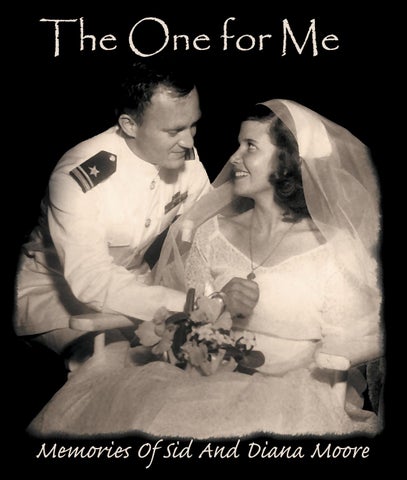
The One For Me mEMORIES OF sID AND dIANA mOORE
Editor: Judith Kolva, Ph.D. Memoir Shoppe www.memoirshoppe.com Designer: Enid Grigg Heritage Biographies www.heritagebiographies.com Š 2010 by Sid and Diana Moore, Pamela Hamel All rights reserved. No part of this document may be reproduced or transmitted in any form or by any means, electronic, mechanical, photocopying, recording, or otherwise, without prior written permission of Sid and Diana Moore, Pamela Hamel. Photographs courtesy of Sid and Diana Moore
For, you see, each day I love you more, Tomorrow more than yesterday and less than tomorrow. Rosemond Gerard
To Our Children Roderick Sidney Shawneen Louise Pamela O’Niell Monica Tarr Brett Paul
Thank You It was our daughter Pamela’s idea to write this memoir. Diana and I deeply appreciate that she asked us to prepare it through the able guidance and assistance of Dr. Judith Kolva. Pamela indicated that the memoir will be shared with her brothers, sisters, and their families. Diana and I will share it with other relatives, as well. The accounts of our experiences, along with the photos, may be noted by future generations long after we’re gone. Let’s hope they’ll find our memories both interesting and amusing. Sid and Diana Moore July 2010
Our Family
Foreword Our family memoir is not complete without the stories of our parents. The story of our parents, Sid and Diana, is a love story. And because it is, our family is imbued with their love that has rippled through our own stories. I dearly hope that it will always be so! My parents told us many stories about their growing-up years, and they delighted in doing so. I can’t say I was always interested in hearing them, especially as a teenager. But thank goodness, as I’ve aged, their stories are so much more meaningful and precious to me. I marvel at the richness of their stories and am now comforted in hearing them and in hearing them often. Finally, their stories are in a written form—what a wonderful gift! My parents’ childhoods, the story of their wedding, their navy life, the joys and challenges of raising five children, their senior years, and, perhaps most importantly, their love are memorialized forever. The greatest gift my parents gave me is their deep love and respect for each other. That example is precious because it tells me time-and-again that our greatest endeavor in life is to love each other, especially those closest to us. No matter what “success” we achieve in this life, the most valuable is the success we enjoy in our family relationships. My father is a gifted story-teller. I’ve often tried to understand why it is so! He speaks thoughtfully and deliberately, and shares insightful details. But that’s not the magic! The magic is HIM—his way of speaking, gesturing, and sharing himself. I have often asked my mom if, over the years, she’s heard all his stories. She always answers, “No!” My mother’s story-telling gift is in her many joyful family memories of her unique upbringing. She was a great example of a young girl who moved often, like we did, and she enjoyed the many opportunities it gave her to see the world. It trained her just-right to become a navy wife, who moved many times over the course of my dad’s military career. But my mother’s greatest gift to me growing up was her loving, consistent, and encouraging presence in my everyday life. I am deeply grateful to my parents for the tremendous effort they made, with the invaluable help of Judith Kolva, to share their life with us in this way. Oh, the glory of stories! Oh, the glory of true love! Pamela O’Niell (Moore) Hamel August 2010
Sidney Richards Moore
Growing Up, Southern Style
I
Sid Boy would like to tell you my birth was remarkable. It wasn’t. The only story that marks the event is this: On August 20, 1924, I was the first child born to Sidney Richards Moore and Betty O’Niell Moore. My rather normal start to life took place in the county of Ouachita Parish, in
the city of Monroe, in the state of Louisiana. My parents named me Sidney Richards Moore Junior, after my father. Shortly after I, his namesake, was born, people referred to my father as “Big Sid.” And up to the time I was well into my early teens, people referred to me as “Sid Boy.” After my father died, I dropped the “Junior” from my name. On May 22, 1927 my sister joined our family. My parents named her Betty, after my mother. But no one called my sister “Betty.” She had various and sundry little nicknames, including Tina-Boo, and when she was older, Bettina. But, then, for my mother’s side of the family, nicknames were normal. I had a cousin named Gibson Tucker. When he was just a little fella, he couldn’t pronounce his name. He would say, “My name is D-Tuck.” So, of course, we called him “D-Tuck.” Dorthea was another cousin who we called “Do-tee.” Belle was another cousin who we called “T-Ta.” We called another cousin “Charlie Boy.” Anyway, for whatever Sid and Sister “Tina-Boo”
reason, we had lots of little nicknames in our family.
Marilyn Flower Bush
W
hen I was born, my mother and father lived in an apartment, in a castle that was called “Layton Place.” Layton Place was a large estate on the Washtenaw River that was, in a sense, like a farm. The younger generation of the Layton family still lived there. Layton
Place was on a large plot of land with a barn, farm animals, a planted field, and a separate dwelling for Negro workers. One woman who lived there was very old and reputed to be a former slave. Even though I was only four years old when my family moved away from Layton Place, I remember many things about the people I met and the things we did together during the time I lived there. 1
Growing Up, Southern Style
For one, my cousin Martha Ann lived in the same complex. She was a little older than me, but we played together. Then, there was Marilyn Flower Bush. Marilyn Flower Bush was a young lady who lived in my building, and I remember her well. From my very early days, I loved girls, and I must tell you that Marilyn Flower Bush was the first love in my life. I was really sweet on her and was sorry when my family moved to the north end of town, away from Marilyn Flower Bush. When I was finally of school age and got to go to kindergarten, who should be in my class but Marilyn Flower Bush? I admired her so. Even though I was only five, she was the girl I was sweet on. Yes she was!
Experiences
B
ut back to Layton Place: I remember an experience on the river. The Layton family owned a boat dock directly across the street from the castle. One morning, my friend and I climbed into a skiff that was tied to the dock. The
skiff drifted away, and there we were—afloat in the open water. After a considerable time out in the river, I wanted to return ashore, but I didn’t have a clue as to how to get us back. I must have been very dumb because my friend just reached over, grabbed a tow line, and pulled us up alongside the dock. Another little experience I remember about Layton Place is the day I stuck a horseshoe nail in my foot. I had to get a tetanus shot because, back when I was a child, people who lived around farm animals, like we did, were concerned about getting lockjaw from rusty nails. During the years I lived at Layton Place, my mother enjoyed spending the summers with her parents, Justice Charles Austin O’Niell and Bettie Gordy O’Niell. So the O’Niell cousins and I got together
Justice Charles Austin O’Niell and Bettie Gordy O’Niell
frequently. That’s how I got to know my cousins rather well. In fact, some of my cousins stay rather close to me, even today. As an aside, that email is a remarkable thing. Even though I now live in Virginia, I can stay in touch with cousins who still live in Louisiana. 2
Growing Up, Southern Style
Anyway, we spent two entire summers on the Gulf Coast, where my grandparents rented a house in Pass Christian, Mississippi. Charlie Boy and I went fishing almost every day, and if we didn’t go fishing, we went swimming. There was always something to do, and my cousins and I had these experiences together.
Speed Avenue
I
n 1928, when I was four years old, my family moved to the north end of Monroe. This was a relatively new area, just being developed. My mother and father decided
they wanted to have a house built on the corner of 5th and M Streets. M Street was later changed to Speed Avenue, not because there was racing on the street but because Speed was the name of a prominent family in Monroe. The house was a brick house, painted with whitewash. I remember my mother was very anxious for the whitewash to wear away, so the house would have sort of a rustic appearance. Whitewash is a low cost paint with almost no strength, so it didn’t take long before my mother was happy with the way the house looked. Sid Moore,Circa 1928
One of the little things that occurred when I lived on Speed Avenue was Neville High School, which was and still is a very prominent school in Monroe, was built. I also remember Forsythe
Park, which was just one block to the north. The park had an American Legion Hall, tennis courts, a swimming pool, a golf course, and a baseball stadium.
The Great Depression
I
n 1934, my mother, my sister, and I moved to New Orleans, where we lived with my mother’s parents. My mother was a former school teacher, but she didn’t want to go back to teaching school, so she went to business school and learned secretarial duties. Once she was able to 3
Growing Up, Southern Style
hold down a job, we moved out of my grandparents’ house into our own little duplex, there in New Orleans. All this happened during the Great Depression. We were fortunate in that my father had a job, so we were not poor. I do, though, remember going to school and seeing kids who were dirt-poor. Some of them came to school barefooted and wore very ragged clothing. They were true victims of the Great Depression. I had an aunt who taught school, and she told stories about kids who came to school in the wintertime with their clothing sewn onto them, so they had to wear the same clothing all winter. Most days, all these kids had for lunch was two pieces of bread smeared with lard. There were lots of little signs of the Great Depression. But I didn’t personally suffer it, and my family was never deprived to the extent that we had to go without food. For us, though, the social climate did cause family problems. First, I’ll give you some background:
Homebrew
Y
ou see, in 1920, the Eighteenth Amendment to the United States Constitution, or what was simply referred to as “Prohibition,” became the law of the land. This meant no one was supposed to manufacture, sell, or transport alcohol. Well, what people were supposed
to do and what they did were two different things, entirely. Even my own parents made homebrew. They stirred all their ingredients for beer in a large crock, and after it fermented, they funneled it into bottles. Sometimes they let me push down the little lever that set the bottle caps. Then, they stored their beer in a dark room until it was properly seasoned, and they could drink it. It was served in coffee cans. Occasionally, I was surprised to see a bootlegger pull up in front of our house in his long, black limousine. Bootleggers didn’t have much trouble making money during the Great Depression because their job was to smuggle booze. We normally fancied bootleggers as very shady people. But this guy was a distinguished looking bird, so he didn’t exactly fit the image. We suspected bootleggers in our area ran their stills in the hills just outside west Monroe, but that was something I had vague information about. I do, though, remember that in 1934 a posse shot and killed the notorious bank robbers Bonnie 4
Growing Up, Southern Style
and Clyde over in Bienville Parrish, which is not far from Monroe. People said they were shot so many times the undertaker couldn’t get the embalming fluid to stay in their bodies. That caused a lot of excitement. I remember another time when my father and I went to buy ice. Back in those days, we put ice on the bumper of the car and drove home that way. Well, when we were at the ice house, a car-load of gangsters drove up for their ice. We were in awe of them.
Family Problems
E
ven though this was a very exciting time in the history of our country, as I started to tell you, I think the whole alcohol thing may have been part of my family’s problems. You see, my father was a traveling salesman for Merchant’s Coffee Company in New Orleans. Even
during the Great Depression that business seemed to do alright. The brand the company made for the northern Louisiana territory has probably long since disappeared from the face of the earth, but back then it was called “Alameda Coffee.” My father took out ads in the local newspaper. He had a little “drop-in” ad appearing in large grocery store ads that read Sid says, Drink Alameda! So when his friends saw him on the street, they would ask him, “What do you say, Sid?” And he would answer, “Drink Alameda!” Anyway, during the week he traveled his different routes, and then on weekends, when he was home, my mother and father got together with friends and usually booze and beer were involved. The truth is my father sometimes drank too much, and that, eventually, became a problem for my mother. My mother and father also had another problem: During the Great Depression, my father felt obligated to his own brothers and sisters. He had a brother who had dif-
My father, Sidney Richards Moore Senior, Served in United States Navy during World War I
ficulty holding a job. He was forever hitting up my father for handouts. He may have been asking for a loan, but it 5
Growing Up, Southern Style
was the kind of loan he’d never be able to repay. So because we had so little ourselves, my mother got very annoyed with my father because he shared so liberally with his family. And these different things contributed to my parents’ problems.
Vision Test
W
hen I was in about the third grade, all the students in my school had to take a vision test. It was a very elementary eye test that didn’t
actually involve reading. Instead, we had to look at cards with symbols on them. Then, we had to say if the symbol was facing left or right. I flunked the test. I brought my report home and showed it to my mother. She wasn’t happy. I don’t know why, but she had a certain vanity about me and didn’t want me to wear glasses. With that in mind, my mother took me out of school for a semester. So, of course, all my friends and associates, including Marilyn Flower Bush, went on without me, and I fell My mother, Betty O’Niell Moore
behind. My mother took me to see the doctor, and he prescribed eye drops.
So for six months, my mother made me put these cloudy, yellow drops in my eyes that were supposed to correct whatever problem was causing my vision loss. She wouldn’t allow me to go to school until the drops had a chance to do their trick. As I look back on that little experience, I don’t know if the drops helped, or if I just grew out of the problem, or if it was really no problem at all. I suspect the drops didn’t really change my vision. I don’t know the whole story, but I do know I had a bad feeling because I was not with my initial associates. I can’t, though, blame the whole thing on my mother. About this same time, my mother and father’s marriage problems got worse. Not long after, my mother decided to leave my father. I think there was a trial separation earlier that didn’t last very long, but their problems finally got to the point where my mother left for good.
6
Growing Up, Southern Style
Rubber Gun Wars
W
hen I was about ten years old, I started to play a game my associates and I called “rubber gun wars.” And, oh, how well I remember rubber gun wars. Neighborhood boys would take pieces of wood that were about a foot long and fashion them into pistols.
To make a pistol you would fasten a clothespin to its handle. Then, you would strip a piece of
rubber from an inner tube and stretch the rubber from the barrel-end of the pistol back to the clothespin. After your pistol was finished, you were ready to fight. You would aim your pistol and squeeze its handle, and that would release the rubber to fly over and hit your enemy. We did the same thing with rifles. Except to make a rifle you would use longer piece of wood, notch its barrel, and tie a string just above the notches. When you pulled the string, it would release the rubber. If you pulled really hard, you could release five or six shots at one time. We even made cannons. If you happened to run into one of these cannon lashes, you really knew you were hit. A boy would hide his cannon around a corner, and if you didn’t know it was there, you were in trouble. You would be walking down the street, minding your business, when a long strip of rubber would come flying around the corner and practically wrap around your entire body. We had great fun running around and shooting these various weapons.
Chinaberry Wars
C
hinaberry wars were also popular. You see, when the chinaberry is still green it is hard, and it is firm. So what you did was find a piece of bamboo. Then, you would cut it off just inside its two knots. Then, you would make a little plunger out of a piece of wood
and fit it into the bamboo. Then, you would take green chinaberries and with a little stick, you would tap them into your little bamboo weapon. When you saw someone or something you wanted to shoot, you would hit the wood, which would cause compression, and the chinaberry in the far end would blow out. And I must tell you that it blew out with a lot of force.
7
Growing Up, Southern Style
Seasons
L
ife when I was a kid in Louisiana was a lot different than life today. We didn’t have activities like Little League. We just played ball together. We had seasons for doing certain things: There was a season for tops; there was a season for kites; there was a season for mumble-peg
played with pocket knives; there was even a season for playing Cowboys and Indians.
Springtime was the season for marbles. We played marbles in our neighborhood. We even played marbles at school. To start a game of marbles, we drew a big ring in the dirt. Each player would place a marble on a line in the center. Then, shooting from outside the ring, each had a turn trying to knock marbles in the center out of the ring. The marble used for shooting was called an “aggie.” It was a select marble made of agate stone or glass. Players kept the marbles they won. We even battled with our kites. Kites were armed by attaching a razor blade or a sharp-pointed stick to the vertical strut. The object was to cut the other person’s kite string or to slash his kite.
Boy Scouts
I
became interested in Boy Scouts in 1935, while still living in Monroe. Back then, you had to be eleven years old to become a troop mascot. As soon as I turned eleven, I became a mascot for a local scout troop. Later, after I moved to New Orleans, I joined Boy Scout Troop 55.
From the very beginning, I had a lot of fun in Boy Scouts and remember my experiences well. On one occasion, the scout masters organized a tour of the southern states. Carrying our bedrolls and tents, my associates and I climbed in the back of a long trailer, where we sat back-to-back on benches. Our tour included Florida, where we stopped at a camp on the beach near Saint Augustine. Then, we went on to a mountainous area near Ashville, North Carolina, where we swam in a cold mountain stream. All along the way we stopped overnight at various places, including a firehouse. We detoured around Tennessee, which was one of the states we were scheduled to visit, because of a polio outbreak. The scout master swabbed our throats as prevention from polio. Back in the 30s, there was a wide-spread outbreak of polio, and people were very fearful of paralysis or even death. Anyway, we wound up touring through Hot Springs, Arkansas and returning from there to Louisiana.
8
Growing Up, Southern Style
In 1937, we took a train to Washington, DC for the very first Boy Scout Jamboree. While we were there, we saw Franklin Roosevelt, who was driving around in an open car waving to all the boys. From there, we took a train to New York, where we went to Coney Island. Back then, whenever we traveled long distances we went by train because there were no flights, but that was part of the fun. Another experience I remember about the Boy Scouts is going to Camp Salmen. Camp Salmen is on a bayou in southeast Louisiana, where we did a lot of canoeing. I want to tell you that my memories of my Boy Scout experiences are all positive memories.
Segregation
I
t’s too bad, but race segregation was around for a long time in the South. When I was growing up, I thought segregation was normal. I wasn’t prejudiced myself. Yet, we in the South had a different attitude about race. We lived in close association with blacks all of our lives, but we
looked upon them as people who, for the most part, worked at menial jobs. That was the thinking for a long time. When I was a history student at LSU, I had an American history teacher who talked about racial segregation during the years when I was a youngster. He mentioned that the philosophy of the white southerners toward the blacks was come as close as you like, but don’t go high. But in the North the thinking was go as high as you want, but don’t come close. And that was true. There was definitely segregation. When I was growing up, whites and blacks even had separate water fountains. This went on for a very long period of time. I’m not sure we’re out of it yet, but it’s mostly behind us. Just look at what happened in the 2008 presidential election: For the first time ever, the people in the United States elected a black president. But I remember back in the 40s when I was aboard the Johnnie Hutchins, there was segregation aboard ship. Most of the blacks on the ship worked as stewards, which meant that like in the days of slavery, they were still serving whites. The blacks had to bring coffee up to the officers on the bridge and serve meals in the officers’ dining room. When the war was over, and I was back in the States, I took a thirty-day leave. Our ship docked in Long Beach, California, and I rode the train from Los Angeles to New Orleans. In those days it was a long, long trip. Well, I took my meals in the dining car. But I worried about the black stew9
Growing Up, Southern Style
ard from our ship who was also aboard the train. He wasn’t eating a proper meal in the dining car. Instead, he bought sandwiches and ate them at his place in the rail car. I insisted that he come to the dining car with me and have a decent meal. For my whole life, I’ve had my own thoughts about blacks and how they should be treated.
Lena
A
nyway, back when I was young, we white people in the South had black people who worked in our homes, and we became very close to them. My mother had a maid named Lena who did everything for us. While my mother was at work, Lena cooked for us, fed
us, swept the sidewalk, and did the laundry. We didn’t have a washing machine, so Lena scrubbed the dirty laundry on a scrub board before she hung it out to dry. If visitors stayed overnight and left their clothes on the floor, Lena picked them up, and before the guests knew it, their clothes were washed and hung on the line to dry. Lena was extremely efficient and a very loveable, delightful person. Lena was divorced from her husband, Willie Williams. Well, she had to go to the court to get payments from Willie because often times he neglected getting around to paying his alimony. Each time she appealed her case, she had to say specifically, “I’m talking about Willie Williams number six.” There were that many Willie Williams who had defaulted on their alimony. The lottery was very popular among blacks, and Lena loved to play the lottery. She bought what was called a “dream book.” Lena’s dream book had numbers relating to certain objects. When she had a dream—whether it was a tree, or a horse, or a stream, or a dog—all she had to do was look it up in her dream book, and her dream book told her what number to play. Lena belonged to a burial society. I don’t remember exactly what her dues were, but they were nominal—something like twenty-five cents a week. Paying into this burial society guaranteed that when she died, she would be properly buried. Another benefit of belonging to the burial society was Lena’s dues entitled her to go to the wakes of other people who were members of the same society. When Lena came to our house in the morning as happy as she could be, we knew she was going to a wake that evening. Why wouldn’t she be all happy? The wakes always had lots of beer and were a guaranteed good time. 10
Growing Up, Southern Style
Only a few blocks from where we lived on Maple Street there was a cemetery. I remember watching black funeral processions passing by our house on their way to the cemetery. There was a band that played dirges going to the burial. Then, after the burial, they jazzed it up, and marched in a more active mood. I think these black burials and the burial society had something to do with the origin of jazz, although I’m sure there were other elements involved with the making of jazz music.
Sid Boy, the Carhop
D
uring my teenage years, my sister and I spent our summers in Monroe with our father. One summer I got a job at a drive-in restaurant as a carhop. The main thing I sold was malted milkshakes. People drove up in their cars, and when I went out to take their
order, they’d tell me how many malts they wanted—two chocolate, three vanilla, one strawberry, and so on. Then, I would hurry back inside and pour ice cold milk and malt powder into a tall silver container, add ice cream, and attach this container to a machine that whipped it all together and made the drink. I would put the malts on a tray, hurry back out to the car, and hook the tray onto the car. You see, part of the tray hooked to the window and there was a little brace that held it outside the car, so the people could reach out and grab their drinks. Back then, malted milkshakes cost something like twenty-five cents. I don’t remember how much I made, but it wasn’t much. Occasionally I’d get a tip, but again it wasn’t much. Later in the day the drive-in sold beer. So there were various and sundry things we sold. And that was my little experience as a carhop. Yes. When I think back, I realize that my boyhood was surely a very different time and place. I grew up Southern Style.
When I think back, I realize that my boyhood was surely a very different time and place. I grew up Southern Style.
11
Formal Education
Deviltry
M
y formal education began in 1930, when I started elementary school at Georgia Tucker Elementary in Monroe. Then, when we moved to New Orleans, I continued elementary school at Lutcher Elementary. With my elementary school days over,I
entered Fortier High School in New Orleans in 1938. Fortier was a public school, and during those years, the public schools in New Orleans were segregated for males and females. Over two thousand boys attended Fortier, and in many ways it was a tough school. Actually, the boys were terrible. You see, part of the element that went to Fortier was from the section of New Orleans called the “Irish Channel.” The Irish Channel had some very rough kids. Fortier was a building that was four stories high. Students moved from room to room for different studies, but when we arrived in the morning, the first thing we did was assemble in our homerooms, where the teachers did a roll check. After about fifteen minutes, a bell rang, and we got on with our day. Now, the homerooms were actually study halls—very large rooms that were the equivalent of three or four classrooms all in a row. The windows opened out, and the only way to open them was by pushing. My home room teacher was a little fellow by the name of Venier. Well, Mr. Venier had two problems: One, he was adverse to the cold. Two, he was never quite on time. So during the wintertime, the boys would run into the study hall, lock all the doors, and push open the windows. Before you knew it, the big study hall was ice cold. When Venier finally arrived, he would knock on the door and holler, “Let me in!” The boys would ignore him. He would holler some more. When they finally did open a door, it was a door some distance away from the door Mr. Venier was knocking on. Venier would dash down the hall only to discover that door closed and the first door open. Much to the boys’ amusement, they kept him running back-and-forth for quite some time. When Venier’s tormentors finally tired of the game and let him in, the first thing he would do is run to the back of the room and attempt to close the windows. Well, as you can imagine, a boy would be right behind him, opening windows as fast as Venier could close them. This is just one little story about the deviltry that went on at Fortier.
12
Formal Education
Rip Open His Spavor!
O
ne of my very good friends at Fortier was a Scotsman named Alan Minty. Being from Scotland, Alan used different words for common things. He called an undershirt a “singlet.” The hood of a car was a “bonnet.” The fly in boys’ pants was a “spavor.” Now,
keep in mind that back in the 30s, there was no such thing as a zipper. Boys’ pants were closed with buttons. Well, when we initially arrived at Fortier in the morning, we walked into the ground floor, where there were no classrooms. Instead, there were wooden stages located here-and-there, where boys could sit and wait for the first bell to ring. Now, ripping buttons from boys’ flies was a common game at Fortier. Alan Minty played the game by asking an associate to sneak up behind a boy who was sitting on the edge of a stage. He’d say, “You pull him back. I’ll rip open his spavor!”
Fieldtrip
I
will always remember the day Mr. Venier took my class on a fieldtrip to the zoo at Audubon Park. Fieldtrips were supposed to be educational, but the class elected to go to the zoo because the boys thought it would be more entertaining than looking at some factory. Had Mr.
Venier been smart, he would have insisted on the factory. One of the zoo’s main attractions was the seal cage. The cage was outfitted with a pool, where the seals could swim, and rocks, where they could sun themselves. It was surrounded by an iron fence that had curved iron bars with sharp points. The bars looked dangerous, and they were. They were meant to prevent the seals from leaping over the fence and escaping. When we walked up to the exhibit, the seals were playing in the water, which was enough to amuse most of my associates. There were, though, a few boys who had no interest in watching seals play. They snuck up behind Venier, grabbed him, lifted him over the pointed bars, suspended him above the water, and threatened to throw him in with the seals.
13
Formal Education
Sailing Report Cards
H
ow well I remember my math teacher at Fortier. When most teachers passed out report cards, they passed them out in an orderly fashion. But one of the little things this math teacher did was deal out report cards as if he was dealing out a hand of cards.
He called your name, you held up your hand, and he sailed your report card to you. If you
weren’t a cooperative student—if he didn’t favor your way of studying—he threw your report card out the window, and you had to run down four stories to retrieve it. I guess he favored me because I never had to pick my card up out of the street.
The Cajuns
D
uring my first two years of high school, I lived at home with my mother in New Orleans. I never stopped loving my mother, but I did find her to be a difficult person to live with. That’s all I can say. So in 1940, I elected to go to Franklin High School in
Franklin, Louisiana for my junior year. At the time, my grandfather lived in New Orleans, but he owned a home in Franklin, where my Aunt Cat and Aunt Nora lived. They welcomed me to live there with them. It was at Franklin High School that I became associated with the Cajuns. Like most students in Louisiana, I took French so I could understand the French culture that was prominent in the area. The Cajuns soon discovered that when it came to recitation in French, I was not that good. They, of course, were excellent. Well, when the teacher got ready to call on a student to read or recite, the Cajuns all pointed at me. They almost died laughing as I stumbled through my French. But when it came to taking the test, I did better than most of them because I could handle the written word. They could not. That was just one of the little experiences I had at Franklin High School. At the end of my junior year, my cousin Charlie Boy graduated from Franklin and went on to Georgia Tech. Getting back to the fact that I had been withdrawn from school for awhile because of my failed vision test, my associates and the people I palled around with were a year ahead of me. I didn’t want to continue going to school without my cousin. So for my senior year, I decided to join my friend Alan Minty at Jefferson Military Academy. 14
Formal Education
Strict Military Routine
J
efferson Military Academy is a very old military school in Washington, Mississippi, about six miles outside Natchez. The school has long history of prominence and excellence in education. I was proud to be a student at Jefferson and want to tell you about my experiences:
The routine at Jefferson was a very strict military routine. Each morning we were awakened by a
bugler. Drills were conducted by a bugler. Morning calisthenics were part of daily life. Major Walser, a former major in the Marine Corps who had been gassed during World War I, was the commandant of the school. He got us out every morning and put us through drill paces. Even though we were only fifteen-, sixteen-, and seventeen-year-old boys, we were fairly well militarized. We marched wherever we went and received demerits for what was considered to be misbehavior. Major Walser held court periodically, and if you had demerits, you could be sentenced to “walk the path.” The path circled the flag pole, and your sentence was to carry a gun and march around the flagpole for an hour, or two hours, or whatever your sentence happened to be. The possibility of a sentence kept you on your toes. If you were caught smoking cigarettes, you knew for certain you would be sentenced to walk the path. I must admit that one time I was caught smoking cigarettes. Major Walser threatened to kick me off the football team. He didn’t do that, but he did sentence me to walk the path. I can tell you from firsthand experience that it’s no fun carrying a gun and marching around and around a flag-
I can tell you from firsthand experience that it’s no fun carrying a gun and marching around and around a flagpole in military fashion.
pole in military fashion. Our dress uniforms were very fine, but our everyday uniforms were simple gray khaki, with a blue stripe down the sides of the pants. You never went anywhere without your cap, which was powder blue and had a little bill. Each morning the cadets met for various announcements, followed by a songfest. Our English teacher
played tunes on the piano, and we sang along. The words to the songs were printed on song sheets. I suppose a lot of them were kind of silly, but to this day, I remember some of the songs. One was “My Sweetheart’s the Man in the Moon.” There was another song that dated from World War I.
15
Formal Education
I’ll give you a few lines from that song: The colonel tried to write it, but he fell down on the verse. The major tried to write it, but he only made it worse. They called in Captain Cuttle, but he missed by a mile. So they left it to the sergeant of the file. And it went on from there.
Determination
F
rom the time I was a freshman at Fortier I wanted to go out for football. The problem was Fortier had some big boys. They were big enough to play football at Louisiana State University (LSU). I was too small. When I transferred to Franklin, I still couldn’t go out for
football, or any other sport, because I hadn’t attended the school long enough. The state had a rule that students had to be enrolled for a certain amount of time before they could play varsity sports. Finally, when I got to Jefferson, I could go out for football. My friend and roommate Alan Minty also went out for football. Alan had played the previous year, but this was my first year. Even though I was a senior, I didn’t make the team right off the bat. I warmed the bench—at least during the early part of the first game. Let me tell you what happened: The captain of the cadets, Hunter “Ace” Mullis, was the number one boy at Jefferson. Ace was a blonde, curly haired, very firm fellow. He was outstanding young man—a leader—a boy everyone looked up to. Ace was so well-known that at one time, someone wrote a letter simply addressed to Ace, Washington, Mississippi, and the letter found him. There was no doubt that Ace was in the football game. He played halfback. Well, early on in life, Ace broke his arm. After he broke it about the fourth time, the doctor operated and pinned his arm together with a piece of steel. After the surgery, the doctor warned Ace if he broke his arm again, he didn’t have many options left, except amputation. Nonetheless, Ace was dying to play football. Major Walser, who along with being Jefferson’s commandant was our football coach, didn’t want to lose this fine player, so he had a special brace made that was meant to protect Ace’s arm. The brace was a laced-up piece of leather lined with steel ribs and wrapped in fleece. Well, let me tell you, at practice Ace was a menace with that brace. He knocked the living daylights out of us, his teammates. 16
Formal Education
The first game, though, was a very different story. Our opponents weren’t intimidated by Ace’s brace, and Ace knew it. So I think Ace played a little shy. Well, when my father went to college at what was then called “Mississippi A&M” but became Mississippi State, he played football. My father always warned me, “Don’t play shy because you’ll get hurt.” It’s too bad Ace didn’t hear my father’s advice because in an attempt to protect his arm, I’m sure he played shy. Sure enough, he got hurt. You see, in those days, football players didn’t wear masks— we didn’t even know what masks were. When Ace backed off, an opponent kicked him in the face and completely tore up his nose. Ace was bleeding like a stuck pig, but he was all guts. He didn’t want to leave the game. Major Walser finally had to send in two big guys to pull Ace off the field, so the paramedics could strap him down on a stretcher and load him into the waiting ambulance. The next thing we knew, the ambulance flashed its lights and screamed off toward Natchez with Ace onboard. Now, Major Walser had a problem. He needed someone to replace Ace. Before that little experience, I was eager to get in the game. I was itching to play. But when I saw Ace carried off the field, bleeding all over everything, I said to myself, “I’m not so sure . . .” Actually, the real truth is I hoped the ground would
Actually, the real truth is I hoped the ground would swallow me up, and no one would see me sitting there on the bench.
swallow me up, and no one would see me sitting there on the bench. No such luck. Major Walser looked around. He paced along the bench. He stopped in front of me. I gulped. “YOU!” he barked, “Get in there!” After that little experience, I played right
halfback for sixty minutes of every game. I wasn’t very good. But I played. Back then, we didn’t have defense and offense, so players played the entire game. I remember we played some of our games on fields that WPA workers built directly on Mississippi’s hillsides. As an aside, the WPA— the Works Project Administration—was the largest New Deal agency. It was created by President Franklin Delano Roosevelt to carry out public works projects. Back during the Great Depression, it offered jobs to thousands of people, who couldn’t otherwise find work. Anyway, unlike me, my friend Alan Minty was a very good football player. As I told you before, Alan was a Scotsman who grew up playing soccer, which is Scotland’s equivalent to America’s
17
Formal Education
football. Even when I first met Alan back in the eighth grade, his legs were well developed and he could really kick the ball. I remember one day during recess, Alan came along and kicked a volley ball so hard it went sailing across the playground and knocked a kid unconscious. At Jefferson, Minty did place kicking—not punting—but place kicking. He was so good that on a kickoff, he kicked the ball out of the end zone almost every time. Even today, some sixty years later, rarely does a college kicker kick the ball out of the end zone. Then there was me. I was not very good at anything. I just had a lot of determination.
A Single Weekend
M
y grandfather O’Niell was a graduate of Tulane University. He was a Tulane man, through-and-through. His two sons, though, went to LSU’s law school. That meant my grandmother O’Niell was a very strong LSU fan. So there was this little differ-
ence in my family. Well, during the time I was growing up and living in New Orleans, we lived in the shadow of Tulane University. This was years before New Orleans had the Superdome, so Tulane’s stadium was outdoors. On game days, the band assembled in the gym armory and from there, marched into the stadium. It was a very big deal for the neighborhood kids to run over to the armory, hang around the band, and volunteer to carry instrument cases into the stadium. So there we were—young kids, instrument cases under our arms, marching behind the band singing, “Hail Green Wave, for you we give a cheer; Hail green wave, for you we have no fear; Hurrah for Old Tulane,” at the top of our lungs. During the game, we felt very important because the band members allowed us to run little errands. For kids, this was all very exciting. Plus, we got into the games free. When I was a kid, I was certain that when I grew up and went to college, like my grandfather, I would be a Tulane man. But the truth is that all changed in a single weekend. One weekend, when I was attending Jefferson, I visited friends at Louisiana State University. Back in those days, LSU had men’s dormitories built into the football stadium, and that’s where I stayed. My friends took me around the campus, and we went into Baton Rouge. I’m not exactly sure why, but by the end of the weekend, I was sold on LSU. And that’s where I went to college. Looking back, it’s probably just as well because LSU was a lot less expensive than Tulane. 18
Formal Education
Dog Moore
I
enrolled as freshman at LSU in 1942. LSU is a land-grant college, and back in those days, ROTC (Reserve Officer Training Corps) was compulsory for all freshmen and sophomore males who attended. I was in L Company—an infantry company—and lived alongside my as-
sociates in the military barracks. Along with our studies, we did a lot of PT (physical training) and many other little things required by the military. Any boy who went to LSU back in my days can tell you about freshman hazing. You were hardly unpacked before older students seized you and shaved your head. It was easy to identify freshmen because they all had skin heads. You had to kowtow to the upperclassmen, and if for one reason or another, you didn’t shape up you got whacked by a broom. LSU issued freshmen little purple beanies with yellow bills. You never went anywhere without your beanie. It was your identification. If you were a freshman you were a dog—D-O-G—dog. You were required to write your name on the flipped-up lid of your beanie. I was known as “Dog Moore.” Every dog knew he was subject to beatings. If he didn’t do something right in the barracks, he would get whacked by a broom. We were dogs! One thing a dog dare not do was wear anything green, which is a Tulane color. All dogs knew if they wore green, they were in for it. One morning an upperclassman spotted my associate Alan Minty walking across campus wearing green socks and immediately did his duty: “Hey, dog! What are you doing wearing green socks?” “Green? What’s wrong with green?” Alan asked. The upperclassman was taken aback. “Haven’t you heard of Tulane?” Alan answered, “Tulane? What’s that?” “You can go, dog,” the upperclassman said.
Hell Week
E
arly during my first semester at LSU, I pledged the Delta Kappa Epsilon—DKE—fraternity. Hazing at the fraternity house was even worse than the hazing in the barracks. During hell week, among many other little things, the upperclassmen whacked the pledges with paddles.
When we had noon meals, especially on Sunday, we said grace before we sat down to eat. On 19
Formal Education
one particular Sunday, Jack Everett, who was another pledge, was called upon to say grace. We all bowed our heads. Then, we waited. We waited some more. The upperclassmen were getting annoyed because Dog Everett still didn’t speak. He had his head bowed reverently and seemed to be thinking, but he didn’t say a word. Finally, Dog Everett said, “I, J. Everett, thank Thee, J. Christ, for this food. And for God’s sake, get this hell week over so my ass will get well.”
Live Bands
B
ut life at LSU wasn’t just about hazing. We had fun. We attended lots of dances, where we always had live bands. There was no such thing as DJs, playing recorded music like they do today. I especially remember a band called “Dukes of Dixieland.” They were really
good, and my associates and I thoroughly enjoyed that experience.
GI Bill
I
n 1942, I joined the U.S. Navy. I’ll tell you about that experience later. For now, I’ll continue with my education. In 1946, after the war, I returned to LSU. I was determined to finish college, and a lot of other people had the same idea. A whole generation went back to school
on the GI Bill, which was an omnibus bill that provided, among other things, college or vocational education for returning World War II veterans. I was one of them. After the war, with all the GIs in school, the enrollment at LSU went up from forty-five hundred students, which is what it was before the war, to seventy-three hundred students. It was bursting at the seams. We thought it was very unnatural to have more than seven thousand students on campus. I thought LSU would settle back down to a little college of forty-five hundred. But that didn’t happen. Today, in 2010, I think LSU has pretty close to thirty thousand students on campus. Nevertheless, after the war there were a lot of former GIs on campus, and the boys outnumbered the girls by far. I decided I wanted to reside in the Delta Kappa Epsilon house and found a couple of my old friends who roomed with me. After the war, many veterans wore their military uniform to class and kept military paraphernalia around. But other than one fleece jacket, I didn’t do that. 20
Formal Education
Distinguished Heritage
A
fter I graduated from LSU, I thought I should go to law school. My grandfather, Charles Austin O’Niell, was a chief justice of the state of Louisiana for more than thirty years. There is still a plaque outside the Franklin Courthouse Square that reads, “Franklin na-
tive, Charles A. O’Niell, 1869-1951. On Louisiana Court bench 1914-1949. Stamped as one of the state’s immortals for his contribution to law in the United States and the cause of justice and freedom.” Grandfather Charles O’Niell is an important part of our family history, so I want to tell you more about him. As an aside, somewhere along the line, the family name had the traditional spelling of “O’Neill.” But for whatever reason, it was changed to “O’Niell.” So now when I see the spelling “O’Niell,” I can be more certain this person is, indeed, one of my family members. Anyway, my grandfather was born on September 7, 1869 in Franklin, Louisiana. His mother, Isabella Margaret Burnham O’Niell was from London, England. His father, John A. O’Niell, was from Ireland. My grandfather’s interest in public service all started with his father, my great-grandfather. Colonel John O’Niell was a highly educated, cultured gentleman, who served in the Crescent regiment in the Trans-Mississippi department in the Confederate States Army during the Civil War. He was al-
Betty Moore (seated left) “Bettina” Moore (seated right)Sid Moore standing in front of portrait of Chief Justice Charles Austin O’Niell
ways interested in public affairs, including serving two terms as sheriff and several terms as treasurer of Saint Mary parish. 21
Formal Education
My grandfather O’Niell was one of many children. Yet, his family managed to give him a classical education. He was stricken with typhoid fever when he was a child, which left him lame. So from the time he was six years old until he was sixteen years old, he walked on crutches. In 1893, he graduated from Tulane University with a degree in law. Following his admission to the bar, he practiced law in Saint Mary Parish until 1908, when he was elected district judge. After four years service as district judge, he was elected to the Supreme Court of Louisiana, having defeated five other candidates. He served on the Supreme Court for thirty-five years and as chief justice for twenty-four years. He died in 1951. In 1949, I earned my BA degree at LSU and at my mother’s urging entered law school. I soon discovered, however, that I was not suited for law. I was a poor student and washed out. Let me add, though, that throughout my working career, I attended night school whenever I could. Even when I was stationed in Taiwan, over a long stretch of time, I acquired some twentyseven credit hours in such subject areas as marketing, education, administration, government, expository writing, and public relations. My credits are from Tulane, Roosevelt University, the University of Maryland, and USC. I never made less than “A” in any of these courses, except one titled “Judiciary Process.” So, maybe, unlike my grandfather, I wasn’t cut out for law.
22
Lifelong Patriot
USS Lemon Soda
I
joined the navy because my father was in the navy. During World War I, he served on the battleship USS Minnesota. My father kept paraphernalia from his navy experience, and when I was a child, I played with it. I don’t remember this myself, but my aunts told me that I
referred to his battleship as the USS Lemon Soda. So from the time I was a young boy, I favored the navy. Let me tell you about my experiences:
Crazy Dream
O
n December 7, 1941 I was sitting in my room at Jefferson Military Academy, either doing homework or writing a letter home. I had the radio on, and about noon, the program was interrupted with an announcement that Japan bombed Pearl Harbor. My first
thoughts were: I don’t know a thing about Pearl Harbor. I don’t even know where it is. Well, football season was over, and even though it was only December, guys were already on the lawn pitching baseballs back-and-forth, warming up for baseball season. Even though I had no idea what had really just happened, I thought it sounded pretty darn serious, so I went outside and told my associates what I heard. From that time on, we listened to the radio very carefully. That very night the army started to move troops. Camp Shelby, which is a large army base, is located not too many miles from Jefferson, and an intersection on the highway leading to the base is located outside Jefferson’s front gate. It was at this junction where the army trucks changed gears. The activity went on all night long. When I finally got to sleep, I dreamed that the Japanese were invading, but I couldn’t protect myself. You see, Jefferson issued rifles to all the cadets, but the rifles didn’t have bullets. Nonetheless, we were required to clean our rifles with an emery cloth and pol-
When I finally got to sleep, I dreamed that the Japanese were invading, but I couldn’t protect myself. That crazy dream stayed with me throughout the war. Even when I was at sea, it came back from time-to-time.
ish them until they gleamed like sliver. 23
Lifelong Patriot
At night we suspended our rifles on cords under our bunks. Well, I dreamed that as the Japanese floated down in their parachutes, my associates and I grabbed our useless rifles, but our attempt to stave them off was to no avail. That crazy dream stayed with me throughout the war. Even when I was at sea, it came back from time-to-time. Thankfully, my dream went away as soon as the war was over because it wasn’t a pleasant experience.
Rod Man
A
nyway, my associates and I were dying to serve in the war. The problem was I was only seventeen, and my mother refused to allow me to volunteer for the navy until I was eighteen. I was impatient but knew I couldn’t get around my mother. I graduated from Jeffer-
son in June of 1942, and practically the very next week, I started my freshman year at LSU. One of the very first things I did at LSU was to volunteer for the Naval Aviation Program, which was called “V-5.” Baton Rouge didn’t have a procurement office, so I had to go to New Orleans. My blood pressure was so high I had to go back time-and-time again, but I finally made the grade. I thought it would be a matter of a week or two before they called me up for active duty, so I dropped out of school, ready to go. Well, the navy procrastinated and procrastinated. When I didn’t get called up, I needed something to do, so I went to work for my uncle who was an engineer in Lake Charles. Have you ever seen the kid who stands next to the surveyor and holds a red and white striped pole? That was me. I was a rod man. I soon learned that the rod man does more than just hold the pole—he slings a sledgehammer and drives stakes into the ground. I worked at that job until the navy finally called me up and sent me to the University of Texas for the Naval Air Cadet Program. I didn’t make it as a naval air cadet because I couldn’t navigate worth a damn. I was just terrible. Well, at one time, if you didn’t hack it as a naval air cadet, the navy released you to go out and do whatever you wanted to do. I had it in mind that if the navy didn’t like me, I would join the Army Air Corps. The problem was the navy made me sign a piece of paper agreeing that if I washed out of the aviation program, I had to stay in the navy, and my next assignment would be boot camp.
24
Lifelong Patriot
We Were Cold!
T
rue to their word, in November of 1942, the navy put me on a train headed for the Great Lakes Naval Training Center a few miles north of Chicago, Illinois. The Naval Recruit Training Command was located there. The train had a number of cars packed with mili-
tary personnel, all being transported to navy boot camp. When the train pulled out of Texas, it was hot. Back then, trains weren’t air conditioned, so we slept in our underwear. By the time we got to Chicago, the temperature was four degrees below zero. Never, in my entire life, had I experienced anything like that. I saw snow one time in New Orleans, and it was such a novelty that kids ran outside to catch snowflakes. Well, I soon learned that although it snowed in New Orleans once every eighteen years, it snowed in Chicago once every eighteen minutes—or at least once every eighteen hours. Anyway, after we arrived in Chicago, we had to change trains and take the North Shore Line to Great Lakes. It was the wee hours of the morning before we reached our final destination. We were cold! The navy could care less. About 0530 they roused us out of our bunks.
Dignity Disappeared
T
he first order of business was to get measured for uniforms. The drill instructor marched us over to a big building, where we stripped off all our clothing. The only items we were allowed to keep were our shaving cream, toothbrush, razor, and a few little odds and ends.
We were instructed place our toiletries in a drawstring ditty bag. Our clothing was packed in a box that was labeled to be sent home. So there we were—many young men, wearing no clothing, clutching little ditty bags. It was a sad sight. But the navy wasn’t finished. They marched us through an assembly line, where we were measured for uniforms.
So here’s a guy sitting behind a desk, fully clothed and immaculate. And here you are, with black marks on your body and no clothing.
Dignity disappeared. This was all about efficiency. Guys armed with black markers wrote your chest size on your chest, your arm size on your arm, your leg length on your leg, your waist size on your belly. Before you knew it, you had 25
Lifelong Patriot
numbers written all over your body. Of course, this made it very easy for the guys who issued the uniforms. All they had to do was look at you and holler out, “Size 32 pants,” and so on. In the middle of this, you were sent to see a psychiatric evaluator. So here’s a guy sitting behind a desk, fully clothed and immaculate. And here you are, with black marks on your body and no clothing. As you stood there in front of his desk, he asked you questions to determine your mental stability. At that moment it wasn’t so great.
Not Soon Enough
I
hated the cold weather. The barracks were heated by coal, and occasionally we got the duty to shovel coal. Coal duty meant we had to go down into a big coal bin, shovel coal onto a conveyer belt, push a button, and wait for the conveyer to move the coal into the furnace.
Did you ever see what happens to snow around a coal furnace? Well, coal furnaces shoot out soot.
The soot settles on the snow. Before you know it, the nice, white snow is black. Then, it snows again. Again, the snow is nice and white. It doesn’t stay that way. It sits there for a few days. The coal dust settles. Again, it turns black. Then, it snows again. Again, the snow is nice and white. It doesn’t stay that way. Well, you get my point—before long when you dig down in the snow, there is layer after layer of black and white. I couldn’t get away from that place soon enough.
Out Going Unit
A
fter I finished six weeks of training, I was allowed to go home on a two-week leave. Before leaving, however, I had been interviewed to determine what further training I would receive. Although I said I wanted to be an aerial gunner, the interviewer noted that I had
been a rod man. He insisted that I was going to quartermaster school. When I returned from my leave my biggest concern was that I might have to stay at Great Lakes and attend the quartermaster school there. Much to my relief, I discovered my quarters were in a building called “Out Going Unit—OGU.” That meant I wasn’t going to quartermaster school at Great Lakes. I was going elsewhere. I didn’t know where, but basically anywhere was better. I wanted to get away from the frigid climate. While I was in OGU, I came down with the flu—back then they called it “cat fever.” I was petri26
Lifelong Patriot
fied to turn myself into sick bay because I thought if I didn’t remain in OGU, I would end up going to school at Great Lakes. So, sick as a dog, I stayed in my bunk and waited to be called to leave Great Lakes. My name finally reached the top of the list, but by then, I was so weak I couldn’t pick up my sea bag. Do you know what sailors’ sea bags are? They are big white bags. You stuff everything you own into this bag, hook it over your shoulder, and walk to wherever you are going. I was lucky to have a couple of friends volunteer to carry my sea bag. So there we were—two guys with sea bags hooked over their shoulders, another sea bag hanging between them, and me dragging behind. We boarded the train and found our seats, still without any idea where we were headed. It wasn’t until after the train pulled out of the station that the chief petty officer announced, “Okay, guys, the train is rolling, so I can tell you where you’re going. Your new duty station is Newport, Rhode Island.” To tell you the truth, I didn’t really care. Anywhere was better than Great Lakes. Meanwhile the pharmacist aboard the train saw I was sick as a dog and gave me some pills. Now, troop trains took a long time to get from Point A to Point B—they didn’t move very fast. So it took four or five days to get to our quartermasters school in Newport, and by then, I had pretty well recovered from my sick spell.
Pack Up!
T
his is a good time to tell you that navy quartermasters aren’t the same as army quartermasters. Even though navy and army quartermasters are both enlisted personnel, there is a difference in duties. Army quartermasters issue socks and other supplies. Navy quarter-
masters are navigators’ assistants. Anyway, we finally made it to Newport. And wouldn’t you know it? There was a huge snowstorm. Well, the navy didn’t want to take students who were already in class out to shovel snow. So who got the job? Us guys who just arrived shoveled snow for days. And keep in mind this was before aluminum snow shovels were invented. Our snow shovels were coal shovels—big, heavy metal things. On the sixth day, I was sent to the hospital. I didn’t like Newport much, at all. There was a signal station offshore in Narragansett Bay. An instructor out on the station would send flashing-light messages while students on the beach would 27
Lifelong Patriot
attempt to read and record them. The wind would blow in your face, and you’d be cold as the dickens. I couldn’t wait for things to get better. Then, spring broke in New England. It was beautiful. Everything that had been covered with snow came up green. The world looked much better. But just as things started to look good and my attitude started to brighten, some petty officer announced, “Alright, fellows. Pack up! The whole school is moving out of here. We’re going to Gulfport, Mississippi.” I wasn’t too unhappy because Gulfport was close to New Orleans, so I could visit my family. And I did. Whenever I got a weekend pass, I hitchhiked to New Orleans. Still, I couldn’t help but think about the contrast between a beautiful spring in New England and the hot Gulf Coast.
Tredway
U
pon finishing quartermaster school, I volunteered for submarine duty. But when I took the physical examination, the doctor told me I had a problem with my blood pressure. This wasn’t the first time. So, by then, I had learned a few things about blood pressure. I
said to the doctor, “Don’t worry. I have labile blood pressure. It goes up and down. I’m ready to go into submarine service. I want to go into submarine service. ” Well, the doctor didn’t care how much I knew about blood pressure. He said, “You’re just the type we don’t want in a submarine,” and stamped a big Rejected for Submarines on my record. That meant I was unable to keep company with a good friend who was going into submarines. But I had to go somewhere. The class was divided into two groups: “amphibs” (amphibious ships) and destroyer escorts. I was assigned to destroyer escorts. Even though half of us were going one way and the other half another way, we all rode the troop train to Norfolk, where we were to get on our ships. Not only did troop trains move slowly, we rode with windows open to cool off. Our white uniforms turned black. Coal dust settled in our hair. When we ran a comb through our hair, it came out in clumps because the coal grit acted like little razor blades. When we finally got to Norfolk, this fellow took one look at us and said, “I don’t know where I’m going to put you because you weren’t due here for two weeks. But I’ll manage. I’ll find a place for you.” I’m not sure what he did, but somehow or the other, we finally moved into our barracks. After about two weeks, a guy in our party got in touch with a buddy who had just reported in. 28
Lifelong Patriot
The buddy discovered that their amphib training should have started two weeks beforehand. The amphib group had received the two week leave that our quartermaster group should have received. But that’s the way the navy was back then. And, most likely, the army was even worse. Anyway, we all waited in the barracks until we were called away in dribs and drabs to board our ships. I don’t remember exactly how many people there were, but probably around eighty. Out of our entire class, there was only one fellow I really didn’t want to go aboard ship with. His name was Tredway.
The Chowhound
T
redway was a big, strapping fellow who in his civilian life was a lumberjack from the North Woods. He was a real tough kid, but for some reason or another, he had a regular following of guys who liked to hang around with him.
Tredway was what they called a “chowhound.” He loved to eat. He wasn’t exceptionally big, but he certainly was a very sturdy boy. Tredway was always one of the first people in the chow line because, by being early, he’d have time to go through the line several times. Now, even though Tredway had a fine following, someone in his barracks wing decided to play a mean trick on him. One day, right before lunchtime, somebody stole Tredway’s pea coat. He looked all around, but when he
(left to right) Bob Tredway, Sid Moore, William (Bugs) Jordan
couldn’t find it, he went on to chow without it. It was freezing cold. Tredway didn’t care. He wanted food. Well, we had a master-at-arms who scrutinized the chow lines to make sure we were keeping proper order and were in proper uniform. So this master-at-arms went right up to Tredway and barked, “Hey, kid! You can’t stand in line out in this cold weather without your pea coat. Go get it.” Tredway stood his ground. “Look, somebody took my pea coat, and I can’t find it.” 29
Lifelong Patriot
The master-at-arms wasn’t interested in Tredway’s pea coat story. “I don’t care. You can’t stay here. You have to leave,” he hollered. So Tredway was ousted out of line. He didn’t know who took his pea coat. But he did know he was mad about this devilish trick. Well, at Newport, we slept in hammocks. The hammocks were hung in alphabetical order in stations. Each hammock stretched five feet off the ground, and like all hammocks, they had a little sag. You figured out very quickly that if you didn’t want your hammock to close in over your face when you were asleep, you stretched one end of it with a broom handle. The night of the devilish trick everyone was asleep, except Tredway. He had the fire guard duty from midnight to four o’clock in the morning. Because his last name started with a T and mine with an M, I was in a different wing, but I sure heard what he did: Tredway waited until everybody was well asleep. Then, he went right down the line, crawled underneath the hammocks, and flipped everyone onto the deck, five feet below. As soon as the guys realized what was going on, a bunch of them tried to take Tredway down. Like all normal young men, they wanted to defend themselves and retaliate. But Tredway was such a powerful kid even these strapping young men couldn’t get him off his feet. So there I was in Norfolk, waiting to ship-out, thinking all along: Tredway is the one kid I don’t want to go to sea with. The first day orders came out four or five guys were called. The second day another four or five guys were called. The third day another four or five guys were called. Finally, there were only three people left: Tredway, Bill Settler, and me. Wouldn’t you know it? I had to go to sea with the chowhound. I’m proud to tell you that during our time together on the USS Johnnie Hutchins, Tredway became one of the best friends I’ve had in my entire life.
The Reunion
A
s a matter of fact, when, in 1975, I organized a reunion for the Johnnie Hutchins, I particularly want to locate Tredway. I had corresponded with him some, but over the years, I lost touch. When I found Tredway’s brother, he told me the unfortunate story that Tred-
way had committed suicide. You see, Tredway loved lumberjacking and after he was discharged from the navy, he started his own business up in the North Woods. I don’t have direct information, but his brother told me that 30
Lifelong Patriot
people who worked for Tredway attacked him and beat him to within an inch of his life. After that incident, Tredway wasn’t the same and committed suicide. I was very disappointed, but I went ahead and had the reunion anyway. I didn’t know where any of my former associates were. But I located more than eighty people who were with me on the Johnnie Hutchins, and more than half of them came to the reunion, some with their wives. Even the commanding officer, the executive officer, and a bunch of other officers came. You know, when you were aboard the ship, you were anxious to get off. When the war was over, you were ready to leave that ship. But once you left, you remembered the comrades you had when you were aboard. I started working on organizing a reunion for my Johnnie Hutchins’ shipmates in 1974. It took me a whole year to locate enough people to have the reunion. But I did. And we had a very good reunion at Crystal City, in the Washington, DC area. We had a lot of fun at the reunion with show-and-tell. We took turns standing up and reminiscing about our experiences on the ship. Everybody had a different memory of what took place. Everybody had a different story to tell. One story I told took place after V-J Day (Victory over Japan Day) while the Johnnie Hutchins was in Tsingtao, China. We received orders to escort a large seaplane tender to Korea. As we were passing through the Yellow Sea, we came across many floating mines. It was great sport to jump up, grab a rifle off the rifle rack in the pilothouse, and shoot at the mines. On the particular occasion of my story, the executive officer, Forrest, was up on the bridge when he spotted some mines. He grabbed a rifle, leveled it, and shot. Unbeknown to him, the captain had stepped out onto his veranda just below the flying bridge to see what the commotion was all about. Well, when the exec fired his gun directly over the captain’s head, it was so loud the captain looked up and barked, “Forrest damn near deafened my starboard ear.”
Sea-worthy Ship
B
ut that’s just one of the little stories I told at our reunion. I can remember so many experiences aboard the Johnnie Hutchins: I boarded the USS Johnnie Hutchins (DE-360) in 1944. I was twenty years old. The
Johnnie Hutchins was a John C. Butler-class destroyer escort that was acquired by the U.S. Navy during the war. Her primary purpose, like the purpose of all destroyer escorts, was to escort and 31
Lifelong Patriot
protect merchant ships in convoy. Destroy escorts came into existence just before World War II. They were smaller than destroyers. The Johnnie Hutchins was 306 feet in length. She was a little more than 36 feet in breath, from beam to beam. She could travel at 24 knots, top-speed. She was armed with 5 inch guns, torpedo tubes, depth charge projectors, and depth charge tracks. She carried a crew of 14 officers and 201 enlisted men. Earlier destroyer escorts were diesel driven, but the Johnnie Hutchins was steam driven. All in all, she was a very sea-worthy ship. All the destroyer escorts, including the Johnnie Hutchins, were named for naval heroes. My ship was named for Johnnie David Hutchins a Seaman who was awarded our nation’s highest military award—the Medal of Honor. On September 4, 1943, Johnnie Hutchins, or “JD” as he was called, was aboard the USS LST 473. During her assault on Lae, New Guinea, he gave his own life to save the lives of his shipmates. The Johnnie Hutchins was sponsored by Mrs. Johnnie M. Hutchins, JD’s mother. She was launched 2 MAY 44. We had six ships in our squadron. The
The DE-360
squadron commodore was aboard the USS
Woodson, which was the 359. We were the 360. The other ships in our squadron were the USS Walton, the USS Rolf, the USS Pratt, and the USS Wambach.
USS Warrington
T
he Johnnie Hutchins was commissioned 28 AUG 44 in Orange, Texas. Commander H. M. Godsey was her captain. We left Orange and went on to Galveston to get fitted. From Galveston we were ordered to steam on to Bermuda for our shakedown cruise.
In route to Bermuda, we encountered bad weather. We were lucky. The USS Warrington was not.
Here’s what happened: On 10 SEP 44, the USS Warrington departed Norfolk. Her mission was to escort the USS Hyades to Trinidad. Two days out of Norfolk, along the Florida coast, the two ships ran into heavy weather. 32
Lifelong Patriot
The afternoon of 12 SEP 44, the Warrington’s captain was alerted she was steaming straight into a terrible hurricane. She continued on course, and by early evening, she was in real trouble—the heavy winds forced her to heave. Well, the Hyades continued on her way, and the two ships were separated. The Warrington rode fairly well throughout the night, but the wind and high seas continued to build. During the early morning hours of 13 SEP 44, she lost headway and started to ship water through her vents. As the water started to interfere with her engineering systems, it set off a chain reaction: Her main engines lost power. Her steering engine went out. She continued to ship water, but, somehow, she regained headway. The Warrington’s radioman tried to contact Hyades but didn’t get a response. When there was
Just before noon, the crewmen knew they couldn’t save her. An order went out to abandon ship, and by 1300 hours the Warrington went down, leaving over 300 men afloat in shark-infested waters.
no other option, the Warrington resorted to a plain-language SOS call to any ship or shore station. Just before noon, the crewmen knew they couldn’t save her. An order went out to abandon ship, and by1300 hours the Warrington went down, leaving over 300 men afloat in shark-infested waters. Apparently, along with the problem of the hurricane, a gunners mate had left a depth charge set for fifty feet, which was a terrible
mistake. It should never have been on. When the ship sunk in the rough seas, the depth charge exploded after the men were in the water, so many were killed outright or maimed. The Johnnie Hutchins didn’t come across the disaster until 16 SEP 44. There were only about seventy survivors, total. We picked up bodies and thirty-four of the survivors and transported them back to Norfolk. Well, the survivors may have been alive, but they were in pretty bad shape. Some had hands and feet bitten off by sharks, and almost everyone was badly sunburned from exposure to the tropical sun. Some guys were even injured by the flotation nets that were supposed to serve as life preservers. You see, guys climbed onto these floatation nets in order to stay afloat. The problem was the flotation nets had sharp edges, and when they moved with the moving water, they pinched the guys who were holding on. Some of the survivors were pinched literally from head-to-foot. 33
Lifelong Patriot
We didn’t have a doctor on board. Instead, we had two pharmacist mates, who had the difficult job of keeping the survivors alive until we reached Norfolk. Sure it was a horrible situation, but I was entertained by the fact that one of the mates was a cut man before he joined the navy. Do you know what a cut man does? Well, when a prize fighter goes to his corner after a round and has a cut over his eye, a cut man is the guy who treats the eye with caladium and does his best to patch up the fighter before he sends him back to the ring to fight another round.
Fearless
T
he whole tragedy was horrible. But, you know, there’s a certain resiliency to youth. I certainly didn’t want to be in their shoes, but when you’re young, things don’t bother you too much. I know now why they want young people to fight the wars. They’re damn near
fearless. Older people have more sense. For example, when the war was over the Johnnie Hutchins went to China. Our mission was to escort a seaplane tender from China to Korea across the Yellow Sea, which was well-mined during the war. As an escort, we were out in front looking for floating mines, and the tender was behind us. The best way to get rid of a floating mine was to shoot it with a rifle, rather than a machine gun. It got to be a competitive thing to grab a rifle and take a shot when the opportunity came. Well, one fellow, who was a signalman on the bridge gang, was a little older than the rest of us. It bothered him that although we could find these mines during the daytime without many problems, at night, the only way to detect them was with sonar. The chances of sonar doing the job weren’t very good, so he couldn’t sleep at night for fear of hitting a mine. It never bothered me a bit—I never once worried about it. But it worried the life out of some people—especially people who were a little older.
Quartermasters
I
was a quartermaster aboard the Johnnie Hutchins. In the navy, quartermasters assist the navigator, who on the Johnnie Hutchins was the executive officer. After the navigator worked out a solution to determine our location, the head quartermaster worked the same problem. Then,
they compared notes to determine who had the best answer. From their answers they made plots, and if the two plots agreed, they knew the ship was close to being directly on target. 34
Lifelong Patriot
Quartermasters also kept the ship’s log, which is an official document. Anytime the Johnnie Hutchins was underway at sea and made a change—whether that change was a change in course, or a change in speed, or any other change—the quartermaster wrote it in her log. The quartermaster’s log was called a “rough log,” which meant quartermasters wrote things down as they happened. The officer of the deck also wrote a log. His log was called a “smooth log.” He wrote a summary of what took place during the four hour stint when he was on duty. The officer of the deck noted things such as the captain’s orders that had been passed along from one officer of the deck to another. Quartermasters also worked with the signalmen. When we were in port, quartermasters stood signal watches up on the bridge. That meant we looked for flashing light signals that were sent from either the beach or other ships. I wasn’t very good at semaphore. I was not terribly sharp with the flag hoists. But I managed pretty well with the flashing light.
Life Aboard Ship
L
ife aboard the Johnnie Hutchins was fairly routine. We stood watch, had the duty, ate, and slept. Initially, I bunked in the aft end of the ship, but eventually I was assigned to a bunk located on the forward mess deck. Mine was the top bunk, so no one was in a bunk above
me. But I did have to climb up three tiers of bunks to get to my bed. Because we were primarily at sea, we didn’t take on many fresh provisions. The only fresh meat brought aboard ship was mutton from Australia, when we were in the Pacific Theatre. I never again cared for mutton. I remember on one occasion, we ran out of most of our decent food. All we had to eat for a week or so was spaghetti and more spaghetti. It seemed to me that we ate spaghetti for a very long time It irritated us enlisted men that the officers got better food than we did. On one occasion, a big load of potatoes was brought aboard ship. We missed fresh food and sure looked forward to eating those potatoes. Well, the potatoes were stored in a big bin. We noticed the potatoes diminishing, but we weren’t getting a single one. Come to find out, they were being fed to the officers, so some enlisted guys just pitched them overboard. If we weren’t going to get potatoes, neither were the officers. Something else we missed (probably more than potatoes!) was girls. We were normal young men, out to sea, with only men. Naturally, we missed girls. I had a girlfriend. I wrote her frequent let35
Lifelong Patriot
ters, and she wrote back to me. The letters were important, but they weren’t the same as real live girls. And there’s something else you should know: Things were different during the war. Not many people went steady. The girl I admired wrote to many guys who were in the military, and they wrote back. That’s just the way it was. Well, when we got to Shanghai and had liberty, my associates and I found our way to the section of this international city that was occupied largely by white Russians. (This has to do with politics rather than skin color.) As we were wandering, we stumbled on a place called “Missouri Bar,” where Russian girls served as hostesses. They were very friendly, and we liked nothing better than going to this bar, drinking beer, and chatting with the girls. This little experience sure broke the monotony of being around men day-in-and-day-out. Most of the time we were out to sea, but on occasion, we stopped at various places. When we operated out of Subic Bay in the Philippines, there was a little island right in the middle of the bay, where we were allowed to get off the ship, play softball, and drink beer. Our ship even provided us with meat, and we cooked out. I remember one little experience when we went on liberty in Manila, soon after Manila fell to the Americans. There was still occasional sniper fire, so every so often we heard rifle fire somewhere in the city. I remember seeing Allied nurses who had been Japanese POWs. They were walking scarecrows. One day as we walked past the back end of a bank in Manila, we noticed the wall around the bank had been blown away, and we could see what was going on. We saw people carrying money out of the bank by the wheelbarrow full and burning it. It was Japanese occupation currency, so we knew they wanted to get rid of it. When we asked if we could have some, and they gladly said, “Help yourselves!” We stuffed a bunch of this money in our jumpers and took it back to the ship, where we stored it in a locker in aft-steering. When the war was over, we went to China, and some guys took that money when they went on liberty in Shanghai. As they rode through the streets in rickshaws, they reached into their jackets, pulled out the money, and threw it up in the air. This caused a riot. People dove for the money. The rickshaw drivers let the rickshaws fall and joined the hubbub. The guys didn’t care. They laughed so hard that they didn’t even mind the inconvenience of being dumped.
36
Lifelong Patriot
T
Combat he Johnnie Hutchins had one combat. It happened at the very end of the war. On 6 AUG 45, the United States dropped an atomic bomb on Hiroshima. On 9 AUG 45, a second atomic bomb was dropped on Nagasaki. To tell you the truth, we didn’t have any com-
prehension of what was going on. We heard that there had been an awesome explosion at Hiroshima, but we were so busy ourselves we didn’t pay much attention. Let me tell you what happened: At the end of July, the navy cruiser USS Indianapolis delivered the parts for these atomic bombs to the U.S. airbase in Tinian. As she steamed away, she was torpedoed by the Imperial Japanese Navy submarine I-58. She sank in twelve minutes. As I recall, there were over eleven hundred men aboard, and about three hundred went down with the ship. Those who survived were in the water for over a week with almost no food or water. A navy patrol plane (PBY) on routine patrol found them by accident. By then, they were dehydrated, sunburned, and maimed by sharks. Only about three hundred managed to stay alive. It’s hard to imagine today, but back then, the navy—and other branches of the military—had a real communication problem. Ships’ arrivals were reported, but non-arrivals weren’t. So even though the Indianapolis
Petty Officer Sid Moore Circa 1945
was due in port, word never got out that she was missing. Well, the Johnnie Hutchins was ordered to be part of the task force assigned to sweep convoy lanes and eliminate submarine danger that led to the sinking of the Indianapolis. The task force was made up of a baby aircraft carrier and eight or nine destroyer escorts that swept along, sonar on, searching for Japanese submarines. 37
Lifelong Patriot
The Johnnie Hutchins was designated as the picket ship, so we were in the lead, ten miles out in front of the aircraft carrier, when we spotted an enemy submarine on the surface. We didn’t know the details at the time, but it turned out to be a baby submarine. Baby submarines were similar to Kamikaze pilots in that they completed suicide missions. The general alarm rang about 1130. About a third of the crew was down in the chow hall, so getting everybody out and up to their battle stations was slow. As a quartermaster, my general quarters position that day was up on the bridge, manning the engine order telegraph. In other words, I was responsible for pushing down two handles and telling the engine room what to do. You see, a ship can go from one-third speed, to two-thirds speed, to full speed, to flank speed. Flank speed is also known as “all out”—the ship is going as fast as she can go. By the time I got up to my station, we were already at flank speed, which was something close to 26 or 27 knots. It looked to me that we were rushing full speed ahead straight toward this submarine. I thought the captain intended to ram this boat. But apparently he had received intelligence—and it’s a good thing he did—informing him that ramming a midget submarine was almost sure death. It would explode on contact and take us up with it. Just before we got to the sub, the captain ordered a starboard turn. As we got right up alongside, he ordered the K guns on the portside to fire. The K guns launched depth charges that the captain had ordered to be set for a shallow depth—something like 50 feet—and when they exploded, they lifted that little midget right up out of the water. It had been just barely awash, but this gave us a clear view and great chance to get a direct shot. We were so close that the 5 inch gun shell clipped the lifeline of our ship. We blew that thing half in two. That boat went down. While we were attacking the sub on the surface, the crew in the aft section of our ship reported torpedoes crossing our wake, so we knew other submarines were present. We didn’t know if they were mother subs or other midgets, but we knew they were out there. After we paused to get samples from the downed midget, our ship as well as the other destroyer escorts (DEs) went into a spoke-wheel search pattern. By this time, the other ships caught up to us, and the aircraft were buzzing around. We had two more contacts and made two more probable kills. So in a two hour period, on 9 AUG 45, the same day the atomic bomb was dropped on Nagasaki, the USS Johnnie Hutchins had one positive and two probable kills. Prior to this incident, we were drilling in Subic Bay because we thought we would be involved 38
Lifelong Patriot
with the invasion of Japan itself. When we finally settled down enough to realize what the atomic bombs meant, we were relived. We were now out of the invasion detail and didn’t have to go through that exposure. Two months later, on 2 SEP 45, aboard the battleship USS Missouri, the Japanese formally signed the terms of surrender. World War II was officially over. So that was our little experience with combat. Even though the Johnnie Hutchins wasn’t in the war as such, I have read a lot about World War II and know what a terrible thing it was.
Pollywogs
M
ost of the time I spent aboard the Johnnie Hutchins was tedious. I do, though, want to tell you about crossing the Equator in the Pacific. I always said that I was in the wrong place at the wrong time. When I started military school, I was hazed. When I
was a freshman at LSU, I was hazed. When I pledged my fraternity, I was hazed. Well, that was kid stuff. Then, I joined the United States Navy. And wouldn’t you know it? I was hazed again. It is a navy tradition to initiate people the first time they cross the Equator. Well, on the Johnnie Hutchins, most of the crew, me included, had never been out to sea, and we certainly had never crossed the Equator. We were pollywogs. The people—and it was only a handful—who had crossed the Equator were shellbacks. It was the shellbacks’ responsibility to initiate us pollywogs. I had the 1200 to 1600 watch up on the bridge the day we crossed the Equator and could see
Pollywogs were required to crawl on their hands and knees through the beltline, where the shellbacks whacked their behinds with pieces of fire hose chopped into lengths that were handy for swinging.
the activities that took place down below. People paraded around and made lots of noise, but the primary activity was the beltline. Pollywogs were required to crawl on their hands and knees through the beltline, where the shellbacks whacked their behinds with pieces of fire hose chopped into lengths that were handy for swinging. Well, because the pollywogs far outnumbered the shellbacks, the shellbacks de-
cided that after a pollywog was appropriately tortured, he, too, could be an initiator in the beltline. By the time I got off duty the initiators’ ranks had grown, and the beltline was quite long. 39
Lifelong Patriot
Now, a sore behind wasn’t enough torment—King Neptune, a big fat Bosun’s Mate who had his belly painted with nasty black torpedo grease, sat waiting at the end of the beltline. I knew from my observations that when a pollywog reached the end of the beltline, he was supposed to kiss King Neptune’s hairy belly. I crawled all the way up to where I was supposed to plant my kiss on this greasy belly, but I just wouldn’t do it. This was too much for me. They kept whaling away on my behind with these pieces of fire hose. Finally, King Neptune took pity on me. He grabbed the back of my head and smashed my face into his gut. I guess he figured one way or another I was going to become a shellback. So, we had our frivolous moments, but we also chipped a lot of paint. It was a make-work kind of thing. The navy didn’t believe you should be idle, ever. From the time you got up in the morning until the time you crawled into your bunk, you were usually busy. The only time you had a little free time was on Sunday. They gave you a quasi day of rest, but you still had to stand your watches, and you were on watch frequently.
Armed Forces Information School
S
o to put the timing in perspective, after I was discharged from the navy, I went back to school at LSU, and after I graduated, I became an assistant field director for the American Red Cross and was sent to Saint Thomas, where I met Diana. (I’ll tell you more about that
later.) Subsequent to meeting Diana, I was called back into the navy and assigned to the USS New in Norfolk, Virginia. I was happy to be in the navy again. This was in 1952, during the height of the Korean War. The first year Diana and I were married we were together only a matter of weeks because I spent a lot of time at sea. Although the Korean War was going on full-force at that time, the New was not in the Pacific arena, so we were not anywhere near Korea. Instead, we went on a Mediterranean cruise, which meant I had to leave Diana alone and pregnant back in the States. That cruise turned out to be longer than we initially thought it would be. We spent time in the Mediterranean before we went on to England and Scotland. Then, we participated in a military exercise with the British Navy, off the coast of Norway and above the Arctic Circle. With all that activity, I was away for six solid months. Diana returned to Saint Thomas to live with her parents for part of that time, but she was back 40
Lifelong Patriot
in Newport when I returned in time for Roderick’s birth. One interesting little thing that happened was when I checked Diana into the hospital, I tried to follow her back to the labor room. But I guess I went too far because a navy nurse stepped in front of me and snapped, “Husbands are not allowed on the labor deck!” I retreated and did my waiting outside in a little vestibule. Prior to Roderick’s birth, I had volunteered for a couple navy programs. One was the Frogman program, which later became the Navy Seals. I wasn’t accepted. I also volunteered for the Navy Information School, and low-and-behold after a little over a year aboard the New, I was sent to the Armed Forces Information School in New York. The school was located at Fort Slocum, New York, which was a United States military base that occupied David’s Island and Hart Island at the western end of Long Island Sound. The only way to get to school was by ferry. U.S. military personnel and military personnel from around the world attended the school, where they learned about public relations, photography, public speaking, typing, radio script writing, news releases, and citizenship history. It was a tough curriculum, but I finished with no problems and went on to become an instructor. I shared an office with a fellow by the name of Lieutenant Jim Reyback. I have Jim to thank for drilling me on how to be a good instructor. I would stand up on stage and go through lectures and whatnot, and he would comment. If it wasn’t for my office mate, I might not have succeeded. Fortunately, Jim was very good. He was persistent in getting me ready for the job. I can assure you that instructors in a military school, such as the Armed Forces Information School, get a lot of scrutiny. When they make presentations to a room full of students, staff people sit in the back of the room and listen in. If they don’t like the instructor’s performance, he won’t be there very long. But I managed to hang on and become a success as an instructor. The problem was the school closed, so my tour of duty was disrupted. From there, I went on to another assignment.
USS Thresher
I
n 1962, I was assigned to the Naval Sub Base in Groton, Connecticut. The USS Thresher was sunk in 1963, and for about a year I worked on managing press inquires and the process of searching for the Thresher.
Let me first tell you about the USS Thresher: The USS Thresher was the U.S. Navy’s lead ship
in her class of nuclear-powered attack submarines. On 9 APR 63, accompanied by the submarine 41
Lifelong Patriot
rescue ship Skylark, she sailed to an area just east of Cape Cod, Massachusetts to start deep-diving tests. As Thresher got close to test depth, Skylark received garbled communications over underwater telephone that indicated Thresher was “Experiencing minor difficulties! Attempting to blow!” The “minor difficulties” turned out to be quite serious. When communication stopped, surface observers strongly suspected Thresher had sunk. It took a number of days to publically announce that all one hundred twenty-nine crew members were presumed dead. Well, when Skylark first reported that Thresher hadn’t surfaced as anticipated, the navy wanted to search immediately. The hope was maybe she had, in fact, surfaced at another area, away from where Skylark was monitoring. So, at this point, the American public wasn’t informed of the possible loss because the navy hoped Thresher would be recovered. The U.S. Navy wanted help with the search efforts, so the Canadian Navy was contacted. Unfortunately, the call for help was broadcast on the radio in Canada, and as soon as newsmen picked it up, they leaked the news. The first word out to the public was that an American submarine was missing in the Atlantic. Naturally, this caused anxiety on the part of all American submarine families because they didn’t know which submarine was missing. Then, it was narrowed to a nuclear submarine. So the best thing to do at that point was to acknowledge it was Thresher, so other families wouldn’t worry about their relatives. All-in-all, the initial announcement that a sub was lost was a big hassle. The very first day the news
So, at this point, the American public wasn’t informed of the possible loss because the navy hoped Thresher would be recovered. The first word out to the public was that an American submarine was missing in the Atlantic.
broke, it seemed that every newsman on the planet showed up at the gate to the base and wanted to talk to “someone.” The base executive officer told me he would turn them away if that’s what I wanted him to do. But I agreed to talk to them. After I dealt with the newsmen, I got involved with the search process. You see, Thresher went down on 19 APR 63, and for five days after, the admiral I worked for in New London was out on a search ship. That’s why I was involved. 42
Lifelong Patriot
The navy had a pretty good idea where Thresher went down because Skylark was able to verify that she was about two hundred miles off the coast of Cape Cod in the Atlantic Ocean when the trouble occurred. The navy thought they might find her somewhere on the surface. But she wasn’t on the surface. She was on the bottom. A research ship from Woods Hole participated in the search. I was with a navy group embarked. The ship towed cameras submerged to a depth of two-and-a-half miles. The cameras photographed some o-rings used in spare parts repair on submarines, indicating the remains of Thresher might be near. As the ship towed the cameras, it was also laying down grid markers on the ocean floor. This would be of help when the search continued later. We returned to port. During the second phase of the search, we went out with the oceanographic ship Mizar and other ships. The bathyscaphe (deep boat) Trieste, with its crew of two that could reach a record-breaking depth of 19, 911 meters (35,797 feet), searched and found debris on the bottom that could belong to the battery of a submarine. But this was just a visual thing—all we could do was look. So we went back to port, and Trieste was refitted with an arm that could retrieve objects off the ocean floor. When, in late May or early June, Trieste went out a second time, she was able to grasp a copper pipe and head back to the surface. The “593 boat” etched into the pipe made it obvious that the debris was from Thresher. Tragedy is tragedy. Thresher went down. Lives were lost. That can’t be changed. The good thing that came out of it, though, is Thresher’s loss at sea was considered to be a decision point in the implementation of SUBSAFE—the navy’s submarine safety program. Thresher was very big news in the 60s, and I was pleased to be involved.
First Marine in Vietnam
I
n 1964, I was transferred to the Seventh Fleet Amphibious Force, which operated out of Subic Bay in the Philippines. I had to leave Diana and our five children, all under eleven years old, back in the States for three or four months until they were able to join me.
I was assigned to the USS Mount McKinley. She was an amphibious command ship, so every time
there was an incident in Vietnam, our amphibious task force of several ships with a few thousand marines embarked went racing off to the Tonkin Gulf. We thought our job in Vietnam was to 43
Lifelong Patriot
evacuate American civilians and military. But here’s what actually happened: The Gulf of Tonkin Incident is the name given to two separate incidents that involved the United States and North Vietnam. On 2 AUG 64, the United States destroyer USS Maddox was engaged by three North Vietnamese Navy torpedo boats. Just two days later, on 4 AUG 64, a second naval battle occurred. The second incident resulted in the U.S. Congress passing the Gulf of Tonkin Resolution—a resolution that gave President Lyndon Johnson the authority to assist any Southeast Asian country whose government was considered to be jeopardized by communist aggression. In other words, this resolution gave President Johnson the right to deploy U.S. forces and open warfare against North Vietnam. And that’s exactly what he did. Our amphibious task force with the several thousand marines embarked was directed to the Tonkin Gulf. Our commander, Rear Admiral D. W. Wulzen, was called upon to land marines at Da Nang, South Vietnam. His staff embarked in the USS Mount McKinley assisted in directing the landing.
In other words, this resolution gave President Johnson the right to deploy U.S. forces and open warfare against North Vietnam. And that’s exactly what he did.
Our admiral flew up-and-down the beach monitoring the activities. I, though, was stuck aboard ship and couldn’t see everything that went on. I learned later that a team of newsmen was stationed on the beach, assigned to watch the marines come ashore. One newsman, in particular, looked carefully so he could identify the first marine to set foot in Vietnam. The moment he spotted this marine, he ran across the sand to interview him. “Hey, Marine, do you know you are the first marine ashore?” the newsman asked. “No, sir. I didn’t.” the marine responded. The newsman said, “Well, you are. What do you think about being here in Vietnam?” “Sir, all I can say is that I’m just glad to get off that damn ship!” Little did he know this was just the beginning of many long years of bloody battles. But how could he? Vietnamese flower girls ran up-and-down the beach, draping flower leis around the necks of our marines as they came ashore. It looked like a very peaceful landing. And to tell you the truth, the landing, as such, was peaceful. But no more than a week or two later, we learned a couple of marines who had been aboard our ship were killed. As history records, it was very serious business. 44
Lifelong Patriot
Five O’clock Follies
A
few weeks later, I was assigned to temporary duty in Saigon, where I reported on naval air strikes. Our seventh fleet detachment received messages early in the day that informed us a certain area was targeted for an air strike. So we identified the target—it might be a
bridge, or a road junction, or a railroad—but because the information was coming from a top secret document, we couldn’t release the news until the target was actually hit. For about four or five months, my job was to prepare accounts of naval air strikes indicating the targets and any damage assessment. I passed my reports to a contact at the Military Advisory Command, Vietnam (MACV) for their release. MACV also held daily press briefings known by newsman and others as the “Five O’clock Follies.” I’ll tell you a little story about one experience that was very big news: The day the navy shot down the very first MiG—or what we thought was the very first MiG—we managed to get the crew and some of the pilots who had participated in the shoot-down to the Five O’clock Follies, where they told us a very dramatic story. You see, a MiG is much faster than the propeller-driven Skyraiders our navy pilots were flying that day. But our pilots were able to take advantage of their slower speed by flying in tighter and tighter circles as they fought with the MiGs. Ultimately, they got inside the orbit of a MiG, shot off cannon fire, and knocked it plumb out of the sky. Anyway, back to the dramatic story—this was a very complex situation. What actually happened was this: That MiG was NOT the first MiG shot down. It was the second. The REAL first MiG was shot down by a navy jet, and at the time the incident occurred, the secretary of the navy was onboard. He wanted to keep the news under wraps, so he could use the information to leverage more money from congress. The bottom line was the incident wasn’t supposed to be reported. Well, come to find out the fellow who told us the story about the “first” shoot-down was actually describing the second shoot-down. Regardless, the pilot who told the story was just like an old country boy describing a squirrel shoot. I think, though, it’s obvious why the newsmen called the briefings the “Five O’clock Follies.” Anyway, while I was in Vietnam, I got a telephone call from a naval officer in Taiwan who told me I was supposed to be his relief in Taiwan. The officers above me told me that if I didn’t want to go, they would argue my case back in Washington. But I didn’t think it was a smart career move to 45
Lifelong Patriot
make an issue of it, so I went ahead and accepted the assignment. That was in 1965, and for the next two years Diana, and I, and the children lived in Taiwan.
Ask Pamela
Y
ou know, military life and civilian life are different. For one thing, military men often have to leave their wife and children behind. When you’re away you certainly think about your family and hope everything is going well.
I remember when I left Diana and the children at the submarine facility in New London, I was
comforted by the fact that submarine people believe in looking after their own. I wasn’t a submariner, as such, but they showed consideration to anyone who was on their staff. I felt better because I knew Diana was in a command structure that was considerate of her, the children, and me. I would much prefer to have them with me, but I was in the navy, and that’s the way navy life is. Back then, we didn’t have email. We didn’t have cell phones. We didn’t have Skype. The only way for us to keep in touch was through writing letters back-and-forth. If we did speak by phone, it was very brief. I think the children remembered me when they saw me after I was away for a long time. But I guess to get the real truth you’ll have to ask Pamela or one of the others.
The Moores (Front row, left to right) Brett, Monica, Pamela, Shawneen (Back row, left to right) Roderick, Diana, Sid Arlington, Virginia 1968
46
Lifelong Patriot
Pentagon
I
n 1967, I returned to the States and was assigned to the Department of Defense at the Pentagon. The people in my office worked for the Assistant Secretary of Defense for Public Affairs. One of my jobs was to monitor the Five O’clock Follies press interviews that took place in
Vietnam. That meant I had to get to work by 0500. I would take notes and report what was going on to the “Authorities That B” at the defense department. I spent lots of hours at work and was often detained well after the time I was supposed to leave for home. Diana and I had one car, which meant when she had the car, she had to drive to the Pentagon and pick me up. It wasn’t unusual for her and the children to have to sit in the car and wait for me to get off duty. But that was part of being in the navy. I want to tell you about the various anti-war demonstrations that took place during the late 60s and early 70s when I was at the Pentagon: Military personnel were only supposed to wear uniforms to work one day a week because the government didn’t want the military presence in Washington, DC to appear so dominant. The thought was if we wore civilian clothes, even though we went into the Pentagon daily, we wouldn’t be identified as military personnel. But even with that precaution, there was a good deal of hostility and protest. I remember occasions when the Pentagon was completely circled with people protesting the Vietnam War. A line of soldiers surrounded the parameter of the Pentagon in an attempt to keep the protesters away. Still, some pretty nasty things happened out there. There were so many indignities. I remember the protesters even going so far as to urinate on the soldiers.
Proud Patriot
I
t was a dirty shame that Vietnam era military men and women were held in such contempt. I saw demonstrations in Washington, DC where protesters marched in the streets holding the American flag upside down. That really angered me. No one confronted me personally, but I
saw it happening. It just wasn’t right. I thought the United States was doing the right thing by being in Vietnam. We periodically had students come to the Pentagon for a tour. They always asked me what I thought, and I’d tell them it was our place to be there. 47
Lifelong Patriot
You see, after World War II, when I went back to school at LSU, I had a professor who told us that the United States waited too long to get involved in the Second World War. While Japan was occupying China, we didn’t do a thing. When gunboat USS Panay was deliberately attacked and sunk by the Japanese on the Yangtze River, we didn’t do a thing. When Poland was invaded, we didn’t do a thing. When the Italians invaded Ethiopia, we didn’t do a thing. We just sat around on our hands until Japan attacked us at Pearl Harbor—only then, did we finally get involved. As for Vietnam, the communists had been a threat for a long time. People were very concerned about communism spreading to the United States. Plus, we had visions that all of Southeast Asia would be taken over by communists. After the French defeat at Dien Bien Phu in 1954, Vietnam was divided North and South. South was considered democratic. Conditions in the North became so frightful that the navy launched “Operation Freedom” to help evacuate those in the North who wanted to escape to the South. Dr. Tom Dooley, who was then a navy doctor, was assigned to screen
LT(jg) Sid Moore
the evacuees medically before they boarded navy transport ships in Haiphong Harbor. He saw many cases of physical abuse such as nails driven into heads. He documented these findings in a book entitled Deliver Us from Evil, which is a book I read. I thought if the communists were really that dreadful—if they were threatening to take over Vietnam by force—we were doing the right thing by stepping in and trying to prevent it. The thought I carried over from what I learned about World War II was (and still is) this: It is better to act now, rather than later. The United States should have won the conflict. We should have defeated the North Vietnamese. But we didn’t because our hands were tied. The United States Navy couldn’t blockade Haiphong 48
Lifelong Patriot
Harbor because the American people were afraid it might provoke the Russians. We couldn’t do anything about the trains coming in from China with war goods because we didn’t want to get the Chinese on our backs like they were in the Korean conflict. As a lifelong patriot, I thought it was a sad day when we had to get out of Vietnam and let the communists take over. I still feel it was a sad day. But it happened. In retrospect, maybe the Vietnamese are not that bad off. I don’t know. But back then, we certainly had no reason to think communist takeover was a good thing. I do, though, know I was, and still am, proud to be a navy man—proud to be a patriot. For twenty-six years, through three wars, I did my best to serve my country. I hope that, in part, people remember me for what I did in the United States Navy.
For twenty-six years, through three wars, I did my best to serve my country. I hope that, in part, people remember me for what I did in the United States Navy.
49
Inspection Service
Animal Disease Eradication
I
retired from the Navy in 1970, and from then until 1987, I worked for the United States Department of Agriculture (USDA) Animal and Plant Health and Inspection Service (APHIS). My job was to work primarily with veterinarians who were trying to eradicate certain types
of animal diseases. The very first day on the job I was sent to a meeting about how to control hog cholera. Veterinarians called local hog growers together, and were prepared to quarantine something like sixteen counties. This caused quite a stir in the press. After hog cholera, I was involved with a program called “Venezuelan Equine Viral Encephalomyelitis —VEE.” It’s a disease of horses. We wound up vaccinating every horse in the United States against this dangerous disease, which can be transferred from a horse to a person. We got a lot of publicity locally in DC because we vaccinated Black Jack, the horse that participated in John F. Kennedy’s funeral. Then there was a chicken’s disease in California called “Exotic Newcastle Disease—END.” This outbreak caused thousands of egg-layer chickens to be under quarantine. Then, the government paid an indemnity, which was something like two dollars per chicken, for each chicken that had to be killed. I’ll never forget an outfit called “Cassidy Pets.” Cassidy Pets raised animals to perform in Hollywood. Well, their roller skating cockatoo developed some sort of problem and had to be eliminated. When the veterinarian on the case looked at the sales slip and saw that Cassidy Pets had paid two thousand dollars for this cockatoo, he agreed to a payment of the exact amount. As soon as the chicken people heard how much we paid for this roller skating cockatoo, they put an investigative reporter on the job to sniff out the details. The veterinarian stunned the reporter when he said, “I refused to pay for the cockatoo unless I could see him skate.” Cassidy Pets immediately strapped skates on the cockatoo and off he went. The bad news was after he skated, we had to kill him. The headline in a Los Angeles newspaper read: Roller Skating Cockatoo Skates to Death! We had to live with that one for quite awhile. And, of course, every time the story was repeated, the value of the cockatoo went up, and up, and up.
50
Marriage: The Way to Go
Lovely Looking Girl
I
want to tell you my thoughts about marriage. I’ll start with mine: After I washed out of law school, I went to work for the American Red Cross because I thought it was the patriotic thing to do. By then, I had rejoined the navy and received a direct commission in the reserves. Ini-
tially the Red Cross sent me to a marine airbase at Cherry Point, North Carolina. Then, when the Marines deployed to Saint Thomas, Bee Baker, another assistant field director, and I went along. For some time after I arrived, I was busy getting established and didn’t have the opportunity to meet local girls. Then, one day, as I was walking into town, a man stopped his car and asked me if I wanted a ride. All of a sudden there I was—sitting next to a local girl in the backseat of a stranger’s car. Well, I was just a normal male—very pleased to find myself sitting next to a lovely looking girl— so I made a point of finding out her name and where she worked. I was told her name was Diana Tarr, and she worked for her father at a communications office in one of the local hotels. That seemed easy enough. The very next day I went by and asked her for a date. Diana invited me to her parents’ house for dinner. That was pleasant, so I asked her for a second date, and a third date, and it went on from there. Well, pretty soon, I told Bee Baker about meeting Diana and being invited to her home and so forth. I was describing her in glowing fashion when he stopped me and said, “You know, Sid, you should marry that girl.” Even though I had dated lots of girls through the years, I hadn’t really thought about marriage until my associate made that comment. But there comes a time when you have to settle down. From
And even though I only knew Diana for a month and she was young, it wasn’t too hard for me to know she was the girl for me.
then on, I thought a lot about marriage. And even though I only knew Diana for a month and she was young, it wasn’t too hard for me to know she was the girl for me. With that, my objective became to ask Diana to marry me. And I did. And we have had a very successful marriage.
51
Marriage: The Way to Go
Best Decision Ever
I
honestly don’t remember what I said to Diana when I proposed. I don’t remember if I asked her personally, or if I asked her in a letter. I do remember after I returned to the States from Saint Thomas, we corresponded—we wrote lots of letters. As a matter of fact, we wrote practi-
cally every day of the week. After I left Saint Thomas, I made a point of stopping by Miami to meet her younger sister, who was going to high school in Miami. Then, I went on up to Gainesville to meet her older sister, who was married to a fellow by the name of Jimmy McLain. Jimmy was a student at the University of Florida. I did this because I had pretty much decided that Diana was the girl I wanted to marry. How I made that decision, I don’t know. But I did. And it was the best decision I ever made.
Two Grips
E
ven though I knew I was going to Saint Thomas to get married and bring Diana back to the States with me, I didn’t do too much to prepare. I borrowed money from my roommate aboard the USS New to buy her a wedding ring and an engagement ring. The wedding ring
wasn’t expensive, at all. But the engagement ring cost a lot of money. I had to pay for that ring over the period of time—probably a couple of years. I had located a furnished apartment in Norfolk. When we moved into that apartment after a short honeymoon, we got out of the taxi cab with only our two grips in our hands. All we had in the world was in those two bags. We walked into the apartment in one trip, and that was it. A few months later we moved into another furnished apartment in the same complex, and I had to make two or three trips by automobile to move our personal things. When we left Norfolk, just one year later, it took a moving van to move us. You accumulate things in a hurry. When we were first married we technically had nothing.
52
Marriage: The Way to Go
Do It!
B
ut things aren’t what matters. I told you I am from a divorced family. For myself, I didn’t want to have anything to do with divorce—I didn’t have any interest in being divorced. I entered my marriage convinced I was never going to be divorced. And I never was. I was
lucky that I picked Diana. I was lucky Diana was the only girl I ever asked to marry me. Here is my advice about marriage: Let’s believe in marriage. Let’s have marriage. I don’t believe in living together to try the marriage out to see if it is going to work. Don’t be afraid of commitment. Do it! If you love somebody and you want to marry them, ask them. I don’t like the way the younger generation has gone with this notion that they’ll live together first. That’s a bad way to go. Marriage is the way to go. I don’t think I’ve been good at suggesting life’s ways to my grandchildren. Maybe I don’t do it. Maybe I don’t have the opportunity. Maybe I’m just not the kind of guy you look LT(jg)Sid and Diana Moore Wedding Reception, April 28, 1952
up to. I wish I could identify with them more. I wish I could offer them more grandfatherly advice, but I have not been very good at it. Maybe this is my chance. I don’t know. But I can hope.
53
Devout Catholic
Raised Methodist
A
fter Diana and I had been married eight years, I decided to join the Catholic Church. My maternal grandfather, Charles Austin O’Niell, was a Catholic. But he married a Methodist. Although by church law my grandparents’ eight children were all christened Catholic,
they were raised as Methodists. My grandmother, Bettie Gordy, was a staunch Methodist. She played the organ in church and directed the music for the church. So although my mother was christened Catholic, she was raised Methodist. My father was also Methodist. I was raised Methodist.
Step Up
B
efore I married Diana, I had to be indoctrinated into the Catholic Church. I took instructions from a Benedictine chaplain, who was a very gentle man. Then, when Diana and I lived in Norfolk, the Protestant chapel and the Catholic chapel were in the same building.
I would go to the Protestant service. Diana would go to the Catholic service. We would meet after church. Frankly, the Catholic service was faster than the Protestant service, so she was in-and-out before me. That appealed to me, so I got in the habit of going to
I thought we should present a united front in respect to raising them. That was one motivation. The second motivation was I believed (and still do) becoming Catholic is a step up rather than a step back. Catholicism demands more of you.
the Catholic Church with Diana. I wasn’t quick about joining the church, but after we had children, I thought we should present a united front in respect to raising them. That was one motivation. The second motivation was I believed (and still do) becoming Catholic is a step up rather than a step back. Catholicism demands more of you. As an example, Methodists attend church voluntarily, but Mass is compulsory for Catholics. And there are a number of other things that are more demanding of Catholics. So, with that in mind, I didn’t think joining the Catholic Church was a mistake. 54
Devout Catholic
Opportune Time
W
hen I was transferred from Washington to Great Lakes, I had to leave my family behind for a few months, and decided I’d join the Catholic Church while we were apart. I took instructions from Father Hoffman, who was the chaplain at Great
Lakes. When it became time for me to actually become a Catholic, Captain Suballe, who was the commanding officer of the Recruit Training Command and a long-time associate, agreed to be my sponsor. That was in 1960, two years after Pope John XXIII was elected to be the 261st Pope of the Roman Catholic Church. Pope John was a beloved Pope—a great individual—who was
When it became time for me to actually become a Catholic, Captain Suballe, who was the commanding officer of the Recruit Training Command and a longtime associate, agreed to be my sponsor.
known to many as “Good Pope John.” After a reign of only four years, Pope John died an untimely death from stomach cancer. But in that short time, he revolutionized the Catholic Church—Mass is now delivered in English rather than Latin, and the Catholic Church has an entire new approach to its worldviews. So I joined at an opportune time. I was happy to become a Catholic and have been a devout Catholic ever since.
55
Sidney Richards Moore Fellowship
Love for LSU
I
n 2004, my daughter Pamela and her husband George Hamel established the Sidney Richards Moore Fellowship in Political Philosophy at LSU. It was a gift for my 80th birthday and a way to honor my love for LSU. This means a lot to me, but to tell you the truth, I’m surprised
they did it. I wasn’t a great student, so in that regard, I’m not a very deserving person. Nevertheless, when Pamela called and told me their plans, I had to decide where I wanted the fellowship placed. It required careful thought, and I’m pleased with my decision. You see, I majored in history at LSU. I considered switching to political science, but when I found out political science majors had to be conversant in several languages, I stayed with history. Plus, I didn’t think political science was a career opportunity for me, in any way. Anyway, while I was a student at LSU, I had a very inspiring history teacher—a fellow by the name of T. Harry Williams, who wrote popular history books about Abraham Lincoln. I thought
I thought back to my years at LSU and remembered Eric Voegelin, who taught in the Department of Government. Eric Voegelin was, without a doubt, the most inspiring teacher I had during my entire time at LSU. about asking Pamela and George to make the fellowship in history, but I got annoyed with T. Harry Williams because after I left LSU, he wrote a book on Huey Long. In his book, he said some disparaging things about my grandfather. So because of the legacy of T. Harry Williams, I didn’t want to get involved with the history department. That took me to political science, my second choice of majors. LSU told me that because I picked the area of political science, they would offer the fellowship in political philosophy. I wasn’t quite sure of the connection between science and philosophy, but then I thought back to my years at LSU and remembered Eric Voegelin, who taught in the Department of Government. Eric Voegelin was, without a doubt, the most inspiring teacher I had during my entire time at LSU. About same time I was making my decision, there was a seminar going on in the Washington area 56
Sidney Richards Moore Fellowship
that had to do with Eric Voegelin. One of the schools participating was Catholic University, so I called and spoke with one of the professors. I told her that I had an opportunity to have a fellowship in my name in political philosophy and asked her what she thought. For a minute she was thrilled. But then I told her I wasn’t talking about Catholic University. I was talking about LSU. She said, “Well, lucky them,” and proceeded to give her views on Eric Voegelin and how she regarded him. In the end, I decided political philosophy was a good decision, so that is what Pamela and George did. It goes along with their support of the Sidney Richards Moore Memorial Fund, which is a project in LSU’s political philosophy department. This project supports the work of the Eric Voegelin Institute and the proceeds provide money for publishing books in political philosophy. Specifically stated it is: the COLLECTED WORKS OF ERIC VOEGELIN and the monograph volumes in Eric Voegelin Institute Series in Political Philosophy and in RELIGION AND POLITICS. I’m honored that each book has the following inscription: Publication of this book has been assisted by a contribution from the Eric Voegelin Institute, which gratefully acknowledges the generous support provided for the series by the Earhart Foundation and the Sidney Richards Moore Memorial Fund. At one point LSU did so well with the money that Pamela and George provided, they actually expanded the fellowship to two students. I wanted to meet the first fellow who benefited from the fellowship, so a few years ago Diana and I went to Baton Rouge and met the original recipient. He was an outstanding young man. We were really impressed with him. I was very pleased because, as is customary, the fellowship is a financial stipend for deserving graduate students that requires no services in return. As an aside, a few years before the fellowship offer came up, Diana and I invited Pamela, George, and their sons to a LSU football game. The Hamel boys know I am a sports enthusiast and diehard backer of the LSU football team. But there is more to LSU than sports, so while they were in Baton Rouge, I wanted them to appreciate the fact that LSU is also an academic institution, and, I might add, academics at its finest.
57
Sidney Richards Moore Fellowship
I arranged to have them meet with Doctor Ellis Sandoz, a professor in the political science department. He was very accommodating. When Pamela and George offered to establish a fellowship in my name, I remembered Professor Sandoz, who had so graciously talked with the Hamels. So because they had been introduced to him, I had an even stronger reason to go with political philosophy as an area for the fellowship.
Sid and Diana LSU-Florida game
58
Favorable Thoughts
I Enjoy Life
N
ow that I’m eighty-six years old my activities are simple, but I enjoy my life. I go to a rec center about three times a week—the weight room first thing in the morning and then the swim class. There are likely to be a dozen women to three or four men in any
given swim class. I enjoy it! One day I was in the locker room when I met a pilot who was a POW in Hanoi for almost eight years. He was actually the fifth longest held POW in American history. I enjoy being associated with people who have similar backgrounds to me.
Upright Person
D
iana and I are blessed with five children. I’ve enjoyed our children. We have fifteen grandchildren and two great-grandchildren. There might be more great-grandchildren coming along. I don’t know. But at least we have two. It has (and still is) been a pleasure
to be a family man. I can’t create what future generations remember about me. I do, though, know I tried to live a good life. I tried to be an upright person. What else can you do? I hope people remember me for the life I’ve lived. I didn’t achieve anything especially great here on Earth, but I do hope they think of me favorably when I’m gone.
Wonderful Wife
I
wish I had the actual key to a satisfying life. I don’t. But if you pick the right mate, that goes a long way. The far and away best thing that ever happened to me was I married Diana. Any little happenings I’ve had for the past fifty-eight years have been because of her. I’m so glad I
made the pick I made. I’m probably alive today because I have a wife who cares about me. Actually, she cares too much. She’s too cautious. But I can’t complain because without her, I’d be long gone. I have oodles and oodles of friends and relatives who aren’t here today. There used to be so many of us, but not anymore. I pray for them every night. I’m glad to be alive. I know I’m blessed with a wonderful wife who keeps me here on this Earth. She’s the one for me! 59
Favorable Thoughts
My Story
I
’m pleased to tell my story because it allows me to re-live some of my past incidents. I tried to give it to you [the interviewer] the best I could
and trust that you will be a good writer and put it all together in a decent way! I’m pleased you wanted to do this for me. I know you are doing it because Pamela asked. I understand she will share it with her siblings and their families. I’m please they will have something they can look back on and think favorably of me.
Sid
I can’t create what future generations remember about me. I do, though, know I tried to live a good life. I tried to be an upright person. What else can you do? I hope people remember me for the life I’ve lived. I didn’t achieve anything especially great here on Earth, but I do hope they think of me favorably when I’m gone.
60
Diana Tarr Moore
Multicultural Family
Close Family
I
was born into a multicultural family. My father, Louis Horatio Tarr, was born January 3, 1905 in Rockport, Massachusetts, which is just north of Boston. My mother, Carmen Leonor Ceballos, was born January 14, 1911 in Guayaquil, Ecuador. They were married May 13, 1929.
At the time, my father worked for All America Cables and Radio, which was later bought out by IT&T. Back in the early twentieth century, All America Cables and Radio was the company that sent cablegrams, radiograms, and made radio telephone calls possible. My father’s job required my parents to live internationally, so they were very comfortable living in various South American, Central American, and West Indian cultures. At the time of my birth, April 3, 1932, my sister Rita was two years old. Two years later, my sister Eileen was born. From the time I can remember, I loved Eileen’s name. It is such a pretty name. Because my family moved from one country to another, my sisters and I only had each other, so we were very close. Actually, my entire family was close. The only thing I know about my birth is that I was born in a house, out in the country, above the city of Medellin, Colombia. I do not remember Medellin at all. When I look at my pictures, I see I am wearing pants, but all the other little girls are wearing pretty dresses. My mother told me she had to dress me in pants because bugs bit me and left scars on my legs. I was only three-and-a-half years old when we moved away from Medellin to the Canal Zone, so I am not sure if being dressed differently bothered me or not. I do know back in those days, little girls—at least most little girls—always wore dresses. Diana Circa 1937
61
Multicultural Family
Big Cry Baby
M
y earliest memory is when I was four-and-a-half years old and lived in the Canal Zone. It is not a nice memory. When we lived in the Canal Zone, we lived on a hill called “Cable Heights,” with all the other people who worked at the cable company. I
remember walking down the hill crying. I do not know why I was crying, but I do know I used to be a big cry baby. If people looked at me cross-eyed, I cried. Our neighborhood in the Canal Zone was very lush. We had a big tree next to the side porch of our house that was full of iguanas. They never climbed down from the tree and came after me, but I was afraid of them. For years afterwards, I had nightmares about iguanas. I still think iguanas are pretty horrible looking. I am not really afraid of them anymore, but I sure do not want one walking around my house. Cable company families lived in houses that were built on stilts and sat on the side of the hill. It was nice to have a house raised on stilts because if we had too much rain, and it rained a lot, we had a clothesline under the house, where our clean clothes were hung up to dry. We also had a rocking chair for two—a chaise—under the house. We sat there and rocked and looked out at Fourth of July Avenue, which was the dividing line between the Canal Zone and Panama. I always thought it was interesting that Panama was just across the street from our house. My friend Joan lived near one of the Panama Canal locks. She and I liked to sit on the side of the hill and watch the locks work. When the really big ships passed through, I held my breath because their hulls practically scraped the cement. But I wasn’t scared. I was excited. I have always been interested in mechanical things. I like to know how things are made and how they run. Today, when people tell me they have gone through the Panama Canal, I think: Well, not only did I go through it, I watched it work over and over again.
Obedient Child
O
ne day, when I was about five years old, my family went to the beach. We three sisters were in the backseat of the car. My mother and father were in the front. Back in the 30s, cars did not have seatbelts. So I was standing up, playing with the door handle.
My mother was worried I might get hurt, so she turned around and scolded me. “Diana! Stop 62
Multicultural Family
playing around.” I did not listen. Well, back then, the door handles in cars were backwards from what they are today, so the door was very easy to open. The next thing I knew I fell out of the car and landed—plop—right on my stomach. Have you ever had a fall so hard that the air gets blown right out of your body? That is what happened to me. So there I was—lying in the road, watching the car drive away. I remember thinking: They are
So there I was—lying in the road, watching the car drive away. I remember thinking: They are leaving me! They are leaving me! Even though I was barefooted and the road was very hot, I jumped up and ran after the car.
leaving me! They are leaving me! Even though I was barefooted and the road was very hot, I jumped up and ran after the car. Meanwhile, back in the car, my sister Rita said to my father, “Diana fell out of the car.” My father said, “Rita, you should not say those things unless they are really true.” Rita said again, “Diana fell out of the car.” I guess that got my father’s attention because he turned the car around, picked me up, and took me straight to the American hospital. I had
scratches on my stomach where I scraped myself, but the doctor said everything was fine and sent me home. From then on, I decided to be a very obedient child. It is not that I was naughty before that day because frankly, having observed my children, I think some children are born very obedient and some children are born risk takers. Except for that one time, I was timid and obedient. My older sister, Rita, was very independent in her way of thinking, but she was obedient. My younger sister, Eileen, was not obedient. She was more adventuresome. I remember, years later when we lived in the Virgin Islands, Eileen took over the job of driving. Bladen, our driver, would come to the house, pick me up, drive me to work, pick me up from work, and drive me back home. That arrangement was fine with me. But Eileen did not like Bladen driving her around, so she told my father she wanted to buy a car because if she had a car, she could get the money instead of paying a driver. My father was completely against the idea, but my mother was for it. She thought: Good. I will have Eileen to drive me here, there, and everywhere. So, in the end, Eileen bought a tiny car that sounded like a coffee perco63
Multicultural Family
lator coming up the hill. But my point is this: Eileen did things Rita and I would never, ever do.
Entertaining Monkeys
I
want to tell you something that was very embarrassing: When we lived in the Canal Zone, each time my parents’ friends came to visit my mother insisted that we three girls entertain them. We always knew what to expect: Mother called us; we curtsied; I did my splits; Eileen
and I sang; Rita tap danced. We felt like entertaining monkeys. I thought this was very strange, but Mother insisted that we perform.
Bloomers
I
n 1938, my family moved to Miraflores, Lima, Peru, where I attended an American school run by Sisters of the Immaculate Heart of Mary. In the first and second grade, boys and girls were in class together, but starting in the third grade, the school only had girls.
The school week was a long one. On weekdays, we were not released until four o’clock, and we
had to go to school on Saturday mornings. Even though the school was just a few blocks from our house, our maid met us and walked us home. We always knew Mother would be home waiting for us. That was nice. It was also nice that she would have our snack of cookies and chocolate ready. Starting in the second grade, all the kids learned foreign languages. I had a French class in the morning and a Spanish class in the afternoon. (The Peruvian government required all kids to take Spanish.) Lots of Peruvian children attended our school. Of course, they did not have any trouble with the Spanish class, but that was the only time they were allowed to speak Spanish. We all had to speak English in our other classes and during recess. And speaking of recess: We had riding stables. We played pickup sticks. We played jacks. There was a special circle in the center court, where we sat on the smooth ground, threw our little bouncy balls up in the air, and scooped up our jacks. We especially loved to jump rope. We even did Double-Dutch. We wore navy blue uniforms with red ties, like ties men wear. Underneath our uniforms we wore cotton bloomers that had elastic at the waist and down around the knee, which made them very blousy and very modest. Well, when we jumped rope, our skirts flew up so everyone could see our bloomers. 64
Multicultural Family
That was funny, but it was not nearly as funny seeing a nun’s bloomers. My second grade teacher, who just happened to be my all-time favorite teacher, liked to jump rope with us. She wore bloomers too, but hers went clear to her ankles. Of course, with each skip-hop over the rope, her habit flipped up and exposed her bloomers. Use your imagination: There we were—six-, seven-, and eight-year-old girls—giggling as only young girls can giggle. We would get to laughing so hard we could hardly breathe. I have very good memoires of my school in Peru.
Carefree Days
I
n 1939, my family moved to Guantanamo Bay, Cuba. I was in the second half of my third grade year, and because there was only one other girl in the third grade, we were put in a class with fourth graders. I did not mind because I liked school and liked to do my best, even if it meant keeping up with older kids. We lived in a one-story duplex that had a screened-in front porch. A low stone fence surrounded a big, grassy front yard that looked out over Guantanamo Bay, so we had a very nice view. The best way for me to describe the neighborhood is to tell you that it was like a compound, where all the cable people lived. We had tennis courts, an outdoor movie theatre, and a commissary all close by. This was very nice for my mother because she simply gave her shopping list to a black handyman who owned a mule and wagon. He went to the commissary and bought our food. Actually, he bought food for all the cable people. These were very carefree days. My sisters and I jumped rope on the tennis courts. We roller skated. We fished. A carpenter on the station built a pigeon coop for Rita, and even though she was just a little girl, she raised pigeons.
Diana Flower girl at Villa Maria Academy Circa 1939
Believe it or not, my family actually ate Rita’s pigeons. Even though I was never a Tom boy, I was usually best 65
Multicultural Family
friends with boys. When I lived in Cuba the little boy who was my best friend loved to read comic books, so we read lots of comic books together. I did not play with dolls. I did not like dolls. But when I got older, I had a large collection of movie star paper dolls. Lana Turner, Hedy Lamarr, Judy Garland, Betty Grable—I had them all. I liked paper dolls because one, I loved going to the movies. And two, I loved their beautiful clothes.
First and Last Cigarette
I
remember there were steps near our house in Cuba that lead down to our fishing spot. One day, Eileen got caught smoking a cigarette down there and got in big trouble. Years later, when I turned eighteen Eileen said, “When I am eighteen, I am going to smoke.”
She made her declaration in front of my mother, who immediately said, “You are? Why wait? Let’s
smoke together,” and lit cigarettes for the three of us. The next thing I knew my mother, who had never smoked in her life, stuck a cigarette in her
I took a couple of puffs, and said, “EW! I have a terrible taste in my mouth. I do not ever want to smoke.”
mouth, but it was in the corner of her mouth. I laughed at her and told her that she looked like a gangster. I took a couple of puffs, and said, “EW! I have a terrible taste in my mouth. I do not ever want to smoke.” So, for me, that was the first and last
cigarette I smoked in my entire life. My father smoked a lot, so I associated smoking with men, not women. I am sorry to tell you that he died of emphysema, and now Eileen, who smoked for thirty years, has a slight case of emphysema.
Gitmo
T
he cable station was close to our house, so it was easy for us to walk to my father’s office and visit with him while he was at work. I will always remember the cable and radio machines and the tapes that ran through them. The tapes were about an inch wide and had
dots running along the top and dashes running along the bottom. I thought my father was so clever because he could string this tape along and read what was on it just from the dots and dashes. 66
Multicultural Family
Our neighborhood was right next to the U.S. Naval Base Guantanamo Bay—“Gitmo” as everybody called it. My sisters and I loved to walk to the airstrip and watch the little military planes that saw so much action in the early years of World War II take off. Out in the bay we could see a submarine indicator net which was meant to entangle enemy U-boats and sea planes. We were especially interested in watching the big military ships steam into the bay.
Floating Hat
M
y family employed a very, very dark Jamaican maid named Clarista. Well, Clarista always wore a white hat. When the war started and we were not allowed to turn on lights at night, we would see this white hat floating around the neighborhood and
knew that was our maid. We got such a kick out of Clarista and her floating hat. I will always
When the war started and we were not allowed to turn on lights at night, we would see this white hat floating around the neighborhood and knew that was our maid.
remember the Jamaican brown bread full of dried fruit that Clarista baked for special occasions. My family enjoyed Clarista, and we loved her delicious bread. Even though my family and the other cable families lived on the island of Cuba, no one from the cable company got involved with the Cu-
ban culture. As a matter of fact, I always wondered why cable people never even employed Cubans. Everyone hired Jamaicans, who are English. In thinking back, it was probably because the Cubans spoke only Spanish, but I do not know for sure. I do know my sisters and I always went to American schools. Even though my mother spoke Spanish to us until I was about fifteen, when we moved to the Virgin Islands and she had to learn to think in English, we were always Americanized. My mother thought we would be too mixed up if we were half-Latin and half-American, so she did her best to be sure we part of the American culture. Regardless, I thought Cuba was a wonderful place, and this was a very happy time in my life.
67
Many Moves
New Bicycle
T
he morning of December 7, 1941 the Japanese Navy attacked Pearl Harbor, and suddenly the United States was at war. Americans were shocked. But I was only a nine-year-old child, so all I remember about Pearl Harbor Day is I was riding my bicycle. It was a bi-
cycle without a seat. My parents had promised me a new bicycle for Christmas. They also promised my new bicycle would have a nice seat. Well, when we lived in Gitmo it was not easy to buy things like bicycles. The base did not have a hardware store, so we could not just run out and buy whatever we wanted. If the exchange had it, fine. If the exchange did not have it, too bad. Many times we had to order out of Sears or Montgomery Ward catalogues, and it took weeks for things to arrive. My parents, though, assured me I would have my new bicycle in time for Christmas. So there I was—riding my seat-less bicycle down the road, when someone mentioned Pearl Harbor had been attacked. I thought: I don’t know even know where Pearl Harbor is and went about my business. Then I remembered something: About half the children in my school were gone, and there was talk that their marine families were transferred to Pearl Harbor. But I was so young it did not mean much. Pearl Harbor was just a place somewhere on the map. I was more interested in Christmas and my new bicycle.
Oysters on the Half-shell
C
hristmas came and went, and I did get my new bicycle. But there was a problem: With the war on, military and cable wives and children were ordered to evacuate Guantanamo Bay. That meant Mother, Rita, Eileen, and I had to move to the States without my father.
We did not have a choice. And if that was not bad enough, I had to leave my new bicycle behind in Cuba. I always thought the island of Cuba looks like an upright vacuum cleaner, with Guantanamo at one end and Havana at the other end. So late in January of 1942, my family and I traveled across the entire “bag” to reach our port city of Havana. We stayed at a hotel for about a week. The most memorable thing about the hotel is my sister Rita. Rita loved oysters on the half-shell. She put lemon juice on them so they shrunk up and 68
Many Moves
looked awful. But no matter how many times the rest of us turned up our noses and said, “Ewww— how can you eat those things?” Rita kept eating her oysters.
Big Fuss
T
he day we were to leave Cuba, we boarded the plane without any problems. But just as we settled in our seats Cuban officials, literally, came on board and forced us to get off. I remember we returned to our hotel, but I do not remember why there was such a big fuss.
We always registered with the American consulate and traveled on my father’s passport. My sisters
and I were Americans, but my mother was not. She had never lived in the States long enough to take the test and get her U.S. citizenship. So maybe something was wrong with my mother’s visa. Or maybe something was wrong with her Ecuadorian passport. I do not know. I do know that when she went to the Ecuadorian Embassy to get things straightened out, she was surprised to discover that her cousin was the Ecuadorian ambassador. Whatever the problem was, he fixed everything. By that time, though, the flights were all booked, so we had to travel from Havana to Miami in this very small ship. We were not allowed to open the portholes for fear that German submarines would see the lights and sneak up alongside. It was hot. The air was close. The ship was very rocky. I was seasick. I was not afraid, but I was happy that the trip was just overnight.
Loved Moving
F
rom Miami we boarded a Pullman train, which was a passenger railcar that contained sleeper berths for all its passengers. During the day the upper berth folded up. At night, it folded down, and the two facing seats below it folded over and made a bed. Curtains pro-
vided privacy. The washrooms were on either end of the car—one for men and one for women. We were on the top deck and found this all very exciting. My Uncle Ralph and Aunt Alice (my father’s relatives) met us in Boston and took us to their house in Lynn, Massachusetts. The temperature was below zero. Being from a hot climate, we knew nothing about cold weather. My sisters and I were so terribly cold that somehow my mother managed to buy us winter coats and hats, but she forgot gloves, so our hands were freezing. 69
Many Moves
Frankly, even though everything was different from what I was used to, I loved moving. Today I hear people say, “You cannot move your children from their school because it will be a big trauma.” But we always looked forward to our many, many moves. In part, it was how my mother handled it. Plus, it helped that my sisters and I always did well in school, and we thought it was interesting to meet people from other cultures. I even loved the change of climate and the snow.
Life in Gloucester
W
e lived in Massachusetts nine months before we saw my father again. We missed him, but it helped that his family in the States was very nice to us. Frankly, I think they were intrigued by my mother.
She had a lot of personality and was a very interesting person. Plus, she spoke with an accent, and because her English was not perfect, she said little things that amused everyone. They did not make fun of her. They thought she was charming. Frankly, my older cousins were more my mother’s contemporaries than they were ours. I was only in the third grade, so my boy cousins who were in high school were not that interested in me. When you are very, very young six or eight years make a big difference. Naturally, they were friendlier with my mother. They brought their girlfriends home and laughed and had a good time. I think that helped my mother adjust to life without my father—at least a little. For me, the language was interesting. Even
Louis Horatio Tarr
though I spoke English for my entire life, I had a hard time with idioms. All America Cables and Radio was an American company, but many British, Irish, and Australian people 70
Many Moves
worked there. Like most international people, they did not speak slang. They spoke formal, proper English. So that is what I was used to hearing. When I first heard my teacher in the States say things such as, “She kicked the bucket,” or “They’re chewing the fat,” I had no idea what she meant. I took it literally. My father was not there to ask, and of course, my mother did not know, either. So we had to ask our cousins, and because we did not understand what was obvious to them, they thought we were a little strange. I remember my mother sending me to the store with our ration coupons to buy coffee. As I stood in line, I thought: That coffee smells wonderful. When I grow up, I am going to drink coffee. I never did. I think it is bitter and does not taste anywhere near as good as it smells. But even to this day, when I smell coffee I think back to that little store and my life in Gloucester, Massachusetts.
Life in Coral Gables
I
n 1943, we moved from Gloucester to Coral Gables, Florida. That was nice because it was easier for my father to get on a military plane and visit us in Florida than it was for him to come to Gloucester. For me, it was especially nice because he brought the new bicycle I had to
leave behind in Guantanamo. By then, I was in the sixth grade and World War II was going on full force. What I remember most about the war is rationing. You see, during the Second World War, you could not just walk into a store and buy as much sugar, or butter, or meat, or coffee, or cheese as you wanted to buy. All these things were rationed, which meant you were only allowed to buy a small amount, even if you could afford more. The government introduced rationing because certain things were in short supply, and rationing was the only way to make sure everyone got their fair share. Each American family received ration books and ration 71
Carmen Lenor Ceballos (Carrion) Tarr (Left to right) Rita, Eileen, and Diana Tarr 1943
Many Moves
tokens. Some items, like sugar, you got your equal share. Some items, like cheese, you were assigned points and you could spend your ration coupons for any combination of items in this group. Some items, like gas and fuel oil, you got according to needs that varied. Some items, like cars and tires, you got only if you applied and showed a real need. Basically, once you used your points you could not buy any more of that item. But I
I spent my allowance on Hit Parade magazine because it had lyrics from the popular songs of the day, and I loved to sing. I still remember Big Band songs like Glenn Miller’s “In the Mood” and Tommy Dorsey’s “I’m Getting Sentimental over You.”
do not remember ever being deprived. Something else I remember about my life in Coral Gables is my large collection of movie star pictures. I wrote letters to the major movie studios in Hollywood, California, and they sent me 5 X 7 glossy pictures, signed by movie stars. They all seemed so glamorous. I spent my allowance on Hit Parade magazine because it had lyrics from the popular songs of the day, and I loved to sing. I still remember Big Band songs like Glenn Miller’s “In the Mood” and Tommy Dorsey’s “I’m Getting Sentimental over You.” I also read a lot. I was still reading fairy tales when I was in the seventh grade. Today I cannot abide science fiction—I got my fill of it when I was a child.
Leave Them Wanting More
I
n 1945, when I was thirteen years old and in the eighth grade, my family moved back to the Canal Zone, where I joined a huge chorus. We were so good that people flew in from other countries to hear our Christmas program. We sang many, many great songs, but one of our
most famous was the “Hallelujah Chorus.” The only bad thing was I could not hear just how good we were. When you are in a chorus, you never get to hear how it really sounds, and I would have loved to be able to hear us. Mr. Branstetter was our director. I will never forget something he told us. He said, “Always leave them wanting more. Never let them think they’ve had enough.” And, you know, that advice has stayed with me in many ways. Even today, I think: Never overstay your welcome. Make them say, “I wish you would stay a little longer.” 72
Many Moves
Full Dance Card
T
he year I was a freshman in high school, I sang on HOG radio. I also sang with a junior college orchestra for our dances. I loved our dances. The only bad thing was girls had to have a date. Boys could go stag. Girls could not. When a girl got to the dance, she re-
ceived a dance card that listed ten dances, with three songs each. She was obligated to give her date the first, the fifth, the sixth, and the tenth set of dances. Then, other boys could ask her to dance. Frankly, my dance card was always full. Dances were from six to ten every Friday night. High school boys were not allowed to drive cars, so your date rode the bus to pick you up and take you to the high school gym. After the dance was over, your date took you home on the bus and then hurried to get back on the bus, so he could get home by midnight when the busses stopped running. My sisters and I went to dancing classes, so we were good dancers. But my mother had a rule: If the boy who asks you to dance is a bad dancer, you must also be a bad dancer. The only time we could refuse a dance was if a boy was drunk. Other than that, if a boy asked us to dance, even if we were not that keen on him, we were obligated to dance with him.
Dating was Different
D
ating, in general, was very different when I was a teenager. When my children were teenagers they went out with a crowd of boys and girls. The girls even went out with just other girls. We could not go anywhere without a boy, and the boy paid for every-
thing. Movies were fifteen cents. After the movie, your date would take you to the snack bar at the exchange and buy you a soda, or a milkshake, or a root beer float. I did not like ice cream sundaes. They were just too much. But my point is this: The boys could afford it. The entire date was under fifty cents, and that was just fine. Everything was nice. To me, that was the best time and place to be a teenager.
73
Many Moves
Enjoyed Singing
A
nyway, I always enjoyed singing. After I got married and we moved to Groton, Connecticut I sang with the Julie Singers, and later when we moved to Taipei, Taiwan I sang with the Nightingales. Most of the people in the Nightingales were music majors, so they could
read notes. I cannot. At first I hesitated to join the group because I felt intimidated. But by the time I left, the director said to me, “Diana, you can read music. You just cannot tell me if a note is a D or an F.” That made me feel good.
Gypped
I
n 1950, I returned the States to complete my senior year of high school at Rockport High School in Rockport, Massachusetts. I want to tell you a big story about that. It all started when my parents sent me to the States to live without them:
Mr. Cooney was my father’s childhood friend, so he and his wife, Etta, let me live with them. They were lovely people. Still, they were not my parents, and I sort of felt like an orphan—an outsider. There were thirty-one students in my senior class. I was number thirty. The thirty-first was a girl from Latvia. The other kids, though, had been together all their lives. So, again, I was an outsider. Well, except for gym class, I always loved school, and on the whole I liked my teachers. No matter what school I attended, I got all As and a few Bs. This made my mother and father happy. It also made me happy. So by my senior year, I had a very high grade point average. Toward the end of my senior year, the principal called me down to his office and said, “We have a problem, Diana.”
Diana Tarr Senior Picture Rockport High School 1951
“Oh, really? What is the problem?” I asked. The principal said, “Well, Diana, you have the highest grades in your class. Technically, you should be the valedictorian. But Geneva has gone to school in 74
Many Moves
Rockport for her whole life, and everyone expects her to be the valedictorian.” I think he was trying to get me to say, “Oh. Okay. That is alright. Let Geneva be the valedictorian.” But I was not that gracious. I figured the honor was for the best grades, so he had to stick to the rules. Had he suggested that we both receive the honor I might have gone along with him. But he did not. He just wanted me to step down. Because my mother and father were not living in Rockport, it was up to me to make the decision. Maybe my mother and father would have said—well, frankly, I do not know what they would have said. Anyway, I did not step down. There were two bad things about my graduation: One was the program everyone received. I should have been listed as the valedictorian. I was not. The second thing was I did not get to give the valedictorian’s address. Neither my classmates nor the people who attended graduation knew I graduated first because it is just not polite to go around bragging, “Wow! Guess what? I have better grades than Geneva.” That was the only thing I did not like about Rockport. I thought I got gypped. But the good thing is I stood up for myself. I remember when I was young my mother made a remark that I should not let people run all over me. And I do not.
A Special Talent
B
ack when I started high school, I did not even know what a valedictorian was. So I did not set out to be the valedictorian. I did, though, want to be one of the top people no matter what grade I was in. I remember the school papers always listed students who made all As.
There might have been two hundred students in a class, but only three would make all As. Today, when I look at the Fall’s Church paper, I see umpteen names of people who made all As. That is just not the way it was when I was in school. I want to tell you that I have continued to study and learn throughout my life. I have a daughter, Shawneen, who is what they call an “over-achiever.” She once said, “My special talent is that I am a really good student.” I was very surprised. But when I thought about it, it occurred to me that being a good student really is a talent. I am not competitive like I used to be. But I do like to do things well. 75
The Way It Should Be
Beholden to You
A
fter I graduated from Rockport High School in Massachusetts, I moved back to Saint Thomas, where I lived with my parents. Well, one afternoon my father, mother, and I were in the car on our way to do some errands. As we drove by the airfield, which was
usually overrun with marines, I noticed a man walking and said to my father, “That man is wearing a gray uniform. He does not look like a marine.” My father turned his head to look and said, “You are right. He is not a Marine. He is with the Red Cross.” We drove on, and I did not think anything more about the man. But on our way back, we saw this man again. He was still walking. It was a very hot day, so my father turned to my mother and asked, “Shall we give that young man a lift?” I was very surprised to hear my mother agree because we never picked up anybody. My father stopped the car and asked the young man if he would like a ride. He accepted and got in the backseat with me. I was changing my jewelry from either gold to silver or silver to gold, so I had a lap full of jewelry. Well, I had no idea how I should act. I did not know if I should ignore him, or be polite, or be friendly. So I just sat their sorting my jewelry. My father chatted with the young man and found out his name was Sid Moore. As we got closer to town, my father said, “Sid, we are going into town. Where would you like us to drop you off?” “At the bank, please, sir,” Sid replied. When we pulled up in front of the bank, Sid got out of the car, leaned over, and said to my father, “I’m much beholden to you for the ride.” As he walked away, I asked my father, “What does ‘beholden’ mean?”
When we pulled up in front of the bank, Sid got out of the car, leaned over, and said to my father, “I’m much beholden to you for the ride.”
My father said, “That is nice southern way of saying he appreciated the ride.” I was impressed.
76
The Way It Should Be
Is He Married?
D
during the short time we were in the car, Sid found out I worked in my father’s office in the Virgin Island Hotel. Just a day or two later, I looked up from my desk, and there he was. He asked me if I would have a drink with him after work. I said I was sorry, but I
had a commitment to go out with someone else. The very next day, Sid called me up and asked if he could take me out to dinner. I was not comfortable going out to dinner with him, so I asked him to come to my house for dinner. My mother fixed a nice meal, and we all enjoyed the evening. Sid told me later that he had never seen a girl eat as much as I ate. I used to have a wonderful appetite, and even though I was not a sports girl, I did not gain an ounce. Anyway, within the next day or so, Sid asked me again if he could take me out to dinner. I thought having him to my house was different than going on an actual date, so I told him I had to ask my mother and father. I was surprised when they agreed to let me go because Sid and I had not been formally introduced. They told me that I was with them when we met, so it was proper. My next thought was: I wonder if he is married? You see, during those years, it was common for people to come to Saint Thomas, stay six weeks, and go home with a federal divorce. So before I agreed to go out to dinner with Sid, I told him I had to ask him a question. He was interested enough to come back to the hotel and ask me what I wanted to know. I came right out and asked, “Are you married?” He did not hesitate for a second. “NO!” he said. I said, “I do not date married men, so I had to be sure.” With that cleared up, I accepted his invitation, and we went out to dinner. The problem was it was a Friday evening and, being Catholic, I could not eat meat. When I explained I had to go to a restaurant that served fish, Sid was very agreeable. He told me not to worry. He loved fish. We had a nice dinner, and after we ate, we went dancing. Sid knew from the beginning I was also dating a young marine pilot. Actually, the reason Sid was in Saint Thomas with the American Red Cross was to take care of the over thousand marines who were on the island preparing for the Korean War. But that was not a problem. In those days, you just dated. Everyone knew people dated other people because they saw you out-and-about with others. You were not obligated to anyone. That is just the way it was. 77
The Way It Should Be
Southern Charm
A
fter being on the island only a month, Sid proposed. I thought the attraction might be the moonlight, the palm trees, and the cheap liquor. The liquor was very, very cheap, and he did drink. I would drink one drink because I wanted him to feel comfortable, but that was
my limit. Liquor did not agree with me. Anyway, I knew I wanted to marry him, but I wanted him to be sure. So I told him that when he got back to Cherry Point, where he was stationed, he should think about it, and if he still felt the same way, he should write me a letter. So he did. Frankly, we wrote letters back-and-forth every day for six months. He even wrote a letter to my parents asking for my hand in marriage. Then, he proposed to me again in a letter. Even though I had known Sid only four weeks, I accepted his proposal. My mother and father were not that keen on me marrying him because they did not think I knew him well enough. I had dated many men from California, New York, and the Midwest, and I knew what they were like. I told my mother I was going to marry a southern man because they have more charm. And Sidney did have charm. In fact, he still does. Plus, I liked him But, you know, what you think you know at nineteen, you really do not know. That is why I feel lucky that our marriage turned out so well because in looking back, I really did not know Sidney. Sure, when we were courting, we went to the movies; we danced; we went out to dinner; we played on the beach. But that was just dating. That was different. That was not spending whole days together. Still, I was sure I wanted to marry him.
Mailed Engagement Ring
S
idney wanted to get married in February. But I did not want to get married when I was a still a teenager. I told him he had to wait until I was twenty years old. My birthday is April 3rd, so he mailed me an engagement ring for my birthday gift. I liked the ring, and even
though he was not there, the whole thing was very exciting. It is interesting that both my sisters and I had our engagement rings mailed to us. Sid and I set our wedding date for April 28, 1952. He was supposed to be in Saint Thomas two days before. The problem was he flew down on a military plane, and when he arrived in San Juan, 78
The Way It Should Be
he missed the last plane to Saint Thomas and had to wait until the next day. I was disappointed, but there was nothing I could do, except wait.
Small Chapel
T
he day of our wedding was a busy day. A bride today has all kinds of help getting ready for her wedding. I did not. All the arrangements were left up to me and my parents. Rita was married the previous year. She ordered her flowers from San Juan, and I remembered
she almost did not have them in time to decorate the church because they had to be inspected by the government. I did not want to take a chance, so the day of my wedding my mother, father, Sid, and I went up in the mountains around Saint Thomas and bought my flowers from the local farmers. They were not all white, like Rita’s flowers, but they were very pretty flowers of different colors. Our next job was to take them to the small chapel up in the mountains and arrange them in vases. We also tied white ribbon bows around a few pews. My father was the best bow-tier, ever. As young girls, my sisters and I always had our father tie our dress bows. Rita had been married at Saint Peter and Paul, which is a big church downtown Saint Thomas. I did not want that. You see, at that time, there were many people in Saint Thomas with a lot of money. They had either moved to Saint Thomas to live permanently, or they came and stayed for six months. In either case, they were very superficial people. Rita had invited some of these people to her wedding, and believe it or not, they came to the reception, but they did not come to the church to see her get married. All they wanted to do was go to drinking parties. I told my parents I would rather be married in a small chapel and invite fewer people—people who were more interested in seeing me get married than they were in going to a party.
It All Worked Out
B
efore Sidney and I were married, he took instructions from a Catholic chaplain in Norfolk, but he was not Catholic. He had to sign an agreement that he would allow our children to be raised Catholic and another agreement that he was not a Mason. I do not know why, 79
The Way It Should Be
but in the 50s, Catholics were not allowed to marry Masons. Let me tell you the most interesting thing that happened: My priest wrote a letter to Sid’s mother asking her if her son had been married before. Well, instead of just coming out and saying, “No. He has never been married before,” she said, “To the best of my knowledge he has never been married before.” I thought that was very strange. Frankly, getting married in Saint Thomas was the best thing that could have happened. In Saint Thomas, unlike in the States, Sidney and I could get married at the altar of our little chapel. If we had been married in the States, the ceremony would have to be performed in the rectory. Plus, in Saint Thomas, unlike in the States, the popular version of “Ave Maria” was allowed. My sisters were not living in Saint Thomas when I got married. Eileen was in Coral Gables, attending high school. Rita was in Gainesville, living with her husband Jimmy McLain. Of course, this meant they could not be in my wedding. Well, in the 50s, anyone who stood up in a Catholic wedding was supposed to be Catholic. This was a real predicament because at the time not many white Catholics lived in Saint Thomas. I had to select a girl who was not Catholic to be my maid of honor, and Sidney’s best man was not Catholic, either. But, again, because we got married in Saint Thomas this was allowed. And it all worked out just fine.
Petrified
A
s was tradition, my father walked me down the aisle. As was tradition, my wedding veil covered my face. But tradition stopped there. I was pe-tre-fied! I looked as if I was going to my death.
Years later, I went to a wedding where the bride was smiling and looked so happy walking down
the aisle. I could not help but think: That is the way I should have looked. But the truth is I was scared. I did not fully admit it then, but when it came right down to it, Sidney and I did not know each other. I am sure I was nervous and wondered if I did the right thing. Anyway, petrified or not, the ceremony took place. I was officially Mrs. Sidney Moore, and it was time for my honeymoon.
80
The Way It Should Be
LT(jg) and Mrs. Sid Moore April 28, 1952
81
The Way It Should Be
Wedding Night
T
he morning of our wedding, while we were up in the mountains decorating the church, Sidney asked me, “Where are we spending our wedding night?” I pointed and said, “Over there.”
He thought I was pointing to the next hill. I was not. I was pointing to a little apartment, right
next door to my parents’ house. The people from Maximillian Furs spent the winter there, but in April, the apartment was vacant. Well, the owners knew I was getting married and had so graciously offered me this apartment for my wedding night. The owners of the Virgin Island Hotel, where I worked, had offered me a suite, but I turned them down because I knew everybody who worked at the hotel and would be too embarrassed to show my face outside our room the next morning. Anyway, Sid said, “Fine. That is where we will go,” but he never dreamed I had decided to spend our wedding night right next door to my parents. We spent the night in this apartment, and the next morning when Sidney asked me where I wanted to go for breakfast, I simply said, “My parents’ house.” He was a little surprised, but that is exactly what we did. I guess my mother was a little surprised too. She was a wonderful cook, but she was so nervous she burned our breakfast. I want to tell you that I was very comfortable with my parents. It seemed normal to spend my wedding night right next to their house and eat breakfast with them the next morning. My children never understood it, but even if I was at the movies with a date and my parents were at the same movie, my date and I would sit with my parents. That is just the way it was between us. Anyway, Sid and I spent the next few days in Saint Thomas, where we did typical honeymoon things: We went to the beach. We went out to eat. We went dancing. Then, we spent one night in New York City before we went on to Norfolk. And that was the beginning of our life together.
A Thousand Times More
A
ll these years later—fifty-eight to be exact—I can tell you that I made the right decision. Sidney was, and still is, the one for me. Back when I married him, I did not really know what kind of man he is. But I can tell you that over the years I have learned to respect him. He has
great integrity. He is very truthful. He brought out the best in me. He taught me to be more open. 82
The Way It Should Be
I feel very lucky. I love Sidney a thousand times more than I did the day I married him, and that is the way it should be. I think many married couples love each other the day they get married, but it all goes downhill from there. I want to tell you, though, you have to work at marriage. You cannot presume that just because you are happy this year, you will be happy next year.
Compromise
S
id and I had to work at our marriage. Over the years, there were ups-and-downs. It is hard to analyze, but I think the only way a couple can work out their differences is to compromise.
One day my grandson asked me what he should consider when selecting a marriage partner. I
thought about what Sidney and I have and told him two things: One, respect the other person. Two, be sure you bring out the best in each other. If you do not have these things, I am not sure your marriage will work out. Sure, you might have lusty feelings for someone, but that is not enough to make a good marriage. There is not a doubt in my mind: Sidney and I have a very good marriage.
83
Husband First
Free and Easy
A
fter our honeymoon, Sid and I traveled by train to Norfolk, Virginia, where he was stationed. He had rented a furnished apartment in a building where many other young navy couples lived. I had sent Rita money to buy sheets and towels. She had them shipped to
our apartment, and that was all we had. We moved in, carrying just our suitcases. Sid’s ship was out to sea most of the time. I slept late. Then, I spent the afternoon at the library, reading magazines. I got to know other girls whose husbands were aboard ship, and like me, they were free and easy. We would all go shopping and to the movies together. But there was one thing we did not do together: Iron our husbands’ shirts. I would sit and watch them take twenty minutes to iron a single shirt. Not me. My mother told me, “Do not iron your husband’s shirts.” And I did not.
Bad Driver
O
n occasion, when Sid was in port, I drove to the ship, had supper with him, and watched a movie. I especially remember how exciting it was when I visited him on New Year’s Eve. At precisely midnight, all the ships in the Norfolk harbor blew their whistles.
The problem was whenever I visited Sid, I had to drive myself back-and-forth from the ship, and I was a very bad driver. You see, I got my driver’s license when I was a junior in high school at Coral Gables. But as a senior, in Rockport, I never drove. Then, after high school, when I moved to Saint Thomas and lived with my parents, my father did not let me drive because in Saint Thomas people drive on the left-hand side of the road. Plus, it is mountainous. If you go off the side of the cliff, that is it. So when I married Sid, even though I had a Florida driver’s license, I could barely drive. My problem did not end there. A military man was allowed to keep his driver’s license from his home state. The wives could not. If we wanted to drive, and we did, we had to have a license from the state where we were stationed. That meant I had to get a Virginia driver’s license. The first time I tried to get my license, a girlfriend drove me to the examination station. I took the written test and passed with flying colors. Then, it was time for the driving test. There were three lanes, and as I attempted to turn, I straddled the line. I failed. 84
Husband First
A few days later, another friend drove me back to the examination station. This time, I stalled the car in an intersection. I blamed it on the stick shift. The examiner ignored me. I failed again. A few more days passed, and another friend drove me to the examination station for the third time. As I attempted to parallel park, I knocked over the very pole I was supposed to miss. I failed again. A woman always gave me the tests. I think that was part of the problem, but I did not argue, especially when she told me that if I failed one more time, I had to wait six months and start all over again. Sid decided to help. He brought this thing home from the ship that looked like a big bullet, and told me that I could use it to practice parallel parking. Now, our apartment building was full of navy officers and their wives, who enjoyed sitting outside. And there I was—practicing my parallel parking in front of everyone. I finally got my license and insisted that was the last license I would ever get. Then, we moved. I ended up with a driver’s license from Connecticut, Massachusetts, New York, Illinois, Louisiana, and Florida (for the second time.) Not Sid. He was allowed to keep his Louisiana license forever. I must admit I am still not good at parallel parking. About a year ago I wanted to go to the Falls Church library. I tried and tried to park, but I could not maneuver into the parking space. I finally thought: I will turn around and find a space that is a little bigger. The truth is I ended up turning around and driving back home.
Nine-and-a-Half Months
A
bout a month after I got married, I was terribly sleepy. I was not sick in the morning. Still, I suspected I was pregnant. When the doctor told me I was correct, I was very happy. Sid was out to sea, so I had to wait for the ship to come back to port before I could tell him
the good news. I do not remember exactly what he said, but I do remember he was very pleased. On February 14, 1953, just nine-and-a-half months after Sidney and I got married, Roderick Sidney Moore was born. The truth is Sid and I had only been together thirty days out of the entire nine-and-ahalf months, and they were not entire days, at that. You see, his ship went out early Monday morning and returned Friday afternoon. But that did not mean he could come home. When he had the duty, which was frequently, he had to stay over Friday night and not get off until Saturday afternoon. 85
Husband First
Mad!
R
oderick had bronchial asthma, so he had trouble breathing. I went to the navy doctors a lot! Frankly, I went so many times that a sergeant asked me, “When are you moving in, Mrs. Moore?” That got me mad.
Roderick also had problems with ear infections, but he did not usually run a fever with them. So
when I took him, again and again, to the doctor, the nurse always looked at me and said sarcastically, “So. You think your son has an ear infection, do you?” That got me mad, too. When the doctor looked in his ear, he always said, “You are right, Mrs. Moore. Your son does have an ear infection.” I finally said, “Will you please tell that nurse I know what I am talking about?” I learned I had to stand up for myself with the navy medical people.
Husband First
R
oderick was our first. Over the next ten years, we had four more children. The city of their births depended on where we were stationed at the time. Shawneen Louise was born in New Orleans, Louisiana on June 21, 1954. Pamela O’Niell was born in Bethesda,
Marilyn on June 8, 1957. Monica Tarr was born on February 27, 1959 in Port Belvoir, Virginia. Brett Paul was born on October 3, 1963 at New London Naval base in Groton, Connecticut. I had all my children by the time I was thirty-one and Sid was thirty-nine. I want to tell you that the thirties can be hard on a marriage because the mother is involved with the children, and the man is involved with getting ahead. If the couple is not careful, they do not pay much attention to each other. I did not want that to happen to me and Sidney. I wanted to make sure that when my children left home, I still had a husband. That is why I put my husband first. I think Sidney knows—at least I hope he does—that he was always first. Let me tell you why: Children appreciate the fact that you put your husband first. After all, if you are not happy with your husband, your children will not be happy living in your house.
86
Husband First
(Bottom row, left to right) Pamela, Diana, Brett, Sid, Monica (Top row, left to right) Roderick and Shawneen 1966
Except One
I
can honestly tell you that Sidney and I never had disagreements. Well, except one. When we lived in Taiwan, we had a dog named Roscoe. Sid and fought about how to treat Roscoe. I wanted to keep Roscoe inside. Sid wanted to keep Roscoe outside. I grew up with dogs and
cats in the house. But in the South, they kept dogs outside in the yard in a dog house. It never made sense to me, and that is precisely why I never wanted another dog.
87
Big Family
One at a Time
I
was terribly busy raising my children, but I did not know anything else. I must tell you that sometimes I wonder myself how I raised five children, sometimes all alone. But you just have to do it. Thanks goodness I had them one at a time.
When my children were young, it was common for people to have a lot of children. I will always
remember the day Pamela ran in the house and said, “Mommy, why do people think we have so many children? We only have five!” When you are one of five, you are one of five, and that is normal. But the poor thing. Pamela is in the middle, so she was never alone. Frankly, though, it did not bother her. After I had five children, I heard Pamela was praying for me to have twins. I said, “Please do not pray for twins. We are having a hard enough time finding bedrooms for five children.” I guess she stopped praying because I did not get pregnant, and I did not have twins. Sometimes I think there is an advantage to being an only child because the adults pay more attention to you, but the disadvantage is you do not have
Please do not pray for twins. We are having a hard enough time finding bedrooms for five children.
anyone to share memories with. What one sibling remembers, the other will say, “Now that you mention it . . .” and the memory comes back. Only children have another problem: They do not have anyone else around to help them take care of their parents after they get old! My children, though, never had to worry about being an only child. We were, and still are, a big family. Like with all big families, there was a lot of going and coming. Back when my children were growing up, there was not any such thing as a pre-school. Your children were home with you until they went to kindergarten.
Funny Stories
W
hen you have a lot of children, there are many funny stories. I remember one time when Shawneen and Roderick and I were waiting for Sid to get off the plane at National Airport, we saw two nuns in their habits. Roderick pointed and said, “Look!
Look at the witches!” I almost died. 88
Big Family
Something else I’ll never forget is when Roderick was five years old his ambition was to be a garbage man. For a five-year-old boy, garbage men have very exciting jobs. Well, my parents were coming from South America to visit, and I was sure my mother would be shocked to learn her grandson wanted to be a garbage man when he grew up. I had to think fast to get Roderick to forget his ambition and come up with a new career goal. When we lived in Great Lakes, Monica loved to ride her tricycle, pick up cigarette butts, and put them in her mouth. One day, she decided it wasn’t enough to put the butts in her mouth, so she stuck one in her nose. Monica is four-and-one half years older than Brett. Well, when Brett got old enough to sit up, I’d sit him in his highchair while I was fixing supper. Being a nurturing little person, Monica would feed him. One evening she looked at him with a rather worried look on her face and said, “When I go to school, who is going to take care of you?” When we were living in the Washington, DC area, the kids watched the TV show “Romper Room.” Well, Shawneen begged to be on the program, so I took her to the studio for the interview. After they saw her, she got booked for a week. Thursday and Friday were filmed the same day. So when, on Friday, she watched herself on TV she could not figure out how she could be seeing herself on TV and be sitting in front of it at the same time. Now let me tell you about my children and music: You see, my father played the accordion and he was a great piano player. When I was a child in Peru, I took piano lessons, but I could never get my left hand going. I could play one-handed, but never with two hands. Regardless, my family did not need me to play the piano so everyone could sing, and during the years I was growing up, there was a lot of singing in our house. This carried over from my father’s family. He had a very happy household. His parents loved to have parties, where everyone stood around the piano and sang songs. Well, the tradition did not carry over to my family. Brett never liked to hear me sing. The moment I started to sing, he tugged on me, and said, “Don’t sing!” I do not know what it was with him, but he actually got in trouble at the Catholic school because when the children sang, he refused. Naturally, the nuns got after him. Frankly, I did not hear Brett sing until he was an adult, and he joined in with the rest of us singing “Happy Birthday” to his daughter. Then there was Pamela: She would sneak up on the refrigerator, open the door, and try to catch the light when it was off. One time, she was not fast enough and got her nose caught. Not everybody can say they got their nose caught in a refrigerator and survived. 89
Big Family
They Turned Out Well
A
long with funny stories, families have stories that are not so funny. My children’s teenage years were very difficult for me because things had changed so much from when I was a teenager. I found it especially trying to be the mother of teenage girls. When Shawneen,
Pamela, and Monica were teenagers, they went out at night and gathered with other kids. They went to games, and they even went to bars. I never did that. My mother was very, very strict, but she was a very, very good mother. I did not think I was that strict, but my daughters, especially my oldest daughter, did not agree. My girls had to wear jumpers when they went to the
My children’s teenage years were very difficult for me because things had changed so much from when I was a teenager.
Catholic school overseas. But when we came back to Arlington, they could wear whatever they wanted to wear. The girls thought this was good news, until the day I told them they could wear pants to school only when the weather was very cold. Well, when I found out Shawneen was sneaking her jeans to school and changing before class, I was mad. I took her one-and-only pair of jeans away from her and hid them for a whole month. No matter where she looked, she could not find them. In looking back, I think this was the biggest punishment she ever had, and now I think I probably went too far. But in my defense, I thought if my girls looked like bums, they would act like bums. If they looked like ladies, they would act like ladies. Another punishment that was far from popular involved the car. My children were not that interested in television, so if I tried to punish them by making them turn off the television, they could care less. The only effective punishment I could come up with was refusing to let them drive our car. My children did not have their own cars on purpose. I wanted them to drive the family car because, then, we were the boss. I think they behaved, at least in part, because they would be humiliated if any of their friends saw Mother or Daddy driving them around. Driving was my trump card, and it worked. But, frankly, even though I had a hard time during their teenage years, all five of my children turned out very well.
90
Big Family
Worth Every Minute
I
do not like an exciting life. I am a homebody. I like things to be calm. That is just my temperament. The most sensational life we had was when we lived in Taiwan. I had five children to take care of, but we had servants who stayed with them. So Sidney and I did have a social life,
and that was nice. I do, though, want to tell you that too much drinking at parties or anywhere is not good for a marriage. I did not drink at all. I think because I did not drink, Sidney did not drink as much as he might have. We did not go on a vacation until we had been married over eleven years, and then it was usually between stations when we were moving from one place to another. We never even had a weekend away from the children. Frankly, the only time I was away from my children was when I was in the hospital having another baby. We never lived near our parents, so unlike many other people, we could not spend Thanksgiving or Christmas with our families. But that was fine. We had each other. I want to tell you that having five children was a lot of work, but they are worth every minute of it all.
91
Adaptable
Thirty Different Houses
I
think I was pretty adaptable marriage-wise. Being in the military, and living in so many different places, I had to be. We actually had nine moves, with five children, in fourteen years. But, frankly, moving was not anything new for me. One day, not too long ago, I figured out that
during my lifetime, I have lived in thirty different houses. When Sid was in the navy, the military paid for our moves. One day the movers would come and pack us. The next day they would haul everything out. I had to be very careful with the children because the movers were busy moving, so they did not always see little people, who were naturally very curious. Frankly, keeping track of the children and all the boxes leaving the house was very nerve-wracking.
Twenty Hour Trip
W
hen we moved from Connecticut to the Philippines, I traveled alone with five children. It was a twenty
hour trip from San Francisco to the Philippines. Brett was only fourteen months old and weighed about twenty-five pounds. I could never have made the trip without Roderick because he was able to carry Brett when I could not. In those days, the walk from the plane to the terminal was at least a quarter-mile.
Off to the Philippines (First row, left to right) Pamela, Brett, Monica (Top row, Left to right) Roderick, Diana, Shawneen
92
Adaptable
Sit and Wait
I
enjoyed our navy life. I really did. But I must tell you that after Sid retired and worked nineto-five for the Agricultural Department, I thought that was very nice because I knew what time he would be home. When your husband is in the military, you never know what time he
will be home, especially with Sid’s kind of job. Sidney was in public relations. For years, we only had one car, so if I needed the car, I had to pick him up after work. As soon as he would call and tell me he was ready to come home, I would load up the children and drive to the base. More often than not, something would come up at the last minute, and he would not be there. Back then, we did not have cell phones, so I could not call him and find out what was wrong. The only thing I could do was sit in the car with the children for a half-hour, or forty-five minutes, or whatever and wait until he appeared.
Gifts Expected!
T
o tell you the truth, today, with both parents working, I really do not know how it all works out for military families. In my day, most women—at least women who were married to military officers—did not have jobs. They stayed home with the children and
took care of the house. I do not know about the enlisted wives. Maybe the poor things had to work outside their homes, too. Frankly, none of my girls wanted to marry military men. They never told me why, but they were not even that interested in dating military men. I want to tell you that it was a hard life, especially for the women who tried to have a career. Many times they were refused employment because the employers knew they would leave in a couple of years. Another difficulty is that military wives are often left behind to manage the children. Sid had tours of duty where he was away for long periods of time, and I was left alone with the children. After I had four children, he went to Great Lakes, and I had to stay by myself with the children in Arlington for three months and wait for housing. The same thing happened when he was sent to the Philippines. Because there were no hotels or motels where the children and I could stay while we waited for the very limited base housing, we had to wait in Connecticut three months before we were allowed to join him. Even then, we had 93
Adaptable
to take whatever housing we could get. Our first house had only two bedrooms. It took some time before we could spread out a bit in a three bedroom house. Then, Sid was away in Vietnam on two different tours of duty, when he was gone two or three months at a time. I was very thankful we did not have a television that worked because the war was fought in living rooms all over America during suppertime. Had my children known their father was in Vietnam, they would have been petrified. Even though he was not fighting in the jungles like the soldiers, he was there. One nice thing about Sid being away was his homecomings. He always returned with gifts. And, come to find out, my children expected him to bring gifts!
Self-sufficient
S
o, yes, being a military wife is a hard job because you must be so self-sufficient. You do not have your husband around to help you take your children to the doctor or help you with the hundred other daily things you must do to raise children. You are expected to do it all. And
you do. Then, in many cases, when the man returns he tries to take over and treats his wife like a dummy. Sidney never once did that. You see, after I graduated from high school, I attended a business school in Gloucester, where I took bookkeeping. So Sid always told me that it was my job to take care of our checkbook and pay our bills. Frankly, that was a good idea. What was I going to do? Wait until he came back to pay our electric bill? I have always been very careful with money. He never had to worry about me being extravagant—I am just not an extravagant person. That is just one of the many ways we got along. When the children were teenagers we did not charge everyday things. We paid cash. The only things we bought on time were big things, like a refrigerator, or a television set, or a car. Many times, when the children asked for something, I had to tell them we could not afford it. Then, they got mad. Finally, Sidney put his foot down and said, “The reason your mother told you we cannot afford it is because she is the one who knows how much money we have. If she says we cannot afford it, we cannot afford it.” And that was that. When the children became teenagers and got little jobs, I would say, “Okay. Your dad and I will 94
Adaptable
pay fifty dollars for what you are asking for. If you want to spend more, it is out of your money.” With five children, we were on a tight budget. There were times we lived from payday to payday. Frankly, I could not wait for payday to come because many times we only had a few dollars left.
Controlling
I
n this day-and-age, the military is very understanding. When we were in the service, it was not. I remember when we went to Hong Kong we could not change our money in this bank or that bank. Then, there was only one department store. We could go to the department store,
but we were not allowed to spend our money because it would go to Red China. The military controlled people in many ways. If your child misbehaved, it was a reflection on the father, and it would be put down in his records that he could not manage his children. Thank goodness my children never misbehaved. They did not want to have a negative reflection on their father’s military record. As a matter of fact, my children did a lot to help me. I remember the time Roderick was my knight in shining armor when he fixed a flat tire on the main street of Peitou in Taiwan.
Opportunities
E
ven though, in many ways, military life was a hard life, it gave me opportunities I would not otherwise have had. We did many, many interesting things outside the States. We saw people like Pat and Richard
Nixon and Hubert Humphrey. I even got to shake John Kennedy’s hand when he was campaigning. So I want you to know there were many pluses with the military, and I would not trade my experiences for anything. I handled things well and must tell you that, all-in-all, it was a very good life.
95
LCDR and Mrs. Sid Moore Mlitary Ball Circa 1966
Good Mother
Hard Work
I
do not think my life was that interesting because I was just a wife and mother. But I like being a wife. I like being a mother. I hope future generations remember me, in part, for being a good wife and a good mother. I know I worked hard at both, and it is hard work.
Sometimes I had no idea how to be a good mother, but I tried and gave it the best I could. In
my opinion, a good mother is nurturing. She sets a good example. She is responsible. She raises children who are kind. A good mother teaches her children right from wrong, even though today it seems as if nothing is wrong. A good mother teaches her children how to get along with other people. I always said to my children, “If you cannot get along with your brothers and sisters what are you going to do when it comes time for you to go to work? Your brothers and sisters have the same parents—the same background. But at work you might deal with obnoxious people. You must learn to adjust.� I do not think any woman really knows if she was a good mother. I do know I did the best I could. And that is all anyone can be expected to do.
I hope future generations remember me, in part, for being a good wife and a good mother. I know I worked hard at both . . .
96
I LOVE CLOTHES
Dresses
F
rankly, I have always loved clothes. It all started when I was a little girl. My mother dressed me and my sisters very well. She liked the feminine, girly-girl look. Mother hired a seamstress to make us short, short dresses, with matching panties that had a pocket. As a matter
of fact, when something came up missing, we were often accused of taking it because we were the only ones with pockets in our panties. Then there were the bows: Our dresses had huge bows that made us look as if we were taking off. Mother made sure we had pretty shoes in different colors that matched our dresses. Basically, I have worn dresses for my entire life. I remember when I was a teenager and went to dances, I wore very pretty mid-calf length dresses and always had a fresh flower in my hair. When I went to church, I always wore a lace mantilla because in the tropics a mantilla was easier than a hat. I remember during my senior year at Rockport High School, when it was very cold, girls were allowed to wear slacks underneath our dresses. But when we got to school, we had to take them off and put them in our lockers before we went into the classroom. But I didn’t care. I wore little Capezio shoes that were like ballet slippers. They came in many different colors and matched my dresses. People always commented on my nice clothes and asked me where I bought my shoes.
Mother, (Left to right) Diana, Eileen, Rita
97
I LOVE CLOTHES
Elverhoj
B
ut I really want to tell you about the clothes in Saint Thomas: Practically everything my sisters and I wore was designed by a lady on what was called “Elverhoj.” She was a former New York model who made beautiful clothes. You see, because the islands (Saint Thomas,
Saint John and Saint Croix) were owned by the Danes until the United States purchased them in 1917 to protect the Panama Canal Zone from the Germans, they have Danish named streets. The city Charlotte Amalie was even named after a Danish queen. The “Elverhoj” only sold their clothes in Saint Thomas. They even had printed material that was designed by them. The skirts were mid-calf and had two or three inch midriff boning sewn in. There was a blouse on top, and even though the outfit looked like a dress, it was really a top and bottom. Most of the blouses were off-the-shoulder, with elastic sewn in, so when we pushed the elastic down, our shoulders were bare. The short sleeves also had a band of elastic sewn in, so there was a ruffle at the bottom of the sleeve. The material was beautiful, and the clothes were very distinctive. At one time, I had twenty-three off-the-shoulder blouses. I still have a couple white ones that have Belgian lace sewn on as trim. I do not know why I am holding on to them. People today would not wear them. But in Saint Thomas, everyone noticed these clothes. 98
Rita and Eileen Elverhoj Design Saint Thomas
I LOVE CLOTHES
Even my wedding dress was designed by Elverhoj. It was a skirt and blouse, with a neckline made out of lace and a bone sewn into its two or three inch waist band. Can you imagine what the waist band looked like when it was two or three inches wide with restrictive boning?
Twenty-four Inch Waist
B
ack then, I had a twenty-four inch waist. My sisters, though, had twenty-two inch waists, so I thought I was very big. Rita was very, very thin, so she wore petticoats under her skirts to make her look heavier. Eileen had a gorgeous figure. She was very well-shaped—
kind of like the Mitzi Gaynor, guitar shaped figure. Actually, when my sisters and I were younger, we were all on the thin side. The problem I had in Saint Thomas was I continued to lose weight. When I was sixteen/seventeen years old, I was five feet, three inches tall and weighed a hundred and eight pounds. But in nine months, I lost eighteen pounds, so I only weighed ninety pounds, soaking wet. In looking back, I think it was because of the heat and the fact that we had to climb one hundred-eighteen steps from Main Street to get to our house. Even though I was a big eater—I ate three sandwiches for lunch—I lost weight. My mother could not understand it, and that is one reason she sent me to live in the States my junior year in high school. I must tell you that getting pregnant with my first child changed the problem I had with continually losing weight. It did not, though, change my love of clothes.
99
RAISED to be LADIES
Good Girls
M
y mother raised me and my sisters to be ladies. And I, in turn, raised my daughters to be ladies. My mother was very strict. The year Rita was a senior and I was a junior, we went to Ponce de Leon High School in Coral Gables, Florida. My mother and
father were in Saint Thomas, so Rita and I lived with a teacher and her mother. How my mother let us go off, I do not know. I would never let my daughters do that, but, then again, that was a different time and place. Anyway, even though my mother was in Saint Thomas, I can tell you that Rita and I did not do a single thing that we would not have done in front of our mother. It is not that the teacher and her mother kept track of us, saying we had to be home by this or that time. They were not that way at all. It is simply that Rita and I were taught to be good girls. We were taught to be ladies. Ladies are well-mannered. They sit properly. They are polite. Girls today wear pants all the time. If they wear very short shirts, which they do, you can see all the way to their underpants when they do not keep their knees together. Frankly, what they should do is cross their legs. Anyway, my sisters and I were very well-mannered. We were taught to greet people. Even today, I greet dogs in the street, when I pass by them walking. We thanked people after a party. We were taught that when we left the party, we were to find the parents and thank them for having us. We wrote thank you notes. We were soft spoken. We simply talked and acted like ladies, not like the tough girls I see running around today. Frankly, though, I am very pleased to tell you that my granddaughters all act like ladies.
Stages
B
ack when I was young, boys were taught manners, too. When I lived in Coral Gables during my sixth and seventh grade years, I was invited to join a cotillion. That was very nice because girls and boys alike learned how to act at a formal dance. Boys were taught how
to ask a girl to dance. At the end of the dance, they were not allowed to just walk away and leave the girl standing alone in the middle of the dance floor. They had to escort her back to where they found her.
100
RAISED to be LADIES
When I was young, we dated early. But I want to tell you something about dating: Boys were very, very respectful of girls. I do not think they are today. Back when I was a teenager, if you did not let a boy hold your hand, that was fine. He would never dream of trying anything else. Here is how it worked: Things went in stages. If you let a boy hold your hand, fine. If he tried to put his arm around you and you shrugged it off, he would not do it anymore. Boys were simply very, very respectful of girls. It is different today. Why? I do not know for sure, but it might be television shows, where people are very aggressive and sexual. I do know boys of today will try anything and everything.
Sweet Sixteen
I
wanted to be sweet sixteen and never been kissed. That was my ambition. And I did not get kissed until I moved to St. Thomas. I waited. And thank goodness I did. I dated a lot of boys, and if I had been kissing all of them, gracious, I would have been a woman of the world.
The boys I dated were the nicest boys. It was different then. The girls controlled the situation.
We did a lot of flirting, but it did not lead anywhere. It just showed that they were boys, and we were girls. But when I told my girls about flirting, they said, “Oh no! We can’t do that.” When I asked them, “Why not?” they told me it was because the boys would get the wrong idea. Things sure were different in my day.
101
Strong Faith
Holy
I
have always enjoyed being Catholic. I made my first Holy Communion when I lived in Peru. In South America, all the little girls wore floor-length white dresses, white gloves, and
veils. My dress was the same dress my sister Rita wore when she made her first Holy Communion. I felt like a little princess. My parents gave me a prayer book, with a mother of pearl cover, and I went to confession for the first time. I do not remember what I confessed when I was only seven years old. But I do remember I felt holy. The whole experience was very, very nice.
Confession
C
Diana First Holy Communion
atholics believe after you go to confession, you are wiped clean—you can start all over again with a clean slate, and that is a nice feeling. I have to laugh, though, because I was different from my daughter Pamela who once told me that when she went to confession,
she made things up to keep it interesting for the priest. I was completely taken aback and said to her, “NO! You are not supposed to make it interesting for the priest. You are supposed to tell him things like, ‘I forgot to say my prayers. I was nasty. I hit someone. I didn’t go to church.’” You are not supposed to tell anyone what you confess. But I will tell you a story about confession: About ten years ago, my husband and I went to confession. After you make your confession, the priest tells you to say three “Hail Mary’s,” four “Our Father’s,” one “Act of Contrition,” or whatever. Well, I knelt down and was saying my prayers when my husband, who had gone into the confessional after me, got up off his knees. I thought: How is it that he is already finished? I mean, we are both retired and live in the same house. We are with each other practically every hour of every day. How can we commit such different sins?
102
Strong Faith
So after I finished my prayers, I asked my husband, “What did you get for confession? Why did you get less penance than I did?” All along I was thinking: Is the priest discriminating because he is a man and I am a woman? Maybe I should be holier than a man? But no. My husband explained to me that when he goes to confession, he tells the priest how old
That was the one time during the year when the priest talked about why Catholics should not marry non-Catholics, and there was Sidney sitting next to me.
he is, or that he is married, or that he has five children, or that he has fifteen grandchildren, or that he has two great-grandchildren. Can you imagine? Even though my husband gets less penance than I do, I refuse to take up my time in the confessional with all that!
Ten Minutes Early
I
grew up Catholic. Sidney, though, joined the church as an adult. When we first got married and lived in Norfolk, the Protestant chapel was next door to the Catholic chapel. He would go to his service, and I would go to mine. For my entire life, I went to church with my family,
so I felt very alone going to Mass all by myself. One Sunday, I asked Sid to come to Mass with me, and he agreed. Well, wouldn’t you know it? That was the one time during the year when the priest talked about why Catholics should not marry non-Catholics, and there was Sidney sitting next to me. I thought: Oh, my! He will never come to Mass with me again. But he did. He actually joined the church. In fact, Sid was so good about going to church that after we had children, one of us would go to Mass, and the other would stay home with the children. Then, we would switch. But that is not all—Sidney taught me to get to Mass early. I used to get there at the last minute. Not Sid. He always got there early. And now we are at least ten minutes early for Mass every Sunday.
103
Strong Faith
Comfort
T
here is a lot of ceremony to the Catholic Church, which is a nice comfort you can count on. And the music is nice. I enjoy singing in church. Even with all the scandals that went on during the last few years, I am very happy with my religion.
In fact, let me tell you a story: When we lived in Saint Thomas, one of Rita’s best friends was Bernie Law. Bernie is the cardinal in Massachusetts who was blamed for everything that went wrong with the church in that state. My family knew Bernie well. He was in the same grade as Rita, and his mother taught Eileen to play the piano. Even as a teenage boy, Bernie went to church every day, which is very unusual. While we were going to parties and dances, he was doing good works for the people in Saint Thomas. Eventually, Bernie became a priest, then a bishop, and then a cardinal. I do not know whether or not he was involved with moving the priests who were misbehaving from one parish to another. But I can tell you that he was an outstanding, good boy. As for the scandal in the Catholic Church, I think the higher-ups were just naïve enough to think they could sweep it all under the rug, and no one would ever know about it. But that has not changed my faith—my belief in the church—at all. The church is made up of people who are not perfect. I am not excusing them, but it is only about five percent of priests who were wrong. A lot of good priests get blamed just because they walk around with a Roman collar and people judge them as being bad. I do not think that is fair. Today, Sidney and I have wonderful priests in our church. They are very nice—the best we have ever had. I would not want them to think people look down on them because they are thought to be among the bad ones. I will tell you this: Through good times and bad times, my faith has been—and always will be—strong.
104
A Few of My Favorite Things
I want to tell you about a few of my favorite things:
I
Exercise Class n 1974, when I was only forty-two years old, I started teaching two exercise classes a week. And today, at seventy-eight years old, I still teach the exercise classes. It is obvious that I enjoy what I do. It is a nice experience.
Over the years, exercise has changed—things come and go—but I read a lot of books on exercise
and do my best to keep up because I want to do a good job. And I guess I do because some of the women who started out with me still come to my class. Even though I lead the class, I still enjoy doing the exercises. If I were home alone, I would not do that much exercise. If you feel better after the exercise class, I think that is a plus. I always tell my ladies when they start, “If you are tired, you have done too much. You must know your body.” The women in my class are very, very nice women. They range in age from the low-sixties to the mid-eighties, and all of them are at a good weight, except one. We learn a lot from each other because we talk while we exercise. Talking makes our class more fun than just staying silent and doing the exercises. Plus by talking, we get to know each other. I have a theory that if someone comes to our class and she does not like us, maybe it is because she is not a nice person. We do not gossip about each other. A couple of times the ladies started to gossip, but when I said nice things about the person, they stopped. My ladies know that if they miss a class, we will not talk behind their backs, and that is nice.
800 Plus Club
I
have always been a movie goer and a reader. Since 1985, I have seen over 800 movies and read over 800 books. After I read a book, I grade it—not by how wonderfully it is written but by how much I enjoyed it.
I love to read sewing books. Other than hemming, I do not sew much anymore, but I would
really love to make myself a pair of pants that fit. As you get older, your figure changes. I know exactly where I need the fitting, but I need someone who knows how to sew fit me. Sewing is not my problem. Fitting is. My advice to women is this: As you get older sew more, so things fit. Let me tell you a story about my sewing: Sid hates to have the television on at mealtime. I re105
A Few of My Favorite Things
member one day we sat down to eat lunch later than we normally do, and I had a sewing program I did not want to miss on the television. Sidney asked me, “Are you planning any big sewing projects?” I said, “No. I watch sewing programs like you watch football,” and he never said anything to me again. Threads magazine is a wonderful magazine for sewers. It has everything. One day I went to the library, and a lady was giving up her entire collection of Threads magazine. I bought eighty-three of them, and I am still not finished reading. I find that interesting.
Travel
S
idney and I have enjoyed seeing the many places we visited together: In 1966, we went to Hong Kong, China for two weeks. In 1985, we went to England, Scotland, Wales, and Ireland for three weeks. In 1988, we went to Germany, Italy, and Greece and three of its
islands for three weeks. In 1989, we went to Gibraltar and Tangier for two weeks. In 1992, we went to Ramstein, Vogelweh, and Kaiserslautern, Germany, and Paris, France for two weeks. I think travel is exciting because I enjoy meeting different people, looking at beautiful architecture, seeing in person the places I have read about, and being with Sid.
One at a Time
S
idney and I now have fifteen grandchildren and two great-grandchildren. They live all over the United States, and I love having them come to visit. I do not talk on the phone every day to my children, but that is okay. I think they need their space. Still, family is
important. It means being there for each other and, when possible, being together. The way I like it best is to have one family visit us at a time because if the grandchildren have their cousins around, they pay attention to each other, so I do not really get to know them. For my seventh-fifth birthday my children gave me a party, and almost everyone in my family came. That was wonderful, but to really get to know the grandchildren, it is better to have them one family at a time.
106
A Few of My Favorite Things
Diana’s seventy-fifth birthday party (Left to right) Shawneen, Roderick, Monica, Sid, Diana, Brett, Pamela
Then, to have one grandchild at a time is special, too. I have grandsons who are fourteen, sixteen, and nineteen, and when Sidney and I have them all alone, they really get to know us. One day we will be gone, and we do not want them to say, “I never knew my grandmother and grandfather because we did not live in the same town.”
Games
I
like to do whatever the grandchildren like to do. Something they really like to do is to play games, and I love to play games. When I was growing up, we did not have a television, so my family played lots of games. My mother and father liked card games, so we played a lot
of Whist and Rummy. My abuelita taught us to play Canasta before anyone in the United States played Canasta. My grandchildren and I play Rummy Tile and 10K Tumble. It is difficult to just sit and talk to a nine-year-old child. It is just not going to happen. But when you play a game with them they talk. I know they like it because when they are with us they always ask, “What are we playing tonight after supper?”
107
A Few of My Favorite Things
There are only two games I do not like. I do not like Candy Land because I have played it too many times. I do not like Monopoly because it lasts too long and sometimes it is too uneven—not everyone has a chance to win.
Naps
E
ven though I enjoy the company of my family, there are times I like to be by myself. I like to take naps. I read a bit, sleep, and then get up. It is a big plus that everyone knows I like to take naps. When Sidney and I have company, we have two or three hours each day when
everyone is alone to do their own thing. It is hard to be “on� for eighteen hours every day, so this works out well. I am not as gregarious as my sisters. I like to be by myself and am never bored.
108
kindness
My Story
I
n closing, I want to tell you that life has been good to me in many, many ways. I have been
lucky to have a good husband and good children. Sure, like with all families, we have had our little tiffs, but that is to be expected. I did my best to teach my children that kindness is what really matters. Kindness is the most important gift one person can give to another. I am surprised, but pleased, that Pamela arranged for me to tell my story. I hope the children will find it interesting because I think for many years they did not want to hear about my young life. I finally had to tell my mother not to mention anything about me when I was young in front of my children. But, you know, that was just children being children. They are older now, and things are different. My story is all written down. I like that. I hope they will, too.
Diana
Kindness is the most important gift one person can give to another.
109
Great Parents - a Tribute
Great Parents Great parents to promise without limits never to know discouragement with and without reminders behave did trusteeship of God to create a world with love surround with a family blessing with happy ending example think it and always repeatedly to realize parents devout my parents great parents give in your heart a shining pearl I love always forever my great parents Roderick
110
Between the Lines
Stories are our most precious gift. They shape those who follow us. Our stories protect, guide, advise, console, celebrate, and preserve our heritage. It’s our stories, not our sterling, that are our true legacy. Thank you, Tammy Surratt, Owner & President of Legacy Family Office, for your vision. Thank you, Pamela Hamel for your enthusiasm and ongoing support. Thank you, Jackie Gregory, Legacy Family Office Coordinator, for your attention to detail. And thank you, Sid and Diana Moore for your trust and candor. It is an honor and privilege to preserve your legacy.
Judith Kolva, Ph.D. is the founder and CEO of Memoir Shoppe. She travels worldwide transforming precious memories into priceless memoirs. Please visit her website www.memoirshoppe.com or contact her at 954-759-4531.
Enid Grigg is a visual artist, designer and photographic storyteller. Her experience and passion for design led her to collaborate with Dr. Judith Kolva and help her produce The One for Me. It is her hope that the book design will enhance the Moore family story transforming the words into a work of art. She can be reached at Heritage Biographies 770-712-6111.