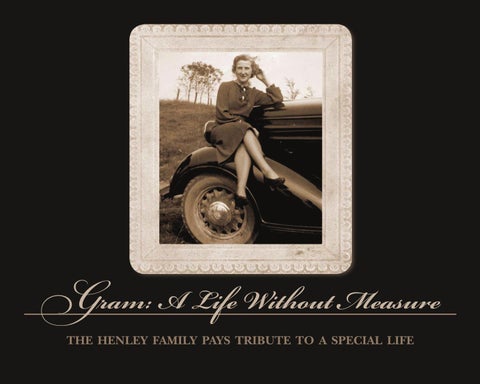
Gram: A Life Without Measure the henley family pays tribute to a special life
Editor: Designer:
Judith Kolva, Ph. D. Memoir Shoppe www.memoirshoppe.com cj Madigan Shoebox Scanning & Design www.shoeboxscanning.biz
Text copyright © 2008 Judith L. Kolva Photos from the personal archives of and copyright © Judith L. Kolva and cj Madigan respectively Photo collage on page 5 courtesy of Lisa Kagan, Lisa Kagen Designs, www.LisaKaganDesigns.com Page design copyright © 2008 cj Madigan
To the Henley clan past, present, and future
A
Gram: A Life Without Measure
lthough Gram’s life was ordinary, it was extraordinary. It wasn’t a life you’d bring home in a brown paper bag. Instead, you’d wrap it in cherry red paper, tie it with a huge gold bow, and sign the gift card with a flourish: A gift to treasure forever. Gram, more than anyone I’ve known, lived life to its fullest. She treasured each day, each hour, each moment. She was a lovely lady—the high priestess of laughter and love. To Gram, life was robust. She never complained. She never criticized. She never condemned. Gram looked for satin, not seams. Gram fussed over her family’s creature comforts. She accepted us. She treasured us. She bragged about us. She loved us unconditionally. It’s not that she didn’t recognize our faults. She did. But she loved us, warts and all. As a result, we never wanted to disappoint her. Although Gram didn’t judge us, we did our best to “measure up.” Gram’s greatest fault was, ironically, also her greatest virtue. Gram had the rare gift of being a good listener. She loved to talk with us about our lives. Actually, she welcomed our conversations. We’d go to Gram with our stories, our problems, our triumphs, and even our true confessions. No matter what we wanted to talk about, Gram poured coffee, plated one of her freshly baked treats, pulled chairs up to the kitchen table, and listened. Gram told us time and time again, “God gave you two ears and one mouth for a good reason.” Now that Gram has passed, we realize that although she was a wonderful storyteller, we only know snippets of her life story. Yes, we intended to learn about her life. We put it on the Someday List. Then, convinced that all was well, we went whistling merrily and obliviously
through the days, weeks, months, and years. There’s no excuse. We simply allowed life to reel by and dosi-do around. Suddenly, the Someday wakeup call rang. But it wasn’t the call we wanted to answer. It was too late. Gram was dead. The family lamented, “If only we knew more. If only we had taken Gram’s advice and listened.” But there’s no going back. Instead, we did all we could do. The family rallied and decided to preserve the few treasures we do have—the stories and recipes that honor Gram’s life, a life without measure. Our advice to others is this: Life passes quickly. It’s like a stone skipped across water. It makes ripples and then disappears into an unknown depth. Don’t become a victim of the Someday List syndrome. Don’t Someday wail, “If only we knew more.” You never know what will happen next year, next month, next week, or even tomorrow. Don’t play roulette with the universe. Start now. Talk to the Gram in your life, and make her past your present to the future.
Cindy Henley Sims Granddaughter October 2007
The Best Christmas Present Ever
I
’m not sure which tradition I enjoyed more—the story of Gram’s Christmas Eve birth or her melt-inyour mouth filled cookies. Fortunately, I never had to decide. Each year, I’d munch her cookies and listen and laugh as she told me how she was almost upstaged by a skunk. And each year, the story and the cookies got better. I can still hear Gram’s soft voice…
An icy wind shook the sturdy farmhouse in Phelps, Michigan. Weak morning light crawled through its snow bearded windows and tried unsuccessfully to cheer its frigid interior. My mother stoked the wood stove, lit the kerosene lamps, and pumped water to wash the breakfast dishes. When her chores were finished, she turned her attention to the aromatic pine standing majestically in the corner of the living room. The tree was waiting patiently to claim its noble rite of adornment. Everyone knows it isn’t really Christmas until the family tree is bedecked in its full glory. Mom and my brother Pete draped the tree with strings of cranberries and popcorn. Chains of red and green paper loops followed. Dad helped secure candles to the branches and crowned their creation with a glittering tinfoil star. Everyone agreed. The tree was beautiful. But Mom had little time to enjoy its splendor. By early afternoon, labor pains drove her to her bed. “It’s my time, Walter,” she whispered. Dad faced a bleak reality. He scratched at the ice welded to the kitchen window, squinted through his peephole, and stared at the swirling blizzard. The only way to contact the doctor was to brave the storm and trudge two miles to the nearest telephone. Dad buttoned an extra pair of long johns under his bib overalls, forced two pair of wool socks into his felt lined boots, and tugged on his fleece jacket. The only spot of color
by Susan Henley Gardner, Granddaughter
was his scarlet stocking cap—the cap that protected his bald head whether he was awake or asleep. “Hang on, Nellie,” he assured his wife. “I’ll be right back.” Dad knew Mom was alone with seven-year-old Pete. He also realized she was in heavy labor. The bold possibility of freezing to death in the raging blizzard was gut wrenching. But he had no choice. As the wind whipped the door out of his strong grip, he wondered: Will I ever hold my new child? It was all Dad could do to stand up against the fierce gusts. Snow blinded his vision. But he was on a mission of life. He must get to a telephone. Out of the corner of his eye, Dad caught a glimpse of black scampering against the pristine show. His hunter’s instinct shouted, “Skunk!” During the winter months, his family’s survival depended on the money he earned from selling the pelts of skunk and fox. This year, in spite of his cunning as a woodsman, his traps were empty. Dad hesitated only a moment before he turned toward the skunk track. Swiftly, he traced the skunk to its den. Confident that he would return the next day and set his trap, he marked the spot with a rock. Baby or no baby, the skunk didn’t have a chance. Dr. King, Charlevoix’s only physician and the selfproclaimed star of the town’s annual Christmas pageant, was almost as unlucky as the skunk. Just as he was donning his costume, he was summoned to answer an urgent phone call.
The lights were dimmed. The donkey was braying impatiently. The audience shuffled in anticipation. Where was the star? The show must go on. Go on it did. The stage, however, was transported by horse and sleigh from a candle lit church altar to a dusky farmhouse bedroom nine icy miles away. And the star wasn’t Dr. King from Charlevoix. The star was me. Mom always said Santa Claus brought me. She insisted I was the best Christmas present ever. I’m not sure Dr. King or the skunk would agree.
Nellie Henley and Fly, Circa 1910
The Cyclone
A
unt Lea was of Irish heritage. Everyone knows the Irish have full, undisputed, rights to the art of blarney. I was never sure if Aunt Lea’s stories were true or if they were a tad embellished. Nonetheless, I loved them all. The story about how she and her family traveled from Texas to Michigan was especially, well, can you say “intriguing”? Even if the story was sanctioned with a storyteller’s license, her brown bread never lacked a delicious authenticity. I can still hear Aunt Lea’s soft voice … The day dawned like all Texas days. An unforgiving sun beat down on our heads. Nothing stirred except pesky bugs and ever-swirling dust. My brothers and I quarreled more than usual.
The North-bound Henleys, Circa 1921
We thought Dad called us to the running board of our Model T pickup to scold us. We were wrong. Dad slumped on the running board. I couldn’t believe my eyes. Tears made paths through the dust on his cheeks. Dad never cried. He told us Mom was in the hospital and would probably die. I knew Mom was pregnant and not feeling well. But she couldn’t die. She was my mom. What would I do? What would my brothers do? What would my dad do? Mom was gentle, but she was the strength of our family. She was the glue of love that held us together. I thought my heart would break. Finally, Mom was released from the hospital. I didn’t understand what “peritonitis” meant. All I knew was Mom lost the baby, and she was still sick. All I cared was she was home, and she wasn’t going to die. My brothers and I did our best to “be good.” But it was hard to live up to our promise when we developed boils. They itched, festered, and ran. We whined, fussed, and complained. Dad couldn’t find work. Mom was bothered by the heat and bugs. It was time to go home to our farm in Michigan. We joined a caravan of four other north-bound families. My brother Pete, who was twelve, drove our 1914 Model T pickup truck. Mom and Dad rode beside him in the front seat. Bruce and I jostled along in the truck’s bed. The sun beat on our bare heads and road dust choked our throats. But we didn’t care. As far as we were concerned, we occupied first class
Cindy Henley Shaw, Niece
seats. Our tickets entitled us to unlimited access to the dining car. We gorged ourselves on the raw bacon, brown bread, and beans Mom stored in the truck’s bed until Dad’s switch made it clear we were not the VIP’s we pretended to be. We were secondclass passengers riding coach and had better dump our airs. At dusk, our caravan halted beside the road, where we set up camp. The men pitched tents. My mom and the other women lit an open bonfire, so they could cook supper. The kids were free to play games until it was time to eat. My brothers and I didn’t own toys so our entertainment was left to our imaginations. One evening, we decided to amuse ourselves with Ani I Over. All was great fun until the rock we were using for the ball smashed through the window of the car we were using for the wall. We weren’t “spoiled brats.” We certainly didn’t mean any harm and could never understand why the folks who owned the car abandoned our caravan. As we chugged further north, the terrain and vegetation became more familiar. Like a horse heading to its familiar barn, we just wanted to get home. But the weather had other plans. We were close to Chicago when the cyclone hit. Trees were uprooted, roads closed, and debris flew everywhere. We were terrified. A kind family allowed us to take refuge in their barn until the storm passed.
We huddled in the hay and stared, sightless, into the black night. A nighthawk’s sharp, “EEEEEE,” whistled through the darkness. A hoot owl answered, “WHOOO . . . WHOOO are YOUUU?” Suddenly, the barn-door creaked open, and there stood our eldest brother Jack. How could this be? Jack was an attorney in Nebraska. There was no explanation. It was a miracle. I spent the rest of the trip lying on my back, staring up at the puffy clouds, and weaving intricate, magical tales about how the cyclone blew Jack to us.
Ripples
I
treasure Mom’s stories. But because this one captures her inner-most feelings, it’s my favorite. Each time I treat myself to her decadent chocolate pie, which is frequently, I think of my mom and the legacy she left to her family. I can still hear Mom’s soft voice… It was a chamber of commerce Easter morn. Sun filtered through the church’s stained glass window. Special red velvet cushions snuggled on the walnut pews. The altar was draped in royal purple and adorned with dozens of aromatic white lilies. The congregation was bedecked in splendid Easter bonnets complete with their required frills. The warmth of fellowship saturated the pre-service, “Good Mornings.” What a glorious day for a baptism. Our plan was to celebrate the baptism, and then go home and enjoy our traditional Easter dinner of ham, potato salad, garden-fresh peas, homemade yeast rolls, and the family’s all-time favorite
chocolate pie. Two year-old June (that would be me!) had other ideas. Hymns were sung. The black-robed choir raised glorious hosannas. Pastor delivered a powerful sermon. Gold offering plates were passed. And, now, it was time for the Sacrament of Holy Baptism. The usher approached our pew, and as we rose to “Come forth little children,” my little child screamed at the top of her lungs, “NOOOO! NOOOO! NOOOO!” Eventually I discovered the truth. It seems Grandpa Henley informed his granddaughter that she would be dunked in a pail of cold water. Well, said granddaughter wanted no part of a dunking and wasn’t at all shy about sharing her piercing protests with the entire congregation. What was I to do but grab June and yank her and her screams out the back door? I didn’t think much about church for another fifteen years. But one Sunday for a reason I can’t explain, I felt compelled to get out of bed, dress in my Sunday-best, and attend a service at our local Lutheran church. This decision literally changed my life. Shortly after that day, I joined the church. My church family is now my extended family. When life is painful, they circle the wagons and protect my heart and my soul. I will always be grateful for how my church family helped me through the ordeal of Jim’s funeral. My church family took care of the details I couldn’t begin to deal with—the flowers,
June Henley Corona, Daughter
the service, and the luncheon all soothed my wounded spirit. The hugs reached out and proclaimed, “We love you. We are here for you.” I look forward to Sunday mornings. I kneel at the altar, bow my head, and open my heart to the inner meaning— inner peace— church contributes to my life. The Sunday service prepares me for the week ahead. My spiritual life reminds me of the marvel of the world around me and helps me appreciate God’s creations. I love my Pastor Mike and the friends I see each Sunday. Without church, my life would be empty. Recently, June asked me, “Mother, what gives meaning to your life?” She continually challenges me with her queries. Most times, I manage to dodge her determination. But on this occasion, June’s piercing green eyes demanded an answer. I contemplated. My answer came to me in the form of a prayer—the prayer I leave to you as my legacy: O, Divine Master, grant that I may not So much seek to be consoled as to console; To be understood as to understand; To be loved as to love. For it is in giving that we receive. It is in pardoning that we are pardoned. It is in dying that we are born to eternal life.
Life passes quickly. It is like a stone skipped across water. It makes ripples and then disappears into an unknown depth. My fervent hope is the ripples I leave behind help others. This, my dear family and friends, is my legacy for you.
June Henley, 1948
Secret Dandelion Wine
W
hat’s better than curling up in front of the fireplace, sipping a glass of wine, and remembering Gram’s stories about slaughtering pigs and making wine? Not much. Fortunately, Gram managed to convince her father, my great grandfather, to reveal his secret to dandelion wine. Gram would settle into her rocking chair, pick up her knitting, drink what she called a “little nip” of wine, and begin. “Honey, did I ever tell you about how we butchered pigs and made wine when I was a girl?” Of course, she had. Of course, I wanted to hear the story again and again and again. I hope you enjoy the story as much as I enjoy the wine. I can still hear Gram’s soft voice… When the calendar page turned to September, I returned to school, but I was allowed to stay home the day our pigs were slaughtered. The men did the dirty work out behind the barn. I never saw them stab the pigs, but I knew the butcher knife had to hit an exact spot in the pig’s neck. That required lots of experience and well-developed skills. Not just anyone could slaughter pigs. The pig had to be dead, but the meat couldn’t be damaged. I must confess I was glad to be a girl—girls weren’t expected to butcher pigs. Once the pig’s carcass was scraped clean of bristles and the meat had cooled, Dad prepared the prosciutto. That’s the
Cindy Henley Sims, Granddaughter
prime ham he rolled in a mixture of cracked pepper, salt, and herbs. After it was properly coated, he wrapped it tightly in cheesecloth, tied it with a piece of waxed string, and hung it from the cellar ceiling. There it cured until it was time for our winter feasts. Meanwhile, the pig’s organs were submerged in a huge pot of water heating on top of the woodstove and left to simmer in their own juices. Not a single ounce of the pig was wasted. I never asked what happened to some of the parts. Another not-to-be-missed autumn event was wine making day. The neighboring farmers made their own wine and each claimed bragging rights to the season’s best unofficial yet very official award. Dad was no exception. He wanted to win and never hesitated to insist his dandelion wine was the finest in wine in the county. He didn’t write one word of his formula on paper. Instead, he guarded his secret in his head. Bright and early on wine making day, Dad set up the wine press and other wine making equipment in the middle of the lawn. He, then, turned his attention to supervising the activities of the grape gatherers. The grapes were picked, sorted, and along with the just right amount of sugar, crushed. The golden liquid was poured into two old oak barrels that were stored in the cellar. There it aged, slowly, until it was ready to drink. The family’s persistent, “When will the wine be ready?” question could only be answered by sampling. Dad did lots of sampling
Great Gram Henley and the Pigs, 1924
Our Hero, Jack
G
ram claimed her mother’s coconut custard pie was the all-time favorite in the family’s restaurant. Sure, this was almost a hundred years ago, but I guess when you get right down to what’s really important in life, times haven’t changed that much. I love my great grandmother’s coconut custard pie, and I’m sure my children will love it, too. Even after Gram was in considerable pain from cancer, her blue eyes sparkled each time she told me about the Henley family restaurant and her maverick brother Jack. I can still hear Gram’s soft voice…
Shortly after I was born, my family moved from our farm in Phelps, Michigan to town, Charlevoix the Beautiful, where Mom and Dad became restaurateurs. Their restaurant was on Bridge Street, which was the main street of town. Proudly, Dad erected the sign, and W.H. Henley & Son: Meals and Short Order opened for business. It didn’t matter that the “& Son” was nine-year-old Pete. Meal tickets cost $3.00. Prices on the menu ranged from 5¢ to 40¢. The food was all good, but Mom claimed the favorite was her coconut custard pie. One day, during the flurry of the hungry lunch crowd, grease spilled on the kitchen floor. Flames followed its trail. Through the smoke, Mom screamed, “Pete! Take care of Leola!” I guess Pete thought this was his chance to really take care of me. He bumped my buggy down the stairs, gave it a shove toward the harbor, and went whistling about his business. In his nine-year-old mind, that was the end of his attention-grabbing little sister. To make sibling rivalry worse, our brother Bruce joined the family. We lived upstairs at the rescued restaurant, and one of our greatest thrills was to sit at the window and watch for a special boat to glide into the harbor. We called it “Jack’s Boat.” Jack was our hero. We knew he was our brother, but he was a maverick horse—an escapee from the daily routine of our familiar corral. His life was an exotic mystery. We worshiped him. Jack worked on a boat that harbored in Chicago, where
Alice Henley West, Granddaughter
he attended law school. The very mention of his name caused my brothers and me to squeal in anticipation. He would visit for a couple of days, distribute his thoughtful gifts, and be off to adventures we could only imagine. Mom read his marvelous letters out loud. Although we didn’t understand his educated vocabulary, we did understand Mom’s tears. She never complained, but we knew how much she missed her eldest son and our hero, Jack. When I graduated high school, Jack wrote a letter just to me. It’s one of my life’s most treasured possessions. I hope the family keeps it, always.
May 19, 1938 My Dear Little Sis: Sub-consciously I have been aware of it, because for the last few years you have written about it many times. But actually it startled and surprised my senses to receive the clever and attractive announcement of your graduation from dear old Charlevoix High School, and to realize that the little girl I used to rock to sleep upon my knee and care for on odd occasions has grown into a young lady old enough to graduate from high school. I am glad for you, for many reasons. You are to be commended and congratulated upon the fine achievement. A great deal of credit is due you and to the folks as well, for all of you had a big part in it. No one will appreciate any more than I the sacrifices both you and the folks have had to make at times in order that this gala day might become a reality. In this remark, I am not overlooking for one moment the part that the rest of the kids had in it too. So, let us all, little Sis, revel in your “great day of joy”—together. Lovingly, your brother Jack
Our Hero, Jack, 1935
The Slop Jar
M
y all-time favorite story is Gram’s story about the full slop jar. I sit in my bubbling Jacuzzi tub, watch the reflection of candlelight dance in the smooth marble, sip champagne, and think: A slop jar? Even my wildest imagination can’t go there. But I can tell you up close and personal that the lemon pie my great grandmother made is to die for. I can still hear Gram’s soft voice…
Still Foolin’ Around, 1927
My family loved to listen to the radio. Jack gave us two radios. The first had earphones, so we had to take turns. But the second was a real marvel. It had speakers, so we could listen together. Dad and us kids worked in the fields until dark. After we’d greedily devoured the huge supper Mom worked most of the afternoon to prepare, Bruce and I argued our way through the mountain of dirty dishes. As soon as the last plate was dry and stacked on the shelf, we’d cut huge slices of lemon pie, and gather around the radio. Mom closed her eyes and hummed along with Kate Smith to When the Moon Comes Over the Mountain. Dad favored Lowell Thomas. From Lowell’s signature sign-on, “Good evening, everybody,” to his classic sign-off, “So long, until tomorrow,” we had to be quiet, so dad could hear every word. My brothers and I scared ourselves silly with our own rendition of Orson Welles narrating The Shadow. We’d poke each other and whisper diabolically, “Who knows what evil lurks in the hearts of men? The Shadow knows!” When the radio shows were over, it was up the stairs to bed. The boys and I knew we were supposed to go to sleep and not “fool around.” But more often than not, mischief interfered with Dad’s warning. Our favorite game was a pillow fight. It’s hard to have a quiet pillow fight. And on this particular night, the ruckus was especially obvious. Dad yelled up the stairs, “You guys cut it out! Stop foolin’ around.”
Kelley Henley, Great Granddaughter
For a few moments we did “cut it out.” But Bruce couldn’t resist one last fling. Of course, Junior had to defend his honor. The commotion got louder. This time Dad was serious. He jumped up from his chair, yanked opened the stair door, and growled, “I mean it now. Stop this foolishness. Get to bed!” This was Dad’s if-you-don’t-do-what-I-say-you’re-in-for-alickin’ voice. From past experience, we knew he wouldn’t fool around. What we didn’t know was as we dove into our beds and pulled the covers over our giggles, Junior kicked over the full slop jar. Dad, thinking he’d accomplished his mission, settled back into his chair. It was warm next to the woodstove. He was just about to doze off when through the crack in the floor—drip, drip, drip, drip—leaked the contents of the slop jar. His bald head couldn’t have been in a more perfect position. I don’t exactly remember the lickin’. But I do remember I never again forgot to empty a slop jar.
Top of the Mornin’ Ma’am
I
love Mother’s story about how she and Dad met. She’d start with her parents, my grandparents. Perhaps one reason I relate to this story is I can see me in my mother. Actually, I can see my daughter, too. We are three generations of women with strong, independent natures. Learning about my mother gives me a feeling of being connected. It helps me understand myself. My mother was extraordinary. I’ve never known anyone like her. She was confident, focused, and motivated yet, gentle, kind, and compassionate. Being
around her was like tracking a sunbeam with attitude. Unfortunately, I’m not the great cook Mother was. The family, however, treasures her recipe for fresh peach pie. When someone, other than me, bakes this wonderful treat, we top it with vanilla ice cream and savor every bite. I can still hear Mother’s soft voice… My lineage traces back to England. My daddy, Harry Edwards, worshiped me. I loved to hear him call me “Daddy’s girl.” Daddy worked as a streetcar conductor, and each afternoon I’d skip down the sidewalk to greet the streetcar. Daddy would leap off the car, sweep me off my feet, twirl me around, and “surprise” me with a treat before we linked arms and strolled home. Regardless of her stern features Harriet Edwards, my mother, was a kind, caring, loving woman. Mother was busy, busy caring for her active brood of eight children whose ages spanned twenty-five years. When Mother was in her late forties, she was struck with an acute pain—a pain so intense she couldn’t get out of bed. Her darkened bedroom became her prison and her sanctuary. My siblings and I were allowed to tiptoe in to see Mother but only for brief moments. Mother was of Christian Science faith, so consulting a doctor was never an option. This, of
Lynne Beacham Rogers, Daughter
course, left her malady undiagnosed. During her last days on earth, faith healers surrounded Mother’s bedside. They chanted and offered her herbal tea. Their work was done kinesthetically through a prayer stance. It was as if they were dancing. Unfortunately, lying on of the hands lacked the power to lessen Mother’s pain and sustain her life. My mother died peacefully at home—probably from cancer. I was only eighteen years-old when I married for the first time. “Mr. Williams,” as I called my husband was a handsome, debonair, roguish man—a man with the need to bless more women than me with his charm and good looks. When I caught him in a rather uncompromising position with one of the maids, I gathered my three children and walked away. In those days, divorce was social suicide. But convention be hanged. I did what was right for me and my children. I guess it’s appropriate that we found our way to an orphanage. I paid for our room and board by cooking for the orphans. If I do say so myself, my fresh peach pie with its flaky crust was out of this world. The children always begged for seconds. I’d lived at the orphanage for about a year when one sunny morning, a red-headed Irishman knocked on the door. He whipped off his cap, grinned at me, and just stood
on the door step. I can still see the twinkle in his blue eyes. Finally, he said, “Top of the mornin’, ma’am. I’m lookin’ for work.”Within hours, he was hired to be the building superintendent. Well, this story-telling Irishman found more than a way to make a living in that orphanage. He liked to say that it was his Irish charm and bright red hair that caught my fancy. But you all know the truth: A kind heart beat beneath your dad’s rather rough exterior.
The Orphanage, Great Gram & Gramps, 1910
Truth Sermons, Grandpa Style
M
y Gram was the best storyteller, ever. After dinner we’d sit around the table, eat her strawberry shortcake topped with mountains of whipped cream, and listen to her stories. One of my favorites is about the time my grandpa found my great uncle Tyler. I loved my grandpa. He taught his kids and his grandkids the value of hard work, how to conduct our lives with honor, and to always tell the truth. His truth sermon, however, did allow a bit of leeway. We learned it wasn’t a sin to embellish a bit whenever we had the opportunity to tell a story. Like Gram, my grandpa wove marvelous tales. My cousins and I never failed to giggle when we heard why Grandpa was bald. Apparently one fine spring day he fell asleep under a maple tree. A resourceful cow bird spied her opportunity. She swooped down,
plucked off his hair, and zoomed away with the perfect lining for her nest. We were never quite sure if, indeed, the reason Grandpa never made it to Beaver Island was because he’d start swimming, make it half-way, then he’d get tired. What was he to do but turn around and swim back? Nor, could we figure out why Grandpa was so smart. He only went to school two days in his entire life. And those two days were quite traumatic. The first day the school house burned. The second day the teacher died. But the real mystery was when and where Grandpa was born. How could it be that a wayward buzzard laid an egg on a fence post, and after days of incubating in the hot sun, out popped Grandpa? The questions were never answered, but we begged Grandpa time and time again to tell his beguiling stories. Grandpa’s stories were, well, stories, but Grandma’s tale about his reunion with Uncle Tyler was the absolute truth. I know. I was there. I can still hear Gram’s soft voice…
Shawn Henley, Granddaughter
Your grandpa was born October 10, 1880, on a primitive tobacco farm in Palmyra, Tennessee. His lineage traces back to Ireland. In order to feed their ever-growing brood of thirteen children, his parents, Thomas and Clawdell Henley, literally scraped the poor soil. Their sturdy Irish heritage saved the family from starvation. Grandpa was a master woodsman—one with a deep love for the land and all wildlife. He never used dogs for hunting wild game—he didn’t need them. Your grandpa knew critters’ watering holes and their feeding habits. He could follow their trails better than any hound alive. Your grandpa lived with the game, not at it. He hunted for food, not sport. I can still hear your grandpa fume, “Killing something for sport is the silliest damn thing I’ve ever heard tell.” One crisp October day, your grandpa crouched behind a scrawny bush and aimed his shotgun at a squirrel. The gun misfired, and the bullet ricocheted off a tree. His brother Tyler fell to the ground. Your grandpa was only sixteen years old and didn’t know how to cope with the possibility he’d killed his brother. With only a few pennies in his pocket, Grandpa hitched up his britches, shouldered his rifle, grabbed his Irish optimism, and started walking. His final destination was Omaha, Nebraska.
Fifty years later your grandpa returned to his roots. One spring afternoon, he walked, unannounced, into a tobacco barn in Clarksville, Tennessee. A man shaded his eyes, mopped the sweat from his brow, and jumped down from the tobacco bales. As he sauntered toward your grandpa, time stood still. The man offered his hand to your grandpa, and uttered a single word, “Walter.” Grandpa clasped his brother’s hand and said, “Tyler.” For a half-century, the brothers were strangers. But now in that musky tobacco barn, the layers of years were peeled away. Your grandpa never talked about it, but I knew he was relieved of a heavy, life-long burden.
A Family Reunion, 1927
Happy Days
I
t may seem strange that a story about an outhouse and food go together. But they do. I’d sit in Gram’s cluttered kitchen, which was creative chaos at its finest, eat biscuits that dripped with butter and honey, and listen to her stories. One of my favorites is about the outhouse—not that I can imagine an outhouse—and her happy days on the farm. I can still hear Gram’s soft voice… Behind our big red barn was the outhouse—a classic twoseater. One hole was large; the other was small. As kids, we learned the messy way not to sit on the large hole. That was for adult sized butts only. Our outhouse had a crescent moon carved above the door. This gave privacy and just enough light to let us take care of our business. At night, the moon
would shine through the opening. Carrying a lit lantern into the outhouse wasn’t a good idea. During the summer months, we stored a box of apples inside the door. This helped reduce the number of spiders. Next to the apples was a bag filled with lime. Scoops of lime helped control the odor—sometimes. We used a switch to chase chickens out from under the seat. When the holes were nearly full, Dad dug new holes near the old ones and simply moved the shanty. He shoveled dirt over the old holes and let the worms do their thing. Dad told us that the worms ate the waste, and who was I to question him—or investigate? We never thought about the rough board seats, the odor, or our winter-cold butts. The outhouse was all we knew. One of my most important chores was to keep the outhouse supplied with the Sears, Roebuck catalog. People today might think it’s a joke, but that is what we used for toilet paper. A big willow tree grew next to the outhouse. Mom always claimed “I’m going to the willow.” But Dad and us kids weren’t as refined. We simply told it like it was, “I’m going to the crapper.” The well house stood next to our house. In it was a hand pump—the source of our water supply. The water was pure and freezey cold. It came from a spring running through the roots of spruce trees, which gave it a slightly piney, fresh taste. We’d fill a little tin bucket with the frosty water and laugh as
Elizabeth Henley Gray, Granddaughter
it dribbled down our chins. Yes, there was a tiny hole in the dipper. Everybody drank water. When people came to visit, the first thing a proper hostess did was ask, “May I get you a drink of water?” Back then, we didn’t know about soda pop in cans. Each Monday, Mom hauled our dirty clothes to the well house and scrubbed them on a wash board. When the clothes were clean, she sloshed them in rinse water and wrung them out by hand. She then hoisted the heavy clothes basket onto her hip, and regardless of the weather, pinned the clean clothes to the clothesline. The clothespins were made of rough wood. Mom never escaped this chore without a splinter or two. Each Tuesday, she heated the flat irons on the woodstove and spent most of the day ironing—sheets, pillowcases, underwear, coveralls—everything, but socks, was ironed. The routine never varied. I still love the sunshine fragrance of clean laundry. The separator was also in the well house. We poured whole milk into its belly and cranked the handle. Rich cream gushed out one spout and milk out the other. My brothers and I played a cut-throat game of cards, and the looser had to wash the separator. We’d never heard of homogenization or pasteurization. We just drank the milk. It was great fun to squirt the warm milk directly from the cow’s teats into our mouths or into the mouths of our kitties.
Part of the cream was churned into butter. When we gobbled our flaky breakfast biscuits drenched with gobs of melted butter and sticky honey, we never thought about clogged arteries or a cholesterol-free diet. We just enjoyed. These were happy days on our farm.
The Henley Barnyard, Circa 1920
Comfort
S
ome people love pie. Some people love pizza. I love pickles. And my Gram’s are the best. Sure, I go to the grocery store and buy big jars of pickles. That cute little stork claims, “Vlasic is the best tasting pickle I’ve ever heard.” But he’s wrong. Vlasic can’t compete with Gram. I love all Gram’s pickles, but my favorite is her Sunshine pickles. Maybe it’s the name that attracts me. When I was a baby, my gram rocked me and sang, You are my sunshine, my only sunshine. You make me happy when skies are gray. You never know, dear, how much I love you. But I do know how much my gram loved me. The comfort Gram talked about was embedded in her DNA. I can still hear Gram’s soft voice…
Our house was an unpainted farmhouse. Its gray clapboards etched a sharp contrast against the brilliant blue of the Michigan sky. It would never be featured in House Beautiful, but it was our home. Its walls wrapped us with a sense of comfort. My brothers and I crossed the sagging porch and clattered into the friendly kitchen. The aromas of freshly baked bread, cinnamon-laced apple pies, and dark, robust molasses swimming in the baked beans welcomed us. It seemed to us Mom worked culinary miracles on her ancient, jet-black woodstove. When I close my eyes, I can still see the droplets of sweat on Mom’s brow as she bent to stoke the stove with wood that spilled from the wood-box. Her blonde braids shimmered in the dim evening light. Her hands were dusted with flour. Her faded housedress and bib apron were rumpled from the heavy labor of her long day. I can still hear her gentle voice ordering us, her noisy brood, back outside to wash our hands in the cold water that splashed from the pump in the well house. And I can still see the love in her eyes as she watched her family clamor into chairs around our big kitchen table. Maybe it wasn’t the house that comforted us. Maybe it was Mom. The kitchen was the heart of our home. Mom canned our vegetables and brined our pickles. She baked our bread, biscuits, and pies. We didn’t have a refrigerator, so she salted our meat. Our butter, cream, eggs, and milk were stored in a
Elaine Henley, Granddaughter
cistern under the well house. Our neighbors, the Blanchard’s, had an ice house and an ice box. These were real luxuries. We knew if you had an ice box, you must be rich. By the middle of January, the mercury dipped below zero, and the ice on Lake 26 froze to a depth of four feet. That’s what we were waiting for. We swaddled ourselves in blankets, hitched the horses to sleighs, and laughed our way behind their jingle bells to the lake. Our mission was to chop ice. We hauled huge blocks of ice back to the Blanchard’s ice house and covered them with sawdust. It was a day of bone-chilling hard work—a day we would brag about when during the dog days of August, we used the ice to churn rich ice cream. I’m not sure which day we enjoyed more. They seemed to fit together like layers of wood that were cross-stacked on our wood pile—each independent of the other, yet, each counting on the other for its survival. Saturday was a big day for the Henley clan. It was bath day. Each Saturday we drug a galvanized tub into the kitchen and filled it to the brim with hot water dipped from the reservoir in the woodstove. We knew the hot water depended on the completion of two chores: loading the wood box and filling the water reservoir. But knowing and doing were arguments
apart. My brothers and I spent hours obstinately insisting, “It’s not my turn!” Once the fussing quieted down and the tub was steaming, we took turns in the bath water. The rule was clear: whoever was dirtiest got the last cold, scummy bath. I always got to go first. I’m not sure if it was because I was really the cleanest or just because I was the girl. Whatever the reason, I scurried to grab my lye soap and stiff towel. I didn’t want to lose my place in line
Junior in front of the Henley Farmhouse, Circa 1928
The Cold Hand
F
or “old time’s sake,” Gram would make pumpkin pie and tell me her story about the Great Depression. Over and over, I’d listen to her describe people who didn’t have a dime to buy food. Although I can’t imagine what it’s like to be really hungry, I can relate to Gram’s description of happy days on the farm. And as for the “cold hand”? Well, psychic premonitions run in our family. I can still hear Gram’s soft voice… If I had to choose a single phrase to describe my family’s life on the farm, it would be “Happy Days.” When I was ten years old, we welcomed a new family member, Walter Henley Junior, to the Henley household. Mom’s sister, Aunt Mabel, rode the train from Omaha to help Mom manage her lively brood and assist with the birth. My brothers and I adored Aunt Mabel.
We were disappointed to learn she had kidney problems and had to return to Omaha. Mom’s announcement still sends chills up my spine, “I felt a cold hand on my leg this morning. Something is wrong with Aunt Mabel.” My brothers and I just nodded and finished our breakfast. Mom’s intuition, though a mystery, wasn’t anything new. We’d often whisper to each other, “She has eyes in the back of her head.” Later that day a telegram arrived. Mom choked out the words, “Bad news—STOP—Mabel died yesterday—STOP— So sorry—STOP.” We were saddened by the death of our beloved aunt but never questioned the cold hand. Mom was Mom, and like her mother before her, she often predicted the unpredictable. My family was now complete: Dad, Mom, Jack, Pete, Leola, Bruce, and Walt or “Junior” as everyone called him. We saw Jack and his lovely wife Sylvia only on rare occasions, but they were part of our family. We worked, played, laughed, cried, fought, teased, schemed, and loved side by side. The country was gripped by the Great Depression. In Detroit, mobs of people scrounged the dirty markets for spoiled food. When you’re really hungry, you’ll do anything. Even though Kellogg’s bran flakes cost ten cents a box, chuck roast ten cents a pound, eggs fifteen cents a dozen, and bacon
Penny Henley Gregg, Granddaughter
nineteen cents a pound, people didn’t have money to buy these staples. The stock market crashed, banks closed, and factory doors were nailed shut. The most popular song of the day was Brother Can You Spare a Dime? People were down-and-out. President Hoover claimed good times were just around the corner, but that was hard to believe. It was the Dark Ages all over again. Folks stood in bread lines and got an occasional bite to eat at soup kitchens. Hobos rode the trains, and bandits raided the highways. With unemployment at twenty-five percent of the workforce, men who could no longer take care of their families pulled the trigger. Suicide was at an all time high. We heard about the tragedies but protected by the bounty of our farm we were insulated—isolated—from the Depression’s wrath. Mom fed us lots of beans and potatoes, and for dessert she made pumpkin pie. But that was all we knew. Didn’t all farm families eat beans and potatoes and pumpkin pie? I do remember asking Dad if he ever had ten dollars in his pocket all at once. His, “Nope!” wasn’t important. We were together. We loved each other. We were happy. We were family. That’s what mattered.
The Farm’s Bounty, 1930
Just One More Time!
S
omehow, I can’t quite imagine Gram’s Parker House rolls—you know, those flaky little yeast rolls you make by flattening a ball of dough with a rolling pin so it becomes an oval and then folding it in half and dipping it in butter before you snuggle it in the baking pan next to the other rolls—made with bear tallow. I’ll stick with the butter version—thank you very much—and just wonder about the bear tallow version. However, something I’ll never wonder about is the family love that accompanied Gram’s story about Pete’s Bear. Like Gram and my great uncles, I’d beg to hear it, “Just one more time!” I can still hear Gram’s soft voice…
Our living room was the most adorned room in the house. It had a braided rug, a horse hair sofa, and a mahogany table that made into a bed. Behind the table were three big windows. Their lace curtains stirred in the summer breezes. During the winter months, their faces were hidden by newspapers—a protection against the sub-zero temperatures of the Michigan winters. But no matter what the season, their sills displayed Mom’s brilliant red geraniums. Mom loved her geraniums. As a testimony to her tender-loving care, they rewarded us with a bright spot of year-round color. The woodstove—our only source of heat—jutted out from the living room wall. It was flanked by Mom and Dad’s rocking chairs. Tucked behind the stove was a mat where Dad would curl up and take a nap. That’s where he was the night Pete came home with a bear. It was late fall—bear season— and Pete was hunting in Michigan’s Upper Peninsula. Like Dad, Pete was a natural woodsman. They belonged to nature, to the simple wonders of the world. We were on our way to bed when we heard a truck pull into the yard. We could tell by the sound of the engine it was our truck. Dad jumped off his mat, and hollered, “Bet Pete got a bear.” We trooped out into the frigid night. From the light of the moon and stars, we spotted the outline of our truck and its cargo: a 300 pound black bear.
Ellen Henley Sage, Granddaughter
Our, “Wows!” caused Pete to scuff his toe in the dirt, but we could tell he was proud. We knew bear hunting was dangerous and shivered thrills to hear Pete’s story. He rose early that morning and followed a ridgeline known to be a bear trail. About noon, he spotted the bear. It was lumbering through a meadow ablaze with yellow birch leaves. The bear, catching the scent of a human, lowered his head, extended his lips, and rolled back his ears—all indicators he was about to charge. Pete raised his .30-30 Winchester, an uncommon bear rifle, and aimed. The shot hit its target. The bear roared in pain and snapped his jaws at the fatal wound. He lumbered toward Pete, breaking four inch thick birch trees as if they were toothpicks. Just steps before reaching Pete, the bear slumped. His remaining lifeblood soaked the earth. The next morning a man from Charlevoix came out to the farm and helped Pete and Dad dress the bear. A taxidermist made a rug out of the skin and fashioned the head into a trophy. Mom cooked and baked with bear tallow instead of her usual bacon grease. I can’t tell you why, but I can tell you that food tasted better when it was made with bear tallow. I especially remember the Parker House rolls mom baked to accompany the roasted bear meat. Mom’s roll recipe was out of
Fannie Farmer’s original cookbook, which sure didn’t call for bear tallow. But maybe Fannie missed something. If she did, we didn’t care. We’d pass around Mom’s creation of the rolls and beg to hear Pete’s bear story, “Just one more time!”
Gram, 1935
The Smear Chump
Olden Days on the Farm, 1921
F
or the Henleys, card games top the list of family fun. Playing cards is a tradition that sticks with us even after we marry and have kids of our own. You aren’t a true Henley until you learn to play Smear. It’s a revered tradition to vie for bragging rights to the family’s Smear Chump award. Maybe, way back when, a few drops of gambler’s blood mixed with our Irish blarney and English persistence. Another family tradition is to follow our card contests with family stories and big bowls of Mom’s butterscotch pudding. On the surface, Mom’s stories were about the “olden days” on the farm. But there was more. Mom was a wise woman. She had a way of capturing our attention by making us laugh. But, then,
ZING! Right in the middle of the light-hearted fun, she’d slip in a lesson. I can still hear Mom’s soft voice… Each morning my mom threw grain to her “girls.” I can still hear her scolding the dogs as they barked their way through the chicken flocks. The dogs never paid any attention to Mom’s protests, so feather flurries were a daily occurrence. Cows, horses, and too many cats to count lived in the barn. Pigs rooted in their pens. Barney and Bess were our horses— the team who did the real work on the farm. And then there was Fly—a young horse we all loved. The day Fly had a heart attack and died in the barnyard was one of the saddest days of my life. Barney and Bess were burly workhorses. They were part of our family. I loved feeding them grain and treating them to an occasional apple. My reward was to hear their gentle “thank you” whinny and feel their huge heads nuzzle my shoulder. Barney and Bess were more than just animals. There was depth in their gentle brown eyes—a depth that revealed their wisdom and understanding—a depth that expressed their love and devotion to us and our farm. I’m an old woman now, but when I reminisce about Barney and Bess, I still think about relationships—about love—about devotion. I’ve learned there are a few relationship rules. Meaningful relationships need tending through the
Nell Beacham McDowell, Daughter
good times and the hard times. Without devotion, love is empty. True love is fueled with commitment to each other. When you love deeply, there are times you must chop wood and carry water, and that’s plain old hard work. But through it all, you must respect each other and learn to compromise. And there’s one more thing: If you aren’t willing to talk about what’s happening between you, you’re heading for trouble. We counted on Barney and Bess to guide the plow through the fields, haul the hay wagon, and provide us with transportation. Dad hitched them to the wagon in the summer and the sleigh in the winter. They faithfully plodded us to where we were going. One cracking cold evening, my family piled into the sleigh and headed Barney and Bess toward the Blanchard’s for our regular Saturday night card game. We loved playing cards. We loved socializing with our neighbors. And we loved ending the evening with Mom’s creamy butterscotch pudding. The Blanchards lived about two miles away. Roads weren’t plowed, but the moon rose and silvered our way over the snow banks. Dad drove the horses. Mom perched on a box next to him holding Junior, who was still a baby, on her lap. Pete, Bruce, and I snuggled in the sweet straw that filled the sleigh bed. On this particular Saturday night, we were about halfway there when, suddenly, the sleigh gave a little jerk. The
box Mom was sitting on slid side-ways. She tossed Junior into the nearest snow bank and plopped gently next to the sleigh. No one was hurt. My brothers and I giggled for days over the sight of Junior’s little head sticking out of the snow as if to say, “Hey! What did I do to deserve this?”
Thunks
T
rue confessions: I’m a chocoholic. You know, one who gets up in the middle of the night and secretly scarfs down chocolate chip cookies, chocolate ice cream, chocolate cake, chocolate brownies—white chocolate, sweet chocolate, milk chocolate—I’m not picky. Chocolate. Chocolate. Chocolate. It’s one of life’s staples.
Although I don’t exactly discriminate, there is one chocolate that surpasses all others: my mother’s chocolate fudge. I suppose that’s one reason I love to reminisce about summertime on our farm. But there’s more. I’m the tallest brother—the brother who benefited from thunks—the brother who repeatedly won the watermelon seed spitting contest. Like most Henleys, my sister had a gift for storytelling. I can still hear her soft voice… Summertime on our farm was special. A highlight was the county fair. Mom packed a picnic basket with fried chicken, biscuits, tomatoes, and her best-in-the-world chocolate fudge. Then, off we’d go. As soon as we arrived at the fairgrounds, Mom and Dad strolled through the animal barns and examined every tomato, every squash, every green bean, and every potato in the entire county. My brothers and I did our best to be patient until, finally, we were released for the real fun. We’d stroll the midway stuffing ourselves with cotton candy and gaping at the “freaks.” Then it was off to the tummylurching thrills of the Ferris wheel. When I close my eyes, I can still hear the merry-go-round’s calliope calling me. I remember the twirling horses and the excitement each time I grasped the golden ring. One year, Dad treated me to my first airplane
Bruce Henley, Brother
ride. The loop-de-loops were electrifying. I boasted bravely to Mom and my brothers, “It was great—fantastic—thrilling.” Being scared to death was my secret. Hot Sunday afternoons and fishing were like Mom’s pancakes and Dad’s maple syrup. They belonged together. Dad and the boys fished. Mom and I lazed on the river bank and dangled our feet in the water. As far as Mom knew, only the fish swam. She forbade us to go in the water. But on occasion, my brothers and I would sneak to the swimming hole. I thought this was great fun until the day I was out over my head and sucked in a lung full of water. I went down three times before the boys hauled me out and rather unceremoniously flopped me onto the muddy shore. That ended my interest in swimming. Summertime also meant watermelon. Our watermelons grew like molasses flowing uphill, slowly. The beans, cucumbers, and potatoes got ripe. But the watermelons? They just sat there, growing. Finding a ripe watermelon was a skill—a ritual. At sunup, we’d follow Dad into the fields for the thump test. He’d squat down beside a watermelon and thump it. If he didn’t shake his head, that was a good sign. If he did, we moved on, hoping.
Waiting for Thunks: Gram, Bruce, Pete, 1928
We learned a thumped ripe watermelon makes a” thunk” sound. If it sounded “thank,” it was still green. We lived for thunks. Thunks meant it wouldn’t be long before watermelon juice would be dripping down our chins and we’d be spitting seeds at each other. Bruce always won the seed spitting contest. To this day, I think that’s just because he was the tallest.
from Gram’s kitchen‌
Chicken and Spinach 3 lbs. cooked chicken 2 pkgs. frozen spinach, cooked For sauce, blend: 1 can mushrooms 1 1/2 cans cream chicken soup 3/4 c. mayonnaise 1/2 t. curry 2 T lemon juice
Layer spinach, then 3/4 sauce, chicken on top. Top with remaining sauce. Sprinkle with parmesan cheese. Bake 350 degrees for 45 minutes. Can serve over rice.
34 34
Spinach & Tortellini soup 2 lbs. Italian sausage 32-oz. chicken broth 16-oz. whole tomatoes 1 pkg. spinach 8-oz. tortellini 1/2 c. chopped celery 2 c. water 1/2 c. onion, chopped parmesan
Simmer celery, onion and sausage one hour in water. Add chicken broth, tomatoes and spinach and simmer another hour. Add tortellini and simmer another 1/2 hour.
down through the generations Potato Sesame Bread 2 pkgs. yeast 5 1/2 c. sifted flour 2 T sugar 2 t. salt 1 1/3 c. milk 1/2 c. butter 1 1/2 c. sieved hot cooked potatoes 1 egg white, slightly beaten Sesame seeds
In mixing bowl, thoroughly mix yeast, 2 c. flour, sugar & salt. Heat milk, butter & sieved potatoes over low heat until very warm (120-130 degrees). Butter need not be completely melted. Add liquid to dry ingredients. Beat 2 minutes. Add remaining flour, kneading in by hand (10 minutes) or with dough hook. Place dough in buttered bowl turning to butter all sides. Cover. Let rise until double in bulk. Punch down, divide into 4 parts. Roll each between buttered palms to form a strand about 15 inches long. Spiral wrap 2 forms together to form twist loaf. Place in buttered loaf pan. Let rise. Brush tops with egg white and sprinkle with sesame seeds. Bake at 375 degrees for 40 minutes. Makes two loaves.
Karen’s Salad 2 bags spinach 1 bag iceberg lettuce 1 c. cottage cheese 1 lb. bacon 3/4 c. Swiss cheese 1 red onion 3/4 lb. mushrooms 1 1/2 T poppy seeds 1 1/2 c. olive oil 3/4 c. vinegar 1 1/2 t. salt 3/4 c. sugar 3/4 t. dry mustard
Marinate last 8 ingredients overnight. Pour over first 5 ingredients just before serving. Crowd size.
35 35
from Gram’s kitchen‌
Marinated Flank Steak 1/3 c. soy sauce 2 T honey 2 T vinegar 2 cloves garlic 2 T ginger 1/2 c. corn oil 1 1/2 lbs. flank steak
Press garlic or mash with fork. Put this and all other ingredients into a container, shake well, and pour over steak. Marinate 24-48 hours. Cook on grill.
Colombian Chicken Cut up 2-3 chickens in pot, cover with water. Add salt, freshly ground pepper, finely chopped medium onion, finely chopped bunch of celery. Cover, boil, then simmer 45 minutes.
Remove skin and bones, continue cooking broth. Cut chicken into small pieces. Add: 2 small cans button mushrooms 2 small jars diced pimiento 1 large green pepper, diced 1 package slivered almonds and/or water chestnuts Mix all and reserve. Add 2 T chicken boullion, 1 T Gravy Master, and cornstarch and water mixture to broth to thicken slightly. Add reserved ingredients and cook until green peppers are tender but still green. Serve over rice. To freeze, let broth cool, then add reserved ingredients and freeze.
36 36
down through the generations Apple Crisp 6 tart apples 1 c. sugar 1/4 t. ground cloves 1/2 t. cinnamon 2 t. lemon juice 3/4 c. flour 1/8 t. salt 6 T butter 1/4 c. chopped nut meats Whipped cream or ice cream
Preheat oven to 350 degrees. Peel, core, and slice apples into a bowl. Add 1/2 c. sugar, the spices, and lemon juice. Mix lightly and pour into 1 1/2 qt. casserole. Blend remaining sugar, flour, salt, and butter to crumbly consistency. Add nuts and sprinkle over the apple mixture. Bake 45 minutes or until apples are tender and crust is nicely browned. Serve with whipped cream or ice cream.
Cream Cheese Brownies 8 oz. package cream cheese 2 1/2 c. sugar, divided 3 eggs 1/2 c. butter 3/4 c. water 2/3 c. cocoa 2 c. flour 1 t. baking soda 1/2 t. salt 1 t. vanilla 1/2 c. sour cream 1 c. chocolate chips Combine cheese, 1cup sugar and eggs. Set aside. Mix butter, water and cocoa in saucepan until butter is melted.
Mix flour, remaining sugar, soda, salt, vanilla, 2 eggs and sour cream. Beat chocolate into flour mixture. Spread in greased and floured 17 1/2 x 11-inch pan. Spoon cream cheese mixture over chocolate and marble with a knife. Sprinkle chips on top. Bake at 375 degrees for 20-25 minutes. Makes 32 brownies.
37 37
About This Culinary Memoir This limited edition culinary memoir was coordinated and edited by Memoir Shoppe in Fort Lauderdale, Florida. Book design, digital imaging and page layout was done by Shoebox Scanning & Design in Vero Beach, Florida. Judith Kolva, Ph.D. is the founder and owner of Memoir Shoppe. Judith’s doctoral work focused on how preserving life stories can create meaning in life. She is a trusted interviewer, expert researcher, and gifted writer whose experience and expertise makes completing life stories easy. Judith travels worldwide transforming precious memories into priceless memoirs. Please visit her web site: www.memoirshoppe.com cj Madigan is a publication designer and digital imaging specialist with over twenty years’ experience in graphic design and print production. Her firm, Shoebox Scanning & Design in Vero Beach, Florida, helps private publishers turn manuscripts into masterpieces. You can reach her through her web site: www.shoeboxscanning.biz.
Leola Mae Henley Beacham Gram 1919-2007
may gram’s life reach out and touch tomorrow