Dakota CPA Connection Produced by the North Dakota CPA Society
September 2026 | Volume XXXIX| No. 05
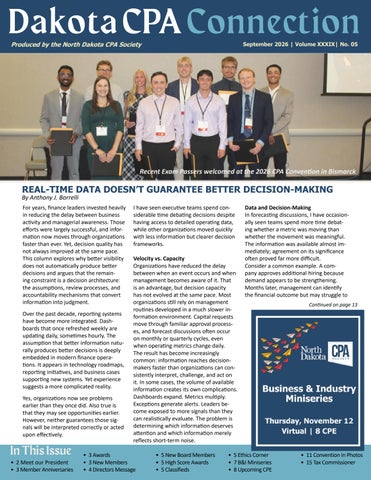
Recent Exam Passers welcomed at the 2026 CPA Convention in Bismarck
Real-Time Data Doesn’t Guarantee Better Decision-Making
By Anthony J. Borrelli
For years, finance leaders invested heavily in reducing the delay between business activity and managerial awareness. Those efforts were largely successful, and information now moves through organizations faster than ever. Yet, decision quality has not always improved at the same pace. This column explores why better visibility does not automatically produce better decisions and argues that the remaining constraint is a decision architecture: the assumptions, review processes, and accountability mechanisms that convert information into judgment. Over the past decade, reporting systems have become more integrated. Dashboards that once refreshed weekly are updating daily, sometimes hourly. The assumption that better information naturally produces better decisions is deeply embedded in modern finance operations. It appears in technology roadmaps, reporting initiatives, and business cases supporting new systems. Yet experience suggests a more complicated reality. Yes, organizations now see problems earlier than they once did. Also true is that they may see opportunities earlier. However, neither guarantees those signals will be interpreted correctly or acted upon effectively.
In This Issue • 2 Meet our President • 3 Member Anniversaries
I have seen executive teams spend considerable time debating decisions despite having access to detailed operating data, while other organizations moved quickly with less information but clearer decision frameworks. Velocity vs. Capacity Organizations have reduced the delay between when an event occurs and when management becomes aware of it. That is an advantage, but decision capacity has not evolved at the same pace. Most organizations still rely on management routines developed in a much slower information environment. Capital requests move through familiar approval processes, and forecast discussions often occur on monthly or quarterly cycles, even when operating metrics change daily. The result has become increasingly common: information reaches decisionmakers faster than organizations can consistently interpret, challenge, and act on it. In some cases, the volume of available information creates its own complications. Dashboards expand. Metrics multiply. Exceptions generate alerts. Leaders become exposed to more signals than they can realistically evaluate. The problem is determining which information deserves attention and which information merely reflects short-term noise.
• 3 Awards • 3 New Members • 4 Directors Message
September 2026 | Page 1
• 5 New Board Members • 5 High Score Awards • 5 Classifieds
Data and Decision-Making In forecasting discussions, I have occasionally seen teams spend more time debating whether a metric was moving than whether the movement was meaningful. The information was available almost immediately; agreement on its significance often proved far more difficult. Consider a common example. A company approves additional hiring because demand appears to be strengthening. Months later, management can identify the financial outcome but may struggle to
• 5 Ethics Corner • 7 B&I Miniseries • 8 Upcoming CPE
Continued on page 13
on page 5 • 11Continued Convention in Photos • 15 Tax Commissioner
Meet our President Juan Martinez, CPA
Current Position: Audit Partner at Widmer Roel PC What is your background as a CPA? While finishing my degree at the University of North Dakota I interned with Widmer Roel. After graduation I joined the firm full-time. A decade has gone by quicker than I would have imagined, yet looking back, it is incredible to see how the profession continues to evolve. What excites you most about being on the Society Board of Directors? North Dakota has a great community of CPAs. Being able to take part in serving the Society’s members and helping shape the profession has been rewarding. Additionally, serving on the Board has given me the opportunity to learn from and collaborate with leaders from many different backgrounds and areas of expertise. While our backgrounds as CPAs might be different, all past and current members of the Board have brought a shared drive for strengthening and advancing the CPA profession. What are some of the biggest opportunities for young CPAs today? The CPA designation remains one of the most recognizable brands in the business and continues to offer opportunities that extend beyond traditional tax and audit services. With a push to fast-track development of early career CPAs entering the workforce; young CPAs have an opportunity to create value for businesses and organizations earlier in their career and take part in helping lead innovation for the profession. You have a free weekend. What are you doing? During the fall and winter seasons my family heads to Grand Forks to catch a UND Football or Hockey game. Tell us about your family: My wife Stephanie and I live in Fargo with our three boys; Brayden, Beau, and Brody who are 4, almost 2, and 6 months.
September 2026 | Page 2
Celebrating Membership Anniversaries 50 Year Members (Joined in 1976)
Harris Bailey Duane Dunn Ronald Fuchs Wayne Goter Jerry Holter Ronald Leopoldt
Paul Maddock Robert Oss Richard Pfeiffer H. James Reiten Thomas Ribb James Stewart
Terry Thompson Charles Wendel Nancy Yoder-Bidwell
40 Year Members (Joined in 1986) Melanie Beauchamp Jane Bissel Laura Block Patrick Brown Juli Bryl Philip Condit John Gast Craig Hanson Randy Hatzenbuhler Dwight Hetletved
Gary Hummel Nadine Julson Jodi Kary Mark Larson Carter Lehmann Gerald Lommen Timothy Myron Steven Opdahl Kevin Ritter Brenda Samson
Randall Schneider Patrick Senger Collin Serhienko Mark Stenseth Scott Swanholm Douglas Vang JoAnn West Daniel Wilson
30 Year Members (Joined in 1996) Lore Baarstad Shannon Breuer Theresa Brorby Steven Darwin Chris DeConcini Trisha Deitz Debra Eblen Bryan Freeland Julie Gerving Wesley Griggs Kent Haugen
Kristy Hofmann Kent Huss Edward Irion Darla Jensen Waldemar Kowitz Kathryn Lehman Scott Mann Patricia Mastel Timothy Mehlhoff Victoria Nemmers Cynthia Olson
Brad Oothoudt Darin Praska ReNae Roney Raymond Safranski Cindy Schauer Stephanie Sievert Jason Smith Michele Sorenson Gerloff James Sprynczynatyk
20 Year Members (Joined in 2006)
Ryan Bakke Derrick Hohbein John Power Tina Bichler Tonya Holmstrom Lyndsey Roemmich Jared Bickler Tammy Jones Michelle Schumacher Michael Bryant Cory Kaufman Clarence Sitter Roberto de Magalhaes Matthew Komprood Hsiu Wu Ryan Donahue Sarah Lindemann Brent Drovdal Michael Misheski Jennifer Eggebrecht Judy Monson Jacquelyn Erovick Michelle Nyhus Christopher Feller Jean Ostrom-Blonigen
Member Awards Lifetime Member Inductees John Mongeon has been an active member of the Society for over 40 years. He served as President of the Society in 20142015. Over the years he served on multiple committees including CPE, Governmental Accounting, Legislation, Nominations and the Convention. John was a Shareholder with Brady Martz in Bismarck. Joe Martin has been a Society member for 35 years. He was a valued member of the Peer Review committee from 2002 - 2017. He also served on the Accounting and Auditing Committee. Joe was a shareholder with Brady Martz in Grand Forks
Making a Difference Award
Dr. Robert Dosch is a treasured Professor of Accounting at the University of Mary. He has been a member of the Society Since 2001. His volunteer positions are numerous including serving as the President of the Society in 2022-2023. He also served on many committees including CPE, YP, Convention, Scholarship Task Force, Curriculum Task Force and Nominations.
Welcome New Members Brianna Bakke . . . . . . . . . . . . . . . . . . . . . . . . . . Grand Forks Bethany Cichonsky. . . . . . . . . . . . . . . . . . . . . . . Minot Trestan Demarce*. . . . . . . . . . . . . . . . . . . . . . . Saint Micheal Bryce Enerson . . . . . . . . . . . . . . . . . . . . . . . . . . Fargo Naima Fatimi . . . . . . . . . . . . . . . . . . . . . . . . . . . Bismarck Trevor Goetzfridt. . . . . . . . . . . . . . . . . . . . . . . . New Salem Lindsey Harpestad. . . . . . . . . . . . . . . . . . . . . . . Oxbow Derrick Heick . . . . . . . . . . . . . . . . . . . . . . . . . . . West Fargo Dylan Henry. . . . . . . . . . . . . . . . . . . . . . . . . . . . Fargo Andrew Jahnke. . . . . . . . . . . . . . . . . . . . . . . . . . Denver Kimberly Jones. . . . . . . . . . . . . . . . . . . . . . . . . . Minot Danelle Kjar . . . . . . . . . . . . . . . . . . . . . . . . . . . . Fargo Kelcee Knoepfle. . . . . . . . . . . . . . . . . . . . . . . . . Dickinson Wade Kusler. . . . . . . . . . . . . . . . . . . . . . . . . . . . Bismarck Sara Lynch. . . . . . . . . . . . . . . . . . . . . . . . . . . . . . Jamestown Olivia Morton. . . . . . . . . . . . . . . . . . . . . . . . . . . Fertile Kassadee Olson* . . . . . . . . . . . . . . . . . . . . . . . . Sidney Zachary Plante. . . . . . . . . . . . . . . . . . . . . . . . . . Grand Forks Aimee Schwartzwalter. . . . . . . . . . . . . . . . . . . . Hickson Faith Stumpf*. . . . . . . . . . . . . . . . . . . . . . . . . . . Thompson Kelly Swenseth. . . . . . . . . . . . . . . . . . . . . . . . . . Devils Lake Shannon Wellen*. . . . . . . . . . . . . . . . . . . . . . . . Watford City
*Student Member
Director’s Message Sherre Sattler
By the Numbers The CPA Society Board of Directors, along with several committee chairs, met in May to revisit our strategic plan. While many would rather endure a visit to the dentist than update a strategic plan, the conversation was lively, and the outcome provided a clear direction for the future. The good news is that the group found we are on the right track. There are many challenges ahead, including a declining population of CPAs. However, for those who are well informed, our value remains strong. Our updated mission, “To champion the CPA profession through advocacy, connection, and education while empowering members to lead, adapt, and serve the public with integrity,” focuses on our core values of Advocacy, Education, Connection, Leadership, and Innovation. As we move forward, we plan to continue our outreach to high schools and universities, encouraging students to become CPAs. We also want to place greater emphasis on member outreach and engagement. Advocacy remains a top priority as we prepare for the 2027 legislative session. We will continue to enhance and update our educational programs, focusing on adapting and evolving to meet the needs of the future.
ND CPA Society Members by Business Type
Here are some of our latest statistics along with a few fun facts: 1615: Number of CPA Society Members 97: How old the CPA Society will be on November 15 18/96: The ages of our youngest and oldest members 140: Number of members on committees for 2025-26 9+: Number of committees to get involved with through the Society www.ndcpas.org/volunteer Conference Attendance 316 265
330 211
315 166
315
264
221
177
301 192
Convention
325
287
205
210
Nonprofit Education Other 2% 1% 2% Government 3% Student 8% Retired 18%
271
266
258
157
186
155
Business and Industry 28%
Mgmt
ND CPA Society Members by Location 0 Location Fargo Area (580 & 581) Grand Forks Area (582) Devils Lake Area (583) Jamestown Area (584) Bismarck Area (585) Dickinson Area (586) Minot Area (587) Williston Area (588) Out of State Out of Country
100
Public 38%
200
300
400
North Dakota Licensees
500
600 512
209
2800 2400 2000 1600
39 52
1200 306
52
800 400
116
0
2010
2015
2020
2025
All Licensees
2890
2949
2983
2914
In-state Licensees
1572
1720
1716
1524
28 280 20
September 2026 | Page 4
Meet our New Board members
Tahnee Magnus What’s your current role and professional background? I’m a partner at Brady Martz in Bismarck. I’ve been with Brady Martz for 15 years this month! My career here has been spent providing attest and tax services to the construction and for-profit industries and auditing employee benefit plans. In the past 5+ years, I’ve also focused on building a litigation and forensic practice at the firm. I earned my CPA license in 2009 and hold both the Certified Fraud Examiner (CFE) and Certified in Financial Forensics (CFF) designations. What I like about the Society: Getting to network with CPAs. What made you say “yes” to serving on the board? I was involved with our local chapter for many years but after stepping down in 2024 I’ve been wanting to get more involved again. This was the perfect opportunity to do so! Who has been a mentor or inspiration in your career? Stacy DuToit, CEO of Brady Martz. She was the reason I joined Brady Martz and I worked directly under her my entire journey from associate to partner. I’ve learned a lot from working with her but even more so from watching how she interacts and communicates with others. If you could give a TED Talk on anything (not accounting): Backyard chickens? (see below) I’ve had to nurse a couple back to health and ask anyone on my Snapchat – it is full of chickens! What book or podcast are you currently enjoying? Blindsighted by Karin Slaughter on Audible. I don’t have time (or patience) to read so I listen while I clean or drive. Any mystery / thriller is right up my alley! What’s the most “you” thing someone would find in your office? It probably was either the million pictures of my kids or the “But did you document it?” sign but recently it might be the “I love chickens” décor. We have 6 backyard chickens and they keep us entertained and are my stress relief! My 11 year old told me that after a rough day at school, the first thing he did when he got home was to spend time with the chickens. Tell us about your family: I’m married to my husband Nick. We moved to Bismarck in 2005 and have been married since 2009. We have two boys – Nicholas who is 11 and Branson who is 6. Our family is rounded out with a dog (Rocky), a cat (Luna) and our 6 chickens (Ruby, Tyler, Ginger, Sapphire, Goose and Chicken Hawk).
September 2026 | Page 5
Josh Odegard What’s your current role and professional background? I am a Senior Accountant at the City of Grand Forks. I do a variety of things including working on the upcoming annual budget, grant accounting, and helping with preparing the ACFR. I have been working at the City of Grand Forks since I interned in the summer of 2019. What I like about the Society: I really like the community aspect of the Society. Attending the annual conference is something I enjoy and it is nice to see familiar faces from my years at UND as well as meet new people that are part of the profession. What made you say “yes” to serving on the board? Since my time at UND I have always been willing to get involved in organizations. I think it creates personal growth and I see the value that the ND CPA Society adds for CPAs in the region. It made it an easy decision to say yes to being on the board. Who has been a mentor or inspiration in your career? I think my biggest mentor in my career so far has been Mike Vatnsdal, the Budget Manager at the City of Grand Forks. He was the one that oversaw my internship and I still work closely with him. I have learned a lot in the 7 years I have been at the City of Grand Forks and a lot of that is due to him! If you could give a TED Talk on anything (not accounting): If you know me, you know that I love to play volleyball so my TED talk would be why collegiate volleyball is just as exciting if not more than any other college sport. Barely any stoppage time, insane athletes, a score cap so you know what the teams are fighting to get to. It is a good watch and heavily slept on in my opinion. What book or podcast are you currently enjoying? I am not an avid reader or podcast enjoyer but I am actually reading the book that Corey Ciocchetti spoke about and sold at the CPA convention. It is called “Inspire Integrity” if anyone is interested! What’s the most “you” thing someone would find in your office? I don’t keep a whole lot in my office, but the most ‘me’ item I have is a picture of me and my wife on our wedding day. Tell us about your family: I am married to my wonderful wife McKenzie. We are celebrating our 3 year anniversary soon, but have been together since we met freshman year of college in 2016. We bought our first house in 2025 in East Grand Forks, MN which has been a great! It has been so nice to get out of the apartment living and moving every couple years that happens when you are in college. We don’t have any kids but we do have two pet rabbits that we love very much!
ND CPA Society | Page 5
CONGRATULATIONS High Score Exam Awards Hayley Diers, CPA is from Fargo. She cur-
rently works at Grant Thornton Advisors LLC in Minneapolis, MN. Haley graduated from North Dakota State University. Advice: Do lots of practice questions and read the explanations for why each answer was right or wrong to make sure you had the right thought process. Also, plan time to do a final review the week before the exam and make study guides that condense all the topics into a single reference point that shows the big picture and key points to remember.
Christian Johnson, CPA is from Menahga, MN. He currently works at Eide Bailly, LLP in Fargo, ND. Christian graduated from Minnesota State University Moorhead. Advice: “Discipline is choosing between what you want now and what you want most.” — Abraham Lincoln. That mindset carried me through the CPA exams. Get started, build a study routine you can stick to, and trust the process. Study when you’re at your best (for me, early morning), eliminate distractions (put your phone in another room), and stay positive. The CPA exams are less about intelligence and more about discipline, consistency, and work ethic.
classifieds
North Dakota Practices for Sale: SW North Dakota Tax & Accounting Practice, Gross: $279,000; For general information call 800-397-0249 or view listing details and register for free email updates at www.APS.net. THINKING OF SELLING YOUR PRACTICE? Accounting Practice Sales is the leading marketer of tax and accounting practices in North America. We have a large pool of buyers looking for practices to purchase. We also have the experience to help you find the right fit for your firm and negotiate the best price and terms. For information about our risk-free and confidential services, call Trent Holmes at 800-397-0249 or email Trent@aps.net. Trilogy LLC is Hiring a Controller! We are seeking an experienced accounting professional to lead our finance and accounting functions in the oil and gas service industry in Minot, ND. CPA preferred. Competitive compensation, benefits, and 401(k) match offered. To apply please email a resume and cover page to info@trilogy.us.com
September 2026 | Page 6
Georgia Dovea, CPA is from Grand Forks. She currently works at Haga Kommer in Fargo, ND. Georgia graduated from North Dakota State University. Advice: Find a study routine that works for you, stay consistent, and use your mistakes as learning opportunities. Good luck! Kolsen Papon, CPA is from Fergus Falls, MN. He currently works at Widmer Roel PC in Fargo. Kolsen graduated from Minnesota State University Moorhead. Advice: Use the same study strategies you did in college. If you learned best by writing everything down and taking detailed notes, then keep doing that, or whatever help you learn best. Another tip, move your study locations so that it doesn’t feel like as much of a grind. A few examples of what I did is biking to the coffee shop before work or on the weekends, reviewing my notes in the park in my hammock, and studying at work to avoid distractions at home. My last tip is to do the practice exams like the real deal! This helps you determine areas you thought you knew well, but actually you need to brush up on before the real exam.
Ethics corner
The Case of Does Vance Notiss Know This Vance Notiss, CPA, is an audit manager at Ouch, Vouch and Couch CPAs (OVC) in Bottineau, North Dakota. He has been the volunteer controller at the Society for the Prevention of Hiccups (the Society), a small non‐profit entity. He is solely in charge of the accounting function. He does not take a salary for his volunteer work. The Society has grown and needs a financial statement audit for it’s fiscal year ending October 31, 2026. Requests for proposals were sent to the usual suspects around Bottineau. OVC received one. Q. Can OVC propose and be independent? A. No. See the recent revisions to simultaneous employment or association with an attest client that is effective September 15, 2026. Vance is in a key position and independence is impaired in spite of the fact that he would not be a covered member on the engagement. (See 1.275.005.01b) Charles Selcer, CPA, has over 30 years of audit and business consulting experience. His areas of specialization include audits of distribution companies, SEC registrants, not-for-profit organizations & charities, including organizations subject to Circular A‐133.
A. Why Strategy Fails at Execution 8:30–10:10 a.m. | Heather Polivka
B. Budgeting from the Bottom Up 10:25 a.m.–12:05 p.m. | Ruth King
C. AI as Your Partner: Advanced Financial Analysis Beyond Basic Prompting 1:00–2:40 p.m. | Steven Yoss
D. Influence--The 12 Timeless Truths of Gaining Trust 2:55–4:35 p.m. | Randy Johnson
EVENT DETAILS CPE Credits:
8
Location:
Virtual
Member Price:
$299 ($349 after November 7)
Nonmember Price:
$325 ($375 after November 7)
Cancellations and Refunds
Receive a full refund when cancellation is received at least 10 working days before the conference. Cancellations received fewer than 10 working days before the conference are subject to a $50 administrative fee. No refunds are available on or after the program date or after materials have been downloaded. Exceptions may be considered on a case-by-case basis.
REGISTER TODAY
www.ndcpas.org/business_industry_miniseries
October 9/28 9/29 9/29 10/1 10/1 10/6 10/9 10/15 10/29
Surgent’s Update on Recent AICPA Standard Setting: Staying Current in a Changing Environment (USS4) (4 credits)
MNCPA Understanding the Form 990 and its Preparation Prerequisites (Webinar) (2.5 credits) FREE Member Webinar: From Software Buyer to Strategic Partner: How AI Frees CPAs to Do the Work That Matters (1.5 credits) Surgent’s Audits of 401(k) Plans: New Developments and Critical Issues (AFPL) (8 credits)
FREE Member Webinar: AICPA Town Hall Series (10/1/2026) (1 credit) Federal Disasters - How to Deduct Personal Casualty Losses (1 credit) How SAS Nos. 134-145 Improve Risk-Based Audits (4 credits) FREE Member Webinar: AICPA Town Hall Series (10/15/2026) (1 credit)
FREE Member Webinar: AICPA Town Hall Series (10/29/2026) (1 credit)
November 11/2 11/3 11/6 11/11 11/16 11/23 11/23
Surgent’s Preparing Individual Tax Returns for New Staff and Paraprofessionals (PITR) (8 credits) AI Risk Fundamentals: Understanding Emerging Tech Threats (1 credit) The Ethics Hour: Accounting Scandals: What Happened and Why? Can We Prevent Them?, featuring Tracy Cooper and Don Minges (1 credit) ACPEN Signature 2026: Small Business Recurring Tax Nightmares! (8 credits) K2’s Eight Awesome PivotTable Features (2 credits) Government Ethics: Theory & Application (VBOA Approved) (2 credits) How to Build a Custom AI Chatbot and GPT in Plain English (2 credits)
Want to find more? Visit us at: www.ndcpas.org/cpe
September 2026 | Page 8
Wednesday, December 9 8:00 AM - 9:40 AM
A. K2’s Tech Update
10:00 AM - 11:40 AM
B1. K2’s Productivity Life Hacks
B2. K2’s Building Future-Ready Businesses
12:40 PM - 2:20 PM
C1. K2’s AI Accounting And Fraud Detection
C2. K2’s NextGen Document Management, Workflows, And Portals
2:40 PM - 4:20 PM
D. K2’s Stop Wasting Time In Excel
Thursday, December 10 8:00 AM - 9:40 AM
E. K2’s AI: Real Tools, Real Results
10:00 AM - 11:40 AM
F1. K2’s Microsoft Copilot, Including Agentic AI
12:40 PM - 1:30 PM
G1. K2’s Innovative Strategy And IT Governance
1:40 PM - 2:30 PM
H1. K2’s Dynamic Arrays In Excel
2:40 PM - 4:20 PM
J. K2’s Automation For Increasing Personal Efficiency And Effectiveness
F2. K2’s Optimizing Your CAS & Advisory Tech Stack G2. K2’s Technology’s Seven (Not Quite) Deadly Sins H2. K2’s Getting Control Of Your OneDrive Account
About This Conference
CPE Credit: Earn up to 16 hours of CPE credit across various fields of study. Course Developer: K2 Enterprises Prerequisites: Participants should have a foundational understanding of hardware, software, and current technology trends. Program Level: Update Who Should Attend: Accounting and finance professionals seeking practical strategies to enhance both personal efficiency and organizational productivity.
Registration Fees (Add $50 for registration after December 2)
• • • •
$475 | Society Member $525 | Nonmember $375 | One-Day Society Member $425 | One-Day Nonmember
• • •
Receive a full refund for cancellations submitted on or before December 1, 2026. No refunds will be issued after December 8, 2026. A $50 administrative fee applies to cancellations made fewer than 10 business days before the event.
Cancellation & Refund Policy
Find more details about this event at: www.ndcpas.org/techconf.
Faster payments. Easier billing. Get paid faster and simplify billing with 8am CPACharge, trusted by 25k+ accounting professionals. Purpose-built for accounting professionals Faster reconciliation with next-business-day deposits Preferred by AICPA and 30+ state CPA societies
Built for accounting. Trusted by CPAs.
Learn more at cpacharge.com/ndcpas
September 2026 | Page 10
College SAVE The smart, tax-advantaged way for your clients to invest in their child’s future.
Unused 5 funds? Re 29 a clients the ssure options y have rolling o such as ver to a
Roth IRA
.
Visit collegesave4u.com/CPA or call 866-SAVE-529 For more information about North Dakota’s College SAVE Plan (“College SAVE”), call 866-SAVE-529 (866-728-3529) or visit collegesave4u.com to obtain a Plan Disclosure Statement. Investment objectives, risks, charges, expenses, and other important information are included in the Plan Disclosure Statement; read and consider it carefully before investing. Before you invest, consider whether your or the beneficiary’s home state offers any state tax or other state benefits such as financial aid, scholarship funds, and protection from creditors that are only available for investments in that state’s qualified tuition program. The College SAVE Plan is a 529 plan established by the State of North Dakota. Bank of North Dakota (Bank) acts as trustee of College SAVE Trust, a North Dakota Trust, and is responsible for administering College SAVE Trust and College SAVE. Ascensus Broker Dealer Services, LLC (“ABD”), the Plan Manager, and its affiliates, have overall responsibility for the day-today operations of the Plan, including recordkeeping and marketing. The Vanguard Group, Inc. (Vanguard) provides underlying investments for the Plan. The College SAVE’s Portfolios, although they invest in mutual funds, are not mutual funds. Units of the Portfolios are municipal securities and the value of units will vary with market conditions. Investment returns are not guaranteed and you could lose money by investing in College SAVE. Account owners assume all investment risks, including the potential for loss of principal, as well as responsibility for any federal and state consequences. Not FDIC-Insured (except for the Savings Portfolio). No Bank, State or Federal Guarantee. May Lose Value. 1937672-GOV-2142557 (01/2025)
September 2026 | Page 12
Continued from pg 1 - Real-Time Data
reconstruct the assumptions that supported the decision. Was demand expected to remain elevated for two quarters or six? Was the decision intended to support growth, improve service levels, or address capacity constraints? Finance functions routinely review results against budgets, forecasts, and prior periods. Variances are analyzed and forecasts revised. Financial outcomes receive considerable scrutiny. The original decision logic receives much less. I have been in post-period reviews where teams could explain precisely why financial results differed from plan, yet no one could confidently explain whether the underlying decision had been sound based on the information available at the time. The distinction matters. A good decision can produce an unfavorable outcome; a poor decision can occasionally produce a favorable one. But without preserving assumptions and reviewing decision quality separately from financial results, organizations may learn the wrong lessons. Incentives can reinforce the issue. Leaders are often rewarded for responsiveness, decisiveness, and execution speed. Those traits are valuable. They can also create subtle pressure to act before assumptions have been challenged adequately. Over time, organizations may begin equating action with judgment. The two are not always the same. None of these issues are caused by real-time information. The difficulty arises when organizations assume that faster visibility compensates for weaknesses in how decisions are evaluated, documented, and reviewed. More information may improve decisions, but it does not guarantee better decisions. Where the Problem Shows Up Weak decision discipline rarely appears as a dramatic failure. More often, it emerges through reasonable decisions that appear justified individually. An organization experiences several months of strong sales growth and begins discussing expansion. Hiring follows. Inventory commitments increase. Marketing spending rises. Each decision may be supported by current operating data, while the underlying assumptions remain less certain. I have seen situations where management teams were monitoring revenue trends almost daily, yet they invested relatively little effort in understanding whether those trends were sustainable. Growth was visible. The drivers of growth were less certain. By the time questions emerged regarding customer retention, pricing durability, or margin quality, resources had already been committed. Similar patterns appear in workforce planning. A manufacturer experiences three months of 18% sales growth and approves 25 additional production employees based on the assumption that demand will remain elevated through the following year. Six months later, demand normalizes. During the review process, finance discovers that the hiring decision relied heavily on recent order activity but included little analysis of customer concentration, backlog composition, or order durability. The outcome was not necessarily caused by poor data. The underlying assumptions were simply never documented or revisited. The organization responded quickly; whether it responded prudently is a different question. Decision Architecture Organizations often respond to decision quality concerns by requesting additional reporting, new metrics, or more detailed dashboards. Those efforts may improve visibility, but don’t necessarily improve judgment.
What is often missing is a structured approach for converting information into decisions. Decision architecture is the term I use for the assumptions, review processes, accountability mechanisms, and analytical disciplines that shape how important decisions are made. The first component is information quality. Real-time data creates little value if management lacks confidence in its accuracy or consistency. Before an organization can improve decisions, it must establish confidence in the information supporting those decisions. The second component involves interpretation. Data rarely explains itself. A decline in margin may reflect pricing pressure, changes in customer mix, labor costs, timing differences, or some combination of factors. Two experienced executives can review the same report and reach different conclusions. Without a disciplined approach to interpretation, additional information often increases debate rather than clarity. A third component is accountability. Significant decisions are often supported by forecasts or analysis, yet the assumptions behind those decisions are rarely preserved. Without them, organizations may struggle to distinguish between a flawed decision and a genuinely reasonable decision that was affected by changing circumstances. The final component is outcome review. Most finance functions are highly skilled at reviewing results. Fewer organizations consistently review the quality of the decision process itself. Some of the most valuable lessons emerge from examining what management believed, what ultimately occurred, and why the two differed. Those conversations often reveal weaknesses in assumptions, blind spots in analysis, and occasionally decisions that were better than the outcomes suggest. Individually, none of these elements is particularly novel. Together, they help organizations derive greater value from real-time information. Information quality establishes trust, interpretation provides context, accountability preserves decision logic, and outcome review creates learning. Without those elements working together, information velocity may simply accelerate inconsistent judgment. Real-time data can shorten the distance between events and awareness. The harder task is converting that awareness into sound decisions. Implications The role of finance may be evolving in ways that are easy to overlook. Historically, the finance function earned influence by producing reliable information. That responsibility remains essential, but it is increasingly supported by technology. So, as information becomes more accessible, the source of value is shifting. Finance leaders are often positioned to provide something many organizations need more urgently than additional reporting: structure around how decisions are evaluated. This does not mean finance should own every significant decision. It does suggest that finance is uniquely positioned to challenge assumptions, evaluate trade-offs, assess risk, and create discipline around decisions that might otherwise remain informal. Forecasting becomes less about predicting a single outcome and more about testing assumptions. Variance analysis becomes an opportunity to evaluate decision logic rather than simply explain results. Capital allocation discussions become stronger when underlying assumptions are documented clearly enough to revisit later. The distinction will create opportunities for firms willing to move beyond discussions of reporting efficiency. Questions surrounding assumption
Thoughts of Constant Due Dates Motivating You To…
SELL! SELL! SELL! With over ~$2 Billion in Practices Sold, We’ll guide you every step of the way!
Delivering Results - One Practice At a time Trent Holmes Trent@APS.net
September 2026 | Page 14
800-397-0249 www.APS.net
Scan Here
Updates from the state tax commissioner Brian Kroshus AI in the World of Tax Artificial intelligence or AI in the world of tax, is no longer futuristic in nature but already all around us. AI in the broader sense, beyond increasingly frequent news headlines surrounding the placement of datacenters not only in North Dakota but worldwide, is interpreted in many different ways depending on one’s perspective. Those different perspectives invariably lead to compelling discussions on the pros and cons of utilizing AI to further drive digital transformation. The many unknowns combined with curiosities stemming from what often feels like an overabundance of viewpoints, makes this latest wave of digital transformation both intriguing and impossible to ignore. AI-driven tax administration is to put it mildly, complex and even daunting at times. Posing both a challenge and opportunity, the application of advancing technologies from a software and programming perspective creates a new dynamic organizations including government, will continue to explore. From a management standpoint, strategy discussions related to the leveraging of AI are currently occurring in virtually every organization across the state, country and world. Invariably those conversations include what the application of AI means in terms of creating new efficiencies, the role it will play in helping entities remain both relevant and competitive, and even how it can help grow market share. Our office, as a government entity, obviously doesn’t experience Continued from pg 13 - Real-Time Data
development, decision accountability, governance, and post-decision review often receive less attention than technology selection, yet they may have a greater influence on long-term business performance. As compliance work becomes more automated and reporting becomes more immediate, the advisory role of the profession may continue to expand because finance professionals are trained to evaluate evidence, challenge assumptions, and connect individual decisions to broader economic outcomes. The next stage of finance maturity will likely be defined by a disciplined approach to deciding what that information means. Conclusion The challenge has shifted from obtaining information to interpreting it. Real-time reporting solved a visibility problem. It did not solve the more difficult question of how organizations evaluate assumptions, weigh competing risks, or determine which actions deserve confidence.
competition in the same manner as the private-sector businesses that we serve. Our benchmarks aren’t tied to profitability, but instead to the level of service we provide to the citizens of North Dakota, including businesses active in the state. Focus remains on how efficiently complete our work with the set appropriation do we receive from the legislature each session. That in makes the AI discussion equally important not only to the North Dakota Office of State Tax Commissioner and plethora of government agencies serving citizens in the state in many different ways, but to those same citizens that fund state operations through the taxes they pay. Creating new efficiencies and elevating the level of service provided to the public is key for any government entity and especially true at our office. As our agency in particular continues to reduce staffing levels, with 25 fewer full-time equivalents today than in the not too distant past, decreasing from 142 to 117 FTEs over the course of the past fifteen years, the application of AI and technology poses a significant opportunity given the dynamic growth the state continues to experience. Growth equates to more ground to cover as business activity in the state continues to increase and our administrative responsibilities associated with that growth, expands. Doing more with less is always a good concept, particularly in government, and leveraging AI in tandem with our existing employee base equates to being able to successfully meet new, growth-driven needs in the state with current Team Tax members both efficiently and effectively. In many respects, the future of finance may depend less on producing information and more on creating discipline around how information is used. Those who derive the greatest value from real-time data are more likely to be those who develop clear decision frameworks, preserve assumptions, review outcomes thoughtfully, and learn from experience. That may sound less exciting than new technology, but it is where much of the value resides. Organizations have solved much of the problem of knowing what is happening. The next challenge is knowing what to do about it. Anthony J. Borrelli is a staff accountant at Maillie LLP in West Chester. He holds a bachelor’s degree in accounting from the University of Pittsburgh and is a member of the Pennsylvania CPA Journal Editorial Board. He can be reached at aborrelli@maillie.com.
This newsletter is published bimonthly by the North Dakota CPA Society. DIRECTORS Juan Martinez, President Tabitha Talkington, President-elect Matt Labernik, Secretary Katie Buchli Amanda Gessner Sheldon Kauk Rayna Kordonowy Tahnee Magnus Josh Odegard Lindsey Slappy Nicole Wald Emily Klym, President
North Dakota CPA Society 3100 South Columbia Road, Suite 500 Grand Forks, ND 58201
3-Year AICPA Council Member, Dave Glennon Sherre Sattler, Executive Director Heidi Bell, Education Director North Dakota CPA Society 3100 South Columbia Road, Suite 500 Grand Forks, ND 58201 Toll Free: 877-637-2727 Local: 701-775-7111 Email: info@ndcpas.org Find us on Facebook, Twitter, LinkedIn & Instagram
Your Charitable-Giving Experts in North Dakota
John Heinen, CFRE Dickinson 701-590-4614 John@NDCF.net
Kara Geiger, CFRE Bismarck 701-222-8349 Kara@NDCF.net
Steve Lipp President & CEO Bismarck 701-222-8349 Steve@NDCF.net
Scott Nicholson Wahpeton 701-892-2007 Scott@NDCF.net
Amy Stromsodt, CFRE Larimore 701-795-1531 Amy@NDCF.net
We are your resource if your client wants to give back! Ask us about CRUTs, CRATs, CGAs, the 40% tax credit, or other charitable-giving tools. We are available for free confidential consultations regarding charitable gift and estate planning with you and/or your client. www.NDCF.net September 2026 | Page 16