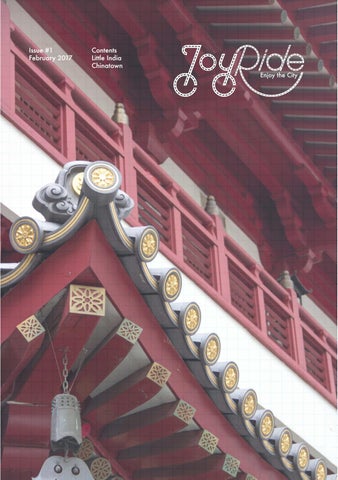
Issue #1 February 2017
Contents Little India Chinatown
CONTENT Editor’s Note History of Little India and Chinatown 6 Series Mural Unplugged Session #! That Chinese Villa Sri Veeramakaliamman Temple Umbrella Trees Swee Choon 4 Colours HDBs Nanyang Academy of Fine Arts Peoples’ Park Complex Sri Mariamman Temple Buddha Tooth Relic Temple Uncle-Aunty Town - Kreta Ayer Square Unplugged Session #2 Unplugged Session #3 Chinatown Street - Tin Tin Shop How to Use - Application Map Credits
Editor’s Note For its first issue, Joyride are privy to a range of heritage and culture of Singapore. We are a team that explore areas of Singapore through a bike, doing short interview dialogues and learning to pick up a skill or two. With this in mind, our team are grateful for the opportunity to work with Singapore Tourism Board of it’s launched Joyride, which have provided great knowledge of these lost culture. Join us on a journey to understand how Singapore have shaped our cultural DNA, interpreting past tradtionals and visualising it with our eyes.
The History of Little India and Chinatown In the 1840s, Europeans lived here mainly for the racecourse, where they met and mingled. When cattle trading took root, it became a mostly Indian trade as traders hired Indian migrant workers. Certain goods and services took off, and mosques and Hindu temples were built. Little India is a buzzing historic area that shows off the best of Singapore’s Indian community from vibrant culture to incredible shopping. Whereas Chinatown, the cramped five-foot-ways, dingy alleys and raucous street hawkers are relics of it’s past. Yet pockets of history remain in Chinatown, along with more movdern sights Singapore’s historic Chinatown is a bustling mix of old and new, filled with traditional shops and markets as well as cool stores and cafes.
6 Series Mural - Tekka Centre Singapore’s largest indoor wet market - is a collaboration between Singapore’s TraseOne streetart activist and Australia’s street artist Regan Tamanui, celebration of SG50 called 50 Bridges in May 2015 Titled ‘Cricket and Classical’ A mural dedicated to featuring iconic Indian practices such as Indian dance, flute playing and even cricket - India’s national sport. Keep your eyes peeled for the number of creative murals around the area, each revealing a facet of the Indian community and its development through the times.
Light in Little India by Elmac can be seen at Alley way connecting Rowell Road and Desker Road.
Series of mural can be seen at the famous Tekka Centre and look for the entrance to the carpark along Buffalo Road
Traditional Trades of Little India by Psyfool along Belilios Lane
Unplugged Session #1 // Madam Aishwarya Merra Bachchan, Mini-mart shop
How long have you been here in Singapore? // In the 1980s, I came here with my husband from Sri Lanka to start up a fruit business but unfortunately, the business was not picking up. But the year 2000 took it turns when the government started taking in India nationals to work here, thus the business blooms tremeoudously
Over the years, what are the differences you see in Little India? // Everything! Especially the environment, there are many pretty mural art on the wall. Many people like to visit here (Little India) with a camera now. Once in a while, I like it when I am been taken. *laugh*.
What and where will you recommend tourist to go? // Just a street ahead, there are umbrella trees. They are very colourful and not many people pass by that area. You should have a look too.
Tan Teng Niah Residence Kerbau Road The history of the building goes back to 1900, when Tan Teng Niah who was one of the few prominent Chinese businessmen in Little India, built it for his wife. This building is one of the last surviving Chinese villas in Little India. Said to be a hybrid of Southern Chinese and European architectural influences, the building won the Singapore Institute of Architects Honourable Mention Award in 1991. This was after the restoration work in the 1980s. Some of the interesting features include the bamboo tiled roof, the glided name plate at the entrance with the calligraphic inscription “Siew Song� or Elegant Pine, and the swinging door (also know as pintu pagar in Malay).
Former house of Tan Teng Niah at 37 Kerbau Road
Sri Veeramakaliamman Temple The Sri Veeramakaliamman Temple is dedicated to the Hindu goddess Kali, fierce embodiment of Shakti and the god Shiva’s wife, Parvati. Kali has always been popular in Bengal, the birthplace of the labourers who built this temple in 1881. Visitors are welcome inside the temple during designated hours. You’ll need to remove your shoes and leave them at one of the racks by the entrance. Photography is allowed, just bear in mind that this is an active site of worship and do not disturb anyone who is praying. If you’d like to leave an offering, you can buy a garland of flowers at the kiosks on Serangoon Road.
Located at 141 Serangoon Rd
Umbrella Trees - Hindoo Road Inspired by our tropical climate where shade is important to escape the heat, these “trees” are installations by Ms Marthalia Budiman, a participant of the URA’s My Ideas for Public Spaces: Forgotten Spaces competition held in 2015. If you find yourself hungry and needing some shade, pack some Indian food from Sri Veera’s Curry Restaurant just down the street to this breezy field for a break. With a blend of colours perfect for your Instagram backdrop, it will be hard to leave without striking a pose or two.
Installation of Umbrella Trees along Hindoo Road
Swee Choon
Located at the heart of Jalan Besar, in the district of Little India, Swee Choon provides air-conditioned as well as alfresco dining in the back alley. Whether it is for breakfast, dinner or supper, you can enjoy and savour a wide variety of Hong Kong and Shanghai dim sum. Here at Swee Choon, quality is never compromised and only the finest herbs and ingredients are used in our food preparation, in order to give our patrons a delectable treat.
Perfect pitstop for a break at 191 Jalan Besar
Rochor Centre Situated on the fringe of the centre business district in Bugis, Rochor Centre leaves a strong impression on the urban landscape of Singapore with its colourful facades. Rochor Centre is home to an eclectic mixed of developments. But, the bustling activity of Rochor Centre will gradually fade with its vivid colours into the pages of history as it makes way for the upcoming North-South Expressway
People’s Park Complex is located on Eu Tong Sen Street in Outram
Nanyang Academy of Fine Arts (NAFA) NAFA is a publicly-funded Singapore polytechnic-level arts and design education institution. There are few exhibitions that are free for admission to public.
3 campuses can be seen along Bencoolen Street
Image taken by NAFA
#funfact During the 1980s, that green portion was an apartment studio owned by a rich man
People’s Park Complex is located on Eu Tong Sen Street in Outram
People’s Park Complex - Outram Located at the foot of Pearl’s Hill, the site where the People’s Park Complex currently stands was an open public park. It later became the People’s Market or Pearl’s Market with outdoor stalls It’s always nice to see Singapore from a different perspective, and a trip up to the rooftop is also not complete without taking in the numerous views of the cityscape that sits in the background of the Chinatown enclave.
Sri Mariamman Temple An agamic temple, built in the Dravidian style. the temple serves the majority Hindu Singaporeans, Tamilians, in the city-state. Due to its architectural and historical significance, the temple has been gazetted a National Monument and is a major tourist attraction. Sri Mariamman Temple is managed by the Hindu Endowments Board, a statutory board under the Ministry of Community Development, Youth and Sports. Founded in 1827 by Naraina Pillai, eight years after the East India Company established a trading settlement in Singapore. Pillai was a government clerk from Penang who arrived in Singapore with Sir Stamford Raffles on his second visit to the island in May 1819. Pillai went on to set up the island’s first construction company, and also entered the textile trade. He rapidly established himself in business and was identified as a leader of the Indian community.
Located at 244 South Bridge Road, in the downtown Chinatown district
Key features of the Temple. Located in front of Ketar Ayer Square
Buddha Tooth Relic Temple The temple is based on the Tang dynasty architectural style and built to house the tooth relic of the historical Buddha. The ground breaking ceremony was conducted on 13 March 2005. It is claimed that the relic of Buddha from which it gains its name was found in 1980 in a collapsed stupa in Myanmar. The relic can be viewed by the public at the 4th floor of the temple. Since opening, the temple has become a popular attraction within Chinatown. Simple vegetarian fare is served in the basement of the temple, though donations are accepted.
Unplugged Session #2 // Mr Chew Hsien Soon, frequent visitor
Singlish Vocabulary lah - expression to create a certain mood. mah - expression to state the obvious.
What are you doing here? // To kill time lah! I lived around here, so during the weekends I will come down to the square and catch up with my friends. We play all sorts of games. Most of us like to play ‘chinese chess’, ‘weiqi’ and ‘checkers’. There is other games as well.
The crowd here are mostly uncles, and it is so crowded. Do you all plan at a certain timing to meet? // Most of the females like to stay at home or dancing *points infront where many aunties are line-dancing*. Many of us will bring friends over and eventually the crowd grew bigger and noiser. Sometimes there will be petty fights *laughs*.
You mention there is petty fights, why? // Gambiling mah! Some people do not like it went they are gambling, people stand at the back and tell them to learn who to choose their battles. Men have very big ego *laugh*
Do you think many ‘ang moh’ know this place? // No, many of them will glance for awhile but walk away without knowing our culture and tradition. I hope they can talk and learn from us, we look fierce but we are human, we like to interact too.
Unplugged Session #3 // Madam Tan, line-dancer for 2 years
You can dance very well! Do you come here and perform? // Thank you! I have been dancing back in 2014, so it’s almost 2 years. We are practising a dance routine for our coming April performance. But there are many first timer who join us as well.
How do all of you gather and practice together? It must be tough. // Yes, because most of us need to do housework *laugh*. We usually plan on one weekend to dance and also reserve the place to dance. There is a community centre there *points near to the uncles playing chess area*. So that’s how we book the square. Plus, since everyone loves line-dance, we will all make time for it.
And you’re the only one that dress like that, very fashionable! // *laugh* I like to dress up nicely so I will have the ‘feels’ of doing line dancing. Like cowboy!
Can people join in? // Of course, the more the merrier. Like what I said before, many first timer join us as well, some are tourists, we don’t mind too. It’s nice seeing foreigners doing what locals do, it’s very special to me.
Chinatown Street located right outside the MRT station
From People’s Park Complex, get a bird eye view shot of Chinatown Street
Chinatown Street As the largest ethnic group in Singapore is Chinese, Chinatown is considerably less of an enclave than it once was. However, the precinct does retain significant historical and cultural significance. Large sections of it have been declared national heritage sites
The TinTin Shop The shop is entirely devoted to Tintin merchandise, including books, greeting cards, postcards, posters, watches, stationery and t-shirts. For the true Tintin fan, they also stock collectible diecast model cars and limited edition resin and metal figurines
In an alley of 28 Pagoda St