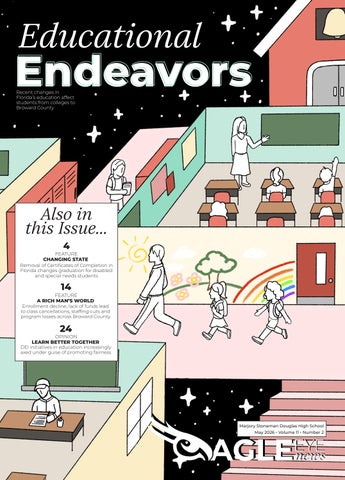
Educational
Endeavors Recent changes in Florida’s education affect students from colleges to Broward County
Also in this Issue... 4
FEATURE CHANGING STATE Removal of Certificates of Completion in Florida changes graduation for disabled and special needs students
14
FEATURE A RICH MAN’S WORLD Enrollment decline, lack of funds lead to class cancellations, staffing cuts and program losses across Broward County
24
OPINION LEARN BETTER TOGETHER DEI initiatives in education increasingly axed under guise of promoting fairness
Marjory Stoneman Douglas High School May 2026 • Volume 11 • Number 2
Marjory Stoneman Douglas High School 5901 Pine Island Road Parkland, Florida 33076
Quarter Four 2026 • Volume 11, Number 2
EagleEye.News
@MSDEagleEye
@HumansofMSD
@MSDEagleEye
@MSDEagleEyeNews
Feature
o d c s G t t
State 04 Changing Removal of Certificates of Completion in Florida changes graduation for disabled and special needs students
Randy Congdon 07 Q&A BRACE advisor Randy Congdon guides students into their futures
A h m T a h
27
to Success 09 Steps Extracurriculars mold students into
J
future scholars
Age 10 ICE ICE raids in Florida communities
irreparably change education for immigrant students
Rich Man’s World 14 AEnrollment decline, lack of funds lead
to class cancellations, staffing cuts and program losses across Broward County
18 Class Dismissed
Broward Teachers Union achieves recertification after Florida law alters union rules
Hej Amerika 19 Hej, Foreign exchange student Karin (Edit)
Danielsson experiences life as American high school student
21 The Road Not Taken
Seniors choose alternative paths after high school as opposed to traditional 4-year institutions
25
24 of the Fittest 25 Survival Valedictorian tradition compromises students’ well-being
To Degree or Not to Degree
Stigma wrongfully surrounds noncollege paths after highschool
in Silence 26 Schooled School districts restrain teachers’ free
speech, threatening First Amendement rights and discouraging classroom discussion
Track to Burnout Ascendance 27 Fast 23 Academic Push for AP and AICE credit initiates MSD students continue their academic careers at prestigious Ivy League universities
Opinion
24 DEI initiatives in education increasingly
mental health crisis in schools
A(I)CE of Spades
Introduction of AICE classes negatively impacts existing AP, honors and regular classes
Learn Better Together
DESIGN BY Grace Brill
axed under guise of promoting fairness
Editors-in-Chief Grace Brill Victoria Damaso Andie Korenge Business Manager Rio Rice Photo and Social Media Editors Ella Bernbaum Luke Dautruche Chelsea Townsend
Section Editors Natalia Dzielnicka Crystal Goes Matthew John Lynn-Gabrielle Soilvilus Ahana Tippanagoudar
Cover
Staff Maria Derival Rose Elia Charlotte Hamm Stella Profili Milania Rufino Drew Siddens Olivia Villalobos Kaylee Williams
Publication Policies Eagle Eye News is an open forum for student expression created by Marjory Stoneman Douglas High School students. Eagle Eye News does not represent the views of of Marjory Stoneman Douglas High School or Broward County Public Schools. Eagle Eye News seeks to recognize the individuals, events and ideas relevant to readers. Our organization is committed to fair reporting, providing a platform for student voices and equitable coverage.
To read our complete set of policies and editorial procedures, please visit us at www.eagleeye.news The publication is a member of the Florida Scholastic Press Association, the National Scholastic Press Association, the Columbia Scholastic Press Association and the Southern Interscholastic Press Association. If you would like to advertise please call (754) 322-2150 or email MSDEagleEyeNews@gmail.com
DESIGN BY Grace Brill
to the
Letters Editor
Hello World
Dear Editor, I have an increasing concern with the usage of AI. Many people have become far too dependent on it and some feel as though they cannot live without it. For example, numerous students are using apps like ChatGPT and Gauth AI to do their schoolwork. The use of this does not allow the student to build critical thinking and problem & solution skills. However, this issue is beyond students alone. Artificial intelligence feels almost inescapable. It has now become a part of our daily life. Social media platforms like Instagram, Snapchat, and TikTok all use artificial intelligence to create algorithms that curate your feed. It keeps you hooked so you continue to use their app. JESSICA ANDERSON, 10
Attack of the Clones
Dear Editor, I’d like to agree and add on to the student opinion “Conformity Culture.” It talks about how creators now no longer attempt to create original content but copy the same tone and joke as someone else. Everything on TikTok now mainly goes viral if you use an audio that everyone is using along with hashtags and text prompts in videos. Creators no longer try to be individually creative but steal others ideas. When people come to notice they comment on those who do copy and steal content but most of the time this is just used as “rage bait” which has become the new star of the algorithm. Rage bait is when you purposely try to make people upset or angry by doing things incorrectly or “annoying” in order to gain views and attention. We have lost the art of individual creativity and the art that can be made with it. So many platforms have been used to spread uniqueness but have now just been washed into the same form or entertainment. We need to start uplifting and supporting smaller creators to spread creativity once again. SOFIA TERAN-SANSONE, 11
Machine Learning
Dear Editor, I am writing in response to the article, “AI Attachment.” Overall, I found this article very interesting and informative. I feel that AI can be used as a helpful resource in certain situations, but not all. Although, I agree that AI should not be used as a replacement for social interaction. Since AI is not an actual human being, it does not have the capability to deeply understand actual emotions. Young individuals need to be able to communicate with real people with real feelings, not an AI chatbot. I also agree that AI should not be used for conflict resolution, since most of the time, AI will agree that the user is correct, even though they may not be. I want to thank you for talking about this crucial topic in our society. ISABELLA SHAW, 10
Numerical Value
Dear Editor Colleges lately in the newer generation have been so focused solely on scores. We used to be able to get in for more than just a number. Now we are just a number on the screen or page and that number determines if you get into college or not. The system for SAT testing is so tedious and articulated in such a way it is
hard to study for everything you will be tested on. We were able to show personality and our essays counted for something, but even the colleges now have said that the essays are not even looked at closely, leaving lots of student who work very hard but test badly in a difficult position. ZAHRA MOHAMMED, 12
Rat Race Dear Editor, After reading the most recent edition of Eagle Eye News, I felt obliged to add on to the conversation around academic expectations and student accomplishments. While it’s heartening to see our school recognize achievement, I believe we also need to be open about the daily stress that many students experience. For grades, extracurricular activities, leadership positions, and college acceptances, high school is often portrayed as a race. Many students are striving to live up to high expec-
tations from both themselves and others while juggling schoolwork, extracurricular activities, and personal responsibilities. Learning may feel more like survival than growth as a result of this ongoing strain. In my opinion, our school community should prioritize balance, mental health, and reasonable expectations in addition to continuing to celebrate accomplishments. Students’ health shouldn’t be sacrificed for success. ANUSHRI SEEPERSAD, 11
Dear Editor, I think the lack of coordination between all the events, activities, and important information at school is frustrating and inconvenient. Everything requires multiple different tabs, more than five minutes and information regularly switches between being available on Canvas and on the website. Additionally, the information is often given in parts and forces the reader to search for information in many places. To a new student, this kind of disorganization can be stressful and ultimately cause confusion. To be able to find the right information could help students gain volunteer hours, attend after-school events, get information for their post-high school and find clubs they might be interested in. JODAYA BELLOT, 11
Compare and Contrast
Making Waves Dear Editor, After reading “Sink and Swim,” I honestly couldn’t stop thinking about it. Mckayla Barton’s story felt inspiring in a way that was real, not just impressive. The way she described every dive as a completely different experience really stuck with me. It made me realize how easy it is to forget how much beauty exists right here in Florida. I’ve grown up surrounded by beaches and ocean life, but I don’t always stop to appreciate it. Reading about someone our age actively exploring and respecting marine life reminded me that environmental awareness
Scavenger Hunt
isn’t just something adults talk about — it starts with us. Her passion shows how powerful it is when students step outside their comfort zones and truly commit to something meaningful. I also appreciated that the article highlighted who she is beyond school. It’s motivating to see students recognized not just for grades, but for dedication and curiosity. Thank you for sharing stories that inspire students to grow and see the world differently. VANESSA SANCHEZ, 11
Dear Editor, I’ve come to realize that with our generation, being better than someone is always so important. Having better shoes, better clothing, a better lifestyle, etc. It’s rarely about who one really is on the inside. This generation; our generation, is full of judgement. And it shouldn’t be this way. It’s extremely concerning for us students because of our mental health, and for our relationships that we build here at school; whether those relationships are friends, partners in a group project, mentors, or even teachers. I feel as though our school should implement more group events/assignments that can unite us, much like our leadership classes. We must stay united as classmates and a community, instead of judging each other based on what’s on the outside, rather than the inside. VICTORIA GORDON, 11
Digital Disruption Dear Editor, I am writing to thank you for shedding light on the unrealistic standards of social media in the article “Mirror, Mirror on the Phone.” It’s great to hear from students and obtain their thoughts on the exploitation of the internet. During middle school, my parents didn’t necessarily allow me to have many social media apps. At the time, I didn’t agree with their rules because I thought that I wouldn’t fit in, but that is exactly the root of
the problem we are facing nowadays. Children, teenagers, and adults alike are being corrupted by the many standards that are set every day online. With just one click of a button, your entire self-esteem can implode. While I agree that technology has improved and simplified the lives of many people, I also believe that we may have blown its use out of proportion and possibly created a future of people who struggle with their mental health. GIANNA DESTEFANO, 11
Send Us a Letter
Have something to say about the school? Have something to say about a local, national or global issue? Have something to say about this issue of The Eagle Eye? We want to hear your opinions. Email submission to: MSDEagleEyeNews@gmail.com Submissions must be between 100-200 words
DECA-cated Dear Editor, I enjoyed reading the article about DECA’s Valentine’s Day social. It’s inspiring to see how much effort students put into their accomplishments and the awards they earn for their work. Twenty-page business papers are not easy, and seeing them completed is motivating and inspiring. Articles like this are important because they highlight the opportunities available to high school students. It’s great to know there are many ways to participate in school activities and balance them with schoolwork and other commitments. This article could inspire many students interested in joining DECA. I love that students are recognized for their achievements, showing others that hard work pays off and that nothing is too much if you truly dedicate yourself. NIGELLA ALEXANDER, 12
LETTERS TO THE EDITOR 3
Changing State
Removal of Certificates of Completion in Florida changes graduation requirements for disabled and special needs students
O
ur words can change the world,” Malala Yousafzai said to the United Nations in 2013. “Because we are all together, united for the cause of education. And if we want to achieve our goal, then let us empower ourselves with the weapon of knowledge and let us shield ourselves with unity and togetherness. Education is the only solution. Education first.” Education has been a topic of debate for years among politicians and society, especially concerning those with disabilities. As more disabled students are completing their education, policies concerning accessibility, secondary education and employment opportunities are becoming increasingly relevant. Specifically, Certificates of Completion (COCs) were designed for students who completed the 24 required credits for high school graduation, but could not pass the mandatory statewide assessments, such as the tenth grade English Language Arts (ELA) Exam and Algebra 1 end-of-course (EOC) exam or maintain a 2.0 grade point average (GPA). The program also allowed students who could earn COCs to stay in high school for one additional year for another chance at achieving the minimum GPA or passing the statewide tests. COCs were introduced as part of the Florida Accountability Acts in the 1970s. This was upheld through the Debra v. Turlington court case on May 4, 1983. Ten Florida students who failed Florida’s competency test challenged its use as a requirement for a diploma. Although originally ruling that the test was valid, appeals from the plaintiffs and defendants led to an evaluation of the test to determine if it truly measured what was being taught in schools. This eventually led to the use of COCs
for those who did not pass the test, in turn leading to the use of COCs for all students who could not pass the requirements to graduate. This was especially helpful for students with disabilities. According to the Down Syndrome Foundation of Florida, while proposed Senate Bill 166, which would have eliminated specific testing requirements for Algebra and ELA, did not pass, students with an Individualized Education Plan (IEP) may request a waiver from these tests. However, on July 1, 2025, students lost access to this program. The Florida Senate passed
Starting in the 2025-2026 school year, students with disabilities are no longer able to get a COC. According to the Gator TeamChild Juvenile Law Clinic at the University of Florida, the intention behind the bill was to replace the COC with a more “informative and practical system.” In addition to phasing out COCs, the bill requires all school districts to offer a super senior, or fifth-year program, for high schoolers who would have qualified for a COC. Sponsored by Rep. Susan Valdes, R-Tampa, it follows the pattern of Republicans dismantling protections, accessibility efforts and benefits for disabled people. For example, President Donald Trump signed executive orders on Jan. 20 and 21,
Instead of earning a COC, students will stay in high school full time or part-time for one year. By Jan. 1, the FLDoE created a document containing options for students who do not meet the requirements for a standard diploma. This includes career education or credit programs at a career center or Florida College System institution, apprenticeship programs and the Graduation Alternative to Traditional Education (GATE). The GATE program is designed for students ages 16-21. Through the program, students can enroll in a Career and Technical (CTE) program and an Adult Secondary Education (ASE) program simultaneously. ASE is a program that allows adults to earn a high school diploma to expand career prospects by successfully passing the Standard GED tests, which are four tests showing academic knowledge comparable to a high school diploma. Students who choose to complete this program will have up to three years to complete it. In order to earn CTE certification, a student must take at least 18 credits and maintain a minimum 2.0 GPA on a 4.0 scale. Specifically, students must take four English credits, four math credits, three science credits, three social studies credits and two credits in CTE classes, including a program completion and industry Post-Secondary Alternatives for Secondary Students certification. While this may not apply to all (PASS) teacher Christina Ferrara students with disabilities or special needs, it is still a viable option for students who are unable to House Bill (HB) 1105, which, along with other dismantling Diversity, Equity and Inclusion complete the regular graduation requirements. changes to the education system, eliminated (DEI) programs across the country and removing For students with learning disabilities, the COCs and required the Florida Department of accessible environments and non-discrimination GED may not be a viable option. While the Education (FLDoE) to develop an alternative policies for disabled people. Trump also cut exams offer accommodations, these only increase solution for adult education and postsecondary funding from Medicaid, which provided exam time or provide breaks. The content is options for students who do not earn a diploma healthcare to more than 15 million people with still identical for both disabled and able-minded by Jan. 1, 2026. This generated a lot of disabilities, according to a 2025 article titled “5 individuals. confusion and frustration — it was unclear what Key Facts About Medicaid Coverage for People For those who meet certain conditions, these options would be at the time. with Disabilities.” exam requirements can be waived and current “If I were to go through that and spend This affects not just the students who were alternative assessments can be given instead. all these years seeing my son or daughter in supposed to go into this program, but their Specifically, students with significant cognitive school and giving it their best effort and loving teachers and parents, as well as boards of disabilities will receive the Florida Alternate what that whole experience was about their education, as they are forced to restructure their Assessment (FAA). This assessment aligns with educational experience and then not seeing that programs to accommodate the changes. Florida’s Benchmarks for Reflective Thinking be recognized, that would be pretty devastating In order to implement the new changes, (BEST). There are currently two versions of the for any family,” Vladimir Baldelomar, a parent HB 1105 had to introduce alternate solutions to exam: the FAA Performance Task, which assesses of a child with a disability, said in a 2025 article provide students who were going to use COCs to students at three different levels of complexity, called “Florida ends certificates of completion complete their education with the opportunity to and the FAA Dataportfolio, which addresses the for students with disabilities.” learn skills for employment. needs of students who typically do not have a
“
[the law] will impact my class by possibly not having as many students as I have right now. So that’s upsetting, because, you know, we’re a community, and the more students who are in here, the more students we can help.”
certificate conundrum Students with disabilities are no longer able to get a COC, starting with the 2025-2026 school year.
Through the Workforce Credential Program, students will have the opportunity to earn badges that correspond to specific workplace skills.
The GATE program is designed for students ages 16-21. Through the program, students can enroll in a Career and Technical Education (CTE) program and an Adult Secondary Education (ASE) program simultaneously.
Other paths proposed by the FLDoE include career education or credit programs at a career center or Florida College System institution and apprenticeships programs.
04 EDUCATION • Special Needs Suspension
FLDoE introduces new alternative paths after the removal of COCs
hats off to the grad MSD students weigh in on the importance of graduation
62% 59%
of MSD students agree that graduation requirements should be flexible
1970s
COCs were introduced as part of Florida Accountability Acts
of MSD students agree that having a high school diploma is needed to get a job
Results from of survey of 202 MSD students
formal mode of communication and those who may work at pre-academic levels. To qualify to take the FAA, the requirements are quite stringent and require 70% of attendance during the school year. According to the Helios Education Foundation, in the 2022-23 school year, Florida’s 30.9% chronic absenteeism rate was the seventh highest in the country. According to the CDC, children with disabilities are about three times more likely to have experienced chronic school absenteeism than children without disabilities. Disabled students might miss the attendance requirement and be unable to take an alternative exam. Along with the removal of the COCs, HB 1105 introduced the Workforce Credential Program. Students in this program will have the opportunity to earn badges that correspond to specific workplace skills. Each badge will represent five skills. The program had to be fully implemented by Jan. 31. Lessons are designed to be flexible throughout one or multiple school years. However, given the broad language of the statue, it is unclear what credentials students may earn and how they will be able to use those credits. These badges will most likely not be a functional way to meet job requirements and further hurt their employability as compared to a COC. These programs do not provide a direct path to employment. While a 2024 article by health researchers Alison Enticott and Dew have shown providing transition services and support to find a job from age 14-15 is likely to improve competitive employment outcomes for disabled students, Florida does not provide this as an option. The bill requires students to update their IEPs if they previously chose to graduate with a COC. The school district must change their IEP plan and give the student the document with graduation options. With these changes happening, disabled students who are in their senior year can see their graduation option be taken away as they must figure out how to participate in a new program for their last year of high school. It is unclear if this disruption will be beneficial. Many families are concerned about the implications of the new law; the career opportunities available for students without a
COC are limited and the alternate solutions have not clearly stated their impact on students. However, the supporters of the law have pushed back on these claims. “The disability community –– my heart goes out to them, because the rhetoric around this bill and how it will affect them is totally false –– totally false,” Valdes said. Students with severe disabilities who cannot earn a standard high school diploma will leave school without any formal recognition upon graduation. This could impact their ability to attend college. “[W]ithout that certificate, [students] are potentially going to lose all eligibility to all sorts of opportunities after high school, whether that’s even taking a college placement test or pursuing developmental or vocational programs,” Executive for the Down Syndrome Association of Central Florida Amy Van Bergen said, according to University of Florida. Previously, several colleges accepted COCs, including but not limited to Florida Atlantic University, University of Central Florida, Polk State College, Southeastern University, The College of the Florida Keys and Sante Fe College. It is currently unclear if admissions policies will change in response to HB 1105. IEPs are also impacted by HB 1105. An IEP is designed to create a special, personalized curriculum for students depending on their needs and abilities. Some parents of students with disabilities may have declared an intent to earn a COC. However, under the new bill, they must revise and update the intent at the student’s next IEP meeting. Students with IEPs often have to begin their transitions to a personalized educational curriculum early, either by the seventh grade or when they turn 12 years old. The Federal Individuals with Disabilities Education Act (IDEA) requires postsecondary goals to be created at 16 years old. Therefore, students and their parents have to start planning for their futures earlier than students who complete the standard diploma without any additional accommodations. This earlier planning time is especially crucial now due to the removal of COCs. Parents and their children may have to start planning even earlier to abide by the new laws. Van Bergen also worries that the law could
take away some of the incentives that students had to even complete high school. The removal of COCs could lead to less students in the classroom as they may be unable to finish their education without the certificate. “I think [the law] will impact my class by possibly not having as many students as I have right now,” Post-Secondary Alternatives For Secondary Students (PASS) teacher Christina Ferrara said. “So that’s upsetting, because, you know, we’re a community, and the more students that are in here, the more students we can help.” Along with affecting students who were on track to complete a COC, the new law affects other types of students, too. According to The Tampa Bay Times, the law could disproportionately affect English language learners. It could also impact foreign students from other countries, as it is already difficult for them to get their past credits accepted and often have to retake classes. Sophomore Mariana Betin Rojas is a student who moved from Columbia. The credits from the classes she took from her home country were not accepted at this school, and she has to re-do several classes to take all the credits for graduation and to move to college-level classes. While graduation is not a concern for her, she believes it is for foreign students who move to the U.S. later on, such as senior year. “I think the time would be really limited to make up all the credits for graduation,” Betin Rojas said. “[If I moved later] I would probably have to repeat a year, but I’m saying this based on what [the school] has told me.” Without COCs, foreign students may have no recognition of their graduation when their credits do not adequately transfer. The ending of COCs have effects on the education of marginalized groups, such as immigrants and disabled students. Whilst new programs have been introduced in their place, it remains to be seen how effective the alternative programs will be in keeping students in the workforce and able to have independence later in life. STORY AND DESIGN BY Natalia Dzielnicka and Ahana Tippanagoudar GRAPHICS BY Natalia Dzielnicka
1983
Their creation was upheld through the Debra v. Turlington court case on May 4.
2025
In 2025, the Florida Senate passed House Bill 1105, which, along with other changes to the education system, eliminated COCs.
2026
By Jan. 1, the FLDoE created a document containing options for students who do not meet the requirements for a standard diploma.
EDUCATION • Special Needs Suspension 05
DESIGN BY Rio Rice and Rose Elia
Crocante Cafe & Gourmet Bakery crocantebakery@gmail.com Daniela Castillo (954)-341-4416
Plaster Carousel
JC ESL Tutor
Fun Painting Studio Scott Gilman
Jerilyn Carey
jcesltutor@gmail.com (808)-989-9446
info@plastercarousel.com (954)-753-5354
Oceans Pediatrics Edwin Perez Eperez@oceanspeds.com (561)-793-2500
Elite SKLZ Soccer
Elitesklzcamp@gmail.com
(954)-257-8430
IMPA
S
ra y Berg an Pr
590 SW 9th Terrace Suite 1 Pompano Beach, FL 33069
W s w t S g
W h
I c g c w s g D h s
S w
N o w g c r
W r
Diamond Dealer
Broward Pulmonary and Critical Care (754)-702-3247 browardpulm@gmail.com 10139 NW 31st St, Suite 103, Coral Springs, FL 33065 06 EDUCATION • Advertisements
W a o
I I s c c K t
Q &A
DESIGN BY Kaylee Williams
BRACE Advisor
Randy Congdon
What is your favorite thing about helping students figure out what to do after college?
Well, I feel that feeling when I’m telling people something that they don’t already know. I like watching the kids learn new things that’ll help them later in life. That always kind of drives me. So yeah, it’s fun. I’ve always had fun helping guide students.
What path did you take after high school?
I graduated high school and went straight to college to Flordia State University (FSU) and graduated in four and a half years. I was a criminology major at FSU and my first job was working as a probation and parole officer for the state, and I did that for four years. I was about to go into my interviews for the Hollywood Police Department. But then, my girlfriend at the time, her dad said he knew someone who needed someone to do recruiting for a college.
So you did not always intend to work with kids? No, I didn’t. I didn’t even think about that kind of thing. And at first I did not want to do it. I was telling myself, “I’m not gonna do it, I’m not gonna do it,” but I did it and I loved it. I did college recruiting for about 30 years before I retired and came here.
What did you do for college recruiting?
I did it for a couple different colleges actually. I worked in admissions, I managed admissions teams and things like that all around the country. I work at some colleges throughout the country and then here in Florida. I worked for Kaiser University for a few years and managed the recruiting of Florida and the Caribbean.
BRACE (Broward Advisors For Continuing Education) advisor Randy Cogden guides students into their futures
What is important when it comes to working as a BRACE advisor?
I think you just have to be patient. You know with people not everyone understands what you’re going to tell them the first time. So sometimes you have to tell somebody something three times before they really grasp what you’re saying. When working with young folks who are going into something new that they don’t know about, it’s going to take a lot of patience.
What are some underutilized resources at this school that students should take advantage of?
Zello is something that students don’t utilize. They know it is there, but they have not really used it. From ninth grade on, there are tools and things you can do. Lessons and different exercises can help to lead you toward the right path after high school as far as career, school and everything for that matter.
What inspired you to become a BRACE advisor after doing college recruiting?
What is the most important skill or trait students should develop if they want to be successful I’ve done this type of work for 32 years in college in the path they choose? recruiting, but I retired. I’ve been working in this kind of field for many years, but I got tired of all the travel and management that I was doing. Now, working here, I feel that this is perfect for me at this point of my life because it’s the same thing I’ve been doing for many years. I knew the previous B.R.A.C.E advisor, Mrs. Freand, from back in the day. When she left to work at North Broward she told me about this position and that’s how I came to be here.
How do you help guide students who are unsure what they want to do after high school? I recommend different personality profiles. Like there’s profiles on Zello that students can use to kind of identify what their personality traits are and their skills. It shows them different careers that are matched to those traits and skills. Another website I’ve used for many years is 16 personalities. It is a website you can go to and it takes about ten minutes to get your results. This helps to give at least a starting point to look at certain occupations that may fit your personality.
As you go out of high school, whether you go to college or work, I think that time management is the thing that can help you the most. That’s just a huge trait that’s going to do you well in anything you do during or after high school.
What is the most rewarding part of helping students map out their futures?
I think it is always rewarding to see folks that I start talking to in tenth, 11th grade that are looking to do this later or go to this college, and seeing them once they get the career they want or get accepted into the college they wanted to go to. It is always good to see things like that happen.
What is one of the biggest problems that students face when trying to transition to college, and what do you do to help them? Transitioning to college is all about focus and time management. You have to understand what you have to spend time on and some kids struggle with that. One thing I tell kids is to spend more time studying, more than they did in high school. The heart of so many things to be successful is managing time and focus.
If you could change one thing about how our education system prepares students for the real world, what would it be?
A lot of times when you are going into the four-year university system in the U.S., traditionally your first two years of college are general education requirements that are covered in high school, along with maybe some electives you can take to help decide what you’ll want to do. That’s part of the system that we’ve always used and I think that could help some students going into the four-year university path, but taking more of what they want to major in and what they’re interested in. So for those students who know what they want to do, they can get into what they want to do quicker. Sometimes that helps them to stay focused enough to graduate. Although I think that this system is great, there are people who don’t need that time.
What is a word of advice you would give to students who are juggling extracurricular activities, school work and college applications all at once?
Well, as far as activities go, you don’t want to do things just to do them. Some think that more is better, but you’ll typically want to do something that you’re interested in. And once you get really into that one thing, you can move up to leadership positions and that’s what colleges are really looking for as far as extracurricular activities. You only have so much time in the day to get your studies done, keep your grades up and get your extracurriculars in. You want to focus on things that you’re really interested in, not just to do something for a number. REPORTING BY Kaylee Williams
EDUCATION • Randy Congdon 07
DESIGN BY Rio Rice
N T S n i a s T
a n
t t i i i t F
w W o
t p m t
08 EDUCATION • Advertisements
N H
DESIGN BY Luke Dautruche
Steps to SUCCESS
Founded this school year by seniors Aiden Gregorio, Leo Dinh, Dhruv Extracurriculars mold students into Mutha and Stan Scaria, future scholars Mobilizing MSD is a club formed in collaboration with an organization under the same name. The organization originally formed after dmission into prestigious colleges is becoming more competitive. the shooting in 2018 to help connect recent Colleges now demand greater criteria for acceptance, such as higher graduates to the school’s alumni. GPA’s, SAT/ACT scores and longer resumes, leaving students feeling Using the prestige and help of thousands of overwhelmed by the pressure to balance academic and extracurricular alumni across the U.S., the four founders created work to even be considered by admissions offices. the club to help provide students with internship In a college landscape where applicants feel buried by pressure and left in the opportunities, extracurricular opportunities, mentorship dark about how to reach their goals, a number of clubs have risen to shine a light, and more. guiding students onto the path of success. “What inspired us to found [the club] was rampant STORY BY Luke Dautruche gatekeeping at the school,” Mutha said. “Students at the top of their class would keep important information from their peers and it would hurt their college chances. Also, low income students without connections hurt disproportionately more from this. So, by making all the information, activities, internships and strategies an open source, we can increase equity.” Focused on college readiness, Mobilizing MSD not only allows students to access DECA is an paid internships and opportunities outside of school, but helps students form resumes international nonand applications, along with informing students about what stands out and appeals to profit student organization admissions offices. aimed to prepare high Over the school year, Mobilizing MSD has found over 15 internships for students, edited over school students for careers in 20 resumes for jobs, discovered over 50 extra curricular programs from industries in medicine, finance, business, marketing, hospitality, engineering and more and has presented numerous guest speakers such as the Chief Executive Officer finance and management. The DECA of Chewy. chapter at school is the third largest The experience gained from Mobilizing MSD and its benefits sets students onto tracks of success in college chapter in Florida and the seventh largest and the work industry, bettering the school’s community. globally, with over 800 members. DECA is a business club, developing leadership and entrepreneurial skills through case studies, roleplay and community service. DECA specializes in prompting students to imagine The themselves in the workforce, a reality that may seem farther National away than it really is. The co-curricular course teaches Technical Honor students to dress professionally, write resumes and applications, Society is a conduct themselves in interviews and network. It strengthens college non-profit organization applications by demonstrating leadership and industry knowledge, as integrated into a club, well as business acumen to admissions offices. aimed to uplift and empower “I feel as if DECA has not only helped prepare me for future college life, students through Career and but also for the real world,” sophomore Noah Lee said. “It really just helped me a Technical Education (CTE). lot with knowing what skills I’m going to need when I want a job in the future.” The program serves over 100,000 In addition to regular meetings, socials and in-school events, the core of DECA’s active members through over 5,200 chapters experience is its extensive competitive events program, featuring competitions at district, nationally. state and international levels. DECA’s competitive events can be grouped into three broad CTE programs provide students with academic, categories: role play and case studies, prepared events and online simulations. Students technical and employability skills, guiding students can only qualify for state and international competitions by placing in the leading spots at district towards high-demand and high-wage careers. This competitions, compelling students to strive for success in the program. is done through industry certifications, apprenticeships, DECA also prides itself in its many scholarship offers from corporate partnerships and merit-based internships and mentoring. CTE programs were awards. Annually, DECA awards over $200,000 in scholarships to its members, with scholarships usually implemented by the Florida Department of Education for ranging from $1,000-5,000, giving students a helpful nudge in the right direction against rising tuition costs. their ability to prepare individuals for occupations crucial to
A
Mobilizing MSD
Florida’s economic development. “High school is a vulnerable time where many attempt to discover what they want to do in the future,” NTHS co-founder and president Grace Wang said. “We aim to encourage a diversity in career options and educate our members through guest speaker events and workshops.” NTHS assists students in their journey to higher education not only through the over $300,000 in scholarships the program offers annually, but also professional portfolios, letters of recommendation, certifications and connections offered through membership. This greatly strengthens college applications and gives students financial ground to stand on once they enter college.
National Technical Honor Society
DECA EDUCATION • Clubs for College 09
O
ICE Age
n Sept. 9, 2025, the Department of Homeland Security (DHS) issued a statement saying that Immigrations and Customs Enforcement (ICE) does not “raid or target schools.” In Jan. 2025, the Trump administration ended protections for sensitive locations that prevented ICE from arresting people in schools and churches since 2011. “Operation Tidal Wave,” a collaboration between ICE and Florida law enforcement, has resulted in the detainment of over 10,400 in Florida, with Gov. Ron DeSantis commending them for protecting citizens. The 287(g) agreements implemented permit state officers to have immigration authority typically reserved for the federal government. Florida Attorney General James Uthmeier emphasized that many of those arrested were attempting to prey on children, although the majority of immigrants detained had zero criminal record across all U.S. ICE operations. Despite claims of violent and dangerous immigrants being deported, only five percent of people detained by ICE across the U.S. have violent convictions, according to the Cato Institute. Operation Tidal Wave has led to people being sent to detention centers after being stopped for traffic violations, as police are made to enforce immigration laws. In Florida, due to the Trump administration demanding a 3,000 daily arrest quota, there was an 86% increase in arrests of those without criminal convictions, double the increase of those with criminal convictions. These operations have most affected a sensitive population: children. Fear of ICE is widespread across the U.S.; however, Florida is one of the most affected states. According to the Higher Ed Immigration Portal, about one in every five people in Florida is an immigrant. Florida ranks third in the U.S. for the number of undocumented students in higher education, per Florida College Access Network data. As ICE raids neighborhoods, students are becoming afraid of coming to school. They fear being taken and separated from their families.
It goes beyond those who are immigrants. It impacts entire communities. Children can find themselves stranded because a bus driver is detained. Babysitters who previously helped with dropoff and pickup are no longer there to help. “Out of the Class and Into the Shadows: Immigration Enforcement and Education Among U.S.-Citizen and Foreign-Born Hispanics,” a 2021 study by Jose R. Bucheli, details that in wake of ICE activity, high percentages of Latino citizens avoid important activities, including parents being engaged and actively involved in their children’s schools. Immigration-related arrests in the interior of the country have hindered school enrollment among Hispanic youth regardless of place of birth. In Florida, school enrollment is expected to be down by about 46,000 students this year,
ICE raids in Florida communities irreparably change education for immigrant students
schools may not be going enough. Schools like Marjory Stoneman Douglas High School have implemented policies like the 10-10-10 rule to deter absenteeism, or repetitive absences. The COVID-19 pandemic caused high absenteeism in Florida public schools. Sophomore Mariana Betin Rojas has seen immigration anxiety and fear result in her friends accumulating more absences from school. “One of my friends had to live in a really difficult situation due to ICE,” Betin Rojas said. “A lot of my friends are scared of getting out of their house more than necessary.” New immigration policies are only worsening these effects. A study showed that a greater number of immigration arrests cause immediate increases in student absenteeism, as high as 11% points for certain demographics. “Some kids can be scared to come to
decrease in school absences. Broward County Public Schools (BCPS) did mention in a memo that immigration anxiety is present, and offered little support to students and families facing those anxieties. Florida school funding is based on student attendance and standardized tests. Schools in Florida rely on high pass rates on exams, such as the FAST, to receive funding. These policies threaten educational outcomes of students and thus threaten school funding and resources given to students. The paper “The Effects of Immigration Enforcement on Student Outcomes in a New Era of Immigration Policy in the United States” details a study where researchers investigated the impact of increased immigration anxiety on student test scores in a large school district in Florida during the beginning of Trump’s second term. Increased immigration policing at the beginning of 2025 reduced test scores for Hispanic students. Notably, the scores of both U.S.- and foreign-born Spanish-speaking students decreased, showing that these effects perpetuate beyond only immigrant children. These policies greatly affect groups that have historically been struggling. According to the 2017 article “The Potential and Promise of Latino Students” by Patricia Gándara, Latino students fall far behind both white and sophomore Mariana Betin Rojas Asian students in academic achievement and due to several factors including a declining birth school because of this not really knowing if educational attainment, as nearly two-thirds of rate, universal school choice and immigration immigration forces could come, due to some Latino children live in or near poverty. While policies. According to the Orlando Sentinel news outlets stating how [ICE has] moved to Latino students are already struggling, fear takes article “‘Not going anymore’: Immigration searching schools at times,” sophomore Dayana them away from education and causes more enforcement hits Florida school enrollment, Pozuelos said. “They might fear that if their setbacks. attendance,” state demographers believe parents come for a reason they could possibl[ly] Florida schools may eventually choose President Donald Trump’s immigration policies be detained.” to implement alternative strategies to ensure to be the main reason for the decline. Immigrant minorities are most affected, Latino students find school success while staying A decrease in school enrollment can while other groups may still continue to go to at home. Schools in Minneapolis and the lead to school closures and reduced funding, school. surrounding areas gave students the option of diminishing the quality of education and “I feel like it depends on the person,” junior accessing classes online. However, the pandemic access to education for all students. Especially Juan Tejada said. “I know some people tend to showed that this form of learning was not in districts that consist of high immigrant miss school for that same fear, but some people effective. populations, student numbers decline more won’t because they think they won’t be affected.” Despite Uthmeier’s concern for children, dramatically and harm these areas — areas However, there are always potential the policies he is advocating for are causing a which were likely already underfunded the most. programs that Florida schools could implement pattern of childhood trauma. Even students who are enrolled in public to prevent absences. In Minnesota, a city with a “I see how it makes everybody uneasy heavy ICE presence, volunteers pick up students and worried for their safety, just to go grocery and walk them to their bus stops or even drive shopping, and it has a big impact on our them directly to school. The efforts resulted in a mentality and mindset,” Tejada said. “People’s
“
One of my friends had to live in a really difficult situation due to ICE. A lot of my friends are scared of getting out of their house more than necessary.
the student body School demographics showcase potential impact of ICE activity in Florida
m e w g
e a
o C o P T r
c i d b w h a fi
C i T r
mapping
resistance The following map records different ICE Protests in high schools and universities throughout Florida as of April 20, 2026.
89%
High School anti-ICE
of protests in educational institutions in Florida took place in high schools.
University anti-ICE Protests Scan to view interactive map
Sources: Palm Beach Post, NBC, Orlando Sentinel, USA Today, WLRN, Scripps Media Map data ©2026 Google
mentality would start to be more fearful of law family members, as their friends, neighbors and “I’m an over-thinker, and I analyze every enforcement an immigration and anything teachers may suddenly leave their lives. possible result of a situation,” Betin Rojas said. with the law, which will cause fear to go out in “Children thrive on familiarity, “The uncertainty of this situation makes me be general” predictability, and attachments to important [sic] really fatalistic, paranoiac, thinking about When families shelter at home to avoid people in their lives, including family and the possibility of being in danger when I go to encountering ICE, their children do not eat well, friends,” licensed clinical social worker Jessica school or outside of my house.” as reported by UCLA. Adelman said. “When those close connections A recent Supreme Court decision in Noem A study by researchers at the University are lost for a long period of time, they will v. Vazquez Perdomo allows ICE to profile of Georgia and Xi’an Jiaotong University in struggle with feelings of abandonment, Americans based on the perception that they China analyzed data to understand the effects of Trump’s revival of the Secure Communities Program during his first term on young people. The program is no longer in effect after it was revoked by Former President Joe Biden. This program compared fingerprints collected by police with the DHS Security’s immigration databases. A match in immigration databases led to deportation. In places affected by the policy, Latino students, compared to white students, reported persistent sadness or junior Juan Tejada hopelessness, suicidal ideation, planning or attempted suicide, alcohol and cigarette use, insecurity, and will have trust issues. They might look like an immigrant. The profiling criteria fighting and poor grades. act out from feelings of anger, fear, and sadness. includes the location someone is found (such A 2011 report from the Applied Research It is truly a grief response to loss, as they are not as a car wash or bus stop), the type of job they Centre found there were at least 5,100 children sure if these lost relationships will ever return.” appear to work, whether they speak Spanish or in foster care with detained or deported parents. The loss of these relationships in a child’s English with an accent and their apparent race That was well before immigration enforcement young developmental years worsens their mental or ethnicity. ramped up to its current levels. health. Older students who understand the “We are in a state of anxiety for the Children suffer a loss of community and political environment more live in a state of fear. uncertain[ty] this situation is for us, just because
“
... it makes everybody uneasy and worried for their safety, just to go grocery shopping, and it has a big impact on our mentality and mindset.
Two in five students identified as Hispanic or Latino
One in five Hispanic students is a firstgeneration immigrant
Three in five Hispanic students are secondgeneration immigrants
of the fact that we are immigrants we are in danger of being taken away from our family and safety, [and] be victims of racism and injustice present on the current ICE,” Betin Rojas said. ICE raids have perpetuated an atmosphere of hate inside school buildings. Some believe that these profiles constitute racial profiling, creating a new acceptable norm where children find themselves more comfortable mimicking hateful ideas. “[Political environments where certain groups are targeted] contribute to students feeling more comfortable in harassing others, as imitation is very common amongst school age children.” Adelman said. “Of course, whatever they hear at home they are influenced by from an early age. If they hear people at home being prejudiced against a certain group or calling them names, this can become acceptable to them. It can show up in school in the form of bullying the group the people were disparaging at home.” Immigrant students across the U.S. have experienced increased bullying, according to a new 2025 survey conducted by UCLA of high school principals. More than one-third of U.S. public high schools had bullying happen toward students from immigrant families. Principals said that
The school’s student population consists of many Hispanic students. The vast majority of Hispanic students are second-generation, meaning that they were born in the United States. Results from a survey of 202 students, grades 9-12
EDUCATION • ICE In Schools 11
some of their students have threatened Hispanic classmates with comments like “Can I see your papers?” or “Go back home.” “There are people who tell other immigrants offensive names based on how they look and where they are from and that they should go back to their country, that they don’t belong here,” Betin Rojas said. “It happened to me, when I mentioned really proudly I was Colombian, they started calling me beaner, drug dealer, illegal and that I should go back to my land. I had to report [the incident]... They called the people involved and gave them detention.” Overall, this school has not seen an uptick in cases of students of a certain background facing more harassment. However, the district implemented stringent consequences for bullying this year. “The situation or cases that are brought before me that could potentially be bullying or harassment encompasses a variety of people,” Assistant Principal Lisa Farris said. “It’s not relegated to one group. It’s not like one group is being bullied more than another. This is the first year that the district has decided that if you are found to be a bully, then you will be removed from your school. If you are found to be harassing, the stakes are up as well. There have been changes because the district is really trying to crack down on the bullying.” Bullying is another factor that affects school performance. “The stress certainly leads to worse educational outcomes as kids that are bullied or harassed tend to have poorer school attendance as they do not feel safe or comfortable attending,” Adelman said. “When they do attend, I would imagine that the anxiety over encountering these bullies would cause them to be distracted as well as anxious, and those are two things that would make grades suffer.” In wake of the killing of Alex Pretti and Renee Good by ICE agents, many students across the nation, including in Florida, took to the streets through walkouts and protests. Hundreds of K-12 students across the country have received detentions
or suspensions after participating in classroom walkouts to protest ICE efforts. Leaving school grounds is not a form of protest protected by the First Amendment. “[Student protest] shows a lot of strength and like the simple knowledge of what’s happening in the world, especially when it comes to immigration,” Tejada said. “I think it’s a great thing that people our age are showing that we care. It’s a necessary expression of speech.” Schools generally teach the ideas of civic engagement, whether through debate, civics
punishment would be given if a student makes a bomb threat. “I don’t think students should receive punishment for protesting,” Tejada said. Palm Beach County students protested against ICE with school walkouts. The Palm Beach County School District responded to these student-led protests, stating that leaving school is unsafe and a violation of the student code of conduct. “I think [schools’ reactions] may be due to a safety factor, because I know during some of these protests that kids get hurt,” Tejada said.
“
This is the first year that the district has decided that if you are found to be a bully, then you will be removed from your school Assistant Principal Lisa Farris or history. Any history class will teach that protests, from the civil rights movement to workers’ rights, have caused change. However, schools’ responses to protests have often been antagonistic. The administrations of Florida high schools have used a heavy hand when dealing with protests, leading to suspensions and detentions. Liam Fisher, a student protesting from St. Petersburg High School, was cited for a major campus disruption according to The Tampa Bay Times. The punishment he received, a three-day out-of-school suspension, was considered harsh by his family. The same
12 EDUCATION • ICE In Schools
“I don’t think that the school wants that for any of us.” Parents are not spared either. The Clovis Police Department in California is filing charges against parents who joined a student walkout, according to The Fresno Bee. Moreover, Florida lawmakers are using the protests to justify introducing legislation to damage teachers’ unions, despite no evidence that teachers are encouraging the protests. “Teacher unions are again using children as pawns to carry out their radical political agenda,” Florida Education Commissioner Anastasios Kamoutsas said
on X. “Their actions could result in lasting consequences for a student’s educational record — yet they are willing to put politics above what is best for students.” The reaction is notable as it is inconsistent with Florida schools’ past reactions to protests. When kids walked out of classes in 2018 to rally against gun violence in the aftermath of the Parkland shooting, school officials looked to turn the heightened interest into a teachable moment. When students protested House Bill 1557 — colloquially known as the “Don’t Say Gay” law — administrations supported students. Teachers were not accused of encouraging students to be disruptive. Following two student protests in Brevard and walkouts throughout the state in response to ICE actions, Kamoutsas told parents to report school employees if they had encouraged kids to participate in protests. These protests can oftentimes stem from issues with school administration. Further, several universities in Florida have signed agreements to cooperate with ICE, including the University of Florida. According to CNN, this had led students to protest on campus against the deportation of a Columbian student. This fear of punishment, for students and teachers alike, has stamped down on potential protests. Schools like this one, which have previously seen high levels of civic engagement, are notably not participating in ICE protests. Still, citizens and students alike remain hopeful that their voices can bring about change. “I wish the best for all immigrants and families in the U.S. This situation will improve, and we will have justice,” Betin Rojas said. The intense crackdown on protests is considered by many to be politically motivated. Going forward, students and citizens can continue to use their voices if they wish to bring about change and reduce the effects of legislation on minorities. STORY AND GRAPHICS BY Natalia Dzielnicka DESIGN BY Natalia Dzielnicka and Grace Brill
the online conversation Students have encountered...
—169 (83.7%)
Mainstream media content about ICE Longform videos (including YouTube videos) about ICE
—110 (54.5%)
Shortform videos about ICE (Instagram Reels, YouTube Shorts, TikTok, etc.)
—175 (86.6%) —115 (56.9%)
Text posts about ICE (Reddit, X, Facebook, etc.) —67 (33.2%)
Podcast content about ICE Friends/Family discussing ICE
—155 (76.7%) 50
100
200
150
Results from a survey of 202 students, grades 9-12
public opinion
8+5262932
Strongly Disagree
28%
25+25+51530
I have had anxiety about going to school due to an increase in immigration enforcement.
Fears of ICE cause me to preform worse in school
30%
Students’ feelings about ICE factor into their school life
6%
Agree
22%
29%
Neutral
Strongly Agree
14%
Neutral
Disagree
14% Agree
24%
Strongly Disagree
28%
Disagree
5%
Strongly Agree
Results from a survey of 202 students, grades 9-12
know your rights
Students can learn valuable information to protect themselves
Officers must have a warrant signed by a judge to enter your home or any other private place like companies and resteraunts. You have the right to ask to see a warrant.
You have the right to remain silent and do not have to discuss your immigration or citizenship status with the police, immigration agents, or other officials.
You are not required to sign any documents.
You are allowed to document ICE officers and record them if you so wish.
EDUCATION • ICE In Schools 13
A Rich Man’s World Enrollment decline, lack of funds lead to class cancellations, staffing cuts and program losses across Broward County
E
nrollment decline is a large reason Florida’s education budget declined by 1.3% for the 2025 – 2026 school year. As a result, school districts across the state are receiving less money. To exacerbate matters, during the 2023 – 2024 school year, roughly $2.1 billion was taken out of the Florida Education Finance Program (FEFP), which is the main system the state uses to fund public schools in order to fund Universal School Choice Voucher programs. Broward County Public Schools (BCPS) enrollment has dropped by 10,000 students during this school year alone, the decline in enrollment can be blamed on immigration enforcement, high cost of living and school choice expansion, that combined with a lack of expertise regarding structural financial decisions ultimately leading to an $85 million budget deficit from the district according to CBS News. This financial cut has made a significant impact on the lives of many teachers, students and district officials. “This year, for the first time, the district took certain pots of money that we have and centralized them… the schools don’t have discretion over their use any longer,” Principal Michelle Kefford said. “I can no longer, as a principal, say, ‘Okay, this class needs a new set of computers.’ I have to get approval specifically from the district to make any purchase.”
Private vs. Public
up in the national average. Since there are fewer people becoming fully certified teachers, many students have begun the school year in critical classes being taught by someone who is not a permanent, qualified educator. In fact, according to the Florida Education Association (FEA),10% of the 591,461 courses taught statewide are being taught by someone not certified in the field. Similarly, the lack of teachers forces schools to combine classes, turning two classes of 20 into one class of 40, reducing the attention each child gets. This has encouraged some students to switch to online school. “My educational needs have been better met through online school than in-person school because the teachers are attentive to just me and it’s more personal, rather than being in a room full of people trying to learn from a distracted teacher,” junior and former MSD student Madysen Filsame said. The expansion of the Florida Initiative Schools of Hope (SOH) program, an initiative aimed at placing high-performing charter schools in areas with “persistently low-performing” (PLP) traditional public schools, has not only driven families to apply for charter schools, but also drained funds from Florida’s public school budget. SOH is a category of private
The largest factor of Florida’s decreasing education budget is a lack of enrollment. Over the past few years, parents have increasingly preferred sending their children to private schools over public schools. Meanwhile, other education options like charter schools and home schooling have driven other families away from public schools. A 2025 poll conducted from Dec. 19-23 by Media Design to Win Communications — a national political strategy and public relations firm based in Plantation, Florida — revealed that only 41% of voters chose BCPS as their top choice of education for their children, with 33% choosing private schools, 15% choosing charter schools and 5% preferring home schooling. According to NBC Miami, “parents are choosing charter and private schools over public schools because of concerns about teacher quality, college preparation programs and class sizes.” “I think people are switching to private schools because the lack of money leads to a badly maintained school and distrespectful kids,” sophomore Valentina Correa said. Many parents blame the state-wide teacher shortage for the increase in class sizes, which consequently decreases education quality for their children. People across Florida are turning away from the teaching profession due to low pay, with Florida ranking 50th in the nation for average teacher pay for two years in a row. Small pay increases fail to keep up with inflation, according to the Florida Education Association. $101 million have been allotted for teacher salaries, which would work out to roughly $20 more per paycheck per teacher — slightly more from prior years, yet insufficient to move Florida
14 EDUCATION • Lack of Funding
schools that help students deemed PLP – which was around 90 schools at the time the program was created. On July 3, 2025, Republican Gov. Ron DeSantis signed Senate Bill (SB) 2510 into law, which changed the definition of PLP schools to include Internal Revenue Service (IRS) designated “Opportunity Zones.” According to the IRS, Opportunity Zones are “an economic development tool that allows people to invest in distressed areas in the United States,” used to “to spur economic growth and job creation in low-income communities while providing tax benefits to investors.” Florida has at least one Opportunity Zone in every county, totaling 427 zones. SB 2510 gives SOH operators the chance to choose to take over schools within a five mile radius of an opportunity zone, allowing them to compete with public schools across the state, according to the Florida Policy Institute. The law also requires the school districts of newly founded SOH to pay for
the expenses, which according to an article by Duval County Public Schools, includes routine maintenance, custodial fees and transportation. According to NBC Miami, the Knowledge Is Power Program, Mater Academy and Success Academy, three prominent SOH operators, have applied to occupy at least 29 Broward schools as of Nov. 2025. Funding these extra schools that are already draining student enrollment would put significant strain on the already tight BCPS budget. The introduction of the Universal Voucher Laws through the 2023 law HB 1 is also an initiative that the government has spent Florida’s education money on, instead of public schools. The law allowed any Florida student to receive public education funds for a private education, which is supported through both the Florida Empowerment Scholarship (FES) and Florida Tax Credit Scholarship (FTC). While FTC diverts tax credits from general state revenue, FES redirects state aid given
DESIGN BY Ella Bernbaum and Crystal Goes to public schools districts to private school tuition and often redirects over $8,000 per student, according to the Education Law Center. The total estimated cost of these FES vouchers, and the amount taken from funding for public schools, is $2.8 billion. To mitigate the effects of the under-enrollment issue, the BCPS has implemented the “Redefining Our Schools” plan. The plan was initially introduced in 2023 by former BCPS Superintendent Peter Licata, but has since been taken over by Licata’s former deputy and current Superintendent, Howard Hepburn. This procedure includes adding and removing classes, combining or closing schools, adjusting boundaries and laying off staff, as per The Miami Herald. “...My considerations for redefining BCPS, which will include change of grade level configurations, lease or sell of properties, change of school boundaries, public-private partnerships, merge or combining schools, converting schools to full choice programs, repurposing schools and also closing schools,” Hepburn said during a BCPS school board meeting. While the plan has had significant budgetary positives, saving millions in the long run, the effects on students and staff have been negative, severely impacting their views of the district. According to the same poll by MDW Communications, 24% held an unfavorable view of the school district, following issues including a “canceled office rental lease, a botched search for a management company to oversee construc-
tion work and the revelation… that senior administrators received large bonuses from money voters approved to help teachers and lower-paid employees,” according to The Sun-Sentinel.
Electives Cut
In the 2024-25 school year, many students at this school selected classes like forensics and botany on their course cards to take in the upcoming school year. However, due to a lack of funding in part, these classes were removed
good, they really fight for teachers and students, and I very much trust their decisions. I know it’s not easy when they have to make hard choices. I know they don’t take it lightly, and they fight behind the scenes before they have to break it to us when that’s not what we want.” This was a disappointment to many students that had been looking forward to taking the class. “I really wanted to go into forensics because I had been thinking about going somewhere in
“
If anyone thinks that these cuts can be made without consequences, they’re delusional,” Campus Monitor Darlene DePasquale from course offerings to ensure adequate, evenly spread class sizes in other science classes, like biology and chemistry. Forensics was initially going to be taught by integrated science and biology teacher Billie Dollins. Forensics is an honors-level year-long course that covers a variety of investigative and critical thinking skills that students develop throughout the year by examining crime scenes, conducting evidence analysis and going through the scientific process. “It makes me sad that when budget cuts happen, that this is the kind of result: where kids lose choices and teachers feel pressured,” Dollins said. “But our administration here is very
that career path,” junior Addison Haak said. “But when they took it out, I thought that there was no point in me trying to go into that career path in the future because I wouldn’t have that background knowledge to enter college.” This disappointment led to some of these students opting to take integrated science instead, while other students decided to not take either of the classes. Integrated Science is taught in thematic units, which bring together all the areas of science as well as social studies and language arts. In the class, students make podcasts and create diorama projects, bringing together a little bit of everything. Integrated Science also includes a forensics unit, which lasts about seven weeks. However, the forensics course would have been a year long curriculum that engaged vari-
ous aspects of forensic science like blood typing, entomology, handwriting analysis, fingerprinting, toxicology and more. Botany was another year-long course cut from the curriculum that was already taught in prior years by biology teacher Branden Davis, in which students had the opportunity to study plants and other natural phenomena. The class helped students understand empirical evidence and how to work complex scientific machinery by allowing them to complete work in the lab and outside in the garden every week. “It really was a big letdown, especially for the kids, because I had around 80 kids who gave me a piece of paper saying that they were going to sign up for it,” Davis said. “So that was enough for two full sections. The school cannot afford to pay for those extra classes for some teachers, especially for a general elective. Although it has science standards, it wasn’t deemed appropriate to be a science credit.” Although the elimination of these science classes affected the community, programs like Dual Enrollment, Advanced Placement (AP), International Baccalaureate (IB), Advanced International Certificate of Education (AICE) and Career and Technical Education (CTE) will maintain current funding levels and continue being taught in public schools. Engagement from parents, community members and educators across Florida, lead these popular programs that can award college credits and overall readiness for college, will stay. Then, in another major controversy that occurred this school year regarding schedules, students were at the forefront of pushing back against the district and advocating for their voices to be heard by petitioning and protesting on social media.
Schedule Dilemma
Earlier in the 2025-26 school year, the School Board of Broward County tried to eliminate study halls and the block schedulein all high schools in order to save money from paying teachers for a class period of no instruction. According to The Sun-Sentinel, this change was supposed to save an estimated $35 million. The threat of a schedule change spread worries throughout school for approximately two weeks. During this time many students and teachers felt frazzled about this abrupt change. In a survey of 300 students conducted by Eagle Eye News, over 90% of students supported keeping the block schedule and study hall periods. Sophomores Angelique Chong and Giulia Diniz took action, creating a petition to show their disapproval for the proposed change. Juniors Grant Scala and Marome Shanun created an Instagram account (@keeptheblockmsd) to promote the petition to keep the eight-period block schedule, which quickly gained over 2,000 followers. The petition garnered 18,721 signatures from supporters across Broward County. “We started the petition to provide more student outlook on the recent policy change,” Chong said. The decision affected teachers, too. Sarah Leonardi, a school board member and former teacher with a decade of classroom experience, primarily in Broward County, told The Sun-Sentinel she personally had never been comfortable with the proposal, since it resulted in teachers making less money. Due to push-back from teachers, parents and students, the schedule change proposal vanished and the district allowed schools to keep their
EDUCATION • Lack of Funding 15
DESIGN BY Rio Rice and Rose Elia
We hope you enjoyed Scholastic Journalism Week 2026, “Press Under Pressure.” Mon., Feb. 23 Don’t Fold Under Fake
Tues., Feb. 24 Reporting In the Fire
In a world flooded with spin, distortion and digital noise, journalists stand firm because facts are their anchor. Don’t Fold Under Fake is a rallying cry for journalistic truth-tellers who resist the pressure to sensationalize, choosing instead to verify, investigate and report with integrity. Their commitment to accuracy ensures that even when misinformation swirls, the public can rely on journalism as a steady compass.
Journalists have an unwavering courage to risk their safety to uncover truths that others would rather keep hidden. Even when threatened, silenced or pushed to the margins, the press refuses to back down, finding new ways to speak up, publish and shine light into the darkest corners. These reporters prove that even in the most hostile environments, truth has a voice and it will not be extinguished.
Wed., Feb. 25 Pressure Makes Professionals
Thurs., Feb. 26 Student Press Freedom Day
Pressure doesn’t break journalists, it builds them, forging resilience, sharp instincts and unwavering dedication to the craft. In the face of tight deadlines, complex stories and public scrutiny, they learn to think clearly, act ethically and deliver truth with precision. Every challenge faced under pressure becomes a lesson that transforms aspiring reporters into seasoned professionals.
Fri., Feb. 27 Truth Against the Clock
Journalists race against time every day, but speed never trumps accuracy, because the truth is the ultimate deadline. Even under pressure, they verify facts, consult sources and uphold ethical standards to ensure every story informs rather than misleads. In a world flooded with instant content, real journalism stands apart by proving that urgency and integrity can and must coexist. 16 EDUCATION • Advertisements
Student Press Freedom Day is a reminder that student journalists deserve the same rights and protections as professional reporters. It celebrates the courage of young reporters who investigate, inform and challenge authority, often in the face of censorship or administrative pressure.
Scholastic Journalism Week is sponsored by the Journalism Education Association, along with Quill & Scroll International Journalism Honor Society. #SJW2026
usual routine for the 2026-2027 school year. “After careful consideration, the School Board and I have decided to maintain the current high school… block schedule with personalization/study hall period, and with middle schools maintaining their current schedules,” Hepburn said after a closed-door BCPS school board session in Nov. 2025. While plans to keep study halls succeeded,
to leave, worsening existing shortages before official cuts have even been implemented. “I do not think that the district’s decision to cut costs align with the reality of what schools need to stay safe because we won’t have enough security,” campus monitor Darlene DePasquale said. “We already don’t have enough security to run the school, especially a campus as big as this one, and so I can’t imagine if we kept security,
place inside the schools.” The district has also implemented a hiring freeze, meaning that they will not replace faculty and staff if they retire, quit or get fired. While the layoffs may not directly target teachers, it will significantly impact them by increasing their work loads and class sizes. “My classes have so many students in them,” sophomore Carter Hershenson said. “It is sometimes hard to concentrate because there are so many people in the small classroom.” In the same survey of 300 students conducted by Eagle Eye News, 60.7% of students felt that their teachers seemed more stressed or overworked this year compared to last year. To cut down on expenditures, the school board has also decided to close six underenrolled schools across the district. Four elementary schools, one middle school and one high school have been shut down, leaving attending students to merge with other schools in the area. According to NBC Miami and WLRN, these closures will save the school an estimated $8-$10 BTU Chief Steward Jacob Abraham million dollars a year. The closing of these campuses offers new ways for the Broward County School Board to it did not solve the underlying issue of fundwhat that would look like.” utilize the space. According to Hepburn, the ing, leaving the school district to extract funds Last school year, the campus had approxiboard is aiming to lease floors of their current elsewhere. mately 15 security guards; this year, that number headquarters, the Kathleen C. Wright building According to TAPinto Parkland, the total has dropped to just 10. In a large school, rein downtown Fort Lauderdale, and let their staff general fund revenue for BCPS is $2.38 billion, duced security presence can lead to increases in occupy some of the empty campuses. Addiand $1.92 billion of that goes toward personnel defiant behaviors such as skipping class, fighting tionally, extra space in the campuses will likely costs, while non-personnel costs amount to and vaping. be available for lease/rent by non-profits and $488 million, exceeding the $2.38 billion funds Because many guards are assigned to fixed municipalities, per WLRN. revenue. This led the district to begin their plan posts, such as parking lots, the front gate secu“We’ll work with the community on some to reduce staffing, specifically security. rity booth and metal detectors, only a limited of those campuses, but our staff number remain available to actively patrol the is going to occupy many of Staffing campus. This leaves fewer personnel to monitor those spaces,” Hepburn Security positions in schools are a specific high-traffic times like lunch and dismissal or to said. portion of staffing that BCPS is planning to cut. respond quickly in emergency situations. This cut Since the shooting at MSD in Feb. 2018, staffing During lunch, for example, on Wed. March affects the lives all over Broward County has dramatically 25, when a fight broke out on campus, there of teachers and increased with about 692 campus monitors, were no security guards available nearby to staff. By laying respond immediately, requiring a non-security triple the number from 2015-2016, and about off hundreds of staff member from the front office and a school security staff, 250 security specialists, which is twice as many as a decade ago. The district also has 14 area se- resource officer to step in. The district will also reduce other staff curity managers and about 90 armed guardians, positions that did not exist prior to the shooting, gradually, per WLRN, and will continue to lay off staff working in district offices. However, according to The Sun-Sentinel. “That will drastically impact the functioning the employees fired will be mainly within the district offices, with Hepburn saying this “will of schools, for example, the people who work in guidance that make sure we have proper suicide not affect school staff.” On Tues., March 10, BCPS voted on the prevention programs- were included in the cuts plan to cut 3,000 non-teaching positions over of those 300 people, so the district is trying to be creative with their math,” Broward Teacher’s the next three years, which prevailed with a 6-3 vote among the board. According to NBC Union Chief Steward and debate teacher Jacob Abraham said. “Instead of cutting director posi- Miami, the cuts could save the district up to $250 million. While district leaders assured tions, people who sit in fancy chairs downtown educators the hiring cuts would not affect and oversee the operations of the day to day teachers, Broward Teachers Union President employees without actually overseeing what Anna Fusco is skeptical. we do, are the ones who are keeping their jobs, “If anyone thinks that these cuts can be while the people who make an everyday impact made without consequences, they’re delusionon children, are losing their jobs.” al,” DePasquale said. “They don’t work in the According to school staff, fears of job instaschool and don’t know the reality of what takes bility have already led some security personnel
“
Instead of cutting director positions, people who sit in fancy chairs downtown and oversee the operations of the day to day employees without actually overseeing what we do, are the ones who are keeping their jobs, while the people who make an everyday impact on children, are losing their job.”
fiscal feedback 73% 63%
of students feel that the district’s budget cuts have negatively impacted their education.
of students have noticed changes in staffing this year.
Results from a survey of 300 students, grades 9-12
administrators and teachers, BCPS is making attempts to increase the budget, while this action could disregard the lives of current employees who have served in the county for years. “We are the sixth largest school district in the country, and with that, an immense amount of knowledge, experience and proper leadership need to be utilized here,” Davis said. “Unfortunately, we’ve gone through Superintendents left and right, and I’m not entirely convinced that they have our best interest in mind at any level. The school level is about the only level I trust.”
Conclusion
A lack of funding does not just affect students, it affects teachers, parents and administrators. Without a responsible disbursement of money throughout the county, these funding issues will persist. “We haven’t received the budget for next year, so I don’t know what it’s going to look like,” Kefford said. Over the next five years, the county plans to mitigate these funding issues, although it will affect the lives of teachers and families. Jobs will be cut, schools will be shut down and enrollment numbers remain unpredictable, leading this funding cut to be a major concern in the lives of everyone in Broward County and Florida. STORY BY Ella Bernbaum and Crystal Goes GRAPHICS BY Ella Bernbaum and Lynn-Gabrielle Soivilus
Survey data details students’ opinions on the effects of district budget
47% 53%
of students have noticed larger class sizes this year. of students feel that their teacher’s availability has been negatively impacted by the district’s budget cuts.
EDUCATION • Lack of Funding 17
Class
The Broward Teachers Union achieves recertification after Florida law alters union rules
Dismissed
On May 9, 2023, the Florida Senate passed Senate Bill (SB) 256. This bill is in relation to employee unions; it imposes several new requirements on certain organizations, including teacher unions. Critics say that this can significantly affect working conditions for those teachers, which in turn affects the quality of education for students. This is because if teachers are not given the proper working conditions, their retention rates are likely to be lower, disrupting learning, as per a 2022 article from Centegix called “Teacher Retention.” Specifically, the bill requires employees who wish to join certain organizations to sign a membership authorization form and allows the Public Employee Relations Commission (PERC) to inspect member authorization forms at any time; this means that they can remove members of unions if their authorization forms are not valid. PERC is a government organization that controls the regulation of labor and employee unions, and handles any and all disputes for public sector employees. This puts pressure on unions to ensure that every member’s forms are complete. According to a 2024 article by Governing titled “Florida Workers Are Losing Union Representation. What Comes Next,” paperwork problems can lead to a potential loss of members. The state also gains more direct influence over unions. PERC also allows employee unions to revoke members without any reason and prohibits some organizations from receiving members’ dues from their paychecks. This creates instability within unions and reduces member retention rates. Collecting dues for members also becomes inconsistent. The bill expands the information in an organization’s annual registration renewal to include the number and percentage of duepaying members and requires an organization’s financial report to be audited. By expanding the amount of requirements, more work is placed on unions as failing to complete these can result in decertification. The new law also authorizes an employee to challenge the application for an organization’s renewal, requires the organization to provide certain information to members, expands the activities prohibited by an organization, allows a public employer to petition PERC to waive the prohibition on due deductions from paychecks, the requirement for an organization to petition for recertification and the revocation of certification of an organization.
By allowing employees to contest a union’s renewal application, the chance that unions lose their certification increases. Similar to the expansion in requirements, additional responsibilities will be placed on unions. Finally, the last line of the bill requires an employee organization to be recertified if the number of employees paying dues during the last registration period is less than 60% of the number of employees eligible for representation. This raises the threshold for recertification. The process of certification allows PERC to formally recognize a union as an exclusive representative for its members. These requirements removed automatic certification, making it difficult for employee organizations, such as teacher unions, to operate because they would have to manually vote for certification. These changes can have several effects on student education. Teachers may lose support and representation, in turn losing their ability
“
[The union] will benefit the community because the more that teachers are supported and the more that we’re able to do our jobs, the better it is for the district and for the students. Ashley Kurth, Steward for Broward Teachers Union to advocate for better working conditions and classroom resources. As a result, classrooms may not be as effectively managed. According to a 2017 article by Chalkbeat titled “When union protections disappear, poor schools lose teachers, new research finds,” instability created by membership loss can diminish teacher morale. This can lead to a decrease in the quality of instruction. According to a 2018 article from Florida State University, “The Effect of Teachers’ Unions on Student Achievement: Evidence from Wisconsin’s Act 10,” unions are spending more time on government tasks, they have less time to advocate for policies that protect and benefit students. Overall, this could limit improvements in the Florida school system. The last line of SB 256 specifically affected the Broward Teachers Union (BTU) of Broward County, Florida. With more than 10,000
certification
The Florida Senate passes SB 256, placing several restrictions on employee unions, including a requirement to undergo recertification if the number of employees paying dues was less than 60%.
agreeable and what we’re bringing to the table.” The difficult payment process was a discouragement for membership. Groups against the union, such as the School Board of Broward County, would also make it difficult for BTU to function. “People [got] frustrated for the amount of years that we’ve spent arguing over raises and watching the district-level people give themselves raises and basically say we have no money for different types of projects,” Kurth said. “The people that they’re hiring to do [the projects] are charging us triple, so all this money is kind of going nowhere.” As a steward, Kurth advocated for the recertification of BTU by talking to potential members who were not already in the union and explaining how they would be affected by new laws and rules if they did not join. Kurth also attended numerous meetings to help her fellow
2024
2023
journey to
members across over 300 schools, the union serves to deliver fair wages and safe working conditions for every member. In August 2024, BTU fell short of automatic certification, according to a 2024 article in The Sun-Sentinel called “Broward teachers vote overwhelmingly to keep their union.” The amount of members who paid dues during the last registration period was less than the 60% membership threshold. At the time the law was passed, the BTU’s membership was 64%, but had fallen to 54%. Culinary instructor Ashley Kurth serves as a BTU steward at school. She represents 30 members — as per the BTU handbook — and is in charge of getting information for them, as well as representing them in meetings. “I know that people think that they have good ideas and they sometimes feel frustrated that we’re not going after the right concepts or we’re not going after the right fight,” Kurth said. “[They are] not realizing that we’re being very
BTU fell short of automatic certification and had to go through the recertification process. More than 10,000 employees were affected by this.
18 EDUCATION • Broward Teachers Union
colleagues, as well as meetings for negotiations with the district to figure out how to get BTU recertified without losing benefits for educators. “[The union] will benefit the community because the more that teachers are supported and the more that we’re able to actually have the creativity and ability to do our jobs, the better it is for the district and for the students,” Kurth said. On July 14, 2025, two years after the law was officially passed, an election was held to determine if the BTU would continue to function. Members could vote for it to be recertified or decertified. The votes were then taken to Tallahassee, where they were counted and tallied by PERC. “I think we’re going to have a good turnout,” BTU president Anna Fusco said in a 2025 article titled “Broward teachers vote overwhelmingly to keep union.” “I’m not worried –– really, I’m not.” The tally revealed that 6,288 teachers voted to keep the BTU, whereas 128 voted for decertification. The majority won, and the BTU was officially recertified. Other unions around Florida experienced similar situations. Miami-Dade and Palm Beach teachers already had voted for recertification by the time the BTU’s election was held. Although the BTU achieved a major victory, they continue to face opposition by members of the Broward County School Board, as well as the Freedom Foundation, a conservative thinktank funded by billionaires Charles Koch, Harry Bradley, Lynne Bradley, Adolph Coors, Ed Uihlein and Daniel Searle. Focused on weakening government unions, this organization uses legislation and grassroots campaigns to target teacher alliances. This is because they want a smaller government, with less programs and organizations. Teacher unions like BTU directly oppose the organization’s values. While BTU secured certification, the process revealed how the government can directly affect the stability of unions, in turn affecting classrooms and students’ abilities to receive a proper education. The long-term repercussions of union policies on teachers and students are yet to be seen. STORY AND DESIGN BY Ahana Tippanagoudar
2025 BTU held an election to determine if it would continue to function. The majority of delegates voted for recertification.
2026 BTU continues to function, supportin Broward County Public Schools teachers and staff.
e
Hej, Hej Amerika
Foreign exchange student Karin (Edit) Danielsson experiences life as an American high school student
W
alking through big red gates of the school, junior Karin (Edit) Danielsson spots her friends in the courtyard waiting for her. She rushes through the metal detectors, eagerly running up to them. Danielsson and her friends converse about their upcoming schedules for the day. As the bell rings, signaling the beginning of school, they walk to class together. Smiling to herself, she thinks about her weekend plans to go to the beach with her friends. Danielsson moved to Florida from the town of Arvika, Värmland County, Sweden. She chose to become an exchange student because she did not want the “normal” experience of completing high school in Sweden. Originally, Danielsson planned to study abroad after she graduated high school. “Then, two years ago, my family hosted an exchange student in Sweden, which made me want to do something else even more,” Danielsson said. “My mom did an exchange year when she was sixteen.” She plans to spend 10 months in the U.S., completing her junior year of high school. Her family has been extremely supportive of her journey. Although it was difficult for her to
wear dress pants or jeans. Danielsson also was surprised at the use of surnames to address teachers. In Sweden, she is on a first-name basis with most of her teachers. “I don’t even know some of my teachers’ last names,” Danielsson said. “If you called them by their last name, they would almost be offended.” Danielsson enjoys all of her classes here. She is currently taking English, Marine Biology, Physical Education, Holocaust History, United States History, Economics and Geometry. However, she particularly enjoys Holocaust History because she made her first two friends there. “It’s not easy to connect with new people,” Danielsson said. “When I walked into that classroom, I felt like these students welcomed me like they’ve known me their entire lives.” She has spent much of her time with her new friends both in and out of school. She regularly spends time with them, whether it be going to a new restaurant together or trick-or-treating on Halloween. She taught them a lot about her culture, and they have taught her about their cultures in return. “My friends are probably tired of me teaching them about the country,” Danielsson said. “I’ve taught them some Swedish phrases
“
When I walked into that classroom, these students welcomed me like they have known me their entire lives. Karin (Edit) Danielsson, International Student from Sweeden leave them, they were excited for her to have the chance to study abroad. Danielsson originally applied to go to Australia, but was ultimately convinced by her friends to go to the United States instead. She applied to the EF Student Exchange program and was accepted to complete a school year in the U.S. “We don’t really choose where we end up,” Danielsson said. “I felt that wherever I ended up, I was going to do my best.” Danielsson originally arrived in the summer of 2025. She went to New York for the summer, but later moved to Florida for the school year. “It was so, so humid and so hot,” Danielsson said. “Coming from a country where your winter is our summer, it was a very different experience.” Danielsson also did not expect to drive so much. “I’m used to walking everywhere and being able to take my bike,” Danielsson said. “I would say it takes me half an hour to bicycle through my whole town, from one side to the other side.” When the school year began, Danielsson was surprised at how different this school was from her school in Sweden. This school had much more security, whereas in her old school, students would regularly bring their friends to class with them, even if they did not go to that school. Here, students could dress however they wanted, but in Sweden, it was common for students to
and how we say our vowels and some Swedish traditions.” Along with learning about different cultures and experiences, Danielsson has learned about herself. Danielsson also learned about the type of people she likes, as well as how to talk to them. Specifically, in Sweden, all the students in Danielsson’s school know each other because the school is in a small town. As a result, it was difficult for Danielsson to figure out who her real friends were and who were not. Despite this, the friends she made here have taught her a lot. “To be honest, through the years, I have gone through a lot of friends and realized that they weren’t friends with me because they liked me, but because they got something out of it,” Danielsson said. “My friends here have taught me so much and they inspire me to be a better and smarter person. They have made me want to keep traveling to keep working on myself and to keep meeting new people.” Although Danielsson enjoys school in America, there are some experiences that she never got to try. “I haven’t done any clubs or things at school,” Danielsson said. “I think it’s been hard to find stuff to do because there are so many options. I had a hard time understanding how everything with clubs worked; because I started school a week late and missed all the things that would help me to figure out what to do.”
Throughout her time in the U.S., Danielsson has tried many new foods. She has great memories with food, as she often spends time with her friends going to different restaurants. She particularly enjoys Ackee and saltfish. “My host family is from Jamaica,” Danielsson said. “I also really enjoy plantains and Chick-Fil-A sauce.” Although Danielsson enjoys the U.S., she does miss Sweden. For her, it is now natural to speak English, but she misses hearing people speak Swedish. She also misses her family, friends and most of all, her dog. However, she says that she is grateful to be in the U.S. as she would have missed certain experiences. Danielsson encourages other students to do a foreign exchange experience. She believes that doing so will help others learn about themselves and their own cultures. “Life will keep going forward, even if you don’t want it to,” Danielsson said. “So, enjoy your life and meet new people.” As she approaches the end of her foreign exchange journey, Danielsson continues to experience new things with her U.S. friends and host family. Although she cannot wait to
see her motherland again, the memories she experienced will continue to stay in her mind. Studying abroad has shown Danielsson that she truly enjoys traveling and learning new things. STORY BY Ahana Tippanagoudar DESIGN AND GRAPHICS BY Stella Profili
PASSPORT
UINTED STATES OF AMERICA
EDUCATION • International Student 19
DESIGN BY Rio Rice and Rose Elia
Thank you for supporting Eagle Eye News!
Visit eagleeye.news to view online content 20 EDUCATION • Advertisements
The Road Not Taken
Seniors choose alternative paths after high schools as opposed to traditional four-year institutions
While many of their classmates prepare for the typical four‑year college experience, a growing number of students are charting their own paths. Some are taking gap years, others are entering the military or pursuing trade certifications. Their decisions reflect a mix of passion, financial considerations, and the influence of family and social circles. STORY BY Ella Bernbaum and Crytsal Goes DESIGN BY Drew Siddens
WE WANT YOU
Matthew Kennedy, 12
For senior Matthew Kennedy, taking the path to join the United States Coast Guard was not a hasty decision; rather, it grew from a combination of discipline, responsibility and family history. Kennedy is fully committed to a life of service for his country, and is currently preparing for the physically and mentally demanding training camp. For the first few years of high school, he had considered the traditional post-high school experience of attending a four-year college program. Eventually, he decided against it, opting for the military. “I always assumed I was going to go to college, but it is just expensive,” Kennedy said. “Going to the military teaches you how to be a man, and you get a lot of benefits, too.” While many seniors choose college for the experience, Kennedy is laser-focused on his career in the Coast Guard, and does not feel like he is missing much. “People say that you’re ‘missing out on college experiences’,” Kennedy said. “You can make friends in the military, but no, I don’t think I’m missing out on anything.” Despite only intending to go to the military about a year ago, Kennedy has been familiar with the military his whole life. “My grandpa was a Marine, my uncle was a Marine, and my cousin was a Marine,” Kennedy said. However, he feels no pressure to meet familial expectations. His parents have played a large role in relieving pressure that came with not attending college, and have been incredibly supportive of his decision to join the Coast Guard. “My mom and my dad encourage me,” Kennedy said. “My papa gives me advice, my mom gives me military advice and my dad gives me life advice.”
His family inspired his plans to attend either an Marine Enforcement (ME) or Aviation Survival Technician (AST) program after completing basic training at Training Center Cape May, the fifth largest Coast Guard base in the nation. According to the United States Coast Guard, the AST program trains recruits to become specialized rescue swimmers and fly on Coast Guard helicopters to help with difficult sea situations, while ME trains recruits for maritime law enforcement. The AST program is based in the Aviation Survival Technician Center in North Carolina. The program consists of classroom learning, squadron lectures, simulator testing and hands-on exposure. However, Kennedy is most excited to learn how to jump from a helicopter 30-feet in the air. “I picked AST, which is like a rescue swimmer,” Kennedy said. “They are the ones who jump out of helicopters and save people.” To prepare for the rigorous program he is set to take, Kennedy worked on his Armed Services Vocational Aptitude Battery (ASVAB) score. The ASVAB is a three hour test to assess the skills and abilities of a student to predict future military or occupational success. The test can help determine what occupations within the military are a projected perfect match, and if one chooses to join the military, a higher school can lead to higher and more technical positions within the military. Kennedy is currently studying the Helmsman, the official training and survival guide for Coast Guard recruits to prepare for Coast Guard basic training in Cape May. Additionally, he is physically training to prepare his body for the AST program by swimming and going to the gym as much as possible. Kennedy’s end goal is to save as many lives as he can.
Bring the Heat
“practical training and experience through education, community Long before high school, senior Alysa Roderick knew she wanted involvement and public service.” “We get to go on ride-alongs and learn on the actual fire trucks,” a future that would allow her to help her community, while challenging herself physically and mentally. Instead of taking the traditional Roderick said. At the program, she plans to specialize in becoming an Emerfour-year college path, she chose the Broward Sheriff’s Office (BSO) gency Medical Technician (EMT). According to the United States Fire Academy, a path that reflects her determination and drive. Bureau of Labor and Statistics, EMT’s are trained to assess injuries, Through balancing school, personal responsibilities and intense preparation, she is committing to a life of courage and service to her provide emergency care and transport patients to the appropriate medical facilities and can earn roughly $46,350 per year to start. community. To prepare for the rest of her program, Roderick will continue Roderick’s family played a big role in her decision to attend the fire academy, as her uncle currently works as a firefighter. Her aunt’s attending the cadet program’s weekly Thurs. meetings at the fire station. However, before getting hired, she will need to pass a series role as a nurse played a similar role in her decision to attend the of physical and mental tests, including the Candidate Physical Ability BSO Fire Academy. Test (CPAT), FireTEAM and a psychological evaluation. She ultimately decided to attend the fire academy instead of a The CPAT is a physical exam consisting of eight simulated four-year college because it provided a quicker path for her to graduevents that candidates must complete while wearing weighted vests ate from the program and make a direct impact by helping people. to simulate protective equipment and gear, as per the International “I have to be in it for two to four years to learn everything,” Association of Fire Fighters. FireTEAM is an exam evaluating four Roderick said. “Then I can just go straight to being a firefighter areas: human relations, mechanical, reading and math. after I finish.” After turning 18 and passing all necessary physical and mental In Dec. 2025, Roderick began training with the BSO Fire and tests, Roderick will be certified as a firefighter and can begin the life Rescue and Emergency Services Cadet Program. According to she has been looking forward to for so long. the BSO website, the program allows cadets aged 14-17 to gain
Alysa Roderick, 12
EDUCATION • Non-College Plans 21
DESIGN BY Rio Rice and Milania Rufino
Eliane John, D.D.S.,MS
YOUR CAR JUST WON ‘MOST LIKELY TO NEED A WASH’
TIME FOR A
GLOW UP TRY YOUR FIRST WASH FOR $5 ELCARWASH.COM
IMPA
S
ra y Berg an Pr
590 SW 9th Terrace Suite 1 Pompano Beach, FL 33069
22 EDUCATION • Advertisments
Diamond Dealer
Academic ASCENDANCE
Class of 2026 students continue their academic careers at prestigious Ivy League universities
W
“I never really wanted to go to Yale because ith the warm late summer Connecticut air kicking in and I was always into more STEM stuff,” Murthy said. “But when I got in and toured the campus, the smell of New Haven-style pizza, another semester begins I was impressed with their STEM facilities,” With graduation rapidly approaching and at the prestigious Yale University. Yale University a new chapter about to begin, Murthy spoke is regarded as one of the most respected universities in the world, celebrated for its leaders about his time in high school and how it shaped his future, highlighting the ups, the downs, and and scholars, intellectual prowess and historic prestige. Yale is a member of the elite Ivy League the sacrifices he made on the way to get into an schools, and where senior Eashaan Murthy will Ivy League school. soon call home in the upcoming college semester. Murthy worked hard in high school, taking 20 Advanced Placement classes as well as eight dual-enrollment classes. He believes his essays were a crucial factor in the admission process, and states the acceptance to Yale came as a surprise; he was not expecting to get into a school of such academic excellence. “I was really surprised when I got in because I was keeping my expectations low and got rejected basically everywhere else.” Murthy said. “I think my essays were a big factor in the admission process and really helped my applications,” At Yale, Murthy plans to study Biochemical Eashaan Murthy Engineering and Economics. Despite the school’s fame, he never really planned to attend Yale, “High school was a really low-stress environstating he was always very interested in science, ment that allowed me to explore my interests. technology, engineering and mathematics From that, I was able to focus on what I liked (STEM) programs. After a tour of the campus, and excelled in,” Murthy said. “I also sacrihis views changed, and his interest grew.
Eashaan Murthy, 12
“
To be honest, I’m not fully ready for college, and after touring, there’s definitely going to be a lot to adjust to with the college lifestyle.”
B
etween balancing his rigorous coming home from work late.” academic courses, attending to Despite all the blood, sweat and tears it took multiple extracurricular activities, to reach this point, Chen states he is satisfied it has been quite the year for senior his hard work and effort has finally paid off, Kevin Chen. Chen worked tirelessly throughout and gives thanks to his time in high school for all four years of high school, sacrificing a lot teaching him valuable skills that prepared and from his first day as a freshman to the home will benefit him at UPenn. stretch of his senior year. His hard work has paid “My high school experience taught me how off with acceptance into the coveted Ivy League to manage a rigorous course load while staying school, the University of Pennsylvania (UPenn). disciplined,” Chen said. “Balancing AP classes, Chen plans to major in Mathematics and Economics with concentrations in Finance and Business Analytics. He credits his passion for problem-solving and numbers as the driving factor for his decision. Chen’s quest to get into UPenn began with aspirations as a freshman in high school. He aimed to get into many top schools since he was 14 years old, but had a goal to attend UPenn someday. Four years later, he made that goal a reality, noting his acceptance as surreal. “Honestly, I was in shock at first,” Chen said. “It didn’t feel real, and then it turned into excitement and relief after all the work I put in.” Chen worked and sacrificed much throughout his high school career, taking an 16 Advanced Placement courses along with many extracurricular activities and a part-time job. He faced a lot of adversity, working late into the night and managing his studies along with Kevin Chen obligations to serve his clubs and a job. “I definitely had to sacrifice a lot of free time, extracurriculars, and part-time work helped me especially during my junior year to focus on develop strong time management skills and stay school, extracurriculars and applications,” Chen organized under pressure. Leadership programs said. “There were countless late nights studying and competitive programs also pushed me to and many days where I had multiple exams after think critically and collaborate effectively.”
ficed a lot of time with my friends and family STORY BY Matthew John and to attend extracurricular events and complete Crystal Goes school work.” PHOTO BY Matthew John With the last couple of moments of his senior year ticking down, Murthy expressed uncertainty with what the future will hold for him this fall in New Haven. He is excited to see what will happen in the next stage of his life.
Kevin Chen, 12
“
Honestly, it feels surreal, and I haven’t fully processed it yet. It’s going to be a completely new planet environment that I’ve never been in, but nonetheless I am very excited for all of the new opportunities and a fresh start.”
As graduation gets closer and closer, Chen will soon trade high school hallways for the historic university in Philadelphia, Pennsylvania. His journey is one of dedication, hard work, grit and perseverance. Now, with his skills fully developed, he prepares to step into the next chapter of his academic career. STORY BY Matthew John and Crystal Goes
PHOTO BY Crystal Goes DESIGN BY Matthew John
EDUCATION • Ivy League Students 23
WE WANT TO HEAR FROM YOU. Eagle Eye News welcomes reader input. Please send any comments, responses, reactions or corrections in the form of a letter to the editor to msdeagleeyenews@gmail.com. Letters must be signed to be published. We will not necessarily publish all letters received and reserve the right to edit for length and clarity.
Student Opinions E
agle Eye News is an open forum for student expression. Staff editorials represent the opinion of the editorial board arrived at by discussion and will not be bylined. Bylined articles are the opinion of the individual writer. The views expressed on the opinion pages of Eagle Eye News do not represent the views of Marjory Stoneman Douglas High School or Broward County Public Schools.
Learn Better Together
DEI initiatives in education increasingly axed under guise of promoting fairness
I
n the midst of America’s shift towards conservatism, both socially and politically, Diversity, Equity and Inclusion (DEI) has remained a popular point of contention since the early 2020s. In Florida specifically, Republican Gov. Ron DeSantis and his administration have vowed to halt and remove any aspect of Florida’s education system seen as a DEI initiative, or “woke,” a term originally symbolic of social alertness that has been villainized by right-wing media. DEI is an umbrella term for policies and practices designed to promote fair treatment, inclusivity and equal opportunity among the population, specifically for marginalized groups in society. The reasoning behind the policy changes and removals have been framed as attempts to achieve equality through merit rather than identity. At the New College of Florida during his signing of Senate Bill 266, which defunded DEI programs in public universities, DeSantis argued that DEI initiatives serve as “discrimination, exclusion and indoctrination” rather than fostering true fairness. In interviews and press conferences, DeSantis boasts that the state has “led the country on DEI elimination,” specifically stated on his X account. The governor oversaw the passing of multiple acts and laws laminating DEI initiatives, such as 2022’s House Bill 7, the ‘Stop WOKE Act,’ which prohibited educators from teaching students concepts that allegedly evoke racial guilt or feelings of inferiority based on race or sex. These include concepts such as Critical Race Theory, the study of how systemic racism is embedded in legal systems, policies and institutions. The act has forced educators to drastically change their curriculums, walking on metaphorical eggshells out of fear of being reprimanded for discussing topics deemed inappropriate under new standards. While the government’s reasoning in banning initiatives, programs and literature may seem well-meaning, its claim of trying to promote equality is a thin veil covering the desire to suppress marginalized communities’ voices and stories. Education is a tool to help society advance.
By silencing the truth of America’s dark history and the reality of the lives people of color and queer individuals live every day, future generations remain ignorant to the suffering of their peers, delaying the time it takes to enact social change. On a federal level, one of the latest additions in the government’s anti-woke education crusade was its call to ban the Latinos in Action (LIA) program, a well-renowned organization operating in over 300 chapters across the United States. Built on pillars of leadership, education, service and assets, LIA provided a community and a way to thrive for thousands of students across the nation who are often at a disadvantage due to racial and economic status, especially in South Florida due to the area’s high population of Hispanic individuals. The club acts as a DEI initiative through its social and academic opportunities for students of color,
people from many different backgrounds and cultures, a large number not even originating from Latin America. “I don’t agree at all with the changing of LIA,” Global Leaders United president senior Johanna Michaud said. “I don’t like their basis of saying it’s not diverse. If you stepped one foot into our classroom, you’ll see how diverse our class is. The name of the club doesn’t paint a single picture; there’s a different story for every single LIA classroom across Broward County.” The LIA chapter at school has transformed into Global Leaders United (GLU), still carrying the same goals and principles, but without ties to the LIA organization. While a name change may not seem to be a significant matter, the crackdown on LIA creates a slippery slope, muddying the definition of discrimination. When boundaries and definitions are not clear, discrimination can be used as an excuse to remove any inclusionary
educators to teach incomplete curriculum, negatively affecting students’ education. This concern and fear not only follows marginalized students in their high school careers, but also in their efforts to move on to college. The gutting of Affirmative Action, race and gender conciseness in the college application process, in 2023 by the U.S. Supreme Court discouraged many students applying for college in the last few years from mentioning any aspect of their marginalized identities in thir essays, for fear that they would be disregarded, overlooked or simply undervalued in compliance with the court ruling. These students would not have to base their essays around their identities if America had not subjugated and oppressed minorities for decades to centuries, as their experiences are bred from resilience over those struggles. It is unfair to expect a Black person to not include race as a core aspect of their identity after systematically forcing their people into poverty, not even letting them drink from the same water fountains as White people a few decades ago. Affirmative Action’s removal along with the country’s fleeting tolerance for honest conversation and acceptance of minority stories and realities under conservative administrations leaves an existential vacuum in minority students, feeling forced into conformity and Ariana Moore, 11 silence for a chance at a future. closing occupation and graduation gaps. program viewed unfavorably. “I think [affirmative action’s removal] According to a 2012 analytical study by the The school has a number of clubs created for definitely makes me feel more hesitant to write Northwest Journal of Teacher Education, nearly minority communities, and LIA’s suppression about topics like my ethnicity,” junior Ariana 100% of students observed in the LIA program places these clubs on the chopping block for Moore said. “Despite it being such a big part of graduated high-school, 85% went on to college federal and state governments that have already who I am, there are many who would view it as and of those, over 85% received scholarships. proven they are not afraid to use the knife. me being ‘woke’ and I worry that it will affect On Sept. 24, acting Assistant Secretary Can the Black Student Union and Asian my application process.” for Civil Rights, Craig W. Trainor, wrote a Student Association be disbanded for not DEI initiatives are not meant to give an letter to Broward County’s Superintendent properly accommodating the White majority? unfair advantage to minorities, but to level the Howard Hepburn stating that the LIA Can the Muslim Student Association be forced playing field for minorities at an established organization conflicted with the Civil Rights to change its name as to appease the Christian disadvantage, ensuring all students have an Act of 1964, which made racial segregation and Jewish student majority? Can history equal chance to succeed and thrive. The and discrimination in institutions illegal, as the courses be barred for telling the blunt truth regression of tolerance in society and education program “appears to exclude students based on about how European powers exploited Africa’s is a dangerous reminder of the importance of race, to engage in unlawful racial balancing and people and resources, so as to not let White DEI initiatives in education, as the drawbacks to segregate students based on race.” students feel ashamed? and negative effects from their removals are Yet, LIA was never exclusionary in terms LIA’s elimination sparks questions and being observed in real time. of race nor ethnicity. This school’s chapter, concerns about what can be axed next, clubs OPINION BY Luke Dautruche consisting of over 200 students, comprised of and classes alike. Concern becomes fear, leading GRAPHIC BY Grace Brill
“
I think [affirmative action’s removal] definitely makes me feel more hesitant to write about topics like my ethnicity.”
24 EDUCATION • Student Opinions
DESIGN BY Luke Dautruche and Grace Brill
survival of the fittest Valedictorian tradition compromises students’ well-being
C
hugging down the remains of her coffee, a student draws her attention to the math problem on her computer screen. A long sigh escapes her lips as she connects her pencil to her notebook; this is her second all-nighter this week, and her list of school assignments and extracurricular work has not declined despite long hours of hard work. As sunlight slowly enters her room, a single goal propels her to finish her assignments: being valedictorian. Being valedictorian is awarded to the student with the highest class rank in the graduating class, measured by cumulative grade point average (GPA). While striving to be the valedictorian can encourage students to perform their best academically, it can also pressure students to uphold unrealistic academic expectations that compromise their well-being. The more Advanced Placement, Dual Enrollment and AICE classes a student takes, the more points added to their weighted GPA, increasing their class ranking. These courses are more difficult than regular and honors classes; they generally require students to dedicate more time to studying, especially if they want to excel. However, when students overload their schedules with college-level classes, they are forced to sacrifice activities they enjoy for the sake of studying. By pursuing the honor or being named valedictorian, students may then endure mental health issues. According to a 2016 research article published in the Journal of the American Academy of Child and Adolescent Psychiatry,
high achievement in school is often associated with students having eating disorders such as anorexia nervosa and bulimia nervosa. Additionally, pressure to perform well academically leaves students subject to burnout, or a state of emotional and mental exhaustion caused by prolonged stress. According to a 2020 survey conducted by the China Care for the Next Generation Working Committee revealed that over 70% of adolescents experienced academic burnout. Burnout interferes with students’ academic performance and affects their mental health by inducing feelings of anxiety, fear and frustration. Only one person can be the valedictorian, meaning that when the majority of those in pursuit of it fail to attain it, they may develop feelings of self-doubt. The competition to become valedictorian leads students to tie their worth to an exclusive academic title, which in turn allows their confidence levels to become directly proportional to their GPAs. Because of the exclusivity, the tradition of being valedictorian also fosters unnecessary competitiveness among students, turning friends and classmates against each other. Friends are an integral part of school life, and oftentimes they are one of few things that help students get through school days. Friends provide emotional support, reduce stress levels and improve focus. Students can also form study groups with their friends, which can certainly lead to an improved GPA. Instead of building friendships though, the competition for valedictorian can alienate
students from their peers, and potentially compel them to compete in extreme ways. This may include cheating and other unacceptable behaviors such as fights between students. Because of the numerous consequences of encouraging competition over such an exclusive
to degree or not to degree
F
or many high school students, college is seen as the next step after graduation. Acceptance letters are celebrated, college apparel fills the halls and conversations focus on where people are going. However, not all students choose to attend college right away, if at all; those paths are just as valid, despite unfair judgment. According to the U.S. Bureau of Labor Statistics, in 2024 about 62.8% of high school graduates went to college right after graduation. Some enter the workforce, some take a gap year and some join the military. These choices are common and are often not given the same level of respect as college. Studies show that social attitudes towards education can affect how students feel about their choices. An article by Goodwin University in 2023 found that 86% percent of students felt pressured to go to college. One reason students choose alternatives to college is the cost. According to the Education Data Initiative, the average student graduates from college with about $35,760 in student loan debt. Because of this, some students decide to work or enroll in programs that allow them to earn money while still going to school. Pressuring students to take on large amounts of debt simply because other paths are looked down upon can lead to long-term financial struggles. Gap years are an option for students who want time to work, travel or plan their future.
Research from the American Gap Association shows that students who take a structured gap year may return to school more focused and motivated. Despite this, gap years are sometimes viewed as a delay rather than a planned decision. The Institute of Family Studies explains that taking time away from a traditional academic path gives students the opportunity to explore their personal interests, develop their talents and contribute to society, while also allowing for self-reflection, exploration and emotional growth. Students who choose an alternative path may feel judged or overlooked. As career options continue to expand, schools and communities are beginning to recognize the importance of multiple post-graduation paths. Another option for students after high school is enrolling in community college. Community colleges offer lower tuition costs and flexible programs, allowing students to complete basic education courses before earning an associate’s degree or transferring to a four-year university. According to Tulane University’s School of Professional Advancement, “attending a community college on your own time and on a more flexible financial level can ensure that you find the right course of study that matches your personal and professional goals before you transfer to a university.” Community college is sometimes seen as a
“lesser” option, which can discourage students from choosing a path that can cost less while allowing them to reach their goals. Going into the workforce right after graduating high school is another option. With the growth of online businesses and digital platforms, young people are able to start their own companies or be self-employed. Pew Research Center from 2021 data revealed that most users visit social media platforms at least once a day, and 51% of users visit
title, schools should end the valedictorian tradition and instead implement other ways to encourage students to perform at a high academic level. OPINION BY Rose Elia GRAPHIC BY Kaylee Williams
Stigma wrongfully surrounds non-college paths after high school
more than one social media platform multiple times a day. While this path requires dedication and holds some level of risk, it allows students to do what they love and still be able to gain real world skills. While college can be valuable, it should not be seen as the only path. Different options allow students to build futures that line up with their individual goals and intrests. OPINION BY Charlotte Hamm GRAPHIC BY Grace Brill
EDUCATION • Student Opinions 25
WE WANT TO HEAR FROM YOU. Eagle Eye News welcomes reader input. Please send any comments, responses, reactions or corrections in the form of a letter to the editor to msdeagleeyenews@gmail.com. Letters must be signed to be published. We will not necessarily publish all letters received and reserve the right to edit for length and clarity.
Student Opinions E
agle Eye News is an open forum for student expression. Staff editorials represent the opinion of the editorial board arrived at by discussion and will not be bylined. Bylined articles are the opinion of the individual writer. The views expressed on the opinion pages of Eagle Eye News do not represent the views of Marjory Stoneman Douglas High School or Broward County Public Schools.
Schooled in
Silence I
o r h d h s s h
School districts restrain teachers’ free speech, threatening First Amendment rights and discouraging classroom discussion
n class, a teacher instructs on a lesson related to politics. Her voice echoes through students’ chatter. The overhead lights flicker and the board powers on as students quiet down and the teacher begins to explain the complexities of the political world. During her instruction, she allows her personal views to slip out, not interfering with the lesson and keeping a neutral stance. Regardless, the teacher is reported and terminated for her speech. When school districts unlawfully strip teachers of their First Amendment right to expression, they undermine a basic principle of American life and suppress students’ critical thinking and discussion. In efforts to preserve academic integrity and avoid political influence on young minds, many school districts across the country have made the controversial decision to prohibit teachers from disclosing their views on politics in classrooms. This is a blatant violation of teachers’ rights as schools are suggesting that their basic Constitutional freedoms are conditional rather than guaranteed. The subject of teachers expressing their political views in the classroom has long been a gray area for the U.S. The extensive, controversial history of regulating speech in schools began in sch1969 with the Supreme Court case Tinker v. Des Moines. In this landmark case, justices ruled that students and teachers do not shed their First Amendment rights at schoolhouse gates, thus protecting free speech. The court made the proper decision, choosing to stand by the rights explicitly listed in the Constitution. However, this precedent was unlawfully struck down with the Supreme Court ruling in the 2006 Garcetti v. Ceballos case, where it was determined that when public employees speak as part of their official duties, they are not speaking as citizens and do not retain First Amendment protections. This ruling effectively states that political speech is not protected in the classroom and in turn can be subject to restriction, violating one of the most basic freedoms of the U.S. Constitution. According to the U.S. Constitution, speech that incites violence, unlawfulness, obscenity and defamation, such as libel and slander, are not protected by the First Amendment. Political speech does not fall under any of these categories, and school districts are violating teachers’ rights by restricting it.
In Broward County, policies have been implemented to prohibit teachers from expressing their political opinions during schooling operations or in the classroom. The Broward County School Board, under policy 1400.1, restricts school staff from using school time, students or school facilities to promote their views or campaign. This policy has been met with criticism from teachers. “I don’t feel that they had the right to take away our freedom of speech, and I believe it is a violation of the First Amendment,” English teacher Holly Van Tassel said. While educating students on politics is a vital component of students’ development, there are issues with teachers blurring the lines between educating and influencing students on politics. A notable incident occurred when Professor James Bowley at Millsaps College in Mississippi was placed on leave and then terminated for his comments on the 2024 presidential election. On Nov. 6, 2024, Bowley sent an internal email to students using his official university email to cancel class, explaining that he needed time to
n a a a s
a r 1 A A b a t
o 3 p a w
weighing in with their opinions on political subjects. This does not interfere with instruction and provides students with different viewpoints on political matters. “The difference in educating students in politics is you’re teaching them about what is going on in the political world,” Van Tassel said. “In influencing students on politics, you’re really trying to push your actual views and not
“
The difference in educating students in politics is you’re teaching them about what is going on in the political world. In influencing students on politics, you’re really trying to push your actual views and not allowing students to have their own views.” Holly Van Tassel, English Teacher “mourn and process this racist fascist country.” Bowley explicitly stating his views on the matter was considered influential to students, as rather than explain he needed time to process the election, he chose to express his political opinions and grievances with the election using a school email. Bowley’s actions were classified as promoting his political views, resulting in his termination. However, when teachers only express their political views rather than impress them on students, as seen with Bowley, they are merely
26 EDUCATION • Student Opinions
O
allowing students to have their own views.” By allowing teachers to state their political views and only restricting political promotion, school districts can balance safe instruction on politics with respect for the First Amendment rights of teachers. Politics ties into several subjects, such as government, history, economics and English. While teachers teach these subjects, it is vital they maintain a neutral stance to avoid influencing students with their personal views. Teachers should be allowed to briefly express
their views so long as they make clear that these views are their own and not necessarily “correct,” before getting back to a neutral stance and explaining the beliefs of both sides. “I think education on understanding politics and what’s going on is perfectly okay and it also can be related to the curriculum, especially in my class,” DECA Academy of Finance instructor Sharon Cutler said. “Things like what’s going on in the economy, such as tariffs, and things like that. It is not exactly a political view, but people definitely have their opinions on the matter.” Ultimately, teachers should hold the right to disclose their political views as long as they do not express them in a promotional matter. When teachers are allowed to share their political views, their First Amendment rights are upheld and students are encouraged to think critically about diverse political standpoints. In addition, by allowing teachers to express their views, rather than promoting them, school districts can ensure teachers rights are respected while allowing for strong and safe education on political matters. OPINION BY Matthew John GRAPHIC BY Grace Brill DESIGN BY Maria Derival and Grace Brill
m t t
fast track to burnout
Push for AP and AICE credit initiates a mental health crisis in school
O
ver recent years, the number of students taking Advanced Placement (AP) and Cambridge Advanced International Certificate of Education (AICE) classes has been steadily rising in high schools across the country. As higher-level classes and opportunities such as dual enrollment become more accessible to high schoolers, there is now an expectation that students have to meet while also managing their social lives, extracurricular activities, physical health and mental health. Although advanced classes may open new pathways for students, these extra classes also carry the risk of advancing students’ academics too quickly, raising expectations and undermining realistic academic ideals for students nationwide. This growing expectation to partake in advanced classes is reflected in the dramatic rise of AP class participation over time. In 1990, only 1.6% of 41.2 million students across America participated in AP classes according to AP National and State Data studies conducted by Collegeboard. These students would be seen as strong academic candidates, obtaining credits that showed their preparation for elite colleges. In the present day, however, the status of these AP courses has weakened. With 35% of America’s now 49.3 million students participating in AP programs, advanced classes are no longer the prestigious honor they once were. Although the growth in student population may account for some of the rising percentage, the growth is just too dramatic to blame only on the population growth alone.
As participation has grown, the academic expectations in many high schools have shifted; students feel pressured to overflow their already stuffed schedules with rigorous AP classes before they feel fully prepared to enroll in the courses. This causes them to feel burnt out, and as though they are struggling to keep up with peers who seem to excel effortlessly. This pattern is more than just stressful, it is extremely dangerous. Burnout is a spark for a number of issues, such as depression and anxiety. Left untreated, these issues may lead to decreased performance in school, withdrawal from peers, constant fatigue and physical health complications such as immune system damage or chronic illnesses. “Sometimes advanced classwork can be too much, especially after I go to school for eight hours and then have to spend the rest of my evening doing a ton of homework,” freshman Haleigh Mills said. According to a 2022-2023 school report conducted by Emily Segada, “Building Resilience While Avoiding Burnout - A Student Perspective,” in Oct. 2025, 54% of students felt burntout, with numbers rising to 60% in 2024. Despite these concerns, College Board — the program curating AP curriculums and administrating AP exams — continues to push these classes on students academically matched for lower-level courses. Another article, “College Board Pushes A.P. Courses and Tests, Even as They Fail Some Students” by Dana Goldstein in 2023, explains that College Board knowingly pressures AP classes on low-income schools that do not have the resources provided to teach themse courses,
A(I)CE of spades
A
causing inadequately prepared students to flunk and generate high fail rates. Hours of homework from advanced courses can also prevent time for involvement with extracurricular activities such as sports, clubs and hobbies, which are crucial for a balanced high school experience and college application. This pushes students to focus on subjects that may be inapplicable to their future career — only providing a simple boost on their resumes schedule with no long-term benefits. Depending on how the student scores on the AP exam, some colleges do not accept AP classes taken during high school. Top schools such as Brown, Cal Tech and Dartmouth do not grant credit for AP courses.
While advanced classes will likely maintain an important role in high school education, offering above-average classes prepares students for the task of challenging themselves and earning college credit. However, schools and students should remain mindful that not all students are alike and that the amount of advanced courses that are on students’ schedules do not define them. True achievement comes from a student’s personal growth, and meaningful learning towards whatever unique path they choose to take in the future, keeping a healthy school-life balance in their lives. OPINION AND GRAPHIC BY Olivia Villalobos
Introduction of AICE classes negatively impacts existing AP, honors and regular classes
ccording to Broward County Public is losing control over curriculum. As more Schools (BCPS), BCPS leads Florida AICE classes are introduced in schools, BCPS in combined funding for industry is gradually sacrificing its power to dictate certifications, Advanced Placement important standards for Florida student learning (AP), Advanced International Certificate of to corporations only interested in making Education (AICE) and dual enrollment. It is no money. surprise that advanced classes quickly gained During the Cambridge Schools Conference popularity among students hoping to gain in June 2025, Cambridge and BCPS boasted college credit and raise their GPAs and course the AICE courses’ ability to boost Florida rigor. The addition of AICE has negatively Assessment of Student Thinking (FAST) and affected the existing AP program in several ways. SAT scores. This brings into question the AICE has simply been an extension of effectiveness of honors and regular classes. the demand for advanced classes. It is an If students taking AICE English General international curriculum and exam system Paper had more than double the growth in administered by Cambridge University in average Florida Standards Assessments (FSA) England. The program has been slowly ELA scores compared to non-AICE students, integrated into BCPS since 2004. Today, about that means the district curriculum is lagging 30 schools take part in the program, with this behind and far less effective even under its own school being one of the more recent additions. benchmarks. To understand AICE’s true impact, it is As AICE and AP are prioritized, the valuable to compare course card options at district has even less incentive to improve their school before and after AICE’s introduction. On curriculum to meet these crucial benchmarks. juniors’ course cards in 2015, out of all classes They instead offload the ‘burden’ of offered, only 11 were AP classes. This year’s improvement onto corporations. course card paints a different picture, with 16 Due to the shortage of teachers in Broward AP classes and eight AICE classes available for County, the student-to-teacher ratio is higher juniors to take. That is more than double the than the Florida average, according to U.S. amount of advanced classes offered in 2015. News, from 2023-2024 school year data; This is significant because advanced classes teachers will be forced to take on more advanced controlled by a corporation, whether it is classes than regular classes. Regular classes College Board or Cambridge, must follow their will need to be shaved off because not enough set curriculum. In other words, the district teachers will be able to teach both the new
AICE classes and the regular classes. As teachers take on more advanced classes, they suffer this same loss of control as they must teach towards a stringent exam. This restricts teacher innovation in creating unique curriculums; they are forced to prioritize exam content over learning. For students committed to the AICE diploma, they must take a total of seven AICE credits, meaning room for regular and honors classes, including electives, shrink in students’
schedules. These programs are incredibly costly. Adding AICE programs to more schools is another strain on the BCPS budget — a budget that is already in the red. Before implementing more costly programs, BCPS should have considered changes that would have actually improved learning: paying teachers more, for example. Instead, they succumb to corporate greed. OPINION BY Natalia Dzielnicka GRAPHIC BY Grace Brill
EDUCATION • Student Opinions 27
E
E
R FR sF B s B