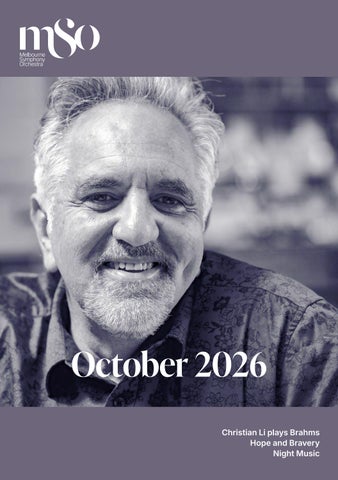
October 2026 Christian Li plays Brahms Hope and Bravery Night Music
COVER: JOE CHINDAMO, MSO COMPOSER IN RESIDENCE (PHOTO: MAO LI)
Contents Melbourne Symphony Orchestra Acknowledging Country Your MSO
04
Christian Li plays Brahms 9, 10 October
09
Hope & Bravery: Shostakovich & Tomasi 15, 17 October
17
Night Music 28, 29, 31 October
23
Supporters MSO Family Our Partners
29 36 38
In consideration of your fellow patrons, the MSO thanks you for silencing and dimming the light on your phone.
MSO 2026 Season
3
Acknowledging Country
The MSO has developed a musical Acknowledgement of Country with composer James Henry to pay our respects to the traditional owners of the land through the language of orchestral music. James Henry’s position is supported by Cybec Foundation
About Acknowledgement ‘I wrote this piece to reflect the complex journey toward the recognition of Aboriginal people as the traditional custodians of the land. It opens with rhythms inspired by the character of traditional songs found across many parts of Australia. From this texture, a melody emerges, representing the long period during which Aboriginal ownership of land was disregarded. The piece traces both progress and setbacks over time. ‘With the passing of the Victorian Statewide Treaty Bill, there is a renewed sense of optimism among many Aboriginal Victorians. Through Acknowledgement, I seek to convey a feeling of determination and resilience, reflecting the ongoing work to improve the quality of life for Aboriginal people, and to deepen respect for and awareness of our distinct culture, history and enduring connection to Country.’ James Henry 2025–2026 Cybec First Nations Composer in Residence
4
October Program
Melbourne Symphony Orchestra
The Melbourne Symphony Orchestra is Australia’s preeminent orchestra, dedicated to creating meaningful experiences that transcend borders and connect communities. Through the shared language of music, the MSO performs to the highest standard, enriching lives and inspiring audiences across the globe. Woven into the cultural fabric of Victoria for 120 years, the MSO reaches five million people annually through performances and TV, radio and online broadcasts, as well as critically acclaimed recordings on its newly established label. Jaime Martín continues as the MSO Chief Conductor and Artistic Advisor in 2026, leading a diverse and richly talented Artistic Family.
with the ABC, the MSO’s performances in the Classic 100 in Concert reach more than a million Australians each year. The first Australian orchestra to perform overseas (1965) and at Carnegie Hall (1970), the MSO has a proud history of international touring that has taken it to China, Indonesia, Singapore, Europe and the UK. Driven by the belief that music is a universal right, the MSO also brings music to all corners of the community, ensuring that everyone can share in the transformative power of music. Whether performing on world stages or in the heart of Victoria, the MSO transforms its mission and vision into reality – enriching lives and creating cultural connections through the unparalleled beauty of music.
The MSO regularly presents exceptional artists from across the globe in mainstage programming and special events, as well as reaching beyond the customary classical audience with contemporary collaborations. And through a partnership
MSO 2026 Season
5
Your MSO First Violins
Second Violins
Cellos
Natalie Chee Concertmaster Tair Khisambeev
Matthew Tomkins Principal
The Gross Foundation*
David Berlin Principal Rachael Tobin
Peter Edwards
Associate Principal
Assistant Concertmaster Assistant Principal
Sarah Curro
Dr Harry Imber *
Peter Fellin Deborah Goodall Karla Hanna
Dawna Wright and Peter Riedel*
Lorraine Hook
Jolene S Coultas*
Anne-Marie Johnson David Horowicz*
Kirstin Kenny Michelle Ruffolo
Diane and Stephen Fisher *
Anna Skálová Kathryn Taylor
Jos Jonker
Monica Curro
Assistant Principal Dr Mary-Jane Gething AO *
Mary Allison Emily Beauchamp Isin Cakmakçioglu Tiffany Cheng Val Dyke*
Freya Franzen Cong Gu Andrew Hall Robert Macindoe Philippa West Patrick Wong Cecilie Hall*
Roger Young
Shane Buggle and Rosie Callanan*
Violas Christopher Moore Principal Michael Grolid Associate Principal
Lauren Brigden Katharine Brockman Anthony Chataway
Associate Principal
Elina Faskhi
Assistant Principal
Joseph Kelly Rohan de Korte
Annie Neil in memory of Murray A Neil*
Rebecca Proietto
Peter T Kempen AM *
Ariel Volovelsky
Morris and Helen Margolis*
Caleb Wong
Rosemary and the late Douglas Meagher *
Michelle Wood
Andrew and Theresa Dyer *
Double Basses Jonathon Coco Principal Rohan Dasika
Acting Associate Principal
Benjamin Hanlon
Acting Assistant Principal
Aurora Henrich Suzanne Lee Stephen Newton
Peter T Kempen AM *
William Clark
Morris and Helen Margolis*
Aidan Filshie
Suzie and Edgar Myer *
Gabrielle Halloran Patricia Nilsson*
Jenny Khafagi
Margaret Billson and the late Ted Billson*
Fiona Sargeant
For a list of the musicians performing in each concert, please visit mso.com.au/musicians 6
October Program
Flutes
Horns
Timpani
Prudence Davis Principal
Nicolas Fleury Principal
Matthew Thomas Principal
Jean Hadges*
Margaret Jackson AC *
Wendy Clarke
Lucie Kysatis
Sarah Beggs
Saul Lewis Principal Third
Associate Principal
Piccolo Andrew Macleod Principal
Oboes Johannes Grosso Principal Ann Blackburn Margaret Billson and the late Ted Billson*
Cor Anglais Michael Pisani Principal
Clarinets David Thomas Principal Philip Arkinstall Associate Principal
Bass Clarinet Jonathan Craven Principal
Bassoons
Associate Principal Cecilie Hall and the late Hon. Michael Watt KC *
Abbey Edlin
Hanlon Foundation*
Josiah Kop
Kim and Robert Gearon*
Rachel Shaw
Tim and Lyn Edward*
Robert Cossom
Dr Clem Gruen and Dr Rhyl Wade*
Harp Yinuo Mu Principal
Trumpets Owen Morris Principal Shane Hooton Associate Principal Glenn Sedgwick*
Rosie Turner
MSO Academy
Dr John and Diana Frew *
Trombones José Milton Vieira Principal Richard Shirley
Bass Trombone
Elise Millman
Tuba
Natasha Thomas
Shaun Trubiano Principal John Arcaro
Gary McPherson*
Jack Schiller Principal Dr Harry Imber * Associate Principal
Percussion
Michael Szabo Principal Timothy Buzbee Principal
Jamie Miles viola Georgia White clarinet Hayden Burge bassoon Jacob Fenchel horn MSO Academy is supported by the Robert Salzer Foundation
Patricia Nilsson*
Contrabassoon Brock Imison Principal
* Position supported by † MSO guest musician MSO 2026 Season
7
7 – 21 November Hamer Hall, Arts Centre Melbourne Melbourne Recital Centre
Brahms Festival Two weeks dedicated to the life journey of a remarkable musician – at once a vulnerable human being and a masterful composer, always wearing his heart on his manuscript-smudging sleeve. Hear all four symphonies and the two piano concertos when the MSO and Chief Conductor Jaime Martín are joined by pianist Denis Kozhukhin. Ein deutsches Requiem with bass-baritone Sir Bryn Terfel and the MSO Chorus provides a gala conclusion.
Book Now mso.com.au
Symphony No. 1 Piano Concerto No. 1
7 November
Chamber Music by Brahms with Natalie Chee (violin), Nicolas Fleury (horn) and Denis Kozhukhin (piano)
10 November at MRC
Symphony No. 2 Piano Concerto No. 2
12 November
Symphony No. 3 Symphony No. 4
14 November
Spring Gala: A German Requiem
19 & 21 November
Friday 9 October at 7:30pm Frankston Arts Centre
Saturday 10 October at 7:30pm
Hamer Hall, Arts Centre Melbourne
Artists Melbourne Symphony Orchestra Tianyi Lu conductor Christian Li* violin
Program Andrée Andante quasi recitativo for strings [5’] Brahms Violin Concerto [38’] interval
Tchaikovsky Swan Lake: Selections [41’]
*
CHRISTIAN LI PLAYS BRAHMS | 9, 10 October
Christian Li plays Brahms
Young Artist in Association
CONCERT EVENTS Pre-concert talk: Learn more about the music with harpist Megan Reeve at 6:45pm at the Frankston Arts Centre (9 Oct) and in the Stalls Foyer (Level 2) at Hamer Hall (10 Oct) Running time: 1 hour and 55 minutes, including a 20-minute interval. Timings listed are approximate. MSO 2026 Season
9
PHOTO: MARCO BORGGREVE
Tianyi Lu conductor Chinese-born New Zealander Tianyi Lu is known for her thrilling energy, deeply creative interpretations and inspiring leadership, and is in demand across Europe, North America and Australasia, collaborating with leading orchestras and opera companies. She returns to the MSO having previously held the post of Cybec Assistant Conductor (2017–2019). In the 2026–27 season, she returns to the London Philharmonic and Montreal Symphony orchestras, as well as the New York Philharmonic, Staatsorchester Stuttgart, Orchestre Philharmonique de Monte-Carlo, Staatsorchester Stuttgart and BBC National Orchestra of Wales. Further highlights include debuts with the Wiener Symphoniker, Netherlands Radio Philharmonic Orchestra, Baltimore and New Zealand symphony orchestras, Düsseldorfer Symphoniker, Hamburger Symphoniker and Civic Orchestra of Chicago, as well as a UK tour with the National Youth Orchestra of Great Britain. Recent seasons have seen her BBC Proms debut (BBC Symphony Orchestra) and 10
engagements with the Frankfurt Radio Symphony, National Symphony Orchestra (Washington), San Francisco Symphony, Philharmonia Orchestra, the Hallé, City of Birmingham Symphony Orchestra, Orchestre National de Lyon, Helsinki Philharmonic Orchestra, Belgian National Orchestra and New World Symphony, as well as the Sydney and Melbourne symphony orchestras. A former Dudamel Fellow, she has conducted the Los Angeles Philharmonic in the Hollywood Bowl and the Walt Disney Concert Hall. Her stage work includes Rigoletto (AaltoMusiktheater Essen) and the premiere of the ballet Marie & Pierre (Theater Basel). After winning both the Sir Georg Solti International Conductors’ Competition and the Cantelli International Conducting Competition in 2020, she was appointed Conductor-in-Residence of the Stavanger Symphony Orchestra, a position she held until 2024. Tianyi Lu studied orchestral conducting at the Royal Welsh College of Music & Drama and is an alumna of Dallas Opera’s Hart Institute for Women Conductors. October Program
PHOTO: ALBERT COMPER
Christian Li violin
YOUNG ARTIST IN ASSOCIATION
Melbourne-born Christian Li captured international attention in 2018 when, as an 11 year old, he became the youngest-ever winner of the Menuhin Competition, sharing the Junior First Prize after playing and directing a movement from Vivaldi’s Four Seasons with the Geneva Chamber Orchestra. Christian has been the MSO’s Young Artist in Association since 2021, and regularly performs with the orchestra as soloist and chamber musician. He has also appeared with the Sydney Symphony Orchestra, Australian Brandenburg Orchestra, Auckland Philharmonia, Royal Liverpool Philharmonic Orchestra, Macao Orchestra, Oslo Philharmonic, and Gävle, Aalborg and RTV Slovenia Radio symphony orchestras. Following several prominent European appearances in 2025–26, highlights of the current season include performances of the Brahms Violin Concerto with the George Enescu Philharmonic (Bucharest) and Kraków Philharmonic Orchestra. He will also perform the Sibelius concerto MSO 2026 Season
with the Danish Philharmonic Orchestra and return to the Macao Orchestra for performances in Beijing and Guangzhou, as well as giving a recital at the Chan Centre for the Performing Arts, Vancouver. He has released three albums for Decca Classic, most recently the highly praised Tchaikovsky (2025). With his debut album, recorded with the MSO in 2021, he became the youngest artist to record The Four Seasons; this was followed by Discovering Mendelssohn, also recorded with the MSO. Christian studies with Margaret Batjer at the Colburn School in Los Angeles, having previously studied with Robin Wilson in Melbourne and at the Yehudi Menuhin School. He also received mentorship from David Takeno in London. Christian Li plays on the ‘Crespi’ (1699) Antonio Stradivari violin, generously loaned to him by Dr David Li through the Beare’s International Violin Society.
11
PHOTO: TEKNISKA MUSEET, STOCKHOLM
Andrée responded by playing excerpts from her second symphony on the piano, declaring that a woman should be able to do ‘anything to which she has inclination, desire and love’. For Andrée, the orchestra was that love: ‘It is an interpreter of the wondrous surgings of the soul.’ The Andante quasi recitativo was another love. She was so fond of the piece, she made at least four more versions, arranging it for piano, for solo organ, and for cello and organ, and including it in her Swedish Mass No. 2.
Elfrida Andrée (1841–1929)
Andante quasi recitativo for strings This eloquent miniature begins a program in which all three works were completed within two years, 1877–78. But where Brahms and Tchaikovsky are familiar names, Swedish composer Elfrida Andrée is an MSO first – a belated but welcome recognition of a distinctive musical voice and pioneering personality. Female musicians of Andrée’s generation struggled for recognition and professional opportunities; she was fortunate to live in the liberal city of Göteborg and to have the support of an enlightened father, a town physician who believed women should have equal educational opportunities to men. Together they overturned a Swedish law prohibiting women from becoming church organists, and Andrée became the Göteborg Cathedral organist, a composer and conductor. Even so, frustrations abounded, and when the soprano Jenny Lind (the ‘Swedish nightingale’) was sceptical about women’s capacity for orchestral composition, 12
‘Quasi recitativo’ calls for the expressive power of speech-like song, heard in the opening solo for the concertmaster. The richness of sound comes in part from the divided cello section. But the restless beauty of this work owes most to its expansive melodic phrases and the dense harmonies that delay gratification in the manner of Wagner and look forward to works like the Adagietto from Mahler’s Fifth Symphony. Yvonne Frindle © 2026
Johannes Brahms (1833–1897)
Violin Concerto in D major, Op. 77 Allegro non troppo Adagio Allegro giocoso Christian Li violin Brahms spent the summers of 1877–79 in the lakeside village of Pörtschach in Carinthia, producing the first of his Op.74 motets, the Ballades and Romances for two voices and piano (Op.75), the Symphony No.2 and the Violin Sonata in G (Op.78) – works which share an atmosphere of pastoral beauty shot through with nostalgia. But as Brahms scholar Karl Geiringer notes, the ‘crowning masterpiece’ of this time is the Violin Concerto. October Program
While Joachim was intimately involved with the creation of early works of Brahms’s chamber music, it was not until those summers at Pörtschach that Brahms wrote solo music for his friend. Geiringer notes that, in the case of both Concerto and Sonata, Brahms ‘conscientiously asked his friend’s advice on all technical questions – and then hardly ever followed it’. In fact at crucial points Joachim’s advice was invaluable. This consisted mainly of tinkering with certain figurations to make them more gratifying to play. But Joachim was also a profoundly serious artist – like Brahms – and out of their collaboration came a work in which the element of virtuosity never overshadows the musical argument. Joachim also wrote a cadenza which is still frequently heard today. The Concerto has some of the expansive dimensions of Brahms’s first Piano Concerto. This is especially true of the spacious first movement which, like that of Beethoven’s Violin Concerto, takes up more than half the work’s playing time, and which begins with a long, symphonic exposition of its main themes. Like its companion Second Symphony, the Concerto is in D major, a key which makes use of the violin’s natural resonance; like the Symphony it has something of a visionary Romantic tone.
MSO 2026 Season
PHOTO: BRAHMS-INSTITUT, LÜBECK
The Concerto, like the G major Sonata, was composed for the virtuoso Joseph Joachim, whom an ecstatic 15-year old Brahms had heard play the Beethoven concerto. In 1853 their friendship began in earnest, with Joachim writing to Brahms’s parents of how ‘Johannes had stimulated my work as an artist to an extent beyond my hopes…’ Brahms similarly admired Joachim – significantly as a composer rather than performer, saying that ‘there is more in Joachim than in all the other young composers put together’.
Brahms originally thought to write the piece in four movements, making the central pair a scherzo and contrasting slow movement. But he wrote to Joachim that the ‘middle movements – naturally the best ones – have fallen through. So I have substituted a feeble adagio’. Feeble is of course hardly the word for this: derived from the falling broken chord with which the violin begins it evolves into one of Brahms’s most soulful but restrained movements. As such it provides a wonderful contrast to the gypsy style finale, with its pyrotechnic solo line and exciting use of displaced accents. Joachim premiered the piece in Leipzig in 1879, but the response was tepid, and only through Joachim’s persistence did it gain its rightful place in the standard repertoire. Brahms and Joachim fell out over the violinist’s divorce in 1884, the rift lasting until Brahms wrote the Concerto for Violin and Cello in 1887. But that’s another story. Gordon Kerry © 2006
13
Pyotr Ilyich Tchaikovsky (1840–1893)
Swan Lake: Selections Scène (Moderato), from Act II
ACT I: THE PRINCE’S BIRTHDAY
Valse
ACT II: DANSES DES CYGNES
Allegro moderato (‘Dance of the Little Swans’) Scène (Andante)
ACT III: THE BALL
Danse hongroise (Csárdás) Danse russe Danse espagnole (Bolero) Danse napolitaine
ACT IV: FINALE
Allegro agitato – Scène finale
One of Tchaikovsky’s friends claimed to see, involuntarily, visions of a prima ballerina whenever he heard the composer’s Fourth Symphony. It was not a compliment. Rather, the friend, Sergei Taneyev, considered it a ‘defect’. And perversely, even as his symphonies were being dismissed as too much like ballet music, Tchaikovsky’s ballets would be charged with being ‘too symphonic’. Inventiveness of themes, subtlety of orchestration, and long-range harmonic planning may have been commonplace in the Romantic symphony, but they were foreign concepts in Romantic ballet. Today these symphonic qualities – together with his sublime melodic gift and directness of expression – are recognised as the strengths of Tchaikovsky’s ballet scores. It’s appropriate, then, that tonight’s suite from the ballet Swan Lake fills the role of the symphony on the program. Expanding on the familiar concert suite, Tianyi Lu’s selection reveals something of the symphonic character of the ballet as well as its narrative.
14
In the 1870s, ballet music was typically composed by specialists willing to conform to its functional requirements – not an endeavour for ‘serious’ composers. Tchaikovsky was being defensive when he wrote that he’d agreed to the Swan Lake commission ‘partly because I want the money, but also because I have long had a wish to try my hand at this kind of music’. Naturally, his first foray into ballet music attracted considerable attention. He reported from the chaotic first rehearsals that ‘everyone at the theatre is raving about my music’, and the premiere in 1877 was full – ‘explained solely,’ suggested one review, ‘by the interest of the public in hearing the new musical creation of one of the distinguished and quite popular Russian composers’. The performance itself was not a success, with criticisms of the lead ballerina as well as the choreography, and the audience may have been puzzled by the refinement and sophistication of the score. But the music would survive, and with the revival by Marius Petipa and Leon Ivanov, choreographed after Tchaikovsky’s death, the ballet began its progress towards immortality. ❖❖❖ Swan Lake is the quintessential ballet. Its scenario has all the right ingredients: a melancholy prince, a tragic heroine, an evil sorcerer, a glittering royal court, foreign princesses… and enchanted swans. Act II introduces the gloomy forest lake where the Odette and her maidens are transformed by day into swans by Baron von Rothbart. Choreographically, this is the pivotal act. Musically, it develops a haunting melody that Tchaikovsky had devised much earlier for a tiny children’s ballet on the same subject. The curtain lifts on the first Scène (Moderato) to this haunting oboe and harp theme, which unifies the whole ballet. The swans flutter
October Program
and float (in the famous Anne Woolliams production arranged in a striking wedge formation), assuming their true guise at midnight. A magnificent Valse then returns us briefly to the royal court of Act I and Prince Siegfried’s birthday celebrations. In Act II, seeking respite from the pomp and hunting for the swans he’d glimpsed at the end of Act I, Siegfried finds instead the swan-maidens with their tragic princess. They tell him their story, and as he casts away his crossbow, Odette declares him a friend to her companions. The Prince is further disarmed by their grace and beauty, with a quartet of swans demonstrating breathtaking precision in the sprightly Allegro moderato (a number known since Petipa’s choreography as the ‘Dance of the Little Swans’). A second number drawn from the Danses des cygnes follows: the Scène (Andante), featuring solos for the harp, violin and cello in music rescued from Tchaikovsky’s lost opera Undine. As Siegfried invites Odette to attend the ball at which he must choose his bride, imploring her not to reject his love, Tchaikovsky develops the swan theme with increasing intensity. The ball of Act III assembles diplomats and foreign princesses – potential brides – thus offering a pretext for a suite of national dances. For these, Tchaikovsky wrote a Hungarian csárdás, with its characteristic slow (lassú) and fast (friss) sections, a Spanish bolero featuring castanets, and a Neapolitan dance with a cornet solo. After the score was complete, Julius Reisinger, the choreographer, insisted Tchaikovsky add a Russian dance for the lead ballerina. (Yes, she would step out of character and don national costume.) This Danse russe, almost never seen in Australian productions, is said to show the contrasting darkness and cheerfulness of the Russian soul. It also offers the
MSO 2026 Season
concertmaster a brilliant solo opportunity. [Tonight’s concerto soloist, Christian Li, has included it in his latest recording.] Rothbart tricks the Prince into choosing his daughter Odile and this betrayal seals Odette’s fate – she will be forever trapped as a swan. Tonight’s suite takes us to the tragic finale of Act IV: heartbroken, Odette rushes into the arms of her companions, while Siegfried struggles through the rising storm to beg her forgiveness. With a drum roll, this Allegro agitato leads into the Scène finale and impassioned music drawn from Tchaikovsky’s opera The Voyevoda – a long-awaited meeting of the lovers. The story’s ending is open to interpretation, but according to Tchaikovsky’s score, Odette dies of grief in Siegfried’s arms and the waters of the lake rise and engulf the lovers, leaving a vision of swans gliding over the surface. Musically, the oboe swan theme returns for the last time, moving from B minor to B major in a gesture that’s been compared to the forced mood of triumph that concludes the Fifth Symphony. But the true ending, as John Warrack observes, is the enigmatic close on a long-held unison B – neither major nor minor, neither victory nor loss. At every turn, this music shows evidence of the profound love Tchaikovsky felt for his task, introducing sophisticated and expressive symphonic elements without ever losing sight of the dancers’ needs. Swan Lake might not be a symphony, but its score – written by a composer armed not with experience but with an unerring natural instinct – is luminous and deeply emotional. Yvonne Frindle © 2003/2026
15
Thank you for helping make the MSO an Orchestra for all Victorians To celebrate the MSO’s 120th year, every donation will be matched on Giving Day, tripling your impact.
Give on Tuesday 27 October at givetomso.com.au
Scan to donate
More People. More Places. More Ways.
Thursday 15 October at 7:30pm Saturday 17 October at 2:00pm
Hamer Hall, Arts Centre Melbourne
Artists Melbourne Symphony Orchestra Jonathon Heyward conductor Steven Banks saxophone
Program
HOPE & BRAVERY | 15, 17 October
Hope & Bravery: Shostakovich & Tomasi
Tomasi Saxophone Concerto [20’] interval
Shostakovich Symphony No. 7, Leningrad [80’]
CONCERT EVENTS Pre-concert talk: Learn more about the music with saxophonist Joseph Lallo at 6:45pm (15 Oct) and 1:15pm (17 Oct) in the Stalls Foyer (Level 2) at Hamer Hall Running time: 2 hours and 15 minutes, including a 20-minute interval. Timings listed are approximate. MSO 2026 Season
17
PHOTO: KAUPO KIKKAS
Jonathon Heyward conductor Jonathon Heyward grew up in South Carolina, where he trained as a cellist and started conducting while still at school. He studied conducting at the Boston Conservatory of Music, followed by postgraduate lessons from Sian Edwards at the Royal Academy of Music, London. In 2023 he took up the post of Music Director of the Baltimore Symphony Orchestra, a role that has been extended to 2031. He is also Artistic Director and Music Director of the Festival Orchestra of Lincoln Center. Previous roles have included Chief Conductor of the Nordwestdeutsche Philharmonie (2021–24) and Assistant Conductor of the Hallé Orchestra, where he was mentored by Mark Elder. He is also in demand as a guest conductor for concerts and opera through the UK and in the United States. In addition to the MSO, in the 2026–27 season he makes his Israel Philharmonic Orchestra debut and returns to the London Philharmonic, Danish National Symphony and Detroit Symphony orchestras.
18
Recent highlights include concerts with the New York Philharmonic, Cleveland Orchestra, Chicago Symphony Orchestra, London Symphony Orchestra, London Philharmonic Orchestra, Danish National Symphony, NDR Elbphilharmonie Orchestra, Castilla y León and Galicia Symphony. In August he returned to the BBC Proms for a critically acclaimed performance with the Chineke! Orchestra. He made his Royal Ballet and Opera debut conducting Hannah Kendall’s opera Knife of Down, and conducted the premiere of Giorgio Battistelli’s Wake for the Birmingham Opera Company. He also conducted Weill’s Lost in the Stars with the Los Angeles Chamber Orchestra and, last season, launched the Baltimore Symphony Orchestra’s multi-year Verdi cycle with Aida. Jonathon is an advocate for music education and community outreach. He has been recognised among TIME’s Next Generation Leaders and Bloomberg’s Ones to Watch. In 2023, he was named a Fellow of the Royal Academy of Music. October Program
PHOTO: ANGELA ORELLANA
Steven Banks alto saxophone Hailed as ‘the saxophone’s best friend, fiercest advocate and primary virtuoso in the classical realm’ (Washington Post), Steven Banks is redefining the role of the saxophone in classical music through performance, composition and commissioning. In two groundbreaking achievements, he was the first saxophonist to win First Prize at the Young Concert Artists Susan Wadsworth International Auditions (2019) and to receive an Avery Fisher Career Grant. In addition to his MSO debut, this season he makes debut appearances with the Los Angeles Philharmonic, RundfunkSinfonieorchester Berlin and Orchestre National de Belgique. He performs with leading orchestras across North America and Europe, and this season returns to the Cleveland Orchestra, National Symphony Orchestra (Washington), Seattle Symphony, and the Toronto and Cincinnati symphony orchestras, as well as collaborating with conductors such as Stéphane Denève, Jukka-Pekka Saraste, Cristian Măcelaru, Rafael Payare, Leonard Slatkin and Xian Zhang. MSO 2026 Season
Committed to establishing the saxophone as a vital voice in classical music, he has commissioned and premiered major works by Billy Childs, Joan Tower, Carlos Simon, Augusta Read Thomas and Christopher Theofanidis, with a new concerto by Joel Thompson to be premiered in 2028. Earlier this year he released the album, Cries, Sighs and Dreams, featuring his own works in collaboration with pianist Xak Bjerken and the Dover Quartet. His Come As You Are project broadens access to classical music through community engagement for people traditionally underrepresented in the concert hall. Steven Banks was raised in a musical family in Winston-Salem, North Carolina. He studied with Taimur Sullivan, Otis Murphy Jr and Galvin Crisp, earning degrees from the Indiana University Jacobs School of Music and Northwestern University Bienen School of Music, and now serves on the faculties of the Cleveland Institute of Music and the University of North Carolina School of the Arts.
19
HENRI TOMASI IN 1959 (PHOTO: ARCHIVE HENRI TOMASI)
finest conductors of opera in France. A prolific composer, he wrote much vocal music, a number of substantial works for the stage, and a series of concertos for various wind instruments. Tomasi had been appalled by the Second World War, writing a Requiem for Peace in memory of all who died from France. His Concerto for alto saxophone and orchestra, which was composed in 1949, occupies a world insulated from such tragedy and grief.
Henri Tomasi (1901–1971)
Saxophone Concerto Andante – Allegro Final. Giration (Tournoyant) Steven Banks saxophone Born in Marseilles of Corsican background, Henri Tomasi enrolled in the Paris Conservatoire in 1921 and in 1927 won the Prix de Rome. In the 1930s he was conductor of the Colonial Radio Orchestra in French Indochina, and decades later expressed his love and support for that country in his Chant pour Viet-Nam of 1967. Other music from Asia inspired works such as the Concert asiatique, Chants laotiens and Quatre chants de Geishas, all composed in the 1930s, and Tomasi also looked to European folk traditions such as those in Brazil, Scotland and his ancestral Corsica – the latter, of course, having some links to the cultures of north Africa. Tomasi divided his time between conducting and composing; in the former capacity he had a reputation as one of the 20
The piece is in two movements. The first falls into two contrasting parts (Andante and Allegro) and alludes at various times to jazz, naturally enough, as well as various folk traditions, and the music of other recent French composers as it moves to a cinematic climax. The second movement is about half the duration of the first, and is much less expansive. Its title, Giration, together with the instruction ‘Tournoyant’ (spinning), aptly describes its whirling energy, which becomes at one point a full-fledged tarantella. In addition to the musical accents evoked in the first movement, there are shades of Ravel in the Bolero-esque use of parallel keys. Gordon Kerry © 2009
Dmitri Shostakovich (1906–1975)
Symphony No. 7, Op. 60, Leningrad Allegretto Moderato (poco allegretto) Adagio – Moderato risoluto – Adagio – Allegro non troppo – Moderato It is a desperately sad irony that the most hellish time imaginable for Shostakovich, Leningrad, the Soviet Union and Europe virtually ensured the spectacular public success of the Leningrad Symphony. In 1941, Leningrad (now St Petersburg) was under siege from the advancing German army; Shostakovich was at work on his Seventh Symphony. On 17 September 1941 he said in a radio broadcast: October Program
I speak to you from Leningrad at a time when brutal battle rages at its very gates…Two hours ago I finished the first two movements of a symphonic work. If I succeed in writing this composition well, if I manage to finish the third and fourth movements, then I may call it my Seventh Symphony. Why do I announce this? I announce this so that those listening to me now may know that life in our city goes on as usual… Shostakovich was evacuated from Leningrad to Moscow, where he composed the third and fourth movements, and where the premiere took place on 5 March 1942 in Kuibishev. Its Leningrad premiere, conducted by Karl Eliasberg, took place on 9 August 1942 while the city was still under siege. The performance was given by an orchestra depleted by war and illness, in a hall with a bomb-damaged roof, with a special order given to the Leningrad artillery to knock out as many of their German counterparts as possible immediately before the performance. The story of the symphony’s first performance in the United States is well known: the NBC had been persuaded by Leopold Stokowski to purchase rights to the score, and a microfilmed copy was conveyed by road, via Teheran and Cairo, and air to the USA. Arturo Toscanini, however, had enough clout to secure this famous premiere for himself. His politically loaded letters to Stokowski on the subject – from a conductor trading heavily on his anti-fascist credentials, in a country which had only just decided to join the war – make interesting reading: Don’t you think, my dear Stokowski, that it would be very interesting for everybody, and yourself, too, to hear the old Italian conductor (one of the first artists who strenuously fought against fascism) to play this work of a young Russian anti-Nazi composer?
MSO 2026 Season
Shostakovich initially gave titles to the movements (War, Reminiscences, Russia’s Vastness and Victory), which were later withdrawn. The symphony opens sturdily, with a theme given out by the strings in octaves, punctuated by the timpani and trumpets. This yields to a more lyrical section, eventually fading down in a piccolo and violin solo. The patter of a snare drum opens probably the most notorious single passage in all of Shostakovich’s music: a march built upon a single melody and a pervasive accompanying rhythm, undergoing a crescendo from the piano pianissimo of a single instrument to the forte fortissimo of the full orchestra. There is an obvious similarity here to Ravel’s Bolero – as Shostakovich reportedly said to Isaak Glikman at the time: ‘Idle critics will surely rebuke me for imitating Bolero. Well, let them; that is how I hear the war.’ It is not long before ‘wrong notes’ in the cellos and basses begin to colour the innocently diatonic opening. Dissonance and slithering chromaticism continue to accumulate; eventually a whole extra brass section (held in reserve until this point) is brought in, with a startling change of key again paralleling Bolero. Finally the march rhythm comes to a halt; the symphony’s opening music returns, this time in the minor key, in what Richard Taruskin has aptly described as a ‘horripilating climax’. Perhaps the real climax of the movement, however, is not a sound but a silence: after several pages of fortissimo struggle between the march theme and the opening music of the symphony, there are two one-beat rests for the whole orchestra. After these, the struggle abruptly ceases, dying down into the more lyrical music heard before. A distant reminder of the march concludes the movement.
21
At the time, the march episode was held to represent specifically the siege of Leningrad. Some years after the event, the conductor Yevgeny Mravinsky saw the march as ‘a universalised image of stupidity and crass tastelessness’, while another Soviet critic saw it as a ‘generalised image of evil’, albeit with ‘German colouring’. The remaining movements do not feature such concrete imagery, and so have been unfortunately neglected, despite containing some of Shostakovich’s most deeply felt music. Shostakovich described the second movement as an ‘intermezzo’, and the opening certainly fits this description, with a gentle melody in the strings alone, yielding to a lyrical oboe solo. The contrasting middle section is initiated by the E flat piccolo clarinet in its highest register; it eventually subsides into the return of the opening music, with the oboe solo on bass clarinet, before the strings conclude. The third movement is dominated by a chorale from the winds, and a recitative-like section from the violins; again the middle section supplies a dramatic contrast. The finale follows without a break, and returns to the grander scale of the first movement. A typically Beethovenian climb out of its suspenseful beginning passes through a variety of textures, culminating in the reappearance of the music which opened the symphony. As in Shostakovich’s Fifth Symphony, the final climax is spectacular; it is also far from unequivocal, with some searing chromaticism on the high trumpets clouding the harmony to unsettling and ambivalent effect. Within a few years of its premiere, the furore surrounding the Leningrad Symphony had begun to die down, and a backlash commenced. Performances were comparatively infrequent until the appearance in 1979 of Testimony, Shostakovich’s purported memoirs ‘as 22
related to Solomon Volkov’. For those who wished to find in Shostakovich’s music a hidden denunciation of Stalin, the book was timely. We read there: ‘The “invasion theme” has nothing to do with the attack. I was thinking of other enemies of humanity when I composed the theme. I feel eternal pain for those who were killed by Hitler, but I feel no less pain for those who were killed on Stalin’s orders.’ Thus the work began to be rehabilitated. The same notes which had been dismissed as tired platitudes when seen as a tool of heroic anti-Hitler propaganda found a new (if no less musically dubious) lease of life as a tool of heroic anti-Stalin propaganda. Right from its appearance, controversy has raged over the literal authenticity of Testimony, although even those who doubt the literal authenticity of these ‘memoirs’ acknowledge that there seems to be much truth behind them. The issue does, however, bring to the foreground one disturbing feature of the reception of Shostakovich’s music: we seem to prefer to be told ‘what the music means’. As with most music of any enduring interest, there is no simple answer. And as the history of the Leningrad Symphony demonstrates, once an ‘answer’ has been found the work loses much of its interest: it is the continuing reassessment of the layers of meaning of this work that has given it a comparatively secure place on the concert platform. We can never know what specifically Shostakovich had in mind when he composed the symphony, and this is emphatically not something to be regretted. Indeed it is a large part of why we still listen to it today. Carl Rosman © 2000 Bernard Heinze conducted the first Australian performances of the Leningrad Symphony in War Funds concerts in 1943, first with the SSO (24 August) and then with the MSO (29 November). October Program
Wednesday 28 October at 7:30pm
The Wedge Performing Arts Centre, Sale
Thursday 29 October at 7:30pm Berninneit, Cowes
Saturday 31 October at 7:30pm Melbourne Recital Centre
Artists Melbourne Symphony Orchestra Natalie Chee violin and director Eliza Shephard flute
NIGHT MUSIC | 28, 29, 31 October
Night Music
Program Joe Chindamo* Fantasie auf Nachtmusik [15’] Joe Chindamo The Vicious Circle – Flute Concerto** [22’] interval
Mozart Symphony No. 36 (Linz) [31’] *
2026 Composer in Residence
** MSO commission, first performed 22 October 2026 at Broadmeadows Town Hall
CONCERT EVENTS Pre-concert talk: Learn more about the music with MSO Principal Viola Christopher Moore at 6:45pm before each performance. Running time: 1 hour and 45 minutes, including a 20-minute interval. Timings listed are approximate.
Freemasons Foundation Victoria
MSO 2026 Season
The MSO’s regional touring program is supported by AWM Electrical and Freemasons Foundation Victoria
23
PHOTO: LUCAS ALLEN
Natalie Chee violin and director MSO CONCERTMASTER
Natalie Chee learned piano then violin as a child and at the age of ten began studying with Alex Todicescu, a professor at the Sydney Conservatorium of Music and member of the Sydney String Quartet. As a student, she won numerous competitions and prizes, including the ABC Young Performer of the Year (1992), and she performed as a soloist with all the Australian symphony orchestras. While still in high school, she was accepted into the Soloist Class of Igor Ozim in Bern, Switzerland, receiving her Soloist Diploma with High Distinction. During this time, she was invited to join Camerata Bern, which she also directed. She also co-founded the Tiramisu chamber music ensemble and Mozart Piano Quartet, touring North and South America, Europe and Australia with these groups and making several recordings with prominent Swiss and German labels. Natalie has held the First Concertmaster roles with Camerata Salzburg (appointed
24
2000), the Stuttgart Radio (SWR) Symphony Orchestra (2009), and the Gürzenich Orchestra (2019). She was named MSO Concertmaster in 2025 and took up the role this year. In addition, she is a regular guest concertmaster and director of orchestras worldwide, including the BBC Symphony Orchestra, Munich Philharmonic, Munich State Opera, Hamburg Radio Orchestra, Swedish Radio Orchestra, Royal Scottish National Orchestra, Toronto Symphony Orchestra, Mahler Chamber Orchestra and the Academy of St Martin in the Fields. Natalie is also a highly regarded chamber musician, appearing in festivals and concerts throughout Australia and Europe. From 2009 to 2025 she was first violin of the Hegel String Quartet in Stuttgart, and their album From Vienna to Hollywood was named by the German Record Critics Award as one of the four best chamber music recordings in 2022.
October Program
PHOTO: CAMERON JAMIESON
Eliza Shephard flute Eliza Shephard is a vibrant flutist who is paving her way as an educator, improviser and collaborator. In 2022 she won the ABC Young Performers Award; the following year she was ABC Classic Artist in Residence. She is currently an Ian Potter Emerging Performers Fellow. With the MSO she has performed Matthew Hindson’s House Music concerto at the Sidney Myer Music Bowl, in the 2023 Classic 100 in Concert, and for the In Your Neighbourhood concert in Mornington. She again appeared as soloist and presenter for Neighbourhood concerts in Glenroy and Wyndham, and has led Classic Kids: Eliza’s Orchestral Adventures for the MSO’s Schools program. This year she launched her debut album, I Will Not Be Sad In This World (ABC Classic). Other recent highlights include performing with ELISION to celebrate the ensemble’s 40th anniversary, and performing alongside Ensemble Modern at short notice for the Tongyeong International Music Festival (South Korea).
MSO 2026 Season
A fervent contemporary musician, she performs with ensembles such as the Plexus Collective and Ensemble Offspring (Hatched Academy Associate Artist, 2021– 22), and has commissioned and premiered many new works. Her March of the Women recording project (begun in 2020) champions music by female-identifying composers, and in collaboration with soprano Judith Dodsworth, she has explored creative, theatrical ways to present music in both concert and video. Eliza is a graduate of the Australian National Academy of Music, Australian National University (where she studied with Virginia Taylor) and Griffith University. She established a course on experimental techniques, The Extended Flute, and her master’s research focused on the Glissando Headjoint. She is now a teaching associate at Monash University and engages with regional communities to share her knowledge and experiences of growing up as a young musician from the Riverina in NSW. She is a Haynes Artist.
25
Joe Chindamo (born 1961)
Fantasie auf Nachtmusik for string orchestra
The music unfolds in nine sections, moving though shifts in tempo, mood and style. Fantasie auf Nachtmusik was commissioned by the Perth Symphony Orchestra in 2019, with the wonderfully open brief to ‘give us a modern day Mozart’. This made me think: What might it mean to create a modern day Mozart? Although very much a child of his time, Mozart was a universal musical mind, his imagination timeless, and his music continues to sound fresh and alive to each generation. In a sense, Mozart is the modern day Mozart. My task was not to make Mozart modern, but to take fragments from Eine kleine Nachtmusik, one of his best-known serenades, and use them as building blocks for a new work. The result is less a reimagining than a kind of musical biography of Mozart himself. The familiar music is sometimes heard almost as Mozart wrote it; elsewhere it is fragmented, transformed or distorted. At times I’ve invented new passages in his spirit. Often, rather than bringing the music forward a century, I found myself taking it back in time. The shorter, more rhythmic phrases of Baroque music, with their cell-like energy, lend themselves surprisingly well to contemporary classical music. This opened the way for a polystylistic approach, allowing Mozart’s material to move between musical languages from the Baroque to the 20th and 21st centuries, at times recognisably Mozart, at others transformed almost beyond recognition. I’ve sometimes thought of Mozart as the Stravinsky of his time: a maverick, an enfant terrible, and a composer whose 26
personality could be as unruly as his music. There is the Mozart we know through the elegance, balance and clarity of his music, but also the man revealed in his letters: irreverent, funny, scatological, vain and capable of being quite difficult. Both sides interest me. The music moves between these different versions of Mozart – from grace and formal poise to something darker, stranger and more unstable – as the familiar Nachtmusik is subjected to new contexts and ways of hearing. The result is a continuous fantasy, with Mozart’s music as both starting point and raw material. His music already seems to belong to everyone; I wanted to find my own way into it, while allowing something of the extraordinary mind behind it to remain present. Joe Chindamo © 2026
The Vicious Circle – Flute Concerto City of Myths Tender is the Night Vertigo – The Brightest Hour Eliza Shephard flute The Vicious Circle takes its inspiration from Dorothy Parker, the Algonquin Round Table and 1920s New York – an intoxicating world of wit, glamour, parties and artistic brilliance, where gossip was plentiful and a perfectly delivered insult could be an art form. Parker’s later journey to Hollywood, where she worked on A Star Is Born (1937), adds another dimension to this landscape of glittering dreams and darker realities. I was drawn to the contradictions within this world: laughter that can conceal sadness, brilliance that can become destructive, and a life lived in the brightest possible light that can nevertheless cast a deep shadow. The members of the Algonquin Round Table dubbed themselves ‘the Vicious October Program
The three movements navigate this world in different ways. City of Myths is an affectionate evocation of New York itself, expansive and romantic at first, before giving way to a frenzied, Charleston-like repartee between soloist and orchestra. It eventually returns to a darker urban pastoral, full of the kind of nostalgia many of us might carry for a city we’ve never visited, a feeling powerfully embodied by New York. Tender Is the Night turns inward, evoking the city after dark and the solitude of the artist, when the noise and wit of the day have fallen away. In this melancholy waltz, flute part becomes more lyrical and intimate, with the orchestra creating a world around it rather than simply accompanying the soloist. After a brief prelude (Vertigo), rhythmic and precise, the main part of the final movement (The Brightest Hour) brings the contrasting sides of this world into collision. The music becomes increasingly fevered and unstable, driven by excess and exhilaration, before moving towards a brighter and more open conclusion. This concerto was written for Eliza Shephard, who in some ways presents a musical counterpart to Dorothy Parker’s literary persona, with a similar combination of intelligence, precision, irreverence and wit. I wanted the flute part to reflect Eliza’s combination of extraordinary precision and razor-sharp wit with music that’s lyrical and expressive, highly agile, and capable of sudden flashes of mischief. Joe Chindamo © 2026
MSO 2026 Season
PHOTO: MAO LI
Circle’, and the concerto’s title suggests both the social world surrounding Parker and the cycles of exhilaration and vulnerability beneath it. But the concerto is less an attempt to recreate 1920s New York than an exploration of its energy, sophistication, wit, glamour, appetite and restlessness.
JOE CHINDAMO OAM is an Australian composer whose music combines cantabile lyricism with a sophisticated harmonic language, architectural clarity and a vivid orchestral palette. The Vicious Circle is the second composition to emerge from his tenure as the MSO’s Composer in Residence, following Are There Any Questions?, performed in March. His orchestral output includes Ligeia for trombone and orchestra and Concerto del Motore for clarinet and orchestra (both commissioned by the Adelaide Symphony Orchestra), and his Violin Concerto and Concerto for Orchestra (Tasmanian Symphony Orchestra). His music has been heard across Australia and Europe, including the European premiere of Ligeia with soloist Peter Moore (Principal Trombone, London Symphony Orchestra). Melbourne performance highlights have included his Principia Clarinettica (Melbourne Chamber Orchestra and Philip Arkinstall), Ligeia (MSO with Jonathan Ramsey), Concerto for Orchestra (MSO), and the premiere of Machiavelli’s Mirror – A Renaissance Suite (MCO). He has also been commissioned by leading ensembles such as the Australian Chamber Orchestra, Camerata, Australian String Quartet, Wilma & Friends, Southern Cross Players, Ensemble Offspring and Omega Ensemble. 27
Wolfgang Amadeus Mozart (1756–1791)
Symphony No. 36 in C major, K. 425 (Linz) Adagio – Allegro spiritoso Andante Menuetto – Trio Presto In 1783, having exhausted his supply of excuses and postponements, Mozart took his new bride Constanze to visit his disapproving father in Salzburg. After three strained months, they returned to Vienna, stopping on the way in Linz. There, the reception was much warmer: Count Johann Thun insisted the couple stay at his palace and invited Mozart to appear in a concert with his ‘first-rate’ orchestra. But Mozart had been travelling light: ‘since I have not a single symphony with me, I am writing a new one at breakneck speed…’ Less than a week later, he’d completed (and copied the parts for) his most brilliant and original symphony to date. He may have even, as scholar Neal Zaslaw wryly speculates, have had time to rehearse it! Mozart may have been composing at speed, but there’s virtually no sign in the music of haste: nothing in the way of padding, and each movement is full of inventive ideas. And more than ever before, he was taking a serious approach to the symphonic genre: adopting longer forms, exploring new colours and expressive effects, and writing for the orchestra (especially the wind instruments) with new subtlety and virtuosity. The orchestration also shows how completely Mozart had absorbed the results of his experimentation in other orchestral genres: opera and especially the piano concerto. There are other quiet innovations in the ‘Linz’ Symphony. It was the first of Mozart’s symphonies to begin with the 28
newly fashionable slow introduction. But this noble beginning with its majestic rhythms almost immediately shifts character: suspenseful lines for bassoon, oboe and violins lead into the Allegro spiritoso (fast and spirited) section of the first movement, splendid with the sound of trumpets and drums. On the surface, the second movement with its lilting rhythms is a lyrical Andante like so many other of Mozart’s slow movements. But then, in the second phrase, he brings in horns, trumpets and timpani. This was rare in a slow movement of the time, as the changing of crooks and re-tuning of drums created difficulties in performance. The effect on the 18th-century audience would have been one of surprise and an unexpected sense of solemnity. Today, the trumpets and drums – played very quietly – still bring an ominous edge to this radiant movement. The Menuetto is cheerful, courtly and apparently conventional. But even here Mozart offers sophisticated ideas to please the connoisseurs: expanding the proportions of the minuet with a little fanfare figure, and pointing to the Baroque origins of the minuet dance with prominent use of oboe and bassoon in the folk-like trio section. The bubbling and exuberant finale reveals the influence of Haydn with its brilliant, clear-cut textures and witty character. There’s a profusion of melodies, sometimes contrasted with each other, sometimes passed around the orchestra as if in a relay. Mozart would have expected musicians to take his Presto tempo marking literally: ’as fast as possible.’ And the hushed beginning of the main theme only serves to highlight the festive and joyous outbursts. Yvonne Frindle © 2022/2026
October Program
Supporters MSO Patron
Program Benefactors
Her Excellency Professor, the Honourable Margaret Gardner AC, Governor of Victoria
MSO Now & Forever Fund: International Engagement Gandel Foundation
Honorary Appointments Chair Emeritus Dr David Li AM Life Members John Gandel AC and Pauline Gandel AC Jean Hadges ♡ Sir Elton John CBE Lady Primrose Potter AC Jeanne Pratt AC Lady Marigold Southey AC Michael Ullmer AO and Jenny Ullmer MSO Ambassador Geoffrey Rush AC
Artist Chair Benefactors Cybec Assistant Conductor Chair Daniel Corvaia Cybec Foundation
Artist Development Programs – Cybec Foundation Cybec Young Composer in Residence Cybec First Nations Composer in Residence Cybec 21st Century Australian Composers Program Community and Public Programs Australian Government Department of Health, Disability and Ageing, AWM Electrical, City of Melbourne, Hansen Little Foundation, Professor Mary-Jane Gething AO, Besen Family Foundation, Gandel Foundation, Perpetual Foundation – Alan (AGL) Shaw Endowment, The Ledger Charitable Trust Student Subsidy Program Anonymous Jams in Schools Melbourne Airport, Department of Education, Victoria – through the Strategic Partnerships Program, AWM Electrical, Jean Hadges, Hume City Council, Marian and EH Flack Trust Regional Touring AWM Electrical, Freemasons Foundation Victoria, Sir Andrew and Lady Fairley Foundation Sidney Myer Free Concerts Sidney Myer MSO Trust Fund and the University of Melbourne, City of Melbourne Event Partnerships Program MSO Academy Robert Salzer Foundation Instrument Fund Tim and Lyn Edward, Catherine and Fred Gerardson, Pauline and David Lawton, Joe White Bequest
MSO 2026 Season
29
Platinum Patrons ($100,000+)
AWM Electrical Q Gandel Foundation Professor Mary-Jane Gething AO ♡ The Gross Foundation ♡ Dr David Li AM and Angela Li Q Lady Primrose Potter AC Anonymous (1)
Virtuoso Patrons ($50,000+) The Aranday Foundation Q Besen Family Foundation Mrs Jennifer Brukner OAM Q Dr Harry Imber ♡ Margaret Jackson AC ♡ Lady Marigold Southey AC Q The Yulgilbar Foundation Q Anonymous (1)
Impresario Patrons ($20,000+)
Michael Aquilina Christine and Mark Armour Ren Barlow Krystyna Campbell-Pretty AM Debbie Dadon AM Q Tim and Lyn Edward ♡ ♫ Edwards Family Trust Q Catherine and Fred Gerardson The Hogan Family Foundation Pauline and David Lawton Suzie and Edgar Myer ♡ Paul Noonan Elizabeth Proust AO and Brian Lawrence ☼ Sage Foundation ☼ Kim Williams AM ♫ Anonymous (2)
Maestro Patrons ($10,000+)
John and Lorraine Bates ☼ Margaret Billson and the late Ted Billson ♡ Nigel and Sheena Broughton Shane Buggle and Rosie Callanan ♡ Q Cooper Investors The Cuming Bequest Audrey Cutting Miss Ann Darby in memory of Leslie J Darby Craig Drummond
Val Dyke ♡ Fancourt Capital Group Q The Finkel Foundation Q Cecilie Hall and the late Hon Michael Watt KC ♡ ♫ Hanlon Foundation ♡ Ryan Harkness Jo Horgan AM and Peter Wetenhall Q David Horowicz ♡ Q Peter T Kempen AM ♡ Q Suzanne Kirkham Allan and Evelyn McLaren Rosemary Meagher and the late Douglas Meagher ♡ The Mercer Family Foundation The Myer Foundation Patricia Nilsson ♡ Dr Justin O’Day and Sally O’Day Q Ian and Jeannie Paterson Prior Family Foundation RQ Squared Consulting Ralph and Ruth Renard Glenn Sedgwick ♡ Q Straight Bat Private Equity Q Lyn Williams AC Q Igor Zambelli Anonymous (4)
Principal Patrons ($5,000+)
Andyinc Foundation Mary Armour Arnold Bloch Leibler Q Philip Bacon AO Q Barbara Bell in memory of Elsa Bell Natasha Bowness Julia and Jim Breen Jannie Brown Janet Chauvel and the late Dr Richard Chauvel John Coppock OAM and Lyn Coppock Mrs Jolene S Coultas ♡ Philip Crutchfield KC David and Kathy Danziger Anthony and Marina Darling Q Mary Davidson and the late Frederick Davidson AM Sandra Dent
♡ Chair Sponsor | 2025 Europe Tour Circle | ☼ First Nations Circle ♫ Commissioning Circle | ∞ Future MSO
30
October Program
Carol des Cognets Andrew and Theresa Dyer ♡ Equity Trustees ☼ Diane and Stephen Fisher Bill Fleming John and Diana Frew ♡ Geelong Friends of the MSO The Glavas Family ♡ Colin Golvan AM KC and Dr Deborah Golvan Dr Rhyl Wade and Dr Clem Gruen ♡ Louis J Hamon OAM Noela Henderson Dr Keith Higgins and Dr Jane Joshi Geoff and Denise Illing Amy and Paul Jasper Sandy Jenkins John Jones Merv Keehn and Sue Harlow Mr Ian Kennedy AM and Dr Sandra Hacker AO Ann Lahore Liza Lim AM ♫ Lucas Family Foundation ♡ Morris and Helen Margolis ♡ Samantha Mark Lisa and Brad Matthews Janet Matton AM and Robin Rowe Christopher Menz and Peter Rose Gary McPherson ♡ Rupert Myer AO and Annabel Myer Anne Neil in memory of Murray A Neil ♡ Sophie Oh Jan and Keith Richards Dr Rosemary Ayton and Professor Sam Ricketson AM Meredith Schilling KC The Kate and Stephen Shelmerdine Family Foundation Q Dr Michael Soon Harry Stamoulis Gai and David Taylor Mary Waldron Kee Wong and Wai Tang Q Dawna Wright and Peter Riedel ♡ Shirley and Jeffrey Zajac Anonymous (5)
MSO 2026 Season
Associate Patrons ($2,500+)
Barry and Margaret Amond Carolyn Baker Lyn Bailey Ariane Barker Michael Bartlett Janet H Bell Allen and Kathryn Bloom Boncal Family Foundation Drs Alan and Jennifer Breschkin Stuart Brown Dr Giovanni Butera Peter Cameron and Craig Moffatt Dr Lynda Campbell Oliver Carton Christine Clough Caroline Davies Leo de Lange Escala Partners Donald Farrands KC James Flintoft and Siobhan McKenna Martin Foley Q Elizabeth Foster Barry Fradkin OAM and Dr Pam Fradkin Anthony Garvey and Estelle O’Callaghan Janette Gill The Glenholme Foundation R Goldberg and Family Miss Catherine Gray Christine Grenda Susan and Gary Hearst Michael Heine Q Julie Kantor AO and Michael Kantor Tim Knaggs Halina Lewenberg Charitable Foundation Dr Jenny Lewis David R Lloyd Andrew Lockwood Andrea McCall Chris McDermott Peter McMullin AM Dr Paul Nisselle AM George Pappas AO in memory of Jillian Pappas Roger Parker and Ruth Parker Alan and Dorothy Pattison Peter Priest James Ring Cathy Rogers OAM and Dr Peter Rogers AM Tom and Elizabeth Romanowski
31
Dr Ronald and Elizabeth Rosanove Gillian Ruan Q Adam Seward Steinicke Family Jenny Tatchell Aaron Turner Christina Turner Nicholas and Faith Vann Janet Whiting AM and Phil Lukies Q Robert and Diana Wilson Anonymous (5)
Player Patrons ($1,000+)
Dr Sally Adams Don Adamson Applebay Pty Ltd Margaret Astbury Geoffrey and Vivienne Baker Marlyn Bancroft and Peter Bancroft OAM Robbie Barker Mr Robin Batterham Kate Beattie Peter Berry and Amanda Quirk Rick Berry William Birch Michael Bowles and Alma Gill Joyce Bown Jill and Robert Brook Drs John D L Brookes and Lucy V Hanlon Suzie Brown OAM and the late Harvey Brown Roger and Coll Buckle Jill and Christopher Buckley Ronald Burnstein John Chapman and Elisabeth Murphy Alan and Wendy Chuck Kaye Cleary Warren and Margaret Collins Sue Dahn Mrs Nola Daley Panch Das and Laurel Young-Das Rick and Sue Deering Dr Rainer Dietrich John and Anne Duncan Dr Matthew Dunn Christopher R Fraser Chris Freelance Miles George David I Gibbs AM and Susie O’Neill Sonia Gilderdale
32
Joy and Dr Henry Glennie Dr Celia Godfrey George H Golvan KC and Naomi Golvan Dr Marged Goode Louise Gourlay AM Q David Hardy Cathy Henry Gwenda Henry Michael Hill Anthony and Karen Ho In Memory of Rosemary Hodgson Anna Holdsworth Rod Home Lorraine Hook Doug Hooley Katherine Horwood Penelope Hughes Basil and Rita Jenkins Wendy Johnson Sue Johnston Dr Gint Kalpokas and Dr Michael Upson Drs Bruce and Natalie Kellett Dr Anne Kennedy In memory of Tannah Kirkman Melissa Tonkin and George Kokkinos Dr Jerry Koliha and Marlene Krelle Jane Kunstler Kerry Landman Janet and Ross Lapworth Rex Lau Bryan Lawrence Phil Lewis Elizabeth H Loftus Dr Helen MacLean Eleanor and Phillip Mancini Sandra Masel in memory of Leigh Masel Wayne McDonald and Kay Schroer Joel McGuinness Lesley McMullin Foundation Dr Eric Meadows Sylvia Miller Ian Morrey and Geoffrey Minter Dr Anthony and Dr Anna Morton Ed Newbigin Dr Judith S Nimmo Rosemary O’Connor Brendan O’Donnell Phil Parker Bruce Parncutt AO Ian Penboss
October Program
Ronald Pitcher AM Liz and Graham Pratt Professor Charles Qin OAM and Kate Ritchie Eli and Lorraine Raskin Michael Riordan and Geoffrey Bush The Rowe Family Liliane Rusek and Alexander Ushakoff Viorica Samson Marshall Segan in memory of Berek Segan OBE AM and Marysia Segan, Founders of the Castlemaine State Festival Martin and Susan Shirley P Shore Janet and Alex Starr Dr Peter Strickland Bernard Sweeney Rosemary Swift Frank Tisher OAM and Dr Miriam Tisher Margaret Toomey Andrew and Penny Torok Chris and Helen Trueman Ann and Larry Turner Dr Elsa Underhill and Professor Malcolm Rimmer Edward and the late Paddy White Willcock Family Casper David Wrede Anonymous (20)
Overture Patrons ($500+)
Anna A’Beckett Margaret Abbey PSM Vera Afanasyeva Jane Allan and Mark Redmond Jenny Anderson Doris Au Marcus Beames Amrita Bhattacharyya and Anna Kontarini Caroline Bowler Stephen and Caroline Brain Robert Bridgart Miranda Brockman Christine Brown Elizabeth Brown Phillip Brown Patricia Buchanan Marc Buchholz and Stephan Duchesne Ian Carson AM Dr Catherine Cherry Dr Hyein Ellen Cho Robert and Katherine Coco
MSO 2026 Season
Gregory Crew Sue Cummings Dr John Daley and Dr Rebecca Coates Toby Duffy Jane Edmanson OAM Ron Elisha Vivien and Jack Fajgenbaum Brian Florence Nadine Fogale M C Friday Nikki Gaskell Dr Julia Gellatly David and Geraldine Glenny Hugo and Diane Goetze Eva Gory The late George Hampel AM KC and Felicity Hampel AM SC Dr Neville Hathaway Geoff Hayes Alison Heard Dr Jennifer Henry C M Herd Endowment William Holder Oliver Hutton and Weiyang Li Rob Jackson Shyama Jayaswal Chris and Merryl Jessup Karen Johnson Tony and Nathalie Johnson Linda Jones John Keys Lesley King Dr Judith Kinnear Dr Karishma Kulkarni Heather Law Peter Letts Andrew Levy Sarah and Andrew Lindsay Elena Lovu Wilson Lui Janice Mayfield Dr James McComish Gail McKay Jennifer McKean Shirley A McKenzie Richard McNeill Alison Milne Professor Heather Mitchell Lisa Mitchell Joan Mullumby Yoko Murakoshi
33
Rebecca-Kate Nayton Adrian and Louise Nelson Marian Neumann Valerie Newman Amanda O’Brien John O’Toole Phil Parker The Hon Chris Pearce and Andrea Pearce Jason Peart Sienna di Pietro and Lewis Pierce Geoffrey Ravenscroft Ian Reddoch Dr Christopher Rees Fred and Patricia Russell Grant Samphier Julia Schlapp Faye Simpson Irene Sutton Tom Sykes Allison Taylor Hugh and Elizabeth Taylor Lily Tell Serey Thir Geoffrey Thomlinson Wendy Thorpe OAM Mely Tjandra Sally and Adrian Wallis Rosemary Warnock Amanda Wasilewski Amanda Watson Shirley and Peter Watson Brian and Leanne Whiter Deborah and Dr Kevin Whithear OAM David Willersdorf AM and Linda Willersdorf Charles and Jill Wright Richard Ye Anonymous (13)
MSO Guardians
Jenny Anderson David Angelovich Lesley Bawden Peter Berry and Amanda Quirk Tarna Bibron Joyce Bown Patricia A Breslin B J Brown Jannie Brown Jenny Brukner and the late John Brukner Sarah Bullen Georgie and Phil Burg
34
Peter A Caldwell Peter Cameron and Craig Moffatt Luci and Ron Chambers Roger Chao Sandra Dent James Dipnall Sophie E Dougall in memory of Libby Harold Val Dyke Alan Egan JP Gunta Eglite Marguerite Garnon-Williams Dr Clem Gruen and Dr Rhyl Wade Louis J Hamon OAM Charles Hardman and Julianne Bambacas Carol Hay Dr Jennifer Henry Graham Hogarth Rod Home David Horowicz Lyndon Horsburgh Katherine Horwood Tony Howe Lindsay Wynne Jacombs Michael Christopher Scott Jacombs John Jones Merv Keehn and Sue Harlow Pauline and David Lawton Robyn and Maurice Lichter Peter Lovell and Michael Jan Christopher Menz and Peter Rose Dr Helen MacLean Andrea McCall Cameron Mowat Laurence O’Keefe and Christopher James David Orr Matthew O’Sullivan Rosia Pasteur Kerryn Pratchett Penny Rawlins Margaret Riches Anne Roussac-Hoyne and Neil Roussac Michael Ryan and Wendy Mead Anne Kieni Serpell and Andrew Serpell Jennifer Shepherd Suzette Sherazee Professors Gabriela and George Stephenson Pamela Swansson Frank Tisher OAM and Dr Miriam Tisher Mr and Mrs R P Trebilcock Christina Helen Turner Michael Ullmer AO October Program
The Hon Rosemary Varty Francis Vergona Mr Steve Vertigan and Ms Yolande van Oosten Tam Vu and Dr Cherilyn Tillman Robert Weiss and Jacqueline Orian Terry Wills Cooke OAM and the late Marian Wills Cooke Mark Young Anonymous (18) The MSO gratefully acknowledges the support of the following Estates Norma Ruth Atwell Angela Beagley Barbara Bobbe Michael Francois Boyt Christine Mary Bridgart Margaret Anne Brien Ken Bullen Deidre and Malcolm Carkeek Elizabeth Ann Cousins The Cuming Bequest Margaret Davies Blair Doig Dixon Neilma Gantner Angela Felicity Glover The Hon Dr Alan Goldberg AO QC Derek John Grantham Delina Victoria Schembri-Hardy Enid Florence Hookey Gwen Hunt Family and Friends of James Jacoby Audrey Jenkins Joan Jones Pauline Marie Johnston George and Grace Kass Christine Mary Kellam C P Kemp Jennifer Selina Laurent Sylvia Rose Lavelle Dr Elizabeth Ann Lewis AM Peter Forbes MacLaren Joan Winsome Maslen Lorraine Maxine Meldrum Professor Andrew McCredie Jean Moore Joan P Robinson Maxwell and Jill Schultz Miss Sheila Scotter AM MBE Marion A I H M Spence MSO 2026 Season
Molly Stephens Gwennyth St John Halinka Tarczynska-Fiddian Jennifer May Teague Elisabeth Turner Albert Henry Ullin Cecilia Edith Umber Jean Tweedie Herta and Fred B Vogel Diana Whitehead Dorothy Wood Joyce Winsome Woodroffe The MSO honours the memory of Life Members The late Marc Besen AC and the late Eva Besen AO John Brockman OAM The Hon Alan Goldberg AO QC Bertha Jorgensen MBE Harold Mitchell AC Roger Riordan AM Ila Vanrenen Listing current as of 24 September 2026 The MSO relies on the generosity of our community to help us enrich lives through music, foster artistic excellence, and reach new audiences. Thank you for your support.
♡
Chair Sponsors – supporting the beating heart of the MSO.
2025 Europe Tour Circle patrons – elevating the MSO on the world stage.
☼
First Nations Circle patrons – supporting First Nations artist development and performance initiatives.
♫
Commissioning Circle patrons – contributing to the evolution of our beloved art form.
∞
Future MSO patrons – the next generation of giving.
The MSO welcomes support at any level. Donations of $2 and over are tax deductible.
35
MSO Family MSO Board
MSO Artistic Family
MSO Staff
Chair Edgar Myer
Jaime Martín Chief Conductor and Artistic Advisor
Richard Wigley Chief Executive Officer
Benjamin Northey Principal Guest Conductor
ARTISTIC OPERATIONS
Co-Deputy Chairs Martin Foley Farrel Meltzer Board Directors Shane Buggle Tony Grybowski Lorraine Hook Chris Howlett Joel McGuinness Gary McPherson Lisa Mitchell Meredith Schilling KC Mary Waldron Company Secretary Nikhi Cox
Daniel Corvaia Cybec Assistant Conductor Sir Andrew Davis CBE † Conductor Laureate (2013–2024) Hiroyuki Iwaki † Conductor Laureate (1974–2006) Warren Trevelyan-Jones MSO Chorus Director Karen Kyriakou Artist in Residence – Learning and Engagement Christian Li Young Artist in Association Joe Chindamo Composer in Residence Andrew Aronowicz Cybec Young Composer in Residence James Henry Cybec First Nations Composer in Residence Xian Zhang, Lu Siqing, Tan Dun Artistic Ambassadors
Simonette Turner Director of Orchestra & Operations Meg Bowker Orchestra Manager Ffion Edwards Orchestra Manager Callum Moncrieff Head of Operations Jy Etherington Production Lead Andrew Robinson Production Lead Nicholas Cooper Operations Lead Katharine Bartholomeusz-Plows Head of Artistic Planning Keturah Haisman Artistic & Engagement Manager Veronika Reeves Artistic Administrator Julia Potter Artistic Coordinator Kate Rockstrom Principal Librarian Jennifer Collins Orchestra Librarian Megan Baker Chorus Administrator
36
October Program
Nicholas Bochner Head of Learning & Engagement Elizabeth Dedman Learning & Engagement Lead Fergus Inder Jams Program Coordinator Erika Noguchi Executive Producer, MSO Presents Rebecca Moore Associate Producer, MSO Presents Monica Curro MSO+ Creative Director Emma Wigley MSO+ Producer Sally Hern Head of Digital Experience Casual Production Staff Anita, Aurora, Campbell, Jenny, Jess, Lauren, Lewis, Liz, Lindsay, Lucca, Manny, Matthew, Matthieu, Millie, Ned, Steven DEVELOPMENT & REACH Suzanne Dembo Chief Operating Officer Lisa Drew Assistant to the COO Caroline Buckley Director of Strategic Priorities
Keith Clancy Donor Liaison
Ben Wallace Box Office Manager
Nellie McLean Head of Partnerships
Nicole Rees CRM & insights Manager
Nina Dubecki Events & Partnerships Lead
Marta Arquero Ticketing & Customer Experience Coordinator
Jayde Walker Director of Brand & Communications Phil Paschke Senior Manager, Content & Digital Samantha Meuleman Digital Content Lead Prue Bassett Publicity Manager Beckie Peel Social Media Coordinator Dylan Stewart Director of Marketing, Insights & Customer Experience Sarah Rozycki Head of Marketing Laura Mitton Campaign Marketing Manager Gabrielle Hanley Marketing Coordinator Leah Toyne Marketing Administrator
Box Office Attendants Angela, Ashley, Bec, Bradd, Christine, Emil, Jessica, Josh, Kara, Kez, Leah, Lucy, Maeve, Sasha, Stephanie FINANCE & PEOPLE AND CULTURE Anita Drake Chief Financial Officer Sonia Yakub Senior Management Accountant (on leave) Laura Estupiñan Accountant Marilen Manalo Assistant Accountant Matthew Bagi Project Officer Holly Wighton People & Culture Lead Jess Kirkman Payroll Officer
Alison Kearney Loyalty Manager
Allison Blahna Director of Development Isobel Lake Grants & Reporting Lead
MSO 2026 Season
37
Thank You to Our Partners Principal Partner
Major Government Partners
Major Partners
Supporting Government Partners
Supporting Partners
Paul Noonan, Keypoint Law
38
October Program
Training and Education Partners
Trusts and Foundations
Freemasons Foundation Victoria
The Ledger Charitable Trust
Perpetual Foundation – Alan (AGL) Shaw Endowment
Sidney Myer MSO Trust Fund
Broadcast and Production Partners
Venue Partners
MSO 2026 Season
39