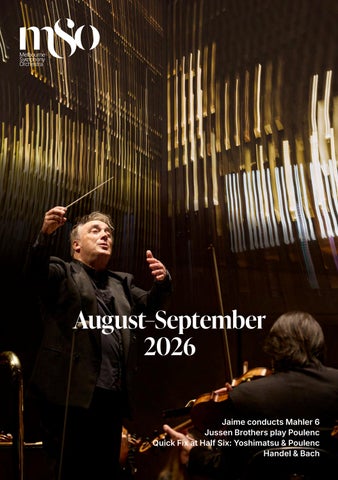
August–September 2026 Jaime conducts Mahler 6 Jussen Brothers play Poulenc Quick Fix at Half Six: Yoshimatsu & Poulenc Handel & Bach
COVER: JAIME MARTÍN (PHOTO: LAURA MANARTITI)
Contents Melbourne Symphony Orchestra Acknowledging Country Your MSO
04
Jaime conducts Mahler 6 13, 15 August
09
Jussen Brothers play Poulenc 10, 12 September
15
Quick Fix at Half Six: Yoshimatsu & Poulenc 14 September
23
Handel & Bach 18, 19 September
25
Supporters MSO Family Our Partners
33 40 42
In consideration of your fellow patrons, the MSO thanks you for silencing and dimming the light on your phone.
MSO 2026 Season
3
Acknowledging Country
The MSO has developed a musical Acknowledgement of Country with composer James Henry to pay our respects to the traditional owners of the land through the language of orchestral music. James Henry’s position is supported by Cybec Foundation
About Acknowledgement ‘I wrote this piece to reflect the complex journey toward the recognition of Aboriginal people as the traditional custodians of the land. It opens with rhythms inspired by the character of traditional songs found across many parts of Australia. From this texture, a melody emerges, representing the long period during which Aboriginal ownership of land was disregarded. The piece traces both progress and setbacks over time. ‘With the passing of the Victorian Statewide Treaty Bill, there is a renewed sense of optimism among many Aboriginal Victorians. Through Acknowledgement, I seek to convey a feeling of determination and resilience, reflecting the ongoing work to improve the quality of life for Aboriginal people, and to deepen respect for and awareness of our distinct culture, history and enduring connection to Country.’ James Henry 2025–2026 Cybec First Nations Composer in Residence
4
August–September Program
Melbourne Symphony Orchestra
The Melbourne Symphony Orchestra is Australia’s preeminent orchestra, dedicated to creating meaningful experiences that transcend borders and connect communities. Through the shared language of music, the MSO performs to the highest standard, enriching lives and inspiring audiences across the globe. Woven into the cultural fabric of Victoria for 120 years, the MSO reaches five million people annually through performances and TV, radio and online broadcasts, as well as critically acclaimed recordings on its newly established label. Jaime Martín continues as the MSO Chief Conductor and Artistic Advisor in 2026, leading a diverse and richly talented Artistic Family.
with the ABC, the MSO’s performances in the Classic 100 in Concert reach more than a million Australians each year. The first Australian orchestra to perform overseas (1965) and at Carnegie Hall (1970), the MSO has a proud history of international touring that has taken it to China, Indonesia, Singapore, Europe and the UK. Driven by the belief that music is a universal right, the MSO also brings music to all corners of the community, ensuring that everyone can share in the transformative power of music. Whether performing on world stages or in the heart of Victoria, the MSO transforms its mission and vision into reality – enriching lives and creating cultural connections through the unparalleled beauty of music.
The MSO regularly presents exceptional artists from across the globe in mainstage programming and special events, as well as reaching beyond the customary classical audience with contemporary collaborations. And through a partnership
MSO 2026 Season
5
Your MSO First Violins
Second Violins
Cellos
Natalie Chee Concertmaster Tair Khisambeev
Matthew Tomkins Principal
The Gross Foundation*
David Berlin Principal Rachael Tobin
Peter Edwards
Associate Principal
Assistant Concertmaster Assistant Principal
Sarah Curro
Dr Harry Imber *
Peter Fellin Deborah Goodall Karla Hanna
Dawna Wright and Peter Riedel*
Lorraine Hook
Jolene S Coultas*
Anne-Marie Johnson David Horowicz*
Kirstin Kenny Mark Mogilevski Michelle Ruffolo
Diane and Stephen Fisher *
Anna Skálová Kathryn Taylor
Jos Jonker
Monica Curro
Assistant Principal Dr Mary-Jane Gething AO *
Mary Allison Emily Beauchamp Isin Cakmakçioglu Tiffany Cheng Val Dyke*
Freya Franzen Cong Gu Andrew Hall Robert Macindoe Philippa West Patrick Wong Cecilie Hall*
Roger Young
Shane Buggle and Rosie Callanan*
Violas Christopher Moore Principal Lauren Brigden Katharine Brockman Anthony Chataway
Associate Principal
Elina Faskhi
Assistant Principal
Rohan de Korte
Annie Neil in memory of Murray A Neil*
Joshua Jones Rebecca Proietto
Peter T Kempen AM *
Ariel Volovelsky Caleb Wong
Rosemary Meagher and the late Douglas Meagher *
Michelle Wood
Andrew and Theresa Dyer *
Double Basses Jonathon Coco Principal Rohan Dasika
Acting Associate Principal
Benjamin Hanlon
Acting Assistant Principal
Aurora Henrich Suzanne Lee Stephen Newton
Peter T Kempen AM *
William Clark
Morris and Helen Margolis*
Aidan Filshie
Suzie and Edgar Myer *
Gabrielle Halloran Patricia Nilsson
Jenny Khafagi
Margaret Billson and the late Ted Billson*
Fiona Sargeant
For a list of the musicians performing in each concert, please visit mso.com.au/musicians 6
August–September Program
Flutes
Horns
Timpani
Prudence Davis Principal
Nicolas Fleury Principal
Matthew Thomas Principal
Jean Hadges*
Margaret Jackson AC *
Wendy Clarke Sarah Beggs
Saul Lewis Principal Third Cecilie Halland and the late Hon. Michael Watt KC *
Piccolo
The Hanlon Foundation*
Associate Principal
Andrew Macleod Principal
Abbey Edlin Josiah Kop
Oboes
Kim and Robert Gearon*
Johannes Grosso Principal Ann Blackburn
Gary McPherson*
Margaret Billson and the late Ted Billson*
Cor Anglais Michael Pisani Principal
Clarinets David Thomas Principal Philip Arkinstall Associate Principal
Bass Clarinet
Rachel Shaw
Trumpets
Callum G’Froerer Rosie Turner
Dr John and Diana Frew *
Bass Trombone
Jack Schiller Principal Dr Harry Imber *
Michael Szabo Principal
Patricia Nilsson*
Robert Cossom
Dr Clem Gruen and Dr Rhyl Wade*
Harp Yinuo Mu Principal
MSO Academy
Trombones
Bassoons
Natasha Thomas
Tim and Lyn Edward*
Associate Principal Glenn Sedgwick*
José Milton Vieira Principal Richard Shirley
Associate Principal
Shaun Trubiano Principal John Arcaro
Owen Morris Principal Shane Hooton
Jonathan Craven Principal
Elise Millman
Percussion
Tuba Timothy Buzbee Principal
Jamie Miles viola Georgia White clarinet Hayden Burge bassoon Jacob Fenchel horn MSO Academy is supported by the Robert Salzer Foundation
Contrabassoon Brock Imison Principal
* Position supported by MSO 2026 Season
7
Season 2027 Packages on sale now mso.com.au/2027
Thursday 13 August at 7:30pm Saturday 15 August at 7:30pm
Hamer Hall, Arts Centre Melbourne
Artists Melbourne Symphony Orchestra Jaime Martín conductor
Program James Henry* Freshwater Saltwater** [10’] Mahler Symphony No. 6 [77’] *
Cybec First Nations Composer in Residence
** World premiere of an MSO commission, with support from the Cybec Foundation
JAIME CONDUCTS MAHLER 6 | 13, 15 August
Jaime conducts Mahler 6
CONCERT EVENTS Pre-concert talk: Learn more about the music with Cybec First Nations Composer in Residence James Henry in conversation with MSO Donor Liaison Keith Clancy 6:45pm in the Stalls Foyer (Level 2) at Hamer Hall Running time: 1 hour, 35 minutes without interval. Timings listed are approximate. MSO 2026 Season
9
PHOTO: KRISTIAN GEHRADTE
Jaime Martín conductor MSO CHIEF CONDUCTOR AND ARTISTIC ADVISOR In addition to his role with the Melbourne Symphony Orchestra, Spanish conductor Jaime Martín is Music Director of the Los Angeles Chamber Orchestra and Principal Guest Conductor of the BBC National Orchestra of Wales. He was previously Chief Conductor of the National Symphony Orchestra of Ireland (2019–24), Principal Guest Conductor of the Spanish National Orchestra (2022–24) and Artistic Director and Principal Conductor of Gävle Symphony Orchestra (2013–22). Having spent many years as a highly regarded flautist, working with the most inspiring conductors of our time, Jaime turned to conducting full time in 2013 and soon became sought after at the highest level. He now regularly conducts major orchestras in the UK, Europe, US and Australasia. Recent highlights include an acclaimed BBC Proms appearance with BBC NOW and an 11-day Beethoven Festival with the MSO, conducting all nine symphonies. In 2025 he also led the MSO on a tour of the UK and Europe, the 10
orchestra’s first full international tour since 2019, with performances at the Edinburgh International Festival and BBC Proms. His extensive discography includes recordings with the Gävle Symphony Orchestra, Orquestra de Cadaqués, Barcelona Symphony Orchestra and London Philharmonic Orchestra, as well as releases on the MSO’s recently launched label: Debussy & Strauss, featuring soprano Siobhan Stagg; Gustav Holst: The Planets with Deborah Cheetham Fraillon’s Earth; and two albums of Dvořák symphonies (Nos. 2, 5, 6 and 8). Jaime Martín is Artistic Advisor and former Artistic Director of the Santander Festival and a Fellow of the Royal College of Music, London, where he was a flute professor.
August–September Program
About the music James Henry (born 1979)
Freshwater Saltwater Freshwater Saltwater explores the meeting of two worlds and the ways in which difference can both divide and enrich. It was inspired by the relationship between freshwater and saltwater – an interaction that is sometimes seamless and gradual, and at other times distinct, when the two waters meet but resist mixing. I was also drawn to the history of the Yarra River, where a natural barrier once separated freshwater from saltwater. [See image on page 12.] The removal of this barrier altered that relationship, transforming the way the waters interacted, and this image became a powerful metaphor for the meeting of cultures: at times blending naturally, at other times remaining distinct, separated by barriers both natural and imposed. As the opening work for a concert featuring Mahler’s Sixth Symphony, this piece also touches on the themes of cultural identity and division that shaped Mahler’s life. A Jewish composer working within a predominantly Christian society, Mahler experienced prejudice and cultural exclusion. His story prompted me to consider the cultural divides that continue to exist in the world today. Musically, these ideas are expressed through contrasts in dynamics, unexpected harmonic shifts, and the rhythmic tension created by groups of three set against groups of four. Musical ideas that at first seem incompatible are placed alongside – sometimes rubbing against each other, sometimes finding common ground. Freshwater Saltwater seeks to demonstrate that contrast need not result MSO 2026 Season
in conflict. Differences can coexist, complement one another, and contribute to a richer and more vibrant whole. In this way, the music reflects the possibilities of cultural exchange and the strength that emerges from diversity within a multicultural society. James Henry © 2026 Yuwaalaraay/Yorta Yorta composer JAMES HENRY is known for his fusion of traditional Aboriginal and contemporary musical genres. He has been the MSO’s Cybec First Nations Composer in Residence since 2025, and in 2023 was an inaugural participant in the MSO’s First Voices program as well as First Nations Composer in Residence for Ensemble Offspring (2023–24). In addition to the MSO, he has composed for the Sydney Symphony Orchestra, Sydney Philharmonia Choirs, Melbourne String Ensemble and Derwent Valley Concert Band, and has been musical director for the Dreamtime at the G and Melbourne Festival ‘Tanderrum’ opening ceremonies. His stage credits as composer-sound designer include The Black Woman of Gippsland and Jacky (Melbourne Theatre Company), 37 (MTC and Queensland 11
IMAGE: STATE LIBRARY OF VICTORIA
Theatre), Blak in the Room (MTC/Ilbijerri Theatre Company), Guuranda (Insite Arts/ Adelaide Festival), In Place (Na Djinang Circus/Footscray Arts Centre), Tracker (Australian Dance Theatre/Ilbijerri), and in collaboration with Gary Watling and Lydia Fairhall, Heart is a Wasteland (Ilbijerri), for which he earned his first Green Room Award for Sound Design in 2023. He is also a singer-songwriter, and as a DJ and producer, he crafts House and Techno music under the pseudonym Nurra. James Henry has immersed himself in the cultural fabric of various communities, playing an integral role in the revitalisation of Indigenous languages through song. His recent fellowship deepened his understanding of traditional Aboriginal music, enabling him to seamlessly integrate it into contemporary contexts and genres. This allows him to explore musical landscapes ranging from Techno to symphonic compositions, while maintaining cultural sensitivity and appropriateness.
Melbourne from The Falls. For tens of thousands of years, a rocky bar or reef across the Yarra River separated salty tidal water from the fresh water flowing down from the valley. The resulting falls (Yarra Yarra) held great significance for the local First Nations peoples. When John Batman arrived in Narrm in 1835, he too recognised the importance of the Falls and declared the adjacent site on the northern bank of the river as ‘the place for a village’. During the 19th century, this stretch of the river was dammed (with little success) and bridges were built, before two major floods (1863 and 1878) led to a decision to demolish both the man-made structures and the reef itself. The Falls were dynamited in 1883 and in 1890 the Queens Bridge was officially opened on the site. This watercolour and oil drawing by surveyor and architect Robert Russell, shows the early settlement of Melbourne from the southern side of the Yarra, and was based on one of several sketches he made from this vantage point in 1837–38.
Cybec Foundation generously provides support for James Henry’s position as Cybec First Nations Composer in Residence. 12
August–September Program
Gustav Mahler (1860–1911)
Symphony No.6 in A minor Allegro energico, ma non troppo. Heftig, aber markig [impetuous but plenty of vigour] Andante moderato Scherzo. Wuchtig [weighty] Finale (Allegro moderato – Allegro energico) Mahler was worried. His Sixth Symphony had just received its first performance in the German city of Essen, and his colleague Richard Strauss had made the offhand remark that the work was ‘overscored’. Strauss’s remark may have been facetious; after all the orchestration of his own Salome sounded to Giacomo Puccini like a ‘badly mixed Russian salad’. But Mahler was worried. According to the young conductor Klaus Pringsheim (who witnessed the exchange) Mahler kept coming back to Strauss’s comment. He asked ‘almost humbly, reverently, what might be the reason why everything came so easily to the other composer and so painfully to himself’. In his monograph on Mahler, Theodor Adorno caricatured Strauss as a ‘blond Siegfried, a balanced harmonious individual who is supposed, singing like a bird, to shower as much happiness on his listeners as is falsely ascribed to him’. By contrast, Adorno argued, Mahler’s music reflects the increasing impotence of the individual in late bourgeois society; Mahler’s best music dramatises the discontinuity of the world. Unlike Strauss, Mahler was suspicious of music which needed the explanatory prop of a ‘program’, but this is not say that Mahler’s music is not at some level about non-musical ideas. In many ways Mahler’s Sixth Symphony is comparable to Strauss’s tone poem A Hero’s Life: Mahler himself conceded that the work has a ‘hero’ who faces an inexorable fate – but MSO 2026 Season
the crucial difference is that Mahler’s music acknowledges the fear of inevitable oblivion. So the answer to Mahler’s own question about why everything came so much more easily to Strauss might be that in Mahler’s music much more is at stake. According to the composer’s widow Alma ‘none of his works moved him so deeply at its first hearing as this’. Mahler’s emotions at having composed such as work as this must have been intense. Mahler first four symphonies mine his many song-settings of folk poetry and three of them contain significant vocal elements. His three central symphonies are all works of ‘absolute’ rather than programmatic music. Nevertheless, his Fifth, Sixth and Seventh symphonies derive some of their thematic material from two sets of songs to poetry by Friedrich Rückert (1788–1866), including the cycle Kindertotenlieder (Songs on the Death of Children). (Alma describes the Kindertotenlieder and Sixth Symphony as premonitions of the death of their daughter and the onset of Mahler’s heart-condition.) For all its epic scale, the Sixth is the work, as Mahler put it, of ‘an old fashioned composer’ in that it is cast in a traditional four-movement design. Its tone – which led to the occasional use, even in Mahler’s time, of the nickname ‘Tragic’ – is unambiguous. A fully scored A major chord, underpinned by an obsessive rhythmic motif from the timpani, fades and, as it fades, changes to the minor mode. This is music which will end in darkness. The first movement begins as a march – not triumphant or doom-laden but, as scholar Michael Kennedy describes it, ‘modern music [that] marches in with this sinister tramping start’. The movement’s starkly contrasting second subject is a lyrical tune which rises and falls largely by step. Alma describes how, after Mahler had drafted the first movement, ‘he came down from [his study] 13
The ordering of the two central movements in Mahler’s Sixth Symphony has a complicated history. In his manuscript, the Scherzo followed the first movement, but Mahler then felt that the piece worked better with the Andante second and Scherzo third. The first edition placed the Scherzo before the Andante but Mahler himself always performed the piece using the Andante–Scherzo order that we hear tonight. Then, in 1919, the conductor Willem Mengelberg asked Mahler’s widow Alma for clarification, and in a four-word telegram she insisted ‘First Scherzo, then Andante’ (What she intended by this is unclear, as her Memories and Letters confirms Mahler’s own order!) Mengelberg, acting in good faith, used that order, and it became enshrined in 1963 with the publication of the International Gustav Mahler Society’s Critical Edition. Only as recently as 2004 did the IGMS state a new official position: that the correct order of the inner movements is Andante–Scherzo. to tell me he had tried to express me in a theme’. The yearning lyricism provides a perfect foil for the implacable march of the beginning – ‘change and conflict are the secret of effective music’, as Mahler said. Another unique aspect of this work is the celebrated evocation of alpine scenery first heard toward the end of the movement. This striking sound world was said by Mahler to represent the ‘last earthly sounds heard from the valley below by the departing spirit on the mountain top’. He noted that ‘the cowbells should be played with discretion—so as to produce a realistic impression of a grazing herd of cattle, coming from a distance…’ In what we must accept as Mahler’s preferred order, the Andante represents a complete contrast with both the first movement and the following Scherzo, but the tone is hardly tragic. Rather, with its horn calls and reminiscence of the cowbells, it is poignant and romantic, a relaxation of the work’s dramatic tension. Like the first movement, with which it shares some thematic material, the Scherzo has an insistent rhythm to begin with (which may have prompted Mahler to delay it). There is much Mahlerian irony in this movement, both in the dry clattering of the xylophone and in what Kennedy calls the ‘delicate pastiche Haydn’. The oboe conjures up an innocent, rustic world, recalling a Bohemian folk song. As a caution against over-interpreting, it 14
should be noted that the scherzo has been interpreted as ‘diabolical’ and ‘catastrophic’ on one hand, where Alma’s reminiscences insist that it depicts the ‘tottering’ of their children at play before the intrusion of tragedy at the end of the movement. The Finale is one of Mahler’s largest and most complex structures, and it bears the weight of the symphony as a whole, recalling material from earlier in the work. Its introductory section contains material that will be developed as the movement unfolds, particularly the impassioned melody heard first high in the violins. The movement depicts a nightmarish world, where the Allegro energico strains towards climactic release, only to be brutally interrupted on three occasions. Mahler originally included a sickening thud ‘like an axe-stroke’ at each of these points, but later omitted the third out of superstition. Adorno wrote that in Mahler ‘happiness flourishes on the brink of catastrophe’. According to Alma in Memories and Letters, Mahler himself said that the movement describes ‘the hero on whom falls three blows of fate, the last of which fells him as a tree is felled’. The piece ends in dissolution. No wonder Mahler was worried. Abridged from a note by Gordon Kerry © 2007
August–September Program
Thursday 10 September at 7:30pm Saturday 12 September at 7:30pm Hamer Hall, Arts Centre Melbourne
Artists Melbourne Symphony Orchestra Nodoka Okisawa conductor Lucas and Arthur Jussen piano duo
Program Takemitsu Three Film Scores [13’] Poulenc Concerto in D minor for two pianos [19’] interval
Takashi Yoshimatsu And Birds Are Still… [8’] Poulenc Sinfonietta [30’]
JUSSEN BROTHERS PLAY POULENC | 10, 12 September
Jussen Brothers play Poulenc
CONCERT EVENTS Pre-concert talk: Learn more about the music with MSO Viola Gabrielle Halloran 6:45pm in the Stalls Foyer (Level 2) at Hamer Hall Running time: 1 hour and 35 minutes, including a 20-minute interval. Timings listed are approximate. MSO 2026 Season
15
PHOTO: FELIX BROEDE
Nodoka Okisawa conductor Following her Australian debut with the MSO in 2022, Nodoka Okisawa returns with another program that plays to her strengths in French and Japanese repertoire. Since that first visit, she has been appointed Chief Conductor of the City of Kyoto Symphony Orchestra (her contract now extended to 2029), and in 2024 was named the first Principal Guest Conductor of the Seiji Ozawa Matsumoto Festival. She is also General and Artistic Director of the Aoi Umi to Mori (Blue Sea and Forest) Music Festival. Recent highlights have included debuts with the Hallé, Dortmund Philharmonic, and the London Philharmonic, Latvian National Symphony and Boston Symphony orchestras, as well as a return to the Munich Symphony Orchestra, where she was Artist in Residence in 2022–23. This Australasian tour will also include debuts with the Tasmanian Symphony Orchestra and Auckland Philharmonia. Much in demand in Japan, she regularly conducts the Japan Philharmonic Orchestra as well as the Yomiuri Nippon, 16
Toyko Metropolitan and NHK symphony orchestras. Her opera credits include The Marriage of Figaro and Britten’s Midsummer Night’s Dream (Seiji Ozawa Matsumoto Festival with the Saito Kinen Orchestra), and The Merry Widow and Carmen (Tokyo Nikikai Opera Foundation). Born in Aomori, Japan, Nodoka Okisawa played piano, cello and oboe before studying conducting with Ken Takaseki and Tadaaki Otaka at the Tokyo University of the Arts. She subsequently earned a second master’s degree studying with Christian Ehwald and Hans-Dieter Baum at the Hochschule für Musik Hanns Eisler in Berlin, where she now lives. While still a student, she won the 2018 Tokyo International Music Competition for Conducting, followed by the grand prize and orchestra and audience prizes in the 2019 Besançon International Competition for Young Conductors. After graduating, she held a scholarship at the Karajan Academy of the Berlin Philharmonic (2020–22) and was assistant to principal conductor Kirill Petrenko. August–September Program
PHOTO: JESAJA HIZKIA
Lucas and Arthur Jussen piano duo Lucas and Arthur Jussen enjoy illustrious international careers and have become the Netherland’s pre-eminent ambassadors for classical music. Their energetic, almost symbiotic playing, great refinement of sound and gripping interpretations are praised by critics and audiences alike. The Jussen brothers have performed with leading orchestras worldwide, including the Boston and Chicago symphony orchestras, Royal Concertgebouw Orchestra, Budapest Festival Orchestra, Leipzig Gewandhaus Orchestra and the Academy of St Martin in the Fields, collaborating with conductors such as Christoph Eschenbach, Iván Fischer, Neville Marriner, Andris Nelsons, Yannick Nezét-Séguin and Jaap van Zweden. In the 2025–26 season, the Jussen brothers made their Berlin Philharmonic debut and served as Artists in Residence with the Frankfurt Radio Symphony. Other highlights included their Pittsburgh Symphony Orchestra debut and tours of Europe (Munich Philharmonic, Academy of St Martin in the Fields) and Asia (Hong MSO 2026 Season
Kong Philharmonic Orchestra), as well as multiple performances of a dynamic piano–percussion program with Alexej Gerassimez and Emil Kuyumcuyan. In April they gave the premiere of Andrew Norman’s new double piano concerto (Boston Symphony Orchestra and Susanna Mälkki). Since 2010, when they released an awardwinning debut album of Beethoven, they have recorded exclusively for Deutsche Grammophon. Subsequent recordings have included Poulenc’s Double Concerto and Saint-Saëns’ Carnival of the Animals (Concertgebouw Orchestra and Stéphane Denève), and Cantus (2025), featuring chorales from Bach to Arvo Pärt. Lucas and Arthur began studying piano in their native Hilversum, and as children performed for Queen Beatrix. Later, their teachers included Maria João Pires. Lucas completed his studies with Menahem Pressler (USA) and Dmitri Bashkirov (Madrid). Arthur graduated from the Amsterdam Conservatory, where he studied with Jan Wijn. 17
About the music Tōru Takemitsu (1930–1996)
Three Film Scores for string orchestra I.
Music of Training and Rest (from José Torres) II. Funeral Music (from Black Rain) III. Waltz (from Face of Another)
Tōru Takemitsu was almost entirely selftaught. After fleeting encounters with non-Japanese music during his military conscription as a teenager, and despite a lack of formal training, at the age of 16 he decided to become a composer. His career would ultimately span 50 years, win him numerous international awards, and see him characterised as Japan’s most significant composer. Takemitsu’s output is extraordinary in its breadth, influenced equally by European avantgarde and Japanese traditions, but he found his widest audience through film music. Three Film Scores for string orchestra (1994) provides a snapshot of this oeuvre, reimagining extracts from three of his 90 film scores. The first movement, Music of Training and Rest, appeared in Hiroshi Teshigahara’s 1959 documentary about the Puerto Rican boxer José Torres. Marked ‘jazzy, blues like’, the movement unfolds across five brief sections, moving from lush Hollywood-style melodies to syncopated Latin rhythms, with the finale following a dramatic pause, demonstrating Takemitsu’s characteristic use of silence.
inviting a feeling of instability. In the second half, he adds to the unsettled atmosphere with techniques such as tremolos, harmonics, and sul ponticello (in which the musicians bow close to the bridge for a distorted sound). The finale, Waltz, is from Teshigahara’s 1966 feature Face of Another (Tanin no Kao) – about changes in a facial burn victim’s life after being given a prosthetic mask. With its regular triple rhythm, sweeping melodies and conventional trio section, this movement has the expected elements of a Viennese waltz, but the minor key and extensive chromaticism make it clear that this is not a traditional Strauss work, lending the movement a sense of eeriness. Sarah Kirby © 2026
The second movement, Funeral Music, is drawn from his score for Shōhei Imamura’s 1989 feature Black Rain (Kuroi Ame), set in the aftermath of the US bombing of Hiroshima. The movement is imbued with a sense of unease; from its soft opening, it unfolds through waves of growing intensity, with changing time signatures 18
August–September Program
PHOTO KLEIN, PARIS (UNIV. OF MELBOURNE ARCHIVES)
Poulenc at the piano in 1946 – 14 years after he’d composed the Concerto for two pianos and a year before he began his Sinfonietta, or ‘Little Symphony’. Poulenc was also a concert pianist and on two occasions (1945 and 1955) performed the Concerto for two pianos with Benjamin Britten as duo partner.
Francis Poulenc (1899–1963)
Concerto in D minor for two pianos Allegro ma non troppo Larghetto Finale (Allegro molto) Lucas and Arthur Jussen piano duo The music of Francis Poulenc has often been undervalued, simply because much of it is humorous, light and witty. He is also remembered for the vast tract of religious music he composed, being a devout Roman Catholic. But there were many colours on Poulenc’s compositional palette other than the flippant and the sacred. To categorise him, as the critic Claude Rostand once did, as ‘half bad boy, half monk’, reduces his talents to something approaching glib. Poulenc’s life was indeed a kaleidoscope of emotions. He had periods of extreme elation, but these episodes were nearly always countered with overwhelming lows. One suggested reason for this emotional polarity is that Poulenc grappled with his homosexuality versus his ardent Catholic faith. Despite this apparently irreconcilable contradiction in MSO 2026 Season
fundamentals, Poulenc eventually came to accept these converse aspects of his nature. In fact, he was often musically inspired by his love affairs, particularly when composing some of his finest religious music. He once described himself as ‘an almost great composer’. This is a sad indictment of the times he lived in rather than a barometer of his talent. His works were characterised as the epitome of Parisian lightness. Some composers may have considered such a label demeaning, but for Poulenc, communicating with an array of audiences was of paramount importance. He was influenced by a number of composers, in particular Stravinsky. Poulenc was also part of a group of composers known as ‘Les Six’ – the other five being Georges Auric, Louis Durey, Arthur Honegger, Darius Milhaud and Germaine Tailleferre, with Jean Cocteau as their enthusiastic promoter and spokesman. The group was ostensibly a band of friends who were on a common quest to establish a new French music. Poulenc was more of a drifter than his colleagues, and was also remarkably 19
self-effacing when it came to describing his way of working and his favoured inspirations: I envy composers like Milhaud and Hindemith who can write wherever they may happen to be. I’m extremely susceptible visually, everything is an excuse for getting side-tracked, for frittering away my time… I need happy sights, because since I’m very prone to sadness I tend to create what I see out of my own feelings… I work a lot at the piano, like Debussy, Stravinsky and so many others. Contrary to what is generally believed, I don’t work easily. My first drafts, written in a sort of strange musical shorthand, are full of crossings-out. When a melodic idea presents itself to me in a certain key, I write it down (for the first time of course) in that key. When I’ve told you that I’ve composed my least bad music between eleven o’clock and midday, I think I’ve told you everything. Poulenc believed his Concerto for Two Pianos held a dominant place among his piano works, ‘not so much on account of its musical value as because of its success so far as its orchestration is concerned’. Composed over two months at Le Tremblay in 1932, it was intended for performance with his friend, Jacques Février. It was the result of a commission from the Princesse Edmond de Polignac, who was not only well-connected through marriage, but also the heir to her father’s fortune derived from his famous sewing machine business – her maiden name was Winnaretta Singer. The Concerto for Two Pianos has been variously described as ‘a typical cocktail of all that seemed entertaining to Poulenc at the time’, and having ‘a base of brash neo-classicism, a sprinkling of black-andwhite movie romance, a dash of end-ofthe-pier melodrama, the whole thing topped with frothy good humour’. The concerto also contains some exquisite
‘I know very well that I am not the sort of musician who makes harmonic innovations, like Stravinsky, Ravel or Debussy, but I do think there is a place for new music that is satisfied with using other people’s chords.’ Francis Poulenc moments of hypnotic tranquillity, inspired by Poulenc’s visit to the 1931 Paris Colonial Exhibition at which he heard a Balinese gamelan for the first time. The Concerto opens briskly, toccata-like, its common-time metre sharply accented by both orchestra and soloists. The exotic setting of gamelan sounds finishes this otherwise jaunty movement. At the start of the Larghetto, one could be forgiven for thinking that the pianist has in fact accidentally strayed into an early sonata of Mozart’s! But the second piano enters and the unmistakable seductive charm of Poulenc is restored. The movement, however, continues to tantalisingly teeter between Mozart and Poulenc. The finale, Allegro molto, contains even more tunes than the previous two movements. The brittle Stravinskyian tutti introduces a toccata for the soloists, which in turn leads to a brisk march. This is followed by a linked succession of melodies, heard, repeated and discarded until one of them, marked Agité, rises to the climax. After a brief flirtation with an ‘oom-pah, oom-pah’ theme, and a few moments of calm, a coda winds up the movement to a whirligig finish. Hilary Shrubb Symphony Australia © 1999
PHOTO: NAOKI HASHIMOTO
Australia in order to hear the lyrebirds in Sherbrooke Forest) is another birdobsessed influence in the background. Like Tōru Takemitsu, Yoshimatsu was largely self-taught as a composer. His youthful obsessions included Beethoven and Tchaikovsky symphonies, and he studied briefly with Teizo Matsumura, who exposed him to the early 20th-century influence of Maurice Ravel and Igor Stravinsky. In his own words, Yoshimatsu is an advocate of ‘new lyricism’ who ‘objects to unmusical “modern music”’, and in 1986 he described his choice of bird imagery as a search for ‘wings with which to fly from the chaotic woods/world of contemporary atonal music’. This approach is evident in And Birds Are Still…, one of his most beloved works.
Takashi Yoshimatsu (born 1953)
And Birds Are Still…, Op. 72 A quick look at the titles in Yoshimatsu’s work list reveal a special fascination with birds. One of his earliest major works – and the piece that won him widespread recognition – is Threnody to Toki (1980), inspired by the toki or Japanese crested ibis, a species threatened with extinction. (The MSO and Hiroyuki Iwaki gave the Australian premiere of Threnody to Toki in 1999.) This was followed by works such as Chikap (‘Birds’ in the Ainu language), When a Bird Dreams Moonbeams (1999) and Twitter Birds Blog (2007), as well as his popular saxophone concerto Cyber Bird (1994) and his sixth symphony, Birds and Angels (2013). If this makes you think of Finnish composer Einojuhani Rautavaara (1928–2016), then listening to Yoshimatsu’s music, with its evocative colours and Neo-Romantic language will confirm the impression. The French composer Olivier Messiaen (who woke his hosts before dawn when visiting MSO 2026 Season
And Birds Are Still… was composed in 1998, Yoshimatsu explains, as a short elegy for string ensemble and his inspiration came from ‘an image of birds gathered around a dead comrade’. This can be heard from the outset: muted violins play fragmented, fluttering motifs above the fragile sound of violas sustaining a single note sul tasto (over the fingerboard) – literal stillness. Whispering textures are achieved by dividing the strings: there are four individual first violin lines, three second violin lines, two viola and two cello lines. And Birds Are Still… is in three main sections, each one fading to a sustained pause before the next begins. A solo violin introduces the central section with a tranquil, floating melody, which develops, says Yoshimatsu, ‘into a melancholic recollection of a memory of long ago’. The fluttering, whispering effects of the opening return before the music fades into the silence of grief. Yvonne Frindle © 2026
21
Francis Poulenc (1899-1963)
Sinfonietta Allegro con fuoco – Molto vivace Andante cantabile Finale (Prestissimo et très gai) This Sinfonietta emerged from failure: a string quartet, completed in 1945 and performed just once, in private. Poulenc was so dissatisfied, he tossed the manuscript into a gutter in the Place Péreire, telling his friend Georges Auric it had ‘no more than three pretty themes’. Auric – a fellow composer in ‘Les Six’ – thought Poulenc had been right to jettison the work, but advised him not to forget the themes. And within months, a commission from the BBC Third Programme gave Poulenc the opportunity to salvage his bewitching melodies. A glance at the program page (30 minutes) and the stage (63 musicians) might leave you puzzled by Poulenc’s unpretentious title. A sinfonietta is a ‘little symphony’, and the duration and ensemble wouldn’t raise eyebrows alongside full-blown symphonies by Haydn, Mozart or even Mendelssohn. The clue lies in the BBC contract: a work for small orchestra, of 15 minutes duration, and modelled on Prokofiev’s Classical Symphony. (The fee was £100.) But three months into the project, the work suffered from ‘scope creep’. ‘Catastrophe!’ reported Poulenc to the BBC. ‘The Sinfonietta has become a symphony; the first three movements are already 19 minutes long.’ It would take him another year to finish, the title unchanged. The Sinfonietta was the closest Poulenc ever got to composing a symphony. The idea of the Romantic symphony held no appeal – he considered the profound aspirations and grandeur of such works dreary and pedantic – but even so, he embraced its conventions with a twinkle in his eye. 22
The Allegro con fuoco, for instance, adopts a first-movement sonata form structure: presenting two groups of contrasting themes (one fiery and impetuous, the other broadly lyrical) before developing them in a ‘mélancholique’ section featuring the oboe, and then bringing the musical ideas home in a recapitulation. But Poulenc’s playful gestures undermine any feeling of seriousness, with off-beat accents, unexpected changes of metre, and kaleidoscopic shifting of ideas. In this respect he met the BBC’s brief perfectly, writing a French answer to Prokofiev’s witty, neoclassical first symphony. The breezy second movement functions as the scherzo, continuing the playful spirit with a speedy tarantella. At first the model seems to be Stravinsky’s Pulcinella – another icon of neoclassicism – but it’s also possible to hear sly allusions to the scherzo from Tchaikovsky’s Pathétique Symphony, especially when the first clarinet enters about a minute into the movement, and to the effervescent finale of Les Biches (composed for the Ballets Russes and Poulenc’s first big success). Clarinets again take the lead in the slow third movement, introducing a gentle, flowing melody that has been compared to Brahms. As with the previous movement, Poulenc organises the music in a threepart ‘A B A’ form – outer sections framing contrasting central ideas. The Finale is marked ‘as fast as possible and very cheerful’, and again there’s a hint of Stravinsky – this time blended with Mozart, French music hall and a hint of Prokofiev’s ‘grotesque’ style. Following the Classical model, the form is a rondo, with a recurring main theme. But this musical whirlwind is full of surprises, especially in the coda, which creates expectations of what is for Poulenc an uncharacteristically grandiose conclusion before tossing it all away with a flourish. Yvonne Frindle © 2024 August–September Program
Yoshimatsu & Poulenc Monday 14 September at 6:30pm Hamer Hall, Arts Centre Melbourne
Artists Melbourne Symphony Orchestra Nodoka Okisawa conductor Daniel Corvaia* presenter
Program Takashi Yoshimatsu And Birds Are Still… [8’] Francis Poulenc Sinfonietta [30’]
The conductor biography and program note for this performance can be found on pages 16 and 21. * Cybec Assistant Conductor
QUICK FIX AT HALF SIX: YOSHIMATSU & POULENC | 14 September
QUICK FIX AT HALF SIX
CONCERT EVENTS Tonight’s onstage introduction will be Auslan interpreted Running time: 1 hour. Timings listed are approximate. Quick Fix at Half Six is supported by City of Melbourne. The MSO’s Auslan interpreted performances receive funding from the Australian Government Department of Health, Disability and Ageing. MSO 2026 Season
23
INTRODUCING THE
Jaime Martín Martini...bottled. A dry, aromatic and savoury martini with a Spanish twist.
www.patientwolfgin.com
24
Learn more
August–September Program
Friday 18 September at 7:30pm
George Wood Performing Arts Centre
Saturday 19 September at 7:30pm
Elisabeth Murdoch Hall, Melbourne Recital Centre
Artists Melbourne Symphony Orchestra Kristian Bezuidenhout harpsichord and director
Program JS Bach Orchestral Suite No. 1 in C major, BWV 1066 [21’]
HANDEL & BACH | 18–19 September
Handel & Bach
JS Bach Contrapunctus XIV from The Art of Fugue, BWV 1080 [10’] arranged by Kristian Bezuidenhout
Handel Overture to Admeto [5’] Handel Concerto grosso in D minor, Op. 3 No. 5 [6’] interval
JS Bach Sinfonia from Cantata No. 52 [4’] Handel Water Music: Suite No. 1 in F major, HWV 348 [32’] Handel Water Music: Suite No. 2 in D major, HWV 349 [12’]
CONCERT EVENTS Pre-concert talk: Learn more about the music with Miranda Hill 6:45pm in the George Wood Performing Arts Centre (18 September) and Elisabeth Murdoch Hall (19 September) Running time: 2 hours, including a 20-minute interval. Timings listed are approximate. MSO 2026 Season
25
PHOTO: MARCO BORGGREVE
Kristian Bezuidenhout harpsichord and director Born in South Africa, Kristian Bezuidenhout began his studies in Australia before graduating from the Eastman School of Music (Rochester, NY), and now lives in London. After training as a modern pianist with Rebecca Penneys, he studied harpsichord with Arthur Haas, fortepiano with Malcolm Bilson, and continuo playing and performance practice with lutenist Paul O’Dette. He gained international recognition at the age of 21 after winning the Bruges Fortepiano Competition. He is now a regular guest soloist on fortepiano, harpsichord and modern piano, appearing with leading ensembles such as the Freiburger Barockorchester, Bavarian Radio Symphony Orchestra, Leipzig Gewandhaus Orchestra, Mozarteum Orchestra, Camerata Salzburg, Orchestre des Champs Elysées, Les Arts Florissants, Orchestra of the Eighteenth Century, Royal Concertgebouw Orchestra, Chamber Orchestra of Europe, Orchestra of the Age of Enlightenment, Orchestre Révolutionnaire et Romantique, Chicago Symphony Orchestra and the ACO.
26
Kristian is also increasingly in demand as a conductor, exploring music of the late 17th and early 18th centuries with groups such as the English Concert, Collegium Vocale, Tafelmusik, Kammerakademie Potsdam, Juilliard 415 and Dunedin Consort. He is Principal Guest Director of both the Freiburger Barockorchester and English Concert, and Associate Artist of the Irish Chamber Orchestra. His award-winning discography of more than 30 albums covers repertoire from Beethoven and Mozart piano concertos to Bach and Mozart violin sonatas and Schubert and Schumann song cycles. The 2025–26 season saw engagements with the Royal Northern Sinfonia, Irish Chamber Orchestra, Tapiola Sinfonietta, Dunedin Consort, Kammerakademie Potsdam and Bochumer Symphoniker, as well as debut appearances with the Norwegian Radio Orchestra, SWR Symphonieorchester and Tampere Philharmonic.
August–September Program
IMAGES FROM LEFT: HANDEL PORTRAIT BY THOMAS HUDSON (1749); BACH PORTRAIT BY HAUSSMANN (1748) BACH ARCHIV LEIPZIG CC BY-SA 4.0
Handel and Bach In Bach and Handel’s time, the ‘orchestra’ wasn’t so much an ensemble as a domain of music-making, distinct from the church, that embraced the theatre, the court ballroom, ceremonial events and public entertainments. And tonight’s program represents that domain in all its splendour, with concertos, suites and overtures – the staple repertoire of orchestras from an earlier time, before Haydn invented the modern symphony. For George Frideric Handel, this secular domain is completely in character. As a young man, Handel left his home city of Halle and spent four years in Italy before taking his cosmopolitan style to the hub of the 18th-century musical world, London. And there he stayed – a force to be reckoned with in the realm of opera and the new English oratorio. Meanwhile, his instrumental works represented the elegant and lively hybrid of French and Italian styles that German composers had claimed for their own.
MSO 2026 Season
By contrast, Johann Sebastian Bach was best-known in his lifetime as an organist, reaching the pinnacle of his career as director of church music in Leipzig. Even now, he’s associated with sacred music – cantatas and the great passion-oratorios – and as a writer of complex, weaving fugues – music with an intellectual focus. If Handel is the entertainer, Bach is the philosopher. Unlike Handel, Bach never left Germany. But it would be wrong to think he had no exposure to international musical styles. Without setting foot in Italy, he made a close study of Vivaldi’s concertos; nor did he have to travel to France to discover the secrets of the French style. Tonight we hear philosopher-Bach in music from his Art of Fugue and we hear church-Bach in (it would seem!) the sinfonia from a sacred cantata. But it’s fashionable-Bach who begins the program with an orchestral suite composed for an ensemble of virtuosos.
27
Johann Sebastian Bach (1685–1750)
Orchestral Suite No. 1, BWV 1066 1. 2. 3. 4. 5. 6. 7.
Ouverture Courante Gavotte I and II Forlane Menuet I and II Bourrée I and II Passepied I and II
JS Bach arr. Bezuidenhout Contrapunctus XIV from The Art of Fugue, BWV 1080
George Frideric Handel (1685–1759)
Overture to Admeto
GF Handel Concerto grosso in D minor, Op. 3 No. 5 (HWV 316) 1. 2. 3. 4. 5.
[Largo] – Allegro [Fuga] Adagio Allegro ma non troppo Allegro
Bach à la mode Bach’s four orchestral suites were written, or at least substantially revised, in Leipzig, where he had access to the many fine instrumentalists of the Collegium Musicum who performed at Zimmermann’s Coffee House. But the impetus may have stemmed from his time in Cöthen (1717–23), where the prince, a Calvinist, didn’t need church music, but loved fashionable French-style instrumental music. What we call an ‘orchestral suite’ Bach called ‘Ouvertüre’ – a French title transliterated into German. Consisting of stylised court dances, this type of suite gained its final form in the late 17th century when German composers developed the idea of beginning with a French-style ‘operatic’ overture. In the Ouverture of Bach’s first suite the grand rhythms serve to catch attention, as they would have done in the theatre. Bach is true to his French model: the majestic introduction is followed by a fast section featuring intricate imitation between the instruments and a return of the slow introduction. What then follows is not so much dance music as dance-inspired music. Bach’s listeners would have recognised the characteristic dance metres – the ‘skipping’ character of the forlane, for instance – then admired what Bach did with them as he exploited their emotional and musical possibilities. The colours in this orchestral suite derive from French opera and its ‘choirs’ of different instruments. One of these is the oboe, a wind instrument that can vie with a violin. The French called the oboe ‘high wood’ – hautbois – and in the second bourrée, as well as parts of the first movement, the two oboes play on their own with a ‘low wood’, the bassoon. Meanwhile, the Italian influence can be heard in the way Bach presents the two
28
August–September Program
oboes and bassoon as a solo group in clear alternation with the full ensemble – a concerto grosso in all but name. Bach also makes ingenious use of the strings, including at one point (in the second gavotte) giving them ‘trumpet’ fanfares.
An unfinished fugue Bach’s first orchestral suite begins the concert in the key of C major, a key that 18th-century theorists considered suitable for mirth and rejoicing. With the Contrapunctus XIV from The Art of Fugue, Kristian Bezuidenhout embarks on an extended exploration of the key of D minor that will continue with Handel’s Admeto overture and Concerto grosso Op. 3 No. 5. And with this change of key, the mood turns serious and contemplative, coloured by melancholy and drama. Composed during the last two decades of Bach’s life, The Art of Fugue was conceived not with performance in mind but as an exemplar of advanced contrapuntal technique – demonstrated through a series of fugues based on a single musical subject. It remained incomplete at Bach’s death and the Contrapunctus XIV (also known as ‘Fuga a 3 soggetti’ or fugue in three subjects) is itself unfinished, a single inner voice cut short mid-phrase. Carl Philipp Emanuel Bach would later write on his father’s manuscript: ‘The composer died while working on this fugue, that uses the name BACH as the countersubject.’ Some have cast doubt on this romantic account. Christoph Wolff, for example, suggests that Bach may have had no intention of writing anything further, instead leaving it unfinished as a puzzle for his readers. More significant is Emanuel Bach’s reference to the ‘BACH’ countersubject: the notes B flat (‘B’ in German note naming), A, C and B natural (‘H’ in German) provide the third subject, which is clearly spelled out about six or seven minutes in. MSO 2026 Season
Opera without words Tonight, Bach’s fugue functions as a prelude to Handel’s Admeto overture, itself a prelude to the operatic drama in store. Imagine the glittering premiere in 1727, with three celebrities (the castrato Senesino and rival sopranos Faustina Bordoni and Francesca Cuzzoni) as stars in a complex story taken from classical myth. Admetus, king of Thessaly (Senesino) is granted longer life if he can persuade someone else to die for him. His wife Alcestis (Faustina) consents to be that person. Antigona, a Trojan princess and former flame of Admetus, provided both subplot and a role for Cuzzoni. She sees an opportunity to regain Admetus’ love but her hopes are dashed when Hercules rescues Alcestis from Hades. The overture is regal in character, adopting the French style with its majestic opening rhythms and busy Allegro section. But Handel concludes with the Allegro rather than repeating the opening section. In the opera, this is replaced by a separate instrumental introduction, still grand but darker in tone, as the curtain rises on the dying Admetus and a nightmarish vision of spectres holding bloody daggers. George Frideric Handel was himself a celebrity of the London music scene: amassing (but not always keeping) large sums of money, mixing with the rich and famous, and often the subject of rivalries and gossip. But even Handel experienced his low moments, and in the 1730s his captive market for opera was dwindling. The publication in 1734 of his Opus 3 – a set of concerti grossi ‘after the Italian manner’ – was a smart strategic move, although Handel himself had very little to do with it. Capitalising on the demand for Italian music, Handel’s publisher John Walsh had assembled the concertos from existing material. In the fifth concerto, the sources included anthems Handel had written some 15 years earlier for the Duke of Chandos. 29
JS Bach Sinfonia from Cantata No. 52 (‘Falsche Welt, dir trau ich nicht’)
GF Handel Water Music: Suite No. 1 in F major, HWV 348 1. Ouverture (Largo – Allegro) 2. Adagio e staccato 3. [Allegro] 4. Andante – 3. [Allegro] da capo 5. [Allegro] 6. Air 7. Minuet 8. Bourrée 9. Hornpipe 10. [Allegro moderato]
Suite No. 2 in D major, HWV 349 11. [Allegro] 13. Minuet (Coro) 14. Lentement 15. Bourrée 12. Alla Hornpipe
A River Excursion on the Thames, featuring music by Mr Handel… As diplomat Friedrich Bonet recalled, His Majesty’s approval of the specially composed music was so great that he ’caused it to be played three times in all, twice before and once after supper, even though each performance lasted an hour’. A modern orchestra manager would be wincing at the overtime, and indeed, the concert cost Baron Kilmanseck £150 (more than £28,000 today) for the musicians alone. 30
Handel’s Italian tempo words describing the movements disguise the inherent drama and personality of this Concerto grosso, which can be experienced as an opera-without-words. The fiercely dignified opening movement segues to a three-part fugue (Allegro), forming a pair that mirrors the Admeto overture. This is followed by a sommeil (a sleep or dream scene) – deeply expressive in its anguish. The fourth movement is a tightly written fugue, the imitative voices arriving every two beats, hot on the heels of the previous entry. The heightened tension this creates is resolved in the final Allegro, a sprightly gavotte.
Concerto in church If the sinfonia to Bach’s Cantata No. 52 were to turn up in a playlist, you’d likely recognise it immediately. Not as the beginning of ‘Falsche Welt, dir trau ich nicht’ (False world, I do not trust you), a cantata composed for Leipzig in 1726, but as the beginning of the first Brandenburg Concerto (in F major, BWV 1046) with its featured parts for horns and oboes. Discussions of the cantata are polarised. Some declare the borrowed sinfonia as having no relevance to the cantata’s juxtaposition of worldly hypocrisy with the constancy of God. Others suggest the music’s brilliance could represent the ‘false world’ that’s rejected in the cantata’s opening lines. More significant, though, is the inclusion of an introductory sinfonia at all, which would have surprised Bach’s Leipzig congregations. By 1726, Bach had long abandoned this 17th-century practice, and in reviving it he was doing something fresh. As scholar Peter Wollny explains, the introduction of virtuoso instrumental music typical of concertos, brought an urbane flair and an atmosphere of courtly splendour to the world of municipal church music. Perhaps, too, Bach was reminding his listeners he was once music director of the Prince of Anhalt-Cöthen. August–September Program
Music on the Thames In 1710, at the age of 25, Handel took the post of court director of music to the Elector of Hanover, promptly deferring the appointment with an eight-month leave of absence in London. A year later, he was again given permission to visit England, this time with the injunction to return ‘within reasonable time’. In the end, Handel outstayed his leave but not his welcome. He was still in England in 1714 when his employer assumed the throne as George I. Although Handel was never truly out of favour with the king, the performance of his Water Music during a royal river party on the Thames in 1717 may have been a gesture of reconciliation. Regardless, such events had become common in an attempt to make the Hanoverian dynasty visible and popular, despite the king’s dislike of ‘pageantry and splendour’. This was 18th-century public relations in action. Handel’s Water Music has overt parallels in the outdoor music of the French court at Versailles and the music is French in externals – especially in its dance movements. But the musical language, as opposed to the form, is typical of Handel – a blend of German and Italian musical elements, with an acquired English ‘accent’. No definitive score of Handel’s Water Music survives and it’s impossible to know exactly which movements the king heard, or in which sequence, as the 50 or so musicians played in the barge alongside his. But the musical numbers have long been grouped into three suites: the ‘horn suite’ (in F major) and ‘trumpet suite’ (in D major), suitable for the Thames journey, and the more intimate ‘flute suite’ (in G major/minor), probably performed during the 1 am supper break at Chelsea. The Suite in F major begins with a formal French overture, whose fast (Allegro) section is fugal in character without being a strict fugue. In what could pass for a MSO 2026 Season
concerto slow movement, the solo oboe shines in the expressive Adagio e staccato. The horns then make their first appearance in a ‘hornpipe’ movement with repeated notes and trills. This is probably the first music Handel wrote for horns in London, and it has been suggested the river was a good place to try out these sometimes recalcitrant instruments! The famous Air is followed by a group of dances: minuet, bourrée and another hornpipe. Each dance is marked to be played three times: first by strings, then by winds, then by the full band. The final movement, in the key of D minor, takes on a serious air, Handel returning to a ‘fugal’ texture for his theme, and incorporating aspects of the Italian concerto by alternating the woodwind group (oboes and bassoon) with the strings. The Suite in D major begins with a ceremonious allegro that has a military air: horns and trumpets expand on fanfares in dialogue, each pair accompanied by its own ‘camp’ – oboes, violins and violas siding with the trumpets; bassoon and basso continuo instruments with the horns. A noisy truce then leads to a few bars of slow music that leave the music poised for the music to follow. A group of French dances then recalls Versailles: a ‘trumpet’ minuet in lively fourbar phrases; the Lentement suggesting the loure with its lilting rhythms and simple, almost drone-like bass-line; and a bourrée for the full band. And in this performance we conclude with the Alla Hornpipe – possibly the most famous Water Music movement of all. It’s a final opportunity for the trumpets and horns to display their agility – this time without ‘allies’, but introduced each time by the woodwinds and strings. Program notes by Yvonne Frindle and David Garrett © 2026
31
Where refined luxury meets symphony of culture
A Hotel for the Arts and a proud supporting partner of the Melbourne Symphony Orchestra ACCOMMODATION • RESTAURANT • BAR • EVENTS
Book your stay at sofitel-melbourne.com.au
Supporters MSO Patron
Program Benefactors
Her Excellency Professor, the Honourable Margaret Gardner AC, Governor of Victoria
MSO Now & Forever Fund: International Engagement Gandel Foundation
Honorary Appointments Chair Emeritus Dr David Li AM Life Members John Gandel AC and Pauline Gandel AC Jean Hadges ♡ Sir Elton John CBE Lady Primrose Potter AC Jeanne Pratt AC Lady Marigold Southey AC Michael Ullmer AO and Jenny Ullmer MSO Ambassador Geoffrey Rush AC
Artist Chair Benefactors Cybec Assistant Conductor Chair Daniel Corvaia Cybec Foundation
Artist Development Programs – Cybec Foundation Cybec Young Composer in Residence Cybec First Nations Composer in Residence Cybec 21st Century Australian Composers Program Community and Public Programs Australian Government Department of Health, Disability and Ageing, AWM Electrical, City of Melbourne, Hansen Little Foundation, Professor Mary-Jane Gething AO, Besen Family Foundation, Gandel Foundation, Perpetual Foundation – Alan (AGL) Shaw Endowment, The Ledger Charitable Trust Student Subsidy Program Anonymous Jams in Schools Melbourne Airport, Department of Education, Victoria – through the Strategic Partnerships Program, AWM Electrical, Jean Hadges, Hume City Council, Marian and EH Flack Trust Regional Touring AWM Electrical, Freemasons Foundation Victoria, Sir Andrew and Lady Fairley Foundation Sidney Myer Free Concerts Sidney Myer MSO Trust Fund and the University of Melbourne, City of Melbourne Event Partnerships Program MSO Academy Robert Salzer Foundation Instrument Fund Tim and Lyn Edward, Catherine and Fred Gerardson, Pauline and David Lawton, Joe White Bequest
MSO 2026 Season
33
Platinum Patrons ($100,000+)
AWM Electrical Q Gandel Foundation Professor Mary-Jane Gething AO ♡ The Gross Foundation ♡ Dr David Li AM and Angela Li Q Lady Primrose Potter AC Anonymous (1)
Virtuoso Patrons ($50,000+) The Aranday Foundation Q Besen Family Foundation Mrs Jennifer Brukner OAM Q Dr Harry Imber ♡ Margaret Jackson AC ♡ Lady Marigold Southey AC Q The Yulgilbar Foundation Q Anonymous (1)
Impresario Patrons ($20,000+)
Michael Aquilina Christine and Mark Armour Ren Barlow Shane Buggle and Rosie Callanan ♡ Q Krystyna Campbell-Pretty AM Debbie Dadon AM Q Tim and Lyn Edward ♡ ♫ Edwards Family Trust Q Catherine and Fred Gerardson The Hogan Family Foundation Pauline and David Lawton Suzie and Edgar Myer ♡ Paul Noonan Elizabeth Proust AO and Brian Lawrence ☼ Sage Foundation ☼ Kim Williams AM ♫ Anonymous (2)
Maestro Patrons ($10,000+)
John and Lorraine Bates ☼ Margaret Billson and the late Ted Billson ♡ Nigel and Sheena Broughton Cooper Investors The Cuming Bequest Audrey Cutting Miss Ann Darby in memory of Leslie J Darby Craig Drummond Andrew and Theresa Dyer Q ♡
Val Dyke ♡ Fancourt Capital Group Q The Finkel Foundation Q Bill Fleming Q Cecilie Hall and the late Hon Michael Watt KC ♡ ♫ Hanlon Foundation ♡ Ryan Harkness Jo Horgan AM and Peter Wetenhall Q David Horowicz ♡ Q Peter T Kempen AM ♡ Q Suzanne Kirkham Peter Lovell Janet Matton AM and Robin Rowe Q Allan and Evelyn McLaren Rosemary and the late Douglas Meagher ♡ The Mercer Family Foundation The Myer Foundation Patricia Nilsson ♡ Dr Justin O’Day and Sally O’Day Q Ian and Jeannie Paterson Prior Family Foundation RQ Squared Consulting Ralph and Ruth Renard Glenn Sedgwick ♡ Q Cathy Simpson and John Simpson AM Q Straight Bat Private Equity Q Lyn Williams AC Q Igor Zambelli Anonymous (4)
Principal Patrons ($5,000+)
Andyinc Foundation Mary Armour Arnold Bloch Leibler Q Philip Bacon AO Q Barbara Bell in memory of Elsa Bell Natasha Bowness Julia and Jim Breen Jannie Brown Janet Chauvel and the late Dr Richard Chauvel John Coppock OAM and Lyn Coppock Mrs Jolene S Coultas ♡ Philip Crutchfield KC David and Kathy Danziger Anthony and Marina Darling Q
♡ Chair Sponsor | 2025 Europe Tour Circle | ☼ First Nations Circle ♫ Commissioning Circle | ∞ Future MSO
34
August–September Program
Mary Davidson and the late Frederick Davidson AM Sandra Dent Carol des Cognets Equity Trustees ☼ Diane and Stephen Fisher John and Diana Frew ♡ Geelong Friends of the MSO The Glavas Family ♡ Colin Golvan AM KC and Dr Deborah Golvan Dr Rhyl Wade and Dr Clem Gruen ♡ Louis J Hamon OAM Noela Henderson Dr Keith Higgins and Dr Jane Joshi Geoff and Denise Illing Amy and Paul Jasper Sandy Jenkins John Jones Merv Keehn and Sue Harlow Mr Ian Kennedy AM and Dr Sandra Hacker AO Ann Lahore Lucas Family Foundation ♡ Morris and Helen Margolis ♡ Samantha Mark Christopher Menz and Peter Rose Gary McPherson ♡ Rupert Myer AO and Annabel Myer Anne Neil in memory of Murray A Neil ♡ Sophie Oh Jan and Keith Richards Dr Rosemary Ayton and Professor Sam Ricketson AM Meredith Schilling KC The Kate and Stephen Shelmerdine Family Foundation Q Dr Michael Soon Harry Stamoulis Gai and David Taylor Mary Waldron Kee Wong and Wai Tang Q Dawna Wright and Peter Riedel ♡ Shirley and Jeffrey Zajac Anonymous (5)
Associate Patrons ($2,500+) Barry and Margaret Amond Carolyn Baker Lyn Bailey Ariane Barker Michael Bartlett
MSO 2026 Season
Janet H Bell Allen and Kathryn Bloom Boncal Family Foundation Drs Alan and Jennifer Breschkin Stuart Brown Dr Giovanni Butera Dr Lynda Campbell Oliver Carton Christine Clough Caroline Davies Leo de Lange Escala Partners Donald Farrands KC James Flintoft and Siobhan McKenna Martin Foley Q Elizabeth Foster Barry Fradkin OAM and Dr Pam Fradkin Anthony Garvey and Estelle O’Callaghan Janette Gill The Glenholme Foundation R Goldberg and Family Miss Catherine Gray Christine Grenda Susan and Gary Hearst Michael Heine Q Julie Kantor AO and Michael Kantor Halina Lewenberg Charitable Foundation Dr Jenny Lewis Liza Lim AM ♫ Andrew Lockwood Lisa and Brad Matthews Andrea McCall Chris McDermott Peter McMullin AM Craig Moffatt and Peter Cameron Dr Paul Nisselle AM George Pappas AO in memory of Jillian Pappas Roger Parker and Ruth Parker Alan and Dorothy Pattison James Ring Tom and Elizabeth Romanowski Dr Ronald and Elizabeth Rosanove Gillian Ruan Q Viorica Samson Adam Seward Steinicke Family Jenny Tatchell Aaron Turner Christina Turner Nicholas and Faith Vann
35
Timothy Walker CBE AM Janet Whiting AM and Phil Lukies Q Anonymous (5)
Player Patrons ($1,000+)
Dr Sally Adams Don Adamson Jessica Agoston Cleary ∞ Applebay Pty Ltd Margaret Astbury Geoffrey and Vivienne Baker Marlyn Bancroft and Peter Bancroft OAM Mr Robin Batterham Kate Beattie Peter Berry and Amanda Quirk Rick Berry William Birch Michael Bowles and Alma Gill Joyce Bown Jill and Robert Brook Drs John D L Brookes and Lucy V Hanlon Suzie Brown OAM and the late Harvey Brown Roger and Coll Buckle Jill and Christopher Buckley Ronald Burnstein John Chapman and Elisabeth Murphy Kaye Cleary Warren and Margaret Collins Sue Dahn Mrs Nola Daley Panch Das and Laurel Young-Das Michael Davies and Drina Staples Rick and Sue Deering John and Anne Duncan Dr Matthew Dunn Christopher R Fraser Chris Freelance Miles George David I Gibbs AM and Susie O’Neill Sonia Gilderdale Joy and Dr Henry Glennie Dr Celia Godfrey George H Golvan KC and Naomi Golvan Dr Marged Goode Louise Gourlay AM Q Hilary Hall, in memory of Wilma Collie David Hardy Cathy Henry Gwenda Henry
36
Michael Hill Anthony and Karen Ho In Memory of Rosemary Hodgson Anna Holdsworth Rod Home Lorraine Hook Doug Hooley Katherine Horwood Penelope Hughes Basil and Rita Jenkins Wendy Johnson Sue Johnston Dr Gint Kalpokas and Dr Michael Upson Drs Bruce and Natalie Kellett Dr Anne Kennedy In memory of Tannah Kirkman Tim Knaggs Melissa Tonkin and George Kokkinos Dr Jerry Koliha and Marlene Krelle Jane Kunstler Kerry Landman Janet and Ross Lapworth Rex Lau Bryan Lawrence Phil Lewis David R Lloyd Elizabeth H Loftus Dr Helen MacLean Eleanor Mancini Sandra Masel in memory of Leigh Masel Wayne McDonald and Kay Schroer Lesley McMullin Foundation Dr Eric Meadows Sylvia Miller Susan Morgan ∞ Ian Morrey and Geoffrey Minter Dr Anthony and Dr Anna Morton Dr Judith S Nimmo Rosemary O’Connor Brendan O’Donnell Phil Parker Bruce Parncutt AO Ian Penboss Ronald Pitcher AM Liz and Graham Pratt Peter Priest Professor Charles Qin OAM and Kate Ritchie Eli and Lorraine Raskin Michael Riordan and Geoffrey Bush Cathy Rogers OAM and Dr Peter Rogers AM
August–September Program
The Rowe Family Marie Rowland Liliane Rusek and Alexander Ushakoff Marshall Segan in memory of Berek Segan OBE AM and Marysia Segan, Founders of the Castlemaine State Festival Martin and Susan Shirley P Shore Janet and Alex Starr Dr Peter Strickland Bernard Sweeney Russell Taylor and Tara Obeyesekere Frank Tisher OAM and Dr Miriam Tisher Margaret Toomey Andrew and Penny Torok Chris and Helen Trueman Ann and Larry Turner Dr Elsa Underhill and Professor Malcolm Rimmer Edward and Paddy White Willcock Family Robert and Diana Wilson Anonymous (20)
Overture Patrons ($500+)
Anna A’Beckett Margaret Abbey PSM Vera Afanasyeva Jane Allan and Mark Redmond Jenny Anderson Doris Au Robbie Barker Marcus Beames Amrita Bhattacharyya and Anna Kontarini Caroline Bowler Stephen and Caroline Brain Robert Bridgart Miranda Brockman Christine Brown Elizabeth Brown Phillip Brown Patricia Buchanan Marc Buchholz and Stephan Duchesne Ian Carson AM Dr Catherine Cherry Dr Hyein Ellen Cho Alan and Wendy Chuck Robert and Katherine Coco Gregory Crew Sue Cummings Dr John Daley and Dr Rebecca Coates
MSO 2026 Season
Toby Duffy Jane Edmanson OAM Ron Elisha Vivien and Jack Fajgenbaum Brian Florence Nadine Fogale M C Friday Nikki Gaskell Dr Julia Gellatly David and Geraldine Glenny Hugo and Diane Goetze Eva Gory The late George Hampel AM KC and Felicity Hampel AM SC Dr Neville Hathaway Geoff Hayes Alison Heard Dr Jennifer Henry C M Herd Endowment William Holder Oliver Hutton and Weiyang Li Rob Jackson Shyama Jayaswal Chris and Merryl Jessup Karen Johnson Tony and Nathalie Johnson Linda Jones John Keys Lesley King Dr Judith Kinnear Heather Law Peter Letts Andrew Levy Sarah and Andrew Lindsay Elena Lovu Janice Mayfield Dr James McComish Joel McGuinness Gail McKay Jennifer McKean Shirley A McKenzie Richard McNeill Alison Milne Professor Heather Mitchell Lisa Mitchell Joan Mullumby Yoko Murakoshi Rebecca-Kate Nayton Adrian and Louise Nelson Marian Neumann Ed Newbigin
37
Valerie Newman Amanda O’Brien John O’Toole Phil Parker The Hon Chris Pearce and Andrea Pearce Jason Peart Sienna di Pietro and Lewis Pierce Geoffrey Ravenscroft Ian Reddoch Dr Christopher Rees Fred and Patricia Russell Grant Samphier Julia Schlapp Faye Simpson Irene Sutton Rosemary Swift Tom Sykes Allison Taylor Hugh and Elizabeth Taylor Lily Tell Serey Thir Geoffrey Thomlinson Wendy Thorpe OAM Mely Tjandra Sally and Adrian Wallis Rosemary Warnock Amanda Wasilewski Amanda Watson Shirley and Peter Watson Brian and Leanne Whiter Deborah and Dr Kevin Whithear OAM David Willersdorf AM and Linda Willersdorf Charles and Jill Wright Richard Ye Anonymous (13)
MSO Guardians
Jenny Anderson David Angelovich Lesley Bawden Peter Berry and Amanda Quirk Tarna Bibron Joyce Bown Patricia A Breslin B J Brown Jannie Brown Jenny Brukner and the late John Brukner Sarah Bullen Georgie and Phil Burg Peter A Caldwell Peter Cameron and Craig Moffatt
38
Luci and Ron Chambers Roger Chao Sandra Dent James Dipnall Sophie E Dougall in memory of Libby Harold Val Dyke Alan Egan JP Gunta Eglite Marguerite Garnon-Williams Dr Clem Gruen and Dr Rhyl Wade Louis J Hamon OAM Charles Hardman and Julianne Bambacas Carol Hay Dr Jennifer Henry Graham Hogarth Rod Home David Horowicz Lyndon Horsburgh Katherine Horwood Tony Howe Lindsay Wynne Jacombs Michael Christopher Scott Jacombs John Jones Merv Keehn and Sue Harlow Pauline and David Lawton Robyn and Maurice Lichter Christopher Menz and Peter Rose Dr Helen MacLean Andrea McCall Cameron Mowat Laurence O’Keefe and Christopher James David Orr Matthew O’Sullivan Rosia Pasteur Kerryn Pratchett Penny Rawlins Margaret Riches Anne Roussac-Hoyne and Neil Roussac Michael Ryan and Wendy Mead Anne Kieni Serpell and Andrew Serpell Jennifer Shepherd Suzette Sherazee Professors Gabriela and George Stephenson Pamela Swansson Frank Tisher OAM and Dr Miriam Tisher Mr and Mrs R P Trebilcock Christina Helen Turner Michael Ullmer AO The Hon Rosemary Varty Francis Vergona
August–September Program
Mr Steve Vertigan and Ms Yolande van Oosten Tam Vu and Dr Cherilyn Tillman Robert Weiss and Jacqueline Orian Terry Wills Cooke OAM and the late Marian Wills Cooke Mark Young Anonymous (18) The MSO gratefully acknowledges the support of the following Estates Norma Ruth Atwell Angela Beagley Barbara Bobbe Michael Francois Boyt Christine Mary Bridgart Margaret Anne Brien Ken Bullen Deidre and Malcolm Carkeek Elizabeth Ann Cousins The Cuming Bequest Margaret Davies Blair Doig Dixon Neilma Gantner Angela Felicity Glover The Hon Dr Alan Goldberg AO QC Derek John Grantham Delina Victoria Schembri-Hardy Enid Florence Hookey Gwen Hunt Family and Friends of James Jacoby Audrey Jenkins Joan Jones Pauline Marie Johnston George and Grace Kass Christine Mary Kellam C P Kemp Jennifer Selina Laurent Sylvia Rose Lavelle Dr Elizabeth Ann Lewis AM Peter Forbes MacLaren Joan Winsome Maslen Lorraine Maxine Meldrum Professor Andrew McCredie Jean Moore Joan P Robinson Maxwell and Jill Schultz Miss Sheila Scotter AM MBE Marion A I H M Spence Molly Stephens Gwennyth St John MSO 2026 Season
Halinka Tarczynska-Fiddian Jennifer May Teague Elisabeth Turner Albert Henry Ullin Cecilia Edith Umber Jean Tweedie Herta and Fred B Vogel Diana Whitehead Dorothy Wood Joyce Winsome Woodroffe The MSO honours the memory of Life Members The late Marc Besen AC and the late Eva Besen AO John Brockman OAM The Hon Alan Goldberg AO QC Bertha Jorgensen MBE Harold Mitchell AC Roger Riordan AM Ila Vanrenen Listing current as of 30 July 2026 The MSO relies on the generosity of our community to help us enrich lives through music, foster artistic excellence, and reach new audiences. Thank you for your support.
♡
Chair Sponsors – supporting the beating heart of the MSO.
2025 Europe Tour Circle patrons – elevating the MSO on the world stage.
☼
First Nations Circle patrons – supporting First Nations artist development and performance initiatives.
♫
Commissioning Circle patrons – contributing to the evolution of our beloved art form.
∞
Future MSO patrons – the next generation of giving.
The MSO welcomes support at any level. Donations of $2 and over are tax deductible.
39
MSO Family MSO Board
MSO Artistic Family
MSO Staff
Chair Edgar Myer
Jaime Martín Chief Conductor and Artistic Advisor
Richard Wigley Chief Executive Officer
Benjamin Northey Principal Guest Conductor
ARTISTIC OPERATIONS
Co-Deputy Chairs Martin Foley Farrel Meltzer Board Directors Shane Buggle Tony Grybowski Lorraine Hook Chris Howlett Joel McGuinness Gary McPherson Lisa Mitchell Meredith Schilling SC Mary Waldron Company Secretary Randal Williams
Daniel Corvaia Cybec Assistant Conductor Sir Andrew Davis CBE † Conductor Laureate (2013–2024) Hiroyuki Iwaki † Conductor Laureate (1974–2006) Warren Trevelyan-Jones MSO Chorus Director Karen Kyriakou Artist in Residence – Learning and Engagement Christian Li Young Artist in Association Joe Chindamo Composer in Residence Andrew Aronowicz Cybec Young Composer in Residence James Henry Cybec First Nations Composer in Residence Xian Zhang, Lu Siqing, Tan Dun Artistic Ambassadors
Simonette Turner Director of Orchestra & Operations Meg Bowker Orchestra Manager Ffion Edwards Orchestra Manager Callum Moncrieff Head of Operations Jy Etherington Production Lead Andrew Robinson Production Lead Nicholas Cooper Operations Lead Katharine Bartholomeusz-Plows Head of Artistic Planning Keturah Haisman Artistic & Engagement Manager Veronika Reeves Artistic Administrator Julia Potter Artistic Coordinator Kate Rockstrom Principal Librarian Jennifer Collins Orchestra Librarian Megan Baker Chorus Administrator
40
August–September Program
Nicholas Bochner Head of Learning & Engagement Elizabeth Dedman Learning & Engagement Lead Fergus Inder Jams Program Coordinator Erika Noguchi Executive Producer, MSO Presents Rebecca Moore Associate Producer, MSO Presents Monica Curro MSO+ Creative Director Emma Wigley MSO+ Producer Sally Hern Head of Digital Experience Casual Production Staff Anita, Aurora, Campbell, Jenny, Jess, Lauren, Lewis, Liz, Lindsay, Lucca, Manny, Matthew, Matthieu, Millie, Ned, Steven DEVELOPMENT & REACH Suzanne Dembo Chief Operating Officer Lisa Drew Assistant to the COOr Caroline Buckley Director of Strategic Priorities Allison Blahna Director of Development Charlotte Crocker Philanthropy Programs Lead
MSO 2026 Season
Isobel Lake Grants & Reporting Lead
Ben Wallace Box Office Manager
Keith Clancy Donor Liaison
Nicole Rees CRM & insights Manager
Nellie McLean Head of Partnerships
Sam Harvey CRM & Data Specialist
Nina Dubecki Events & Partnerships Lead
Marta Arquero Ticketing & Customer Experience Coordinator
Jayde Walker Director of Brand & Communications Phil Paschke Senior Manager, Content & Digital Samantha Meuleman Digital Content Lead Prue Bassett Publicity Manager Beckie Peel Social Media Coordinator Dylan Stewart Director of Marketing, Insights & Customer Experience Sarah Rozycki Head of Marketing Laura Mitton Campaign Marketing Manager Claudia Biaggini Senior Marketing Coordinator
Box Office Attendants Angela, Ashley, Bec, Bradd, Christine, Emil, Jessica, Josh, Kara, Kez, Leah, Lucy, Maeve, Sasha, Stephanie FINANCE & PEOPLE AND CULTURE Anita Drake Chief Financial Officer Sonia Yakub Senior Management Accountant (on leave) Laura Estupiñan Accountant Marilen Manalo Assistant Accountant Matthew Bagi Project Officer Holly Wighton People & Culture Lead Jess Kirkman Payroll Officer
Leah Toyne Marketing Administrator Alison Kearney Customer Experience Manager
41
Thank You to Our Partners Principal Partner
Major Government Partners
Major Partner
Supporting Government Partners
Supporting Partners
Paul Noonan, Keypoint Law
42
August–September Program
Training and Education Partners
Trusts and Foundations
Freemasons Foundation Victoria
The Ledger Charitable Trust
Perpetual Foundation – Alan (AGL) Shaw Endowment
Sidney Myer MSO Trust Fund
Broadcast and Production Partners
Venue Partners
MSO 2026 Season
43