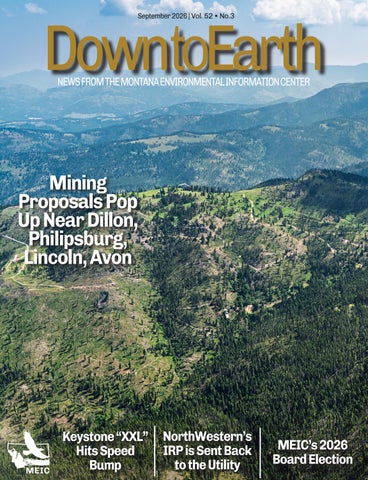
DowntoEarth September 2026 | Vol. 52 • No.3
NEWS FROM THE MONTANA ENVIRONMENTAL INFORMATION CENTER
Mining Proposals Pop Up Near Dillon, Philipsburg, Lincoln, Avon
Keystone “XXL” Hits Speed Bump
NorthWestern’s MEIC’s 2026 IRP is Sent Back Board Election to the CleanUtility and Healthful. It’s Your Right, Our Mission. 1
In This Issue
MEIC is an environmental nonprofit that advocates for present and future generations by protecting Montana’s clean and healthful environment. This publication is printed on recycled paper. Board President: Jessie Wiles
3 Bridger Pipeline Waiver Overturned
14 Vote for MEIC Board of Directors Candidates
4 Rolling Stone Op-Ed: Bridger Pipeline
17 Mining Proposals Popping Up Around the State
Board Members: Jessie Big Knife Michael Durglo Jr. Grace Gibson-Snyder Rob Farris-Olsen Diana Hammer Mary McNally Eva Molina Jeremy Osborn Jim Sayer Roger Sullivan Beth Taylor-Wilson Jesse Therien Meridian Wappett
6 Daines Props Up Declining Montana Coal
18 Energy Proposals Heating up Before Legislature
MEIC Ex. Director: Anne Hedges
8 PSC Returns Deficient IRP
20
MEIC Staff: Caroline Canarios Ben Catton Nick Fitzmaurice Keilin Huang Shannon James Derf Johnson Peyton Olson Denise Roth Barber Katy Spence Julie Wintersteen
24 MEIC Tak 24 akes es Aerial Tour of Helena-Area Mines
9 Exxon Sacks CO2 Pipeline 10 How the NW Power Plan Could Impact Montana 12 Report Reveals Path to Lower Energy Bills 13 Data Center Update Cover photo: Sentinel Metals' exploration mining project underway above the headwaters of the Blackfoot River. Photo by Ecoflight. Interior: MEIC’s Ben Catton (left) flew with a recent Ecoflight to see the sites of proposed Blue Copper and Columbia Gold Projects. Photo by Ecoflight.
2
Feds Try to Nuke Nuclear Protections
21 PFAS Getting Attention in Interim Committees 22 Exempt Wells Continue to Drain Water Resources 23 Legislature Slow to Mitigate Wildfire Risk 24 Supporting MEIC Without Cash 25 Welcome, Keilin! 27 From the Executive Director
Montana Environmental Information Center
Mailing: P.O. Box 1184 Helena, MT 59624 Contact: 406-443-2520 MEIC@MEIC.org www.MEIC.org
by Shannon James
M
ontana could soon become the latest victim in a new tar sands oil pipeline system stretching from Alberta, Canada, to Oklahoma. The proposed Bridger Pipeline Expansion would run roughly 650 miles through eastern Montana ending near Guernsey, Wyoming (see map on pg. 5). From there, the project’s developers, Bridger Pipeline and South Bow, plan to build a subsequent pipeline segment to Cushing, Oklahoma — creating a massive new route for tar sands oil from Canada to U.S. refineries and export markets. This is Keystone XXL. The Bridger Pipeline is currently under review by the Montana Department of Environmental Quality (DEQ) and the Bureau of Land Management. In April, Pres. Donald Trump issued a cross-border permit for the project, even though the state and federal environmental reviews were not complete. The stakes are high. The proposed pipeline would carry more than Keystone XL, up to 1.13 million barrels of tar sands oil per day across Montana’s rivers, aquifers, agricultural lands, wildlife habitat, and areas of significance to Tribal Nations. The route would cross the Yellowstone, Missouri, and Poplar rivers, as well as numerous other smaller rivers and streams, putting Montana’s water and communities at risk from a pipeline carrying one of the most carbon-intensive forms of oil. Just last month, we were reminded that even one spill can have enormous consequences. South Bow, the company that owns a branch of the Keystone Pipeline in the Midwest and is also involved in the proposed Bridger system, agreed to a proposed federal settlement stemming from a 2022 rupture in Kansas that released nearly 540,000 barrels of heavy crude into a creek and nearby farmland. The spill harmed more than 2,700 animals and was the largest onshore crude pipeline spill in the U.S. in nearly a decade. Under the proposed settlement, South Bow would pay more than $26 million in civil penalties and spend an estimated $40 million on measures intended to prevent future spills. But there is some good news in Montana.
Earlier this year, DEQ granted Bridger a waiver that allowed the company to leave out certain financial information and baseline environmental data from its application, including an analysis of alternative routes. Those requirements exist for a reason: the public and regulators need complete information to understand a project’s potential impacts and determine whether the company has the financial capacity to address them. After Earthjustice, on behalf of two Montana residents and MEIC, objected to the waiver, DEQ reversed course in July and revoked it. The agency is now requiring Bridger to provide the missing information and, importantly, the company’s application is considered officially incomplete until it does so. This is a meaningful victory for Montana communities. DEQ’s decision means Bridger cannot simply move forward with an incomplete application while leaving critical questions unanswered. Before the project can advance through Montana’s permitting process, the company must provide the information DEQ originally allowed it to omit. It also demonstrates why public participation matters. Montanans spoke up, challenged a decision that would have weakened the review process, and succeeded in getting DEQ to reconsider. But it raises a bigger question: Why did Montanans have to challenge the agency’s decision before the public was given access to information needed to evaluate a $2 billion pipeline project? The waiver reversal is a step in the right direction, but the fight is far from over. Montana deserves a transparent, thorough review — not a fast-tracked process designed to get a tar sands pipeline built before anyone has a chance to fully understand the consequences. The Bridger Pipeline may be marketed as a new project, but the risks are familiar. We have seen what happens when pipelines spill. We know tar sands oil is among the dirtiest forms of oil. And we know that once a pipeline is built, Montana will live with the risks and consequences for decades.
Clean and Healthful. It’s Your Right, Our Mission.
3
Op-Ed: Trump Wants to Build a New Pipeline Even Bigger than Keystone XL A version of this op-ed ran in Rolling Stone in July.
by Krystal Two Bulls and Anne Hedges
I
f you haven’t heard of the proposed Bridger Pipeline Expansion yet, you’re not alone, and that may be by design. The Bridger Pipeline has misleadingly been dubbed in the media as “Keystone Light” due to its similarities to the now defunct Keystone XL pipeline, though a more suitable name would be “Keystone 2.0” or “Keystone XXL.” If approved, the pipeline could be capable of moving up to 1.13 million barrels of oil per day, far more than the original Keystone XL proposal. The new project also comes with a host of potential significant impacts on the surrounding region and peoples, just as its predecessor did. The pipeline would carry crude oil from Alberta, Canada, south through eastern Montana, terminating in Guernsey, Wyoming. While Bridger Pipeline initially refused to disclose the type of oil it plans to transport, it later confirmed what many suspected after reporters pushed for answers: this pipeline is designed to carry tar sands oil, one of the dirtiest and most environmentally destructive fuel sources on the planet. The company recently announced plans to build a third leg of the project to move the oil to refineries in Cushing, Oklahoma. When you piece it all together, it sounds a lot like an attempt to build a bigger version of Keystone XL. The threat this pipeline poses to Indigenous Peoples and Tribal lands cannot be overstated.The proposed routes for the pipeline could cut through unceded hunting territory guaranteed to the Lakota, Northern Cheyenne, Arapaho, Gros Ventre, Assiniboine, Mandan, and Arikara Tribal Nations under the Fort Laramie Treaty of 1868. It could also cut through the “Warrior Trail” alongside Highway 212, which includes historic sites from the Black Hills War of 1876. It could also cross the Missouri River, which feeds Lake Sakakawea, the primary water supply for the Fort Berthold Reservation, home of the Mandan, Hidatsa, and Arikara Nation. One proposed route would travel directly through the Fort Peck reservation, a critical sage grouse habitat. Water protectors from these Indigenous Nations are raising the alarm to stop the
4
Montana Environmental Information Center
Bridger Pipeline in order to protect the land and water, treaty rights, and sacred sites. The pipeline is backed by True Companies, which reportedly had several significant pipeline spills at other existing facilities, including a 50,000-gallon spill into Montana’s Yellowstone River in 2015 and a 45,000-gallon spill in Wyoming in 2022. The consequences of a potential spill from this pipeline are even more severe with tar sands crude because its chemical and physical properties make it extremely difficult and costly to clean up once it enters the environment. The proposed pipeline could cross the Yellowstone, Missouri, and Poplar Rivers in Montana and the Little Missouri, Belle Fourche, Cheyenne, and North Platte Rivers in Wyoming. On federal lands alone, it could cross water features like streams and rivers over 150 times. This pipeline threatens potentially devastating oil spills into our vital clean water resources. We know if this project goes through, the land, water, our non-human relatives, ways of life, and future generations could be in danger. Why would we risk it all for the fossil fuel industry to profit? The Trump administration issued a crossborder permit for the pipeline in April without ever completing an environmental analysis, consulting with impacted Tribes, or informing the public about the type of oil this pipeline will transport. But Bridger
Bureau of Land Management Miles City Field Office 111 Garryowen Rd Miles City, MT 59301 (406) 233-2800
Bridger Proposed Pipeline Montana Overview
Montana Wyoming
4/8/2026 Proposed Pipeline Route
85
City
Daniels County
Field Office
Divide County
Sheridan County Pipeline still needs several state and federal permits before it can move forward with this Fort Peck Phillips Valley County massive pipeline. Indigenous, conservation, County Williams Roosevelt County County and community groups are joining forces to Glasgow ensure the risks of this pipeline are exposed 2 and that the law is followed. McKenzie Richland County County If agencies fail to properly assess the Sidney potential impacts on the environment or McCone County North Dakota meaningfully obtain free prior and informed consent from impacted Tribes, we’ll see Garfield County Dawson County them in court. Outside of the courtroom, Glendive Golden we’re marshalling the same sort of resistance Montana Valley County Prairie we garnered from communities who united County Wibaux County against Keystone. And we need to speak up CANADA urgently. This moment is critical. § ¨ ¦ Slope Miles City 12 County The Trump administration has ND Fallon MT County Custer County already signalled that it is willing to limit Treasure Rosebud County County public engagement to potentially force Bowman County SD this project through. In the project’s WY NE South Hardin Federal Register notice, the U.S. Bureau Dakota of Land Management states that it “may Carter County Big Horn Northern 212 County Cheyenne provide additional opportunities for public Powder River Crow Harding County participation consistent with the NEPA and County § ¨ ¦ DEQ MEPA processes, including a 30-day Butte County comment period on the Draft EIS,” despite Campbell Sheridan Map via U.S. BLM. Wyoming County Crook County 14 County the fact that project documents indicate Bridger Pipeline is still gathering information about defeated Keystone XL, but Keystone 2.0 could be critical aspects of the project. just as menacing. There’s nothing “light” about this The Montana Department of Environmental new pipeline proposal.The project should concern Quality also appears to be putting its finger on the scale anyone who cares about our waterways, Indigenous in favor of industry. The agency granted an undisclosed communities, endangered species, public health, and waiver to the project that appears to have allowed the the climate. The Bridger Pipeline is a potential disaster company to omit required information from its project waiting to happen. application, and appears to have done so without the It is clear that we have a fight ahead of us. It took public notice or public hearing, as required by law. At years of political pressure, organizing, and multiple recent public meetings across Montana and Wyoming, rounds of litigation to defeat Keystone XL. We did not agencies also failed to allow for oral comment put in years of work on behalf of our communities to opportunities, amounting to tabling opportunities for simply allow the Trump administration and its allies in fossil fuel industry representatives. Northern Rockies states to rubberstamp Keystone 2.0. We have a right to know about the true impacts of It is time for us to get organized once again and time is this pipeline and weigh in on how it will impact our of the essence with this fast-tracked project. We have communities. another tar sands pipeline to kill. If we know one thing about the Trump administration, it is that it will go to significant lengths Krystal Two Bulls is executive director of Honor the Earth to put the fossil fuel industry and its lobbyists before and Anne Hedges is executive director of MEIC. the people and our environment. We ultimately GLASGOW
District Office Interstate
US Highway
County Boundary
BLM Administrative Unit Field Office Boundary
FIELD
Bureau of Indian Affairs
Glasgow Field Office
Bureau of Land Management Bankhead-Jones
OFFICE
Bureau of Reclamation
Department of Defense, Energy, or Corps of Engineers Local Government
National Park Service Private Lands State Lands
US Fish and Wildlife Service National Wildlife Refuge US Forest Service
MILES CITY
US Forest Service - National Grasslands Water
FIELD OFFICE 94
Miles City Field Office
0 0
40 Miles
Eastern Montana/daks District Office
90
50 Kilometers
No warranty is made by the Bureau of Land Management as to the accuracy, reliability, or completeness of this map or the data displayed for individual use or aggregate use with other data.
Clean and Healthful. It’s Your Right, Our Mission.
5
Montana Coal: The Writing’s on the Wall, but Sen. Daines Can’t Read It
by Derf Johnson
C
ontrary to Pres. Donald Trump’s foolhardy and expensive policies, the long-term, structural decline of coal for energy use continues under this administration, both here in Montana and across the United States. Year-to-date numbers for 2026 from the U.S. Energy Information Administration show that Montana mined approximately 12.3 million tons of coal through the beginning of August 2026, which represents a 14% decline from this time last year. If current production rates hold for the remainder of the year, Montana will not have mined this little coal since at least 1975, when modern coal mine production began in the Powder River Basin. That’s a big deal, especially considering that electricity demands continue to be met and exceeded. Clean energy is now a popular option for developers and utilities, with production costs continuing to drop and market penetration for renewables continuing at a steady pace (see story on pg. 11). Case in point; the world added a jaw-dropping record 814 gigawatts of new wind and solar capacity in 2025, a 17% increase over the 2024 additions. This past May, solar in the U.S. supplied more electricity than coal for the first time ever (12.8% to coal’s 12.2%). Solar coupled with wind supplied close to 20% of the overall electricity demand in the U.S. in 2025. There are enormous opportunities in the clean
6
Montana Environmental Information Center
The Signal Peak Mine is dewatering precious resources in the Bulls. Photo by Chris Boyer.
energy sector for economic growth, employment, a sustainable tax base, and rural economic diversification. And yet, certain politicians continue to throw good money after bad through subsidies to the coal industry, as well as continue their attempt to weaken laws that protect public health and the environment. All of this with the goal of propping up an industry that can’t stand on its own and is clearly bound for retirement.
Signal Peak Coal Mine Dewaters the Bull Mountains
The Bull Mountains are a unique, semi-arid mountain range in central Montana, just north of Billings. The range is known for its unique and diverse wildlife, including an excellent elk population as well as dozens of family ranches that support the local economy. Unfortunately, for the past two decades, the modern iteration of coal mining — underground longwall mining — has been taking place directly below the Bulls, and the consequences have been dire. The mine is owned and operated by Signal Peak, which is in turn owned by a consortium of three bad actors, including a Swiss company known as Gunvor with ties to Vladimir Putin that was recently acknowledged by the Treasury Department as being the “Kremlin’s
puppet.” Signal Peak exports virtually all of its coal overseas to South Korea, China, Japan, and Chile, where it can fetch a far higher price. There’s also the benefit of avoiding appropriate royalty payments to the federal and state governments because of complex and dubious corporate structures that force the federal government to calculate the royalty payment at the mine mouth rather than the overseas point of sale. Due to the semi-arid nature of the Bull Mountains, the springs and seeps that do occur are absolutely essential for cattle ranching and wildlife. Unfortunately, as Signal Peak undermines the Bulls, water sources are being impacted or entirely dewatered. This process has directly affected numerous ranching operations and almost certainly displaced wildlife that depend upon the intermittent sources of water located throughout the Bulls. Because Signal Peak is destroying the water of the Bull Mountains and emitting enormous amounts of greenhouse gas pollution (approximately 14 million tons of CO2 from coal combustion in 2025), a judge prohibited mining of federal coal in 2019 until the U.S. Office of Surface Mining actually conducted an adequate analysis under the National Environmental Policy Act that fully considered the environmental problems associated with the mine. That process was underway until last June, when the Trump Administration rushed approval of the mine under the pretext of an “energy emergency,” freeing up the ability of the mine to once again impact federal lands. The legally questionable “energy emergency” is now being challenged by MEIC and our partners in federal court (see March 2026 Down to Earth for more information).
Sen. Daines’ Bull Mountains Land Privatization Scheme
In the face of overwhelming market pressures and the serious environmental damage caused by coal mining in the Bull Mountains, Sen. Steve Daines and his colleagues in the Montana delegation continue to push legislation inappropriately titled the “Crow Revenue Act.” The revamped legislation passed out of the Senate Committee on Indian Affairs on a 6-5 party
line vote on August 5. Its ultimate goal is to privatize federal public lands and the coal they contain within Signal Peak’s mine boundary so that the company is exempt from having to comply with federal law. In order to privatize the federal public land and coal, Sen. Daines’ legislation would transfer federal ownership to the Hope Family Trust, a private trust that is set up to benefit individual members of the Hope family. The Hope family would receive an extreme windfall in this deal. Along with the coal being transferred comes the royalty payments that were previously being paid to the public, which will amount to tens of millions — if not hundreds of millions of dollars — over the life of the mine. As part of this exchange, the Hope family will transfer its ownership of subsurface coal on the Crow Reservation to the Crow Nation. The Hope family will not have to transfer any surface rights to the Crow despite acquiring surface rights in Sen. Daines’ bill to the public lands above the Bull Mountain mine. The legislation does not guarantee revenue for the Tribe. While it suggests that the Crow Tribe will share in the revenue from the Signal Peak operation with the Hope Family, it does not require such an agreement, nor spell out the terms of an agreement to assure that the Crow share equally in the proceeds. With the surface lands not being transferred, the potential benefit to the Tribe will simply be a paper exercise. Additionally, the coal being transferred to the Tribe on the reservation is highly unlikely to be developed as it is not near any existing infrastructure and the state of the coal industry is such that mining is not economically viable. One has to ask: what benefit does the average Montanan receive in this deal? We lose out on the royalty payments that were previously going towards funding our local, state, and federal government; we continue to let a conglomerate of bad actors trash the land and water of the Bull Mountains; we contribute to the climate crisis and hotter, drier summers; and we continue to subsidize a dying industry, all the while suffering the opportunity costs of failing to recognize and support the fastest growing industry in the United States — solar and wind. It makes you wonder, who is Sen. Daines actually representing? And who is the Hope Family Trust that is making out like a bandit?
Clean and Healthful. It’s Your Right, Our Mission.
7
A Crossroads for Montana’s Energy Future by Nick Fitzmaurice
I
t’s easy to get lost in the wonky policy, regulatory, and technical weeds when engaging on energy issues in Montana. In fact, it often seems that NorthWestern Energy obscures its intentions behind the veil of complicated accounting and regulatory procedures. The utility’s iterative 20-year Integrated Resource Plan (IRP) is no exception. However, no matter how complicated these processes become, what’s at stake is quite simple: the affordability and reliability of Montana’s energy future, and the persisting health and stability of our environment and climate for present and future generations. The Public Service Commission’s (PSC) public comment window for NorthWestern’s 2026 IRP concluded in July, and MEIC, our partners, and the public emphatically told the PSC that NorthWestern must do better. Not a single person expressed support for NorthWestern’s plan at the PSC’s public meetings. The PSC’s 120-day statutory timeline for reviewing NorthWestern’s IRP would have concluded in late August, but that’s assuming that NorthWestern filed
a complete plan. The Commission is allowed to return IRPs if they don’t meet minimum filing requirements. The PSC’s consultant, GDS Associates, released its report on its independent review of NorthWestern’s IRP at the beginning of August. The report strongly critiqued the IRP’s modeling and affirmed numerous concerns that MEIC and the public had previously raised. Broadly, the consultant determined that “although no single issue is necessarily a critical deficiency, the combined effect is a planning framework that appears predisposed toward identifying additional resource need.” GDS went on to explain that “until the most significant issues identified in this review are addressed, particularly those related to load forecasting and resource adequacy methodology, the Commission should carefully scrutinize claims that additional resource acquisitions are necessary, prudent, or urgent.” GDS also critiqued NorthWestern’s undervaluation of demand-side resources, its lack of transmission modeling, its resource accreditations and reliability assumptions, its modeling limitations for energy
NorthWestern’s IRP modeling assumptions systematically bias the model toward expensive and damaging coal, gas, and nuclear generation and away from low-cost clean energy resources such as wind, solar, and storage. For example, NorthWestern’s assumptions for solar capital and O&M costs lead to price projections that are tens to hundreds of percentage points higher than standard industry projections.
8
Montana Environmental Information Center
storage, its undervaluation of hybrid renewablestorage resources, its overreliance on projected market revenues, its refusal to model carbon pricing and the model configurations’ inconsistency with the company’s Net Zero by 2050 goal, the lack of transparency and replicability of NorthWestern’s modeling software, and other modeling biases. Importantly, the consultant reported that “GDS cannot, however, conclude that the IRP meets the minimum legal requirements.” The Commission voted to return the IRP to NorthWestern on August 18, giving the utility 30 days to correct the identified statutory deficiencies. This is thanks to the strong critique from GDS Associates, MEIC, and our partners and experts; the public’s outpouring of opposition to the plan; and the PSC staff’s willingness to propose a strong recommendation to the Commissioners. However, NorthWestern refused to modify its IRP modeling as far back as October 2025 when model results were first presented to the utility’s technical advisory committee, so it seems unlikely that the major flaws biasing the modeling
Exxon Abandons Dangerous Tax Avoidance Scheme
by Nick Fitzmaurice
I
will be corrected within 30 days. The Commission’s order told NorthWestern that if it cannot fully satisfy requirements, it should request additional time or explain its inability to fully meet requirements. As of this writing, NorthWestern had not yet filed any IRP updates, extension requests, or explanations of its inability to comply. Regardless of NorthWestern’s next move, the findings of the consultant’s report will have major implications for future proceedings. We’ve shown up at this milestone to hold NorthWestern accountable for pervasive flaws throughout its modeling that led to unrealistic planning results. We’ll show up again when NorthWestern next tries to build or acquire additional generation resources. And we’ll show up yet again when NorthWestern next asks the PSC to adjust its rates. We show up time and time again to hold the utility accountable and to steer Montana incrementally toward a cleaner, more affordable, and more reliable energy future, because we know what’s at stake.
n July, ExxonMobil subsidiary Denbury Inc. withdrew its application to the Bureau of Land Management (BLM) to inject carbon dioxide (CO2) underground in southeast Montana’s Carter County. Exxon stood to rake in over $12.7 billion in federal tax subsidies from this project, rewarding the company for its continued extraction and processing of planetwarming methane gas at the company’s Shute Creek Treating Facility in Wyoming, 500 miles from the proposed site in Montana. CO2 pipelines are dangerous, and when one of Denbury’s pipelines in Mississippi ruptured in 2020, 45 people in the sparsely populated surrounding area were hospitalized. Denbury operates existing CO2 pipelines in eastern Montana for harmful enhanced oil recovery, with one rancher filing a legal complaint against the company in 2023 surrounding 16 identified leaks and ruptures on his land over the course of a decade.
MEIC commented in opposition to Denbury’s project several times since the BLM first opened a public review period in 2023. We also worked with partners at the Western Environmental Law Center and the Northern Plains Resource Council to challenge the project and share information with the public. Local opposition overwhelmed the BLM’s record, and in July 2025, the BLM granted Denbury only a limited right of way through BLM land to access its proposed test well site on state land. However, Denbury never used its test well. The project proposed 15 injection wells, three of which were located on parcels of state land. MEIC lobbied to successfully kill SB 81 (Sen. Josh Kassmier, R-Fort Benton) in the 2025 legislative session, which would have allowed for the injection of CO2 under state lands. In the face of these mounting roadblocks and strong public opposition, Exxon abandoned the project.
Clean and Healthful. It’s Your Right, Our Mission.
9
Another Important Regional Electricity Plan
by Nick Fitzmaurice
N
orthWestern Energy’s Integrated Resource Plan (IRP) isn’t the only plan that will impact the future of Montana’s energy system. The Northwest Power and Conservation Council, created by the federal Northwest Power Act of 1980, recently released a draft of its 9th Northwest Regional Power Plan. This 20-year planning document is similar to utility IRPs, but rather than analyzing the needs of a given isolated utility, it examines comprehensive needs across the Northwest states of Montana, Idaho, Oregon, and Washington. While individual utilities aren’t necessarily obligated to follow recommended planning outcomes, these plans are a unique opportunity to take a broader look at needs of the Northwest electric grid and to understand how decisions made by individual utilities play into a larger mosaic of regional electric reliability. The plans are particularly consequential to the Bonneville Power Administration (BPA), a semiautonomous federal electricity and transmission marketing agency that covers much of the Pacific Northwest. BPA sells power from federally owned and operated hydroelectric dams in the Northwest, along with power from a handful of other generating facilities, and owns and operates over 15,000 miles of high-voltage transmission lines along with hundreds of electric substations across the region. The Northwest Power Plan functions almost like an IRP for BPA, establishing the agency’s energy conservation and resource acquisition priorities. The Council consists of eight individuals (two appointed by the governor of each Northwest state) and is supported by a central staff in Portland and local staff in each Northwest state. Like IRPs, the Northwest Power Plan is an iterative planning document and is revisited every five years. Unlike traditional utility IRPs, however, the Northwest Power Plan includes a standalone Fish and Wildlife Program to mitigate the impacts of BPA’s hydroelectric system operations on fish and wildlife in the Columbia River Basin. The Fish and Wildlife Program influences the operations of BPA’s hydroelectric system (when and how much water to discharge), which determines how much power these facilities are anticipated to generate throughout the
10
Montana Environmental Information Center
CANADA
BPA Service Area BPA Service Area Boundary State border Columbia River Basin
ª
Seattle Spokane WASHING TON
0
Miles 50
100
MONTANA
Yakima
Helena
Pacific Ocean
Salem
Portland
Eugene
Coos Bay
OREG ON
Idaho Falls
Boise
Twin Falls
Medford
CALI FO RNIA
WYO MI NG
IDAHO
NEVADA
UTAH Great Salt Lake
planning horizon. This becomes a fundamental input for the Northwest Power Plan. The Council conducts much more sophisticated modeling than NorthWestern’s IRP and demonstrates major priorities for energy conservation, demand response resources, renewable energy development, and energy storage. However, influenced by the Council’s two Montana members — Council Chair and former Montana Speaker of the House Mike Milburn and former Flathead Electric Coop Trustee Douglas Grob — the plan also prioritizes major and unnecessary gas investments across the Northwest. It is important that the public pushes back on the plan’s reliance on new gas infrastructure. Gas is not only expensive and environmentally damaging, but it is dependent on extremely constrained and volatile supply chains for turbines and fuel. It is also not necessary for system reliability with adequate deployment of renewables, energy storage, and interregional electric transmission infrastructure. MEIC is working closely with regional partners, particularly the NW Energy Coalition, to review the draft plan, provide comments to influence the Council’s finalization of the plan, and to mobilize the public to do the same. The draft was released on August 13, kicking off a 65-day public comment window concluding October 16 and including public meetings in each of the four Northwest states. Comments can be submitted through the Council’s website, which is linked on MEIC’s Action Center, and stay tuned for more information about the Council’s public meeting in Montana, tentatively scheduled for October 5.
Renewables Remain Competitive Amidst Inflation, Fluctuation With all this activity around regional energy planning, it’s important to take stock of the current cost landscape for various energy resources. Lazard, a major multinational financial advisory and asset management firm, conducts exactly this comparison in its annual Levelized Cost of Energy (LCOE) analysis. Lazard released its 19th LCOE analysis in July, measuring and comparing the average, unsubsidized per megawatt-hour total cost to construct and operate various energy resources over their entire operating lives. While inflation, supply chain constraints, and other pressures have increased the costs of all energy resources, and the elimination of federal renewable energy tax credits has stifled renewable energy incentives, Lazard still finds that “unsubsidized renewable energy remains the most cost-competitive form of new-build generation.” Lazard’s analysis displays a range for the levelized cost of each resource, representing the lowest and highest levelized costs for a given resource based on the most favorable or adverse development and operational conditions. These ranges demonstrate that utility scale solar and onshore wind enjoy lowest overall costs, while nuclear and gas peaking facilities represent the most expensive generation sources.
Values for new-build geothermal and coal resources are based on inflationadjusted data going back to Lazard’s 2014 analysis given limited recent development of these resources,2 though Lazard does include a publicly disclosed estimate for new geothermal technology.5 Cost estimates for nuclear are based on Vogtle units 3 and 4 which came online in 2023 and 2024,4 with an illustrative but unsupported estimate for small modular nuclear reactors.8 Lazard also includes an industry-provided illustrative estimate for restarting closed nuclear facilities,7 though these costs are very likely underestimated, along with cost estimates for operating fully depreciated thermal generation facilities.6 Lazard’s full LCOE analysis can be found online.
Clean and Healthful. It’s Your Right, Our Mission.
11
Lower Peaks in Electricity Use Means Lower Bills by Nick Fitzmaurice
M
EIC recently worked with scientist and science journalist, Karin Kirk, to develop a report that challenges NorthWestern Energy’s assertion that it needs to build additional expensive fossil fuel-fired power plants. The report identifies and provides examples of the many alternative ways a utility can address the high-demand periods for electricity that occur during cold snaps and heat spells. While building large new power plants may benefit utility executives and shareholders, it’s a disaster for utility customers, public health, and the climate. MEIC and Montanans for Affordable Energy submitted Kirk’s report “Taming the Peaks” to the Montana Public Service Commission during the comment period on NorthWestern’s Integrated Resource Plan (IRP) to demonstrate that addressing peak electricity demand reliably can be achieved in more affordable and environmentally sound ways than what NorthWestern has proposed. The report is an excellent compilation of strategies being utilized elsewhere that avoid building expensive new generating infrastructure for the few hours throughout the year when utilities actually experience peak demand. The report also has implications beyond NorthWestern’s IRP, as the measures it explores can and should be incorporated as a central tenet of all energy decisions made in Montana and across the nation. “Peaks” are the daily and seasonal high-water marks of electricity demand within a given area on the electric grid, such as the area of the grid that NorthWestern Energy manages. Daily electricity peaks often occur on weekday evenings when people return from work, turn on air conditioners or heaters, and simultaneously start using other household electric appliances. Seasonal electricity peaks occur in the hottest and coldest months of the year when space heating and cooling needs are at their highest. While many utilities face their highest annual peaks either in the summer or the winter, NorthWestern is among the utilities that experience similarly high peaks in both the summer and winter seasons. While daily peaks outside of peaking seasons are easily manageable with standard grid operations, daily peaks that coincide with the hottest and coldest days
12
Montana Environmental Information Center
of the year require more involved problem-solving to address cost-effectively. Unfortunately, NorthWestern is in the business of spending money to make money, so it opts for the brute force solution: building expensive generation infrastructure for those rare peak events, then keeping that infrastructure idle the rest of the year while ratepayers remain on the hook for construction, operation, and maintenance costs. Kirk’s report shows that there is another, much more affordable way through five key strategies, providing examples of other utilities that are currently employing those strategies. These key strategies are: Grid Utilization, Battery Storage, Demand Response, Interregional Transmission, and Electricity Markets. All of these strategies effectively achieve the same outcome by different but complementary means: meeting existing and future electricity demand not by building major new infrastructure for the 1% of the year when it is needed, but by utilizing existing infrastructure, technologies, and strategies in ways that change the way peak demand shows up and is served. The electric grid spans the entire United States, and peaks occur at different times and seasons in different geographic regions. Coordinating electric generation and demand both in time and space allows for existing infrastructure to go much further, keeping costs down while maintaining the same level of reliability. Karin Kirk’s full “Taming the Peaks” report can be found on MEIC’s Resources webpage.
Data Centers Everywhere, and No Regulation in Sight by Anne Hedges
M
EIC and our partners are working hard to convince the Montana Public Service Commission (PSC) to protect electricity customers from paying higher utility bills because of data centers. So far, the PSC has been slow to respond to our efforts but is willing to move forward a duplicitous proposal by NorthWestern Energy to provide electricity to data centers. The question is, will the PSC protect electricity customers or will it bow to NorthWestern Energy’s shareholders and data center developers?
No Good News on Tariffs… Yet
Last fall, Earthjustice, on behalf of MEIC and numerous partners, filed a petition with the PSC requesting regulations to protect existing utility customers from subsidizing the costs for NorthWestern Energy to serve electricity to data centers. The PSC finally asked NorthWestern to respond to our complaint in February. It has yet to do so. Instead, NorthWestern filed a milquetoast data center tariff with the PSC. (Tariffs are a set of rules detailing how a utility provides electricity service to a customer.) We’ve asked the PSC to consider our data center tariff proposal with NorthWestern’s in the same docket to ensure its ability to consider the broader suite of options to protect existing customers. NorthWestern objected, likely hoping to constrain the PSC from considering more protective provisions. This process is ongoing. A PSC hearing about new regulations to protect existing customers from subsidizing NorthWestern’s provision of electricity to data centers is currently scheduled for March 2027.
A Step Towards Transparency
In July, NorthWestern Energy finally released the contents of its heavily redacted Letters of Intent with specific data centers. Last fall, the PSC allowed NorthWestern to keep these agreements secret. Despite strong legal arguments made by Earthjustice on behalf of MEIC, Honor the Earth, and NW Energy Coalition, the PSC did what NorthWestern asked. In July, NorthWestern unexpectedly submitted the unredacted documents to the PSC, arguing that
it had no legal obligation to do so and is allowed to keep any future agreements secret. The agreements contained a few important points. First, Sabey Data Centers is proposing 500 MW of data centers, not 250 MW. That’s equivalent to about two-thirds of NorthWestern’s average customer demand for electricity. Second, NorthWestern refuses to provide the location of Sabey’s second proposed site in ButteSilverbow County.
In Other Data Center News...
Eastern Montana is getting hammered by cryptocurrency data centers. In recent years, 22 cryptocurrency data centers have sprung up near the North Dakota border, most within a 13-mile radius of each other. These facilities claim to divert methane from gas wells that would otherwise be flared. They use that gas to run highly polluting engines to run cryptocurrency mining operations. Combined, these facilities have the potential to emit the same amount of many harmful air pollutants as the Hardin coalfired power plant. DEQ has permitted these facilities without analyzing the cumulative impacts of having so many of these operations within a small area. The data center proposed at the old mill site in Bonner appears to be shelved… for now. Krambu, the data center developer, refused to provide the details of its proposal despite repeated requests from Missoula County. Even the size of the facility remained unclear, vacillating between three and 100 MW. The mill owner, responding to community concerns, finally cancelled Krambu’s lease for the site. It’s unclear if Krambu intends to build at another location but for now, Missoula County is moving forward with updating its data center regulations. Go Missoula! MEIC continued with its public education campaign on data centers, holding a public meeting in Broadview in June to discuss Quantica’s hyperscale data center proposal for 1,785 megawatts of new methane gas plants and the ability to pull 7,235 MW of power from the grid, making it one of the largest proposals in the nation. We also were invited by student volunteers with the Park County Environmental Council, to speak at a well-attended data center forum in Livingston.
Clean and Healthful. It’s Your Right, Our Mission.
13
2026 Board of Directors Election It’s time for the annual MEIC Board of Directors election. Please cast up to seven votes. Only MEIC members can vote; MEIC members are those who have contributed financially within the last year. Subscribers and business corporations are not eligible to vote. To vote by mail: • Complete the enclosed postage-paid card and mail it back to MEIC in time to arrive by October 20, 2026. To vote online: • Scan the adjacent QR code with your smartphone’s camera to access the online ballot. • Or submit votes online at https://tinyurl.com/MEICBoard2026 by October 20, 2026. Not sure if you’re a current member? Email Denise Roth Barber at drothbarber@MEIC.org to check the status of your membership. Thank you for your participation!
Jessie Wiles (she/her), Helena
I hope to continue to serve on MEIC’s board because I am committed to the organizational background work that keeps MEIC a healthy, functioning organization. Beyond the practical value of continuity, the work itself remains meaningful. There’s real satisfaction in seeing the tangible effects of the work that the Board does in helping to sustain MEIC’s operations. Finally, boards work best with a mix of experienced and fresh perspectives, and remaining involved allows for mentoring newer members while still contributing the judgment that comes from having seen the organization through its recent challenges. It’s an honor to serve on this Board!
Steve Running (he/him), Missoula
I have been with the University of Montana-Missoula since 1979, now as a University Regents Professor Emeritus of Global Ecology. My primary research interest is the development of global ecosystem biogeochemical models integrating remote sensing with bioclimatology and terrestrial ecology. I have worked in the NASA Earth Observing System since 1981 and developed the EOS MODIS global terrestrial net primary production and evapotranspiration datasets. I have published more than 300 scientific articles and two books, and for many years have been designated a Highly Cited Researcher. Before retirement, I chaired the NASA Earth Science Subcommittee followed by co-chairing the Committee on Earth Science and Applications from Space for the National Academy of Science. I was a chapter Lead Author for the Intergovernmental Panel on Climate Change (IPCC) which shared the Nobel Peace Prize in 2007, and in 2014 led the Forest chapter of the National Climate Assessment. I am an elected Fellow of the American Geophysical Union, and received the E.O. Wilson Biodiversity Technology Pioneer award. In the popular press, my essay in 2007 “The 5 Stages of Climate Grief” has been widely quoted. I consider MEIC to be the most effective NGO I contribute to and would love to join the board.
14
Montana Environmental Information Center
Dave Chadwick (he/him), Helena I have worked for the last 30 years on public policy and public affairs, with an emphasis on wildlife conservation and environmental protection. I moved to Montana about a dozen years ago to work for the Montana Wildlife Federation; before that I worked for state government in Colorado, and spent some time in Washington, D.C. working on a range of environmental policy issues. I currently work as a freelance consultant, assisting conservation organizations around the country with a variety of strategy, advocacy, and capacity needs. I believe science, trust democracy, and enjoy big ideas. We still have time left to protect the land, water, and wildlife that make Montana a great place to live and a destination for visitors from all over the world — but the window is closing. I am eager to help MEIC continue to lead the fight to Keep Montana Montana by mobilizing people to protect what we have and restore what we’ve lost.
Nels Johnson (he/him), Bozeman One hundred Montanans gathered in Helena in 1972 for the first and only state constitutional convention since Montana statehood in 1889. The new constitution included inalienable rights to a clean and healthy environment and a directive to state government to maintain and improve the environment. With Montana’s long and proud history of environmental protection now under assault at the state and federal level, I can think of no more important calling than to serve on MEIC’s board of directors. I grew up on the Great Plains in North Dakota with family roots in Montana followed by college in Oregon (Reed College) and graduate school in Connecticut (Yale School of the Environment). My career in international conservation and U.S. climate and energy policy has included research and program management at the World Resources Institute and The Nature Conservancy, where I was most recently director of TNC’s North America Renewable Energy Strategy. I also served as board member and chair of the Pinchot Institute for Conservation. After four decades of work around the world, I’m still firmly convinced that Montana is the best place on the planet! My wife Eileen and I live in Bozeman when we’re not exploring back roads and hiking trails across the West.
Karen Jarussi (she/her), Billings I grew up in big cities in Texas. In 1979, I spent three weeks in northwestern Montana and was smitten. The next spring, I moved up “for the summer” and have been here ever since. After graduating from law school at the University of Montana in 1987, I began a federal judicial clerkship in Billings. A two-year term turned into a career position for 19 years, under two different Judges. Billings is still home, where I live with my husband of 36 years and our sweet pup Gemma Jo. The Hatch Act precluded involvement in many activities while working at the Court. I volunteered as a child advocate and served two terms on the Board of Directors of Yellowstone CASA. Since retiring, I have worked with several political campaigns, assisted with public interest litigation, joined a NPRC Laurel methane plant task force, and recently, gathered signatures for the Yellowstone County Data Center Ballot Initiative. I worry about climate change and other threats to our environment. I want my grandkids to be able to thrive and live full lives. MEIC is at the forefront of many of the issues we face, and I’d be honored to join in that work.
Clean and Healthful. It’s Your Right, Our Mission.
15
Mary Costello (she/her), Trout Creek I first moved to Montana in the early ’90s and own a home in Trout Creek. I have an undergraduate Biology degree in Conservation from Kent State and an M.S. degree in Avian Ecology from Iowa State. I was drawn into environmental work by my love of wilderness. I am a co-founder and the director of both the Rock Creek Alliance and Save Our Cabinets, which are two grassroots nonprofits addressing proposed mines beneath Montana’s Cabinet Mountains Wilderness in northwestern Montana. I have been working on mining issues in the Cabinet Mountains for 30 years. I have been privileged to work with MEIC staff for many years, and still do. MEIC is a phenomenal group effectively tackling hard core issues. I am honored to be invited to serve on its board and hope I can bring a “grassroots perspective.” In my spare time, I am an avid birder and enjoy hiking, mountain biking, and backpacking.
16
Montana Environmental Information Center
Multiple Mining Projects Make a Charade of Public Participation by Ben Catton
M
o n t a n a ’ s Constitution gives citizens powerful promises: the right to know what their government is doing and the right to participate before the government makes decisions that affect them. Yet, a growing push to expedite mineral exploration threatens to downgrade those rights into little more than box-checking exercises and hollow out that constitutional promise. Montanans know that mining impacts can last generations and that permitting decisions deserve a hard look, careful planning, and meaningful consideration of public input. Haste makes waste. The Sentinel Metals Columbia Gold Project, situated at the headwaters of the Blackfoot River near Lincoln, illustrates the problem. In June, the Montana Department of Environmental Quality (DEQ) approved an amendment to an exploration permit allowing up 21 drill holes totaling more than 14,000 feet of drilling. The draft Environmental Assessment (EA) drew a staggering 8,736 comments. But when the public was commenting, critical information was missing; the underlying exploration permit and related documents were not made available by DEQ until after the comment period closed, despite an information request from MEIC and Clark Fork Coalition that preceded the comment period and a request for the extension of the comment period due to this lack of information. MEIC and Clark Fork Coalition had to file suit, arguing in court that withholding documents necessary to understand the proposed amendment deprived Montanans of meaningful participation. It’s more than a technical dispute. The right to participate means little if citizens are deprived of the necessary information to evaluate their government’s
proposals and decisions. The Blackfoot River has already endured a legacy of disastrous mining impacts (see June 2026 Down to Earth). Careful scrutiny of new exploration is warranted. The Little Blackfoot watershed and the communities of Avon and Elliston face a similar concern with Falcon Copper’s Blue Copper Project, an exploration proposal impacting 10,816 acres of public lands. Falcon Copper plans as many as 127 drill pads and 700 drill holes, with nearly continuous operations over five years. The project would consume up to 24,000 gallons of water per day. Local residents have raised concerns about water, grazing, livestock, traffic, hunting, and recreation. The project also lies in habitat used by grizzly bears, Canada lynx, and wolverines. It affects the Little Blackfoot watershed, including already impaired waterways: the legacy of mining in Montana. For a project of this magnitude, 30 days of public comment and no Forest Service public hearing are inadequate. An Environmental Impact Statement (EIS) is justified, as it would provide a deeper analysis of alternatives, cumulative impacts and mitigation, and give the public a more meaningful opportunity to understand what five years of industrial exploration
story continues on pg. 25 Clean and Healthful. It’s Your Right, Our Mission.
17
by Nick Fitzmaurice
M
ontana’s 2027 Legislative Session is still more than three months away, but the Governor’s Energy Task Force and the legislative Energy & Technology Interim Committee (ETIC) have already been developing legislative concepts and draft bills to shape the energy landscape in 2027 and beyond. The Task Force released its final report and recommendations for the Governor in August and held its final meeting on August 25. Some of the Task Force recommendations parallel legislative developments coming out of ETIC, but it remains unclear how other policy proposals will be translated from Task Force recommendations to actual bills in the 2027 Session. In many cases, MEIC would prefer these recommendations don’t find their way into the 2027 Legislative Session. After being heavily criticized for failing to consider the concerns of Montana consumers struggling to pay their bills, the Task Force feigned concern while simultaneously developing recommendations that would benefit data center developers and the utilities hoping to serve them electricity, all at the expense of existing ratepayers. ETIC, on the other hand, planned to hold its final meeting of the interim on September 9, after this writing. It was slated to vote on moving specific legislation forward to the 2027 Session with the committee’s endorsement.
ETIC Bills
ETIC was scheduled to vote on endorsing the following legislation at its September meeting: • Shared Solar: Given the strong utility opposition to the bill in 2025, some tweaks have been made to this legislation to make it more palatable to utilities and the Governor, who vetoed the bill. MEIC’s hope is that these tweaks will not diminish the benefits that shared solar can provide to Montana ratepayers. ETIC is looking to build on momentum from last session to bring this bill back with committee support and get it over the finish line in 2027.
18
Montana Environmental Information Center
• Data Center Consumer Protection: MEIC has also been working closely with legislators as ETIC drafts a bill to ensure ratepayer protection from data center development. Specifically, the bill would require utilities to develop a dedicated data center customer class to isolate all costs associated with serving such facilities. This would ensure that data centers pay all of the short- and long-term costs for the utility to provide them with electricity and infrastructure, and would prevent any of these costs from being passed onto existing customers. • Grid Utilization: Legislators in Virginia recently passed bipartisan legislation to require utilities to observe and publicly report on a number of metrics indicating to what extent existing grid infrastructure is being utilized. The idea is that where infrastructure is underutilized, utilities can increase utilization rather than making major additional infrastructure investments to improve the affordability of the entire system. While increased interregional transmission connectivity remains necessary, especially during times of peak demand, many pieces of the electric grid likely are only partially utilized most of the time. This concept comes from model legislation promoted by a nonprofit organization called the Utilize Coalition. MEIC believes it is a no-brainer to, at a minimum, require that this information is tracked and publicly available. Then, Montana can determine whether we can increase utilization of any existing grid infrastructure to improve affordability. • Energy Authority: Rep. Gary Parry (R-Colstrip) has indicated throughout the interim that he intends to revive his Energy Authority proposal that MEIC opposed in the 2025 session. Rep. Parry’s primary motive with this legislation is to force a nuclear energy future on Montana regardless of the costs and risks. MEIC continues to advocate for winnowing this concept down to a Transmission Authority, similar to agencies that have been established in other Western states, to address our pressing transmission needs without dragging
generation into it. While MEIC had not yet seen a draft of this legislation for ETIC’s consideration as of this writing, it seemed likely that this would be considered at the September ETIC meeting. • Geothermal bills: MEIC has weighed in as ETIC drafted two bills related to geothermal energy development in Montana. The first bill would establish a comprehensive regulatory framework for permitting and developing geothermal projects in Montana. The second, much shorter bill would appropriate funds for the Montana Bureau of Mines and Geology to finish a survey of Montana’s potential geothermal energy resources. ETIC voted at its May meeting to pre-introduce the following bills for next session. (Read more about these legislative proposals in MEIC’s June Down to Earth.) • PSC Restructuring from Elected to Appointed • Interstate Transmission Compact
Governor’s Task Force Recommendations
• Reform Utility Regulation: This recommendation is similar to PSC restructuring legislation developed by ETIC. • Strengthen Energy Leadership for Montana: This is the Task Force’s response to Rep. Parry’s Energy Authority proposal, still with the potential for unduly prioritizing expensive and risky fossil fuel and nuclear generation resources. • Advance Regional Markets and Transmission Development: MEIC has appreciated the Task Force’s work supporting necessary markets and electric transmission development. However, MEIC is concerned about the Task Force’s additional focus on investing in the gas transmission system, which would bake unnecessary costs and environmental harm into Montana’s energy system for decades.
• Drive Economic Development: This is code for “build data centers and supply them with dirty coal and gas generation at existing ratepayers’ expense.” • Right-size Energy Tax Framework: And this is code for “hand out more tax breaks to data centers and fossil fuel energy developers.” • Build Innovative, Reliable Power Supply: This topic is a mixed bag. MEIC appreciates that the task force, like ETIC, has taken an interest in establishing a regulatory framework for geothermal energy development in Montana. However, MEIC remains concerned about the Task Force’s much bigger priority of forcing an expensive and risky nuclear energy future onto Montana. • Optimize Grid Utilization and Control Consumer Energy Costs: Similar to grid utilization legislation contemplated by ETIC, this recommendation has an additional focus on energy efficiency measures and distributed energy resources (DERs), i.e. small-scale, local solar, and batteries. This is a great recommendation that was not included in Task Force discussions until it was brought up time and time again by stakeholders external to the Task Force membership. This recommendation hints at supporting legislation to enable community solar in Montana, and also encourages exploring other opportunities for DER development and coordination. The Task Force’s entire report can be found on the DEQ’s webpage, where the public can submit comments on the recommendations. While these legislative developments give a sneak peek into what to expect this session, legislators will certainly develop additional energy legislation in the coming months and throughout the session. MEIC will also be working on our own initiatives, and we’ll continue to track and share legislative developments as they arise and our work transitions to the halls of the Capitol come January.
Clean and Healthful. It’s Your Right, Our Mission.
19
Feds Try to Nuke Nuclear Protections by Shannon James
M
EIC has been closely tracking the rapid push to deregulate nuclear power over the past few years. That effort has accelerated dramatically in recent months, with the federal government moving to weaken environmental review, shorten licensing timelines, and roll back longstanding radiation protections in an effort to speed up nuclear development. The changes will have lasting consequences for communities and the environment. The push is fueled by growing electricity demand from artificial intelligence and data centers, but it goes far beyond meeting new energy demand. It represents a fundamental shift in how nuclear power is regulated and how much oversight the public can expect. One of the most significant recent changes involves the National Environmental Policy Act (NEPA). The Nuclear Regulatory Commission (NRC) has proposed a sweeping overhaul of its environmental review regulations that would narrow the impacts considered, expand the use of categorical exclusions, and impose strict limits on the length and timing of reviews. The proposal would also allow nuclear applicants to prepare their own environmental documents. NEPA is one of the public’s most important tools for understanding the potential consequences of major projects. Environmental review helps identify impacts to water, wildlife, communities, and other resources and provides opportunities for the public to participate before decisions are made. Weakening these requirements could mean less information, less scrutiny, and fewer opportunities for communities to have a say in nuclear projects that could affect them for generations. Radiation protections are also being targeted. The NRC is proposing to eliminate the longstanding ALARA principle or “as low as reasonably achievable” from its radiation protection regulations. For more than 50 years, ALARA has required nuclear facilities to minimize radiation exposure even when exposures remain below legal limits. Under the proposed changes, the NRC would move toward a more flexible approach to radiation
20
Montana Environmental Information Center
protection. Critics, including radiation experts, warn that eliminating ALARA could allow exposures to move closer to regulatory limits. This is particularly concerning because any exposure to ionizing radiation can damage DNA and increase the risk of cancer. The longstanding approach to radiation protection has been to minimize unnecessary exposure — not to treat legal limits as targets. These proposals build on a series of actions over the past year aimed at accelerating nuclear development and reducing regulatory barriers. Together, they represent a fundamental shift toward treating environmental review, public participation, and safety requirements as obstacles to nuclear development rather than essential safeguards. Montana has a stake in these changes. Montana voters passed a 1978 citizen initiative requiring a statewide referendum before any nuclear power plant could be built, ensuring communities had a direct say in nuclear development. But the Legislature repealed that protection in 2021, opening the door to nuclear development in Montana, and in 2025 passed legislation allowing nuclear waste storage and uranium processing facilities. Now, NorthWestern Energy has identified nuclear power as a resource for meeting future electricity demand, and an expansion of the nuclear industry could bring increased interest in nuclear generation, uranium development, and radioactive waste storage in our state. Nuclear power should not be given a free pass simply because policymakers want to build a lot very quickly, while cutting costs for industry. If nuclear power is going to expand, it must be subject to rigorous environmental review, independent oversight, strong radiation protections, and meaningful public participation. The rapid deregulation of nuclear power is not slowing down. MEIC will continue closely tracking these changes and will keep you informed about opportunities to weigh in through public comment. Public participation will be critical as federal agencies reconsider the safeguards that protect Montana communities, workers, and the environment.
It’s Past Time For Action on Toxic Forever Chemicals in Montana by Ben Catton
T
he widespread PFAS pollution in Montana is rapidly coming to light, and even the Montana Legislature is beginning to take notice. The Legislature’s Environmental Quality Council (EQC) probed the issue at its July meeting, where Sonja Nowakowski, Montana’s Director of the Department of Environmental Quality (DEQ), described PFAS as an environmental “glitter bomb,” meaning it’s spread everywhere. Ironically, the industrial deployment of “forever chemicals,” or PFAS, originated with the Manhattan Project, where these highly toxic and durable substances served as gasket and valve piping materials for uranium enrichment to aid the creation of the atomic bomb. In the decades since, chemical manufacturers have used PFAS in cookware, carpets, apparel, personal care products, food packaging, and everything else under the sun, and now these chemicals are found in our water supplies, our food, and our bodies. Even low amounts of exposure to PFAS can raise the risk of cancers, infertility, and birth defects, and can lower immune system functions. Although fish tissue PFAS contamination data was available in 2025, Director Nowakowski and the DEQ did not share it while a PFAS regulation bill was before the Legislature. We now know that a single serving of fish from many Montana lakes and rivers can deliver PFAS levels multiple times above the Environmental Protection Agency’s (EPA) safe drinking water standard. Furthermore, of the hundreds of Montana public water supplies that have been tested for PFAS, about 10% are contaminated with PFAS, and more than half of those are contaminated at levels above the EPA’s safe drinking water standards. Alarmingly, PFAS was recently detected in Helena’s Jim Darcy Elementary School’s water supply. This summer, MEIC hosted “PFAS 101 – How Toxic Forever Chemicals Are Changing Montana,” a recorded webinar now available on MEIC’s YouTube channel. The webinar featured three panelists with expertise in PFAS and public health, human biology, and public policy. While these revelations are overwhelming, fear cannot become paralysis. Action works. We know
from experience with regulating lead, PCBs, and DDT that exposure drops after phase-outs and investing in proactive safeguards is significantly more economical than the staggering human and financial tolls of cancer care, environmental remediation, or the enduring burden of chronic disease. We also know that industrial sectors habitually inflate anticipated regulatory expenses and then demonstrate remarkable agility in transitioning to safer alternatives once constraints are implemented. For instance, recall the replacement of leaded gasoline or the installation of sulfur dioxide scrubbers on coal plants that reduced acid rain. Thus, treatment and remediation of PFAScontaminated sites must become priorities this legislative session, as must the regulation of the production of these chemicals. Establishing transparent, equitably applied regulations provides the corporate landscape with consistency and prevents harm to the public. Unfortunately, Montana will not find a federal partner in the Trump Administration. The EPA is abandoning or delaying many important rules designed to curb the spread of PFAS contamination. These delays and rollbacks are gifts to chemical corporations who want to continue to profit from pollution as well as data center developers who use such chemicals in their cooling systems. Both are insults to Americans who will suffer the resulting harm. Americans are clamoring for regulatory action on PFAS. It’s notable that Attorneys General as politically different as Ken Paxton of Texas and Letitia James of New York are suing manufacturers of toxic PFAS. MEIC is pushing back on federal backsliding and working with legislators to bring bills with solutions for Montana’s next legislative session.
Clean and Healthful. It’s Your Right, Our Mission.
21
The Development Boom Continues Despite Drain of Water Resources
by Caroline Canarios
T
his summer has, once again, reminded us of the fragility of Montana’s water. More than half of Montana is experiencing drought. Montana Fish, Wildlife, and Parks announced fishing restrictions and closures in 24 water bodies across our state. Toxic algal blooms are being detected, and DEQ announced advisories for several water bodies. Montanans have reason to be concerned about our water quality and quantity. At the same time, Gov. Greg Gianforte issued a press release in April based on data from the National Home Builders Association, boasting that Montana tops the nation in percent increase of single family homes from the year prior. One of the driving forces behind our diminishing water table is rapid, unchecked subdivision development. Water is a precious resource in our drought-prone state and, in many basins, is already over-appropriated. This means more water rights have been given than we have water legally available for beneficial use. Despite the lack of available water and evidence of increasing drought events from climate change, Montana continues to allow a statutory loophole that favors subdivision development over water availability. Exempt wells allow for drilling of water wells without obtaining a permit through the prior appropriation permitting system at the Montana Department of Natural Resource and Conservation (DNRC). Exempt wells were originally intended for rural homes and agricultural properties with a small or “de minimis” use of water (less than 35 gallons/minute and less than 10 acre-feet/year). Most households, without factoring in the watering of lawns and gardens, use far less than that threshold. However, exempt wells One acrefoot of water would cover a football field with one foot of water. Image via MSU Extension.
22
Montana Environmental Information Center
are not metered or monitored. If allocated 6 acre-feet/ year, for example, there’s simply no way to determine or enforce water use beyond the limit. There’s also a cumulative effect of water depletion. Depletion is more likely and evident in our most urbanized and sought-after counties, where tens of thousands of wells are pulling from the same source. A smaller number of exempt wells dotted across our landscapes were rarely an issue, but subdivision use of the loophole has resulted in more than 125,000 exempt wells across Montana, according to DNRC. More concerning, this number is likely underreported, and the exact tally and location of every exempt well is unknown, with DNRC conceding the number might be as high as 191,000 as of 2020. The actual number is expected to be even higher given the rapid development following the pandemic. Both the courts and the legislature recognize the problem with the exempt well loophole. In the most recent case challenging DNRC’s exempt well implementation from 2024, District Court Judge Michael McMahon expressed serious concern on the continued exploitation of exempt wells, noting, “At this rate, in less than 50 years, exempt wells will be entitled to draw on a trillion gallons of water each and every year… they are starting to add up.” The legislature followed the court’s most recent opinion with a “compromise” bill in 2025 that failed to pass due to numerous problems, including an expansion of the loophole for subdivisions. The Water Policy Interim Committee of the legislature is now proposing a package of exempt well bills. Unfortunately, history has a habit of repeating itself, and the bills fail to protect Montana’s water resources. At worst, they expand the amount of water subdivisions can use under the exemption. MEIC is pushing back on this bill package while also litigating the exempt well statute and its implementation. We are part of a diverse group of partners, including agricultural organizations and municipal government representatives, who are concerned about the future administration of Montana’s water and the constitutionality of the exempt well loophole. If the legislature was smart, it would await the court’s decision before crafting a solution.
Under Smoky Skies, Legislature Slow to Mitigate Wildfire Risk by Caroline Canarios
M
ontana has yet again experienced an impactful wildfire season. As dry conditions worsened, August brought new fires each day. In the third week of August alone, 108 new fires emerged. The Sand Creek Fire has taken the Maverick ski lift in southwest Montana and burned over 32,000 acres. Smoke filled the air from wildfires across the West, preventing many Montanans from enjoying the outdoors at the end of the summer. We’ve also watched other states experience significant wildfire events beyond our imagination. What were once rare occurrences of mass structural damage in urbanized areas are becoming more commonplace as our climate warms and more homes are built in the Wildland-Urban Interface (“WUI” - the zone where human development meets wild landscapes). The increasing frequency and severity of wildfires are surfacing a concern among Montanans: Is my home at risk of burning? As Montana’s communities grow substantially in the WUI, the answer is increasingly “yes.” The Building Industry Association has reported that Montana saw a 25% increase in building permits for single family homes in the last year, increasing sprawl into areas most prone to wildfire. In the event of a wildfire — beyond tragic losses of life and homes — costs shift to us all to repair the damage to these homes through rising insurance premiums, exorbitant firefighting bills, and increased public services to protect sprawling communities. Insurers are taking notice of the risk of development in the WUI. Nonrenewals (an insurer’s decision to not renew a homeowner’s policy) have increased in Montana year-over-year in areas with higher wildfire risk and areas with rapid subdivision growth of high-value homes. Insurance premiums are rising for all homeowners in Montana. According to the Consumer Federation of America, insurance premiums are outpacing inflation by nearly 9%. The American Property Casualty Insurance Association reports that Montanans, on average, are paying 10% more in their homeowners insurance premium since 2021. Rural areas, often in the WUI, are the hardest hit, with some areas seeing 20% increases.
Simply put, increasing fire events coupled with rapid development in high-risk areas are a recipe for disaster. The good news is there are proven policy solutions to reduce our wildfire risk and our insurance premiums. These include providing more data and transparency from Montana’s insurance carriers, and enacting a statewide WUI-specific building code that discourages development in the WUI. MEIC has been actively involved in two study bills on this topic: HJ 61 (Joshua Seckinger, D-Bozeman) and HJ 62 (Becky Edwards, D-Bozeman). The Economic Affairs Interim Committee (EAIC) is using HJ 61 to provide meaningful data insights into how insurers are assessing risk and the resulting premium and nonrenewal rates. In August, EAIC received its first presentation from Montana’s Auditor’s Office on the data provided by the National Association of Insurance Commissioners. The presentation confirms our suspicions: ZIP codes with the highest wildfire risk, and the highest property values, are seeing premiums skyrocket and nonrenewals increase at the highest rates. In some areas most prone to disaster, this means that homeowners are paying 2-3% of their annual income on property insurance alone. This is a first step for data transparency, which provides evidence for the legislature to act and provides homeowners the opportunity to assess their fire risk and take steps toward mitigation. Unfortunately, HJ 62 is coming to a close at the Environmental Quality Council (EQC) without support for concrete policy proposals to study wildfire prevention or resilience. The draft report from the EQC recognizes the WUI and enacting WUI codes as part of the three-legged stool for wildfire prevention and resilience, but the legislators on the EQC have yet to support an enforceable statewide WUI code or consider land-use planning strategies to reduce development in high-risk WUI zones. MEIC will continue to push for policy reform at the upcoming legislative session. We believe increased transparency and access to data from insurance carriers will help further identify and support opportunities to reduce development in the WUI and highlight the growing risk of our climate crisis.
Clean and Healthful. It’s Your Right, Our Mission.
23
Strategic Giving:
Ways to Support MEIC Beyond Cash
by Denise Roth Barber
M
EIC members are the backbone of our organization, providing more than half of our annual income. Many donors give in the form of checks, cash, or credit cards. Some, however, prefer to give in other ways that align with their financial planning, assets, or values. From planned giving and IRA rollovers to stock gifts and donoradvised funds, these alternative giving methods provide vital support for our critical work. The non-cash giving options detailed here will allow you to see which approach best supports your financial goals and our shared mission.
Donor-Advised Funds
Donor-advised funds (DAFs) offer a flexible way to give. You receive an immediate tax deduction, avoid capital gains tax on appreciated assets, and enjoy tax-free growth on funds before they are granted to MEIC. To give via a DAF, simply recommend a grant to MEIC through your DAF provider. Since some DAF gifts arrive without contact details, please consider notifying us of your recommendation, so we can properly thank you.
MEIC License Plate
Members can also support our work by choosing an MEIC Montana license plate. The tax-deductible fees — $40 initially and $20 for renewals — directly support our work. Visit your local DMV with your current plates to make the switch.
Gifts of Stock
Donating appreciated securities can maximize your impact. By gifting stock directly, you may avoid capital gains taxes while providing MEIC with muchneeded resources.
24
Montana Environmental Information Center
For information on how to initiate a stock transfer, please contact our CFO Julie Wintersteen at jwintersteen@MEIC.org, and let her know the name of your stock and the share count being liquidated.
IRA Rollover Gifts
If you are 70½ or older, a Qualified Charitable Distribution (QCD) from your IRA is a tax-smart choice. You can direct up to $100,000 annually to MEIC. This could also count toward your Required Minimum Distribution (RMD), if you are 73 or older. Contact your IRA administrator to arrange your gift.
MEIC’s Clean and Healthful Legacy Society
Planned giving creates a lasting legacy for MEIC’s mission and may offer significant state tax benefits. This option is accessible to everyone, regardless of income or asset level. Giving possibilities include: • Bequests: Easily designate MEIC in your will or trust; these require no upfront funds and can be updated at any time. • Retirement Plans: Name MEIC as a full or partial beneficiary of your retirement account. • Endowment Credits: Utilize the Montana Charitable Endowment Tax Credit by setting up a gift annuity through the Montana Community Foundation. • Life Insurance: Designate MEIC as a beneficiary on your policy’s change of beneficiary form. • Real Estate: Gift property to MEIC while retaining lifetime use and benefiting from tax advantages. Disclaimer: Information provided in this article is meant as general information only. MEIC strongly advises you to seek financial counsel when making a non-cash gift.
Welcome, Keilin Huang! Hello everyone! I’m so excited to join MEIC as the new Communications Associate. I use outreach strategies to elevate the visibility of MEIC’s work, advocacy, and goals, which includes tabling at events, posting on social media, and sending out newsletters. Feel free to say hi! I was raised in San Francisco, where my love of the outdoors began on family road trips to Yosemite, Lake Tahoe, and the Redwoods. I’ve jumped around from California to New York City, where I worked in the children’s book publishing world before doing a 180 in my career and doing zero-waste work at New York’s Department of Sanitation. I finally ended up in Montana, where I earned my M.S. in Environmental Studies from the University of Montana and worked in sustainability nonprofits for two years. I enjoy recreating outdoors year-round, volunteering at Missoula’s numerous community events, and singing along to musicals at the local theater. I’m attempting to become a knitter or crocheter in the hopes of making a sweater. I love composting, climate action, comics, and cats.
Mining Projects Update (continued from page 17) across thousands of acres of public lands could mean. At a grassroots-organized community meeting in Avon, 56 of 74 attendees raised their hands in support of an EIS. At this time, the Forest Service only intends to do a more cursory EA. The concern is not confined to these two projects. In October 2025, during the federal government shutdown, the Forest Service approved Hecla Mining’s 16-year long Libby Exploration Project under the Cabinet Mountains Wilderness. The project involves a mile of new tunnel and thousands of feet of new boreholes, dewatering and industrial activity in habitat for grizzly bears, wolverines and bull trout. The rushed environmental review failed to adequately address potential effects on water and wildlife. Mining proposals are cropping up at an alarming rate, with short public notice and participation windows. IRIS Metals has submitted exploration applications for a tungsten project in Finley Basin, about 11 miles east of Phillipsburg, proposing up to 16 drill holes and more than 23,000 feet of drilling (see image). The company plans to use up to ten helicopter trips a day to serve
the mine site on an ongoing basis. Near Argenta, the Forest Service is reviewing the Goldfinch Mine proposal, a three-year exploration project involving trenches, reopening an old shaft and new drill holes. Montana can support responsible mineral exploration without sacrificing public accountability. Jobs are important, but so are clean water, wildlife, working ranches, hunting and angling grounds, and the public’s constitutional right to understand what its government is approving. Speed should never become a substitute for scrutiny. Public comment periods should never become rituals performed after the important decisions have effectively already been made.
Clean and Healthful. It’s Your Right, Our Mission.
25
Hardy MEIC members in Great Falls weathered the late afternoon gusty squall to hear Derf provide an update on all things on MEIC's full plate.
26
Not to be outdone by Bozeman, 30+ Missoula members gathered in August – also at The Sidecar – to enjoy delicious summer fare with friends and hear about the good, bad and ugly from Katy, ShannonInformation and Anne.Center Montana Environmental
More than 30 B area members gaozeman in July at The S thered to enjoy good fooidecar drinks, while gett d and lowdown from Aning the ne and Nick.
MEIC
SUMMER SOCIALS
From the Executive Director:
A New Normal of Callous Indifference
by Anne Hedges
A
rrogance combined with callous indifference to public health and environmental protection seem to be the new normal for government entities and regulated industries. The federal government is doing everything imaginable to eliminate safety measures for nuclear power development and eliminate rules governing air pollution, water pollution and public health, all while trying to bake in decades worth of new and old fossil fuel power plants for data centers that undermine more affordable clean energy that could help mitigate skyrocketing electric bills. Unfortunately, state agencies are taking their cues from the federal government. This summer, the Montana Department of Environmental Quality (DEQ) hit a new low with proposed rules governing the Montana Environmental Policy Act. DEQ characterized the proposed changes as merely revisions to “terminology” to improve “readability” or “clarity,” with no substantive effect. Yet, the rules roll back DEQ’s obligation to disclose impacts as well as public participation and public disclosure. MEIC and our remarkable allies, especially the Western Environmental Law Center, worked to provide detailed comments on very short notice. This is just one example where DEQ is trying to decrease its duties at the expense of those who have to live with the consequences. The Public Service Commission (PSC) is similar. It’s yet to make a decision on a 2024 petition from MEIC and more than 40 businesses and organizations asking it to consider climate change in its regulation of utilities. The PSC’s attorneys told the court that it was going to make a decision “shortly” so the court didn’t have to mandate it respond to our petition. However, “shortly” has become more than two years, and it still hasn’t bothered making a decision. MEIC filed a complaint last year asking for data center regulations to protect existing utility customers, and the PSC waited months to move the process forward. Now our complaint is languishing, because NorthWestern Energy hasn’t responded and the PSC hasn’t done anything to enforce NorthWestern’s obligation to respond. Even worse is the PSC’s inability to make a final decision in the most recent NorthWestern Energy rate
case. The rate case began in July 2024 and had a trial in June 2025. In its initial decision in late December, the PSC approved NorthWestern’s rate increase, and motions to reconsider were filed last January by various parties including NorthWestern and Earthjustice on behalf of MEIC and our partners. However, the PSC has ignored those motions and its obligation to respond to them. Nine months later, it has yet to rationalize and finalize the rate case decision. Despite our reminding them of this unprecedented delay at a recent meeting, the PSC still hasn’t acted. The hits keep coming. Instead of filing its response to our data center complaint last year, NorthWestern Energy filed a motion to dismiss in the spring. Rather than following the law and responding to our complaint, NorthWestern filed a mockery of a data center tariff proposal in which it proposes to subvert the PSC’s authority and instead regulate itself. But it doesn’t end there. NorthWesternn’s “merger” docket would subordinate NorthWestern’s Montana operations to a giant out-of-state utility with no apparent benefit to the customers in Montana. When pressured to detail how Montanans will actually benefit from the merger, the utility has harassed the only lawyer left in the docket, Monica Tranel, who is trying to defend the utility’s customers. We are living in an era where elected officials, regulators, and big business express callous indifference for ordinary people. MEIC is working on all of these fronts to try and bring sanity and our constitutional rights to the forefront, even when those in power do their best to argue our rights are meaningless. We deserve transparent, honest and fair consideration for our concerns about the health of present and future generations. Our constitution requires it, and MEIC will keep doing whatever we can to help people realize those rights.
Clean and Healthful. It’s Your Right, Our Mission.
27
Nonprofit Organization U.S. Postage PAID Helena, MT Permit No. 132
MONTANA ENVIRONMENTAL INFORMATION CENTER P.O. Box 1184 Helena, MT 59624
CHANGE SERVICE REQUESTED