MEIC is a environmentalnonprofit advocate whose purpose is to advocate for present and future generations by protecting Montana’s clean and healthful environment. This quarterly publication is printed on recycled paper.
Board PrEsIdEnt: Jessie Wiles
Board MEMBErs:
Jessie Big Knife
Michael Durglo Jr.
Grace Gibson-Snyder
Rob Farris-Olsen
Diana Hammer
Mary McNally
Eva Molina
Jeremy Osborn
Jim Sayer
Roger Sullivan
Beth Taylor-Wilson
Jesse Therien
Meridian Wappett
MEIC staff:
Caroline Canarios
Ben Catton
Nick Fitzmaurice
Anne Hedges
Shannon James
Derf Johnson
Peyton Olson
Denise Roth Barber
Katy Spence
Maghan Strachan
Julie Wintersteen
MaI lIng: P.O. Box 1184 Helena, MT 59624
ContaCt: 406-443-2520 meic@meic.org www.meic.org
by Roger Sullivan
ifferent paths have led each of us to MEIC
My path traces back to 1989 when I returned from a trip to find that, unannounced, an enormous rig had started drilling an exploratory oil and gas well on private land adjacent to Glacier National Park. Our small local conservation group, the North Fork Preservation Association, wanted to take legal action — if we could find a larger organization willing to join in the fray. My ensuing cold call to Jim Jensen, then-executive director of MEIC, was greeted with enthusiastic support, and our lawsuit immediately followed. Relying on the Montana Constitution’s rights to open meetings and public participation, we were able to set aside the permit issued by the Montana Board of Oil and Gas, bringing more transparency (if not accountability) to an industry-centric regulatory agency. Thus began my adventure-filled 37-year association with MEIC, including several terms as a board member.
Whatever path brought you to MEIC, I believe that what holds us together is the palpable sense of a deeply-caring community. Although we are farflung across the vast Montana landscape, facing an array of threats to the environment, we have a shared sense of responsibility for fulfilling the promise of Montana’s Constitution that, “The State and each person shall maintain and improve a clean and healthful environment in Montana for present and future generations.” This shared commitment brings us up against powerful corporations, a state administration that not only ignores its constitutional obligations but abets their transgression, and a federal administration that holds environmental values in utter contempt.
And yet MEIC’s staff, with the vitally-important support of its members, has responded to these seemingly overwhelming challenges with a steadfast resolve based on rigorous research, including convening forums informing the public of the multi-dimensional threats posed by data centers; challenging EPA’s elimination of science-based climate and air pollution protections; demanding that the Public Service Commission do its job by regulating NorthWestern Energy in regards to unjustified rate increases resulting from NorthWestern Energy’s ill-advised commitment to fossil fuels; and

opposing climate damaging fossil fuel projects, mining, pipelines, and generation. And so much more.
Our collective efforts to fulfill the promise of Montana’s Constitution, not only to this but future generations, recalls the closing lines of Adrienne Rich’s poem entitled “Natural Resources:”
I have to cast my lot with those who age after age, perversely, with no extraordinary power, reconstitute the world.
I feel that this is the work that we, the members of the MEIC community, are engaged in — together!
Roger Sullivan is chair of MEIC’s litigation committee and a trial lawyer who has received a number of honors including Public Justice’s 2025 National Trial Lawyer of the Year for his work on the team that successfully litigated Held v. Montana.

by Derf Johnson and Katy Spence
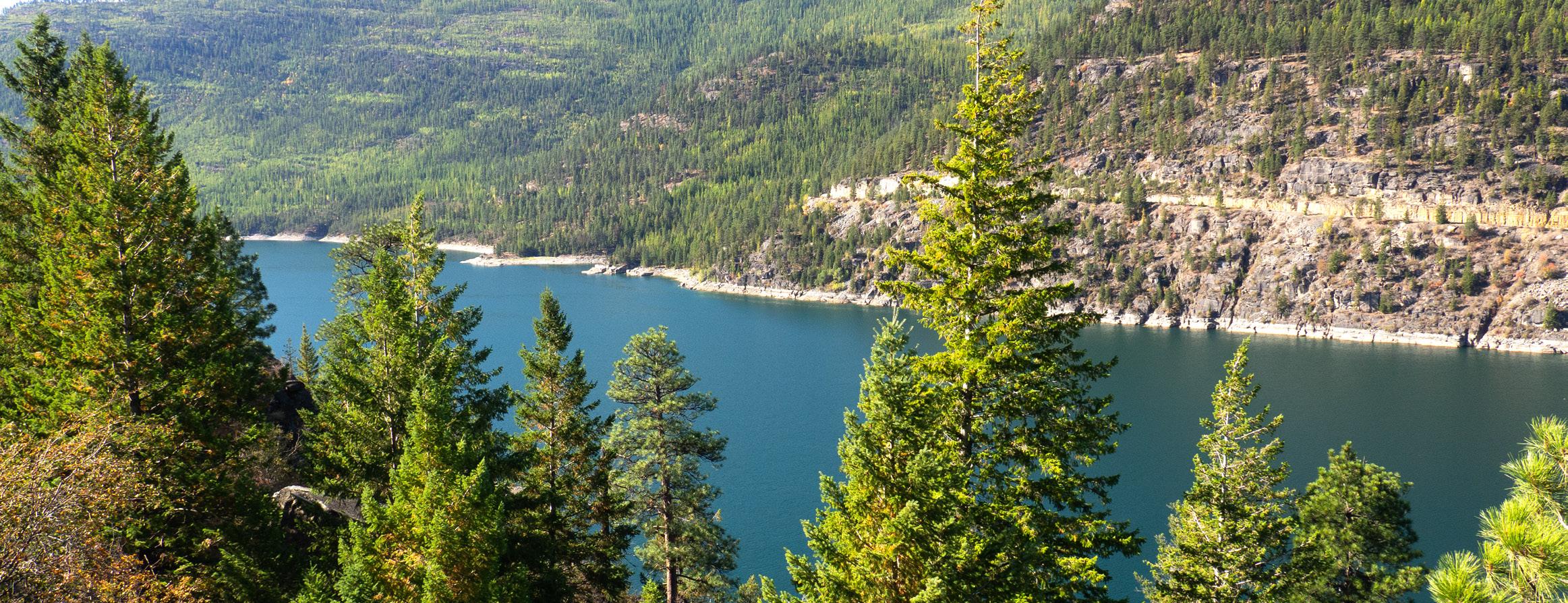
Massive, mountain-top removal coal mine operations in the Elk Valley of British Columbia are causing what is likely the worst case of selenium pollution in the world — right here in Montana. These operations, currently owned and operated by international commodities trader Glencore, supply metallurgical coal to Asian furnaces for steel production. In the process of mining, Glencore generates an enormous amount of exposed rock and waste, and the water that runs off-site and into the Elk River is highly contaminated with selenium and other pollutants. The pollution ultimately travels downstream to the Kootenai River and Lake Koocanusa in Montana, causing these water bodies to regularly violate Montana’s site-specific water quality standards.
Montana’s site-specific standards were adopted in 2020 after years of study, a rigorous scientific process, and lengthy stakeholder input. The standards were set to preserve the beneficial uses of the water bodies, including assuring that the fishery and aquatic life were protected from mining pollution. But instead of investing the necessary resources and planning into addressing the pollution problem, Glencore chose to continue pursuing a legal challenge to Montana’s selenium standard — attempting to invalidate it and potentially legitimize the high levels of pollution emanating from its mines. While this legal challenge ultimately commenced at the Montana Board of
Environmental Review (BER), for the past year it has been litigated in Montana District Court in Helena.
Thankfully, in early April, the court issued an order which rebuked and dismissed Glencore’s legal challenge to Montana’s water quality standards for selenium. The impacted waterbodies are the traditional territory of the Confederated Salish and Kootenai Tribes, who spearheaded the establishment of Montana’s selenium standard.
The preservation of Montana’s selenium standard is a significant victory for clean water, as the environmental implications of continued and increasing selenium pollution in Montana’s water poses serious implications for Montana’s fishery. Excess levels of selenium can be lethal for fish and other aquatic life, which are especially critical resources for the economy and way of life in northwest Montana.
The decision is also well-timed. The U.S. and Canada, the transboundary Ktunaxa Nation (composed of Tribes and bands in British Columbia, Montana, and Idaho), the state governments of Idaho and Montana, and the Province of B.C. are currently participating in an International Joint Commission to address the pollution from Glencore’s mines. The draft report of the IJC is expected to be released in the fall for public comment, and so having added legal clarity surrounding Montana’s water quality standards — and
what Glencore is expected to meet — will be critical.
While the district court order is still subject to appeal, it sends a strong message that Montana’s selenium water quality standards are legal and based on science. The next step is to implement and enforce these standards against those who continue to allow pollution of Montana’s waters. MEIC owes a debt of gratitude to Mary Cochenour, the skillful attorney who shepherded this case to victory.
Even as the IJC attempts to identify pathways to mitigate the selenium pollution emanating from Elk Valley coal mines, the province of B.C. is considering a proposed expansion of the Fording River Mine. The Fording River Extension (FRX) would expand the existing mountain-top removal coal mine by approximately 5,000 acres, which would exacerbate the damaging selenium pollution in Lake Koocanusa and
the Kootenai/y watershed.
Following the lead of our Canadian partner organization Wildsight, MEIC and Idaho Conservation League helped gather more than 30 businesses and organizations to request the Canadian Minister of Environment and Climate Change to assign the project to a review panel that could better assess the cumulative impact of selenium pollution, especially in the context of the IJC’s work.
After our letter was submitted, the Confederated Salish and Kootenai Tribes and the Kootenai Tribe of Idaho also submitted letters requesting an independent review panel.
Without additional review, the province could make a decision that undercuts its own efforts to mitigate pollution, and MEIC will do everything we can to prevent that from happening.
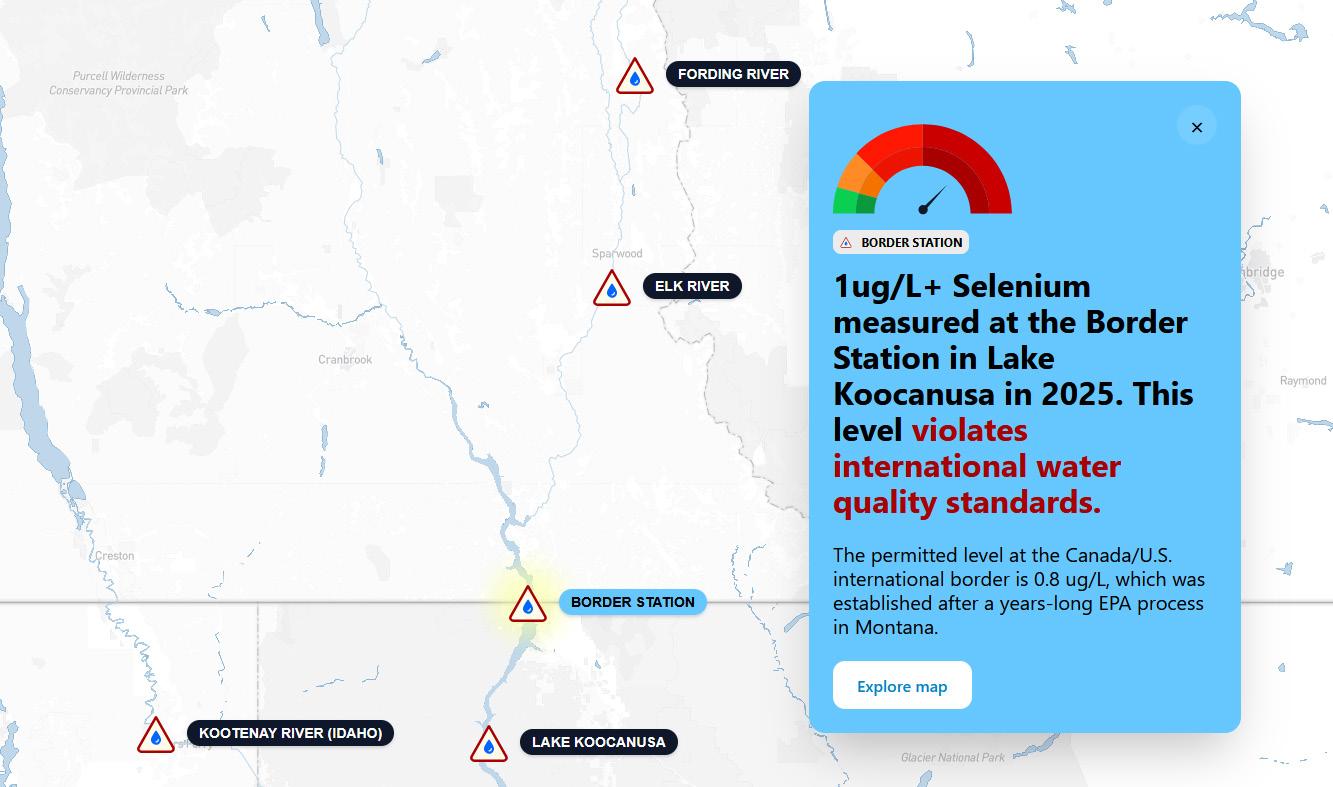
MEIC has also been working with partners to create a website that tells the story of selenium pollution. Visit this website to track water quality on a map, read scientific studies, and media from the U.S. and Canada tracking developments in this decades-long, ongoing story. Visit the website: www.elkkootenaypollution.ca


by Ben Catton and Derf Johnson
2026 marks the 50th anniversary of Norman Maclean’s A River Runs Through It and Other Stories. The world is not yet perfect, but the Blackfoot River is more perfect than it was in 1976 when the book was first published. Unfortunately, a large new gold mine proposal once again poses a threat to the iconic Blackfoot River.
This spring, Montana Department of Environmental Quality (DEQ) unveiled a draft Environmental Assessment (EA) for exploratory drilling for Sentinel Metals’ Columbia Gold Project, situated in the vital headwaters of the Blackfoot just east of Lincoln. The proposal triggered a public review process beginning March 20. Sentinel Metals is owned and operated by an Australian corporation, with Australian executives and investors. Any benefits from the mine are unlikely to stay in the state — but the risks and the consequences absolutely will.
At the heart of the controversy is the improper downplaying of the project’s magnitude. By framing it as a minor exploration amendment, DEQ ignores the reality of a budding full-scale gold mine. Sentinel Metals’ own communications to investors boast of the deposit’s economic viability, yet the EA overlooks three decades of intensive activity involving more than 400 drill locations and 45,000 meters of drilling. Furthermore, the assessment fails to grapple with the cumulative degradation of water quality,
wildlife corridors, and critical fisheries. Although the Blackfoot’s headwaters are already burdened by heavy metals and sediment, the EA lacks essential baseline data. It conveniently ignores the looming threat of acid mine drainage and fails to evaluate how further drilling might exacerbate existing contamination in these sensitive waters. The mine proposal endangers the ecologically and culturally vital headwaters of the Blackfoot River — a landscape already scarred by the toxic legacy of industrial mining.
The project also downplays or completely overlooks impacts on vulnerable species such as bull trout, grizzly bears, and Canada lynx. Beyond ecological concerns, the assessment neglects Tribal and cultural heritage while offering vague reclamation strategies and insufficient bonding details, failing to ensure the land is ever made whole again.
Moreover, the DEQ has yet again undermined public transparency. While DEQ calls the project “an amendment” of an existing permit, DEQ has withheld the primary exploration permit and essential records during the comment period despite repeated requests. Given the significant potential for environmental, economic, and cultural harm within the Blackfoot Valley, state law and historical precedent demand nothing less than a comprehensive Environmental Impact Statement (EIS) to protect this storied river.
Despite a short public comment window, MEIC and partners submitted robust technical comments opposing the deficient EA for the Columbia Gold
Project, and more than 370 people submitted public comments opposing the project through MEIC’s website alone. The technical comments submitted by MEIC and our partners demonstrate that the EA is both legally and scientifically inadequate, necessitating a more vigorous EIS.
A River Runs Through It brought the Big Blackfoot River and its world-class coldwater fishery to the big screen in 1992, cementing its fame. However, the film wasn’t actually shot on the Blackfoot River, because the river was heavily polluted from industrial mining, logging, and erosion from more than a century of abuse. The river was still recovering from the Mike Horse mine disaster of 1975 in which the mine’s tailings dam blew out, dumping deadly levels of lead, copper and zinc into the Blackfoot.
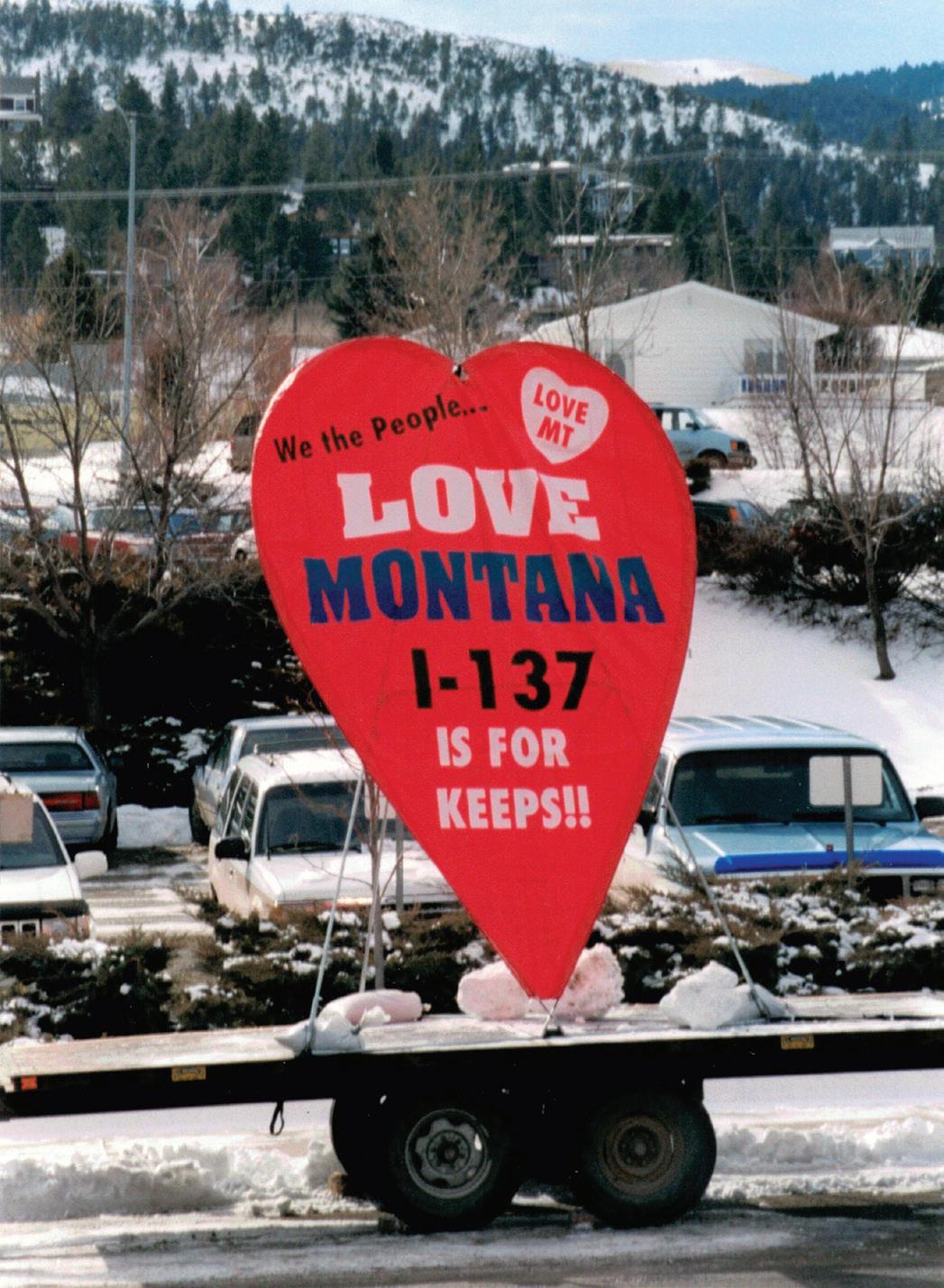
Mining threats to the Blackfoot reared their ugly heads throughout the 1990s. Finally, MEIC and Montana voters who were fed up with mining companies exploiting natural resources for private profit and leaving environmental disasters in their wake passed ballot initiative I-137 to ban open-pit cyanide heap leach mining.
In 1999, after DEQ allowed the Seven-Up Pete Joint Venture to discharge arsenic- and zinccontaminated groundwater near the Blackfoot River without conducting a nondegradation review, MEIC and partners went to court. MEIC won, and MEIC v. DEQ became one of Montana’s most important environmental rulings, establishing a strong precedent requiring rigorous environmental review for mining and other projects affecting public resources, and affirming that Montana’s constitutional rights to environmental protections are preventative and anticipatory.
In 2004, mining interests attempted to repeal the cyanide heap leach ban through initiative, but Montanans rejected their efforts resoundingly (see photo).
For decades, residents of the Blackfoot Valley and its surrounding regions have worked together towards abandoned mine reclamation and land-use planning to restore the river and the valley. The success is evident. The river is a thriving fishing destination and a powerful economic engine for the communities it
transects. A recent University of Montana study found that Montana’s 2024-2025 fishing season generated $919 million in direct activity, with a total economic impact of $1.5 billion and nearly 16,000 jobs supported. On any summer day, the Blackfoot’s access sites are full of anglers, floaters, and families — people drawn by the unmatched recreation this river provides. But that recreation economy only exists as long as we protect the resource itself.
As A River Runs Through It so beautifully first depicted 50 years ago, the Blackfoot River is part of western Montana’s cultural identity. It will need our help to continue that trajectory.
MEIC and our partners will not back down from protecting this treasure. Montanans — and the Blackfoot River — deserve better. It’s been said before, but it’s worth saying as many times as needed: “The Blackfoot is more precious than gold.”
by Shannon James
This spring, many Montanans experienced a familiar and unwelcome sense of déjà vu. A new tar sands pipeline proposal has surfaced, presenting the same risks, the same promises, and the same troubling lack of transparency that defined the fight over the Keystone XL pipeline: the Bridger Pipeline, often dubbed “Keystone 2.0.”
The Bridger Pipeline would carry crude oil from Alberta, Canada, south through eastern Montana into Wyoming, terminating in Guernsey (see map on opposite page). While the company initially refused to disclose the type of oil it plans to transport, it later confirmed what many suspected: this pipeline is designed to carry tar sands oil, one of the dirtiest and most environmentally destructive fuel sources on the planet. The company also noted it plans to find a partner to build a subsequent line to either Cushing, Oklahoma, or to the Gulf Coast.
Montana stands to bear the brunt of this project. Unlike Keystone XL, the majority of this pipeline would run through our state, placing our land, water, and communities directly in harm’s way — all for the benefit of filling the pockets of big oil.
And the risks are not abstract.
The Bridger pipeline could transport up to 1.13 million barrels of oil per day, surpassing Keystone XL’s capacity. Yet critical details including the pipeline’s full route, end destination, and ultimate use of the oil were omitted from the application submitted to state and federal agencies. Without this information, regulators and the public are being asked to evaluate a project without understanding its full scope or consequences.
Transporting tar sands oil introduces additional dangers. Tar sands contain bitumen: a thick, heavy, and viscous form of petroleum. This raw bitumen must be mixed with lighter petroleum products to make it flow through pipelines. The consequences of a spill are higher because bitumen can sink in water and mix with sediments, making cleanup more challenging and more expensive.
Spills are not hypothetical. Pipeline failures are inevitable over time. True Companies, the parent company behind Bridger, has already been responsible for major incidents, including a 50,000-gallon spill
into Montana’s Yellowstone River in 2015 and another 45,000-gallon spill in Wyoming in 2022. For a state whose economy depends heavily on agriculture, hunting, and fishing, even a single spill from the Bridger pipeline could have devastating and longlasting consequences.
The proposed route only heightens these concerns. The preferred alignment would cross three major Montana rivers (the Yellowstone, the Missouri, and the West Poplar) and intersect streams and waterways more than 150 times on federal lands alone. These are not just lines on a map; they are lifelines for communities, farms, and wildlife.
The construction methods themselves carry risks. The project would rely heavily on horizontal directional drilling (HDD) for placing underground pipes, a technique often marketed as less disruptive but far from risk-free. HDD can result in “frac-outs.”
Frac-outs from horizontal drilling are not caused by fracking but are uncontrolled releases of drilling fluids that can pollute waterways, smother aquatic life, and migrate unpredictably underground.
Beyond water risks, the pipeline threatens air quality, public health, and fragile ecosystems. Construction would bring increased emissions, heavy equipment, and widespread land disturbance. Sensitive habitats would be disrupted, and already vulnerable species — including whooping cranes, northern longeared bats, pallid sturgeon, and sage grouse — could face further decline.
There are also profound impacts on Tribal Nations. The pipeline corridor cuts through areas of cultural, historical, and ongoing importance, including unceded hunting territories. These environmental concerns are also issues of sovereignty, heritage, and treaty rights.
And looming over all of this is the climate crisis.
Expanding tar sands infrastructure is fundamentally incompatible with any serious effort to address climate change. This project would drive increased oil extraction, transportation, and combustion, resulting in significant greenhouse gas emissions at every stage. Tar sands crude is especially carbon-intensive, requiring more energy to extract and refine than conventional oil. At a time when communities across Montana are already experiencing the impacts of drought, wildfire,
and shifting ecosystems, this project moves us in exactly the wrong direction.
Despite the magnitude of these risks, the project is being fasttracked. In April, the Trump Administration approved a Presidential Permit for the pipeline’s international crossing without conducting an environmental review or consulting Tribal Nations. Meanwhile, the Bureau of Land Management and the Montana Department of Environmental Quality are moving forward with an environmental review process that remains incomplete, even as key project details are still being developed.
Agencies have indicated there may be limited opportunities for public input, including a short comment period on the forthcoming draft Environmental Impact Statement. But meaningful public participation requires more than a procedural checkbox; it requires transparency, time, and a genuine willingness to consider the full range of impacts.
Montanans have been down this road before. We know what is at stake.
The Bridger Pipeline is all risk and no reward for our state. It asks us to endanger our rivers, our livelihoods, our wildlife, and our climate so that the most dangerous type of oil can pass through Montana
on its way to distant markets. We are being treated as a corridor, not a community. We cannot afford to repeat the mistakes of the past. Montanans deserve a full and honest accounting of this project’s impacts, robust public engagement, and decision-making that prioritizes the health of our land and people over corporate profit.
by Anne Hedges
While the state is busy trying to minimize its oversight of opencut mines (gravel pits), a Missoula district court judge issued a strong rebuke of the state’s woefully inadequate opencut mine permitting process. The problems with opencut mine permitting and environmental review were largely created by the passage of a 2021 state law that cut the public out of most of the permitting process, put a target on unzoned rural areas, prevented consideration of water, air noise, wildlife and community safety impacts, and eliminated sciencebased decision-making by the Montana Department of Environmental Quality (DEQ).
Despite promises that air and water resources would be protected from gravel pit operations by other permitting processes, DEQ has been using “general permits” to approve gravel operations that impact water resources and release particulate pollution into the air, bypassing constitutionally guaranteed public notice and involvement processes with little to-no-analysis of site-specific impacts. These new permitting processes fail to protect neighbors and natural resources.
DEQ recently proposed to weaken the process even further by releasing a draft programmatic Environmental Assessment (EA) that would dramatically curtail environmental review of gravel pits under the Montana Environmental Policy Act (MEPA). DEQ’s proposal would allow any mine that a developer claims to be “dry” to avoid site-specific environmental analysis or public involvement. The generic onesize-fits-all programmatic EA would allow DEQ to avoid analyzing or disclosing a mine’s site-specific impacts on air quality, water quality, water quantity, wildlife, vegetation, historic and cultural resources, the economy, health, environmental regulations, and natural resources. DEQ says that only mines that do not impact water resources would be allowed to use this fast-track MEPA process. But DEQ’s proposal is deeply flawed.
DEQ’s draft programmatic EA assumes that developers always submit complete and accurate
permit applications regarding a mine’s potential impacts to water resources. If a developer claims their mine would not impact water resources, DEQ would not independently verify the claim; instead, it would just fill out a checklist EA to show that it considered potential impacts. It would not need to consider public comment or conduct independent site-specific analyses. DEQ would not provide neighbors with notice or an opportunity for comment. The public, especially neighbors, would have no opportunity to provide accurate information to protect their water resources. Instead, it appears that DEQ wants people to anticipate what their concerns may be over a future gravel mine in their area and raise those concerns during the programmatic EA stage instead of being able to provide comments when a developer actually submits an application years from now.
In its proposed programmatic EA, DEQ dismisses all potential negative impacts from future mines by saying the potential impacts would be “small in comparison to the greater landscape” and would only last for 25 years (though mines can file for extensions beyond that timeframe).
For example, the programmatic EA assumes that the impacts of a gravel pit near the Blackfoot River would be the same as the proposed Emigrant gravel pit in the Paradise Valley or a mine near Jordan, which ignores vast differences in landscape, wildlife, and hydrology. And, to top it all off, DEQ would not be required to ensure neighbors are notified.
Furthermore, when considering a mine’s impacts on wildlife, the programmatic EA flippantly dismisses any future concerns by claiming that other suitable habitat will be available and the disturbance would only last 25 years. DEQ provides no site-specific analysis to indicate what other suitable habitat near future mine sites would provide such habitat or how different species may fare in the intervening 25 years.
In short, the programmatic EA creates a rubber stamp, allowing DEQ to quickly approve projects that a developer says are “dry,” regardless of harmful impacts or information to the contrary.
Fortunately, courts are not so easily duped. In late April, a Missoula district court judge ruled in favor of Protect the Clearwater, slamming DEQ’s permitting process for opencut mines. The decision involved a proposed gravel pit mine adjacent to the BlackfootClearwater Wildlife Management Area, an important corridor for wildlife, such as grizzly bears and elk. DEQ argued that the developer said the mine site was “dry,” and the Legislature left it no time to provide notice and comment opportunities to neighboring landowners or to consider public input. The court did not buy those arguments.
The court found that, regardless of what the legislature required, “[t]he Montana Constitution obligates DEQ to render informed decisions on environmental matters.” The court also found that, “[b]y interpreting the statute to eliminate its obligation to calibrate public participation to the complexity and seriousness of the environmental issues,” DEQ failed to follow the law and the Constitution.
The court said DEQ erred by allowing the operator to determine the level of public participation and
whether the proposal impacted ground and surface waters even though “[t]he record contains unsolicited communications from the public raising substantive concerns — including potential health impacts, threats to water quality, and environmental degradation.” The court ruled that DEQ should have consulted the Montana Department of Fish, Wildlife and Parks regarding impacts to this wildlife mecca. The judge’s extensive 58-page decision found DEQ’s permitting and environmental review process to be severely flawed and rejected its unsubstantiated claim that approval of a 17-year mining operation’s impact on wildlife would be “short-term and negligible.”
DEQ indicated it wanted to ask the Montana Supreme Court to intervene before the district court process was complete. Hopefully, the Supreme Court will reject that proposal and will eventually agree with the district court by requiring DEQ to notify neighbors, provide a meaningful public comment period, and analyze water resource and other environmental impacts before it issues permits that could significantly impact areas for decades to come.
by Derf Johnson
This spring, the Montana Department of Environmental Quality (DEQ) released a Draft Programmatic Environmental Assessment (EA) for the construction and operation of subsurface wastewater treatment systems, a.k.a. septic systems. As with the programmatic EA for opencut mining, this is a solution that will cause more harm for the environment than good.
The rule would allow for an application that contains up to 300 septic system drainfields to basically receive a rubber stamp for their construction — bypassing the environmental review process for determining potential water pollution impacts. Domestic wastewater is a major and growing source of pollution in Montana and increasingly is becoming a major issue for our rivers and streams.
As residential development expands, the cumulative impacts of many individual septic systems degrade water quality, harm fisheries, and threaten public health
and drinking water supplies. What DEQ is proposing is to basically assume that, provided an applicant for a septic system meets basic engineering requirements, that an applicant receives a permit. There will no longer be a site-specific analysis of water quality pollution potential, the current state of the receiving water, and the cumulative impacts that have or will occur in the watershed. This is especially problematic in a state as vast and diverse as Montana, with significant differentiation in our watersheds regarding soils, water quality and composition, and the impacts from development and growth.
DEQ’s proposed draft programmatic EA, however, proposes gutting the permitting for most domestic wastewater discharged to groundwater, instead of using strong science and site-specific considerations to evaluate permitting decisions, as required by Montana laws and our Constitution. Hopefully DEQ will scrap this problematic proposal and instead pursue a sciencebased approach to permitting septic systems. We’ll see.
by Anne Hedges
Aformer Montana Public Service Commissioner once told me that being termlimited was unfortunate because after nearly eight years on the PSC, he was finally starting to understand the issues. Unfortunately, he still knew far too little to notice when the utility was using bogus arguments in order to manipulate the PSC to increase its revenue for shareholders at the expense of residential customers.
Anecdotes like this make it hard
to defend the status quo when it comes to the PSC. The last decade was riddled with scandal after scandal. Our Commission is a regional embarrassment in the energy world. All too often, Montana Commissioners are elected to office with no knowledge or experience in the energy sector and are expected to stand up for consumers against well-heeled utility lawyers with decades of experience. Far too many have been former legislators who seemed more interested in being in a high-paying public office than digging into the nitty gritty of energy law and policy. It doesn’t help that a public servant’s pension is calculated by averaging their last five years of state employment. PSC Commissioners are some of the best paid positions in state government.
The PSC is supposed to balance the needs of average Montanans with the need to have financially healthy utilities that can maintain low borrowing rates. Unfortunately, that balancing act has been skewed. The PSC’s regulation of NorthWestern Energy, for example, has resulted in a nearly 40% electric rate increase for residential customers since 2022. It resulted in Montanans electric bills increasing faster than inflation, faster than other states in the region, and faster than Montanans can afford.
Nearly everyone agrees that something needs to change. But what?
Montana is one of only 10 states that elects PSC commissioners. Many legislators and other interest groups are looking to establish an appointment process for commissioners. Last session, a bill supported by
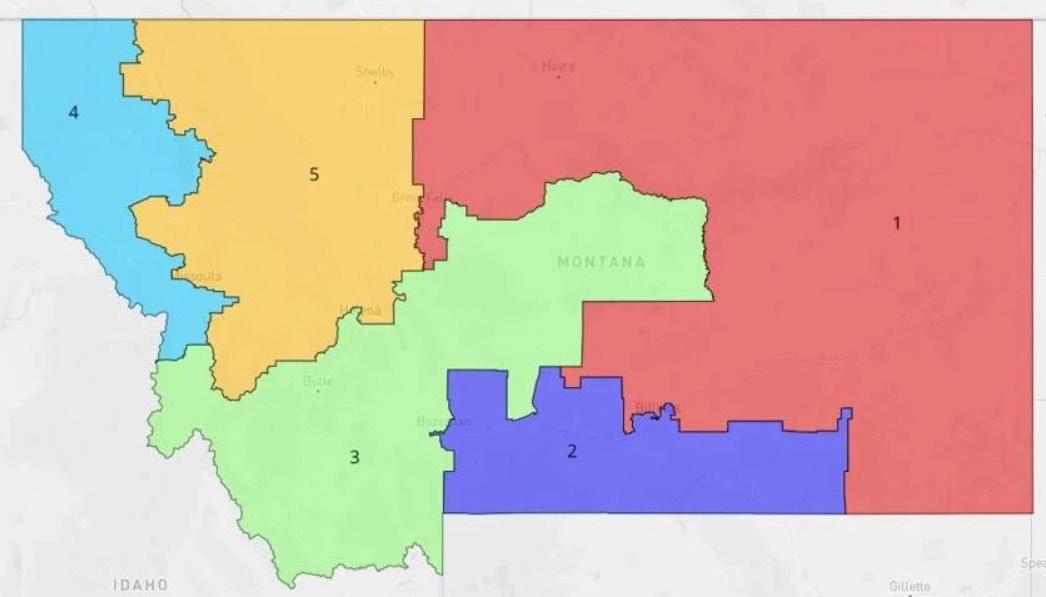
The 2023 Legislature established new PSC districts, splitting most of Montana’s largest cities in two.
the Montana Chamber of Commerce that would have established an appointment process failed to pass the legislature. Since then, a bipartisan group of legislators and others have worked on a new proposal for the 2027 Legislature.
The question is — who does the appointing? In a current proposal, the Governor decides on appointees based upon legislator recommendations and Senate confirmation. That idea should give everyone pause. The disastrous Board of Environmental Review is appointed by the Governor with Senate approval. It has been packed with industry lobbyists, retirees and consultants who take years to make decisions while projects move forward. Simply put, it is not a model that should be replicated, especially in a process that governs utility rates for hundreds of thousands of Montanans.
Gov. Greg Gianforte’s appointed Commissioners would most certainly have a strong bias toward monopoly utilities. Some argue that Democrats should be allowed to propose a certain number of appointees, but those recommendations would have to be approved by the Governor and the Montana Senate, and we’ve seen what the Senate has done with good judicial nominees.
The Legislature sets PSC districts, rather than the
story continues on pg. 15
by Nick Fitzmaurice
The Bonneville Power Administration (BPA) is a federal electricity and transmission marketing agency that covers much of the Pacific Northwest and plays a critical role in the affordability and reliability of the electricity system in the region. As of this writing, the agency was poised to announce its new Administrator and CEO, with former Montana Public Service Commissioner Travis Kavulla positioned as the likely contender.
BPA has the potential to generate more than 17,000 megawatts of electricity at cost to customers, largely from federal dams across the Northwest, and is required to prioritize selling this low-cost power to public power entities such as rural electric co-ops and municipal utilities. BPA also owns and operates a major high-voltage transmission system covering over 15,000 miles, including a portion of western Montana. While BPA is technically housed within the U.S. Department of Energy (DOE), it has historically operated with significant autonomy as a non-profit federal agency that covers its own operating costs by selling electricity and transmission services. Given this unique agency structure, it often appears that BPA is accountable to no one but its own internal leadership.
BPA’s regional positioning is extremely important to regional power sharing across the West as two
competing Western energy markets emerge to facilitate the buying and selling of electricity between utilities for anticipated needs up to a day in advance. The more advanced proposal that launched in May 2026 is the Extended Day-Ahead Market (EDAM), operated by an independent, non-profit regional governing body called the Regional Organization for Western Energy (ROWE). The less developed proposal, Markets+, is not slated to go live until October 2027 and would be operated by the Southwest Power Pool (SPP), headquartered in Arkansas. BPA announced highly controversial plans to join Markets+ in May 2025, despite numerous analyses showing this would cost electricity customers millions of dollars more compared to joining EDAM.
Since BPA owns and operates 75% of the highvoltage transmission system in the Northwest, its decision makes it more difficult for other utilities and transmission operators, such as NorthWestern Energy, to choose the more transparent and robust day-ahead market implemented by the ROWE. Last year, Earthjustice, on behalf of MEIC and several partner organizations, filed a yet-unresolved challenge to BPA’s decision in federal court because BPA failed to follow its own rules and related federal requirements in making its decision.
A low-cost carbon-free energy system will require
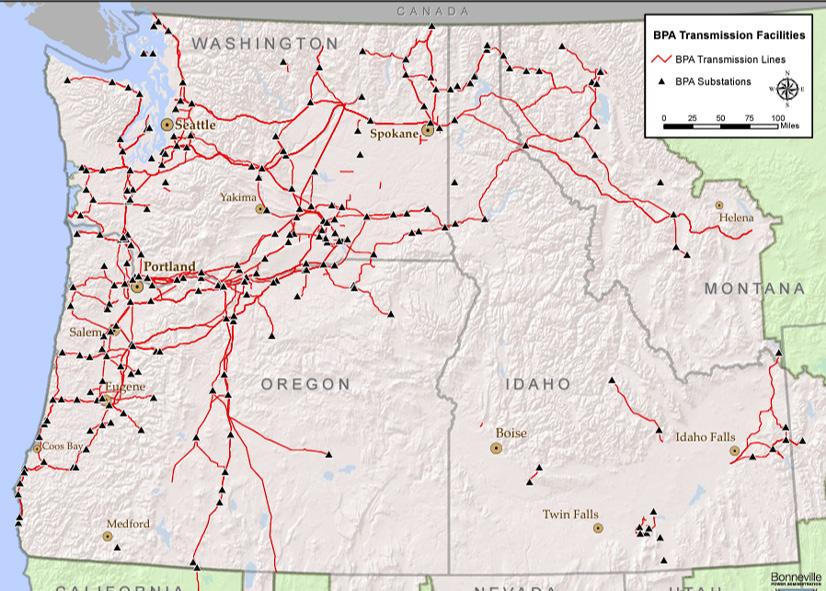
BPA could have a huge influence on the decarbonization of Montana’s energy system. Image via RTO insider. a sophisticated and geographically diverse market system to optimally dispatch clean electricity from where it is available to where it is needed. EDAM has the potential to unify the Western grid into a single, highly efficient energy market, having grown out of an organic expansion from the already wildly successful real-time Energy Imbalance Market (EIM). story continues on pg. 17
by Anne Hedges
Over the last year, NorthWestern Energy has repeatedly refused to be transparent regarding its desire to serve electricity to energy-hungry AI data centers. The Montana Public Service Commission (PSC) has repeatedly said that NorthWestern must get its approval prior to energizing data centers, but NorthWestern has stalled. In April, NorthWestern finally submitted a proposal to the PSC referred to as a “large load tariff.” A large load tariff is essentially a set of rules that govern how a utility provides power to data centers.
Quantica Infrastructure’s recent proposal of a nearly 9 gigawatt data center near Broadview highlights the urgency for a tariff with strong consumer protections. NorthWestern’s proposal is anything but protective.
NorthWestern sees data centers as a lucrative new revenue stream, but it insists on keeping secret all of its information regarding ongoing deals with data centers. The merger docket is a perfect example of this secrecy as it has refused to answer any questions regarding data centers and the PSC has allowed it to do so (see article on pg. 16). It appears that the hefty bonuses that NorthWestern executives will receive are enough of an incentive to hide the ball from Montanans regarding its data center plans; CEO Brian Bird alone is slated to receive a $13.6 million bonus for a successful merger.
NorthWestern’s proposed data center tariff would put it in the driver’s seat on nearly all decisions to serve data centers instead of the PSC. For example:
• It would allow NorthWestern to conceal all agreements with data centers from its existing customers.
• It fails to propose a separate rate class for data centers, which is the best guarantee that they pay all of the costs that they impose on NorthWestern’s system including expensive power plants, fuel costs, routine maintenance, outage costs, and transmission and distribution costs.
• It unfathomably (and illegally) allows NorthWestern to control agreements with data centers under 50 megawatts and avoid PSC and public review. It is increasingly apparent that NorthWestern will ask the Legislature to retroactively make this legal.
• The tariff has extremely vague, weak provisions that would allow developers to build large data center campuses in 49-megawatt increments in order to avoid PSC scrutiny and public oversight.
• NorthWestern would not be required to ask the PSC for permission to provide electricity to a data center until after it has signed contracts with the developer.
• It puts NorthWestern, not the PSC, in charge of deciding the level of financial assurance (e.g. bonds) that data center developers would provide
in case they disappear before they pay their bills for such things as transmission lines or power plants, leaving customers to pick up the tab.
The list goes on.
If the PSC does its job, it will reject NorthWestern’s feeble proposal for a data center tariff. But the PSC has been delinquent in addressing MEIC’s two-year old request to include the cost of climate change in its regulation of utilities. It has failed to act on our November 2025 submittal for the PSC to create a detailed and protective tariff and separate rate class for data centers. And over our repeated objections, the PSC has allowed NorthWestern to keep secret all substantive information regarding its existing deals with data centers. (All of these actions were taken by Earthjustice on behalf of MEIC and a host of outstanding partner groups and businesses.)
NorthWestern Energy wants to serve 14 data centers that will need thousands of megawatts of electricity, dwarfing the 750 megawatt needs of its existing customers. It’s clear where the utility’s allegiance lies, and it’s not with existing customers. NorthWestern is dedicated to revenue generation and growth, and it sees data centers as providing both. The Montana Power Company had similar arguments when it convinced the Legislature to pass electric deregulation. We would be wise to heed the old proverb, “Fool me once, shame on thee; fool me twice, shame on me.”
continued from page 12)
redistricting commission, which sets districts for every other state elected office. Unfortunately, the legislature has gerrymandered the districts to such an extent that it guarantees that unqualified candidates can win races as long as they win their primary.
A few years ago, a court found that the PSC districts were not representative of Montanans and required redistricting. Unfortunately, the legislature stepped in and severely gerrymandered the districts beyond anything rational. That legislative redistricting was challenged by Montana Conservation Voters and others with the help of the Upper Seven Law Firm. The Montana Supreme Court is currently deciding
that case.
If Montana had more reasonably representative districts, elections could result in more qualified Commissioners. Until the court decides on whether or not the current districts are legal, it is premature to move to appointed Commissioners that would nearly guarantee utilities and business interests would win appointments over true watchdogs who wouldn’t make it through the filter of the Governor and Montana Senate. MEIC is going to wait for the outcome of the court case before deciding if appointments are our last best hope.
A version of this article appeared as an op-ed in print and online around Montana and the West.
by Anne Hedges
Over the last several months, NorthWestern Energy has vehemently denied that data centers are behind its desire to “merge” with another South Dakota utility, Black Hills Energy. However, when company executives announced the deal to investors, they repeatedly pointed to data centers as a top reason for the two utilities’ efforts.
NorthWestern is currently asking the Montana Public Service Commission (PSC) to approve the so-called “merger” (which looks a lot more like an acquisition of NorthWestern) without considering any information regarding the 14 proposed data center projects that NorthWestern mentioned on an investor call earlier this year. NorthWestern has refused to answer any questions in the PSC proceeding regarding data centers. NorthWestern’s desire to keep this information secret from the PSC and utility customers should raise red flags for all Montanans. If we aren’t careful, we are going to get burned — as has happened to millions of utility customers across the country when data centers come to town.
When announcing the deal on August 19, 2025, NorthWestern CEO Brian Bird told investors that merging NorthWestern with Black Hills Energy
would help both utilities be “more competitive” in the race to “capture data center opportunities” and would enable them to “make strategic investments that foster economic development, including addressing the growing demand for energy, including from data centers.”
While states around the country are taking action to prevent unregulated data centers from disrupting communities, harming water resources, and increasing electricity rates, Montanans are vulnerable. The Legislature has given sweetheart property tax deals to data centers and has systematically undermined local control, limiting the power of county commissions to protect rural communities. Our Governor, a tech megamillionaire, is eager to sell out Montana communities and homeowners to the tech industry.
For example, despite repeatedly saying that the merger with Black Hills Energy will allow it to better serve data centers, NorthWestern Energy has refused to answer a single question regarding data centers in the merger proceeding before the PSC. Unfortunately, the majority of PSC Commissioners have agreed with NorthWestern at every turn. NorthWestern’s refusal is not terribly surprising considering its CEO Brian Bird will earn a bonus of more than $13 million if the merger is successful. Other top executives will also earn millions. Apparently, these financial incentives are too enticing for the company to be honest with customers
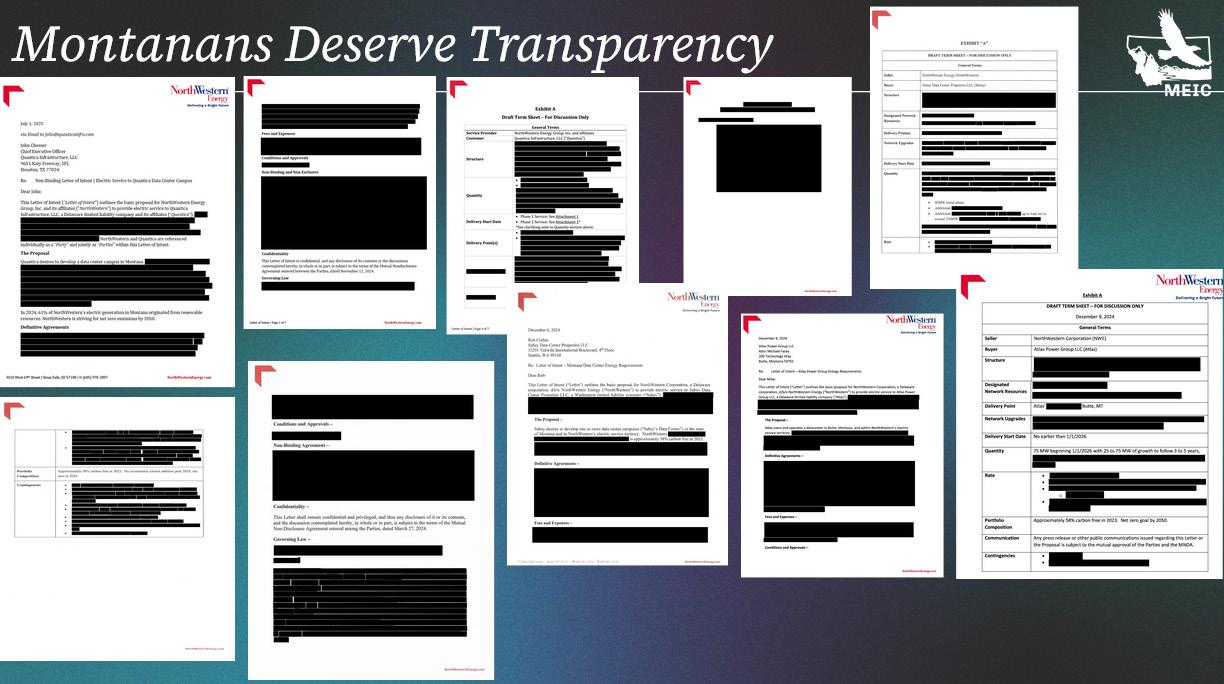
NorthWestern Energy has redacted the letters of intent it has signed with more than a dozen data centers. Images via PSC filings.
and the PSC about its data center deals.
To be clear, NorthWestern is about to get swallowed up by a much larger company so shareholders can make a boatload of money. NorthWestern Energy currently serves about 700,000 electric and gas customers in Montana and 150,000 gas and electric customers in South Dakota and Nebraska. After the merger, the new company’s service territory would include another 1.35 million gas and electric customers from Black Hills Energy in an additional five states. The newlyformed mega monopoly would provide electricity and gas in eight states, amounting to a service area of about 20% of the United States, according to NorthWestern’s CEO.

to enrich utility shareholders at Montanans’ expense.
A majority of the board members for the new company, Bright Horizons Energy Corporation, will be from Black Hills Energy. The behemoth multi-state monopoly utility will not need to prioritize Montanans — except as far as the state will help the new company meet its revenue and data center goals.
It increasingly appears that Montana will be a cash cow for this enormous new monopoly. NorthWestern and Black Hills refuse to be transparent about their plans to serve data centers or disclose how the merger could impact Montanans’ residential electricity rates, which have already seen a nearly 40% increase in the last few years. We should not be kept in the dark about the new utility’s data center agreements that are likely
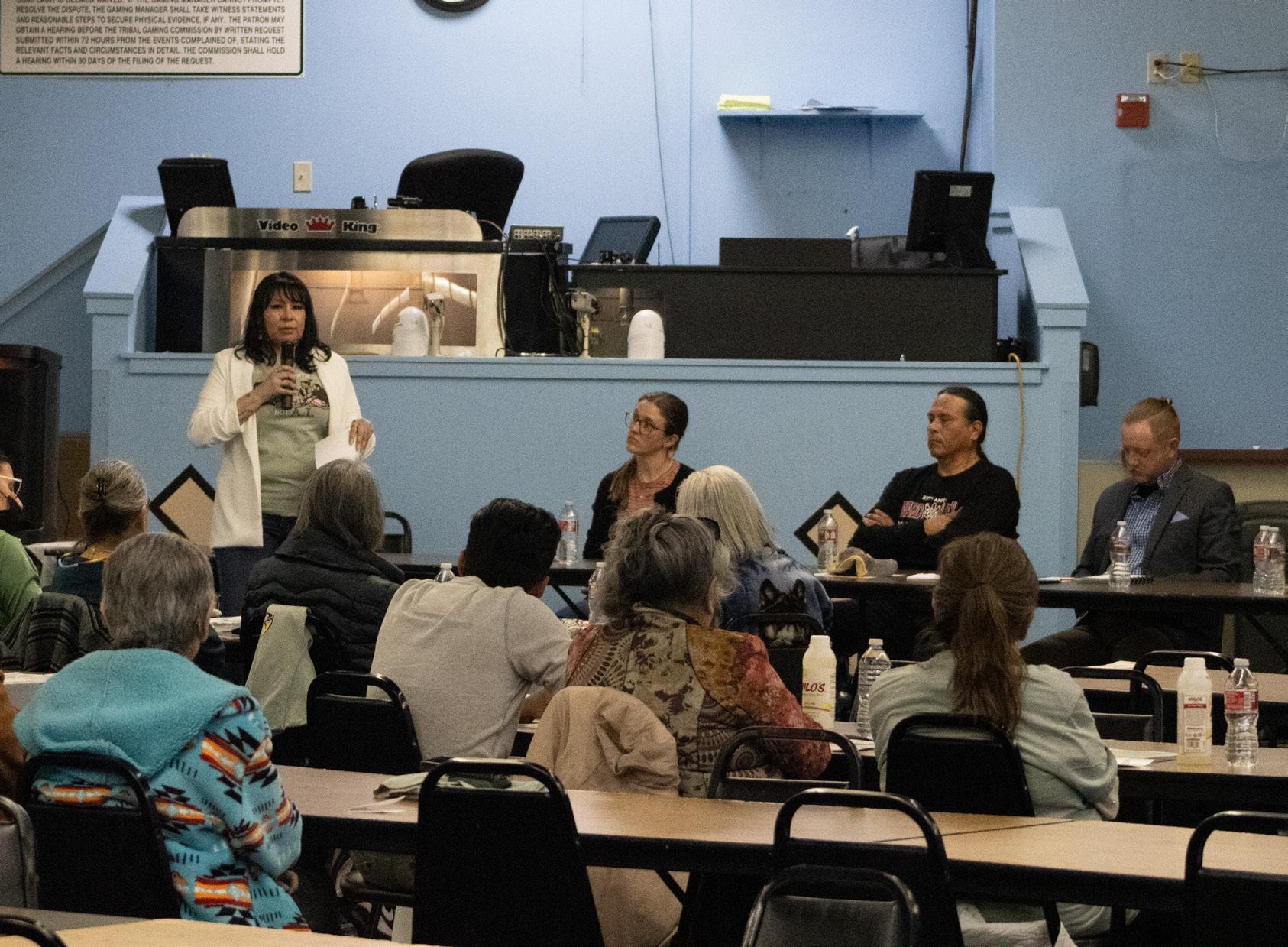
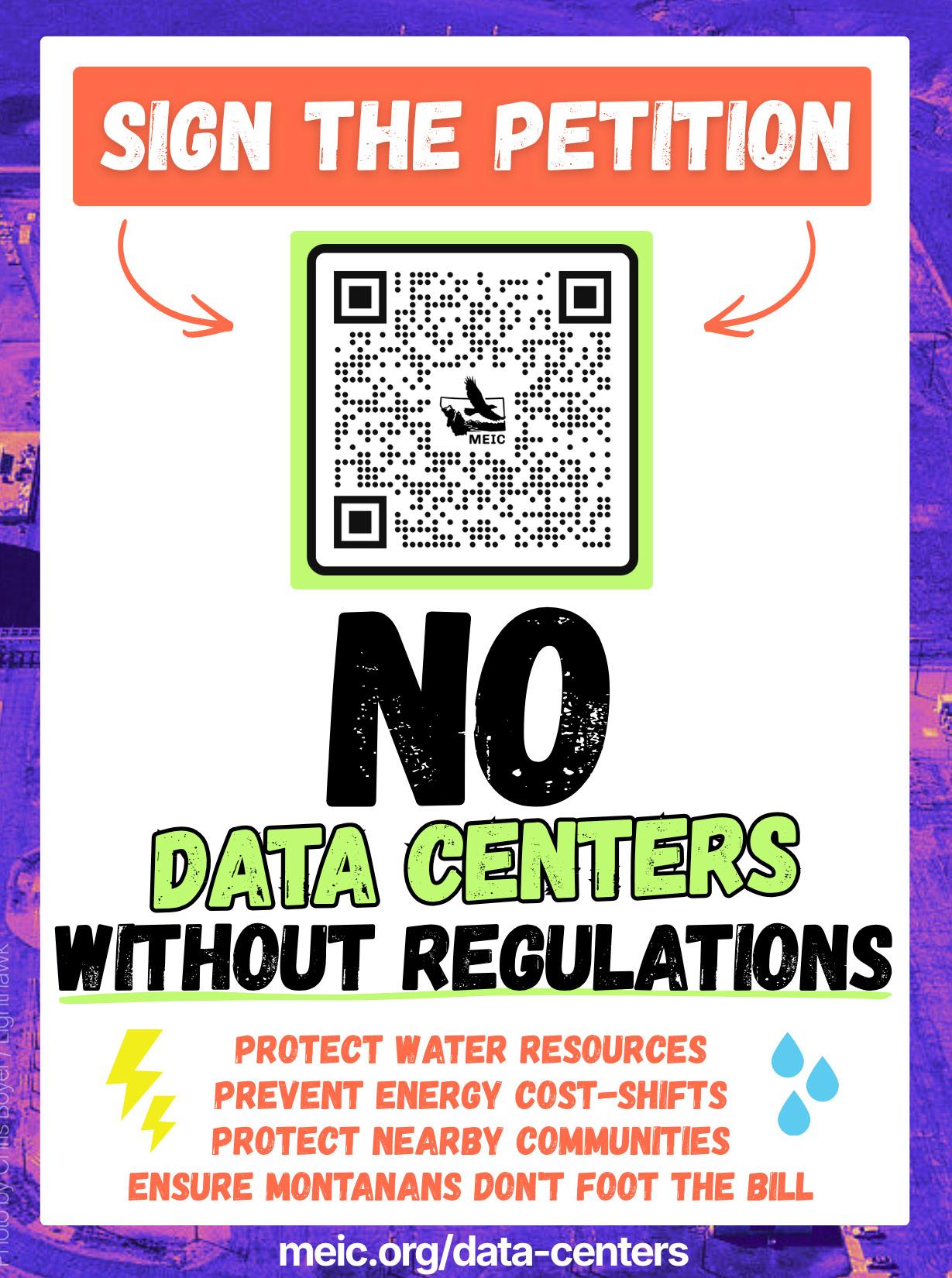
MEIC has spent months visiting numerous communities across the state to educate and answer questions about data center risks and impacts. Based on the hundreds of people we’ve met and thousands who have signed petitions against unregulated data centers in Montana, it has become clear that this is truly a bipartisan issue that is extremely concerning to Montanans.
We need bipartisan politicians at every level of government who are willing to challenge NorthWestern’s secrecy and monopolistic instincts and protect everyday Montanans — and our water and our communities — from subsidizing data centers. We can protect ourselves, but we need politicians who are willing to do so on our behalf. Time is short, so let’s get to work, roll up our sleeves, demand transparency and tell NorthWestern that there will be no merger without the answers that customers need to ensure we won’t have to pay far, far more than our fair share.
That has created a whopping $8.62 billion in benefits to market participants since 2014 (including more than $223 million in benefits to NorthWestern since 2021). Unfortunately, SPP’s proposed Markets+ appears to be designed to extract profit from a nascent Western market landscape, threatening to bifurcate the Western electric grid and ensure more expensive and less efficient trading of electricity across the region.
For months, BPA has bulldozed ahead with its market decision. However, the DOE uncharacteristically joined the debate at the beginning of May, instructing BPA staff to pause work toward joining Markets+ while DOE weighs in on the agency’s market decision. Hopefully, the incoming Administrator can help get BPA on track and create a path to a more affordable and efficient single West-wide energy market.

by Nick Fitzmaurice
NorthWestern Energy is at it again. On April 27, the utility filed its “final” Integrated Resource Plan (IRP) at the Montana Public Service Commission (PSC), an iterative 20year plan for providing electricity to its customers. Implementation of NorthWestern’s current IRP would commit Montanans to the most expensive and polluting energy sources available today. While expensive electricity resources are good for utility executives and shareholders, they are terrible for our air, water, climate, and... budgets.
MEIC has participated in NorthWestern’s IRP Stakeholder Work Group for the past year and has weighed in on the IRP’s development in every available forum. We submitted extensive comments to NorthWestern covering countless issues in its Draft IRP, but the utility has barrelled ahead with its illadvised planning planning without any meaningful adjustments to its flawed modeling. (MEIC’s full comments to NorthWestern can be found on our website.)
The PSC must now determine whether the IRP meets minimum filing requirements as outlined in Montana statute. If the PSC identifies filing deficiencies, then NorthWestern will have to update the IRP to address those deficiencies. Unfortunately, filing
requirements represent only the bare bones of the IRP, and the PSC can only make recommendations for future IRP iterations beyond those minimum requirements.
On two occasions prior to submitting the final IRP, NorthWestern requested waivers regarding certain demand-side management reporting requirements. MEIC and NW Energy Coalition, represented by Earthjustice, made compelling arguments against the requests, and the PSC unanimously ruled against NorthWestern’s waiver requests.
Once the PSC has received a complete plan, it has 120 days to conduct its review. At the time of this writing, it was unclear whether NorthWestern had fulfilled all filing requirements. The PSC’s final review of the plan will be crucial in determining whether NorthWestern can charge its customers for additional expensive and unnecessary gas and coal generation in the coming years.
The PSC will have a 60-day public comment period and a number of public meetings. While the PSC is required to host a minimum of two meetings, MEIC, along with 18 partner organizations, requested that it hold meetings in each of the five commissioners’ districts as it has in the past. Keep an eye out for MEIC’s email action alerts to make sure you don’t miss the PSC’s comment period and public meetings! Sign up for email action alerts: www.MEIC.org/take-action
MEIC has been actively participating in updates to statutory and administrative rule requirements for NorthWestern’s IRP. We lobbied extensively to secure beneficial amendments on HB 55 from the 2025 Session that preserve transparency and public participation in the IRP process, and we’ve since been participating in the PSC’s rulemaking to implement that bill.
MEIC has participated in several rounds of public comment for this rulemaking, ensuring that the PSC’s final rules will require broader participation in NorthWestern’s technical advisory committee and that NorthWestern cannot bias its resource selection against low-cost clean energy. The PSC held a public hearing on this rulemaking on June 2.

by Ben Catton
Northwestern Montana’s Cabinet Mountains host rare inland temperate rainforest, providing vital habitat for threatened grizzly bears, wolverines, and bull trout. The area holds deep cultural importance for the Confederated Salish and Kootenai Tribes and has been federally protected since its 1935 Primitive Area designation and later inclusion in the 1964 Wilderness Act. Yet despite nearly a century of protections for this remarkable landscape, the Cabinet Mountains remain under threat from mining interests seeking to extract silver and copper from beneath the Wilderness.
Last year, Hecla Mining Company’s Libby Exploration Project received FAST-41 designation from the Trump Administration, granting it preferential federal permitting status. That designation helped shortcut meaningful environmental analysis and public scrutiny. The project received official approval in the midst of the 43-day-long government shutdown. The approval reflects a broader effort by the Trump Administration to weaken environmental review and accelerate extractive development on public lands.
In late March, alongside a coalition of local and national organizations, MEIC brought suit against the Trump Administration’s Forest Service and Fish and Wildlife Service for their defective environmental assessment and failure to conduct a full environmental impact statement before approving this project.
The agencies ignored serious risks to water quality, threatened species, and the integrity of the
wilderness itself. The project could dewater lakes and streams within the Cabinet Mountains Wilderness, increase pollution in Libby Creek — critical habitat for threatened bull trout — and fragment habitat essential to the already-vulnerable Cabinet-Yaak grizzly bear population. Not least of all, Hecla Mining Company possesses a troubling track record at its other ventures. To name but a few, Hecla violated its National Pollution Discharge Elimination System permit at the Lucky Friday Mine roughly 200 times, in one instance exceeding the daily zinc limit by 42,000%. At the same mine, unsafe working conditions and unfair labor practices led to a strike of more than 200 union workers. Environmental infractions at the Greens Creek Mine in Alaska led to elevated toxic metal levels in waters, impacting local coastal wildlife. When greenlighting the Libby operation, however, the Forest Service neglected to account for this documented pattern of regulatory infractions.
For decades, conservation groups including MEIC, Cabinet Resource Group, Save Our Cabinets, Earthworks, Clark Fork Coalition, and Yaak Valley Forest Council have repeatedly challenged illconceived and mitigation-deficient mining proposals in the Cabinets with the invaluable help of expert lawyers at Earthjustice. The law is clear: projects in this landscape must demonstrate they will not significantly harm wilderness values, clean water, or endangered species. MEIC remains commited to ensuring the law is strictly enforced to safeguard this irreplaceable and ecologically vital wilderness landscape.

by Ben Catton and Nick Fitzmaurice
2027 still feels far away, but draft legislation is beginning to take shape in advance of Montana’s next Legislative Session. As always, MEIC tracks legislative developments in the interim so you don’t have to. A number of interim committees have been meeting since the close of the 2025 Legislative Session, with final meetings, legislative recommendations, and opportunities for public input slated for later this summer. You can leave comments for committees by calling 406-444-3064 or visiting www.legmt.gov/participate.
In late April, PBS Impact reporter Anna Rau broke a story that revealed the Department of Environmental Quality (DEQ) withheld fish tissue sampling results for more than a year, despite those results revealing toxic levels of PFAS (Per- and Polyfluoroalkyl Substances). PFAS is a term used for man-made chemicals that have unique characteristics which can be desirable to certain products, but the exact chemical recipes are often proprietary. Due to their durability, they persist indefinitely and accumulate in soil, water, air, and living organisms, and are linked to cancer, reproductive impacts, development delays, and more.
DEQ collected fish tissue samples in 2023, but the Governor’s Office directed the agency to withhold the reports that advise against eating PFAS-contaminated fish from many of Montana’s popular fisheries. Consuming a single serving of fish from these lakes and rivers may expose a person to thousands of times more toxins than the EPA’s limit for drinking water.
On May 13, MEIC’s Derf Johnson appeared before the Montana legislative EQC interim committee and argued for further investigation into identifying sources of these contaminants, mitigation strategies, and regulations to protect Montanans health and our recreation economy. Johnson pointed out that DEQ leadership was in possession of these reports during the 2025 Legislative Session when bills like HB 290 (Rep. Ed Stafman, D-Bozeman) aimed to address these contaminants. DEQ leadership was in the
room in January 2025 when a citizen from Helena testified that taking no action on PFAS would lead to consequences such as “forbidding people from eating fish, wild turkeys, and even deer because PFAS contaminants have bioaccumulated in the meat, and the chemical concentrations now greatly exceed safe limits by hunters, anglers, and their families.” That citizen’s hypothetical scenario was already reality, and DEQ should have shared that vital information with legislators and the public.
“This is really about our right to know,” Johnson said. “Disclosure of information has to be timely… If you have people unknowingly exposing themselves to things that cause cancer, that is a serious issue.”
Montanans deserve a government willing to confront this problem honestly before the costs — environmental, economic, and human — become even greater. Following MEIC’s suggestion, EQC will further investigate this topic at its July meeting.
WPIC was tasked with HJ 44 (Rep. Zack Wirth, R-Wolf Creek), a study of the presence, prevalence, and potential harms of Endocrine-Disrupting Chemicals (EDCs) and PFAS in Montana. The study passed 8811 in the House and 40-9 in the Senate but has been largely neglected by WPIC. With the revelations of grave PFAS contamination in fish tissues across the state, MEIC is encouraging WPIC to reopen the study. Please contact the committee and tell them to further research sources of toxic contamination, mitigation strategies, and prevention solutions.
The Governor’s Energy Task Force and its three subcommittees (Generation, Growing Demand, and Transmission and Markets) continue to work toward their September deadline to issue a closing report with policy recommendations to the Governor. The full Task Force met in March and May, with their next full Task Force meeting tentatively scheduled for July 8. Welcoming data centers to the state and building

expensive gas and nuclear generation to power them remains a top focus of the Task Force, with Montanans’ need for an affordable and reliable electric system trailing far behind, and environmental considerations nowhere to be found.
As of the Task Force’s May meeting, policies were beginning to take shape. However, it remains unclear what beneficial recommendations might come out of the Task Force other than the Governor endorsing the findings of the Western Transmission Expansion Coalition (WestTEC) 10-year study. Those findings include essential interstate transmission development to better connect Montana to clean, reliable, and affordable energy throughout the West.
MEIC anticipates a slew of sinister policy recommendations around data centers and gas plant development (such as a massive 1,785 megawatt gas plant proposal from Quantica that came to light right as this issue went to press) and will continue monitoring the Task Force closely as those recommendations take shape. For example, the Growing Demand Subcommittee has taken aim at Montana’s “Choice Statute,” MCA 69-8-201. That law requires new energy customers over five megawatts (such as data centers) that choose electricity service from the public utility to demonstrate to the PSC that they will not cause harm to existing utility customers before the utility can begin to serve them. Exactly what changes the full committee will recommend remain to be seen, but it’s safe to assume that NorthWestern Energy will try to increase the megawatt threshold for PSC oversight of new data center customers, decrease public transparency into negotiations with new data center customers, and change the law to the benefit of NorthWestern’s shareholders, not its existing customers — exactly as its large load tariff proposal attempts (see article on pg. 14).
ETIC began formalizing draft legislation in its March and May meetings. MEIC will continue engaging in the two remaining meetings in July and September as the committee finishes drafting committee legislation for the upcoming session. Here
is some notable draft legislation:
• PSC Restructuring: An initiative to change the PSC from elected to appointed commissioners would institute professional experience criteria with the intent to create a non-partisan, competent regulatory body with regulatory expertise. While it is apparent that our current PSC is dysfunctional, MEIC values Montanans’ ability to select its Commissioners rather than handing that selection power to the Governor. MEIC is awaiting the Montana Supreme Court ruling on whether the current PSC districts represent unconstitutional gerrymandering before weighing in further. At its May meeting, ETIC agreed to pre-introduce a bill for next session (see article on pg. 12).
• Interstate Competitive Transmission Development Compact Act: While this is a wellintentioned initiative to spur interstate collaboration for developing transmission projects, the early draft appears to create additional regulatory hurdles to transmission development without meaningfully improving the chances for developing interstate transmission across Montana’s borders. At its May meeting, the Committee agreed to pre-introduce the bill for next session.
• Montana Solar Shares Act: ETIC is reviving the popular shared solar bill that passed with overwhelming bipartisan support before falling to the Governor’s veto in 2025. ETIC is looking to build on momentum from last session to bring this bill back with committee support and hopefully get it over the finish line in 2027.
• Geothermal Regulatory Framework: MEIC continues working with members of ETIC to craft legislation that will pave the way for enhanced geothermal clean energy development in Montana while establishing important regulatory guardrails to protect the environment and Montanans should geothermal development come to the state.
• Ratepayer Protection: MEIC is working with members of ETIC as they craft legislation to ensure ratepayers are protected from subsidizing major data center interests.
by Ben Catton
Last spring, the Montana Legislature passed HJ 61 (Rep. Josh Seckinger, D-Bozeman), authorizing an “interim study on the property insurance market in Montana.” Due to the explicit ties between land-use planning and climate change, MEIC has been tracking this legislation and the study’s development very closely.
The resolution notes that “property insurance rates have been increasing significantly for all Montanans, regardless of where they live. Montana had the fifth fastest increase in rates in the nation in 2024, and Montana’s cumulative increases in insurance rates from 2019-2024 are 44.3%.” Remarkably, the Montana Legislature ranked this study resolution as the most deserving of time and resources. It was assigned to the Economic Affairs Interim Committee (EAIC).
Under the previous Commissioner of Insurance, Troy Downing, Montana chose not to participate in a national “call for data” from insurers that provided a look at ZIP code level trends in homeowners insurance premiums from 2018-2022. For the 43 states that did participate, the data was revealing, finding that insurance claims widely correlate to climate changerelated impacts, especially in wildfire-prone areas.
While these aren’t huge surprises, they are extremely valuable data points for understanding and seeing how trends within a small or specific region influence the larger statewide insurance market. Homeowners in low-risk areas may be subsidizing the insurance costs of homeowners in high-risk areas like the wildland-urban interface (WUI). Comprehensive data down to the zip code level could illustrate if insurance companies are increasing premiums on homeowners in low-risk areas so developers can continue to build and insure homes in the riskier WUI (see article in September 2025 issue of Down to Earth). Without the data, it’s hard to know.
In one HJ 61 meeting, the lack of data demonstrated its problematic effects when Sen. Mark Noland (R–Bigfork) asked if the substantial insurance losses from 2025’s California fires could impact Montana insurance rates. The Deputy Insurance Commissioner acknowledged that a lack of Montana-specific data can impact credibility, necessitating the use of data from other states to inform rate-setting decisions.
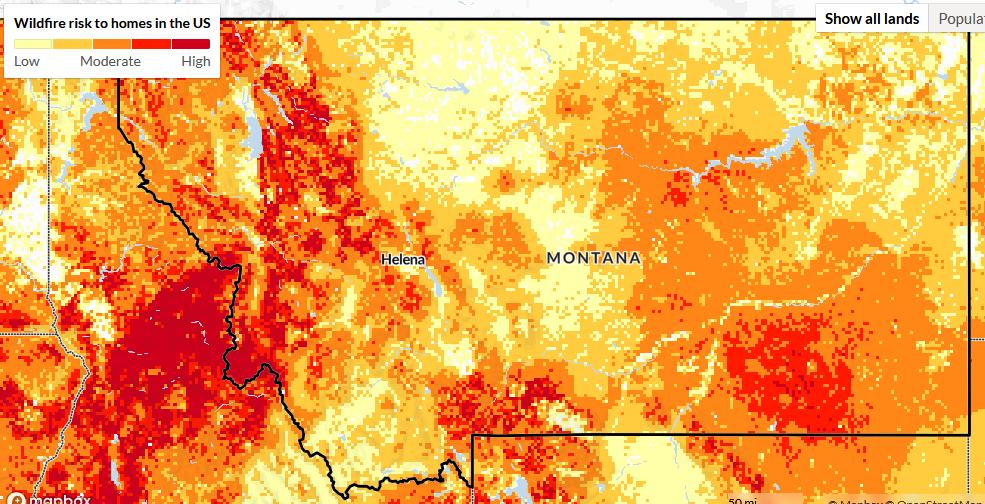
Without local data, insurers assess future uncertainty by examining states with similar environments.
With continued encouragement from EAIC through HJ 61, the current Commissioner of Insurance, James Brown, has now committed Montana to participating in the next national call for data, though it remains to be seen if that data will be usable in time for the 2027 legislative session.
HJ 61 resolves that the results of the EAIC’s study “be reported to the 70th Legislature.” Because EAIC will be required to produce a report that includes “findings, conclusions, comments, or recommendations” of the HJ 61 study, it should make clear that climate change disasters and insurance nonrenewals are major threats to Montana households. The report should reflect that every expert that has come before the panel has made connections between climate models, risk analysis, and insurance repricing and nonrenewals. The report should recommend better data collection, including transparency behind insurance decisions and their connection to climate risk analysis. Finally, the report must outline proactive solutions that experts have identified to maintain insurance availability and affordability for Montana households, including but not limited to smarter land-use planning, incentivizing community-level hardening to fire risk, and improved building codes.
The best solutions require the best data. Policy solutions transcend ideology and become nonpartisan when they are backed by facts and data. This summer, call EAIC at 406-444-3064 and encourage a thorough report about climate impacts on insurance rates. Call the Commissioner of Insurance at 406-444-3525 and encourage transparency in Montana’s insurance markets.
by Nick Fitzmaurice
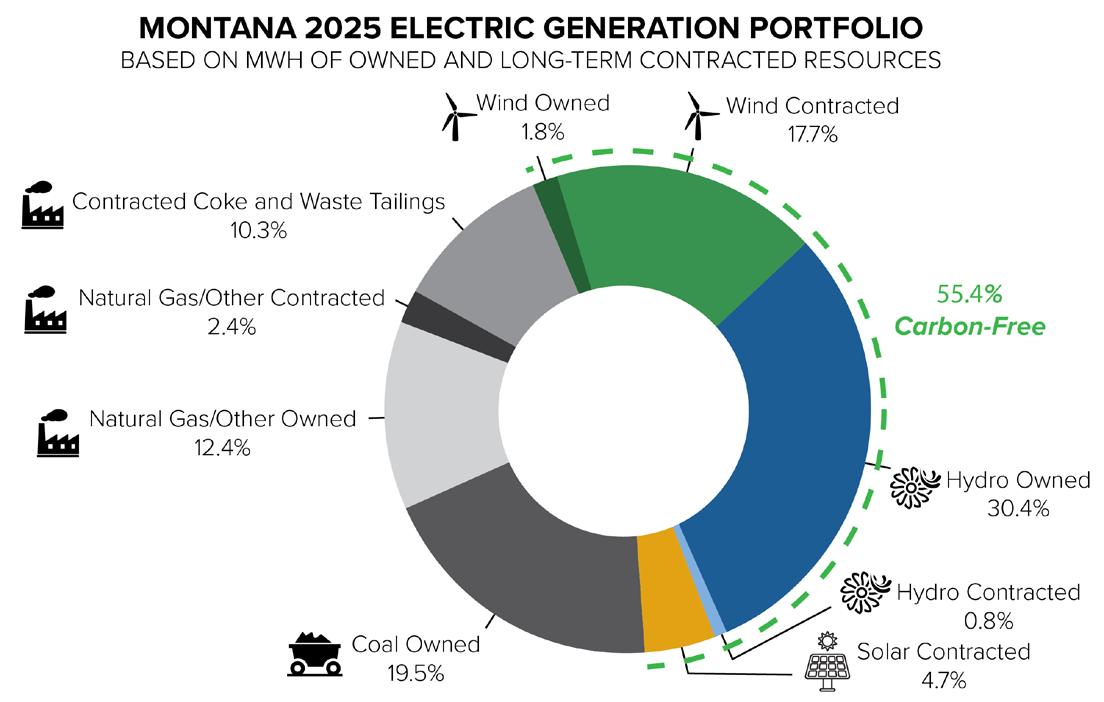
NorthWestern Energy often pays lip service to clean energy and environmental commitments, but looking at trends in the utility’s generation portfolio tells a radically different story. Every year, NorthWestern updates its website to show the previous year’s generation mix, flaunting a seemingly large carbon-free percentage, but previous years’ generation portfolios can’t be accessed for comparison. However, MEIC absolutely tracks these portfolios from year to year.
In 2024, NorthWestern showed a 61% carbonfree generation portfolio in Montana, based on total delivered megawatt hours (MWh) of energy. However, despite Montana’s geographic positioning with the second highest wind generation potential and fourth highest solar generation potential in the nation, only 2% of NorthWestern’s 2024 portfolio consisted of wind or solar energy owned by the utility. That 2% came from two wind facilities that were built over a decade ago, while 35% of the portfolio came from hydro resources that pre-date NorthWestern. The remaining carbonfree wind and solar came from energy contracts that NorthWestern is required to purchase. To be clear, NorthWestern can’t take credit for most of the existing carbon-free resources in its portfolio and is doing nothing to increase its low-risk carbon-free resources.
In fact, the carbon-free generation in NorthWestern’s portfolio is actually shrinking. In 2025, NorthWestern reported an only 55% carbonfree portfolio in Montana. This reduction is largely attributable to the Yellowstone County Generating Station gas plant coming online at the end of 2024, as well as diminishing output from hydro facilities due to prolonged drought conditions. Unfortunately, the
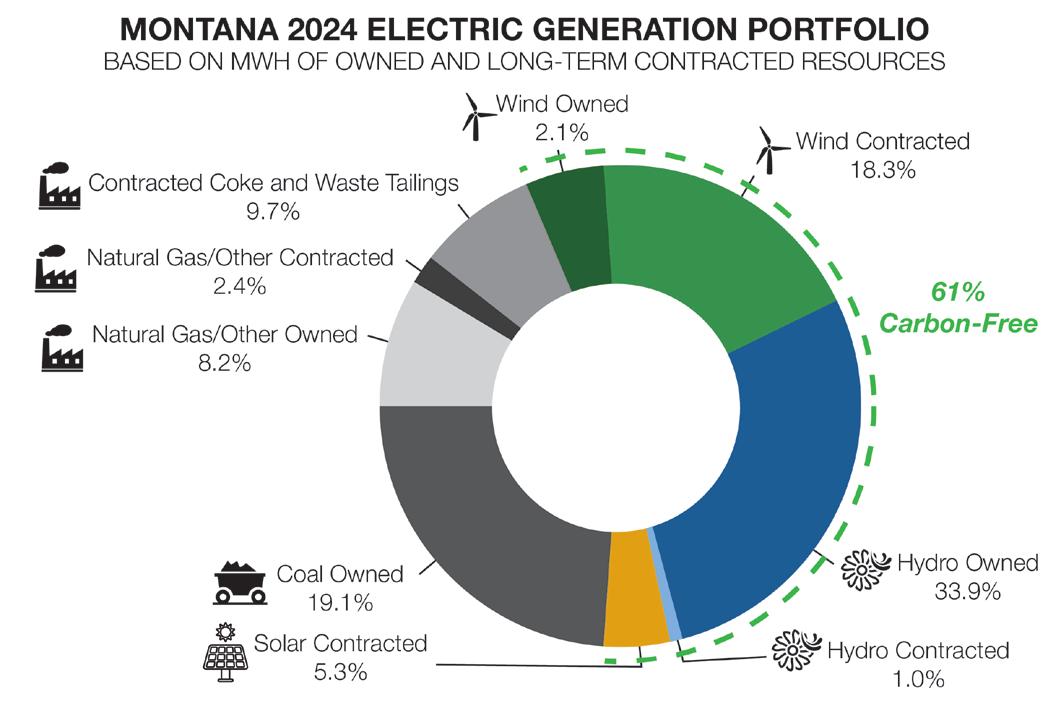
outlook for carbon-free generation in NorthWestern’s portfolio is even worse.
NorthWestern acquired Avista’s 222 megawatt (MW) and Puget Sound Energy’s (PSE) 370 MW of the Colstrip plant on January 1, 2026, adding to its existing 222 MW share. A significant portion of the 222 MW from Avista is already being dispatched for NorthWestern’s Montana customers, which will reduce NorthWestern’s carbon-free percentage even further in 2026, while the utility has indicated the 370 MW from PSE could be used for Montana customers (i.e., new data centers) beginning in 2027. Meanwhile, NorthWestern is allowing its contract with the Judith Gap Wind Facility to expire at the end of 2026, meaning even less carbon-free energy in the coming years. Judith Gap has been NorthWestern’s most productive wind resource, supplying over 6% of the utility’s total delivered electricity in 2022 (the most recent year for which MEIC has comprehensive data).
MEIC can’t anticipate exactly how much energy each of NorthWestern’s resources will generate in the coming years. However, analyzing the utility’s entire portfolio of resources would suggest that the additional Colstrip plant shares and removal of Judith gap from the portfolio will likely bring NorthWestern’s carbonfree generation well below 40%, and potentially as low as 21% depending on how various resources are dispatched (or not) to meet customer needs. This is why MEIC is engaging so heavily in NorthWestern’s Integrated Resource Plan, which currently lays out a 20-year future almost completely devoid of new lowcost wind and solar projects (see article on pg. 18). Other utilities across the country and around the world are rapidly developing new wind and solar projects, and we need NorthWestern to do the same.
by Shannon James
In March, Honor the Earth, an international organization focused on Tribal sovereignty and environmental justice, hosted a packed panel discussion in Lame Deer focused on two rapidly emerging industries in Montana: nuclear energy and data centers. Both are being explored as development opportunities across the state, yet they raise significant concerns for land, water, public safety, and local communities.
The panel brought together voices from across the country who have been on the frontlines of similar fights. I joined speakers Ian Zabarte of the Native Community Action Council, Jeanie Alderson of the Northern Plains Resource Council, and Oklahoma farmer and land-use advocate Darren Blanchard. Together, we shared lessons from past and ongoing resistance efforts, highlighting the long history of communities organizing to protect their resources from industrial development.
Tribal members in attendance voiced particular concern about water, an invaluable and increasingly scarce resource. Their perspectives underscored what is at stake as Montana faces growing pressure from energy-intensive industries.
Zabarte spoke about decades of opposing nuclear development on Indigenous lands. He continues to lead efforts to stop nuclear waste dumping at Yucca Mountain, the ancestral homeland of the Western Shoshone. Zabarte was also part of the successful campaign to end nuclear bomb testing in North America, a movement that exposed long-term health and environmental consequences of nuclear activities.
I highlighted how national trends are rapidly
taking shape in Montana. For decades, Montana voters had a direct say over nuclear development through a 1978 initiative requiring statewide approval for any nuclear plant. That safeguard was repealed in 2021, opening the door to new development. Subsequent legislation passed in the 2025 session has allowed for nuclear waste storage and uranium processing in the state, while efforts to require local and Tribal approval ultimately failed.
Much of the current push for nuclear power is being driven by the rapid growth of data centers. These facilities demand enormous amounts of electricity and water, often requiring new infrastructure and driving up costs. In other regions, data centers have already contributed significantly to rising electricity prices. Montana has seen dramatic rate increases in recent years, even before large-scale data center development.
While NorthWestern Energy explores nuclear power and keeps the public in the dark about data center development, the federal government is accelerating efforts to deregulate the nuclear industry. The Department of Energy is aiming to have three new advanced reactors operational by July 4. This is a dangerously ambitious target driven by one of Pres. Trump’s Executive Orders on nuclear energy signed last May. In the rush to meet this goal, federal agencies are rolling back safety standards and weakening environmental review requirements, limiting transparency and public oversight.
MEIC is closely tracking the steady stream of rule changes coming out of the federal government. We will continue to keep you informed and flag opportunities for the public to weigh in on these concerning proposals.

by Denise Roth Barber
Every day in Montana, there are quiet, often unseen moments that determine the future of the places we love — decisions about clean water, breathable air, and the landscapes that define this state. Because of our members, MEIC can show up for those moments.
We’re so grateful for all our members, but in this Down To Earth, we would like to shine a light on members of our Snowberry Society. These are members who donate what they can — $5, $25, $100+ — every month! Our monthly donors provide the steady, reliable support that allows MEIC to plan ahead, act quickly, and stay focused on protecting Montana’s air, water, and wild places every single day.

Like the snowberry — quietly resilient, rooted in place, and enduring through every season — our monthly donors may not always be visible, but they are essential. Snowberries nourish wildlife through the winter and help sustain the ecosystem year-round. In the same way, our Snowberry Society sustains MEIC’s work behind the scenes, ensuring we can respond nimbly to emerging threats, advocate effectively, and stay the course for long-term change.
Bob and Carolyn Adams of Helena, for example, have been strong supporters of MEIC since its inception in the early ’70s. In 2008, they chose to give consistently every month, which they have been doing for the past 16 years! When asked why they decided to give monthly, Bob and Carolyn said, “The foremost reason is to support the most effective environmental advocacy program in Montana. During MEIC’s decades-long presence at the Legislature, before its committees and commissions, in state and federal courts, MEIC remains articulate, accurate and relentless in pursuit

of environmental justice. We believe that the best and most efficient way to allow MEIC to plan its budget is for staff and board to know that there is a steady and dependable source of funds arriving in each month of the year. That’s a solid basis for long-range commitment to projects. While we encourage whatever manner of giving works best for you, we also urge you to consider the Snowberry program for monthly giving. After all, the attacks on our Montana Constitutional Right to a Clean and Healthful Environment occur monthly, if not daily!”
I, too, have been a member of MEIC’s Snowberry Society since 2023. I give monthly so that I can give more. Large one-time donations aren’t always possible, but making consistent monthly donations allows me to ultimately give more each year, without putting extra stress on my wallet.
Because of committed supporters like you, MEIC is able to take on complex, long-term challenges: from pushing for a closure date for Montana’s largest polluter, the Colstrip Power plant, to protecting the Cabinet Mountains Wilderness, to ensuring NorthWestern Energy customers aren’t left paying for corporate pollution mistakes. This work requires persistence, stability, and courage, and monthly support helps make all three possible.
We want to thank all of our monthly donors for standing with us in such a meaningful way. We’re honored to have you as part of our dedicated community protecting the Montana we all love — today and for generations to come.
Please consider joining our Snowberry Society, if you haven’t already. To do so, go to our website Donate page, select “Recurring Donation” under Gift Purpose, and select “Monthly.”
If you have questions, don’t hesitate to reach out to me at drothbarber@MEIC.org or 406-443-2520.
by Derf Johnson
Over the past several years, I’ve noticed a troubling trend in the way the Montana state government interfaces and integrates the public into its decision-making. Increasingly, the voices of Montanans and the opportunities to participate and request public documents are being pushed out in favor of secrecy and “efficiency.”
This is especially alarming, as the right for the public to know and participate in governmental decision-making is critical to our democracy and ultimately our fundamental, Article II Constitutional rights in Montana. These Constitutional rights are not just boilerplate language tossed into our constitution that the government can choose to ignore; they were specifically added into our constitution after a century of mining oligarchs controlling our government and the purposeful obfuscation of government decisionmaking by the likes of the Anaconda Company.
Recently, I’ve discovered that hardrock mining exploration licenses no longer have a notice and comment process associated with them unless the DEQ decides a project may be controversial enough to do so. That’s a problem, as how can the DEQ know about the full suite of environmental issues and concerns from the public unless it, well, asks the public? Mining activities can pose extreme risks to the environment and property rights, and this is exactly the type of activity contemplated by our Constitutional Convention
delegates when they drafted the Article II rights.
DEQ is using loopholes in order to avoid its obligation to hear from the public. At the public meeting for the proposed Bridger Pipeline in Miles City (see article on pg. 8), the event was more akin to a tabling exercise for industry than a public meeting. Commenters were not allowed to speak their comments aloud but rather were restricted to written comments. The company’s “public” meeting for the proposed gold mine on the Blackfoot River (see article on pg. 6) was similar, but even worse; while not an official publicly noticed meeting, DEQ had a table at the event as a “vendor” and spoke with members of the public, all while not on the public record (see image below).
The Governor’s Energy Task Force is taking a page out of this book (see article on pg. 20), hosting multiple tabling events around the state in order to preach — but not listen.
Unfortunately, the weakening of Montana’s Rights to Participate and Know about environmental permitting is not limited to administrative agencies. In 2021, the Montana Legislature passed HB 599 (Rep. Steve Gunderson, R-Libby), which dramatically limited public input regarding the permitting of gravel mines. Now, the most frequent calls into our office are from distraught landowners with massive gravel pits going in next door — with little recourse unless the law changes (see article on pg. 10).
This trend has also borne itself out in the Governor’s Office. Back in November 2021, MEIC submitted an information request to Gov. Greg Gianforte regarding his office’s communications with the mining industry and specifically its decision to drop the “Bad Actor” enforcement action against Hecla Mining Co. Ultimately, our information request was rejected, and we are still in litigation. We have not been provided with the vast majority of the relevant information that
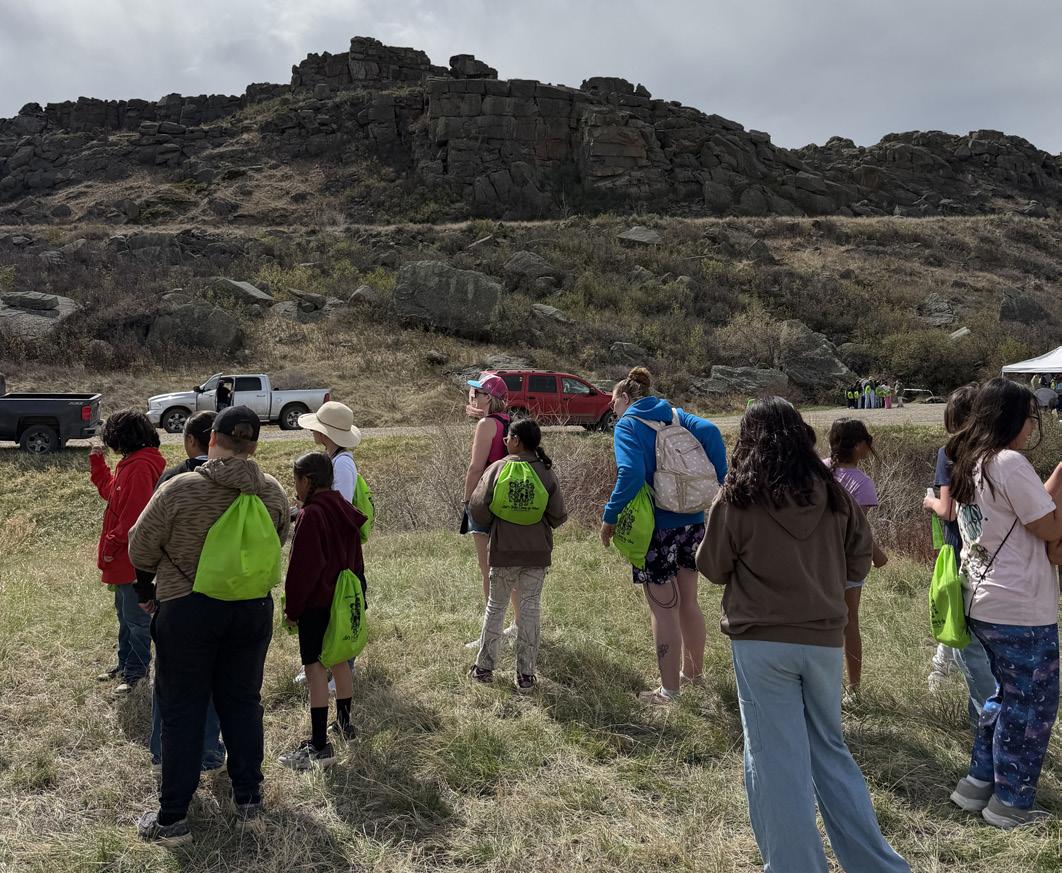
MEIC ’s Derf Johnson spent Earth Day with students on the Fort Belknap Indian Reservation, teaching them about our Right to a Clean and Healthful Environment.
we requested, and it is now close to five years since our original request. Needless to say, access to information has an expiration date. If the government is able to tie up its required disclosure in court for years on end, to the point where accountability becomes obsolete, then what good is our right? Now, the Governor’s Office is arguing for a massively expanded “gubernatorial privilege” that would, if accepted, basically exonerate the Governor’s Office from having to comply with our Constitutional Right to Know.
Not to be outdone, back in the summer of 2024, the Montana Legislature attempted to prohibit the public from seeing its files on bill drafts, colloquially known as “junque” files. This was a big deal, as these files contain a wealth of information that the public has found to be instructive and informative on the legislative process. MEIC and partners brought suit against the Legislature for this attempt to thwart constitutional transparency, and the case is currently being considered by the Montana Supreme Court.
I suspect that — at least in part — the government would argue that public processes are cumbersome, and for the sake of efficiency, the public should just take it
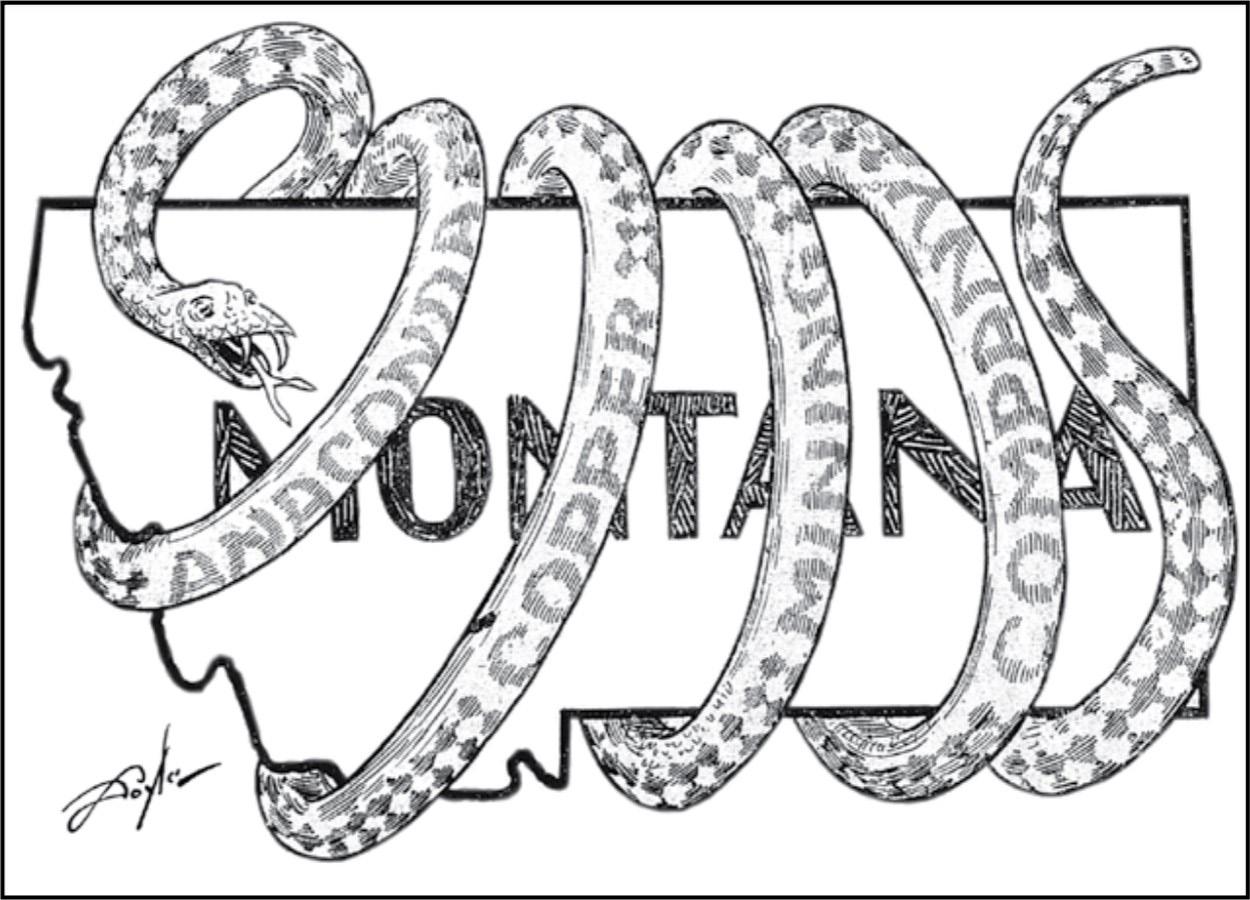
on the chin. That’s not just inappropriate and probably illegal, but will ultimately lead to poor decisions by our leaders and agencies. Without an adequately-informed public and without the opportunity to meaningfully participate in the mechanics of our government, the decisions will only reflect and cater to those with access to the Governor, Legislature, and agencies — namely those with money and influence well beyond the average Montanan. I can guarantee you, that’s not what Montanans want.
I’m eager to join MEIC’s team as Land and Water Policy Advocate. In this role, I advocate for sustainable land use practices, protection of water resources, and environmentally conscious and economically equitable communities.
I spent the past eight years at Northern Plains Resource Council. I served as Community Organizer for Northern Plains’ affiliate group in Billings where I supported its members establishing the City of Billings Energy and Conservation Commission and launching the first Solarize Billings campaign. I also worked for six of those years with Northern Plains’ ranching members to fight for competitive livestock policy at the state and federal level.
In 2022, I relocated to Helena to lead the legislative and government affairs program for the organization while also organizing their Gardiner affiliate group and Northern Plains’ democracy work. I fell in love with lobbying and all things Montana legislature, and worked with Northern Plains members on some key wins like defeating harmful constitutional amendments and passing the Montana Solar Shares Act through both chambers.

I spend my free time antiquing and frequenting estate sales, gardening, and enjoying Helena’s downtown with my husband and young daughter.
P.O. Box 1184 Helena, MT 59624