DowntoEarth December 2025 | Vol.51 • No.4
NEWS FROM THE MONTANA ENVIRONMENTAL INFORMATION CENTER
The Fight Against Fossil Fuels Continues
MEIC Goes to Court Over Exempt Wells
Transmission Data Center Outlook is Hype Spells Good MT It’s Your Right,Trouble Cleanfor and Healthful. Our Mission. 1
In This Issue
MEIC is a nonprofit environmental advocate whose purpose is to protect Montana’s clean and healthful environment. This quarterly publication is printed on recycled paper. Board President: Jessie Wiles
24 Jan & Harold Hoem are Conservationists of the Year
2
3 Montana Defends Lake Koocanusa
12 Governor's Task Force Prioritizes Industry
4 MEIC Goes to Court Over Exempt Wells
13 Mine Tests New Nutrient Water Standard
5 Pushing the PSC to Regulate NWE on Data Centers
14 CHS Refinery Pays a Small Fee for Huge Pollution
6 Butte Data Center Conversation a Hit
15 Nuclear Energy Event Highlights Indigenous Voices
8 NWE's Latest Colstrip Plant Boondoggle
16 Transmission Study Outlines Positive Paths
9 NWE Attempts to Create Unregulated Subsidiary
18 Promising Advances in Enhanced Geothermal
10 MEIC Sues Over DEQ's Rubber-Stamp of NWE Gas Plant
19 NWE's 20-Year Plan Coming Soon
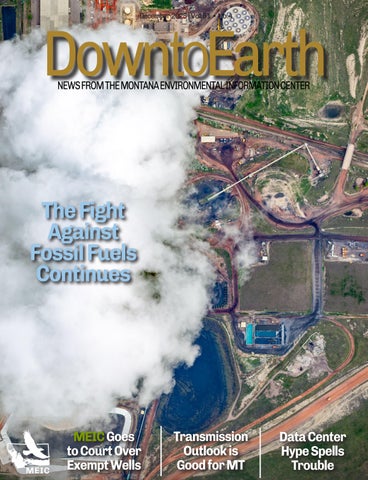
Cover photo: The Colstrip plant by Kestrel Aerial. Interior photo: Jan and Harold Hoem pose for a photo with the coal trains they battled. Photo via Jan Hoem.
23 DOI Rejects Coal Sale
20 NWE Rate Case Update 27 From the Executive Director
Montana Environmental Information Center
Board Members: Jessie Big Knife Rob Farris-Olsen Grace Gibson-Snyder Diana Hammer Mary McNally Eva Molina Jeremy Osborn Jim Sayer Roger Sullivan Beth Taylor-Wilson Jesse Therien Meridian Wappett MEIC Staff: Ben Catton Laura Collins Nick Fitzmaurice Anne Hedges Shannon James Derf Johnson Peyton Olson Denise Roth Barber Katy Spence Maghan Strachan Julie Wintersteen Mailing: P.O. Box 1184 Helena, MT 59624 Offices: 324 Fuller Ave. Helena, MT 225 W. Front St. Missoula, MT Contact: 406-443-2520 meic@meic.org www.meic.org
DEQ denies petition to increase pollution in Lake Koocanusa by Katy Spence
I
n an ongoing battle to defend Montana waters against Canadian coal mining pollution, the Montana Department of Environmental Quality (DEQ) denied a petition from Lincoln County Commissioners in September that would have doubled the amount of allowable selenium pollution in Lake Koocanusa. While the work is far from over, this is an indication that Montana DEQ remains a solid partner in protecting our water from Canadian pollution and – perhaps more importantly – that public comments and community action are still effective ways to protect Montana resources. The selenium in Lake Koocanusa and the Kootenai River emanates from massive open-pit coal mines in the Elk Valley of British Columbia. The mines are owned by Glencore, a Swiss-headquartered multinational commodities trader that has a well-known reputation for corruption, bribery, and environmental damage. In 2020, DEQ adopted a “site-specific” standard for selenium of 0.8 μg/L (micrograms per liter) in Lake Koocanusa, due to overwhelming stakeholder input and scientific evidence that this is more protective for aquatic life. Glencore (and its predecessor Teck Coal) see the standard as a threat to their bottom line, and actually tried to repeal the standard through a review process at the Board of Environmental Review. However, in a surprising move, the Lincoln County Board of Commissioners (who represent the far northwest Montana county and the watershed most impacted by Glencore’s pollution) submitted a petition to DEQ in July 2025, requesting that it weaken the water quality standard for selenium from 0.8 to 1.5 μg/L, as well as weaken the definition of “steady state,” a determining factor in assuring that water quality is protected and restored. DEQ held a public hearing on Aug. 13. A dozen opponents spoke against the petition, including a number of partner organizations and outfitters in northwest Montana. Only one person spoke in favor of
the petition – one of the commissioners who brought it forth. After denying the petition, DEQ stated in an email that it denied the petition “after consideration of the body of record evidence, including submitted petition materials and the public comments received.” Many MEIC members and partners spoke out against what seems to be a politically-motivated move by the Lincoln County Commissioners. There is no scientific justification for weakening the current standard. Fish in Lake Koocanusa showed unhealthy levels of selenium at water quality levels of 1.5 μg/L. While selenium is beneficial to human health in trace quantities, excessive selenium has been shown to result in sudden and severe crashes in fish populations by causing a significant reduction or elimination of reproductive capacity. There are multiple species of fish in the lake that regularly exceed selenium standards, such as longnose sucker, northern pike minnow, and redside shiner. The decimation of fish populations would not just be an ecological disaster for the watershed but would compromise the recreation economy in northwest Montana. Boating and fishing are Montana’s second largest recreational activity, accounting for $149 million in economic activity. Further downstream, the Kootenai River in Idaho has been deemed impaired due to excessive amounts of selenium flowing from Canada. In the coming months, DEQ may be considering listing Lake Koocanusa as impaired due to excessive selenium, which will help act as a political lever to continue fighting for accountability from our northern neighbors. This process will likely come with a comment period. MEIC has been to court in defense of these protective standards, and we are closely following the International Joint Commission’s efforts to mitigate and reclaim the selenium pollution emanating from the coal mines in B.C. We won’t stop fighting for the health of the threatened watershed.
Clean and Healthful. It’s Your Right, Our Mission.
3
Montana’s Exempt Well Loophole: A Constitutional Crisis for Our Water
by Laura Collins
A
cross Montana, the quiet spread of exempt wells is creating a big problem for our rivers, streams, and drinking water. Under current law, these small wells, originally intended for single homes or limited agricultural use, can be drilled without a water right permit. But developers have long used them to provide water to large subdivisions, each new home adding one more straw into the same shrinking aquifer. To address this growing challenge, MEIC has joined with the Clark Fork Coalition and National Trout Unlimited, represented by the Western Environmental Law Center, as well as municipalities, developers, and agricultural water users, to file a legal challenge against the Montana Department of Natural Resources and Conservation (DNRC) and the State of Montana to close the exempt well loophole due to its impact on constitutionally-protected water rights. Water rights are protected under the Montana Constitution and the Water Use Act. However, exempt wells are not subject to the water rights permitting process. The exempt well law incentivizes new groundwater development outside of the rigorous permit process, which has led to the rapid conversion of agricultural lands into poorly-planned development, loss of water for instream flows and traditional uses, and other adverse impacts to impaired surface waters. Exempt wells are often paired with septic systems, which leach nitrogen and phosphorus into groundwater. Over time, that pollution seeps into rivers and lakes, triggering toxic algal blooms and threatening both wildlife and human health. The result is widespread groundwater depletion, polluted lakes, and impaired rivers and streams. This exemption leaves water rights holders zero recourse to exercise and defend their water rights. The exempt well law violates Montana’s constitutional water rights protection provisions and prevents DNRC from protecting these rights. This isn’t just bad policy. It’s a blatant violation of the fundamental rights of all Montanans who depend on clean and plentiful water. Montana’s Constitution guarantees every person “the right to a clean and healthful environment” and requires the state to “maintain and improve” it for future generations. Yet, the state has allowed thousands
4
Montana Environmental Information Center
Clark Fork Coalition's Exempt Well Dashboard tracks exempt wells in the Bitterroot and Missoula aquifers.
of exempt wells to be drilled without meaningful review, monitoring, or mitigation, failing to prevent harm before it occurs. Exempt wells not only deplete water needed to sustain fish and rivers, they undermine the rights of senior water users whose legally-protected water rights are being drawn down without notice or recourse. In allowing this unchecked development, the state is additionally violating Montanans’ constitutional rights to due process, and the rights to know and participate in government decisions. Exempt well permits evade public review entirely, cutting water users and citizens out of the process and leaving local governments unable to manage development responsibly. Montanans are owed better water policy. The right to a clean and healthful environment and the rights of senior water right holders are intertwined. The time has come to fully close the exempt well loophole and craft a better legal framework that recognizes that water is a shared and finite precious resource that must be managed responsibly for present and future generations. All Montanans deserve a voice in determining the fate of our shared precious resources.
by Ben Catton
N
orthWestern Energy wants to provide electricity to energy-guzzling data centers while it evades its legal obligations to existing customers. The law is clear: a public utility in Montana can only provide electricity to a new energy intensive customer – including data centers – if it can demonstrate to the Public Service Commission (PSC) that providing that electricity won’t harm existing customers. Yet, NorthWestern has largely ignored the PSC’s requests to comply with the law. NorthWestern has signed three letters of intent to serve large data centers. Unfortunately, NorthWestern wants to keep those signed letters secret from the public who could be forced to subsidize the electricity and transmission bills of some of the richest companies in the country as a consequence of these deals. As a result, MEIC and our partners,* represented by Earthjustice, filed a complaint with the Montana PSC in November requesting it protect existing customers from subsidizing the electricity and transmission costs of data centers. The complaint asks the PSC to exert its control over NorthWestern, enforce existing law, and use the tools at its disposal to protect Montanans from big-tech’s high-risk investments. Prior to filing the complaint, Earthjustice sent two letters to the PSC in October on behalf of MEIC, Honor the Earth, and the NW Energy Coalition. One letter requested the PSC deny NorthWestern’s unjustified protective order attempting to keep the contracts from public scrutiny. NorthWestern's attempt to hide the contents of its agreements with data centers from the public is concerning. While there may be valid reasons to keep portions of those contracts secret, it is unusual in Montana for an entire contract to be off-limits to the public. These backdoor deals are a common tool used by utilities across the country to avoid disclosing that they are using revenues from existing residential and small business customers to subsidize electricity for data centers. In one recent instance, litigation revealed that an east coast utility was planning for existing customers to pick up an extra $325 million for discounted energy
costs to the data center over the life of the contract. Existing customers deserve to know if their hardearned money will be used to subsidize power and transmission for data centers. The second letter detailed why NorthWestern’s contorted legal theory about not needing PSC approval was erroneous. We requested the PSC address NorthWestern’s legal obligation to prove that it will not harm existing customers, outlining the risks of shifting costs from large load data center customers to existing residential and small business customers. This letter details how creating a separate rate class for large energy users such as data centers can protect existing ratepayers, as can various “tariffs” that provide specific sideboards for that electricity service. It asserts that the PSC’s approval must occur prior to the utility providing for electricity supply service, as the law dictates. The PSC has repeatedly issued letters to NorthWestern saying that NorthWestern needs its approval to serve data centers. In its November reply, NorthWestern finally acknowledged that the plain language of the law requires “approval,” a word it painstakingly avoided for nine months. To date, NorthWestern has only agreed to come before the PSC with a proposed tariff by the end of the year. While tariffs can be useful tools to avoid current customers subsidizing data centers, they are insufficient on their own to guarantee data centers pay their fair share. NorthWestern’s reluctance, omissions, and incomplete solutions led MEIC and our partners to file this complaint with the PSC. Sustainable data center policies that ensure that big-tech’s data center proposals don't raise electricity bills for existing customers, drain water resources, or damage public and environmental health is the only rational path forward in this frothy bubble of AI and data center hype. *Partners in the litigation include: Big Sky 55+, Butte Watchdogs for Social and Environmental Justice, Climate Smart Missoula, Golden Triangle Resource Council, Helena Interfaith Climate Advocates, Honor the Earth, MontPIRG, and NW Energy Coalition.
Clean and Healthful. It’s Your Right, Our Mission.
5
Buttians Question the Impacts of Big Tech’s Data Centers by Ben Catton
B
uttians are worried about data center development. On October 16, more than 70 people filled the Copper Lounge at Montana Tech in Butte to learn about the potential impacts of Big Tech’s plans for data center development in Silver Bow County. The event, Beyond the Boom: Protecting Butte from New and Old Resource Pressures, opened with MEIC’s Anne Hedges discussing state and federal policies that incentivize data center development and are likely to raise electricity bills. Sarah Borduin, a Butte citizen organizer, took a hard look at a current data center operation in Butte as well as a proposed data center nearby. Butte resident Steve McGrath concluded the presentation by explaining how public engagement resulted in cleaner air for people in Butte. He shared how the Greeley Neighborhood Community Development Corporation, Inc., worked with MEIC to persuade Montana Resources to install dust control technology. McGrath emphasized that “a dedicated and unrelenting community effort can bring positive results.” A community discussion, moderated by Erik Nylund, podcaster at “Mad About Montana,” followed the presentations. The robust set of community questions were submitted to the Butte-Silver Bow County Commission for a written response. (The full event can be viewed on MEIC’s YouTube channel.) Data centers are massive warehouses of computers. Montana’s proposed data centers are called “hyperscale projects” and demand enormous amounts of power and water. The two data centers discussed by the panel could consume 400 megawatts (MW) of electricity – enough to power over 300,000 homes. For comparison, NorthWestern Energy currently supplies
6
Montana Environmental Information Center
about 750 average MW to its entire Montana customer base. Large data centers also need an enormous amount of drinking-quality water. A single data center can consume up to five million gallons of water daily, a volume comparable to the water usage of a town of up to 50,000 residents. The proposed data center in Butte recently admitted it would use up to three million gallons of water a day. The audience questioned where that water would come from and in a drought, what would happen to fish, wildlife and senior water users. Proponents have mentioned the possibility of nuclear energy supplying data centers with electricity, but this is likely a red herring. The supposed new generation of nuclear power plants, referred to as small modular reactors (SMRs), will take at least a decade to build – not within a timeframe that could power these energy-hungry data centers. In addition, nuclear power is currently the most expensive generation available, and SMRs in development are proving to be similarly unaffordable (with staggering tax payer subsidies). The panelists stressed that transparency and regulations are needed to ensure that promises made by Big Tech’s salespeople, utility CEOs, and politicians are backed up in writing. It is essential that our elected officials at the Public Service Commission (PSC), in our local governments, and at the Montana Legislature restore balance in our regulatory relationship with data centers — before it's too late. MEIC is engaging local communities in this fight, and we are holding the PSC accountable to their role in protecting Montana’s energy customers. People in Montana deserve elected officials who will stand up for them, not out-of-state tech companies who can afford to pay their own way.
Artificial Intelligence Threatens Water, Climate, Jobs, and Utility Bills
by Katy Spence
B
y now, it seems impossible to avoid “smart” features in internet-powered devices. Often powered by artificial intelligence (AI), many of these features seek to make our lives easier. But more advanced AI takes a toll on our water resources, our energy bills, our rights, and even our brains. Known as “generative AI” or “gen-AI,” some AI platforms are able to generate images, imitate human speech, read and write emails, or even have chat conversations with humans on the other end. The intensive computing demand of gen-AI relies on data centers, which are a climate, water, and energy disaster (see article on pg. 5). Many data centers use drinking-quality water to keep computers cool, pulling water from nearby residents. Large data centers can consume up to five million gallons of water each day, which is enough water to support a town of up to 50,000 people, according to the Environmental and Energy Study Institute. A new Cornell study estimates the number could increase to as much as 1.1 billion cubic meters of water in the U.S. annually. The Cornell study also found that if AI continues to grow at its current pace, U.S. data centers could emit 24 to 44 million metric tons of carbon dioxide into the atmosphere every year by 2030, which is the equivalent to emissions from up to 10 million cars. Beyond the devastating impacts to water and energy, gen-AI is having an impact on humans. Many corporations are incentivized to adopt gen-AI features to replace human workers, especially in areas of online customer service or content creation. CBS News reports that 10,000 jobs were cut in July 2025 alone due to adoption of gen-AI, without enough jobs being created to replace them. Gen-AI models can create images and write text because they were trained using art and content created by humans often without permission from or compensation to the original creators. Countless
Generative AI has the potential to replace jobs currently filled by humans, at a large energy and water cost.
publications, music labels, TV studios, and more have entered into litigation with AI companies, but many individual artists and writers may not have the resources to seek retribution for unauthorized use of their creations. You might be a victim of this, too: your email, cloud storage, and even video conferencing software may offer “AI” or “smart” features that rely on reading your email, consuming your photos, and capturing your likeness and voice on video, all without needing your permission. At MEIC, we are fighting this battle on multiple fronts: pushing back against unneeded and unwanted data centers, as well as asking for our state regulators to study — and regulate — their impacts. MEIC staff are attempting to opt-out of gen-AI features where we can. As consumers, we should be able to turn off AI features when we don’t need or want them, especially if they are harming our water, our climate, and our privacy. To cap it all off, researchers at MIT have found that consistent use of ChatGPT (a popular gen-AI platform) can decrease brain function; it’s easy to ask a computer to do the thinking or drawing for you, but without consistent use, brain function declines quickly. This is one technology we should approach cautiously.
Clean and Healthful. It’s Your Right, Our Mission.
7
NorthWestern’s Complex Scheme to Avoid Scrutiny of New Colstrip Shares by Anne Hedges
I
n September, NorthWestern Energy made an extraordinary request of the Montana Public Service Commission (PSC). It requested permission to engage in a complicated scheme that would essentially result in its existing customers having to pay another $18 million for the costs of operation and maintenance for an additional share of the Colstrip plant before the PSC determines that owning that additional share is “prudent” – a requirement in existing law. Washington-based utilities, Avista Corp and Puget Sound Energy, are original owners of the Colstrip plant, but both are exiting the plant because it is expensive and counter to the state’s energy goals. Both have cut deals to give their shares of the plant to NorthWestern starting on January 1, 2026. NorthWestern volunteered to take Avista’s share of the plant in Jan. 2023. Nearly three years later, and right before it takes ownership of the new share, NorthWestern is asking the PSC to use a novel scheme to start charging customers for Avista’s 220 megawatt share of the plant before the PSC has a chance to kick the tires on the deal. NorthWestern had three years to go through the normal acquisition process, but instead waited until the last minute in an apparent attempt to prevent a thorough investigation into whether its customers actually need the extra electricity and whether the electricity from the Colstrip plant is affordable. Instead of following the long-established process to charge customers for the additional share of this expensive, outdated, and frequently-broken plant, NorthWestern is trying to do an end run around the public and the PSC. In September, NorthWestern requested the
8
Montana Environmental Information Center
PSC approve its scheme to use the Power Costs and Credits Adjustment Mechanism (PCCAM) to charge customers for operation and maintenance costs for the new share of the plant. PCCAM is supposed to be used for fuel costs and market purchases and sales, but under NorthWestern’s proposal, revenues that should be passed back to customers through the PCCAM would instead be diverted to pay for NorthWestern’s additional share of the Colstrip plant. NorthWestern is using this expedited mechanism to bypass traditional rate-making procedures. This truncated process leaves very little time and ability for PSC staff, MEIC, or the Montana Consumer Council to ask questions, receive answers and verify that this type of scheme is legal and truly benefits existing utility customers. In October, Earthjustice, on behalf of MEIC and Sierra Club, intervened in this docket to get some answers, protect existing customers from suffering from ever escalating electricity bills, and force NorthWestern to use the appropriate mechanism to establish whether it’s actually in customers’ interest to pay the everescalating costs for operation and maintenance of the Colstrip plant.
NorthWestern Bypasses PSC in Creation Montana Transmission of New Subsidiary
by Anne Hedges and Shannon James
N
orthWestern Energy is once again putting corporate profits ahead of Montana customers. Years ago, NorthWestern cut a deal with Puget Sound Energy to acquire Puget’s share of the Colstrip plant when Puget is no longer allowed to sell coal-based electricity to its customers in Washington State. NorthWestern’s existing customers in Montana have no need for more electricity, especially since NorthWestern went on a spending spree and built the Yellowstone County Generating Station. So the question has lingered for years: what is NorthWestern going to do with all of the excess power it will acquire from Puget and Avista Energy? Recently, NorthWestern quietly filed a docket at the Federal Energy Regulatory Commission (FERC) requesting permission to create a new corporation within the utility that would not be subject to regulation by the Montana Public Service Commission (PSC). This new, unregulated subsidiary — NorthWestern Colstrip 370 Pu LLC (NorthWestern Colstrip) — will sell the newly-acquired 370 megawatts of electricity from the Colstrip coal plant into the market. Without PSC oversight, NorthWestern’s new corporation will be less transparent and could be shielded from public scrutiny and accountability. NorthWestern plans to have NorthWestern Colstrip sell the electricity to Mercuria Energy Group, a Houston-based trading firm with no ties to our state. Mercuria will then sell this power on the open market for profit, while NorthWestern’s Montana customers may well end up footing an unfair share of the costs to keep the outdated Colstrip plant running. Thanks to Earthjustice, MEIC was able to quickly intervene in the FERC proceeding to object to this complex transaction and ensure existing customers are insulated from NorthWestern’s shenanigans. At least three components of this FERC filing raise questions. First, NorthWestern said that the “energy rates… are below NorthWestern Colstrip’s costs of producing energy.” Translation: NorthWestern’s subsidiary is selling below-cost electricity into the market, leaving Montanans to pay more for their electricity from the Colstrip plant than those who will buy Colstrip power from the market, with no PSC oversight for this new share to ensure Montanans are
Image from MRDAP Report June, 2018
not subsidizing the cost to operate and maintain the new share of the plant and the transmission system. Second, in its FERC filing, NorthWestern said its rates for the new power will be based on a previous lower-cost coal contract. Coal is one of the most expensive components of the cost of Colstrip power. If the subsidiary is paying for coal costs based on a previous lower-cost contract for coal from the mine, why should existing customers pay the new higher costs for coal to fuel the same plant? Third, while both Avista Energy and Puget are giving away their shares of the Colstrip plant for economic and legal reasons, they are both maintaining their ownership of the transmission system that moves power from Colstrip to western Montana and other western states. For years, NorthWestern argued that the transmission system is maxed out, yet this deal would result in NorthWestern taking up precious transmission capacity to serve new market loads. This raises concerns that existing customers may be required to sacrifice their access to an already-constrained transmission system. This could impair affordability and reliability, and it could result in customers subsidizing the transmission costs for NorthWestern Colstrip’s sales of electricity into the market. Montanans are already overpaying for electricity based upon the cost of the Colstrip plant compared to other electricity sources. As a result, Montanans are struggling to pay electricity bills that are 39% higher than they were in 2022. Montanans deserve the ability to guarantee that they aren’t subsidizing the costs of an expensive old coal plant and limited transmission capacity so that NorthWestern’s executives and shareholders can make more money at our expense.
Portland General Electric
Clean and Healthful. It’s Your Right, Our Mission.
9
Photo of the YCGS by Kestrel Aerial.
MEIC Challenges DEQ’s Rubber Stamp of Laurel Gas Plant
by Anne Hedges
E
arlier this year, the Montana Supreme Court directed the Department of Environmental Quality (DEQ) to comply with Montana’s constitution and analyze the impacts of the greenhouse gas emissions from NorthWestern Energy’s Laurel Generating Station (sometimes referred to as the Yellowstone County Generating Station) As predicted, DEQ’s attempt was lackluster. On September 29, Earthjustice and Western Environmental Law Center, on behalf of MEIC and Northern Plains Resource Council, filed a challenge to DEQ’s continued failure to analyze, disclose, and consider the impacts of greenhouse gas emissions from one of the largest pollution sources ever to be permitted in Montana. In early January, the Supreme Court relied on its recently issued Held v. State of Montana youth climate case when it ruled that DEQ was required to consider greenhouse gas emissions and their impacts in its permitting process for NorthWestern’s Laurel gas plant. In the Held case, the court found that a healthy climate was part of Montana’s environmental life support system and therefore subject to constitutional protection under Montanan’s right to a clean and healthful environment. The Montana Legislature immediately tried to undermine the ruling by carving out exemptions to the Montana Environmental Policy Act (MEPA), the law at the center of Held and the MEIC gas plant cases. DEQ appears to be emboldened by the Legislature’s disdain for MEPA and chose to ignore the Supreme
10
Montana Environmental Information Center
Court’s rulings, the Montana Constitution, and the purpose of MEPA in its revised analysis for the gas plant. DEQ’s MEPA analysis only contained one vague sentence on climate change impacts in Montana. If DEQ’s interpretation of MEPA is accurate, Montanan’s constitutional right to a stable climate was dealt a major blow. MEIC, Northern Plains, and our attorneys believe a stable climate is worth fighting for, even when DEQ doesn’t seem to think so. While DEQ’s analysis was severely flawed in a number of ways, perhaps nothing was more egregious than its refusal to consider more than one year’s worth of the gas plant’s greenhouse gas emissions, even though the plant is expected to operate for more than 30 years. So instead of analyzing the harm that could result to the climate, water resources, wildlife, public health and the economy from 25 million tons of greenhouse gas, DEQ only considered the emissions from less than one million tons of pollution. DEQ was made aware of its error during the public comment period, but when it issued its response to comments, it said it would answer that issue in a different section of its response. However, the referenced provision failed to address the concern. DEQ simply failed to do its job. We hope that a court can course-correct DEQ so that its guidance document (see article on pg. 11) and future MEPA analyses do not contain the same errors that allow the state to ignore the vast majority of greenhouse gas emissions and resulting harm from polluting industries.
DEQ Seeks Input on Half-Baked GHG Guidance Document by Shannon James
T
he Montana Department of Environmental Quality (DEQ) recently released its draft greenhouse gas (GHG) guidance, as directed by SB 221 (Sen. Wylie Galt, R-Martinsdale) in the 2025 legislative session. The document is meant to help state agencies assess new projects under the Montana Environmental Policy Act (MEPA). While the draft represents a small but important step forward, it leaves significant room for improvement. DEQ’s guidance acknowledges credible climate science and Montana’s growing vulnerability to climate impacts, yet major gaps prevent it from meeting MEPA’s requirements or DEQ’s constitutional duty to maintain a clean and healthful environment. The guidance should clearly state that every ton of GHG emissions contributes to both global and local harm. By allowing substantial emission increases without recognizing that atmospheric GHG levels are already
critical, the draft risks undermining its own purpose. The draft also ignores secondary, upstream, and downstream emissions — omitting the majority of emissions from fossil fuel projects. As a result, DEQ’s analyses will fail to reflect the true climate impacts of proposed projects. In addition, DEQ rejects the use of economic tools such as the Social Cost of Greenhouse Gases, which quantify real-world costs of climate change to Montana’s communities, public health, and natural resources. This metric captures damages from increased fire, flood, and drought — costs that Montanans are already bearing. Finally, the absence of guidance on mitigation measures and project alternatives contradicts MEPA and the state constitution. The law requires agencies not only to identify potential harm but also to prevent it. Unless revised, DEQ’s future MEPA analyses will fall short of their legal and constitutional obligations.
Hecla’s Mine Under the Cabinets Wilderness is Approved, MEIC Fights Back by Ben Catton
I
n early October, in the midst of the government shutdown, the U.S. Forest Service (USFS) granted approval to Hecla’s Libby Exploration Project. This 16-year project consists of nearly a mile of tunneling and many thousands of feet of boreholes as well as hundreds of thousands of cubic yards of waste rock dumped at the surface. Hecla has been pursuing this ore body for years. Although Hecla rebranded the project as an “exploration project” so it can get a foot in the door, its long-term objectives are the same. Hecla knows what minerals are there but is trying to minimize what is at stake: the mine is adjacent to one of the nation’s first wilderness areas and critical habitat for threatened grizzlies, wolverines, and bull trout. And while Hecla posits that the project’s impacts will be contained to the private tracts that are already developed, you don’t need to look hard to find examples of that being untrue at other mine sites in
Montana. On top of that, Hecla has a long track record of making big claims that it can’t deliver on when it comes to worker safety, environmental protections, and preserving water quality and quantity. This project could dewater lakes and streams in the Cabinets. Dewatering and impacts to wildlife were poorly addressed in the rushed and incomplete Environmental Assessment, and the objections raised by the public, Tribes, and MEIC and our partner conservation groups were dismissed. USFS should conduct a more thorough Environmental Impact Statement to fully examine the mine’s impacts on vital water resources in this wilderness area. Given Hecla’s poor track record in other parts of the U.S., this is likely to be another boom-and-bust extractive project where corporate executives will take all the profits and the community will be left to deal with the cleanup. MEIC and our partners are exploring ways to protect this treasured area.
Clean and Healthful. It’s Your Right, Our Mission.
11
Deregulation Tops Agenda for Gov.’s (Data Center) Energy Task Force by Nick Fitzmaurice, Shannon James, and Ben Catton
W
hether it’s deregulation to incentivize data centers, nuclear power, or methane gas plants, the Governor’s newly established energy task force is a disaster for the little guy. In September, Gov. Greg Gianforte established the “Unleashing American-Made Energy Taskforce” to “provide the governor with short- and long-term recommendations and strategies for Montana to increase the supply of affordable and reliable energy options.” The task force has no consumer advocate or representative for the average Montanan who already struggles to pay their utility bills, once again proving that the Governor couldn’t care less about anyone but his big business buddies. MEIC knows that affordable and reliable energy lies in energy efficiency and Montana’s abundant renewable energy potential. However, the task force is simply a vehicle to mirror the Governor’s commitment to fossil fuels while stymying renewable energy development (remember his veto of SB 188 for Shared Solar?), and his task force is doing his bidding without a care for individuals’ utility bills. MEIC is closely monitoring this Task Force to prevent it from increasing fossil fuel development in Montana at the expense of the climate and regular Montanans. The Task Force membership consists of two legislators, utility representatives, power plant owners,
12
Montana Environmental Information Center
data center developers, major industrial representatives, and deregulation advocates. Notably missing are representatives of residential and small business utility customers and environmental advocates. The task force is administered by the Department of Environmental Quality (DEQ), and consists of three subcommittees focused on bringing data centers online and providing them with gas and nuclear power, without any representation for those who will have to pay the tab and suffer the consequences. The subcommittees consist of the following: Generation, discussing the “need” for natural gas and nuclear development in Montana; Growing Demand, where data center developers and energy providers discuss building gas and nuclear power plants (at the expense of ratepayers) to sell that power (very cheaply) to data centers; and Transmission & Energy Markets, the only committee that appears to have the potential for positive outcomes for increasing Montana’s transmission capacity. The Task Force will meet again on January 21 and must produce a report with its recommendations by September 15, 2026. The public can attend these meetings virtually and provide public comment. The meetings are also recorded and posted to DEQ’s website, but beware, they are difficult to listen to if you care about climate change, public health, or affordable electric bills.
EPA Approves Repeal of Nutrient Standard...Without a Replacement Plan
by Laura Collins
A
fter years of trying — and failing — to replace Montana’s science-based numeric nutrient standards with subjective narrative standards, the Montana Legislature passed and the Governor signed HB 664 (Rep. Bill Mercer, R-Billings), despite MEIC’s strong objections. This bill repealed Montana’s numeric water quality standards for nutrients and replaced it with less protective narrative standards. In October, the U.S. Environmental Protection Agency (EPA) changed its position and approved the repeal, accomplishing what municipalities and industry have worked towards for years: eliminating the state’s ability to use a numeric standard for measuring the amount of pollution that is discharged into our rivers and streams. Montana was one of the first states to adopt numeric nutrient pollution limits due to the decline in statewide water quality. Currently, Montana is the only state to go backwards from a strong standard to more subjective (and undefined) narrative limits and adaptive management plans. The numeric standard was adopted in 2014 after close to a decade of stakeholder involvement. A large body of science was used to establish the correct water quality standards that would protect the beneficial uses of waterways, (e.g. swimming, drinking, and fishing), from the harms caused by excessive nutrients in the water such as algae blooms that choke out aquatic life. Nutrients generally find their way into waterways through failing septic systems, lawn care, and agricultural runoff, known as “non-point source” pollution. They also result from “point source” pollution: discharges directly into waterways from municipal waste water treatment facilities and industries such as mining and refineries. DEQ’s numeric limits were initially approved by the EPA as an effective, evidence-based
An algal bloom in Canyon Ferry by Kestral Aerial.
way to address point source nutrient pollution. Previous attempts to change the standard were rejected by the EPA because they did not comply with the federal Clean Water Act. Unfortunately, the repeal is already leading to proposed weakening of limits on industrial wastewater permits. The Stillwater Mine, for example, just requested that DEQ increase its allowed nutrient pollution discharges from 0.2 ppm to 16 ppm – a nearly 6,000% increase which is certain to harm the East Boulder River. With the elimination of science-based numeric limits, the EPA approved DEQ’s rollback with only a single, vague narrative rule (under Administrative Rule 17.30.637) which lacks clear procedures based on scientific guidance. This could be used by DEQ to make subjective, case-by-case permitting decisions with no scientific basis. While EPA’s October 2025 approval cited an expectation that rules would be developed to implement the narrative standard, permits changes are being proposed without those rules in place to protect water resources. With more than one-third of Montana’s assessed waterways already impaired by nutrient pollution, this regulatory void undermines the state’s ability to prevent further degradation, protect public health, and sustain Montana’s clean water economy. Until DEQ adopts a transparent, science-based narrative framework, permitting nutrient discharges under the current system risks irreparable harm to the rivers, lakes, and streams Montanans depend on. MEIC will be participating in rulemaking processes to help define the scope of the narrative standards. We will let you know when there are opportunities to help protect Montana’s waterways.
Clean and Healthful. It’s Your Right, Our Mission.
13
DEQ Gives CHS Refinery a Tepid Slap on the Wrist
by Katy Spence
A
fter years of MEIC and other watchdogs sounding the alarm, the Montana Department of Environment Quality (DEQ) has levied an inconsequential fine against the CHS Refinery in Laurel for releasing excess amounts of multiple types of pollution into the Yellowstone River. The Billings Gazette reported in October that CHS failed 32 of 44 tests for excessive nitrogen and/ or ammonia in its water pollution discharges from June 2021 to January 2025. These tests, which must be done at least once each month, measure the levels of nitrogen and/or ammonia in the wastewater that the refinery pumps into the Yellowstone River. While the tests only measure water on one day per month, it’s highly likely that CHS is dumping wastewater with excessive levels of harmful pollution all the time. On September 24, DEQ published a consent order stating that CHS “had control over those permit violations, but did not take timely, reasonable precautions to prevent” the violations and made a point to say that CHS — a global business — should know better. The agency levied a $100,000 fine against the company, which it claims is the maximum allowed by state law. Let’s be clear: $100,000 is less than a drop in the bucket for a company that reported $1.1 billion in net income from its $40 billion in revenue in 2024. At the federal level, the EPA is able to fine a company around $60,000 for each day that company is in violation of water quality standards and it assumes a company is out of compliance until it proves that it is back in compliance. This framework provides an incentive to
14
Montana Environmental Information Center
CHS Refinery in Laurel regularly fails water quality tests for its discharge into the Yellowstone River. Photo via Earthworks.
come back into compliance quickly. Montana has chosen a weaker path. It charges far less for each violation and assumes the violation only occurs on the one day the test was taken and not subsequent days, even if the next test is also in excess of the legal limit. In addition, DEQ has known about CHS’ water pollution violations since at least 2021. While DEQ is responsible for issuing water pollution permits, it must also enforce the law when a company fails to comply with the state and federal Clean Water Act. Unfortunately, DEQ waited so long to bring an enforcement action against CHS’ pollution that it is unable to enforce every violation due to its arbitrarily short statute of limitations for such violations. The Yellowstone River is an incredibly valuable resource for southeastern Montana, and the discharge point for CHS is directly upstream of Billings and other communities, increasing concerns about the cleanliness and safety of drinking water and fisheries. To add insult to injury, this fine does not include consideration of the toxic levels of arsenic that the plant has been releasing into the Yellowstone River for years (see December 2022 issue of Down to Earth). MEIC is currently challenging DEQ’s reissuance of its wastewater permit to the refinery because of its continued, long-term failure to meet arsenic limits in the water it puts into the Yellowstone. The Yellowstone River deserves better than to be treated as a dumping ground for harmful and toxic pollution from refineries. The law doesn’t allow it and neither should DEQ.
Would You Want a Nuclear Power Plant in Your Backyard? by Shannon James
A
s part of Missoula Climate Solutions Week, MEIC hosted a panel exploring the impacts of nuclear energy — a topic that remains divisive among climate advocates. While MEIC has long raised concerns about the cost and feasibility of nuclear power, this discussion focused on its broader social, environmental, and justice consequences. Panelists included MEIC’s Nick Fitzmaurice, Rep. Shelly Fyant (D-Arlee), and Honor the Earth’s Northern Cheyenne Community Organizer Otto Braided Hair III. Fitzmaurice provided background on Montana’s history with nuclear energy and highlighted two 2025 bills sponsored by Rep. Gary Parry (R-Colstrip) aimed at encouraging nuclear energy development in the state: HB 623 allows the siting of nuclear waste storage facilities in Montana, and HB 696 authorizes uranium conversion and enrichment sites in the state. Rep. Fyant shared her experience carrying an amendment to HB 623 that would have required local and Tribal approval before citing nuclear waste facilities — an amendment that passed the House but was removed in the Senate. She emphasized that nuclear development raises issues of environmental justice, where the nuclear industry has historically disproportionately impacted indigenous communities. “We can do better,“ Rep. Fyant said. “There is more affordable, sustainable, reliable power in wind, solar, and geothermal.” Otto Braided Hair lives on the Northern Cheyenne Nation, just south of the Colstrip power plant.
We had a great conversation in Missoula as part of Climate Solutions Week.
NorthWestern Energy proposes to replace the Colstrip plant with a nuclear power plant. Braided Hair spoke about the risks to his community and to sacred water sources, saying “Imagine having radioactive waste just miles from your home. On the Northern Cheyenne Reservation, we rely on crystal-clean spring water. If contamination reaches it, we lose more than our water — we lose our way of life. In our language, ma’kaata means money, but ma’kaata is not worth more than our children. It’s not about what’s best for industry. It’s about what’s best for the land.” All three panelists emphasized that nuclear power remains an expensive and risky distraction from safer, cheaper, and cleaner renewable energy options already available in Montana. They pointed to rising energy needs from data centers as a key factor driving renewed interest in uranium processing and nuclear energy development (see article on pg. 5). They also proposed a question to attendees: Who among us would dive down the dangerous nuclear path if a facility were being proposed in their own backyard? Nuclear has always been high risk, and with recent federal deregulation, it has become even more dangerous. Safety is being pushed aside as the Trump Administration mandates expedited approval of new reactors. Even if small modular reactors existed in the U.S. — they currently don’t — we should all be able to agree that public health and safety must come before industry interests. Want to see the full discussion? Check it out on MEIC’s YouTube channel!
Clean and Healthful. It’s Your Right, Our Mission.
15
Study Outlines Paths for Transmission Improvements by Nick Fitzmaurice
W
ithout increasing electric transmission connectivity across the West, clean energy projects like wind and solar cannot be plugged into the grid, and clean energy electrons cannot be delivered to households and businesses. At a time when lawmakers are pushing for a return to fossil fuels, transmission development still enjoys bipartisan political support. Working to overcome obstacles for transmission development, MEIC helped fund a study by the independent energy consulting firm Energy Strategies to examine transmission needs for improving Montana’s connection to other states in the West. Montana has the second-highest potential for wind generation and fourth-highest potential for solar generation in the entire country, making it possibly the best western state for low-cost renewable energy development. It has historically been an energy exporter, bringing significant economic benefits to the state. Montana’s renewable energy potential could help continue this beneficial legacy. The Montana Transmission Connectivity Study
was intended to analyze transmission needs to improve connectivity on the state’s most congested transmission pathways: Path 18 into Idaho and beyond, and Path 8 into the Northwest (see image below). Improving regional transmission connectivity across these pathways will not only improve Montana’s access to clean, affordable, and reliable energy in the region, but it will also bolster clean, reliable, and affordable energy for the entire Western electric grid. Transmission development can be expensive on the surface, and allocating costs for regional projects across jurisdictions can create massive headaches. However, the U.S. Department of Energy has estimated that every dollar invested in expanding the transmission system can create between $1.60 and $1.80 in overall system benefits, with others estimating those benefits as high as $4.70 per dollar spent. (Check out MEIC’s Transmission Factsheet on our Resources webpage for further reading on transmission as a clean energy solution.) The study, which was completed this fall, explores phased transmission expansion to accommodate three incremental levels of additional energy moving
Map 2.2 Electric Transmission Pathways
55
16
Montana Environmental Information Center
resources to access a broader set of markets. Collectively, the portfolio investments es new high-voltage backbone from North Dakota to Washington, increasing the West’s a integrate resources and loads across the region. Figure 19: Transmission Portfolio Integration with Planned Projects
through Montana’s system over the coming decades: 3 Gigawatts (GW) in a Low Deployment Scenario, 9 GW in a Medium Deployment Scenario, and 12 GW in a High Deployment Scenario (a gigawatt is a thousand megawatts). For each of these scenarios, the modellers at Energy Strategies developed a digital model of Montana’s existing transmission system, incrementally adding energy development onto the system up to the total deployment for each scenario. When the model identified any part of the The study focused on key areas for transmission system violating a physical limitation, a 8. A diverse set of transmission technologies improvesinportfolio efficiency and flexi improvements transmission lines. transmission solution was implemented to address the The study found that deploying a mix of transmission technologies enhanced the perfo violation. Each scenario builds off the transmission additions time. portfolios. This phased approach in avoids efficiency, and flexibility of the over transmission As summarized Figure 20 bel needs identified in the previous, lower resource overbuilding, aligns infrastructure with evolving transmission solutions adopted in each scenario varied, with higher deployment scena development scenario, creating an incremental generation and market dynamics, preserves leveraging a broader range of technologies to address systemand needs. roadmap for transmission development in Montana for flexibility under future uncertainty. enabling a clean, affordable, and reliable energy future Figure 20: Summary of Technologies Adopted by Portfolio A new Montana-Idaho transmission line in the state. provides a high-impact starting point. While the study identifies specific transmission For the Low Deployment scenario, a new Highprojects for consideration, the lines included in the Voltage Direct Current (HVDC) line between the study are provisional. The task of mapping out specific Colstrip transmission system and Idaho, paired with corridors and developing real transmission projects minor upgrades in Montana, offers an efficient solution must center the concerns of the communities where for beginning to unlock interstate connectivity and these projects will take place and cannot be achieved associated system-wide affordability and reliability through a planning exercise on paper. But this kind existing Where feasible, rights-of-way were prioritized for reconductoring or rebuilding benefits. of study does serve as a beneficial starting point. land Theuse and minimize permitting hurdles. In some cases, new AC and HVDC corridors following key findings will help MEIC and other study added to create parallel paths, to avoid creating new reliability issues, or to connect ne Montana transmission can devices were intr sponsors prioritize future engagement inportions transmission of the system. Advanced conductors andexpansion power flow control integrate with other major regional planning and development.
Montana’s transmission system is already constrained under current conditions.
Capacity on existing interstate transmission paths, including the Colstrip system, Montana-Northwest, and Montana-Idaho corridors, is fully allocated. Without new infrastructure, even modest amounts of incremental generation is not possible.
Phased transmission investments allow Montana’s grid to scale with resource growth and market demand.
The study identified a series of coordinated transmission upgrades that enable incremental resource
transmission projects.
The transmission portfolios identified in the study complement and connect to major planned transmission projects, such as Gateway West, Boardman-toHemingway, SWIP North, and the North Plains Connector (NPC). Together, these projects support a stronger, more resilient regional grid.
A mix of technologies maximizes system performance and limits land impacts.
The transmission portfolios include a mix of HVDC, advanced conductors, reconductoring, and
story continues on pg. 22
Clean and Healthful. It’s Your Right, Our Mission.
17
Promising Horizons for Enhanced Geothermal Energy
Image via Berkeley Lab.
by Nick Fitzmaurice
O
ne of the oldest forms of energy known to humans, geothermal, is experiencing a resurgence. This resurgence is driven by technological advancements that increase the efficiency and cost-effectiveness with which we can access the earth’s heat. As developers transition from successful pilot projects toward commercialization, clean energy advocates are beginning to ask if this new geothermal energy technology — enhanced geothermal systems (called “EGS” by those in the biz) — could be an essential component of a reliable and affordable carbon-free electric grid. Geothermal energy generation can be carbon-free, can supply energy on-demand to complement lowcost wind and solar, requires no fuel, has a minimal land footprint, and puts oil and gas workers and infrastructure to work for the clean energy transition. This all sounds too good to be true, but as costs for enhanced geothermal continue to fall, this technology may soon be cost-competitive with other forms of energy generation, helping to meet clean energy goals and ease our reliance on fossil fuels. Traditional geothermal power generation has been confined to limited regions around the world where near-surface geothermal activity coincides with high temperature underground water reservoirs for easily harnessing the earth’s heat. Enhanced geothermal, on the other hand, strives to access the earth’s heat in
18
Montana Environmental Information Center
virtually any geographic location, driving down costs by deploying drilling techniques honed in the shale gas boom while mitigating the environmental concerns for water contamination and induced seismicity associated with drilling for oil and gas. Leading developers are now slashing drill times (majorly reducing costs), reaching well depths of 15,000 feet or more in just a few weeks, a fraction of the time previously thought possible. Enhanced geothermal goes deeper than traditional geothermal energy generation and brings its own water, expanding the technology’s geographic viability beyond near-surface naturally occurring super-heated reservoirs. While geothermal energy currently meets less than 1% of global energy demand, the International Energy Agency projects the global technical potential of geothermal electricity generation at approximately 600 terawatts (TW), or 200 times the current global electricity demand. While the economically feasible “market potential” is estimated at 800 gigawatts (GW) globally (that’s about 25% of global electricity demand), further technological breakthroughs could continue increasing this potential. (For reference, NorthWestern Energy’s average electric load in Montana is around 760 megawatts (MW). 1 TW = 1 thousand GW = 1 million MW.) As the technology improves, enhanced geothermal leaders are making headlines. Texas-based Fervo
story continues on pg. 23
NorthWestern’’s 20-Year Plan Is Imminent by Nick Fitzmaurice
M
ontana law requires monopoly electric utilities such as NorthWestern Energy to prepare and submit an Integrated Resource Plan (IRP) to the Public Service Commission (PSC) at least every three years. IRPs detail how utilities plan to supply reliable and affordable electricity to their customers over the coming 20 years. Engaging in the development of the IRP is incredibly important as NorthWestern usually tailors these plans to support its intent to invest in the most expensive and polluting power plants. Investing in expensive fossil fuel plants such as the Colstrip plant and the Yellowstone County Generating Station (YCGS) increases NorthWestern’s revenues on the backs of ratepayers. After NorthWestern submitted its last IRP in 2023, nearly 500 people from across Montana showed up at the PSC’s public meetings to decry its inadequacies. Many of these comments were reflected in PSC staff’s analysis, even if some were cut from the PSC’s final analysis. The opportunity for robust public engagement in NorthWestern’s current IRP is now upon us. NorthWestern has been developing its current IRP since late 2023 and intends to have a draft completed by the end of this year. As of this writing, the utility was planning to host public presentations of its draft IRP in Bozeman, Helena, Missoula, and Great Falls on undetermined dates in January and February after publicly unveiling the draft IRP in Butte on January 16, 2026. However, NorthWestern has been shifting around its IRP timeline as it seeks various regulatory approvals to expand its ownership in the Colstrip plant (see related article on pg. 8) and to merge with Black Hills Energy. NorthWestern proposes to file its IRP with the PSC on April 28, 2026. Once the IRP is filed, the PSC will host at least two public meetings.
MEIC has been engaged in the development of NorthWestern’s current IRP from the start. In 2024, MEIC persuaded the PSC to send a letter to NorthWestern regarding concerns about the utility’s compliance with Montana statutes and the Commission’s administrative rules for transparency and public participation in IRP development. Although the process is extremely opaque, MEIC continues to monitor NorthWestern’s technical advisory committee and is a member of NorthWestern’s IRP Stakeholder Working Group. MEIC’s primary issues regarding NorthWestern’s IRP include: • • • • • • • •
Modeling participation in energy markets Integrating electric transmission planning Accurately modeling energy storage by itself and in combination with clean energy resources Assumptions around generator capacity factors and resource reliability Modeling the true costs of the Colstrip plant and planning for its retirement Assessing the climate impacts of its power plants and reaching net zero emissions Fairly representing energy resources for selection in IRP modeling Creating a more transparent and robust IRP development process
A detailed summary of our concerns can be found on MEIC’s website. When a draft IRP is made available to the public, MEIC will review it thoroughly as we call on our members and supporters to show up to NorthWestern’s and the PSC’s public IRP meetings.
MEIC fought hard this legislative session to secure crucial amendments to HB 55 (Rep. Gary Parry, R-Colstrip) to protect and bolster transparency and public participation in the IRP development process. The PSC began rulemaking to implement HB 55 this fall, and MEIC submitted extensive comments to ensure that public process, transparency, and integration of transmission planning in IRPs are prioritized in the PSC’s implementation of the bill. These new laws and rules for IRP development will likely guide NorthWestern’s next IRP. Clean and Healthful. It’s Your Right, Our Mission.
19
The Waning Days of NorthWestern’s Rate Case
by Nick Fitzmaurice
I
n July 2024, NorthWestern Energy filed an application with the Montana Public Service Commission (PSC) to increase residential electricity base rates by 26%. This came on the heels of a decision by the PSC in October 2023 to approve a 28% increase to NorthWestern’s residential electric customers. As of this writing, the PSC has voted to delay issuing their final order on NorthWestern’s current rate case following their public hearing and final briefs from NorthWestern and intervening parties such as MEIC. A final decision is expected by mid-December. At a high level, electricity rates are comprised of fixed base rates, set in rate cases before the PSC to pay for large infrastructure investments such as power plants, and variable rates, adjusted more regularly to account for utilities’ variable costs. Utility rates can fluctuate based on variable factors, including the
utility’s property tax rates, the costs and amounts of fuel consumed (i.e., coal and gas), sales and purchases of electricity from other utilities, and other factors. NorthWestern implemented an interim rate increase this summer as part of the current rate case (subject to refund should it exceed the PSC’s final order), at which point the average residential customer bill was 39.4% higher than in August 2022 based on NorthWestern’s own numbers. MEIC’s intervention primarily focused on the following issues: whether customers should be charged for the Yellowstone County Generating Station (YCGS) methane gas plant, and, if so, how much; the future costs and potential retirement planning for the expensive and unreliable Colstrip power plant; whether NorthWestern and the PSC should consider climate change risks in making and approving infrastructure investments; and the affordability of
Compensation for NorthWestern’s CEO has increased dramatically in recent years, from $1.2 million in 2010 to an outrageous $4.8 million in 2024. Over that same period, Montana’s median household income has increased only modestly, just barely keeping up with inflation. Overlaid on this chart are residential electricity bill snapshots over the years, representing what a 750-kilowatt-hour (KWh) household would have paid for electricity in a given month. To represent these electricity data points on the same Million USD scale as the data for CEO compensation and median household income, monthly rates are cubed. For example, cubing the monthly bill of $73.75 in 2010 scales the value to $0.401 billion. Cubing the monthly bill of $127.24 in 2025 scales the value to $2.060 billion.
20
Montana Environmental Information Center
NorthWestern’s proposed rate increases. If the PSC approves NorthWestern’s request for YCGS, the average residential electricity customer would be paying an additional $10.52 per month ($126.24 per year) for this expensive and polluting gas plant. In November, the PSC's staff filed its recommendations for the Commission's final order, which included an acknowledgement of numerous issues associated with the selection and construction of YCGS and the associated costs of that plant. (See MEIC’s website and previous Down to Earth publications for more details about NorthWestern Energy’s rate case.) While providing reliable electricity to Montanans is not free, it is apparent that compensating its executives and shareholders is more important to Montana’s largest monopoly utility than providing affordable energy to its customers. As electricity prices have skyrocketed over the last few years, so have NorthWestern executives’ compensation. CEO Brian Bird has seen the largest compensation increase, up 55% from $3.1 million in
2023 to $4.8 million in 2024. NorthWestern’s rate increases are not the result of investments in reliable electricity. They are the result of a greedy monopoly utility taking as much as it can from cash-strapped Montanans and giving it to a CEO based in South Dakota. If the PSC approves another rate hike this fall, you can bet that NorthWestern’s executives will see another handsome bonus. Suffice it to say, Montanans cannot afford this steady stream of crippling electricity rate hikes, and the CEO of the utility responsible for those hikes certainly doesn’t deserve to be rewarded for making Montanans’ electric bills unaffordable.
PSC Kicks Can Down the Road on Climate Petition by Nick Fitzmaurice
F
or the past two years, MEIC has been working with a coalition of over 40 organizations and businesses across Montana in a joint effort formally petitioning the Montana Public Service Commission (PSC) to consider climate impacts in its regulation of gas and electric utilities. This initiative was launched on the heels of the historic Held v. State of Montana district court ruling, later upheld by the Montana Supreme Court, affirming that Montanans’ Constitutional right to a clean and healthful environment includes the right to a stable climate system. The effort included both a petition for the agency to create rules dictating how it would consider climate impacts in its regulatory decision-making, as well as a request for a declaratory ruling on the PSC’s interpretation of its statutory and constitutional obligations to consider climate impacts in its decisions. Petitioners filed the request for rulemaking and declaratory ruling in February 2024, and the PSC held a public hearing on the matter in April 2024. The requests then languished in front of the PSC for more
than a year. This September, having sat on the petition for 18 months, the PSC voted unanimously to deny our request for a declaratory ruling. Commissioners argued that it was outside of their authority to make such a declaratory ruling, sidestepping their responsibility under Montana’s Constitution to consider climate change impacts in their regulation of Montana gas and electric utilities. A decision on Petitioners’ request for rulemaking is still pending before the PSC. Petitioners filed a request for reconsideration with the PSC on September 12, and on October 1, the PSC waived its 20-day deadline for making a decision on this request. This left an ambiguous timeframe for the PSC to rule on our appeal, and as of going to print, Petitioners still await a final decision from the Commission. If the PSC denies the appeal, petitioners will have 30 days to file a challenge in state district court. Montana’s Constitutional right to a clean and healthful environment — including a stable climate system — is clear, and MEIC will continue working to ensure that the PSC upholds its obligation to consider climate change in its regulation of Montana utilities.
Clean and Healthful. It’s Your Right, Our Mission.
21
Western Energy Markets Advance by Nick Fitzmaurice
E
lectric transmission is the physical infrastructure that allows clean energy infrastructure to connect to the grid and deliver electrons to households and businesses (see article on pg. 16). Meanwhile, energy markets overlay the transmission system as a mechanism for organizing electricity trades between utilities. There has been a lot of recent activity as organized energy markets expand in the West. Energy markets dictate how energy is allowed to move between utility service territories and who pays for and benefits from that energy. The more efficient the market, the more affordably that energy will be dispatched, meaning higher utilization of low-cost renewables and lower bills for utility customers. Renewable energy thrives in markets that are bigger than the weather, using complementary renewable resources across a region to supply power from where it is available to where it is needed. Trading energy in the West has long been rudimentary and inefficient, but that has been changing over the past decade. The first step was the development of the shortterm, real-time Western Energy Imbalance Market (EIM), which allows participants to buy and sell electricity up to an hour in advance. Since it began in 2014, participants have realized over $7.4 billion in benefits, including NorthWestern Energy, which has
attained over $153 million in benefits to its customers since joining in 2021. Now, two competing energy markets that will coordinate energy trades up to a day in advance are being developed in the West, each vying for utilities’ participation. The Energy Day Ahead Market (EDAM) has far greater potential for member benefits and the potential to unify the West into a single, highlyefficient energy market, and it celebrated a major victory this September. The California Legislature passed a bill relinquishing the state’s governing control over that market, which will now be governed by an independent regional nonprofit organization whose mission is to value participating states’ interests and benefit all stakeholders in the West. This addressed the major concern around governance that led a number of utilities to join Markets+, the alternative day-ahead market offered by the Arkansas-based Southwest Power Pool (SPP). This market is less desirable because, while participating utilities and states have primary oversight of Markets+, ultimate decision-making authority resides with the Arkansas-based SPP Board of Directors whose mission is to improve the business environment for its members. NorthWestern has already joined the EIM, operated by the same entity that is developing EDAM, but it has yet to choose which day-ahead market to join. Should NorthWestern join Markets+, it would have to leave the EIM and forgo the millions of dollars in customer benefits it realizes from participation in that market. The good news is that the West is now one step closer to a unified energy market and the low-cost clean energy system it will enable.
Transmission Study (continued from page 17) flow-control technologies that increase efficiency and flexibility to maximize existing infrastructure while minimizing the need to obtain new rights-of-way.
Tribal collaboration is essential for future corridor planning.
Current datasets are insufficient to
22
Montana Environmental Information Center
properly incorporate Tribal preferences and culturallysensitive areas into routing; deeper, direct coordination with and informed consent from Tribal nations is needed to identify preferred corridors. A list of key findings, along with the Montana Transmission Connectivity Study, is on MEIC’s website.
Not Even the Dept. of Interior Can Revive the Coal Industry by Anne Hedges
A
funny thing happened on the way to Pres. Donald Trump’s deregulation of the coal industry. Coal companies across Montana and the nation have been clamouring for get-out-of-jailfree cards from the Administration for massive coal mine expansions and exemptions from environmental safeguards like the mercury and air toxics limits for power plants. However, the Administration's latest attempt to give away public resources was a colossal flop. Not even coal companies want to bet on a coal resurgence. When last summer’s Big Bad Budget Busting bill (inappropriately named the “One Big Beautiful Bill”) mandated the Department of Interior (DOI) offer four million tons of coal for leasing to private companies and decrease royalty rates paid to U.S. taxpayers for that coal, lawmakers ignored a few key facts: 1. While coal was responsible for over 50% of the nation’s electricity production 25 years ago, that number had declined to 15% in 2024. 2. Coal deposits are often found beneath public lands. When a coal company leases the coal, the surface (public land) is unavailable to the public, but more importantly, the land is destroyed by massive open-pit coal mines that take decades to mine and (hopefully) reclaim. Coal strip mines are massive, with some in Montana taking up as much land as the city of Billings.
3. Coal’s decades-long downward slide is because there are cleaner, less expensive, and faster ways to generate electricity that don’t destroy public lands. So, it wasn’t terribly surprising when DOI offered to lease 167 million tons of coal in Montana and received only one bid. The Navajo Transitional Energy Company (NTEC), which operates Montana’s largest producing coal mine, the Spring Creek mine, only bid $186,000. That’s about one-tenth of a penny per ton. For less than half the median price of a home in Montana, a coal company wanted to lease millions of tons of coal and eliminate access to thousands of acres of public lands. This low-ball bid was even too much for the Trump Administration. They rejected NTEC’s bid along with a low-ball bid for coal in Utah and cancelled a similar lease sale in Wyoming in fear that the result would be similarly inadequate. The coal industry is in a downward spiral, yet this Administration is trying to prop it up by eliminating regulations such as the mercury and air toxics standard for coal-fired power plants, decreasing regulations for water pollution from coal mines, using taxpayer money to prop up power plants, lowering royalty rates, bypassing public involvement processes, and curtailing environmental analyses. Amidst all of this deregulation, it’s nice to see that there is a limit to how low they’ll go for a dying industry.
Geothermal (continued from page 18) Energy’s first 3.5 MW project is up and running in Utah, and its second, much larger 500 MW project is under development nearby. It is set to come online in two stages in 2026 and 2028. MEIC is following and sharing these developments with decision-makers and the public, including Montana’s Energy and Technology Interim Committee, which is also interested in the prospects of enhanced geothermal. MEIC has been working with
members of that committee as it considers bringing enabling legislation that sets reasonable guardrails around enhanced geothermal development for the 2027 legislative session. We also hosted a webinar on the topic in November featuring Dr. Roland Horne, Director of the Stanford Geothermal Program. A recording of that webinar can be viewed on MEIC’s website along with a forthcoming geothermal energy fact sheet.
Clean and Healthful. It’s Your Right, Our Mission.
23
Jan and Harold Hoem Honored as MEIC MEIC’s ’s Conservationists of the Year by Katy Spence
O
n his 88th birthday, Harold Hoem gave public comments at a virtual Environmental Protection Agency (EPA) hearing about the agency’s rollback of air quality regulations for coalfired power plants. Sitting at his side, as she has been for 65 years, Jan Hoem had her own set of comments. As in many cases when Jan and Harold submit public comments, they draw upon their life experiences. Both are leaders of Montana Elders for a Livable Tomorrow (MELT), a close group in Missoula that focuses on climate action to help preserve a livable future for their children, grandchildren, and beyond. For decades, Jan and Harold have advocated for clean air and clean water, and MEIC is honored to recognize them as 2025’s Conservationists of the Year.
The Early Years
Harold was born and raised in Butte, America, working in the underground mines before the Berkeley Pit became a stain on the landscape. He attended college at the University of Montana and worked as a smokejumper for three years. When he moved to the University of Washington, mutual friends set him up on a blind date with Jan, a Washington gal, and they were married less than a year later. Their daughter, Marsha, was born in Butte. During the early years of their life together, the Hoems lived and worked all over the world. While the small family was not always living in the same place, they were never far apart. As a special agent for naval intelligence, Harold’s work took them around the world. For three years, they lived in Yokohama, Japan. When Harold was posted to Vietnam in 1967, Jan and Marsha moved to the Big Island of Hawaii where Jan taught and Harold could see them on his R&R. The family then met up in Hong Kong and travelled west to Greece, where they lived and taught for two years. “We both have always sought adventure,” Jan said, adding that they were always adventuring on a shoestring: renting a truck in Kenya for six weeks and tenting alone in wild areas (where Harold once stepped right over a cobra!); hiking in the Japanese Alps with
24
Montana Environmental Information Center
Harold, center right, joins a protest at the University of Montana. Opposite, Jan edits sound for "Coal Road to China." Photos via Jan Hoem.
Jan’s college conversational English students; visiting the remote areas of Hunza and Kafiristan with Marsha. Jan said the fates have treated her family kindly, before sharing a story of falling in love with Scotland, where they lived for nine months before it was time to go home.
Commercial Fishing and Rural EMTs
Settling in the Seattle area, Harold bought a commercial fishing boat – a profession he had to learn on the job. They became a fishing family, fishing for albacore, halibut, and black cod. Jan continued to teach. Like so many who find their way to conservation work, being on the front lines of an extractive industry was eye-opening for the couple. Harold’s Norwegian roots and love of the sea had instilled in him a strong sustainable fishing ethic, and he became involved with the Fishing Vessel Owners’ Association in Seattle to advocate against rampant over-fishing in the area. Harold helped get observers on fishing boats to help ensure that the fishermen, especially trawlers, weren’t wasting fish. “That’s how we got involved in our first conservation efforts,” Harold said. After 25 years, they decided to exit the commercial fishing industry. Harold built a small, cozy cabin in the North Cascades near Twisp, where Jan taught fifth grade and high school art, English, and Spanish. “They had nobody who could speak Spanish, including me,” Jan said, as Harold laughed. She spent six weeks in Mexico learning Spanish to prepare.
While in Twisp, Jan and Harold joined the opposition to a large downhill ski development that would have drawn thousands to the area and changed the pristine landscape of what has now become a popular cross-country skiing destination. The couple also became volunteer EMTs and were often required to go above and beyond the call of duty. The two relayed a number of memorable experiences, from a man transporting his wife and her broken leg in a front-end loader to helping the rural ambulance driver navigate the busy roads of Seattle. Their time as EMTs has been crucial to their work on climate change. They saw first-hand the suffering of people having acute asthma attacks and other conditions made worse by air pollution from wood stoves.
MELT & “Coal Road to China”
In the 1990s, Jan and Harold returned to Montana. While living on Georgetown Lake, they joined with other homeowners and Trout Unlimited to confront irrigators whose practices threatened to dewater the lake and endanger fish populations. By 1999, they had moved to Missoula. One day, Jan heard an interview with author and climate activist Ross Gelbspan on the radio, and a spark was ignited. She wanted to learn more, so she called him. She told him that the future he described was not what she wanted for her children, and Ross replied that it was his own children’s futures that inspired him to write the book. Jan wanted to know how she could help, and Ross said, “If you can write and you can teach, why not publish a climate change newsletter?” With Harold’s help, Jan began a newsletter called “The Mercury’s Rising,” a quarterly publication that ran for three years and was sent to recipients in 16 countries. During this time, Jan joined Missoula’s Air Quality Advisory Council (of which she has been a member for 17 years), and the two met Anne Hedges, MEIC’s longtime policy lead and current Executive Director.
In 2010, Jan and Harold attended a class about how human activities are negatively impacting Earth’s atmosphere. When someone asked “What are we going to do?” a group of like-minded seniors decided to meet, and Montana Elders for a Livable Tomorrow (MELT) has been meeting since. Comprised of now-retired geologists, biologists, a professional chef, a former coal mine manager, educators, professors, medical professionals, a former legislator, and more, MELT is proud to boast “lifetimes of experience.” MELT’s largest and most challenging project was the making and showing of a film called “Coal Road to China,” in response to proposals to build five coal export terminals on the west coast. Coal would travel by train through communities across Montana, Idaho, and Washington and eventually be shipped to Asia. Harold thought, “If you could see a place, maybe you would learn to love it.” Harold led the film crew (Jan, Harold, and MELT-er Ray Willms) on three trips to coal country in the Powder River Basin, filming Indigenous activists, ranchers, coal workers, and the coal mining process. Jan spent eight months creating a 35-minute film that can still be viewed on YouTube. They traveled around the Pacific NorthWest showing the film, bringing in speakers, and generating successful opposition. Today, MELT is still about community, being involved in climate issues, and showing up. Jan said the members are like family.
Looking Forward
With a lifetime of experiences around the world and many years advocating for Montana, Harold and Jan are hopeful that we can move away from fossil fuels and create a healthier climate for the planet. Harold finds hope in international resistance to the U.S.’ policy backslides and in local organizations that can help activists do more. “You can only do so much by yourself,” Harold said. “That’s why organizations like MEIC and MELT are so damn valuable. I know we’re on the right side of history here.” With years of activism under their belts and no signs of slowing down, the Hoems are welldeserving recipients of this lifetime achievement award.
Clean and Healthful. It’s Your Right, Our Mission.
25
26
Montana Environmental Information Center
From the ED:
Partnerships Are A Winning Strategy by Anne Hedges
2
025 was a tough year. Staffing changes in January left me holding the reins of MEIC as the legislative session kicked into high gear. The federal administration implemented Project 2025 with gusto, leaving many of our environmental and public health protections in tatters. Troops descended on peaceful cities. The word “ICE” now instills anger and fear instead of something in your drink. Rights are being trampled, and Congress and the U.S. Supreme Court ceded constitutional authority to the executive branch. It’s been a scary, undemocratic, maddening, destabilizing year. And yet… We continue our work. This year more than ever, I am proud to be a part of MEIC. To have a chance to fight back. To speak up. To organize. To sue for justice. It’s been a privilege to have agency in these frustratingly difficult times. To be clear, MEIC is strong and able to fight back because of our members (thank you) and our partnerships. From Climate Smart Missoula to Bitterroot Climate Action Group to Helena Interfaith Climate Advocates, their ideas and energy inspire our work. Montana Elders for a Livable Tomorrow are willing to speak up and show up when we need them most. Park County Environmental Council and Families for a Livable Climate help remind us of the importance of community and helping youth develop knowledge and strategies regarding the climate crisis. The Sierra Club has been with us through thick and thin. Small but mighty groups like Protect the Clearwater, Save the Cabinets, and Cabinet Resource group protect their communities from gravel mines, silver mines, and damage to waterways and wilderness. They help focus us on why we fight: the right to protect areas we love from devastation and pollution. Citizens for Clean Energy has worked with MEIC on energy issues since the proposed Highwood Generating Station near Great Falls. New threats call for new (or renewed) partnerships, such as working with Honor the Earth, Watchdogs for Social and Environmental Justice, and MontPIRG to stop data centers’ impact on affordable, clean energy. Thankfully, there are partners that we have counted on for decades: Northern Plains Resource Council and its affiliates across the state — as well as
its dedicated members and staff — who remind us that working with communities is critical when fighting government incompetence or deregulation. We value the expertise of the Clark Fork Coalition and Upper Missouri Waterkeepers in protecting water resources, and Montana Conservation Voters’ quest to have political leaders who protect our right to a clean and healthful environment. MEIC partners with scores of groups on more discrete projects to accomplish shared goals. The Montana League of Cities and Towns and Montana Farm Bureau Federation are partners in our quest to protect water resources from the ever-expanding and damaging exempt well loophole. Regional groups like the NW Energy Coalition and Renewable Northwest help decipher complex energy materials and are always available to brainstorm new ideas. And of course, Earthjustice and Western Environmental Law Center have some of the smartest, most dedicated lawyers on the planet, and we are eternally grateful for their representation, friendship, and inspiration. Lawyers at Upper Seven Law and Kim Wilson and Rob Farris-Olsen are indefatigable partners in our shared desire (and success) to maintain our constitutional right to know. And, of course, Roger Sullivan brought MEIC’s first lawsuit decades ago and continues to provide advice to MEIC and public interest attorneys across the state. There simply isn’t room to list the scores of wonderful organizations who also deserve our thanks. Thanks to them all. I’m proud that MEIC’s incomparable staff (pictured, mostly) have developed so many wonderful partners, whether in individual campaigns or on decades-long campaigns. We are better together, and together, we will continue to inspire and assist each other to get through the next few years.
Clean and Healthful. It’s Your Right, Our Mission.
27
Nonprofit Organization U.S. Postage PAID Helena, MT Permit No. 132
MONTANA ENVIRONMENTAL INFORMATION CENTER P.O. Box 1184 Helena, MT 59624
CHANGE SERVICE REQUESTED