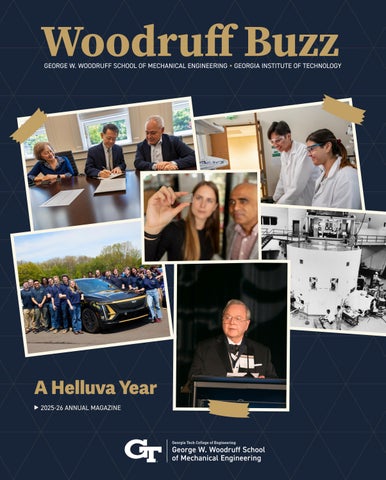
Woodruff Buzz GEORGE W. WOODRUFF SCHOOL OF MECHANICAL ENGINEERING
A Helluva Year 2025-26 ANNUAL MAGAZINE
GEORGIA INSTITUTE OF TECHNOLOGY
14 Woodruff Buzz is published annually for the students, faculty, staff, alumni, and friends of the George W. Woodruff School of Mechanical Engineering at the Georgia Institute of Technology. SCHOOL CHAIR Carolyn Seepersad
24
32
EDITOR/DESIGNER Ashley Ritchie WRITERS Dhanesh Amin Michelle Azriel Catherine Barzler Eric Butterman Mikey Fuller Steven Gagliano Alba Garcia-Sarabia Jennifer Herseim Chloe Morris Walter Rich Ashley Ritchie Tony Rehagen Siobhan Rodriguez Joshua Stewart Tracie Troha PHOTOGRAPHERS Chloe Arrington Rob Felt Mikey Fuller Georgia Power Company Candler Hobbs Christopher McKenney Gary Meek Ashley Ritchie Ian Sargent George W. Woodruff School of Mechanical Engineering Georgia Institute of Technology 801 Ferst Drive Atlanta, Georgia 30332 404.894.3200 me.gatech.edu nremp.gatech.edu Social: /megeorgiatech Copyright © 2026 Georgia Institute of Technology
46
TABLE OF CONTENTS STUDENT SUCCESS
06 Student Notes 08 Georgia Tech Takes First Place at the EcoCAR EV Challenge 09 Hearo Wins InVenture Prize With At-Home Ear Exam 14 First Helluva Makerspace Race 17 3 New AI and ML Courses Offered in the Woodruff School 20 Commencement Spotlight
RESEARCH PREEMINENCE
22 Faculty Notes 24 Researchers Expose Hidden Cybersecurity Risk in Mobile Robots 32 Crafting a Career at Intersection of Making, Helping, and Human Mobility 40 Neely Nuclear Research Center Named Nuclear Historic Landmark COMMUNITY AND CULTURE
43 Alumni Notes 44 Record $100M Gift From Alumnus John W. Durstine 46 CoE Alumni Awards 48 2025 Class of 40 Under 40 58 Professorship for Excellence in Mechanical Engineering
MESSAGE FROM THE CHAIR Looking back on a helluva year for the George W. Woodruff School of Mechanical Engineering, I am grateful for the opportunity to serve this extraordinary community as chair. Every day, I have the privilege of witnessing the talent, collaboration, and dedication that define our students, faculty, staff, alumni, and friends. This year has been marked by significant achievements, meaningful investments, and a shared commitment to advancing engineering education, research, and service. This edition of the magazine highlights the accomplishments that made this year so transformational. Earlier this year, our graduate program in mechanical engineering achieved its highest ranking ever — No. 3 in the nation and No. 1 among public universities — a testament to the excellence of our faculty, students, staff, and alumni. Our students continued to distinguish themselves through creativity and leadership, helping multidisciplinary teams earn top honors at the Georgia Tech InVenture Prize, leading Georgia Tech to a first-place finish in the final year of the EcoCAR EV Challenge, and showcasing their ingenuity during the inaugural Helluva Makerspace Race. These achievements reflect the curiosity, teamwork, and hands-on learning that prepare our graduates to solve the world’s most complex challenges. Our faculty continued to make notable contributions across research, teaching, and innovation. Andrés García was elected to the American Academy of Arts and Sciences, David McDowell was named to the National Academy of Engineering, and Aaron Young was recognized as a senior member of the National Academy of Inventors. Principal Research Scientist Kinsey Herrin continues to advance technologies that help patients improve or regain mobility, while our teaching faculty are doing far more
than delivering lectures — they are designing learning experiences, building collaborative ecosystems, and leading curriculum innovation that prepares students for successful engineering careers. We also celebrated the designation of Georgia Tech’s former Neely Nuclear Research Center as an American Nuclear Society Nuclear Historic Landmark, recognizing its lasting contributions to nuclear science and engineering. This year also provided many opportunities to celebrate the people who make the Woodruff School exceptional. Eight graduate students received Women of Woodruff fellowships, and at the College of Engineering Awards, seven Woodruff School alumni and two emeritus faculty were recognized for their outstanding leadership and impact, reflecting the influence of our School across engineering and industry. The commitment of our community to future generations has been equally inspiring. Last fall, alumnus John Durstine’s transformational $100 million estate gift created the largest gift in Institute history. This year, Regents’ Professor Steven Liang and his wife, Jen, established the Jen and Steven Liang Professorship for Excellence in Mechanical Science and Engineering, making Steven the first tenure-track faculty member to endow a professorship while still serving at Georgia Tech and the first to do so across the University System of Georgia. Together, these extraordinary investments demonstrate a shared belief in the lasting impact of faculty excellence, student success, and groundbreaking research. The generosity of our alumni and friends continues to shape what is possible for the Woodruff School. Although we were the first unit at Georgia Tech to
surpass our fundraising goal during the Transforming Tomorrow campaign, I am proud to share that Georgia Tech has officially reached its historic campaign goal. Now, we are turning our focus to fundraising for the expansion of experiential learning, including the renovation of the Manufacturing Related Disciplines Complex (MRDC). This effort will expand our existing ecosystem into the next generation of experiential engineering education, creating an integrated environment where students can build, test, model, document, and co-create across disciplines. These investments will help us provide even greater opportunities for collaboration, innovation, and discovery while positioning the School for continued growth and success. Thank you for your continued partnership, generosity, and belief in us. Together, we will continue building on this remarkable momentum and elevating the Woodruff School through excellence in education, research, and service for generations to come. All the best, Carolyn Seepersad Eugene C. Gwaltney, Jr. School Chair and Professor
2025-26 ANNUAL MAGAZINE
3
ABOUT THE WOODRUFF SCHOOL MISSION
The George W. Woodruff School of Mechanical Engineering is an inclusive, innovative, and thriving educational and research environment committed to fostering the next generation of intellectually curious and globally engaged leaders who are empowered to create solutions to society’s most challenging problems and dedicated to improving the human condition.
TOP RANKED PROGRAMS
No. 4
Mechanical Engineering Undergraduate Program
(U.S. News & World Report, 2026)
No. 3
Mechanical Engineering Graduate Program
(U.S. News & World Report, 2026)
VISION
No. 9
Nuclear Engineering Graduate Program
(U.S. News & World Report, 2026)
The Woodruff School will be a student-centered, research-focused, and service-oriented community recognized for its outstanding education, the development of leaders, and the creation of innovative technological solutions that improve society and the human condition. We will embrace the diversity of our collaborative community, the foundational principles of engineering and science, and ethical behavior as we achieve a culture of inclusive excellence.
4
GEORGE W. WOODRUFF SCHOOL OF MECHANICAL ENGINEERING
DEGREES The Woodruff School offers: 2 B.S. Degrees 7 M.S. Degrees 6 Ph.D. Degrees
CUTTING-EDGE RESEARCH Acoustics and Dynamics; AI, Informatics for ME (AI2ME); Automation, Robotics and Control; Bioengineering; CAE and Design; Engineering Education; Fluid Mechanics; Heat Transfer, Combustion, and Energy Systems; Manufacturing; Mechanics of Materials; Medical Physics; Micro & Nano Engineering; Nuclear and Radiological Engineering; Tribology
DEGREES AWARDED, 2025-26
479
337
B.S. Degrees
ENGINEERING SCHOLARS
2139
Undergraduate Students Fall 2025
981
Graduate Students Fall 2025
64
M.S. Degrees
FACULTY AND STAFF 92 Tenure-Track Faculty 89 Staff 33 Research Faculty 14 Non-Tenure Track Faculty
Ph.D. Degrees
FINANCES
FY26 Total Expenditures ($98,253,097)
$63M
Other $90,600
FY26 New Sponsored Research Awards
Sponsored Research $56,699,996
$98.3M FY26 Total Expenditures
GT Foundation $8,313,366
Sponsored Research $50,032,273
State $39,816,858
2025-26 ANNUAL MAGAZINE
5
STUDENT SUCCESS
Student Notes Sherry Adadi received an ANS Scholarship.
Mingeun Choi received a Paul R. Yopp Memorial Fellowship.
Marin Alter received the Georgia Tech Outstanding PLUS Leader Award.
Carolina Colón was named a TechMade Graduate Makerspace Innovation Fellow.
Amir Ashkezari received a WoW Fellowship.
Youndo Do received a William H. Glenn, Sr. Fellowship.
Milad Azizkhani received a Beth B. and D. Fort Flowers, Jr. Fellowship.
Chelsea Ekwegh was selected for the 2025 class of the Millennium Fellowship.
Avi Balakirsky received an NSF Graduate Research Fellowship.
Emmeline Evans received a WoW Fellowship.
Allison Bateman received a Beth B. and D. Fort Flowers, Jr. Fellowship.
Martin Jaramillo Feijoo received a College of Engineering Honors Day Award.
Benjamin Beyerle received a Hugh Wellington Fellowship.
Matthew Fernandez was named a 2025 Astronaut Scholar by the Astronaut Scholarship Foundation. He received an NSF Graduate Research Fellowship.
Aidan Billings received an NSF Graduate Research Fellowship. He was selected as a Georgia Tech Stamps Fellow.
Juntao He received a Beth B. and D. Fort Flowers, Jr. Fellowship. Massimiliano Iaschi received a Richard K. Whitehead Jr. Memorial Award. Rizky Ilhamsyah received a Beth B. and D. Fort Flowers, Jr. Fellowship. Alison Jenkins was selected as the Fall Commencement reflection speaker for the Ph.D. ceremony. Daniel Rodriguez Jorge earned Best Lightning Talk from the College of Engineering at the Fall 2025 Georgia Tech Postdoctoral Research Symposium. Kiran Kapileshwari was selected for the 2025 class of the Millennium Fellowship.
Lucas McCarty received a Hugh Wellington Fellowship. Madison McKinnon received the Young Physics Investigator Award from the Leksell Gamma Knife Society. Angel Mercado received a Hugh Wellington Fellowship. Sebastian Mettes received a WoW Fellowship. Lena Moller received an Honorable Mention Teaching Award. Madeline Morrell received a WoW Fellowship and the James E. Pruitt, Jr. Fellowship. Chinaza Ogbonna was chosen for the Institute for Matter and Systems’ new apprenticeship program.
Emmett Freeman received an NSF Graduate Research Fellowship.
Shweta Karnik received a Paul R. Yopp Memorial Fellowship.
Owen Gil received a Richard K. Whitehead Jr. Memorial Award.
Akshar Kota received a William H. Glenn, Sr. Fellowship.
Colin Gold received the George W. Woodruff School of Mechanical Engineering Chair’s Award in Nuclear and Radiological Engineering.
Andrew Lenart received a Hugh Wellington Fellowship.
Tejaswin Gontla was named the Young Philanthropist of the Year by the Association of Fundraising Professionals Greater Louisville Chapter.
Darren Lie received a William H. Glenn, Sr. Fellowship.
Tyler Rome received a Beth B. and D. Fort Flowers, Jr. Fellowship.
Fukang Liu received a William H. Glenn, Sr. Fellowship.
Arthur Rubino received a Hugh Wellington Fellowship.
Samuel Chen was named a TechMade Graduate Makerspace Innovation Fellow.
Vincent Griffo received the Barry Goldwater Scholarship. He was named a 2026 Astronaut Scholar by the Astronaut Scholarship Foundation.
Vidor Lujan received a William H. Glenn, Sr. Fellowship.
Sai Saidu received a Hugh Wellington Fellowship.
Savannah Luney received a Hugh Wellington Fellowship.
Jack Schoonover received an ANS Scholarship.
Eunsik Choi received a Sweigert Award for Excellence in Teaching.
Rongming Guo received a Hugh Wellington Fellowship.
Joseph Schwalbe received a Hugh Wellington Fellowship.
Jungho Choi received a Beth B. and D. Fort Flowers, Jr. Fellowship.
Syona Gupta was awarded a Fulbright Canada-Mitacs Globalink Research Internship.
Edouard Machenaud received a Beth B. and D. Fort Flowers, Jr. Fellowship.
Aleksandar Bošković received the George W. Woodruff School of Mechanical Engineering Outstanding Scholar Award. Marcellus Boykin received a Sweigert Award for Excellence in Teaching. Alison Brei received an NSF Graduate Research Fellowship. Timothy Brumfiel received a Paul R. Yopp Memorial Fellowship. Carlos Carrasquillo received a William H. Glenn, Sr. Fellowship.
6
GEORGE W. WOODRUFF SCHOOL OF MECHANICAL ENGINEERING
Derek Lewis received an ANS Scholarship.
Emmanuel Mate-Kole received a Beth B. and D. Fort Flowers, Jr. Fellowship.
Payal Patel received an NSF Graduate Research Fellowship. Rithwik Shankar Raj received a Hugh Wellington Fellowship. Pranoy Ray received a William H. Glenn, Sr. Fellowship. Courtney Ream received a William H. Glenn, Sr. Fellowship.
Aastha Singh received an NSF Graduate Research Fellowship and a Richard K. Whitehead Jr. Memorial Award.
Gianna Slusher received a WoW Fellowship. Vijay Sreenivasan received the George W. Woodruff School of Mechanical Engineering School Chair’s Award. Jackson Stahl received a College of Engineering Honors Day Award. Chase Sun received a Hugh Wellington Fellowship and a Sweigert Award for Excellence in Teaching. Aayush Surawar received a Hugh Wellington Fellowship. Abby Taylor received a WoW Fellowship. Talia Thomas received a WoW Fellowship. She was named a TechMade Graduate Makerspace Innovation Fellow. Olivia Trask received an NSF Graduate Research Fellowship and a Richard K. Whitehead Jr. Memorial Award. Aditya Ananda Venkatesh received a Hugh Wellington Fellowship. Tarun Vinodkumar received an NSF Graduate Research Fellowship and a Richard K. Whitehead Jr. Memorial Award. Calvin Washburn received an ANS Scholarship. Kaleb Washington received an NSF Graduate Research Fellowship. Winona Wiley received an ANS Scholarship. Samuel Woolsey was named a 2026 Astronaut Scholar by the Astronaut Scholarship Foundation. He was awarded a Fulbright Canada-Mitacs Globalink Research Internship.
Woodruff School’s Mechanical Engineering Graduate Program Reaches Historic No. 3 Ranking The George W. Woodruff School of Mechanical Engineering’s graduate program in mechanical engineering has reached a historic milestone, earning its highestever ranking of No. 3 in the nation (No. 1 among public universities), according to U.S. News & World Report’s 2026 edition of Best Graduate Schools. The program is tied with the California Institute of Technology and the University of California, Berkeley. Georgia Tech’s nuclear engineering program, housed within the Woodruff School, remains ranked No. 9. “We are incredibly proud that our graduate programs have once again earned national recognition as some of the very best, including achieving our highest-ever ranking in mechanical engineering,” said Carolyn Seepersad, Eugene C. Gwaltney, Jr. School Chair and professor. “This milestone reflects the Woodruff School’s continued commitment to excellence in research, education, and service. It is a testament to our extraordinary students, dedicated faculty and staff, inspiring alumni, and generous supporters, whose collective efforts drive innovation and make a meaningful impact on society. We are honored to be recognized alongside peer institutions at the forefront of engineering and remain focused on building on this momentum.”
For the third year running, the engineering graduate programs at Georgia Tech are No. 4, placing the College of Engineering among the elite engineering schools in the U.S. and No. 2 among public programs. Tech is tied with Purdue University. The latest rankings also mark the 12th consecutive year that all 11 engineering programs are ranked within the top 9 of their respective disciplines. U.S. News releases graduate school rankings each spring. The publication’s evaluation of engineering as a whole is based on a number of factors, including research expenditures and publications, assessments from peer institutions and employers, and academic achievements of entering students. Rankings of specific engineering disciplines are based solely on peer assessments by department heads. In the fall, U.S. News ranked the Woodruff School’s mechanical engineering undergraduate program No. 2 among public universities and No. 4 overall, further reinforcing the School’s continued excellence across programs.
Xiaoqing Yu received a WoW Fellowship.
2025-26 ANNUAL MAGAZINE
7
STUDENT SUCCESS
GEORGIA TECH TAKES FIRST PLACE AT THE ECOCAR EV CHALLENGE After days of testing at General Motors’ Milford Proving Ground in Milford, Michigan, Georgia Tech won first place in the final year of the current EcoCAR EV Challenge cycle. Tech students competed against 13 universities over four years, applying emerging technologies to create intelligent mobility solutions. During the four-year cycle, more than 250 undergraduate and graduate students from six of Georgia Tech’s Colleges worked to reengineer a Cadillac LYRIQ EV, adding a new front motor, a new clutch-enabled rear motor, and automated driving features. In the Motor City, Tech earned 867 out of 1,000 points, outperforming its competitors across technical, vehicle, and connected automation challenges. The team stood out in the Connected Driving Evaluation, developed by Argonne National Laboratory, to measure how effectively teams integrate vehicle connectivity with automated driving features. The GT team also excelled in lateral automation with strong lane-centering and automatic parking performance. While meeting all design targets, Tech’s car delivered the competition’s most impressive acceleration, and the team was the only group to successfully demonstrate automatic parking. Teams were tested at the end of each year of the competition cycle, with Tech securing multiple top-three finishes in years past. As the Yellow Jackets were crowned the winners of year four at the final awards ceremony, faculty advisor Antonia
Antoniou says the elation and relief felt among the team members were a testament to the group’s resilience. “They really are the best of Georgia Tech. There were hurdles along the way where they faced major setbacks, including catastrophic equipment failures that could’ve discouraged them, but they were relentless in their pursuit of perfection,” Antoniou, a professor in the George W. Woodruff School of Mechanical Engineering, said. Project manager Eric Gustafson has been with the team since day one, and the victory is something he dreamed of and hopes every team member during the last four years can revel in. “It was surreal,” he said. “A single moment validating every all-nighter and difficult gauntlet our team worked through to compete against teams with budgets two and sometimes three times larger than ours. To win this challenge, at this Institute, speaks to the tenacity and sheer resilience that Tech students have. To actually execute, almost flawlessly, over a four-year span with different students coming into the program at different times, is a ‘helluva’ achievement.” In addition to the first-place overall finish, the team also earned victories in 11 of the competition’s engineering awards and two communications awards.
“To actually execute, almost flawlessly, over a four-year span with different students coming into the program at different times, is a ‘helluva’ achievement.” —Eric Gustafson
8
GEORGE W. WOODRUFF SCHOOL OF MECHANICAL ENGINEERING
An Ear for Innovation:
Hearo Wins InVenture Prize With At-Home Ear Exam After some of the most intense competition in the program’s history, team Hearo won first place at the 18th annual InVenture Prize competition, which began with a record 72 teams and culminated in six finalists pitching live to a panel of judges and a packed audience. Hearo’s invention reimagines the otoscope for parents, enabling caregivers to conduct an at-home ear exam and capture physician-usable images to help identify ear infections without a trip to the doctor’s office. Drawing on their variety of skills and backgrounds, mechanical engineering student Luke Towery, alongside teammates Ander DeOnaindia, Vasileios Kouloumentas, Luis Lujan, Agustin Munyau, and Marilyn PelayoMontufar, saw an opportunity to make a big change in healthcare.
“It’s so huge,” Towery said. “Winning this really shows what can happen when a team finds a problem in the world to solve and sticks together.” First place comes with a $20,000 prize and a coveted spot in Georgia Tech’s CREATE-X Startup Launch, a 12-week summer program in which participants work with experienced entrepreneurs and Tech alumni to launch their ideas into fully functioning startups. “Next, we’ll take Hearo through CREATE-X and start getting it into parents’ hands,” said Pelayo-Montufar. “We know how hard it is to be stuck in waiting rooms and doctors’ offices, and so getting Hearo to other parents is extremely important to us.”
DoorTix Voted People’s Choice The People’s Choice Award — selected through audience voting that opened a week before the finale and closed just before the competition’s end — went to team DoorTix, an automated ticket-purchasing platform for fair, predictable pricing. Mechanical engineering student Dhruv Narang, with teammates Shinhai Chen and Arayna Saxena, wanted to restore transparency, fairness, and trust to a ticketing market that currently disadvantages millions of fans. “We’re literally built for the people,” Saxena said. “We want to make it easier for our customers to get cheap tickets, and winning People’s Choice hopefully means we can get them for you, too.”
2025-26 ANNUAL MAGAZINE
9
STUDENT SUCCESS
Capstone Design Teams Tackle Global Challenges
Last fall, four mechanical engineering and interdisciplinary Capstone Design teams spent the semester developing technologies to address challenges in Guatemala as part of a new initiative called Design for Planet Impact. Under the guidance of Professor of the Practice and Interim Associate Chair for Innovation and Entrepreneurship Mike Tinskey, and supported by mechanical engineering doctoral student Fiona Chun, the students applied their classroom knowledge to real-world problems. “Design for Planet Impact is taking the amazing talents of Georgia Tech students and applying those engineering skills to underserved markets,” Tinskey, who holds the inaugural Siemens Corporation Termed Professorship, said. “One of the first markets we’ve been looking at is Guatemala. We had students identify problems we could solve with engineering. We came up with four products, and those products are now what the Capstone teams are designing.” In October, 12 students from the four teams traveled to Antigua, Guatemala, to conduct fieldwork. They met with local residents, visited hospitals and clinics, and learned firsthand about the challenges faced in underserved communities. The four Capstone teams — Big Mastermind Energy (BME), Comfort Companion, Ramblin’ Mech, and Team Sight — each tackled a distinct challenge informed by their research.
10
Inspired by local practices and consultations with medical professionals, the BME team designed a low-cost, reusable filter for medical suction machines. Their solution could reduce costs to under $1 per filter, improving safety and sustainability in resourcelimited hospitals. The Comfort Companion team developed stuffed animals equipped with sensors and interactive features to comfort children experiencing medical trauma. Their ideas included creating plush companions that can monitor heart rate and temperature or connect children with peers who have faced similar medical challenges.
“Design for Planet Impact is taking the amazing talents of Georgia Tech students and applying those engineering skills to underserved markets.” —Mike Tinskey
GEORGE W. WOODRUFF SCHOOL OF MECHANICAL ENGINEERING
In Guatemala, volcanic activity contributes to high levels of arsenic in drinking water, posing serious health risks. The Ramblin’ Mech team developed an innovative insert for existing water filtration systems to remove arsenic, building on the eco-filter technology already in use. Their design aims to make clean water more accessible and safer for Guatemalan families Guatemala has very few optometrists and ophthalmologists, making it difficult for many children to obtain prescriptions. Team Sight designed an adjustable lens mechanism that can serve as a diagnostic tool, helping users determine their prescriptions without a trained specialist. Their device was developed alongside durable, adjustable frames.
Looking Ahead For the Design for Planet Impact teams, their work could be a stepping stone toward real-world implementation. “We’re envisioning that these Capstone teams will hand off their designs and work to next semester’s Capstone teams,” Tinskey said. “Hopefully, at the end of the full academic year, we’ll have some designs that we can take into production.”
Bringing Water Sustainability to Nepal Getting water for the 1,000 residents of the rural village of Chisopani Bhirkhe in Nepal is a daily challenge. Women spend hours climbing steep roads with heavy containers to access three springs that are contaminated and often run dry. A team of Georgia Tech students in Engineers Without Borders (EWB) is working to change that. “For a lot of the women, their entire day revolves around fetching water,” said third-year civil engineering student Grace Jiang. “They have small sources and one larger one, but they have to travel long distances and wait in line.” While on a five-day assessment trip last summer, Jiang and mechanical engineering students Devasena Sitaram and Nishita Tonangi surveyed water points, analyzed topography and water flows, and talked with community members to learn more about water shortages during the dry season.
“Before we even started designing anything, we wanted to listen,” said Anjali Balaganesh, a biomedical engineering student and one of the project leads. “The trip reminded us that good engineering starts with understanding the people you’re building for.” The students’ goal is to develop and deploy a water supply system that has capacity to serve all 200 households in Chisopani Bhirkhe during even the driest parts of the year. Once they create a plan, the team will return to Nepal to begin to implement their system alongside the locals. The group is investigating a series of methods to stabilize water supply, including constructing a groundwater recharge pit to filter water into the underground aquifer, installing tap stands connected to a water supply system, and searching for a new longterm well. The team estimates their work will cost $100,000. They’re fundraising through EWB-USA and searching for sponsors.
2025-26 ANNUAL MAGAZINE
11
STUDENT SUCCESS
Matthew Fernandez’s Passion for Robotics
Took Off at Georgia Tech
In addition to space robotics, Fernandez has continued to explore his interest in underwater robotics at the Complex Rheology and Biomechanics (CRAB) Lab.
When Matthew Fernandez’s passion for robotics led him to enroll at Georgia Tech, he had no idea the decision would set him on a remarkable journey that included an internship at NASA’s Jet Propulsion Laboratory, building a Mars rover, and studying abroad in Switzerland. Now a fourth-year student at the George W. Woodruff School of Mechanical Engineering, Fernandez credits his achievements to both opportunity and support.
“It was during my time [at JPL] that I was convinced the best path forward for this field was for me to pursue a Ph.D. in robotics, which is when I joined Professor Daniel Goldman’s CRAB Lab and haven’t turned back since,” Fernandez said. In summer 2025, Fernandez conducted research at ETH Zurich in Switzerland as a ThinkSwiss Research Scholarship recipient. While there, he built autonomous swimming robots from the ground up.
“I became interested in Georgia Tech when I was working on underwater robotics throughout high school,” Fernandez said. “I applied and made the final decision to attend after receiving a phone call from Jerry McTier, a member of the Godbold Foundation. Through this group and the Provost Scholarship, I confirmed the financial and logistical feasibility of attending Tech, and I am extremely grateful to these groups.” At Georgia Tech, Fernandez has built an impressive portfolio of research and leadership as he studies robotics in extreme environments. Recently, he received the prestigious Astronaut Scholarship. The recognition, he said, has allowed him to “completely focus on my research and future prospects as I look toward graduate school.” Some of the projects that helped Fernandez earn the Astronaut Scholarship include joining the Antarctic AUV Vertically Integrated Projects program, working with the RoboJackets’ RoboNav team to build Georgia Tech’s first Mars rover, and landing an internship at NASA’s Jet Propulsion Laboratory (JPL). At JPL, Fernandez worked on the smallest space-grade manipulation system for the Mars Sample Return mission.
12
“It was a fast-paced environment full of talented people,” Fernandez said. “Outside of work, I had the opportunity to fully indulge in local culture and food, and on the weekends, I was able to backpack around Switzerland’s various lakes and the Alps.”
“Georgia Tech does an incredible job of making opportunities accessible to all, and the breadth of things you can do here is amazing.” —Matthew Fernandez
GEORGE W. WOODRUFF SCHOOL OF MECHANICAL ENGINEERING
When he’s not in the lab, Fernandez’s campus involvement has also included the Society of Hispanic Professional Engineers, the American Society of Mechanical Engineers, the Invention Studio, and several teams within the Student Competition Center. For future Yellow Jackets, Fernandez’s advice is to get involved and take advantage of Georgia Tech’s resources. “Georgia Tech does an incredible job of making opportunities accessible to all, and the breadth of things you can do here is amazing,” he said. “The earlier you get active in the various projects and culture, the more you will get out of your time here. This will guide your decisions and form your path postgrad.”
NRE Student Colin Gold Makes a Big Impact at Georgia Tech Colin Gold, a fourth-year nuclear and radiological engineering (NRE) major, has embraced being in the George W. Woodruff School of Mechanical Engineering program. As one of about 198 students currently enrolled, he sees its small size as an advantage. “I’m really close with a lot of people in my classes from being together over the years, and I feel like my professors are all very approachable and communicative,” Gold said. “No one’s a stranger, and that sense of community really raises everyone up and ensures that no one struggles alone.” A native of Pensacola, Florida, Gold was drawn to Georgia Tech at the suggestion of his father. “My father is my role model, and he always held Georgia Tech in high regard,” he said. Georgia Tech’s culture of innovation, its commitment to improving the human condition, and its location in the heart of Atlanta all appealed to Gold, offering endless opportunities for new experiences. Gold said his desire to help others fostered his love for nuclear and radiological engineering. “After reading about the positive benefits of nuclear energy, coupled with the technical feats associated with harnessing the power of the atom, I knew it was a challenge I wanted to take on,” Gold said. One of his favorite courses has been NRE 3026, Experimental Reactor Physics, which gave him the opportunity to apply classroom concepts to the real world in fascinating ways.
“Although the labs weren’t easy, getting to manipulate real uranium rods and use neutron sources, as well as designing our own lab experiment, was very fulfilling and rewarding,” Gold said. In addition to this academic success, Gold said one of his proudest achievements is his work helping student organizations obtain additional funding. “I think one of the greatest things we have at Tech is our extensive list of student organizations,” Gold said. “By helping fund them, we really get 10 times the investment back in terms of giving students the ability to lead and succeed as well as provide fun and engaging events throughout campus.” At Georgia Tech, Gold sought out a community of like-minded peers interested in nuclear energy and technology, which led him to join the student chapter of the American Nuclear Society (ANS). He was later elected the ANS outreach chair and served as the chapter’s secretary. In addition, Gold represented NRE students in the Student Government Association’s Undergraduate House of Representatives. In this role, Gold and his colleagues successfully amended existing regulations on financing registered student organizations to distribute funds more equitably, benefiting smaller organizations such as ANS. He is also proud to have supported bills promoting mental health through the Mental Health Joint Allocations Committee, ensuring that organizations are empowered to care for students’ well-being.
In the Fall 2024 semester, Gold was one of 10 students selected for the inaugural Chair’s Ambassadors in Leadership and Service Fellowship. The recipients were chosen for their leadership and service to the Woodruff School and the positions they hold in student organizations. When Gold isn’t studying or serving his community, he enjoys playing games with his friends, exploring new restaurants in Atlanta, and reading about current events. He also serves as president of his fraternity, Theta Chi. Looking ahead, Gold hopes to continue his studies and earn a master’s in NRE with a concentration in nuclear enterprise management. For high school students considering Georgia Tech, Gold stresses the importance of finding a passion that makes the world a better place. “Georgia Tech will prepare you to be the best you can be, but following your passions will give you the motive to overcome any obstacles that come your way,” he said.
2025-26 ANNUAL MAGAZINE
13
STUDENT SUCCESS
Students Race Across Campus Makerspaces in
First Helluva Makerspace Race
Students raced, built, and solved engineering challenges across campus during the inaugural Helluva Makerspace Race, a new event designed to introduce the campus community to the resources available at Georgia Tech’s makerspaces. Sponsored by TechMade and the Student Government Association, the race brought together nearly 70 students for an afternoon of friendly competition and hands-on problem-solving. Teams traveled between the Yang Aero Maker Space, the HIVE, the Materials Innovation and Learning Laboratory (MILL), and the Flowers Invention Studio makerspaces to complete design-andbuild challenges before racing to the next stop. The event, driven largely by student leaders, marked the first time four makerspaces collaborated on a single program.
14
GEORGE W. WOODRUFF SCHOOL OF MECHANICAL ENGINEERING
“When I was stepping into the role of Aero Maker Space president, one of my goals was to bring makerspaces together in a campuswide event,” said Saniya Kulkarni, a fourth-year aerospace engineering major. “Each space has its own culture, tools, and community, and most students only use or know of one or two of them.” Inspired by the TV show The Amazing Race, organizers envisioned a fast-paced competition to introduce participants to each makerspace.
“We wanted to have a fun way to integrate the makerspaces on campus and felt that a friendly competition was the best way to go about it,” said Ethan Lam, a second-year chemical engineering major, event co-leader, and the MILL’s chief communications officer. Planning the event took several months of coordination among the student leaders. “Bringing together four Tech makerspaces for one event was not an easy task,” said Laura Huff, a fourth-year electrical engineering major and director of outreach for the Hive. “We wanted this race to have a positive outcome, and we all put in countless hours to achieve that.” Organizers met regularly to align logistics, develop challenges, and coordinate resources. Despite busy schedules and differences across the spaces, the team built what Kulkarni described as a “shared vision” for the event. At each makerspace, teams completed hands-on challenges designed to highlight different tools and skills. In the Aero Maker Space, teams completed a “tour the space bingo” where they explored different areas to earn parts to build a model Ramblin’ Wreck. Then they assembled propeller-powered cars that had to travel far enough to pop a balloon decorated with Georgia Bulldog stickers. In the MILL, teams used a microscope to search for tiny Buzz figures hidden within a detailed line art image on a printed circuit board. At the Hive, participants built a full-wave bridge diode rectifier on a breadboard.
“It required a bit more technical thinking than most of the other challenges, especially for non-electrical and computer engineering majors, but that was part of the fun,” Huff said. “Multiple participants asked questions about how the circuit worked while building it.” At the Invention Studio, teams searched for hidden 3D-printed bulldogs and assembled small catapults from laser-cut and printed parts to knock them off a tower. For Bailey Tuckman, a first-year mechanical engineering major whose team placed second in the race, the experience was fun and technically engaging. His team especially enjoyed the Invention Studio challenge. “I think the most fun and most challenging part of the race was in the Invention Studio,” he said. “It was challenging because one of the parts we originally got was missing a hole, so we weren’t able to put together the catapult until we realized it and got a different part.” Tuckman said teamwork was key to his team’s success. “We tried to divide and conquer so we could work in parallel as much as possible and split the workload,” he said. For Saragha Surendra, a third-year aerospace engineering major and programming and outreach officer for the Aero Maker Space, introducing students to new spaces was central to the event’s mission. “Many students tend to use just one space for their projects, but each space has a variety of tools,” Surendra said. “The goal of the event was to encourage students to discover other makerspaces and encourage them to use different spaces for their project needs.”
Organizers also emphasized inclusivity and designed challenges for students of all majors. They hope the event will encourage students to explore the makerspaces more confidently, a message that resonated with some participants. “The makerspaces are one of the biggest reasons I decided to come to Georgia Tech,” Tuckman said. “The ability to start engineering from the very beginning of your degree is something that makes Tech a great school, and exploring the makerspaces is a fantastic way to do that.” At the end of the race, teams gathered for the awards. The top teams earned prizes, including LEGO sets and a custom Ramblin’ Wreck model car for the first-place team. With strong participation and enthusiasm in its first year, organizers said the Helluva Makerspace Race already shows promise as a new campus tradition.
2025-26 ANNUAL MAGAZINE
15
STUDENT SUCCESS
TechMade Course Helps Students Turn Ideas Into Real-World Products Georgia Tech students are known for solving complex technical problems, but building real-world products requires more than technical skill. It requires collaboration across disciplines, empathy for users, and the ability to take an idea from concept to prototype to production. That’s the focus of ME 4853/MGT 4803/ ID 4850: Product Design and Realization, a TechMade elective course that brings together students from multiple majors to explore how products are designed, tested, and refined in industry environments. The course is built around three pillars: human-centered design, manufacturing and prototyping, and digital engineering through computational modeling and simulation. “We had to think hard about a class that could be cross listed across multiple schools,” said Carolyn Seepersad, Eugene C. Gwaltney, Jr. School Chair and professor in the George W. Woodruff School of Mechanical Engineering, who taught the pilot course. “Students have to learn how to speak each other’s language and bridge the gap between different backgrounds.” Launched in Fall 2024, the course was designed to give students opportunities to apply their deep technical knowledge in interdisciplinary teams.
16
“We wanted students to go through the experience of working with others from different disciplines and understand how those perspectives come together to create a product,” said Amit Jariwala, director of design, innovation, and experiential learning in the Woodruff School, who helped develop the course. For Jocelyn Hill, a fourth-year mechanical engineering major, the course delivered exactly what she was looking for. “I wanted hands-on experience designing, building, and showcasing my own projects,” Hill said. “I was looking for a course that goes beyond theory and allowed me to apply engineering concepts in a creative and practical way.” Hill said the course exceeded her expectations by giving her the opportunity to “turn ideas into real, tangible prototypes.” Fourth-year mechanical engineering student Nathan Drury had a similar motivation for enrolling in the course. “I always wanted to get more involved with product design, especially fabrication and optimization,” he said. “The class seemed to be the only option that offered this hands-on style course where we actually get to build a large number of products.”
GEORGE W. WOODRUFF SCHOOL OF MECHANICAL ENGINEERING
Hill and Drury took the Fall 2025 Product Design and Realization course taught by Wayne Li, the James L. Oliver Professor of Practice in Design and Engineering in the School of Industrial Design. Under Li’s guidance, students completed individual mini-assignments along with a semester-long team project to design a therapeutic toy that provides personalized comfort to children overcoming medical trauma. The team project was based on a Capstone Design project called Comfort Companion sponsored by Design for Planet Impact. Li said this structure helped students “learn by doing” and synthesize their skills with others to “make something greater than the sum of its parts.” “Another skill I think human-centered design particularly emphasizes is that of empathy and perspective,” Li said. “Students learn how to understand a customer’s requirements without jumping to the wrong conclusions.” Hill said one of her biggest takeaways was learning how different disciplines contribute to product development. “Everyone approached problems differently, which broadened my perspective on engineering design,” she said. “It highlighted how important communication is in cross-disciplinary
teams and showed how easily miscommunication can occur if roles and expectations aren’t clear.” Drury also said working with industrial design students expanded his understanding of the design process. “I learned how intensive their design and fabrication process is, which was definitely inspiring to see,” he said. “I also got to use some of their facilities.” Lena Moller, a graduate teaching assistant for the course, said the hands-on nature of the class is what makes it stand out. “The students love the ability to get some hands-on experience with tools, especially while working on a chosen project that interests them,” she said. “For the final project, they really dove deep on physical testing and prototyping.” The course also emphasizes peer-topeer learning across majors. Moller recalled seeing students regularly teach one another new skills. “I remember one mechanical engineering student teaching an industrial design student how to do some basic CAM work on Fusion 360,” she said. “Later they swapped, and the industrial design student was teaching the mechanical engineering student how to draw prototype schematics. Neither of those things were concretely part of our course, but they still dedicated themselves to learning it anyway.” Faculty hope the course continues to expand across campus through additional cross-listings. “Other schools don’t have to recreate the wheel. They can partner with us,” Jariwala said. For students considering the course, Seepersad offered simple advice. “Keep an open mind,” she said. “It’s a class where you can take some risks and learn new things.”
3 New AI and ML Courses Offered in the Woodruff School Three new or modified courses have been developed by George W. Woodruff School of Mechanical Engineering faculty members to enhance student preparedness for leveraging the growing relevance of artificial intelligence (AI) and machine learning (ML) technology in mechanical engineering and nuclear and radiological engineering fields. “These courses were developed in response to the interest of our own students in these disciplines, and the growing need from our industry partners for engineers graduating with AI-fluency,” Associate Chair for Undergraduate Studies and Woodruff Professor Brandon Dixon said. In addition, the courses can be used towards the applications of AI and ML minor that was launched in the 20242025 academic year as a collaborative effort between the College of Engineering and the Ivan Allen College of Liberal Arts. These new or reintroduced courses in the curriculum will serve as the backbone for AI and ML training within Georgia Tech and the Woodruff School:
•
ME/MSE 4710 – Foundations in Machine Learning for Engineers
•
ME 4853-JAJ – AI for Design and Manufacturing
•
ME 4853-WAN – Machine Learning Methods for Mechanical Engineering
Funded by the College of Engineering and the Woodruff School, the curriculum was designed by Amit Jariwala, director of design, innovation and experiential learning; Associate Professor Roger Jiao; Surya Kalidindi, Regents’ Professor and Rae S. and Frank H. Neely Chair; Aaron Stebner, Eugene C. Gwaltney, Jr. Chair in Manufacturing and professor; and Professor Yan Wang. ME/MSE 4710 – Foundations in Machine Learning for Engineers, taught by Stebner, will introduce students to the fundamentals of data
science, emphasizing the collection, categorization, and quantification of raw data. Students will learn the mathematical skills and foundational principles of statistics and data analytics needed to critically evaluate ML implementations and identify when, why, and how to use ML to solve engineering problems. Jariwala and Jiao will teach ME 4853JAJ – AI for Design and Manufacturing. This course will guide students to structure and interpret information into actionable knowledge. Students will learn fundamental AI methods and intelligent decision support techniques for creating, analyzing, synthesizing, and implementing design solutions to open-ended problems in manufacturing system planning and operations optimization. It is designed to help students bridge the gap between the creative decision-making in design they learned in ME 2110, and the practical application of engineering concepts they learned in Capstone Design in ME 4182. ME 4853-WAN – Machine Learning Methods for Mechanical Engineering, taught by Kalidindi and Wang, teaches machine learning techniques that contextualize and connect data to extract meaningful information. It introduces students to fundamental methods and models of AI and ML by giving them hands-on experience using the latest ML software tools to solve mechanical engineering problems through lab sessions and course projects. Jiao believes these three courses form a well-aligned educational pathway anchored in the foundational AI principle of transforming data into information, and information into knowledge. “This coherent curriculum equips students with cutting-edge skills and a deep understanding of AI’s role in mechanical engineering, empowering them to innovate and lead in their professional careers,” Jiao said.
2025-26 ANNUAL MAGAZINE
17
STUDENT SUCCESS
Students Showcase Communication Skills at Webb-Donnell Competitions Students in the George W. Woodruff School of Mechanical Engineering took center stage at the third annual WebbDonnell Communication Competitions. The event highlighted the importance of clear, engaging communication in engineering and featured graduate and undergraduate competitors. Five Ph.D. students participated in the live, final round of the Graduate Quick Talks Research Communications Challenge, each delivering a five-minute presentation on their research. Johnny Sentmanat, a mechanical engineering doctoral student, earned first place for his talk, “BeamMap: Mapping the Way to Cure Disease.” “One of my favorite things to do is take my research and try to explain it to a broad audience,” Sentmanat said. “For me, it was like a puzzle — what is going to draw people? How can that translate?”
Addy Bateman, a bioengineering Ph.D. student, placed second for her presentation, “Smart Stent Grafts: A Modernized Way of Monitoring Vascular Disease.” She said simplifying her complex research was both challenging and rewarding. “It was really tough, but it was also nice because it lets you whittle down to the most important parts of your research,” Bateman said. “It was fun to go back to the foundational component that initially got me excited about the research.” The event also featured the Explain It! Engineering Concept Video Competition. Five undergraduate finalists, selected from 25 submissions, displayed posters with QR codes linking to their videos. Rihan Mammen, a fourth-year mechanical engineering student, won first place for his video, “Noise Cancellation — How Does It Work?” “We had a lot of freedom to pick the topic, which I think added to it,” Mammen said. “I liked seeing all the videos from the other finalists. It’s really interesting to see what drives a person.”
“Throughout the curriculum, our students practice communicating design decisions, experimental results, and engineering reasoning to different audiences. The competitions give them a chance to take those skills a step further by sharing their work with a broader audience.” —Jill Fennell
18
GEORGE W. WOODRUFF SCHOOL OF MECHANICAL ENGINEERING
The competition, made possible by the Frank K. Webb Charitable Trust, awarded a total of $15,000 in prizes. Named in honor of Frank K. Webb, ME 1938, and Jeffrey Donnell, the first Frank K. Webb Academic Professional Chair in Communication Skills, the event celebrates their legacy and commitment to communication in engineering. “Events like this remind us that engineering is not just about solving technical problems. It’s also about helping others understand those solutions,” said Jill Fennell, the current Frank K. Webb Academic Professional Chair in Communication Skills. The competitions are part of the Woodruff School’s Webb Communication Program. The program emphasizes that strong engineering requires clearly explaining ideas so others can understand, trust, and act on them. “Throughout the curriculum, our students practice communicating design decisions, experimental results, and engineering reasoning to different audiences,” Fennell said. “The competitions give them a chance to take those skills a step further by sharing their work with a broader audience.”
WoW Leadership Symposium Inspires Future Leaders The George W. Woodruff School of Mechanical Engineering and the Women of Woodruff (WoW) hosted the second annual WoW Leadership Symposium, providing undergraduate and graduate students with a full day of leadership training, inspiration, and networking. Sponsored by Anheuser-Busch, Boeing, Freudenberg-NOK, Phillips 66, and Techwood Precisions, the symposium offered students real-world insights from accomplished female leaders in industry. Participants attended sessions focused on career readiness, strategic networking, and effective leadership, and earned the WoW Leadership Certification from the Woodruff School. The featured speakers were Georgia Tech alumni and included Jazmine Brite, ME 2015, manager of the AI Product Activation Program at Google; Jieun Ku, Ph.D. AE 2007, senior manager of 787 Wing & Empennage at Boeing; Carly Queen, B.S. ME 2009, M.S. CE 2016, MCRP 2016, owner and CEO of Aurora Innovative Solutions; and Aparna Shah, ME 2001, senior vice president and general manager of the U.S. Information Solutions Direct to Consumer business at Equifax. Each speaker had their own unique presentation, but they all emphasized the importance of embracing the human aspect of engineering and building strong relationships. “[WoW’s] definition of leadership as ‘the art of making others better’ was also shared with the students,” said Jonathan Gaines, associate chair for outreach and engagement at the Woodruff School and WoW faculty liaison. “They were able to reflect on the different forms this leadership can have and the ways in which they can fine-tune their personal approach so they can be ready for a long and successful career as an engineer.”
The impact of the event was clear from student feedback, as many said it gave them practical tools they could apply to their studies and future careers. “This program has been an extremely valuable experience that helped me grow both personally and professionally,” said third-year mechanical engineering student Mikko Westerbeke. “I learned a lot about leadership, communication and teamwork through hearing different perspectives and real-world stories from experienced leaders. It made me think critically about my own strengths and areas for improvement, and I’ve started applying what I learned in my classes and organizations.” Angela Sherman, ME 1986, president and CEO of S&S HVAC Equipment and a WoW founding member, hopes students will be inspired to lead the way for the next generation of women in engineering. “Supporting women and inspiring them to chase their dreams, especially in technical fields, is what this is all about,” Sherman said. Gaines said the WoW Symposium grew in both reach and impact from the previous year, and he hopes it will become a signature program for the Woodruff School.
2025-26 ANNUAL MAGAZINE
19
When Tiana Fontejon, a fourth-year mechanical engineering major, first arrived at Georgia Tech, she wasn’t entirely sure mechanical engineering would be her path. She initially chose the major to keep her options open. “I really didn’t know what I wanted to do,” she said. “There was a very good chance I was going to switch into a different major.” Now, as she prepares to graduate from the George W. Woodruff School of Mechanical Engineering, Fontejon’s journey has been anything but linear. “If I had to sum up my experience in one word, it would be unexpected,” she said.
Continuing the Georgia Tech Family Legacy Fontejon comes from a Georgia Tech family. Her father earned bachelor’s and master’s degrees in aerospace engineering, and her older brother earned bachelor’s and master’s degrees in electrical engineering. At first, she wasn’t sure she wanted to follow in their footsteps, but a campus visit cemented her decision. “I realized there were so many things I could do here,” she said. “Research, internships, study abroad—I found that I could do all of that here.”
COMMENCEMENT SPOTLIGHT:
An Unexpected Path to Mechanical Engineering
Once on campus, she began exploring. Like many students, her interests shifted as she gained experience. She tried research in nanotechnology, explored semiconductors during an internship, and joined a rocketry team. In the summer of 2023, Fontejon studied abroad at Georgia Tech-Europe, where she balanced coursework with travel across the region. While she visited major cities such as London and Amsterdam, she especially valued time spent in smaller towns. Each experience taught her something new, sometimes by showing her various surprises and challenges. “I feel like I pivoted so many different times,” she said. “But I learned so much about myself.”
20
GEORGE W. WOODRUFF SCHOOL OF MECHANICAL ENGINEERING
Learning by Doing Hands-on learning became a defining part of Fontejon’s time at Tech. Her first internship, with Texas Instruments in Dallas, introduced her to industry work and allowed her to apply classroom concepts in a real-world setting. “I got to be very hands-on,” she said. “I was always on the floor working with the technicians and engineers. I actually got to implement the things I was learning about in the classroom.” The following summer, she interned with Blue Origin in Seattle, contributing across multiple stages of a product’s lifecycle, from development to testing to redesign. She also found early inspiration through a Georgia Tech Experimental Rocketry team, where she gained machining and design experience and worked alongside peers in a collaborative environment. “That was one of my first introductions into true mechanical engineering,” she said.
A Defining Moment in the Classroom While internships and extracurriculars shaped her experience, one class stands out as a turning point: ME 2110. Before taking the course, Fontejon wasn’t sure she could be a mechanical engineer. But the hands-on design experience and its challenges changed her perspective. Her team, Barbie-que ChicKen, went on to win first place in the Fall 2023 ME 2110 Design Competition.
“Learning how to design, fail, and still bounce back, that was huge,” she said. “After all the failures that my team went through and all the hardships, we won the competition. That was really cool.” The experience helped build her confidence and solidified her place in the field.
Building Community and Connections Fontejon made the most of her time outside the classroom as well. A four-year member of the women’s club volleyball team, she traveled across the Southeast for tournaments. She also served as marketing director for the Filipino Student Association, where she helped organize events and performed traditional dances at campus and community celebrations. She also worked as a student assistant in the Woodruff School, interacting with faculty, alumni, and visitors, an experience that gave her a new perspective on mentorship. “When I first came to Tech and was looking for mentors, I looked to those successful engineers who have in-depth technical knowledge,” she said. “But when I started working in the administrative office, I learned it’s also important to have mentors who can communicate well, who are kind, who are flexible, and can work with anyone. I want to thank all the staff, especially in the administrative office, for teaching me what it means to be a good communicator and to learn throughout your life.”
Advice for Future Engineers For students just beginning their Georgia Tech journey, Fontejon emphasizes the importance of asking for help. “Don’t be afraid to reach out,” she said. “Whether it’s professors, classmates, or alumni, everyone wants you to succeed.” That support system, she said, is one of the most powerful aspects of the Georgia Tech experience.
Looking Ahead After graduation, Fontejon will move to Los Angeles to begin a role in operations management with McMaster-Carr, where she’ll combine her mechanical engineering degree with her certificate in business analytics, business administration, and management and operations from the Scheller College of Business. The role aligns with her long-term goal of moving into management and offers opportunities for continued education. As she prepares for this next chapter, Fontejon feels ready to move forward. “I used to be scared of graduating, but now I know it’s time,” she said. “I’m excited to close this chapter and begin the next one.”
2025-26 ANNUAL MAGAZINE
21
RESEARCH PREEMINENCE
Faculty Notes Ferdous Alam joined the Woodruff School as an assistant professor.
Suhas Jain received an NSF CAREER Award.
Joseph Mooney was recognized in Forbes’ 30 Under 30 list for 2026.
Costas Arvanitis received the Woodruff School Outstanding Mid-Career Faculty Award.
Amit Jariwala received the Woodruff School Outstanding Non-Tenure Track Faculty Award. He was selected for the 202526 Leaders in Teaching and Learning cohort at Georgia Tech.
Sharmistha Mukhopadhyay was promoted to senior academic professional. She received the Woodruff School Outstanding Non-Tenure Track Faculty Award.
Karam Kim was promoted to research engineer II.
Flavia Neto De Jesus joined as research scientist II-LT.
Satish Kumar was selected for Georgia Tech’s 2025–26 Emerging Leaders Program.
H. Jerry Qi was named to the Clarivate Highly Cited Researchers 2025 list, recognizing scholars whose work ranks in the top 1% most cited within their fields worldwide.
Bert Bras received the Woodruff School Chair’s Appreciation Award. Zachary Brunson is part of GA-AIM that won the Institute’s Outstanding Achievement in Research Program Impact Award. Tony Chen joined the Woodruff School as an assistant professor. Shaheen Dewji was promoted to associate professor with tenure. Xiaoxu Diao joined as research engineer II. Brandon Dixon was one of five Georgia Tech leaders selected for the 2026 ACC-ALN Fellows program. Denis Dorozhkin was promoted to senior lecturer. Bachir El Fil received the Woodruff School Research Award. Megan Elliott joined as research engineer I-LT. Anna Erickson was awarded the 2026 James Corones Award in Leadership, Community Building and Communication from the Krell Institute. Craig Forest was appointed Regents’ Entrepreneur. Andrés J. García was elected to the American Academy of Arts and Sciences. François Guillot was promoted to principal research engineer. Marta Hatzell was promoted to professor. She was selected for Georgia Tech’s inaugural Research Leadership Academy. Kinsey Herrin was promoted to principal research scientist. She received the CoE Outstanding Faculty Achievement in Research Award (Research Faculty) and the Woodruff School Research Faculty Excellence Award. She received a $3.2 million NIH R01 grant from the National Institute on Aging to advance research on aging and walking.
22
Thomas Kurfess is part of GA-AIM that won the Institute’s Outstanding Achievement in Research Program Impact Award. Julie Linsey is part of the 2025-26 cohort of faculty members selected for the Jim Pope Fellowship. She was part of the Human Space Exploration Team that won the Institute’s Outstanding Achievement in Research Program Development Award. Peter Loutzenhiser is part of the Human Space Exploration Team that won the Institute’s Outstanding Achievement in Research Program Development Award. Ellen Yi Chen Mazumdar received the Institute’s Class of 1940 W. Roane Beard Outstanding Teacher Award and the Woodruff School Outstanding Junior Faculty Award. Matthew McDowell was promoted to professor. He was named a finalist for the 2025 Blavatnik National Awards for Young Scientists. He received the Georgia Tech Chapter Sigma Xi Best Faculty Paper Award and the Woodruff School Outstanding Distinguished Faculty Award. Shreyes Melkote was honored with the 2025 Distinguished Alumnus Award from the Indian Institute of Technology Kharagpur. He received the Woodruff School Sustained Exceptional Performance Award. His startup, OpenWerks, was selected to be a part of the first cohort of Georgia Tech’s CreationsVC Space Fellows Program. Akanksha Menon received the CoE Outstanding Faculty Achievement in Research Award (Early Career). She was selected to participate in the 2025 EU-US Frontiers of Engineering Symposium. She was chosen by the U.S. Department of Energy’s ARPA-E for its 2025 IGNIITE program.
GEORGE W. WOODRUFF SCHOOL OF MECHANICAL ENGINEERING
Karim Sabra was awarded a Woodruff Professorship. Emily Sanders received an NSF CAREER Award. Gregory Sawicki was awarded a Woodruff Professorship. He received the Woodruff School Mentor of the Year Award. He received a $3.2 million NIH R01 grant from the National Institute on Aging to advance research on aging and walking. Carolyn Seepersad was named Eugene C. Gwaltney, Jr. School Chair. Richard Simmons received the Woodruff School Outstanding Teaching Excellence Award for Non-Tenure Track Faculty. Ankur Singh was awarded up to $6 million from the Defense Threat Reduction Agency of the U.S. Department of Defense to accelerate the development of medical countermeasures against deadly biological threats that endanger public health, national security, and warfighters. He was selected for Georgia Tech’s 2025–26 Emerging Leaders Program. Aaron Stebner was named associate director of the Georgia Tech Manufacturing Institute. He was selected as a James R. and Sarah R. Borders Faculty Fellow. He is part of GA-AIM that won the Institute’s Outstanding Achievement in Research Program Impact Award. Prasoon Suchandra received the Woodruff School Research Faculty Excellence Award. Yuguo Tao was selected for Georgia Tech’s inaugural Research Leadership Academy.
National Academy of Engineering Elects David McDowell Susan Napier Thomas received the Woodruff School Sustained Exceptional Performance Award. Mike Tinskey was awarded the inaugural Siemens Corporation Termed Professorship. Jun Ueda was named an ASME Fellow. He was awarded the Harris Saunders, Jr. Professorship. Ruoyu Yang joined as academic professional. Yusuf Yaras was promoted to senior research engineer. Shannon Yee was selected by The Rockefeller Foundation as a resident of its Bellagio Center Residency Program. W. Hong Yeo was promoted to professor. He received the CoE Outstanding Faculty Achievement in Research Award (Mid-Career) and the Woodruff School Outstanding Achievement in Commercialization and Entrepreneurship Award. Aaron Young was named a senior member of the National Academy of Inventors. He was selected as a James R. and Sarah R. Borders Faculty Fellow. He received the Woodruff School Research Award. He received a $3.2 million NIH R01 grant from the National Institute on Aging to advance research on aging and walking. Fan Zhang was named to the American Nuclear Society’s 40 Under 40 List. Zhuomin Zhang was awarded the 2026 James Harry Potter Gold Medal by ASME. He was named the 2026 Zeigler Outstanding Educator. Ye Zhao was promoted to associate professor with tenure. He was awarded a $1 million, three-year industrial grant from GIGABYTE to advance robotics and AI research, with a focus on helping robots better interact with the real world. Ting Zhu received the Woodruff School Research Award.
Mechanical engineer David McDowell is among the newest members of the National Academy of Engineering (NAE). McDowell is one of 130 new members and 28 international members in the 2026 class. Election to the NAE is among the highest professional recognitions for engineers and an honor bestowed on just 2,900 professionals worldwide. New members are nominated and voted on by the Academy’s existing membership McDowell is Georgia Tech’s 50th NAE member. He is Regents’ Professor Emeritus in the George W. Woodruff School of Mechanical Engineering and the School of Materials Science and Engineering. The Academy cited McDowell “for microstructure-sensitive computational modeling of engineering alloys, and methodologies for computational materials design.” His research focuses on how materials behave, building computer algorithms and models that can predict how they deform and fail. He has developed methods for designing materials based on their structure at various scales, from the atomic level up to that of engineering components and devices, including rare event failure mechanisms. His work has applications for lightweight structural materials, hightemperature aircraft gas turbines, highperformance alloys such as titanium and steel, and other areas.
McDowell has published more than 500 research papers and several textbooks. He was founding executive director of the Georgia Tech Institute for Materials, which has since evolved into the Institute for Matter and Systems. A member of the Georgia Tech faculty for more than 40 years, McDowell advised scores of graduate students, including at least two Woodruff School leaders — former chair Samuel Graham and current Eugene C. Gwaltney Jr. School Chair Carolyn Seepersad. “I am still attempting to emulate Dr. McDowell’s approach with my own Ph.D. students, challenging them to educate me on their research while I probe and challenge them to take the next steps,” Seepersad said. “I owe him a debt of gratitude for the powerful impact he has made on my professional life. I cannot imagine a more worthy person for the NAE.” McDowell received the Class of 1934 Distinguished Professor Award in 2020, the highest distinction for Georgia Tech faculty members. He is a fellow and past president of the Society for Engineering Science and a fellow of the American Society of Mechanical Engineers (ASME); The Minerals, Metals & Materials Society; and ASM International. In 2023, McDowell received two significant professional awards: the Paul C. Paris Gold Medal from the International Congress on Fracture and the ASME Worcester Reed Warner Medal for outstanding contributions to the permanent literature of engineering. He will be formally inducted into the Academy in October.
2025-26 ANNUAL MAGAZINE
23
RESEARCH PREEMINENCE
Georgia Tech Researchers Expose Hidden Cybersecurity Risk in Mobile Robots
As robots become essential for tasks ranging from warehouse logistics to disaster response, their reliance on networked communication makes them vulnerable to cyberattacks, particularly threats that leave no trace. A new study from Georgia Tech reveals how attackers can hijack mobile robots using simple mathematical tricks without triggering any alarms. Published in IEEE Transactions on Robotics, a research paper by Jun Ueda, Harris Saunders, Jr. Professor in the George W. Woodruff School of Mechanical Engineering, and mechanical engineering Ph.D. student Hyukbin Kwon demonstrates that an undetectable cyberattack known as false data injection attacks (FDIAs) is not only possible but surprisingly easy to execute.
24
“Mobile robotic platforms are widely used in robotics and possess inherent dynamic symmetries that can act as vulnerabilities, allowing perfectly undetectable attacks in the worst case,” Ueda said.
When “Normal” Isn’t Normal Modern robots constantly exchange data with remote controls, reporting their position and receiving movement commands. This connectivity enables autonomy, but it also opens the door to manipulation. In an FDIA, attackers inject false data into these communication channels, misleading the robot or its controller. Ueda and Kwon’s study focuses on perfectly undetectable attacks. Unlike typical hacks, these attacks make the robot behave incorrectly while convincing the controller that everything is fine.
GEORGE W. WOODRUFF SCHOOL OF MECHANICAL ENGINEERING
Their research shows that, rather than relying on complex algorithms or deep system knowledge, attackers can exploit basic mathematical operations called affine transformations, such as scaling (multiplying values) or reflection (flipping directions). By applying these affine transformations to both the robot’s commands and its reported position, hackers can alter its trajectory without raising suspicion. For example, a scaling attack slows down or speeds up the robot, and a reflection attack mirrors its path, sending it into unintended areas. “Traditionally, kinematic and dynamic symmetries are incorporated into many robotic systems to ease design and control complexities. Ironically, such symmetries are vulnerabilities,” Ueda said.
Proof in Practice
A Path to Defense
To validate their theory, the team tested attacks on a TurtleBot 3, a widely used mobile robot. The results showed that, when under attack, the robot followed a completely different path, yet the controller believed it was on track. Traditional detection methods failed because the compromised data matched expected patterns.
In their paper, Ueda and Kwon propose a novel countermeasure called the state monitoring signature function (SMSF). SMSF is a mathematical tool that creates a unique signature of the robot’s state that is difficult to spoof using simple transformations.
“The most surprising observation was how easily and elegantly attacks could be implemented with minimal knowledge requirements. The attacker only needed the structure of the dynamics, or Jacobian matrix, without requiring mechanical details like inertia, wheel size, or even controller parameters,” Ueda said. “Despite this limited knowledge, attacks can be successfully implemented to alter trajectories while maintaining perfect undetectability.”
“The research community should be aware of the symmetry-based attack methodology and must move beyond traditional cybersecurity toward security-aware control architecture design,” Ueda said.
While SMSF adds a layer of protection, it’s not foolproof. Attackers could eventually learn the signature through observation, underscoring the need for frequent updates.
The Critical Need for Robot Cybersecurity With robots becoming increasingly integral to critical operations, a successful undetectable attack could disrupt supply chains, damage property, or even endanger lives. The study highlights an urgent need for robust security strategies in cyber-physical systems. As robots grow smarter, so must their defenses.
2025-26 ANNUAL MAGAZINE
25
RESEARCH PREEMINENCE
Finding Clarity in the Noise:
A New Way to Recover Hidden Signals at the Nanoscale In the world of nanotechnology, seeing clearly isn’t easy. It’s even harder when you’re trying to understand how a material’s properties relate to its structure at the nanoscale. Tools like piezoresponse force microscopy (PFM) help scientists peer into the nanoscale functionality of materials, revealing how they respond to electric fields. But those signals are often buried in noise, especially in instances where the most interesting physics happens. Now, researchers at Georgia Tech have developed a powerful new method to extract meaningful information from even the noisiest data, or when, alternatively, the response of the material is the smallest. Their approach, which combines physical modeling with advanced statistical reconstruction, could significantly improve the accuracy and confidence of nanoscale measurement properties. The team’s findings, led by Nazanin Bassiri-Gharb, Harris Saunders, Jr. Chair and professor in the George W. Woodruff School of Mechanical Engineering and School of Materials Science and Engineering (MSE), are reported in Small Methods. Co-lead authors Kerisha Williams, a former MSE Ph.D. student, and Henry Shaowu Yuchi, a former Ph.D. student in the H. Milton Stewart School of Industrial and Systems Engineering (ISyE), spearheaded the study. Other collaborators include Kevin Ligonde,
26
GEORGE W. WOODRUFF SCHOOL OF MECHANICAL ENGINEERING
a Ph.D. student in the Woodruff School; Mathew Repasky, a former Ph.D. student in ISyE; and Yao Xie, Coca-Cola Foundation Chair and professor in ISyE. This research was initiated through Georgia Tech’s Forming Teams and Moving Teams Forward seed grant program, launched by the Office of the Executive Vice President for Research in 2021. Designed to support cross-disciplinary collaboration, the program helps build research teams that align with the growing national emphasis on large-scale, team-based projects. The grant supported early work by Bassiri-Gharb, Xie, and Juan-Pablo Correa-Baena, associate professor and Goizueta Early Career Faculty Chair in MSE.
The Signal Problem PFM is a type of scanning probe microscopy technique. It’s a key tool for understanding how materials behave at the smallest scales. This technique works by scanning a tiny cantilever tip across a surface while applying an electric field, then measuring how the surface responds, revealing details about electromechanical and polar properties.
But there’s a catch: in regions where polarization switches, such as during the transition from positive to negative polar direction, the electromechanical response naturally drops to zero. This is expected physics. And when working at the nanoscale, there’s almost always a substantial amount of noise. That combination can cause the signalto-noise ratio (SNR) to fall sharply, making the data misleading or unusable, especially if small errors are mistaken for exotic new phenomena. “These low-SNR regions aren’t just noise, they’re often where the most critical information lives,” said Williams. “We needed a way to recover that data without introducing new artifacts.”
A Smarter Way to Fill in the Gaps Traditionally, researchers have tried to “clean” low-SNR data points using simple interpolation or by discarding and replacing values one at a time. But those methods can disrupt the physical relationships between extracted information, leading to inaccurate or incomplete interpretations. The Georgia Tech team took a different approach. First, they used errors from the standard signal-fitting process, based on a simple harmonic oscillator model of the tip surface contact, to detect which data points were unreliable. Then, instead of patching them one by one, they used statistical machine learning approaches to reconstruct entire segments of missing or noisy signals. This preserved the natural correlation between parameters like amplitude, phase, frequency, and damping. The team used a new statistical machine learning method developed by the ISyE research group, called Bayesian matrix completion (BayeSMG). This method is designed to make sense of messy and incomplete data by finding patterns and reducing noise. It works well when there are similarities across different measurements, helping to reveal meaningful signals that might otherwise be hidden. In the context of PFM, this method helps researchers better understand how the material behaves. “The new BayeSMG has been largely developed as a general statistical learning framework for low-rank matrices and is part of Henry’s Ph.D. thesis; we are excited about its first real-world application in such an impactful domain,” said Xie. After cleaning up the data, the team applied a standard model to extract values that make sense physically and match known behavior. BayeSMG also provides information about how confident researchers can be in these results by estimating uncertainty. “Our method doesn’t just guess what the signal should be; it builds it back using the underlying structure of the data,” said Bassiri-Gharb. “That gives us much more confidence in what we’re measuring.”
By reconstructing the true nanoscale response in the low signal-tonoise regime, the method opens the door to a clearer understanding of materials that are critical for sensors, actuators, memory devices, and energy systems. Even more importantly, the team emphasized transparency. They documented each step of the data-processing pipeline, calling attention to the subjective decisions researchers often make behind the scenes, like choosing frequency ranges, phase calibration methods, or error thresholds. These choices, while routine, can significantly affect outcomes.
A Blueprint for Better Science “This work fills a major gap in the field,” said Williams. “There’s been no standard for handling noisy data in signal-modulated SPM. We’re not just offering a tool, we’re offering a process that others can follow, replicate, and improve on.” Bassiri-Gharb and Williams hope their approach will serve as a model for the broader SPM community and beyond. They advocate for open sharing of metadata, code, and processing details, aligning with the F.A.I.R. principles that promote reproducible and transparent science. And while their method was demonstrated in PFM, it applies to a wide range of techniques where external fields are used to probe materials at the nanoscale. “In many ways, this is like finding a needle in a haystack,” BassiriGharb said. “With the right tools and a little patience, we’re learning how to recover the signals that matter most.”
Acknowledgments The authors gratefully acknowledge support from the U.S. National Science Foundation (NSF) through grant DMR-2026976; the Harris Saunders Jr. endowed Chair funds at Georgia Institute of Technology; the Alfred P. Sloan Foundation Minority Ph.D. program, grant G-2019-11435; and the NSF CAREER CCF-1650913.
Rethinking Past Assumptions When applied to a lead magnesium niobate-lead titanate (a material routinely used in underwater acoustic transducers and medical ultrasound devices), the method revealed a cleaner and more physically realistic dynamic polar behavior than conventional techniques. In particular, it eliminated misleading artifacts, like signal plateaus or sudden jumps and dips, that have sometimes been interpreted as signs of complex phase transitions or mechanical coupling.
2025-26 ANNUAL MAGAZINE
27
RESEARCH PREEMINENCE
Breathtaking Breakthrough: Lung-on-a-Chip Defends Itself They are about the size of a postage stamp, etched with tiny channels and lined with living human cells. Roy and Singh’s innovation was adding a working immune system — the missing piece that turns a chip into a true model of how the lung fights disease. Now, researchers can watch how lungs respond to threats, how inflammation spreads, and how healing begins.
The Human Stakes
On a clear polymer chip, soft and pliable like a gummy bear, a microscopic lung comes alive — expanding, circulating, and, for the first time, protecting itself like a living organ. For Ankur Singh, director of Georgia Tech’s Center for Immunoengineering, watching immune cells rush through the chip took his breath away. Singh co-directed the study with longtime collaborator Krishnendu “Krish” Roy, former Regents’ Professor and director of the NSF Center for Cell Manufacturing Technologies at Tech and now the Bruce and Bridgitt Evans dean of engineering and University Distinguished Professor at Vanderbilt University. Rachel Ringquist, Roy’s graduate student, and now a postdoctoral fellow with Singh, led the work as part of her doctoral dissertation. “That was the ‘wow’ moment,” Singh said. “It was the first time we felt we had something close to a real human lung.” Lung-on-a-chip platforms provide researchers a window into organ behavior.
28
For millions of people struggling with lung disease, everyday life can feel nearly impossible, whether it’s climbing stairs, carrying groceries, or even laughing too hard. Doctors and scientists have attempted for decades to unlock what really happens inside fragile lungs. “This unique lung-on-a-chip model opens new, preclinical pathways of discovery that will allow researchers to better understand the interplay of immune responses to severe viral infections and evaluate critical antiviral treatments,” said Roy. For Singh, the Carl Ring Family Professor in the George W. Woodruff School of Mechanical Engineering with a joint appointment in the Wallace H. Coulter Department of Biomedical Engineering, this research is deeply personal. He lost an uncle when an infection overwhelmed his cancerweakened immune system. “That experience stays with you,” Singh reflected. “It made me want to build systems that could predict and prevent outcomes like that, so fewer families go through what mine did. I think about my uncle all the time. If work like this means fewer families lose someone they love, then it’s worth everything.” That motivation pushed his team to reimagine what a lung-on-a-chip could do, setting the stage for the breakthroughs that followed.
GEORGE W. WOODRUFF SCHOOL OF MECHANICAL ENGINEERING
When the Lung Fought Back The turning point came when Roy’s and Singh’s team peered through a microscope and saw something no one had ever witnessed on a chip: blood and immune cells coursing through tiny vessel-like structures, behaving just as they do in a living lung. For years, researchers had struggled to add immunity to organ-on-a-chip systems. Immune cells often died quickly or failed to circulate and interact with tissue the way they do in people. The team solved that problem, creating a chip where immune cells could survive and coordinate a defense. “It was an amazing breakthrough moment,” Singh said. The true test came when the team introduced a severe influenza virus infection. The lung mounted an immune response that closely mirrored what doctors see in patients. Immune cells rushed to the site of infection, inflammation spread through tissue, and defenses activated in response. “That was when we realized this wasn’t just a model,” Singh said. “It was capturing the real biology of disease.” Singh and Roy’s research is published in the journal Nature Biomedical Engineering.
Fighting More Than the Flu What began with influenza now expands to a wider range of diseases. Roy and Singh believes the platform can be used to study asthma, cystic fibrosis, lung cancer, and tuberculosis. The researchers are also working to integrate immune organs, showing how the lung coordinates with the body’s defenses. The long-term vision is personalized medicine: chips built from a patient’s own cells to predict which therapy will work best. Scaling, clinical validation, and regulatory approval will take years, but Singh is undeterred. “Imagine knowing which treatment will help you before you ever take it,” Singh said. “That’s where we’re headed.” Georgia Tech postdoctoral researcher Rachel Ringquist was the first author leading the study. This research was supported by Wellcome Leap, with additional funding from the NIH, Carl Ring Family Endowment, and the Marcus Foundation.
Humanoid Robots Make Confident Strides Toward Walking Stability “Humanoid robots are coming.” While this statement might cause anxiety for some, for one Georgia Tech research team, working with humanlike robots couldn’t be more exciting. Bipedal — or two-legged — autonomous robots can be quite agile. This makes them useful for performing tasks on uneven terrain, such as carrying equipment through outdoor environments or performing maintenance on an ocean-going ship. However, unstable or unpredictable conditions also increase the possibility of a robot wipeout. The researchers, led by Ye Zhao, director of the Georgia Tech Laboratory for Intelligent Decision and Autonomous Robots (LIDAR), and Zhaoyuan Gu, a robotics Ph.D. student, wanted to develop a realtime planning and control framework that guarantees a robot’s safety and recovery when traversing difficult terrain. Until now, there’s been a significant lack of research into how a robot recovers when its direction shifts — for example, a robot losing balance when a truck makes a quick turn. The team aims to fix this research gap.
Putting the Project Pieces Together In an IEEE Transactions on Robotics paper, the researchers describe a firstof-its-kind strategy that gives robots a clear set of rules for reacting when something changes in its path. These rules help the robot make quicker decisions and take more confident steps. When the robot senses that its current plan might not keep it stable, it uses these rules to adjust its next few steps, so it can continue moving safely. In earlier experiments, which lacked this framework, two-legged robots struggled to identify a solution for stability and were prone to falling. The researchers implemented the new framework with Cassie, a two-legged robot. Inside Tech’s 3,000-squarefoot Human Augmentation Core Facility, the Cassie robot confidently walks on a Computer-Aided Rehabilitation Environment (CAREN) — a treadmill system that can be programmed to move in any direction at different times. When the team realized CAREN is limited in how much force it can inflict, they added a BumpEm system, which creates a stronger jerk to further stress-test Cassie’s gait.
The Results Through these experiments, the researchers found that their new programming framework outperforms state-of-the-art methods with more certainty, faster decision-making, higher collision avoidance, and the ability to reliably walk on moving platforms and varying types of terrain. Zhao said, “The results we got through this project are very impressive. They’re the most comprehensive and extensive hardware results we’ve published so far.” Though significant, the realworld results weren’t perfect. The robot doesn’t perform as well when moving downhill, which requires it to take riskier steps and walk less efficiently. However, the only time Cassie completely failed to recover its gait was during a difficult scenario involving a very wide step and a crosslegged maneuver. Recovery simply wasn’t feasible given the spatial limits of the narrow treadmill.
Next Steps for Walking Robots Overall, the researchers’ framework increases by 81% Cassie’s ability to recover from instability. The team noted that bipedal stability in robotics needs further research. “This paper may serve as a foundation for continued work on walking robots,” said Zhao. “Our work may inspire further research that can imitate or learn from the framework we’ve created.” The team would like to eventually enable the use of autonomous twolegged robots in marine environments, where ship maintenance and operations require risky, strenuous labor. Ideally, these robots could reliably, safely, and efficiently perform these kinds of tasks. The project will be tested at sea through the Office of Naval Research in Arlington, Virginia. “Humanoid robots are coming to your homes, coming to the factories, coming to logistics. They're going to show up on the street. It’s exciting,” said Gu.
2025-26 ANNUAL MAGAZINE
29
RESEARCH PREEMINENCE
Georgia Tech Researchers Create “Living” Polymers That Grow, Heal, and Transform Most plastic and rubber materials remain in a fixed shape from the moment they leave the mold. Their size and function are the same until they wear out or break. But what if synthetic materials could behave more like living organisms, growing or repairing themselves when needed? A research team led by Yuhang Hu, associate professor in the George W. Woodruff School of Mechanical Engineering and the School of Chemical and Biomolecular Engineering, has created a new material designed to do exactly that. In a new study published in Advanced Materials, Hu and her collaborators describe a groundbreaking class of “living” polymers that can grow, shrink, heal, and even regenerate long after fabrication. Their work combines advances in chemistry, mechanics, and materials design into a polymer platform that could reshape how engineered products are built, maintained, and recycled.
30
GEORGE W. WOODRUFF SCHOOL OF MECHANICAL ENGINEERING
Material Inspired by Living Systems Hu and her colleagues wanted to challenge the limitations of synthetic polymers by designing materials that behave like living systems. “Living systems constantly remodel themselves—growing, healing, adapting, and even reshaping their mechanical properties in response to their environment,” Hu said. “What inspired us was the question: Can we design synthetic materials that behave more like living matter?” To answer that question, the researchers designed what Hu describes as an “open, nonequilibrium” polymer platform. In this system, small molecules can move in and out of the polymer network, reversible chemical reactions occur, and the material itself can expand or contract. The result is a material that can grow new polymer segments, remove existing ones, change stiffness, and regenerate damaged regions. “Conceptually, it’s like giving the material metabolism,” Hu said.
Growth, Degrowth, and Regeneration on Demand The research team’s polymers can grow when supplied with the right chemical “nutrients.” As new molecules diffuse into the material, they react with existing polymer chains, effectively adding new material and causing the structure to expand. Under different conditions, the chemistry can work in reverse, breaking the polymer chains and causing the material to shrink. Equally important, the polymer network can reorganize itself during these processes, preventing the internal stresses that would normally cause a growing material to crack or fail. “Most current self-healing materials rely on fusing cracks or reforming local bonds. That’s useful, but limited,” Hu said. “Our system goes further. It can add new material, remove material, or alter composition after fabrication. That opens possibilities for structural regeneration, functional repair, and property reprogramming, especially beneficial in high-value systems like aerospace, robotics, and biomedical devices.”
Demonstrating Adaptive Materials In the study, the team built several prototype devices to demonstrate the material’s capabilities. In one experiment, researchers embedded liquid metal within the polymer to create a flexible antenna. As the polymer grew longer, the antenna’s electrical length changed, shifting its resonant frequency. The device could essentially be reprogrammed by allowing the material to grow.
The team also built a small magnetic soft robot made from the polymer. As the robot’s body expanded through chemical growth, it became capable of manipulating larger objects, demonstrating how adaptive materials could allow robots to change their capabilities over time. Another notable demonstration involved localized regeneration. Using light to trigger chemical reactions in specific areas, the researchers were able to regrow structures that had been removed from the material. In one case, a gecko-shaped polymer structure had part of a limb cut off and then regrown piece by piece. “In the future, adaptive electronics, repairable devices, and reconfigurable structures could all benefit from materials that physically evolve after deployment,” Hu said.
A Path Toward More Sustainable Polymers Hu said this research has major implications for sustainability. Today, most plastics end up in landfills because it’s too difficult to recycle them. The new polymer platform provides a better alternative. “One of the most exciting aspects of this platform is that growth and reprogramming do not require complete depolymerization each time,” she said. “Instead of discarding a polymer product, you can regrow, reshape, or retune it. When needed, the polymer can also be chemically broken down into recoverable monomers and reused.” That combination of adaptability and recyclability could reduce reliance on new petroleum-based materials and lower the environmental impact of plastics.
Innovation Through Collaboration The project brought together researchers in mechanical engineering, chemical engineering, chemistry, and materials science, illustrating the power of interdisciplinary collaboration. In addition to Hu, the Georgia Tech research team consisted of graduate students Jiahe Huang and Huajian Ji from the School of Chemical and Biomolecular Engineering; Jiehao Chen, Dongjing He, and Haohui Zhang from the Woodruff School; and Xuelin Sui and Associate Professor Will Gutekunst from the School of Chemistry and Biochemistry. The team also included Michael D. Dickey and Febby Krisnadi from the Department of Chemical and Biomolecular Engineering at North Carolina State University. “The key innovation—chemomechanical coupling mechanism—required simultaneous control of reaction kinetics, nutrient transport, and evolving mechanical stresses,” Hu said. “If any one of those components were treated in isolation, continuous tunable growth would not occur.” The interdisciplinary collaboration allowed the researchers to move from molecular design to material development and ultimately to functional devices such as reconfigurable antennas and soft robots.
Looking Ahead Hu said she and her research team are excited about extending their work to other chemistry systems and materials. “Commercially, adaptive electronics and soft robotics are immediate frontiers,” Hu said. “Creatively, imagine structures that are ‘seeded’ and later cultivated into final form. Architects, artists, and designers might one day treat materials less like static matter but more like programmable organisms.” As the work of Hu’s research team shows, the boundary between living and synthetic materials is beginning to blur, and the possibilities are starting to grow.
2025-26 ANNUAL MAGAZINE
31
RESEARCH PREEMINENCE
The Perfect Fit: Crafting a Career at the Intersection of Making, Helping, and Human Mobility Growing up in rural southwest Georgia, Kinsey Herrin loved “making stuff.” She loved it so much that she regularly dug up muddy clay from her family’s property and the surrounding area to make ceramics.
Her story is a testament to the power of knowing oneself — how one little girl who loved to make things grew up to build a tailor-made career at the leading edge of wearable robotics.
“I’ve always loved to make things with my hands, which totally played into my career decision and where I ultimately landed,” she said.
A Step in the Right Direction
Herrin is a principal research scientist in the George W. Woodruff School of Mechanical Engineering at Georgia Tech. She directs the Human Interface Design Development and Engineering (HIDDEn) lab and helps oversee studies at the Human Augmentation Core, a major facility within the Institute for Robotics and Intelligent Machines. As a prosthetist/orthotist, Herrin creates and tests devices that help patients improve or regain mobility — from prosthetic limbs to braces of all kinds. But her role at the Institute is even more expansive. She’s at the epicenter of a research community where medical devices, studies, data, patients, clinicians, and students collide.
Riding bikes through backroad trails, floating down the Muckalee Creek, and playing softball, Herrin was always outside and constantly on the move. Her youth was so full of physical activity that the fact she had mobility challenges might come as a surprise. At birth, Herrin sustained nerve damage in both legs, and doctors told her parents that walking would be a challenge. She has drop foot, which means she can’t lift her foot normally when she walks. As a child, she was fitted with leg braces. “In those early visits to the orthopedist, I was exposed to other people who were going through something similar or worse than I was, and that experience made me want to help people,” she said. “I think being helped by so many clinicians as a kid made me want to help people too.” Herrin’s ability to have an active childhood was in part thanks to orthotists. “I had no idea I would one day be one myself,” she said.
32
GEORGE W. WOODRUFF SCHOOL OF MECHANICAL ENGINEERING
Finding Her Fit Always a science lover, Herrin started on the path to a career in medicine — right on track with her childhood dream of serving others. She majored in chemistry at the University of Georgia, but during a summer program shadowing physicians in a hospital, something didn’t click. “I remember thinking, ‘Oh, I don’t think I like this,’” she said. “The making aspect was missing. I wanted to make things that would help people, and I didn’t want to see my patients only once a year. I wanted real relationships.” Staring down the start of senior year and an MCAT exam that was weeks away, she found herself utterly unexcited about going to medical school. That realization sent Herrin searching. She soon discovered Georgia Tech’s Master of Science in Prosthetics and Orthotics (MSPO) program and arranged a visit, followed by a shadowing opportunity at a local clinic. In that shadowing visit, she watched a child with cerebral palsy run up and down a hallway with a customized orthotic walker, clinicians crafting prosthetic legs and arms, and others fitting devices to help people stand taller and walk with less pain. “The work was just so diverse and so interesting, and I was amazed,” she said. “But more than anything, they were making things. I needed to build. I needed to make. I needed some art and craft built into the profession I was going into. I was instantly hooked.” Herrin changed her plans, loaded her class schedule with 21 credit hours, and set her sights on Georgia Tech. “It’s very rare for a medical profession to be so broad,” she said. “That’s what drew me in, that combination of science, creativity, and helping people every single day.”
“That’s what’s so cool about being research faculty here at Georgia Tech: If you have an idea, you can really explore it.” —Kinsey Herrin
Training and Traction Herrin earned her degree at Tech and completed her orthotics residency at Children’s Healthcare of Atlanta. There, she led her own research project to test a novel orthosis that successfully treated idiopathic toe walking, a condition in which children habitually walk on the tips of their toes. By then, it was clear that she loved translating research into real-world impact. Herrin completed a second residency in prosthetics at the University of Michigan before beginning clinical practice as a prosthetist/orthotist in Florida, where she helped people just as she had been helped as a young girl. After five years, she faced another critical juncture in her career path. “As much as I loved my patients and my work, I wanted a new challenge,” she said. “I needed something to stimulate me, to try something different.” Herrin returned to Georgia Tech to teach in the MPSO program she had enrolled in as a student. At that time, Tech’s MPSO program was winding down, and Herrin played a key role in transitioning it to Kennesaw State University, where it thrives today. While teaching, Herrin also began volunteering on a prosthetic research project with Aaron Young, associate professor in mechanical engineering. That collaboration bloomed, and before she knew it, she was working with pediatric and stroke patients and modifying hip exoskeletons. Eventually, she was offered a full-time research faculty role at Georgia Tech. “I saw my transition from teaching to research as another really amazing opportunity to chart my own course. That’s what’s so cool about being research faculty here at Georgia Tech: If you have an idea, you can really explore it.”
Personal Experience, Professional Purpose Today, Herrin is the lead clinician in Georgia Tech’s exoskeleton and prosthetics studies and fosters meaningful connections with the patient community who participate in studies, providing critical data and feedback that propel the work forward. “I think the biggest and most interesting part of what I do revolves around patients. They are my big why,” she said. “I also love writing about problems that clinicians and patients are facing — and figuring out how we solve those in practical ways. I want the work we do to actually make it to people, whether that’s the patient or the clinician. That’s been the focus of everything I’ve ever done.”
One of Herrin’s first projects in her current role involved writing a grant about microprocessor prosthetic knees and how to guide their use in clinical practice. She was awarded the grant, led the study, and now her work is out in the real world in the form of an app that guides clinicians in determining the right microprocessor prosthetic knee for their patients. Herrin brings clinical wisdom to the robotics and prosthetics teams, helping ensure that devices are safe, comfortable, and appealing for real people. She is constantly inspired by the people who give their time to the research. Many of them have dealt with serious challenges, including amputations, strokes, and other conditions. She also mentors students on how to interact respectfully and empathetically with participants, always grounding the work in human experience. Her journey gives her a deep empathy for the people she meets in the lab. “My own experience with mobility challenges as a kid gives me a special understanding,” she said. “It all feels relatable and personal to me — especially the projects that help kids walk.” That’s one reason she’s drawn to wearable robotics research, like exoskeletons that can help children move more naturally without standing out. “The idea that we can make something a kid can use to walk better without feeling stigmatized — that speaks to my soul,” Herrin said. As a child, Herrin remembers looking down at her leg braces and deciding she was done with them. “I quit wearing my braces for social reasons,” she said. “When I got to middle school, I just didn’t like them anymore.” Years later, as a researcher reviewing survey feedback from an exoskeleton study, she came across a participant’s comment suggesting that wearable devices should be invisible. “I feel like that’s my new mantra,” Herrin said. “OK, maybe they won’t be truly invisible. But I want them to be wearable and not hugely noticeable — something that doesn’t make you look like you have a ‘problem.’ I’d rather have you look and feel confident like the next Iron Man.” That’s exactly what she’s helping build — technology that restores mobility and confidence. “Beyond the publications and the prototypes, what I really want is to see our devices on patients,” Herrin said. “Helping them move better, go farther, carry their grandkids, or just get out of the house. That’s the real success.”
2025-26 ANNUAL MAGAZINE
33
RESEARCH PREEMINENCE
Advancing Accurate Robotic Manufacturing In a Boeing-funded lab at the Advanced Manufacturing Pilot Facility, researchers are working on a very different kind of manufacturing technology. They aim to replace large, expensive machine tools with highly accurate robotic systems to help lower the cost of aircraft production. For about a decade, mechanical engineer Shreyes Melkote and his students have improved the accuracy of industrial robots so they can perform precise manufacturing operations, such as trimming metal and composite structures. In Boeing’s airplane plants, these precise operations require enormous machines that cost millions of dollars and can’t be easily reconfigured or repurposed for new uses. Melkote — and Boeing — see potential for using robots to do some of this work. They’re less expensive, smaller, and reprogrammable for new tasks. And they could help the company work through a years-long backlog of orders by boosting the rate of production. The problem is, robots just aren’t accurate enough to meet the aerospace industry’s requirements. “These are very large structures being assembled, and maintaining precision in terms of dimensions and shape is not easy at that scale,” said Melkote, Morris M. Bryan Jr. Professor in the George W. Woodruff School of Mechanical Engineering.
You can’t transport a fuselage section easily to a machine. If something needs to be reworked, you’d like to be able to rework it right on the line.” With Boeing’s support, Melkote and his students have developed real-time control systems and computer vision to clear the accuracy hurdles. Now they’re embarking on merging those systems with the goal of trimming large, molded composite parts. This is how it would work: Using a camera mounted on an industrial robotic arm, Melkote and his team scan a part and use artificial intelligence algorithms they developed to identify specific features molded into the part. That information feeds a real-time control system that uses lasers to track exactly where the robot is in space and then commands the robot to trim the part. “We’ve spent several years to get to this point, and our understanding has improved significantly,” Melkote said. “Now we are bringing the research to a point where we demonstrated this integrated capability, and Boeing can then take it and develop a production-grade system. That’s my hope.” Along the way, he added, his students are learning and being trained in what works and what doesn’t. That primes them to potentially be recruited to implement these kinds of nextgeneration precision manufacturing robots.
“If you can overcome the accuracy limitations of industrial robots, “The best transfer of technology is people,” Melkote said. “They’re then you can take advantage of all of their pluses in terms of lower the ones who know it — even better than I do.” cost, flexibility, reconfigurability, and their ability to essentially take a process to the part as opposed to take the part to the process.
34
GEORGE W. WOODRUFF SCHOOL OF MECHANICAL ENGINEERING
Advancing Neonatal Health Monitoring in Ethiopia A new, soft, all-in-one, wearable system has been designed for continuous wireless monitoring of neonatal health in lowresource settings. Developed by Georgia Tech researchers using advanced packaging technologies, the system features a chestmounted patch and a forehead-mounted pulse oximeter that transmits real-time data to a smartphone app. The wearable device measures and records important clinical parameters such as heart rate, respiration rate, temperature, electrocardiograms, and blood oxygen saturation. Speedy detection of abnormal readings in resource-challenged neonatal units could significantly reduce newborn mortality rates. The device’s pilot study, conducted at Tikur Anbessa Specialized Hospital (TASH) in Addis Ababa, in collaboration with Abebaw Fekadu, Ph.D., from the Centre for Innovative Drug Development and Therapeutic Trials for Africa (CDT Africa Inc.), and neonatologist Asrat Demtse, M.D., from the TASH department of pediatrics, demonstrated a significant improvement over current vital sign monitoring and recording methods by providing continuous oversight using less medical equipment while also reducing handwritten paper tracking. Vital signs are a group of the most crucial medical data that indicate the status of the body’s life-sustaining functions. The pairing of this wearable system with a smartphone app automated the monitoring process and delivered a superior level of neonatal care compared to the current processes at Ethiopia’s best hospital.
Yeo and Gleason are faculty members in the George W. Woodruff School of Mechanical Engineering and the Wallace H. Coulter Department of Biomedical Engineering at Georgia Tech. And both are affiliated with Georgia Tech’s Institute for People and Technology, which seeks to improve global health. In 2009, Gleason and his wife were in the process of adopting a baby from Ethiopia named Kennedy. Before they could bring her home, however, she died — the result, Gleason said, of a seemingly preventable combination of malnutrition and diarrhea. “This loss redirected my academic teaching, research, and service activities at Georgia Tech,” said Gleason. “Since then, I’ve spent most of my career focused on developing resource-appropriate biomedical devices to reduce maternal and child mortality.” “When we started this latest study, Ethiopian parents were reluctant to participate. But once we recruited a few mothers in the neonatal intensive care unit (NICU), everyone in the NICU community wanted their child to participate in our wearable health monitoring system.” According to Yeo, “We designed the wearable patch as a safe, clinical-grade solution with minimal skin irritation. Its key design advantage lies in the use of nanomembranes, which allows the device to be soft and highly conformal to the baby’s skin. Wearing the
device helps to ensure critical events are not missed since the built-in automation acts as a force multiplier, freeing clinical staff to focus more on complex decision-making rather than manual data acquisition.” “Rudy has a deep love for the people of Ethiopia. I feel fortunate to have met him as we embark on this project aimed at helping sick babies in the country. Without his support, I could not envision bringing this technology to Ethiopia,” said Yeo. During the past decade, child mortality rates have decreased in Ethiopia, but newborn deaths have remained mostly unchanged. Both Yeo and Gleason feel their new wearable neonatal device could significantly lower mortality rates for newborns in Ethiopia as they advance this research. Citation: Zhou, L., Joseph, M., Lee, Y.J. et al. Soft, all-in-one, nanomembrane wearable system for advancing neonatal health monitoring in Ethiopia. npj Digit. Med. 8, 575 (2025). DOI: https://doi.org/10.1038/s41746-02501974-8 Funding: Gates Foundation (INV-006189) and the National Institutes of Health (R01HD100635). This work was also supported by the Imlay Foundation— Innovation Fund.
Medical staff and parents also observed a reduced need to wake their babies when using the wearable monitoring system. In addition, after participating in the study, 84% of Ethiopian parents said they would use the device at home. “Professor Hong Yeo and I connected immediately after he gave a brief research talk about a new, wearable cardiac monitor for children,” said Rudy Gleason. “I asked him if we could co-develop a wearable device for newborn babies in Ethiopia that measured not one, but a variety of vital signs. We both thought it was a great idea.”
2025-26 ANNUAL MAGAZINE
35
RESEARCH PREEMINENCE
Teaching Faculty Driving Innovation in the Woodruff School At the George W. Woodruff School of Mechanical Engineering, the teaching faculty do far more than deliver lectures. They design experiences, build ecosystems, and lead curriculum innovation that shapes how students learn, collaborate, and prepare for engineering careers. As the School prepares to hire a new cohort of teaching faculty this year, the work of its current educators offers a compelling look at what makes the Woodruff School a distinctive place to teach. Connecting Students to Opportunity As associate chair for outreach and engagement, Jonathan Gaines develops leadership and outreach initiatives that connect students to opportunity and strengthen community pathways into mechanical engineering. One of his projects is Woodruff Connect, a centralized platform that streamlines the way students, faculty, and staff access events, workshops, job postings, volunteer opportunities, and community activities. The system pushes events directly to personal calendars, allows users to post opportunities, and tracks student engagement in programs such as the Women of Woodruff (WoW) Leadership Symposium.
36
GEORGE W. WOODRUFF SCHOOL OF MECHANICAL ENGINEERING
Gaines also leads GT PRIME, a multi-week summer STEM immersion and mentoring program for middle school youth and school counselors. Launched in 2024, the program blends technical learning with personal development and has served more than 500 participants while deepening the School’s ties across the Atlanta community. “I want to focus on building a legacy of helping people,” Gaines said. “That’s where my passion is.” Beyond outreach, Gaines conducts engineering education research, coordinates alumni engagement, and actively pursues grants to expand his programs.
Designing Learning Through Experience Amit Jariwala, director of design, innovation and experiential learning, helps shape the hands-on, student-centered culture that defines the Woodruff School. “I’m most energized by the way students take ownership of their learning here,” he said. “Georgia Tech empowers students to lead—from mentoring peers to shaping how we design and build in our makerspaces— and my role lets me co-create with them.” Jariwala describes teaching innovation as a continuous loop where “practice informs curriculum and curriculum fuels practice.” Collaboration plays a central role, with alumni and advisory board members regularly contributing to classroom and lab experiences. Leadership and teaching fellowships across campus have helped Jariwala build a strong professional network dedicated to advancing teaching excellence. Within the Woodruff School, the Flowers Invention Studio, Capstone Design Expo, ME 2110 course, Student Competition Center, and the Engineering Education Research Area Group exemplify the School’s leadership in hands-on learning. Jariwala’s advice for future teaching faculty is simple: start with student agency, build partnerships early, and take advantage of Georgia Tech’s teaching resources. “GT is an incredibly large organization of world-class experts,” he said. “Actively seek out new connections to grow your network and mentorship.”
Reimagining Engineering Communication Jill Fennell, the Frank K. Webb Academic Professional Chair in Communication Skills, leads a nationally distinctive approach to integrating communication into engineering education. Through the Webb Communication Program, students complete workplaceready communication assignments embedded directly into mechanical engineering courses. One example is Burdell Inc., a fictional engineering firm used across multiple classes. The shared framework places students in realistic scenarios with clients, constraints, and trade-offs, reinforcing communication as a core engineering skill rather than an add-on. “The Woodruff School really embraces innovation,” she said. “It allows us to build assignments with academic and professional merit.”
Fennell also leads the Webb-Donnell Communication Competitions and hosts the Webb Communication Podcast, which explores communication challenges with faculty, alumni, and students. In addition, she is heavily engaged in engineering education research, contributing to conference presentations and co-authoring pedagogical studies.
Innovating the First-Year Experience For hundreds of Georgia Tech students each year, the engineering journey begins with ME 1670: Introduction to Engineering Graphics and Design. Over the past two decades, Principal Lecturer Raghuram Pucha has transformed this cornerstone course, placing context, creativity, and personal connection at the heart of the curriculum. A signature solo project invites students to design and 3D print a home décor inspired by their culture or lived experience, fostering both technical skill and personal reflection. In coordination with Jariwala, team-based projects draw from industry-defined Capstone Design challenges, giving first-year students a glimpse of the real-world problems they’ll tackle as upperclassmen. Through a peer-mentorship model, former students return to guide teams, helping freshmen envision their own path from cornerstone to capstone. “The students realize that, in three years, they’ll be doing these Capstone Design projects,” Pucha said. “The goal is to immerse freshmen in real design experiences early and help them understand the curriculum, envision their future, and feel inspired to continue in mechanical engineering.” Last semester, Pucha partnered with Fennell to introduce a digital story component, asking students to produce four-minute digital stories about their projects. The results revealed remarkable maturity, creativity, and emotional resonance, adding a reflective layer to the design experience. With over 8,500 students taught over his Georgia Tech career spanning multiple courses—including ME 1670, COE 2001, COE 3001, ME 3210, ME 4042, and ME 6124—Pucha’s impact reaches far beyond the first-year classroom. His dedication has been recognized with multiple teaching awards, and his ongoing longitudinal research tracks students from ME 1670 through Capstone and beyond, informing continuous improvement of the curriculum. “Every semester is exciting,” he says. “The students are so smart. They push you to be better.”
Teaching Across Disciplines in Nuclear Engineering Andrew Hummel, the Woodruff School’s sole lecturer in Nuclear and Radiological Engineering and Medical Physics, teaches across the full curriculum, from introductory courses to graduate electives. His role provides continuity in a specialized program and allows him to mentor students over multiple years. Hummel is committed to keeping the curriculum aligned with a rapidly evolving field. He recently transformed a nuclear criticality safety course into a softwareintensive class, reflecting industry practices and evolving technology. His approach ensures students gain practical skills while maintaining a strong grounding in theory. Because he teaches many of the same students across multiple years, Hummel forms long-term mentoring relationships and sees students develop from their first-year of learning into advanced engineers. He credits the Woodruff School’s collaborative culture and respect for teaching faculty for enabling his success. “The School has a family feel to me. The research faculty view me as a peer, and we end up teaching a lot of the same classes,” he said.
Bridging Industry Insight and Engineering Education As a Professor of the Practice and the Siemens Corporation Termed Professor, Mike Tinskey brings industry perspective into the classroom, emphasizing hands-on learning and real-world problem-solving. “One of my primary goals is to prepare students for their future careers,” Tinskey said. “I also enjoy helping students think critically about where they can make the biggest impact with their skills.” He is currently teaching and developing new courses in areas such as automotive propulsion, drones, machine learning, and intrapreneurship, and is helping launch Design for Planet Impact, a social-good startup that enables students to apply engineering skills to societal challenges. “The students and faculty are truly world-class, and the optimistic, forwardlooking energy on campus is contagious,” Tinskey said. “It’s an environment where people are excited to learn, build, and push boundaries together.” Passionate about teaching, collaboration, and impact? Contact Woodruff Professor Brandon Dixon at dixon@gatech.edu to learn about current teaching faculty job openings.
2025-26 ANNUAL MAGAZINE
37
RESEARCH PREEMINENCE
Tech Engineers to Develop a New Catheter to Improve Heart Procedures When patients undergo procedures to open blocked heart arteries, precision matters. Even small imperfections in placing a stent can affect blood flow and long-term health. Now, a research team led by F. Levent Degertekin, Regents’ Entrepreneur, George W. Woodruff Chair in Mechanical Systems, and professor in the George W. Woodruff School of Mechanical Engineering, is working to change that with a new kind of catheter designed to give doctors clearer, real-time insight during these life-saving procedures. Backed by a four-year, $2.2 million National Institutes of Health Research Project (R01) grant, the project aims to develop a microcatheter that combines high-resolution imaging with precise pressure sensing in a single device.
Personal Inspiration and A Long-Term Vision Degertekin’s motivation for improving these procedures is deeply personal. “My brother is an interventional cardiologist,” he said. “It turned out that the ultrasound imaging technologies I’ve been working on were especially suited to address the needs of cardiologists like him.” That connection helped shape more than two decades of research focused on catheterbased imaging technologies for the heart.
Hidden Problems After Successful Procedures Each year, more than a million patients in the United States undergo procedures to open blocked coronary arteries. While interventions such as angioplasty and stent placement are routine, they are not always perfect.
38
Research shows that 24% of patients have residual issues, even when imaging suggests success. In some patients, blood flow is not fully restored, which can lead to complications or additional procedures. “Nearly one in five cases are complex, and the results are not optimal,” Degertekin explained. “The blood flow is not restored as desired, and there are still pressure drops at the lesion sites.” Part of the problem lies in how procedures are currently evaluated. Physicians primarily rely on X-ray imaging (fluoroscopy), which shows anatomy but not how well blood is flowing. Measuring that requires additional devices, which adds time, cost, and risk.
A Single Device Providing Multiple Insights Degertekin’s team is addressing this gap by combining two critical capabilities into one ultra-small catheter: intravascular ultrasound imaging to visualize the artery, and fractional flow reserve sensing to measure blood flow and pressure. By integrating both functions, the device allows physicians to assess both structure and function at the same time. “With a single catheter providing both anatomical and physiological information, potential issues can be detected and resolved during the same procedure, reducing the complications,” Degertekin said. The approach could minimize procedure time and reduce radiation exposure and risk to the patient.
Powered by Silicon Innovation At the heart of the new device is advanced silicon microelectronics technology.
GEORGE W. WOODRUFF SCHOOL OF MECHANICAL ENGINEERING
Using techniques similar to those found in computer chips, the team is integrating ultrasound transducers, pressure sensors, and electronic circuits onto a single silicon platform. This allows the creation of a catheter that is only 800 micrometers in diameter, or less than a millimeter, with nearly 100 tiny transmitters and receivers that are all connected with only eight cables. It’s an engineering feat made possible by combining sensing and electronics on the same chip. “Only with this small size can one measure pressure accurately in narrow arteries without blocking blood flow,” Degertekin said.
A Collaborative Effort Across Disciplines The project brings together a multidisciplinary team spanning engineering and medicine, including collaborators from Emory University and Kennesaw State University. Team members include Yue Chen, associate professor in the Wallace H. Coulter Department of Biomedical Engineering; Shaolan Li, assistant professor in the School of Electrical and Computer Engineering; Coskun Tekes, associate professor of computer engineering at Kennesaw State University (KSU); and Dr. William “Bill” Nicholson, director of interventional cardiology at Emory University. “This is truly a multidisciplinary project,” Degertekin said. “It requires integrated circuit design, microfabrication, catheter design, and real-time signal processing and beamforming expertise on the engineering side, each of which is a specialization by itself and covered by the Georgia Tech and KSU faculty members.” Degertekin added that Nicholson’s experience designing and commercializing coronary catheters has been especially valuable in shaping the device for real-world use.
ARPA-H Awards up to $21.8M for Woodruff School Researchers to Treat Lymphatic Disease From Lab to Clinic Over the next four years, the team will design, build, and test the catheter system, moving from benchtop validation to animal studies. “If we can demonstrate that this technology can perform imaging and pressure sensing as well as the currently separate individual devices in an animal study at the end of the project, that would be a great success,” Degertekin said. The next steps would include scaling up manufacturing and clinical trials. Encouragingly, some of the underlying fabrication techniques are already used in commercial medical devices, helping lower barriers to translation.
Mechanical engineering researchers will work to deliver a first-of-its-kind therapy for patients with lymphatic disease with up to $21.8 million from the Advanced Research Projects Agency for Health (ARPA-H). For many of these patients, care has long meant pain, disfigurement, and severe side effects, rather than treatment for the disease itself. Susan Napier Thomas and Brandon Dixon have collaborated for more than a decade on the project, and now they’ve reached a potential turning point. “Funding support at this level is unprecedented,” said Thomas, Woodruff Professor in the George W. Woodruff School of Mechanical Engineering. “It finally gives us a
chance to move beyond symptom management and toward real treatment. We’re addressing an underserved population with a huge unmet need.” The lymphatic system helps keep fluid moving through the body and plays a key role in immune health. When it does not function properly, fluid can build up in tissues, causing chronic pain and other long‑term complications. In the coming years, the researchers will work toward an initial human trial, with an early focus on rare lymphatic conditions in children and chronic disease in adults.
Transforming the Future of Heart Care Looking ahead, Degertekin believes this technology could have a significant impact, especially in complex cases involving multiple blockages or chronic total occlusions, which can be especially challenging and time-consuming. “It can potentially improve clinical outcomes, especially for complex interventions,” he said. “The catheter also has special features to help cross chronic total occlusions, which can lead to hours-long procedures.” By enabling physicians to make better decisions in real time, the technology could lead to safer procedures, fewer complications, and better long-term outcomes for patients. Eventually, innovations like this could redefine interventional cardiology, making procedures more successful the first time.
2025-26 ANNUAL MAGAZINE
39
RESEARCH PREEMINENCE
Neely Nuclear Research Center Named American Nuclear Society Nuclear Historic Landmark
Georgia Tech’s former Neely Nuclear Research Center (NNRC) has been designated as an American Nuclear Society (ANS) Nuclear Historic Landmark in recognition of its nearly four decades of pioneering contributions to nuclear science, education, and technology. The NNRC operated from 1964 until its closure in 1995. The ANS Board of Directors approved the designation in September. The ANS Nuclear Historic Landmark Award honors sites or facilities that played a pivotal role in advancing nuclear science and engineering. The NNRC will receive a bronze plaque that reads: “The Neely Nuclear Research Center at Georgia Institute of Technology advanced nuclear science through its pioneering reactor design, biomedical applications, and training of generations of engineers. As a unique academic complex integrating reactor, radiochemistry, and irradiation capabilities, it played a transformative role in peaceful nuclear research.”
40
GEORGE W. WOODRUFF SCHOOL OF MECHANICAL ENGINEERING
A Cornerstone of Nuclear Research The NNRC housed the Georgia Tech Research Reactor (GTRR), a 5 MW D₂O-moderated and -cooled reactor designed by Walter Zinn, a key figure in the Manhattan Project and one of the founding pioneers of nuclear reactor design. By providing an academic setting that integrated reactor operations, radiochemistry, materials testing, and biomedical applications, the NNRC was a training ground for generations of nuclear engineers, researchers, and medical physicists. “[The NNRC] has played a pivotal role in the education and training of countless nuclear engineers—many of whom went on to contribute significantly to the expansion of the nuclear power utility industry in the United States,” said alumnus Dolan Falconer, B.S. NE 1978, M.S. NE 1979, a member of George W. Woodruff School of Mechanical Engineering’s Nuclear and Radiological Engineering and Medical Physics (NREMP) Advisory Board.
The Vision and Funding of the NNRC The origins of the NNRC trace back to a 1956 meeting of Southern governors who wanted to bring nuclear science to the region. Georgia’s civic and industrial leaders, led by Frank H. Neely, spearheaded efforts to build a research reactor at Georgia Tech. In 1957, the Georgia Legislature created the Georgia Nuclear Advisory Commission with Neely as its chairperson. Funding for the $4.5 million facility—the largest single building investment in Georgia Tech’s history at the time—came from the state of Georgia, the National Science Foundation, and the Atomic Energy Commission. Construction began in 1960, and the reactor achieved first criticality on Dec. 31, 1964. The facility was named in honor of Neely, a distinguished Georgia Tech alumnus, business leader, and longtime supporter of the Institute. The naming was a tribute to his vision for integrating science and industry and to his lifelong commitment to Georgia Tech as a trustee, alumnus, and civic leader.
Innovation in Science and Medicine Beyond its engineering significance, the NNRC broke new ground in medical research. The center’s Boron Neutron Capture Therapy (BNCT) facility was at the forefront to explore neutron-based treatments for glioblastoma multiforme, an aggressive brain cancer. The reactor’s medical irradiation room, equipped with a hydraulically actuated neutron beam collimator and bismuth gamma shield, exemplified the integration of nuclear technology with biomedical innovation. “One of my colleagues, who served as the director of at least three different university research reactors, once referred to the GTRR facility as the Porsche of such facilities,” said Professor Emeritus Nolan Hertel.
A National Resource for Training and Research As a training hub, the NNRC educated thousands of students in reactor physics, health physics, and radiochemistry. It also provided extensive services to national laboratories, medical institutions, and utility companies.
“The legacy of the NNRC lives on in the careers of its alumni and the technological advances it helped realize,” said NREMP Program Chair Steven Biegalski. “As someone who now leads the academic program it once physically anchored, I see daily the lasting impact it has had on our discipline and the high standard it set for integrated nuclear research infrastructure.”
Legacy and Decommissioning The reactor’s closure coincided with preparations for the 1996 Atlanta Olympic Games, when security and logistical considerations led to the removal of its highly enriched uranium fuel. Although relicensed for low-enriched uranium operation, Georgia Tech decided to decommission the reactor in 1995. Its fuel was shipped offsite, and the building was eventually demolished to make way for the Marcus Nanotechnology Building.
A Lasting Tribute The ANS Nuclear Historic Landmark designation affirms the NNRC’s significance in U.S. nuclear history and serves as a tribute to the scientists, engineers, and students who advanced peaceful applications of nuclear energy within its walls. “Placement of the award plaque will serve as a permanent memorial to the reactor and the people who operated and utilized it in pursuit of expanded successful deployment of nuclear technology for the benefit of mankind,” said alumnus and NREMP advisory board member Kyle Turner, EE 1969, M.S. NE 1969, Ph.D. NE 1971.
The ANS president formally presented the plaque to Georgia Tech during the Neely Nuclear Research Center Historic Landmark Celebration on April 2, 2026, at the Krone Engineered Biosystems Building.
“The legacy of the NNRC lives on in the careers of its alumni and the technological advances it helped realize. As someone who now leads the academic program it once physically anchored, I see daily the lasting impact it has had on our discipline and the high standard it set for integrated nuclear research infrastructure.” —Steven Biegalski 2025-26 ANNUAL MAGAZINE
41
COMMUNITY AND CULTURE
Staff Notes Chris Aldridge received the Woodruff School Solutions Award. Jamya Amosun was promoted to manager – financial. She was selected to participate in the 2026 spring cohort of Georgia Tech’s Culture Champion Academy and was part of the 2025-26 cohort of the CoE SOAR Program. Lenna Applebee received the Woodruff School Hats Off Performance Award. She completed the CoE PROPEL for People Leaders program as part of its inaugural cohort. Bruce Barkley was promoted to building and delivery services manager. Carlos Barrow received the Woodruff School Leader Jackets Award. Betty Carter joined as admin professional sr.
Shamekia Cotton was promoted to assistant to the chair II. She received the Woodruff School Professional Support Excellence Award.
Jaimie Hayes received the College of Engineering Excellence in Leadership Award and the Woodruff School Outstanding Staff Leadership Award.
Megan Darling received the COESCAC Culture Champion Award.
Camellia Henry received the Woodruff School Outstanding Student Support Award.
Mikey Fuller was promoted to communications officer II. He received the Woodruff School Staff of the Year Award.
Khadijah Jenkins was promoted to financial administrator.
Stephen Fuller received the Woodruff School Sustained Exceptional Performance Award. Nick Gawdun received the Woodruff School Hats Off Performance Award. Diamond Giles received the Woodruff School Professional Support Excellence Award. Tayllor Hastings was part of the 2025-26 cohort of the CoE SOAR Program.
Georgina Jimenez received the Woodruff School Outstanding Student Support Award. Glenda Johnson received the Woodruff School Sustained Exceptional Performance Award.
Tiffany Sneeze completed the CoE PROPEL for People Leaders program as part of its inaugural cohort.
Gabrielle Kenny joined as academic advisor II.
Tracie Troha joined as communications officer I.
Laura Mullins was promoted to grants administrator.
Ranjini Unnikrishnan was promoted to lead application developer.
Kierra Payne received the Woodruff School Culture Champion Award. She was selected to participate in the 2026 spring cohort of Georgia Tech’s Culture Champion Academy. Shamecia Powers joined as school administrative officer.
GEORGE W. WOODRUFF SCHOOL OF MECHANICAL ENGINEERING
Monifa Skelton‑Wells was promoted to assistant director – admin operations. She received the Woodruff School Chair’s Appreciation Award.
Jacob Tompkins received the Institute’s Putting Students First Award and the College of Engineering Service Award.
Joi Outlaw received the Woodruff School Staff of the Year Award.
42
Echo Sayr received the Woodruff School Staff Excellence Award.
Tiffany Johnson won the College of Engineering Soaring Jacket Award and the Woodruff School Culture Champion Award. She was part of the 2025-26 cohort of the CoE SOAR Program.
Karlos Odum was promoted to building coordinator I.
Jacob Tompkins receiving the Institute’s Putting Students First Award.
Ashley Ritchie was promoted to associate director – marketing & communications. She received the Woodruff School Leader Jackets Award. She completed the CoE PROPEL for People Leaders program as part of its inaugural cohort.
Seth Reed was promoted to instrument maker III.
Biye Amy Wang received the Woodruff School Solutions Award. Daryll Whitehead received the Woodruff School Staff Excellence Award. Blake Willms joined as academic advisor II. Yolanda Zimmerman joined as admin professional III.
Alumni Notes Derek Bier, ME 1995, joined the Woodruff School Advisory Board.
TreVorski Garrett, ME 2014, joined the Woodruff Young Alumni Council.
David B. Brown, B.S. ME 2012, M.S. ME 2018, Ph.D. ME 2019, was awarded a 2025 Sloan Scholars Mentoring Network Seed Grant to support the exploratory design phases of a research facility expansion.
Ashley Goulding, M.S. ME 2016, Ph.D. MSE 2016, was named partner at OE Partners LLC.
Kimberly A. Burns, B.S. NRE 2006, M.S. NRE 2008, Ph.D. NRE 2009, joined MELE Associates, Inc. as a program analyst. Jacqueline Buzzett, ME 2020, was promoted to AI activation manager at Google. Wei Chen, Ph.D. ME 1995, joined the Woodruff School Advisory Board. Andrew Conant, B.S. NRE 2014, M.S. NRE 2015, Ph.D. NE 2019, joined the Woodruff Young Alumni Council. Lisa Cupid, ME 2000, was featured among ‘Georgia Trend’s’ 100 Most Influential Georgians for 2026. Stacey Dixon, M.S. ME 1995, Ph.D. ME 2000, received the 2026 Arthur C. Lundahl-Thomas C. Finnie Lifetime Achievement Award from the United States Geospatial Intelligence Foundation Board of Directors. She was appointed to Gateway Global’s Advisory Board. Cleveland “Cleve” Fann, ME 2005, was appointed to the Georgia Tech Alumni Association Board of Trustees. Russell Ford, ME 1984, shared insights from his time at Georgia Tech and his three-decade career in the aerospace industry during a chat with Provost Raheem Beyah, as part of the Dean’s Distinguished Lecture Series. Timothy H. Fox, M.S. HP 1992, Ph.D. NE 1994, was named chair of the NREMP Advisory Board.
Samuel Graham, M.S. ME 1995, Ph.D. ME 1999, was named the 2026 recipient of the Richard Chu Award for Excellence in Thermal and Thermo-Mechanical Management of Electronics, presented by the IEEE. He was elected Fellow of the American Society of Thermal and Fluids Engineers. Johney Green Jr., M.S. ME 1993, Ph.D. ME 2000, shared his experiences as a leader and a pioneer of his industry with the graduates before they turned their tassels at the Fall Ph.D. Commencement Ceremony. Sourabh Jha, Ph.D. ME 2021, joined the Woodruff Young Alumni Council. Caitlin Leksana, B.S. ME 2016, M.S. ME 2017, was featured in the 2026 edition of 100 Women in AI: Celebrating 100 women shaping the future of artificial intelligence. DJ Lewis, NRE 2018, was named to the Atlanta Business Chronicle 40 Under 40 Class for 2026. Calvin Mackie, B.S. ME 1990, M.S. ME 1992, Ph.D. ME 1996, received the 2026 “I am a Guardian” Community Impact Award. He was honored as a Louisiana Legend by Louisiana Public Broadcasting. Katherine McLellan, M.S. HP 1986, was named a Fellow of the Health Physics Society. Roxanne Moore, M.S. ME 2009, Ph.D. ME 2012, joined AGS - American Gaming Systems as VP-Game Design Transformation.
Daniel Moreno, M.S. ME 2015, Ph.D. ME 2019, was selected for ASME’s 2026-2027 ECLIPSE Program.
Shannon Stott, Ph.D. ME 2006, was appointed chair of the Department of Biomedical Engineering at Boston University.
Margie Ann Morse, NE 1979, was among the newest honorees selected for the campus installation, Pathway of Progress: Celebrating Georgia Tech Women.
Santosh Subramaniam, ME 2011, joined the Woodruff Young Alumni Council.
Shay Natarajan, B.S. ME 2009, M.S. ME 2012, was named partner at Alliance. Pranav Nathan, ME 2025, was among the 2025 class of NobleReach Scholars. Johné Parker, B.S. ME 1985, M.S. ME 1992, Ph.D. ME 1996, was elected a Fellow by ASME. Joshua Parker, NRE 2003, joined GE Vernova Hitachi Nuclear Energy as senior director, fuels. Mihir Pathak, B.S. ME 2008, M.S. ME 2010, Ph.D. ME 2013, co-founded Antitech. He was a Georgia Tech delegate at the inauguration of Drexel University’s President. Alberto Peluzzo, ME 1991, was appointed to the Georgia Tech Alumni Association Board of Trustees. Eric L. Pinckney, Sr., B.S. ME 1986, M CP 1993, joined the Woodruff School Advisory Board. Kyle Saleeby, M.S. ME 2019, Ph.D. ME 2021, is part of GAAIM that won the Institute’s Outstanding Achievement in Research Program Impact Award. Anna Schafer, NRE 2025, joined the Woodruff Young Alumni Council. Ward Sokolowski, ME 1995, joined Forj Medical as chief operations officer. J.R. Spriggle, ME 2002, was named VP of operations at Lennox International.
Kenji Takeuchi, ME 1994, began the second year of his two-year term as an At-Large member of the ASME Executive Committee. David Torello, M.S. ME 2013, Ph.D. ME 2017, was selected as executive director of the John H. Martinson Honors Program. Matteo Valles, ME 2016, led his company, Vol Case & Container, to 109% growth and its first Inc. 5000 ranking. The company debuted on the 2025 Inc. 5000 at No. 3532. Naim Vasaya, B.S. ME 2018, M.S. ME 2019, joined the Woodruff Young Alumni Council. Mickey Wade, M.S. NE 1987, Ph.D. NE 1991, joined the NREMP Advisory Board. Michael J. Weiler, B.S. BMED 2010, M.S. ME 2012, Ph.D. BIOE 2015, and Associate Chair for Undergraduate Studies Brandon Dixon, co-founders of LymphaTech Inc., announced the company’s acquisition by Tactile Medical for $6.8 million at closing, expanding its lymphedema solutions portfolio. Gregory White, NE 1989, shared insights from his leadership experiences and his time on campus during a chat with Dean and Southern Company Chair Raheem Beyah, as part of the Dean’s Distinguished Lecture Series. Want to be recognized in future publications? Submit alumni updates to communications@ me.gatech.edu.
2025-26 ANNUAL MAGAZINE
43
COMMUNITY AND CULTURE
Georgia Tech Receives Record $100M Gift From Alumnus John W. Durstine The largest single gift in Institute history will support faculty and academic excellence in the George W. Woodruff School of Mechanical Engineering. A historic $100 million bequest from the late Georgia Tech alumnus John W. Durstine will forever transform the Institute’s George W. Woodruff School of Mechanical Engineering. The landmark gift — the largest single gift in Tech’s history — will establish endowed chairs, professorships, and faculty awards, ensuring that the Institute continues to recruit, develop, and retain world-class faculty for generations to come. “John Durstine’s historic generosity is deeply inspiring to all of us working to carry out the Institute’s mission,” said Ángel Cabrera, president of Georgia Tech. “John could have left his estate to many good causes, and he chose to invest in Georgia Tech’s faculty because he knew firsthand the transformative impact that our outstanding faculty have in the lives and careers of our students. This gift will have an enduring impact and will ensure that Georgia Tech faculty have the resources to push the boundaries of mechanical engineering, inspire our students, and help improve the human condition. His legacy will live on in every discovery, every innovation, and every student who learns from the faculty his gift supports.” The Woodruff School offers one of the nation’s largest and most influential mechanical and nuclear engineering programs, with more than 110 faculty and 3,000 students. Faculty lead groundbreaking work in advanced manufacturing, bioengineering, robotics, nuclear technology, and artificial intelligence in engineering design. Durstine’s gift will allow Georgia Tech to attract both early-career rising stars and internationally recognized pioneers of academia, keeping the School at the forefront of innovation.
44
Durstine, whose life embodied integrity, innovation, and loyalty, passed away in February 2025. He was known for his sharp intellect, quiet generosity, and unwavering loyalty to Georgia Tech. Originally from Birmingham, Alabama, Durstine enrolled in Tech in the 1950s to study mechanical engineering — a decision he often credited with shaping the trajectory of his life. After graduation, he earned an MBA from Harvard Business School and joined the Ford Motor Company, where he spent more than three decades shaping truck and light vehicle design, powertrain strategy, and advanced systems engineering. The John W. Durstine Endowment will provide transformative support in three main areas:
•
Faculty Excellence — Establish endowed chairs, professorships, and early-career professorships across the Woodruff School.
•
Innovation Infrastructure and Strategic Differentiators — Seed bold interdisciplinary research and provide premier facilities and tools that allow world-class minds to teach, discover, and innovate at the highest level.
•
Student Experience and Programming — Expand facilities and hands-on programs such as the Capstone Design, the Flowers Invention Studio, and the Student Competition Center by supporting faculty mentors and students.
GEORGE W. WOODRUFF SCHOOL OF MECHANICAL ENGINEERING
Durstine maintained a lifelong bond with Georgia Tech, staying closely connected to the Woodruff School and cheering on students at competitions. In 2014, he was inducted into the College of Engineering Hall of Fame — an honor he treasured. His philanthropy began in 1978 with a $100 gift to Tech’s annual fund, Roll Call, and continued over the next four decades until it ultimately culminated in one of the most extraordinary commitments in Institute history. His bequest will now ensure that the institution that launched his career will continue to launch the careers of countless others. “John valued integrity, precision, and results — qualities that define the best engineers,” said William J. Wepfer, professor emeritus and former chair of the Woodruff School. “His gift is as strategic as it is generous, aimed squarely at ensuring Georgia Tech remains a leader in mechanical engineering far into the future.” The endowment marks a bold step forward for the Woodruff School. It strengthens the foundation for future investment and philanthropic partnership to ensure that the School remains a global leader in mechanical and nuclear engineering education and research. The Georgia Tech Foundation will manage the endowment in accordance with Durstine’s wishes, ensuring that its perpetual support shapes the Woodruff School’s future for decades to come. This transformative gift is also part of Transforming Tomorrow: The Campaign for Georgia Tech, a $2 billion effort running through 2027 to provide vital resources for Tech students, faculty, programs, and facilities across campus.
2025-26 ANNUAL MAGAZINE
45
COMMUNITY AND CULTURE
Woodruff School Grads, Faculty Honored with 2026 CoE Alumni Awards Seven graduates from the George W. Woodruff School of Mechanical Engineering and two emeritus faculty were among those honored at the College of Engineering’s 2026 Alumni Awards Induction Ceremony. The College annually celebrates alumni who have contributed to the profession, advanced in their careers, and enhanced the lives of others both personally and professionally.
Council of Outstanding Young Engineering Alumni Award Nicholas Selby, ME 2016 Vice President of Engineering, Renewvia At Renewvia, Selby is responsible for the design, procurement, construction, productive use, and software infrastructure of solar mini-grids in rural Kenya and Nigeria. After Georgia Tech, he earned an M.S. in mechanical engineering and a Ph.D. in electrical engineering and computer science at MIT. In addition to Renewvia, Selby’s career has included working as a research engineer for NASA’s Jet Propulsion Laboratory and Sandia National Laboratories.
Omar Fergani, M.S. ME 2014 Founder and CEO, NeoForge After graduate school at Georgia Tech and the Norwegian University of Science and Technology — earning respectively a master’s and Ph.D. in mechanical engineering — Fergani moved into industry to turn advanced ideas into real products. At Schlumberger, Siemens, and MKS Instruments, he worked across research, product, and operations to bring new manufacturing software and methods into production. Fergani’s entrepreneurial streak led him to co-found NAVASTO, an AI/simulation company later acquired by Autodesk. He now leads NeoForge, described as the world’s first AI-defined manufacturing contract manufacturer, focused on supporting European space and defense with critical components. His work has been recognized by the Society of Manufacturing Engineers — 30 Under 30 and Outstanding Young Manufacturing Engineer — honors that reflect both technical rigor and practical impact. Fergani is a committed mentor in the Georgia Tech Entrepreneur Network, working closely with recent graduates who have deep-tech ambitions.
Academy of Distinguished Engineering Alumni Award Angela Sherman, ME 1986 President, S&S HVAC Equipment Sherman’s dream was to become a sales engineer and the owner of a manufacturer’s representative within the commercial HVAC industry. Those dreams were solidified during sales engineering roles at Carrier Corporation, Honeywell, and Marley Cooling Towers, leading her to co-found S&S HVAC Equipment. After receiving multiple awards and recognition from manufacturers, adding great people to the team, and representing manufacturers in the commercial HVAC industry, Sherman achieved her goal. S&S HVAC is now a trusted commercial and industrial HVAC manufacturer’s representative in the greater Houston market for hydronic equipment, parts, and service. The company is a manufacturer’s representative for SPX Marley Cooling Towers and a trusted partner for more than 1,000 commercial and industrial clients. Two things continue to drive her: making S&S HVAC Equipment better and helping others with similar dreams. Her Georgia Tech degree has given her the confidence to pursue those goals professionally and personally. Sherman formed the Marley Women Cooling Club to mentor others in the industry. And, as a founding member and current chair of the Women of Woodruff, she continues to support women. John B. Williams, NRE 2002 Senior Vice President, Technical Services and External Affairs, Southern Nuclear Operating Company Williams is a visionary leader working to create the future of nuclear energy. Driven by the belief that goals should inspire, he championed Accident Tolerant Fuels — reshaping industry standards and boosting the resilience of nuclear technology. His leadership was instrumental in powering America’s first newly built reactors in over three decades, making Plant Vogtle the nation’s largest clean energy generator. These historic milestones earned the industry’s most prestigious recognition, including the Platts Global Energy Award for Energy Transition, Power Plant of the Year, and five Nuclear Energy Institute Top Innovative Practice awards.
46
GEORGE W. WOODRUFF SCHOOL OF MECHANICAL ENGINEERING
Dean’s Awards
Since joining Southern Nuclear in 2005, Williams has influenced innovation across technical and strategic roles, steering safe, reliable operations for eight nuclear units and guiding external nuclear initiatives. His relentless challenge of what’s possible and commitment to building tomorrow’s workforce are evident in his service and mentorship throughout the industry, including advising the Woodruff School and the nuclear and radiological engineering program while chairing national efforts to advance new nuclear technologies.
Engineering Alumni Hall of Fame Tom Noonan, ME 1983 Chairman, TEN Holdings LLC Noonan is a founding partner of TechOperators LLC, an early-stage venture capital firm based in Atlanta that invests in innovative technology and cybersecurity companies. He also serves as chairman of TEN Holdings, a diversified family office managing investments across technology, manufacturing, and private equity.
A recognized leader in the cybersecurity industry, Noonan was the co-founder and longtime CEO of Internet Security Systems, which was acquired by IBM in 2006, where he went on to serve as general manager of the Internet Security Systems division. He has also started, built, led, and exited multiple technology companies, including Endgame Security, JouleX, Relayr, and Neokami. President George W. Bush appointed Noonan to co-chair the National Infrastructure Advisory Council, a White House homeland defense initiative to protect systems critical to the nation’s infrastructure. He also served on the National Security Agency Advisory Board from 2001 to 2017. Noonan received the Joseph Mayo Petit Service Award from Georgia Tech in 2024 and the Ernst & Young Entrepreneur of the Year Award in 1999. In addition to his business ventures, he has served on numerous corporate and nonprofit boards, contributing his expertise in innovation, technology strategy, and leadership development.
Alongside the individual honorees, Interim Dean Doug Williams presented two special awards. The Dean’s Impact Award went to mechanical engineering alumni Curt Lary and Nicholas Mulka. They’ve built a company called Hex that deploys fully automated stations to swap drone batteries without human intervention. Their system allows for longer operations, expanding access to aerial security monitoring and data collection for their customers. The Dean’s Appreciation Award went to three people: Ann Dibble, William Wepfer, and, posthumously, Ward Winer, whose son accepted on behalf of the Winer family. The trio spent years building relationships with alumnus John Durstine that resulted in a $100 million estate gift to the Woodruff School. Dibble worked for two decades as director of gift planning at Georgia Tech. Wepfer and Winer are former chairs of the Woodruff School. “John Durstine was particularly special,” Wepfer said. “John was committed to Georgia Tech’s spirit of progress and service. So, as I think about this gift and his legacy, I think John might be smiling. And I view it as one big exclamation point behind our motto of Progress and Service.” This year’s emcee was Engineering Hall of Fame member Jim Borders. He is president, CEO, and founder of Novare Group, an Atlanta-based real estate investment and development company that has overseen creation of more than 20,000 residential units across 66 communities.
2025-26 ANNUAL MAGAZINE
47
COMMUNITY AND CULTURE
5 Woodruff School Alumni
Named to 2025 Class of 40 Under 40
Kevin Cone, ME 2010 Assistant Athletic Director, Student-Athlete Development Georgia Tech
Joe Harms, M.S. MP 2015, Ph.D. NE 2018 Assistant Professor/Medical Physicist Washington University in St. Louis
Kevin Cone serves as assistant athletic director for Student-Athlete Development at Georgia Tech, where he leads the Total Person Program and oversees the Georgia Tech Letterwinners Club. A former Yellow Jacket and NFL/CFL wide receiver, Cone is dedicated to developing student-athletes as leaders on and off the field. He also serves as co-athletic chair of the Black Alumni Organization and liaison for the Student-Athlete Advisory Board. Cone holds a Bachelor of Science in mechanical engineering from Georgia Tech, an MBA from Georgia State University, and is currently pursuing a doctorate of business administration to explore how innovation, leadership, and purpose can redefine the future of business.
Joe Harms is a board-certified medical physicist and assistant professor of Radiation Oncology at Washington University. He received his master’s and doctorate in medical physics from Georgia Tech, followed by a residency at Emory University. Harms’ research focuses on technological innovation to improve therapeutic outcomes for patients receiving radiation. His clinical expertise includes adaptive and proton therapies, techniques which focus on reducing the side effects typical of radiation. Outside of work, Harms spends his time raising two wonderful children with his wife, Kelsey. A former collegiate basketball player, he also likes to stay active by hiking, running, and cycling.
Favorite Tech Memory: Seeing my Dad’s name (Ronny Cone) the first time I walked into the football team locker room.
48
Favorite Tech Memory: Sitting in on Bill Leahy’s CS2110 lectures. His teaching style was one of a kind, and he made learning about computing architectures truly entertaining.
GEORGE W. WOODRUFF SCHOOL OF MECHANICAL ENGINEERING
Robert Herbert, Ph.D. ME 2022 Assistant Professor Louisiana State University Robert Herbert is an assistant professor in the Department of Mechanical and Industrial Engineering at Louisiana State University. He received his Bachelor of Science and Master of Science in mechanical engineering from The Ohio State University and his Ph.D. in mechanical engineering from Georgia Tech, followed by postdoctoral studies at Carnegie Mellon University. His group studies the design and manufacturing of soft electronics and robotics for a variety of applications, including implantables, wearables, extreme environments, and space missions. Among other topics, Herbert’s group leads the development of vascular electronic systems to improve the monitoring and treatment of vascular diseases. Favorite Tech Memory: Getting lunch from the Bento Bus food truck almost every time it was on campus.
About the 2025 Class of 40 Under 40 Akanksha Menon, M.S. ME 2015, Ph.D. ME 2018 Assistant Professor George W. Woodruff School of Mechanical Engineering Akanksha Menon is an assistant professor in the Woodruff School of Mechanical Engineering at Georgia Tech, where she directs the Water-Energy Research Lab. Her research interests lie at the intersection of thermal science/engineering and functional materials, with the overarching goal of developing sustainable technologies for clean water and clean energy. Menon is a recipient of the NSF CAREER Award, the ACS Doctoral Young Investigator Award, and three Department of Energy (DOE) grants on thermal energy storage. Menon was awarded the 2023 ASME Pi Tau Sigma Gold Medal, the 2025 ASTFE Early Career Researcher Award, and she was featured by DOE in their Women @ Energy initiative. Favorite Tech Memory: Two core memories are publishing my first journal paper and pulling off a very successful Energy Expo event with speakers from around the country!
Shay Natarajan, B.S. ME 2009, M.S. ME 2012 Partner Mobility Impact Partners Shweta “Shay” Natarajan is a partner at Mobility Impact Partners (MIP), a PE firm that invests across mobility, energy, financial services, and AI domains. Natarajan leads the collaboration with MIP’s large corporate coalition and is responsible for generating high-conviction investment theses leading to substantial investments. Prior to MIP, she was in senior positions at Caterpillar and McKinsey. Natarajan started her career at Apple, with prior short stints at Lutron Electronics, 3M, and Honeywell. She is a member of the advisory board at the Woodruff School of Mechanical Engineering at Georgia Tech. She also received the 2024 Council of Outstanding Young Engineering Alumni Award from Georgia Tech. Favorite Tech Memory: My graduate experience at Georgia Tech! I had a great advisor, made a lot of friends, loved my graduate research and met my husband! I really had a great time.
The Georgia Tech Alumni Association has announced the 2025 class of 40 Under 40. The newest honorees of this annual program are reshaping industries, solving big challenges, and leaving a lasting mark on the world as they elevate excellence. Together, they embody the spirit of progress and the boundless potential of the Georgia Tech community. Nominees, who must have completed at least one semester at Georgia Tech and be under the age of 40 as of June 30, 2025, were scored using a 25-point rubric by a committee of 28 faculty, staff, and volunteers who collectively represented all Georgia Tech colleges. These alumni are doing the impossible and building brilliant legacies.
2025-26 ANNUAL MAGAZINE
49
COMMUNITY AND CULTURE
From Georgia Tech to New Zealand:
How Mechanical Engineering Led One Alumnus to Manuka Honey At first glance, mechanical engineering and honey may seem worlds apart. But for Georgia Tech alumnus Mike Everly, ME 1982, the analytical mindset he developed at the George W. Woodruff School of Mechanical Engineering laid the foundation for his unexpected and thriving international honey business. Everly is the co‑founder of Bees & Trees Manuka Honey LLC, a U.S.-owned boutique brand producing premium Manuka honey in New Zealand’s Taranaki region. The company has built a loyal following among American consumers who are drawn to Manuka honey for its natural wellness properties. Its origin story, however, began with a leap of faith and a reinvention.
50
GEORGE W. WOODRUFF SCHOOL OF MECHANICAL ENGINEERING
Engineering a Nontraditional Career Path After earning his bachelor’s degree in mechanical engineering from Georgia Tech, Everly began his career as a field engineer in the oil industry before transitioning into management consulting with Ernst & Young. Along the way, he learned that a mechanical engineering education is less about a single career path and more about developing a disciplined approach to problemsolving. “Mechanical engineering is such a good problem-solving general degree,” Everly said. “It trains you to think in a really disciplined manner. That directly applies to what I’m doing now.” That foundation proved invaluable when a consulting project took Everly to New Zealand in the late 1990s. What began as a two‑week stint became a transformative three‑month stay for his family. After returning home to Atlanta, Everly and his family spent years talking about going back. In 2009, they finally made the leap and relocated to New Zealand without a defined career plan. “It was really just a leap of faith,” he said. “I’ll figure something out.” What he figured out was Manuka honey.
Discovering Honey by Helicopter
“You spend all year getting ready for this one crop, and you’ve got one shot at it,” he said. “If you have a good season, the flowering might last four or five weeks. But on a short season, you only have a three-week window to produce essentially your whole income for the year.” To reach remote flowering regions, the team flies the hives in by helicopter and coordinates trucks, staging areas, and rapid extraction timelines. It’s an operation where, as Everly put it, “everything has to be executed really, really well.” “If you get the hives in too early, the bees forage on other nectar, and it dilutes the content of the Manuka honey,” he said. “If you get them in too late, you can miss the season entirely.”
A Boutique Brand with Yellow Jacket Pride Today, Bees & Trees Manuka Honey sells 90% of its honey directly to U.S. consumers through its website and works with about 150 independent health food stores nationwide, including in Atlanta. The company remains intentionally small, focuses on quality control, and sources exclusively from the Taranaki microclimate, known for producing some of New Zealand’s best‑tasting Manuka honey. Even while building a business halfway around the world, Everly never lost his connection to Georgia Tech. A longtime Yellow Jacket supporter, he maintains strong ties to fellow alumni and his fraternity, Theta Chi. His company’s beehive boxes are painted Georgia Tech yellow, a nod to his alma mater that has become his signature in New Zealand’s close-knit beekeeping community.
While exploring a sustainable forestry investment in New Zealand’s North Island, Everly saw helicopters flying beehives into remote forested areas. That moment introduced him to the Manuka honey industry, a highly specialized and valuable product known for its antibacterial, antiviral, and anti-inflammatory properties.
“Only Georgia Tech people can really appreciate that,” Everly said. “But here in New Zealand, when people see the yellow boxes, they say, ‘That’s Mike Everly’s stuff.’”
Intrigued by both the business opportunity and the science behind the product, he began investing in beehives and soon found himself immersed in a complex agricultural operation that relies heavily on data, logistics, and precision.
Reflecting on his winding career path, Everly’s advice to Georgia Tech students is to welcome unexpected opportunities.
Engineering Behind the Beekeeping Producing high‑quality Manuka honey requires data‑driven precision. Each season, Everly’s team analyzes climate trends, soil temperatures, and weather patterns to predict the brief window when Manuka flowers bloom.
Advice for Today’s Students
“Stay open to all sorts of opportunities. You never know where things are going to take you,” he said. “And don't underestimate the benefits that can come from the interactions you’ll have in a work environment, whether it’s in an office, in a manufacturing facility, or wherever your job takes you.” From oil rigs and consulting rooms to remote forests in New Zealand, Everly’s journey is a testament to the versatility of a mechanical engineering education and to the power of taking a leap when opportunity calls.
2025-26 ANNUAL MAGAZINE
51
COMMUNITY AND CULTURE
Engineering a Faster Path to Life-Saving Therapies When Mason Chilmonczyk, M.S. ME 2017, Ph.D. ME 2020, arrived at Georgia Tech to pursue graduate degrees in mechanical engineering, his goal was to become a professor. Instead, an unexpected turn in his research led him to entrepreneurship. Today, he is the chief executive officer of Andson Biotech, a growing biotools startup he co-founded with Andrei Fedorov, associate chair for graduate studies and the Rae S. and Frank H. Neely Chair at the George W. Woodruff School of Mechanical Engineering. The company is commercializing a breakthrough technology Chilmonczyk developed during his doctoral research that simplifies the development and production of cell and gene therapies.
Removing Bottleneck in Biotechnology Mass spectrometry is a critical step in developing biotherapeutics, including monoclonal antibody drugs, mRNA treatments, and gene and cell therapies. Traditional workflows can take hours of sample preparation and analysis, slowing research. At Georgia Tech, Chilmonczyk developed a microfluidic device that reduces mass spectrometry analysis time from hours to minutes. The innovation became the foundation of Andson Biotech’s DynaChip platform technology, which simplifies and accelerates mass spectrometry for biotechnology and pharmaceutical companies. “It was the right idea at the right time, in front of the right people,” Chilmonczyk said.
An Accidental Path to Entrepreneurship Chilmonczyk’s path to entrepreneurship was anything but linear. He initially joined Fedorov’s lab to work on mass spectrometry applications in pulp and paper manufacturing. Support from the
52
National Science Foundation’s Engineering Research Center in Cell Manufacturing Technologies (CMaT) and Georgia Tech’s Marcus Center of Excellence for Cell Biomanufacturing later helped redirect the research toward cell and gene therapy applications, revealing the technology’s potential in biopharmaceutical development. “We swapped out pulp and paper manufacturing for biopharma,” he said. “It was an accident, but a good one.” As his doctoral research progressed, collaborations across campus expanded the technology’s potential in cell and gene therapy development. At the same time, Chilmonczyk began reconsidering his career goals. “I asked myself, if I’m on my deathbed, what do I want to say I spent my time doing?” Chilmonczyk said. “We had a chance to contribute to therapies that save people’s lives. I had to take a swing at maybe changing the world.”
Early support from the Georgia Research Alliance helped the company get off the ground and connected the founders with investors who later led major funding rounds, including a $3.6 million round in 2024 and a $5 million round in 2025. Some of those investors include the co-founders of Axion Biosystems, another Georgia Tech spinoff company. Andson Biotech now has about a dozen employees in metro Atlanta. In August 2025, the company received a Deal of the Year Award from Georgia Life Sciences. Fedorov said Chilmonczyk’s willingness to take responsibility has been key to the company’s success. “It’s about assuming personal responsibility not just for your own success, but for something bigger than yourself,” he said. “Mason has that capacity.”
Building the Company
Chilmonczyk’ s advice to aspiring entrepreneurs is simply to be kind and nurture your network. One of his earliest supporters, whom he met at an event years before Andson Biotech was formally launched, later became a key investor and connector. He also believes doctoral training prepares students for startup life. “A Ph.D. is actually perfect training for entrepreneurship,” he said. “The uncertainty, the struggle, navigating rooms where people are a lot smarter than you—if you do it right, that prepares you.” Though he no longer plans to pursue a faculty role, Chilmonczyk is leading in a different way by guiding a team, building a company, and helping accelerate the development of next-generation therapies. “Seeing the impact this company could have on human health and cell immune therapy is revolutionary,” he said. “It saves people’s lives. That’s what motivates me.”
In 2019, Chilmonczyk and Fedorov began exploring commercialization. They incorporated their company and started pitching investors, but those early days were challenging. “We failed to raise money a lot,” Chilmonczyk said. “You fail 300 times before you raise millions of dollars.” The experience sharpened his communication skills. He delivered hundreds of presentations, conducted countless customer interviews, and built relationships across the industry. Over time, the pitch evolved, even as the core idea remained the same. “The idea hasn’t really changed much since 2019,” he said. “It’s just how I present and package it now.”
GEORGE W. WOODRUFF SCHOOL OF MECHANICAL ENGINEERING
Advice for Future Founders
Unlimited Space: Launching a Space Technology Company For Marco Gomez-Jenkins, AE 2011, ME 2011, it’s all about a clear vision. These days as cofounder and CEO of Cambridgebased SuperSharp Space Systems, he is preparing for an early 2027 scheduled launch of his company’s first high-resolution thermalimaging satellite, which will launch from a SpaceX rocket. “The unfolding space telescope allows you to fit very large telescopes in small packages, launching a small box and deploying a telescope for 10 times the resolution per unit cost,” he says. This satellite will be about the size of a washing machine and will operate in lower orbits of 500 kilometers (310 miles) in altitude. It will allow for the creation of global temperature maps, which can be useful for agriculture and energy efficiency. “It’s heavily related to climate change because the dynamic temperature maps, for example, can monitor the energy efficiency of buildings,” says Gomez-Jenkins, who also co-founded the Costa Rica Institute of Technology’s Space Systems Laboratory. “It’s a big problem in Europe, in particular, because of the age of some of the infrastructure. We can help to identify buildings for retrofitting to help with emissions when it comes to cities. Our technology also can detect heat stress in crops. This way, before physical changes occur, you can see crops that are dehydrated. It’s an early warning system that can help boost overall yields of the season.” Growing up in San José, Costa Rica, it was hard for GomezJenkins to see an aerospace career in his future, but it was his time at Georgia Tech that put it in focus. He remembers one lecture, in particular, by Georgia Tech Professor Lakshmi Sankar.
“The professor’s enthusiasm and knowledge was part of the spark for my career,” says Gomez-Jenkins. “You had professors who had worked for JPL and on Mars rover missions, and hearing their experiences opened my mind where I could see that a career in the space industry was something that was really plausible. I can tell you that if Georgia Tech didn’t have an aerospace engineering program, I would not be doing what I’m doing today.” Gomez-Jenkins started looking into creating his own company because he had seen companies like SpaceX develop their own satellite constellations or their own rockets, he says. “Before SpaceX came along, the industry was dominated by space agencies and big contractors. It’s now changed, and it’s demonstrated that you can build a space company and provide products and services and grow the industry overall.” As he awaits the first quarter of 2027 for his company’s satellite launch, he sees it as the next opportunity in a career where imagination, teamwork, and entrepreneurism can mix for success. “From solving the problem of space debris to the opportunities of the lunar economy—not just sending people to the Moon but exploring its possible resources and building permanent space stations— it’s a time of unlimited possibility.”
Fastest Lap Vehicle Dynamics Engineer Drew Cattell, ME 2008, completed a 6:49.275 lap in a yellow Corvette ZR1X at the 12.9-mile Nürburgring this summer in Germany. Cattell, who is not a professional racecar driver, broke the record for the fastest lap in an American car. Cattell says it was the experience of a lifetime to drive the ZR1X around the Nürburgring, which has the highest number of high speed corners of any track. As an engineer, he was able to connect the dots between the driving experience and the analytical and design side of developing a vehicle.
to one coherent driving experience that is both enjoyable to drive while also breaking track records,” he says. Cattell’s passion for race cars started when he was 5 years old and went to his first racetrack with his father. “Tech has allowed me to expand that passion into a successful career.”
sponsorship of Tech’s FSAE team. His time spent working with his Formula SAE team has paid off in his career. “The long hours, relative design freedom and team atmosphere in FSAE taught me the value of hard work, innovation, and the relentless pursuit of performance.”
While a student, he was part of Georgia Tech’s Formula SAE team (FSAE). He interviewed with General Motors through the company’s
“Both aspects are crucial in combining the vehicle’s hardware and our many active control systems in
2025-26 ANNUAL MAGAZINE
53
COMMUNITY AND CULTURE
Powering the Future
Georgia Tech Alumni Fuel Nation’s Largest Nuclear Plant Primarily driven by the rapid construction of data centers nationwide amid the artificial intelligence boom, total electricity usage in the United States is projected to grow by 32% by 2030, according to the Connected Grid Initiative. Nuclear power currently supplies roughly 20% of U.S. electricity, but because of its reliability compared to wind and solar power and its potential to reduce carbon emissions, the industry is positioned to expand its role in reshaping the future of energy. When Southern Company officially connected Units 3 and 4 at the Alvin W. Vogtle Electric Generating Plant to the grid, Georgia became home to the country’s largest nuclear power facility and to the first nuclear units built in the U.S. in more than 30 years. With Georgia Tech alumni playing critical roles at the plant, students entering the field, and faculty conducting innovative research, the Institute’s influence can be felt throughout the industry.
On Site Located 180 miles from Atlanta in Waynesboro, Georgia, Plant Vogtle houses four reactors on a 3,000-acre site, supplying power to over 1 million homes and businesses each day at a generating capacity of 4,800 megawatts. Operating 24/7, the plant’s thousands of systems are interconnected and monitored around the clock. Sarah Gillham, NRE 2010, manager of online controls, oversees the planning and execution of the reactor’s maintenance to minimize service interruptions. “I like to think of the plant like a house. You have your physical structure, with mechanical, electrical, and plumbing systems within it, all of which need to be properly maintained to keep it running effectively. At home, it may be scheduling an electrician or changing your air filters, but here, it’s hundreds and thousands of activities and manhours that we have to ensure are done on time, on the right equipment, and in a way that doesn’t conflict with all the other operations of the plant,” she said. Since graduating from Tech, Gillham has held various roles in the nuclear industry and credits her time at the
54
GEORGE W. WOODRUFF SCHOOL OF MECHANICAL ENGINEERING
Institute for developing the ability to think critically to solve complex problems and to develop reliable systems that ensure the plant’s viability over time. John Williams, NRE 2002, serves as Southern Nuclear’s senior vice president of technical services and external affairs — responsible for the company’s multibilliondollar portfolio of upgrades to its units, outage services, emergency planning, and Nuclear Regulatory Commission engagement. In his role, Williams sees the ever-expanding nature of nuclear energy, its potential to power the future, and how Southern Nuclear is laying out the blueprint. “Because of Vogtle Units 3 and 4, the stage has been set to believe that we can build nuclear in the United States,” he said. “Now we’re focused on getting more production out of our units than ever before.” Williams says adding more nuclear energy to the grid diversifies our fuel mix and enhances reliability for growing customer demand. “When our plants are running, our customers are paying less for electricity. Nuclear power provides energy to our schools and our hospitals all the time, not just when the sun is shining or when the wind is blowing,” he said. According to Southern Company, for a wind farm to match Plant Vogtle production, it would need to cover an area of over 1,000 square miles. Additionally, a single 1/2-inch uranium nuclear fuel pellet — of which it takes approximately 74 million to power the four reactors at Vogtle — creates as much energy as 150 gallons of oil.
The Next Generation Engineering may be at the forefront of nuclear energy, but Williams says that for the industry to reach its full potential, it will take a collaborative effort. “It’s not just nuclear engineers. We need mechanical, civil, and electrical engineers. We need chemists, physicists, employees with finance, international affairs, and public affairs experience,” he said. “All of those career aspects touch this energy infrastructure that we are growing, and it’s a brilliant time to think about energy as a career.” Tech alumni have shaped the vision for Units 3 and 4 since the beginning. Director of Corporate Development and Analysis Steve Fluevog, ME 1984, conducted the financial analysis for the project. Assistant Treasurer for Southern Company Services Jon Haygood, ISyE 1998, played an integral role in constructing the project’s financial framework and securing federal loan guarantees. Steve Biegalski is the Nuclear and Radiological Engineering and Medical Physics Program Chair in the George W. Woodruff School of Mechanical Engineering and says that the curriculum is changing to meet the needs of the industry, introducing policy, finance, supply chain, AI, and other elements into coursework to help students “build their toolbox” at Tech. “Our industry partners tell me they don’t want cookiecutter students. They want graduates who contribute in unique ways, so we create an environment where everyone can build skills that fit their passions and help them leverage those skills in their careers,” Biegalski said.
Southern Company hired its first Georgia Tech co-op student in 1920 and remains one of the Institute’s largest employers. Holly Alesandro is one of three Tech students working with Southern Nuclear and one of the two at Plant Vogtle this semester, as a member of the Risk Informed Engineering team. Alesandro grew up in Miami, Florida, across Biscayne Bay from the Turkey Point Nuclear Generating Station. Intrigued by the scale of the operation, Alesandro began to study plant design and is now a mechanical engineering student minoring in nuclear and radiological engineering. Through her coursework, Alesandro has continued to find new applications of nuclear energy, from reactor design to the fission process. Looking for a way to invite others to explore the field, Alesandro co-founded a Women in Nuclear chapter at Tech, which has quickly grown to 30 members. “It’s just exciting to know that I am a piece in a puzzle and can have an effect on a bigger picture. I want to share with my classmates and younger students that there is going to be a gap between the current workforce and the demand needed in the future, so I think more people should definitely be more excited about this,” Alesandro said.
2025-26 ANNUAL MAGAZINE
55
COMMUNITY AND CULTURE
You Can Go Home Again and Again and Again John Woodward, ME 1963, has attended 17 Tech Homecomings since 2003, one of the most of any Jacket on record. The feat is more remarkable when one considers that, when Woodward graduated from Tech, he wasn’t sure he’d ever return. “I was glad to get away from Tech,” says Woodward. “I was glad to get away from the grind. Being out in the workforce was much easier than the schoolwork.” Woodward was born in Vienna (pronounced vye-ANNuh), Georgia, a tiny town about 150 miles south of Atlanta. The small school gave him a solid but basic education— enough to spark Woodward’s interest in math and science. That and a childhood spent around his parents’ service station drove Woodward to pursue a career in mechanical engineering. But when the small-town boy arrived at the downtown Atlanta campus in 1959, he immediately felt overmatched by his surroundings, schoolwork, and classmates. “It was an academic shock,” says Woodward. “These were all new things I’d never been exposed to before. I was thrown in with people who were a lot more sophisticated and better educated.” Woodward simply worked harder. He spent countless hours in the Price Gilbert Memorial Library, poring over his textbooks and notes. He studied while his contemporaries participated in extracurricular activities. He enjoyed Yellow Jacket football and basketball home games, but most of his time was spent in the classroom, the stacks, and his dorm, Howell Hall. As a result, he didn’t make many strong connections on campus. After getting his degree, he took research jobs in Alabama and
56
GEORGE W. WOODRUFF SCHOOL OF MECHANICAL ENGINEERING
Southwest Georgia before settling in Albany, Georgia, to work for the Marine Corps as an engineer. Then in 1978, Woodward suddenly decided to attend his 15-year class reunion. Why? “It’s hard to say,” says Woodward. “It was good to go back to see campus and the football game.” Woodward and his wife also got involved with Georgia Tech Alumni Travel, which organizes tours for graduates. They journeyed to Europe, the Panama Canal, the Caribbean, and across the U.S. Along the way, Woodward forged stronger bonds with fellow alumni than he had ever made as a student. These new friends, along with Atlantabased family, became an excuse for the Woodwards to use Homecoming as a mini-vacation from Albany as often as possible. Through 17 Homecomings, Woodward has enjoyed Buzz Bash, the Ramblin Wreck Parade, the Old Gold Reunion, and of course, the football game. Woodward also enjoys seeing how campus has changed around his old dorm and the library. But he no longer thinks of Tech as just a place where he struggled to keep afloat. With more than 60 years of perspective, he can now see the Institute as the small-town boy’s gateway to a broader future. “I didn’t have much of an idea what I would be doing when I arrived. I gradually learned what my career path could be at Tech. It pointed me to a career that I wouldn’t have had otherwise. And the degree opened many doors.”
Get to Know the New School Chair Drawing on her experience as a Georgia Tech alumna, Carolyn Seepersad shares her priorities for the Woodruff School, the importance of philanthropy and alumni engagement, and her vision for advancing student success, research leadership, and growth in the years ahead.
What are your top priorities for the School, and where do you see the greatest growth opportunities?
How do you plan to keep students our top priority as you lead the Woodruff School?
One of the things I think about is how we can work as a team to really elevate the School. You’ll see us reimagining the curriculum at both the undergraduate and graduate levels, expanding and strengthening experiential learning opportunities, and building a warm, welcoming and empowering School culture. You’ll also see us expanding our facilities, continuing to fund multidisciplinary research grants that elevate our research to the next level, and providing more fellowship and professorship opportunities for faculty at all levels.
For me, it’s important to find ways to ensure student voices are included in all the conversations we have. As we make changes to the curriculum and our spaces, and think about how we support our students, we need to make sure their voices are heard. We also want to connect students with alumni so they have those relationships as they move into the workforce.
What areas of research do you believe the School is especially well-positioned to lead in over the next decade? Our appetite for multidisciplinary and interdisciplinary research positions us well for the future. Many of the areas in which we already excel—robotics, healthcare, manufacturing, national security, AI and intelligent systems—are highly interdisciplinary, and I think we’re poised to take the lead. As we move forward, many of the most compelling challenges we face as a society won’t be solely mechanical engineering challenges. They’ll require interdisciplinary approaches, and mechanical engineers have an important role as integrators who bring different fields together to address those challenges.
What role do alumni play in shaping the future of the School, and how can they best stay involved and engaged? Alumni are crucial to the Woodruff School, and we have one of the best alumni communities anywhere in the country. Our students are hungry for interactions with alumni. They want to hear about what alumni have achieved, but more importantly, how they got there so they can think about their own paths after graduation. Alumni support is also critical in helping us recruit students, faculty and staff, as well as providing financial support for the School and our new initiatives. But most importantly, alumni are ambassadors to the world. We need people to tell our story and share what makes the Woodruff School such a special place.
In what ways has philanthropy impacted outcomes for students and faculty, and what priorities remain where additional support would be most meaningful? From fellowships and professorships to student scholarships and space, philanthropy has had a huge impact across the School. As we move forward, we have big visions for making sure all of our students are supported. Our Flowers Invention Studio continues to be one of the most amazing in the country, but we have a great need to expand it.
When you think about the School five to ten years from now, what would success look like under your leadership? It should be a place where faculty who want to be successful and innovative in the lab and classroom want to join the Woodruff School. Physically, I hope that in five to ten years we will continue to grow our research footprint and our experiential learning facilities. Ultimately, I want to see us recognized as a national and international leader in mechanical engineering—known for the excellence of our faculty, the impact of our students, the strength of our research, and the innovative learning experiences we provide.
2025-26 ANNUAL MAGAZINE
57
COMMUNITY AND CULTURE
A Legacy That Endures:
Steven and Jen Liang Commit to Professorship for Excellence in Mechanical Engineering
58
With this gift, Steven becomes the first tenure-track faculty member to endow a professorship while still employed at Georgia Tech — and the first to do so across the USG. In his nearly 40 years at Georgia Tech, Regents’ Professor Steven Liang has built a career advancing manufacturing research, mentoring students, and developing new ideas. Now, he and his wife, Jen Liang, are investing in something designed to last far beyond it. The Liangs have committed support for the Jen and Steven Liang Professorship for Excellence in Mechanical Science and Engineering, a newly endowed professorship in the George W. Woodruff School of Mechanical Engineering. Their
GEORGE W. WOODRUFF SCHOOL OF MECHANICAL ENGINEERING
monetary commitment, to be made available immediately, will support a tenured faculty member in the Woodruff School, with a focus on research innovation, education value, and professional service leadership. With this gift, Steven becomes the first tenure-track faculty member to endow a professorship while still employed at Georgia Tech — and the first to do so across the University System of Georgia (USG). The milestone reflects his long-standing commitment to the Institute and his belief in the enduring value of faculty excellence.
Inspired by Family and Experience The idea for the endowment came from the Liangs’ sons, Vincent and Franklin, who encouraged their parents to give back to Georgia Tech in a meaningful way. Vincent Liang and his wife Jackie are both Georgia Tech alumni, and Franklin Liang is a former staff member at the Georgia Tech Research Institute. “Jen and I pondered upon it again and again for quite some time,” Steven Liang said. “We did the calculations, we weighed different options, and we kept coming back to the same conclusion: we couldn’t think of a better or more impactful way to utilize our resources than to make an endowment to Georgia Tech.” For Steven, who also holds the Morris M. Bryan Jr. Professorship in Mechanical Engineering for Advanced Manufacturing Systems, the decision was also rooted in personal experience. As an endowed professor, he knows firsthand how flexible funding can shape a career. “I benefited from my own professorship over the years,” Steven said. “That support helped me pursue ideas and initiatives that went a long way for my development.” Now, he hopes to extend those opportunities to others. “The Jen and Steven Liang Professorship can help deserving faculty grow and innovate,” he said. “It can also help the Woodruff School retain and attract outstanding faculty. That is very fulfilling to us.”
Fueling Innovation at Critical Moments
A Shared Commitment While Steven has had a long academic career at Tech, Jen emphasized that the gift is very much a shared decision. “I see how much respect there is among the faculty here,” she said. “That gave me confidence in Georgia Tech and in mechanical engineering as the place to invest. And if other faculty see how much the Jen and Steven Liang professor is benefiting from the donation, then it might encourage them to join in and give back too.” Steven echoed that sentiment, expressing hope that their example might inspire other faculty members to endow professorships. “This is such a wonderful opportunity to contribute to the community that you love,” he said. “We’re hoping that, for faculty who’ve never thought about establishing an endowment, this will inspire them to do so.”
A Melody That Lingers While Steven will eventually retire from his faculty career, he hopes the impact of this gift will continue long after. “One day, my work and songs at Georgia Tech will stop,” he said. “But we hope the melody lingers on. We hope our presence and our love for this campus will go on and on through this donation in perpetuity.” In establishing the Jen and Steven Liang Professorship for Excellence in Mechanical Science and Engineering, the Liangs are ensuring that melody will continue to resonate throughout the Woodruff School for generations to come.
Endowed professorships provide resources often unavailable through traditional funding, especially for mid-career and senior faculty pursuing new and groundbreaking ideas. Steven said those funds can support early-stage research, bridge gaps between projects, sustain graduate students, and facilitate team-based efforts. “Without a feasibility study, how do you develop a strong proposal?” he said. “This support allows faculty to test new ideas and stay innovative.” It also strengthens Georgia Tech’s research ecosystem and reputation. “It’s not just about money,” he said. “A professorship represents the Institute’s trust in a faculty member. It’s an honor and recognition.” To make a gift or commitment Woodruff School in support of the Transforming Tomorrow Campaign, contact Senior Director of Development Jaimie Hayes at jaimie.hayes@me.gatech.edu.
2025-26 ANNUAL MAGAZINE
59
COMMUNITY AND CULTURE
Safety Kits Strengthen Culture of Safety for Mechanical Engineering Students The George W. Woodruff School of Mechanical Engineering has launched a new safety initiative that equips students with personal safety kits designed to support their work in makerspaces, machine shops, laboratories, and other experiential learning environments. The effort was funded through a gift from Mark and Jackie Ligler, whose commitment to student safety helped move the project from discussion to reality. The first kits were distributed to 18 students enrolled in the summer section of ME 2110, the School’s second-year design/build course. By fall, the rollout expanded to more than 280 students in the course, along with 60 student leaders who attended the Experiential Learning Leadership Summit in October. Alumnus Mark Ligler, ME 1976, said the goal is to ensure students carry essential safety tools with them throughout their academic journey. “We’re giving the kits to all the secondyear students now so that, in three years, all the undergrads will be equipped with them,” he said. Ligler, a member of the Woodruff School Advisory Board and the School’s safety committee, said the idea for the personal safety kits emerged after conducting safety audits of research labs and makerspaces and holding several discussions with the safety committee. “Safety was and is a big thing to me,” he said. “A culture of safety is crucial for the ethical use of equipment and for fostering innovation.”
60
When discussions turned to how to pay for the kits, Ligler drew on lessons from his career leading engineering teams. Now retired, Ligler was co-owner and vice president of the Atlanta-based Factory Automation Systems. “As a manager of engineers, something I learned a long time ago is you have to get rid of the excuses or, as I call them, the crutches,” he said. “So, becoming aware of the challenge of resources for safety initiatives opened up the opportunity to contribute to the culture of the School. I talked to Jackie, and we decided that we would begin to fund this.” Each safety kit contains safety glasses, earplugs, work gloves, disposable gloves, elastic bands for securing hair and clothing, adhesive bandages, and a carabiner that allows the pouch to be clipped onto a bag or belt loop. “It’s all about protecting the ears, eyes, hands and getting clothing out of the way to ensure best practices in labs and makerspaces,” Ligler said. His wife, Jackie, a retired nurse, helped select items for the kits and recommended adding simple first-aid items. Amit Jariwala, director of design, innovation and experiential learning, helped lead the design and implementation of the kits. After meeting with the Liglers in late 2024, he worked with faculty, staff, and students to test different pouch styles, survey students, and refine the contents.
GEORGE W. WOODRUFF SCHOOL OF MECHANICAL ENGINEERING
Some of the faculty and staff involved in creating the safety kits included Mechanical Engineer III Jacob Tompkins, who did the creative design of the kit bag; ME 2110 instructor Marty Jacobsen and Frank K. Webb Academic Professional Chair in Communication Skills Jill Fennell, who provided faculty input; and Lab and Facilities Coordinator Megan Darling, who helped with assembly and distribution to the students. “In every step in the process of making the kits, we got feedback from students and faculty,” Jariwala said. Jariwala incorporated the kits into his summer ME 2110 course, requiring students to bring them to every lab session. Student feedback has underscored the kits’ value. “I personally have used the safety glasses most frequently,” said graduate student Lena Moller. She noted that communal glasses in makerspaces often ran out or didn’t fit properly, making the personal kit especially helpful. The kits, she added, give students “something that they can take ownership over.” As the program expands, students will have opportunities to customize their kits to create a sense of identity and pride within the School. Jariwala said the goal is to make the kits a part of the Woodruff School’s culture, much like the iconic RAT cap, signaling a shared commitment to safety at the School.
Transforming Tomorrow: The Campaign for Georgia Tech is a more than $2 billion comprehensive campaign designed to secure resources that will advance the Institute and its impact — on people's lives, on the way we work together to create innovative solutions, and on our world — for decades to come. To make a gift or commitment to the Woodruff School in support of the Transforming Tomorrow Campaign, reach out to Senior Director of Development Jaimie Hayes at jaimie.hayes@me.gatech.edu or 404-385-8345.
FINAL SPOTLIGHTS 01
It was standing room only at the Woodruff School’s TechMade Symposium: XR in Design and Manufacturing, where students, faculty and community visitors gathered to learn how extended reality (XR) technologies are shaping the future of design, manufacturing, and research. The event also marked the debut of the newly renovated XR makerspace in the Flowers Invention Studio.
02
Georgia Tech alumnus and faculty member Tim Lieuwen, M.S. ME 1997, Ph.D. ME 1999, donated his ASME Medal — the society’s highest honor — to the Woodruff School. The $14,000 gold medal is displayed in the School Chair’s suite, where it serves as a symbol of excellence and achievement for students, faculty, and visitors.
03
Woodruff School alumni Natalia and Ali Khosravani turned an unlikely first impression into a lasting partnership. What began as lab colleagues eventually grew into a relationship that carried them through graduate school, the COVID-19 pandemic, and into marriage. Today, the couple lives in the Seattle area with their daughter, Parmis, while building impressive engineering careers. Natalia is a propulsion engineer at Blue Origin, and Ali works as a failure analysis engineer at Exponent.
04
Tucked away in the Love Manufacturing Building is a body of water unknown to much of campus. The Acoustic Water Tank is 40 feet long and 21 feet wide, plunging 24 feet from the first floor into the building’s basement. Professor Karim Sabra and his research group oversee the facility. They can float small boats on the surface and use a 3-ton crane to submerge equipment for underwater acoustics experiments.
05
Georgia Tech hosted the third annual Crane Safety Research Center meeting, uniting students, faculty, safety advocates, and crane industry representatives for two days focused on innovation, research, and safety.
06
The Woodruff School honored 36 graduate students with awards and fellowships during the 2025-26 academic year. This year also marked the introduction of the Hugh Wellington Fellowship for master’s students. Hugh Wellington, B.S. ME 1982, M.S. ME 1983, established the fellowship after learning that graduate student support is one of the School’s greatest needs to remain competitive.
01
02 62
GEORGE W. WOODRUFF SCHOOL OF MECHANICAL ENGINEERING
04
03
05
06 2025-26 ANNUAL MAGAZINE
63
Non-Profit U.S. Postage
PAID
Communications Department Georgia Institute of Technology 801 Ferst Drive Atlanta, GA 30332
Atlanta, GA Permit #8087
Looking back: Alumnus Larry Montgomery, ME 1978, and his wife, Mary, cut the ceremonial ribbon during the Montgomery Machining Mall Dedication Ceremony in 2016. The Montgomery Family Foundation’s generous gift enhanced the Woodruff School’s machining facility, expanding opportunities for hands-on learning and manufacturing education.