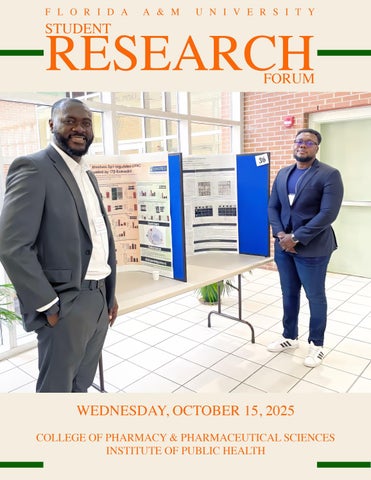
Florida A&M University 2025 Student Research Forum (SRF) Wednesday, October 15, 2025 College of Pharmacy & Pharmaceutical Sciences, Institute of Public Health 12:00 Noon-5:30 PM
Organized by The Florida A&M University Office of Undergraduate Research
The 2025 SRF activities have been sponsored by a generous contribution from AbbVie
Florida A&M University Tallahassee Campus
The University campus is comprised of 156 buildings situated on 423 acres in the heart of Tallahassee.
About Florida A&M University Founded October 3, 1887, Florida Agricultural and Mechanical University (FAMU) is a public, historically Black university located in Tallahassee, Florida. What distinguishes FAMU from other universities is its legacy of providing access to a high-quality, affordable education with programs and services that guide students toward successfully achieving their dreams. FAMU is part of the State University System of Florida and is accredited by the Southern Association of Colleges and Schools Commission on Colleges.
In addition to the main Tallahassee campus, FAMU has several satellite campuses across Florida. These include the College of Law in Orlando and the College of Pharmacy and Pharmaceutical Sciences, Institute of Public Health, which has sites in Crestview, Tampa, Jacksonville, and Miami. • • • •
Enrolls nearly 10,000 students from across the United States and more than 70 countries. 2020-2021 Academic Profile (Admitted First Time in College Students) – 3.67 GPA / 23 ACT Retention Rate 82% / Acceptance Rate 30% One-third of summer and fall 2020 incoming students majored in S.T.E.A.M.
Quick Facts Accolades Florida A&M University earned multiple spots on the badge-eligible list of the U.S. News & World Report 2025 Best Colleges because of its high rankings: • National Universities #152 • Top Public Schools - National Universities #81 • Best Value - National Universities #87 • Social Mobility - National Universities #20 • Historically Black Colleges and Universities #3 • Best Undergraduate Computer Science #214 • Best Undergraduate Psychology #249 • Best Undergraduate Nursing #254 • 23 degree programs ranked in top 10 • Number 1 HBCU for Research and Development (National Science Foundation) • Named Fulbright HBCU Institutional Leader
About Florida A&M University University Mission Statement Florida Agricultural and Mechanical University (FAMU) is an 1890 land grant, doctoral/research institution devoted to student success at the undergraduate, graduate, doctoral and professional levels. FAMU enhances the lives of its constituents and empowers communities through innovative teaching, research, scholarship, partnerships, and public service. The University continues its rich legacy and historic mission of educating African Americans and embraces all dimensions of diversity.
University Vision Statement Florida Agricultural and Mechanical University (FAMU) will be recognized as a leading national public university that is internationally renowned for its competitive graduates, transformative research, and innovation.
University Values Florida Agricultural and Mechanical University is committed to the values of accountability, inclusion, innovation, and integrity. The University also values and endorses the Board of Governors' Statement of Free Expression and expects openminded and tolerant civil discourse to take place throughout the campus community. These values represent the tenets that guide our actions, enable us to sustain our historical mission, and realize our strategic plan.
OFFICE OF UNDERGRADUATE RESEARCH DIVISION OF ACADEMIC AFFAIRS
TELEPHONE: (850)599-3774
October 15, 2025 It is my pleasure to welcome you all to the 2025 Florida A&M University Student Research Forum. Careful planning has gone into ensuring that today is a wonderful celebration of scholarship, innovation, and discovery shared with the FAMU community and beyond. I am excited to share that this year we have 60 student presenters showcasing their research. It was not too long ago that I, myself, participated in the FAMU Student Research Forum both as an undergraduate and a graduate student. The experience, feedback, and mentorship I received during those early presentations helped prepare me for my future career. It is my hope that each of today’s presenters will take full advantage of this opportunity to grow as scholars and professionals. I would like to extend my heartfelt appreciation to AbbVie for serving as the official sponsor of the FAMU Student Research Forum for the fourth consecutive year. AbbVie’s continued partnership demonstrates a deep commitment to advancing student research, innovation, and diversity in the sciences. Their sustained support helps make events like this possible and reinforces the University’s mission to prepare future leaders through academic excellence and experiential learning. Special thanks are also extended to the faculty research mentors who have guided and supported our student researchers throughout their journeys. Your mentorship is instrumental in shaping the next generation of scientists and innovators. I also thank our panel of judges for dedicating their time to evaluate the presentations and provide valuable feedback that will help our participants refine their research communication skills. To all of our Student Research Forum presenters, congratulations on reaching this milestone. I wish each of you the very best as you share your research findings and inspire others through your work.
Sincerely,
Tiffany W. Ardley, PhD Associate Professor of Medicinal Chemistry Director, Office of Undergraduate Research Director, Bachelor of Science in Pharmaceutical Sciences Coordinator, 2024 Student Research Forum
College of Pharmacy and Pharmaceutical Sciences, Institute of Public Health Office of the Dean
TELEPHONE: (850)599-3301 FAX: (850) 599-3347
October 15, 2025 Greetings, It is my distinct pleasure to welcome you to the 2025 Florida A&M University (FAMU) Student Research Forum, proudly hosted by the College of Pharmacy and Pharmaceutical Sciences, Institute of Public Health (CoPPS, IPH).
Building on last year’s success, this year’s forum promises another enriching experience, showcasing interdisciplinary research from our talented undergraduate and graduate student learners. We are honored to host this esteemed event once again and extend our deepest gratitude to AbbVie for their continued sponsorship, which has been instrumental to the forum’s growth and success.
Congratulations to all participating student learners and their mentors. Your dedication, perseverance, and passion for advancing scientific knowledge are the pillars of this program, and today, we come together to celebrate your remarkable achievements.
A special thanks to AbbVie for their unwavering support, helping to drive forward our students’ research journeys. We also acknowledge the essential contributions of the National Institutes of Health (NIH), the U.S. Department of Education (USDoE), and the Research Centers in Minority Institutions (RCMI) Program. Their sustained support has significantly strengthened FAMU's research capacity over the years. Our heartfelt appreciation goes to our faculty members as well, whose excellence in securing research funding, providing mentorship, and fostering academic growth prepares students for national symposia, scientific conferences, and future graduate studies.
Thank you for joining us at this year’s forum. We look forward to a day filled with innovation, discovery, and inspiration.
Sincerely,
Seth Y. Ablordeppey, Ph.D. Interim Dean and Professor Eminent Scholar Chair in Biomed Sciences
FAMU IS AN EQUAL OPPORTUNITY/EQUAL ACCESS UNIVERSITY
FAMU ALUMNA SPOTLIGHT Florida A&M University proudly recognizes Dr. Joy Jackson-Guilford for her generous and continuous support of the annual FAMU Student Research Forum.
Her steadfast commitment to empowering student scholars and advancing research excellence has helped create meaningful opportunities for innovation, mentorship, and academic growth. We extend our deepest appreciation for her fostering of partnerships and a lasting impact on the success of this signature event.
Dr. Joy Jackson-Guilford is a dynamic leader, entrepreneur, and advocate for inclusive excellence with over 28 years of experience in the pharmaceutical industry. She retired from AbbVie as the Director of Strategic Partnerships within the Human Resources organization, where she led enterprise-wide inclusive talent strategies, developed impactful external partnerships, and elevated AbbVie’s presence in key talent communities. Her work centered on embedding equity into the company’s recruitment ecosystem through collaborations with professional organizations, academic institutions, and community-based entities. Joy’s career began as a post-doctoral scientist at Eli Lilly and Company, followed by leadership roles at Ortho Biotech Products, L.P., Abbott Laboratories, and AbbVie. She served as a Medical Science Liaison in Immunology and led field-based teams for nearly a decade as a Field Director in both Immunology and Neuroscience. In 2018, she transitioned to Human Resources and joined the Equity, Equality, Diversity & Inclusion (EEDI) team. In 2020, she pioneered AbbVie's Pipeline Partnerships strategy, which laid the groundwork for the Strategic Partnerships function she went on to lead. Now retired from corporate life, Dr. Jackson-Guilford channels her passion and purpose through her consultancy, Dr. J3 Consulting, LLC, where she empowers pathways, elevates talent, and connects futures. Her work focuses on strategic advising, inclusive talent development, and organizational partnership building. In addition, she is the proud owner of Precious Solemates, a boutique children’s shoe and accessories store rooted in community engagement, quality service, and timeless style. Through this venture, she creates memorable experiences for families while fostering early learning, selfconfidence, and joy in every “precious sole.” Dr. Joy Jackson-Guilford’s legacy continues through her entrepreneurial and philanthropic work, as she inspires, mentors, and uplifts the next generation of leaders, innovators, and change-makers.
Joy Jackson-Guilford, MS, PhD Dr. J3 Consulting, LLC 770-701-0285 - drj3consultingllc@gmail.com
Jonelle Pieterson is a Senior Project Specialist on AbbVie’s Strategic Pipeline Partnerships team within the Equity, Equality, Diversity and Inclusion (EEDI) department. In her current role, Jonelle is responsible for cultivating and maintaining partnerships with Historically Black Colleges and Universities (HBCUs) and Hispanic-Serving Institutions (HSIs), ensuring AbbVie continues to recruit, develop, and retain top diverse talent. She leads initiatives that strengthen AbbVie’s visibility and engagement within these communities, driving forward the company’s commitment to building a more inclusive workforce. Before joining AbbVie, Jonelle spent a decade at Mary Kay Inc.’s corporate headquarters, where she founded and built the company’s first internship program—transforming it into a cornerstone of Mary Kay’s early-career talent strategy. Following her success there, she joined Salesforce, where she led university recruiting eQorts and forged strong partnerships with Spelman College, bringing exceptional talent into the organization. Jonelle is a proud graduate of the University of Oklahoma, where she earned her degree in Human Resource Management. She is deeply passionate about developing early talent, creating equitable hiring pathways, and mentoring young professionals as they navigate their careers. Jonelle believes in the power of authenticity and leads by example, showing others what’s possible when you stand confidently in who you are. Outside of work, Jonelle is the proud mother of her son, Jojo—the guiding light behind all that she does. A passionate traveler, she is currently on a personal journey to visit the Seven Wonders of the World, with Christ the Redeemer in Brazil as her most recent adventure. She also considers herself a devoted brunch connoisseur, always seeking the perfect mix of good food, great energy, and even better company
Adrienne Russell, PharmD, RPh, is the Field Director of Medical Science Liaisons in Immunology-Rheumatology at AbbVie, overseeing the northeast region. In her current role, Adrienne is responsible for leading and guiding a team of Medical Science Liaisons to deliver critical medical insights and support the medical community, ensuring alignment with AbbVie’s strategic objectives in immunology and rheumatology. Since joining AbbVie in 2017, Adrienne has played a pivotal role in supporting the launches and growth of the Immunology portfolio within the Medical Affairs organization, serving as both a Gastroenterology and Dermatology Medical Science Liaison. In her leadership role, she partners with her MSL team to deliver comprehensive information on AbbVie’s products and disease states, communicates clinical updates from regional and national conferences, and supports pipeline advancement across the rheumatology portfolio. Adrienne’s career began in specialty pharmacy in 2008 as an HIV Specialist Pharmacist at Grubb’s Pharmacy. She spent nearly a decade focusing on chronic inflammatory conditions. As a committed clinician and patient advocate, she helped launch one of the country’s first linkage-to-care programs for HIV and Hepatitis C patients, supporting optimal outcomes for underserved populations. She was appointed Chief Pharmacist of Grubb’s NW Specialty Pharmacy in 2011, where she addressed the needs of patients with chronic conditions requiring specialized care and co-managed thousands of Hepatitis C and HIV patients throughout Washington, D.C. She also was an active member of the D.C. Pharmacy and Therapeutics Committee for DC Medicaid, where she helped drive key decisions for underserved populations. In 2015, Adrienne became Pharmacy Account Executive at Magellan Health, overseeing the DC Medicaid account before transitioning to AbbVie. Adrienne holds a Bachelor of Science in Medical Technology from Morgan State University and a Doctor of Pharmacy from Howard University. Adrienne is passionate about developing and building strong, high-performing teams that have a meaningful impact within the medical community. She is also deeply committed to mentoring young healthcare professionals in career development, confidence, mindset, and business topics—empowering the next generation of leaders. Adrienne enjoys giving back to her community and helping others succeed. Outside her professional commitments, she enjoys spending time with her husband and three children, traveling, and exploring new culinary experiences.
Rattlers Striking from the Top
Biography
Carmen Gay, PharmD Senior Medical Science Liaison Migraine, AbbVie Neurosciences Carmen Gay is a Medical Science Liaison supporting AbbVie’s Migraine therapeutic portfolio within Medical Affairs. In this role, she is responsible for developing and maintaining professional relationships with internal and external stakeholders, and for providing medical, scientific, and clinical trial support. She regularly engages in scientific exchange with Key Opinion Leaders in Neuroscience, facilitates educational presentations on AbbVie’s products, and supports research initiatives. She is a dedicated advocate for advancing science to improve patient outcomes. Carmen is a proud graduate of Florida A&M University, where she earned her Doctor of Pharmacy (PharmD). She began her professional career as a community pharmacist before transitioning into the pharmaceutical industry in 2019 as a Medical Science Liaison, gaining experience in the infectious diseases and hepatology therapeutic areas. Prior to joining the industry, she served as a specialty clinical pharmacist for a managed care organization. Carmen joined the AbbVie Neuroscience team in June 2021, supporting Washington, D.C., and Virginia. Passionate about developing the next generation of pharmacy professionals, Carmen actively mentors pharmacy students and recent graduates who are interested in pursuing careers in the pharmaceutical industry. Outside of her MSL role, you’ll find Carmen traveling, running, or watching sports. She enjoys volunteering with the D.C. and Atlanta FAMU Alumni Associations, is a proud plant mom, and loves spending time with her family.
Rattlers Striking from the Top
STUDENT RESEARCH FORUM SPEAKER STUDENT RESEARCH FORUM SPEAKER
Biography
Andriana Inkoom, Ph.D. Manager, Regulatory Submissions
Andriana Inkoom is a Manager of Regulatory Submissions within Strategic Portfolio Operations at AbbVie, where she brings a strategic, science-driven approach to regulatory innovation. In her role, she champions cross-functional collaboration and regulatory innovation to accelerate drug development across diverse therapeutic areas. With a unique blend of experience as a pharmaceutical scientist and former regulatory reviewer, Andriana leads cross-functional efforts within Discovery Research to ensure alignment of key regulatory elements that support the preparation and delivery of high-quality nonclinical submissions. Prior to joining AbbVie, Andriana served as a Regulatory Reviewer at the FDA’s Center for Drug Evaluation and Research (CDER), Office of Pharmaceutical Quality (OPQ). There, she contributed to initiatives advancing drug quality and safety through her work on USP monographs, biowaiver assessments, and product quality specifications. Andriana earned her Ph.D. in Pharmaceutical Sciences from Florida A&M University, where her research on novel treatment modalities for pancreatic cancer led to a U.S. patent. She is a twotime American Association for Cancer Research (AACR) Minority Scholar in Cancer Research. She believes in cultivating future leaders through mentorship and community engagement, bridging science with purpose. Outside of work, Andriana enjoys hiking, creative design, and leading community mentorship initiatives that foster innovation and inspire future leaders.
FA MU ST UD EN T RESEARC H FORUM AGEN DA OCTOBER 15, 2025 CoPPS, IPH - 1ST F LOOR
12:00 PM – 1:00 PM Registration & Poster Set-up - 1st Floor 1:00 PM – 1:30 PM - OPENING CEREMONY - Florida Blue Auditorium Welcome Dr. Tiffany Ardley, Director of Office of Undergaraduate Research Jonelle Pieterson- Senior Project Specialist Strategic Pipeline Partnerships - Abbvie AbbVie Experience Adrienne Russell, PharmD, RPh – MSL Field Director - Rheumatology BREAK 1:45 PM – 3:15 PM Poster Presentations & Judging (1st Floor) 3:30 PM – 4:30 PM Reception (2nd Floor) 4:30 PM - 5:00 PM - CLOSING CEREMONY - Florida Blue Auditorium Introduction of the Speaker Jonelle Pieterson
Forum Speaker Andriana Inkoom, Manager, Regulatory Submissions - Abbvie FAMU Student Research Forum Reflections Dr. Joy Jackson Guilford, Dr. J3 Consulting, LLC Retired Director of Strategic Partnerships in Human Resources – Abbvie Award Presentations Closing Remarks Dr. Tiffany Ardley
Florida A&M University 2025 Student Research Forum Poster Presentations
October 15, 2025 - 1:45-3:15 PM New Pharmacy Building, First Floor Abstract No. 38 39 6 16 40 17 41 10 24 42 1 11 7 18 58 43 32 25 8 26 44 19 27 28 29 12 45 20 59 60 30
Last Name Ablordeppey Ajayi Alhashim Anigboro-Napoleon Avril Baburaj Banjara Banks Beeker Boirie Brito Brown Bullen Chandler Collins Crawford Danae DeSouza Dotson Duke Edge Elkholy Francis Hagins Harrell Henry Hudson Hunter Israel Jackson Johnson
First Name Joshua Itunu Rahmah Olaoluwa Marlee Karunya Bipika Trinity Sydney Breana Richard Jordan Shomar Xandria Leah Sydnee Gibson Amari Amber Tia Kiara Eman Noah Emmani Xavier Ryan Alicia Ernesta JerMeny Kamryn Assata
Classification Graduate Student Graduate Student Graduate Student Graduate Student Graduate Student Graduate Student Graduate Student Undergraduate Student Undergraduate Student Graduate Student Graduate Student Undergraduate Student Graduate Student Graduate Student Undergraduate Student Graduate Student Undergraduate Student Undergraduate Student Graduate Student Undergraduate Student Graduate Student Graduate Student Undergraduate Student Undergraduate Student Undergraduate Student Undergraduate Student Graduate Student Graduate Student Undergraduate Student Undergraduate Student Undergraduate Student
General Research Area Pharmaceutical Sciences Pharmaceutical Sciences Engineering/Technology Life Sciences Pharmaceutical Sciences Life Sciences Pharmaceutical Sciences Engineering/Technology Life Sciences Pharmaceutical Sciences Clinical Research Engineering/Technology Engineering/Technology Life Sciences Pharmaceutical Sciences Pharmaceutical Sciences Life Sciences Life Sciences Engineering/Technology Life Sciences Pharmaceutical Sciences Life Sciences Life Sciences Life Sciences Life Sciences Engineering/Technology Pharmaceutical Sciences Life Sciences Pharmaceutical Sciences Pharmaceutical Sciences Life Sciences
Florida A&M University 2025 Student Research Forum Poster Presentations
October 15, 2025 - 1:45-3:15 PM New Pharmacy Building, First Floor Abstract AbstractNo. No. 382 3921 646 1631 40 22 1747 413 1023 24 33 42 48 14 1149 750 1851 58 52 43 53 32 54 259 85 26 34 4413 1955 27 35 28 56 29 57 1236 4514 20 37 5915 60 30
Last LastName Name Ablordeppey Jordan Ajayi Keyes Alhashim Lamango Anigboro-Napoleon Larsen Avril Light Baburaj McGriff Banjara McLeod Banks Medany Sobhy Beeker Miller Boirie Mishra Brito Moore Brown Morgan Bullen Nathani Chandler Odoom Collins Ofosu-Asante Crawford Okoro Danae Pamukuntla DeSouza Perdomo Dotson Pierre Duke Pierrelouis Edge Quant Elkholy Reed Francis Rosales Hagins Steward Harrell Stone Henry Taylor Hudson Thomas Hunter Veal Israel Williams Jr. Jackson Johnson
First FirstName Name Joshua Shauntai Itunu Dominique Rahmah Jean-Baptiste Olaoluwa Christine Marlee Katie Karunya T’Onj Bipika Brianna Trinity Doaa Sydney Kyra Breana Shubham Richard McKenzie Jordan Alexus Shomar Aakash Xandria Jahnissi Leah Kweku Sydnee Joy Gibson Mounika Amari Isabela Amber Ny'lah Tia Esther Kiara Bliss Eman Sarah Noah Rosemarie Emmani Elroy Xavier Romell Ryan Jada Alicia Janelle Ernesta TiLiyah JerMeny Patrick Kamryn Assata
Classification Classification Graduate Graduate Student Student Graduate Student Graduate Student Graduate Graduate Student Student Graduate Student Undergraduate Student Graduate Graduate Student Student Graduate Student Graduate Student Graduate StudentStudent Undergraduate Undergraduate Student Graduate Student Undergraduate Undergraduate Student Student Graduate Student Graduate Student Graduate StudentStudent Undergraduate Undergraduate Student Graduate Student Graduate Graduate Student Student Graduate Graduate Student Student Undergraduate Student Graduate Student Graduate Graduate Student Student Undergraduate Student Graduate Student Undergraduate Student Graduate Student Graduate StudentStudent Undergraduate Undergraduate Undergraduate Student Student Graduate Student Undergraduate Student Graduate Graduate Student Student Undergraduate Undergraduate Student Student Undergraduate Student Graduate Student Undergraduate Student Graduate Student Undergraduate Undergraduate Student Student Graduate StudentStudent Undergraduate Graduate StudentStudent Undergraduate Undergraduate Undergraduate Student Student Undergraduate Student Undergraduate Student
General General Research Research Area Area Pharmaceutical Clinical ResearchSciences Pharmaceutical Life Sciences Sciences Engineering/Technology Pharmaceutical Sciences Life Life Sciences Sciences Pharmaceutical Life Sciences Sciences Life Sciences Sciences Pharmaceutical Pharmaceutical Clinical ResearchSciences Engineering/Technology Life Sciences Life Life Sciences Sciences Pharmaceutical Pharmaceutical Sciences Sciences Clinical Research Engineering/Technology Pharmaceutical Sciences Engineering/Technology Pharmaceutical Sciences Life Sciences Sciences Pharmaceutical Pharmaceutical Sciences Pharmaceutical Sciences Life Sciences Sciences Pharmaceutical Life Sciences Engineering/Technology Engineering/Technology Clinical Research Life Sciences Pharmaceutical Sciences Engineering/Technology Life Sciences Sciences Pharmaceutical Life Sciences Life Sciences Sciences Pharmaceutical Life Sciences Sciences Pharmaceutical Engineering/Technology Life Sciences Pharmaceutical Sciences Engineering/Technology Life Sciences Pharmaceutical Sciences Engineering/Technology Pharmaceutical Sciences Life Sciences
1
The Presence of Ethnic Disparities Within the Relationship Between Adverse Childhood Experiences & Falling in Florida, BRFSS 2020 & 2023
Richard C. Brito, MSW: Zoë Rushetsky, B.S.: Parker North, B.S.: Andres F. Gil Arana, B.S.: Shauntai N. Jordan, LCSW, MASS: Charles Fleischer, M.D.: Carlos Reyes-Ortiz, M.D., PhD. Florida Agricultural & Mechanical University, College of Pharmacy & Pharmaceutical Sciences, Institute of Public Health & Global Health Collaboration Project richard1.brito@famu.edu
Adverse Childhood Experiences (ACEs) are potentially traumatic events, such as abuse, neglect, and household dysfunction. ACEs are linked to mental illness, risky behaviors, falling, and chronic disease. The purpose of this study is to examine the differences in the prevalence of falls across ethnic groups in Florida and to investigate disparities in the relationship between ACEs and falls in Florida. It is hypothesized that the prevalence of falls will differ across ethnic groups, the relationship between ACEs and falls will vary by ethnicity, and both ethnicity and ACEs will be independently associated with fall risk. This cross-sectional study involves a secondary analysis of data from Florida’s 2020 and 2023 Behavioral Risk Factor Surveillance System, conducted in partnership with the Centers for Disease Control and Prevention. The study population included adults aged forty-five to eighty, who had available information on falls and ACEs. Outcomes included self-reported falls within the past year and associated risk factors. Data was analyzed using descriptive statistics and logistic regression, accounting for the complex survey design. The results demonstrated that adults aged forty-five to sixty-four reported fewer falls than those sixtyfive years and older. Furthermore, Black and Asian participants had a lower prevalence of falls compared to other ethnic groups, and across all groups, fall prevalence increased with the number of ACEs reported. Lastly, higher ACE scores were linked to greater odds of falling among White, Asian, and Hispanic participants, and after adjusting for relevant risk factors, both ethnicity and ACEs remained independently associated with fall risk.
2 A Prospective Comparative Analysis of Barriers to Conventional Mental Health Services in Urban & Rural Honduras Shauntai N. Jordan, LCSW, MASS: Parker North, B.S.: Richard C. Brito, MSW: Ana Valdes Herrera: Benjamin Linkous, B.S.: Zoë Rushetsky, B.S.: Joyce Pineda, M.D.: Julianna Gregory, B.S., RN: Yen Lam, MHA: Emilio Nasser, M.D.: Fatimah Sherbeny, PharmD, MS, PhD: Carlos Reyes-Ortiz, M.D., PhD: Charles Fleischer, M.D.
Florida Agricultural and Mechanical University, College of Pharmacy and Pharmaceutical Sciences, Institute of Public Health & Global Health Collaboration Project shauntai1.jordan@famu.edu
Approximately one-fifth of Hondurans reported little to no access to healthcare, with limited access to mental health services. Furthermore, geographic isolation, financial hardship, cultural norms, stigma, and restricted digital infrastructure all contribute to barriers in care, especially in rural communities that face greater barriers to accessing conventional mental health services (CMHS). In response, Traditional, Complementary, and Alternative Medicine (TCAM) has become a cornerstone of care in rural communities. Prior studies have examined TCAM modality use across Honduras, yet little is known about the prevalence and utilization of both TCAM and CMHS in relation to barriers, perceptions, and access to care. This gap has contributed to persistent inequities in mental health care. To address this, this study will conduct a prospective, crosssectional, comparative analysis in Honduras’ capital, Tegucigalpa, and selected rural communities. Participants will include Honduran adult citizens, recruited through either in-person or online screening. Data will be collected using a CMHS access and attitudes questionnaire and the International Questionnaire on the Use of Complementary and Alternative Medicine. Licensed CMHS providers will also be recruited with the intent of exploring increased collaboration between TCAM and CMHS providers, obtaining insights into current practices, and exploring current CMHS barriers within rural communities in comparison to urban areas. We hypothesize that access to CMHS remains limited due to adverse social determinants of health, inconsistent utilization shaped by cultural and societal norms, and the absence of integrated policies. Findings may help inform strategies to bridge TCAM and CMHS, guided by local stakeholders and community priorities.
3
Designing a Culturally Responsive Digital Recruitment Strategy to Engage Black College Men at HBCUs in Cancer-Related Behavioral Research Brianna M. McLeod, Dr. Elizabeth C. Stewart College of Science and Technology Florida Agricultural and Mechanical University e.clare.stewart@gmail.com
Black men in the United States face disproportionate cancer burdens including higher incidence and mortality rates, later stage diagnoses, and poor health outcomes, yet they remain underrepresented in cancer related research. Historical medical mistreatment and systemic racism have contributed to a deep mistrust of research institutions among many Black communities, resulting in low participation rates and limited culturally specific data to inform interventions. This study examines whether digital recruitment strategies, when implemented through trusted institutional networks such as Historically Black Colleges and Universities, can increase research engagement among Black male college students. Black college men are at a critical developmental stage when individuals begin to form long term health behaviors, establish identity, and assume responsibility for personal healthcare. HBCUs provide a culturally affirming environment with faculty, staff, and peer leaders who serve as credible messengers for health outreach. Using a mixed methods approach, Black male students at Florida Agricultural and Mechanical University were recruited through peer led social media campaigns and word of mouth. Participants completed an online survey addressing campus life, health perceptions, mental health, social media use, and willingness to participate in research. At the conclusion of the survey, students could opt into a focus group held through secure online discussions. Results indicate that participants emphasized the importance of peer leaders, faculty trust, and culturally relevant content in shaping their willingness to engage. These findings suggest that digital strategies rooted in institutional trust can effectively recruit Black college men into health research and contribute to addressing disparities in research participation and health outcomes.
4 The Use of Salivary Amylase as a Non-Invasive Indicator of Stress in Rats During Syringe Oral Dosing McKenzie L. Moore and Tanise Jackson, DVM College of Agriculture and Food Sciences, Florida A&M University mckenzie1.moore@famu.edu
Stress in laboratory animals can negatively influence their well-being and alter experimental outcomes, leading to unreliable or inconsistent research data and raise ethical concerns in laboratories. Accurately measuring stress is essential for improving both animal welfare and scientific validity. However, most existing stress measures, such as blood sampling or heart rate monitoring, are invasive and may increase the very stress they seek to measure. This ongoing study addresses the need for a non-invasive, accurate indicator of stress in laboratory rats. The purpose of this project is to evaluate whether salivary amylase, an enzyme naturally found in saliva, can serve as a sensitive and non-invasive biomarker for stress experienced during syringe oral dosing procedures. To explore this issue, male rats will be divided into two groups. One group will be gently handled and gradually exposed to the syringe to simulate positive conditioning, while the other group will receive no prior handling or acclimation. Both groups will receive agave solution by syringe, and saliva samples will be collected immediately before and after dosing. Amylase activity will then be analysed to determine changes in stress response. It is expected that salivary amylase levels will increase following dosing, particularly in untrained rats, while trained rats will exhibit a smaller rise. These anticipated results would suggest that salivary amylase is a reliable non-invasive marker of acute stress and that positive handling effectively reduces physiological stress. This project contributes to enhancing laboratory animal welfare while improving the accuracy and reproducibility of behavioural and biomedical research outcomes.
5 Microneedling Atrophic Acne Vulgaris Scars & Post-Inflammatory Hyperpigmentation: A Scoping Review Ny’Lah J. Pierre: Meihmy Chang, M.D.: Julianna Gregory, B.S., RN.: Zoë Rushetsky, B.S.: Rita Benkirane, B.S.: Madison Leonard, B.S.: Joyce N. Pineda Ordoñez, M.D.: Emilio Nasser, M.D.: Carlos Reyes-Ortiz, M.D., PhD.: Richard C. Brito, MSW: Charles Fleischer, M.D. Florida Agricultural & Mechanical University, School of Allied Health & Global Health Collaboration Project Nylah1.pierre@famu.edu
Acne scarring and post-inflammatory hyperpigmentation remain common dermatologic concerns with limited effective treatment options available. Microneedling has emerged as a minimally invasive treatment option to address these patient concerns. This study is a scoping review to determine microneedling's effectiveness for acne scarring and hyperpigmentation. Eleven studies met our inclusion criteria; data on patient skin type treatment parameters, outcomes, adverse events, and narratively synthesized the findings. Most studies used microneedling as a stand-alone treatment, with needle depths recorded between one-point-four and two-point-five millimeters over three to six sessions. Thirty to forty-five percent reduction in scar scores were noted across these studies. For patients with darker skin tones, one paper reported five microneedling sessions at a depth of one-point-five millimeters reduced melanin index readings by forty to sixty percent, with effects lasting at least six months. One article reviewing biopsy evidence supported these findings by showing an increase in collagen and a thickening of the epidermis. Another article revealed that combining microneedling with other treatments, such as platelet-rich plasma, scar improvements increased by an additional ten to twenty percent compared to microneedling alone. Overall, microneedling is an effective and low-risk treatment for acne scars and hyperpigmentation across all skin types. Used alone, microneedling provides significant improvement with adjuvant therapies offering additional benefits. Careful needle depth and sun protection minimize pigment changes for optimal outcomes, particularly in darker skin. This research was made possible in part by the FAMU Title III Undergraduate Research Program Project 008042 and the FAMU Office of Undergraduate Research.
6 EAGLES tool: Environmental impact of Agriculture using Life-cycle assessment and Knowledge-based Expert System Rahmah, A, Alhashim: Velan, Thanasekar: Doaa, M, Sobhi: Ibrahim, K, Alhashim: Aavudai, S, Anandhi FAMU-FSU College of Engineering, Florida State University: Agriculture and Life sciences: University of Florida: School of the Environment, Florida A&M University: International Baccalaureate (IB) Program, Rickards High School Biological: Systems Engineering, Florida A&M University rahmah1.alhashim@famu.edu
Agriculture must meet a projected 70% increase in global food demand by 2050 while reducing environmental harm. Traditional Life Cycle Assessment (LCA) is widely applied to evaluate agricultural impacts but remains limited by data gaps, complexity, and poor accessibility for nonexpert users. This study introduces EAGLES (Environmental Impact of Agriculture using LifeCycle Assessment and Expert System), a decision-support tool designed to address key limitations in existing sustainability assessment approaches. Life Cycle Assessment (LCA) evaluates environmental impacts but is limited by data availability and usability, especially for new users in agriculture. The objective of this study is to address this gap by developing the EAGLES tool, which innovatively combines an expert system (knowledge-based, rule-based) with the LCA methodology A systematic review of 184 peer-reviewed studies (1999–2025) informed the knowledge base, while an if–then rule framework organized data across the four LCA phases: goal/scope, inventory, impact assessment, and interpretation. The features of EAGLES include coverage of 36 impact categories, 4 LCIA methods, and 5 scope analyses. The tool provides expert guidance by distinguishing essential from non-essential steps and delivers impact scores with actionable sustainability recommendations for farmers, policymakers, and researchers. A case study on Mississippi rice production (2021) demonstrated the tool’s application. Fertilizer use of 8.11 × 10⁶ kg N/year resulted in 1.08 × 10⁷ kg NO₃⁻ emissions, corresponding to a marine eutrophication potential (MEP) of 1.70 × 10⁶ kg N-eq/year. Normalization and weighting identified significant risks to water quality, leading to targeted recommendations such as precision fertilizer use, cover crops, controlled-release fertilizers, and improved irrigation practices. By combining expert knowledge with structured LCA, EAGLES enhances usability, transparency, and decisionmaking, advancing sustainable agriculture and addressing urgent food security and environmental challenges.
7 Improving Vineyard Productivity Operations Using Field Monitoring Plant Phenotyping & Agroclimatic Data Shomar K. Bullen1; Wei-zhen Liang2; Violeta M. Tsolova3; Jingqiu Chen4* 1. Soil and Water Sciences, College of Agriculture and Food Sciences, Florida A&M University 2. Biological Systems Engineering, Panhandle Research & Extension Center, University of Nebraska–Lincoln 3. Center for Viticulture and Small Fruit Research, College of Agriculture and Food Sciences, Florida A&M University 4. Biological Systems Engineering, College of Agriculture and Food Sciences, Florida A&M University *Corresponding author: Jingqiu.chen@famu.edu
The grape and wine industry is a significant agricultural sector, producing high-value commodities, however, vineyard management faces challenges such as water scarcity, fertilization needs, pest control, and increasing climate variability. Efficient irrigation is crucial as it directly impacts grape quality and health. About 70% of water consumption worldwide is used for agricultural purposes. However, water scarcity is expected to rise in the coming decades. Additional pressures, including labor shortages and environmental complexities, further highlight the need for high-precision, adaptive technologies. Despite advances in navigation systems, irrigation, and imaging tools, growers still struggle with scheduling critical operations due to early and mid-season data scarcity. Without reliable early-season data, key management decisions become uncertain, negatively affecting profitability. The integration of sensor networks offers promising solutions by enabling improved vineyard monitoring, smart irrigation, and data-driven decision-making. These technologies collect large datasets to identify patterns and provide actionable insights. This research explores the integration of Internet of Things (IoT), wireless sensor networks (WSN), agroclimatic data, and imaging technologies primarily for vineyard water management, assessing their effectiveness in improving resource efficiency and decision-making. By using the WSN, we analyze a straightforward soil water balance model for irrigation. Statistical tests and visualization allow for identification of key environmental and crop parameters affecting water consumption and yield and evaluate economic feasibility. By addressing data scarcity and technology adoption challenges, this research provides practical insights for growers, particularly in the southeastern U.S., demonstrating how data-driven approaches can enhance productivity, profitability, and sustainability in precision viticulture.
8 Self-Assembled Bacteria-Inspired Nanoswimmers Under Magnetic Actuation Amber D Dotson,1,2 Jamel Ali1,2 1
FAMU-FSU College of Engineering, Department of Chemical and Biomedical Engineering Tallahassee, Florida 32310, USA 2 National High Magnetic Field Laboratory, Tallahassee, Florida 32310, USA jali@eng.famu.fsu.edu
The development of nanoscale swimmers is attracting growing attention for a wide range of applications, from targeted drug delivery to probing the mechanical and chemical properties of cellular and subcellular environments. A central challenge in this field lies in designing soft, stimuli-responsive nanorobots that can adapt dynamically to diverse and changing conditions. Although several nanoswimmer designs have been proposed with promising potential, most remain restricted in versatility, efficiency, or the ability to perform multiple tasks. By contrast, natural bacterial flagella exhibit extraordinary adaptability, undergoing rapid and reversible morphological changes in response to a variety of external stimuli. To address this gap, we present the design of biohybrid nanoscale swimmers self-assembled from magnetic nanoparticles coupled with one or more bacterial flagella. This strategy integrates the controllability of engineered magnetic actuation with the innate responsiveness of biological structures. Using high-resolution fluorescence microscopy, we directly visualize both propulsion and conformational dynamics while manipulating swimmer orientation through external magnetic fields. Our experiments reveal pronounced differences in swimming behavior before and after inducing flagellar transformations, highlighting sensitivity of these biohybrid swimmers to external cues. Moreover, we demonstrate that deliberate induction of flagellar bundling in multiflagellated swimmers significantly enhances propulsion efficiency, closely replicating natural bacterial motility. These findings not only validate the feasibility of integrating biological components with engineered systems at the nanoscale but also open new avenues for constructing adaptable, multifunctional nanorobots. Ultimately, our results underscore the promise of biohybrid nanoswimmers as versatile tools for navigating complex biological environments and advancing biomedical and environmental applications.
9 Additively Manufactured Micro Swimmers for Drug Delivery Applications Isabela Perdomo,1,2 Leili Hayati,1, 2 Juliana Castelli,1,2 Anya Tillman,1,2 Jamel Ali1,2 1
Department of Chemical and Biomedical Engineering, FAMU-FSU College of Engineering, Tallahassee, Florida 32310, USA 2 National High Magnetic Field Laboratory, Tallahassee, Florida 32310, USA isabela1.perdomo@famu.edu
Bacterial flagellar locomotion serves as inspiration for the design of biocompatible micro swimmers—tiny constructs that can traverse viscous fluids, including biological settings, for targeted therapeutic use. Although bacteria naturally swim with helical tails, their biological makeup poses limitations for in vivo medical applications due to compatibility concerns. We propose that synthetic helical micro swimmers, produced through high-resolution 3D bioprinting and integrated with magnetic nanoparticles, can achieve guided movement in viscous fluids, offering a biocompatible option for medical use. Helical structures (25–50 microns) were fabricated using two-photon polymerization (2PP) technology with hydrogels designed for biocompatibility. Structures were embedded with magnetic nanoparticles and characterized using advanced microscopy techniques. Using a magnetic field generator (MFG) system integrated with real-time microscopic observation capabilities, the performance of the micro swimmers was evaluated. Early findings confirm the successful production and magnetic control of the printed helical constructs, demonstrating the potential of synthetic micro swimmers. Ongoing research is directed at refining the system in several areas: biomaterial choice and properties, printing parameters, and magnetic field configurations to enhance propulsion efficiency. This study outlines a practical approach for fabricating biocompatible micro swimmers through 2PP bioprinting. Future efforts will extend optimization work and investigate other propulsion strategies, including acoustic and electric field–based actuation, progressing toward real-world drug delivery applications and broader medical uses in complex biological settings.
10 Understanding Object Detection Vulnerabilities in the Age of YOLO v11 Trinity Banks: Idongesit Mkpong-Ruffin, PhD: Deidre Evans, PhD Florida Agricultural and Mechanical University trinity1.banks@famu.edu, idongesit.ruffin@famu.edu, deidre.evans@famu.edu
Object detection models are an essential resource in modern and future technology, playing a crucial role in various applications. Through reviewing existing literature, this study explores how models like YOLOv11 have shaped the field of computer vison and how object detection models continue to evolve. YOLO v11, the latest version of this model, has introduced significant improvements since the model’s creation. However, despite these advancements, object detection models remain vulnerable to adversarial attacks (Fu et. al., 2021). We will examine the nature of adversarial attacks, specifically adversarial patches, which alter how models interpret visual information. Understanding these vulnerabilities is critical, as such attacks can manipulate how these models interpret visual data leading to misclassifications which may have real-world implications.
11 From Vineyard to Wine: Harvest and Juice Analytical Insights into Muscadine Grape Cultivars Jordan L. Brown1; Kendra R. Badger1; Dionne S. Jones1; Allen F. Humphries2; Violeta M. Tsolova2; Jingqiu Chen1* 2.
1.
Biological Systems Engineering, College of Agriculture and Food Sciences, Florida A&M University Center for Viticulture and Small Fruit Research, College of Agriculture and Food Sciences, Florida A&M University *Corresponding author: Jingqiu.chen@famu.edu
This study focused on the harvest and processing of muscadine grape cultivars, Noble, Floriana, and A27 from a precision engineering system monitored vineyard experiment at the FAMU Center for Viticulture and Small Fruit Research. The immediate objective was to characterize fruit yield and enological parameters. Grapes were processed using a crusher/destemmer and bladder press to obtain juice for analysis. Standard analytical tools, including a refractometer, pH meter, and titration setup with 0.1M NaOH and bromothymol blue indicator, were used to measure soluble solids (°Brix), pH, and titratable acidity. Samples were also prepared with a vacuum pump and filter for advanced analysis on the Lyza 5000 Wine Analyzer, providing comprehensive enological data. Harvest weights were recorded by cultivar and vine, with Noble, Floriana, and A27 showing distinct differences in gross and net yields. Juice analyses revealed variation in soluble solids, acidity, and pH across cultivars, reflecting genetic differences and vineyard conditions. These parameters are critical indicators of grape ripeness, fermentation potential, and wine quality. Looking forward, these results provide a foundation for integration with precision engineering monitoring systems for canopy, climate, soil, and management practices. Together, such datasets will enable cultivar-specific insights to guide harvest timing, optimize processing, and refine winemaking strategies to advance precision viticulture in muscadine grapes.
12 Preliminary Development of Autonomous Spraying System for Muscadine Vineyards Ryan E. Henry; Ava D. Cason; Jariah J. Williams; Camrynn G. Harper; Robert D. Williamson, Jingqiu Chen* Biological Systems Engineering, College of Agriculture and Food Sciences, Florida A&M University *Corresponding Author: jingqiu.chen@famu.edu
Muscadine vineyards traditionally rely on continuous blanket fungicide spraying, which increases chemical usage, drift, labor demands, and worker exposure. To address these challenges, we propose an autonomous spraying system that employs real-time muscadine grape leaf detection using a deep learning model to enable selective spraying only when targets are present. This targeted approach aims to reduce input, enhance safety, and improve spraying efficiency. The system integrates real-time inference on vineyard imagery, target distance estimation, and spray duration modulation. It features a mobile rover equipped with two cameras for navigation and targeting, a fungicide tank with a solenoid-controlled sprayer, and a mobile base. An Arduino Nano will activate the sprayer based on detection signals, while a Raspberry Pi will process the detection pipeline and provide performance data. The detection model, based on YOLOv11, will be trained on muscadine grape imagery collected at the FAMU Center for Viticulture and Small Fruit Research. Training will incorporate data augmentation, class-balanced sampling, and fieldadjusted confidence and non-maximum suppression thresholds. System performance will be evaluated by detection efficiency (mAP@0.5, precision, recall) under different lighting and canopy conditions, inference speed (target ≥10 FPS on Raspberry Pi), and spray accuracy (percentage of intended leaf coverage, overspray, and miss rate). Results will be compared against a baseline fixed-rate, continuous-spray protocol at matched travel speed and nozzle configuration. Outcomes will quantify chemical savings, drift reduction, labor efficiency, and safety improvements. This low-cost, practical platform has potential to advance precision viticulture by combining real-time vision with selective actuation for targeted fungicide application in muscadine vineyards.
13 Enhancing the Proton Exchange Membrane Fuel Cell Performance of Poly(arylene ether sulfone) Composite Using Amino-Sulfonated Additives Bliss B Quant; Zariyah A. Springer; Dr. Natalie Y Arnett Ph.D. FAMU-FSU College of Engineering Natalie.arnett@famu.edu
Proton exchange membrane fuel cells are widely studied for their ability to efficiently generate clean energy, with performance largely determined by the stability and conductivity of the polymer electrolyte membrane. Previous work from our lab demonstrated that incorporating amino sulfonic acid additives into poly(arylene ether sulfone) membranes significantly enhanced proton conductivity, surpassing that of commercial membranes. Building on this foundation, the present study investigated the chemical incorporation of aniline-2-sulfonic acid into alkyne phenolphthalein-biphenol poly(arylene ether sulfone) to address long-term stability limitations caused by additive leaching. Polymer films were cast from dimethyl sulfoxide and 1-methyl-2pyrrolidone solvents with additive loadings of 1, 5, and 10 percent, and additional NMP films were aged for up to seven days. Characterization included Fourier-transform infrared spectroscopy, differential scanning calorimetry, scanning electron microscopy, and hydration tests. Results confirmed successful sulfonic acid group incorporation, with solvent, additive concentration, and aging time strongly influencing thermal transitions, surface morphology, and hydration properties. NMP-based films with high additive loadings displayed the greatest water uptake, reaching over 60 percent, while aged films showed improved additive retention and enhanced crystallinity with melting points approaching 299 °C. Morphological analysis revealed a progression toward porous surfaces at higher additive concentrations, suggesting greater potential for ion transport. These findings demonstrate that chemical integration of sulfonated additives offers a pathway to balance conductivity, durability, and hydration in polymer membranes. The work contributes to advancing high-performance membranes for long-term fuel cell operation and positions chemically modified PAES systems as viable candidates for next-generation energy applications.
This research was made possible in part by the FAMU Title III Undergraduate Research Program Project 008042 and the FAMU Office of Undergraduate Research.
14 Regional Analysis of Urbanization and Population Dynamics in the Southern United States: A 20-year Geospatial Study Janelle Thomas1, Jingqiu Chen1* 1.
Biological Systems Engineering, College of Agriculture and Food Sciences, Florida Agricultural and Mechanical University, 1409 Wahnish Way, Tallahassee, FL, 32310 * Corresponding author: jingqiu.chen@famu.edu
Urbanization across the southeastern United States has accelerated over the past two decades, reshaping landscapes, altering ecosystems, and intensifying resource demands. This research expands on prior Florida-focused studies by examining urbanization trends across 12 southeastern states: Florida, Georgia, South Carolina, North Carolina, Alabama, Tennessee, Mississippi, Louisiana, Arkansas, Virginia, West Virginia, Kentucky, and Missouri. Using the MultiResolution Land Characteristic Consortium National Land Cover Database (NLCD) in conjunction with Geographic Information System (GIS) tools, we analyzed land cover changes from 2001 to 2021 at five-year intervals, focusing on shifts in high-, medium-, and low-intensity developed lands and open spaces. To contextualize these changes, U.S. Census Bureau County level population data from 2000, 2010, and 2020 were integrated to explore correlations between demographic growth and land cover dynamics. By comparing urban expansion and population patterns across different ecological and socio-economic regions, this study highlights spatial variations in the pace and intensity of development. Additionally, the research evaluates the environmental implications of increasing impervious surfaces, particularly impacts on watershed function, water quality, and ecosystem services. Findings from this regional-scale analysis provide a foundation for more targeted urban planning and resource management strategies, offering insights into balancing population growth with sustainability in one of the fastest developing regions of the United States.
15 Optical Signatures of Extracellular Matrix Cross-Linking in Renal Development and Fibrosis Patrick L. Williams, Jr; Triniti N. Vanoven; Jessica K. Baas; and Isaac J. Pence, Ph.D. Department of Biomedical Engineering, UT Southwestern Medical Center, Dallas, TX 75390 Email of corresponding author: isaac.pence@utsouthwestern.edu
More than 1 in 7 U.S. adults have chronic kidney disease (CKD). A common pathological feature of CKD is renal fibrosis, which is the scarring of tissue due to the excessive deposition and potential cross-linking of extracellular matrix (ECM) proteins. If left untreated, renal fibrosis leads to end-stage renal disease, which requires dialysis or a kidney transplant for survival. Changes in the local cell expression and biomechanics of kidney ECM have been shown along the corticomedullary axis during healthy development and in areas of pathological progression. However, there are limited tools to investigate spatial changes in ECM to link expression, chemical composition, and biomechanics. To address this, here we apply Raman spectroscopy (RS) as a label free technique that uses inelastic scattering of monochromatic light to provide a chemical fingerprint by which molecules can be identified. It is a non-destructive technique that can give spatially-resolved information about biochemical changes such as composition and protein chemical crosslinking (CXL). We hypothesize that Raman spectral signatures will correspond to CXL dosage and that RS will detect changes along the mouse kidney corticomedullary axis. The objective of this project was to demonstrate the ability to use RS to characterize ECM CXL across controlled phantoms and complex kidney tissues. As part of this work, gelatin and collagen hydrogels were formulated in replicates as controls or subjected to varying concentrations of glutaraldehyde, a CXL agent, and measured via confocal Raman microscopy. Sagittal sections of fixed embryonic mouse kidneys were measured at both specific locations and with spatial mapping to compare chemical signatures that may be related to CXL. The Raman spectra were preprocessed via cosmic-ray removal, smoothing, and background subtraction, followed by analysis using custom MATLAB scripts to identify spectral trends. Finally, the gelatin and collagen gel results were compared to the mouse kidney Raman mapping. Our findings suggest that CXL can alter the intensity of certain Raman peaks that are associated with proteins and that embryonic mouse kidneys exhibit a consistent trend along its corticomedullary axis, with increased protein amide signatures found within the cortex. In conclusion, Raman spectroscopy may be a promising tool for improving the understanding of kidney development and CKD with the potential to inform new therapies and tissue engineering efforts to supplement the transplant pool. Future work will consist of extending testing to fresh mouse kidney samples and models of disease.
16 Using SWAT to Simulate Residue Management as a Best Management Practice to Improve Watershed Management Olaoluwa E. Anigboro-Napoleon1; Yaoze Liu2; Jingqiu Chen3* 2.
1. Soil and Water Sciences, College of Agriculture and Food Sciences, Florida A&M University Department of Environmental and Sustainable Engineering, University at Albany, State University of New York 3. Biological Systems Engineering, College of Agriculture and Food Sciences, Florida A&M University *Corresponding author: jingqiu.chen@famu.edu
Soil & Water Assessment Tool (SWAT), a widely used hydrological modeling tool, simulates various hydrological processes. The standard SWAT model currently lacks support for simulating residue management, a key agricultural best management practice. This study extends the SWAT model’s capacity to represent residue management practices. The SWAT model’s source code, which is written in Fortran, was modified to develop and implement a new function capable of effectively simulating residue management. This newly created function allows explicit control over residue management, enabling simulations to explore various conservation scenarios. Another major challenge was that the modified model functioned efficiently only for a single Hydrologic Response Unit (HRU), whereas real watersheds typically comprise hundreds of HRUs. To address this, we developed a MATLAB-based automation that identifies HRUs by land use type and replaces default management operations with customized schedules. SWAT operation codes and parameters were further modified, assigning code 7 to residue management (variable HARV+RES). These improvements enable SWAT to simulate residue cover effects on runoff and soil erosion at the HRU level, thereby supporting more realistic watershed-scale assessments of residue management and enhancing conservation planning and water quality evaluations.
17 Dimensions of Complexity: A Systematic Review from Streamflow Perspective Karunya Baburaj1: Aavudai Anandhi2 1 School of the Environment, Florida Agricultural and Mechanical University, F.S.H. Science Research Center, 1515 S. M.L.K. Jr. BLVD, Tallahassee, FL 32307. 2 Biological Systems Engineering, Florida Agricultural and Mechanical University, Benjamin Bannekar Tech C, 1409 Wahnish Way, Tallahassee, FL 32307. anandhi.swamy@famu.edu
The concept of complexity gives as for understanding the behaviour of different dynamic systems, extending across various disciplines such as physics, economics, and environmental sciences. This review was conducted following the Preferred Reporting Items for Systematic Reviews and Meta-Analyses (PRISMA) framework to ensure a systematic and transparent approach. The study explores various dimensions of complexity measures including randomness, unpredictability, irregularity, structure, uncertainty, disorder, and causality both in general contexts and specifically in relation to streamflow systems. Additionally, the temporal evolution of complexity measures over time was examined to trace their development and applications. Furthermore, the advantages and disadvantages of different complexity measures were evaluated across multiple studies to identify their methodological strengths and limitations. The review also highlights the applications of complexity measures in general systems and streamflow analysis, incorporating temporal and spatial analytical techniques to provide a better understanding of their use in hydrological research.
18 Poly(Xylitol Sebacate): Biopolymer for Biomedical Applications Xandria L Chandler, Kadisha Culpepper, Dr. Natalie Arnett
Florida Agricultural and Mechanical University, College of Science and Technology Email: Xandria1.chandler@famu.edu
This research investigates the application of poly(xylitol)-based polymers synthesized through melt polymerization as platforms for non-invasive and effective targeted drug delivery. Designed as alternatives to chemotherapy and radiation, poly(xylitol sebacate) (PXS), a semi-crystalline, biocompatible, biodegradable, and hydrophilic biopolymer was modified using other dicarboxylic acids, namely dodecanedioic acid and suberic acid to further understand and improve the release properties. The resultant polymers, poly(xylitol dodecanedioate) (PXD) and poly(xylitol suberate) (PXSub) were compared with PXS to determine which system produced nanoparticles within the desired 100–200 nm range for affinity toward cancerous sites. Synthesis conditions were optimized based on chain length and substituents from the dicarboxylic acids, to evaluate nanoparticle stability and uniformity. Both unloaded and curcumin-loaded nanoparticles were studied to assess effects on cells, stability over 72 hours, and curcumin release and migration. Curcumin, used as a model therapeutic, was quantified by ultraviolet–visible spectroscopy and Beer–Lambert’s law. Optimization showed that PXS synthesized over 15 hours with 20 minutes of sonication produced the most favorable results. Dynamic light scattering of a 1 mL sample revealed nanoparticles averaging 170.02 ± 8.91 nm after 96 hours, demonstrating size stability and suitability for therapeutic delivery. Current work focuses on improving storage conditions, including embedding nanoparticles in epoxy, to reduce aggregation during drying and minimize material loss for scanning electron microscopy. These findings identify PXS as a promising material for stable, tunable, and targeted drug delivery systems, underscoring its potential to advance safer alternatives to current cancer treatments. This research was made possible in part by the FAMU Pathways to Biomedical Research Program.
19 Carbon Storage and Sequestration Assessment in Apalachicola National Forest Using the InVEST Model Eman Elkholy* and A. Anandhi School of the Environment, Florida A&M University, FSH Science Research Center, 1515 MLK BLVD, Tallahassee, FL, USA; Biological Systems Engineering, College of Agriculture and Food Sciences, Florida A&M University, Benjamin Banneker Tech C, Tallahassee, FL, USA eman1.elkholy@famu.edu
Forests and wetlands are critical carbon sinks that help regulate the global climate. The Apalachicola National Forest in north Florida, the largest national forest in the state, contains diverse ecosystems including pine flatwoods, cypress swamps, and wetlands that store substantial amounts of carbon. However, spatially explicit estimates of carbon storage in this forest are limited. This study applies the Integrated Valuation of Ecosystem Services and Tradeoffs (InVEST) Carbon Storage and Sequestration tool to quantify four carbon pools: aboveground biomass, belowground biomass, soil organic carbon, and dead organic matter. Land cover data from the National Land Cover Database (NLCD) will be combined with literature-based carbon pool values to estimate current carbon stocks and assess potential changes under various land-use scenarios. The results are expected to provide a baseline understanding of carbon distribution in Apalachicola National Forest and highlight the implications of land management for long-term sequestration potential. This work demonstrates the importance of linking geospatial data with ecosystem service assessment tools to support conservation planning and climate change mitigation strategies in Florida’s coastal forests.
20 Soil Nitrogen Monitoring: Sensor Techniques, IOT Applications and Challenges Ernesta Hunter1, A. Anandhi2 School of the Environment1 and Biological and Systems Engineering2, Florida A&M University 32307 ernesta1.hunter@famu.edu
Nitrogen fertilizer synthesis and processes are expensive, extremely hazardous and contributes to CO2 emissions. Traditional methods of soil nitrogen sampling and monitoring use direct sampling and laboratory-based methods which can be time-consuming, expensive and traditionally conducted off-site. Soil nitrogen monitoring is a significant factor as high nitrogen fertilizer prices and crop yield are important to farmers and overall food security and in-situ technologies, with fewer soil disturbance and environmental impacts are needed. To determine the sensors and tools used for soil nitrogen monitoring, a systematic review was conducted using the Google Scholar database, using the keywords “soil nitrogen monitoring” and the search results provided twenty-three (23) records. The review was conducted using the PRISMA 2020 Statement method and after eligibility and screening 15 articles were available for review. The specific techniques and site-selection criteria for the various monitoring tools are presented. In-situ technologies, with less environmental impacts have included reflectance technology such as spectrophotometry attenuated total reflectance spectroscopy (ATR), hyperspectral remote sensing data and other reflectance instruments. Emerging soil monitoring technologies include IoT technology and printable sensors. The studies also included a small-scale, in-situ nitrogen synthesis technology that was implemented using electrochemical soil monitoring sensors to monitor soil nitrogen by conducting nitrogen fixation on-site through the merging of non-thermal plasma technology with electrochemical sensors along with inputs of air and water to produce a fertilizer-enriched irrigation water. In the field changes are possible and it was reported that nitrogen non-thermal plasma irrigation water beneficial to enhancing plant growth up to 130%. It was found that 55% of the studies did not show or list specific technologies for measuring soil nitrogen. Only 40% of the studies reported which nitrogen species is considered for detection and measurement. Nitrogen species measured by some of the monitoring tools included nitrate, nitrate-nitrogen, ammonium nitrate and plant available nitrogen and was dependent upon the tool. 65% of the studies were fabricated and implemented in foreign countries. Soil nitrogen should be further implemented and researched for additional focus and measurements. Monitoring of soil nitrogen using various sensing technologies are impacted by challenges of the Rural Digital Divide, where rural and remote places may not have access to infrastructure that is needed for real-time data for in-situ precision agriculture decisions. Soil nitrogen monitoring and integration of the various sensors and technologies is promising, and further research is needed for monitoring soil nitrogen, as soil is the cornerstone of sustainability, crop production, yield and food security.
21 Media-Induced Shifts in Gut Microbial Diversity Assessed by 16S rRNA Sequencing Dominique M. Keyes3, Erin Nesmith3, Jillian L. Pope, Ph.D.3, Ashley Wolf, Ph.D.1,2 1 Division of Infectious Diseases and Vaccinology, School of Public Health, University of California, Berkeley, Berkeley, CA, USA 2 Center for Computational Biology, University of California, Berkeley, Berkeley, CA, USA. 3 Department of Biology, Florida A&M University Dominique1.Keyes@famu.edu
The gut microbiota is a complex and dynamic community of microorganisms that plays essential roles in host health and disease. Each individual harbors a unique microbial composition, and cultivation conditions, particularly the composition of the growth medium, strongly influence which microbes thrive and how the community structure shifts. In vitro cultivation provides a controlled framework for examining how different nutritional environments shape microbial diversity, with nutrient-rich media favoring fast-growing opportunists, while more defined formulations enable slower-growing or less abundant taxa to persist. Methods: In this study, fecal samples were cultivated anaerobically in Base Collinsella Medium Glucose (BCMG) and Brain Heart Infusion (LYBHI), supplemented with 1% or 2.5% DMSO. Baseline fecal communities were sequenced and compared to cultivated samples using 16S rRNA gene sequencing. Alpha and beta diversity metrics generated in QIIME2 were used to quantify and compare diversity across conditions. Results: Media composition had a significant influence on microbial diversity. LYBHI cultures exhibited increased richness and evenness (Shannon index) but reduced phylogenetic diversity (Faith’s PD) relative to BCMG. Higher DMSO (2.5%) further reduced phylogenetic diversity. Beta diversity analyses revealed clustering primarily by media type, with BCMG and LYBHI forming distinct communities, and DMSO contributing to subtle within-media shifts. Taxonomic profiling revealed media- and DMSO-dependent enrichment of specific genera. Our results are consistent with the microbial concept that changing the medium can markedly alter which microbes can thrive, as exemplified by the enrichment of Streptococcus, Bifidobacterium, and Fusobacterium varium, alongside shifts in other commensal and opportunistic taxa. Conclusion: Recognizing media-driven effects is a critical experimental design consideration for ensuring the reproducibility and interpretability of in vitro gut models. Accounting for these variables is essential to guide future optimization of methodological protocols and to generate biologically meaningful insights that can inform downstream functional analyses. This research was made possible in part by the FAMU Title III Undergraduate Research Program Project 008042 and the FAMU Office of Undergraduate Research.
22 Modeling Forest Road Runoff and Erosion in Florida Panhandle Region, USA Katie Light1, Johnny Grace III2, Jingqiu Chen3*
2.
1. Soil and Water Sciences, College of Agriculture and Food Sciences, Florida A&M University USDA-Forest Service, Southern Research Station, Center for Forest Watershed Research, Tallahassee, FL 32307, USA 3. Biological Systems Engineering, College of Agriculture and Food Sciences, Florida A&M University *Corresponding author: Jingqiu.chen@famu.edu
Studying forest road runoff and erosion is vital for reducing sediment, protecting water quality, and sustaining forest operations. Runoff and erosion in the Panhandle region of Florida, U.S. were simulated using the WEPP model over a 30-year period, evaluating the effectiveness of six management practices, three soil surface types, and three slope designs imposed on the experiment forest road. Comparative analyses were conducted using four temporal scales, and paired t-tests of the forest road attributes. The results from the paired-t test showed that forest buffer is are the most effective management practices in reducing runoff and 268.4%; gravel proved effective for reducing erosion, where gravel reduced erosion by 53.4% and 46% when compared to compacted and bare road surfaces, respectively; and Buffers reduced the annual erosion average to 99.3% when compared to non-buffered managements. The U5 topography reduced erosion by 53.1% and 38.3% when compared to U3Dev and U10, respectively. A uniform and low slope gradient topography design demonstrates an effective erosion control design. The erosion and runoff from all road attributes diminish with increasing precipitation depth, and the gravel surface produces the lowest runoff and erosion yields. The largest precipitation class (>50mm) generates the and accounts for most of the estimated erosion and runoff yields. These findings highlight the importance of integrating road design, surface material, and slope characteristics with local climate and temporal dynamics to optimize forest road planning, erosion control, and environmental protection. Future work should evaluate the least and most effective road traits in terms of cost, durability, and performance along the road length.
23 Soil Nutrient Monitoring Technologies for Sustainable Agriculture Doaa M. Sobhy 1 and Aavudai Anandhi 2 1-School of the Environment, Florida Agricultural and Mechanical University 2-Biological Systems Engineering, Florida Agricultural and Mechanical University
Soil nutrient monitoring is crucial for advancing sustainable agriculture by maintaining soil health, enhancing crop productivity, and minimizing environmental impacts. This study systematically reviews 93 articles following the Preferred Reporting Items for Systematic Reviews and MetaAnalyses (PRISMA) framework, with a particular focus on the role of Artificial Intelligence (AI) in transforming monitoring practices. Among the identified approaches, AI emerged as a rapidly growing frontier. These AI models demonstrated capabilities in nutrient estimation, soil mapping, sensor calibration, image-based deficiency detection, and site-specific recommendations for fertilizers and crops. Widely adopted algorithms included Random Forest (RF), Support Vector Machines (SVM), Convolutional Neural Networks (CNN), and Gradient Boosting methods, each contributing to enhanced prediction accuracy and decision support. The integration of ML and DL with soil and environmental datasets highlights the potential for real-time, data-driven precision agriculture. This review also synthesizes a unified definition of soil nutrient monitoring. By emphasizing AI’s emerging role, this study highlights how advanced computational techniques can bridge knowledge gaps, enhance monitoring accuracy, and expedite the transition toward sustainable, technology-enabled soil management.
24
Nickel Resistant Bacterium from Oak Ridge Reservation Site: A Candidate for Nickel Remediation Sydney Beeker, Veera LD Badisa, Benjamin Mwashote, Rajesh Rathore, Victor Ibeanusi School of The Environment, Florida A & M University, Tallahassee, FL, USA
Nickel (Ni) metal is one of the most commonly used heavy metals and widespread contaminants of the environment. The main source of Ni metal is the industrial activities such as Ni batteries manufacture, mining, tanning, carpet washing and dying. Wastewater contains significant concentration of Ni metal that cannot be degraded by the conventional wastewater treatment process. High levels of Ni reduce the crop yield and quality and enter the food chain. Ni metal can trigger skin damage and respiratory system dysfunction and show carcinogenic and mutagenic toxic effects in humans. Bioremediation can be used effectively to reduce contaminant toxicity and mobility that are harmless to human health and ecosystem. Microorganisms contain mechanisms that regulate metal ion accumulation to evade metal toxicity and there are many reports about microbial resistance to metals. In this study, Ni resistant bacterium from Oak Ridge Reservation site soil was isolated and identified using 16S rRNA sequencing. Ni tolerance concentration was determined by growing it at various Ni concentrations. The optimum growth temperature of the bacterium was determined by growing at various temperatures. The Ni remediation potential was measured by exposing the bacterium to different concentrations of Ni for 48 h. After the incubation time, the remaining Ni concentration in the supernatant was measured with the inductively coupled plasma optical emission spectrometer. The bacterial response to Ni exposure on the protein expressions was also investigated. The proteins in total cell lysate, membrane and cytoplasmic fractions were analyzed on 10% SDS PAGE gel. The results showed that the bacterium can tolerate 20 ppm Ni. The optimum growth temperature of the bacterium was found to be 25 °C. The bacterium showed 26 and 25.3% Ni remediation with 5 ppm Ni treatment after 48 and 72 h in pH 10 NB medium. The differential expression of proteins was observed in bacterial cells exposed to Ni in comparison to untreated control cells and was shown by the heat map. This study clearly shows that this Ni resistant bacterium can be a feasible candidate for Ni remediation.
25 From Stress to Survival: Metal Detoxification Pathways in Pseudomonas sp. strain VMI-ORR-1
Amari R. Desouza, Jada Taylor, Veera Badisa, Benjamin Mwashote, Victor Ibeanusi, Rajesh Singh Rathore Core Laboratory, School of the Environment, Florida A&M University, Tallahassee, FL, USA Amari1.desouza@famu.edu, jada5.taylor@famu.edu, veera.badisa@famu.edu, Benjamin.mwashote@famu.edu, Victor.Ibeanusi@famu.edu, rajeshsingh1.rathore@famu.edu
Nickel contamination poses major risks to human and ecosystem health. Chronic exposure is linked to respiratory diseases, dermatitis, kidney dysfunction, and elevated cancer incidence, with global nickel-related lung cancer deaths rising from ~5,200 in 1990 to ~9,300 in 2019. At the cellular level, nickel induces oxidative stress, mitochondrial dysfunction, DNA damage, and disruption of essential metalloenzymes, triggering inflammation and apoptosis. Nickel can displace or compete with essential metal cofactors (e.g. Zn, Mg, Fe) in metalloenzymes or other proteins, thereby disrupting enzyme function and allosteric regulation. Given these health and ecological risks, there is an urgent need for effective bioremediation strategies. In this context, we investigated the metal-resistant Pseudomonas sp. strain VMI-ORR-1 as a potential candidate for nickel detoxification. The strain tolerated nickel up to 10 mM minimum inhibitory concentration (MIC) and significantly reduced nickel concentrations in culture medium as confirmed by Inductively Coupled Plasma Optical Emission Spectroscopy (ICP-OES). Bioinformatics analysis revealed stress-induced protein expression, suggesting activation of detoxification pathways. These findings highlight Pseudomonas sp. strain VMI-ORR-1 as a promising candidate for mitigating nickel toxicity and restoring environmental health.
This research was made possible in part by the FAMU Title III Undergraduate Research Program Project 008042 and the FAMU Office of Undergraduate Research.
26 Isolation and Identification of Lead-Resistant Bacterium from Oak Ridge Reservation Site Soil: A Feasible Candidate for Lead Remediation Tia Duke, Veera LD Badisa, Benjamin Mwashote, Rajesh S. Rathore, Victor Ibeanusi Core Laboratory, School of The Environment, Florida A&M University, Tallahassee, FL, USA
Lead (Pb) metal pollution is a significant global environmental concern due to its toxicity and persistence in ecosystems. It can enter water, soil, and the atmosphere via industrial waste, posing significant risks to humans and wildlife. Due to its toxic and non-degradable nature, there is an urgent need for cheaper and eco-friendly remediation techniques. Bioremediation, using bacteria provide a sustainable approach to mitigate the metal pollution. This study focused on the isolation and identification of Pb-resistant bacterium from the Oak Ridge Reservation (ORR) site soil as a preliminary step towards the bioremediation of Pb from the environment. The 16S rRNA gene sequencing was performed for identification of the bacterium. The Pb resistance capacity of the bacterium was determined by growing the bacteria at different Pb concentrations (100, 250, 500 ppm). Bacterial growth was measured using spectrophotometer at 600 nm. The optimum growth temperature of the bacterium was determined by growing at various temperatures (25, 30, and 37 °C) in an incubator with continuous rotation speed of 100 RPM. The Pb remediation potential was measured by exposing the bacterium to different concentrations of Pb for 24 h. After the incubation time, the remaining Pb concentration in the supernatant was measured with the inductively coupled plasma optical emission spectrometer. The results showed that the bacterium can resist 500 ppm Pb. The optimum growth temperature of the bacterium was found to be 30 °C. It showed 84.3 ± 4.0 and 97 ± 0.6% respectively after treatment with 10 and 25 ppm Pb for 24 h. The results of this research study suggest that this bacterium is feasible for the remediation of Pb from the polluted environment.
27 Isolation and Identification of Manganese resistant Bacterium: A Potential Candidate for Manganese Remediation Noah Francis, Veera LD Badisa, Benjamin Mwashote, Rajesh Rathore, Victor Ibeanusi Core Laboratory, School of The Environment, Florida A&M University, Tallahassee, FL, USA
Manganese (Mn) metal pollution has become a widespread environmental problem. Due to the mining activities, fossil fuel combustion, erosion, and industrial waste, Mn is released into water, soil, and accumulates into the vegetables and other food items. Manganese can be harmful to humans causing chronic and acute disorders such as metal fume fever, eye and nose irritation. Owing to its non-degradability and harmful effects, there is a high demand for the cheaper and sustainable remediation technique of Mn removal from the environment. Recently, bioremediation using bacteria is becoming one of the most cost effective and sustainable ways of remediation in the environment worldwide. Metal resistant bacteria are potential candidates for metal remediation. In this study, Mn resistant bacterium was isolated from the Oak Ridge reservation site soil and identified by 16S rRNA sequencing. Bacterial growth was measured at 600 nm using spectrophotometer. The optimum temperature for the growth of the bacterium was determined. The Mn remediation potential was also measured. After the incubation time, the remaining Mn concentration in the supernatant was measured with the inductively coupled plasma optical emission spectrometer (ICP-OES). The bacterial response to Mn exposure on the protein expressions was also investigated. The proteins in total cell lysate, membrane and cytoplasmic fractions were analyzed on 10% SDS PAGE gel. The growth results of Mn resistant bacterium showed that 30°C was optimum temperature for growth. The bacterium showed 61.4 and 55.1% Mn remediation with 5 and 7.5 ppm Mn treatment after 72 h. The differential expression of proteins was observed in bacterial cells exposed to Mn in comparison to untreated control cells and was shown by the heat map. This study clearly shows that this Mn resistant bacterium can be a potential candidate for Mn remediation from the environmental samples.
28 Fatty Acid-Modified Rhodamine 6G: Synthesis, Optical Properties, and Biomedical Potential Emmani T. Hagins: Ti’Liyah D Veal: Beni B. Dangi, Bishnu P. Regmi College of Science at Technology at Floride Agricultural and Mechanical University Emmani1.Hagins@famu.edu
For biomedical imaging, sensing, and diagnostic applications, rhodamine 6G chloride is a popular fluorescent dye that is valued for its strong absorption, high quantum yield, and photostability. For improved performance, its stability and solubility can be adjusted. By substituting chloride ion of rhodamine 6G chloride with fatty acid anions, such as oleate and palmitate this work seeks to increase the stability and fluorescence efficiency of the compound. With these changes, it should perform better in biological applications like as enhanced imaging and tailored medication delivery. In a biphasic solvent system consisting of water and dichloromethane, sodium palmitate and sodium oleate were used in an ion-exchange procedure to create fatty acid derivatives rhodamine 6G. The final product was obtained by separating the organic layer, washing it, and evaporating the solvent. The reprecipitation process was then used to create nanoparticles after the derivatives were dissolved in methanol. Using UV-Vis and fluorescence spectroscopy, the optical characteristics of the produced compounds were examined to evaluate variations in absorption and emission features. The changed compounds' UV-Vis spectra revealed a low change in absorption, with a maximum absorption peak at 527 nm that was equal to that of rhodamine 6G chloride. On the other hand, possible variations in emission properties are being examined using fluorescence spectroscopy. By shedding light on the effects of alkyl chain changes on the photophysical characteristics of rhodamine 6G, this study could improve fluorescent materials for use in biomedical applications such as diagnostic imaging and therapeutics. This research was made possible in part by the FAMU Pathways to Biomedical Research Program.
29 Integrated Biogeochemical Assessment of Tallahassee Freshwater Quality Xavier M. S. Harrell, Charles Jagoe, Benjamin Mwashote, Veera LD Badisa, Victor Ibeanusi, Rajesh S. Rathore
Core Laboratory, School of the Environment Florida Agricultural and Mechanical University, Tallahassee, FL 32307
Freshwater scarcity is one of the most pressing sustainability challenges of the 21st century. Although water covers over two-thirds of Earth’s surface, only 2.5% is freshwater, and less than 1% is readily accessible for human use. In the United States, daily withdrawals exceed 322 billion gallons, with Florida among one of the highest consumers due to rapid population growth, agriculture, and industrial demand. Clean freshwater is vital for drinking, food production, sanitation, and economic activity, while also supporting ecosystems. Yet competition for this finite resource is intensifying as demand expands to emerging applications such as Artificial Intelligence (AI) data center cooling, thermoelectric power generation, industrial manufacturing, and largescale irrigation. Within this context, this study examined freshwater vulnerability in Tallahassee, Florida, where lakes such as Bradford and Piney Z support recreation and fisheries while remaining hydrologically connected to Wakulla Springs, a nationally recognized manatee habitat. This connectivity introduces watershed-level risks, where contamination in one lake can propagate system-wide, threatening ecological integrity and public health. To assess these risks, water samples from nine sites were analyzed using a multi-parameter probe, Dionex ICS-2100 Ion Chromatography System (ICS), and Inductively Coupled Plasma–Optical Emission Spectroscopy (ICP-OES). Fish tissues were evaluated for trace metal bioaccumulation, while gut microbiota and gill swabs provided insights into microbial community dynamics and biological stress markers. These integrated analyses offer a comprehensive assessment of contaminant pathways and ecosystem health, with implications for Florida’s water security and broader national freshwater sustainability strategies.
This research was made possible by the FAMU Title III Undergraduate Research Program Project 008042 and the FAMU Office of Undergraduate Research.
30 The Effects of Hunteria umbellata Extract on Intestinal Epithelial Cell Migration Assata S. Johnson, Christine Larsen, Kyra Miller, Jada Joseph, Jillian L. Pope Florida A&M University, College of Science & Technology, Tallahassee, FL 32307 Christine1.larsen@famu.edu
Epithelial cells serve as a protective barrier for the body’s organs’ surface. They are integral to the daily function of respiratory, reproductive, gastrointestinal, urinary, and circulatory systems. This is a direct result from the chemical and mechanical signals transmitted throughout an organism which indicate to all cells when and where to migrate, so they’re able to maintain this daily functioning. The ability for cells to migrate is important for cell communication and health. However, if a group of cells are cancerous, for example, then that natural integral movement can be dangerous because the mutated components can also move and spread throughout an organism. Recently, we have observed a potential anticancer effect from the Hunteria umbellata plant (HU), a seed extract found in Africa that is known for its ability to alleviate diabetes, inflammation, and pain and demonstrate a decrease in colon cancer cell migration. In this study we investigate the effect of HU in intestinal epithelial cells, referred to as IEC6. The IEC6 cells are an epithelial cell line isolated from the crypt cells of a rat’s small intestine and are commonly utilized as model intestinal cells in gastrointestinal research. Intestinal cells in this case were used for measuring and comparing the cell migration in a wound healing assay when treated with 250 and 500 ug/ml of a Hunteria umbellata (HU) or methanol-HU extract.
This research was made possible in part by the FAMU Title III Undergraduate Research Program Project 008042 and the FAMU Office of Undergraduate Research.
31 The Effects of Hunteria umbellata Extract on Intestinal Epithelial Cell Migration Christine Larsen, Assata S. Johnson, Kyra Miller, Jada Joseph, Jillian L. Pope
Florida A&M University, College of Science & Technology, Tallahassee, FL 32307 Christine1.larsen@famu.edu
Epithelial cells serve as a protective barrier for the surface of the body’s organs and are integral to their daily function. The ability for cells to migrate is important for cell communication and health. Recently, we have observed a potential anticancer effect of the Hunteria umbellata (HU) a seed extract in colon cancer cells. This plant is found in Africa and is known for its ability to alleviate diabetes, inflammation, and pain. In this study, we investigate the effect of HU in normal intestinal epithelial cells, using IEC6 cells as a model. IEC6 cells are an epithelial cell line isolated from the crypts of rat small intestine and are commonly utilized as a model of intestinal cells. In this study, we measured the effect of HU seed extract on IEC6 cell migration. Cells were plated into Ibidi inserts which creates an even space between the cells over which they can migrate. Upon removal of the insert, cells were treated with 250 and 500 ug/ml of HU seed extract for 24 hours. Microscopic images at 0 and 24 hours was analyzed using Image J to measure the percent wound closure after treatment. We observed a significant decrease in percent wound closure for both treatments (p<0.001). These results show that HU can influence epithelial cell migration. Further studies will investigate the molecular mechanism induced by HU.
32 Isolation and Identification of Selenium Resistant Bacterium: A Potential Candidate for Selenium Remediation Anna Manning, Gibson Danae, Veera LD Badisa, Benjamin Mwashote, Rajesh S Rathore, Victor Ibeanusi Core Laboratory, School of the Environment, Florida A&M University, Tallahassee, FL, USA
Background/Objectives: Selenium (Se) pollution has become a problem, caused by anthropogenic activities, such as mining, coal combustion, oil refining and industrial manufacturing operations. It was reported that high Se levels were accumulated in crops in the form of selenate and selenite, thus threatening human health. Se poisoning causes nail deformation, hair loss, skin lesions and nervous system disorder. Due to these toxic consequences, using an environmentally friendly, costeffective solution to reduce Se pollution is one of the best options for remediation. Bioremediation uses microorganisms that consume and break down environmental pollutants, rehabilitating a polluted location. In this study, Se resistant bacterium was isolated from the soil and identified by 16S rRNA gene sequencing. The bacterial response to Se treatment was also studied through proteins expression. Approach: Bacterial cultures were incubated with various concentrations of Se (250, 500 ppm) in an incubator at 28°C with continuous rotation speed of 120 rotations per minute (RPM) for 3-4 days. At the end of the incubation, the culture was centrifuged and Se concentration in the supernatant was quantified using the Inductively Coupled Plasma Optical Emission Spectrometer (ICP-OES). The proteins expression was studied using 4-10 % SDS-PAGE gel. Results/Lessons Learned: The results showed that Se metal was remediated by the bacteria with the reduction of Se concentration in the supernatant after 3-4 days of incubation. The SDS PAGE gel revealed the differential expression of bacterial proteins in response to Se exposure. This study clearly showed the bioremediation of Se metal with the isolated Se resistant bacteria and can be used to reduce se pollution in the environment.
33 Hunteria umbellata Seed Extract Mitigates Oxidative Stress in Intestinal Epithelial Cells Kyra I Miller, Lakasjah A Brown, Jillian L. Pope. Florida Agricultural and Mechanical University, College of Science and Technology Kyra3.miller@famu.edu
The Nigerian plant Hunteria umbellata is known for its diverse therapeutic effects in diabetes, obesity, and pain, and is being investigated for biological applications in cellular systems. In this study, we evaluated the ability of HU to modulate reactive oxygen species (ROS) in epithelial cells. Previous work shows HU acts as a ROS scavenger in cell-free systems and regulates antioxidant activity in the liver. We hypothesize HU can regulate ROS levels within intestinal epithelial cells. We utilized the IEC-6, a rat intestinal epithelial cell line, and Caco-2, a human colon cancer cell line derived from small intestine, as our experimental models. Stimulation of ROS was induced by hydrogen peroxide and measured using the DCFDA (2’,7’Dichlorodihydrofluorescein diacetate) assay, which employs a cell-permeable, non-fluorescent dye that detects ROS levels. To assess effects on endogenous ROS, cells were treated with HU extract (50𝜇𝜇g/mL and 250𝜇𝜇g/mL) for 2 hours, followed by DCFDA treatment for 30 minutes. HU significantly reduced basal ROS levels in both IEC-6 (*p<0.05) and Caco-2 (***p<0.001) cells. We then tested the ability of HU to modulate hydrogen peroxide-induced ROS. Cells were exposed to hydrogen peroxide (1.5 mM) after HU pre-treatment or during HU co-treatment. Pre-treatment produced a slight reduction in ROS, whereas co-treatment significantly decreased ROS-induced fluorescence in IEC-6 cells (***p<0.001). Our findings suggest that HU extract reduces oxidative stress in intestinal epithelial cells and may provide protection during ROS exposure. Future studies will examine HU’s effect on mitochondrial ROS and the role of the Nrf2 pathway in HU-mediated antioxidant protection.
34 Development of Poly (Xylitol Sebacate)-based Nanoparticles for Curcumin Encapsulation and Delivery Esther Pierrelouisa, Xandria Chandlera, and Natalie Y. Arnettb a
.Florida A&M University, 1601 S Martin Luther King Jr Blvd, Tallahassee, FL 32307, USA b.
FAMU-FSU College of Engineering, 2525 Pottsdamer St, Tallahassee, FL 32304, USA natalie.arnett@famu.edu
Polymeric nanoparticles improve the efficacy of drugs in the body via encapsulation and controlled release. Modifications to the chemical structure of polymers could lead to dramatic changes in drug delivery properties, thereby curbing the need for current invasive and harmful cancer treatment. This research investigates a potential drug delivery carrier system designed from a series of aliphatic biodegradable xylitol-based polyesters. Initial studies demonstrated the impact of reaction time on successful synthesis of soluble poly(xylitol sebacate), PXS, via melt polymerization. It was found that synthesis of PXS at 150 °C for 15 h was optimum for obtaining soluble polyester that produced strong anionic nanoparticles with spherical morphology of size ranging between 100 to 300 nm. In this work, the focus is on the modification of PXS with propargyl bromide, chitosan and azide-chitosan and their corresponding nanoparticles to compare which nanoparticle design best suits the size needed to successfully encapsulate curcumin and target cancer cells. FTIR analysis shows a strong broad -OH peak (3200-3500 cm-1) in 10 Hr PXS, which decreases in the reaction with propargyl bromide indicating that some -OH groups reacted with PBr. A new peak corresponding to the terminal alkyne (~500 cm-1) is observed in PXS-PBrDimethyl Sulfoxide, confirming the attachment of PBr to the polymer. PXS nanoparticle formation is compared and analyzed through the addition of modifiers to its backbone from a 10-hour reaction. The nanoparticles retrieved through nanoprecipitation with the 10 Hr PXS did not fall within the targeted nanoparticle parameters (100-200nm).
This research was made possible in part by the FAMU Title III Undergraduate Research Program Project 008042 and the FAMU Office of Undergraduate Research.
35 Isolation and Identification of Copper Resistant Bacterium from Oak Ridge Reservation Site: A Suitable Candidate for Copper Remediation Rosemarie Rosales, Veera LD Badisa, Benjamin Mwashote, Rajesh Rathore, Victor Ibeanusi School of the Environment, Florida A & M University, Tallahassee, FL, USA
Copper (Cu) metal can be toxic at high concentrations, even though it is an essential micronutrient for all living organisms. Anthropogenic activities such as mining and fungicide usage led to copper contamination in the environment. It mostly enters the food chain from plants and accumulates in the human body which can cause brain and kidney damage, liver cirrhosis and chronic anemia. Due to its harmful effects and non-degradability, there is an urgent need for cheaper, and ecofriendly remediation of Cu from the environment. Bioremediation is the usage of living organisms such as bacteria to degrade pollutants in the environment restoring the environment. In this study, Cu resistant bacterium from Oak Ridge Reservation site soil was isolated and identified using 16S rRNA sequencing. The tolerance level of Cu was determined by growing the bacteria at different Cu concentrations (50, 100, 125 ppm). Bacterial growth was measured using spectrophotometer at 600 nm. The optimum growth temperature of the bacterium was determined by growing at various temperatures (25, 30, and 37 °C) in an incubator with continuous rotation speed of 100 RPM. The Cu remediation potential was measured by exposing the bacterium to different concentrations of Cu for 48 h. After the incubation time, the remaining Cu concentration in the supernatant was measured with the inductively coupled plasma optical emission spectrometer (ICP-OES). The results showed that this bacterium was able resist 100 ppm Cu. At 30 °C, this bacterium showed the optimum growth. The bacterium showed 41.9 ± 3.2 and 64.6 ± 6.2% remediation with 50 ppm Cu treatment after 24 and 48 h respectively. This study clearly shows that this isolated Cu resistant bacterium can be used to remediate Cu in the polluted environmental samples.
36 Bio-Based Remediation of Lead Using Pseudomonas sp.Strain Jada Taylor, Amari R. Desouza, Veera Badisa, Benjamin Mwashote, Victor Ibeanusi, Rajesh Singh Rathore Core Laboratory, School of the Environment, Florida A&M University, Tallahassee, FL, USA rajesh.rathore@famu.edu,
Lead poisoning is responsible for an estimated ~1 million deaths globally each year (WHO), primarily due to cardiovascular disease, making it a major contributor to premature mortality and disability. Exposure to lead is linked to neurological impairment, kidney failure, reproductive issues, high blood pressure, behavioral changes, and developmental disorders in humans— especially children, for whom lead can cause irreversible deficits in intelligence and learning ability. Lead pollution persists in the environment, often entering water systems through soil runoff and industrial discharge. In wildlife and microorganisms, lead disrupts population health, enzymatic functions, and ecosystem diversity. This study investigates the bioremediation capacity of a lead-resistant Pseudomonas sp. strain, isolated from the Oak Ridge Reservation, by evaluating its response to 5 mM Pb exposure over a six-day experimental period The strain demonstrated high tolerance (MIC 20 mM) and effective Pb removal, confirmed by Inductively Coupled Plasma Optical Emission Spectroscopy (ICP-OES) analysis. These results highlight Pseudomonas sp. strain’s promise to mitigate lead toxicity and address the global public health burden posed by heavy metal contamination.
37 Fatty Acid-Modified Rhodamine 6G: Synthesis, Optical Properties, and Biomedical Potential Ti’Liyah D. Veal: Emmani T. Hagins ,Beni B. Dangi, Bishnu P. Regmi College of Science at Technology at Floride Agricultural and Mechanical University Tiliyah1.veal@famu.edu
For biomedical imaging, sensing, and diagnostic applications, rhodamine 6G chloride is a popular fluorescent dye that is valued for its strong absorption, high quantum yield, and photostability. For improved performance, its stability and solubility can be adjusted. By substituting chloride ion of rhodamine 6G chloride with fatty acid anions, such as oleate and palmitate this work seeks to increase the stability and fluorescence efficiency of the compound. With these changes, it should perform better in biological applications like as enhanced imaging and tailored medication delivery. In a biphasic solvent system consisting of water and dichloromethane, sodium palmitate and sodium oleate were used in an ion-exchange procedure to create fatty acid derivatives rhodamine 6G. The final product was obtained by separating the organic layer, washing it, and evaporating the solvent. The reprecipitation process was then used to create nanoparticles after the derivatives were dissolved in methanol. Using UV-Vis and fluorescence spectroscopy, the optical characteristics of the produced compounds were examined to evaluate variations in absorption and emission features. The changed compounds' UV-Vis spectra revealed a low change in absorption, with a maximum absorption peak at 527 nm that was equal to that of rhodamine 6G chloride. On the other hand, possible variations in emission properties are being examined using fluorescence spectroscopy. By shedding light on the effects of alkyl chain changes on the photophysical characteristics of rhodamine 6G, this study could improve fluorescent materials for use in biomedical applications such as diagnostic imaging and therapeutics.
38 Therapeutic Potential of Novel Polyisoprenylated Phosphonyl Ester Inhibitors (PPEIs) in Triple-Negative Breast Cancer (TNBC) Joshua Kofi Ablordeppey: Amarender Goud Burra: Kweku Ofosu-Asante: Jahnissi Odoom: Nazarius S. Lamango Florida A&M University, College of Pharmacy and Pharmaceutical Sciences,Institute of Public Health, 1516 S Martin Luther King Jr Blvd, Tallahassee, FL 32307 joshua1.ablordeppey@famu.edu
Hyperactive monomeric G-proteins such as RAS are dominant “drivers” in cancer. In triple-negative breast cancer (TNBC), RAS hyperactivity is due to low levels of the RAS-GTPase activating protein, RASA1, a tumor suppressor. KRAS is polyisoprenylated and methylated to become functional. Polyisoprenylated methylated protein methyl esterase (PMPMEase) is overexpressed in various cancers, and its specific inhibition causes cancer cell death. Polyisoprenylated phosphonyl ester inhibitors of PMPMEase (PPEIs) were designed to suppress hyperactive RAS-promoted cancers through PMPMEase inhibition. Here, we evaluated the anti-proliferative properties of the PPEIs against two TNBC cell lines, MDA-MB-468 and MDA-MB-231. The PPEIs, NSL-AB-01, NSL-AB-02 and NSL-AB-03 inhibited TNBC cells with EC50 values of 3.3 µM, 4.0 µM and 3.6 µM for MDA-MB-468 and 4.1 µM, 5.6 µM and 5.6 µM for MDA-MB-231, respectively. Following 48 h exposure to 1 µM NSL-AB-01, the proliferation of MDA-MB-231 and MDA-MB-468 cells was inhibited by 48% and 8%, respectively. At 2 to 3 µM concentrations, the proliferation of both cell lines was completely blocked. In addition, NSL-AB-01 inhibited the migration of MDAMB-231 and MDA-MB-468 cells by 95% at 5 µM and 73% at 3 µM, respectively, thereby suggesting potential antimetastatic effects of the PPEIs. Further investigations are in progress to ascertain the molecular mechanisms underlying these effects. Overall, these findings suggest the therapeutic potential of PPEIs as novel agents for TNBC and other cancers with activated G-protein signaling. Supported by U54CA233396, U54CA233444, & U54CA233465 grant from the National Institutes of Health (NIH), National Cancer Institute (NCI), and continuations of National Institute of General Medical Sciences (NIGMS) of NIH under Grant SC1CA190505, by the NIMHHD of the National Institutes of Health under Award Number U54 MD007582.
39 Transcriptional Mechanisms of Manganese-induced Dysregulation of 14-3-3γ via YY1 in CAD Neuronal Cells Itunu Ajayi1: Edward Pajarillo1: Sanghoon Kim1: Alexis Digman1: Michael Aschner2: Eunsook Lee1 1
Department of Pharmaceutical Sciences, Florida A&M University, Tallahassee, FL, USA; 2 Albert Einstein College of Medicine, New York, NY, USA Email: itunu1.ajayi@famu.edu
Chronic overexposure to manganese (Mn) via occupational/environmental sources causes a neurological condition known as manganism, sharing similar symptoms with Parkinson’s Disease (PD). Although several mechanisms of Mn toxicity have been reported, the precise underlying mechanism is yet to be fully delineated. 14-3-3s are a class of regulatory proteins that are abundant in the brain and play an essential role in many cellular processes by interacting with diverse target proteins. There are seven isoforms of 14-3-3s, regulated by different genes, but dysregulation of certain isoforms, such as 14-3-3γ, has been implicated in neurodegenerative diseases, including Alzheimer’s Disease and PD. Moreover, Parkinsonian neurotoxins such as MPTP and rotenone are known to decrease the expression of 14-3-3γ, whereas overexpression of 14-3-3γ demonstrates protection against neurotoxicity induced by these toxins. However, it is not known if Mn dysregulates the expression of 14-3-3γ, particularly at the transcriptional level. Notably, the promoter sequence of 14-3-3γ contains a putative binding site for transcription factor Yin Yang 1 (YY1), which was activated by Mn in other neural cell types, including astrocytes. Our results showed that Mn decreased 14-3-3γ promoter activity, mRNA/protein levels in CAD cells. Mn also increased YY1 protein levels, while overexpression of YY1 decreased 14-3-3γ promoter activity, mRNA/protein levels. YY1 also recruited epigenetic modifier histone deacetylases (HDACs), such as HDAC 1 and 2, to repress 14-3-3γ transcription. Taken together, these results suggest that Mn decreases 14-3-3γ, possibly via upregulation of YY1, with the need for further experiments to explore this pathway.
40 The Synthesis of 5-ethyl-1,2,3,6-tetrahydropyridine Substituted Analogues to Act as Anti-Breast Cancer Agents and Selective COX-2 Inhibitors Marlee Avril; Bereket, Mochona; Tiffany W. Ardley Florida A&M University - College of Pharmacy and Pharmaceutical Sciences 1415 S. Martin Luther King Jr Blvd, Tallahassee FL, 32307 Marlee1.avril@famu.edu
Breast cancer is the most frequently diagnosed cancer in women and the second most common cancer overall according to the World Health Organization. Though incidence rates are comparable amongst all racial/ethnic groups, Black and Hispanic women have significantly higher mortality rates. Hence, the identification and development of new compounds for potent anticancer medicine is urgently needed. There is a biological correlation between cancer and chronic inflammation. Evidence suggests that inflammation is not merely a consequence of tumor development but also a driving factor that facilitates cancer initiation, progression and metastasis. An inflammatory mediator that has emerged as a particularly important target is Cyclooxygenase2(COX-2). COX-2 is an inducible enzyme involved in prostaglandin synthesis and research studies have consistently shown that it is overexpressed in several malignancies, including breast cancer. Thus, research into COX-2 inhibition and how it relates to cancer treatment is very important. Many natural compounds have been found to contain the tetrahydropyridine(THP) structure, which has biological features such as anti-inflammatory, antioxidant, and chemotherapeutic effects. The heterocyclic ring system contributes to its diverse biological activities. THPcontaining compounds represent a valuable scaffold for rational drug design aimed at modulating inflammation and tumor growth. With this knowledge, this research is focused on identifying, designing, and synthesizing THP analogues with selective COX-2 inhibitory potential. Novel compounds have been created to synthesize based on molecular modeling using the Schrödinger software suite and docking these compounds to the protein COX-2. This computational approach serves as phase 1 and the foundation for this research which involves the synthesis and the biological studies of these compounds. The ultimate aim is to contribute to the development of more effective anticancer therapeutics that address the biological mechanisms of cancer and the urgent need for equity in treatment outcomes. This research was made possible in part by the FAMU Pathways to Biomedical Research Program.
41 Midasin Is Required for Mammosphere Stability in Letrozole Resistant Breast Cancer Bipika Banjara1: Mounika Pamukuntla1: Manasa Kotina1: Afia Ohemeng1: Alicia Hudson1: Selina Darling-Reed1: Jillian Pope2: A. Michael Davidson1: and Syreeta L. Tilghman1 1
Division of Basic Pharmaceutical Sciences, College of Pharmacy and Pharmaceutical Sciences, Institute of Public Health, 2Department of Biological Sciences, College of Science and Technology, Florida A&M University, Tallahassee, FL. bipika1.banjara@famu.edu
Aromatase inhibitors (AIs), such as letrozole, are first-line therapies for postmenopausal, hormone-dependent breast cancer, but long-term use frequently results in resistance accompanied by the emergence of breast cancer stem cells (CSCs). Our laboratory previously identified midasin, a chaperone protein critical for ribosomal biogenesis, as markedly upregulated (35-fold) in letrozole-resistant mammospheres, and elevated midasin expression correlated with reduced relapse-free survival in endocrine-resistant breast tumors. We hypothesized that elevated midasin promotes stemness, proliferation, and metastatic potential in AI-resistant cells. To test this, AIsensitive (AC-1) and AI-resistant (LTLT-Ca) cells were cultured in two- and three-dimensional systems and treated with the midasin inhibitor ribozinoindole-2 (Rbin-2). Proliferation and colony formation assays demonstrated a 35–60% growth reduction with Rbin-2, with AC-1 cells being more sensitive. LTLT-Ca cells exhibited higher basal midasin expression, elevated N-cadherin and vimentin, and greater migratory capacity, all of which were reduced by Rbin-2. Wound healing assays confirmed a dose-dependent inhibition of migration in both cell lines. Interestingly, mammosphere assays revealed that Rbin-2 treatment disrupted sphere integrity: AC-1 spheres remained dense and large (324.04 ± 21.36 µm), whereas LTLT-Ca spheres became hollow and significantly smaller (67.36 ± 4.82 µm). These findings suggest that midasin supports CSC maintenance and epithelial-to-mesenchymal transition (EMT)-like traits, thereby contributing to endocrine resistance. Inhibition of midasin reverses these phenotypes, disrupts mammosphere stability, and diminishes migratory potential. Collectively, our results highlight midasin as a novel therapeutic target to overcome endocrine resistance and improve treatment outcomes in AIresistant breast cancers.
42 Combination Therapy Using Cannabinoids in Combating Pancreatic Cancer Breana Boirie; Mounika Aare, Sandeep Chary, Jassy Lazarate, Mandip Sachdeva Florida A&M University, College of Pharmacy and Pharmaceutical Sciences, Institute of Public Health Breana1.boirie@famu.edu
Pancreatic ductal adenocarcinoma (PDAC) remains one of the most lethal malignancies, requiring novel therapeutic strategies. This study evaluated the anticancer efficacy of cannabinoids in combination with standard chemotherapies. Cannabidiol (CBD) and cannabigerol (CBG) exhibited cytotoxicity in MIAPaCa-2, PANC-1, and patient-derived xenograft CCT-4IT cells (IC₅₀: 4.43 ± 0.9 μM and 4.11 ± 0.46 μM, respectively). Combined CBD+CBG enhanced potency (IC₅₀ = 1.98 ± 0.06 μM, p<0.0001) and synergistically reduced nab-paclitaxel’s IC₅₀ from 7 ± 0.23 nM to 0.34 ± 0.03 nM at IC₁₅ concentrations. Migration assays confirmed significant inhibition with combination treatments. Mechanistically, CBD+CBG downregulated caspase-3 and survivin, while the addition of nab-paclitaxel further suppressed KRAS (p<0.0001). In vitro, CBG+gemcitabine also reduced expression of 5-HT1D and markers of the ferroptosis pathway. Western blot analyses revealed downregulation of PI3Kp110, KRAS, Notch1, and SOD2, while in vivo validation demonstrated suppression of KRAS, YAP, HES1, p-STAT3, PARP, cyclin D1, and the angiogenesis marker VEGFA (p<0.001). Epigenetic profiling further showed that the triple combination (CBG+gemcitabine+nab-paclitaxel) downregulated tri-methylated histone H2 (K4) in MIAPaCa-2 cells and acetyl-histone H3 (K27) in both MIAPaCa-2 and PANC-1 cells (p<0.001). Importantly, a reduced-dose regimen of CBG+gemcitabine+nab-paclitaxel achieved comparable efficacy to standard treatment. These findings demonstrate that cannabinoid-based therapies not only enhance chemotherapeutic potency but also suppress oncogenic, epigenetic, metabolic, and angiogenic pathways, supporting their potential as adjuvant strategies for PDAC.
43 Design, Synthesis, and Characterization of Novel N-Substituted[Benzoylamino]-4-Ethyl-1,2,3,6 Tetrahydropyridines as Potential Anti-Cancer Agents and Anti-inflammatory Agents Sydnee A. Crawford: Tiffany Wilson-Ardley
College of Pharmacy and Pharmaceutical Sciences, Florida A & M University, Tallahassee, FL, USA Tiffany.ardley@famu.edu
According to the American Cancer Society (2024), breast cancer makes up 32% of all new cancer diagnoses in women, with 310,720 projected cases and 42,250 deaths. An estimated 80% of cases are estrogen receptor-positive (ER+). Chronic inflammation by way of cyclooxygenase-2 (COX2) contributes to ER+ breast cancer by promoting prostaglandin synthesis and aromatase upregulation, increasing estrogen production. Elevated COX-2 expression also correlates with therapy resistance. Current endocrine therapies, include selective estrogen receptor modulators (SERMs) such as Tamoxifen, are effective when starting therapy but come with challenges like resistance and adverse effects in other tissues, including increased risk of endometrial cancer. These limitations necessitate the development of novel therapeutic agents. Tetrahydropyridine (THP) derivatives were investigated as potential ER+ breast cancer agents. Molecular modeling was implemented to evaluate binding interactions of N-substituted (benzoylamino) 4-ethyl1,2,3,6-tetrahydropyridines with ERα. A four-step synthetic scheme was employed to generate THP derivatives, which were then purified and characterized using H-NMR and C-NMR spectroscopy. Three THP derivatives were successfully synthesized, purified, and structurally confirmed. Molecular modeling identified the binding interactions with ERα, supporting the potential of the THP pharmacophore as a novel chemotype for further modifications and development. The THP core shows promise as a versatile pharmacophore for synthesizing ER antagonists with better selectivity and reduced adverse effects compared to current therapies. Future work will focus on synthesizing additional analogs with other substituents to establish structure-activity relationships. These may contribute to the discovery of new and improved therapeutic options for ER+ breast cancer treatment.
44 The Synthesis of Non-steroidal Anti-Estrogens to Target Breast Cancer – Abstract Kiara N. Edge1; Xue Y. Zhu, PhD1; Musiliyu Musa, PhD2; John S. Cooperwood, PhD1 College of Pharmacy and Pharmaceutical Sciences, Florida A&M University Kiara1.edge@famu.edu, xue.zhu@famu.edu, musiliyu.musa@famu.edu, john.cooperwood@famu.edu
Breast cancer is the most common cancer diagnosis in the world at almost 13% cases. In 2025, it is estimated that over 370,000 cases of breast cancer (invasive and non-invasive) will be diagnosed in women in the United States. With 1 in 8 women in the U.S. developing breast cancer and a projected 42,000 deaths from breast cancer for 2025, efficient and safe treatments are needed. Breast cancer development is associated with the stimulation of the estrogen receptor by Estradiol, and treatment involves estrogen withdrawal. With about 80% of diagnoses being estrogen-positive, one way to block estrogen’s activity is to inhibit it from binding to its receptors. This research aims to develop potential drugs with anti-cancer activity and a drug safety profile using the same nonsteroidal chemical scaffold as selective estrogen receptor modulators. Selective estrogen receptor modulators (SERMs) are therapeutic agents used to prevent and treat breast cancer in conjunction with chemotherapy. They are known to have high affinity for ER, but none for any other steroid hormone receptors. Long-term usage of SERMs such as Tamoxifen can cause undesirable effects on the endometrium and a reduction in bone mass density (BMD). While drugs like Raloxifene and Tamoxifen are effective in reducing the recurrence of ER-positive breast cancer by 30-50% in high-risk patients, the adverse effects due to long-term usage can impact a patient’s adherence and overall quality of life, emphasizing the need for safer and more targeted therapeutic alternatives. Throughout this research, I plan to (1) synthesize a series of non-steroidal antiestrogens, (2) use various analytical techniques to identify the structures of the non-steroidal antiestrogens, (3) test the antiproliferative and estrogenic effect of the non-steroidal anti-estrogens on various cell lines and compare the results to Tamoxifen and Raloxifene, and lastly (4) use computational modeling to better understand the nature of the bonds, how the drugs interact with their receptors, and better understand their structure-activity relationships. This research was made possible in part by the FAMU Pathways to Biomedical Research Program.
45 A Novel Garlic Organosulfide Attenuates the B[a]P-induced Progression of Premalignant Breast Cancer Cells Through Abrogating EMT. Alicia Hudson, Dominique Ferguson, Sarah L. Reed, Equar Taka, Manasa Kotina, Mounika Pamukuntla, Bipika Banjara, Afia Ohemeng, Syreeta L. Tilghman, and Selina Darling-Reed
The chemopreventive and chemotherapeutic effects of the garlic organosulfide, diallyl trisulfide (DATS), are well documented. Previous studies in our lab demonstrated that DATS attenuates benzo[a]pyrene (B[a]P)-induced cancer initiation in MCF-10A breast epithelial cells by inducing cell cycle arrest, preventing DNA strand breaks, and inhibiting lipid peroxide production. Given the ubiquitous nature of B[a]P in fossil fuels and its ability to act as a complete carcinogen we decided to examine the preventative impact of DATS on B[a]P-induced progression using premalignant MCF-10AT1 breast cancer cells. We hypothesize that DATS attenuates the B[a]Pinduced progression through abrogating cancer stem cell formation and EMT in premalignant breast cancer cells. To test this hypothesis, wound healing, invasion, spheroid formation, immunoblotting, and immunofluorescence studies were performed on premalignant MCF-10AT1 breast cancer cells treated with DMSO (vehicle), 1 μM B[a]P, 40 μM DATS, and B[a]P/DATS cotreatment. Following 24-48 hr exposure, DATS prevented the migratory and invasive behavior of the cells by > 90% and 97%, respectively, while cotreatment exacerbated the response. Spheroids were also monitored for 90 days and were significantly decreased in the presence of DATS or cotreatment. Putative breast CSC markers measured by immunoblotting showed DATS decreased the B[a]P induction of CD24 and CD44. Interestingly, DATS and B[a]P alone significantly increased CD44 expression, but cotreatment decreased its expression. Similar results were observed with immunofluorescent staining of CD24/CD44. When EMT markers were examined, cotreatment decreased vimentin, and ß-catenin indicated for the first time the potential of DATS to prevent the induction of EMT in premalignant cells. These results suggest that DATS can inhibit B[a]P-induced CSC formation in premalignant cells, which can attenuate cell migration and invasion. This research was made possible in part by the FAMU Pathways to Biomedical Research Program.
46 Prognostic and Functional Relevance of KRAB-Zinc Finger Proteins (ZNF266 and ZNF439) in Colorectal Cancer Jean-Baptiste S. Lamango: Renee Reams Florida A&M University College of Pharmacy & Pharmaceutical Sciences, Institute of Public Health jean.lamango@gmail.com
Colon cancer, also known as colorectal cancer (CRC), is one of the most commonly diagnosed cancers and a leading cause of cancer-related death worldwide. Lifestyle factors such as obesity, lack of exercise, smoking, and alcohol consumption can increase risk, while age, family history, and limited access to screening also contribute. At advanced stages, CRC is aggressive and resistant to many therapies, often leading to poor outcomes. Research suggests that KRAB-Zinc Finger Proteins (KRAB-ZFPs), which regulate cellular differentiation and stem cell renewal, may play an important role in CRC development. Dysregulation of these transcription factors could contribute to tumor progression and transition into more aggressive subtypes. We propose that: (1) KRAB-ZFP clusters on chromosome 19 are differentially expressed in CRC tumors compared to normal tissue, and (2) altered expression of ZNF266 and ZNF439 correlates with more advanced stages and greater aggressiveness. UALCAN, an online resource for exploring cancer OMICS data, was used to analyze zinc finger gene expression, protein levels, and survival outcomes in colon adenocarcinoma. ZNF266 was found to be upregulated in colon adenocarcinoma, with higher expression linked to poorer survival. In contrast, ZNF439 was downregulated, and its reduced expression was also associated with poor outcomes. Zinc fingers regulate key cellular processes by binding to DNA, RNA, and proteins. Our findings suggest that ZNF266 and ZNF439 are potential biomarkers for colon adenocarcinoma, with their altered expression marking disease progression and aggressiveness.
47 Development Of Monocarboxylate Transporter 4 Inhibitor/Docetaxel-Loaded Smart Layer-By-Layer Nanoparticles for Prostate Cancer Therapy T’onj D. McGriff1; Kamryn Jackson A. Jackson1 , Konner Paul1, Jeania Bloom1 , Albert Nguessan Ngo1; Wang Zhang 1 Florida AM University, College of Pharmacy and Pharmaceutical Sciences, Institute of Public Health1 Prostate Cancer is the second leading cause of death in the United States of America. In advanced prostate cancer, anaerobic glycolysis increases, leading to excessive production of lactic acid. Monocarboxylate transporters (MCT4) play a crucial role in maintaining the hyper-glycolytic acid-resistant phenotype of prostate cancer by facilitating lactate efflux. Inhibition of MCT4 by an MCT4 inhibitor (MCT4i, AZD0095) increases prostate cancer cells’ intracellular pH, ultimately leading to prostate cancer cell death. Little is known about the anti-prostate cancer properties of the compound AZD0095, a promising MCT4i. Docetaxel(DXT) is one of the few options to treat advanced prostate cancer when androgen deprivation therapy has failed objective.The proposed work seeks to develop and characterize a MCT4i/DXT-loaded poly(lactide-co-glycolide) Acid (PLGA), a smart layer-by-layer (LBL) Nanoparticle for prostate cancer combination therapy.The core of the LBL smart NPs is prepared by nanoprecipitation and subsequently freeze-dried. This freeze-dried nanoparticle is a common PLGA nanoparticle (F).Then, the LBL smart nanoparticle shell is engineered by resuspending the freeze-dried NPs in a potential Prostate Specific Membrane Antigen (PSMA) ’ligand ( i.e ethylphenyl phosphinate) aqueous solution of sodium acetate and freeze-dried for the second time. This nanoparticle is the layer-by-layer (LBL) smart nanoparticle (SF). The different nanoformulation parameters are shown in Table 1. The physicochemical properties of the different nanoparticles(i.e, Particle Mean Diameter, zeta potential, percent weight, and surface chemistry of the nanoparticle were characterized by Advanced ZetaSizer, UV/VIS Spectrophotometer, and Infrared spectrometer (FT-IR). The cytotoxicity of the different formulations on C4-2, a castration resistance Prostate cancer cell line, is assessed by MTS assay. The particle’s mean diameters (PMD) range from 153.8±6 nm to 2341.0 nm. The PMD of F3 and SF3 is 559.1±16 nm and 260.4±38 nm. The PMD of all smart nanoformulations (SF) are less than that of common PLGA nanoparticles (F). The size distribution by intensity of all nanoformulations is shown in Fig.1. The FTIR confirms that sodium acetate coats all the nanoformulations. Based on ISO10993-5 for cell viability, with 100%viability assigned to the control, the blank PLGA NPs (B1) and blank Smart acetate layer-by-layer NPs (SB1), which do not contain any drug, are not cytotoxic to the C4-2 cells. As expected, the Smart layer-by-layer MCT4i/DTX-loaded PLGA NPs are strongly cytotoxic to the C4-2.cells. The C4-2 cell growth when exposed to both F3 and SF3 nanoformulations is 34.78±7.74% and 31.17±8.13%, respectively, after 48-hour exposure with 0.1 µg/mL of each nanoformulation. The Smart NPs show dose-dependent cytotoxicity on the C4-2 cells as shown in Fig2. In conclusion, the layer-by-layer nanoparticle was successfully developed using a combination of nanoprecipitation method and sodium acetate, with surface-active and coating properties. This study shows that the smart layer-by-layer monocarboxylate transporter 4 inhibitor/docetaxel-loaded PLGA-based nanoparticle significantly reduces the prostate cancer cell viability. This new delivery system can be promising to potentiate the efficacy and reduce the current clinical vehicle-associated side effects of docetaxel for prostate cancer therapy. In the future, we will conduct biodistribution and determine the pharmacokinetics parameters of the optimized smart nanoformulations.
The research reported was supported by Florida A&M University start-up Award #101, program 11, the RCMI Grant 5U54MD007582 from the National Institute on Minority Health and Health Disparities. This research was made possible in part by the FAMU Pathways to Biomedical Research Program.
48
The Inhibitory Effects of Silibinin on JAK1/STAT3 mRNA and Protein Expression in IFN-γ-Stimulated Triple Negative Breast Cancer Shubham D Mishra, Patricia Mendonca, and Karam F.A. Soliman College of Pharmacy and Pharmaceutical Sciences, Institute of Public Health, Florida A&M University, Tallahassee, FL 32307
Email: shubham1.mishra@famu.edu Breast cancer is the second most prevalent malignancy among women in the United States. Of these cases, approximately 10-20% are classified as triple-negative breast cancer (TNBC), a highly aggressive subtype to which African American women show increased susceptibility. Several natural products have demonstrated potential in mitigating breast cancer aggressiveness by modulating the tumor microenvironment. Among them, silibinin, a flavonolignan derived from Silybum marianum, has shown broad anticancer activity across multiple malignancies, including liver, lung, prostate, colorectal, and breast cancers. In addition to its direct antitumor effects, silibinin is recognized for its ability to attenuate oxidative stress and inflammation, two key processes that drive cancer initiation and progression. This study investigated the anticancer effect of silibinin through the modulation of the JAK/STAT signaling pathway using MDA-MB-231 (Caucasian) and MDA-MB-468 (African American) TNBC cell lines. The methodology included cytotoxicity studies using 2D and 3D cell culture assays, cell proliferation assays, RT-PCR, and Western analysis. Silibinin (0.78-400 µM) decreased cell viability in both cell lines, with higher potency in MDA-MB-231 cells (IC₅₀ = 154.23 ± 4.15 µM) compared to MDA-MB-468 cells (IC₅₀ = 175.43 ± 5.87 µM). Anti-proliferative effects were observed in both cell lines, with MDA-MB-468 showing greater time-dependent sensitivity. In addition, 3D assays confirmed that silibinin significantly reduced spheroid growth and viability, supporting its inhibitory effect observed in 2D monolayer cultures. RT-PCR analysis revealed downregulation of IFN-γ-induced JAK1 mRNA after 6, 12, and 24h of silibinin treatment in both cell lines. In comparison, downregulation of STAT3 mRNA was observed only at 6 hours in MDA-MB-231 cells. Consistently, Western analysis showed downregulation of phosphorylated JAK1 and STAT3 in both cell models, while total STAT3 was only downregulated in MDA-MB-231 cells. In conclusion, the findings demonstrate silibinin’s anticancer effects in TNBC cells by modulating the IFN-γinduced activation of the JAK/STAT pathway, which is involved in oncogenic signaling associated with cancer proliferation, invasion, and metastasis, highlighting the differential response of genetically distinct cell lines.
49 Design, Chemistry, and In Silico Profiling of Novel SYA 40247 Analogs for the Management of Pain Alexus Morgan1, Edem K. Onyameh1, Andrea Jenkins1, Barbara A. Bricker1, Hye J. Kang2,3, Chandrashekar Voshavar1, Seth Y. Ablordeppey1 Florida Agricultural and Mechanical University, Tallahassee, USA, 2University of North Carolina at Chapel Hill, Chapel Hill, USA, 3National Institute of Mental Health Psychoactive Drug Screening Program, Chapel Hill, USA
1
The development of safer and more effective analgesics remains a major clinical challenge due to the adverse effects associated with traditional opioids. Recent studies highlight the 5-HT7 receptor (5-HT7R) β-arrestin signaling pathway as a promising therapeutic drug target for reducing pain sensitivity and sensation with less side effects. In this study, a series of novel analogs of SYA 40247 were designed and synthesized with the aim of enhancing selectively towards the β-arrestin 5-HT7R signaling pathway. Experimental binding affinity studies were conducted in collaboration with the National Institute of Mental Health (NIMH-PDSP), yielding nanomolar Ki values and receptor selectivity profiles. Chiral resolution was achieved using high-performance liquid chromatography on a CHIRALPAK AD-H column, ensuring enantiomeric purity. Molecular docking studies evaluated the top analogs for ligand interactions with key residues consistent with β-arrestin-biased activation using Schrödinger Modeling Suite. In Silico ADMET profiling via ADMETlab 2.0 predicted good oral bioavailability, blood brain barrier permeability and low toxicity, with most compounds adhering to Lipinski’s Rule of Five (Ro5) for drug-likeness. Collectively, these findings highlight the potential of SYA analogs as next-generation analgesic candidates. Ongoing studies, including functional assays and behavioral studies aim to further validate their therapeutic efficacy. This research was made possible in part by the FAMU Pathways to Biomedical Research Program.
50 Hypoxia-mimetic and Pulsed-electrical Stimulation Amplify NK-Exosome Manufacturing and Immunomodulatory Activity Aakash Nathani; Sandeep Chary Padakanti; Mandip Singh Sachdeva* College of Pharmacy and Pharmaceutical Sciences, Florida A&M University, Tallahassee, FL, 32307, USA
*Corresponding author email: mandip.sachdeva@famu.edu Harnessing the full therapeutic potential of natural killer cell–derived exosomes (NK-exos) require strategies that enable both large-scale production and retention of functional cytotoxicity. To address this challenge, we engineered a dual-modulation bioreactor system that combines biochemical and biophysical stimulation during NK-cell activation. Specifically, cells were cultured under a hypoxia-mimetic cue using cobalt chloride (CoCl₂, 75 µM) together with lowfrequency pulsed electrical stimulation (10 Hz, 300 µs pulses, 45 min/day) in the presence of IL15. This combined regimen yielded a substantial improvement in exosome output compared with a standard bioreactor. Quantitatively, we observed a ~3.2-fold increase in exosome particle number (p < 0.001) and a ~2.4-fold rise in total protein content (p < 0.001). Importantly, proteomic analysis confirmed significant enrichment of granzyme-B and FasL cargo (p < 0.01), two key effectors of NK-mediated cytotoxicity. Functionally, fluorescently labeled “electro-hypoxic” NK-exos demonstrated superior tumor homing in a syngeneic KRAS^G12C Lewis lung carcinoma model. Flow cytometric profiling of the tumor microenvironment further revealed increased infiltration of both NK cells (↑1.8-fold, p < 0.001) and dendritic cells (↑3.6-fold, p < 0.001), indicating enhanced immunomodulatory potential. Collectively, these findings establish a scalable, GMPcompatible strategy that amplifies both yield and antitumor activity of NK-exos, advancing their application as next-generation, cell-free immunotherapeutics. Ongoing work is focused on optimizing electrical and hypoxic stimulation parameters to maximize manufacturing efficiency and mechanistically link priming conditions with alterations in exosomal payload composition.
51 Polyisoprenylated Phosphonyl Ester Inhibitors as Anti-Cancer Agents Against Pancreatic Cancer Jahnissi F Odoom: Armaranda Burra: Kweku Ofosu-Asante: Joshua Ablordeppey: Nazarius S Lamango Florida A&M University, College of Pharmacy and Pharmaceutical Sciences 1516 S Martin Luther King Boulevard Jahnissi1.odoom@famu.edu
Monomeric G-proteins such KRAS, RHOA, and RAC1 are polyisoprenylated and methylated to become fully functional. Polyisoprenylated protein methyl transferase (PPMTase) and polyisoprenylated methylated protein methyl esterase (PMPMEase) appear to regulate G-protein function. Previous studies showed that PMPMEase inhibition causes cancer cell death. In the current study, polyisoprenylated phosphonyl ester inhibitors (PPEIs) were developed as t,t,farnesyl-targeted irreversible PMPMEase inhibitors. Experiments were conducted with two pancreatic cancer cell lines, MIA PaCa-2 and PANC-1. NSL-AB-01, NSL-AB-02, and NSL-AB03 suppressed pancreatic MIA PaCa-2 cancer cell viability with EC50 values of 4.5, 4.8, and 4.6 µM, respectively, and 5.0, 6.4, and 5.1 µM for PANC-1 cells, respectively. Proliferation was by 99% and 95% for MIA PaCa-2 and PANC-1 cells at low micromolar PPEIs concentrations, respectively. PPEIs induced caspase activity by over 150% for both cell lines. Phosphorylation of MAPK proteins ERK1/2, MEK1/2, and CRAF was reduced by 77%, 50%, and 42% for MIA PaCa2 cells, respectively. In PANC-1 cells, ERK1/2 phosphorylation decreased by 75%, while MEK1/2 increased by 140%. The PI3K/AKT proteins, S6 Kinase, PI3K, and AKT, were activated through phosphorylation by 19, 20, and 94%, in MIA PaCa-2 cells. However, opposing effects were observed in PANC-1 cells, whereby PDK1 and PI3K phosphorylation significantly decreased by 30% and 40%, respectively. PPEI treatment caused actin filaments to become diffused, retracted, and clustered, causing the cancer cells to lose shape and become rounded. The disruption of the cytoskeletal structure of the cell inhibited cell migration. These findings show the potential role of PPEIs in disrupting cancer cell proliferation and, consequently, cancer progression.
52 Transcriptomic Analysis of Polyisoprenylated Cysteinyl Amide Inhibitors Treatment of Pancreatic and Breast Cancer Reveals Changes in Apoptotic and Angiogenic Factors Kweku Ofosu-Asante: Amarender Goud Burra: Jahnissi Odoom: Joshua Ablordeppey: Nazarius S. Lamango Florida A&M University, College of Pharmacy and Pharmaceutical Sciences Institute of Public Health, 1415 S Martin Luther King, Jr. Boulevard, Tallahassee, FL 32307 Kweku1.ofosuasante@famu.edu
The aggressive nature of KRAS-driven cancers and the lack of effective targeted therapies makes them extremely challenging to manage. The polyisoprenylated cysteinyl amide inhibitors (PCAIs) were designed to mimic the polybasic C-terminal hypervariable (HVR) region of KRAS and related proteins. The HVR and polyisoprene modifications are essential for their functional localization. Disrupting the polyisoprenylation-dependent interactions abrogates RAS signaling interactions, affording opportunities for controlling hyperactive G-proteins in cancers. Previous studies have demonstrated the effectiveness of PCAIs against cancer-progression phenomena various cancer cell lines. Hence, we determined the effect of the PCAIs on the gene expression in PANC-1, MIA PaCa-2 and MDA-MB-231 cells, to better understand biological responses elicited by cancer cells on exposure to PCAIs at gene level. Following 3 µM NSL-YHJ-2-27 treatment of MIA PaCa-2 cells, total RNA was extracted, sequenced and analyzed using Partek Flow. DESeq2 tool was used to analyze a total of 88 genes that were significantly differentially expressed. Out of the 88 genes, 85 were upregulated and 3 downregulated. Notable genes such as tumor suppressor gene, suppressor of cytokine signaling 1 (SOCS1) and autophagy-related protein 9 (ATG9L) were significantly upregulated by 2-fold and 3-fold, respectively. Moreover, treatment with 3 µM NSLAB-51 of both PANC-1 and MDA-MB-231 cells resulted in 9 and 28 genes, respectively, being differentially expressed. The gene endothelin-1 (EDN1) which promotes cell proliferation, survival and neovascularization was significantly downregulated by one-fold in PANC-1 cells. Genes such as BCL-2 binding component 3 (BBC3) that has been shown to promote apoptosis and angiopoietin-like 4 (ANGPTL4) that inhibits tumor angiogenesis were significantly upregulated by 2-fold and 4-fold, respectively. These effects on the transcriptome strongly corroborate the phenotypic characteristics of the PCAIs against cell viability and proliferation, migration, invasion and angiogenesis and offers more opportunities to further understand and develop the PCAIs as potential agents to treat KRAS-driven cancers.
Supported by U54CA233396, U54CA233444, & U54CA233465 grant from the National Institutes of Health (NIH), National Cancer Institute (NCI), and continuations of National Institute of General Medical Sciences (NIGMS) of
53 Enhanced Anticancer Activity of Novel Gemcitabine Analog Against Pancreatic Cancer Joy Okoro1: Raviteja Bulusu1: Esther Frimpong1: Sherise Rogers2: Bo Han3: Xue Zhu1: Edward Agyare1 College of Pharmacy and Pharmaceutical Sciences, Florida A&M University, Tallahassee, Florida Department of Medicine, Division of Hematology and Oncology, University of Florida College of Medicine, Gainesville, Florida 3 Department of Surgery, Keck School of Medicine University of Southern California, Los Angeles, California Corresponding author: joy1.okoro@famu.edu 1
2
Gemcitabine (Gem) acts against pancreatic cancer but it is rapidly metabolized in blood to an inactive metabolite. To increase its therapeutic levels and efficacy, Gem is administered at high doses, thereby predisposing patients to severe side effects. This study aimed to improve Gem’s metabolic and therapeutic stability by modifying the amine group (4-NH2) with hydroxylamine to form 4-N-hydroxylGem hydrochloride (GemAGY). GemAGY was characterized using nuclear magnetic resonance and micro-elemental analysis. Its anticancer activity was investigated using MiaPaCa-2, BxPC-3, and PANC-1 pancreatic cancer cell lines. GemAGY’s metabolic stability was evaluated in a human liver microsomal solution. The purity of GemAGY was found to be 99.6%. The half-maximal inhibitory concentration (IC50) value of GemAGY against MiaPaCa-2 cells was significantly higher (1.63 ± 0.15 µm) compared to GemHCl-treated MiaPaCa-2 cells (4.0 ± 1.7 µm). A similar trend was observed in PANC-1 and BxPC-3 cells (1.7 ± 0.2 µm vs 5.6 ±1.3 µm) (3.2 ± 1.1µm vs 5.5 ± 1.0 µm). The invitro metabolic stability showed 60% of GemAGY remained intact after 2 hours of exposure in comparison to less than 45% for GemHCl. GemAGYtreated MiaPaCa-2 cells at 3.12 and 6.25 μΜ concentrations demonstrated a significantly reduced cell mobility towards the wound area with (102.3 ± 4.1) and (65.7 ± 6.0) number of cells migrating respectively compared to the GemHCl-treated MiaPaCa-2 cells which showed (192± 3.0) and (174.3 ± 4.0) number cells at the same concentrations. GemAGY demonstrated remarkable anticancer activity and improved metabolic stability compared to GemHCl, and it may have potential anticancer activity against pancreatic cancer.
54 Overexpression of Midasin Drives Cancer Stem Cell Dynamics in ESR1 Mutant Breast Cancer Mounika Pamukuntla1: Manasa Kotina1: Bipika Banjara1: Afia Ohemeng1: Alicia Hudson1, A.Michael Davidson1: Jillian Pope2: Selina Darling-Reed1: Simak Ali3: and Syreeta L. Tilghman1 Division of Basic Pharmaceutical Sciences, College of Pharmacy and Pharmaceutical Sciences and Institute of Public Health, 2Department of Biological Sciences, College of Science and Technology, Florida Agricultural and Mechanical University, Tallahassee, FL 32307; 3Department of Surgery & Cancer, Imperial College London, Hammersmith Hospital Campus, England. Email: pamukuntla1.mounika@famu.edu 1
Most estrogen receptor–positive (ER+) breast cancers initially respond to endocrine therapy but frequently develop resistance, often linked to ESR1 ligand-binding domain mutations and cancer stem cells (CSCs). Given that midasin (MDN1) is overexpressed in CSC-enriched subpopulations, we hypothesized that ESR1 mutations and MDN1 cooperate to drive CSC survival. Docking studies identified ribozinoindole-2 (Rbin-2) as a potential MDN1 inhibitor, binding to its Cterminal domain with a score of –5.7. Functional studies in MCF-7, MCF-7 D538G, and MCF-7 Y537S cells demonstrated that Rbin-2 (1–12 µM) inhibited proliferation by 30–55% under 2D culture. Western blotting confirmed MDN1 and ER expression across all lines, with D538G showing elevated levels. Rbin-2 treatment reduced MDN1 expression in both 2D and 3D models. Migration assays revealed D538G cells were the most motile, with Rbin-2 reducing motility by 48–55%. Mammospheres of MCF-7 and D538G were CD44^high/CD24^low, while Y537S were CD44^low/CD24^low; Rbin-2 selectively decreased CD44 expression. Spheroid invasion assays showed D538G spheroids were highly invasive, and Rbin-2 reduced invasion across all lines by 20–35%. Furthermore, MDN1 inhibition increased epithelial marker E-Cadherin and reduced mesenchymal marker N-Cadherin, consistent with a reversal of EMT. Together, these findings suggest that MDN1 overexpression promotes stemness, viability, and invasion in ESR1 mutant breast cancer, while pharmacologic inhibition of MDN1 by Rbin-2 disrupts these processes. Targeting MDN1 may therefore represent a novel therapeutic strategy to overcome endocrine resistance in ER+ breast cancer.
55 Metformin Mitigation of Oxidative Stress and Inflammation in LPSstimulated BV-2 Microglial Cells by Suppressing Inflammatory Pathways and Activating Nrf2. Sarah Reed, Equar Taka, and Karam F.A. Soliman Division of Pharmaceutical Sciences, College of Pharmacy and Pharmaceutical Sciences, Institute of Public Health, Florida A&M University, Tallahassee, FL 32307 E-mail of corresponding author: karam.soliman@famu.edu
Metformin is a medication that is typically used to treat Type 2 Diabetes (T2D). Previous studies have noted its neuroprotective side effects during treatment. Neuroinflammation is primarily driven by microglial activation, as microglia serve as the resident immune cells of the CNS. When excessively stimulated, they contribute to neuronal injury by releasing pro-inflammatory cytokines and reactive oxygen species (ROS). Metformin exerts anti-inflammatory effects partly by suppressing microglial activation. We hypothesize that Metformin provides neuroprotective properties by reducing inflammation and oxidative stress through the Nrf2 activation and the suppression of inflammatory pathways. The objective of this study is to investigate the effect of Metformin as an anti-inflammatory and antioxidative agent in LPS-stimulated BV-2 cells and demonstrate that the effect is through activation of Nrf2/ARE cytoprotective pathways. Our methods involve stimulating BV-2 cells for 1 hr with 1µg/mL LPS. We treated the cells for 24 hours as control, LPS only, 2 mM, and 2 mM + LPS Metformin concentrations. This study uses PCR array, Western blotting technology, and ELISA to determine the protein expression of antiinflammatory and pro-inflammatory cytokines. Our findings indicate that Metformin significantly downregulated the expression of mRNA for IL-1β and CCL2 (MCP-1), demonstrating that Metformin can reduce inflammation. Metformin also significantly increased mRNA expression of Akt1, Smad3, Hmox1, Mapk3, NF-κB2, and IL-10, suggesting its antioxidative and neuroprotective effects. The Western blot results also revealed that Metformin significantly increased the protein expression of Nrf2, which is involved in the transcription of many antioxidant genes. In conclusion, these findings will suggest that Metformin is not only beneficial for the treatment of T2D but also has therapeutic potential to prevent or slow the progression of neurodegenerative diseases by reducing oxidative stress and neuroinflammation.
56 Synthesis and Biological Evaluation of Estrone-Based Compounds for Breast Cancer Therapy Elroy P. Steward: Musiliyu Musa, PhD: John S. Cooperwood, PhD College of Pharmacy and Pharmaceutical Sciences, Florida A&M University elroy.steward@famu.edu
Breast cancer remains a leading cause of cancer-related mortality worldwide, with hormonedependent subtypes constituting a significant proportion of diagnosed cases. Current therapies targeting estrogen receptor activity are limited, underscoring the urgent need for novel compounds that leverage structural modifications of estrogen derivatives to enhance efficacy, selectivity, and overcome resistance. The objective of this study is to synthesize and biologically evaluate a series of innovative estrone-based compounds, incorporating strategic modifications at the 17-position using cyclic ketals and at the 3-position with various dialkylaminoethoxy substituents to optimize pharmacological properties. These chemical modifications were achieved through a carefully designed sequence of multi-step reactions, including etherification and cyclic ketalization. Structural confirmation and purity assessment of the synthesized compounds were performed using advanced techniques such as nuclear magnetic resonance and mass spectrometry analyses. The antiproliferative activity of the compound mixture is currently under evaluation through IC₅₀ assays against the MDA-MB-231 (estrogen receptor-negative) and MCF-7 (estrogen receptorpositive) breast cancer cell lines. Tamoxifen and raloxifene, established antiestrogenic drugs, serve as benchmarks in these assays. All biological evaluations are conducted in triplicate to assure reproducibility and statistical reliability of the results. Preliminary observations indicate varying cytotoxic responses between the two cell lines, suggesting that these targeted modifications may enhance selective antiproliferative effects. The compound mixture shows promising activity, particularly against the estrogen receptor-positive MCF-7 cells, highlighting its potential for therapeutic targeting. These findings underscore the significant potential of strategically altering the estrone scaffold to develop compounds with improved therapeutic profiles for hormonedependent breast cancers. This research contributes to expanding the medicinal chemistry toolbox for breast cancer treatment and provides valuable insights into structure-activity relationships that merit further exploration. This research was made possible in part by the FAMU Pathways to Biomedical Research Program.
57 Defining DNAJA2 Client Proteins in Pancreatic Cancer to Elucidate Mechanisms of ROS Regulation and Chemoresistance Romell Stone, Jada Rasberry and Hernan Flores-Rozas College of Pharmacy and Pharmaceutical Sciences, Florida A&M University
hernan.floresrozas@famu.edu Abstract: Pancreatic cancer is highly aggressive and frequently chemoresistant due to its ability to maintain protein homeostasis and overcome oxidative stress. Heat shock protein 40 (HSp40) co-chaperones, such as DNAJA2, are critical in these processes through its ability to identify unfolded, damaged proteins and initiate their refolding, yet their full spectrum of client proteins remains unknown. Preliminary data from our lab that DNAJA2 downregulation sensitizes cells to doxorubicin and increases reactive oxygen species (ROS) indicating that DNAJA2 stabilizes redox-regulating proteins. To better understand this mechanism, we aim to identify novel DNAJA2 client proteins and confirm previously known redox-related enzymes, such as SOD2 and catalase that are involved in proteostasis, metabolism and stress adaptation. To isolate and identify a broad range of DNAJA2 client proteins, we generated a His-tagged version of the DNAJA2 C-terminal domain, that harbors the substrate-binding region of DNAJA2, to be used to bait client proteins. This was done using PCR amplification and cloning into the pET47c expression vector. The recombinant protein was expressed in E. coli BL21 (DE3), purified by Ni-NTA chromatography, and immobilized on resin for use as bait in pull-down assays with protein extracts of MIA-PaCa2 pancreatic cancer cells. Captured proteins were then analyzed by SDS-PAGE, Western blot, and LC-MS/MS. The study aims at discovering molecular interactants that may participate in DNAJA2-mediated control of chemoresistance and ROS homeostasis in pancreatic cancer. These findings are anticipated to provide light on chaperone-dependent survival pathways and pinpoint novel therapeutic targets.
58 Association of ABCD3 Expression with Endocrine Therapy Response in Luminal Breast Cancers Leah Collins1, Simone Heyliger2, Marylyn Saulsbury2 and R. Renee Reams1 1
College of Pharmacy and Pharmaceutical Sciences, Institute of Public Health, Florida A&M University, Tallahassee, Florida; 2School of Pharmacy, Hampton University, Hampton, Virginia
The ABC transporters represent the largest family of transmembrane proteins. They also serve in protective roles, whereby many transporters act as efflux pumps for xenobiotics. And subsequently, several members, most notably of the A, B, and C subfamilies, have been implicated in cancer chemoresistance. Purpose/Research Question. However, the D family members have not been extensively studied with regard to cancer biology and treatment. Results/Findings. Here, we report that ABCD3 transporter expression is upregulated in breast cancer. The gene was also upregulated across cancer stages. Analysis of histological subtypes revealed that ABCD3 was expressed across infiltrating ductal carcinoma (IDC). Immunohistochemistry analysis (IHC) confirmed that ABCD3 is expressed IDC. Moreover, ABCD3 expression was elevated in White and Asian breast cancer patients but not in African American patients. Analysis of molecular subtypes revealed that ABCD3 expression was significantly higher in the Luminal Breast cancer Subtype. Furthermore, ROC analysis of gene expression in response to treatment revealed that ABCD3 is a moderate predictor of response to endocrine therapy (tamoxifen and aromatase inhibition) and a strong predictor of chemotherapy in luminal breast cancers. Summary. Taken collectively, the ABCD3 could be a biomarker important for determining therapeutic response.
59 The Synthesis of N-(4-tert-Butylbenzoyl chloride)-5-ethyl-1,2,3,6tetrahydropyridine to Act as Anti-Breast Cancer Agents and Selective COX-2 Inhibitors JerMeny B. Israel and Tiffany W. Ardley Florida A&M University - College of Pharmacy and Pharmaceutical Sciences 1415 S. Martin Luther King Jr Blvd, Tallahassee FL, 32307 JerMeny1.israel@famu.edu tiffany.ardley@famu.edu
The synthesis of N-(4-tert-Butylbenzoyl chloride)-5-ethyl-1,2,3,6-tetrahydropyridine represents a segway for anti-breast cancer agents with selective COX-2. This compound is a target against breast cancer cells while minimizing effects on healthy tissues. By using Cyclooxygenase-2 (COX2), which is often expressed in various malignancies, including breast cancer, this synthesized compound aims to disrupt inflammatory pathways implicated in cancer progression. Additionally, the presence of the tetrahydropyridine in the molecule suggests potential anti-inflammatory and chemotherapeutic effects. Through evaluation and testing, this synthesized compound offers an approach in combating breast cancer while minimizing side effects commonly associated with conventional treatments. As a result, substituted phenylcarbonylamino-S-ethyl-1,2,3,6tetrahydropyridine compounds have been proposed in the development of cyclooxygenase-2 inhibitors. The synthesis of a new tetrahydropyridine analogue was carried out in four steps. The hydrolysis of ethyl-o-(mesitylene sulfonyl) acethydroxymate to produce O-(mesityl sulfonyl) hydroxylamine (MSH) was the first step in the synthesis of these 1,2,3,6-tetrahydropyridine analogues. MSH then interacts with 3-ethyl pyridine, acting as an aminating agent to afford the 1amino-3-ethylpyridin-1-ium salt. To create N-ylide products, the salt product was subjected to acylation with different substituted benzoyl chlorides. The desired final tetrahydropyridine product, N-(4-tert-Butylbenzoyl chloride)-5-ethyl-1,2,3,6-tetrahydropyridine was produced by the partial reduction of their respective ylides. Analytical methods include thin layer chromatography, liquidliquid extraction, and vacuum filtration. Column chromatography was utilized to purify the desired compounds, and characterization was done by nuclear magnetic resonance and infrared spectroscopy. Further studies involve biological studies on breast cancer cell lines.
60 Engineering of Docetaxel Smart Crystalline Solid Dispersion for Prostate Cancer Therapy Kamryn A. Jackson: T’Onj D. McGriff: Albert N. Ngo College of Pharmacy and Pharmaceutical Sciences, Institutes of Public Health, Florida A&M University albert.ngo@famu.edu
Prostate cancer is the second leading cause of cancer death in men in the United States. ProstateSpecific Membrane Antigen (PSMA) is an anchored and overexpressed transmembrane protein found on the surface of over 95% of prostate tumors. Hence PSMA is a valuable target for prostate cancer therapy. Docetaxel (DXT) is one of the few treatment options for Prostate cancer following the failure of androgen deprivation therapy. Currently, little is known about the docetaxel smart crystalline solid dispersion (CSD) effectiveness for prostate cancer therapy. It is hypothesized that smart docetaxel crystalline solid dispersion potentiates the accumulation of DXT in prostate cancer cells, resulting in increased DXT effectiveness and reduced side effects. The smart CSD is engineered by dissolving DXT in sodium acetate/Glacial acetic solution and subsequently freezedried for 24 hrs. The resulting formulation (F) is redispersed in 1%v/v ethyl phenyl phosphinate aqueous solution, a potential PSMA ligand, and subsequently freeze-dried to produce the smart CSD formulation (SF). The resulting CSDs' physical and chemical properties are characterized by ZetaSizer Advanced Pro, Fourier Transform Infrared, and Spectrophotometry (F). The cytotoxicity on a prostate cancer cell line (C4-2) is assessed by MTS assay. The entrapment efficiency of formulation F and SF is 94.9±2.6% and 99.9±7.7%, respectively. The size and the zeta potential of F and SF are 2341±619 nm, 1203.33±29.26 nm, and -6.14±0.92 mV, -21.86±1.8mV, respectively. The drug loading of formulation F and SF is 8.83.±.0.6 % w/w and 8.62±0.19 %w/w, respectively. The cytotoxicity of F and SF is dose-dependent. In conclusion, we have successfully engineered the smart crystalline solid dispersion with high drug loading. In a future study, we will conduct the cell viability assay in a 2D prostate cancer cell culture model, the morphology, surface chemistry analysis of the smart CSD and, western blot analysis. This research was made possible in part by the FAMU Pathways to Biomedical Research Program.
2025 Student Research Forum Acknowledgements Mrs. Angela Hodge Sparrow Administrative Assistant, BSPS Degree Program Florida A&M University College of Pharmacy and Pharmaceutical Sciences, Institute of Public Health Melissa Golden-Smith, MPA Computer Applications Coordinator Florida A&M University College of Pharmacy and Pharmaceutical Sciences, Institute of Public Health Tracy S. Allen Program Assistant, Curriculum/ Building Coordinator Florida A&M University College of Pharmacy and Pharmaceutical Science, Institute of Public Health Office of Title III Erick Akins, Ph.D. Executive Director Florida A&M University
Making a remarkable difference starts with you abbvie.com