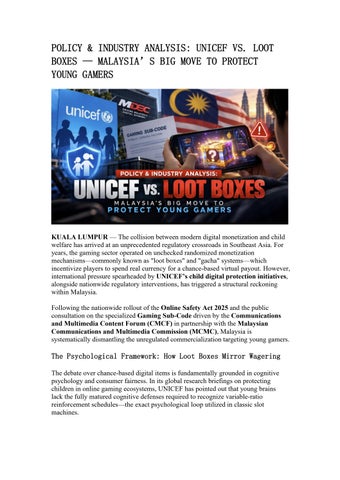
POLICY & INDUSTRY ANALYSIS: UNICEF VS. LOOT BOXES — MALAYSIA’S BIG MOVE TO PROTECT YOUNG GAMERS
KUALA LUMPUR — The collision between modern digital monetization and child welfare has arrived at an unprecedented regulatory crossroads in Southeast Asia. For years, the gaming sector operated on unchecked randomized monetization mechanisms—commonly known as "loot boxes" and "gacha" systems—which incentivize players to spend real currency for a chance-based virtual payout. However, international pressure spearheaded by UNICEF’s child digital protection initiatives, alongside nationwide regulatory interventions, has triggered a structural reckoning within Malaysia. Following the nationwide rollout of the Online Safety Act 2025 and the public consultation on the specialized Gaming Sub-Code driven by the Communications and Multimedia Content Forum (CMCF) in partnership with the Malaysian Communications and Multimedia Commission (MCMC), Malaysia is systematically dismantling the unregulated commercialization targeting young gamers.
The Psychological Framework: How Loot Boxes Mirror Wagering The debate over chance-based digital items is fundamentally grounded in cognitive psychology and consumer fairness. In its global research briefings on protecting children in online gaming ecosystems, UNICEF has pointed out that young brains lack the fully matured cognitive defenses required to recognize variable-ratio reinforcement schedules—the exact psychological loop utilized in classic slot machines.
When a digital title incorporates opaque drop rates, simulated celebratory animations, and premium virtual currencies, it blurs the line between casual gameplay and predatory behavioral conditioning. In Malaysia, where smartphone adoption exceeds 97% and youth participation in titles like Mobile Legends, PUBG Mobile, and Genshin Impact is near universal, minors are uniquely exposed to these dark patterns. For years, spending mechanics operated in an informational vacuum where neither parents nor children understood the underlying odds. MALAYSIAN DIGITAL GAMING OVERSIGHT PIPELINE ├── Advocacy Tier ──► UNICEF Child Safety Frameworks & Guidelines ├── Regulatory Board ──► CMCF Gaming Sub-Code & MCMC Oversight ├── Statutory Force ──► Online Safety Act 2025 & Consumer Protection Codes └── Enforcement Targets ─► In-Game Spending, Algorithmic Drop Rates & Age Assurance
Under the proposed Gaming Sub-Code, the regulatory apparatus is shifting from passive warnings to legally binding transparency obligations. Developers and publishers serving the Malaysian domestic market face mandatory algorithmic odds disclosures, parental consent gates for real-money currency conversions, and statutory bans on coercive microtransaction loops targeted at minors.
Software Optimization and the Regulatory Shift This heightened level of scrutiny fundamentally impacts how software is constructed and distributed across the region. In a market where connectivity varies between Tier1 urban fiber networks and rural cellular backhauls, game clients have historically prioritized raw speed and retention metrics above regulatory transparency. To maintain market penetration, regional development houses rely heavily on lightweight runtime frameworks. For example, high-volume casual game platforms like the specialized Mega888 client have built their user bases around "Lite-Coding" architectures designed to operate with minimal hardware friction and zero latency over standard 4G and 5G networks. However, as regulatory authorities tighten child safety protocols across all interactive software, the parameters of platform compliance are expanding. In this new operating environment, modern client architectures—whether powering mainstream esports titles, immersive mobile experiences, or casual modules like the Mega888 platform— must balance lean data throughput with verifiable identity gates and algorithmic auditability. Software engineering teams can no longer view optimization purely through the lens of frame rates and ping; codebases must now be structured to support transparent transactional verification without degrading the client’s mobile efficiency.
The Economic and Esports Balancing Act Malaysia's decisive action against deceptive monetization comes at a delicate strategic moment. As the government aggressively pursues its 2026–2030 Electronic Sports Development Strategic Plan to establish the nation as Southeast Asia's premiere
digital hub, policymakers must distinguish between exploitative monetization and legitimate competitive gaming. Industry practitioners emphasize that putting clear safeguards in place protects the long-term sustainability of the gaming industry itself. If younger players and parents experience severe financial harm through unregulated in-game spending, community backlash and legal sanctions can undermine legitimate grassroots talent development. By instituting early curbs against loot box abuses, the domestic sector establishes a trusted, institutionalized framework that attracts responsible corporate investment rather than fly-by-night operators.
Enforcement Realities and Future Outlook While the policy directives initiated by the CMCF and supported by UNICEF’s principles establish a clear direction, execution remains the ultimate hurdle. Crossborder digital distribution models, decentralized app mirrors, and third-party top-up channels continue to bypass regional digital storefronts. To counteract these blind spots, the MCMC is coordinating with telecommunications service providers, payment aggregators, and commercial financial institutions to flag suspicious transaction volumes linked to juvenile accounts. The introduction of robust e-KYC protocols and automated transaction limits provides a secondary firewall against unauthorized expenditures. The collaboration between global human rights organizations and Malaysian regulatory authorities signals a permanent end to the "Wild West" of digital child exploitation. As Malaysia aligns its legal mechanisms with global best practices, the message to international publishers and domestic developers is clear: long-term commercial access to Southeast Asia’s most dynamic digital economy now requires ethical design, transparent mechanics, and an uncompromised commitment to child safety.