The Economics of Play: How In-Game Purchases, Digital Wallets, and Carrier Billing are Shaping Malaysia's Gaming Revenue
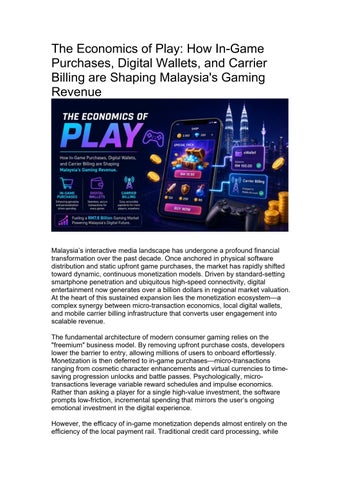
Malaysia’s interactive media landscape has undergone a profound financial transformation over the past decade. Once anchored in physical software distribution and static upfront game purchases, the market has rapidly shifted toward dynamic, continuous monetization models. Driven by standard-setting smartphone penetration and ubiquitous high-speed connectivity, digital entertainment now generates over a billion dollars in regional market valuation. At the heart of this sustained expansion lies the monetization ecosystem—a complex synergy between micro-transaction economics, local digital wallets, and mobile carrier billing infrastructure that converts user engagement into scalable revenue. The fundamental architecture of modern consumer gaming relies on the "freemium" business model. By removing upfront purchase costs, developers lower the barrier to entry, allowing millions of users to onboard effortlessly. Monetization is then deferred to in-game purchases—micro-transactions ranging from cosmetic character enhancements and virtual currencies to timesaving progression unlocks and battle passes. Psychologically, microtransactions leverage variable reward schedules and impulse economics. Rather than asking a player for a single high-value investment, the software prompts low-friction, incremental spending that mirrors the user’s ongoing emotional investment in the digital experience. However, the efficacy of in-game monetization depends almost entirely on the efficiency of the local payment rail. Traditional credit card processing, while
standard in Western markets, presents significant friction across Southeast Asia. A substantial portion of the Malaysian demographic remains underbanked or prefers not to share card details for micro-purchases. To bridge this gap, local fintech infrastructure has evolved dramatically. The widespread adoption of national e-wallet systems—such as Touch 'n Go eWallet, GrabPay, and Boost—has revolutionized digital commerce. Integrated seamlessly via direct Application Programming Interfaces (APIs), digital wallets allow users to execute instant, one-click micro-transactions directly within game interfaces. By eliminating complex multi-step card verification forms, e-wallets substantially reduce checkout abandonment rates, capturing impulse spending precisely when user intent is highest. Parallel to e-wallets, Direct Carrier Billing (DCB) has emerged as an indispensable financial vehicle for digital content monetization. DCB enables consumers to charge digital purchases directly to their monthly postpaid mobile bill or deduct the balance from their prepaid phone credit. Because it relies solely on active telecommunication subscriptions provided by networks like CelcomDigi, Maxis, or U Mobile, carrier billing requires neither a bank account nor a credit card. This frictionless authentication mechanism provides zero-checkout friction, driving conversion rates far higher than conventional payment methods and ensuring that even younger or underbanked player segments can participate in the digital economy. The operational stability of these transaction networks is equally critical when evaluating standalone, third-party software environments. Outside mainstream app stores, proprietary application packages require secure, welldocumented server architectures to manage user accounts, authenticate balance updates, and facilitate system requests safely. For instance, platforms running modified mobile applications, such as the Mega888 client, rely heavily on encrypted API handshakes, dedicated clientside validation, and robust database management protocols to ensure continuous operational uptime. Maintaining strict technical protocols protects system integrity, prevents transaction drops during peak traffic hours, and guarantees synchronization between user terminals and backend billing systems. System administrators, developers, and platform researchers can inspect detailed platform specifications and operational client deployment guides directly at https://mega888client.com/. Looking toward the future, the integration of embedded finance within interactive software will only grow tighter. As 5G infrastructure expands across Malaysia, real-time micro-payments will become even more frictionless, supporting emerging mechanics like localized cloud gaming subscriptions, peer-to-peer virtual item trading, and automated micro-loyalty programs. Ultimately, Malaysia’s booming digital gaming revenue is not merely a byproduct of entertaining software. It is the direct result of a highly sophisticated financial ecosystem that harmonizes player psychology with accessible, localized payment methods. By removing transaction barriers
through e-wallets, carrier billing, and secure client architectures, developers and payment service providers have turned modern interactive media into one of the most resilient drivers of the broader digital economy.