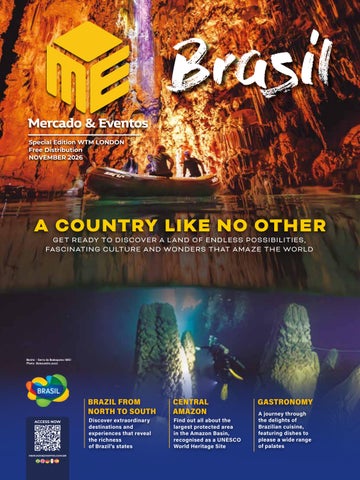
Brasil Special Edition WTM LONDON Free Distribution NOVEMBER 2026
A COUNTRY LIKE NO OTHER GET READY TO DISCOVER A L AND OF ENDLESS POSSIBILITIES, FASCINATING CULTURE AND WONDERS THAT AMAZE THE WORLD
Bonito - Serra da Bodoquena (MS) Photo: @alexandre.socci
BRAZIL FROM NORTH TO SOUTH
CENTRAL AMAZON
Discover extraordinary destinations and experiences that reveal the richness of Brazil’s states
Find out all about the largest protected area in the Amazon Basin, recognised as a UNESCO World Heritage Site
GASTRONOMY A journey through the delights of Brazilian cuisine, featuring dishes to please a wide range of palates
2
WTM LONDON 2026 - NOVEMBER 3RD TO 5TH
WTM LONDON 2026 - NOVEMBER 3RD TO 5TH
3
BRAZIL DESERVES A PLACE ON EVERY BRITISH TRAVELLER’S BUCKET LIST As someone who believes that travelling is one of the best ways to discover new cultures, I cannot imagine a more fascinating destination for British tourists than Brazil. A country of extraordinary natural beauty, vibrant cities, rich traditions and warm, welcoming people, Brazil offers experiences that go far beyond a conventional holiday. Whether you want to relax on idyllic beaches, explore the Amazon rainforest, discover historic cities or take part in world-famous festivals, I believe Brazil has something special to offer every type of traveller. The figures confirm this growing appeal. In 2025, Brazil welcomed more than 9 million international tourists, reaching a historic record and registering a 37.1% increase compared with 2024, when approximately 6.7 million international visitors arrived in the country. In my view, this remarkable result shows that Brazil is gaining increasing prominence on the international tourism stage. For British travellers looking to discover a different destination filled with unique experiences, now is the ideal time to explore everything the country has to offer. One of the aspects I find most interesting about Brazil is the diversity of its destinations. Nature lovers can marvel at the magnificent Iguazu Falls, observe wildlife in the Pantanal wetlands, explore the Amazon rainforest or spend a relaxing afternoon on a beach surrounded by green mountains. Brazil’s extraordinary biodiversity and vast territory make it an ideal destination for those seeking adventure, relaxation or ecotourism. I believe few destinations offer such an impressive
combination of natural wonders, outdoor activities and opportunities to connect with nature. Brazilian culture is a chapter in its own right. From the infectious rhythm of samba to the energy of Carnival, as well as regional cuisine, music and traditional markets, every Brazilian region has its own identity and charms. Visitors should experience Brazilian hospitality, sample treats such as pão de queijo (cheese bread) and brigadeiro (a chocolate fudge sweet), and discover the importance of football, music and family traditions in everyday life. In my view, it is these authentic experiences that turn a simple trip into a lifelong memory. In 2025, more than 187,000 visitors from the United Kingdom travelled to Brazil. I see this figure as a positive sign of the growing ties between the two countries, but also as an invitation for even more British travellers to discover Brazil. It is a place where natural beauty meets cultural diversity, where every trip can bring an unexpected discovery and where visitors have the opportunity to create unforgettable memories. If you are British and looking for your next great holiday destination, my advice is simple: put Brazil at the top of your list. Come for the beaches, cuisine and spectacular landscapes, but allow yourself to be captivated by the people, culture and unique experiences. I am sure Brazil has so much to offer and is ready to welcome you with open arms. Natália Strucchi Editorial Director at M&E
www.mercadoeeventos.com.br PRESIDENT Roy Taylor VICE-PRESIDENT Rosa Masgrau rosamasgrau@mercadoeeventos.com.br (55-21) 2254-3543 EDITORIAL DIRECTOR Natália Strucchi natalia.strucchi@mercadoeeventos.com.br (55-21) 99164-2940 EDITOR Janaina Brito janaina.brito@mercadoeeventos.com.br (55-11) 98779-5732 SALES DIRECTOR Mari Masgrau mari.masgrau@mercadoeeventos.com.br (55-11) 97509-0605 ADMINISTRATIVE AND FINANCIAL DIRECTOR Roberta Saavedra roberta.saavedra@mercadoeeventos.com.br (55-21) 2487-1616 OPERATIONAL Andreia Boccalini andreia.boccalini@mercadoeeventos.com.br (55-11) 95389-7662
4
REPORTAGE Ana Azevedo ana.azevedo@mercadoeeventos.com.br Rafael Torres rafael.torres@mercadoeeventos.com.br Giulia Jardim giulia.jardim@mercadoeeventos.com.br Beatriz do Vale beatriz.vale@mercadoeeventos.com.br Felipe Abílio felipe.abilio@mercadoeeventos.com.br DESIGNER Patrick Peixoto SOCIAL MEDIA Matheus Bueno REPORTAGE SP (55-11) 97863-2020 | REPORTAGE RJ (55-21) 99164-2940 READER SERVICE (55-11) 95389-7662
WTM LONDON 2026 - NOVEMBER 3RD TO 5TH
IT INFRASTRUCTURE MANAGEMENT WorkNet Tecnologia fernando.carilo@worknetecnologia.com.br WA AGENCY Agência WA (https://waagenciadigital.com.br) SALES DEPARTAMENT (55-11) 95389-7662 Rua 24 de Maio, 276 - 3º andar - República, São Paulo - SP, 01041-000
PUBLISHED BY EDITORA MERCADO E EVENTOS LTDA The articles and opinions of third parties published in the issue do not necessarily reflect the position of the newspaper.
BRASIL
All this awaits you in
Mato
Welcome to Mato Grosso! Experience one place, countless destinations. Here, you´ll be amazed by the natural diversity of the Pantanal, the Amazon, the Brazilian Savanna and the Araguaia. Enjoy various options in ecotourism, photographic safaris, adventure, birdwatching, sport fishing, ethnotourism, mystic and esoteric tourism, with all the structure and comfort you need. For business or leisure, discover this paradise in the heart of Brazil.
SCAN AND DISCOVER THE BEAUTIES OF MATO GROSSO.
SEDEC Secretaria de Estado de Desenvolvimento Econômico
5
WTM LONDON 2026 - NOVEMBER 3RD TO 5TH
descubramatogrosso.com.br
descubramatogrosso
INDEX Photo: Government of Santa Catarina - Eduardo Valente
BRAZIL IN NUMBERS 8 – BRAZIL: KEY FACTS AND FIGURES 12 – MINISTRY OF TOURISM 14 – EMBRATUR
SPECIAL FEATURES 15 - GASTRONOMY 16 – ROTEIROS DE CHARME 20 – CENTRAL AMAZON
BRAZIL’S STATES NORTH BALNEÁRIO CAMBORIÚ - SC Photo: Embratur Sebrae
22 – AMAZONAS 24 – PARÁ
MIDWEST 26 – FEDERAL DISTRICT 28 – MATO GROSSO 30 – MATO GROSSO DO SUL
NORTHEAST
RIO DE JANEIRO - RJ Photo: Embratur Sebrae
32 – PARAÍBA 36 – PERNAMBUCO 38 – BAHIA 42 – MARANHÃO
44 – ALAGOAS 46 – CEARÁ 48 – RIO GRANDE DO NORTE
SOUTHEAST 50 – RIO DE JANEIRO 54 – SÃO PAULO 56 – MINAS GERAIS
SOUTH
FOZ DO IGUAÇU - PR
6
58 – PARANÁ 60 – SANTA CATARINA 62 – RIO GRANDE DO SUL
WTM LONDON 2026 - NOVEMBER 3RD TO 5TH
WTM LONDON 2026 - NOVEMBER 3RD TO 5TH
7
DISCOVER BRAZIL GENERAL INFORMATION OFFICIAL NAME: Federative Republic of Brazil
PRESIDENT OF EMBRATUR (BRAZILIAN TOURISM BOARD): Bruno Reis
SYSTEM OF GOVERNMENT: Federal Presidential Republic
MINISTER OF TOURISM: Gustavo Feliciano
PRESIDENT: Luiz Inácio Lula da Silva
OFFICIAL WEBSITES: www.brasil.gov.br | www.turismo.gov.br
RR
AP
PA
AM
CE
MA
PB
PI AC
PE AL
TO
RO
SE
BA
MT Brasília
GO NORTH
ACRE (RIO BRANCO) | AMAPÁ (MACAPÁ) | AMAZONAS (MANAUS) | PARÁ (BELÉM) | RONDÔNIA (PORTO VELHO) | RORAIMA (BOA VISTA) | TOCANTINS (PALMAS)
NORTHEAST MIDWEST
SOUTH
SP
ALAGOAS (MACEIÓ) | BAHIA (SALVADOR) | CEARÁ (FORTALEZA) | MARANHÃO (SÃO LUÍS) | PARAÍBA (JOÃO PESSOA) | PERNAMBUCO (RECIFE) | PIAUÍ (TERESINA) | RIO GRANDE DO NORTE (NATAL) | SERGIPE (ARACAJU)
PR
GOIÁS (GOIÂNIA) | MATO GROSSO (CUIABÁ) | MATO GROSSO DO SUL (CAMPO GRANDE) | DISTRITO FEDERAL (BRASÍLIA)
SOUTHEAST
ESPÍRITO SANTO (VITÓRIA) | MINAS GERAIS (BELO HORIZONTE) RIO DE JANEIRO (RIO DE JANEIRO) | SÃO PAULO (SÃO PAULO)
PARANÁ (CURITIBA) | RIO GRANDE DO SUL (PORTO ALEGRE) | SANTA CATARINA (FLORIANÓPOLIS)
MG
MS
SC RS
RN
ES
RJ
REQUIRED DOCUMENTATION England citizens do not need a visa for tourist stays of up to 90 days in Brazil. However, travelers must present: •
A passport valid for at least six months from the date of entry;
•
A return ticket or proof of onward travel
LOCATION Brazil is located in South America and covers an area of approximately 8.516 million square kilometers, with a population of around 214.3 million people. Its capital is Brasília, a planned city inaugurated in 1960 that symbolizes the country’s modernity and development. Brazil is divided into five major regions (North, Northeast, Central-West, Southeast and South), comprising 26 states and the Federal District, where the capital is located.
CLIMATE AND BEST TIME TO VISIT Brazil is a continental-sized country, and climate conditions vary significantly across regions. Summer (December to March) is generally hot, while winter (June to August) can be cooler, especially in the South. In the Northeast, sunshine predominates throughout the year.
SAFETY AND HEALTH Travel insurance that includes medical assistance is strongly recommended.
CULTURE AND LANGUAGE Por tuguese is the official language of Brazil. The country is known for its hospitality, music and gastronomy — visitors are encouraged to try traditional dishes such as feijoada and acarajé — as well as major festivals like Carnival.
TRANSPORTATION AND GETTING AROUND Distances within Brazil are long, making domestic flights the best option for traveling between regions. Within cities, ride-hailing apps such as Uber and licensed taxis are recommended.
TIME ZONES Brazil has four time zones. Brasília Time (GMT -3) is considered the country’s official time.
PHONE CALLS CURRENCY AND COSTS The local currency is the Brazilian real (R$). Visitors are advised to carry a combination of cash and credit cards. On average, 1 pound is equivalent to approximately R$ 6.65.
Brazil’s international dialing code is +55. To call Brazil from abroad, dial your country’s international access code, followed by +55, the area code (DDD) of the Brazilian city, and the desired phone number.
10
WTM LONDON 2026 - NOVEMBER 3RD TO 5TH
WTM LONDON 2026 - NOVEMBER 3RD TO 5TH
11
2026/2027 cruise season offers 24% more passenger capacity in Brazil
Photo: Divulgation - MTur
With eight ships and new port calls, the latest cruise season is expected to generate billions in economic activity along the country’s coastline
Gustavo Feliciano, minister of Tourism, and Marco Ferraz, president of CLIA Brazil
Natália Strucchi Brazil’s 2026/2027 cruise season began in November, reinforcing a sense of recovery and optimism for the country’s tourism industry. A survey by the Brazilian Association of Cruise Lines (Clia Brazil) reveals that, through 9 April 2027, eight ships will operate regularly along the country’s coast, one more than in the previous season. As a result, capacity could exceed 800,000 passenger berths, representing an increase of approximately 24%, with around 700 port calls expected throughout the season. The season will feature Corazul Buenavista for the first time ever, Costa Diadema, Costa Serena, MSC Divina, MSC Musica, MSC Seaview, MSC Splendida and MSC Virtuosa. These giants of the seas offer different capacities and travel experiences, ranging from mini-cruises to seven- or eight-day itineraries. The increase in these figures reinforces Brazil’s strategic position in the global market and highlights the direct impact of cruising on local economies. “Brazil is the leading cruise market in South America, and this 24% increase in capacity 12
demonstrates the strength of our coastline. Every time a ship docks, a vast network of services is activated, benefiting those whose livelihoods depend on tourism. The Ministry of Tourism is working to make this market increasingly stronger, as it is strategic for attracting international visitors, integrating our continent and raising the global profile of our diverse destinations,” said Gustavo Feliciano, Brazil’s Minister of Tourism. The season’s embarkation and disembarkation ports are Santos, Rio de Janeiro, Salvador, Maceió, Itajaí, Balneário Camboriú and Paranaguá. Among the new developments is Paranaguá’s return to regular cruise operations, expanding options in Brazil’s southern region. Balneário Camboriú, which debuted as a homeport in the 2025/2026 season, is also expanding its role through the customs-cleared facilities at Atracadouro Barra Sul. This is expected to encourage longer stays before and after cruises and generate more business for local services. “The 24% increase in capacity marks the beginning of a recovery and expands options for travellers and opportunities for destinations. However, we need to look at this development objectively: it has been influenced by market realignments and the international geopolitical situation, and it does not mean Brazil has overcome its competitiveness challenges. We now need to turn this recovery into sustained growth, with adequate infrastructure, competitive costs, predictability and legal certainty. Brazil competes with markets around the world for cruise ships, and making progress on these conditions is essential to maintaining existing operations and attracting new vessels,” said Marco Ferraz, executive president of Clia Brazil. Ports of call will include Búzios, Angra dos Reis, Ilha Grande, Cabo Frio, Ilhabela, Recife, Ilhéus and Porto Belo. Further strengthening South American integration, a priority championed by the Ministry of Tourism, itineraries will also include Buenos Aires, Montevideo and Punta del Este. “On a sin-
WTM LONDON 2026 - NOVEMBER 3RD TO 5TH
Photo: Divulgation - MSC
MSC Seaview Photo: Divulgation - Costa
gle trip, passengers can discover different places without having to repack their bags or rearrange accommodation and transport at every stop,” said Gustavo Feliciano. Combining coastal cruises and long-haul cruise itineraries, Santos will handle the highest volume of traffic, with 161 port calls and more than 640,000 passenger berths. Rio de Janeiro will receive 125 port calls and offer more than 316,000 berths, while Búzios is expected to record more than 400,000 visits across 108 port calls. Ilhabela will have 60 port calls and more than 208,000 visits. In the South, Balneário Camboriú will receive 52 port calls and Itajaí will have 40. In the Northeast, Salvador will record 47 port calls and around 182,000 passenger berths, while Maceió will have 26 port calls and more than 137,000 berths.
Brazil is the leading cruise market in South America, and this 24% increase in capacity demonstrates the strength of our coastline. vast network of services is activated, benefiting
Costa Serena Photo: Divulgation - Corazul
Every time a ship docks, a
those whose livelihoods depend on tourism. Gustavo Feliciano, minister of Tourism
Corazul Buenavista WTM LONDON 2026 - NOVEMBER 3RD TO 5TH
13
Brazil sees 11.3% increase in British visitors as it targets European growth through luxury and nature
Photo: Mercado & Eventos
Embratur president Bruno Reis highlights authentic experiences, regenerative tourism and air connectivity as priorities for expanding Brazil’s presence in the European market
Bruno Reis, president of Embratur
Janaina Brito Brazil welcomed more than 148,000 British visitors by September 2026, an 11.3% increase on the same period last year. The figures underscore the importance of the UK to Brazil’s international tourism promotion and support a strategy focused on diversifying the country’s tourism offering, improving air connectivity and attracting travellers seeking experiences beyond the traditional sun-and-beach holiday. Bruno Reis, president of Embratur, says the agency’s work in the European market has focused on generating business and promoting segments with strong growth potential, including luxury tourism, birdwatching, nature, culture and gastronomy. According to Reis, Europe has already accounted for nearly 1.4 million arrivals in Brazil in 2026. “Our priority has been to strengthen and consolidate a more strategic approach to international promotion, guided by data, air connectivity and business generation”, Reis said. In the UK, the aim is to raise the profile of experiences that showcase Brazil’s diversity and 14
encourage visitors to explore different regions of the country, extend their stays and develop deeper connections with the destinations they visit. The strategy also reflects changes in European travellers’ behaviour. According to the Embratur president, one of the key lessons of 2026 has been the growing interest in authentic experiences that bring visitors closer to local culture, nature and communities. Against this backdrop, regenerative tourism is gaining prominence, with initiatives designed not only to preserve the environment but also to restore ecosystems and enhance the value of the destinations and communities involved. “Brazil has enormous potential in this segment, and we want to give greater visibility to experiences that generate positive impacts for both visitors and the destinations that welcome them”. For British travellers, the diversity of experiences on offer is one of Brazil’s main competitive advantages. Reis says international promotion has made progress in showcasing destinations and tourism products that previously received less attention, supported by the soft power campaign launched in 2025. “What we are seeing is that British travellers are increasingly looking for experiences that offer a genuine connection with a destination, its culture, its natural environment and its communities”, said Bruno. The aim, he explained, is to inspire interest in new itineraries, encourage longer stays and motivate visitors to return to Brazil. Engagement with tour operators, airlines and commercial partners is also central to this strategy, linking destination marketing more closely with opportunities to distribute and sell Brazil’s tourism products. The goal is to turn international interest into actual bookings and trips, spreading the economic benefits of tourism across different regions of the country.
WTM LONDON 2026 - NOVEMBER 3RD TO 5TH
Brazil: A Country of a Thousand Recipes
In the hinterlands, in the capitals, on the beaches or in the sertão, Brazilian food unites past and present with creativity and soul. Even before understanding Brazil, one tastes it. Flavor arrives before the landscape, before speech, before photography. It comes in the aroma escaping the pot, in the sound of the spoon scraping the bottom of the pan, in the first sip of coffee brewed in someone’s home who has never met you, yet already calls you “my child.” Every corner of the country shows that food is more than sustenance: it is memory, it is affection, it is language. It doesn’t matter if it’s under the scorching sun on the beach or in the shadow of the mountains, in the middle of the forest or among skyscrapers: Brazil reveals itself through the mouth. NORTHEAST: HEAT, COLOR, AND ROOTS Northeastern cuisine is pure identity. It has color, strength, and memory. The flavors of the sertão and the coast share space in dishes loaded with history. In Bahia, dendê brings the aroma of African ancestry. Moqueca, vatapá, caruru, acarajé - all come steeped in culture and flavor. In the sertão, sun-dried meat, cassava, and green beans translate the comforting simplicity of the region. Here, food is more than a meal; it is a form of resistance and pride. NORTH: FOREST ON THE PLATE In the North, the Amazon dictates the menu. Flavors are intense, exotic, and often surprising: tucupi, jambu, savory açaí, pirarucu. Nothing is ordinary; everything has a soul. Each dish carries the strength of the forest and the ancestral knowledge of the native peoples. Tacacá, maniçoba, duck in tucupi - these are recipes that transcend time and remain alive in the daily lives of those living near the planet’s largest biome. Eating here is also an act of respect for nature and local culture. CENTRAL-WEST: FLAVORS OF THE HEART OF BRAZIL The Central-West combines sertão tradition
Photo: Freepik
From tradition to affection, Brazilian cuisine speaks every language
Brazil has a great variety of fruits and juices
with Cerrado flavors and indigenous influences. It is a hearty, welcoming cuisine that values local ingredients like pequi, guariroba, and corn. Galinhada, generous meat pies, rice with pequi, and piranha soup are expressions of this authentic mix. Here, simplicity gains charm, and flavor comes accompanied by stories. SOUTHEAST: FROM THE COUNTRYSIDE TO THE URBAN TABLE In the Southeast, cuisine has many voices. Minas Gerais carries rural tradition with its wood-fired stoves, aged cheeses, and sweet preserves. Everything is prepared slowly, honoring memory. São Paulo is a city of the world: it hosts cuisines from all corners and transforms the classic into a trend. From the virado à paulista to Sunday pizza, every dish takes on a local accent. In Rio de Janeiro, the scene completes with feijoada, street pastries, and caldinho by the beach. SOUTH: COLONIAL, AFFECTIONATE, AND PROUD In the South, the heritage of European immigrants is evident, but the soul is Brazilian. The gaucho barbecue is prepared with attention to cut and fire. Paraná’s barreado cooks for hours until it melts in the mouth. The cucas, polenta, and wines that grace Santa Catarina tables all come with tradition, pride, and a certain rustic elegance.
WTM LONDON 2026 - NOVEMBER 3RD TO 5TH
15
Roteiros de Charme bets on new luxury and sustainability to expand its international presence
Photo: Divulgation - Roteiros de Charme
With 72 hotels across more than 60 Brazilian destinations, the association is investing in improving the quality of its properties and in commercial initiatives to attract international travellers spirit of hospitality that comes from the hearts of their owners and staff,” says Roberto Fusetti, president of the association. The strategy reflects a shift in travel demand, with growing interest in experiences that go beyond accommodation and allow visitors to discover destinations more closely. In the Roteiros de Charme portfolio, these experiences may combine beaches and gastronomy, mountains and well-being, nature and adventure, or culture and art, connecting a range of Brazilian attractions with different traveller profiles.
Roberto Fusetti, president of Roteiros de Charme
Giulia Jardim The combination of personalised hospitality, authentic experiences and socio-environmental responsibility has guided the strategy of the Roteiros de Charme Hotel Association as it seeks to expand the presence of independent Brazilian hotels in the international market. With 72 hotels across more than 60 destinations in Brazil, the association is embracing the concept of new luxury, which focuses less on excess and more on service quality, connections with local culture and the distinctive character of each property. Founded in 1992, the association brings together boutique and charming hotels that share quality and sustainability guidelines. Its aim is to promote a genuinely Brazilian hospitality offering, in which regional identity and the involvement of owners and staff in the guest experience are central to the product. “The international market has been showing growing demand for boutique, exclusive and characterful hotels, such as those in the Roteiros de Charme portfolio. These are authentic hotel properties aligned with the current concept of new luxury, without ostentation and with a genuine 16
SUSTAINABILITY AS PART OF THE PRODUCT Socio-environmental responsibility has been one of the pillars of the Roteiros de Charme Hotel Association since its founding. More than an additional attribute, sustainability is embedded in the guidelines governing the selection and monitoring of member hotels. The association has also been making progress on its ESG agenda through a partnership with Brazilian company Symbiose to support the implementation of these practices at its properties. According to Fusetti, more than 50% of the hotels are already working on this process. The association has also committed to eliminating the use of plastic in its hotels’ operations by 2030 as part of initiatives related to the Glasgow Declaration. The aim is to align accommodation quality with environmental and social responsibility while preserving each property’s authenticity and its relationship with the communities and destinations in which it operates. As the executive points out, this commitment has been part of the association’s identity from the outset. “Roteiros de Charme has always been a pioneer in developing domestic tourism, encouraging a hotel sector that, in addition to quality and authenticity, has valued sustainability initiatives since its founding in 1992,” says Roberto.
WTM LONDON 2026 - NOVEMBER 3RD TO 5TH
This positioning also influences Roteiros de Charme’s international commercial activities. The association promotes its portfolio in key source markets for Brazil, including Argentina, Paraguay, Portugal, France, Spain and Germany, through initiatives involving international trade fairs, embassies and local tourism trade representatives. The strategy is supported by Embratur through a technical cooperation agreement focused on international initiatives. GROWTH GUIDED BY QUALITY STANDARDS Roteiros de Charme’s expansion follows a different approach from the rapid growth of hotel chains. The association prioritises maintaining its principles and quality standards, even as new properties express interest in joining the group. Applicants undergo an assessment that considers both accommodation quality and socio-environmental initiatives. The association has sustainability and quality committees and conducts
rigorous follow-up visits to member hotels and properties seeking to join the portfolio, involving the board and senior ‘roteiristas’ (association members). The goal is to preserve the group’s identity and ensure that its properties maintain the expected standards. For this reason, increasing the number of members is not a standalone priority but is conditional on compliance with the guidelines that underpin the association. “The Association is not concerned with rapid growth in membership. Our first priority, together with our partners, is to uphold our principles and guidelines through our sustainability and quality committees,” explains the association’s president. This rigorous selection process aims to preserve the strength of a portfolio comprising independent hotels, each with its own distinctive characteristics, united by a commitment to excellence, Brazilian authenticity and socio-environmental responsibility.
WTM LONDON 2026 - NOVEMBER 3RD TO 5TH
17
VISIT BRASIL .COM
/2027
In Brasil, every match kicks off a new experience
BRAS B E YO N D T H E G A M E S A LVA D O R - B A
18
WTM LONDON 2026 - NOVEMBER 3RD TO 5TH
IL WTM LONDON 2026 - NOVEMBER 3RD TO 5TH
19
Central Amazon: UNESCO World Heritage Site protects more than 6 million hectares of rainforest Anavilhanas, Jaú, Mamirauá and Amanã are part of the complex, which offers river trips, hiking trails and wildlife-watching experiences In the heart of the Amazon, an area of more than 6 million hectares encompasses forests, rivers, lakes, islands, seasonally flooded plains and igapó flooded forests in one of the most biodiverse regions on the planet. This is the Central Amazon Conservation Complex, the largest protected area in the Amazon Basin and recognised as a UNESCO World Heritage Site. The complex’s history on the World Heritage List began in 2000, when Jaú National Park was recognised by UNESCO. In 2003, the protected area was expanded to include Anavilhanas National Park and the Mamirauá and Amanã Sustainable Development Reserves, forming the current Central Amazon Conservation Complex. The diversity of environments is also reflected in 20
the experiences the region offers. Boat trips, hiking trails, wildlife watching and visits to local communities are among the options for those who want to experience Amazonian nature up close. RECOGNITION UNESCO recognised the Central Amazon Conservation Complex for the importance of its biodiversity and the ecological processes that take place in the region. The dynamics of the waters, with seasonal flooding and falling water levels throughout the year, continually transform the landscape and help sustain different environments essential to Amazonian wildlife and plant life. One of the highlights is Anavilhanas, one of the largest river archipelagos in the world. The region
WTM LONDON 2026 - NOVEMBER 3RD TO 5TH
Photo: Embratur Sebrae
•
•
•
Anavilhanas National Park: near Manaus and Novo Airão, it
allows visitors to explore the archipelago formed by hundreds of islands and channels along the Rio Negro
is also home to the greatest known diversity of electric fish on the planet, with 64 species identified. The complex also protects characteristic Amazonian animals, such as the arapaima, jaguar, giant otter, Amazonian manatee, black caiman and two species of freshwater river dolphins. The region is also home to around 60% of the fish species recorded in the Rio Negro basin and 60% of the bird species known in the Central Amazon. THINGS TO DO As the World Heritage Site encompasses four major protected areas, experiences depend on the destination chosen. Highlights include: • Anavilhanas National Park: Near Manaus and Novo Airão, it allows visitors to explore the archipelago formed by hundreds of islands and channels along the Rio Negro. Boat trips are among the main experiences. • Jaú National Park: One of Brazil’s largest national parks, it encompasses rivers, forests and preserved landscapes and can be explored on nature-based tourism itineraries. • Mamirauá Sustainable Development Reserve: Known for its seasonally flooded forests, it offers community-based tourism experiences and opportunities to observe Amazonian wildlife.
Amanã Sustainable Development Reserve: Located between the Negro and Solimões river basins, it preserves forests, lakes and aquatic environments characteristic of the region. Wildlife watching: River dolphins, birds, monkeys, caimans and other animals can be spotted in different parts of the complex, always in accordance with the visitor regulations of each protected area. River experiences: Boat and canoe trips allow visitors to explore channels, lakes and flooded forest areas and observe how the Amazonian landscape changes according to water levels.
WHEN TO VISIT The Central Amazon Conservation Complex can be visited throughout the year, but the experience changes according to the water cycle: • High-water season: Rivers and lakes extend into forested areas, allowing visitors to travel by boat through flooded sections and channels between the trees. • Falling-water and low-water seasons: As river levels drop, beaches and other areas of land emerge, changing the landscapes and opportunities for excursions. • Nature watching: As each protected area has its own characteristics and regulations, the most suitable time to visit depends on the itinerary and activities chosen. Before travelling, it is important to check access conditions and visitor regulations for the conservation area included in the itinerary. HOW TO GET THERE Manaus is the main gateway for those planning to explore the Central Amazon Conservation Complex. The capital of Amazonas state has an airport with flights from various parts of Brazil and international connections. Access from Manaus varies according to the area chosen. Novo Airão is one of the main bases for visiting Anavilhanas National Park and can be reached by road from the capital. For more remote areas, such as Jaú, Mamirauá and Amanã, some journeys are made by river and may require boats and specific travel arrangements. As distances are considerable and many areas have their own access regulations, it is advisable to plan the trip in advance and consult the guidance provided by the conservation units.
WTM LONDON 2026 - NOVEMBER 3RD TO 5TH
21
N O RT H
22
Amazonas reveals the many faces of the world’s largest rainforest From Manaus’s historic landmarks and distinctive cuisine to the waterfalls and caves of Presidente Figueiredo, the state offers experiences shaped by the Amazon rainforest
Giulia Jardim
Photo: Mário Oliveira - MTur
At the meeting of the waters and beneath the vast Amazon rainforest, Manaus surprises visitors with its blend of history, culture, flavours and nature. The capital of Amazonas is one of the main gateways to the Amazon and combines a vibrant urban scene with the strong presence of its rivers and the region’s diverse traditions. In the Historic Centre, Teatro Amazonas stands out for its imposing architecture and dome covered in colourful tiles. Opened in 1896 during the rubber boom, the building has become one of the capital’s defining landmarks. Nearby squares, historic mansions and other heritage buildings tell the story of Manaus and preserve the memory of a period of profound economic change. Another important stop is Mercado Municipal Adolpho Lisboa, where visitors can find regional fish, Rio Negro Palace, in Manaus, preserves part of the history and architectural heritage Amazonian fruits, Brazil nuts, spices of the capital of Amazonas and herbs traditionally used in local cuisine. The market also offers a glimpse into eting of the Waters, where the Negro and Solieveryday life and the relationship between local mões rivers flow side by side for several kilocommunities, the rivers and the forest. Dishes metres without immediately mixing. Differences such as tacacá, roasted tambaqui and recipes fe- in temperature, density and speed contribute to aturing tucupi showcase the distinctive flavours the striking contrast between the dark and muddy waters. A boat trip offers the chance to witness of Amazonian ingredients. On the banks of the Rio Negro, Ponta Negra this natural phenomenon and appreciate the scaBeach features a waterfront promenade, leisure le of the Amazon’s rivers. Manaus also serves as a starting point for ecoareas and places to eat. It is one of the city’s most popular spots for a walk and to watch the sun- tourism experiences, including trips along forest set, when the sky takes on different hues above streams, visits to riverside communities and stays the water. The landscape changes with the river’s in rainforest lodges. With its cultural diversity, water levels throughout the year, shaping both lo- distinctive cuisine and proximity to remarkable natural landscapes, the capital offers an introcal life and the experiences available to visitors. One of the best-known excursions is to the Me- duction to the Amazon that brings together heri-
23
tage, contemporary urban life and contact with nature.
Photo: Mário Oliveira - MTur
N O RT H
PRESIDENTE FIGUEIREDO OFFERS WATERFALLS, CAVES AND ADVENTURE IN THE AMAZON RAINFOREST Known as the Land of Waterfalls, this municipality features cascades, caves and hiking trails just over 100 kilometres from Manaus. Just over 100 kilometres from Manaus, Presidente Figueiredo is one of the destinations in Amazonas that most invites visitors to experience nature up close. Known as the Land of Waterfalls, the municipality is home to cascades, rapids, grottoes and caves amid the lush vegetation of the Amazon rainforest. Its landscapes appeal to travellers seeking adventure, relaxation and an opportunity to discover the region’s natural diversity. The Indian on the Cupuaçu Monument in Urubui is one of the landmarks of Presidente Figueiredo The journey from the capital is made easier by the BR174 highway, making the town a popular choice water levels, so it is important to follow safety for weekends and public holidays. The range of guidance at each site. There is more to the experience than waterattractions also lends itself to longer itineraries. As many sites lie in natural areas outside the falls. Nature trails offer opportunities to observe town centre, it is worth planning ahead and che- Amazonian vegetation and listen to the sounds cking access conditions, booking requirements of the forest, while adventure activities such as abseiling may be available at selected attracand whether local guides are needed. Among the best-known attractions is Cacho- tions through qualified operators. To help protect eira de Iracema, surrounded by rock formations the environment, visitors should stick to marked and native vegetation. The area features trails trails, avoid leaving waste behind and respect the and viewpoints from which visitors can admire visitor rules in protected areas. Regional cuisine completes the itinerary, with the power of the water and the surrounding forest. Another popular site is Caverna do Ma- restaurants serving freshwater fish and ingreroaga, notable for its geological formations and dients typical of Amazonas. The town also offers the humid environment typical of this type of accommodation for different travel styles, from simple stays to guesthouses catering to nature ecosystem. Gruta da Judeia is also part of the munici- tourism. With its natural scenery and proximity to pality’s nature itineraries, with scenery shaped Manaus, Presidente Figueiredo combines advenby the interplay of rock, water and tropical ve- ture and tranquillity while revealing another side getation. Closer to the urban area, Parque do of the Amazon. Urubuí offers rapids and leisure spaces popular with both residents and visitors. Swimming MORE INFORMATIONS: conditions vary according to the season and WWW.AMAZONASTUR.AM.GOV.BR
Photo: Bruna Brandão - MTur
N O RT H
24
The Ver-o-Peso Market is part of a complex dating back to 1625 and is considered one of the largest open-air markets in Latin America
Pará brings together Amazonian heritage, vibrant culture and internationally acclaimed cuisine Pará combines centuries of history, distinctive flavours and experiences that bring visitors closer to the world’s largest tropical rainforest
Beatriz do Vale Few Brazilian cities capture the identity of the Amazon as vividly as Belém, the capital of Pará. A gateway to the rainforest and one of Brazil’s oldest state capitals, the city combines historic heritage, a vibrant cultural scene, internationally acclaimed cuisine and a close relationship with the rivers that shape life across the region. Exploring the historic centre is a journey through more than four centuries of history. Preserved mansions, centuries-old churches and buildings reflecting Portuguese influence stand alongside cafés, cultural centres and markets that keep the traditions of Pará alive. The city’s most iconic landmark is Ver-o-Peso Market, considered one of Latin America’s largest open-air markets. Stalls selling native fruits, medicinal herbs, Amazonian fish, handicrafts and distinctive regional ingredients offer a glimpse into the daily lives of people living on the edge of the rainforest. Another highlight is Estação das Docas, a waterfront complex housed in former port warehouses along Guajará Bay. Restaurants, craft breweries, ice-cream parlours, shops and cultural performances have made it one of the city’s main meeting
places, particularly at sunset. Food is undoubtedly one of Belém’s greatest attractions. Ingredients and dishes such as tucupi, jambu, maniçoba, pato no tucupi, traditionally served açaí and Amazonian fish are central to a culinary scene that has earned international recognition and piqued the curiosity of visitors from around the world. The city also offers nature-based experiences. River excursions take visitors to nearby islands, including Cotijuba and Combu, where they can discover riverside communities, cacao plantations, artisanal chocolate production and forest trails. Belém is also gaining international prominence through investment in infrastructure, the revitalisation of public spaces and preparations to host major global events, reinforcing its position as one of the Amazon’s leading tourism destinations. With its rich culture, biodiversity and distinctive cuisine, the capital of Pará offers a journey defined by bold flavours, spectacular landscapes and warm hospitality, making a visit to the Amazon an unforgettable experience. MORE INFORMATIONS: WWW.SETUR.PA.GOV.BR
DO IT DIFFERENTLY. MAKE A DIFFERENCE. We are a global tourism marketing specialist, delivering strategic promotion and event solutions designed to maximize impact and measurable results. Contact us.
+55 (11) 39056300 WTM LONDON 2026 - NOVEMBER 3RD TO 5TH
25
MIDWEST
26
Brasília beyond politics offers a wealth of culture, nature and experiences Brazil’s federal capital combines modernist architecture, business tourism, gastronomy and natural landscapes, expanding its appeal beyond official and corporate engagements Photo: Divulgation - Embratur Sebrae
The National Congress in Brasilia is one of the most emblematic buildings in the federal capital and a landmark of modern Brazilian architecture
Ana Azevedo Brazil’s Federal District is establishing itself as a versatile tourism destination, offering far more than its administrative role. Brasília remains a gateway and a leading hub for business and events in the country, while the surrounding region is gaining prominence through experiences that attract visitors throughout the year. Business and events tourism, driven by the MICE sector (meetings, incentives, conferences and exhibitions), continues to play a central role in the local economy. Conferences, trade fairs and corporate gatherings generate activity for hotels, restaurants and specialised services, supported by established urban infrastructure and the capital’s strategic position as Brazil’s national decision-making centre. At the same time, the tourism offering is becoming more diverse. Brasília’s architectural ensemble, recognised by UNESCO as a World Heritage Site, remains one of Brazil’s major visitor attractions. Works by Oscar Niemeyer and the urban planning of Lúcio Costa form a civic itinerary that includes landmarks such as the Metropolitan Cathedral, the National Congress, Praça dos Três Poderes (Three Powers Plaza) and the JK Memorial. However, this monumental axis no longer defines the entire visitor experience. Leisure tourism is gaining ground across several areas. Lake Paranoá has become one of the capital’s main social hubs, offering boat trips, water
sports and dining venues that have grown in popularity among residents and weekend visitors alike. The Cerrado, Brazil’s tropical savannah biome, is also becoming an increasingly important part of tourism itineraries. Areas such as Brasília National Park and Chapada Imperial attract visitors seeking hiking trails, waterfalls and contact with protected natural environments, reflecting growing interest in nature-based tourism and short breaks. Within the city, urban leisure options include Sarah Kubitschek City Park, one of Latin America’s largest urban parks, which offers sports facilities, fairs and opportunities to enjoy the outdoors. The food scene reflects this diversity, with restaurants and bars showcasing the cultural influences brought together by the Federal District’s population. Another competitive advantage is Brasília’s role as a national aviation hub, connecting all regions of Brazil and facilitating travel across the country. This connectivity reinforces the Federal District’s importance not only as a destination in its own right, but also as a strategic transit point for travellers. With its combination of iconic architecture, business tourism, nature and urban leisure, Brasília offers a varied range of experiences and deserves a place on any Brazilian travel itinerary. MORE INFORMATIONS: WWW.TURISMO.DF.GOV.BR
An extraordinary retreat with distinctive touches, tailored to transform your stay in Rio de Janeiro into an unforgettable journey.
Urban Retreat
inspired by the ocean. EMBRACE THE CDESIGN JOURNEY Nestled along the serene shores of Recreio dos Bandeirantes Beach, CDesign Hotel delivers an unforgettable getaway, featuring breathtaking design and exceptional hospitality.
SIGNATURE DRINKS
BEACHFRONT
KIDS’ ENTERTAINMENT
HEATED POOL
Celebrate New Year’s Eve oceanfront at CDesign with your whole family, great food, music, and good vibes!
LIVE THIS EXPERIENCE
Escape to our vibrant urban resort and experience timeless coastal charm. The ultimate backdrop for unforgettable moments. @cdesignhotel
WTM LONDON 2026 - NOVEMBER 3RD TO 5TH
Av. Lúcio Costa, 17360 - Recreio dos Bandeirantes, Rio de Janeiro
27
Photo: Reproduction – Hotel Porto Jofre
MIDWEST
28
The brazilian Panthera onca is one of the great symbols of the Pantanal’s wildlife and attracts visitors hoping to observe animals in their natural habitat
Mato Grosso showcases regional culture, distinctive flavours and spectacular natural landscapes The state brings together historic heritage, traditional cuisine and landscapes stretching from the Cerrado savannah to the Pantanal wetlands
Giulia Jardim Cuiabá brings together history, culture and gastronomy in a state capital shaped by the diverse landscapes of Brazil’s Central-West. Founded in 1719 during the gold rush, the city preserves traces of its colonial origins and maintains a strong identity connected to its rivers, the Cerrado savannah and the Pantanal wetlands. At the same time, it has a dynamic urban scene, with shops, cultural venues and restaurants celebrating regional ingredients. In the Historic Centre, colonial mansions, churches and squares tell the story of the capital of Mato Grosso. Highlights include the Museu do Morro da Caixa d’Água Velha, the Museum of Sacred Art and the Palácio da Instrução, all of which help preserve local history and heritage. Walking through the area re-
veals architectural details and offers insight into the different influences that have shaped the city. Food is another highlight of Cuiabá. Freshwater fish such as pacu and pintado feature alongside traditional dishes, including mojica de pintado, a fish stew, and rice with pequi, a fruit native to the Brazilian Cerrado. Markets and restaurants also offer local fruits and ingredients, revealing the close relationship between Cuiabá’s cuisine and the surrounding biomes. Sampling regional dishes is a way to discover customs passed down through generations. Local culture is expressed through music, popular festivals, handicrafts and the warm hospitality extended to visitors. Rasqueado cuiabano, a traditional regional music style, is part of this identity and accompanies celebrations and community gatherings. Pottery, fibre crafts and pieces made with seeds also
29
reflect artisanal knowledge and the connection with the state’s natural resources. Cuiabá’s location makes it easy to combine urban heritage with nature-based itineraries. The city lies around 65 kilometres from Chapada dos Guimarães, known for its towering cliffs, hiking trails and waterfalls, and also serves as one of the main starting points for exploring the Pantanal in Mato Grosso. This proximity allows visitors to broaden their experience while still discovering the state capital. With its history, regional flavours and access to some of Brazil’s best-known natural landscapes, Cuiabá offers an introduction to the diversity of Mato Grosso. From walks through the Historic Centre and traditional meals to excursions into neighbouring biomes, the capital invites visitors to discover a region where culture and nature are deeply interconnected.
Photo: Flávio Andre - MTur
THE PANTANAL IN MATO GROSSO OFFERS EXTRAORDINARY WILDLIFE AND EVERCHANGING LANDSCAPES From Poconé and the Transpantaneira highway, visitors can explore one of the world’s largest tropical wetlands, renowned for its biodiversity and distinctive local culture. In southern Mato Grosso, the Pantanal reveals one of Brazil’s most remarkable natural landscapes. Starting from Poconé, a municipality approximately 100 kilometres from Cuiabá, visitors encounter seasonally flooded grasslands, rivers, waterways and
capital of Mato Grosso with Várzea Grande
MORE INFORMATIONS: WWW.SEDEC.MT.GOV.BR
MIDWEST
The Sérgio Motta Bridge, spanning the Cuiabá River, connects the
vegetation adapted to the annual cycle of rising and falling waters. Recognised as one of the world’s largest tropical wetlands, the biome supports an extraordinary variety of wildlife and offers nature-based tourism experiences throughout the year. One of the best-known routes into the region is the Transpantaneira, a road that begins in Poconé and extends into the Pantanal. Along the way, wooden bridges cross wetlands and offer close-up views of the surrounding landscape. The journey itself is an attraction, although road conditions vary during the rainy season and may require suitable vehicles, careful planning and attention to local guidance. Wildlife is one of the Pantanal’s greatest attractions. Caimans, capybaras, jabiru storks, macaws, marsh deer and numerous bird species can be spotted in their natural habitats, particularly on excursions accompanied by experienced guides. The region is also known for opportunities to observe jaguars, although sightings are never guaranteed and depend on natural conditions and the itinerary chosen. Pantanal ranches and specialist lodges offer activities such as boat trips, walks, horseback riding and wildlife photography safaris. These experiences bring visitors closer to local life and provide insight into the traditional practices of people who live and work in the region. To ensure tourism supports conservation, visitors should maintain a respectful distance from wildlife, avoid excessive noise and follow their guides’ instructions. The landscape changes throughout the year. During the flood season, water covers vast areas, creating an extensive network of rivers and lagoons. In the dry season, grasslands and roads become more accessible, making wildlife easier to observe in certain locations. Each period offers a different experience, so the best time to visit depends on the activities planned and prevailing weather conditions. Before travelling, visitors should check with local operators about road access and available excursions. The Pantanal is also a region rich in culture and tradition. Extensive cattle ranching, regional cuisine, music and knowledge passed down through generations are all part of Pantanal identity. By choosing local services and responsible tourism practices, visitors can contribute to the regional economy and help preserve traditional ways of life. More than an opportunity to observe wildlife and scenery, a visit to the Pantanal reveals the relationship between local communities and an environment in constant transformation.
30
MIDWEST
Photo: Embratur - Sebrae
Campo Grande combines tree-lined streets, public spaces and a welcoming atmosphere, all characteristic of the experience of visiting the capital of Mato Grosso do Sul
Mato Grosso do Sul invites travellers to explore the Pantanal and the crystal-clear rivers of Bonito The state brings together biodiversity, regional traditions and gastronomy, with destinations ranging from the urban life to the crystal-clear waters and landscapes of the Pantanal Campo Grande combines the amenities of a state capital with green spaces, regional traditions and a welcoming pace of life. Known as the Cidade Morena, or ‘Brown City’, a reference to the reddish colour of its soil, the capital of Mato Grosso do Sul also serves as a gateway for visitors wishing to explore the Pantanal and Bonito. The city offers parks, cultural venues, markets and a food scene shaped by the influences of the many peoples who have contributed to the region’s identity. One of the main leisure areas is Parque das Nações Indígenas, with spaces for walking, outdoor activities and enjoying the scenery. Nearby, Bioparque Pantanal is a complex dedicated to aquatic biodiversity, featuring environments that showcase species and ecosystems associated with the state’s waterways. The Museu das Culturas Dom Bosco is another cultural highlight, with collections covering archaeology, natural history and Indigenous peoples.
Indigenous heritage is an integral part of the identity of Mato Grosso do Sul and can be explored through cultural venues and initiatives that celebrate the history and knowledge of Indigenous peoples. Parque dos Poderes, meanwhile, brings together government buildings within an area of native vegetation, offering visitors a glimpse of how the natural landscape and the capital’s urban infrastructure coexist. In the city centre and at local markets, visitors can discover regional products and dishes that reflect the area’s cultural diversity. Chipa, sobá and tereré are among the best-known local specialities, alongside fish dishes and recipes featuring ingredients from the Cerrado savannah and the Pantanal wetlands. Bars and restaurants serve everything from traditional recipes to contemporary interpretations of regional cuisine. Campo Grande also hosts fairs, agricultural exhibitions, festivals and events that enliven the local
31
economy and cultural calendar. Squares, parks and tree-lined streets invite visitors to enjoy the outdoors, while the range of services and accommodation makes it easy to plan trips around the region. Sunsets, often marked by vivid colours on the horizon, are among the images most closely associated with the city. With its cultural heritage, distinctive flavours and strategic location, Campo Grande offers more than just a stopover before continuing a journey. The capital provides an introduction to urban life in Mato Grosso do Sul and serves as a base for exploring natural destinations, including Bonito’s crystal-clear waters and the landscapes of the Pantanal.
MORE INFORMATIONS: WWW.TURISMO.MS.GOV.BR
Photo: Embratur - Sebrae
BONITO OFFERS CRYSTAL-CLEAR WATERS AND RESPONSIBLE ECOTOURISM Transparent rivers, caves, waterfalls and trails have made this destination in Mato Grosso do Sul a leading name in nature-based tourism and environmental conservation. In the interior of Mato Grosso do Sul, Bonito is nationally renowned for its transparent waters, caves and ecotourism experiences. Surrounded by Cerrado landscapes and rivers with exceptional underwater visibility, the destination combines adventure, nature appreciation and environmental conservation initiatives. Visits are organised around attractions with specific rules, helping to manage visitor numbers and protect sensitive natural environments. Snorkelling along the rivers is one of the most popular activities. In rivers such as the Sucuri and areas around the Rio da Prata, visitors can observe
fish and aquatic plants while following the current with a mask, snorkel and safety equipment. Water clarity varies with natural conditions, but the experience offers an opportunity to discover the rivers’ biodiversity up close and understand the importance of protecting their sources. One of Bonito’s most iconic landmarks is Gruta do Lago Azul, known for its vast rocky cavern and intensely coloured lake, whose appearance changes according to the light and environmental conditions. Access is via a trail and staircase, with guided visits subject to specific rules. The underground scenery and geological formations make it one of Bonito’s most emblematic experiences. Waterfalls, trails and natural swimming areas round out the range of activities. At various private properties and natural sites, visitors can walk through the forest, swim in designated areas, watch birds and enjoy natural pools. Diving, cycling excursions and adventure activities are also available, with options to suit different interests and levels of fitness, depending on the conditions at each attraction. Tourism management is an important feature of the destination. Many excursions require advance booking and take place in small groups accompanied by local professionals. Visitor guidelines, appropriate equipment and respect for wildlife and vegetation all help reduce environmental impacts. Before travelling, visitors should check tour availability, weather conditions and any access restrictions.
landmarks, known for its geological formations and intensely blue lake
MIDWEST
The Blue Lake Cave is one of Bonito’s iconic
Paraíba wins over travellers with a blend of history, beaches and quality of life The state combines historic heritage, an unspoilt coastline and experiences that go far beyond sun and sea The calm waters make swimming enjoyable throughout much of the year, making the capital an excellent choice for both families and couples. One of the most popular excursions is to the natural pools of Picãozinho, accessible by boat at low tide. The crystal-clear waters and coral formations attract visitors interested in snorkelling and observing marine life. João Pessoa is also home to one of the most important historic centres in Brazil’s Northeast. Baroque churches, colonial mansions and centuries-old buildings tell part of the story of the city, founded in 1585 and one of the oldest in Brazil. Walking through the historic centre offers an opportunity to discover Brazilian colonial architecture and understand the capital’s place in the country’s history. Another local landmark is the The Seixas Natural Pools are a must-visit in João Pessoa, offering crystal-clear waters, rich marine life and a unique opportunity to connect with nature Cabo Branco Lighthouse, perched above the cliffs that mark the easBeatriz do Vale ternmost point of the Americas. Its views over the Atlantic Ocean are impressive, making it a must-see Few Brazilian state capitals bring together as many for visitors to the city. appealing qualities as João Pessoa. Known for being Food is another highlight. Restaurants specialising the easternmost point of the Americas, the capital in seafood sit alongside establishments showcasing of Paraíba offers far more than its reputation as the ingredients typical of Northeastern Brazilian cuisine, “city where the sun rises first”. With a well-preserved including cassava, carne de sol (sun-dried salted coastline, green spaces, historic heritage and a rela- beef), queijo coalho (a traditional Brazilian grilling xed atmosphere, the destination is attracting growing cheese) and tapioca. Traditional recipes coexist with interest from Brazilian travellers seeking authentic a contemporary dining scene that continues to grow experiences without compromising on comfort or year after year. good infrastructure. In recent years, João Pessoa has also attracted For most visitors, the first impression comes from investment in hotels and new tourism developments. the waterfront. The beaches of Tambaú, Cabo Bran- Its quality of life, relative safety compared with other co and Manaíra form some of the region’s best-k- state capitals and well-developed infrastructure have nown landmarks, with tree-lined promenades, cy- helped establish the city as one of Brazil’s most procle paths, beach clubs and long stretches of sand. mising tourism destinations. Photo: Cacio Murilo - Embratur
N O RT H E A S T
32
TRAVEL & TOURISM IN MOTION. 16 – 18 MARCH 2027 itb.com
JOIN THE GLOBAL TRAVEL INDUSTRY IN BERLIN!
WTM LONDON 2026 - NOVEMBER 3RD TO 5TH
33
Whether relaxing by the sea, exploring the history of colonial Brazil or sampling regional cuisine, the capital of Paraíba reveals a wealth of treasures waiting to be discovered.
terland. Dishes featuring sun dried beef, goat meat, corn, green beans, cassava and artisanal cheeses take centre stage in the city’s restaurants, offering visitors an authentic introduction to regional cooking. Campina Grande also stands out for its strong university presence and technology sector. Recognised as one of the leading innovation hubs in Northeast Brazil, the city is home to companies, research centres and events focused on entrepreneurship and the creative economy, helping attract visitors throughout the year. Religious tourism is another important draw, with historic churches and events that bring together thousands of worshippers. The city also serves as a gateway to itineraries exploring the interior of Paraíba, introducing visitors to smaller towns, historic sugar mills and rural tourism experiences. By bringing together tradition, innovation and hospitality, Campina Grande demonstrates that its tourism potential extends well beyond the June festivities. The city offers an authentic Northeastern Brazilian experience throughout the year, celebrating its cultural identity while welcoming visitors eager to discover one of Paraíba’s most distinctive destinations.
CAMPINA GRANDE TURNS CULTURE AND TRADITION INTO ONE OF NORTHEAST BRAZIL’S BIGGEST TOURISM ATTRACTIONS The city welcomes visitors throughout the year, with its famous São João celebrations taking centre stage in June. Known throughout Brazil for hosting ‘O Maior São João do Mundo’ — billed as the World’s Biggest São João Festival, Campina Grande has developed its tourism appeal far beyond the June traditional festivities. Located in the Agreste region of Paraíba, the city combines culture, cuisine, Northeastern traditions and business tourism with infrastructure that has made it one of the leading economic and cultural centres in the interior of Brazil’s Northeast. Throughout the period, Campina Grande welcomes hundreds of thousands of visitors drawn by the São João programme. Concerts, cultural performances, traditional quadrilha folk dances, regional food and popular celebrations transform Parque do Povo into a vast showcase for Northeastern Brazilian culture. The festival boosts hotels, bars, restaurants, shops MORE INFORMATIONS: and the wider local economy, establishing itself as WWW.PBTUR.PB.GOV.BR one of the country’s major tourism events. But visitors who explore Campina Grande outside the June festivities will find a city that is equally rewarding. Açude Velho, the municipality’s best-known landmark, is one of the most popular gathering places for residents and tourists alike. Around the lake stand notable attractions, including the Os Pioneiros da Borborema monument and the Museum of Popular Art of Paraíba, designed by renowned Brazilian architect Oscar Niemeyer. Another highlight is the Campina Grande Digital Museum, which preserves part of the city’s history through technological resources and interactive experiences. The cultural calendar also includes theatres, event venues and festivals held throughout the year. The local cuisine reflects the Açude Velho is one of Campina Grande’s main landmarks, with significant historical, roots of Brazil’s Northeastern hin- cultural and tourism value, right in the heart of the city Photo: Embratur Sebrae
N O RT H E A S T
34
FERIA INTERNACIONAL DE TURISMO DE AMERICA LATINA FERIA INTERNACIONAL DE TURISMO DE AMERICA LATINA INTERNATIONAL TOURISM TRADE FAIR OF LATIN AMERICA INTERNATIONAL TOURISM TRADE FAIR OF LATIN AMERICA
AMERICA 2 - 5 OCT 2027 AMERICA 2 - 5 AIRES OCT 2027 - ARGENTINA L A T I N A BUENOS L A T I N A BUENOS AIRES - ARGENTINA
Strategic Partnerships to Strategic Partnerships to Drive New Business Drive New Business FIT brings together companies, buyers, and destinations, FIT bringsan together companies,to buyers, and destinations, creating ideal environment showcase offerings, creatingbusiness an idealagreements, environmentand to showcase offerings, solidify discover new solidify business and discover new opportunities foragreements, collaboration. opportunities for collaboration. The 2026 edition attracted 49,081 trade visitors and The 2026participation edition attracted trade visitors featured from49,081 64 countries and and featured participation from 64 countriesasand delegations, reaffirming its importance an delegations, its importance as an internationalreaffirming meeting place for the tourism industry. international meeting place for the tourism industry. The exhibition, the FIT B2B platform, and the Business The exhibition,Sessions the FIT B2B platform, and the Business Matchmaking offer various opportunities to Matchmaking Sessions offer various opportunities to connect with key stakeholders and develop an agenda connect with key stakeholders and develop an agenda focused on specific goals. focused on specific goals. Connect with your future partners at FIT 2027. Connect withthe your futurefor partners at FIT 2027. Learn about options exhibiting. Learn about the options for exhibiting.
Book your s Book your stand! tand! 38,725 m² 38,725 m²
Total Venue Area Total Venue Area
64 64
Countries and Representations Countries and Representations
4,124 4,124
9,348 9,348
143,683 143,683
94,602 94,602
49,081 49,081
Business Meetings
FIT B2B Meetings
Total Visitors
General Public
Trade Visitors
Business Meetings
FIT B2B Meetings
Total Visitors
General Public
Trade Visitors
Organizan Show Manager
Realización Integral Integrale Archieve
Auspicia Sponsor
Colaboran Collaborators
Con la Participación de With the participation of
Organizan Show Manager
Realización Integral Integrale Archieve
Auspicia Sponsor
Colaboran Collaborators
Con la Participación de With the participation of
WTM LONDON 2026 - NOVEMBER 3RD TO 5TH INFORMES: Viamonte 640 - Piso 8 - (C1053ABN) Buenos Aires - Argentina -
+ 5 4 1 1 4 1 7 5 0 1 5 4 - E m a i l : fi t @ fi t . o r g . a r - w w w .fit.org.ar
INFORMES: Viamonte 640 - Piso 8 - (C1053ABN) Buenos Aires - Argentina -
+ 5 4 1 1 4 1 7 5 0 1 5 4 - E m a i l : fi t @ fi t . o r g . a r - w w w .fit.org.ar
35
36
N O RT H E A S T
Pernambuco combines history, culture and innovation in a destination for every traveller One of Northeast Brazil’s most explored states brings together historic heritage, diverse beaches and one of the country’s most vibrant cultural scenes
Beatriz do Vale
Photo: Embratur Sebrae
Recife is a city of contrasts, uniquely blending tradition and modernity. Criss-crossed by rivers, bridges and canals, the capital of Pernambuco preserves an important historic heritage while establishing itself as one of Northeast Brazil’s leading cultural, gastronomic and technology hubs. Exploring Recife Antigo, the city’s historic district, is one of the first things visitors should do. The neighbourhood brings together preserved mansions, cobbled streets, cultural centres, bars, restaurants and art spaces, making it one of the capital’s liveliest areas, particularly at weekends. Here, visitors will find Marco Zero, the starting point for exploring the city’s history and one of Pernambuco’s most photographed landmarks. Nearby, the Francisco Brennand Sculpture Park can be reached by boat, while museums and exhibition centres offer further insight into the region’s history. Another highlight is the Ricardo Brennand Institute,
regarded as one of Latin America’s most important museums. Its complex houses art collections, weapons, historical documents and gardens, turning a visit into a journey through the history of Brazil and Europe. Recife is also renowned for its rich cultural traditions. Frevo, maracatu, caboclinhos and ciranda are integral to local identity and take centre stage during Carnival, considered one of the largest and most inclusive celebrations of its kind in Brazil. The capital’s food scene ranges from traditional regional cuisine to contemporary restaurants. Seafood, carne de sol (sun-dried salted beef), macaxeira (cassava), bolo de rolo (a traditional rolled guava cake) and cartola (a dessert made with banana, cheese and cinnamon) feature alongside creative interpretations of Northeastern Brazilian ingredients by innovative chefs. Urban beaches complete the itinerary. Boa Viagem remains one of Brazil’s best-known urban beaches, with its extensive seafront promenade, tourist
The Capibaribe River is one of Pernambuco’s main rivers, flowing through
Recife and serving as a cultural, historical and urban symbol of the capital
Photo: Embratur Sebrae
37
Porto de Galinhas Village Beach is one of Brazil’s most famous destinations, known for its crystal-clear waters and natural pools
facilities and convenient access to hotels, bars and shopping centres. In recent years, Recife has also gained prominence through the growth of Porto Digital, one of Latin America’s largest technology parks, demonstrating how innovation and historic preservation can thrive side by side. With its heritage, culture, gastronomy and beautiful scenery, Recife offers experiences for everyone, from leisure travellers to those with a particular interest in history and the arts.
MORE INFORMATIONS: WWW.EMPETUR.PE.GOV.BR
N O RT H E A S T
PORTO DE GALINHAS REMAINS A BRAZILIAN FAVOURITE FOR NATURAL POOLS AND CRYSTAL-CLEAR WATERS Paradisiacal beaches, excellent tourism infrastructure and activities for all ages make this coastal resort one of Northeast Brazil’s signature destinations. Porto de Galinhas, in the municipality of Ipojuca, remains one of Brazil’s most sought-after beach destinations. Known for its natural pools and transparent waters, the village combines spectacular scenery, excellent infrastructure and experiences that appeal to families, couples and travellers looking to connect with nature. The area’s defining feature is its natural pools, formed among the coral reefs. At low tide, traditional jangada rafts take visitors to the sandy shallows, where colourful fish can be observed in crystal-clear waters. This experience has helped make Porto de Galinhas famous around the world. Beyond the main beach, the destination offers a
variety of coastal landscapes. Muro Alto is known for its calm waters, sheltered by reefs, making it ideal for families and water sports. Maracaípe attracts surfers and nature lovers, while Pontal de Maracaípe is one of the best places to admire the meeting of river and sea and watch the sunset. The village retains a welcoming atmosphere, with streets lined with handicraft shops, cafés, bars and restaurants. Traditional chicken sculptures scattered throughout the centre have become some of the area’s most photographed tourist symbols. Food is another major attraction. Fresh seafood, fish, lobster and prawns, along with traditional Northeastern Brazilian dishes, feature alongside fine-dining restaurants that showcase local ingredients. Visitors who want to explore further can enjoy buggy rides along the coast, diving, stand-up paddleboarding, kayaking, seahorse watching and excursions to neighbouring beaches, expanding the range of activities available. Over the years, Porto de Galinhas has developed a diverse accommodation offering, from charming guesthouses to high-end resorts, catering to a wide range of travellers and budgets. With its blue-green waters, pleasant weather and advanced tourism infrastructure, Porto de Galinhas remains one of Brazil’s most popular destinations and a leading ambassador for Brazilian tourism on the international stage.
N O RT H E A S T
38
Photo: Divulgation - Manu Dias GovBA
Farol da Barra (Barra Lighthouse), one of the iconic landmarks of the capital of Bahia
Bahia brings together history, faith, cuisine and fantastic beaches Salvador, Brazil’s first capital, captivates visitors with colonial heritage, Afro-Brazilian culture, popular celebrations and idyllic islands in Todos-os-Santos Bay
Rafael Torres Brazil’s first capital, Salvador is a vibrant destination in Bahia where culture, history, cuisine, nature and music come together to create a city unlike any other. Add the warmth and hospitality of its people, and the result is a destination that has captivated visitors from around the world. At the heart of the city is the Historic Centre, which preserves the memory of colonial Bahia through the colourful buildings and cobbled streets of Pelourinho, as well as its churches and museums. Salvador’s culinary heritage, deeply influenced by African traditions, can be found in dishes such as caruru, vatapá and seafood moquecas, served at restaurants specialising in local cuisine. Acarajé, meanwhile, remains the most emblematic dish of Bahian cuisine. The area is also home to a number of charming boutique-style accommodation options. In a city shaped by religious syncretism, faith-
-based tourism offers a wide range of experiences, from Catholic churches to Candomblé terreiros, the traditional places of worship of the Afro-Brazilian religion. The washing of the steps of the Basilica of Nosso Senhor do Bonfim in Cidade Baixa and Masses at the Church of Nossa Senhora do Rosário dos Pretos in Pelourinho illustrate how different beliefs coexist in harmony. On 2 February, the Festa de Iemanjá fills the Rio Vermelho neighbourhood with music, colour and food. Salvador is also home to the world’s largest street party, Carnival, featuring electric sound trucks known as trios elétricos and vibrant Afro-Brazilian blocos. The city’s extensive waterfront is lined with warm, clear-water beaches and landmarks such as the Farol da Barra lighthouse. With world-class nautical infrastructure, Todos-os-Santos Bay is ideal for boat and schooner excursions. An itinerary can also include islands that are part of Salvador, such as Ilha dos Frades, home to charming
WTM LONDON 2026 - NOVEMBER 3RD TO 5TH
39
N O RT H E A S T
40
little churches and beaches including Loreto and Ponta de Nossa Senhora, the latter of which has earned the international Blue Flag certification. Highend restaurants serve a variety of flavours, adding another dimension to the experience. Ilha de Bom Jesus dos Passos is regarded as the birthplace of windsurfing in Bahia and hosts competitions featuring athletes from across Brazil. The island also invites visitors to slow down and enjoy its laid-back atmosphere, with waterfront walks, swims in the sea and strolls along cobbled streets lined with colourful houses. Its religious traditions are highlighted by celebrations dedicated to Nossa Senhora dos Navegantes and Bom Jesus in January. Ilha de Maré has the feel of a traditional seaside village, with beautiful beaches such as Praia das Neves and Praia de Itamoabo. In the village of Praia Grande, visitors can sample coconut sweets and banana-based treats while discovering local basketry. In Santana, women artisans create intricate bobbin lace pieces that have become a favourite among visitors. ITACARÉ IN BAHIA BLENDS ADVENTURE, NATURE AND A RICH HISTORIC HERITAGE This destination on the Cocoa Coast attracts visitors with idyllic beaches, outdoor adventures, hiking trails and Bahia’s distinctive cultural heritage. Surfing on beaches with perfect waves, hiking through the Atlantic Forest, swimming beneath waterfalls, rafting and canopy tours: activities for those who love adventure and nature are all part of the experience in Itacaré, in southern Bahia. One of the highlights of the Cocoa Coast, this small town grew economically during the heyday of cocoa production before finding a new vocation in tourism from the late 1990s onwards. Today, Itacaré offers a well-developed tourism infrastructure, with accommodation, bars and restaurants ranging from simple establishments to luxury properties. There are countless ways to spend the day in Itacaré. The destination offers urban beaches such as Concha, Resende, Tiririca, Costa and Ribeira, as well as more secluded beaches reached by hiking trails, including Prainha, São José, Jeribucaçu, Arruda, Engenhoca, Havaizinho, Camboinha and Itacarezinho. Tours offered by local operators can also include visits to waterfalls such as Tijuípe and Cleandro. Surf schools, kayaking and Hawaiian canoe excursions, stand-up paddleboarding, ziplining and canopy courses are among the attractions. One of the highlights is rafting on the rapids of the famous
Rio de Contas, which rises in Chapada Diamantina and flows into the sea at Itacaré, formerly known as São Miguel da Barra do Rio de Contas. During Brazil’s colonial period, the river played an important role in transporting diamonds, and later became a key route for moving Bahia’s cocoa production to ports for export. In the late afternoon, Ponta do Xaréu provides a natural viewpoint for watching the sunset. At night, Pituba Street comes alive with bars and restaurants offering live music, as well as shops selling a wide range of souvenirs — from coconut and straw handicrafts to themed T-shirts and Bahian chocolate, which has won consumers around the world and established itself as a tourism product in its own right. The Church of São Miguel, built in 1723, is the starting point for exploring historic Itacaré and gaining an insight into local traditions. The historic route includes colonial mansions that still preserve the grandeur of the era of the cocoa barons. Praça Dois de Julho is home to Casa da Catita, named after the cabocla figure who symbolises Bahia’s role in Brazil’s independence, achieved in 1823. Further on are the small harbour, where local residents still fish, and Itacaré’s first lighthouse, originally powered by firewood. MORE INFORMATIONS: WWW.SETUR.BA.GOV.BR Photo: Divulgation - Tarek Roveran
Costa do Cacau, in Itacaré, impresses visitors with its breathtaking scenery
Latin America’s most relevant travel and tourism event 13 - 15 April 2027 São Paulo
Join us!
/wtmlat
latinamerica.wtm.com WTM LONDON 2026 - NOVEMBER 3RD TO 5TH
41
42
N O RT H E A S T
Maranhão: Lençóis Maranhenses, historic heritage and one of Brazil’s richest cultures The state is home to everything from São Luís’ historic centre to Lençóis Maranhenses, one of Brazil’s most iconic natural landmarks
Felipe Abílio
Photo: Biaman Prado - MTur
Maranhão holds a unique position on Brazil’s tourism map. Located at the crossroads of the country’s North and Northeast regions, the state brings together geographical, cultural and historical features that create one of Brazil’s most diverse landscapes. The state’s most recognisable symbol is Lençóis Maranhenses, a spectacular landscape of white sand dunes and seasonal lagoons that attracts visitors from around the world. This natural phenomenon, considered one of the most remarkable landscapes on the continent, has established Maranhão as an international reference for nature-based tourism.
But Maranhão extends far beyond Lençóis Maranhenses. In the capital, São Luís, one of Latin America’s largest collections of colonial architecture has been preserved. Its historic centre, recognised as a UNESCO World Heritage Site, features grand colonial buildings covered in Portuguese tiles, helping to tell the story of Brazil’s colonial settlement and development. The state is also defined by the strength of its cultural traditions. Popular festivals, religious traditions and artistic expressions such as Bumba Meu Boi are an integral part of the local identity and attract thousands of visitors every year. Another of Maranhão’s defining features is its diversity of ecosystems. Mangroves, beaches, rivers, dunes and areas of vegetation characteris-
On the banks of the Preguiças River, the village of Mandacaru offers close contact with nature and reveals a more authentic side of Lençóis Maranhenses
Photo: Biaman Prado - MTur
43
Photo: Douglas Júnior - MTur
mangrove areas and preserved stretches of Maranhão’s coastline. Among the most popular attractions are the lagoons that form between the dunes during the rainy season. Sites such as Lagoa Azul and Lagoa Bonita attract thousands of visitors with their combination of crystal-clear waters and vast expanses of sand. Beyond Lençóis Maranhenses, Barreirinhas also offers experiences connected to local culture and the traditional communities that live in the region. Meeting local residents, sampling cuisine based on regional ingredients and visiting nearby villages all add new dimensions to the White sand dunes and crystal-clear lagoons make Lençóis Maranhenses one of Brazil’s most impressive landscapes visitor experience. The municipality has also gained tic of both the Amazon and the Cerrado coexist international prominence as more overseas traacross the state, creating landscapes that can vellers seek out nature-based destinations. The change dramatically from one region to another. landscape of Lençóis Maranhenses, often compaThis combination of historic heritage, cultural red with extraordinary settings found elsewhere richness and natural landscapes makes Mara- in the world, has become one of Brazil’s most nhão one of the most distinctive destinations in recognisable tourism images abroad. Brazilian tourism. It is a place where nature and More than simply a gateway, Barreirinhas has culture go hand in hand, offering experiences that become an integral part of the Lençóis Maraare difficult to replicate elsewhere in the country. nhenses experience. Between the Preguiças River and the dunes stretching towards the horizon, BARREIRINHAS DRIVES TOURISM the town plays a central role in discovering one of IN ONE OF BRAZIL’S MOST Brazil’s most extraordinary landscapes. PHOTOGRAPHED LANDSCAPES The municipality welcomes Brazilian and inter- MORE INFORMATIONS: national visitors eager to discover one of the cou- WWW.TURISMO.MA.GOV.BR ntry’s most iconic natural settings. Located approximately 250 kilometres from São Luís, Barreirinhas has become the main tourism hub for Lençóis Maranhenses. The town serves as a base for visitors exploring the national park, home to white sand dunes and rain-fed lagoons, a landscape that has become one of the most recognisable images of Brazilian tourism. Over the past few decades, growing demand for Lençóis Maranhenses has driven the development of local tourism infrastructure. Hotels, guesthouses, restaurants and tour operators have taken on an increasingly important role in the municipality’s economy, which welcomes visitors throughout much of the year. Many excursions depart from the banks of the Preguiças River, one of Barreirinhas’ defining landmarks. The river connects communities The Historic Centre of São Luís preserves colonial mansions, across the region and provides a route to villages, Portuguese tiles and one of Brazil’s largest architectural ensembles
N O RT H E A S T
N O RT H E A S T
44
Alagoas, a perfect paradise for those who enjoy crystal-clear waters and natural pools The state combines stunning beaches, historic heritage and natural landscapes that have made it a leading destination in Brazilian tourism Photo: Marco Ankosqui - Mtur
Known as the Brazilian Caribbean, Maragogi offers unique experiences among its coral reefs
Felipe Abílio Alagoas is among the most sought-after destinations in Brazilian tourism. Located in the Northeast, the state boasts a coastline of crystal-clear waters, coconut palms, natural pools and beaches that consistently rank among the country’s most beautiful. The combination of preserved nature, a tropical climate and warm hospitality has established Alagoas as one of Brazil’s most iconic destinations. The Alagoas coastline is its main attraction. Stretching for more than 230 kilometres, it is home to calm waters, coral reefs and long stretches of white sand. Destinations such as Maragogi, São Miguel dos Milagres, Praia do Francês, Barra de São Miguel and Pajuçara attract visitors year-round in search of landscapes reminiscent of the Caribbean. But Alagoas goes far beyond its beaches. The
state is also home to an important historical and cultural heritage, reflected in centuries-old towns, popular traditions, handicrafts and cuisine shaped by seafood, regional flavours and the traditions of Brazil’s Northeast. Another defining feature is the diversity of its landscapes. Beyond the coastline, Alagoas is home to lagoons, rivers, areas of Atlantic Forest and other natural formations that expand the possibilities for ecotourism and outdoor activities. This combination of paradise beaches, cultural heritage and natural beauty makes Alagoas one of the Northeast’s most complete destinations. It is a state where the sea, history and culture come together to create experiences that appeal to both Brazilian and international visitors. MORE INFORMATIONS: WWW.SETUR.AL.GOV.BR
REAL REAL REAL REAL CONNECTIONS CONNECTIONS CONNECTIONS CONNECTIONS THAT THATSHAPE SHAPE THAT THAT SHAPE SHAPE THE THE FUTURE FUTURE
THE THEFUTURE FUTURE
1212TO TO1515 NNOV OV/ 2 / 266 GRA GRA MA MA DD OO
R SR S- -BRBR AA Z IZLI L 12 12TO TO 15 15
NNOV OV/ 2 / 266
GR GRA AMADO MAD O
R SR S- -BRBR AA Z IL Z IL WTM LONDON 2026 - NOVEMBER 3RD TO 5TH
45
N O RT H E A S T
46
Photo: Jade Queiroz - MTur Photo: Jade Queiroz - MTur
One of the main symbols of Ceará’s culture, Mercado Central (Central Market) brings together handicrafts, local flavours and traditions under one roof
Photo: Jade Queiroz - MTur
The colourful cliffs and sea at Canoa Quebrada make it one of Ceará’s most famous postcard destinations
Ceará, where beaches, colourful cliffs and vibrant culture meet The state combines warm waters, cultural heritage and some of Brazil’s most sought-after destinations
Felipe Abílio Ceará stands out among Brazil’s leading tourism destinations. Located in the Northeast, the state combines warm waters, long stretches of sand, colourful cliffs and a distinctive cultural identity that has become a hallmark of the country. This combination makes Ceará one of Brazil’s most diverse destinations for travellers seeking leisure, nature and authentic experiences.
The Ceará coastline is the main attraction. Stretching for more than 570 kilometres, it is home to some of Brazil’s best-known beaches, including Jericoacoara, Canoa Quebrada, Cumbuco and Flecheiras. Consistent winds have also turned the region into one of the world’s leading destinations for kitesurfing and windsurfing, attracting athletes and travellers throughout much of the year. But Ceará goes far beyond its beaches. The state preserves traditions that are deeply rooted in the
47
Photo: Jade Queiroz - MTur
The Lagoa Azul (Blue Lagoon), in Jericoacoara, features crystal-clear waters and landscapes among the most visited along Ceará’s coast
cultural identity of Brazil’s Northeast, with handicrafts, music, cuisine and comedy standing out as defining elements of local culture. Festivals, popular traditions and cultural venues help keep this heritage alive, and its influence can be seen across different parts of the state. Nature is equally diverse. Beyond the coastline, Ceará is home to mountain ranges, plateaus, canyons, rivers and protected areas, expanding the possibilities for ecotourism and adventure travel. This combination of natural landscapes, cultural heritage and hospitality has established Ceará as one of the most visited states in Brazil’s Northeast. It is a destination that caters to a wide range of travellers, offering landscapes and experiences that go far beyond the sea.
MORE INFORMATIONS: WWW.TURISMO.CE.GOV.BR
N O RT H E A S T
FORTALEZA, THE GATEWAY TO CEARÁ’S BEACHES, CULTURE AND CUISINE The state capital combines urban beaches, a vibrant cultural scene and the infrastructure to welcome visitors year-round. Located on Ceará’s coast, Fortaleza is the main gateway for travellers visiting the state. With well-established tourism infrastructure, an international airport and an extensive network of hotels, restaurants and attractions, the capital welcomes millions of Brazilian and international visitors every year. The city’s urban beaches are among its most recognisable landmarks. Praia de Iracema, the Beira-Mar waterfront, Mucuripe and Praia do Futuro
are all part of the itinerary for visitors looking to enjoy the coastline without leaving the capital. The seafront is lined with bars, craft markets, leisure spaces and a lively nightlife scene that attracts both residents and visitors. Beyond its beaches, Fortaleza stands out for its cultural richness. Venues such as the Dragão do Mar Centre of Art and Culture, the José de Alencar Theatre and the Central Market help tell the story of the state while showcasing its artistic production and regional handicrafts. Cuisine also plays an important role in the visitor experience. Seafood, fresh fish, carne de sol, tapioca and traditional sweets feature on menus ranging from long-established local restaurants to contemporary establishments across the city. Fortaleza also serves as a starting point for some of Ceará’s most sought-after destinations. From the capital, travellers can head to places such as Jericoacoara, Canoa Quebrada, Cumbuco, Morro Branco and Praia das Fontes, opening up a wide range of possibilities for exploring the state. More than simply a gateway, Fortaleza has established itself as a destination in its own right. With beaches, culture, cuisine and entertainment, the city has all the characteristics that explain its position among Brazil’s leading tourism hubs and one of the most visited destinations in the Northeast.
Natal, where dunes, flavours and the infectious energy of Rio Grande do Norte’s sunshine come together Known as the “City of the Sun”, Natal stretches between river and sea, captivating residents and visitors with beautiful landscapes, delicious cuisine and a laid-back way of life
Rafael Torres The beautiful capital of Rio Grande do Norte is home to around 800,000 people and is surrounded by nature. Divided by the Potengi River and bordered by beaches, Natal is said to have the cleanest air in the Americas, according to research by Brazil’s National Institute for Space Research (INPE) and NASA. The city is also home to Brazil’s largest Atlantic Forest reserve growing on dunes. Covering 1,172 hectares in the heart of the city, Parque das Dunas acts as a true green lung while offering scenic walks, ecological trails and cultural activities. But the dunes surrounding Natal are about much more than connecting with nature. They are also synonymous with beauty and excitement. The famous buggy rides follow routes filled with exhilarating manoeuvres, dips and activities through landscapes that alternate between desert-like dunes and crystal-clear, inviting lagoons. These natural oases offer both adventure and simple pleasures, from relaxing in a hammock suspended over the water to enjoying a freshly grilled prawn skewer. Speaking of food, come prepared. Even the simplest dishes can be surprisingly flavourful, whether it is the famous prawns, the huge variety of fish, the small gingas served with tapioca or comforting seafood broths. Pastries filled with carne de sol, queijo coalho or shellfish make the perfect appetiser before a meal or an excellent accompaniment to a cold beer or an expertly crafted cocktail. With an excellent range of hotels, bars and restaurants, Natal also boasts a lively cultural calendar throughout the year. From the traditional Monday samba gathering known as Segunda de Vagabundo in the Rocas neighbourhood to Samba de Nazaré, held on Thursdays at Beco da Lama, there is plenty to enjoy. Alongside these free events, forró venues and literary and music festivals keep the cultural scene moving, including Ribeira Boêmia and the MADA festival. In early December, Carnatal turns the city into a
huge celebration, bringing visitors from across Brazil and keeping the party going throughout the summer. Then comes Carnival, when it all begins again and the city’s joy spreads beneath the sun. PIPA ENCHANTS VISITORS WITH COLOUR, NATURE AND A VIBRANT ATMOSPHERE This small seaside village has become one of Brazil’s best-known coastal destinations, where beaches, international influences and a lively nightlife come together. A small village in the municipality of Tibau do Sul, Pipa is one of Brazil’s most famous seaside destinations — perhaps even one of the world’s best-known. The mix of accents and languages heard along its Photo: Divulgation SeturRN
N O RT H E A S T
48
Praia do Amor (‘Love Beach’) is one of Pipa’s iconic landmarks
49
that knows how to celebrate life. Now a well-established tourism destination, Pipa offers high-end hotels, guesthouses and accommodation options to suit different tastes and budgets. Its restaurants are an attraction in their own right. Flavours from around the world are reinterpreted with a distinctly local touch, ranging from fine dining to the simplicity of beach stalls and charming little eateries. With cultural and sporting events taking place throughout the year, Pipa is an open invitation to experience a food festival, a literary gathering, a kitesurfing competition or a jazz festival. Pipa is an invitation. And the only password is to live it. Welcome.
Photo: Divulgation SeturRN
MORE INFORMATIONS: WWW.SETUR.RN.GOV.BR
The Reis Magos Fort preserves the history of the city of Natal Photo: Divulgation SeturRN
narrow, colourful streets seems almost musical. And colour is certainly everywhere. The sea reveals a different spectacle from every viewpoint, with the landscape constantly transformed by changes in sunlight, moonlight and drifting clouds. The streets are equally vibrant, lined with shops, bars and restaurants. People from all backgrounds come together to share Pipa’s sea, light and unmistakable energy. During the day, visitors divide their time between surfing, swimming and seaside walks, or exploring beautiful trails in the Pipa Ecological Sanctuary. At night, the village streets fill with people of all ages, and the beauty of everyday life reveals itself in countless small details. Pipa surprises at every turn. There is the calm sea at Praia dos Pescadores and Prainha, the spectacular views from Praia do Madeiro, and the few hours when dolphins can be spotted more easily at Baía dos Golfinhos as the tide recedes. Then there is the breathtaking panorama from Chapadão. Nature is everywhere, revealing a new perspective at every glance. At night, the main street is closed to traffic and becomes a stage for street performers and a catwalk for everyone. Sun-kissed bodies in colourful clothes and flip-flops stroll, meet friends and enjoy an evening filled with entertainment. From bars to clubs and late-night after-parties, music provides the soundtrack to a destination
metres high, Pipa offers spectacular viewpoints overlooking the Atlantic Ocean
N O RT H E A S T
With towering reddish-orange sandstone cliffs reaching up to 30
SOUTHEAST
50
Discover Rio de Janeiro, the state home to the Marvelous City and far more than its famous Copacabana coastline With internationally recognised landscapes, the state holds a prominent position in Brazil’s tourism industry Photo: Embratur Sebrae
The Museum of Tomorrow, in Rio de Janeiro’s port district, stands out for its contemporary architecture and its focus on reflecting on the future of humanity
Beatriz Waehneldt Located in Brazil’s Southeast, Rio de Janeiro covers approximately 43,700 square kilometres. Despite being one of the country’s smallest states by area, it is home to some of Brazil’s best-known tourist destinations. Bordering São Paulo, Minas Gerais, Espírito Santo and the Atlantic Ocean, the state boasts more than 600 kilometres of coastline, preserved areas of Atlantic Forest, mountain ranges, historic towns and cultural hubs that welcome visitors throughout the year. The combination of natural attractions, historic heritage, infrastructure and a year-round events calendar helped Rio de Janeiro welcome almost 2.2 million international tourists in 2025, according to Brazil’s Ministry of Tourism and Embratur. The state remains one of the country’s main gateways for international tourism, supported by its air connectivity, the Port of Rio de Janeiro and the diverse experiences available in both the capital and the surrounding regions. Much of its appeal is associated with the landsca-
pe of Rio de Janeiro city, recognised by the United Nations Educational, Scientific and Cultural Organization (UNESCO) as a World Heritage Site in the category of Urban Cultural Landscape. Awarded in 2012, the designation recognises the relationship between mountains, green spaces and urban development, encompassing landmarks such as Sugarloaf Mountain, Corcovado, Tijuca Forest and the seafront. Christ the Redeemer, located in Tijuca National Park, is one of the New Seven Wonders of the World and remains one of Brazil’s most recognisable symbols. Founded in 1565, the capital of Rio de Janeiro state served as Brazil’s capital for almost two centuries and preserves important historic landmarks. The city welcomed 12.5 million visitors in 2025. Its centre features buildings that reflect different periods of national history, including the Imperial Palace, São Bento Monastery, Candelária Church and the National Library. The areas around Praça XV, Cinelândia and Lapa illustrate aspects of the political, cultural and architectural evolution of Brazil’s former capital. Rio’s Carnival attracts millions of people every year, from the samba school parades at the Sambadrome
Present
Your next opportunity is here
ABAV Expo 2027 Connect with qualified buyers, industry professionals and new business opportunities.
Discover new destinations, tourism products and services from across the industry.
Let’s do business together atendimento@abav.com.br www.abavexpo.com.br
September 22–24, 2027 Rio de Janeiro, Brazil
WTM LONDON 2026 - NOVEMBER 3RD TO 5TH
Organized by
51
SOUTHEAST
52
to street parties held across the city’s neighbourhoods. Copacabana’s New Year’s Eve celebrations also draw visitors to one of the world’s largest New Year events. Throughout the year, music festivals, cultural fairs, sporting events and conferences help sustain visitor numbers. The state preserves traditions associated with samba, choro, jongo and caiçara coastal culture, alongside religious and popular celebrations held in different municipalities. Inland towns maintain traditional festivals reflecting European immigration, rural production and religious festivities. Seafood features prominently in the coastal cuisine, while the mountain regions incorporate European culinary influences, particularly German, Swiss and Italian. Fish dishes, moquecas (Brazilian seafood stews) and prawns share the table with traditional feijoada, craft breweries, cheesemakers, speciality coffee shops and local producers across the Serra Verde Imperial region. Rio de Janeiro’s ecosystems include areas of Atlantic Forest, coastal scrub, mangroves, coastal lagoons, mountain ranges and protected areas. Tijuca National Park, Serra dos Órgãos National Park, Praia do Sul State Biological Reserve and numerous other conservation areas help protect biodiversity and support the development of ecotourism. Beyond leisure travel, the state is expanding its presence in events, sports, religious, rural and experiential tourism. Airport infrastructure, road connections and a broad hotel network facilitate travel between different regions, allowing visitors to combine beaches, mountains, historic heritage and cultural activities in a single trip. PARATY, THE UNESCO WORLD HERITAGE DESTINATION ALSO KNOWN AS THE CITY OF FESTIVALS This Costa Verde town combines historic heritage, protected natural landscapes, cultural tourism and maritime experiences. Located on the Costa Verde of Rio de Janeiro state, Paraty lies approximately 250 kilometres from the state capital and borders São Paulo state. Strategically positioned between the Serra da Bocaina mountain range and the Atlantic Ocean, the municipality is surrounded by Atlantic Forest and an extensive bay dotted with beaches, coves and islands. This combination of historic heritage and natural landscapes has made Paraty one of Brazil’s best-known tourist destinations. Officially founded in 1667, the town gained economic importance during Brazil’s gold cycle, serving as a transit point for gold transported from Minas
Gerais to the coast. The so-called Gold Trail formed part of this commercial route and remains one of the most significant historic records of settlement in the region. Over the centuries, Paraty preserved a substantial part of its colonial architectural heritage. The historic centre features mansions, churches and cobbled streets dating from the 17th to the 19th centuries. Regular vehicle traffic is restricted in the area, making it easier to explore the main attractions on foot. Churches such as Santa Rita, Nossa Senhora dos Remédios and Nossa Senhora do Rosário e São Benedito help tell the story of the town during the colonial period. In 2019, Paraty was awarded UNESCO World Heritage status as a mixed cultural and natural site. The designation encompasses the historic centre, parts of the Serra da Bocaina, preserved areas of Atlantic Forest and territories inhabited by Indigenous and caiçara communities. The town also hosts events throughout the year, particularly literary, gastronomic, music and cultural festivals that contribute to the local economy. Paraty Bay is home to dozens of beaches and hundreds of islands, most of which are accessible by boat. Schooners, motorboats, sailing boats and private excursions are all part of the local tourism offering, providing access to secluded coves, diving spots and small coastal communities. Waterfalls, hiking trails and preserved stretches of Atlantic Forest can be found in Serra da Bocaina National Park and the Cairuçu Environmental Protection Area. Paraty offers a range of accommodation and tourism services, including hotels, guesthouses, hostels, incoming tour operators, marinas and companies specialising in land and sea excursions. The main road access is via the Rio–Santos Highway (BR-101), which connects the town with Rio de Janeiro and the northern coast of São Paulo state. The bus station serves regular routes from various state capitals across Brazil’s Southeast. Hotels, bars, restaurants, shops, tourist transport, boat trips and related services account for a significant share of local employment and income. Caiçara influences are evident in the local cuisine, with dishes featuring fish, prawns, squid and other seafood. Restaurants in the historic centre and around the waterfront make use of ingredients sourced from the surrounding region. Historic distilleries are also an important part of Paraty’s identity, continuing a tradition of artisanal cachaça production that dates back to the colonial period. MORE INFORMATIONS: WWW.SECTURISMO.RJ.GOV.BR
WTM LONDON 2026 - NOVEMBER 3RD TO 5TH
53
SOUTHEAST
54
São Paulo thrives on culture, culinary diversity and urban energy From world-class museums and leafy parks to traditional neighbourhoods and an acclaimed food scene, Brazil’s largest city offers experiences for every kind of traveller Photo: Rogério Cassimiro - MTur
Mercadão, the gastronomic heart of São Paulo, is a classic that never goes out of style
Beatriz Waehneldt São Paulo offers a travel experience shaped by cultural diversity, gastronomy and a wide range of urban attractions. The city welcomes visitors interested in art, shopping, entertainment, business and excursions that reveal different aspects of local life. Avenida Paulista is one of the best starting points for exploring the city. In addition to its offices and shopping centres, the area is home to cultural venues, bookshops, cafés and institutions such as the São Paulo Museum of Art (MASP). At weekends, the avenue often takes on a different atmosphere, with sections closed to traffic and opened to pedestrians at designated times. Visitors can stroll through the area, explore exhibitions and enjoy public spaces while observing residents and tourists sharing one of the city’s most recognisable thoroughfares. Gastronomy is another highlight. The influence of communities from around the world can be found in restaurants, bakeries, markets and traditional neighbourhoods, with options ranging from Japa-
nese cuisine in Liberdade to Italian restaurants and trattorias in Bixiga. The São Paulo Municipal Market is also a popular stop on many visitors’ itineraries. Its stalls sell fruit, spices, cheeses and other products, while eateries serve dishes and snacks associated with the city’s culinary traditions. For those seeking green spaces, Ibirapuera Park offers walking paths, communal areas, gardens and cultural facilities. It is an ideal place to take a break between sightseeing stops and discover one of the capital’s best-known public parks. The city also has plenty to offer visitors interested in history and heritage. The Ipiranga Museum features exhibitions exploring the formation of Brazil, while the historic centre brings together buildings and sites that help tell the story of São Paulo’s urban development. With its museums, parks, restaurants, theatres and neighbourhoods with distinct identities, the capital makes it easy to tailor an itinerary to the time available. Its blend of culture, gastronomy and urban life makes São Paulo a destination suited to both short breaks and longer stays.
Photo: Felipe Abílio - MTur
55
SOUTHEAST
SÃO PAULO’S NORTH COAST COMBINES BEACHES, ISLANDS AND PROTECTED NATURAL LANDSCAPES Ubatuba, Ilhabela and São Sebastião offer boat trips, hiking trails and outdoor activities along one of the state’s most appealing stretches of coastline. São Paulo’s North Coast brings together destinations renowned for their beaches, Atlantic Forest landscapes and outdoor activities. Municipalities such as Ubatuba, Ilhabela, São Sebastião and Caraguatatuba offer everything from relaxing seaside breaks to water sports, alongside excursions that reveal the coast’s varied scenery. In Ubatuba, the wide choice of beaches is one of the main attractions. The municipality has stretches popular with Praia do Sul, a haven of crystal-clear waters and Atlantic Forest on Anchieta surfers, sheltered bays suited to fami- Island, in Ubatuba lies and areas where lush vegetation reaches close to the sand. Hiking trails, waterfalls base for exploring the surrounding area and enjoying and boat trips also feature among the options for vi- nature-based activities, depending on local condisitors. tions. The municipality includes areas associated with The North Coast’s food scene reflects its close Serra do Mar State Park, an important protected relationship with the sea. Restaurants serve fish, area of Atlantic Forest. For ecotourism enthusiasts, prawns and other seafood, while beach kiosks and the region offers opportunities to explore natural en- waterfront establishments offer options for a meal vironments and admire the coastal landscape while after a day by the water. Choices range from simple respecting conservation guidelines and visitor rules. dishes to more elaborate dining experiences. Ilhabela, meanwhile, combines beaches, waterfalls Beyond the beaches, visitors can enjoy hiking, and hiking trails across an archipelago setting. The waterfalls and excursions to local communities and island is reached by ferry from São Sebastião, and historic areas. The variety of activities makes it postravelling between attractions may require some sible to plan trips for couples, families and groups planning, particularly during public holidays and peak of friends, combining time to unwind with outdoor periods. adventures. Possible excursions in Ilhabela include boat trips, Planning ahead is important when visiting the Norvisits to more secluded beaches and walks through th Coast, particularly in summer, during long weekenative vegetation. The destination also attracts sai- nds and school holidays, when road traffic increases lors and other water-sports enthusiasts, with natural and accommodation is in greater demand. Checking conditions suited to a range of activities at different road conditions, booking stays in advance and conpoints along the coast. sulting access rules for natural areas can help make São Sebastião offers beaches to suit different tas- the trip smoother. tes, including spots favoured by surfers and others With beaches of different character, islands, trails better suited to relaxation. Maresias is known for its and landscapes shaped by the Atlantic Forest, São surf scene and its range of restaurants and accom- Paulo’s North Coast is one of the state’s leading modation, while other beaches in the municipality destinations for nature-based tourism. The region appeal to families and visitors looking for a more lai- combines relaxation, gastronomy and sports while d-back atmosphere. showcasing both its coastal attractions and the natuCaraguatatuba complements the region’s tourism ral environments that surround its towns. offering with urban beaches, a seafront promenade, beach kiosks and services for those who prefer to MORE INFORMATIONS: stay close to the town’s facilities. It also serves as a WWW.TURISMO.SP.GOV.BR
SOUTHEAST
56
Belo Horizonte puts Minas Gerais food culture and creative spirit on the map Traditional markets, landmark architecture, leafy parks and a lively cultural scene make the state capital an inviting destination for urban exploration Photo: Pedro Vilela - MTur
Lagoa da Pampulha (Pampulha Lagoon) brings together nature, architecture and one of the most beautiful landscapes in Belo Horizonte
Yuri Ricci Belo Horizonte offers visitors a blend of gastronomy, culture and urban attractions. The capital of Minas Gerais is home to traditional markets, museums, parks and neighbourhoods with distinct personalities, making it easy to plan an itinerary for anything from a short break to a longer stay. Mercado Central is one of the best-known places to sample the flavours of Minas Gerais. Its aisles are lined with cheeses, sweets, spices, handicrafts and eateries serving regional specialities, offering a taste of local food production in one place. Cuisine is also a highlight in the city’s many bars and restaurants. Pão de queijo, Brazil’s beloved cheese bread, feijão-tropeiro, a traditional bean dish, frango com quiabo, chicken with okra, and other regional recipes sit alongside contemporary offerings. The city’s bar culture is an integral part of everyday life and attracts visitors keen to explore its food scene. Praça da Liberdade is another key stop. The architectural complex brings together historic buildings and cultural venues, including institutions that form part of Circuito Liberdade, a cultural district offering exhibitions and activities related to art, science and the heritage of Minas Gerais. For those looking for green spaces, Américo Renné Giannetti Municipal Park offers gardens, tree-lined paths and places to relax in the city centre. Mangabeiras
Park, meanwhile, lies at the foot of the Serra do Curral hills and provides opportunities to enjoy nature and take in views across different parts of the city. Belo Horizonte’s architecture and history can also be explored in the Pampulha district. The modernist complex built around the lagoon includes works associated with architect Oscar Niemeyer and the Church of Saint Francis of Assisi, one of the capital’s most significant architectural landmarks. The city also maintains a varied cultural calendar, with theatres, cultural centres, fairs and events throughout the year. Visitors can combine exhibitions and performances with excursions through neighbourhoods known for their cafés, restaurants and local shops. Belo Horizonte also serves as a gateway to other destinations in Minas Gerais, accessible by road. From the capital, visitors can plan trips to historic towns and areas known for traditional crafts, including itineraries centred on regional cuisine and the state’s cultural heritage. With its markets, parks, architectural landmarks and celebrated cuisine, Belo Horizonte offers several ways to discover the culture of Minas Gerais. The combination of urban attractions and green spaces makes it possible to explore both the city’s best-known sights and the rhythms of everyday life. MORE INFORMATIONS: WWW.SECULT.MG.GOV.BR
Font: Setur CE
SAVE THE DATE
OCTOBER / 21 22 2 0 2 7
FORTALEZA - CE
V I S I T T H E W E B S I T E TO L E A R N M O R E : PRODUCTION AND ORGANIZATION
HOST STATE
HOST CITY
SPONSORSHIP
WTM LONDON 2026 - NOVEMBER 3RD TO 5TH
@btmbrazil 57 sac@bbceventos.com.br
Paraná pairs urban innovation with one of the world’s most spectacular natural wonders From Curitiba’s celebrated urban design to the mighty Iguaçu Falls, the state offers a distinctive mix of cultural heritage, sustainable city living and extraordinary landscapes
Ana Azevedo For many travellers, Brazil is often associated with tropical beaches, lush forests and major urban centres. In the south of the country, however, Curitiba presents a different side of the Brazilian experience. The capital of Paraná has built its identity around a balance between urban development, sustainability and quality of life, earning recognition for its approach to urban planning and mobility. Designated a UNESCO Creative City of Design, Curitiba stands out for integrating economic development, environmental preservation and well-structured public spaces. The result is a city that invites visitors to explore green areas, contemporary architecture and a vibrant cultural scene. The Botanical Garden is one of the city’s best-known landmarks and an ideal starting point for dis-
covering this distinctive character. Its metal-and-glass greenhouse, inspired by European crystal palaces, has become a local symbol. Surrounded by geometric gardens, it offers a setting that combines architecture, tranquillity and contact with nature. The relationship between art and architecture can also be seen at several locations across the capital. The Oscar Niemeyer Museum, known for its eye-shaped structure, hosts exhibitions spanning art, design and architecture. The Wire Opera House, meanwhile, impresses with its integration of engineering and the natural landscape, its distinctive structure set among lakes, vegetation and former quarries transformed into cultural spaces. Urban parks are part of everyday life in Curitiba and are one of the destination’s defining features. Tanguá Park, with its viewpoints and gardens, and Barigui Park, known for the capybaras that roam the grounds,
Photo: Ana Azevedo - M&E
SOUTH
58
The Oscar Niemeyer Museum (MON) houses exhibitions and is one of the most important cultural spaces in Brazil
Photo: Embratur Sebrae
59
Brazil-Paraguay Integration Bridge in Foz do Iguaçu
demonstrate the importance of green spaces for recreation and community life. Curitiba’s multicultural heritage also helps shape its personality. Throughout its history, the city has welcomed immigrant communities from Europe, particularly Italy, Germany, Poland and Ukraine. Their influence remains visible in its architecture, traditions and cuisine. In neighbourhoods such as Santa Felicidade, restaurants preserve recipes associated with Italian immigration, while markets, cafés and craft breweries reflect the diversity of the city’s contemporary food and drink scene. Combining culture, innovation and nature, Curitiba offers visitors an experience that brings traditional attractions together with everyday urban life. The capital reveals a different side of Brazil, where parks, architecture and urban planning are also part of the travel itinerary.
MORE INFORMATIONS: WWW.TURISMO.PR.GOV.BR
SOUTH
FOZ DO IGUAÇU BRINGS TOGETHER THE POWER OF NATURE, GLOBAL CULTURES AND ENGINEERING ON A GRAND SCALE Home to the world-famous Iguaçu Falls, the destination combines rainforest conservation, multicultural experiences and visits to the Itaipu Dam. At the triple border between Brazil, Argentina and Paraguay, Foz do Iguaçu is one of South America’s most iconic destinations. The city combines nature on a grand scale, cultural diversity and internationally renowned engineering, with attractions that extend far beyond its most famous landmark. The main tourism highlight is Iguaçu National Park, a protected area of Atlantic Forest that is home to Iguaçu Falls, a series of approximately 275 waterfalls along the Iguaçu River. Recognised as a UNESCO World Heritage Site and one of the New7Wonders of Nature, the falls attract visitors from around the world. A network of walkways and viewing platforms allows visitors to admire the cascades from different angles, with the Devil’s Throat standing out
as a particularly impressive sight. Here, the force of the water creates a dramatic landscape of mist and thunderous sound. Beyond their tourism appeal, the falls lie within a national park that protects Atlantic Forest biodiversity and provides a habitat for characteristic plant and animal species. For those seeking a closer encounter with nature, Macuco Safari combines journeys through forested areas with boat trips along the Iguaçu River, bringing visitors close to the falls. The experience offers a greater sense of their sheer scale and the power of the water. Another attraction is the Bird Park, located near the entrance to Iguaçu National Park. Dedicated to species conservation, the park features immersive aviaries where visitors can observe macaws, toucans, flamingos and other birds. Its work also includes environmental education, research and biodiversity conservation. Foz do Iguaçu is also distinguished by its cultural diversity. Communities of different backgrounds have shaped the city’s cuisine, traditions and religious landmarks. Highlights include the Omar Ibn Al-Khattab Mosque and the Chen Tien Buddhist Temple, which reflect the influence of Arab and Asian communities on local life. Infrastructure and technology are represented by the Itaipu Dam, a major landmark in the region. Shared by Brazil and Paraguay, it is one of the world’s largest hydroelectric power plants and offers visitor experiences that explore its structure, operation and role in electricity generation. With this combination of nature, cultural diversity and large-scale engineering, Foz do Iguaçu caters to a wide range of travellers. The destination brings together scenic experiences, leisure and learning, reinforcing its position as one of Brazil’s leading tourism hubs.
SOUTH
60
Santa Catarina brings together nature, culture, mountain scenery and coastal living The state combines beaches, historic towns and mountain landscapes, with destinations offering nature, gastronomy, culture and entertainment throughout the year Photo: Embratur Sebrae
Mole Beach is one of the favourite spots among surfers in Florianópolis
Ana Azevedo From its diverse coastline and culturally rich towns to its mountain regions, Santa Catarina offers experiences that extend far beyond traditional beach tourism. The state brings together preserved natural landscapes, distinctive gastronomy, historic architecture, outdoor activities and well-developed tourism infrastructure, with destinations suited to different types of travellers throughout the year. In Florianópolis, the capital, this diversity is expressed through beaches with contrasting profiles, protected areas of Atlantic Forest, traditional coastal communities and a lively urban scene. In Balneário Camboriú, on the northern coast, the relationship between the sea and the city takes on a more vertical and dynamic character, with seafront skyscrapers, panoramic attractions, theme parks and entertainment concentrated within a compact area. Florianópolis is one of Brazil’s most complete destinations, bringing together beaches for different interests, preserved areas of Atlantic Forest and an urban lifestyle that coexists with traditional villages and natural landscapes. Located on an island con-
nected to the mainland, the capital of Santa Catarina allows visitors to move between strikingly different settings within minutes. In the north of the island, beaches such as Jurerê Internacional and Ingleses offer the greatest concentration of tourism infrastructure. Hotels, beach clubs, restaurants and organised shopping areas create a lively environment throughout the year, with calmer waters and services designed to make longer stays more comfortable. To the east, the scenery changes almost immediately. Praia Mole, Joaquina and Campeche feature a more exposed coastline, with stronger waves, dunes and natural trails. This is the area most closely associated with surfing and outdoor activities, where preserved landscapes remain more prominent than urban development. At the island’s geographical centre, Lagoa da Conceição serves as a connection point between different regions. Its surroundings combine restaurants, water sports and nightlife, while also providing access to viewpoints and routes leading to more secluded beaches. The historic centre preserves important traces of
61
the city’s origins. The Public Market brings together traditional food and commerce, while Praça XV de Novembro and the Metropolitan Cathedral mark the earliest stages of urban development. In neighbourhoods such as Santo Antônio de Lisboa and Ribeirão da Ilha, Azorean heritage remains visible in the architecture, local culture and slower pace of life of these coastal communities. Gastronomy is central to the Florianópolis experience, particularly the oysters cultivated on the island itself. Restaurants specialising in seafood can be found across several neighbourhoods, reflecting the importance of marine production to the local economy and culinary identity. The range of activities further reinforces the destination’s multifaceted character. Hiking trails, surfing, boat trips, dunes and historic fortifications allow visitors to create varied itineraries within just a few days. Florianópolis cannot be defined by a single landscape. The island changes character as visitors move between its beaches, lagoons, villages, forests and urban areas. This constant variation is precisely what makes the destination so compelling and encourages travellers to return.
Balneário Camboriú’s skyline is defined by skyscrapers lining the waterfront
Sul with Praia de Laranjeiras by cable cars crossing sections of Atlantic Forest. Along the route, visitors can access viewpoints and adventure attractions, including zip lines and a mountain coaster, combining transport and leisure within the same circuit. The Oceanic Aquarium expands the itinerary with environments inspired by marine ecosystems and species from different parts of the world. Its exhibits offer a sensory and educational experience for visitors of different ages. Space Adventure provides a contrasting form of immersion, with a collection related to space exploration, including historical items associated with NASA and the Soviet space programme, as well as simulators inspired by astronaut training. For a more playful experience, Aventura Jurássica features life-size dinosaur replicas arranged in settings representing different periods of the Mesozoic Era. The immersive route is designed for all ages and places strong emphasis on visual storytelling. Entertainment continues along the coast with the traditional Pirate Boat, which cruises the shoreline through theatrical performances and interaction with passengers. Elsewhere in the city, the Big Wheel at Barra Norte offers one of the broadest views of the coastline, particularly at sunset. MORE INFORMATIONS: WWW.SECULT.SC.GOV.BR
SOUTH
BALNEÁRIO CAMBORIÚ, WHERE THE SEA MEETS ONE OF LATIN AMERICA’S TALLEST SKYLINES Seafront skyscrapers, panoramic attractions and theme parks make the city one of Santa Catarina’s leading coastal hubs for leisure and entertainment. On the northern coast of Santa Catarina, Balneário Camboriú offers a different proposition from the state capital. With skyscrapers lining the waterfront, a lively seafront and attractions concentrated within a relatively small area, the city combines beaches, entertainment and tourism infrastructure in a compact, dynamic destination. Praia Central is the natural starting point. Following the expansion of its sandy shoreline, the beachfront gained more space for walking, sports and events. The redeveloped promenade also reshaped the relationship between the city and the sea, with cycle paths, public areas and kiosks creating a continuous flow of activity throughout the day for both residents and visitors. The city’s most striking feature is its visual contrast. The concentration of tall buildings along the waterfront forms one of the most vertical skylines in Latin America, creating an urban landscape that is unusual in Brazil, where the beach and the city occupy the same field of view. A few minutes away, Unipraias Park connects Barra
Photo: Government of Santa Catarina - Eduardo Valente
SOUTH
62
Rio Grande do Sul celebrates the ‘gaucho’ traditions, natural landscapes and regional cuisine The state brings together the grasslands of the Pampa, coastal scenery, historic towns and mountain destinations offering regional culture, wine tourism and outdoor experiences is the main gateway for visitors to the state and offers infrastructure for leisure, business and Located in Brazil’s far south, Rio Grande do Sul events tourism. On the shores of Lake Guaíba, offers landscapes ranging from the coast and the the city combines historic heritage, cultural vegrasslands of the Pampa to the Serra Gaúcha nues, urban parks and a food scene that reflects mountain region. Its cultural identity is shaped the diversity of its population. by gaucho traditions and the legacy of EuropeThe Historic Centre features buildings and landan immigration. A diverse range of attractions, marks that tell the story of the capital’s developincluding nature, gastronomy, wine and events, ment, while museums and cultural centres offer supports tourism across different regions throu- further opportunities to explore the city. Highlighout the year. ghts include the Praça da Alfândega area, home The capital of Rio Grande do Sul, Porto Alegre to several cultural institutions, and the Guaíba Waterfront, which has bePhoto: Embratur Sebrae come one of the city’s main public spaces, popular for walks, outdoor activities and sunset views. The capital is also an important business tourism destination, with facilities for conferences, trade fairs and corporate meetings. Air and road connections provide access for visitors from across Brazil and abroad, while making it easier to continue on to other destinations in Rio Grande do Sul. Food is an integral part of the experience, with traditional steakhouses, regional restaurants, bars and establishments reflecting a range of culinary influences. Chimarrão, a traditional hot yerba mate drink and symbol of gaucho culture, and Brazilian barbecue remain Bará do Mercado, a symbol of Afro-Gaúcho spirituality and ancestry, represents the strength of key expressions of the staBlack culture and its historical presence in Porto Alegre’s Public Market te’s identity.
Beatriz Waehneldt
WTM LONDON 2026 - NOVEMBER 3RD TO 5TH
63
64
WTM LONDON 2026 - NOVEMBER 3RD TO 5TH