The Independent Student Newspaper of the University of Toronto Mississauga since 1974
Issue 5 Volume 53
themedium.ca
October 4, 2026
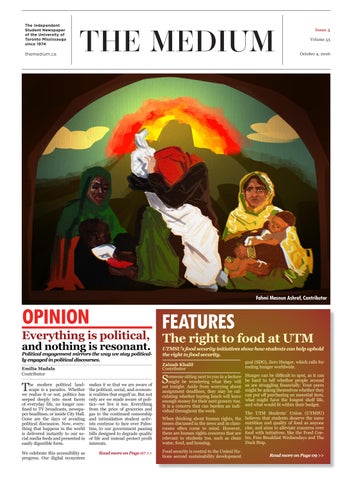
Fahmi Masnun Ashraf, Contributor
OPINION
FEATURES Everything is political, and nothing is resonant.
Political engagement mirrors the way we stay politically engaged in political discourses.
Emilia Madala Contributor
T
he modern political landscape is a paradox. Whether we realize it or not, politics has seeped deeply into most facets of everyday life, no longer confined to TV broadcasts, newspaper headlines, or inside City Hall. Gone are the days of avoiding political discussion. Now, everything that happens in the world is delivered instantly to our social media feeds and presented in easily digestible form.
makes it so that we are aware of the political, social, and economic realities that engulf us. But not only are we made aware of politics—we live it too. Everything from the price of groceries and gas to the continued censorship and intimidation student activists continue to face over Palestine, to our government passing bills designed to degrade quality of life and instead protect profit interests.
We celebrate this accessibility as progress. Our digital ecosystem
Read more on Page 07 >>
The right to food at UTM
UTMSU’s food security initiatives show how students can help uphold the right to food security. Zainab Khalil Contributor
S
omeone sitting next to you in a lecture might be wondering what they will eat tonight. Aside from worrying about assignment deadlines, they may be calculating whether buying lunch will leave enough money for their next grocery run. It is a concern that can burden an individual throughout the week.
goal (SDG), Zero Hunger, which calls for ending hunger worldwide. Hunger can be difficult to spot, as it can be hard to tell whether people around us are struggling financially. Your peers might be asking themselves whether they can put off purchasing an essential item, what might have the longest shelf life, and what would fit within their budget.
When thinking about human rights, the issues discussed in the news and in classrooms often come to mind. However, there are human rights concerns that are relevant to students too, such as clean water, food, and housing.
The UTM Students’ Union (UTMSU) believes that students deserve the same nutrition and quality of food as anyone else, and aims to alleviate concerns over food with initiatives, like the Food Centre, Free Breakfast Wednesdays and The Duck Stop.
Food security is central to the United Nations second sustainability development
Read more on Page 09 >>
02
NEWS
Editor | Natalie Ramadan news@themedium.ca
The Get Hired Fair offers networking opportunities, not on-the-spot job offers
Career Centre Director Felicity Morgan shared that students should treat the fair as a first step toward interviews. Photo Credits: University of Toronto Mississauga Alumni
Yukta Mutai Contributor ore than 1,500 students met face-to-face with M 56 employers at the Fall 2026 Get Hired Fair hosted by the UTM Career Centre on September
29. Throughout the four-hour event, the Recreation, Athletics and Wellness Centre was filled with students navigating a maze of employer booths. These booths ranged from startups across several industries to major firms such as DHL and TD Bank. The fair is held twice a year. The fall event gives students a chance to have one-on-one conversations with employers and leave impressions that could benefit students during job candidate reviews. Overall, the fair encourages students to learn tro approach employers, helps students navigate an increasingly competitive job market, and discover the many resources the Career Centre has to offer. The fair is one of several opportunities to explore career through the Career Centre, which include Job Shadowing, Skills Acceleration, and CLNx. all UTM students can access the Career Centre’s services for free up to two years after graduation. For many university students, approaching a recruiter can feel as intimidating as submitting applications. Maria-Paula Araujo, a first-year student specializing in digital enterprise management, told The Medium, “At first, I was a little nervous approaching employers, but once I started talking [to them], I ended up connecting and learning more about the finance industry.” So, what is the point of a career fair? According to Career Centre Director Felicity Morgan, the Get Hired Fair is more than getting hired.
welcomes first-year students at the fair. “[Net- want to talk to, learn about their organization, reworking] is a great technique,” she said. “I’m re- view careers, ask informed questions and be able ally happy to see first-years getting involved.” to comment on something.” Over the course of its decades-long existence, the fair has evolved alongside the students and employers it serves. “The UTM Career Centre has held job fairs for more than 40 years,” Morgan said. “It adapts to meet the changing needs of employers and students.”
The Career Centre also provided a Power BI dashboard to help students narrow down the employers to meet.
Many students expect to leave events like the Get Hired Fair with a job or an on-the-spot hire, but that is a common misconception. The fair is a Morgan encouraged, “Even if you aren’t look- place to learn, explore, have conversations, and ing for work right now, just go to an event. Walk develop communication skills. Even short interaround. You don’t have to talk to everyone right actions can benefit both students and employers. away.”
“It’s really natural to have the hope that a job will result from the fair. But the impression you make at the fair can really influence the decision of whether [employers] should get [you] an inter- Preparation can make approaching employers less intimidating. Students can review employers view,” said Morgan. and postings listed on the Get Hired Fair web page She added that employers want to see genuine en- ahead of time. thusiasm. “You are competing with a lot of people. You and everyone else [are] doing the same thing. Morgan explained, “All the postings and employers are linked [on the web page], so take the time You want to stand out.” to look at the list in advance, find employers you Morgan sees an advantage in starting early and
Students can visit the CLNx to see upcoming events and workshops hosted by the Career Centre. The next Get Hired Fair will take place on January 19, 2027.
Photo Credits: Karl Joshua Cristoba
Students takes on patient disclosure and data consent in medical ethics debate
The goal in joining the fair is not to walk in looking for a job and walk out with one. It is to put yourself out there and start somewhere. Sometimes, a good start begins with a simple question.
The UTM Debate Club, Pre-Law Organization and Regenerative Medicine Club co-hosted their annual student debate on September 30. Natalie Ramadan News Editor
n September 30, the UTM Debate Club (UTMDC) held its annual student medicine, law, and ethics over three rounds. O debate on medical ethics in the Student Centre, in collaboration with the The first round addressed the motion that physicians should disclose incidental UTM Pre-Law Organization (UTMPLO) and the UTM Regenerative Medicine findings to patients, even when the findings are unlikely to be medically signifiClub (UTM RegenMed). Debaters argued two questions at the intersection of
cant.
03 Incidental findings are results unrelated to the rea- regarding incidental findings, with stances reversed. son a patient was tested or examined. Winners Anthony, Charlotte, and Apreet were choThe second round addressed whether physicians sen by judges after assessing all rounds of debate. should be allowed to use patient data for medical research without explicit consent when the data is UTMDC President Edwina Ng, who is serving her anonymized. The final round repeated the motion second term as president, said the club chose two regarding incidental findings, with stances reversed. motions from a wider list of medical ethics conRecent debates over COVID-19 vaccination Winners Anthony, Charlotte, and Apreet were cho- cerns. have raised questions about how much say patients sen by judges after assessing all rounds of debate. have over medical decisions. The motion regarding findings asks how much disclosure causes UTMDC President Edwina Ng, who is serving her incidental for patients and how much information they second term as president, said the club chose two anxiety motions from a wider list of medical ethics con- deserve to hear. cerns. Recent debates over COVID-19 vaccination Previous debates surrounded topics about abortion, have raised questions about how much say patients AI in the workplace, and cancel culture. The clubs have over medical decisions. The motion regarding have moved away from those topics because the deincidental findings asks how much disclosure causes bates got somewhat heated and political. However, anxiety for patients and how much information they these topics may be re-introduced with a structure deserve to hear. designed to limit bias. Previous debates surrounded topics about abortion, AI in the workplace, and cancel culture. The clubs UTM RegenMed President Doreen Zarrabian said, have moved away from those topics because the de- “We don’t want people to feel uncomfortable.” bates got somewhat heated and political. However, these topics may be re-introduced with a structure Zarrabian explained UTM RegenMed members’ interest in the recent debate topic has to do with redesigned to limit bias. lated first-year courses. These courses teach students The second round addressed whether physicians how to respect research participants and patients’ should be allowed to use patient data for medical consent and how to disclose and share their informaresearch without explicit consent when the data is tion. anonymized. The final round repeated the motion
Ng said the clubs complement each other. While UTMDC and UTMPLO handle “the argumentative portion and the speech portion,” UTM RegenMed brings knowledge of the medical field. “I think something so unique to debate is [that] it’s not [focused on] one field in particular,” Ng said. Students can expect to argue positions that match or oppose their own beliefs, which pushes them to consider other viewpoints. Ng added, “It’s important to understand and empathize where other people are coming from.” This is especially relevant to students in the debate community, many of whom want to be change-makers in medicine, law, or parliament. UTM RegenMed has upcoming events with professors in the psychology, biology, and chemistry departments. The club also hosts an annual stem cell swap event with the Canadian Blood Services. 100 students joined the stem cell registry through the club last year. Students can keep an eye on their Instagram page @utm.regenmed. UTMDC is also preparing for another event. “We [are] planning a big debate competition. We’ll have food, judges, and awards there,” said Ng. The judges’ panel will consist of professionals from the legal industry. The club is also looking to invite professors to the panel. Interested students can find updates on their Instagram page @utm.dc.
UTM Students’ Union opens pub night season with a trip back to 2016
Students danced to 2016 hits and posed for the Mannequin Challenge at The Blind Duck.
Diana Varzideh Arts Editor TM Students’ Union (UTMSU) and UTMSU Orientation hosted its U Back to ‘16 Pub Night at the Blind Duck on September 25. This is the second pub night of the 2026-27 season, and its theme was inspired by music and fashion from 2016.
The party kicked off at 8:30 p.m. and ran until 11 p.m., with an admission fee of $5. A line of eager students piled up outside at doors open, waiting to see if their favourite 2016 hits had made it onto the night’s playlist.
Photo Credits: Diana Varzideh tendees took part before returning to the dance floor. Later, students formed conga lines under the orientation decoration hung in The Blind Duck. The night ended with “U of Tears” shots and more nostalgic song mashups. Some participants shared their feelings with The Medium after the pub night.
Photo Credits: Diana Varzideh
Grace Byun, a second-year communication, culture, information, and technology student shared, “Pub Night was really fun because the DJ played many songs that everybody knew and could have fun with. I had so much fun dancing and singing at the top of my lungs with my friends!”
The partygoers were dressed in a range of styles, from comfortable clothes to headbands and T-shirts in 2010s style.
Antony Boby Joseph, a second-year student majoring in physics and astronomy, expressed, “There were a lot of songs [we] missed out on. Where were the Roblox tycoon songs, man?” He added, “I had great company throughout, and the DJ was chill.”
DJ TrayBaby excited participants with iconic hits, from Sia’s “Cheap Thrills” to Justin Timberlake’s “Can’t Stop the Feeling” and DNCE’s “Cake by the Ocean.” Of course, several Justin Bieber songs made an appearance, notably “Beauty and a Beat,” which was released in 2012, and “Sorry,” which was released in 2015. During the pub night, the DJ and UTMSU executives invited participants to take part in the Mannequin Challenge, a 2016 trend associated with Rae Sremmurd’s song “Black Beatles.” Participants were required to pick a pose (the crazier, the better) and freeze while the photographers went around, recording everyone until the beat dropped. All at-
Maria Jose, a fourth-year sociology major with double minors in political science and geography said, “Pub Night was awesome, and the UTMSU joining in on the dance floor was really fun.” As October rolls around, Halloween decorations and music will take over the Student Centre. Harmonix, the UTM Art Club, the Erindale Gaming Organization, the Department of Visual Studies Student Society, the UofT Gacha Game Club, and UTM Esports will join forces to put on the Halloween Pub Night on October 16. Students can register ahead through club registration links on their Instagram pages.
04
UTM Future Surgeons Society partners with Canadian Blood Services for blood drive at UTM
The two-day blood drive offered the UTM community a chance to donate as Canadian Blood Services reported a 20 per cent decline in blood donations. pointments booked ahead of the blood drive.
Emma Bedja Contributor
As for the FSS, organizing a blood drive aligned with the club’s focus on healthcare and its interest in exposing students to different aspects of patient care.
he UTM Future Surgeons Society (FSS) partnered T with Canadian Blood Services (CBS), an independent registered charity, for a blood drive in the Kaneff
Aarushi Choudhury, a second-year biology for health sciences student and Co-President of FSS, said the blood donation is particularly relevant to the club’s focus. “As a club for future surgeons, I feel that promoting [a] blood drive is one of the most important things,” she said.
Centre Rotunda on September 29 and 30. The blood drive provided an opportunity for the campus community to donate blood and support patients across Canada. The blood drive comes after CBS reported a 20 per cent decline in blood donations between June 1 and July 22 this year. The charity aims to welcome one million new donors by 2030, and university campuses serve as important platforms to reach young and first-time donors.
FSS initially encountered many hesitant students, including people who were afraid of needles or unable to donate because of anemia. But the club responded by increasing its promotional efforts through social media, posters, and donation cards around campus. FSS hoped students would leave the blood drive with a better understanding of blood donation and consider becoming regular donors.
CBS said there is a constant demand for blood and every donation contributes to Canada’s Lifeline. A CBS representative elaborated, “By creating a positive and accessible, first-time donation experience, we hope to encourage students to become regular donors and continue [to donate] well beyond their time at university.”
For students who were unable to donate, CBS encourages them to check their eligibility and look for future blood or plasma donation opportunities in their community. The charity also suggests that students support Canada’s LifeLine by raising awareness or encouraging others to donate.
The blood drive also addressed students’ common concerns about blood donation. CBS said one of the biggest misconceptions among young people was that donating blood is difficult, painful, or uncomfortable.
For the FSS, the event was also part of its broader focus Photo by @utm.futuresurgeonssociety on healthcare-related initiatives. The club is planning The charity shared that the donation process takes during the process. future research events related to stem-cell research, about an hour, with trained staff supporting donors although details have not yet been finalized. Interested throughout. Donors are encouraged to eat and stay CBS said the UTM community showed strong interest students can receive updates on their Instagram page hydrated, while snacks and refreshments are provided in the event, with a high level of engagement and ap- @utm.futuresurgeonssociety.
More than 3000 students attended O-Week 2026
Free and diverse community-based events ran from September 4 to 11. Students’ feedback will be used to plan future orientations. Emma Bedja Contributor
charge, and the schedule included both high-energy activities and quieter options such as board games. Park highlighted several events, including academic garden parties and other opportunities for students to connect with faculty and academic departments. He said students’ early feedback showed that programming focused on academic preparation had a strong impact on their transition to university. Campus tours were another key part of the orientation, allowing students and their families to familiarize themselves with UTM before the academic year began. Meanwhile, resource and student group fairs allowed students to learn about opportunities available on campus.
T
Community-specific events provided a space for students with shared experiences to connect. Park pointed to the UTM Black Excellence Orientation Bonnet and Durag Bash as an example of such programming.
The orientation included academic programming, campus tours, student groups and resource fairs, residence activities, and events for specific student communities.
Park shared that community-focused settings were central to achieving the orientation’s goals. “Those types of events where students are really able to meet and connect with each other in authentic ways — those are the ones that I think are really key to what we’re trying to achieve.”
he UTM Orientation attracted more than 3000 students on campus with more than 100 events from September 4 to 11. The events were designed to help new students meet peers, explore campus, and prepare for university life.
In an interview with The Medium, Centre for Student Engagement (CSE) Assistant Director of Access and Transition Sean Park said the range of programming was intended to give students different ways to participate based on their interests and comfort levels.
Early feedback from students also pointed to the value of having control over their orientation experience. Park said students reported making new friends, meeting upper-year students, becoming familiar with the campus, and appreciating the ability to choose events based on their own interests.
Park highlighted that accessibility was central to this year’s planning. The events were free of
On the other hand, residence programming was
designed to highlight the resources, supports, and opportunities available to students living on campus and became busier as students arrived for events. Looking ahead, Park said UTM will continue using student feedback to shape future orientations. While the CSE hopes to encourage more participation, organizers also paid attention to requests for more low-pressure opportunities for students to build community. Park explained, “It gives students the autonomy to create the experience that they want, which is our ultimate goal.” As UTM continues refining its orientation programming, the response from students has been encouraging for organizers who have spent several years developing the program. Park shared, “It’s really exciting to see our campus come alive. Our students and campus partners all buy into this kind of experience that we really want UTM students to have.”
Photo Credits: @uoftmississauga
05 OPINION
W
hen criticism becomes hate, ho draws the line
By conflating anti-Zionism with anti-semitism, Canada becomes a dangerous place for both Jews and Palestinians. Sameeha Jaffri Contributor
O
n September 24, Public Safety Canada published the National Commitments to Combat Antisemitism, a summer progress report which explicitly and officially recognizes anti-Zionism as an expression of anti-semitism, as defined by the Canadian Handbook on the International Holocaust Remembrance Alliance (IHRA). Although IHRA definitions cannot be legally binding nor can they criminalize free speech, according to the report, the Canadian government states that this update is necessary to address the modern manifestations of anti-semitic discrimination, which apparently includes any and all criticism of the Israeli administration as Zionist. Canada wants to fight antisemitism—and it should. According to a research report released by Jewish human rights organization B’Nai Brith Canada, from 2024 to 2025, there was a 9.3 per cent increase of reported anti-semitic incidents. Canada needs to take antisemitism seriously; Jewish Canadians have faced harassment, threats, and attacks, including in schools, places of worship, and universities. Jewish students should not have to accept hostility toward their identity as the price of participating in campus life. But the summary report released by Public Safety Canada not only fails to address anti-semitic, anti-Palestinian, and anti-Muslim discrimination—by blurring the line between Jewish identity and Zionism, it only makes the fight against hate even harder. A Jewish student on our campus or community should not have to answer for the Israeli government. A Palestinian student should not have to prove they do not hate Jewish people before condemning it.
after refusing to serve in the Israeli military. Mitnick and Gerlitz shared their experiences: their very existence and moral position affirming the fact that Jewish and Zionist identities are not the same. That is what becomes lost when antisemitism and anti-Zionism are treated as interchangeable, even if this interchangeability is not legally binding. Who is to say it won’t be in the future? There are, of course, cases where “Zionist” is simply used as a more socially acceptable replacement for “Jewish.” An antisemitic conspiracy theory does not stop being antisemitic because one word is changed. Holding a Jewish student responsible for Israel because they are Jewish is not activism. Neither is threatening Jewish people, vandalizing Jewish institutions, or using centuries-old stereotypes under the cover of criticizing Israel. That is antisemitism, and calling it political criticism does not make it less so. The problem is what happens on the other side of that boundary. Can a student say that they fundamentally oppose Zionism? Can they condemn the Israeli government? Can they argue that their university should cut ties with Israeli institutions? Can they protest Israel’s actions in Gaza without having their position treated as evidence of prejudice? At U of T, students have already been asking these questions. The 2024 Palestine solidarity encampment called on the university to disclose its investments, divest from assets protesters had linked to Israel, and cut ties with Israeli academic institutions. At the University of Toronto Mississauga (UTM), students later walked out of classes and marched through campus in solidarity with Palestinians.
These were not comfortable protests; political protests Both statements should not be controversial. Increas- rarely are. ingly, they do not feel that way. But Canada is having this conversation at the same time Jewish students have also described feeling unsafe and that Palestinians in Gaza and the West Bank are experi- argued that some rhetoric surrounding campus demonencing what the International Criminal Court (ICC) re- strations crossed from criticism of Israel into antisemiferred to as “crimes against humanity and war crimes.” tism. Those experiences should not be dismissed. But Following an investigation in 2024, the ICC has also is- neither should Palestinian advocacy become suspect simsued arrest warrants for Hamas leaders and Israeli Prime ply because it challenges Zionism. Minister Benjamin Netanyahu. But beyond this, Israel’s war crimes continue to be documented by Palestinian U of T confronted this problem directly in 2025 when it journalists from within Gaza, who face displacement and drafted guidance addressing antisemitism and anti-Isdeath for simply doing their job. raeli discrimination. The university made an important point: replacing “Jewish” with “Zionist” does not make That makes one distinction especially important. Ju- discriminatory conduct acceptable. IJV U of T, however, daism is not Zionism. Jewish people are not the Israeli raised concerns that the guidance could blur Jewish idengovernment. And opposition to Zionism is not hatred of tity, Israeli nationality, and Zionism. The disagreement Jewish people. Zionism is a political movement with a exposes how difficult the boundary becomes once institucomplex, violent history. Like any political ideology, peo- tions are responsible for enforcing it. ple can support it, question it, or reject it entirely. Jewish people do all three. And this is where freedom of expression enters the conversation. Therefore, Public Safety Canada’s report is utterly insensitive towards the Jewish and Palestinian communities. The threat is not necessarily that a student criticizing It is a definitional change that serves not the people, but Israel will suddenly be arrested. It can be much quieter those with a vested interest in amplifying confusion and than that: a student deciding not to attend a protest; an hate—even as Jewish people and Palestinians face real organizer reconsidering the wording on a poster. threat on our streets and the hands of a genocidal government abroad. Somewhere in all our commotion about definitions, ideologies, and acceptable speech are Palestinians themAt the University of Toronto (U of T), Independent Jew- selves. People have watched families in Gaza lose their ish Voices (IJV) has participated in Palestinian solidarity homes, parents bury their children, children lose their activism and openly criticized Israeli policies. In March parents, and entire neighbourhoods disappear. Palestin2025, IJV U of T hosted a panel discussion titled Refusal ians should not have to become a political argument bethen and now: Refusing complicity, resisting oppression, fore their suffering is allowed to matter. Grief and rage and reframing solidarity, involving two young Israelis— over one’s community being murdered does not need an Tal Mitnick and Einat Gerlitz—who had been imprisoned ideological qualification.
Editor | Mashiyat Ahmed opinion@themedium.ca
MASTHEAD EDITORIAL BOARD Editor-in-Chief Samuel Kamalendran editor@themedium.ca Managing Aaron Calpito managing@themedium.ca News Natalie Ramadan news@themedium.ca Opinion Mashiyat Ahmed opinion@themedium.ca Features Madhav Ajayamohan features@themedium.ca A&E Diana Varzideh arts@themedium.ca Sports Tyler Mederiros sports@themedium.ca Photo Melody Zhou photos@themedium.ca Design Sehaj Wander design@themedium.ca Social Media Jannine Uy social@themedium.ca Videographer Samm Mohibuddin video@themedium.ca Copy Yasmine Benabderrahmane yasmine@themedium.ca Gisele Tang gisele@themedium.ca
TO CONTRIBUTE & CONNECT:
themedium.ca/contact @themedium.publications
06 Yet, conversations about Palestine are repeatedly redirected towards a test: “do Sometimes, it is simply the most human response to witnessing it. you condemn Hamas?” A Palestinian student grieving should not have to pass a political purity test before saying that Palestinian lives—that their lives—matter. One should not have to defend Hamas to condemn Israel’s conduct in Gaza. Those are separate questions, and collapsing them makes Palestinian people There is something surreal about witnessing what human-rights organizations answer for a militant Palestinian movement, in much the same way that Jewish have described as genocide and apartheid through a screen. We watch families people should never be made to answer for the Israeli government. torn apart, parents carrying their children, neighbourhoods turned to rubble, and people displaced again and again, all while sitting safely in our bedrooms, No student should have to begin by proving whose violence they condemn beclassrooms, and homes. The distance almost makes the helplessness worse. You fore they are allowed to mourn. refresh your phone, watch another family lose everything, put it down, and realize there is almost nothing you can personally do to stop it. So let students protest. Let them question Zionism. Let them condemn Israel. Let Jewish students challenge antisemitism without being made representatives For many students, protesting, speaking, writing, and demanding action from of a state. Let disagreement be uncomfortable, angry, and difficult without imthe institutions and corporations in our lives are some of the few things that do mediately turning political criticism into hatred. Because the moment we begin not feel completely helpless. So, when criticism of Israel or Zionism is too eas- protecting governments from criticism in the name of protecting people from ily folded into accusations of antisemitism, the consequences are not abstract— discrimination, we are confused who actually needs protecting. they make people hesitate before speaking about suffering they are watching unfold in real time. Condemning that suffering is not hatred of Jewish people. People do. Genocidal governments do not.
Solidarity you can screenshot isn’t solidarity
In a generation fluent in “bed-rotting” and “doom-scrolling,” even empathy gets treated as too much effort.
Natalie Ramadan News Editor It takes less than a second of “activism” to tap the heart, type a comment, hit repost and keep scrolling. Scroll through TikTok or Instagram, or any post from a Palestinian Aid Organization, and you’ll find someone asking for something real—period products for displaced women and girls; food for Photo Credits: George Pagan children and formula for babies; an emergency birth kit; funds for a medical treatment only available abroad. But scroll down to the comment section and you’ll notice a particular disconnect: a wave of “hearts,” a chain of why I haven’t visited home in nearly 10 years. The next day she’d ask to hang comments responding to “What’s your favourite colour? Answer below” or out and get McDonald’s, because it’s just two-dollar fries and then proceed “Sending love!!” or even more recently, just a repost. to ask, is a boycott even productive? The gap between what posts are asking, even begging, of viewers to do and what the comment section gives is where performative activism lives. “Performative” is a word that gets thrown around until it means nothing, so I want to be specific. I don’t mean people who do things in small, perhaps imperfect action. What I mean is the increasingly common move of converting someone’s grief and the desperation for that grief to be recognized into a repackaged opportunity to perform a moral highness—actions that cost nothing but leave people feeling like they did something.
Then I meet a new friend who asks tone-deaf questions, like “why can’t you guys try to live peacefully?” Questions about decades of occupation that become “not deep” and “just a hypothetical,” to implicitly place the burden of “peace” on the people waiting and surveilled at checkpoints, not the armed forces building and enforcing them.
I used to be confused about why the friends I invited to the October 7th protests around campus seemed embarrassed to be there. One even laughed and recorded the crowd to share with his friends—new side quest unlocked, I Commenting doesn’t create change the way a donation page does, or a phone guess. It takes surprisingly little, apparently, for people to stop caring once call to representatives, educating your friends, or even a conversation with their Palestinian friend leaves the room. the person running the account does. People move from one post to the next, I grew up outside of Palestine, raised on stories of martyrs and raids from and the next, and the next. family and the Al Jazeera channel my parents kept on 24/7. I learned about Recently, rapper Macklemore posted a lengthy statement about a difficult displacement and occupation at a young age. I also learned the hard way not conversation with Ed Sheeran, the cost of choosing a side and speaking out to bring up the Palestinian experience in school the day the news broke that in support of Palestine. He was removed from the Sheeran Loop Tour by Mohammed Abu Khdeir, a 16-year-old boy from Al-Quds, was kidnapped promoters and venue owners, and in response, donated $1 million in earn- outside a mosque by settlers, forced to drink gasoline and burned to death ings from the Tour to six different Palestinian Aid Organizations, including in a nearby forest. It wasn’t a school-appropriate topic to bring up for indoor the Palestine Children’s Relief Fund, HEAL Palestine, Gaza Soup Kitchen, recess. Medical Aid for Palestinians, UNRWA USA National Committee Inc. and Now, I can talk freely about the treatment of Palestinians, the genuine grief Anera Org. expressed and then too often left there. I’ve gone to the protests, the charity events, and had the same difficult conversations with friends that leave us as Compare that to the hundreds of thousands of people who reposted the news strangers. of the split, the screenshots, fan art, and “this is so crazy” captions on their stories. Reposting a 24-hour story of someone else’s statement, actions, and That’s why conversations about performative activism feel more urgent than donations is not the same as making your own. It’s possible to circulate the ever. We know that real activism demands us to reconsider our friendships righteous statement on the internet and still walk away having spent noth- and relationships—and in the process—risk loss and estrangement. Performative activism, made easier than ever through our digitally connected lives, ing, risked nothing, and changed nothing. may make you feel better and even give you a sense of purpose. But, who The same thing applies much closer to home than celebrity drama. The friend does that purpose really serve? The self-assumed moral superiority we feel— who attends every protest, chants loudly, and supports protesters at the en- especially with Palestine—does not add anything to the movement we claim campment, then checks out of grocery stores without reading labels, picking to be building or the people whose liberation we claim to champion. up her daily coffee from a boycotted chain on the way home. A boycott, unlike a march, actually asks something of you: a change in habit, a small daily Activism is more than sharing a post with a link in bio. It’s the unglamorous inconvenience, going to a different coffee shop, giving something up. work of checking in on your friends through difficult conversations, boycotting a brand you might have nostalgic attachments to, and hardest of all, to I’ve learned a lot about my friendships by reflecting on just how pervasive stay true to one’s moral and political convictions unwaveringly. Show some performative activism is today—especially in regards to Palestine. I had one humanity to people grieving loved ones. I can’t fix the checkpoints. I can’t friend who I would sit with for hours and talk—sometimes even cry to—about comment my way into pretending it creates change. But I can tell you to stop missing my family in Palestine. I explained to her what an occupation is, or pretending to show up and start actually doing it.
07 >>Continued from Page 01>>
Everything is political, and nothing is resonant haul of the entire societal structure, rather than a reactive approach. We know change requires more than just individual effort, but we lack the robust organization and accountability systems for unified action that do not bow down to threats or placates to half-way reforms when what we, as the people, really deserve is lasting, systemic change. With rising uncertainty, motivation to engage in political action fades. If no one else cares, why should you? The current individual-based structure of political action and education, and the lack of results it produces, leads us to doubt the power of the people—and that’s the real damage of this paradox.
Emilia Madala Contributor
T
he central problem of our times is not that we live in a politically ignorant or apolitical world. In fact, it’s the opposite. The paradox of politics lies in the fact that while politics defines our everyday realities, we see very little actual change in the world. Political awareness, while important, is hollow without organized and sustained political action, and the disconnect between these two ways of political engagement has never been clearer. The rise of social media has created an era of hyper-awareness about politics. We are constantly updated on the crises unfolding around us—climate change, wars, bills and policies, and systemic injustices. Yet, at the same time, political movement-building that envisions a pathway towards real, grassroots change—as opposed to incremental reforms—has withered. According to a report by the Organization for Economic Co-Operation and Development (OECD), membership in institutions like unions, which were once central to collective action, has been steadily declining. And with the proposal of the Canada Strong Act (Bill C-39), which gives the federal labour minister unilateral power to end lawful strikes if they are deemed against “national interest,” it will be even harder for the working-class to organize to demand better working conditions, pay, or other workplace changes that support dignity over profit. Beyond unions, protests and rallies in our politically saturated world erupt in response to injustice, but often fizzle out when the news cycle moves on. And most frustratingly, it seems that every national election period, the vast majority of voters are forced to choose between the lesser evil. Part of the issue is the trend-based way in which we engage in politics. Social media keeps us informed on the latest news, but demand for novelty arises as a consequence, ensuring that each crisis is quickly replaced by the next. It offers a facsimile of activism, where a sense of fulfillment can be achieved by taking a stand on an issue without having to actually do anything. Ultimately, are we doing enough to be politically active? For many, the answer is complicated by the excuse of lack of time. As students, our lives are undeniably busy, which makes it easier to justify staying politically informed as simply enough. This passive logic is a convenient way to ease existential anxieties and the guilt of inaction without disrupting routines. But, while we as students may find it convenient to believe the lack of time and busy schedules as the culprit behind the paradox of politics, the real barrier is the perceived complexity of political participation. It is far easier to consume the bite-sized version of politics and news by our favourite online commentators or algorithm, rather than to seek out and commit to meaningful political action.
Sometimes, we do end up taking political action in the form of voting, donating, boycotts, protests, and petitions. These moments prove that collective action is possible and does drive tangible change. Yet, even when progress is made, it seems ephemeral. The impact feels disproportionately small in the scale of the problems we face—whether that’s the ambitiously unfolding climate crisis, policy-driven privatization of our public infrastructure, or Doug Ford entering another term as Ontario’s premier. The energy behind a movement dwindles along with its hype, because too often, what we call a movement really just feels like a collection of rallies we feel obligated to attend or petitions to sign— leaving the community disillusioned until the next campaign catches on, and so goes the cycle. But, the issue isn’t that the actions we take are necessarily ineffective—even though they could be more disruptive—it’s that they are overwhelmingly solitary. Political engagement mirrors the way we stay politically aware or engage in political discussion. We do it mostly through online means, individually, and detached from collective responsibility. When action does happen, it tends to be reactive. We are in a cycle of constantly responding to the latest crisis, putting out fires as they come up. These efforts offer temporary relief, but they rarely address the root causes of problems. Governmental failures, the protection of profit interests over people, environmental destruction, the erosion of Indigenous sovereignty and marginalized peoples’ freedoms, distrust in media, a democracy on life-support, and the fact that our global economy—whether we benefit from it or not—is essentially propped up by profits extracted from foreign wars and genocides, appear at once too complicated and emotionally stifling to even begin thinking through, let alone organizing against. It is daunting to challenge systems that are so deeply ingrained in our society to the point that they seem inseparable from our daily lives as students, consumers, and workers. This level of change calls for an over-
When action does happen, it tends to be reactive. We are in a cycle of constantly responding to the latest crisis, putting out fires as they come up. These efforts offer temporary relief, but they rarely address the root causes of problems. It is daunting to challenge systems that are so deeply ingrained in our society to the point that they seem inseparable from our daily lives. The level of change our future demands calls for an overhaul of the entire societal structure, rather than a reactive approach. Therein lies the tension: how can we achieve change on that large of a scale? Most of us recognize the need for transformation, yet we remain frozen by the insurmountable magnitude of the challenge. Here, we fall back on political awareness, allowing it to comfort our perceived lack of ability to enact political action. The solution begins with community organization. Our presently declining institutions can become the starting point for change. We need to build stronger, more resilient communities through collective action and shared purpose. Next, we require decisive, even radical action. To break the status quo, we must move beyond mediating the symptoms of the disease and engage in disruptive actions that challenge entrenched power structures. This includes challenging the two-party system by voting in a socially democratic direction—and demanding a people-first politics from our elected officials and those running for office. It means taking consistent, lasting stances when it comes to boycotts, protests, and ideologies—and not allowing them to die down once the social media trend or news cycle has run its course. In the age of information, our society has drastically changed the way it talks about politics. The ease and speed with which we can access the global events and perspectives has created a culture of constant awareness that risks emotional exhaustion rather than energizing people towards change. With how involved we are in the political sphere online, it can feel like staying informed is equivalent to participation. Yet, despite seeing politics entrenched in every sphere of life, we struggle to see any real change in the world. Awareness, no matter how widespread, cannot dismantle the systems that hold the status quo in place. For that, we need sustained, collective action. Building a better future begins when we let go of the idea that being informed is the same as being active.
08
FEATURES
Editor | Madhav Ajayamohan features@themedium.ca
What about Human Rights?
Professor Geoff Dancy discusses human rights, UTM’s response to activism, and shares the importance of original thought. Dancy responded to these criticisms. “What I would say to those people is, ‘You think that they’re useless, then get rid of them, and see what happens.’” He expressed that these institutions are crucial and have real-life impact.
Camille Dornellas Contributor
“State leaders and rebels or whoever is fighting and killing people… they start to get worried that they’re being monitored by the international community, and they curtail some of the violence,” Dancy explained. Dancy said that these institutions create a space in which countries and state leaders can get together and discuss issues. These platforms become forums where international figures meet and negotiate. Without the UN, these exchanges would only happen through the media. The UN has regularly been troubled. From the impasse between the U.S. and Soviet Union at the Security Council during the Cold War, to the current tension between the U.S., China, and Russia. “But what would it be replaced with, if we were to try to do better?” Dancy questioned. “Probably not a much better institution, you know?” But human rights are not a topic discussed only in international conferences. They are also relevant in the local sphere. When it comes to UTM, there is a belief that students are apathetic and disinterested in activism. But is that true? Dancy believes this sentiment stems from UTM being a commuter school. Most students don’t live on campus and people are more prone to engage in activism near where they live. “I don’t know if I’d be willing to generalize [...] When the war in Gaza started, people were protesting here, so it’s not devoid of protests and activism,” he said.
Photo Credits: Geoff Dancy
But to Dancy, the university does have many students who care, who are interested in his work and human rights. “People are searching here. Maybe they haven’t found the exact cause they’re behind, or it’s not easy to organize on this campus, but I don’t think it’s for the lack of interest or apathy.”
However, Dancy thinks Artificial Intelligence (AI) is affecting students. “People r. Geoff Dancy was completing his undergraduate studies at the University say it’s a way to spread information to everybody, that it makes things simpler of North Texas when he saw a flyer around his campus. A group of profes- and is a democratizing influence. What it’s actually doing is curating informasors was taking students to the Netherlands to study at the United Nations’ (UN) tion.” International Criminal Tribunal for the former Yugoslavia. He stated that comparing AI and large language models to the development of Dancy had never heard of the international court before. “We were from Loui- the printing press in the fifteenth century is inaccurate. Dancy explained that the siana, from a very conservative place, and my dad was a bill collector,” he said. latter was a technology that allowed people to access information, while the for“This isn’t the forefront of the human rights movement.” mer is an algorithm that transforms said information into “bite-size” products.
D
It wasn’t, but Dancy knew it was his chance to have fun in the Netherlands. So, after a visit to the library, reading some books, writing a research proposal, and bringing it to his professors the following week, he got offered a spot on the trip. Dancy’s proposal was exactly what they were studying.
The user becomes dependent on how the algorithm decides to filter the data. What defines how the algorithm does this is who programmed it. “People at companies who are consolidating power and resources are curating information for us [...] I don’t want to give power to them,” Dancy said.
“I did the work, but I backdoored my way into going to the Netherlands,” Dancy said. Whether it was through the window, front or back, he flew all the way to the Netherlands and watched the trial of the former Serbian president, Slobodan Milošević.
Beyond abdicating our autonomy, Dancy warned about another trait AI takes from us — self-discovery. “That’s what the university is about, period. In selfdiscovery, you find out what your capabilities are, and then you’re able to produce knowledge.”
The trial was put together to prosecute the war crimes that had been committed during the Yugoslav Wars, which cost more than 130,000 lives. Milošević’s trial was considered a critical moment for international justice. However, Milošević was never convicted due to his death in a UN cell in 2006.
Dancy explained that students are no longer exercising their ability to think and pursue knowledge—they use AI and become a “middleman” that stays between the ideas and the computer. There is no agency or thinking for oneself anymore, therefore, no new ideas.
“I was part of the crowd that saw the first video evidence of the genocidal acts [...] of the massacres at Srebrenica, which were terrible.” Dr. Dancy accompanied the trials for two months and had access to the evidence that was shown during the sessions. “I was part of all this, just a fly on the wall. And I became fascinated by it.”
“That’s boring!” Dancy exclaimed. “Disagree with each other. That’s more fascinating to me than plugging things into some program and watching it spit out text. I’m befuddled by this!”
But after reading this feature, should you feel desperate or hopeful? Dancy rejects this binary view. This line of thinking has been useful for both defenders Professor Dancy’s story with human rights began with this trial, but these ideas and critics of human rights over the years. are much older. The UN was created in 1945 following World War II, and the Universal Declaration of Human Rights (UDHR) was adopted in 1948. There were several books, like “The End of Human Rights” or “The Last Utopia” about how the era for human rights had reached its end. Those books were writThis document states that every human being, regardless of their race, gender, ten 15 years ago. or ethnicity, is born with a right to “life and liberty, freedom from slavery and torture, freedom of opinion and expression, the right to work and education, “As long as people care about stopping cruelty and atrocity—and a lot of people and many more.” The UDHR was a significant milestone, because it was the first do—there’s space in the world for thinking about and pursuing the politics of time that human rights were protected by international law. rights,” Dancy said. However, these rights keep being ignored and abused. Institutions like the UN The new cohort of people who are going to create ideas and care about stopping and the International Criminal Court (ICC) constantly endeavour to protect and cruelty are university students. It’s us, the “apathetic” students who “don’t care” enforce these rights. about activism. We have seen many atrocious war crimes happen since 1948, including the geno- If you do happen to believe UTM does not care about politics, I encourage you to cide against the Tutsi in Rwanda, the Russo-Ukrainian war, and the genocide in think about what Dancy said: “I don’t think the students are apathetic. Do you Gaza. These events raised criticisms towards the UN and the ICC, and many think students are apathetic?” question whether these institutions hold any value.
09 >>Continued from Page 01>>
The right to food at UTM
Zainab Khalil Contributor The Food Centre, located in room 131 of the Student Centre, is a space where students can arrange inperson grocery visits, pick up orders placed in advance, or stop by during opening hours for support. The centre offers a range of perishable and non-perishable food items, including options that accommodate students' particular dietary needs.
The union also offers Free Breakfast Wednesdays (starting from September 30, 2026), a program intended to address food insecurity and support student well-being. It offers a variety of breakfast options that change weekly. The Duck Stop is another available service, which offers snacks and essentials at a more affordable price compared to external retailers.
ing can contact the Food Centre team beforehand to check whether their donation can be accepted. The fulfilment of human rights at UTM manifests in the services we collectively sustain through our tuition and volunteering. These services matter the moment someone needs help and it is crucial that we continue to advocate for students to be able to meet their basic needs.
According to the UTMSU, students can also contribute to the Food Centre. Those interested in donat
Students can find more information and operating hours on the UTMSU Food Centre web page.
COMEDY COLUMN
The universal declaration of student rights A humble proposal for the rights every UTM student deserves.
Sahrish Mirza Contributor
In accordance with basic human decency, students will be given a grace period, particularly during midterm season, in which they will not be required to shoulder the avalanche of assignments and tests due simultaneously for each of their courses.
n 1948, the United Nations set out a multitude of protections for the Students shall be allowed time to choose happiness and recreation, and IHuman security and dignity of all persons in their Universal Declaration of will be given the opportunity to forget about formulae and essays long Rights, and has introduced many more since. Unfortunately, enough to become functioning human beings again. they forgot about the rights of UTM students.
Article IV: The right to be left alone For far too long, we have hoped that our sizable tuition would guarantee us a decent place to sit, a few tasty food options, or at least some as- Henceforth, UTM shall recognize that students reserve the right to surance that we’ll be able to enrol in our required courses on time. But get from one end of campus to the other without getting handed three time and time again, we have been deprived of these essentials. flyers, a club membership, and the obligation to attend an event they didn’t sign up for. Thus, after careful consideration, I have taken it upon myself to compile an appropriate list. No student shall feel the need to lie and say they already signed up or voted, nor should they be bombarded with newsletters for a club whose Article I: The right to sit down mailing list they simply joined to get a free sticker. No student shall be expected to wander aimlessly through the Instruc- Article V: The right to not know what’s going on tional Centre (IB) in search of an afternoon study spot that has been claimed by someone “saving it for their friend.” Students shall hereby be guaranteed freedom from perpetual impostor syndrome, and shall not be required to always be “in the know.” No At their chosen seats, students shall not be required to beg any deity student shall be picked on to answer questions in the middle of lectures, for an outlet that actually holds their power adapter in place, nor shall nor shall they be positioned to feel inferior for not knowing the answers. they be asked to venture to the third level of IB and sit on the floor in an empty hallway when they fail to find one. Should a student know the answers, it shall not be taken as sufficient evidence of their knowledge, and they shall not be expected to reproArticle II: The right to survive course enrolment duce such a performance in the future. Moreover, students shall not be positioned to compare themselves to those who appear to know what Every student at UTM retains the right to secure a spot in classes re- they are doing. As evidenced in group assignments, most people do not quired by their programs. No student shall be expected to run ACORN actually know much of anything. on five different devices in fear of server crashes, and no student will be required to keep seven other courses on standby in their enrolment This concludes the Universal Declaration of Student Rights. These carts, in case lecture spots run out. rights may not yet be recognized by the United Nations, but it is my sincere wish that they will consider them before my next tuition payFurthermore, no student shall be reduced to pleading with strangers on ment is due. Reddit to give up their spot in a course in case of such an event. Whether UTM chooses to recognize these rights remains to be seen. Article III: The right to academic mercy
COMEDY COLUMN
A walk in the wild UTM nature guide The who, what, when, and where for the UTM nature scene—the critters to look out for, and the creatures you should be wary of.
Anwesha Bal Contributor
Photo Credits: @hikingthegta
10 When I was a kid, I was fascinated by characters who lived in the middle of nowhere—tropical islands, quiet towns, forests with endless trees. I never thought I would routinely visit somewhere like that, but UTM offers the same energy.
your favourite shoes. You can spot the birds standing on a bench or a patch of grass, confident and unashamed of their droppings. They might even glare at you, as if they want you to know that your peaceful walk to the library is at the mercy of their generosity.
It’s quiet, tucked into the woods, and completely different from the busy and loud streets of Mississauga. One minute you are on the crowded bus, and the next minute you are quietly greeted by a small pond, lush green trees, and wandering geese. It’s peaceful, and a little surreal. It makes you wonder: Am I still in the city? Do I really have classes here?
If you decide to take a walk behind the Instructional Centre, you have officially reached the main forest. This is for when you feel adventurous enough to hike on steep slopes and stop to notice the flowers and the gushing stream. It feels like an unpaid therapy session after a gruelling organic chemistry class. And you think: life is good.
As you head to your class in Maanjiwe nendamowinan by taking the shortcut from the William G. Davis Building, you might see a pair of eyes glaring at you from behind the bushes. There’s no need to get startled—it’s just a deer. If you’re like me, such an incident can make your heart pound against your chest, while the fearless ones stop to adore the deer’s beauty and click a few pictures to post on social media and caption them #NaturesGift.
You can also find squirrels on their way to work, or creepy crawlies that remind you of why you almost avoided coming here in the first place. But if you keep walking, you will be calmed by the overall beauty of nature.
As time passes, you can see how nature at UTM changes throughout different seasons. Fall is dramatic with bright reds and oranges, giving the campus a pop of colour before it turns into soul-crushing winter, and you pray not to However, I have one warning: don’t mess with the geese. The geese are the slip on ice. Whether the campus is green in the summer, red and crunchy in landlords of the campus. If you live in the campus residences, it can feel like the fall, or grey and brutal in the winter, nature never leaves your side. they are threatening to kick you out. For commuters, they can sometimes charge at you without any reason. To arrive at this fairy tale land, I didn’t have to board a ship to a faraway island. I just needed to take the MiWay bus and dodge a few unexpected bird On unlucky days, you may end up stepping on bird droppings while wearing droppings.
ARTS
Editor | Diana Varzideh arts@themedium.ca
The Frame: Human Rights
Why are human rights so often treated as privileges instead?
Fahmi Masnun Ashraf, Contributor
POETRY CORNER A voice on its own
Chetveer Kaur Sangha, Contributor A voice on its own is just a whisper Quiet. Unheard. Meaningless. But can’t they hear? That voice is a plea; a cry for help, a scream for justice, for anyone willing to listen. How loud must we speak to be heard? Louder than the guns that tear up our homes? How long must we speak for our message to get through? Days? Weeks? Months? Years? Issue after issue is brought under the spotlight. When it's our turn, for the smallest second they acknowledge our injustice, then cast us aside.
How many will carry the torch of our legacy, fighting to keep it glowing? It is nothing more than a spark now. A dimming spark that once shone so bright.
We’ve fought the same battles. We’ve followed the same rules. We’ve fought for the right to stand where we are.
What of the issues still wilting in the dark? Waiting for someone, anyone to speak of them?
We should not fear getting shot. We should not fear our families being torn apart.
Where is our justice?
Our torch will burn for centuries. Those who try to extinguish it: you will not stand a chance.
When will our voice be heard?
Rodrigo’s Daisy Chain Fields festival breaks the neoliberal blueprint for artist activism. Illustration: Nibras Tanveer
For if the ears of the universe are covered And its heart divided, then how will we unite?
And you still deem us the monsters
Why is it that when we unite, it is so often to spread pain and insecurity? To plant seeds of doubt; nurture seedlings of anger; fill our hands with weapons and words.
Womanhood can be political and joyful—and Olivia Rodrigo isn’t afraid to embrace either
A voice on its own is nothing. A voice combined with another is nothing. A voice combined with a thousand is nothing. A voice combined with the whole world is nothing.
And life goes on.
We have the choice, to speak as one, yet we waste our voices.
11
For we use our voices, our tongues, for truth and justice, for fairness and equality. No boundaries will restrain us from our true potential. A voice on its own, can make a difference. If you know where to look.
Mashiyat Ahmed Opinion Editor
O
n August 29, 2026, American singer and songwriter Olivia Rodrigo founded and organized the Daisy Chain Fields Festival, a single day music festival that took place in Irvine, California, and that featured an all-women lineup of artists. From Chappell Roan and Die Spitz to Stevie Nicks and my beloved Mitski, several women artists took to the stage to perform their hit songs in front of a crowd beaming and singing along with undeniable joy. According to Rodrigo and the festival’s mission statement, Daisy Chain Fields affirms “that music and collective experience can serve as enduring drivers of progress and social change. It’s a place where inspiration and curiosity lead to knowledge, strength, and action.” Over the course of the festival, Daisy Chain Fields raised $20 million for 10 non-profit organizations that focus on funding, organizing, and advocating for women’s health, education, and economic freedom. Some of these nonprofits include the Centre for Reproductive Rights, a world-wide organization dedicated to advancing reproductive freedom; John Hopkins Centre for Indigenous Health, which brings together Indigenous knowledge and community wisdom to advance health equity; and the National Domestic Workers Alliance, a coalition which advocates for economic reforms, rights, and protections for all workers. Like its forebear Lilith Fair, the all-day women-led celebration was inclusive, welcoming, and intimately intouch with the social, economic, and political tribulations of our current times—especially at a time where much of the music industry feels disconnected from the realities facing communities across the globe. But what makes this festival different? What makes Daisy Chain Fields so politically refreshing and culturally reso-
12 nant in a world where artists constantly pull from their arsenal of This past September in New Jersey, American rapper Macklemore industry-approved activism talking-points and tone-deaf, privileged was removed from English singer-songwriter Ed Sheeran Loop Tour statements? after Macklemore onstage “Free Palestine” statement. The pressure to remove Macklemore came after businessman and billionaire Robert For one, the non-profits partnerships directly support organizations, Kraft—a pro-Israel businessman and billionare who has made signifimutual-aid networks, and coalitions at a time when the Trump ad- cant donations to the Isreali Defence Forces (IDF) and Zionist lobby ministration is actively defunding and attacking the freedoms and group American Israel Public Affairs Committee (AIPAC)—spoke to visibility of racialized women, disabled people, queer and immigrant Ed Sheeran about the rapper’s sudden but unsurprising removal. communities, and even those who stand in solidarity. Violence and state surveillance of brown and black immigrants continue to soar, Macklemore has been a staunch supporter of Palestinian liberation, trans healthcare gains are eroding, those protesting genocide are donating $1 million of his tour earnings to Palestinian aid organizabeing arrested on the streets, and women of colour continue to face tions and even announced an independent tour. Since his removal, disproportionate levels of violence and dehumanization—whether in several other prominent artists expected to open for Sheeran’s tour, their own homes, on the streets, or in hopsitals. Here in Canada, the quit the tour in protest. Sheeran, on the other hand, continues to gassame story unravels but in a slightly different font. light his fans and critics about his own non-complicity in all this, citing his steadfast commitment to remaining apolitical in a burning and So, how exactly does a bunch of women and girls gathered together breaking world. in an open field address the violence and pain of what it means to be a woman? In an 2024 Instagram post after the presidential debate between Kamala Harris and former President Donald Trump, mega-star Taylor I think part of what made Daisy Chain Fields change the formula of Swift endorsed the democratic candidate, writing that “I’ve done my how women are usually acknowledged in the music industry is that research, and I’ve made my choice. Your research is all yours to do, the festival’s philosophy itself sees women’s joy as a driver for po- and the choice is yours to make.” In recent years, since her relationlitical action, education, and liberation. Throughout history, the se- ship with Travis Kelce and association with the right-wing, Swift has riousness of women’s creative energy and output have been ignored come under fire for her own hypocritical advocacy. or belittled in comparison to men’s. Our aesthetic presentation and choices continue to overshadow the real political change we create For the longest time, celebrities and artists justified their apolitical through our art. stances or sanitized statements with the belief that they are just one person in an ocean of complex political and social forces beyond their I believe that art created and circulated by women and other gender interpretation or comment. But even if Rodrigo and Macklemore are diverse people are a form of radical world-making. Part of why I think individuals, they have managed to up the standards and obligations of the Daisy Chain Fields festival had the impact that it had—beyond artists to speak out against all forms of oppression. the incredible non-profit partnerships—is because it let women center, celebrate, and share their joy when so much of the narratives we In the grand scheme of things, I don’t think what Rodrigo did was consume about ourselves focus on violence, trauma, and one-dimen- anything revolutionary—women artists have been speaking out about sional takes on what it means to inhabit womanhood. oppression and continue to be marginalized for it. But a star as huge as Rodrigo openly supporting reproductive freedoms and standing Daisy Chain Fields makes space for the joy, the honest conversations against state violence against women and girls is the wake-up call about our shared political moment, and creates a forward-looking vi- the industry needs to know that younger generations will not tolersion of liberation and resistance that feels at once original and a hom- ate hypocritical activism any longer. That those who don’t have the age to the women artists who paved the way for political strength in gumption will be held accountable in the arena of public opinion. This the face of destructive governments and conditions. is just the start.
Lines, Pattern, Action at the Blackwood Gallery Curated art from five Pakistani artists, the newest Blackwood Gallery collection comments on colonialism in a new way. Emma Catarino Contributor
Y
ou might have caught sight of the Blackwood Gallery’s new lightbox art installation if you have recently passed by the side entrance of the Davis (DV) Building. Named “Why Do I Tell You This” by Amin Rehman, the piece is part of the Lines, Pattern, Action collection currently housed at the University of Toronto Mississauga (UTM). Curated by Ruba Kana’an, the collection “showcases [the] artistic expressions of translocal subjectivities” of five Ontario-based Pakistani-Canadian artists: Faisal Anwar, Tazeen Qayyum, Amin Rehman, Emaan Shaikh, and Sumaira Tazeen. All artists attended the National College of Arts (NCA) in Lahore, Pakistan. In Rehman’s piece, language is used “to critique colonialism and globalisation.” The art piece features a poem, written in alternating lines and in different colours, each representing a different voice and opposing ideals. The first, the grey text, refers to the acquisition of power, to “become the lord of the land,” and to ensure survival through hardship. It echoes similar ideals—capitalist ideals—that the West champions. The second, the red text, advises people to work with others, to share goods, and ensure
Photo Credits: April Roy
the survival of all. The second view is a socialist one and stands in contrast to the first. The purpose of Rehman’s piece is to highlight how different ideals arise during a post-war period—specifically in the case of Pakistan’s—for survival. Rehman’s artwork currently displayed at the Blackwood Gallery uses language to de-center the West and its values. The “Why Do I Tell You This” poem, along with other pieces of Rehman’s,
13 features an Urdu typography and font, despite being written in English. Here, Rehman was able to pay homage to his homeland, Pakistan, through the symbolic motifs of language. It also assures that viewers slow down when reading the piece—particularly because many may not initially realise that the poem is written in English at first glance. My personal favourite piece is an Light-Emitting Diode (LED) light piece that displays: ENGLISH IS A FOREIGN LANGUAGE. It can be so easy to fall into the belief that the English language is universal. But, when you consider the perspectives of people living outside of our societies, like in Pakistan, you are reminded that language is an imposed language, a singular language amidst the thousands of others. It forces the Anglophonic viewer to confront their biases and reassess why English is understood as the default. One of Rehman’s pieces displayed at the Blackwood Gal-
lery contains seven languages, including English, Urdu, Persian, Baluchi, and Pashto. That specific piece refers to phrases that hold significance to their associated culture; another means of conveying the power of language. While Rehman’s artwork may seem cliché, in that it relies heavily on words to convey a message, the pieces are incredibly thought-provoking when considering how language can be weaponised. On October 15, 2026, the five artists featured in this collection will come together in a panel at the Blackwood Gallery. Moderated by curator Professor Ruba Kana’an, the artists will discuss the overlaps of their work with themes of culture and politics. The event, which has free admission, will take place from 5:30 p.m. to 8:30 p.m. at the Kaneff Center, and the link to register can be found on the Blackwood’s website.
SPORTS & HEALTH
Editor | Tyler Medeiros sports@themedium.ca
How Acessible Are Sports That No One Knows Exists?
The equipment is here. The programs are running. Now students need to know they belong in them Sameen Fatima Jaffri Contributor
U
TM has wheelchair basketball and badminton, sitting volleyball, adaptive swimming, a dedicated adaptive fitness hour, and even a low-sensory gym hour where the lights are dimmed and the music is turned down. If you are a UTM student and this is the first time you are hearing about any of these, that is not a surprise and might be part of the problem. Over the past few years, UTM’s Recreation, Athletics & Wellness Centre (RAWC) has made a genuine effort to make recreation more accessible. According to its Inclusive Recreation program, the RAWC introduced “a slate of new [inclusive] programming” in fall 2024. Today, that includes accessible drop-in sports like wheelchair basketball and badminton, an adaptive fitness swim, and an adaptive drop-in hour in the Strength & Conditioning Centre. The physical space has been considered too. The RAWC lists automatic doors, accessible washrooms, a pool lift, an elevator, recumbent bikes, upper-body ergometers, and resistance equipment that Photo Credits: Samm Mohibuddin can be adapted for different accessibility considerations among its facilities. Its pool and change rooms are also designed to be acces- existed. He suggested that lower participation by wheelchair users sible. could partly be explained by accessible sports not being widely promoted, alongside the relatively small number of wheelchair users on So this is not a story about UTM doing nothing. That would be disin- campus. genuous. It is about what happens after a university does something. The university has continued expanding its inclusive recreation programming. This semester, its Learn to Play program has dedicated wheelchair basketball sessions on October 14, as well as sitting volleyball sessions on October 7 and October 21. The program is designed for students with little or no previous experience, which makes the barrier for entry considerably lower than showing up to When The Medium reported on wheelchair basketball in 2025, a competitive team and hoping for the best. UTM also appears to fourth-year student and wheelchair user Samm Mohibuddin said he be investing in outreach. A recent job description for its Inclusive was interested in participating but didn’t know the drop-in program Recreation Lead specifically included identifying barriers to particiBecause a program can exist, obtain the equipment, have a dedicated staff team, and possess a perfectly functional webpage somewhere on the UTM website, without the students who need it most knowing it’s there. That distinction has already appeared at UTM.
14 hours, not because they felt obligated to support an accessibility initiative, but because they genuinely enjoyed the sport. That is what makes the visibility problem feel like such a missed opportunity. “This year I haven’t seen as much marketing for it,” Mohibuddin said. For a first-year student arriving at UTM, that could mean never discovering these programs at all. And when something is already working, sometimes accessibility does not require reinventing it. It requires making sure people can find it. As Mohibuddin put it, “It’s just getting the word out that these types of sports actually exist.” UTM has made a good start. Now the challenge is making sure that start does not quietly disappear.
Photo Credits: Samm Mohibuddin
pation, gathering student feedback and promoting inclusive recreation through social media, newsletters, posters and the university website. Earlier this year, UTM Moves hosted “New Year, New Moves,” a free event centred specifically around adaptive recreation. Students could try wheelchair basketball, bocce, fitness circuits and other activities, and Canadian Paralympian Jamoi Anderson spoke about adaptive sport and inclusion. That event produced one of the more interesting suggestions for where UTM could go next. In talks with The Medium, Anderson said wheelchair basketball could be every bit as competitive as conventional basketball. When asked what universities could do to push accessible sport forward, he suggested creating intramural leagues involving adaptive equipment. And the opportunities for accessible team sports are glaringly different. UTM’s fall 2026 intramural offerings include basketball, cricket, dodgeball, ultimate, soccer, volleyball, spikeball, badminton, table tennis, tennis and flag football. Students can form teams, follow standings, play scheduled games, and compete in playoffs. But, all of which are inaccessible to wheelchair users and students with accessibility needs. Wheelchair basketball, for instance, is only available through accessible drop-ins and two Learn to Play dates this semester. Both variations matter but they are not given the same attention. For Samm Mohibuddin, the frustrating part is that UTM has already shown that accessible sports can work. He remembers last year’s wheelchair basketball sessions as “a pretty good start.” People came. They stayed. Some of his friends returned every week and played for
There is a difference between being allowed to try a sport and having a sporting community built around it. A recurring league creates teams, competition, routine, and, importantly, visibility. Accessible sports shouldn’t have to survive by being noticed. Perhaps this is where our definition of accessibility needs to widen a little. We tend to think about accessibility physically. Is there a ramp? Is there an elevator? Can someone enter the building, use the equipment, or get into the pool? Those questions are essential. But there is also informational and social access. Do students know an opportunity exists? Do they see people like themselves represented in campus recreation? Does the program feel like a regular part of university life, or something separate that you need to deliberately search for? UTM says its inclusive sports welcome all members of the communities: those who the program is designed around and allies. That means wheelchair basketball can also give students without accessibility needs the chance to join in with their friends. That point feels almost embarrassingly necessary to make. Adaptive sport does not always need to become a lesson, an inspirational story, or a university diversity campaign. Students with disabilities do not need to become symbols of perseverance every time they enter a gym. Sometimes basketball just gets to be basketball, regardless of whether there is another word in front of it. UTM deserves credit for building the foundation. There is accessible equipment. There are adapted facilities. There are dedicated programs, staff positions, and outreach efforts; all of the important elements that did not exist a few years ago exist now. There are also signs that the university is listening and expanding what it offers. But, is that enough? Promote wheelchair basketball alongside other basketball activities. Talk about sitting volleyball. Give these programs the same visual presence students are accustomed to seeing from campus athletics. Keep asking participants what would actually make them return. Offering accessible sport is an important first step. But perhaps, a more accurate measure of accessibility is not whether a program exists somewhere on a university website, it is whether the student who would have loved it ever finds out.
Scheduling mix-up leads to a fierce clash between UTSG’s Red and Blue
Women’s UTSG Red comfortably beat Blue, while the men’s team managed to eke out a draw. Aqeel Shahid Ullah Contributor
O
n September 27, the Eagles—the University of Toronto Mississauga’s soccer team—prepared to face off against the University of Toronto’s St. George (UTSG) Reds at the Varsity Field. Or, at least they were supposed to, according to the schedule on the official website, but unknown to many, the schedule was al-
tered a week before the season began. The schedule online was not updated. Instead, both the women’s and men’s UTSG soccer teams—Reds and Blues—took place that same day. The women’s match started first, at 12 p.m., followed by the men’s at 2:15 p.m. Reds: two in two minutes Both women’s teams were equally matched throughout the opening minutes of the game, but the Blues saw more opportu-
15 Photo Credits: Aqeel Shahid Ullah
nities to score. As the game went on, the intensity ramped up and the Blues continued to have their efforts hampered by the Reds’ seemingly impenetrable defense. Just when it seemed like the first half would go goalless, the Reds were rewarded a corner kick and managed to score: #19 Anna Li at the 42nd minute mark. Down a goal, the Blues were forced to intensify their offense, opening up the game a lot more. This only bit them in the back, when the Reds were awarded another corner and scored again at the 44th minute, shot by #25 Justina Snow. A zealous second half During the second half the Blues were down by two goals but did not seem demoralized and continued their frantic offense. The beginning of the second half took place mostly on the Reds’ side of the pitch: the Blues relentlessly attacked but were unable to put the ball in the net. The Reds eventually managed to retake some possession and assume their offensive tactics, although their attempts on goal were either blocked by the goalkeeper or ended up coasting over the top of the goal posts. Both teams tried over and over again to score: the Blues desperately chasing their two equalizers and the Reds attempting to further their lead. Ultimately, the second half went scoreless; the referee blew his whistle and the game came to an end. Many of the fans in the stands were disappointed: they evidently were Blues supporters, but the few happy Reds’ fans cheered on when the team approached the stands. Charlotte Burgess, captain of the Blues, stated that they “battled well,” despite their loss. “They really got us on the corners,” she added with a resolution that they “will improve” and do better on the upcoming fixtures. A three goal thriller Following up were the men’s teams, both of which seemed riled up, eagerly huddled and chanted loud enough to be heard from the other side of the field. Right from kickoff, the Blues immediately attempted a long range shot that failed when the Reds inter
cepted the ball and were awarded a goal kick. The two teams traded possession back and forth during the opening minutes. In the 10th minute, the Reds scored by #5 Adam Coderniz. The goal helped the Reds pick up momentum and just a few minutes later, in the 18th minute, the Reds scored again, shot by #22 Jerry Duan, bringing the score to a 2-0. However, the goal seemed to be controversial among fans on the stands, for a number of them believed Duan to have been offside. But, no call was given by the referee which left the Blues’ fans a little frustrated. The match seemed to be heading in the same direction as the women’s second half but the Blues were still determined to rip the script and catch up. At the 28th minute mark, the Blues were awarded a free kick, only for it to be deflected by the Reds’ defense. Just when it seemed hopeless, the Blues managed to score when #29 Julian Silvestry managed to secure a goal at the 31st minute mark. The Blues continued to attack and were awarded another free kick in the 44th minute—which was, once again, blocked. The Blues look for a draw Going into the second half, the Blues were down a goal but ready to chase down their equalizer, while the Reds tightened their defense and prepared to hold onto their lead. However, the Reds’ lead did not last long: in the 53rd minute, the Blues found their equalizer through Silvestry once again, when he bagged a brace for himself and his team. Following the Blues’ goal, both teams tried desperately to take the lead, growing an intensity in the match and causing both teams to receive yellow cards. The Blues were awarded a few more free kicks but, time and time again, the Reds defense foiled any goal attempts. Eventually the whistle blew and the game ended in a 2-2 draw. Following the game’s conclusion, the Reds’ captain, Alex Picanco, let out his frustration at the result. “We played like crap… we could have done better,” he mentioned. He also added that the frustration seemed steeped in their last fixture, which also ended in a 2-2- draw. Picanco stated that the Reds’ focus will be “just winning” their upcoming matches and avoiding any more draws or losses.
16 ADVERTISEMENTS
CROSSWORD SECTION
Issue 5: Human Rights
ADS SECTION YOUR ADVERTISEMENT GOES HERE
ADVERTISEMENT IS FREE FOR UTM S T U D E N T- R U N CLUBS! Email us at managing@themedium.ca Maaz Ahtesham Contributor
Across
Down
1. The ability to understand others’ struggles 6. The “way” of a Chinese religious tradition 7. Something you’ll see a lot of while studying paleontology 9. Destiny 12. Southern state that saw the United States’ first (and second) black governor 15. A veil, perhaps mysterious 16. Central Europe’s famous mountain range, to Germans 17. Last resort for immobile vehicles 18. 1960 Canadian federal statute preceding the Charter of Rights and Freedoms 21. What you might get for holding your drink too long, abbr. 22. Small bit 23. A small house 25. One of two South Park creators 27. Law school prereq 30. Small bottle for medication 31. Believer in the tradition associated with 6-across 32. North African country 33. Basic ballet manoeuvre 34. No preference, say 35. UTM Medieval Literature and History professor
2. UTM discipline most concerned with ethics, law, and society 3. Expensive speakers are brought for this sort of sound, abbr. 4. Irish surname meaning “the great” 5. The law of Canada 6. Something that might be short and stout 8. Costello, Ferrigno, and Diamond Phillips 10. UTM club for students from south of the border, abbr. 11. Type of soil required for crops to grow 13. United Nations’ document dictating human rights, abbr. 14. Clubs use them to share updates with their mailing lists, for example 18. A burger’s limit 19. Hazel McCallion Academic Learning Centre, for example 20. Something a horse does, perhaps when it’s in a rush 24. A very formal rejection 26. Chess rating system that Arpad named after himself 28. Mixes with water to make mud 29. Continent where most of UTM’s international students originate 30. MTV Grammy equivalent, abbr.
Issue 4 Answer Key