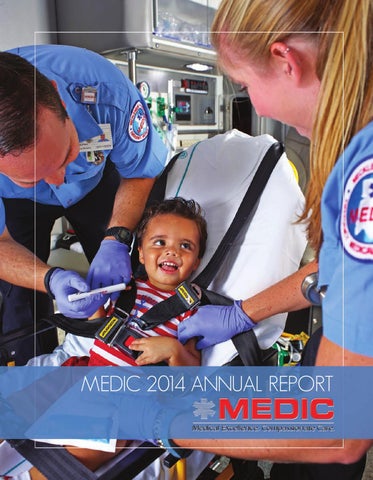
MEDIC 2014 ANNUAL REPORT
INTRODUCTION: AT A GLANCE................................................3 FROM OUR EXECUTIVE DIRECTOR.........................................4 PERFORMANCE System...............................................................................................................5 Research.......................................................................................................15 Finance.............................................................................................................17
TABLE OF CONTENT
COMMUNITY.............................................................................................................19 VISION...................................................................................................................................23 LEADERSHIP.....................................................................................................................24
MEDICAL EXCELLENCE. COMPASSIONATE CARE.
MISSION “To save a life, hold a hand and be prepared to respond in our community when and where our patients need us.”
-2-
EDs SERVED
10
TOTAL NUMBER OF COMMUNITY MEMBERS TRAINED IN CPR
1053 INTRODUCTION
FY ‘14 AT A GLANCE
CALLS FOR SERVICE
118,578 NUMBER OF TRANSPORTS
MEDICAL EXCELLENCE. COMPASSIONATE CARE.
93,964 NUMBER OF EMPLOYEES
489 RESIDENTS SERVICED
990,997 PERCENTAGE OF PATIENTS RATING MEDIC’S SERVICE AS EXCELLENT
71%
-3-
Serving the emergency medical services needs of the visitors and residents of Mecklenburg County is an honor that I share with all 489 employees of this Agency. Everyone within Medic knows the important role we play in the community and how they specifically contribute to the success of this Agency.
FROM OUR
EXECUTIVE DIRECTOR MEDICAL EXCELLENCE. COMPASSIONATE CARE.
Without clarity of purpose and a shared mission, achieving success can be very difficult during good times, much less when facing challenges. Never was this more evident than during FY ’14 when the Agency faced lower than forecasted transport volume and the negative consequences of the increasing variability of revenue sources. The reduction in revenue forecasts caused by these two developments required Agency leadership to adapt and prioritize in order to ensure the Agency’s core mission was not impacted. I am pleased to say this was successfully accomplished, but that would not have been the outcome had everyone in the Agency not been focused on the same goals. The targeted work Medic has done this year to recognize, understand and maximize the linkages within our EMS system allowed the Agency to not only meet the challenges presented, but rise above them. Leveraging these linkages - the interconnectedness of our processes, as well as our people - allowed us to better fully comprehend the meaning of our work and, in turn, more sharply focus our strategies in delivering medical excellence and compassionate care.
As a result, and in spite of the fiscal challenges presented, Mecklenburg EMS Agency posted some remarkable benchmarks against our Pillar Goals; the measures we use to ensure we provide quality care to the citizens of Mecklenburg County. The Agency also achieved unprecedented Sudden Cardiac survival rates, maintaining its status as among the top 1% of all EMS agencies nationwide for this performance outcome. Medic also reduced Total Time on Task (time the responding unit is assigned to a call until the time unit is available for re-assignment) this year by more than 500,000 minutes over the previous benchmark. While these measures highlight the Agency’s increased performance, the men and women of Medic did not lose sight of the person behind the patient. FY ’14 saw the highest patient satisfaction survey scores in the Agency’s history. As the healthcare landscape continues to grow more complex, it is the continued appreciation of this interconnectedness within the internal community of Medic that will equip us to continue to function as a High Performance EMS agency to our external community. FY ’14 was an example of that system and approach successfully at work. The following pages show those linkages and tell that story.
Josef H. Penner
-4-
Medical excellence and compassionate care are the hallmarks by which Medic defines itself. As a result, the Agency has developed key performance measures and pillar goals that keep each of the many women and men it takes to make the EMS system function focused clearly on the important services Medic provides to more than 1,000,000 residents and visitors to Mecklenburg County.
PERFORMANCE
SYSTEM
MEDICAL EXCELLENCE. COMPASSIONATE CARE.
When a member of the community calls 911 to request help for someone who is sick or injured, their expectation is that a well-trained crew will respond quickly, provide quality care, and deliver them rapidly to a facility which can meet their medical needs. Medic fulfills these expectations nearly 120,000 times each year, requiring an entire system of interconnected parts working seamlessly to deliver that care. Before a call for help is ever received, forecasting to reduce response times and costs is utilized, rigorous training is conducted, crews are scheduled, assets are prepared and allocated, and resources are deployed throughout our response area in anticipation.
DID YOU KNOW. . . n MEDIC’S FLEET OF 70 AMBULANCES LOG MORE THAN 2,650,000 MILES ANNUALLY. n LOGISTICS, RESTOCKING AND DEPLOYMENT OF THE AMBULANCE FLEET OCCURS 65 - 70 TIMES A DAY, 365 DAYS A YEAR. n NEARLY 25,000 UNIT PREVENTIVE MAINTENANCE CHECKS CONDUCTED IN-HOUSE, PER YEAR.
6- 5 -
Medic’s Central Emergency Dispatch Center (CMED) is the initial access point to the system of care for a patient. CMED serves as the primary dispatch point for Medic, Mecklenburg County first responders, and for Mecklenburg County fire departments, with the exception of the City of Charlotte Fire Department. These exceptional men and women work quickly to ascertain the location of a call, the primary complaint of the injured or ill, and then assign the appropriate resources. More than 40 certified Emergency Medical Dispatchers (EMDs) make up the team that answer 911 calls 24 hours a day, every day of the year and follow strict protocols established by the International Academies of Emergency Dispatch (IAED) to ensure consistency and quality of care.
FY ‘14 TEN MOST FREQUENT CALL TYPES
DID YOU KNOW. . . n MEDIC’S CMED IS ONLY 1 OF 21 EMERGENCY DISPATCH CENTERS IN THE WORLD TO HOLD DUAL FIRE AND MEDICAL ACCREDITATION FROM THE IAED. n MEDIC’S EMDS COLLECTIVELY POSTED A COMPLIANCE SCORE OF 97.6 ON A 100 POINT SCALE FROM IAED DURING FY ’14. CENTERS MUST MAINTAIN A SCORE ABOVE 90 TO REMAIN ACCREDITED. 7
Mecklenburg County first responders are a valuable link in the EMS system. The strategic design of this system enables Medic to utilize first responders to optimize response coverage. Having positive, efficient partnerships with these first responder departments is crucial for maintaining a seamless high quality system of care.
FY ‘14 EMS CALLS DISPATCHED BY FIRST RESPONDER DEPT.
MEDIC COUNTY CONTRACT COMPLIANCE BY PRIORITY LEVEL
-7-
Pillar Goal: ≤ 10:00 minutes FY ‘ 14 Performance: 9:35 Goal Outcome: Met P1 Trauma Scene Time Chart
For our most critical trauma patients, their best chance for survival lies in rapid recognition of their condition, stabilization and then transport to a designated trauma facility. The Agency’s goal is to have crews assess, begin treatment and initiate transport with Priority 1 trauma patients in less than 10 minutes; thus decreasing the time between injury and hospital intervention. The importance of the timeliness process and subsequent impact to patient outcomes is why we consider it a Pillar Goal for Medic. After initial response has been established by first responders, the Agency’s paramedics and emergency medical technicians (EMTs) deliver on the Agency’s true mission in the community: providing the highest level of pre-hospital care while transporting patients to the most appropriate facility. The demand and need for this service delivery has increased steadily since 1996. And FY ‘14 was no different. However, the forecasted growth was not as strong as the actual transport volume, particularly in the early months of the fiscal year. The forecasted transport volume growth was 6% over the previous fiscal year. In FY ’14, the Agency saw a 2.23% in growth.
-8-
HISTORICAL GROWTH IN RESPONSES AND TRANSPORT
RESPONSES BY PRIORITY LEVEL
-9-
TRANSPORTS BY PRIORITY LEVEL
Providing high quality pre-hospital care to a patient involves many factors including assessing the patient, determining immediate treatment needs, and efficiently transporting the patient to the appropriate medical facility. Medic monitors a set of key performance indicators in order to ensure consistency, quality, and proficiency of patient care.
- 10 -
Pillar Goal: ≤ 90 minutes FY ’14 Performance: 78 minutes Goal Outcome: Met Cardiac Triage Composite: Call Pick Up in CMED to Lesion Treatment ≤ 90 minutes
The amount of time from when an individual begins to experience symptoms of a heart attack until definitive treatment is received at a cardiac catheterization lab is directly linked to a patient’s overall outcome. Medic has worked closely with both area hospital systems to enable its paramedics to bypass the emergency department and take patients directly to the catheterization lab, greatly reducing the patient’s time to treatment. Because this time is so critical for producing a positive outcome in heart attack victims, it is a Pillar Goal for Medic.
DID YOU KNOW. . . n MEDIC AGAIN EARNED ACCREDITATION THROUGH THE COMMISSION ON ACCREDITATION OF AMBULANCE SERVICES (CAAS) IN APRIL OF 2014. n THE CAAS ACCREDITATION SIGNIFIES THE “GOLD STANDARD” OF QUALITY PATIENT CARE IN AMERICA'S MEDICAL TRANSPORTATION SYSTEM AND CARRIES REQUIREMENTS THAT EXCEED TYPICAL STATE AND LOCAL LICENSING. n MEDIC IS 1 OF ONLY 174 EMS PROVIDERS NATIONALLY TO EARN THIS SEAL, AND 1 OF JUST 4 IN NORTH CAROLINA.
- 11 -
DID YOU KNOW. . . n THE NATIONAL STANDARD FROM FIRST MEDICAL CONTACT TO CATHETERIZATION FOR A PATIENT EXPERIENCING A HEART ATTACK IS 90 MINUTES. HEART ATTACK PATIENTS TREATED BY MEDIC, ON AVERAGE, RECEIVE CATHETERIZATION IN LESS THAN 78 MINUTES FROM THE TIME THE 911 CALL IS RECEIVED.
Pillar Goal: > 85% FY ’14 Performance: 85.71% Goal Outcome: Met Cardiac Triage Composite: Accurate Determination Pre-hospital Chart
The accurate determination of the type of heart attack a patient is experiencing is a critical step in delivering the appropriate medical care and transporting to the appropriate hospital destination in a timely manner. Correctly utilizing the latest technological developments, providing advanced training and education of field crews, and intensifying collaborative efforts with our two hospital partners has allowed Medic to maintain a high level of performance in this area. This accuracy in determination is critical to improving heart attack patient survival outcomes, and for this reason it is a Pillar Goal measurement for Medic.
DID YOU KNOW. . . n MEDIC RECEIVED THE INAUGURAL 2014 MISSION: LIFELINE® EMS SILVER LEVEL RECOGNITION AWARD FROM THE AMERICAN HEART ASSOCIATION (AHA). THIS IS CURRENTLY THE HIGHEST AHA AWARD FOR DEMONSTRATED QUALITY IN STEMI (A TYPE OF HEART ATTACK RECOGNIZED BY CHANGES IN A PATIENT’S EKG) CARE BY EMS. 13
Pillar Goal: 40% FY ’14 Performance: 80% Goal Outcome: Met Cardiac Arrest: ROSC/Utstein chart
Cardiac arrest patients are among the most critical patients Medic treats. For a positive patient outcome, the system of care must work correctly and efficiently. A clear performance measure of this is the Return Of Spontaneous Circulation (ROSC) in patients as defined by the Utstein medical criteria, an industry standard. Because this outcome is a solid reflection of an EMS system’s overall performance, it is commonly used as an industry benchmark and is, therefore, a Pillar Goal.
DID YOU KNOW. . . n FOR FY ’14, MEDIC WAS AMONG THE TOP 1% OF ALL EMS AGENCIES NATIONALLY FOR OUT-OF-HOSPITAL SUDDEN CARDIAC ARREST SURVIVAL RATES.
- 13 -
DID YOU KNOW. . . n MEDIC SET A NEW AGENCY HIGH FOR FY ’14 WITH 71% OF PATIENTS RATING THEIR EXPERIENCE AS “EXCELLENT”. MORE THAN 96% RATED THEIR EXPERIENCE AS POSITIVE, GARNERING MEDIC THE 2014 FIVE STAR EXCELLENCE AWARD. THIS AWARD, GIVEN BY PROFESSIONAL RESEARCH CONSULTANTS (PRC), INC., HONORS HEALTH CARE FACILITIES AND PROVIDERS WHO SCORE IN THE TOP 10% OF PERFORMANCE MEASURES IN THEIR FIELDS WITHIN PRC’S NATIONAL DATABASE.
In order to achieve the best patient outcomes, the system of patient care must be tightly linked in order to deliver the right care at the right time and at the right place. Not only does Medic value the importance of these patient outcomes, but the patient’s experience with our personnel is important as well. Sometimes that means going beyond the clinical care by being a calming voice, providing a hand to hold, reassuring family members, and to many other little things that make the emergency experience a little less frightening. Medic’s EMDs, paramedics, and EMTs understand that this, too, defines quality patient care.
Pillar Goal: 68% FY ’14 Performance: 71% Goal Outcome: Met Patient Satisfaction Chart
To ensure patients have a positive overall experience, Medic conducts regular independent patient satisfaction surveys and focus groups aimed at developing specific areas for improvement. Teamwork among EMS personnel, displaying knowledge and skill, and current technology usage are consistently among the top drivers of a positive patient experience. Because patients are Medic’s top priority, this measurement is a Pillar Goal for the Agency.
- 14 -
RESEARCH The continued improvement of the system of care and the patient experience is an integral part of Medic’s mission and vision. For this reason, the Agency is committed to actively participating in relevant research and evidence-based studies that can help Medic continuously meet those objectives. Along with contributors from both area hospitals, the Research Committee participated in the following published clinical research in FY ’14:
Papers in Refereed Journals Infinger AE, Studnek JR (2014). An assessment of pain management among patients presenting to emergency medical services after suffering a fall. Prehospital and Disaster Medicine. 2014 Aug; 29(4):344-9. Schenfeld EM, Studnek JR, Heffner AC, Nussbaum M, Kraft K, Pearson DA (2014). Effect of pre hospital initiation of therapeutic hypothermia in adults with cardiac arrest on time-to target temperature. Canadian Journal of Emergency Medicine. Aug 1;16(0):26-33. Asimos AW, Ward S, Brice JH, Rosamond WD, Goldstein LB, and Studnek JR (2014). Out-of-Hospi tal Stroke Screen Accuracy in a State With an Emergency Medical Services Protocol for Routing Patients to Acute Stroke Centers. Annals of Emergency Medicine. April 16, 2014 (ePub ahead of print).
Refereed Abstracts Studnek JR, Skefos C, Infinger A, Garvey L (2014). A Characterization of STEMI Activations by Patient’s Prehospital Presenting Location. Poster presentation at the annual meeting of the National Association of Emergency Medical Service Physicians. Infinger A, Studnek JR, Vandeventer s (2014). Redefining the Roles for Cardiac Arrest: Testing the Util ity of a CPR Feedback Coach. Poster presentation at the annual meeting of the National As sociation of Emergency Medical Service Physicians. Studnek JR, Infinger A, Vandeventer S (2014). An Assessment of Chest Compression Quality Per formed On Scene versus in the Back of a Moving Ambulance. Poster presentation at the an nual meeting of the National Association of Emergency Medical Service Physicians. Musey P, Studnek JR, Infinger A, Campbell E, Rackley E, Garvey L (2014). Characteristics Of Patients Who Do Not Undergo PCI After Prehospital Cardiac Cathereization Lab Activation. Studnek JR, Vandeventer S, Infinger A, Penner J (2013). Improving out-of-hospital cardiac arrest: A rush to implement state of the science vs. a systematic approach. Oral presentation at the Institute for Healthcare Improvement Scientific Symposium.
- 15 -
Vandeventer S, Studnek JR, Infinger A, Penner J (2013). Assessing the quality of cardiopul monary resuscitation utilizing a vector of performance measures. Poster presentation at the Institute for Healthcare Improvement Scientific Symposium. Infinger A, Studnek JR, Vandeventer S, Penner J (2013). Introduction of performance coaching during cardiopulmonary resuscitation improves compression depth and time to defibrillation in out-of-hospital cardiac arrest. Poster presentation at the Institute for Healthcare Improvement Scientific Symposium.
Research Support Grant number: H34MC26201
Lerner (PI)
9/1/2013-8/31/2016
HRSA $900,000 Title: Development of the Charlotte, Houston, and Milwaukee Prehospital (CHaMP) Research Node. This project will develop an EMS Research Node Center (E-RNC) that is integrated into the Pediatric Emergency Care Applied Research Network (PECARN) while at the same time driven by EMS agencies and their providers. Role: EMSA Site Principal Investigator
- 16 -
FINANCE For Medic, evaluating performance does not stop with clinical outcomes and patient care; it also extends to fiscal responsibility. Maintaining a fiscally viable service delivery model is as critical as the overall quality of care that Medic delivers. In FY ’14, Medic received 24% of its funding from Mecklenburg County; the remaining 76% was primarily generated through fees for services delivered. This requires Agency leadership to remain acutely aware of the numerous variables that impact revenue in the healthcare world. Any changes to call volume, cancellation rates, reimbursement amounts or the payer mix of Medic’s patients will have an impact on revenue. Medic experienced changes to call volume and payer mix in FY ’14, resulting in lower than forecasted revenue. Swift recognition of these changes enabled Agency leaders to adjust spending accordingly, ensuring the fiscal year landed safely within budget.
FY ‘13/FY ’14 BUDGET
-17 -
FY’ 14 TO VARIANCE BUDGET
- 18 -
COMMUNITY
MEDICAL EXCELLENCE. COMPASSIONATE CARE.
While Medic’s primary purpose is to provide the highest quality pre-hospital medical care to the community, the Agency does not stop there at defining service or community. Medic places a high value on the internal community of men and women that come to work each day and make up the Mecklenburg EMS Agency. Providing support and creating a positive work environment all contribute to our ability to effectively carry out our mission. In an effort to improve the employee experience, Medic conducts monthly employee satisfaction surveys. From these survey results, Medic can measure the percentage of employees that rate Medic as “good” or higher, and the Agency can also identify target areas and projects that address changing employee needs and expectations. This internal community is Medic’s most valuable asset and for this reason, employee satisfaction is a Pillar Goal.
Pillar Goal: 81% FY ’14 Performance: 74% Goal Outcome: Did Not Meet Employee Satisfaction Survey Chart
- 19 -
Several members of the Medic community were also recognized this year for their outstanding service and dedication to the Agency’s mission. Three Medic employees were honored this spring in Washington D.C. as “Stars of Life” recipients. Medic’s ePCR Coordinator Ute Dorflinger, Operations Supervisor Don Overcash, and Operations Support Technician Jeff Lineberger joined EMS personnel from across the nation for three days of workshops, policy input, and recognition.
DID YOU KNOW. . . n THIS YEAR MEDIC RECEIVED THE AWLP “WORKLIFE SEAL OF DISTINCTION” AWARD, AHA GOLD LEVEL FIT-FRIENDLY WORKSITE AWARD, AND THE CHARLOTTE BUSINESS JOURNAL “HEALTHIEST EMPLOYER” FINALIST AWARD. ALL THREE OF THESE AWARDS RECOGNIZE AN EMPLOYER’S EFFORTS IN SUPPORTING A FOCUSED WORK-LIFE BALANCE WHILE PROMOTIING MENTAL AND PHYSICAL HEALTH INITIATIVES.
Paramedic Adamo Riascos was also honored in the spring for his service and community engagement as a representative of Medic. Riascos’ exceptional service while on the ambulance, in addition to his work in the Latino community with free health clinics and providing CPR training in Spanish, earned him the “Burnette-Nobles Public Safety Award”. The award is in honor of fallen CMPD officers John Burnette & Andy Nobles who were killed in the line of duty on October 5th, 1993. Medic’s service to the community does not just start and stop with the work done by 911 dispatchers, paramedics and EMTs, and care in an ambulance. Health and wellness checks, safety education, and injury prevention or just some of the other ways Medic engages with the community. For FY ’14, Medic also began a targeted social media initiative that launched in December 2013 and leveraged multi-media assets and a cross-functioning platform. The goals for the initiative included: n To become a more proactive source for timely, accurate and reliable information for our news partners and in turn, our community. n To become more responsive to the needs of our community through thoughtfully activated engagement campaigns that address relevant health, wellness and safety concerns. n To facilitate more effective communication and engagement with our employees.
- 20 -
Medic made great strides towards these goals by implementing customized Twitter channels, development of a more robust YouTube channel, maximizing video assets, and using a monthly strategic editorial calendar within the Public Relations and Communications department to address specific health, medical, and safety needs within the community.
DID YOU KNOW. . . n @MECKLENBURGEMS (PUBLIC) SAW A 131% INCREASE IN FOLLOWERS FROM 12/13-7/14. n LAUNCHED @MEDIC911PRESS ON 1/14, A PRIVATE TWITTER CHANNEL FOR ACTIVE, ACCREDITED PRESS MEMBERS ONLY. NOW AT NEARLY 200 MEMBERS. n MEDIC’S FACEBOOK PAGE GARNERED A 33% INCREASE IN “LIKES” FROM 12/13-7/14.
Pillar Goal: ≥ 44% FY ’14 Performance: 42% Goal Outcome: Did Not Meet Bystander CPR Rates by Fiscal Year
- 21 -
However, Medic’s most robust community engagement is still our Bystander CPR training initiative. Medic trained 1,053 citizens in Bystander CPR during Fiscal Year ’14. Bystander CPR can be crucial for patient outcomes because no one can initiate care quicker than the person standing right next to the patient experiencing Sudden Cardiac Arrest.
Receiving CPR helps a cardiac arrest patient to circulate oxygenated blood throughout the body, increasing the chances for survival. Medic understands the importance of CPR happening as quickly as possible and, therefore, measures the percentage of Sudden Cardiac Arrest patients who receive Bystander CPR with the goal of continually increasing that percentage. Its importance makes it a Pillar Goal for Medic. Another component of the Bystander CPR initiative falls under Medic’s Lucky Hearts Campaign. The program, in its sixth year, trains people in CPR in conjunction with donating Automated External Defibrillators (AEDs). Typically, houses of worship, schools, and public or government centers are recipients. This year, Medic and the Luck Hearts Campaign donated its 116th AED.
DID YOU KNOW. . . n A PERSON’S CHANCES OF SURVIVING SUDDEN CARDIAC ARREST DECREASE BY 10% FOR EVERY MINUTE WITHOUT CPR.
- 22 -
VISION
MEDICAL EXCELLENCE. COMPASSIONATE CARE.
The success that Medic has experienced to date can be attributed to numerous things- outstanding employees, excellent community partners, strong governance, focused leadership, and an unwavering commitment to continuous improvement. The healthcare landscape has gone through tremendous change over the years, and more is yet to come. Medic leadership invests a tremendous amount of energy analyzing and forecasting the possible impacts of healthcare reform, looking to ensure this Agency’s vision of the future is not only sustainable, but capable of meeting the diverse needs of the community we serve. These perspectives, along with a robust commitment to the patient experience drive our philosophy of medical excellence and compassionate care. They also combine to create and navigate our strategic objectives as an organization for the future to ensure that Medic is properly positioned to continue delivering world class out of hospital healthcare to the residents and visitors of Mecklenburg County. FY ‘15 STRATEGIC OBJECTIVES n Develop leaders who know what they are responsible for, are equipped and engaged and understand how their role and performance affects the organization. n Develop an informed and engaged workforce that understands Medic’s mission and their role in achieving it. n Improve the ambulance work environment so that it fits how employees do their work. n Develop an improved system for obtaining information about the needs of our patients.
- 23 -
2014 MECKLENBURG EMS AGENCY Board of Commissioners, Management Committee Other Agency Officers, Medical Control Board, and Quality Management Committee
BOARD OF COMMISSIONERS
LEADERSHIP
(Appointed by Mecklenburg County Board of Commissioners.) Tanya Blackmon - P/NH Matthew Hanley, MD - CMC Katie Kaney, Chair - CMC Dennis Phillips - CMC Paula Vincent, Vice Chair - P/NH Harry Weatherly - Mecklenburg County Tom Zweng, MD - P/NH
MANAGEMENT COMMITTEE
MEDICAL EXCELLENCE. COMPASSIONATE CARE.
(Appointed by Agency Board of Commissioners.) Katie Kaney – CMC Carol Hickey, Chair – Mecklenburg County Paula Vincent, Vice Chair – P/NH
FINANCE COMMITTEE (Appointed by Agency Board of Commissioners.) Carol Hale - CMC Dena Diorio - Mecklenburg County Melissa Masterton - P/NH
OTHER AGENCY OFFICERS (Appointed by Agency Board of Commissioners.) Doug Swanson, MD, Medical Director Shelly Forward, Finance Officer Joe Penner, Executive Director
- 24 -
MEDICAL CONTROL BOARD
MEDICAL CONTROL BOARD
(Appointed by Agency Board of Commissioners.) Voting Members Steven Folstad, MD – P/NH Mike Gibbs, MD – CMC Gary Niess, MD – P/NH Harry Sibold, MD Chair – P/NH Randolph Cordle, MD – CMC Mike Thomason, MD – CMC Brad Watling, MD - CMC Tom Zweng, MD – P/NH
(Appointed by Agency Board of Commissioners.AL Non-Voting Members Doug Swanson, MD, Medical Director Nancy Alexander, Presbyterian Hospital Jon Hannan, City of Charlotte Fire Department Katie Kaney, Carolinas Medical Center David Leath, Mint Hill Volunteer Fire Dept/First Responders Marcus Plescia, MD, Mecklenburg County Joe Penner, Medic Executive Director (BOCC Appointee Open) Community Representative
QUALITY MANAGEMENT (Appointed by Agency Board of Commissioners.) Voting Members Doug Swanson, MD - Medical Director, Chair Stuart Ramsey, RN – CMC Steven Folstad, MD – P/NH Mike Gibbs, MD – CMC Paula S. Swain, RN – P/NH Eric Hawkins, MD – CMC Stephen Wallenhaupt, MD – P/NH
Non-Voting Members Barry Bagwell, Deputy Director Marcus Plescia, MD, Mecklenburg County Joe Penner, Executive Director Kevin Staley, Deputy Director
MEDIC LEADERSHIP TEAM Josef H. Penner, Executive Director Dr. Doug Swanson, Medical Director Barry Bagwell, Deputy Director Kevin Staley, Deputy Director Jeff Keith, Deputy Director Shelly Forward, Finance Manager Dr. Jonathan Studnek, Quality Improvement Manager
- 25 -
- 10 -
Medic911.com
@MecklenburgEMS
facebook.com/MeckEms