APRIL 12, 2018
facebook.com/MeckEMS @MecklenburgEMS mecklenburg-ems-agency
PROJECT UPDATE - PREVENTABLE ACCIDENT REMEDIATION WORKGROUP AIM STATEMENT Develop a remediation process for employees following a preventable vehicle accident to avert reoccurrence. REASON FOR THE EFFORTS • 48 employees involved in a total 112 preventable accidents within a 36 month period with each employee having 2 or more accidents. • 26.7% of multiple incidents involving the same employee had a repetitive cause for the following incident. • 42% of reoccurring accidents lead to an increase in cost on the 2nd or 3rd preventable accident, with the average cost per initial accident being $764.41, while the average cost per subsequent accident is $2,159.15. • 13 accidents involved improper backing, 31 involved poor judgments, and 69 involved The Agency’s current post-accident process is as follows: • First preventable accident, he/she is assigned online training modules. • Second preventable accident within a revolving 36 month period, he/she is referred to his/ her Supervisor for disciplinary action. Each reoccurring preventable accident follows progressive discipline given by the assigned Supervisor. EXPECTED OUTCOMES A remediation process that will provide employees with information regarding their specific preventable accident cause and provide the em-
2
medic911.com
ployee with additional accident prevention tools to reduce the chance for reoccurrence. HOW DO WE KNOW THAT A CHANGE IS AN IMPROVEMENT? • Reoccurrence of preventable accidents will be reduced by 30% or more, • Reduced costs for vehicle repairs tied to reoccurring preventable accidents, • An increase in safe vehicle operations, and • An increased level of comfort in vehicle operations for the employees. WHERE ARE THEY NOW??? The Preventable Accident Remediation group has worked hard to establish ways to prevent recurring preventable accidents and to correct bad driving behaviors instead of encouraging corrective action in the form of discipline. In addition to providing instructor level driver’s training to FTOs, the workteam set an expectation that the techniques are reinforced through FTO time. Through research, the workeam learned that during FTO training backing hand signals were a concern. With this information, the team implemented universal hand signals. These hand signals will be re-introduced at in-service in April. The team has successfully developed a post-accident training program that removes the first preventable accident discipline (in most cases) and replaces it with one-on-one training specific to the accident cause. The training encourages open discussion about the accident and hands-on driving with a safety officer. The workteam is scheduled to meet with the Lead Team on April 11th.
PERIOD 3 (3/1/18 - 6/30/18) WEEKLY RESULTS THRU’ 4/6/18
EST. PAYOUT : $1000 FINANCIAL STANDING VS. BUDGET (GOAL: > 0.25%)
QUALIFYING CRITERIA Budget, Patient Satisfaction and Total Task Time goals must be met to turn on Performance Pay. If one of these three goals is not met, Performance Pay will not be paid.
ON TARGET
PATIENT SATISFACTION RATED AS “EXCELLENT” 68%
(GOAL: > 50%; LOW: 50%-59%; MID:60%-64%; HI: > 65%)
TOTAL TASK TIME
66:22*
(GOAL: < 70:00; LOW: 69:00-70:00; MID: 68:01-68:59; HI: < 68:00)
$0
$150 $300
$0
$150 $300
AGENCY DRIVER SAFETY SCORING AVERAGE (GOAL: > 8%) 9
PERFORMANCE CRITERIA ($100 EA.)
CMED MPDS HIGH COMPLIANCE (GOAL: > 70%) 74%
RESPONSE TIMES P1: 96.80%/P2: 95.45% (GOAL: P1, P2: > 90%; P3: > 85%) P3: 91.56%**
P1 TRAUMA SCENE TIMES (GOAL: < 10:00) 9:12 * TTT as of 3/14/18 **Response Times as of 3/23/18
The latest Performance Pay Tracking Period began on March 1. We are striving to meet the Patient Satisfaction goal of a ≥ 50% rating (experience as “Excellent”). In order to create a comfortable margin of performance, while continuing to improve the patient experience, we would like to share some feedback from recent patient focus groups. The two areas that patients value the most are: 1. Communication from the treating crew: “Explain treatment options and procedures” “Provide reassurance and compassionate communication with the patient”
SEPTEMBER 2014
2. Setting clear expectations: “Set transport length expectation” “Set a triage level expectation before arriving at the hospital”
medic911.com
3
APRIL PERFORMANCE APPRAISAL CHECK-INS The month of April is time for the Agency’s second quarterly Performance Appraisal Check Ins. In addition to updating progress on goals, measures, and competencies for this year, this is also when we start planning for next year. Specifically, supervisors will introduce Fiscal Year 2019 Strategic Objectives. The check-in includes the following discussion points: • Check In • Review competencies • Review current goals/objective measures • Discuss areas of needed improvement • Introduce strategic objectives for coming year • Start developing goals that support coming year Strategic Objectives Why are the Strategic Objectives important to Agency employees? Strategic Objectives (SO) help focus on improvement work, so all departments and individuals are aimed in the same direction. SOs allow the Agency to concentrate resources towards common goals and efforts, making processes more effective and efficient. What should I discuss with my Supervisor? Quarterly check ins are a time to specifically discuss opportunities for you to address your performance. You should discuss areas needing improvement, with an open mind to constructive feedback and genuine interest in seeking. You can also discuss your career development, whether that is becoming more proficient in your existing role or advancing knowledge and skills needed for a future role. What else should we discuss? This is also an opportunity to raise work related issues or concerns you have that are impacting your ability to be fully engaged here at Medic. For more information, email humanresources@medic911.com.
4
medic911.com
DEPARTMENT OVERVIEW: IT Medic’s IT Department is composed of nine full-time employees divided into teams based on skill set and level of expertise for each individual. The teams are split between Systems Engineers, Network Engineers, Helpdesk and Tech Support and Application Specialists (Siren and GIS). The IT department supports all 600+ medic employees, their active directory accounts and exchange email mailboxes amongst other IT related processes. The IT department troubleshoots and closes over 6,000 ServiceDesk support tickets a year and range from troubleshooting problems, design work maintenance, and upgrades. This support encompasses the entire IT infrastructure at HQ and DR (Disaster Recovery) offsite via multiple LANs (local area network) and WANs (wide area network). This enterprise infrastructure is fairly large; supporting over 300 end-user endpoints devices (PCs, laptops, tablets, and monitors). IT also supports over 100 different types of software applications throughout the agency. These applications and systems reside on over 250 virtual Window servers that run on hardware with the following specifications: 190 Proces-
BILLING CHEAT SHEET The Patient Financial Services (Billing) team strives to collect all funds owed to the Agency. This process relies heavily on the quality of documentation (tickets) collected by field crews. It also helps ensure compliance and the ability to achieve revenue targets. In the past, the Billing team has been asked if there is a “cheat sheet” that crews can use to collect needed, non-clinical information for a ticket. The
sor CPU Cores with a total of over 500 GHz of speed, over 250 TB (terabytes) of storage across 4 storage arrays and more than 3500 GB (gigabytes) of memory.
All of this computer power, network architecture and distribution of resources allows IT to provide 24/7 support to Agency employees and first responders. The department takes pride in their ability to support Medic’s network designs and implemented solutions, knowing that they deliver the necessary tools required for the Agency’s excellence in service. For more information, email Mike Fernandez at mikef@medic911.com
team has compiled a cheat sheet (see the Siren Billing Cheat Sheet email sent on March 1 at 7:52a). The sheet includes the most frequently asked questions or errors Billing encounters on tickets. If you have any questionsSEPTEMBER or concerns 2014 with the cheat sheet, please don’t hesitate to contact Shelly Miller at shellym@medic911.com. For more information, email Shelly Miller at shellym@ medic911.com
medic911.com
5
COMPLIANCE CLASS TRAINING In order to successfully complete this LMS training, please be aware of the following: Passwords and Login It is your responsibility to ensure that you have access to the Success Factors Learning Management System (LMS). You will need to log into the LMS to complete your compliance training and to set up your fit testing/TB test, if applicable. If you have never logged into the LMS then you will do the following: • Go to: https://medic911.plateau.com • User ID: Employee ID number with preceding zeros if applicable • Default Temporary Password is: ‘medic911’ If you have forgotten your password please use the “forgot password’ function. If that fails then contact Medical Services at eqs@medic911.com. Password resets will only occur during business hours • You must be sure that you have your correct
login information before attempting to complete work in the lab For complete instructions, visit https://www.medic911.com/extranet/my-medic/corporate-compliance If you have Corporate Compliance content questions, contact Pam Jackson at pamelaj@medic911.com. For technical questions, contact Medical Services at eqs@medic911.com ATTENDEES Jose Aguilar-Castillo, Daniel Baltimore, Lukas Biebinger, Nickolas Bringolf, Amy Broughton, Ty Brown, David Brown, Audrey Danko, Dena Gaston, John Gibson, Jeff Glenn, Jose Gonzalez, Daniel Hagemeyer, Charles Horne, Jeffrey Lineberger, Tim Marshburn, Randy McKown, Veronica Michaelis, Shelly Miller, David Moore, Arthur Nolan, Don Overcash, Tony Pattillo, David Phillips, Beth Rimmer, Don Shue, Barry Thornton, Deanna Vandeventer, Charles Voglewede and Tom Wright.
May 2018
• In-service dates coming soon. • Calendar week starts on Monday. Monday
Tuesday
Wednesday
Thursday
Friday
1
2
3
4
INSERVICE - 1000
INSERVICE - 1000
INSERVICE - 1600
INSERVICE - 1000
7
8
9
10
11
INSERVICE - 1000
INSERVICE - 1000
INSERVICE - 1000
INSERVICE - 1600
INSERVICE - 1000
14
15
16
17
18
INSERVICE - 1000
21
22
28
29
MEMORIAL DAY ADMIN OFFICES CLOSED
6
Saturday
medic911.com
23
24
30
31
SAFETY MEETING 1300 - 1500
Sunday 5
6
12
13
19
20
ASSESSMENT CENTER
SAFE TEEN
0800 - 1700
0700 - 1300
25
26
27
To:
All Field Personnel
From: Doug Swanson, MD, FACEP, FAEMS Medical Director, Mecklenburg EMS Agency Date:
04/02/2018
Re:
Monthly Memo
Review the following regarding Suspected Stroke Patients and the FAST-ED A portion of last month’s in-service was dedicated to the update of our stroke protocol and incorporation of the FAST-ED score It is imperative that this score be performed on all patients with a suspected stroke It is imperative that the exam is scored independently scored by both crew members o Perform the assessment together, score independently o Record each of your scores on the data collection sheets o Record only the primary care-giver’s score in the PCR We have partnered with the stroke teams at both Atrium Health and Novant Health in determining the best score of us to utilize and the data to be collected We anticipate significant QI data and important pre-hospital research findings related to stroke care and destination to be provided by the data we obtain through this process A video is being produced that will be uploaded on the LMS for providers to review to remain confident in their ability to score the FASTE-ED 10. Perform the Field Assessment Stroke Triage for Emergency Destination (FAST-ED) A. Facial palsy Normal/minor 0 Partial/complete 1 B. Arm weakness No drift 0 Drifts or some effort vs. gravity 1 No effort vs gravity/no movement 2 C. Speech changes None 0 Mild to moderate 1 Severe/aphasia/mute 2 D. Eye deviation None 0 Partial 1 Forced deviation 2 E. Denial/neglect None 0 SEPTEMBER Extinction to bilateral stimulus 1 Does not recognize on hand 2
2014
THANK YOU
medic911.com
7
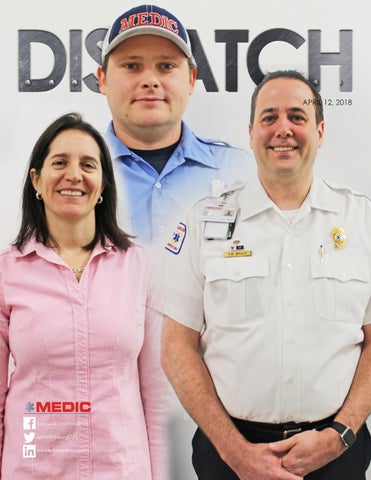
Who did you send to DC??? Receiving multiple nominations, Tim Brake, Nick Heasley and Sharon Taulbert head to the Stars of Life conference n June. Congratulations to Medic’s 2018 Star of Life recipients!!!
Tim Brake
MAY BIRTHDAYS Osborne, Chance W. Schott, Ryan M. Slack, Thomas D. Breeden-Alvarez, Angela Geck, Robin R. McCulloch, Nicolas E. Searcy, Victoria S. Wilkinson, James M. Danek, Luke J. Lawless, Megan M. Smith, Heather L. Jefferson, Cynthia C. Hancock, Russell M. McCormick, Masayo Y. Moore, Mary E. Glenn, Jeffrey S. Rider, Michael S. Wiseman-Floyd, Levy N. Woolf, Joseph B. Black, Ronisha S. Bodien, Scott M.
1 1 1 2 2 2 2 2 3 3 3 5 6 6 7 8 9 9 9 10 12
Nick Heasley
Brown, Lee H. Woods, Wilson O. Johnson, Angela R. Rowland, Bradley W. Roy, Robin A. Shaw, Benjamin J. Rucho, Zachary C. Conklin, Michael E. Lee, Lakisha D. Downs, Shauna Weber, Christopher Helms, Shannon J. MacIntosh, John P. Hanna, Robert R. Howard, Nicholas S. Kennedy, Chad A. Williams, Christopher T. Bielan, Kyle E. Geis, Daniel T. Brown, Christopher B. Murphy, Brian P.
12 13 15 15 15 15 16 17 17 18 19 21 21 24 24 25 25 27 28 29 29
Sharon Taulbert