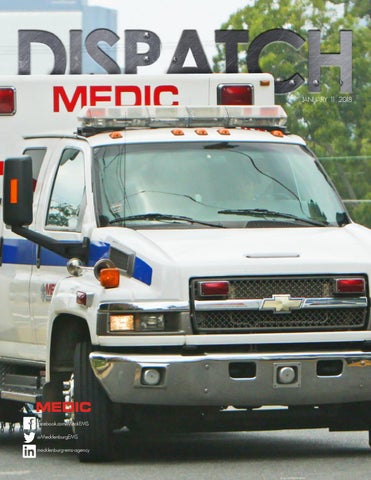
JANUARY 11, 2018
facebook.com/MeckEMS @MecklenburgEMS mecklenburg-ems-agency
SCIENCE OF IMPROVEMENT: HOW TO IMPROVE The Model for Improvement,* developed by Associates in Process Improvement, is a simple yet powerful tool for accelerating improvement. The model is not meant to replace change models that organizations may already be using, but rather to accelerate improvement. This model has been used very successfully by hundreds of health care organizations in many countries to improve many different health care processes and outcomes. The model has two parts: • Three fundamental questions, which can be addressed in any order. • The Plan-Do-Study-Act (PDSA) cycle** to test changes in real work settings. The PDSA cycle guides the test of a change to determine if the change is an improvement. FORMING THE TEAM Including the right people on a process improvement team is critical to a successful improvement effort. Teams vary in size and composition. Each organization builds teams to suit its own needs. SETTING AIMS The aim should be time-specific and measurable; it should also define the specific population of patients or other system that will be affected. ESTABLISHING MEASURES Teams use quantitative measures to determine if a specific change actually leads to an improvement. SELECTING CHANGES Ideas for change may come from those who work in the system or from the experience of others who have successfully improved. TESTING CHANGES The Plan-Do-Study-Act (PDSA) cycle is shorthand for testing a change in the real work setting — by
2
medic911.com
planning it, trying it, observing the results, and acting on what is learned. This is the scientific method adapted for action-oriented learning. IMPLEMENTING CHANGES After testing a change on a small scale, learning from each test, and refining the change through several PDSA cycles, the team may implement the change on a broader scale — for example, for an entire pilot population or on an entire unit. SPREADING CHANGES After successful implementation of a change or package of changes for a pilot population or an entire unit, the team can spread the changes to other parts of the organization or in other organizations. For more information, visit http://www.ihi.org/ resources/Pages/HowtoImprove/ScienceofImprovementHowtoImprove.aspx
PERIOD 2 (11/1/17 - 2/28/18) WEEKLY RESULTS THRU’ 1/8/18
EST. PAYOUT : $1000 FINANCIAL STANDING VS. BUDGET (GOAL: > 0.25%)
QUALIFYING CRITERIA Budget, Patient Satisfaction and Total Task Time goals must be met to turn on Performance Pay. If one of these three goals is not met, Performance Pay will not be paid.
ON TARGET**
PATIENT SATISFACTION RATED AS “EXCELLENT” 65% (GOAL: > 50%; LOW: 50%-59%; MID:60%-64%; HI: > 65%)
TOTAL TASK TIME
67:04
(GOAL: < 70:00; LOW: 69:00-70:00; MID: 68:01-68:59; HI: < 68:00)
$0
$150 $300
$0
$150 $300
AGENCY DRIVER SAFETY SCORING AVERAGE (GOAL: > 8%) 9**
PERFORMANCE CRITERIA ($100 EA.)
CMED MPDS HIGH COMPLIANCE (GOAL: > 70%) 74%**
RESPONSE TIMES P1: 96.79%/P2: 96.18% (GOAL: P1, P2: > 90%; P3: > 85%) P3: 93.25%
P1 TRAUMA SCENE TIMES (GOAL: < 10:00) 7:29* *PI as of 11/10/17 **Budget, Driving Score and MPDS as of 12/29/17
The latest Performance Pay Tracking Period began on November 1. We are striving to meet the Patient Satisfaction goal of a ≥ 50% rating (experience as “Excellent”). In order to create a comfortable margin of performance, while continuing to improve the patient experience, we would like to share some feedback from recent patient focus groups. The two areas that patients value the most are: 1. Communication from the treating crew: “Explain treatment options and procedures” “Provide reassurance and compassionate communication with the patient” 2. Setting clear expectations: “Set transport length expectation” “Set a triage level expectation before arriving at the hospital”
SEPTEMBER 2014
medic911.com
3
It’s that time of year again...time to focus on your New Year’s resolutions. Many people begin an exercise program, but abandon it before Easter. However, you can increase your chances for longterm success if you follow these five simple tips to achieve your fitness goals. Determine Your Readiness Make sure you’re both physically and mentally ready to start an exercise program. Tell your doctor you want to begin a fitness regimen and you want to make sure you’re healthy enough to start. Once you have been physically cleared to proceed, consider your mental readiness. How likely are you to stick with an exercise program once you begin? While there are many factors to consider, three are most significant. • • • • •
You are more likely to succeed if you: Have confidence in your exercise ability. Receive encouragement and support from those closest to you. Participate in an enjoyable form of exercise. More: 3 Tips to Achieve Your New Year’s Resolution
Create a Plan Before you start your exercise program, answer three questions. First, when will you exercise? Identify three days and times that are convenient for you and stick with those days so you are working out at the same time each week. Second, what type of exercise will you do? The best type of exercise is one you enjoy. Don’t worry about what everyone else is doing; pick an exercise that works for you. Choose from activities such as walking, cycling, running, swimming, weightlifting, skating, dancing, golf, handball, tennis and basketball. Third, how much time will you spend exercising? Start with as little as 10 minutes per session and slowly build up to at least 30 minutes per workout. Be Realistic One of the biggest problems with New Year’s resolutions is they can be extremely impractical. Setting goals is a great idea, but make sure they are realistic and feasible. For example, a goal to lose 12lbs by Easter is both reasonable and achievable. So is a goal to complete a 5K run by tax day. Conversely, a goal to complete a marathon by that date is unrealistic and potentially unsafe for newbie runners. Think of it as if you were building a house. Start slow (i.e., low intensity and duration), develop a solid foundation of fitness and then build upon that foundation as your fitness improves. To review al tips or for more information, visit https://www.active. com/fitness/articles/5-tips-to-achieve-your-new-year-s-fitnessgoals?page=1
4
medic911.com
THE END OF AN ERA By Larry Billotto Just in case all of your attention has been on our new beautiful building, Medic is proud to announce that all our Chevrolet trucks are gone. The Chevrolet trucks were the work horses of our fleet from 2003-2017 and these trucks served us well. In the beginning, there were points in time when fleet was not sure if they were going to work out due to the issues with the air ride suspension, bad fuel injectors and belts coming apart. However, through hardship we learned how to overcome these issues and make the Chevrolet trucks run as best as we could. Here are a few facts about these trucks. • They served us for a total of 20 million miles • Roughly 4,200 preventative maintenance checks were conducted during their lifetime.
The lessons learned during the era of the Chevrolet have reaped numerous benefits for us in the Fleet department. Some of these things include changing to a hydraulic rear suspension and moving the A/C Condensers to the top of the trucks. Our most important lesson was asking employees what some of their needs and concerns were to make their jobs easier. All of which contributed to the development of our new Dodge truck design. Medic’s Fleet Department will be starting its 20th year of service in 2018 and contains over 130 years of automotive experience. Most of the 6 members of the fleet department are ASE and EVT “Emergency Vehicle Technician” certified. We constantly strive to train and stay up to date with the latest technology to improve our efficiency and keep your fleet in tip top condition.
SEPTEMBER 2014 For more information, contact Larry Billotto at lawrenceb@medic911.com
medic911.com
5
COMPLIANCE CLASS TRAINING Corporate Compliance training is offered online via the LMS. You can go into the Computer Lab (formerly the Corporate Compliance classroom) or at your desk to complete the training. In order to successfully complete this LMS training, please be aware of the following: Passwords and Login It is your responsibility to ensure that you have access to the Success Factors Learning Management System (LMS). You will need to log into the LMS to complete your compliance training and to set up your fit testing/TB test, if applicable. If you have never logged into the LMS then you will do the following: • Go to: https://medic911.plateau.com • User ID: Employee ID number with preceding zeros if applicable • Default Temporary Password is: ‘medic911’ If you have forgotten your password please use the “forgot password’ function. If that fails then contact Elisabeth Mitchell at elisabethm@medic911.com. • Password resets will only occur during business
hours • You must be sure that you have your correct login information before attempting to complete work in the lab For complete instructions, visit https://www.medic911.com/extranet/my-medic/corporate-compliance If you have Corporate Compliance content questions, contact Pam Jackson at pamelaj@medic911.com. For technical questions, contact Elisabeth Mitchell elisabethm@medic911.com. ATTENDEES Jacob Atkinson, Mian Baker, Elijah Baumgarten, Casey Brennan, Mariann Earwood, Theodore Elias, Donald Eslick, Brendan Ferguson, Lindsay Garrison, Bailey Goodyear, Rheba Graham-James, Ethan Harrison, Alyssa Head, Monroe Hicks, Trueman Jones, Jean Jones, Shawn Kersey, Ryan Lowe, Mary Malinowski, Michael Malone, Christopher McNally, Christopher Noll, Karl Ottesen, Aaron Peppel, Kenny Phillips, Howard Pittman, Michael Pomeroy, Thomas Porcelli, William Ramsey, Teresa Rankin, Adamo Riascos, Bryan Runyan, Mary Shockley, Chris Simmons, Jamie Stanford, John Stroup, Kevin Treat and John Webster
January 2018
• In-service dates coming soon. • Calendar week starts on Monday. Monday
Tuesday
Wednesday
Thursday
Friday
Saturday
Sunday
1
2
3
4
5
6
7
8
9
10
11
12
13
14
15
16
17
18
20
21
27
28
NEW YEARS DAY – ADMIN OFFICES CLOSED
22
23
24 SAFETY MEETING 1300 - 1500
6
29 medic911.com
19 ASSESSMENT CENTER 0800 - 1700
MARTIN LUTHER KING DAY – ADMIN OFFICES CLOSED
30
31
25
26
SAFE TEEN 0700 - 1300
PROGRESSIVE SYSTEMWIDE COLLABORATION By Michael J Jacobs, EMT-P , Karl A. Sporer, MD, FACEP, FACP [Karl A. Sporer, MD, FACEP, Alameda County (Calif.) EMS coordinates with clinical stakeholders to improve cardiac arrest survival. Every year, more than 400,000 people suffer non-traumatic out-of-hospital cardiac arrest (OHCA) in the United States.1-4 This represents the third leading cause of death in industrial nations and accounts for eight times as many deaths as caused by car crashes.5,6 Previous decades have seen minimal improvement in survival outcomes,1 but recently, many systems are improving survival rates among OHCA patients by using a systems-based approach.7-12 Many successful EMS systems have adopted a number of changes to improve outcomes.13-16 Alameda County (ALCO) EMS has made a number of sequential changes over the last decade to improve OHCA care. This article addresses those changes and the resulting improvement in cardiac arrest resuscitation. The endorsed system of care for OHCA by ALCO EMS has been modeled after that of the decade-old and nationally recognized Take Heart America.16 All of the changes and system design are based upon recommended evidence-driven treatment strategies, techniques and devices that are consistent with the 2005, 2010 and 2015 American Heart Association (AHA) Guidelines.17,18 \These have included measures to improve the rate of bystander CPR through CPR-7, a community out-
reach education program using seventh graders and those they train; use of dispatch-assisted CPR; and the implementation of PulsePoint, a method of crowdsourcing citizen CPR. We’ve improved prehospital cardiac arrest treatments from 2005 to the present with annual training on pit-crew CPR, advanced airway placement with the availability of a supraglottic backup airway, intraosseous access and the use of mechanical chest compression devices. The training includes a renewed focus on high-quality CPR that emphasizes the correct compression rate and depth, minimal interruptions, full recoil of the chest wall, and proper use of the impedance threshold device (ITD), which was introduced systemwide in 2009 for both bag-valve mask ventilation as well as with any advanced airway. In 2009, ALCO EMS started collecting all data elements (dispatch, EMS and hospital) from the Cardiac Arrest Registry to Enhance Survival (CARES) and we continue to work closely with our receiving hospitals to obtain patient outcomes. After the third complete year of data collection in 2012, a marked increase was noted in both the return of spontaneous circulation (ROSC) and those discharged alive with a cerebral performance category (CPC) score of 1-2 (good neurologic function). Closer scrutiny and analysis of those data was published in Prehospital Emergency Care as an EMS systems qualSEPTEMBER 2014 ity improvement article.19 To read the entire article, visit http://www.jems.com/ articles/supplements/special-topics/ems-state-ofthe-science/progressive-systemwide-collaboration.
medic911.com
7
Cornelius, Katherine A. Emerson, James E. Leirmoe, Malcolm A. Patterson, Eli H. Catanzaro, Gabriella A. Ellison, Jacob R. Jeffares, Jason M. Pittman, Howard G. Abell, Jacob A. Martinsen, Courtenay S. Priola, Ian A. Voglewede, Charles D. Cail, James B. Green, Mali R. Hewitt, David A. Lamb, Robin M. Opelami, Oluwafemi A. Koelbl, Eric N. Ledbetter, Shellye R. Shreffler, Aaron A. Walker, Michael L. Kraynik, John C. Lee, Rebecca D. Ruiz, Emil M. Dorflinger, Ute E. Marcus, Taylor M. Toms, Carol A.
1 1 1 1 2 2 2 2 3 3 3 4 5 5 5 5 5 6 7 7 8 9 10 11 13 14 14
Dombo, David J. Rabell, Roberto A. Stegall, Matthew K. Balbuena, Josiah M. Edwards, Charles G. McPherson, Matthew R. Baumgarten, Mark Hayes, Stephen M. Robinson, Charles M. Harris, Benjamin E. Ferrante, Anthony R. Walcott, Shane A. Biebinger, Lukas M. Eslick, Donald C. Johnson, Jeffrey E. Kilguss, David J. Perkel, Alexis F. Earwood, Mariann T. Tetenbaum, Claudia M. Ailstock, Anna L. Pomeroy, Michael Varalli, Jonathan A. Wolfram, Jesse Moriarty, Meaghan E. Murphy, Jeremy T. Patrone, Alex P.
15 15 15 16 16 17 18 18 18 19 20 20 21 21 22 23 23 24 24 25 25 25 26 27 27 27
You shared your thoughts and we listened! The result: a redesigned Dispatch. Now bimonthly, the Dispatch will include improved content per the feedback shared in the November 2017 survey. So make sure you check out the Dispatch every other Thursday. The next Dispatch will be distributed on Thursday, January 25, 2018. For more information, email PR@medic911.com