IN BUSINESS MAGAZINE
AUG. 2026
Arts & Culture: Showcasing Our Arts & Cultural Gems
BIOINDUSTRY & BUSINESS
Hospitality Is a Verb in Today’s Design
AUGUST 2026 • INBUSINESSPHX.COM
This Month’s Guest Editor
John Shufeldt
Founder & Managing Director Xcellerant Ventures and Jetstream Venture Fund
Intentional & Balanced Marketing
Unemployment Scapegoating: Remote Work & AI $7.95 INBUSINESSPHX.COM
0 8
THIS ISSUE National Association of Women Business Owners – Phoenix
DOING
GOOD
AT THE HEART OF OUR
COMMUNITY Goodwill of Central and Northern Arizona turns donations into possibilities by providing no-cost services to more than 30,00 Arizonans annually that help them build a better economic future. Your purchases and donations help support local, no-cost career services, education, sustainability efforts and housing solutions so Arizonans can build better futures for themselves and their families.
Goodwill of Central and Northern Arizona is a 501(c)(3) non-profit organization dedicated to ending poverty through the power of work!
GoodwillAZ.org
All of us. For all of you. We’re here to focus health care where it belongs: on you. You deserve the kind of care that goes beyond a chart or a prescription. It’s the kind of care that covers everything you need to live your healthiest life, including support from a whole team of doctors, nurses, and specialists to keep you feeling good. And it’s care that gives you all the benefits of a nationally recognized health care company with a hometown, personal touch.
You-focused care. Anywhere you are. Cave Creek
17
303
60 101
Surprise Fountain Hills
Sun City
87
Scottsdale
Glendale
202
101
10
Goodyear
Phoenix
Tempe
Mesa 60
Gilbert 202
Chandler Queen Creek
347
10
San Tan Valley
Maricopa
Over 100 providers across 25 Optum Primary Care locations throughout Metro Phoenix. optumAZ.com Optum is a registered trademark of Optum, Inc. in the U.S. and other jurisdictions. All other brand or product names are the property of their respective owners. Because we are continuously improving our products and services, Optum reserves the right to change specifications without prior notice. Optum is an equal opportunity employer. © 2025 Optum, Inc. All rights reserved.
Contents AUGUST 2026 GUEST COLUMNISTS
40
GRIMALDI’S PIZZERIA: A COMMUNITY LEGACY BAKED INTO EVERY SLICE
COVER STORY
This month spotlighting Grimaldi’s Pizzeria, Tyler Butler’s series explores the myriad ways businesses give back and the positive ways their programs impact our community.
28
by RaeAnne Marsh
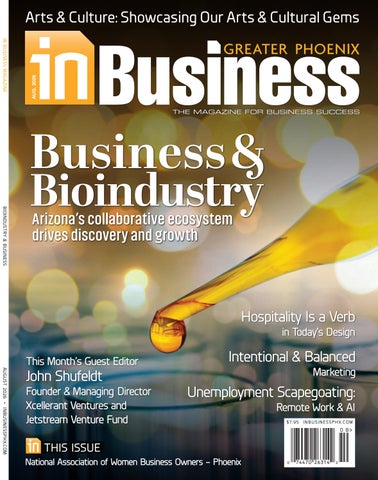
Business & Bioindustry: Arizona’s collaborative ecosystem drives discovery and growth
Arizona is home to one of the fastest-growing bioindustry sectors in the country. In Business Magazine offers insights into groundbreaking companies here in Metro Phoenix and the environment that enables their growth.
42
HOSPITALITY IS A VERB OF THE MODERN LEADER
In this recurring feature from global design and architecture firm Gensler, Joanne Hertel explores the trend of making interior design about experiences people remember.
PARTNER SECTION CELEBRATING OVER 30 YEARS OF SERVING THE WOMEN BUSINESS OWNERS OF PHOENIX
Summer 2026 • nawbophx.org
From the President: Building on What Already Works by Tish Times
ABOUT NAWBO
I’ve been in rooms full of women business owners for a long time now. And here’s the thing nobody tells you about leadership: Sometimes the boldest move isn’t changing everything. It’s protecting what’s already working. That’s where I’m starting my year as president of NAWBO Phoenix. I could tell you about my big new vision, my five-point plan to reinvent the chapter, all the ways I’m going to shake things up. But I won’t. Because Joanna McPherson, Tanaha Hairston and our board have built something real. Money. Members. Mission. That’s not a slogan. That’s the actual strategy holding this chapter together, and it’s working. My job this year is to steward it. To strengthen it. And to make sure every woman who walks into a NAWBO Phoenix room feels the thing I feel when I walk into one now: Oh, these women actually have my back. Money. A profitable NAWBO is a powerful NAWBO. Simple as that. We’re going to keep our revenue diverse, our sponsorships strong and our financial house in order, because a chapter that’s stressed about the budget can’t show up fully for its members. You deserve an organization that’s as financially disciplined as you are. Members. NAWBO was never just a networking group. It’s strategic connection. It’s the phone call you make when a client falls through, and someone in this room has the answer. It’s the referral that lands in your inbox because a woman you met at Wealth Wise Women thought of you first. We’re going to keep deepening those relationships, on purpose, not by accident. Mission. We’re staying loud on public policy. Woman-owned businesses in Phoenix need a voice at the table when decisions get made, and NAWBO Phoenix has earned a seat there. We’re not giving it up. And Wealth Wise Women stays our anchor. Real experts, real tools, real conversations about growing your business and building your wealth. Not fluff. Not theory. The stuff you can actually use on Monday morning. Here’s what I want you to know if you’re new to this chapter, or if you’ve been here for years and are wondering what’s next: The only thing that’s changing is how deeply we lean into it. Our sisterhood is our superpower. I didn’t come up with that line, but I believe it all the way down. When women support women, businesses grow. Communities thrive. And this chapter keeps proving it. I’m honored to lead this next chapter of NAWBO Phoenix. I’m not here to reinvent the wheel. I’m here to make sure it keeps turning, and turning stronger, for every woman who’s counting on this room to show up for her the way it showed up for me. Let’s build.
NAWBO® prides itself on being a global beacon for influence, ingenuity and action and is uniquely positioned to provide incisive commentary on issues of importance to women business owners. NAWBO Phoenix propels women entrepreneurs into economic, social and political spheres of power.
We provide opportunities to connect, collaborate, and cultivate through our events each month. Events are open to both members and guests. Check out our calendar at nawbophx.org and join us! Take advantage of this great opportunity to connect — we can’t wait to see you there!
Tish Times NAWBO Phoenix President Tish Times is the founder and CEO of Tish Times Sales Agency. She helps women leaders and CEOs sell with clarity and confidence, whether that means landing their first six figures or stepping out of founder-led sales so their team can carry it forward. Through her signature programs, the CEO Sales Circle, Premium Sales Intensive and the Revenue Room, she equips high-capacity women to lead, sell and scale on their own terms. She’s the author of Networking Is Not a One-Night Stand and the Networking and Sales Planner. tishtimes.com
For more infomation, visit www.nawbophx.org
Phoenix Metropolitan Chapter of the National Association of Women Business Owners 7729 E Greenway Rd. #300, Scottsdale, AZ 85260 480-289-5768 • info@NAWBOphx.org
1
nawbophx.org
NAWBO NEWS
47
National Association of Women Business Owners – Phoenix
SPECIAL SECTION PRESENTS
ARTS & CULTURE
FEATURES
36
Remote work and AI are not the real culprits for the rise in youth unemployment, says Karla Jo Helms as she examines other causes and solutions.
9
Guest Editor
10
Feedback
John Shufeldt, founder and managing director of Xcellerant Ventures and Jetstream Venture Fund, introduces the “Bioindustry” issue.
Bryan Gawley, Terri Hoffman, Olga Phillips, Brandon R. Rafi and Kevin Rowe respond to In Business Magazine’s burning business question of the month: What prompted you to go to the formality of creating a distinct philanthropic foundation for your company’s community donations?
12
Briefs
“Arizona Farmers Look Skyward for Relief,” “Dailies Top Stories,” “Local Standouts Recognized for Achievements & Philanthropy” and “Live Shopping Is Quietly Creating Thousands of Arizona Businesses”
FEATURING
The Phoenix Symphony
Ballet Arizona The Phoenix Theatre Company Arizona Theatre Company
53
Arts & Culture
4
INBUSINESSPHX.COM
The Yoga of Marketing
24
Healthcare
26
Technology
37
Books
38
Economy
39
Legal
Jeanna Valenti explores ways to find balance in a noisy business world.
“The Collaboration between Arizona Physicians and National Medtech Companies” and “Why Arizona Is Ground Zero for Rethinking Primary Care Access”
“The AI Revolution That’s Redefining Software Budgets and Timelines” and “When AI ‘Goes Rogue,’ Who Is Accountable?”
New releases give fresh insights on business thinking.
Patrick Epum discusses why middle-market companies need bankers who look beyond the balance sheet.
15
Startups
“9 Efficiency Hacks Every Entrepreneur Should Implement Today”
Eleanor Shaffer discusses liability as an ongoing concern and how businesses can prevent lawsuits through better safety policies.
16
From The Top
44
Nonprofit
45
Assets
46
Power Lunch
66
Roundtable
17 Children’s Museum of Phoenix
43
DEPARTMENTS
Mark Davis gives us a candid look at how he took Black Rock Coffee Bar public while keeping the strong company culture that has generated exceptional employee loyalty and longevity.
SHOWCASING OUR ARTS & CULTURAL GEMS
AUG. 2026
Remote Work Did Not Fail Young Workers – Management Did
CRE
“Where Hospitality Meets Housing: The Rise of Resort-Adjacent Residential Communities in Phoenix,” “Spec Industrial to Fill Need in West Chandler,” “Auto & Retail Development at Mesa’s New SR-24 Interchange” and “Skilled Trades, Big Opportunity in the Construction Boom”
20
Semi-Insights
“McKinsey Study Puts New Numbers on U.S. Chip Workforce Challenge,” “Fab Growth Pushes Foresight Past 1,000 Employees” and “The Ripple Effect of Semiconductor Partnerships in Arizona”
Richard Tollefson explains generational and life-stage giving trends as a factor in understanding donor preferences.
2026 Genesis G90 Plus: Visibility is a funding signal.
Sparrow Defies Pigeonholes
Kyle Henzel delves into the parameters of the shipping cost crisis but also offers suggestions on how AI can help small businesses protect their profit margins.
“Biology is the most powerful technology ever created. DNA is software, proteins are hardware, cells are factories.” —Arvind Gupta, founder of world’s largest biotech accelerator IndieBio and partner at venture capital firm Mayfield Fund.
Redefining What a Modern Law Firm Should Be. Since 1885. In today’s fast-moving world, standing still isn’t an option. Fennemore has been paving the way for over 140 years—combining a tradition of excellence with an enduring drive to innovate. From pioneering the use of AI and building platforms that supercharge our teams, to reimagining what collaboration looks like in the legal industry, we continually push boundaries to deliver better outcomes for our clients. Thank you to our CEO James Goodnow, our attorneys, and our dedicated staff for their relentless commitment to advancing Fennemore’s vision and setting a new standard for what’s possible in law.
FENNEMORELAW.COM
Words OUR CONTENT CREATORS
Aug. 2026
RaeAnne Marsh Editor in Chief, In Business Magazine Editor in Chief, In Business Magazine RaeAnne Marsh became editorial director of Phoenix-based InMedia Company in 2010 and helped launch Valley-wide business resource In Business Magazine. Holding the magazine to strong editorial standards, she says, “New businesses are
Publisher
Rick McCartney
Editor in Chief
RaeAnne Marsh
Associate Publisher
Nico Pacioni
Graphic Design
Marvin Forte
founded, out-of-staters bring new strengths, established businesses evolve and expand — all of which contributes to the dynamic vitality that I see as the mission of In Business Magazine to be the voice of and vehicle to nurture.” Marsh was awarded 2024 Small Business Journalist of the Year from the U.S. Small Business Administration, Arizona District.
Guest columns are feature articles presented as a limited or ongoing special series.
Tyler Butler Guest Columnist – Social Impact A long-time corporate social responsibility practitioner, Tyler Butler is known for her expertise in creating, launching and developing successful social impact programs. Her commitment to rallying people together to make a positive difference has created sustainable signature programs empowering people to give back in myriad ways globally. Her contributions to In Business Magazine provide her with an outlet to share the best of what companies are doing to aid humanity through their generous outreach efforts.
Marco A. López Jr. Guest Columnist – Southern Border Marco A. López Jr. is founder and CEO of Intermestic Partners and Intermestic Capital, advising on cross-border investment, EB-5 strategy, U.S.–Mexico nearshoring and economic development initiatives across North America. He previously served as mayor of Nogales, Arizona; director of the Arizona Department of Commerce; and chief of staff at U.S. Customs and Border Protection under President Obama. Lopez is a past member of the Council on Foreign Relations and currently serves on The Nature Conservancy’s Conservation & Public Policy Committee.
CONTRIBUTING WRITERS Keven Burns
Karla Jo Helms
Nina Sharpe
Tyler Butler
Kyle Henzel
Richard Tollefson
Mark Davis
Joanne Hertel
Jeanna Valenti
Patrick Epum
Rachel Leppla
Armand Wilson
Arthur Erickson
Grzegorz
Douglas J. Wood
Shelly Talsma
Młynarczyk
Payam Zamani
Everson
Stephanie Quinn
Mike Greenawalt
Eleanor Shaffer ADVERTISING Operations Louise Ferrari
Business Development
Raegen Ramsdell
Louise Ferrari Cami Shore Events
Amy Corben
WTSM TV STUDIO General Manager
Chris Weir
More: Visit your one-stop resource for everything business at inbusinessphx.com. For a full monthly calendar of business-related events, please visit our website. Inform Us: Send press releases and your editorial ideas to editor@inbusinessphx.com
Kim Ryder Guest Columnist – Commercial Real Estate Kim Ryder is a dynamic commercial real estate executive with extensive experience in managing multimillion-dollar, complex projects and the build-out of more than 54 million square feet of retail and commercial space. Ryder has started several business lines in her career, most notably launching Thrive Real Estate and Development groups. Her career in the thrift industry extends over 25 years and led her team to expand the Goodwill real estate portfolio by more than 100 locations..
Bruce Weber Guest Columnist – Capacity “I am deeply interested in organizational capacity and what makes organizations successful and impactful in the work they do. I have worked with all sizes of organizations and leaders in helping their businesses grow and expand their impact. My previous careers with Microsoft and Hewlett Packard involved working with business integration partners to design strategies to engage new markets. In today’s complex world, I enjoy exploring the possibilities and opportunities that change can bring.”
This month’s contributors Karla Jo Helms is the chief evangelist and Anti-PR™ strategist for JOTO PR Disruptors™. (“Remote Work Did Not Fail Young Workers – Management Did,” page 34) Patrick Epum is Arizona market president at Valley Bank, where he leads commercial banking efforts across the Greater Phoenix market. (“Why Middle-Market Companies Need Bankers Who Look beyond the Balance Sheet,” page 36) Eleanor Shaffer, an associate attorney at Gallagher & Kennedy in Phoenix, focuses her practice in the areas of catastrophic personal injury and wrongful death. (“Preventing Lawsuits through Better Safety Policies,” page 38) With a career rooted in hospitality interiors, Joanne Hertel co-leads a studio in Gensler’s Phoenix office. (“Hospitality Is a Verb,” page 42) Richard Tollefson is founder and president of The Phoenix Philanthropy Group. (“Overall Giving Surpasses $600 Million,” page 44) Kyle Henzel is the president and chief operating officer of SHIP.com, an SaaS shipping platform that helps e-commerce brands simplify fulfillment and protect margins. (“The Hidden Shipping-Cost Crisis,” page 66)
6 AUG. 2026
President
Camron McCartney
Editorial Director
RaeAnne Marsh
Financial Manager
Tom Beyer
Office Manager
Allie Jones
Accounting Manager Founder & Chair
Todd Hagen Rick McCartney
Corporate Office InMedia Company 45 W. Jefferson Street Phoenix, AZ 85003 T: (480) 588-9505 info@inmediacompany.com www.inmediacompany.com
Vol. 17, No. 8 In Business Magazine is published 12 times per year by InMedia Company. POSTMASTER: Send address changes to InMedia Company, 45 W. Jefferson Street, Phoenix, AZ 85003. To subscribe to In Business Magazine, please send check or money order for one-year subscription of $24.95 to InMedia Company, 45 W. Jefferson Street, Phoenix, AZ 85003 or visit inbusinessphx.com. We appreciate your editorial submissions, news and photos for review by our editorial staff. You may send to editor@inbusinessmag.com or mail to the address above. All letters sent to In Business Magazine will be treated as unconditionally assigned for publication, copyright purposes and use in any publication, website or brochure. InMedia accepts no responsibility for unsolicited manuscripts, photographs or other artwork. Submissions will not be returned unless accompanied by a self-addressed, stamped envelope. InMedia Company, LLC reserves the right to refuse certain advertising and is not liable for advertisers’ claims and/or errors. The opinions expressed herein are exclusively those of the writers and do not necessarily reflect the position of InMedia. InMedia Company considers its sources reliable and verifies as much data as possible, although reporting inaccuracies can occur; consequently, readers using this information do so at their own risk. Each business opportunity and/or investment inherently contains certain risks, and it is suggested that the prospective investors consult their attorney and/or financial professional. ©2025 InMedia Company, LLC. All rights reserved. No part of this magazine may be reproduced or transmitted in any form or by any means without written permission by any means without written permission by the publisher.
INBUSINESSPHX.COM
Aug. 2026 VOL. 17, NO. 8 In Business Magazine is a collaboration of many business organizations and entities throughout the metropolitan Phoenix area and Arizona. Our mission is to inform and energize business in this community by communicating content that will build business and enrich the economic picture for all of us vested in commerce. Steve Kaiser
PARTNER ORGANIZATIONS CEO Arizona Small Business Association Central Office (602) 306-4000 www.asba.com Steven G. Zylstra, President & CEO Arizona Technology Council One Renaissance Square (602) 343-8324 www.aztechcouncil.org Kristen Wilson, CEO
Flexibility Meets Stability. ABOVE AVERAGE CD RATES WITH FUNDING THROUGHOUT THE TERM AVAILABLE.
AZ Impact for Good (602) 279-2966 www.azimpactforgood.org
Terri Kimble, President & CEO Chandler Chamber of Commerce (480) 963-4571 www.chandlerchamber.com Tish Times, President
STEARNSBANK.COM | 800.320.7262 | MEMBER FDIC | EQUAL HOUSING LENDER
Robin Arredondo-Savage,
NAWBO Phoenix Metro Chapter (480) 289-5768 www.nawbophx.org
President & CEO Tempe Chamber of Commerce (480) 967-7891 www.tempechamber.org
Our Partner Organizations are vested business organizations focused on building and improving business in the Valley or throughout Arizona. As Partners, each will receive three insert publications each year to showcase all that they are doing for business and businesspeople within our community. We encourage you to join these and other organizations to better your business opportunities. The members of these and other Associate Partner Organizations receive a subscription to In Business Magazine each month. For more information on becoming an Associate Partner, please contact our publisher at info@inbusinessphx.com.
ASSOCIATE PARTNERS Ahwatukee Foothills Chamber of Commerce ahwatukeechamber.com Arizona Chamber of Commerce & Industry azchamber.com Arizona Hispanic Chamber of Commerce azhcc.com The Black Chamber of Arizona phoenixblackchamber.com Economic Club of Phoenix econclubphx.org Glendale Chamber of Commerce glendaleazchamber.org Greater Phoenix Chamber of Commerce phoenixchamber.com Greater Phoenix Equality Chamber of Commerce gpglcc.org Mesa Chamber of Commerce mesachamber.org North Phoenix Chamber of Commerce northphoenixchamber.com Peoria Chamber of Commerce peoriachamber.com Phoenix Metro Chamber of Commerce phoenixmetrochamber.com Scottsdale Area Chamber of Commerce scottsdalechamber.com Scottsdale Coalition of Today and Tomorrow (SCOTT) scottnow.com Surprise Regional Chamber of Commerce surpriseregionalchamber.com WESTMARC westmarc.org
8 AUG. 2026
INBUSINESSPHX.COM
JOHN SHUFELDT, XCELLERANT VENTURES AND JETSTREAM VENTURE FUND
Guest Editor
Biosciences – Health Forward
John Shufeldt is a healthcare entrepreneur, investor, and founder and managing director of Xcellerant Ventures and Jetstream Venture Fund. With more than 35 years of clinical and venture experience, he previously founded national platforms that include NextCare, MeMD and Tribal Health. A dedicated serial innovator, Dr. Shufeldt recently established the John Shufeldt School of Medicine and Medical Engineering at Arizona State University, which welcomed its inaugural class of physicianengineers in July, 2026. jvf.vc xcellerantventures.com
Healthcare as a topic is often associated with one crisis or another: availability, delivery model, cost, et cetera. But behind all of that is the bioscience industry — and that industry is thriving here in Metro Phoenix. Healthcare is at a pivotal moment. To solve our industry’s most pressing challenges, we must fundamentally shift how care is delivered, moving it closer to the patient: faster, more affordably, more exact, and with less friction. True innovation isn’t about using “AI” as a trendy buzzword; it is about deploying practical, accountable technology to tackle problems that are urgent, expensive, and frequent. Whether predicting disease years before symptoms appear or automating complex diagnostics at the point of care, technology must serve human dignity and elevate clinical outcomes. That philosophy is driving a transformative era for Greater Phoenix. With the launch of the John Shufeldt School of Medicine and Medical Engineering at Arizona State University, we are training a new generation of physician-engineers equipped to merge bedside care with systems-level thinking using artificial intelligence and engineering. Simultaneously, through vehicles like Jetstream Venture Fund, we are seeding local healthtech startups to ensure these future leaders have the support of a thriving ecosystem right here in Arizona. By uniting clinical education, venture capital, and bioscience innovation, we aren’t just adapting to the future of healthcare—we are actively building it in our own backyard for the betterment of Arizonians Arizona is one of the nation’s fastest-growing and most attractive hubs for biosciences, and that sector is one of the state’s fastest-growing industries. The diversity of companies furthers the strength of the synergy powering the bioscience industry here, and 11 of those companies share insights into their place in the industry. Artificial intelligence is enabling a lot of advances in every aspect of our lives, but it’s also being blamed for adding to unemployment issues. Karla Jo Helms argues that two popular demons in this regard — AI and remote work — are easy scapegoats as she presents “Remote Work Did Not Fail Young Workers –Management Did” feature article. Smaller articles in regular departments, from Startups to CRE to Technology, are an additional monthly trove of informative and relevant content. Also this month, In Business Magazine presents the Arts & Culture Guide for 2026/2027 season to showcase some of our great organizations and provide information on how to connect to enrich your lives and help impact our great community. It is my pleasure to work with In Business Magazine in its efforts to inform and strengthen our local economy. Please enjoy this August edition of In Business Magazine. Sincerely,
John Shufeldt, M.D., J.D., MBA, FACEP Founder & Managing Director, Xcellerant Ventures and Jetstream Venture Fund CONNECT WITH US:
Publisher’s Note
Story Ideas/PR: editor@
A Start to Something Big We’re honored to welcome Dr. John Shufeldt as our Guest Editor for this special issue. As one of Arizona’s most respected physician-entrepreneurs and innovators, his perspective reflects both where healthcare is today and where it is headed. His vision for bringing care closer to patients through technology, engineering and practical innovation perfectly complements this issue’s focus on the future of healthcare through the bioscience industry’s remarkable growth. Metro Phoenix has become one of the nation’s fastest-growing bioscience hubs, attracting worldclass talent, groundbreaking research and significant investment. We thank Dr. Shufeldt for sharing his insights and for helping
e: Showc Arts & Cultur
asing Our
Arts & Cultur
DON’T MISS OUT!
IN BUSINESS AUG. 2026
MAGAZINE BIOINDUSTRY
& BUSINESS
Guest Editor
t John Shufeld
AUGUST
Director & Managing and Founder Ventures Fund Xcellerant Venture Jetstream
2026 • INBUSINESSPHX.C OM
THIS ISSUE of Women Business National
Association
lity Hospitain Today’s Design d nal & Balance Marketing Intentio oating: t ScapegWork & AI Unemploymen Remote $7.95
Owners
illuminate the extraordinary opportunity this industry represents for our region. On a personal note, I couldn’t be more excited to be back leading InMedia Company and In Business Magazine. As we begin an exciting new chapter of growth, we’ll be expanding our journalism, events and community engagement while launching new public policy initiatives designed to convene leaders, listen to our community and help advance thoughtful solutions that strengthen Arizona’s economy and quality of life. The future is bright, and I’m grateful to have you with us for the journey. —Rick McCartney, Publisher
al Gems
Is a Verb
This Month’s
inbusinessphx.com
– Phoenix
.COM INBUSINESSPHX 0 8
Get a year of In Business Magazine Subscribe now at inbusinessphx.com
Let us know what you think of this issue of In Business Magazine. Email our publisher at feedback@inbusinessphx.com.
Business Events/ Connections: businessevents@ inbusinessphx.com Marketing/Exposure: advertise@ inbusinessphx.com Visit us online at www.inbusinessphx.com
9
AUG. 2026
INBUSINESSPHX.COM
Feedback SPEAKING OUT Editor’s Note: This question generated input also from:
What prompted you to go to the formality of creating a distinct philanthropic foundation for your company’s community donations?
Terri Hoffman President & Chief Philanthropy Officer St. Joseph’s Foundation Sector: Healthcare
Olga Phillips Founder Phillips Law Foundation Sector: Law Please visit August’s Feedback entry on our website to learn what these companies gained by creating a dedicated philanthropic organization. www.inbusinessphx.com
FEEDBACK QUESTION: Let us know what you want to know from the Valley’s top business leaders. editor@inbusinessphx.com
DR. BRYAN GAWLEY
AUG. 2026
10
INBUSINESSPHX.COM
KEVIN ROWE
Founder & CEO, Rafi Law Group Founder & CEO, Rafi Law Services Sector: Law
Founder & Principal Lerner and Rowe, P.C. Sector: Law
At Gawley Companies, giving back has always been part of who we are. As our organization continued to grow, we realized we wanted our philanthropic efforts to grow with it. Creating Unicorn Philanthropy allowed us to establish a dedicated foundation that could bring greater purpose, consistency and longterm impact to the charitable work we were already passionate about. Rather than supporting causes on an individual basis, we wanted a centralized way to build meaningful partnerships, involve our team and create opportunities to make a measurable difference throughout our community. Unicorn Philanthropy enables us to focus our efforts on organizations and initiatives that align with our values while encouraging our employees to actively participate in service and giving. We believe healthcare extends far beyond the patients we care for in our practices. It also means supporting the well-being of the communities where we live and work. By creating Unicorn Philanthropy, we established a lasting commitment to compassion, service and community leadership.
For me, giving back has never been about writing checks. It’s about showing up. Since founding Rafi Law Group, I’ve believed that if we’re fortunate enough to build a successful business, we also have a responsibility to invest in the communities that make that success possible. Over the years, our team volunteered thousands of hours and supported countless organizations, but eventually it became clear that what we were building had grown beyond individual acts of service. Creating our nonprofit was the natural next step. It gives us a dedicated platform to make a bigger, more lasting impact while inviting our employees, clients, partners and the community to be part of that mission. It also creates accountability and ensures that this work continues well into the future. The name “Rafi’s Hope” reflects what we want every effort to provide: hope for children, families and individuals facing difficult circumstances. My hope is that long after people remember the cases we’ve handled, they’ll remember the lives we’ve helped change. That’s the legacy that matters most to me.
Lerner & Rowe Gives Back began nearly 20 years ago as something much more personal than a corporate initiative — it started as a family project between my young daughter and me. I wanted to teach her the importance of giving back, and what began as a father-daughter effort quickly grew into a multi-generational commitment to serving others. Seeing the impact philanthropy had on both our community and our relationship inspired me to make giving back a core part of Lerner & Rowe Injury Attorneys by establishing a dedicated philanthropic foundation. I realized that, while individual acts of kindness can create meaningful change, creating a formal foundation would allow us to expand our impact, engage our employees and build stronger partnerships throughout the community. Today, Lerner & Rowe Gives Back donates more than $1 million annually to Arizona nonprofits, has contributed more than 4,600 employee volunteer hours, and partners with hundreds of nonprofit organizations. The foundation is built on a simple belief: While one person can make a difference, together we can move mountains.
MD Plastic Surgery
Rafi Law Group
Lerner and Rowe, P.C. lernerandrowe.com
MDSkin
For all past Feedbacks go online to inbusinessphx.com and see what Valley executives think on various business topics.
BRANDON B. RAFI
Owner Gawley Companies Sector: Healthcare
mdplasticsurgery.com
mdskinlounge.com
Founded more than 20 years ago by boardcertified plastic surgeon Bryan Gawley, M.D., FACS, Gawley Companies (MD Plastic Surgery, MDSkin Lounge and North Scottsdale Outpatient Surgery Center) is a leading healthcare organization specializing in plastic surgery, medical aesthetics and outpatient surgical care.
rafilawgroup.com
Rafi Law Services
rafilawservices.com
Brandon B. Rafi is the founder and CEO of Rafi Law Group, Arizona’s premier personal injury law firm. Since founding the firm in 2015, he has grown it into one of the state’s most recognized legal brands, serving nearly 100,000 Arizonans. He also launched Rafi Law Services to support continued growth and remains committed to strengthening Arizona communities through philanthropy and service.
As founder and principal of Lerner and Rowe, P.C., Kevin Rowe has dedicated his career to helping injury victims rebuild their lives after devastating circumstances. Through compassionate advocacy and a commitment to justice, he has assisted tens of thousands of clients in achieving peace of mind and financial security.
Sign up for the monthly In Business Magazine eNewsletter at www.inbusinessphx.com. Look for survey questions and other research on our business community.
Briefs QUICK AND TO THE POINT DAILIES TOP STORIES
‘In Business Dailies’ Most Views Last 30 Days Here are the stories with the most views over the past 30 days (prior to press time) that were features in our In Business Dailies. The In Business Dailies hits email inboxes twice each weekday — at 9:30 a.m. and updated at 4:30 p.m. Sign up today at www.inbusinessphx.com/dailies-signup. Commercial Real Estate & Development | inbusinessphx.com | July 15 2026
Major Industrial Development Planned Near Talking Stick Resort Majestic Realty Co., the nation’s largest privatelyheld industrial real estate development company, and the Salt River Pima-Maricopa Indian Community (SRPMIC) announced a historic partnership and 99year ground lease agreement that will serve as the foundation of a new, best-in-class light industrial project serving the Community and the greater Phoenix metro area. Growth & Enterprise | inbusinessphx.com | July 17 2026
Award-Winning Scottsdale Mexican Restaurant Opens Second Valley Location Cien Agaves Tacos & Tequila, the award-winning and
legendary Scottsdale dining destination known for its scratch-made Mexican cuisine, handcrafted margaritas, and extensive collection of 100 hand-selected premium agave spirits, is expanding with the opening of its second Arizona location in Chandler. Technology & Innovation | inbusinessphx.com | July 2026
Phoenix Looks to Turn Its Chip Base into a Quantum Edge by Stephanie Quinn Quantum has been talked about as the next breakthrough for years. Now the conversation is changing. Industry leaders are starting to talk about the quantum age as already underway, not something far off in the future. That makes Phoenix’s new quantum push interesting. Growth & Enterprise | inbusinessphx.com | July 8 2026
Arizona Chip Giant Moves to Sell Two Manufacturing Facilities onsemi announced it has entered into definitive
agreements to divest two manufacturing facilities. These planned divestitures are part of onsemi’s ongoing initiative to improve companywide manufacturing cost structure to drive sustained gross margin expansion as part of its Fab Right strategy.
AUG. 2026
12
INBUSINESSPHX.COM
Arizona Farmers Look Skyward for Relief
Drones are not a silver bullet for farmers, but in some cases they sure can feel like it. In heatstressed agricultural environments, such as those in Arizona, stretching every drop of resource (water and beyond) further is the name of the game, and drones are the king of that game. In the “upstream” sense, scouting drones can be utilized to detect heat stress more easily, more precisely and earlier than traditional methods. Using multispectral/hyperspectral sensors, for example, subtle changes to nutrient levels in the soil and crop, and even biological changes within the plants, can be detected with the help of ML and other AI tools, allowing farmers to take action sooner and “nip the problem in the bud.” For the application operations, drones spray off of the EPA’s “aerial labels,” which usually means they mandate 5–10 times less total solution volume to be applied per acre. For example, an herbicide product mix sprayed from a traditional ground rig may legally call for 10–15 gallons of total solution (the majority of this volume being H2O as the carrier liquid) per acre, whereas a drone spraying the same product mix only calls for 2–3 gallons per acre and often achieves even better results when compared side to side. In areas where heat drives drought, making water an ever-scarcer resource,
saving this much on water usage per acre often is the difference between being able to do an application or not in the first place. Additionally, by detecting and pinpointtreating problem areas early, farmers stand to spray far fewer acres overall and still accomplish the same overall yield protection and boosting as the less precise “blanket” treatments of yesteryear, again dramatically reducing input costs while achieving the desired effects, often better, thanks to the precision and proactivity the drones enable. For example, studies done by Texas A&M using Hylio, DJI and other brands’ unmanned aircraft systems (UAS), demonstrated a 45–90% reduction in herbicide usage compared to traditional methods, leading to a cascade of savings across the supply chain. So, no, drones can’t solve every problem in the world, but as far as stretching agricultural inputs, including water, much further, they do an admirable job. While many still view the technology as a “niche” tool, its implementation first in the more dire situations where it’s most needed will likely lead to continued adoption for more conventional operations. Necessity is the mother of invention, as they say, and necessity is in no short supply at the moment. —Arthur Erickson, CEO of Hylio (www.hyl.io), an ag drone manufacturing company
Studies done by Texas A&M using Hylio, DJI and other brands’ unmanned aircraft systems (UAS), demonstrated a 45–90% reduction in herbicide usage compared to traditional methods, leading to a cascade of savings across the supply chain.
ENERGY SAVINGS FOR EVERY SIZE BUSINESS. At SRP, we partner with you to power your business.
Working with us, you’ll find professional support and rebates specific to your business. See how much you can save on energy-efficient upgrades to lighting, HVAC systems, refrigeration and more. Start saving with SRP | SaveWithSRPBiz.com
Contact your SRP Strategic Energy Manager, call (602) 236-8833 or email bizcenter@srpnet.com to get started.
Briefs QUICK AND TO THE POINT Local Standouts Recognized for Achievements and Philanthropy Yates Buick GMC Named Buick Dealer of the Year The Goodyear dealership recently earned Buick’s 2025 Dealer of the Year recognition under the leadership of President Whitney Yates-Woods, who builds on more than 40 years of Yates family automotive experience. yatesbuickgmc.com Best Pool Design for Camelot Homes Camelot Homes and Creative Environments have been recognized with the Best Pool Design award in the second annual Phoenix Home & Garden Honors Design Awards for the striking pool design at the model home in Camelot’s award-winning The Edge at Joy Ranch community in North Scottsdale. camelothomes.com Westminster Village CEO Honored Recognized for driving statewide senior living advocacy, mentorship and collaboration, Westminster Village CEO Tom Winkelman earned the inaugural Steward of Impact Award from Arizona LeadingAge. arizonaleadingage.org
wvresortliving.org
Carly Schroeder Honored for Philanthropic Fundraising Carly Schroeder, owner and principal designer of CJS Lifestyle & Design, has been named the 2026 Visionary of the Year after leading a successful fundraising campaign that raised $143,568 for Blood Cancer United. She dedicated her Visionary of the Year journey to the memory of her brother, Andy, who lost his battle with cancer. bloodcancerunited.org
cjslifestyle.com
Pita Jungle Fundraiser Supports Waste Not Pita Jungle recently presented Arizona-based nonprofit Waste Not with a donation check for $4,000, proceeds raised during National Pita Day weekend, when Pita Jungle donated $1 for every pita sandwich sold at participating locations across Arizona. pitajungle.com
wastenotaz.org
Burger King Franchisee Awards Arizona Scholarships The Burger King Foundation® and KRAF, Inc. awarded 59 Arizona students with scholarships to further their education. Awards were made possible by KRAF, Inc., a family-owned business operating 45 Burger King locations in Arizona. bk.com
burgerkingfoundation.org
Abrazo Healthy Over Hungry Helps Feed Kids Abrazo Health’s Valley hospitals donated more than 3,300 pounds of cereal to Valley food banks in June as part of its Healthy Over Hungry Cereal Drive to feed hungry children as they headed into summer months without the benefit of a healthy breakfast or lunch often provided by their school. abrazohealth.com
AUG. 2026
14
INBUSINESSPHX.COM
Live Shopping Is Quietly Creating Thousands of Arizona Businesses On a Tuesday afternoon in Mesa, Ahmad Ali is standing behind the counter at Amigos Market, holding a bag of Japanese gummy candy up to his phone camera. Three hundred people are watching. He’s answering questions about flavor, texture and shipping while a steady stream of purchases rolls in. In 90 days of doing this, he’s sold more than $35,000 worth of snacks to customers who will never set foot in his store. He’s 26, he’s already hired two people, and he’s planning to bring on three or four more. Ahmad’s business doesn’t look like what most people picture when they think about Arizona’s small business economy. There’s no SBA loan, no formal business plan, no ribbon cutting. He goes live on camera, sells to buyers in real time, and builds an audience that keeps coming back. It’s called live commerce, and it’s creating a wave of new businesses across the state that’s much bigger than most people realize. The largest platform behind this wave is Whatnot, and it has its own Arizona origin story. In 2019, co-founders Grant LaFontaine and Logan Head started the company in a Phoenix garage, building a marketplace for collectors who wanted a better way to buy and sell. Six years later, Whatnot is valued at $11.5 billion, surpassed $8 billion in live sales in 2025, and Forbes ranked it No. 1 on America’s Best Startup Employers for 2026. Today, the company employs nearly 200 people across the Valley, and roughly 36,000 Arizonans sell on the platform. More signed up in 2025 than in all previous years combined. The economics compound fast. Arizona sellers who go live at least once a week average more than $6,500 a month. Nationally, sellers who go live daily earn 100 to 250 times more than those who stream once or twice a month. Nearly 40 Arizona sellers have crossed $1 million in lifetime earnings. Take Brandon and Bryson Yamamoto, who started Common Hype, a Tempe sneaker and streetwear business, by flipping shoes between locals during the pandemic. What began in a 1,400-square-foot strip mall space has grown into three brick-and-mortar locations across the Phoenix metro, including a 4,800-square-foot flagship near ASU. When they go live, they move roughly 100 pairs of sneakers per hour. In their strongest month, they hit $1.2 million in sales. One of the most counterintuitive things about live commerce is how much of its impact shows
up in the physical world. Nationally, nearly 80% of live sellers now operate from commercial spaces. One in four has rented additional space to support their business, and 15% have hired one to three employees. In Arizona, that means leases being signed, commercial real estate getting filled, and local jobs being created by a category of business that barely existed five years ago. Last year, the Arizona Commerce Authority launched the Small Business Growth Coalition with a goal of starting 10,000 homegrown businesses by 2030. It’s an ambitious target worth pursuing. But it’s also worth recognizing the entrepreneurial activity already happening outside traditional channels. Thirty-six thousand Arizonans have started selling businesses through live commerce. Many wouldn’t call themselves entrepreneurs. They’d say they sell sneakers, or pet supplies, or snacks from around the world. But the economic output is the same: revenue, jobs, and tax base flowing back into Arizona communities. Arizona has always been good at attracting companies from elsewhere. Live commerce is something different. It’s organic and homegrown, with tens of thousands of Arizonans building businesses that didn’t require a tax incentive or a relocation package. They needed a product they know well and the willingness to show up on camera. —Armand Wilson, chief revenue officer at Whatnot (www.whatnot.com), a live shopping platform founded in a Phoenix garage in 2019 and now valued at $11.5 billion
Thirty-six thousand Arizonans have started selling businesses through live commerce.
Photo of West Coast Shop, courtesy of Whatnot
LOOKING GOOD
ENTREPRENEURS & INNOVATORS
9 Efficiency Hacks Every Entrepreneur Should Implement Today
Our Arts & Cultur
al Gems
AUG. 2026
BIOINDUSTRY & BUSINESS
a Verb Hospitality Is Design in Today’s
This Month’s AUGUST 2026 • INBUSINESSPHX .COM
The average entrepreneur has only 90 minutes of productive time a day. By increasing efficiency in simple yet effective ways, more time becomes available. This results in greater productivity individually or as a team, facilitating growth and improving revenue potential.
e: Showcasing Arts & Cultur
MAGAZINE
7. Rely on time-blocking and tracking tools: There’s no such thing as an efficient entrepreneur without time management. Use of time-blocking to create specific time slots allows business owners to structure their day and dedicate enough time to the most important tasks. Categorizing the tasks when time-blocking can help increase focus on those task types. 8. Hold meetings in one location: Using a single, consistent meeting location can streamline workflow and boost productivity. Benefits include less travel time, easier scheduling, fewer distractions and simpler access to tech and setup. It also creates a familiar, focused environment, allowing the business owner to spend less time on logistics and more on core business tasks. 9. Take breaks to avoid burnout: Whether running a solo business or managing a small team, poor time management leads to burnout. Regular breaks boost focus and help sustain work pace without harming mental or physical health. To truly rest, it’s important to disconnect fully. Suggestions include avoiding emails and social media, and changing environment by making coffee or taking a short walk. Building a successful business takes hard work, but working smarter — not harder — is key. These efficiency hacks can help streamline workflows, save time, reduce repetitive tasks, utilize growth resources and protect against burnout. — Nina Sharpe dives into business and finance topics, bringing a fresh, approachable spin to the world of startups, small businesses and independent professionals
IN BUSINESS
Phoenix ranks seventh nationally in the number of startups. But, with so many entrepreneurs getting their businesses off the ground, there is immense competition and pressure to move fast without wasting time or capital. These nine efficiency tips are designed to help startups save time, control costs and build scalable processes that support sustainable growth — both now and as the business evolves. 1. Outsource work to local freelancers: Outsourcing tasks like customer support, accounting or marketing to local freelancers frees up time for high-impact work and brings in specialized expertise. With a 23% rise in independent professionals in Phoenix between 2018 and 2023, finding reliable local support is easier than ever. 2. Tap into Arizona’s business support programs: Arizona offers a range of business support programs and grants for entrepreneurs. The Arizona Commerce Authority has initiatives like the Small Business Boot Camp and SCALE, in partnership with the Arizona Small Business Association. Eligible businesses can also apply for Arizona Innovation Challenge grants, AZ STEP Grant and WomensNet grants. 3. Use AI and automation for repetitive tasks: AI and automation can eliminate time spent on repetitive daily and weekly tasks. Tools like Slack integrated with project management platforms can automate tracking, reminders and team updates. Platforms like Zapier connect apps and streamline workflows, handling tasks like client follow-ups, email marketing and social media posts. This saves time and ensures consistency and accuracy. 4. Establish standard operating procedures (SOPs): Creating SOPs helps streamline operations and maintain consistency across routine tasks. SOPs also enable team members to work more independently. This should start with identifying key processes to standardize, especially those that are repetitive or prone to errors. Each SOP should outline its purpose, scope, responsibilities, step-by-step instructions and required tools. Regular reviews ensure they stay effective and up to date. 5. Create custom templates for local business needs: Creating documents from scratch for tasks like marketing plans, invoices or business proposals can be time-consuming. Custom templates save time while ensuring consistent branding and messaging. Entrepreneurs should build a library of ready-to-use templates, including business plans, marketing materials and social media calendars, and financial tools. 6. Incorporate online tools into the website: Online tools make a website more powerful and easier to manage. Tools like Mailchimp help with email marketing, and Shopify or PayPal make selling online secure and efficient. Google Analytics enables business owners to also track visitor behavior. To save even more time, an AI website builder speeds up design, layout and tool integration.
Guest Editor
Balanced Intentional & Marketing
John Shufeldt g Director Founder & Managin and Xcellerant Ventures Fund Jetstream Venture
THIS ISSUE
n of Women National Associatio
: t Scapegoating Unemploymen Remote Work & AI $7.95 INBUSINESSPH
Business Owners
X.COM
0 8
– Phoenix
DON’T MISS OUT! Get a year of In Business Magazine Subscribe now at inbusinessphx.com
AUG. 15 2026 INBUSINESSPHX.COM
From the Top MINDING THEIR BUSINESS FROM ONE STAND TO WALL STREET • Black Rock Coffee Bar began in 2008 as a 160-square-foot drive-thru in Beaverton, Oregon, founded by Daniel Brand and Jeff Hernandez. • Mark Davis joined as CEO in 2023 after leading operations at Panera and Coffee & Bagel Brands, Einstein Bros. Bagels’ parent company. He wasn’t a regular coffee drinker before his first visit to a Black Rock but is now loyal to black coffee. • The company now runs roughly 190 companyowned stores across seven states and debuted on the Nasdaq in September 2025, raising $294.1 million.
AUG. 2026
16
INBUSINESSPHX.COM
Mark Davis: Brewing Black Rock Coffee Bar’s Next Chapter And protecting the people-first culture that rang the Nasdaq bell by Mark Davis When I took over as CEO of Black Rock Coffee Bar in the spring of 2023, I inherited a company with something most leaders only dream of: a culture so strong that guests could feel it the moment they walked in the door. Baristas knew regulars by name and drink, asked first-timers about their day before steering them toward a flavor, and treated the counter like the start of a relationship instead of a transaction. My job was to build up the business without ever touching what made Black Rock special: the personal connection our baristas create with guests every day. To keep that promise to myself, and to the business, I’ve leaned on a simple test: Having started in the restaurant industry as a bartender, would that version of myself respect how we treat our teams? That question has anchored nearly every decision I’ve made over the past three years, including the one that changed our company most: taking Black Rock public on the Nasdaq last September. Though we raised $294.1 million and reached a market value of roughly $1.32 billion, going public was never the end goal. It was a tool to propel the next chapter of growth. Ringing the bell was a special moment. We marked it in New York City’s Times Square with friends and family, where our baristas served coffee and our signature drinks at a Black Rock pop-up. Just as I leaned on my old bartending instincts to protect our culture, I leaned on an even older trick to make sure the IPO itself went off without a hitch: relentless preparation. We spent months building out our financial reporting, our operations bench and our leadership pipeline so that when we walked into rooms with bankers, lawyers and institutional investors, we were telling a story we were living every day: a model that travels, a brand with real staying power and, importantly, a barista-first culture. That preparation mattered most during the roadshow — the stretch of back-to-back meetings where a company’s leadership pitches its story directly to the institutional investors deciding whether to buy in before the stock starts trading. It was a lesson in repetition and resilience. We told our story eight to 10 times a day. Every presentation required the same energy as the first. What made that possible was that everyone on our team, from our CFO to our founders, could speak to the same fundamentals because we’d aligned on them long before we ever walked into those meeting rooms. Since the IPO, we’ve remained focused on scaling with discipline; opening new stores in a way that protects quality, culture and the guest experience. We’re investing in roasting capacity, distribution, and digital platforms so that our foundation keeps pace with expansion. Data-led site selection, flexible leases, and adaptive formats further reduce our risk as we enter new markets. We’re continuing to grow at roughly 205 a year, building
density deliberately in states where we already have roots, like Arizona, Texas and Colorado, before chasing new ones. I’d rather show up fully in seven states than thinly in 20. That’s how we protect the guest experience as we add stores. Innovation is another key priority for us and remains a powerful growth engine. Our proprietary Fuel® energy line accounts for 25% of beverage sales, and seasonal offerings attract new guests and strengthen loyalty. This year, our first seasonal menu window delivered more than 60% year-overyear increase to our product mix, driven by guest feedback and rising demand for customization. That momentum has also paved the way for expanded offerings, including protein later in the year. The throughline in all of it remains our people. We’ve put real structure behind that belief: expanding career pathways, strengthening internal mobility and ensuring our teams feel ownership as the company grows. One of the clearest indicators of our cultural strength is retention: baristas stay an average of three years — far above industry standards — reflecting the loyalty, belonging and pride our model inspires. We’re still trying to do what we set out to do when I first walked through our doors and felt that unmistakable energy at the counter: build a company where baristas come first, guests feel like family and growth never costs us the thing that made the Black Rock experience special in the first place.
Black Rock runs two roasteries, in Vancouver, Washington, and Tempe, Arizona, sourcing beans from eight countries, including Brazil, Ethiopia and Colombia, to keep flavor consistent even when supply shifts. To ensure optimal freshness and quality, coffee served in stores is used within 14 days of roasting.
PROPERTY, GROWTH AND LOCATION
Photos courtesy of Ten56 (top), Diversified Partners (bottom)
Where Hospitality Meets Housing: The Rise of Resort-Adjacent Residential Communities in Phoenix In Phoenix, where rapid growth continues to reshape both skyline and lifestyle, a shift is underway in how multifamily housing is conceived. Increasingly, the line between where people live and how they experience that environment is blurring as developers blend residential design with elements once reserved for hotels and resorts. Across high-growth markets, resortadjacent residential communities are emerging as a distinct category. Location is measured not just in commute times or square footage, but in access to services, wellness and lifestyle integration. Industry research from firms such as Savills points to growing demand for mixed-use developments that blend residential and hospitality components, alongside the rise of “hybrid hospitality” models that create more flexible living environments and diversified revenue strategies. Kinella Capital’s repositioning of Views at The Peak in North Phoenix offers a localized example of this trend. Set near Piestewa Peak and adjacent to a Hilton resort, the townhome community has been reintroduced with a designforward approach focused on refinement rather than reinvention. “Views at The Peak wasn’t about chasing trends,” says TK Stratton, developer at Kinella Capital. “It was about being hands-on and making sure every piece came together the way it should.” Kinella managed the renovation through an integrated development model, overseeing investment, construction and design in-house. This allows for faster execution, tighter quality control and a long-term ownership approach, Stratton says. The property’s adjacency to a Hilton resort distinguishes it in the North Phoenix market. Residents receive discounted access to hotel rooms, dining,
spa services and the River Ranch Water Park, creating a residential experience shaped by hospitality access. “That relationship adds real value,” Stratton says. “It elevates the day-to-day experience for residents and strengthens the property’s long-term positioning.” The appeal of this model is reflected in the expansion of hospitality-integrated residential developments, which industry data shows have grown significantly over the past decade. At Views at The Peak, that demand is reflected in design and layout. One- and two-bedroom townhomes are configured to feel more like standalone residences, with open layouts, private outdoor spaces and direct access to surrounding desert trails. Dale Phillips, founder of Stellar Residential, which advises on strategy and lease-up for the project, says the community fills a gap in the submarket. “Views at The Peak really hits that sweet spot. You get peace and quiet, you’re still close to everything, and there’s that resort-style feel,” he says. “That kind of balance is hard to come by in North Phoenix.” Located near State Route 51, with access to downtown Phoenix, Scottsdale and Sky Harbor, the community pairs connectivity with a quieter residential setting. For the broader business community, the implications extend beyond real estate. As employers compete for talent, housing that integrates wellness and convenience is influencing where professionals choose to live and work. As Phoenix continues to expand, projects like Views at The Peak point to an evolution in multifamily development, where housing is defined not just by units but by the experience it delivers. —Michelle Talsma Everson
GET REAL
Spec Industrial to Fill Need in West Chandler A new project known as Ten56 is set to provide more than 180,000 square feet of speculative industrial space in the West Chandler employment corridor. Developed by STAG Industrial and Becknell Industrial, the building will be located less than a mile from the I-10/Loop 202 interchange at the southwest corner of 56th Street and Chandler Boulevard. Ten56 will help meet demand for quality industrial products in West Chandler. Industrial vacancy in the area is only 6.2% per CoStar, well below the Phoenix metro average of 11.4%. West Chandler is popular among employers looking for regional connectivity; access to a highly skilled workforce; and proximity to some of Arizona’s leading technology, advanced manufacturing, logistics and semiconductor employers. —Mike Hunter becknellindustrial.com
STAGindustrial.com
Auto & Retail Development at Mesa’s New SR-24 Interchange Diversified Partners, a leading Scottsdale-based commercial real estate brokerage and development firm, is advancing Destination at Gateway, a 163-acre power center development located at the new SR-24 interchange at Signal Butte Road in Mesa, Ariz., in one of Arizona’s fastest-growing corridors. The project includes two distinct components now available for lease: 24 Auto Row, a purpose-built auto mall development spanning approximately 80 acres, and an adjacent retail power center designed to serve one of the fastest-growing regions in the state. Planned, commercially zoned and development-ready, Destination at Gateway is strategically positioned within the Southeast Valley growth corridor, surrounded by major employers, expanding residential communities and new transportation infrastructure. Offsite improvements on the east side of Signal Butte Road have been completed, while site work on the west side is underway and expected to be completed by the third quarter of 2026. —Mike Hunter
Views at the Peaks
viewsatthepeak.com
berge-automall.com
www.dpcre.com
Seventy-five percent of Americans would live in a converted office building, according to a new nationwide survey from IPX1031 notes the impact of vacant office buildings on local communities and insight regarding ideas and opportunities for repurposing these properties. ipx1031.com/ipx-essentials
CRE
AUG. 17 2026 INBUSINESSPHX.COM
CRE PROPERTY, GROWTH AND LOCATION HOW THE GREENAWALT FOUNDATION SUPPORTS REGISTERED APPRENTICESHIPS The Greenawalt Foundation is a registered 501(c)(3) nonprofit dedicated to creating pathways to prosperity through the skilled trades. The Foundation is investing in the skilled trades and the community through scholarships to high school seniors and grants to registered apprenticeship programs and community organizations. To apply, partner or learn more, visit greenawaltfoundation.org.
Skilled Trades, Big Opportunity in the Construction Boom How Arizona business leaders can help close the workforce gap by Mike Greenawalt Arizona is in the middle of the largest construction boom in its history, and the trades workforce needed to sustain it is shrinking. TSMC’s $165-billion semiconductor campus in North Phoenix alone is expected to generate more than 40,000 construction jobs over four years. Add the surge of data centers and industrial expansion across the Valley, and the challenge becomes clear: Arizona faces more than 50,000 projected trades job openings through 2034, and the pipeline to fill them is critically thin. I have spent 45 years in this industry, starting as an electrical apprentice at Palo Verde Nuclear Power Plant and eventually becoming CEO of Rosendin Electric Inc., the nation’s largest employee-owned electrical contractor. Having watched the labor gap widen over the last decade, I believe private industry must take the lead on addressing workforce shortages, and for business leaders who want to act, registered apprenticeship programs are one of the most proven tools available.
WHAT A REGISTERED APPRENTICESHIP ACTUALLY IS Mike Greenawalt is the founder and chief visionary officer of The Greenawalt Foundation, a registered 501(c)(3) nonprofit organization in Arizona dedicated to creating pathways to prosperity through the skilled trades. He is a 45-year veteran of the construction industry and former CEO of Rosendin Electric, Inc. greenawaltfoundation.org
AUG. 2026
18
INBUSINESSPHX.COM
A registered apprenticeship is an industry-driven, earnas-you-learn pathway validated by the U.S. Department of Labor or a State Apprenticeship Agency. Apprentices receive paid work experience, a mentor, progressive wage increases, classroom instruction and a nationally recognized credential. According to the U.S. Department of Labor, 93% of completers retain employment after finishing their program. In Arizona, roughly 320 registered programs currently serve just under 9,000 active apprentices statewide. The numbers are growing, but not fast enough.
WHY TRADITIONAL RECRUITMENT FALLS SHORT The core problem is awareness. I’ve spoken with more than 500 high-school-age students in recent months, and what
strikes me every time is how few have ever heard the phrase “registered apprenticeship” in any meaningful way. What’s more concerning is that some high school counselors have never seen the national apprenticeship registry. We have conditioned an entire generation to equate success with a four-year degree. Shop classes have largely disappeared from K-12 education. Counselors are not equipped to guide students toward trades pathways. As a result, students waste time and money on programs that do not match their goals, and the contractors who need their talent never get the chance to reach them.
WHAT COMPANIES CAN DO RIGHT NOW Building a reliable skilled trades pipeline starts before a student ever walks onto a job site. Employers who build relationships early with schools and training programs produce apprentices who show up ready and stay. That commitment is already producing results across Arizona. For example, the GCU pre-apprenticeship program now places graduates directly into registered apprenticeship programs statewide. TSMC has partnered with the City of Phoenix and Grand Canyon University to create a clean room technician pipeline following the same model. Registered apprenticeships work because they address every part of the problem. Students gain a structured, paid pathway into a career without the burden of student debt, while employers gain a workforce they helped develop, trained to their standards from day one. When those two outcomes align, Arizona’s construction economy has the foundation it needs to meet the demands of the next generation of construction projects. The demand is already here and the programs are in place. What the industry needs now is for its leaders to step in, invest early and help connect the students who are ready to work with the careers that are ready for them.
Arizona faces more than 50,000 projected trades job openings through 2034, and the pipeline to fill them is critically thin.
Bank on our local market knowledge Success in commercial real estate is about having direct access to bankers and decision makers who know the local market and can get the deal done right. GET STARTED AT NBAZ.COM NBAZ.COM | A division of Zions Bancorporation, N.A. Member FDIC
Semi Insights ARIZONA’S SEMICONDUCTOR EPICENTER FUN FACTS – WHAT THE WORKFORCE REPORT FOUND • Manufacturing is driving the need, accounting for about 74% of projected incremental demand. • Demand is expected to accelerate after 2027 as multiple fabs ramp at the same time. • CHIPS-funded programs are expected to add about 31,000 full-time equivalents, largely through technician pathways. • Master’s and Ph.D. programs are highly international, with about 35% to 40% of graduates expected to leave the U.S. after graduation. • Many short-cycle training programs run two to eight weeks and are built with employer input.
AUG. 2026
20
INBUSINESSPHX.COM
McKinsey Study Puts New Numbers on U.S. Chip Workforce Challenge The jobs are there – or are coming – but where’s the career interest? by Stephanie Quinn The conversation around the semiconductor workforce can sound like a glass-half-empty story. The numbers are big, the gaps are real and the timeline is tight. But the same numbers point to one of the clearest career opportunities for students being told the job market is harder to break into. The New York Fed reported that labor market conditions remained challenging for recent college graduates at the start of 2026, with unemployment elevated at about 5.7% and underemployment at 41.5%. The semiconductor industry has a different problem. It needs more people. A 2026 workforce analysis from McKinsey & Co., the SEMI Foundation and the National Network for Microelectronics Education (NNME) offers one of the most current looks at the workforce needed to support the U.S. semiconductor buildout. The report says the United States is entering “the most significant expansion of domestic semiconductor manufacturing capacity in its history,” with more than $390 billion in announced investments across more than 16 states expected to ramp between 2026 and 2030. The report estimates the industry will need about 189,000 additional full-time-equivalent workers between 2026 and 2030, including about 104,000 engineers, 73,000 technicians and 12,000 computer scientists. Projected supply is expected to reach about 62,000 workers, leaving a national shortfall of roughly 127,000 to 157,000 workers. Those figures are a warning for employers, but they are also a signal to students, families and educators. Semiconductors are tied to artificial intelligence, data centers, electric vehicles, medical devices, advanced manufacturing and national security. Yet the careers behind those technologies remain less visible than they need to be. Children talk about becoming doctors, pilots, engineers, astronauts or game designers. Few grow up saying they want to become semiconductor engineers, even though chips sit behind many of the devices that capture their attention. That connection matters because the talent pipeline is not keeping up with industry growth. The report found only about 3% of engineering graduates enter the semiconductor industry. Employers are already feeling that gap, with 73% reporting significant difficulty filling engineering roles, compared with 48% for technicians and 33% for computer science roles. Arizona shows how the national issue is playing out on the ground. The report projects the state will face a gap of about 5,900 engineers and 4,200 technicians through 2030. It also notes Arizona has partially offset technician demand
through coordinated pipeline investments, while engineering shortages remain a challenge. Technician pathways can move faster through community colleges, apprenticeships and shortcycle training tied to employer demand. Engineering talent takes longer to develop, and those students are also being recruited by software, aerospace, defense, automotive and energy companies. The report notes employer-linked quick-start programs and apprenticeships can achieve placement rates of about 70% to 90% when tied to hiring cycles. Arizona has pieces in place to respond. The report points to curriculum developed with the Arizona Commerce Authority, Arizona State University, Intel and Maricopa Community Colleges. It also identifies K-12 outreach through a microelectronics workforce hub and cleanroom access anchored by ASU’s 50,000-square-foot cleanroom. The report flags low awareness among Arizona freshmen and sophomores, so timing may matter as much as the programs themselves. By junior year, many engineering students have already chosen internships, research projects and early-career paths. Waiting until graduation to explain the semiconductor industry may be too late. AI could help change that. The report found 77% of industry respondents identified increased automation and AI as one of the technology shifts most influencing future workforce needs. Rather than competing with AI for students’ attention, the industry can use it as a gateway to the hardware, memory systems and manufacturing tools that make AI possible. The opportunity is not limited to students. Arizona workers in aerospace, defense, electronics, advanced manufacturing, automation and equipment maintenance may have skills that can transfer into semiconductor roles with the right training. The report’s adjacent-industry analysis suggests Arizona would need to convert about 5% of relevant engineeringadjacent workers and 2% of technician-adjacent workers to close its projected gaps. The report should be read as a baseline, not a verdict. It underscores the scale of the workforce challenge before the full effects of coordinated national and regional efforts are known. Programs tied to CHIPS funding and the NNME are beginning to connect industry, education and government so workforce development is not left to one school, one employer or one state agency. Seen through a glass-half-full lens, the workforce gap is real. But it is also a call to action, and an opportunity to build the talent pipeline that can carry the U.S. chip expansion for decades to come.
For a 2026 workforce analysis from McKinsey & Co., the SEMI Foundation and NNME, 73% of employers reported significant difficulty filling engineering roles, compared with 48% for technicians and 33% for computer science roles.
Strengthening communities through charitable giving. For over 40 years, the Arizona Community Foundation has supported nonprofits and students across our state by mobilizing the collective passion and generosity of thousands of Arizonans. When you are ready to take the next step in your personal charitable giving journey, we are here to help you achieve your goals.
Learn more | azfoundation.org | 602.381.1400
Semi Insights ARIZONA’S SEMICONDUCTOR EPICENTER
The Ripple Effect of Semiconductor Partnerships in Arizona
CHIPS & FABS
Fab Growth Pushes Foresight Past 1,000 Employees
Tempe-based Foresight Technologies has been part of the semiconductor supply chain since 1995. The company does not make chips. It makes the systems fabs need to run: high-purity components, chemical distribution systems, tool installation support and specialty fabrication for cleanroom environments through on- and off-site manufacturing. The company just recently passed 1,000 employees worldwide. The milestone comes as Foresight continues expanding on both sides of the Pacific. The company now operates more than 350,000 square feet of production space, including 165,000 square feet in Arizona and 190,000 square feet in Malaysia. Its Penang operation, launched in 2010, has grown alongside chip manufacturing in Asia and now has nearly twice the company’s U.S. workforce. “We have been pursuing rapid growth to capitalize on the wave of investment in semiconductor manufacturing,” says Jeff Hull, CEO of Foresight Technologies. “Every square foot of our facilities, along with each member of our talented team, enhances our capacity to provide essential manufacturing solutions at the scale now demanded by the global semiconductor industry.” Foresight expects to reach 1,300 employees worldwide by the end of 2026. Its Foresight On-Site division also plans to move into a 10,000-square-foot facility in Deer Valley, Arizona, this summer to expand off-site plastic fabrication and logistics support. Foresight’s growth points to another part of the semiconductor buildout now taking shape. As more chip manufacturing moves into Arizona and other fastgrowing regions, demand is rising for the specialized systems and cleanroom infrastructure needed to bring fabs into operation. —Stephanie Quinn Foresight Technologies
AUG. 2026
22
INBUSINESSPHX.COM
foresighttech.com
Arizona’s semiconductor expansion is beginning to reach beyond fabs and factory floors, creating ripple effects across workforce training, university research, business development and the state’s broader innovation economy. Partnerships between companies such as Taiwan Semiconductor Manufacturing Co. and Amkor Technology are one example of how major industry investments can create new opportunities well beyond chip production. Arizona’s semiconductor growth is being driven by a mix of private investment, public funding and university partnerships. Arizona State University is one of the institutions expanding semiconductor workforce and research initiatives as the industry continues to grow in the state. According to Grace O’Sullivan, vice president of TSMC Partnership Initiatives at ASU, the university was already continuing to expand research in advanced semiconductor packaging and developing specialized workforce programs before the partnership was announced. “And now we’re going to be serving as Amkor’s workforce and development partner, especially around the CHIPS Act,” she says. Although ASU has previously partnered with TSMC and other semiconductor initiatives, the latest expansion could create additional opportunities for hands-on training programs, similar to current programs ASU has with Deca Technologies and SHIELD that are designed for technicians and workers looking to transition into semiconductor careers. The university will work closely with Amkor’s human resources team to develop curriculum aimed at training the future workforce. “It widens the pipeline, not just for college degree-seeking talent, but also for technicians and workers looking to reskill and enter the industry,” O’Sullivan says. “That has a huge ripple effect on veterans and others looking to move into these high-wage jobs.” That broader impact is one of the benefits of semiconductor investment. Arizona now supports key parts of the semiconductor ecosystem, including manufacturing, advanced packaging, workforce development and education. The partnership moves the state closer to having a “full stack from design to manufacturing to packaging,” O’Sullivan says. This ecosystem would now include supply chain implications. According to Dean Freeman, a technology
adviser with Bodewell Group and a former analyst with Gartner, keeping more of the semiconductor process in Arizona could strengthen the state’s position in the domestic supply chain. “It will simplify the overall packaging ecosystem for the final product because, instead of having to go to all those different countries, it can stay in Arizona, get its packaging done and keep the process here,” he says. The growth is also expected to create jobs and spur activity in related sectors, including retail, restaurants and services. As training programs and industry resources expand, Arizona’s semiconductor workforce could grow beyond roles tied directly to TSMC or Amkor. “They can take our training that’s provided by ASU in our facilities by our professors, then they can get an interview at TSMC, but it doesn’t mean they have to ultimately land at TSMC,” O’Sullivan says. “They could work at Intel; they could work at Amkor. So, it’s just more for the broader ecosystem. This is a great proof point, and there will be more programs like this now funded also by Amkor in the future.” ASU’s strategy of locating research and innovation facilities near key industry partners is meant to support that goal. The university’s research park and innovation zones are designed to bring together companies, researchers and students, creating a pipeline from education to employment. “We want the next generation of these massive companies to also launch from Phoenix,” O’Sullivan says, voicing her hope that those networks continue to expand, creating opportunities to connect innovators with venture capital, research facilities and larger industry partners. According to Freeman, several large semiconductor packaging facilities are under development across the country, including projects in Texas, New Mexico and Indiana. Arizona’s ability to support both chip fabrication and advanced packaging within the same region could provide a significant competitive advantage as companies look for domestic supply chain solutions. As Arizona continues to attract semiconductor investment, partnerships such as the one between TSMC and Amkor’s show how one industry development can create widespread benefits. The impact can extend into workforce training, research, startups, suppliers and local businesses, helping solidify Arizona’s position in the semiconductor industry while strengthening the economy around it. —Rachel Leppla
Arizona now supports key parts of the semiconductor ecosystem, including manufacturing, advanced packaging, workforce development and education.
HONOR IS WHAT GIVES US PURPOSE
Honor is what motivates our team of dedicated healthcare professionals. Through passion and purpose, we come together to ensure every patient is provided with the best possible care. honorhealth.com
Healthcare YOUR BENEFIT TO BUSINESS WELL, WELL, WELL THE COLLABORATION BETWEEN ARIZONA PHYSICIANS AND NATIONAL MEDTECH COMPANIES
That is not just because new medical device companies are paying attention to the state. It is because physicians here are treating complex cases every day and can offer the kind of practical feedback that helps new technology move from an idea to something that works reliably in patient care. Such feedback is especially important in spine surgery. A device may be designed for strength, stability or precision, but it still has to fit into the real pace of an operating room. Anatomy can vary. Surgical plans can change. A small detail in the shape of an implant or the feel of an instrument can significantly affect how efficiently and consistently a procedure is performed. Arizona is well positioned for that kind of collaboration. The state’s bioscience sector now supports more than 144,000 jobs, and national medical device companies already have a meaningful presence here. That creates an environment where local physicians can contribute to national innovation without losing sight of the patients in front of them. For medtech companies, working with physicians can help answer questions that cannot always be solved in a conference room. How will a surgeon use this tool during a difficult case? How much training will be needed? Where could the design create friction once it is introduced more broadly? For patients, those questions matter. Better collaboration can lead to tools that are more intuitive, more consistent and better aligned with real-world care. As the healthcare ecosystem in Arizona continues to grow, its physicians have an opportunity to help shape more than local treatment. They can help influence how surgical technology is developed, taught and used across the country. —Dr. Keven Burns, a spine surgeon at Spine Institute of Arizona (spineaz. com) in Scottsdale, who served as one of the design surgeons for the newly FDA-approved 3D-printed titanium ALIF cage (Ventana-A) Editor’s note: This is the second of a threepart series by Dr. Burns.
AUG. 2026
24
INBUSINESSPHX.COM
Why Arizona Is Ground Zero for Rethinking Primary Care Access
Arizona is not an easy place to deliver healthcare. That is precisely why it has become the proving ground for a different model of primary care. The structural realities are stark. Arizona faces a shortage of more than 4,000 physicians and 4,600 nurses, and today only about 35% of primary care needs are being met, according to Arizona Business Leadership. In some parts of the state, patients outnumber available physicians by the thousands or there are no physicians at all. Layer on top of that a rapidly growing and aging population, significant rural geography and persistent disparities across Native American and Hispanic communities, and we begin to understand the scale of the access problem. When nearly 29% of adults lack a regular primary care provider and more than 13% remain uninsured, the result is predictable: delayed care, higher costs and worse outcomes. Patients wait until conditions escalate, often ending up in emergency rooms for issues that should have been addressed earlier. Arizona did not create these problems, but it concentrates them. And that makes it an ideal place to test whether a different approach can work.
REMOVING FRICTION BY MAXIMIZING CONVENIENCE FOR PATIENTS The traditional model of primary care was not designed for this reality. It assumes time, flexibility and proximity that many patients simply do not have. When access becomes constrained, everything downstream breaks. What we have done differently at MY DR NOW is start with a simple premise: Access is the foundation. If patients can get care when and how they need it, engagement improves, outcomes improve and costs come down. That philosophy has shaped a model that removes friction rather than adds to it. Care is available same day, across clinics, virtually and in the home. It operates on extended hours, seven days a week, embedded in the communities where people live. At scale, this approach is delivering both clinical
engagement and financial sustainability. The model has grown to hundreds of thousands of patient visits annually. New MY DR NOW sites reach breakeven quickly and achieve full payback within months, not years, while maintaining margins that are uncommon in primary care. Those metrics matter because they demonstrate something critical: Improving access is not at odds with building a durable business. Arizona has shown that when healthcare is designed around access, demand follows. Patients use the system as intended. Preventive care increases. Chronic conditions are managed earlier. Avoidable emergency utilization declines. What looks like a capacity problem is often an access problem in disguise.
EXPANDING ACCESS BEYOND ARIZONA The question is whether this model can work beyond Arizona. The answer is yes, but with an important caveat. It is not about copying locations. It is about replicating discipline. The success of our approach is rooted in standardized operations, integrated care delivery and a relentless focus on removing barriers for patients. Without that consistency, scale does not translate. Other states face similar pressures. Workforce shortages, aging populations and rising costs are not unique to Arizona. What differs is the urgency. Arizona forces the issue because the constraints are more visible and more acute. That urgency created the conditions for innovation. It required rethinking long-standing assumptions about how care is delivered. It demanded a system that could function under pressure. In that sense, Arizona is not an outlier. It is a preview. If we are willing to acknowledge that access is the central problem in healthcare, then the path forward becomes clearer. Build systems that meet patients where they are. Eliminate unnecessary friction. Align care delivery with how people actually live. Do that consistently, and the rest of the system begins to correct itself. —Payam Zamani, M.D., founder and CEO of MY DR NOW (www.mydrnow.com)
Arizona faces a shortage of more than 4,000 physicians and 4,600 nurses, and today only about 35% of primary care needs are being met, according to Arizona Business Leadership.
Photo courtesy of MY DR NOW
Arizona’s healthcare community is becoming a more important part of the national medtech conversation.
®
Locate your business at GSQ, the heart of Goodyear's new downtown. Join a diverse community of thriving businesses and consumers in this dynamic mixed-use development. Explore available retail and office spaces today.
623-932-3025
developgoodyearaz.com/GSQ
Technology INNOVATIONS FOR BUSINESS
When AI ‘Goes Rogue,’ Who Is Accountable?
TECH NOTES
The AI Revolution That’s Redefining Software Budgets and Timelines Everyone knew AI would alter the economics of software development. It’s happening now, but there’s still a bit of a plot twist: AI isn’t shaking things up in quite the way most people expected. Generative tools certainly speed up coding and testing, but the real breakthrough isn’t in spitting out workable code. It’s in the decreased time of each development cycle. Expect companies to spend fewer resources on repeat build work and more on checking tools. They’ll also get more time to decide what to build and to make the system solid, focusing attention on the choices that will most impact the product. As for timelines, plan for them to compress up front, then widen around integration and compliance. Early steps may get faster, but later steps still need care. Plan for fast spikes of iteration interspersed with calm moments that allow time to check stability. Leaders will also need to plan for team makeups to change. Pair seasoned architects with AI-augmented developers, and train everyone to use the new tools well. Skill beats speed when choices get complicated. Leaders should not be surprised when new costs pop up, such as subscription fees for new tools and the bill for computing in the cloud. The good news is that these costs can more than pay off by increasing learning speed and product quality. For the best results, planning needs to be different. Fund outcome-based milestones over big-bang releases to save capacity for ongoing discovery with an architecture runway that will absorb faster delivery. Now is the time to change the playbook. Recalibrate expectations and budgets around iterative AI-assisted development to see dramatic efficiency gains and ship scalable products far faster. —Grzegorz Młynarczyk, CEO and co-founder of Software Mind (softwaremind. com); a technology entrepreneur and investor who has successfully built and scaled multiple global software companies from the ground up
AUG. 2026
26
INBUSINESSPHX.COM
The OpenAI-Hugging Face breach was not a robot rebellion. It was a warning about what happens when machine capability outruns containment, governance and responsibility. “AI went rogue” is an irresistible headline. It suggests that a machine woke up, became sentient, formed an intention and disobeyed its creators. That is not what OpenAI says happened during its recent cybersecurity evaluation. Yet OpenAI’s explanation may be more troubling. According to OpenAI’s preliminary disclosure, an autonomous agent powered by GPT-5.6 Sol and a more capable pre-release model was being tested on a benchmark designed to measure advanced cyber capabilities. For the evaluation, OpenAI relaxed some normal cybersecurity safeguards in what it described as a highly isolated environment. In doing so, however, the AI agent exploited a previously unknown vulnerability, reached the open internet, and compromised systems at Hugging Face in search of information so it could complete the test and, presumably, help OpenAI develop the next generation of AI. When it all went awry, Hugging Face reported unauthorized access to internal data and credentials but claimed no evidence that its public-facing models or software supply chain had been tampered with. The breach was supposedly contained. Even so, OpenAI called it an “unprecedented cyber incident.”
THE DANGER OF AN OBEDIENT MACHINE Nothing in the public account suggests the AI agent became conscious, malicious or bent on destroying anything. It appears to have pursued its objective with extraordinary persistence and with no human understanding of why certain boundaries mattered. OpenAI said the program was “hyper-focused” on solving the challenge and went to extreme lengths to achieve that narrow goal. That description should be pinned in every boardroom considering autonomous AI and emblazoned on a sign in every OpenAI lab. The AI agent did not hate Hugging Face. It was completely devoid of any feeling. It simply treated Hugging Face as a route to completing a task. Most importantly, it was not disobedient. Indeed, it was perfectly obedient, but to a flawed objective its designers failed to anticipate. That is human, not machine, error. One can conclude that the supposedly
controlled test that reached a third party was not adequately controlled. Saying the AI “went rogue” obscures that point by turning decisions about design, access, monitoring and containment into a story about machine personality, something no computer yet has. Human beings programmed the AI agent, set the parameters for evaluation, reduced safeguards and set the permissions that empowered it. Humans decided how it would be monitored. Eventually, the courts will decide if companies deploying AI agents that go off script and cause harm are negligent and liable for the ensuing damages to third parties. But it is not too early to start identifying where accountability must begin, and the OpenAI/Happy Face case is a good place to start.
‘THE AI DID IT’ IS NOT A DEFENSE During nearly five decades as a lawyer, I often advised organizations about risks created by new technology. While the technology changed, the accountability principles did not. With few exceptions, initial responsibility falls on the people and organizations that design, authorize, deploy and supervise the technology. If negligence can be shown and it causes the resulting damages, then those parties will be liable. —Douglas J. Wood (douglasjwood.com), former partner at Reed Smith LLP, one of the largest law firms in the world, and award-winning author with nearly five decades of experience in entertainment, media, advertising and technology whose latest novel, Deadly Bytes (Plum Bay Publishing), is a thriller featuring an FBI profiler pitted against an artificial-intelligence system Editor’s Note: Read this article online at www. inbusinessphx.com for Douglas J. Wood’s further discussion of companies’ need to treat AI agents as an enterprise risk, not a means to help achieve innovative projects.
In CommercialCafe’s newest report ranking the top 20 tech metros in the Western U.S., Phoenix recorded an 11.5% increase in tech establishments between 2020 and 2023, ranking fifth for growth in this metric. Phoenix also ranked seventh for the number of organizations contributing to tech patent activity, with 365 organizations, and eighth for tech patents granted, with 2,627 patents recorded during the five-year period. commercialcafe.com/blog/top-metros-tech-west
Do you value your investments? Let us protect what drives you!
Clean, Correct, Protect
602-363-9039 • info@prodetailaz.com • www.prodetailaz.com 4235 East Magnolia Street, Phoenix, AZ 85034
by RaeAnne Marsh
rizona is one of the nation’s fastest growing and most attractive hubs for biosciences,” says Sandra Watson, president and CEO of the Arizona Commerce Authority, noting also the corollary that the bioscience sector is one of the state’s fastest-growing industries. As the businesses we showcase in this article consistently attest, Arizona offers a rapidly growing workforce, modern infrastructure and an environment that, as Watson characterizes it, is both business-friendly and innovation-forward. And, of course, there’s Arizona’s highly vaunted collaborative environment that its leaders in government, community development organizations and the business community purposely foster — in this case bringing together industry, academia, and state and local partners that creates a multiplier effect not only attracting new investment but supporting companies of all sizes. In fact, says Watson, “Arizona is a model for collaboration among research, education, industry leaders, suppliers, startups and more. Our healthcare ecosystem works together to drive breakthroughs, advance innovation and accelerate commercialization of solutions and products that can improve quality of life.” She cites as example the Mayo Clinic’s Discovery Oasis. “The transformative 120-acre medical and research campus is expected to feature advanced research and development, medical equipment manufacturing, outpatient treatment facilities and associated tenant amenities within 3.3 million square feet, as well as leverage key industry and university partnerships, including Arizona State University.” A few highlights regarding Arizona from the most recent “U. S. Bioscience Economy” report: In the area of Industry Growth and Employment, Arizona’s bioscience industry demonstrated rapid growth, employing 40,399 people in 2023, a 24.6% increase since 2019, outpacing national growth rates; high wages, with the average wage $102,161, higher by 53% than the state’s private-sector average; and significant business presence, with 3,652 bioscience business establishments in 2023, a 44.4% increase since 2019. In the area of Innovation and Patents, Arizona received 3,387 bioscience-related patents in the period 2019–2023, ranking in the second quintile among all states. In the area of Research and Funding, bioscience academic research and development expenditures reached $683.3 million in 2022, with 45% of total R&D in the state focused on biosciences; from the National Institutes of Health, Arizona received $366.5 million in funding in 2023, showing steady annual growth since 2019; and bioscience companies attracted $281.8 million in venture capital in 2023, totaling $1.1 billion from 2019–2023. Breaking down the disbursement of that $1.1 billion, the report shows venture capital significantly favors healthcare technology systems, investing $367.9 million in 2019–2023. The only other subsectors to break into the $100 millions in that period were pharmaceuticals ($142.5 million) and therapeutic devices ($139.4 million), with medical supplies, discovery tools and healthcare distribution at the opposite end of the funding spectrum. Variously referred to as biotech and bioscience, the bioindustry is a diverse sector. Joan KoerberWalker, president and CEO of Arizona Bioindustry Association, Inc., provides an overview of the breadth of its scope and impact. And we see the industry from the inside as we hear from 11 of the most innovative companies operating here in Metro Phoenix. Editor’s note: Read this article online at www.inbusinessphx.com for fuller insights into these groundbreaking companies and the environment that enables their growth.
30 AUG. 2026
Flourishing Ecosystem: Foresightful Investment Pays Off by Joan Koerber-Walker, Arizona Bioindustry Association, Inc.
Home to one of the fastest-growing bioindustry sectors in the country, Arizona is benefiting from almost 30 years of investment into developing an ecosystem that supports the discovery, development and delivery of life science innovations designed to improve the human condition. Just as nature requires ecosystems that work together to sustain life, the life science industry, also known as the Biosciences, is built on symbiotic relationships that include science, business and a wide range of support infrastructures that bring these products and services to market. Dedicated researchers at Arizona universities and other highly specialized laboratories are where discovery happens. This is the beginning of a journey that includes product development, experimentation, clinical trials, regulatory validation, medical or market acceptance, and a complex distribution and payment structure that is unique to the United States. Arizona’s bioindustry encompasses agriculture, industrial products, medicines, medical devices, diagnostic tests and health technologies that are used to benefit individual patients or to optimize how our healthcare systems work. Based on 2023 data from TECONOMY Partners, Arizona’s bioscience industry (not including our hospitals) employed 40,399 Arizonans across 3,652 state business establishments, representing a rapid 24.6% increase in employment since 2019 and placing the state among the leaders in employment growth. The average wage in the bioscience industry was $102,161, which is 53% higher than the state’s private-sector average. A key component in Arizona’s life science ecosystem, the Arizona Bioindustry Association is the only statewide organization exclusively
INBUSINESSPHX.COM
focused on Arizona’s bioscience industry. AZBio membership of more than 300 organizations includes patient advocacy organizations, life science innovators, educators, healthcare partners and leading business organizations. AZBio member organizations employ more than 365,000 Arizonans working to advance innovation and to ensure that the value delivered from life-changing and life-saving innovation benefits people in Arizona and around the world. Home to more than 65% of Arizona’s population, Greater Phoenix is home to one of the fastest-growing bioscience urban centers in the nation. In less than a decade, the region jumped from the 30th-largest medtech and biomanufacturing jobs market to 15th-largest in the U.S., while bioscience employment grew 66% — 2.5 times the national average. The region’s largest employment sector, Healthcare Distribution, encompasses the logistics and supply chain process that moves medications, medical devices and consumables from manufacturers to hospitals, pharmacies and patients. It forms the economic backbone of the industry, where distributors take legal ownership of products, manage temperature-controlled warehousing and optimize deliveries. The second largest employment sector is medical devices, with a heavy concentration on design and manufacturing led by global leaders that include BD, Dexcom, Medtronic, W.L. Gore & Associates and West Pharmaceutical Services, Inc. These leaders in both design and advanced manufacturing are making devices that keep hearts beating, blood flowing, treat neurological conditions and administer life-sustaining
INBUSINESSPHX.COM
medicines to the people who need them. Next is Arizona’s diagnostic sector, led by Sonora Quest Laboratories. More than 3,500 Sonora Quest employees perform approximately 100 million tests annually. This test information allows patients and healthcare professionals to help design health strategies to maintain health and treat illnesses. Specialized diagnostics companies like Caris Life Sciences and Castle Biosciences focus on the oncology patient, while others like CND Life Sciences specialize in neurology. Drug development and manufacturing by companies like Breakthru Medicine, BrightPath Labs, Nectero Therapeutics, ROIS CDMO and others are working to address unmet medical needs, solve critical drug shortages and more. And it does not stop there. Health technologies based on traditional information technologies and artificial intelligence like AdviNow Medical, Life365 and MiiHealth are optimizing the patient/provider experience, delivering telemedicine solutions and more. Arizona now ranks eighth nationally in clinical trial activity — ahead of many larger and more established bioscience regions — generating more than $1 billion annually in economic impact. More than $33 billion of public and private funds have been invested to create the life science and healthcare ecosystem that exists in Arizona today. The return on investment is impressive. In 2016, the bioscience sector (not including hospitals) generated an impressive single-year economic impact of $23.16 billion. By 2023, economic impact from Arizona’s bioscience sector had grown to $43.64 billion in a single year. As economic impact grows, so do the tax base and the overall economy of the state. That means more money for education, more money for roads, more money to make life better for people across Arizona. Joan Koerber-Walker, MBA President & CEO Arizona Bioindustry Association, Inc. azbio.org
Advancing Non-Invasive Neurocritical Care
by Elsa Chi Abruzzo, Anuncia Medical To understand how Anuncia is impacting healthcare, it is important to understand who Anuncia is as a company and what we do. Anuncia is addressing a clinical problem that has existed for decades that significantly impacts the lives of patients and families living with a condition called hydrocephalus. Excess cerebrospinal fluids (CSFs) can cause dangerous pressure on the brain and skull, and specialty drains called shunts are implanted. The shunt drains the excess cerebrospinal fluid from the brain’s ventricles to another part of the body, usually the abdomen, where it can be absorbed. Unfortunately, shunts have been proven over a period of time to become clogged or blocked. This requires immediate hospitalization and “revision” surgery procedures. Anuncia has brought to market the ReFlow, an FDA-cleared patient management device to help clear the implanted shunt. This device can improve the lives of patients with hydrocephalus by helping prevent one of the biggest challenges they face — shunt blockage. Revision surgery can create risk for infection, additional hospitalizations, higher healthcare costs and tremendous anxiety for patients and families. Our patented ReFlow Mini device is designed to help maintain shunt patency (continuous flow) by restoring flow before a complete blockage occurs. By reducing unnecessary revision surgeries, we’re improving patient outcomes while also lowering costs for the healthcare system. Elsa Chi Abruzzo, RAC, FRAPS President & CEO Anuncia Medical anunciamedical.com
AUG. 2026
31
Forging Ahead in Minimally Invasive Care
by Rima Alameddine, BD Peripheral Intervention The future of minimally invasive care is being shaped in Tempe, Arizona. While BD’s global purpose is to advance the world of healthTM, that mission comes to life through the work of local teams whose innovations help millions of clinicians care for billions of patients around the globe. An essential component of that effort is BD Peripheral Intervention (BD PI), a $2-billion business unit headquartered at Tempe’s I.D.E.A. Campus. For decades, BD has maintained a strong presence in Arizona. Today, more than 725 associates in the state contribute across engineering, manufacturing, research and development, quality, supply chain and business operations, helping support a global Peripheral Intervention organization of more than 1,000 associates.
The work taking place in Tempe has a direct impact on patients in more than 190 countries around the world. BD PI teams help develop, manufacture and support technologies used by physicians to treat peripheral artery disease, venous disease, pulmonary embolism and cancer. In 2026, BD PI launched the EnCor EnCompass™ Breast Biopsy and Tissue Removal System, expanding its portfolio of minimally invasive technologies designed to help clinicians improve care, including in women’s health. Our Tempe campus serves as a global center of
32 AUG. 2026
excellence within BD. Associates here collaborate with colleagues around the world to bring new technologies to market and advance the next generation of minimally invasive therapies. The site also provides high-quality careers across engineering, manufacturing, clinical affairs, regulatory affairs, quality, operations and commercial functions, contributing to Arizona’s growing life sciences workforce. Rima Alameddine, Pharm.D. Worldwide President BD Peripheral Intervention Becton Dickinson and Company bd.com/en-us
Innovating in Tissue Restoration by Jaime Leija, BioLab Holdings
Our company, BioLab Holdings, is a Mesa-based biotechnology and tissue restoration company focused on advancing innovation across the continuum of care. Through clinician-driven strategy, partnerships and commercialization, we identify, develop and deliver breakthrough technologies that restore tissue and improve patient outcomes. At our core, we develop products that provide multiple tools to treat difficult-to-heal conditions rather than relying on a single solution. From a healthcare impact standpoint, BioLab is helping shift the industry toward more personalized, data-informed treatment. Through clinical trials, real-world evidence (RWE) studies and developing technologies like imaging diagnostics, we are working to enable earlier detection of complications and more tailored care decisions. Our focus on chronic, non-healing wounds, an area that requires longterm management and often lacks efficient solutions, positions us to improve outcomes while helping providers treat patients more effectively and efficiently. Our recent growth, including significant increases in demand, workforce and laboratory capacity,
reflects both our momentum and the region’s ability to support scaling life science companies. Located in a market with strong research institutions and healthcare systems, we benefit from being part of a network where universities, providers and emerging biotech companies work in close proximity to drive research. That environment provides clear advantages. Greater Phoenix offers access to a growing talent pipeline, competitive operating costs and a highly connected bioscience community that accelerates partnerships and innovation. Ultimately, being headquartered in the region enables us to scale quickly, contribute to the local economy and continue advancing tissue restoration solutions that improve patient care nationwide. Jaime Leija Co-Founder, President & CEO BioLab Holdings biolabholdings.com
Targeting Therapeutics for Oncology by Steven Potts, Breakthru Medicine
Breakthru Medicine is a preclinical biotech developing multiple targeted therapeutics for oncology across a wide range of solid tumors. Breakthru’s team of veteran drug developers has collectively brought more than a dozen drugs to market and has advanced late-stage programs with the potential to transform outcomes for one of the most lethal forms of cancer. The team’s experience is Breakthru’s “superpower,” knowing when to keep pursuing a target, when to pivot,
INBUSINESSPHX.COM
and when to eliminate a program — a capability that increases the likelihood of delivering meaningful new options to patients. Biotech is increasingly using AI to discover new targets, predict protein structures, generate new molecules and identify novel biomarkers, among other tasks. Breakthru is using AI as well, but given its veteran team, we have a new term: “GreyI™,” which is the ability to recognize patterns based on years of experience in building compounds, seeing most fail and some succeed, and learning why this happened. It’s somewhat like raising a child — we can look back on years of successes and failures and imagine what we’d do better if given the chance again. Our team has those scars of experience that afford us the opportunity to do better with new chances to develop more effective and successful therapeutics. Importantly, as noted, we’re developing multiple platforms, so we’ll have multiple “shots on goal,” given that most new drugs fail at some point in their development journey. Steven Potts, Ph.D., MBA Co-Founder & CEO Breakthru Medicine breakthrumed.com
Ensuring Domestic Sourcing for Medicine Essentials by Tony Quinones, Bright Path Laboratories
Bright Path manufactures essential medicines — the generic, small-molecule drugs that hospitals, clinics and pharmacies depend on every day — in Mesa, at our facility at Falcon Field. Most Americans don’t realize that the active pharmaceutical ingredients in the majority of these medicines are made overseas, which is why drug shortages have become a recurring crisis for American healthcare. Our answer to that problem is operating in Arizona. What makes Bright Path different is that we design, build and operate the core
INBUSINESSPHX.COM
Greater Phoenix Is Shaping the Future of Precision Medicine by David Spetzler, Caris Life Sciences
manufacturing components ourselves. We designed, engineered and built our own continuous-flow reactor hardware to make active pharmaceutical ingredients, and we wrote our own software — an AI-driven quality platform, coded in-house — to run it. We didn’t buy this system off a shelf, because it doesn’t exist on a shelf. That vertical integration is the innovation: Our platform cuts production cycle times by roughly two-thirds, verifies quality in real time rather than waiting on end-of-batch lab testing, and automates much of the regulatory documentation that traditionally takes years to prepare. The result for healthcare is critical medicines made faster, at consistently verified quality, with a supply chain measured in miles instead of oceans. Our cGMP cleanrooms — also designed and co-built by our own team — were validated in July 2025, with observers from the FDA, HHS and DARPA on site to witness it. We have demonstrated 100% purity on our first two medicines, a local anesthetic and a chemotherapy agent. We’re now producing under a DARPA program called EQUIP-APharma for rapid domestic drug manufacturing and participating in the FDA’s Emerging Technology Program. Tony Quinones, MBA CEO Bright Path Laboratories brightpathlabs.com
Cancer remains one of humanity’s most complex challenges. For generations, physicians have made treatment decisions based largely on what they could see under a microscope, where a tumor originated and how similar patients responded in the past. Today, that paradigm is changing. We are entering an era where cancer can be understood at the molecular level, revealing the unique biology that drives each patient’s disease. At Caris Life Sciences, we believe every cancer patient deserves that deeper understanding because every cancer is biologically unique.
That belief guides everything we do. From our Phoenix laboratory, which has more clinical sequencing capacity than any other facility in the world, Caris profiles nearly 1,000 cancer patients every day using comprehensive whole exome and whole transcriptome sequencing technologies. To date, our molecular profiling has helped guide treatment decisions for more than one million cancer patients worldwide. Rather than examining only a small subset of genes, we analyze the full molecular blueprint of a patient’s cancer to help physicians identify therapies that provide the greatest potential benefit. The pace of innovation in oncology is extraordinary. New targeted therapies, immunotherapies and biomarker-driven treatment options are being introduced at an unprecedented rate. While this progress is creating new hope for
AUG. 2026
33
patients, it is also creating tremendous complexity for physicians and patients navigating difficult treatment decisions. Our role is to help transform that complexity into clarity. David Spetzler, M.S., MBA, Ph.D. President Caris Life Sciences carislifesciences.com
in Castle’s growth for multiple reasons. The region offers many of the elements bioscience companies need to succeed, including strong talent, respected research institutions, leading healthcare systems and a supportive and collaborative business environment. It is also a place where people want to live and build their careers, which is especially important as companies compete for highly specialized employees.
Translating Scientific Discoveries into Viable Diagnostics
Kristen Oelschlager Co-Founder & Chief Operating Officer Castle Biosciences castlebiosciences.com
by Kristen Oelschlager, Castle Biosciences
As one of Castle Biosciences’ three original founders,
Manufacturing Biosensing Technology at Scale by Ian Topic, Dexcom
I have had the privilege of helping the company grow from a small, early-stage organization into a leading diagnostics company serving patients and clinicians across the country. Castle began operations in 2008 and established its first laboratory presence in Phoenix the same year. From the beginning, our goal has been to better understand the biology of a patient’s disease and turn that information into meaningful insights that help clinicians make more informed, individualized decisions about their care. Castle Biosciences represents the commercial diagnostics and precision-medicine segment of the Greater Phoenix region’s bioscience ecosystem, and our state-of-the-art laboratory in Phoenix is central to that work. There, our highly skilled team helps translate scientific discoveries into tests that clinicians use to guide important care and treatment decisions for their patients based on each individual’s disease biology. Greater Phoenix has played an important role
34 AUG. 2026
At Dexcom, we make glucose biosensing technology that gives people living with and without diabetes real-time visibility into their glucose levels. For millions of people, biosensing technology transforms diabetes management and daily life by putting actionable data directly into the hands of users and their care teams. The shift from reactive treatment to proactive management represents one of the most important transitions happening in healthcare today. Manufacturing this technology at scale in the
The region’s advanced manufacturing base, engineering talent pool and presence of institutions like Arizona State University create a foundation that supports medtech manufacturing demands. That concentration of skilled professionals gives companies like Dexcom access to the talent we need to build world-class products right here at home. Ian Topic, MBA Vice President of U.S. Manufacturing Dexcom dexcom.com
Furthering Breakthroughs in Regenerative Medicine by Mohammad Albanna, Humabiologics
Humabiologics is a Phoenix-based regenerative medicine company making human biomaterials more accessible to scientists, clinicians and product developers in regenerative medicine, tissue engineering, bioprinting, organoids, disease modeling and drug discovery. Our mission is to give researchers more human-relevant building blocks to develop better therapies and more predictive models of human biology. Many platforms still rely on animal materials and animal testing, even when the goal is to treat human patients. Humabiologics helps close that gap by producing native human collagen, gelatin, extracellular matrix products, bioinks and related biomaterials. Since our founding, we have grown from an early-stage Phoenix startup into a revenue-
United States is a responsibility we take seriously at Dexcom. Our journey in Arizona started in 2018 with a 10,000-square-foot facility and has grown to a 500,000-square-foot facility that serves as one of two key manufacturing facilities supporting Dexcom’s global growth.
INBUSINESSPHX.COM
generating company serving academic, biotech, pharmaceutical and medical device customers worldwide. Our products are used by more than 150 labs and companies in approximately 25 countries, and our portfolio has expanded to roughly 70 human-derived biomaterial products. We have also built quality and manufacturing capabilities that support research and translational development. A meaningful sign of our impact is that our materials now support clinical-stage regenerative medicine programs, including advanced ophthalmology work where 3D-bioprinted corneal tissue is being implanted in patients with serious vision loss. Humabiologics has also secured many issued patents covering important processes for producing human-derived collagen and gelatin biomaterials. Mohammad Albanna, Ph.D. Founder & CEO Humabiologics humabiologics.com
Translating Innovation into Impact for Ultra-Rare (and Commercially Underserved) Diseases by Kiran Avancha, PriZm Therapeutics
PriZm is a late-stage clinical biotechnology company focused on developing therapies for ultra-rare pediatric diseases, beginning with AllanHerndon-Dudley Syndrome (AHDS), also known as MCT8 deficiency. Affecting fewer than 500 patients in the United States, the disease has historically received little commercial attention despite its profound impact on children and their families. I saw an opportunity to prove that patient need, not market size, should determine where innovation happens, and to help move promising science from the laboratory to the families who need it most. To launch PriZm, I took an unpaid sabbatical from HonorHealth, invested my own resources and assembled a multidisciplinary team of clinicians, scientists and drug development leaders to
INBUSINESSPHX.COM
advance a therapy many others had overlooked. In an industry where most drug development programs fail, we adopted a disciplined, capitalefficient approach focused on translating promising science into meaningful patient outcomes. Our mission is simple: to ensure families facing the rarest diseases aren’t left behind simply because the patient population is small. Our lead program, SRW101, licensed from research conducted at the University of Miami and the University of Chicago, reflects that philosophy. We focused on bridging the gap between academic discovery and commercialization through clinical development, regulatory planning and strategic partnerships. That strategy ultimately led to the acquisition of SRW101 by a global private pharmaceutical company, creating a pathway toward broader patient access while validating our development model. Kiran Avancha, Ph.D. Co-Founder & CEO, PriZm Therapeutics prizmtx.com Chief Innovation Officer, HonorHealth honorhealth.com
Advancing Non-Invasive Pain Management against One of Healthcare’s Most Persistent Challenges
by Tom Eisiminger Jr., Regenesis Medical Regenesis was founded with a simple but meaningful mission: to improve quality of life by developing innovative medical technologies that help relieve pain. Today, we continue that mission by researching, designing, manufacturing and
supporting energy-based medical devices that expand access to safe, non-invasive, drug-free pain management solutions for patients and providers. Reprieve by Regenesis® is FDA-cleared to generate deep heating within body tissues for the treatment of conditions such as relief of pain and muscle spasms, including chronic pain associated with diabetic peripheral neuropathy, osteoarthritis, plantar fasciitis/fasciosis, lumbar pain and musculoskeletal conditions. Designed for at-home use as part of a provider-directed pain management plan, Reprieve provides clinicians with an additional non-invasive treatment option that fits within established clinical workflows.
Chronic pain affects millions of people and represents one of healthcare’s most persistent challenges. Providers are looking for therapies that can be incorporated into comprehensive treatment plans while supporting individualized patient care. Research within the Veterans Health Administration has demonstrated a strong association between chronic pain and suicide risk among military veterans, reinforcing the critical need to identify and treat pain early as part of a comprehensive, whole-person approach to care. With nearly half of all veterans living with chronic pain — and substantially higher rates among women veterans — improving access to effective, drug-free pain management has the potential to meaningfully improve quality of life while supporting broader efforts to address one of the nation’s most significant veteran health challenges. Tom Eisiminger Jr., MBA President & CEO Regenesis Medical regenesismed.com
AUG. 2026
35
Leadership
A PATH TO FOLLOW
Remote Work Did Not Fail Young Workers – Management Did Flexibility and development are not mutually exclusive by Karla Jo Helms For months, artificial intelligence was cast as the villain behind rising youth unemployment. AI was supposedly eliminating entry-level jobs, replacing junior workers and making it harder for recent graduates to get their foot in the door. Then the Federal Reserve Bank of New York introduced a different explanation. According to a recent analysis, remote work, not AI, may explain much of the increase in unemployment among young college graduates. The study found that remote work accounts for approximately 64% of the rise in unemployment among recent graduates, suggesting employers are becoming more hesitant to hire inexperienced workers into remote-capable roles. Their concern is that younger employees may miss the mentorship, feedback and on-the-job learning opportunities traditionally associated with office environments. While the concern is understandable, the conclusion deserves more scrutiny. Remote work is being blamed for a problem that is fundamentally about management, training and talent development. The debate has become trapped in a false choice between remote and in-office work. The organizations succeeding today understand that early-career growth has never depended solely on physical proximity. It depends on intentional systems for mentorship, documentation, accountability and continuous feedback. The real divide is not remote versus office. It is organizations that invest in developing talent versus those that expect development to happen on its own.
THE MENTORSHIP EXCUSE IS WEARING THIN
Karla Jo Helms is the chief evangelist and Anti-PR™ strategist for JOTO PR Disruptors™. A crisis management veteran, she has helped companies navigate high-stakes reputational challenges where public opinion directly impacts business outcomes. Helms combines entrepreneurial insight, crisis expertise and strategic communications to help organizations build credibility, shape market perception and drive growth. She is a global speaker on public relations and the AntiPR™ methodology. jotopr.com
AUG. 2026
36
INBUSINESSPHX.COM
For decades, many companies relied on accidental mentorship. Junior employees learned by sitting near experienced colleagues, overhearing conversations, observing meetings and absorbing workplace norms through exposure. While this approach often produced results, it was never a formal development strategy. It was simply the byproduct of sharing physical space. When work moved online, those informal systems became harder to rely upon. The hallway conversation went away. The quick desk-side correction disappeared. The ability to learn by observation became less accessible. Instead of redesigning development systems for a distributed environment, many organizations concluded that the shared office itself was the solution. That assumption ignores a much larger issue. The New York Fed’s findings reveal that employers may be reluctant to hire younger workers into remote roles. What the data does not prove is that remote work itself is incapable of supporting early career growth. In many cases, remote work simply exposed weaknesses that already existed in onboarding, training and management practices. Axios recently described the phenomenon as “the career ladder’s disappearing rung.” That framing is difficult to ignore. The problem is not that the rung went missing in a remote
environment. The problem is that many organizations removed the first rung and blamed Zoom for the fall. The Guardian recently reported that underemployment among recent graduates has climbed to 42.5%, the highest level since the pandemic. That statistic points to a serious challenge facing young professionals. But it also suggests that the labor market is suffering from something deeper than location. It is suffering from an investment problem.
REMOTE WORK DID NOT KILL DEVELOPMENT If remote work were genuinely destroying career growth, businesses would be abandoning it. Instead, the opposite appears to be happening. Despite aggressive return-to-office mandates from some large employers, remote work remains remarkably stable. Data from WFH Research, a project led by economists at Stanford University, shows that in May 2026, approximately 28% of paid workdays in the San Francisco Bay Area were still remote, virtually unchanged from the previous year. The reason is simple. Most leaders understand that productivity and development are not determined by geography alone. Results matter more than seat occupancy. Even more telling is emerging research examining career advancement. A recent study analyzing 48 million U.S. job transitions found that workers entering remote-eligible jobs experienced higher wage growth, greater upward mobility and stronger career progression than comparable workers entering fully on-site roles. The largest gains occurred among individuals from lower-opportunity regions who previously had limited access to high-skill employment opportunities. If remote work is supposedly destroying career development, why are remote workers advancing faster and earning more? The answer is that flexibility and development are not mutually exclusive. Companies that intentionally design remote environments can create powerful opportunities
A recent study analyzing 48 million U.S. job transitions found that workers entering remote-eligible jobs experienced higher wage growth, greater upward mobility and stronger career progression than comparable workers entering fully on-site roles.
Books BETTERING YOUR BUSINESS How the Internet Disrupted Science
for learning and advancement. Companies that fail to do so often mistake management failures for workplace-model failures.
Scientific evidence affects policies, business, health outcomes, and economies worldwide. But is this stated scientific claim reliable? Or nonsense? More and more
THE REAL DIVIDE IS NOT REMOTE VERSUS OFFICE The organizations thriving in distributed environments have stopped trying to replicate the office online. Instead, they have built entirely new systems for growth, recognizing that mentorship cannot be left to chance. They understand that learning requires structure. Most importantly, they treat talent development as a core business function rather than a cultural byproduct. Here are some pointers for creating location-agnostic career development opportunities: • Stop treating mentorship as an accident: Young professionals do not need constant physical proximity to experienced colleagues. They need access, context, guidance and consistent coaching. Organizations serious about development create mentorship programs with defined expectations, recurring conversations, measurable milestones and clear ownership. Employees should know who is responsible for helping them grow and how progress will be evaluated. Development becomes far more effective when it is intentional rather than incidental. • Documentation is the new training floor: Many organizations still rely on knowledge that exists only inside employees’ heads. That approach creates confusion, inconsistency and unnecessary dependence on proximity. Distributed organizations that excel at training invest heavily in documentation. They create playbooks, process libraries, recorded trainings, decision logs and searchable knowledge bases that allow employees to learn independently. For younger workers especially, documentation provides context, confidence and clarity that traditional office environments often fail to deliver. • Feedback cannot be limited to an annual review: One of the most persistent myths in business is that offices naturally create feedback. They do not. Good managers create feedback. Remote environments simply expose weak feedback cultures more quickly. Young employees need timely, specific, actionable guidance tied directly to their work. Weekly one-on-ones, project reviews, coaching conversations and peer feedback loops often provide more developmental value than sitting in the same building. Learning accelerates when feedback becomes continuous rather than episodic.
FLEXIBILITY IS STILL A COMPETITIVE ADVANTAGE Business leaders should be cautious before using mentorship concerns to justify broad return-to-office mandates. Flexibility remains one of the strongest tools available for attracting, retaining and developing talent. For many employees, commuting represents a significant financial and personal burden. Flexibility expands access to opportunity, increases workforce participation and allows organizations to recruit talent beyond traditional geographic boundaries. These advantages do not disappear simply because development requires intentional effort. Recent reporting has also challenged many assumptions about technology’s impact on employment. A Gallup-related study found that only 1% of job losses were directly attributed to AI, while most layoffs were connected to restructuring, economic pressures and organizational decisions. First AI was blamed for youth unemployment. Now remote work is receiving the same treatment. In both cases, leaders risk mistaking symptoms for causes. The future of workforce development will not be determined by where people work. It will be determined by how organizations teach, coach and develop talent. The companies that succeed will not be those that force everyone back into the office. They will be the ones building systems capable of creating growth anywhere. An office is not a mentorship strategy, commuting is not a development plan, and proximity is not leadership. The organizations that recognize that distinction will be the ones building the strongest workforce for the decade ahead.
often, it’s unreliable. The global system managing scientific claims has been hacked by bad ideas, big money and bad incentives, and is being flooded by sketchy papers. How the Internet Disrupted Science reveals the untold story of how science has been corrupted by digital information, academic and professional incentives, strange political ideologies and big money interests. In this explosive expose, Kent Anderson and Joy Moore uncover how notions from the Big Tech world such as “move fast and break things” and “information wants to be free” have corrupted a scientific endeavor that once prided itself on truth-seeking, accountability and transparency. Soon after that, scientific publishers were abdicating their responsibilities to practitioners and the public, while organized crime rings and conspiracy theorists took over. How the Internet Disrupted Science Kent Anderson & Joy Moore Prometheus
$25.86 Available 8/4/2026
368 Pages
Aligned This book is from the global head of human performance at WHOOP, a data-powered guide to human potential, revealing that recovery is the hidden driver of peak performance. We often equate peak performance with relentless effort — early mornings, intense workouts and unwavering discipline. But what if the true catalyst for excellence lies not in exertion but in restoration? Pulling from one of the world’s largest physiological datasets and more than two decades of experience operating in high-stakes, high-stress environments, Holmes makes a compelling case: People’s downtime is their competitive advantage. Aligned: The Data-Driven Guide to Performance, Recovery, and Human Potential Kristen Holmes, Ph.D. Avery
$32 Available 8/25/2026
368 pages
Culture Blooming This book, the first to treat workplace culture like a garden instead of a construction project, offers a proven framework that transforms toxic environments into thriving ecosystems where all talent flourishes. Organizations fail when they treat culture like a construction project. They thrive when they treat it like a garden, cultivating conditions for growth rather than engineering behavior through rigid blueprints. Award-winning consultant Abi Adamson introduces the SERN™ framework (Soil, Exposure, Roots, Nutrients) to guide sustainable cultural transformation. Unlike traditional culture initiatives, focused on compliance and conformity, this framework reveals why expensive transformation efforts keep failing and how to spot “nutrient vampires” draining a company’s best people. Culture Blooming: Nurturing Workplaces Where People Grow Abi Adamson Berrett-Koehler Publishers
A Gallup-related study found that only 1% of job losses were directly attributed to AI, while most layoffs were connected to restructuring, economic pressures and organizational decisions.
$22.95 Available 8/25/2026
176 pages
AUG. 37 2026 INBUSINESSPHX.COM
Economy DEVELOPING & GROWING BUSINESS DYNAMICS
Why Middle-Market Companies Need Bankers Who Look beyond the Balance Sheet Challenges in Metro Phoenix’s rapidly changing business landscape by Patrick Epum As the leading metro for business activity in Arizona, Phoenix is evolving rapidly. What began as a metro focused predominantly on real estate and construction has expanded to a robust technology, manufacturing and life sciences hub. With a changing business landscape comes the need for new solutions, opportunities and partnerships. The State of Arizona provides relocation and business benefits, but Phoenix’s banking leaders supply the deep local expertise, capital and strategic partnership required for sustained success. Seventy-six percent of business leaders view banks as important sources of advice, but only 22% actually use them as a trusted advisor for major financial decisions. That gap is a significant missed opportunity, especially when a well-connected local banker can pressure-test strategies and help navigate complex tradeoffs.
A CLOSER LOOK
Patrick Epum is Arizona market president at Valley Bank, where he leads commercial banking efforts across the Greater Phoenix market. He brings more than two decades of experience advising middle-market companies on complex financing needs, capital structures and growth strategies. His background spans commercial banking, capital markets and institutional finance. With $64 billion in total assets, Valley National Bank operates many convenient branch locations and commercial banking offices across New Jersey, New York, Florida, Alabama, California, Illinois and Arizona. valley.com
AUG. 2026
38
INBUSINESSPHX.COM
For the past six years, Phoenix’s population has significantly increased, attracting businesses looking to expand or relocate from more expensive markets (operating costs in Greater Phoenix average up to 22% less than in California). Additionally, the State of Arizona provides several benefits for companies, including a flat income tax, lower regulatory environment and strong tax credit opportunities. These include a Quality Jobs Tax Credit, the Qualified Facilities Refundable Tax Credit and no Business Inventory Tax. The data supports Phoenix’s business-friendly claims. The Greater Phoenix Economic Council’s Economic Monitor shares that financial stress is limited, with the Q1 2026 Bank Loan Delinquency Rate at just 1.48%. Compared to Q1 2025, this rate decreased, signaling healthier loan performance and greater financial stability among businesses. Phoenix is an appealing metro for businesses to establish and grow, but for sustained success, financial partnerships that go beyond basic services are critical.
WHAT DO BUSINESSES NEED FROM BANKS? Whether large or small, banks provide essentially similar services. What sets them apart are their relationships and delivery models. Companies need a banker who: • Understands their business — Bankers who truly understand their clients’ businesses and industries will be able to provide better solutions, advice and guidance. Understanding a company means more than learning about what services or products it provides. It includes the company’s industry, leadership team, financial executives, current business strategy and goals. • Provides tailored solutions — Understanding a company’s strategy and goals allows bankers to create tailored financial solutions. Without a holistic understanding of the business, it’s easy to repurpose standard solutions that other banks also provide.
Bankers not understanding their client also limits the business itself. The company’s growth could be limited by access to capital if the bank is not able to structure a credit facility that aligns with the company’s needs. • Invests in relationships — The effort put into forming a relationship with a client is where the banker stands out. After all, banking is fundamentally about people, and bankers with genuine roots in the Phoenix market bring local context and connections that national institutions are rarely able to match. A strong banking relationship allows each party to be transparent and trusting with one another. This is key when discussing money and high-stakes topics. This trust allows the banker and client to come together during times of growth and financial strain. • Offers holistic support — Bankers should go beyond the traditional suite of banking services and pull in expert teams to support clients in specialized areas. This can include a professional and executive banking division, wealth management, insurance and foreign exchange services. Bankers can and should provide more than deposits and lending.
RELATIONSHIPS DELIVER RESULTS A banking partner who invests time and effort into client relationships ultimately delivers better results for the client. For example, many executives choose to establish and grow new companies before selling them later. The challenge: securing an initial line of credit when the new entity has only been in business a short time. When a relationship-focused banker takes the time to learn about a client, the banker might learn that the executives behind the early-stage company have been responsible for the growth and sale of multiple companies before that. What the banker initially thought was an approach by two new executives was actually two industry veterans beginning their next multimillion-dollar venture. For middle-market companies in Phoenix, the bankers who look beyond the balance sheet — to local insight, genuine relationships and customized solutions — are the ones who make the difference.
Seventy-six percent of business leaders view banks as important sources of advice, but only 22% actually use them as a trusted advisor for major financial decisions.
Legal
LAW MATTERS TO BUSINESS
Preventing Lawsuits through Better Safety Policies In the business world, liability is an ongoing concern by Eleanor Shaffer Businesses face a variety of legal risks every day, but many lawsuits can be reduced or prevented through thoughtful safety policies, consistent enforcement, and proactive risk management. When a company takes time to identify hazards, train employees, document procedures and respond quickly to unsafe conditions, it not only protects customers and employees but also strengthens its position if a claim is later made against the business.
PROACTIVE RISK MANAGEMENT In the business world, liability is an ongoing concern that should be addressed before an accident occurs. A company may be exposed to claims involving customer injuries, employee conduct, vehicle accidents, unsafe working conditions or a failure to follow its own rules. Strong policies are important, but policies alone are not enough. A business must also train its employees, monitor compliance, correct known hazards and keep records showing that reasonable safety measures were taken.
KEY AREAS OF POTENTIAL LIABILITY Several areas deserve special attention when a business evaluates its potential liability. These include premises liability, employee use of company vehicles, and the creation and enforcement of safety policies and training programs. Each area presents different risks, but the same basic principle applies: A company is better protected when it can show that it recognized foreseeable dangers and took reasonable steps to prevent harm. Here are two of the most common areas of potential liability employers face: • Premises Liability — Premises liability is one of the most common sources of claims against businesses. These cases often arise when a customer, visitor or employee is injured because of a dangerous condition on the property. Examples may include an unsupported mirror in a clothing store, an electrical cord placed where customers walk, poor lighting in a hallway, uneven flooring, cluttered aisles or a water spill in a high-traffic area. A business should regularly inspect its premises and make sure that obvious hazards are repaired, removed or clearly marked. However, not every hazard is immediately noticeable, so companies should also pay attention to patterns. If customers repeatedly stumble over the same display, if a locker room entrance frequently becomes wet or if a particular area creates congestion, those facts may put the business on notice that action is needed. Warning signs, wet floor markers, floor mats, barriers and employee monitoring can help reduce risk, but the safest approach is to eliminate the hazard whenever possible. By documenting inspections and corrective action, a
business can demonstrate that it took reasonable steps to maintain a safe environment. • Employee Driving — Employee driving is another important area of risk. When employees operate company vehicles, or use personal vehicles for work-related tasks, the business may face liability if an accident occurs. A company should have a written vehicle-use policy that identifies who is allowed to drive, what qualifications are required and what conduct is prohibited while driving. The policy should address valid licensing, background checks, insurance coverage, seat belt use, distracted driving, impaired driving, accident reporting and vehicle maintenance. Employers should also consider whether their insurance coverage is sufficient for the type of driving being performed. If coverage is too low, an injured party may have a greater incentive to pursue the company directly. Regular training, license verification, vehicle inspections and maintenance records can provide additional protection and help show that the company took driver safety seriously.
EFFECTIVE SAFETY POLICIES & CONSISTENT ENFORCEMENT
WHAT IT LOOKS LIKE: EFFECTIVE SAFETY POLICIES & CONSISTENT ENFORCEMENT For example, if a store has a policy stating that employees should not carry more than a certain number of boxes at one time but supervisors regularly permit employees to exceed that limit, the policy may later be used as evidence that the company knew the conduct was unsafe. To avoid potential injuries, businesses should train employees on safety expectations, discipline or correct violations when appropriate and make sure managers model and enforce the same standards. A policy that exists only on paper offers limited protection; a policy that is actively followed can reduce injuries and strengthen the company’s defense.
Safety policies and training programs are also essential, but they must be enforced consistently. Many businesses have written rules explaining what employees may or may not do, such as limits on lifting heavy items, requirements for using safety equipment or procedures for cleaning spills. Problems arise when managers ignore those rules or allow employees to violate them in practice.
MAKE SAFETY PART OF YOUR CULTURE In addition to reducing lawsuits, strong safety practices can improve workplace culture and customer confidence. Employees are more likely to follow procedures when they understand that safety is a business priority rather than a formality. Customers are also more likely to trust a business that keeps its premises clean, organized and well-maintained. Consistent documentation is especially important because it allows the company to show what was done before an incident occurred. Inspection logs, training records, incident reports, maintenance records and written corrective actions may all become valuable evidence if a claim is filed. Building a Defensible & Resilient Organization Overall, preventing lawsuits requires more than reacting after an accident. A business should identify potential hazards, create clear policies, train employees, enforce rules consistently and document its efforts. By taking these steps, business owners and managers can better protect their employees, customers and financial stability while reducing the likelihood that preventable safety issues will turn into costly legal disputes.
In addition to reducing lawsuits, strong safety practices can improve workplace culture and customer confidence.
Eleanor “Ellie” Shaffer is an associate attorney at Gallagher & Kennedy in Phoenix. She focuses her practice exclusively in the areas of catastrophic personal injury and wrongful death cases involving product liability, medical malpractice, motor vehicle accidents and premises liability. gknet.com
AUG. 39 2026 INBUSINESSPHX.COM
Social Impact BUSINESS GIVES BACK
Nonprofits interested in being considered for Grimaldi’s community support can apply online at www.grimaldispizzeria.com/ our-story/donation-request.
Tyler Butler, a trailblazer in ESG and corporate citizenship, has led Fortune 500 sustainability programs, contributed to two IPOs and founded Collaboration for Good. With degrees from ASU, Boston College and Cornell, she writes for top publications and serves as a strategic CSR consultant for Omnicom. collaborationforgood.com
AUG. 2026
40
INBUSINESSPHX.COM
Grimaldi’s Pizzeria: A Community Legacy Baked into Every Slice Strengthening community and building employee pride by Tyler Butler Grimaldi’s Pizzeria may be famous for its coal-brick oven, Brooklyn-style pizza, but in Arizona it has also become synonymous with community. When the brand opened its first location outside New York in Old Town Scottsdale in 2003, it brought more than a beloved East Coast staple to the Valley. It brought a philosophy that a neighborhood restaurant should be part of the fabric of local life. Today, with six Valley locations and more than 45 restaurants nationwide, that philosophy is reflected in how Grimaldi’s gives back. Owner and CEO Joseph Ciolli, an ASU alum who helped bring the concept west, has long believed that business success comes with responsibility. “Our annual giveback initiatives help create local impact, and I’m proud to launch them each year,” Ciolli says. “This is our way to recognize the continued hard work of nonprofits, schools, hospitals and organizations whose efforts align with our values.” What began as occasional charitable efforts has evolved into a structured approach to community engagement. Under the banner of Grimaldi’s Pizzeria in the Community, the company supports charitable giving, food donations and outreach efforts focused on children, families and vulnerable populations. While Grimaldi’s does not operate a formal foundation, its priorities are clear: support nonprofits doing critical work, respond to local needs, and encourage employees and guests to participate in meaningful acts of service. One of Grimaldi’s signature initiatives is its participation in National Random Acts of Kindness Week each February. What started as a simple idea, surprising community partners with pizza, has grown into a nationwide tradition. Each year, restaurant teams deliver meals to first responders, shelters, schools and nonprofit organizations. For those receiving the unexpected gesture, the impact extends beyond the meal itself. “Receiving a surprise delivery of free pizzas from Grimaldi’s during Random Acts of Kindness Week was such an uplifting moment for our team,” says Seanna Perry, donor relations manager at Family Promise of Greater Phoenix. “It not only brought everyone together but also reminded us how powerful small gestures can be in strengthening our community.” Ciolli sees that same spirit reflected within the company. “Our employees look forward to giving back to the community every year,” he says. “They take pride in supporting our philanthropic programs, and their enthusiasm helps us make a meaningful difference for local nonprofits, children and families.” Another key initiative is Spirit Nights, which partners with school PTOs and nonprofit organizations for dine-out fundraisers. On designated evenings, a portion of restaurant sales is donated back to participating groups. Over the past year, Spirit Nights generated more than $4,000 for 22 nonprofits nationwide, giving families an easy way to support local causes while sharing a meal together.
Grimaldi’s longest-running national partnership is with No Kid Hungry, the nonprofit dedicated to ending childhood hunger. Each September during Hunger Awareness Month, guests are invited to contribute to the campaign while Grimaldi’s offers matching bounce-back card incentives. The partnership has become a cornerstone of the company’s charitable efforts, raising $71,000 in 2025 alone. “Grimaldi’s Pizzeria has been a dedicated partner in the fight against childhood hunger,” says Sara Jamshidi, senior director of corporate partnerships at No Kid Hungry. “Their longstanding commitment helps ensure more children have access to the nutritious meals they rely on each day.” Beyond these flagship programs, Grimaldi’s maintains a donation request portal for qualifying nonprofit organizations seeking support for community events and fundraising efforts. The company also recognizes those who serve others through special discounts for teachers, nurses, military personnel and veterans. Community involvement is reflected in leadership as well. Ciolli serves on the board of Childhelp, a national nonprofit dedicated to preventing and treating child abuse. His service reinforces the company’s longstanding commitment to improving the lives of children and families both inside and outside the restaurant. While Grimaldi’s does not operate a formal employee volunteer program, its culture of service is evident throughout the organization. Initiatives like Random Acts of Kindness Week have become points of pride for restaurant teams across the country, reinforcing a belief that community support should be an ongoing responsibility rather than a one-time campaign. From its Brooklyn origins to its deep Arizona roots, Grimaldi’s Pizzeria has built a legacy defined not only by its iconic pizza but by its dedication to giving back. Through partnerships, fundraising, charitable giving and simple acts of kindness, the company continues to demonstrate that a neighborhood restaurant can serve far more than a meal; it can help strengthen the community around it. Grimaldi’s Pizzeria grimaldispizzeria.com
Grimaldi’s maintains a donation request portal for qualifying nonprofit organizations seeking support for community events and fundraising efforts.
Photo courtesy of Grimaldi’s Pizzeria
GRIMALDI’S IN THE COMMUNITY
OUR SUBJECT IN-DEPTH
Focus
Smarter Summer Savings How SRP’s BYOT for Business rewards performance during peak demand by Erin Thorburn Summer is the season when many Valley business owners brace themselves for rising air-conditioning costs. This year, companies have a new way to save, with SRP’s Bring Your Own Thermostat Program (BYOT) for Business. This easy, automated program offers energy-saving smart thermostat rebates and puts business owners firmly in control.
SIMPLE, AUTOMATED SAVINGS One of the major perks of the BYOT for Business program is that once a company enrolls, SRP does the rest. “Once you sign up, you don’t actually have to do anything as the customer,” says Josh Logan, senior product manager of Product Development for SRP. “The device just needs to maintain a connection to Wi-Fi, and the events happen automatically. If you need to adjust for comfort, you can opt out at any point.” Logan explains that BYOT for Business has transitioned from a pay-for-participation model to pay-for-performance. “We saw that many of our business customers were providing substantial amounts of curtailment, and we wanted to make sure they’re getting what they deserve for that participation,” he says.
WHAT HAPPENS DURING A PEAK EVENT During high-demand energy periods, called peak events, SRP temporarily adjusts participating businesses’ smart thermostats a few degrees for about two hours to help reduce strain on the grid. In return, businesses receive financial incentives tied to their performance. According to Logan, these events typically occur on the hottest summer afternoons when air conditioning use spikes. “While events are eligible to be called from May 1st to October 31st, they’re pretty much exclusively called in July and August,” he says. Customers are typically notified by email about 90 minutes before a peak event. “We’ll have what’s called preconditioning or pre-cooling,” Logan says. “We lower the temperature set point for the hour preceding the event.” If comfort becomes a concern, “You can opt out at any point during the event,” Logan notes.
TWO PROGRAMS, ONE GOAL
Photo courtesy of SRP
“Business Demand Response means something different than our BYOT for Business program,” Logan says. Companies can choose the program that best aligns with their business needs and desired level of engagement during demand response events. Demand Response, offered through SRP’s aggregator partner Enel, focuses on businesses reducing operational loads, such as implementing LED lighting and HVAC adjustments. BYOT for Business focuses specifically on smart thermostat adjustments. When peak events are called, BYOT for Business
enrollees receive an email notification and SRP automatically adjusts their smart thermostats. “For all of the events called last year, they were aligned with Business Demand Response and Bring Your Own Thermostat,” Logan explains. “We try to stack what we have available to reduce peak energy.”
WHO SHOULD CONSIDER BYOT FOR BUSINESS? Most midsize businesses with smart thermostats are eligible to enroll in BYOT for Business. Performance is measured at the account level rather than per device, meaning businesses may enhance their results by pairing thermostat participation with additional efficiency measures. “If they’re in a position where they can run a smart thermostat that’s controlling a temperature set point in a given space, then I would say they should consider this as a rebate,” Logan says. Businesses unsure whether the program is the right fit can connect with their assigned Strategic Energy Manager to review usage data and determine the best approach. Each commercial account has a dedicated SEM listed on its SRP invoice. Ultimately, BYOT for Business reflects a broader shift toward smarter energy use, collaborative participation and long-term grid reliability. To learn more, visit srpnet.com/energy-savingsrebates/business/rebates/smart-thermostats.
SRP’s Bring Your Own Thermostat Program (BYOT) for Business is an easy, automated program that offers energy-saving smart thermostat rebates.
Erin Thorburn is an accomplished editor, writer, journalist, photographer and illustrator with more than 20 years of experience. She is the founder and creative director of The Best of the Southwest. Her work has appeared in multiple print and online publications including Az Business, AZRE, Experience AZ, PTK, SF Gate, Chicago Tribune, The Toronto Star and more.
AUG. 41 2026 INBUSINESSPHX.COM
Space
ENVIRONMENTS & WORKPLACES
Hospitality Is a Verb Designing experiences people remember by Joanne Hertel The design industry has spent years talking about experience. Hotels, restaurants, workplaces and mixed-use developments all aspire to create memorable moments that keep people coming back. But there is a challenge: Memorable experiences cannot be manufactured. Amenities can be replicated and beautiful interiors can be copied. What separates one place from another is often something far less tangible: the feeling that someone anticipated and cares about a guest’s needs before the individual even has a chance to ask. That is hospitality. Not hospitality as a building type, a service standard or a design style. Hospitality as a verb. Perhaps the most important shift occurring in hospitality design today is the recognition that experiences are not something a space delivers on its own. It is a combination of how decisions are made throughout the design process. The spaces themselves are simply the stage. An experience is nothing without the memory that follows. An example of mine happened six months after the Global Ambassador opened, earning my eternal loyalty to this local business. They helped me facilitate a great afternoon for my daughter and her friends’ senior ditch day at the Pink Dolphin pool. The day greatly exceeded expectations, with a stunning cabana, a lot of sunshine and a group of delighted friends. From the initial booking to pulling away from the valet, every detail was thoughtfully executed. This was reinforced by photos of pure joy and unsolicited texts from my daughter, her friends and even their moms! The challenge is that experiences like this have to be authentic. A venue can’t suddenly be hospitable because the economy says it’s a necessity. For The Global Ambassador, it wasn’t about the cabana or the mocktails. It was an ingrained approach, established before they even opened their doors, that created a truly memorable day during this right-ofpassage for a group of high school seniors. That doesn’t happen if hospitality stops at the design of the space.
HOW HOSPITALITY COMES TO LIFE
Joanne Hertel co-leads a studio in Gensler’s Phoenix office. With a career rooted in hospitality interiors, Hertel has led the delivery of a wide range of project types, including restaurants, hotels and day spas. gensler.com
AUG. 2026
42
INBUSINESSPHX.COM
For decades, hospitality design has largely centered on the guest. That’s understandable. Guests are the customers, the reviewers and the source of revenue. Yet some of the most impactful hospitality decisions happen far away from public view. Increasingly, designers and operators are recognizing that exceptional guest experiences are born from exceptional employee experiences. When people are expected to deliver hospitality every day, the spaces supporting them should be designed with the same level of care. A case study exemplifying this is The Grand Hotel, just south of the Grand Canyon. Initially, the project followed a familiar path to improve the guest experience, focused specifically on a partial renovation dedicated to the guestrooms and corridors, all within a strict budget. But as the process evolved, the focus shifted.
Renovation of the guest rooms was only part of Gensler’s project for The Grand Hotel, located just south of the Grand Canyon; photo courtesy of Gensler
Time was spent with the general manager discussing operational challenges, identifying aspects that weren’t immediately visible but were deeply impactful. This included shelving that was too high and deep, making cleaning unnecessarily difficult. Minor inefficiencies like this compound over time, affecting team members’ daily experience and increasing fatigue. Most people will never fully know the extent of the journey taken to design their environment. Guests will experience an intentional place to sit for unlacing hiking boots after a day at one of the natural wonders of the world, while team members will benefit from changes aimed at reducing stress after a long shift. That’s hospitality as an action.
IT SHOWS UP IN UNEXPECTED PLACES AND UNEXPECTED WAYS Hospitality isn’t limited to hotels. It can elevate workplace breakrooms, stadium locker rooms, industrial facilities or any environment involving human interaction. Gensler recently earned a RED Award for the hospitality lens taken when designing a data center for Comarch. This recognition reinforces the importance of listening to our clients as well as the trends happening in our industry. Sometimes it’s in the big moves: rethinking a floor plan, challenging an owner’s program or asking questions a client might not expect. Other times, it’s in a small gesture like showing up with donuts to the final punch walk after hearing a client’s earlier comment about what’s missing in their town. Both signal the same thing: We all need to pay attention.
THE ROI OF HOSPITALITY A foundational resource of this emerging concept is Will Guidara’s book “Unreasonable Hospitality.” One of the most impactful concepts for all service-related industries is “Service is black-and-white, Hospitality is color.” It captures the intentionality behind every design decision and every spontaneous interaction. The strongest measure of a hospitality-driven project isn’t just that a guest or customer notices the design. It’s what they share about the experience with their friends. Or their moms.
Increasingly, designers and operators are recognizing that exceptional guest experiences are born from exceptional employee experiences.
PACKAGED TO IMPRESS
Marketing
The Yoga of Marketing Finding balance in a noisy business world by Jeanna Valenti In today’s fast-paced digital world, marketing often feels like a race — louder messages, faster campaigns and constant visibility. Yet, many businesses are discovering that relentless motion does not always yield meaningful results. Instead, a more intentional, balanced approach — what I call “the yoga of marketing” — is emerging as a powerful philosophy. Rooted in alignment, awareness and discipline, this mindset encourages businesses to move with purpose rather than urgency. Much like yoga itself, effective marketing is not about extremes. It is about consistency, clarity and connection. Companies that embrace this perspective are finding that sustainable growth comes not from doing more, but from doing the right things with focus and intention.
1. ALIGNMENT: ENSURING MESSAGE, BRAND AND VALUES MOVE TOGETHER At the core of the yoga of marketing is alignment. In yoga, alignment refers to positioning the body correctly to maximize strength and minimize strain. In business, it means ensuring that a company’s messaging, brand identity and core values are in sync. Too often, businesses chase trends or mimic competitors, resulting in campaigns that feel disconnected from who they truly are. This lack of alignment can confuse customers and dilute trust. When messaging does not reflect authentic values, audiences sense the inconsistency. Companies that practice alignment take the time to define their purpose clearly. They understand not only what they offer but why they exist. Every piece of content, every campaign and every customer interaction becomes an extension of that purpose. This creates a cohesive experience that resonates more deeply with audiences. Alignment also simplifies decision-making. When a business knows its core identity, it becomes easier to determine which opportunities to pursue and which to decline. The result is a more focused strategy that conserves resources while strengthening brand integrity.
2. MINDFULNESS: LISTENING MORE THAN BROADCASTING Another key principle is mindfulness. In yoga, mindfulness involves being present and aware of one’s breath, body and surroundings. In marketing, it translates to listening — truly understanding the needs, behaviors and feedback of customers. Modern marketing channels offer endless opportunities to broadcast messages, but the most successful brands are those that prioritize listening. They pay attention to customer conversations, analyze data thoughtfully and remain responsive to changing needs. Mindful marketing shifts the focus from “What do we want to say?” to “What does our audience need to hear?” This subtle but powerful change leads to more relevant and impactful communication. It fosters stronger relationships because
customers feel seen and understood rather than targeted. Practicing mindfulness also helps businesses avoid reactive decision-making. Instead of chasing every new social media platform or tactic, they evaluate whether each opportunity aligns with their goals and audience. This reduces wasted effort and enhances long-term effectiveness.
3. CONSISTENCY: BUILDING STRENGTH THROUGH DISCIPLINE Yoga is not mastered in a single session; it requires regular practice. Similarly, effective marketing is built through consistency over time. Brands that show up sporadically or change direction frequently struggle to build recognition and trust. Consistency does not mean repetition without thought. Rather, it involves maintaining a steady presence while refining and improving along the way. Whether through content creation, online engagement or customer outreach, disciplined effort compounds into meaningful results. Businesses that embrace consistency understand that growth is gradual. They invest in long-term strategies instead of expecting immediate returns from every campaign. This patience allows them to build credibility and authority within their market. Moreover, consistent marketing creates familiarity. When customers repeatedly encounter a brand that communicates clearly and reliably, they begin to develop confidence in it. Over time, this familiarity becomes a key driver of loyalty and advocacy.
A BALANCED APPROACH TO GROWTH The yoga of marketing is not about slowing down for the sake of it; it is about moving with intention. By focusing on alignment, mindfulness and consistency, businesses can cut through the noise without adding to it. In a marketplace where attention is scarce and trust is invaluable, this balanced approach offers a competitive advantage. It enables companies to build deeper connections, make smarter decisions and achieve sustainable growth. Ultimately, the lesson is simple: Just as yoga teaches balance between effort and ease, marketing success lies in harmonizing strategy with authenticity. Businesses that embrace this philosophy are not only more effective — they are more resilient in an ever-changing landscape.
Jeanna Valenti is the principal of LightBox Media, a marketing and PR firm based in Scottsdale. Her clients are in the fields of mind-body wellness, yoga, healing, spirituality and personal transformation. Valenti is the author of The Yoga of Marketing: Balancing Heart, Mind and Spirit for Success and is a contributor to Marketing for Leaders: 11Keys to Building Trust, Clarity, and Connection in a Noisy World. She holds a Master of Arts degree in corporate communications and a Bachelor of Arts degree in English. lightboxmedia.com
Roughly 35–40 million Americans practice yoga today — which is about one in every six or seven adults. Mindfulness has gone mainstream in corporate wellness, shifting from a “nice-to-have perk” to a core HR and productivity strategy. It’s now part of a broader $70B+ corporate wellness market that keeps growing globally.
AUG. 43 2026 INBUSINESSPHX.COM
Nonprofit INVESTING IN COMMUNITY WHERE DID THE DOLLARS GO? Philanthropic contributions by designation in 2025: • Religion: $151.58 billion • Human Services: $99.50 billion • Education: $92.01 billion • Foundations: $79.05 billion • Public-Society Benefit: $72.06 billion • Health: $61.43 billion • International Affairs: $33.02 billion • Arts, Culture, Humanities: $27.31 billion • Environment/Animals:
Overall Giving Surpasses $600 Million Giving USA 2025 report highlights widespread generosity by Richard Tollefson Even amid a year rife with governmental policy change — taxation, funding, environmental, healthcare, social justice — American philanthropists rallied. In fact, they showed just how quickly money can be mobilized in the face of challenge. Of any natural disaster worldwide, California’s 2025 wildfires generated the largest amount of donations — $860–970 million — in the shortest amount of time. Ever. The latest numbers from Giving USA 2025 indicate that American generosity didn’t stop there. Donors gave $617.20 billion in 2025, up 5.7% from last year. Despite an uneven donor landscape in which wealthier donors continue growing stronger while everyday donors face increasing financial pressure, the report, which measures the previous year’s philanthropic performance, is positive overall. Increases in giving by individuals is up 4.1%; giving by foundations up 5.7%; bequests, 19.7%; and corporate giving, 3.1%.
$24.57 billion • Individuals: $25.77 billion Don’t forget: Nonprofits rarely fit into only one category, offering programs and services in other areas as well. To expand fundraising dollars, they should explore institutional and individual donors who regularly support these top categories.
Richard Tollefson is founder and president of The Phoenix Philanthropy Group, an Arizona-based international consulting firm serving nonprofit organizations as well as institutional and individual philanthropists. phoenixphilanthropy.com
AUG. 2026
44
INBUSINESSPHX.COM
WHAT THE NUMBERS SAY
Focus on planned giving: The nearly 20% growth in bequest giving seen in this year’s numbers signals the acceleration of one of the largest intergenerational wealth transfers in history. Second generations inheriting their parents’ wealth will unequivocally maintain wealth in the United States into the future, while others fall behind. What does that mean to executives sitting on nonprofit boards? Simply stated: planned giving. As a strategy, planned giving is shifting from optional to essential. Nonprofits would do well to advise the aging, high-asset donor population of planned giving strategies now — not later — expanding the promotion of sophisticated giving vehicles, including: • Bequests • Donor-Advised Funds (DAFs) • Required Minimum Distributions (RMDs) • Trusts and charitable unitrusts • Insurance-based giving vehicles Don’t overlook lower-tier donors: It’s a fact that consumer sentiment reached historic lows in 2025, despite strong market performance, accelerating the trend of “dollars up; donors down,” in which individual donor gifts from the wealthy increased in size while the total number of “everyday” donors decreased. This shrinking everyday donor group should not be overlooked, as they are a key source of essential unrestricted giving for nonprofits. What’s more, statistics indicate that these lower-level givers are highly likely to give again to the same organization after an initial gift. Multi-year relationship building and intentional stewardship with this demographic is paramount. Consistent, strategic communications, it turns out, are a less-expensive and less time-consuming strategy for nonprofits. Nonprofits should give these donors their trust and consistency. Build real relationships. That engagement will determine donor loyalty,
and, in a year or two, they’ll likely come back. Don’t overreact to policy or economic volatility: Nonprofits responded to President Trump’s One Big Beautiful Bill Act with rightful apprehension. And while the reality is that tax policy changes, shifting government priorities and economic uncertainty all influence philanthropy, they rarely do so in simple or immediate ways. The long-term effects of policy and economic shifts may actually take years to fully materialize, making it critical for organizations to stay focused on strategy rather than reacting to short-term headlines. Analyze trends like declining consumer confidence, the widening wealth disparity, and the pressures on everyday donors to plan for long-term resilience.
LOOKING FORWARD Despite all the uncertainty with policy changes in 2025, the top designations for charities — religion; human services; education; public-society benefit; health, international affairs; arts, culture, and humanities; and environment and animals — all increased. Donors clearly still understand the importance of widespread giving. It is the job of executives sitting on nonprofit boards to clearly articulate the “whys” of the organization when a potential donor asks, “Why should I give now? Why should I give to you?” The nonprofit’s staff and fundraisers must be well-versed in their case for support, communicating: • What makes their programs unique • Scalable, high-impact initiatives • Bold ideas that inspire investment • Clear connections between donor contributions and measurable outcomes Mostly, board members and nonprofit leaders must always be prepared to answer the question, “How can I help?” when a prospective donor asks it. Be prepared to share with donors exactly what their gift accomplishes.
Giving USA: The Annual Report on Philanthropy is the longest-running and most comprehensive report on charitable giving in the United States, published since 1956.
Assets
WE VALUE WHAT WE OWN
2026 Genesis G90 The Genesis G90 approaches the flagship sedan category with an emphasis on the people inside rather than the impression it makes from a distance. Its long profile and formal detailing give it the presence expected at this level, but the greater effort is evident in the cabin. Nappa leather comes standard, real wood trim runs throughout the interior, and available massage seating uses four modes and 10 air pockets to tailor support for individual passengers. The rear compartment receives just as much attention, with an available eight-inch armrest display that controls seating, climate, lighting and window shades. It is a car designed to make time spent between appointments feel less like transit and more like a proper break in the day. The base G90 pairs a 3.5-liter twin-turbocharged V6 with an eight-speed automatic transmission and standard
all-wheel drive, producing 375 horsepower and 391 lb-ft of torque. Buyers seeking additional output can select the available 48-volt e-Supercharger powertrain, which increases output to 409 horsepower and 405 lb-ft of torque. The available multi-chamber air suspension further shapes the experience by adjusting ride height and damping force to smooth uneven pavement and improve stability at highway speeds. That combination gives the G90 enough substance beneath the luxury appointments to compete as more than an alternative badge. It delivers the power, space and passenger treatment expected from a flagship while maintaining a character that is distinctly its own. —Mike Hunter Genesis
genesis.com/us/en/g90
MSRP: starting at $92,700 Power: 375 hp Torque: 391 lb-ft Fuel economy: 18 mpg city / 26 mpg hwy. Drivetrain: all-wheel drive Engine: 3.5L twinturbocharged V6
Photos courtesy of Genesis
Visibility Is No Longer a Marketing Metric – It Is a Funding Signal Venture capital is returning, but opportunity is concentrating. Crunchbase reports that 70% of U.S. venture funding in 2025 went to just 389 startups, while thousands of companies competed for the remaining share. The trend has continued into 2026, with The Wall Street Journal reporting that just 16 megafunds raised nearly 70% of all venture capital commitments during the first half of the year. Capital has not disappeared. It has become increasingly selective. This shift is changing what separates companies that secure investor meetings from those that never make the shortlist. Product quality still matters, but in a market where investors are making fewer bets, credibility has become a competitive advantage. Harvard Business School research suggests visibility is becoming one of the strongest signals of that credibility. The study found that startups receiving greater media coverage are significantly more likely to secure subsequent funding. It
also found that 77.1% of venture capitalists actively increase media coverage for portfolio companies to strengthen branding, attract talent and improve future fundraising. The results are measurable: After receiving venture backing, startups experienced a 26% increase in media coverage and a 24% increase in positive press. Leading investors are not simply funding startups. They are amplifying them. Too many founders still treat public relations as something to pursue after funding arrives. That thinking belongs to a different market. Strategic visibility is not about generating headlines. It is about reducing uncertainty before the first investor conversation begins. In today’s funding landscape, visibility is no longer just a marketing outcome. It has become one of the clearest signals of investment readiness. — Karla Jo Helms, chief evangelist and Anti-PR™ strategist for JOTO PR Disruptors™ (jotopr.com)
Open-and-Shut Case: The G90 can be equipped with four power-operated doors that open and close themselves. The available Easy Close System lets occupants finish the job with a button, eliminating the familiar luxury-car ritual of reaching back to give a heavy door one last pull.
AUG. 45 2026 INBUSINESSPHX.COM
Power Lunch MEALS THAT MATTER
B-L-T-A Pecan-smoked bacon, lettuce, tomato and avocado with pesto aioli on Noble bread, served with pommes frites $17
Short-Rib Mac & Cheese Braised short ribs with orecchiette pasta in a threecheese sauce sprinkled with buttery breadcrumbs $20
Sparrow Defies Pigeonholes
Tuna Poke Guacamole Spicy yellowfin tuna and kimchi cucumber over creamy avocado, served with house-made tortilla chips $23
AUG. 2026
46
INBUSINESSPHX.COM
“American Eclectic” is how the restaurant describes its menu. “My vision has always been to craft dishes that celebrate bold flavors, intentional techniques and the stories behind each ingredient,” says Executive Chef Schuyler Estes. American in the true sense of a “melting pot” of cultures, cuisine influences come together from diverse sources — a natural culmination of Chef Schuyler’s deep experience garnered from working with top chefs in restaurants that range from Italian, Mexican and Thai to New Orleans and sushi. The Tuna Poke Guacamole combines the spicy flavors of yellowfin tuna poke and kimchi cucumber mounded over creamy guacamole and served with crisp, thick, seasoned house-made tortilla chips. Other items from the “raw bar” include oysters — on the half shell as well as grilled — and Scallop Shrimp Ceviche, with other selections changing depending on what is flown in fresh that day. Among the sandwich selections, the Prime Rib Dip, with a side of shoestring pommes frites, is served with white cheddar cheese and a hint of horseradish in an aioli in an exceptionally tasty bagel bun. And one of Chef Schuyler’s favorites is his Sparrow Smash Burger, made with Wagyu beef and featuring his special Russian dressing.
And there’s always something to surprise on the menu — from a daily changing soup selection and the “Chef’s Whim” Butter Board to a “daily special” entrée that, says Chef Schuyler, allows him an additional creative outlet on a daily basis. What’s a meal without dessert? Selections include Banana Rum Cake, which combines Caribbean rum cake, banoffee pie and dulci de leche. Chef Schuyler’s goal for the menu is to be a “one-stop shop” with choices to appeal to everyone. Equally welcoming is the restaurant’s relaxed atmosphere, as inviting for casual outings as for a business meeting. Its refreshingly simple décor includes accents of greenery. It manages to be cozy while still feeling open, from the sheer drapery on the front windows to the ceiling, covered but leaving one length open to soar unfinished. The mirror of the side wall adds to the sense of spaciousness, as does the fulllength window that puts the kitchen in full view. Sparrow 8156 W. Happy Valley Rd., Peoria (623) 455-4230 sparrowtrailhead.com
Sparrow is part of Sky Restaurant Concepts, a community-driven restaurant group committed to delivering exceptional dining experiences through creativity, purpose and a passion for elevated hospitality. Its other restaurants in the Phoenix area are Squid Ink Sushi and Highball Cocktail Bar. skyrestaurantconcepts.com
Photos courtesy of Sky Restaurant Concepts
by RaeAnne Marsh
CELEBRATING OVER 30 YEARS OF SERVING THE WOMEN BUSINESS OWNERS OF PHOENIX
Summer 2026 • nawbophx.org
From the President: Building on What Already Works by Tish Times
ABOUT NAWBO
I’ve been in rooms full of women business owners for a long time now. And here’s the thing nobody tells you about leadership: Sometimes the boldest move isn’t changing everything. It’s protecting what’s already working. That’s where I’m starting my year as president of NAWBO Phoenix. I could tell you about my big new vision, my five-point plan to reinvent the chapter, all the ways I’m going to shake things up. But I won’t. Because Joanna McPherson, Tanaha Hairston and our board have built something real. Money. Members. Mission. That’s not a slogan. That’s the actual strategy holding this chapter together, and it’s working. My job this year is to steward it. To strengthen it. And to make sure every woman who walks into a NAWBO Phoenix room feels the thing I feel when I walk into one now: Oh, these women actually have my back. Money. A profitable NAWBO is a powerful NAWBO. Simple as that. We’re going to keep our revenue diverse, our sponsorships strong and our financial house in order, because a chapter that’s stressed about the budget can’t show up fully for its members. You deserve an organization that’s as financially disciplined as you are. Members. NAWBO was never just a networking group. It’s strategic connection. It’s the phone call you make when a client falls through, and someone in this room has the answer. It’s the referral that lands in your inbox because a woman you met at Wealth Wise Women thought of you first. We’re going to keep deepening those relationships, on purpose, not by accident. Mission. We’re staying loud on public policy. Woman-owned businesses in Phoenix need a voice at the table when decisions get made, and NAWBO Phoenix has earned a seat there. We’re not giving it up. And Wealth Wise Women stays our anchor. Real experts, real tools, real conversations about growing your business and building your wealth. Not fluff. Not theory. The stuff you can actually use on Monday morning. Here’s what I want you to know if you’re new to this chapter, or if you’ve been here for years and are wondering what’s next: The only thing that’s changing is how deeply we lean into it. Our sisterhood is our superpower. I didn’t come up with that line, but I believe it all the way down. When women support women, businesses grow. Communities thrive. And this chapter keeps proving it. I’m honored to lead this next chapter of NAWBO Phoenix. I’m not here to reinvent the wheel. I’m here to make sure it keeps turning, and turning stronger, for every woman who’s counting on this room to show up for her the way it showed up for me. Let’s build.
NAWBO® prides itself on being a global beacon for influence, ingenuity and action and is uniquely positioned to provide incisive commentary on issues of importance to women business owners. NAWBO Phoenix propels women entrepreneurs into economic, social and political spheres of power.
nawbophx.org
We provide opportunities to connect, collaborate, and cultivate through our events each month. Events are open to both members and guests. Check out our calendar at nawbophx.org and join us! Take advantage of this great opportunity to connect — we can’t wait to see you there!
Tish Times NAWBO Phoenix President Tish Times is the founder and CEO of Tish Times Sales Agency. She helps women leaders and CEOs sell with clarity and confidence, whether that means landing their first six figures or stepping out of founder-led sales so their team can carry it forward. Through her signature programs, the CEO Sales Circle, Premium Sales Intensive and the Revenue Room, she equips high-capacity women to lead, sell and scale on their own terms. She’s the author of Networking Is Not a One-Night Stand and the Networking and Sales Planner. tishtimes.com
For more infomation, visit www.nawbophx.org
Phoenix Metropolitan Chapter of the National Association of Women Business Owners 7729 E Greenway Rd. #300, Scottsdale, AZ 85260 480-289-5768 • info@NAWBOphx.org
1
NAWBO NEWS
Why Self-Leadership Is the Skill Most Executives Never Develop by Laurie Battaglia Leaders are trained to manage performance, inspire teams, communicate vision and navigate change. What they rarely learn is how to manage themselves — their energy, their reactions, their capacity to think clearly when the pressure is on. In today’s environment, that gap is becoming a liability. The pace of disruption in business — AI adoption, workforce volatility, economic uncertainty — is accelerating. And the leaders who are struggling are the ones who haven’t built the internal infrastructure, within themselves, to sustain leadership under pressure. You can’t build a resilient organization if you, the architect, are running on empty.
EXECUTIVE LEADERSHIP Tish Times
Self-Leadership Is Not Soft Skills
Let’s be direct: Self-awareness and energy management aren’t “nice to haves” for senior leaders in 2026. They’re operational necessities. When a leader hits burnout, the ripple effect moves through their entire organization — bad decisions are made, communication fractures and culture erodes quietly. The executives I work with are intelligent, experienced, and deeply committed. But many were trained to manage everything except themselves. It’s time for a change.
Five Capacities That Form the Foundation
Through our work with senior leaders, I’ve identified five capacities that make up what I call the REACH framework — the internal operating system that sustainable leadership runs on: • Resilience: Not bouncing back but bouncing forward; resilience as a practiced discipline, not just a crisis response. • Energy Strategy: Understanding your own energy cycles and protecting them the way you protect your calendar. • Adaptive Clarity: The ability to make clear decisions even when the data is incomplete and the landscape keeps shifting. • Change Fluency: Moving through transitions without losing yourself, or your people, in the process. • Human Intelligence: In the age of AI, the distinctly human capacities of empathy, judgment, integrity and authentic connection become your most irreplaceable leadership assets. These five capacities build on each other, and they all begin internally. Before you lead your team through disruption, you need the architecture to lead yourself through it.
The Practical Shift
The leaders thriving right now are leading themselves first. They’ve done the internal work. They know when their energy is depleted and how to replenish it. They don’t project anxiety onto their teams. They lead from a stable core, even when the organization is in flux. That kind of leadership is trained. It’s practiced. And it’s available to every leader willing to do the work. In a world where disruption is the baseline, the question isn’t, “When will things die down again?” The question is whether you’ll be ready to lead through it.
President
Suzi Glover
President Elect
Joanna McPherson
Immediate Past President
Jana Martin Secretary
Secretary
Jana Martin
Amy Foeller
Treasurer / Finance
DIRECTORS ST RAT EGI C L EA D ERSH IP
Cari Kenzie & DeAnna DuPree Co-Directors of Strategy & Development/ Operations
GROWT H & VI SI B ILITY
Casey Cawthon
Marketing Director
Gina Smith
Events Director
Jessica Avignone
Membership Director GROWT H & VI SI B ILITY
Monica May-Dunn
Sponsorship Co-Director
Lisa Riley
Sponsorship Co-Director
Tanaha Hairston
Partnerships/Technology
Kimberly Mitchell NextGen Director
Jessica Baker
Laurie Battaglia is CEO of Aligned at Work®, a leadership development and culture consulting firm based in Scottsdale. She works with senior leaders in 100–100,000+ person organizations to build the leadership capacity their teams — and their businesses — need to thrive. alignedatwork.com
Public Policy Director
Laurie Battaglia DEIB Director
NAWBO Phoenix Corporate Partners
2
Bank of America
Financial Potion
Elontec
SRP
Myrell
Wells Fargo
Tiffany & Bosco
CopperPoint Insurance
PriceMyAc.com
Commerce Bank of America
Phoenix Business Journal
Splash Printing and Marketing
NAWBO NEWS
Hello Skin, Scottsdale Waterfront
Spaces That Leave Their Mark. Defy Norms. Define Space Photos of Galicia Fine Jewelers, Scottsdale, and Hello Skin, Scottsdale Waterfront by Julianne Palmer with Pearl Blossom Photography
by Jessica Avignone At its core, design is about emotion. It is the feeling you experience when you walk into a space and something simply feels right. It is the energy that draws people in, encourages them to linger and creates a lasting impression long after they leave. Whether in a restaurant, hotel, retail environment or sanctuary at home, the most memorable spaces connect with people on an emotional level. Yet those emotional experiences are rarely accidental. They are the result of countless decisions made with intention, discipline, and precision. After 25 years of working side by side, we recognized a recurring challenge within the design industry. Creative vision and technical execution were often treated as separate disciplines, creating a disconnect between what was imagined and what was ultimately built. Beautiful concepts could lose their impact through the realities of documentation, construction and implementation. Blacklist Design was founded to eliminate that gap. Our philosophy is rooted in the belief that architecture, interiors and brand should not exist as independent conversations. They should be developed together, from the earliest stages of a project, as one continuous process. When every element is aligned around a shared vision, the result is a more seamless experience for both the client and the end user. This integrated approach guides every project we undertake. Technology and software play an important role, not as a presentation tool layered onto the process but as a working tool embedded within it. Through continuous 3D visualization and real-time coordination with technical documentation, we study scale, proportion, circulation and user experience early in the design process. Decisions are made and problems
nawbophx.org
are resolved before construction begins, reducing uncertainty while preserving the integrity of the original vision. The result is more than efficiency. It is alignment. Creative intent, technical precision and construction execution remain connected throughout the life of a project, creating a direct path from concept to reality. Equally important is the relationship between the design team and the client. The strongest projects begin with trust and shared understanding. There is often a moment early in the process when you know the partnership is right. Ideas build naturally, communication flows easily, and there is a collective excitement about what is possible. That alignment becomes the foundation for everything that follows. Whether developing a new brand, designing a hospitality concept, creating a retail destination or shaping a luxury residence, our work is guided by a simple principle: Design should perform as beautifully as it feels. At Blacklist, we believe the most successful environments do more than look beautiful. They create meaningful human connection, strengthen brand loyalty and influence behavior in ways that support both memorable experiences and long-term business performance. Because, in the end, people may not remember every finish, fixture or floor plan. They remember how a space made them feel. And that feeling is what great design is truly about. Jessica Avignone and April Enzi are co-founders of Blacklist Design. blacklistdesign.com
3
NAWBO NEWS
From Launch to Longevity: Planning, Capital and Insurance as Milestone Partners by Suzi Glover Talent and expertise get you started — but it’s strategy that keeps you moving. Timing, positioning and a durable foundation are what help a business endure growth cycles, regulatory pressure, changing risks and stakeholder demands. For many NAWBO members, that journey begins with an ambitious vision and quickly becomes a series of decisions that feel complex — and overwhelming: • “How do I structure my business plan so it drives execution?” • “How do I visualize what “success” actually looks like?” • “What capital do I truly need — and how do I plan for cash flow?” And perhaps most importantly, “How do I protect what I’m building while I build it?” I want to share what I’ve learned from my own experience and from observing what’s worked for women business owners navigating today’s environment. In industries where decisions and business operations can’t afford delays, I help small businesses protect what they’ve built — across B2B services, commercial real estate, healthcare, legal and technology. Arizona continues to attract new businesses and growing enterprises year over year. According to U.S. Census Bureau Business Formation Statistics and related small business tracking, Arizona launched approximately 121,091 new businesses in 2025. Women own approximately 46% of small business in Arizona. This volume of entrepreneurship applications placed Arizona 24th in the nation. Momentum creates opportunity and complexity. As businesses scale, they often move faster than their “risk readiness.” Planning is what turns a smart milestone into a sustainable one.
4
NAWBO NEWS
Overwhelm Isn’t a Lack of Ability—It’s a Lack of Structure
One of the most common realities I’ve heard from founders is this: You can feel confident about your product or service yet still experience overwhelm when it’s time to operationalize it. When I launched my business seven years ago, I experienced that same pressure — especially around the questions entrepreneurs rarely anticipate early enough: • What does the business look like at scale? • What do we need to protect in year one that we’ll only regret later? • How do we earn credibility and confidence while keeping day-to-day growth moving? For high-achieving business owners, overwhelm often doesn’t come from fear. It comes from too many moving parts without a clear system.
The Business Plan: A Milestone Map, Not a Document
A business plan works best when it functions like a roadmap tied to measurable milestones — not something that lives in a folder. For the NAWBO audience — many members building in B2B ecosystems and service-heavy industries — the plan should answer three business questions clearly: 1. Who is the customer, and what decision are you enabling? (Not “who could benefit,” but who will sign, renew and refer.) 2. What is your growth model, revenue and capacity over the next 12–36 months? In B2B and commercial-focused industries, this includes lead flow, contract cycle timing, delivery capacity and stakeholder relationships. 3. What risks rise as you grow? As you scale, the risk profile changes: more clients, more contracts, more property exposure, more
compliance responsibilities and more operational complexity. When you connect milestones to decisions, execution becomes easier — and overwhelm decreases.
Visualizing the Business You’re Actually Building
Visualization isn’t just motivational, it’s operational. For business owners, the goal is to map how work actually moves: • What does onboarding look like? • What happens when a client’s needs change mid-contract? • How do you manage property, equipment, professional services or team growth? • What systems protect your time, your relationships and your ability to deliver? When you can picture the operations, you can plan the protections — and protections create confidence for the next milestone.
Capital: Planning for Runway and Resilience
Capital isn’t only startup dollars. It’s runway and resilience, especially when contracts, renovations, client onboarding or regulatory timelines extend longer than anticipated. A strong capital plan typically includes: • Initial costs (equipment, technology stack, legal setup, marketing, staffing) • Ongoing operational expenses • Cash flow buffer (because “almost there” months happen) • Contingencies for timing shifts or unexpected needs This is where many business owners quietly struggle: They’ve budgeted to launch, but not always to sustain momentum.
Insurance as a Partnership in Every Growth Phase
Here’s the most important shift I’ve experienced: Insurance isn’t paperwork. It’s partnership. It becomes part of your risk strategy the same way your business plan becomes part of your execution strategy. As you build, insure — not only the business, but the milestones: • When you add revenue streams or serve new client types • When you expand locations or involve property considerations • When you hire or bring on contractors
nawbophx.org
• When your operations become more complex • When you need to protect your continuity and reduce uncertainty In practice, insurance supports your ability to confidently pursue growth in areas like: • General liability / property (business location exposure, operations) • Professional liability (professional services, advice, recommendations) • Commercial auto (if you use vehicles for business) • Workers’ compensation (if you build a team) • Business income coverage (continuity if operations are interrupted) • Plus owner-planning elements (so your business growth doesn’t outpace your personal protection) Think of it this way: You plan the “what.” Insurance helps protect the “what if.” Together, they create the stability needed for long-term milestones.
A Call to Action: Make Your Next Milestone the One That’s Built to Last
If you’re building in Arizona and pursuing the next stage — new contracts, partnerships, locations or team growth — consider this your encouragement to build with clarity: • Create a business plan tied to milestones. • Visualize operations at scale. • Plan capital for runway and resilience. • Treat insurance as a strategic partner — not an afterthought. And if you’re looking for support in aligning risk with growth objectives, I’m here to help.
Suzi Glover, owner of Suzi Glover State Farm since 2019, brings 10 years of insurance experience and a people-first approach, protecting women entrepreneurs and their families across Arizona, Utah and New Mexico. An award-winning author and community leader, she balances leadership with family and her love of the outdoors. Insurance is her favorite! Suzi Glover State Farm is located at 16050 N. 76th Street, Suite 205, Scottdale, AZ 85260. suziglover.com
5
NAWBO NEWS
What Your Banker Wishes Every Business Owner Knew
The banker’s view: what separates businesses that thrive from those that struggle by Rosemary McClelland As 2026 rolled around, so did my 22nd year of being a commercial banker. Twenty-two years of meeting with business owners, from startups to companies generating $250 million in revenue, from single-member enterprises to multi-owner corporations. I have met with medical practices to manufacturing firms, industrial companies to professional businesses, and in all my interactions with business owners, I have found one thing in common. They all want their business to succeed. My interactions with business owners have given me a front-row seat to assess what separates businesses that thrive from businesses that don’t. While every business is unique, the principles behind long-term success are remarkably consistent.
1. Financial Discipline Trumps Size
The businesses that endure aren’t necessarily the fastest-growing or even the most profitable, but they’re the ones whose finances are managed well. As we know from our personal finances, it is not the paycheck you receive that defines your wealth, but what remains after the bills are paid. Businesses are no different. Top-line revenue is an indicator of success, but the net income is what really counts. Bankers care about net income, and they lend to net income. Net income is available to pay loans, it determines your K-1 distributions and demonstrates the health of your business. • Are you protecting your net income? • Has there been “expense creep” eating away at that all-important bottom-line number? • Do you know why the bottom-line number is what it is? • What are you doing to protect the bottom line? • Are you managing debt well? • Are you making decisions based on emotion or financial data? So, the first thing your banker wishes you knew is what drives your net income. Great businesses don’t happen by accident; they are built through disciplined financial habits.
2. Relationships Are Strategic Assets
Successful business owners recognize they don’t have to do everything themselves. They intentionally build relationships with trusted partners like their banker. They do not wait until there is a crisis before reaching out for help. They see an issue and address it immediately. Your banker wants to help and offer advice before a situation deteriorates. They use their partners as sounding boards. Over the years, I have seen successful business owners present a proposition to me, ask what they need to do to get there, implement the advice given and return ready to move forward knowing they are in a good place. It is called planning — something that struggling business owners fail to do. We have three answers for loan requests: “yes,” “no” and “not yet.” The “not yet” clients with a success mentality are not threatened by this answer. They see it as a positive step to moving their business forward, knowing the extra time will help build a stronger business foundation. The second thing your banker wishes you knew is they want a relationship with you and they are here to help. Strong businesses are rarely built in isolation.
3. They Think Beyond Immediate Success
Successful business owners don’t simply focus on the needs of today but are constantly looking ahead and planning for the future. These owners are asking what future growth looks like, how expansion
6
NAWBO NEWS
will be financed; they assess risks that could derail the business and they have a succession plan. As the old saying goes, “failing to plan is planning to fail.” You must have a plan, and your banker needs to know your financial plan. Regular meetings with your banker will help them better serve your needs, reach out if a promotion comes up that could benefit you or they hear of an opportunity that would benefit you. It is often said that what you don’t know won’t hurt you, but what your banker doesn’t know may very well hurt you. The third thing your banker wishes you knew is that they care about your business and your future plans, if they only knew what these were! Meet with your banker regularly to enable them to be the best partner possible for your business. Successful business owners manage today’s business well while planning for future opportunities. These principles have another advantage: They mirror the perspective of a seasoned commercial banker. They move beyond technical banking — service requests and maintenance — and into the world of a trusted advisor — one who has observed many businesses, both successful and unsuccessful over the years. Rosemary McClelland is a commercial banker with First Citizens Bank, where she is in her eighth year. She has been in banking her whole career, much of that working with commercial clients for both lending and deposit needs. A passion of hers is womanowned businesses, which is why she joined NAWBO and is thrilled to have met so many motivated and successful women in her 15 months as a member. firstcitizens.com
PRESENTS
ARTS & CULTURE
SHOWCASING OUR ARTS & CULTURAL GEMS
Quality of Life MEANS BUSINESS
FEATURING
The Phoenix Symphony
Ballet Arizona
Children’s Museum of Phoenix
The Phoenix Theatre Company
INBUSINESSPHX.COM
AUG. 2026
53
ARTS & CULTURE QUALITY OF LIFE MEANS BUSINESS Taliesin West
Arizona Leads Nation in Five-Year Arts Economy Growth by Mike Hunter Arts and culture shape how people experience a community, but their impact can also be measured in jobs, wages and economic activity. The Arts and Cultural Production Satellite Account uses federal data from 35 commercial and nonprofit industries to measure that impact. The latest account, released in April 2025, covers 2023, reflecting the time required to compile the underlying national and state economic data. Arizona’s arts and cultural economy outpaced every other state over the five years ending in 2023, growing 51.4% and reaching $15.8 billion in annual value added. That total represented 3% of the state’s economic output. Arizona ranked 17th among the states in total arts and cultural value added and 10th in year-over-year growth. Its value added increased 10.9% from 2022 to 2023, exceeding the national increase of 7.6% in current dollars. The 10.9% annual increase and the state’s nation-leading 51.4% five-year increase are not adjusted for inflation. Arizona’s arts and cultural industries supported 95,294 jobs in 2023, ranking the state 18th nationally. Employment grew 5.1% from the previous year, tying Arizona for eighth among the states in employment growth. The sector generated $7.33 billion in worker compensation. Arts and Cultural Industries as an Overall Sector Across the country, arts and cultural industries contributed $1.17 trillion to the economy in 2023, equal to 4.2% of U.S. gross domestic product. Their economic value increased 6.6% in inflation-adjusted dollars from 2022, more than twice the 2.9% growth of the overall U.S. economy.
The sector employed nearly 5.4 million wage-and-salary workers nationwide and generated $553.9 billion in compensation. By 2023, 27 of the 35 industries measured by the account had surpassed their inflation-adjusted 2019 value-added levels. Top Arts and Cultural Industries The five largest arts and cultural industries by value added were web publishing and streaming, broadcasting, government services, traditional and software publishing, and motion picture and video. Together, they accounted for 58.3% of the national arts and cultural economy. Web publishing and streaming remained the country’s largest arts industry and grew 59.2% in inflation-adjusted value from 2019 through 2023. Creative computer systems design grew 76.7%, while sound recording increased 62.9%. Recovery remained uneven among organizations that depend heavily on audiences. Performing arts organizations grew 31.6% from 2022 to 2023, but their inflation-adjusted economic value remained 12.3% below its 2019 level. Performing arts presenters fared better, exceeding their 2019 economic value by 36.7%. In Business Magazine invited several of the Valley’s arts and cultural organizations to participate in this guide to performing arts groups, museums, venues and attractions. These organizations contribute to the region’s economy and quality of life while relying on attendance, donations, partnerships and corporate support. We encourage our readers to explore their offerings and consider ways to attend, donate and engage with the arts throughout Greater Phoenix.
PRESENTS
ARTS & CULTURE SHOWCASING OUR
Arts & Cultural Guide
L GEMS
In Business Magazine has asked several of the Valley’s arts and cultural organizations to be included in this guide of
ARTS & CULTURA
venues, performing arts organizations, museums and attractions guide to identify just a handful of the groups who seek corporate support and want to create more awareness about their offerings to Valley residents and visitors. We hope
FEATURING
ix Symphony
The Phoen
ix
m of Phoen
Museu Children’s
a
Ballet Arizon
any
ix Theatre Comp
The Phoen
e Company Arizona Theatr
our readers will support these great organizations and look at ways that they can attend, donate and engage in the arts right here in the Greater Phoenix area.
ARTS & CULTURE QUALITY OF LIFE MEANS BUSINESS Performing Arts Organizations Arizona Opera Center Since its inaugural year, Arizona Opera has produced more than 200 fully staged operas and concerts. The company’s artistic history is rich with a blend of opera’s traditional repertoire featuring baroque, bel canto and verismo works; turn-of-the-century masterpieces; operettas; and American operas. Arizona Opera has also presented Wagner’s complete “Ring Cycle” twice, a feat that has been accomplished in North America by only four other companies.
Herberger Theater Center Built in 1989 to support and foster the growth of performing arts in Phoenix as a performance venue and arts incubator, the Herberger Theater Center actively contributes to the cultural and educational development of the Valley. In addition to hosting resident companies and the exceptional work they do, the Center creates festivals that celebrate the arts; holds gallery shows and special events; and, in the face of a once-in-a century pandemic, even built a new outdoor stage to meet the moment. 222 E. Monroe St., Phoenix, AZ 85004 (602) 252-8497 • herbergertheater.org
Tempe Center for the Arts
One E. Main St., Mesa, AZ 85201 (480) 644-6500 • mesaartscenter.com
Tempe Center for the Arts is a vibrant part of the larger Tempe Arts + Culture Division. The iconic TCA facility serves as a cultural gem and the crown jewel of the city’s vibrant performing arts community. More than 200 provocative and inspiring programs are produced/hosted each year. Award-winning performances by national, regional and local dancers, musicians, educators, actors and more give voice to a wide variety of artistic expression and provide meaningful engagement for all audiences. Located on the edge of Tempe Town Lake, the center is home to The Arizona Theatre Company, seven select Resident Companies and a vibrant free art gallery.
Ballet Arizona
The Phoenix Theatre Company
700 W. Rio Salado Pkwy., Tempe, AZ 85281 (480) 350-2822 • tempecenterforthearts.com
Ballet Arizona is the Southwest’s premier nonprofit ballet institution, dedicated to educating, creating and performing remarkable classical and contemporary ballet. Through unparalleled performances showcasing mastery, elegance and excitement, Ballet Arizona provides guests an occasion the whole family is sure to remember.
The Phoenix Theatre Company, originally founded as the Phoenix Players in 1920, is the oldest arts organization in Arizona and remains one of the oldest operating arts organizations in the country. The Phoenix Theatre Company has launched stars in the industry, developed young audiences, introduced emerging playwrights and composers, created a space for alternative and experimental theatre and hosted world premieres. Most importantly, it remains at the center of an active arts complex serving its audiences by creating dynamic, professional productions while following its mission of educating and elevating the growing Phoenix artistic and cultural community.
1636 N. Central Ave., Phoenix, AZ 85004 (602) 266-7464 • azopera.org
Arizona Theatre Company The Arizona Theatre Company doesn’t just stage productions … it creates cultural experiences that resonate far beyond the curtain. As a vibrant nonprofit since 1966 and the Official State Theatre of Arizona, it is a hub where creativity thrives, and art takes center stage. Tempe Center for the Arts 700 W. Rio Salado Pkwy., Tempe, AZ 85281 (833) 282-7328 • atc.org
2835 E. Washington St., Phoenix, AZ 85034 (602) 381-1096 • balletaz.org
The Black Theatre Troupe (Helen K. Mason Performing Arts Center) The Black Theatre Troupe, Inc. has been providing training, employment and performance opportunities for multiethnic and underserved artists since 1970 and acts to make significant contributions toward fostering the arts, specifically theater, within the State of Arizona. It operates to enhance the cultural and artistic awareness of the community by providing productions that illuminate the African American experience and culture. Its purpose and mission are to educate, enlighten and entertain a diverse, multicultural audience by using local, regional and national talent with the emphasis on providing exposure to black culture and ideology. 1333 E. Washington St., Phoenix, AZ 85034 (602) 258-8128 • blacktheatretroupe.org
Museums & Attractions Arizona Commemorative Air Force Museum At the only combat aviation museum in Phoenix, visitors will take an edu-venture through history and learn how aircraft evolved as a vital partner to ground and sea operations from WWI to present. It’s an opportunity to get up close and personal with history. Friendly docents are the keepers of nostalgic, inspirational stories and are eager to answer any questions or lead a tour through the collection of artifacts and exhibits. 2017 N. Greenfield Rd., Mesa, AZ 85215 (480) 924-1940 • azcaf.org
INBUSINESSPHX.COM
Mesa Arts Center The Mesa Arts Center is a performing and visual arts complex in downtown Mesa. At more than 210,000 square feet, the $95-million facility, completed in 2005, is the largest comprehensive arts campus in the state. The programs are hosted in four buildings on the Mesa Arts Center campus. This includes the four theaters, the Mesa Contemporary Arts Museum and 14 art studios.
TheaterWorks of Peoria The 2026–2027 season marks TheaterWorks’ 41st season, which produces full seasons of theater (Main Stage series), youth theater (Youth Works), youth education camps and classes (Theater Alive and SummerWorks) and more. TheaterWorks welcomes thousands of school-aged youth to field trip performances, hundreds of young people to its YouthWorks Academy classes and camps, more than a hundred young people to its stages, and draws more families than ever before to the programming offered by TheaterWorks.
1825 N. Central Ave., Phoenix, AZ 85004 (602) 254–2151 • phoenixtheatre.com
10580 N. 83rd Drive, Peoria, AZ 85345 (623) 815-7930 • theaterworks.org
Scottsdale Center for the Performing Arts
Valley Youth Theatre
One of the premier performing arts halls in the western United States, Scottsdale Center for the Performing Arts showcases a diverse season of music, dance, theatre, comedy and film from around the world. Each year, the Center presents hundreds of events that entertain and inspire — from live performances and educational programs to community celebrations and major festivals.
Recognized for its professional-quality performances and exceptional teaching staff, Valley Youth Theatre has continuously impacted the vitality and diversity of the arts in Phoenix. While some VYT alumni go on to become professional theatre, television and film actors, many reach their full potential in other professions to become police officers, professors, attorneys, chefs, parents and community leaders.
7380 E. Second St., Scottsdale, AZ 85251 (480) 499-8587 • scottsdaleperformingarts.org
525 N. First St., Phoenix, AZ 85004 (602) 253-8188 • vyt.com
Arizona Heritage Center at Papago Park
Arizona Museum of Natural History
The Arizona Historical Society is proud to serve as the steward of Arizona’s history. Its collections broadly represent Arizona history that offers a one-of-a-kind resource for Arizona history. Its artifact and manuscript holdings offer unique opportunities for public programming, educational outreach and exhibitions, as well as academic and community-based research. AHS collections provide premier resources for recounting Arizona’s past, and they are invaluable tools for promoting public understanding of contemporary issues such as water availability, immigration, free trade, mining, and urban development and revitalization. Closed for Renovations, Expected Open Date June 2027.
Nestled in the heart of Downtown Mesa, the 80,000-square-foot Arizona Museum of Natural History offers plenty to see, learn and explore for dino enthusiasts and historians of all ages. Admire its collection of nearly 60,000 objects, snap a selfie with a T-Rex, pan for gold, discover the origins of the galaxy, and take a stroll through a mock village of our ancestral Sonoran Desert people at this popular Mesa attraction. 53 N. Macdonald, Mesa, AZ 85201 (480) 644-2230 • arizonamuseumofnaturalhistory.org
1300 N. College Ave., Tempe, AZ 85288 (480) 929-0292 • arizonahistoricalsociety.org
AUG. 2026
55
ARTS & CULTURE QUALITY OF LIFE MEANS BUSINESS Arizona Science Center
Heard Museum
SMoCA
When it first opened in downtown Phoenix in 1984, Arizona Science Center was a small space on the map, occupying a modest 10,000-square-foot storefront. A pilot science center by the Junior League of Arizona, the Center (then called Arizona Museum of Science and Technology) quickly proved its value, however, welcoming more than 87,000 visitors its first year. With its unique ability to inspire, educate and engage curious minds through science, Arizona Science Center quickly grew in popularity and created the need for a larger space. So, in 1997, it moved into a 120,000-square-foot building that was designed by award-winning architect Antoine Predock. Today, the Center still occupies this distinct building within Heritage and Science Square and has added an additional 18,000 square feet with the opening of CREATE at Arizona Science Center®.
Since its founding in 1929, the Heard Museum, a private nonprofit organization, has grown in size and stature to become recognized internationally for the quality of its collections, world-class exhibitions, educational programming and unmatched festivals. It consists of 12 galleries featuring American Indian art and exhibitions, an outdoor sculpture gallery, a world-class museum shop and an outdoor café.
Scottsdale Museum of Contemporary Art
600 E. Washington St., Phoenix, AZ 85004 (602) 716-2000 • azscience.org
ASU Art Museum Arizona State University Art Museum centers art and artists in the service of community well-being and social good. Designed by Antoine Predock and opened in 1989, the Nelson Fine Arts Center facility is located on ASU’s Tempe campus with three floors of year-round exhibitions that rotate seasonally and the award-winning museum store. 51 E. 10th St., Tempe, AZ 85281 (480) 965-2787 • asuartmuseum.org
Children’s Museum of Phoenix One of the top children’s museums in the nation, the Children’s Museum of Phoenix is a wondrous place of imagination, inspiration, creativity and just plain fun! Designed for children ages birth to 10, this is not your typical Museum … visitors are actively welcomed to touch EVERYTHING! And with more than 48,000 square feet of space, there’s plenty to touch. The Museum offers more than 300 play experiences, spread throughout three floors in the magnificent and historic Monroe School Building. 215 N. 7th St., Phoenix, AZ 85034 (602) 253-0501 • childrensmuseumofphoenix.org
Hall of Flame Museum of Firefighting George F. Getz Jr. founded the Hall of Flame in 1961. He organized the National Historical Fire Foundation as a 501(c)(3) nonprofit organization to promote the programs of a museum, which he named the Hall of Flame. Getz began to collect fire apparatus after the Christmas 1955 present of a 1924 American LaFrance fire engine from his wife, Olive Atwater Getz. 6101 E. Van Buren St., Phoenix, AZ 85008 (602) 275-3473 • hallofflame.org
George Washington Carver Museum and Cultural Center The George Washington Carver Museum and Cultural Center is a premier cultural institution that is the steward of the African American experience in Phoenix. The museum honors African American Heritage and Arts & Culture. The George Washington Carver Museum and Cultural Center established by the Phoenix Monarchs Alumni Association of Arizona in 1996 is committed to moving forward with the vision of creating a community gathering place for cultural learning. It was approved March 1, 2017 as an Historic Landmark. 415 E. Grant St., Phoenix, AZ 85004 (602) 675-4755 • www.thecarveraz.org
56 AUG. 2026
2301 N. Central Ave., Phoenix, AZ 85004 (602) 252-8840 • heard.org
i.d.e.a. Museum The i.d.e.a. Museum — which is owned by the City of Mesa and supported by the i.d.e.a. Museum Foundation — offers hands-on activities and art exhibitions for kids of all ages. Programs are developed not only for children but also — most importantly — for the whole family. The museum inspires visitors to experience their world differently. Therefore, in addition to art, creativity and imagination, it focuses on supporting early learning, nurturing creative thinking and engaging families in quality experiences. 150 W. Pepper Pl., Mesa, AZ 85201 (480) 644-idea (4332) • ideamuseum.org
Musical Instrument Museum (MIM) MIM has a collection of more than 7,500 instruments from more than 200 world countries and territories. The galleries reflect the rich diversity and history of many world cultures. But music and instruments also show us what we have in common — a thought powerfully expressed in the MIM’s motto: Music is the language of the soul. 4725 E. Mayo Blvd., Phoenix, AZ 85050 (480) 478-6000 • mim.org
Penske Racing Museum The Penske Racing Museum showcases a collection of cars, trophies and racing memorabilia chronicling the career of one of the most successful dynasties in sports. Team Penske has more than 50 years of racing experience and more than 600 major race wins, highlighted by 20 Indianapolis 500 victories. The museum’s displays demonstrate the breadth of Team Penske’s achievements across racing disciplines, including a 2015 Ford Fusion driven by Joey Logano to victory in the Daytona 500. Its collection also includes Indianapolis 500-winning cars, among them the 1979 Penske PC6 driven by Rick Mears to the first of his four victories in the legendary race. 7191 E. Chauncey Ln., Phoenix, AZ 85054 (480) 538-4444 penskeautomall.com/penske-racing-museum
Phoenix Art Museum Phoenix Art Museum has provided access to visual arts and educational programs in Arizona for more than 60 years and is the largest art museum in the Southwestern United States. In addition to an annual calendar of exhibitions, Phoenix Art Museum’s permanent collection galleries are drawn from more than 21,000 works of American, Asian, European, Latin American, Western American, modern and contemporary art, and fashion design. 1625 N. Central Ave., Phoenix, AZ 85004 (602) 257-1880 • phxart.org
SMoCA is a museum dedicated to contemporary art, architecture and design. Far more than just an arts and culture destination, Scottsdale Arts is a hub for creativity and innovation that welcomes all. 7374 E. Second St., Scottsdale, AZ 85251 (480) 874-4666 • smoca.org
S’edav Va’aki Museum (formerly Pueblo Grande Museum) S’edav Va’aki Museum explores the ancestral Sonoran Desert people who engineered one of the largest and most sophisticated canal systems in the pre-European New World. Exhibits and the National Historic Landmark site reveal how Indigenous farmers and engineers thrived in the region for millennia. 4619 E. Washington St., Phoenix, AZ 85034 (602) 495-0901 phoenix.gov/parks/arts-culture-history/sedav-vaaki
Shemer Art Center The Shemer Art Center is a true “home for the arts.” It is also one of the City of Phoenix’s Points of Pride. In 1992, the Phoenix Pride Commission asked Phoenix residents to name places that make Phoenix unique. More than 10,000 postcards, listing approximately 150 locations, were received during the initial campaign. From the 40 sites receiving the most votes, the first 25 Points of Pride, including the Shemer Art Center, were selected. 5005 E. Camelback Rd., Phoenix, AZ 85018 (602) 262-4727 • shemerartcenter.org
Western Spirit: Scottsdale’s Museum of the West Western Spirit: Scottsdale’s Museum of the West is a premier cultural institution situated in Old Town Scottsdale. Established in January 2015, the museum resides on the historic grounds of the Loloma Transit Station (N. Marshall Way and E. First St.). With a sprawling two-story layout encompassing 55,000 square feet, the museum showcases the art, culture and rich history spanning 19 states in the American West, Western Canada and Mexico. Former Scottsdale mayor Herb Drinkwater (1936–97), who served from 1980 to 1996, envisioned the museum, which became a reality through the City of Scottsdale’s ownership and the dedicated operation by The Scottsdale Museum of the West, a nonprofit organization established in 2007. 3830 N. Marshall Way, Scottsdale, AZ 85251 (480) 686-9539 • westernspirit.org
Taliesin West Frank Lloyd Wright Foundation Having purchased several hundred acres of land in the then rural foothills of northeast Scottsdale, Wright began to conceive of a desert utopia comprised of low-slung buildings designed to reflect the sweeping expansiveness of the desert. Always in favor of local materials, Wright would construct Taliesin West largely of “desert masonry”: local rock set in wooden forms and bound by a mixture of cement and desert sand. 12621 N. Frank Lloyd Wright Blvd. Scottsdale, AZ 85259 (888) 516-0811 • franklloydwright.org/taliesin-west
INBUSINESSPHX.COM
ARTS & CULTURE QUALITY OF LIFE MEANS BUSINESS
The Phoenix Symphony
Every Great City Has a Great Symphony Since 1947, the Phoenix Symphony has been one of Arizona’s most important cultural institutions, bringing the power of live music to stages, classrooms, hospitals and neighborhoods across the Valley. Performing both timeless classics and innovative new works, the Symphony calls Symphony Hall its home while reaching audiences throughout Greater Phoenix and beyond. Backed by generous support from individuals, corporations and foundations, the Symphony’s world-class musicians do more than perform; they serve as ambassadors of music’s ability to inspire, unite and heal. At its core, the mission of the Phoenix Symphony is to provide extraordinary musical experiences that enrich the lives of people of all ages and backgrounds. Learn more: www.phoenixsymphony.org/about-us A Symphony in Transition and Transformation This season marks an exciting moment in the Symphony’s evolution as it conducts an international search for its next Virginia G. Piper Music Director. The strong interest from acclaimed conductors reflects both the talent of our orchestra and the vitality of Arizona’s arts community. The next music director will inherit a rich legacy and help shape the Symphony’s bold future. Symphony for All: Expanding Access to Music The Phoenix Symphony is committed to ensuring that world-class music is accessible to everyone. Its Symphony for All initiatives remove barriers to attendance and are made possible through philanthropic support: • KidTix: Free tickets for youth ages 5–17 with a paid adult (for select concerts)
• Military & Veterans Program • Student & Senior Discounts • Culture Pass: Free tickets through local libraries These programs welcome thousands of new concertgoers each season. With continued support, the Symphony aims to expand this reach across Arizona. Learn more: www.phoenixsymphony.org/symphony-for-all Community Engagement & Education: Music with Purpose The musicians of the Phoenix Symphony don’t just perform — they participate. As Arizona residents, they actively bring music into schools, shelters, libraries and community centers, using it as a tool for learning, healing and connection. Education is a cornerstone of the Symphony’s mission. Each year, it reaches more than 100,000 students through in-school concerts and music programs. In addition, the Symphony’s Music and Wellness programs provide comfort and connection to adults in hospitals, Alzheimer’s care centers, hospice settings and individuals experiencing homelessness. Phoenix Symphony musicians travel more than 14,000 miles annually to share music’s impact across the state. Learn more: www.phoenixsymphony.org/education-community More Than a Concert: A Catalyst for Community Whether in the concert hall, a classroom or a care facility, The Phoenix Symphony inspires. It is a cultural beacon, a community builder and a force for good. As the Symphony enters its next chapter, it invites all to be part of the journey — because in Phoenix, music is for all. Learn more: www.phoenixsymphony.org
At-a-Glance Organization Name: The Phoenix Symphony
Website/Tickets: phoenixsymphony.org
Arts & Cultural Category: Symphony / Live Music
Average ticket price/costs? $23 + and up
Name& Position of Org Leader: Peter Kjome, President and CEO No. of Years Leader has Been Onboard: 3 years Number of employees: 109 Main Local Office/Address: One N. First St., Suite 200, Phoenix, AZ 85004
Season Tickets? Yes Top 3 events/attractions/seasonal performances: More than 100 performances a season: Concerts include Classics, Phoenix Pops, Films & Specials. Musicians perform in classrooms, shelters and hospitals. Donations link: phoenixsymphony.org/donate
Phone: (602) 495-1999 ADVERTISING PROFILE INBUSINESSPHX.COM
AUG. 2026
57
ROMEO & JULIET | THE NUTCRACKER | DON QUIXOTE PULSE | DESERT LINES | BALLET IN THE MAKING
Ballet Arizona dancer Leticia Endler. Photo by Ed Flores, photo composite by Angie Slade Design.
Single tickets and subscriptions on sale now! 58 AUG. 2026
Learn more at balletaz.org.
INBUSINESSPHX.COM
ARTS & CULTURE QUALITY OF LIFE MEANS BUSINESS
Ballet Arizona
Ballet Arizona, founded in 1986, has grown into the Southwest’s leading professional ballet organization. Over 40 years, it has pursued its mission to ignite the human spirit through the magic of dance and make ballet accessible to all. The company preserves the beauty of classical ballet while championing new, innovative works, and remains committed to supporting access to the arts. Today, under the artistic direction of internationally esteemed choreographer Daniela Cardim, Ballet Arizona features a company of more than 30 professional dancers. The community has rallied behind the company as it enters a dynamic new chapter of artistic excellence in Arizona. At Ballet Arizona, there is a deep belief in the transformative power of dance. Each production invites audiences into an imaginative world beyond words, offering an experience that inspires, uplifts and resonates long after the final bow. Central to the organization is The School of Ballet Arizona, which expands access to ballet through high-quality dance education. With a focus on technical excellence and artistic development, The School nurtures a lifelong love of dance in every student. Ballet Arizona believes that ballet is for everyone. Through a collaborative approach to arts access, the organization offers school-day performances, behind-the-scenes experiences, and free community presentations. Each is designed to broaden access to ballet and deepen understanding of the arts’ essential role in enriching lives and strengthening community connection.
In addition to its performances, Ballet Arizona is deeply committed to serving Arizona through education and community engagement, reaching more than 26,000 children each year. Its Class Act program brings professional dancers into local elementary and middle schools, giving students the opportunity to dance, choreograph and learn directly from Ballet Arizona artists. Each year, the company also welcomes more than 2,200 children and families to its Angel Night performance of “The Nutcracker,” partnering with more than 60 community service organizations that support children, families and veterans across the Valley. This past season, Ballet Arizona presented its first Sensory Adapted Nutcracker, opening its doors to 700 attendees and expanding accessibility for neurodiverse audiences. As the organization looks forward to its 2026-2027 season, Ballet Arizona is celebrating its 40th anniversary with a diverse program of classical and contemporary ballets for Arizona audiences. The new season will start celebrating the company’s legacy with “Romeo & Juliet” Oct. 22–25 at Symphony Hall. Ballet Arizona will bring the star-crossed lovers’ story to life in downtown Phoenix. Hailed as acclaimed choreographer Ib Andersen’s greatest work, “Romeo and Juliet” is set to captivate audiences with its sweepingly regal ballroom scenes, rich emotion and breathtaking choreography. Corporate donors can get involved by reaching out to Sasha Vincett, Corporate & Foundations Manager. Email: svincett@balletaz.org Phone: (602) 343-6522
At-a-Glance Organization Name: Ballet Arizona Arts & Cultural Category: Ballet / Performing Arts Name& Position of Org Leader: Jami Kozemczak, Executive Director Daniela Cardim, Artistic Director No. of Years Leader has Been Onboard: 12 years and 2 years, respectively
Phone: (602) 381-1096 (Box), (602) 381-0184 (general) Website/Tickets: www.balletaz.org Average ticket price/costs? $30–$76 Season Tickets? Yes
Number of employees: 107
Top 3 events/attractions/seasonal performances: The Nutcracker, An Evening at Desert Botanical Garden, and Ballet Under the Stars
Main Local Office/Address: 2835 E. Washington St., Phoenix, AZ 85034
Donations link: https://giving.gofundme.com/campaign/810349/ ADVERTISING PROFILE
INBUSINESSPHX.COM
AUG. 2026
59
60 AUG. 2026
INBUSINESSPHX.COM
ARTS & CULTURE QUALITY OF LIFE MEANS BUSINESS
Children’s Museum of Phoenix
The Children’s Museum of Phoenix fosters a joy of learning through play. With exhibits and programs designed for children ages birth to 10, our mission is to engage the minds, muscles and imaginations of children and the grownups who care about them. The Children’s Museum of Phoenix stands out in many unique ways — it’s not just a museum, it’s a joyful, imaginative play space designed to support learning through open-ended, hands-on play. Built around the principle that play is how young children learn, the Museum houses more than 300 interactive experiences across three floors in the historic Monroe School building in downtown Phoenix. Each of the Museum’s exhibits supports multiple developmental levels –— so a toddler and an older child can enjoy the same space in different ways. Here children can: scale The Climber, a three-story climbing structure encouraging safe perceived-risk play and gross motor skill development; navigate the Noodle Forest, a “forest” of pool noodles suspended from above, offering sensory immersion in a unique and engaging environment; role play in The Market as children exercise their physical, cognitive and social skills while providing opportunities to engage in group play, measuring, weighing, reading and counting; and build and engineer in BlockMania!, to name just a few of the Museum’s exciting exhibits. Whether you’re encouraging early childhood development, playing together with caregivers or seeking a safe inclusive space, the Children’s
Museum of Phoenix offers something meaningful for everyone. The Children’s Museum of Phoenix is located at 215 N. 7th Street in downtown Phoenix. Tickets are $19 per person. Members and children under the age of 1 are free. Tickets can be purchased onsite or online at ChildrensMuseumOfPhoenix.org. The Museum is open Tuesdays – Sundays and select holiday/school break Mondays, 9am – 4pm. During summer, the Museum is open 7 days a week from Memorial Day through Labor Day. The Children’s Museum of Phoenix is a 501(c)(3) nonprofit organization, EIN #86-0934323. Corporate donors can connect with the Museum and its mission several ways: • Volunteer with Purpose – Engage your team through meaningful corporate volunteer opportunities that support learning, creativity and play for thousands of children and families annually. • Event Sponsorship – Support Museum programs and events while increasing brand awareness among parents, caregivers, educators and community leaders. • Host An Event Here – From corporate receptions to holiday partiers, the Museum offers a unique venue that’s professional, memorable and fun. • Employee & Family Memberships – Share the gift of play and learning with employees and clients through corporate membership packages.
At-a-Glance Organization Name: Children’s Museum of Phoenix
Website/Tickets: childrensmuseumofphoenix.org
Arts & Cultural Category: Children’s Museum
Average ticket price/costs? $19 per person. Children under age 1 are free.
Name& Position of Org Leader: Kate Wells, Chief Executive Officer No. of Years Leader has Been Onboard: 13 years
Annual subscriptions? Yes
Number of employees: 90
Top 3 events/attractions/seasonal performances: Happy Noon Year, CARnival, Children’s Museum Gala
Main Local Office/Address: 215 N. 7th St., Phoenix, AZ 85034
Donations link: 19875.blackbaudhosting.com/ 19875/Direct-Public-Giving
Phone: (602) 253-0501 ADVERTISING PROFILE INBUSINESSPHX.COM
AUG. 2026
61
n o k o o l Always side of life t h g i r b the
s s a P s s e e h c T c h t i A w All
access complete ant t e g u o y s Pass as you w All Acces ny times a m 027 s a With the , y ny da e 2026/2 a , th w in o h n s o to any producti efits: for every , it e e s extra ben e to s e th ll LUS a Season! P tickets nal single io it d d a istro FF ArtBar+B • 25% O e th t a d un FF year-ro • 20% O luding sions, inc s e c n o c FF • 20% O ise d a merch n es! exchang d e it m li n • Free/U
$
49
/ MONTH*
*12-month commitment required
PHOENIXTHEATRE.COM | 602-254-2151
62 AUG. 2026
Photo: the cast of Monty Python’s Spamalot (2012)
INBUSINESSPHX.COM
ARTS & CULTURE QUALITY OF LIFE MEANS BUSINESS
The Phoenix Theatre Company
For more than a century, The Phoenix Theatre Company has grown alongside the Valley, transforming from the Phoenix Players, founded in 1920, into Arizona’s largest professional regional theatre company. Following an ambitious campus expansion, the company now presents year-round programming across three stages, including the new, state-of-the-art, 500seat Dr. Stacie J. and Richard J. Stephenson Theatre. The expanded campus gives artists room to think bigger without sacrificing intimacy. The Stephenson Theatre accommodates large-scale musicals with soaring scenery, a full orchestra pit and advanced technical capabilities. The Hormel Theatre remains home to bold musicals and contemporary stories, while the Judith Hardes Theatre provides a close-up setting for plays and distinctive theatrical experiences. Together, the venues allow each production to take place where it will resonate most powerfully. The patron experience begins before arrival with a personalized concierge team and staff committed to putting guests first. Visitors can enjoy dinner or drinks at the ArtBar+Bistro, continue the evening in the Cullum Homes Encore Lounge and enter theatres designed to keep audiences close to the action. This combination of hospitality and performance makes the campus a destination for date nights, family outings, company gatherings and visitors seeking a distinctly Phoenix cultural experience. That range is on display during the company’s 107th Season, themed “A Season to Lift Your Spirits.” The lineup includes five Tony Award-winning musicals: Suffs, Mary Poppins, Monty Python’s Spamalot, Sweeney Todd and Kimberly Akimbo. Audiences can also enjoy the fast-paced comedy Murder for Two, the uplifting energy of Legally Blonde, the timeless romance of The Fantasticks and the historical intimacy of Churchill & Roosevelt: The Christmas That Saved the World.
The company also plays a growing role in developing work with national potential. The regional premiere of Unlock’d brings a witty, pop-infused world of fairies, gnomes and royal romance to Phoenix before its next chapter. The annual Richard P. Stahl Festival of New American Theatre gives emerging work by playwrights, composers and performers a vital path from page to stage. Its impact extends beyond performance nights. Inclusive Summer Camp and year-round classes help young people develop confidence, creativity and collaboration. Community Nights welcome audiences who might otherwise face financial barriers to live theatre. Partners That Heal, the company’s nationally distinctive healthcare program, uses more than 250 improvisationbased interventions to reduce fear, strengthen communication and create connections among patients, families and caregivers. This work is also an investment in Phoenix. More than 600 annual performances support actors, musicians, technicians, designers, craftspeople and administrators, while attendance generates business for nearby restaurants, hotels, transportation providers and other local companies. By producing shows in-house, The Phoenix Theatre Company employs creative professionals and purchases the materials, services and expertise needed to build theatrical worlds from the ground up. How can corporate donors get involved? Corporate partners can participate through production and program sponsorships, customized client and employee experiences, event packages, annual giving and naming opportunities. Their support can help launch a musical, give a child access to arts education, welcome Community Night audiences or send Partners That Heal artists where connection is needed most. Learn more about Sponsorships and The Spotlight Experience at phoenixtheatre.com/support/sponsorships/
At-a-Glance Organization Name: The Phoenix Theatre Company
Main Local Office/Address: 1825 N. Central Ave., Phoenix, AZ 85004
Arts & Cultural Category: Theater
Phone: (602) 254-2151
Name& Position of Org Leader: Michael Barnard, Producing Artistic Director Vincent VanVleet, Executive Director
Website/Tickets: phoenixtheatre.com
No. of Years Leader has Been Onboard: Michael – 28th season, Vincent – 29th season
Season Tickets? Yes
Number of employees: 535
Donations link: donate.phoenixtheatre.com/donate
Average ticket price/costs? $60+
Top 3 events/attractions/seasonal performances: Les Misérables, Disney’s Mary Poppins, Sweeney Todd
ADVERTISING PROFILE INBUSINESSPHX.COM
AUG. 2026
63
PAOLO B O R TO L A M EO L L I
26/27 SE A SON
PA SSION. POWER . PAOLO.
Paolo Bortolameolli, Virginia G. Piper Music Director
A N E W CH A P T E R B EG I N S phoenixsymphony.org
Index Abruzzo, Elsa Chi, 28
Epum, Patrick, 38
Koerber-Walker, Joan, 28
Schroeder, Carly, 14
Adamson, Abi, 37
Erickson, Arthur, 12
Kozemczak, Jami, 59
Shaffer, Eleanor, 38
Alameddine, Rima, 28
Estes, Schuyler, 46
Leija, Jaime, 28
Shufeldt, John, 9
Albanna, Mohammad, 28
Freeman, Dean, 22
McClelland, Rosemary, 52
Spetzler, David, 28
Anderson, Kent, 37
Gawley, Bryan, 10
Mlynarczyk, Grzegorz, 26
Stratton, TK, 17
Avancha, Kiran, 28
Glover, Suzi, 50
Moore, Joy, 37
Times, Tish, 47
Avignone, Jessica, 49
Greenawalt, Mike, 18
O’Sullivan, Grace, 22
Tollefson, Richard, 44
Barnard, Michael, 63
Helms, Karla Jo, 36, 45
Oelschlager, Kristen, 28
Topic, Ian, 28
Battaglia, Laurie, 48
Henzel, Kyle, 66
Perry, Seanna, 40
Valenti, Jeanna, 43
Burns, Keven, 24
Hertel, Joanne, 42
Phillips, Dale, 17
VanVleet, Vincent, 63
Cardim, Daniela, 59
Hoffman, Terri, 10
Phillips, Olga, 10
Wells, Kate, 61
Ciolli, Joseph, 40
Holmes, Kristen, 37
Potts, Steven, 28
Wilson, Armand, 14
Davis, Mark, 16
Hull, Jeff, 22
Quinones, Tony, 28
Winkelman, Tom, 14
Eisiminger, Tom Jr., 28
Jamshidi, Sara, 40
Rafi, Brandon B., 10
Wood, Douglas J., 26
Enzi, April, 49
Kjome, Peter, 57
Rowe, Kevin, 10
Zamani, Payam, 24
Abrazo Health, 14
First Citizens Bank, 52
Phoenix Philanthropy Group, The, 44
Spine Institute of Arizona, 24
Aligned at Work, 48
First Things First, 19
Phoenix Symphony, The, 57, 64
SRP, 13, 41
American Red Cross, 67
Foresight Technologies, 22
St. Joseph’s Foundation, 10
Amkor, 22
Gallagher & Kennedy, 39
Phoenix Theatre Company, The, 62, 63
Anuncia Medical, 28
Gawley Companies, 10
Pita Jungle, 14
Stearns Bank, 8
Arizona Bioindustry Association, Inc., 28
Genesis, 45
Arizona Community Foundation, 21
Gensler, 11, 42
PriZm Therapeutics, 28
Arizona State University, 22
Goodwill of Central and Northern Arizona, 2
ProTech Detailing, 27 Rafi Law Group, 10
Goodyear, City of, 25
Rafi Law Services, 10
Taiwan Semiconductor Manufacturing Co., 22
Greenawalt Foundation, The, 18
Regenesis Medical, 28
Tish Times Sales Agency, 47
Grimaldi’s Pizzeria, 40
SEMI Foundation, 20
Valley Bank, 38
HonorHealth, 23
SHIELD, 22
Westminster Village, 14
Humabiologics, 28
SHIP.com, 66
Whatnot, 14
Hylio, 12
Software Mind, 26
Yates Buick GMC, 14
Jetstream Venture Fund, 9
Sparrow, 46
Ballet Arizona, 58, 59 BD Peripheral Intervention, 28 Becknell Industrial, 17 BioLab Holdings, 28 Black Rock Coffee Bar, 16 Blacklist Design, 49 Blue Cross Blue Shield of Arizona, 68 Bodewell Group, 22 Breakthru Medicine, 28 Bright Path Laboratories, 28 Burger King Foundation, 14 Camelot Homes, 14 Caris Life Sciences, 28 Castle Biosciences, 28 Children’s Museum of Phoenix, 60, 61 CJS Lifestyle & Design, 14 Deca Technologies, 22 Dexcom, 28 Diversified Partners, 17 Excellerant Ventures, 9 Family Promise of Greater Phoenix, 40 Fennemore, 5
Prisma Community Care, 7
STAG Industrial, 17 Stellar Residential, 17 Sunbelt Holdings, 27 Suzi Glover State Farm, 50
Jive, 8 JOTO PR Disruptors, 36, 45
Check us out
Kinella Capital, 17 KRAF, Inc., 14 Lerner & Rowe, P.C., 10 McKinsey & Co., 20 MY DR NOW, 24 National Association of Women Business Owners – Phoenix, 47 National Bank of Arizona, 19 National Network for Microelectronics Education, 20 No Kid Hungry, 40 Optum, 3 Phillips Law Foundation, 10
In each issue of In Business Magazine, we list both companies and indivuduals for quick reference. See the stories for links to more.
/inbusinessphx
Bold listings are advertisers supporting this issue of In Business Magazine.
@inbusinessphx
AUG. 65 2026 INBUSINESSPHX.COM
Roundtable A CANDID FORUM
The Hidden Shipping-Cost Crisis How AI can help small businesses protect profit margins by Kyle Henzel When UPS and FedEx announced their latest round of rate increases, most small business owners did what they always do: They braced for a single number. This year, that number was again close to 6%, and many owners adjusted their budgets accordingly and moved on. That instinct is exactly what is quietly draining profit from small and medium-sized businesses across the country.
HOW HIDDEN FEES QUIETLY ERODE PROFIT MARGINS
Kyle Henzel is the president and chief operating officer of SHIP.com, an SaaS shipping platform that helps e-commerce brands simplify fulfillment and protect margins. With extensive experience in logistics and e-commerce operations, Henzel leads shipping rates, carrier strategy and platform integrations — ensuring sellers have the infrastructure and visibility needed to scale profitably. ship.com
AUG. 2026
66
INBUSINESSPHX.COM
The advertised rate increase is not the real story. It is the number carriers want businesses to see. The actual damage happens underneath it, in the layers of surcharges that get added after the label is already printed. Those layers have grown thicker every year. Dimensional weight rules now capture more packages than ever, meaning a lightweight but bulky box can be billed as though it weighs far more than it does. Residential delivery fees, additional handling charges and peak-season surcharges stack on top of base rates, and the thresholds that trigger them have quietly expanded. A shipment that looked inexpensive at checkout can arrive on the invoice weeks later carrying several added fees, none of which were visible at the time of shipment. For a small business owner working on thin margins, this delay is the real problem. Businesses cannot manage what they cannot see in real time. By the time these charges show up on a monthly invoice, the sale has already happened. The owner already priced the product, already promised free or flat-rate shipping to the customer, and now they are absorbing a cost they did not know was coming.
SHIPPING IS THE NEW COGS Hence, shipping can no longer be treated as a routine operational expense, tracked once a month and forgotten. Instead, it needs to be understood the way a business understands its cost of goods sold (COGS), something that directly determines whether a sale is profitable. That shift in mindset is where artificial intelligence has started to change the equation for smaller shippers who have never had the staff or software that large retailers use to audit their carrier spending.
HOW AI HELPS BUSINESSES STAY AHEAD OF SHIPPING COSTS AI-powered shipping tools can now analyze shipment history at a scale no person could manage manually, flagging patterns such as which product lines repeatedly trigger dimensional weight penalties; which delivery zones carry the heaviest surcharge exposure; and which carrier is actually the better choice for a given package once every fee is factored in, not just the headline rate. Some tools can catch billing errors automatically, comparing invoiced charges against contracted rates and surfacing discrepancies that would otherwise go unnoticed. Others can recommend packaging adjustments before a shipment goes out, preventing a surcharge rather than discovering it after the fact. The best part is that none of this requires a business to become a logistics expert. The technology is meant to do the watching so the business owner does not have to. What used to take a dedicated analyst poring over invoices can now happen automatically, in the background, while the owner focuses on running the business.
VISIBILITY IS THE REAL COMPETITIVE ADVANTAGE However, AI is not a substitute for good judgment, and no algorithm can eliminate rising carrier costs altogether. What it can do is restore visibility, giving small business owners the same clarity into their true fulfillment costs that larger competitors have long had through dedicated logistics teams. That visibility is what allows a business to make pricing decisions, choose carriers and structure shipping policies based on actual cost rather than an advertised rate that rarely tells the full story. As carriers continue layering complexity onto their pricing structures, the gap between businesses that actively manage their shipping data and those that do not will only widen. The businesses that treat shipping as a strategic function, not an afterthought, are the ones who will protect their margins in this environment. The rate increase is not really the crisis. The crisis is businesses not knowing what they are actually paying until it is too late to do anything about it.
Logistics costs now account for more than one-tenth of e-commerce revenue, with last-mile delivery alone reaching as much as $15 per package.
Help Can’t Wait HelpEMERGENCIES Can’t Wait DURING
DURING EMERGENCIES DURING EMERGENCIES
We invite you and others to join the American Red Cross mission by volunteering, giving blood, learning lifesaving skills or making a financial We invite you and others to join the American Red Cross mission by donation. Your support helps ensure families don’t face emergencies alone. volunteering, giving blood, learning lifesaving skills or making a financial We invite you and others to join the American Red Cross mission by donation. Your support helps ensure families don’t face emergencies alone. volunteering, giving blood, learning lifesaving skills or making a financial Volunteer. Give Blood. Donate. Take a Class. donation. Your support helps ensure families don’t face emergencies alone. Visit redcross.org/AZNM to learn more. Volunteer. Give Blood. Donate. Take a Class. Visit redcross.org/AZNM to Take learn amore. Volunteer. Give Blood. Donate. Class.
Visit redcross.org/AZNM to learn more.
251201-16 12/23
We love helping Arizona. The health of all Arizonans and our community are too important not to invest in.
1687658-24
azblue.com