www.yourcareer.ie
Supplement created for Mediaplanet
Your Future Career
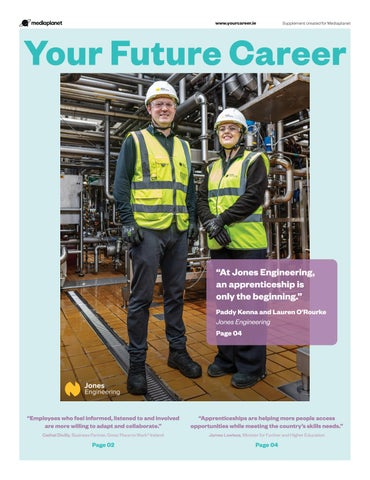
“At Jones Engineering, an apprenticeship is only the beginning.” Paddy Kenna and Lauren O’Rourke Jones Engineering Page 04
“Employees who feel informed, listened to and involved are more willing to adapt and collaborate.”
“Apprenticeships are helping more people access opportunities while meeting the country’s skills needs.”
Cathal Divilly, Business Partner, Great Place to Work® Ireland
James Lawless, Minister for Further and Higher Education
Page 02
Page 04
AN INDEPENDENT SUPPLEMENT FROM MEDIAPLANET WHO TAKE SOLE RESPONSIBILITY FOR ITS CONTENT
How learners and jobseekers are finding the best opportunities in Europe A free online platform makes it easy for people to find learning and job opportunities in countries across Europe — which helps boost competitiveness across the continent. WRITTEN BY Tony Greenway
Sponsored by Quality and Qualifications Ireland
Find out more at www.qqi.ie europass. europa.eu
T
oday’s learners and jobseekers live in a world of immense choice. That’s exciting because study and employment opportunities are available anywhere and everywhere — both in Ireland and across Europe. Yet it’s a challenge, because when education, training and work options are so wide-ranging, it can be difficult to know where to start. How do candidates find courses and careers in countries they might not be familiar with? And how do they showcase themselves in the best way? “This issue is particularly apt because Ireland currently holds the Presidency of the Council of the European Union and has pledged to play a leading role in advancing the EU‘s competitiveness and productivity agenda,” explains Naomi Oldenburg, Senior Manager at the National Europass Centre for Ireland in Quality and Qualifications Ireland (QQI). “Part of that is about helping skilled people seize the best opportunities in the right places.”
Tools and resources that support European competitiveness
Europass — a multilingual online platform developed by the European Commission — aims to support EU competitiveness by making tools, resources and information available to those interested in working and learning across Europe. Users can sign up for free, create customised CVs and cover letters and present their skills and qualifications in a standardised format that can be
Employers are increasingly looking for people with transferable skills. easily understood by any institution or employer across Europe. All documents are stored securely in a user’s personal folder. “One of the platform’s strengths is that it doesn’t just focus on ‘paper’ qualifications,” says Edel Sheerin, Senior Executive Officer at the
National Europass Centre for Ireland in QQI. “It also showcases skills and experience gained in other ways — for example through volunteering schemes or exchange programmes. That’s important for European competitiveness, because employers are increasingly looking for people with transferable skills.” Other features include a job and skill trends tool that explores labour market trends, an online digital skills test that assesses the level of an individual’s digital skills and suggests where improvements can be made and a search function that identifies course and career opportunities across Europe. Users can also receive relevant job suggestions based on their profile information. Anyone can use it, too — not just EU nationals. “Accessibility is very important to the Commission,” says Oldenburg. “The platform’s functionality and user-friendliness are continually being improved to help people explore lifelong learning and career opportunities across Europe more easily.”
Naomi Oldenburg Senior Manager at the National Europass Centre for Ireland in Quality and Qualifications Ireland (QQI)
Edel Sheerin Senior Executive Officer at the National Europass Centre for Ireland in Quality and Qualifications Ireland (QQI)
The long-term performance advantage of investing in people Economic uncertainty rarely creates organisational problems — it reveals them. As pressure mounts, weaknesses in trust, communication and culture become harder to ignore. The organisations that perform best are often those that invested in their people long before uncertainty arrived.
T
Cathal Divilly Business Partner, Great Place to Work® Ireland
Marina Rivas Marketing & Brand Manager, Great Place to Work® Ireland
he experience of Ireland‘s Best Workplaces™ reflects this. Employees are significantly more likely to believe leadership is both accessible and responsive. While 88% say management is approachable and easy to talk with, compared with 61% nationally, 81% believe management genuinely seeks and responds to suggestions and ideas, compared with just 52% nationally.
feel connected to organisational goals are often better positioned to embrace change and respond to evolving customer needs. That ability to adapt may prove to be one of the strongest drivers of long-term performance.
Employees who feel valued perform better
“Great Workplaces are high-trust workplaces, and trust becomes a form of currency during periods of uncertainty,” says Cathal Organisations that Why trust matters Divilly, Business Partner, Great Place Trust influences how organisations to Work® Ireland. “Organisations that perform best during respond to challenges. Employees perform best during uncertain periods uncertain periods who feel informed, listened to and are usually those that have already involved are often more willing invested in building trust long before are usually those that to adapt and collaborate with it’s tested.” management through change. Marina Rivas, Marketing and have already invested The same pattern appears elsewhere Brand Manager, Great Place to Work® in building trust long in the data. While 84% of employees Ireland, believes one of the biggest in Ireland‘s Best Workplaces™ say risks organisations face during before it’s tested. people are willing to give extra to get uncertain periods is failing to listen to the job done, only 61% of employees their people. “When employees stop nationally agree. Similarly, 81% say management shows believing their voice matters, organisations lose access sincere appreciation for good work and extra effort, to one of their most valuable resources: the insight of the compared with 53% nationally. people closest to the work.” As organisations navigate AI and changing workforce The question isn’t whether uncertainty will arrive. It’s expectations, adaptability becomes increasingly valuable. whether organisations have built the trust needed to Companies where employees trust leadership and withstand it.
@Mediaplanet UK & IE
@MediaplanetUKIE
Contact information: ie.info@mediaplanet.com or +44 (0) 203 642 0737
Please recycle
Strategic Account Manager: Jen Church jen.church@mediaplanet.com | Managing Director: Margot Thomas | Designer: Juraj Prikopa Senior Content Manager: Angelica Hackett O’Toole | Paid Media Strategist: Jonni Asfaha Digital Campaign Manager: Jan Martorell | All images supplied by Getty Images, unless otherwise specified
02
MEDIAPLANET
READ MORE AT YOURCAREER.IE
AN INDEPENDENT SUPPLEMENT FROM MEDIAPLANET WHO TAKE SOLE RESPONSIBILITY FOR ITS CONTENT
Advertorial
Im
ag
ep
r ov
id ed by
There is an excitement to getting out on the road and realising that you can do this.
Du blin
Bu
s
Connect people to places as a Dublin Bus driver Dublin Bus is part of the fabric of everyday life in Dublin. Dublin Bus connects people and communities with family, work, education and healthcare.
A
s Ireland’s largest public transport provider, Dublin Bus plays a vital role in keeping Dublin moving, with more than 165 million customer journeys in 2025.
Demand for public transport is growing, and Dublin Bus services must continue to evolve to meet this growth through the expansion of services, BusConnects and additional capacity services. Bus drivers play a vital role in this expansion; without them, services cannot grow. Dublin Bus is recruiting drivers for both full-time and part-time positions, with opportunities to build a rewarding career while playing an important role in keeping our capital city moving. Thinking of a career change? Many Dublin Bus drivers previously worked in different fields such as banking, technology and healthcare before joining as a bus driver.
For Robert Pal, the flexibility of part-time work has allowed him to combine bus driving with full-time education. He says: “For me, working part-time with Dublin Bus means that I can earn and study at the same time without having to miss out on college. The worklife balance allowed me to do a job that I love while continuing my studies.” Part-time bus driving has provided Wendy Ward with a different kind of flexibility. Encouraged by her brother who has worked as a driver with Dublin Bus for 13 years, Wendy left her job in a takeaway for Dublin Bus. “The option of working part-time allowed me to spend more time with my daughter. The work-life balance is great,” she says. Around 8% of Dublin Bus drivers are female, and Wendy is one of them. She is passionate about encouraging more women to join. “There is an excitement to getting out on the road and realising that you can do this,” she adds.
Where could your driving licence take you?
A new and rewarding career direction
Working around your needs
Robert Pal Bus Driver, Dublin Bus
Wendy Ward Bus Driver, Dublin Bus
Applicants must hold a valid Irish car licence for a minimum of two years. Dublin Bus provides the training and support required to become a professional bus driver and to obtain the bus licence. Successful applicants will be invited to complete a six-week full-time driver training programme to build competence and confidence on the road to a new career.
Part-time driving opportunities Michal Golec Bus Driver, Dublin Bus
For many Dublin Bus drivers, the flexibility of the parttime role has made it possible to build a career while continuing to make time for family life, education and other commitments. • Work a minimum of two days (16 hours) each week (Every Sunday and one other day, based on operational requirement). • Start on €22.90 per hour with pay rising to €26.51 per hour on a six-year scale.
READ MORE AT YOURCAREER.IE
Michal Golec took his career in a new direction, leaving the technology industry to become a bus driver with Dublin Bus. “Having previously worked for tech companies, stepping into bus driving was an entirely new path. My only regret is not making this change sooner,” says Michal. “Bus driving has given me a sense of stability and a community here in Dublin.” Barbara Carroll, Chief People Officer at Dublin Bus, says the company wants to make a career with Dublin Bus accessible to people from every background. “People are at the heart of everything we do. There are opportunities for people at all different stages of their lives to build a rewarding career with us. We will provide the training, support and development to help you succeed in a career with Dublin Bus,” says Barbara. “Why not work in a job where you get thanked every day?”
Sponsored by Dublin Bus
Find out more at dublinbus.ie/ careers
MEDIAPLANET
03
AN INDEPENDENT SUPPLEMENT FROM MEDIAPLANET WHO TAKE SOLE RESPONSIBILITY FOR ITS CONTENT
Advertorial
How Jones Engineering is building Ireland’s next generation of engineering talent As demand for engineering skills grows, apprenticeships have become one of the most effective routes into a long-term career, as two Jones Engineering employees, Lauren O’Rourke and Paddy Kenna, can attest.
A Lauren O’Rourke Electrical Estimator, Jones Engineering
Paddy Kenna Construction Manager, Jones Engineering
Sponsored by Jones Engineering
t Jones Engineering, apprentices are immersed What makes Jones different in live projects immediately, learning alongside Lauren O’Rourke began her apprenticeship during the experienced engineers while benefiting Covid pandemic and qualified with a distinction in from structured mentoring and continuous January. Since then, her career has moved quickly, from professional development. The combination of classroom site work into an electrical estimator role, with Jones learning and on-site experience equips apprentices supporting her ambition of becoming a quantity surveyor with the confidence to take on increasingly complex through further training. responsibilities throughout their careers. The four-year “At Jones, apprentices aren’t just brought in to fill a mechanical and electrical engineering role, they’re genuinely invested in,” programmes currently have 264 she says. “Jones contributes so much apprentices, while Jones’ Apprentice towards college courses and gives You earn while you Centre in Carlow is being expanded to you study days, too. They also offer accommodate further growth. excellent work-life balance,” she adds, learn, and with that pointing to the support she received experience behind you, around the birth of her daughter during Learning by working alongside experts her apprenticeship as an example. you can genuinely go Paddy Kenna joined Jones Engineering Since qualifying, Lauren has been anywhere. as an apprentice 25 years ago. He offered further opportunities to has since progressed through the develop within the business, including organisation, from apprentice to exposure to international projects. Her supervisor and now construction manager. “Starting the advice to school leavers considering an apprenticeship apprenticeship gave me a strong direction,” he says. “You reflects that trajectory: “If you are a practical learner, I weren’t just working on a site with no end in sight. You think it’s the best way to go. You earn while you learn, and had a clear path with a goal at the end.” with that experience behind you, you can genuinely go He points to the structured mentoring and continuous anywhere.” training available at Jones, including night classes in For young people considering their options after leaving Building Services Engineering and participation in school, Jones Engineering’s apprenticeship pathways National Skills Competitions, as key to that progression. offer a structured route into a global industry, with clear “Consistent opportunities are available to allow you to progression from tradesperson to management. continue on your path, or change direction if preferred.”
New apprenticeship programmes introduced in Ireland Ireland’s apprenticeship system continues to grow and diversify, with nine new programmes introduced across areas including business and operations, social care, paramedicine, robotics and automation and engineering.
W Minister James Lawless TD Department of Further and Higher Education, Research, Innovation and Science
hen many people hear the word apprentice, they may still think of construction sites and traditional trades. However, in 2026, apprentices in Ireland can be found just as easily in offices, healthcare settings, public services and advanced manufacturing facilities. This broadening of provision reflects the growing role of apprenticeships in supporting a modern economy, including by supporting critical workforce and skills shortages in key sectors.
A route into your chosen profession With nearly 90 programmes now available nationwide,
04
MEDIAPLANET
Explore current opportunities at:
apprenticeships, in addition to providing essential training for skilled trades, are increasingly providing pathways into professional, public service and emerging industry careers, creating opportunities for learners to earn while they learn and enabling employers to develop the talent they need. By opening new routes into professional careers, apprenticeships are helping more people access opportunities while meeting the country’s skills needs.
Developments in Irish apprenticeships
Expanding the apprenticeship system is central to achieving the Government’s commitment to reach 12,500 annual apprenticeship registrations by 2030, of which two thirds are in craft and construction, as set out in the Programme for Government. One of the most significant developments this year is the introduction of the Level 6 Business and Operations Apprenticeship. Delivered across both the public and private sectors, and with the Consortium Steering Group chaired by Lidl, it marks a major step forward in workforce development. For the first time, apprentices will be able to enter the Civil
Service through a mainstream apprenticeship pathway. The programme also includes a dedicated Irish-language pathway, with five places available in the inaugural cohort. Momentum is expected to continue throughout the year, with further programmes in development, including a new degree-level Spatial Planning Apprenticeship. The apprenticeship model has never stood still. Its continued evolution will help ensure that Ireland’s future workforce is as ambitious, skilled and adaptable as the country itself.
READ MORE AT YOURCAREER.IE
AN INDEPENDENT SUPPLEMENT FROM MEDIAPLANET WHO TAKE SOLE RESPONSIBILITY FOR ITS CONTENT
Ways to future-proof your career A new question has emerged when choosing a career: Will this job exist in five or 10 years? Rapid advances in AI, technology and automation should be a serious consideration for students.
A
n engineering qualification offers a pathway to a sustainable and rewarding career, underpinned by versatile skills that help professionals to navigate changing industries and economic
Keith Sunderland Registrar, Engineers Ireland
Going global
An Irish engineering qualification is a passport to a global career. International accords and agreements ensure the global relevance of an engineering education, while ensuring qualifications are globally recognised. Many third-level institutions offer engineering qualifications accredited by Engineers Ireland, including all universities in Ireland. Most universities offer programmes with a common first year as well as specialist engineering courses. An apprenticeship is a programme that combines learning in the workplace with learning in an An Irish engineering Strong rewards educational institution or training qualification is a passport centre. They’re a great, nonEngineering offers financial rewards at every career stage. According to traditional route for those who value to a global career. the Engineers Ireland 2026 Salary hands-on experience from the start of Survey, Graduate engineers can their learning. expect to earn €39,000, on average. Those with 6–10 years QQI-FET Level 5 and 6 qualifications (commonly of experience earn €59,000, on average, with Chartered referred to as PLC courses) and tertiary degree Engineers earning €64,000. programmes (co-developed with Educational Training Engineering directors can earn between €100,000 and Boards and Higher Education Institutions) provide €135,000. An Engineers Ireland Registered Professional alternative pathways to an engineering bachelor’s degree, Title like Chartered Engineer (CEng) and Fellow (FIEI) enabling students to progress seamlessly from further can boost salaries by between €5,000 and €30,000 to higher education and ultimately achieve a Level 7 or 8 annually, depending on the sector and seniority. qualification. cycles. Ireland is facing a critical shortage of engineers. Over 22,300 additional engineers will be needed over the next decade, and several engineering roles are on the national Critical Skills Occupations List. The Future of Jobs report 2025 listed engineering roles in the top 15 fastest-growing jobs. Engineering graduates aren’t just employable; they are essential to delivering the infrastructure and technology needed to power the future.
Supporting apprentices, building futures: how employers can transform learner success
Ima
ge
pr
ov
de
i
db yW
WE
TB
Starting an apprenticeship is an exciting route into a professional career. However, the demands can be challenging. Learn how to earn while developing the skills necessary for success as an apprentice.
L
Dr Karina Daly Chief Executive, Waterford and Wexford Education and Training Board (WWETB) Sponsored by Waterford and Wexford Education and Training Board
ike many individuals entering the workforce for the first time, apprentices can face challenges in areas such as literacy, numeracy and communication, which may impact their ability to fully engage with workplace learning and training opportunities. Others can struggle with confidence, mental health challenges, organisation or the pressures of balancing work, study and personal responsibilities. Without the right support, these challenges can affect an apprentice’s progress, motivation and overall wellbeing.
Employers can make a real difference
Once an organisation recognises its role and responsibility in supporting apprentices throughout the on-thejob phases of their apprenticeship,
READ MORE AT YOURCAREER.IE
the impact can be transformative. Apprentices who feel supported are more likely to engage positively with their learning, overcome challenges and achieve their full potential. Suir Engineering is leading the way in this area. Currently employing 320 apprentices — predominantly across electrical and instrumentation — the company has invested significantly in its Apprentice Centre of Excellence in Citywest, creating an environment where apprentices receive practical training and mentoring throughout their learning journey. Dedicated trainers and mentors work closely with apprentices, helping them develop not only technical competence but also the confidence and professionalism needed to succeed in the industry. Chief Executive of Suir Engineering, John Kelly, attests to the transformative change this
has brought about: “We have seen significant improvements in safety performance, retention and learner outcomes as a result. Apprenticeships were once underrated, but they should be championed as an excellent way to build a long-term, AI-resilient career.”
Investing in talent through support
There is a strong shared commitment from Waterford and Wexford Education and Training Board (WWETB), which recognises the importance of consistent learner support throughout every phase of an apprenticeship. By investing in supports during the off-the-job phases, WWETB complements the work of employers, ensuring apprentices have access to the academic, personal and wellbeing supports they need. Its training advisors regularly monitor progress, help learners prepare for college phases and can connect them with financial, educational and counselling services. Ronan Quinn, Apprentice Programme Manager with Suir Engineering, concludes by reiterating their support for their apprentices: “Many of our leaders began their careers as apprentices, and we are committed to continuing to invest in the next generation of talent.”
WWETB provides 1,000 Phase 2 apprenticeship training places annually across 14 trades. For more information, visit wwetb.ie
MEDIAPLANET
05
AN INDEPENDENT SUPPLEMENT FROM MEDIAPLANET WHO TAKE SOLE RESPONSIBILITY FOR ITS CONTENT
Advertorial
‘Why being a Garda can be tough — but also incredibly fulfilling’
Dealing with traumatic situations can be challenging, says Garda Dylan Hogan*. Yet, helping people in their time of need is rewarding. Did you always want to join An Garda Síochána?
Garda Dylan Hogan (GDH): I was always interested in it. I’m from a small rural village in Ireland and liked how the local Garda officer knew everyone and would make a genuine effort to help anyone within the community if they had a problem.
When did you join?
GDH: In November 2017, aged 22. As a new recruit, I went to the training college in Templemore for eight months and, after two years’ probation, was given my Bachelor of Arts in Applied Policing.
Is your work diverse?
Reasons to remain optimistic for graduate recruitment Ireland’s graduate recruitment market is evolving rather than shrinking. There are solid reasons for optimism in its long-term resilience.
GDH: Absolutely. I’ve been assigned to the Road Policing Unit since June of 2025. My role involves dealing with everything from road traffic collisions to escorting wide loads on the motorway to road-safety enforcement. There are so many diverse areas of An Garda Síochána, too, including response policing, the divisional detective unit and the Drugs and Organised Crime Bureau. There’s the chance to do something different.
H
What’s been your most memorable day as a Garda?
GDH: There are so many, but one springs to mind. I’m a member of the International Policing Association and recently attended an annual seminar in Selm, Germany. I was there in uniform with police officers from over 30 different countries. It was an honour to represent my country, my organisation and my colleagues.
What’s your advice for anyone thinking of joining An Garda Síochána?
GDH: It’s a fantastic job with great opportunities and some of the best people you’ll ever meet. You can see some tough things at times: part of my job involves being there for people during traumatic situations. Afterwards, they’ll often thank me for giving them help when they needed it. Helping members of the public when they need it is hugely rewarding. In my experience, the vast majority of members of the public are grateful for the work we do. * Garda Dylan Hogan is assigned to the Laois/Offaly Divisional Roads Policing Unit and is based in Portlaoise, Co. Laois.
See if An Garda Síochána is a fit for you:
Garda Dylan Hogan Roads Policing Unit Laois/Offaly Division WRITTEN BY Tony Greenway Sponsored by An Garda Síochána
06
MEDIAPLANET
Gavan O’Brien Managing Director, gradireland
iring has become more selective, and undoubtedly, AI has had an impact. Demand remains resilient across sectors such as technology services, life sciences, financial services, public sector and sustainability.
Skills importance and wider access to opportunities
At gradireland, we have noticed that employers are prioritising skills over specific degrees, accelerating pathways for graduates who can demonstrate adaptability, data
Employers are hiring for potential and mindset as much as for experience. literacy and communication. Hybrid work is now embedded across all sectors to varying extents, widening access beyond Dublin and enabling graduates to target roles nationwide and remotely across the EU and UK. Salaries have stabilised after sharp post-pandemic rises, but total reward is broadening: structured training, professional certifications, mentoring and clear progression routes are back at the centre of graduate offers. Crucially, internships and placement programmes are expanding again, creating pipelines that convert to fulltime roles. SMEs, the backbone of Irish employment, are investing more consistently in graduate intakes, often with faster
responsibility and broader exposure than large multinationals.
Value of learning, networking and soft skills
At our recent gradireland events, we could see that the skills reset is a real opportunity. Microcredentials, portfolio projects and short courses allow candidates to close gaps quickly and signal momentum to employers. Networking has become more inclusive through virtual careers fairs and campus-to-employer platforms, giving equal visibility to students from all regions and backgrounds. Soft skills such as curiosity, problemsolving and teamwork remain decisive at assessment centres, where practice and reflection can markedly improve performance.
The graduate market is dynamic
Employers are hiring for potential and mindset as much as for experience. Students who engage early (through internships, societies and skills badges) stand out quickly because they show evidence of learning in action. I would remind graduates to treat their first role as a launchpad. Focus on environments where you’ll learn fast, build relationships and contribute to real outcomes. The outlook, then, is constructive. With targeted upskilling, proactive engagement and openness to highlearning roles in growth sectors, graduates in Ireland have every reason to be positive about securing meaningful, futureproof careers.
READ MORE AT YOURCAREER.IE
AN INDEPENDENT SUPPLEMENT FROM MEDIAPLANET WHO TAKE SOLE RESPONSIBILITY FOR ITS CONTENT
Lifelong learning approaches that can strengthen Ireland’s workforce The most important economic development challenge facing Ireland is talent. Discover how collaboration between education, communities and government can grow national talent and skills.
A
s employers compete for scarce skills, the strength of a region’s education and training ecosystem is becoming critical to its ability to grow, innovate and compete.
Collective talent development
The South East is entering a period of opportunity, with investment, population growth and sectoral expansion creating demand across engineering, construction, advanced manufacturing, healthcare, digital technologies and the green economy. The strategic challenge is ensuring talent development keeps pace. At KCETB, we believe this requires a regional talent ecosystem connecting education, employers, communities and government around priorities. Education must do more than provide access to learning; it must create clear pathways into employment, support progression within careers and enable people to return to work.
Lifelong learning is essential
Apprenticeships, Further Education and Training and tertiary programmes provide multiple routes into sectors driving growth. The traditional model of one qualification supporting a 40-year career is increasingly obsolete as skills evolve more rapidly. Regions must enable employees to renew their skills, gain higher-level capabilities and adapt without leaving employment. Workforce participation can also be strengthened by supporting people returning after periods of caring, family responsibilities, health challenges or other commitments. Their experience and skills represent a source of regional talent.
Anticipating skills needs is vital
Tertiary education can play a strategic role by creating integrated pathways between Further Education and Training and Higher Education, aligning talent development with employer demand and regional priorities. This strategic alignment can expand participation in higher-level learning, retain talent and contribute to productivity, innovation and growth. The regions that prosper will be those that treat talent as critical infrastructure. Through apprenticeships, Further Education and Training, lifelong learning and tertiary education, KCETB is committed to building the talent capacity the South East needs to seize opportunities and compete in a changing economy.
Advertorial
Shifting the dial in disability employment The WAM programme at AHEAD promotes meaningful access to the labour market for graduates with disabilities.
R
esearch consistently shows that disabled graduates remain an untapped market within the Irish labour market. Our work aims to shift the dial in disability employment. The WAM Programme is unique because it engages and supports employers to develop the potential of inclusive workplaces while simultaneously working to upskill graduates with disabilities to empower them within a competitive labour market. In 2025, we secured 68 new positions for disabled graduates with 34 employers within a range of industries across Ireland. As 2026 draws to a close, we are now planning our recruitment for 2027, which will be similarly ambitious and widespread.
It engages and supports employers to develop the potential of inclusive workplaces. The WAM Model
For applicants who get offered a placement via the WAM Programme, the next step is a Needs Assessment meeting with a member of our team. They will guide applicants in identifying reasonable accommodations, provide support in disclosing to their new employer and help in navigating this process. Every job applicant who takes up a WAM Placement is set up with a mentor. A mentor is someone working in the same organisation. Applicants can approach them with questions or for advice during their placement.
Upcoming job opportunities – Civil Service, Bord Bia, ESB
The WAM Programme at AHEAD consistently partners with leading Irish employers to advertise positions exclusively available to disabled applicants across a range of job types and locations, and across all subject areas from NFQ level 6 and higher (as defined by employers based on each role’s requirements). A number of exciting jobs will be open for applications throughout September. The best way to keep up-to-date with placement opportunities is to sign up for the WAMworks database at ahead.ie.
Dr Lindsay Malone Chief Executive, Kilkenny and Carlow Education and Training Board (KCETB)
Deirdre Moore Employment Manager, AHEAD Ireland
Sponsored by AHEAD Ireland
Sponsored by KCETB Find out more at: kcetb.ie/degree/
READ MORE AT YOURCAREER.IE
Find out more at: www.ahead.ie/ wamgraduates
MEDIAPLANET
07
AN INDEPENDENT SUPPLEMENT FROM MEDIAPLANET WHO TAKE SOLE RESPONSIBILITY FOR ITS CONTENT
It’s a highly rewarding experience for both students and staff, which demonstrates the impact of strong educational partnerships. Noreen Reilly, WCFE Principal
How a tertiary pathway is opening doors to a nursing career New tertiary degree in Intellectual Disability (ID) Nursing opens pathway into nursing through a route less travelled. One student speaks about her journey so far.
F
or many students, the journey to university begins and ends with the CAO. But for those who want to pursue a career in nursing, there are other ways to get there.
A different route into nursing
Alisha Collier Tertiary BSc in ID Nursing Student, Waterford College of Further Education
Alan O’Gorman WWETB Tertiary Manager
Dr Sarah Sartori Higher Education Strategic Project Lead, South East Technological University (SETU)
WRITTEN BY Bethany Cooper
08
MEDIAPLANET
Students gain a recognised qualification during the first year and can still apply to other nursing disciplines. “The benefit of this pathway is that students can see where they’re going, without feeling that they’re locked into one particular route,” explains Sarah Sartori, Higher Education Strategic Project Lead, SETU. “The education landscape can be confusing, so having a clear pathway gives students that reassurance, while still allowing them to step off it and explore other options if they decide that’s what they want.”
“There’s so much pressure in the last year of school to get into university,” explains Alisha Collier, a Tertiary BSc in Intellectual Disability (ID) Nursing student. “For someone who struggles with dyslexia like me, I doubted whether I would be academically strong enough to get into nursing. I honestly never thought it would be an option for me.” Achieving in partnership The National Tertiary Office in Ireland is opening doors, The partnership between WWETB and SETU is offering a CAO-points-free degree pathway to a Level designed to remove some of the practical barriers that 8 BSc in ID nursing — among many other skills areas can make pursuing nursing difficult. The first year of —raising awareness of these different options to FET the programme is fully funded, and costs, including students in order to fill a recognised skills gap within the uniforms, books and additional training such as manual nursing profession. handling and first aid, are “The best route for each covered as part of the tertiary individual might not always pathway. “It’s a highly rewarding be straight,” explains Alan experience for both students For some students, having the O’Gorman, WWETB Tertiary and staff, which demonstrates opportunity to build on their Manager. “For some students, the impact of strong educational having the opportunity to confidence and academic ability partnerships,” notes Noreen build on their confidence Reilly, Principal at WCFE. before progressing to university and academic ability before For Sartori, the ambition now progressing to university can is to build on the success of can make all the difference. make all the difference.” the first year and make similar opportunities available to more More than just one way forward students across the region. “This The 1+4 model begins with a is the second year of a successful QQI Level 5 Nursing Studies qualification at Waterford programme, and we’re hoping to continue to grow this College of Further Education before students progress to opportunity across Waterford and Wexford and into other the Bachelor of Science (honours) degree in Intellectual centres,” she says. “We want to keep building on what we Disability Nursing at SETU. Unlike general nursing, ID have and create more opportunities for students.” nursing is typically community-based, with nurses often And while the pathway is opening doors, it still requires supporting people over longer periods and working as hard work and dedication. “It’s not going to be easy; part of smaller, multidisciplinary teams, and can be a you still have to put in the work and achieve the grades very rewarding field to work in. required to progress to SETU, but it’s 100% worth it,” The SETU programme manager introduced ID nursing concludes Collier. “It’s such a fantastic opportunity, to students at WCFE, giving them an insight into what especially for someone like me who has struggled the role involves. “ID nursing wasn’t on my radar before,” throughout school and knowing that your place is says Collier. “But after hearing from someone who had guaranteed gives you that reassurance to succeed.” experienced it, I knew I wanted to do it!”
Sponsored by National Tertiary Office
Find out more at: www.nto.ie
READ MORE AT YOURCAREER.IE