www.healthawareness.co.uk
A promotional supplement distributed on behalf of Mediaplanet, which takes sole responsibility for its content
World Heart Day
NP-GB-107808 | September 2026
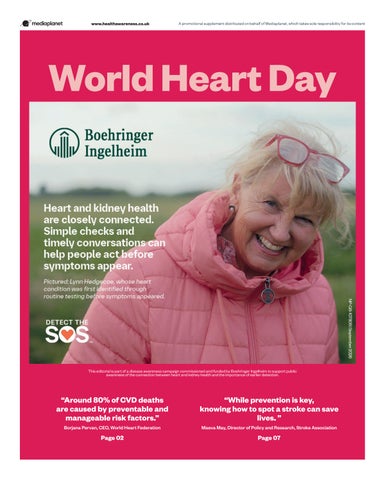
This editorial is part of a disease awareness campaign commissioned and funded by Boehringer Ingelheim to support public awareness of the connection between heart and kidney health and the importance of earlier detection.
“Around 80% of CVD deaths are caused by preventable and manageable risk factors.”
“While prevention is key, knowing how to spot a stroke can save lives. ”
Borjana Pervan, CEO, World Heart Federation
Maeva May, Director of Policy and Research, Stroke Association
Page 02
Page 07
A PROMOTIONAL SUPPLEMENT DISTRIBUTED ON BEHALF OF MEDIAPLANET, WHICH TAKES SOLE RESPONSIBILITY FOR ITS CONTENT
AI finds hidden heart problems in seconds A routine heart test has hit the headlines after it was given a makeover for the 21st century.
A ‘Don’t Miss a Beat’ urges decisive action to prevent causes of CVD Causing about 20 million deaths a year or around one in three deaths globally, cardiovascular disease (CVD) remains the world’s leading cause of death.1
H Borjana Pervan CEO, World Heart Federation
owever, there’s hope, knowing that around 80% of CVD deaths are caused by preventable and manageable risk factors2 — with the right tools and access to care. So, can we properly tackle CVD? Its signs and symptoms are often overlooked, ignored or misunderstood. By raising awareness, encouraging healthier lifestyles and calling on governments to prioritise heart health, we can meet the challenge. On 29 September, World Heart Day unites everyone through the ‘Don’t Miss a Beat’ campaign.
Know the CVD signs, make a change
CVD often hides in plain sight. Consider this: in many parts of the world, women’s CVD symptoms are missed or misdiagnosed; treatable and manageable high blood pressure is a leading risk for cardiovascular disease; and congenital heart disease is a common birth defect, yet many cases are missed at birth. Even small adjustments in nutrition, physical activity, adequate rest and stress management can help our hearts work better. Just
@Mediaplanet UK & IE
@MediaplanetUKIE
30 minutes of daily exercise could help tackle many CVD cases. Yet, on average, one in three adults are not moving enough.3 The Keep the Beat challenge encourages us all to make simple, daily changes to routines throughout September and beyond — and to motivate others with stories of progress.
Make a national plan
There should be no assumptions when it comes to cardiovascular disease: men, women, old or young can be affected; acknowledging this is key to creating access to affordable care for everyone. Despite CVD being the world’s number one cause of death, fewer than 20 countries have a national plan to tackle the disease. Don’t Miss a Beat is about stepping up action for heart health from policies to care systems and the everyday actions that make for thriving communities everywhere. 1
2 3
World Health Organization, 2025. Cardiovascular diseases (CVDs). tinyurl.com/ywekzdcu. World Heart Federation. tinyurl.com/2z8jksjh. World Health Organization. Physical activity. tinyurl. com/ax3yv28v.
rtificial intelligence is increasingly part of everyday life, and its role in healthcare continues to grow. Thanks to the generosity of the public, the BHF has been able to fund research that is harnessing the power of cutting-edge science and emerging technology, including AI.
Around a billion ECGs are performed worldwide each year Recently, at the world’s biggest heart conference, a team of researchers led by Professor Fu Siong Ng presented their study applying AI to electrocardiograms (ECGs). The ECG is one of the most common tests in medicine, which records the rhythm, rate and electrical activity of your heart. It is routinely used to diagnose conditions such as heart attacks and abnormal heart rhythms. But an ECG contains far more information than the human eye can typically see — which AI can now detect in less than two seconds.
AI detects heart disease from ECGs
The researchers from Imperial College London trained the technology on ECGs from millions of patients, then tested it on a further 65,000 ECGs. It identified around 80% of patients who had heart failure and 90% of patients with heart valve disease. The technology cannot be used on its own to definitively diagnose or rule out heart failure or heart valve disease. However, it could give a strong indication that someone may have these conditions.
AI can speed up ECG interpretation
Technology like this has the potential to identify high-risk patients early, even though – like any test – we can’t rely on it to detect everyone with a heart condition. However, it could be a solution to help fast-track the patients most likely to have a heart abnormality for the tests and the treatment they need. ECGs are cheap and common tests used around the world. Applying AI to an ECG trace for further diagnosis and triage has the potential to save or improve the lives of millions.
Dr Sonya Babu-Narayan Clinical Director at the British Heart Foundation and Consultant Cardiologist
Contact information: mpukie@mediaplanet.com or +44 (0) 203 642 0737
Please recycle
Project Manager: Tom Lethbridge tom.lethbridge@mediaplanet.com Business Development Manager: Joseph Moore Managing Director: Margot Thomas | Designer: Juraj Prikopa Senior Content Manager: Angelica Hackett O’Toole | Paid Media Strategist: Jonni Asfaha Digital Campaign Manager: Jan Martorell | All images supplied by Getty Images, unless otherwise specified
02
MEDIAPLANET
READ MORE AT HEALTHAWARENESS.CO.UK
A PROMOTIONAL SUPPLEMENT DISTRIBUTED ON BEHALF OF MEDIAPLANET, WHICH TAKES SOLE RESPONSIBILITY FOR ITS CONTENT
Why saturated fat is a bigger lever than most people realise Cholesterol affects almost half of adults in the UK,1 yet it is widely misunderstood, and myths about cholesterol persist.2
H
EART UK wants every adult to know and understand their cholesterol levels, recognise their wider cardiovascular disease (CVD) risk and take action early.
Assess personal risk of stroke
Jules Payne Chief Executive, HEART UK - The Cholesterol Charity
The furring up of arteries does not happen suddenly; it develops silently over decades. If we could see our arteries on the outside of our bodies, we would notice changes sooner and be more likely to act before damage is done. On 7 July 2026, the NHS published a Cardiovascular Disease Modern Service Framework, putting prevention at its centre and setting a bold ambition to reduce premature mortality from heart disease and stroke in England by 25% within 10 years. However, this is not just an NHS challenge; it is a population challenge. We should all understand our personal CVD risk and take practical steps early to reduce the chance of heart attack or stroke.
Healthy diet and lifestyle prevent CVD
A healthy diet and lifestyle remain the cornerstone of CVD prevention. HEART UK supports people through Cholesterol SMART®, a science-based programme offering targeted, practical guidance to improve cholesterol and cardiovascular outcomes through everyday changes.
Some people will also need medication to lower cholesterol. Statins are often the first option, and with several types available, speak to a healthcare professional about alternatives. Other effective treatments may also be appropriate.
Independent CVD risk factors
Familial hypercholesterolaemia (FH) is an inherited form of high cholesterol. Around 250,000 people in the UK may have FH, yet only around 8% are identified.3 If your family has a history of early heart disease (below age 60), know your cholesterol levels. With FH, cholesterol is high from birth, so the longer it remains undiagnosed, the greater the risk. Lipoprotein(a), known as Lp(a), is another blood fat and an independent risk factor for heart disease. It’s not routinely measured, but if you have FH or unexplained heart disease in your family, HEART UK encourages you to ask about testing. The message is simple: know your CVD risk, act early, and seek support. 1
2
3
Our Future Health, 2023. Revealed: over half of people have high cholesterol and over 1 in 4 have high blood pressure. tinyurl.com/44jrvb8j BBC Science Focus, 2026. Here’s what actually causes high cholesterol (and how to cut it). tinyurl.com/5xaa2y5r. NHS England, Familial Hypercholesterolaemia (FH). tinyurl.com/2hy9e3sc.
Find out more at heartuk.org.uk
Helps actively lower cholesterol
Millers of Mighty Oats Since 1675
Naturally high in fibre
mornflake.com *As part of a varied, balanced diet and a healthy lifestyle; Oat beta glucans have been shown to help lower blood cholesterol. Blood cholesterol lowering may reduce the risk of coronary heart disease. One 40g portion of Mornflake Superfast Oats provides 1.8g of beta glucans from oats, which is 60% of 3g the suggested daily amount.
READ MORE AT HEALTHAWARENESS.CO.UK
British wholegrain MEDIAPLANET
03
A PROMOTIONAL SUPPLEMENT DISTRIBUTED ON BEHALF OF MEDIAPLANET, WHICH TAKES SOLE RESPONSIBILITY FOR ITS CONTENT
Why your kidneys could be a window into your heart health Your kidneys may be telling you something important about your heart. This World Heart Day, learn why early diagnosis can uncover hidden risk before symptoms begin.
D Douglas Clark, PhD Medical Director, Boehringer Ingelheim UK & Ireland
SPREAD WRITTEN BY Tony Greenway
id you know that kidney health and heart health “Kidney disease can progress silently, so it may remain are closely linked? If not, you’re not alone: it isn’t a hidden,” explains Clark. “So, the message is: don’t wait connection that is widely for symptoms to emerge. If talked about. Thankfully, interventions can be made before World Heart Day is an opportunity people experience complications, to change that. That’s important it increases the chance of a better because increasing awareness will outcome for them and their help protect the heart and kidney families and reduces the burden health of more people. I think of the kidneys as a window on the health service.” “World Heart Day is a chance into the health of your heart. to broaden out the heart health Simple urine test can help conversation and stress the prevent major complications connection between heart health Clark stresses that people who are and kidney health,” notes Dr at risk of kidney disease — such as Douglas Clark, Medical Director those living with type 2 diabetes at biopharmaceutical company or hypertension — should have Boehringer Ingelheim UK & Ireland. a conversation with their healthcare teams about heart health. “People may not realise that a simple urine test Early interventions can help improve outcomes can reveal vitally important information about both their “I think of the kidneys as a window into the health of your kidney and their heart health,” says Clark. heart. They provide an early warning sign because if there Different organisations are working together to get this is an issue with your kidneys, it increases your risk of heart message across. “It’s gratifying to see growing collaboration disease.” between NHS professionals, patient organisations, charities, The trouble is, someone can look and feel well while still industry and others,” says Clark. “We all have a role to living with hidden heart and kidney risk, which is why a play in supporting earlier diagnosis, delivering better care, focus on prevention and earlier diagnosis is a priority for reducing health inequalities and, ultimately, supporting the NHS. long-term heart and kidney health.”
These articles were organised, funded and reviewed by Boehringer Ingelheim
Why heart and kidney health should never be viewed in isolation Heart and kidney health are closely related, so they should not be viewed in isolation. Patients should receive joined-up educational information, personalised care and support.
K Fiona Loud Policy Director, Kidney Care UK
Dr Nick Hartshorne-Evans BEM Honorary Doctorate from Glasgow Caledonian University, Founder and CEO of the Pumping Marvellous Foundation
idney health and heart health “For example, high blood pressure advice. He stresses that it’s important should never be viewed in could be a sign of kidney disease,” for people with long-term conditions isolation, explains Fiona says Loud. “So, get your blood such as chronic kidney disease (CKD) Loud, Policy Director at pressure checked at any pharmacy. and heart failure (HF) to receive the UK’s leading kidney patient joined-up educational information support charity, Kidney Care UK. from clinicians, charities and That’s because both organs are patient groups. connected through a network of And everyone — from patients blood vessels, and one can affect to healthcare professionals — The whole health system can help needs to understand the link the other. However, your kidneys can between different conditions. by treating the person, not just decline silently, so finding out “Thankfully, there is a drive their condition. how effectively they’re working for more interconnectivity,” he is a way to pre-empt potential recognises. “And there’s more heart problems. “In fact, people interlock between heart and with kidney disease are far more kidney specialists. That continuity likely to experience cardiovascular can only benefit patients.” problems — whether that’s heart And if you have a family history of It’s also key for clinicians to see failure, heart attack or stroke — diabetes — which is closely linked people as individuals and offer them before they experience kidney with kidney disease and kidney personalised care and support, failure,” she says. failure — go online and take our particularly if they have two or more health check or ask your GP for a medical conditions at the same High blood pressure could point simple blood and urine test.” time. “The whole health system to kidney disease can help by treating the person, Kidney Care UK is currently running Seeing people as individuals — not just their condition,” concludes a campaign called Bloody Amazing not just treating their condition Hartshorne-Evans. Kidneys where people can understand Dr Nick Hartshorne-Evans, CEO more about their risk by answering a and Founder of heart failure charity, few simple questions online. Pumping Marvellous, seconds Loud’s
This article forms part of a disease awareness campaign commissioned and funded by Boehringer Ingelheim. Fiona Loud and Nick Hartshorne-Evans contributed their expertise to this content. The views expressed are their own.
NP-GB-107809 | September 2026
04
MEDIAPLANET
READ MORE AT HEALTHAWARENESS.CO.UK
A PROMOTIONAL SUPPLEMENT DISTRIBUTED ON BEHALF OF MEDIAPLANET, WHICH TAKES SOLE RESPONSIBILITY FOR ITS CONTENT
Protecting your kidney health can lower the risk of heart problems
Protecting your heart and kidney health is just a conversation away
Kidney disease increases the risk of heart problems. However, symptoms may appear late, so it’s ideal to talk to a health professional about risk factors and underlying conditions.
The best advice, help and support for better heart and kidney health is just a conversation away. Ask your GP or local pharmacy about simple checks and tests available to you.
“
Kidney disease is a massive and underrecognised cardiovascular risk factor,” says Professor Raj Thakkar, Immediate Past President of the Primary Care Cardiovascular Society. “The problem is, you may have no clue that you actually have kidney disease — and therefore be at risk of heart problems — because kidney disease is silent.”
Prof Raj Thakkar Immediate Past President, Primary Care Cardiovascular Society, UK Honorary Visiting Professor, Cardiff University, School of Medicine Visiting Professor of Anglia Ruskin University
Delaying shouldn’t be an option in kidney health
He continues: “In fact, symptoms don’t tend to appear until you have complications such as kidney failure, stroke, heart attack, abnormal heart rhythm or a heart valve problem.” However, the good news is, if kidney disease can be diagnosed early enough with a simple blood test and urine test, patients can receive the appropriate treatment to delay or prevent these complications. So don’t delay and take action. “We need to be more proactive about looking for disease,” says Prof Thakkar. “We should empower the population to own their health and to check their health numbers.”
Partnering with patients in a kidney-heart health journey
These articles form part of a disease awareness campaign commissioned and funded by Boehringer Ingelheim. Prof Raj Thakkar, Beverley Bostock and Mahmoud Khodadi were compensated for their time and expertise in contributing to this content. The views expressed are their own.
After all, says Prof Thakkar, we’ll check our bank balance regularly to make sure it’s healthy. So, why not our blood pressure and urine? Anyone with chronic kidney disease risk factors, including diabetes, high blood pressure, a previous episode of kidney injury or a personal history of heart disease, should be particularly proactive about it. The health system must make it easier for patients to check their health, he points out, particularly because chronic kidney disease is included in the Cardiovascular Disease Modern Service Framework. This is the Government’s vision for the earlier prevention, diagnosis and treatment of cardiovascular, kidney and metabolic risk factors. “I’m very keen for patients to become partners on this journey,” he explains. “Ideally, we want people to understand the kidney-heart link so well that they say to their healthcare professional, ‘I know kidney disease is a major predictor of cardiovascular health — and I haven’t had a urine check yet. I would like one, please.’ Make sure you get it done because it could just save your life.”
READ MORE AT HEALTHAWARENESS.CO.UK
I
f you have concerns about your heart or kidney health — or want to know more about the tests and checks available to you — Beverley Bostock, Advanced Nurse Practitioner, Long-term Conditions, Mann Cottage Surgery, has this advice. “Have a conversation with your GP,” she says. “A good clinician will never be concerned by a patient asking for help, advice or information.”
Empowering patients and surgeries through knowledge
Bostock admits that she “would love more people to be proactive about their heart and kidney health.” She would also love more GP surgeries to make it easier for patients to reach out with their questions or concerns. “For example, our practice holds evening meetings where we explain to patients what their kidneys do and why it’s so important to protect them. It’s an information-sharing session that’s a great way to start a conversation about the link between the heart and kidneys.” In addition, Bostock would encourage people to find out whether the urine albumin-creatinine ratio (uACR) test is available, which can help detect early kidney damage and reveal hidden heart risk. “When it comes to kidney function, blood tests are just one part of the equation,” she says. “I’m keen for patients to ask their primary care healthcare team, such as nurses, pharmacists and physician associates, ‘Should I be considering the uACR as well?’”
Tapping into support from your local pharmacy
Beverley Bostock RN MSc MA Queen’s Nurse President-Elect Primary Care Cardiovascular Society Specialist Nurse – Long-Term Conditions
Mahmoud Khodadi MPharm MScACP IPresc Advanced Pharmacist in Cardiovascular Disease
Of course, patients can also seek advice and support from their local pharmacy, notes Mahmoud Khodadi, Lead Pharmacist, Five Parks Primary Care Network. “The great benefit of community pharmacies is their accessibility,” says Khodadi. “They’re typically located closer to where people live or work, and patients can get faster responses without the need for an appointment.” Point-of-care checks available at pharmacies include blood pressure checks as part of a hypertension case-finding service — and some may offer urine sample home-testing kits. “Pharmacies that are successfully integrated within their primary care network will have direct access to GP, Advanced Nurse Practitioner and Advanced Clinical Practitioner colleagues,” says Khodadi. “As a result, they’ll be able to offer patients the best advice regarding next steps.” NP-GB-107810 | September 2026
MEDIAPLANET
05
A PROMOTIONAL SUPPLEMENT DISTRIBUTED ON BEHALF OF MEDIAPLANET, WHICH TAKES SOLE RESPONSIBILITY FOR ITS CONTENT
Convenient meal options that support independent living
How saturated fat and triglycerides really affect your cholesterol Heart disease remains the world’s leading cause of death for both men and women. To reduce risk, learn how to manage cholesterol through diet.
A Jeremy London MD Board-Certified Cardiovascular Surgeon
mong the key risk factors levels increase the number of for heart disease – smoking, atherogenic particles circulating high blood pressure, in your blood. The liver packages insulin resistance – triglycerides for transport in very-lowelevated cholesterol, specifically density lipoprotein (VLDL) particles Apolipoprotein B (ApoB) or that carry an attached ApoB marker. atherogenic particles, stands out as Once these particles deliver their one you can meaningfully influence cargo to tissue, they’re converted into through diet. Two specific dietary intermediate particles, which are then levers do most of the work. either cleared by the liver or further Saturated fat is a broken down into significant lever. mostly small LDL When you eat This is a major reason particles. excess saturated fat, More triglycerides your liver senses the means more of these poorly controlled influx and responds conversions and blood sugar and insulin more circulating defensively by assuming ‘we have LDL and ApoB as resistance correlate enough cholesterol, a result. This is a so strongly with heart major reason poorly stop importing more.’ The liver controlled blood disease risk. reduces the number sugar and insulin of low-density resistance correlate lipoprotein (LDL) so strongly with receptors responsible for clearing heart disease risk. The biggest dietary LDL particles out of the bloodstream, drivers of elevated triglycerides are essentially closing the door to limit refined carbohydrates, added sugars, how much more fat gets pulled in. excess calorie intake, visceral fat and With fewer receptors doing that alcohol – all of which are directly clearance work, LDL particles stay modifiable. in circulation longer, and your numbers climb. The reverse is also Cleaning up saturated fat and true: cut back on saturated fat, and triglycerides the liver restores healthy receptor If, after cleaning up both saturated activity, actively pulling LDL out of fat and triglycerides, your ApoB the bloodstream rather than letting it levels still aren’t optimal, genetics accumulate. is likely the dominant factor. This is when you’ll want to loop in a medical Triglycerides are the second professional for further guidance.
major driver
Triglycerides are closely tied to metabolic health. High triglyceride 06
MEDIAPLANET
As we age, we may face challenges with shopping, meal planning and cooking. Convenient food is a way for older people to eat well and maintain their independence.
“
As we age, shopping, meal planning and cooking can become more difficult, but enjoying good food should not be,” says Holly McComb, CEO of Parsley Box, a provider of convenient ready meals. “We have to keep our protein up – which makes every mouthful matter.”
Food for the belly and brain
The food on our plates must be enjoyable and comforting. We have to want to eat it, otherwise, we’ll end up skipping meals. While McComb notes that food provides ‘the drumbeat to the day,’ she also stresses that it shouldn’t be routine, dull and functional. “For example, the familiarity of a meal can be comforting and appealing,” she says. “It’s a moment of connection with our past. We all have a story about a household favourite, like a cottage pie or lasagne. There’s a reason why these meals are our top sellers.”
Eating well to help maintain your independence
McComb’s company exists to help older adults eat well because people can face food challenges at this time of life. “As we age, shopping, meal planning and cooking can become more difficult,” she says. “But enjoying good food should not.” The company’s meals – developed with older adults’ needs in mind – are delivered directly to customers’ homes, helping them support their wellbeing and maintain independence. Because the meals have a long shelf-life, they can be stored in a cupboard with no need for a fridge or freezer, alleviating fears around food safety. Company staff, meanwhile, are encouraged to listen and engage with customers, providing them with a much-needed human connection. McComb’s advice for older people wanting to improve their diet is simple: “It’s never too late. As we age, we should prioritise our protein, keep our fibre up and drink more water. We always encourage people to add a side of vegetables to our meals for extra balance. Even small changes can make a big difference to our health and wellbeing.”
Holly McComb CEO, Parsley Box
WRITTEN BY Tony Greenway
Paid for by Parsley Box
Find out more at www.parsleybox.com
READ MORE AT HEALTHAWARENESS.CO.UK
A PROMOTIONAL SUPPLEMENT DISTRIBUTED ON BEHALF OF MEDIAPLANET, WHICH TAKES SOLE RESPONSIBILITY FOR ITS CONTENT
How to identify a stroke and stop it from happening in the first place Learn how to spot a stroke and the value of prevention. Simple checks (such as blood pressure monitoring) and lifestyle choices can help reduce the risk of stroke, which can cause long-term disability.
A
stroke happens when the blood supply to part of the brain is cut off or when there is bleeding in the brain. It is a medical emergency that can cause lasting brain injury, disability or death. Although stroke affects the brain, brain and heart health are closely connected. They share many of the same risk factors, including high blood pressure and diabetes.
Maeva May Director of Policy and Research, Stroke Association
and Wales, we recommend attending an NHS Health Check, which includes a blood pressure check.
Spotting a stroke and when to call 999
While prevention is key, knowing how to spot a stroke can save lives and reduce the risk of long-term disability. The NHS’ FAST campaign helps identify the three most common signs: facial drooping, arm Regularly monitoring blood Ways to reduce stroke risk weakness or slurred speech mean pressure is one of the most There are simple ways in which it’s time to call 999. Other, less people can help reduce their common symptoms of stroke important ways to protect both risk of stroke by getting regular include sudden headaches, exercise, eating a healthy diet, vision problems or balance your brain and your heart. not smoking and monitoring issues. If you recognise these in alcohol consumption. However, yourself or someone else, call 999 stroke prevention goes further immediately. than people’s individual choices and is often shaped by their wider circumstances, such as housing and access to Anyone can have a stroke healthcare. Unfortunately, strokes can happen to anyone of any age due Regularly monitoring blood pressure is one of the most to certain genetic or treatable conditions, including high important ways to protect both your brain and your heart. blood pressure. If you can make one small change, get your Free blood pressure checks are available from local clinics, blood pressure regularly checked. pharmacies or GP surgeries. Home blood pressure monitors are available for around £20. If you are over 40 in England
For more information, visit stroke.org.uk or call the Stroke Support Helpline on 0303 3033 100
The bigger benefits of small changes in how you eat and travel Have you ever thought about how the changing climate might affect your heart? Whether you’re 25 or 75, you’re not immune. The good news is that you can act to protect your heart and the planet too.
S
tart with simple dietary swaps. Could you switch beef for beans (or another plant-based alternative) even a couple of times a week?
cutting the methane produced by livestock.
Switching to active travel
Why not swap some car journeys for
Eating better for your heart Nancy Mann UK Health Alliance on Climate Change
Exchanging a beef burger for a bean-and-rice burrito would protect your heart health, lower your weekly food bill and support the natural environment. Almost 85% of the UK’s farmland is devoted to livestock – either grazing animals or growing their feed.1 Eating less red meat and choosing more plant-based foods can make a significant difference to your heart health, with plant-based diets being linked to a 32% lower risk of dying from cardiovascular disease.2 It would also free up land that could be turned over to growing crops – boosting the amount of British-grown food, strengthening our food security and
READ MORE AT HEALTHAWARENESS.CO.UK
What’s good for the environment is also good for our health. walking or cycling? You’ll be investing in your heart twice: getting active and helping to clean the air you breathe. The NHS recommends at least 150 minutes of activity a week: as simple as a brisk 30-minute walk, five days a week.3 Cleaner air protects more than our own hearts. Children are growing up breathing in fine particulate matter (PM 2.5) linked to higher
blood pressure (an early warning sign of cardiovascular disease4). In London, annual PM2.5 levels have been recorded at up to three times the WHO-recommended limit.2 Much of this pollution comes from the same fossil-fuel burning that drives climate change, meaning using less fuel can help protect our hearts and the planet. Small changes to how we eat and travel can add up – because what’s good for the environment is also good for our health. Department for Environment, Food & Rural Affairs. Chapter 2: Structure of industry. GOV.UK. 9 July 2026. tinyurl.com/47njeuas. 2. Bion V, et al. Population and Planetary Health. Accessed 11 August 2026. tinyurl.com/yckapcex. 3. NHS. Physical Activity Guidelines for Adults Aged 19 To 64. 2024. tinyurl.com/nycpbtwu. 4. Zhang D. et al. Air pollution, meteorological factors, and cardiac remodelling in children: a multi-omics cohort study. 2026. European heart journal. :10.1093/eurheartj/ehaf1086 1.
MEDIAPLANET
07
A PROMOTIONAL SUPPLEMENT DISTRIBUTED ON BEHALF OF MEDIAPLANET, WHICH TAKES SOLE RESPONSIBILITY FOR ITS CONTENT
An ounce of prevention starts with knowing your pulse and blood pressure Pay attention to your heart health before a serious event, like heart disease or stroke, occurs. Start by knowing your pulse and blood pressure.
F
or generations, preventing heart disease meant eating healthier, exercising, quitting smoking and maintaining a healthy weight. Those habits remain the foundation of good heart health. Today, prevention also means detecting problems earlier. Two simple habits can make a difference: know your pulse and know your blood pressure.
Trudie C A Lobban MBE FRCP Founder, Arrhythmia Alliance | STARS (Syncope Trust) | AF Association
Consequences of high blood pressure
About one in three people in England with high blood pressure don’t even know they have it.1,2 Even fewer realise it also increases the risk of atrial fibrillation (AF), the most common heart rhythm disorder.3 In AF, the upper chambers of the heart beat fast and irregularly instead of keeping a normal rhythm. Both conditions increase the risk of heart disease and stroke.4,5 People with high blood pressure have about a 50% higher risk of developing AF than those with healthy blood pressure. 6
Silent conditions need monitoring
One of the biggest challenges is that both high blood pressure and AF can be silent conditions; you may have no symptoms and feel completely well.7 Without regular monitoring, they may go undetected until a serious event occurs. Monitoring is easier than ever. Home blood pressure monitors can help you track your readings over time. Some devices can also record an ECG that may help detect an irregular heart rhythm.8 Learning to check your pulse is another simple, free skill you can do anywhere. It helps you recognise what is normal for you and when something has changed. However, home monitoring does not
replace medical care. If you notice an irregular pulse or an abnormal blood pressure reading, talk with your healthcare professional, who can recommend appropriate tests and treatment if needed.
Know how to protect heart health
Sometimes, the first step toward prevention is simply knowing: knowing your pulse, knowing your blood pressure, knowing when something isn’t normal. This awareness can help you recognise problems earlier, start important conversations with your healthcare team and take an active role in protecting your heart. 1
2
3
4
5
6
7
8
Office for National Statistics. 2023. Risk factors for undiagnosed high blood pressure in England: 2015 to 2019. tinyurl.com/yc6ffwr5. Fryar, C. D. et al., 2024. sion prevalence, awareness, treatment, and control among adults age 18 and older: United States, August 2021–August 2023 (NCHS Data Brief No. 511). National Center for Health Statistics. https://doi.org/10.15620/cdc/164016 Gawałko, M., et al. 2024. Diet and risk of atrial fibrillation: a systematic review, European Heart Journal, Volume 45, Issue 40. doi.org/10.1093/eurheartj/ ehae551. National Institute for Health and Care Excellence. 2019. Hypertension in adults: Diagnosis and management (NG136). NICE. nice.org.uk/guidance/ng136 National Institute for Health and Care Excellence. 2021. Atrial fibrillation: Diagnosis and management (NG196). NICE. nice.org.uk/guidance/ng196 Aune D., 2023. Blood pressure, hypertension and the risk of atrial fibrillation: a systematic review and meta-analysis of cohort studies. Eur J Epidemiol. 2023 Feb;38(2):145-178. doi: 10.1007/s10654-022-00914-0. National Institute for Health and Care Excellence. 2021. Atrial fibrillation: Diagnosis and management (NG196). NICE. nice.org.uk/guidance/ng196 National Institute for Health and Care Excellence. 2019. Lead-I ECG devices for detecting symptomatic atrial fibrillation using single time point testing in primary care (HTG508). NICE. nice.org.uk/guidance/htg508
Find out more at www.heartrhythm alliance.org
Advances in minimally invasive cardiac pacing New pacemaker technology is improving life for patients with heart rhythm disorders. Devices are now wireless, much smaller and minimally invasive.
H
eart rhythm disorders, or arrhythmias, are more common than you might think. In the UK, over two million people are affected.1
INTERVIEW WITH Professor Tom Wong Consultant Cardiologist and Electrophysiologist, Royal Brompton and Harefield Hospitals, part of Guy’s and St Thomas’ NHS Foundation Trust
WRITTEN BY Tony Greenway
08
MEDIAPLANET
Arrhythmia symptoms and detection
Arrhythmias occur when the heart’s electrical system is disrupted, causing the heart to beat too fast (tachycardia), too slow (bradycardia) or irregularly. Untreated bradycardia can cause fainting, falls, heart failure and can be life-threatening. “Early detection prevents potentially devastating consequences,” says Professor Tom Wong, consultant cardiologist and electrophysiologist at Royal Brompton and Harefield Hospitals, part of Guy’s and St Thomas’ Specialist Care. “Unfortunately, patients are not always aware they have a heart rhythm disorder. Thankfully, diagnostics have changed tremendously. Take wearables; many people come see me because their smartwatch has told them that their heart is beating abnormally.” If, after further tests, a heart rhythm disorder is confirmed, a consultant
will guide the patient through available treatment options. This might include the fitting of a leadless pacemaker, a device primarily used for slow heart rhythms like bradycardia or heart block, where electrical signals are partially or completely blocked, slowing heart rate.
Advantages of leadless pacemaker technology
Recent advances to this nearly 70-year-old technology are significantly improving patient care. “A conventional pacemaker uses wires, or leads, to connect a pulse generator the size of a matchbox to the heart muscle,” explains Professor Wong. “However, leadless pacemakers are an innovation which may be suitable for some patients. These are much smaller, don’t have wires and can be placed inside the heart in a minimally invasive way. Long-term benefits include fewer lead-related complications, greater comfort and durability.” Unlike a conventional pacemaker, there is no generator, which, in rare cases, can cause infection. Plus, because there are no wires,
there is no issue with wire fracture. Developments to the technology keep coming, including smaller devices and longer battery life. In 2024, Royal Brompton Hospital and St Thomas’ Hospital carried out the UK’s first leadless dual-chamber pacemaker implant, where two devices in the heart communicate with one another wirelessly.
Wider impact for patients
Rapid innovation includes dualchamber systems, improved battery technology, physiologic pacing and advanced communication capabilities. The result: more effective, patient-friendly cardiac rhythm management. “In conjunction with our partners at Imperial College London and King’s College London, we continue to push the boundaries of cardiac therapy with evidence-based research,” says Professor Wong. “This work helps us, and other centres, understand how best to utilise pacemaker technology, informing healthcare guidelines and, importantly, improving patient care.” 1
Arrhythmias. Heart Research UK. https://tinyurl.com/y7vbzr33
Sponsored by Royal Brompton and Harefield
Find out more at gstspecialistcare. co.uk
READ MORE AT HEALTHAWARENESS.CO.UK