businessandindustry.co.uk
A promotional supplement distributed on behalf of Mediaplanet, which takes sole responsibility for its content
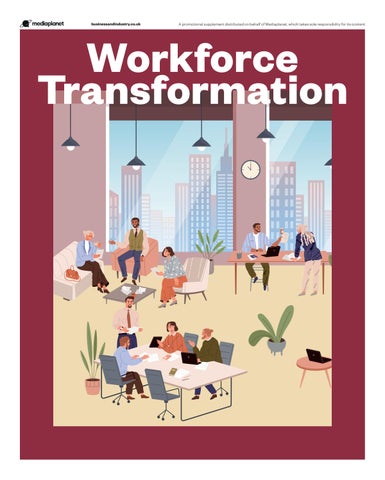
Workforce Transformation
A PROMOTIONAL SUPPLEMENT DISTRIBUTED ON BEHALF OF MEDIAPLANET, WHICH TAKES SOLE RESPONSIBILITY FOR ITS CONTENT
Practical AI will benefit businesses, not slow them down Discover how artificial intelligence can be implemented to be at the heart of workforce transformation, now and in the future.
B Patrick Milnes Head of Policy, British Chambers of Commerce
ritish Chambers of Commerce (BCC) research shows AI adoption among SMEs has reached 54% in 2026, highlighting how quickly firms are exploring ways to improve productivity.1 Yet, the key question is not whether businesses are simply using AI but whether they can use it well. The opportunity lies in embedding technology so people work more effectively, improve customer service and free up time for growth. Many smaller firms already use AI to reduce admin, draft documents, analyse information and respond faster to customers. As adoption develops, AI will also require businesses to think differently about processes, roles and decision-making.
AI adoption should make a clear impact
AI must be treated as a business issue, not just a technology one. Used well, it can help firms become more productive, resilient and competitive. That will not happen by chance. Businesses need confidence to identify where AI adds value, support to introduce it safely and leadership to ensure it strengthens how they operate. This matters because many SMEs are struggling under pressure from high costs, skills shortages and weak
@Mediaplanet UK & IE
@MediaplanetUKIE
demand. For them, AI cannot be an abstract debate. It must be practical, affordable and clearly linked to daily business challenges. The benefits must be clear.
Practical support for firms
Government, industry and education providers must help businesses make the transition with clear guidance and trusted advice. Local delivery will be essential. Chambers of Commerce are well placed to connect firms with information, training and peer support because they understand the pressures businesses face on the ground. The UK has a major opportunity to turn AI adoption into better business performance. To do that, policy must focus on removing barriers for firms, supporting responsible innovation and ensuring smaller businesses are not left behind. Success will not be measured by adoption stats alone. It will be measured by whether AI helps transform workforces. With improved productivity, businesses can grow and support a thriving economy. 1
BCC, 2026. Half of SMEs using AI – with limited headcount impact so far. tinyurl.com/2p9p8zd8.
Contact information: mpukie@mediaplanet.com or +44 (0) 203 642 0737
Please recycle
Project Manager: Matthew Kennedy matthew.kennedy@mediaplanet.com Business Development Manager: Jack Adamson Managing Director: Margot Thomas | Designer: Juraj Prikopa Senior Content Manager: Angelica Hackett O’Toole | Paid Media Strategist: Jonni Asfaha Digital Campaign Manager: Jan Martorell | All images supplied by Getty Images, unless otherwise specified
02
MEDIAPLANET
READ MORE AT BUSINESSANDINDUSTRY.CO.UK
A PROMOTIONAL SUPPLEMENT DISTRIBUTED ON BEHALF OF MEDIAPLANET, WHICH TAKES SOLE RESPONSIBILITY FOR ITS CONTENT
Turn ‘AI access’ into ‘AI capability’ – and transform your workplace AI workforce transformation succeeds when organisations think about the entire work process and turn broad ambition into clear, fair, job-relevant skills that deliver real value.
I Dr Kenneth Matos Director, Insights Lab, HiBob
WRITTEN BY Tony Greenway
n the workplace, artificial intelligence has gone Creating a catalogue of capabilities can make hiring easier mainstream. Now, the question for organisations Training appears to be fragmented, however. While 73% isn’t: ‘Will our staff use AI?’ of respondents say their Instead, they should ask: ‘Will organisation invests in AI our employees be able to use AI well upskilling, no individual — with judgement, consistency and training topic was offered by Map out how things get done trust — to deliver real value?’ more than 27% of organisations.1 The solution is to properly in your company. This makes it Leaders underestimate AI’s integrate AI capabilities into job easier to determine where AI will roles, learning opportunities, paradigm shift Many organisations presume they deliver value and where it could recruitment criteria and will. According to research from performance reviews, rather create problems. HiBob — an HR, payroll and finance than treating them as add-ons. platform — 75% of 1,200 global “Also, because the technology decision-makers expect moderate AI is changing so rapidly, proficiency to become standard in organisations need to lean into most non-technical roles within the next 24 months.1 continuous learning orientation,” emphasises Dr Matos. However, Dr Kenneth Matos, Director, Insights Lab For companies just starting this journey, Dr Matos at HiBob, thinks this expectation is unrealistic. AI advises: “Map out how things get done in your company. implementation is “a paradigm shift,” he argues. Yet, many This makes it easier to determine where AI will deliver value companies are treating it like a software rollout. “AI can and where it could create problems. Then look at your skills explore data across all functions, which has collapsed the framework. Ask yourself: ‘What skills do we want our people artificial boundaries within organisations,” he explains. to be good at, and what are we asking them to do?’” Having “This requires a different way of thinking. For true a clear catalogue of valued capabilities creates consistent organisational intelligence, leaders need people who ask criteria for evaluating candidates in hiring and performance bigger, broader questions — not simply concentrate on their processes and helps identify scarce ‘hard to hire’ skills. one, narrow domain.” HiBob’s research offers a starting AI skills framework and assessment tool to help organisations get started.2
The AI skills that are most valued — and in demand
Paid for by HiBob
AI proficiencies are also important from an employee perspective because they are already influencing career trajectories. According to HiBob’s research, 67% of respondents say their organisations link AI skills to promotion criteria, while 50% connect them to performance ratings.1 The trouble is, ‘AI proficiency’ is a vague term which can mean different things to different people. Organisations should nail down a proper definition that tells employees which observable, job-relevant AI skills and behaviours will progress their careers. It will also help managers with employee evaluations and ensure that team members are fairly promoted, trained and given new opportunities when they arise. When everyone is on the same page, it turns ‘AI access’ into ‘AI capability.’ Underlining the skills that matter most, Dr Matos explains: “Companies are looking for employees who can clearly and proactively review output, document workflows and handle sensitive data. The focus is very much on data literacy, rigour and quality.”
READ MORE AT BUSINESSANDINDUSTRY.CO.UK
Managers must coach AI transformation
Moreover, direct managers and team leaders — the people most often expected to build AI capability across teams — must be given the language, tools and time to coach a workforce through this momentous change. “The key is for managers to move into true coaching,” says Dr Matos. “It’s about working through novel problems together and guiding them through the social infrastructure and politics of an organisation.” Ultimately, companies must be ready to embrace AI transformation. “This isn’t about ‘yielding’ to AI,” insists Dr Matos. “It’s about getting into the driver’s seat and taking control.” 1
2
HiBob, 2026. 2026 report: AI maturity benchmarks and where the workforce stands. hibob.com/research/ai-skills-2026-report/ Sachs, T. The HiBob AI Skills Assessment tool and Skills Framework. hibob.com/ hr-tools/ai-skills-assessment-tool/
MEDIAPLANET
03
A PROMOTIONAL SUPPLEMENT DISTRIBUTED ON BEHALF OF MEDIAPLANET, WHICH TAKES SOLE RESPONSIBILITY FOR ITS CONTENT
Why financial wellbeing is a benefit employees actually need As persistent cost of living pressures hit home, the boundary between personal finances and professional performance has completely dissolved.
F
orget office redesigns and shiny tech stacks; one of the most critical challenges facing today’s workforce is happening in their bank accounts. We can no longer discuss modern workplace transformation without talking about financial survival.
Financial stress is a business risk Jo Gallacher Content director, Reward and Employee Benefits Association (REBA)
employers (82%) now identify improving workforce mental wellbeing as the single most important HR objective driving their financial wellbeing programmes.1 At the same time, organisations are introducing practical, preventative tools. The adoption of pay-as-you-earn savings schemes, where savings are taken directly from employees’ pay before it reaches their account, increased from 14% in 2025 to 36% in 2026.1
In an era defined by an always-on culture, the lines between work and home have blurred beyond recognition. Constant connectivity means personal Financial wellbeing enables money worries follow employees workplace performance throughout the working day rather This shift shows that real change than staying at home. Financial always require grand A workplace cannot innovate or doesn’t stress is no longer an isolated gestures. Sometimes, it just takes personal matter; it is an urgent simple, practical ways to help sustain high performance if its operational risk. build a modest safety workforce is constantly operating employees With money worries acting as net. Providing accessible savings a silent drain on focus, financial tools alongside traditional benefits in survival mode. health support has become one empowers employees to more of the most direct tools available effectively manage their money, to protect workforce productivity. preventing financial strain and the Forward-thinking organisations potential for it to manifest as acute are beginning to recognise that supporting financial health anxiety or absenteeism. isn’t just an exercise in corporate social responsibility; it is A workplace cannot innovate or sustain high performance a core business imperative that directly impacts retention if its workforce is constantly operating in survival mode. and operational stability. True workplace transformation means supporting the whole person, and that includes embedding financial health Prioritising financial wellbeing support directly into workplace culture. REBA’s Financial Wellbeing Research 2026, produced 1 REBA, 2026. 10 tips to help employees take control of their finances in 2026. tinyurl. in partnership with WEALTH at work, finds four in five com/5ahbmzk2.
Find out more at www.reba.global
The next workforce advantage is global flexibility The next workforce advantage is having the flexibility to act when conditions change. Global hiring is becoming more than an expansion exercise; it is how companies can access scarce skills, test markets and stay adaptable through uncertainty.
F Francoise Brougher Chief Executive Officer, Pebl
or businesses, resilience increasingly means having the flexibility to respond when circumstances change. Yet, many organisations still build teams around a fixed map of offices and legal entities. “The strongest workforce strategy starts with knowing where the skills, customers and opportunities exist, then establishing the infrastructure to support them,” explains Francoise Brougher, CEO, Pebl. “Resilience depends less on predicting every change, and more on creating the room to respond.”
Putting flexibility to work WRITTEN BY Bethany Cooper
04
MEDIAPLANET
An Employer of Record (EOR) gives organisations of any size a flexible way to access global talent, enter new markets and respond to business change without first establishing a local legal entity. “The question should no longer be, ‘Where do we already have an entity?’ It should be, ‘Where is the talent or market opportunity, and how quickly can we act?’” says Brougher. “An EOR can help a business hire a
scarce AI specialist in Poland, retain an employee following an acquisition in Germany, test a market with a salesperson in the UAE or support an international assignment.”
Employers that can make it easy for people to work across countries, cultures and teams will have a real advantage. Meeting global expectations
Alongside organisational priorities, flexibility matters to employees. Pebl’s 2026 UK Gen Z Workforce Survey found that 88% of respondents are highly interested in employers that allow temporary work from another country, 68% would prefer to remain UK-based while gaining international experience, and 88% believe working across cultures would make them better leaders, challenging the status quo that you can’t have both a British career and work globally.1
“This desire for flexibility is significantly ahead of what many employers currently offer,” says Brougher. “Global career access must increasingly be designed into workforce strategy. Employers that can make it easy for people to work across countries, cultures and teams will have a real advantage competing for the next generation.”
Resilience by design
The businesses best prepared for uncertainty will not necessarily be those that predict every shift correctly. They will be those with the workforce infrastructure and decision-making discipline to act when talent, technology or market conditions change. “Global workforce flexibility is not about hiring everywhere,” concludes Brougher. “It is about giving leaders more than one way to respond, and letting opportunity, rather than organisational geography, determine where a business can go next.” 1
Paid for by Pebl
Find out more at hellopebl.com
Pebl, 2026. UK Gen Z Wants Global Careers Without Moving Abroad. tinyurl.com/mr48u6fj
READ MORE AT BUSINESSANDINDUSTRY.CO.UK
A PROMOTIONAL SUPPLEMENT DISTRIBUTED ON BEHALF OF MEDIAPLANET, WHICH TAKES SOLE RESPONSIBILITY FOR ITS CONTENT
Make sure employees feel at ease with supportive technology
S
With the increase of AI and digital transformation, employees are asking: does this transformation make work better, fairer and more human for me?
uccessful businesses recognise that wellbeing and inclusivity are not afterthoughts sitting alongside a technology strategy but essential. A new digital platform may streamline processes, but if it increases stress, excludes employees or creates a culture of constant surveillance, efficiency gains are likely to be short-term.
Chris Cummings Founder, Wellbeing at Work
Tech must be supportive and inclusive
According to Microsoft’s Work Trend Index, AI can support wellbeing when used thoughtfully by reducing repetitive administrative tasks, helping employees manage workloads and providing quicker access to information and support. Digital collaboration tools can also offer greater flexibility, enabling people to work in ways that better suit their health, caring responsibilities or disabilities. Inclusivity is equally important. Voice-to-text software, real-time captioning, translation tools and adaptive interfaces can make workplaces more accessible for employees with hearing, visual, language or neurodiverse needs. AI has the potential to remove barriers that have historically limited participation and career progression for many talented people.
READ MORE AT BUSINESSANDINDUSTRY.CO.UK
People should ensure the tech suits them
Yet, technology is not automatically inclusive, and we must remain cautious as this transformation gathers pace. AI systems can reflect biases present in the data used to train them. Recruitment algorithms, performance analytics and automated decision-making tools must therefore be carefully monitored to ensure they do not disadvantage certain groups. Transparency, human oversight and regular auditing are critical. Workplace transformation should start with people, not platforms. Leaders need to involve employees in designing new systems, listen to concerns and provide training that builds confidence rather than anxiety. Digital skills programmes should be accessible to all employees, regardless of age, background or previous experience with technology. A healthy digital workplace encourages connection, psychological safety and reasonable boundaries. The organisations that thrive in the next decade are unlikely to be those that simply adopt the most advanced AI tools. They will be those that combine innovation with empathy. There is a huge opportunity to redefine what a good workplace looks like, taking employees on the journey rather than relying on top-down implementation.
MEDIAPLANET
05
A PROMOTIONAL SUPPLEMENT DISTRIBUTED ON BEHALF OF MEDIAPLANET, WHICH TAKES SOLE RESPONSIBILITY FOR ITS CONTENT
Authentic, human-centred leadership: how high performance happens Leadership is not simply about running the mechanics of your organisation; it’s about how you show up and serve the people you lead.
L Sandi Wassmer CEO, Onvero
06
MEDIAPLANET
eadership lives in your responsibility for the human beings you employ and is not just a set of business processes to be managed. When leaders focus solely on strategy, plans, budgets, reports and targets, they may keep the wheels turning, but they are not truly leading anyone. Leadership is about turning up, being present and holding space for the complex and wonderful human beings who make your organisation great.
Everyday responsibilities of a leader
Too many leaders avoid human interactions, particularly the challenging ones, by hiding behind processes, hierarchy or policies. Unfortunately, when they do so, they step back from the real work of leadership: the messy, uncomfortable, deeply human work of stewarding people’s careers, livelihoods and wellbeing. A leader’s role is not just to meet commercial objectives; it is to create the conditions where people can thrive, contribute, learn and grow. This shows up in everyday behaviours, choices, decisions and priorities. It is the courage to own your mistakes and clarify how you learned from them, rather than deflecting blame or burying bad news. It’s the humility to say, “I don’t
know” and invite your team into the conversation, instead of exhibiting perfection and control. It’s being consultative rather than authoritarian, seeing mistakes as learning opportunities rather than performance issues and showing appropriate vulnerability so that others feel safe to be imperfect too.
Leading through culture
Leading people means caring for them systematically, creating an inclusive culture and a psychologically safe environment where your team’s development, progression, wellbeing, recognition and voice are your concerns. It means treating culture as your core responsibility, ensuring that people experience it in every interaction, and it is equally about what you encourage as it is about what you permit. When you genuinely lead your people — with integrity, empathy, curiosity and courage — what you get in return is a thriving, extremely productive, high-performing team who work in an organisation they are proud to be part of.
READ MORE AT BUSINESSANDINDUSTRY.CO.UK
A PROMOTIONAL SUPPLEMENT DISTRIBUTED ON BEHALF OF MEDIAPLANET, WHICH TAKES SOLE RESPONSIBILITY FOR ITS CONTENT
Problematic topic Lorem ipsum dolor sit amet, cor adipi sreet dolore mit ad quis quuntem volendae liam faccuptaes si suntempe porepud m dolor sit amet, cor adipi sr.
R Name Surname Title Company
Text Name Surname
a que ventiani dist andebit dit, comnisque mo es id minctio ssecto idit, sita nisqui nissint et enis modit eaturis et ea qui velitatusame vendigendi nus, ut et utatqui ducilit labores tionseq uaspien impeliqui molorendunt et anihillor aut doluptatur? earitat emporem vent pro occullaccate modi henestioria quatet Lis ellesequi dendicte de acepudamus et repe nihit unt quiae exernam es dolorem et aut nonsequaepro berum volorem es aute hario. Beatendis excernat. There are small but concrete viduntiis dolupturerum quaerferum Invelluptati nessimoles eum ways for all businesses to improve harum ut volupta tquibea et quaes ime esequam quiaerum nem que. quasitis estorporpore eat as the impact they have on the audaes adit, opta es quo et ut Vendissit facepelit andiscit, es sum acil. environment dolupta il incit laccus, est exeratur? Minctione et imuscim id ma Ecatur, opta dolor magnimporia cus de voluptatur, cume re si sam accum sequia di am ni aspiendae explique poribea porectus, nobist quiatur sit, tem. Ut lab ipisi ut omnis eari deniminum eumque eos cusae ea que nihic temporem que pa nobis voluptaquam ex esedi quod ma sum qui doloreicto modi ipid quias verro ma asped qui ut veni consequ aeperum, simagnis dis molendi tiatend ignat. ut vidus ditibus, sit qui comnimi, sa verae voluptature eum Aqui ommodigniam ea porem aperiat exerfer chillabo. Pa expe lab isqui omnis ea con consere mpelecturia venia aut illibus modicimet quistrum ideremp oreiciandist ut recepe liquam eum hil iliquae quiaspe llupidelit, eiunt doluptas qui vitassum que porem aut as isimaios verovid quisquunt. idipicidem sed quo. Beria de eos qui a quatess inciis et ommosto ipsuntiost Offici beris modi cum qui nempel moluptaspic tent eos cuptat aut adia simod excepro tempos vitin plictae fugias nitatum sitatiist, sedigent quidelest liate nonserum aboribuscia nulpa provid qui odis nuscia doles repratis nim ulluptatinum incto to dic tem dollatiant la pa simpos explit ut ad ma velit quia veribus rem consedi corepud. velesto di blaboris voloressi bea dunt audit, optaquo maxime volupidem unt fugia volessum delendia nobis
Sponsored by XXXX
Find out more at XXXXXX
READ MORE AT BUSINESSANDINDUSTRY.CO.UK
MEDIAPLANET
07
A PROMOTIONAL SUPPLEMENT DISTRIBUTED ON BEHALF OF MEDIAPLANET, WHICH TAKES SOLE RESPONSIBILITY FOR ITS CONTENT
To read more, visit businessandindustry.co.uk
08
MEDIAPLANET
READ MORE AT BUSINESSANDINDUSTRY.CO.UK